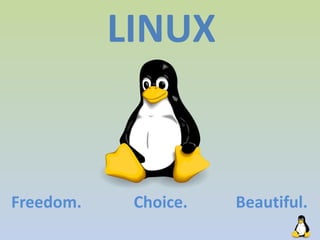
LINUX
Freedom. Choice. Beautiful.
What is Linux
An open-source operating system modelled on UNIX.
Linux is leading OS on Servers and other system such
as Mainframe Computers and Supercomputers.
The development of Linux is one of the most prominent example of
free and open software collaboration. The source code may be
used, modified, and distributed-commercially or non-
commercially-by anyone under GNU (general public license).
Future of Linux
Linux is already successful on many different kinds of devices,
but there are also many technological areas where Linux is
moving towards, even as desktop and server development
continues to grow faster than any other operating system
today.
Linux is being installed on the system BIOS of laptop and
notebook computers, which will enable users to turn their
devices on in a matter of seconds, bringing up a streamlined
Linux environment.
Overview
The Distributions - Distributions are maintained by private individuals and
commercial entities. For the users, most popular distributions offer mature
application management systems that allow users to search, find, and install
new applications with just a few clicks of the mouse.
Licensing - Code is contributed to the Linux kernel under a number of
licenses, but all code must be compatible with version 2 of the GNU General
Public License (GPLv2), which is the license covering the kernel distribution
as a whole.
Community - One of the most compelling features of Linux is that it is
accessible to developers; anybody with the requisite skills can improve
Linux and influence the direction of its development. Developer
communities can volunteer to maintain and support whole distributions,
such as the Debian or Gentoo Projects.
Development - Linux is an operating system that is comprised of many
different development languages. A very large percentage of the
distributions' code is written in either the C (52.86%) or C++ (25.56%)
languages.
Business of Linux
If Linux is free of cost, how does Linux company generate revenue?
In 2008, IDC analyst Al Gillen cited a nearly 24 percent annual growth rate
for the Linux industry, which puts a $21 billion 2007 technology at $49
billion in 2011. The companies involved in Linux include industry leaders
such as IBM, Fujitsu, Hewlett-Packard, Oracle, Intel, Hitachi, NEC, and
Novell. All have all invested time, talent, and resources to bettering Linux
on their own and through the Linux Foundation.
To avoid the timesink and the learning curve required to accomplish such a
task, users can simply pay a distribution maker for the convenience of not
having to build a free Linux from scratch. Businesses and individual users
benefit from the distributors' expertise in putting all of the free Linux code
into an easy-to-use set of packages.
Business of Linux
Business of Linux
Another source of revenue for companies is ongoing commercial support for
Linux. In fact, some distributions will allow users to download their software
free of charge and build their entire revenue model on a services and
support business plan.
Linux is a platform that can generate revenue, all while still being free.
Customers gain the knowledge that they are paying directly for support and
convenience, and will always have a choice of which Linux systems will work
for them best.
One example of how a Linux business works: while nearly all of a Linux
distribution's code is available for free download, the time and cost
involved in actually downloading all of that code and putting it together
in a cohesive and functional manner is significantly high.

Linux

  • 1.
  • 2.
    What is Linux Anopen-source operating system modelled on UNIX. Linux is leading OS on Servers and other system such as Mainframe Computers and Supercomputers. The development of Linux is one of the most prominent example of free and open software collaboration. The source code may be used, modified, and distributed-commercially or non- commercially-by anyone under GNU (general public license).
  • 3.
    Future of Linux Linuxis already successful on many different kinds of devices, but there are also many technological areas where Linux is moving towards, even as desktop and server development continues to grow faster than any other operating system today. Linux is being installed on the system BIOS of laptop and notebook computers, which will enable users to turn their devices on in a matter of seconds, bringing up a streamlined Linux environment.
  • 4.
    Overview The Distributions -Distributions are maintained by private individuals and commercial entities. For the users, most popular distributions offer mature application management systems that allow users to search, find, and install new applications with just a few clicks of the mouse. Licensing - Code is contributed to the Linux kernel under a number of licenses, but all code must be compatible with version 2 of the GNU General Public License (GPLv2), which is the license covering the kernel distribution as a whole. Community - One of the most compelling features of Linux is that it is accessible to developers; anybody with the requisite skills can improve Linux and influence the direction of its development. Developer communities can volunteer to maintain and support whole distributions, such as the Debian or Gentoo Projects. Development - Linux is an operating system that is comprised of many different development languages. A very large percentage of the distributions' code is written in either the C (52.86%) or C++ (25.56%) languages.
  • 5.
    Business of Linux IfLinux is free of cost, how does Linux company generate revenue?
  • 6.
    In 2008, IDCanalyst Al Gillen cited a nearly 24 percent annual growth rate for the Linux industry, which puts a $21 billion 2007 technology at $49 billion in 2011. The companies involved in Linux include industry leaders such as IBM, Fujitsu, Hewlett-Packard, Oracle, Intel, Hitachi, NEC, and Novell. All have all invested time, talent, and resources to bettering Linux on their own and through the Linux Foundation. To avoid the timesink and the learning curve required to accomplish such a task, users can simply pay a distribution maker for the convenience of not having to build a free Linux from scratch. Businesses and individual users benefit from the distributors' expertise in putting all of the free Linux code into an easy-to-use set of packages. Business of Linux
  • 7.
    Business of Linux Anothersource of revenue for companies is ongoing commercial support for Linux. In fact, some distributions will allow users to download their software free of charge and build their entire revenue model on a services and support business plan. Linux is a platform that can generate revenue, all while still being free. Customers gain the knowledge that they are paying directly for support and convenience, and will always have a choice of which Linux systems will work for them best. One example of how a Linux business works: while nearly all of a Linux distribution's code is available for free download, the time and cost involved in actually downloading all of that code and putting it together in a cohesive and functional manner is significantly high.