Great Britain Historical GIS Project:
A Vision of Britain though Time

Linking Spaces with Places:
Examples from the
PastPlace Project
Humphrey Southall
& Paula Aucott
(University of Portsmouth/
Great Britain Historical GIS)
Great Britain Historical GIS Project:
A Vision of Britain though Time

Structure of Presentation:
• Limitations of mainstream geospatial systems
– When applied to historical contexts and textual content

• Alternative more textual – geosemantic – methods
– Most people find out about places by searching using
placenames, not coordinates, and these days they use
search engines, so where do they end up?
– Looking online for information about ―Tallinn‖
– Exploring the Linked Data web, and Vision of Britain

• Introducing Pelagios and PastPlace
– Pelagios 3 is new project linking my team with the Pleiades
gazetteer of the ancient world, based at New York
University, and the China Historical GIS at Harvard
– PastPlace is a rebranding and extension of Vision of Britain
19th September 2013
Great Britain Historical GIS Project:
A Vision of Britain though Time

Mainstream geospatial systems
• ―Geographical Information Systems‖
– Raster GIS
• E.g. IDRISI, ERDAS Imagine
• Mainly for satellite data, etc,
so not discussed further

– Vector GIS
• E.g. ArcGIS, MapInfo
• Separate spatial data and attribute data
• Spatial data = points, lines and polygons

• Geospatial Database Management Systems
– Implemented as extensions to (object-)relational database
systems
• E.g. Oracle and Oracle Spatial, Postgres and PostGIS
• Geospatial databases can organise data as spatial+attributes,
but permit other approaches
19th September 2013
Great Britain Historical GIS Project:
A Vision of Britain though Time

Limitations of ArcGIS, etc
• Everything else exists as
attributes of points, lines or
polygons, so hard to work with
information about unknown or
uncertain locations
• Toponyms treated as ―labels‖,
and fiddly having more than
one per geospatial object
• ArcGIS data model works in
terms of layers or coverages,
which is fine for different kinds
of feature but a very bad way
of representing time
19th September 2013
Great Britain Historical GIS Project:
A Vision of Britain though Time

Gazetteer data standards
• ISO 19112, ‗Geographic information — Spatial
referencing by geographic identifiers‘
– Very general; e.g. does not require coordinates

• Open Geospatial Consortium: Web Feature Server
Gazetteer Service Profile (WFS(G))
– Is this still being actively developed?
– OGC now discussing a different approach, OpenPOI

• Alexandria Digital Library:
– Gazetteer Service Protocol
– Gazetteer Content Standard
www.alexandria.ucsb.edu/gazetteer/ContentStandard/version3.2/GCS3.2guide.htm

– Gazetteer Feature Type Thesaurus:
www.alexandria.ucsb.edu/~lhill/FeatureTypes/ver070302/index.htm
19th September 2013
Great Britain Historical GIS Project:
A Vision of Britain though Time

ADL Gazetteer Content Standard
• Standard allows for many optional elements, but four
compulsory elements:
• A unique identifier
– Usually a number

• A name
– May well be duplicated elsewhere
– Standard optionally allows for many additional variant names

• A footprint
– A point, line or polygon

• A feature type
– To achieve interoperability with other gazetteers via the
Gazetteer Service Protocol, the feature type must be taken
from the ADL Feature Type Thesaurus
19th September 2013
Great Britain Historical GIS Project:
A Vision of Britain though Time

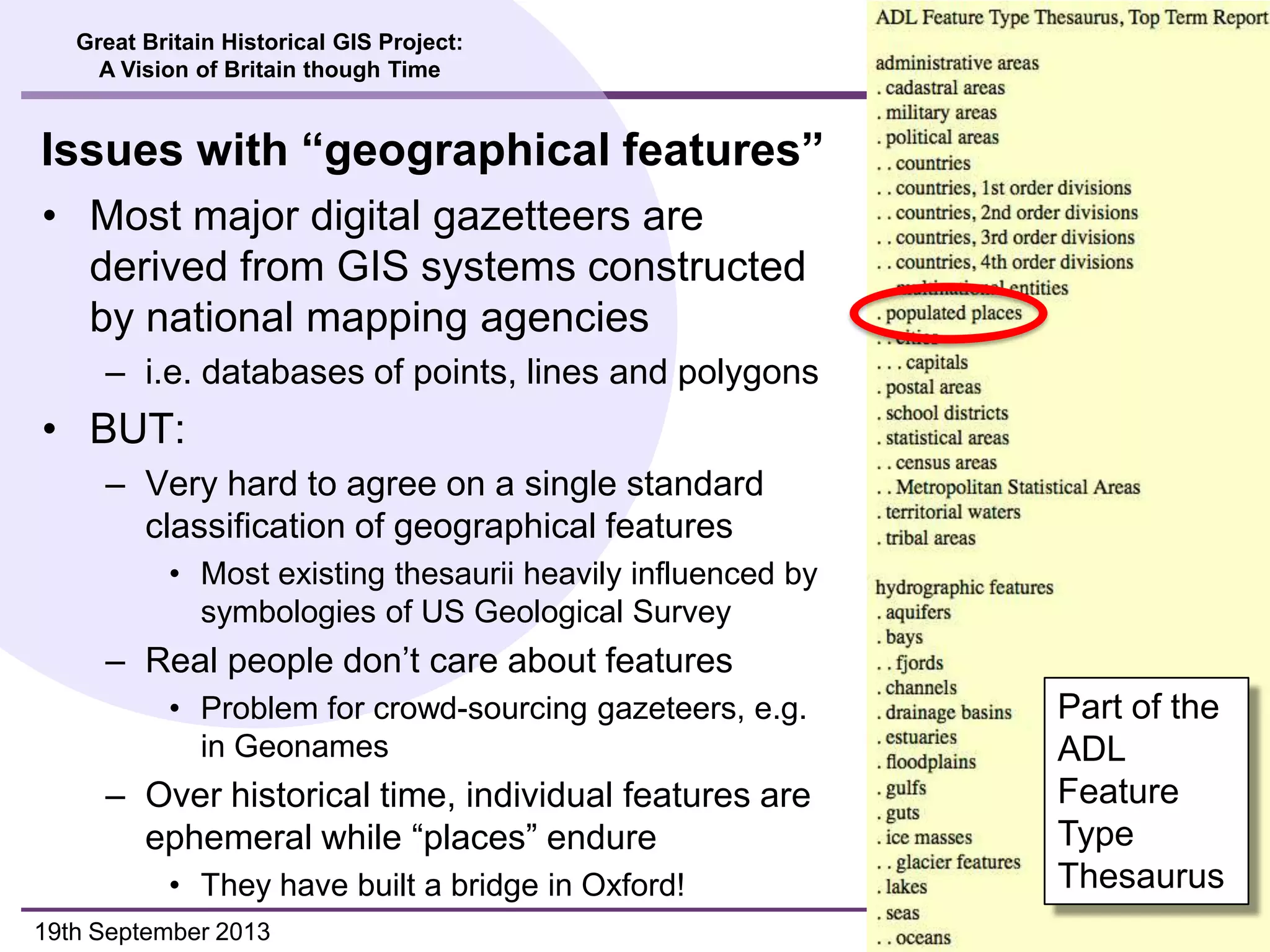
Issues with “geographical features”
• Most major digital gazetteers are
derived from GIS systems constructed
by national mapping agencies
– i.e. databases of points, lines and polygons

• BUT:
– Very hard to agree on a single standard
classification of geographical features
• Most existing thesaurii heavily influenced by
symbologies of US Geological Survey

– Real people don‘t care about features
• Problem for crowd-sourcing gazeteers, e.g.
in Geonames

– Over historical time, individual features are
ephemeral while ―places‖ endure
• They have built a bridge in Oxford!
19th September 2013

Part of the
ADL
Feature
Type
Thesaurus
Great Britain Historical GIS Project:
A Vision of Britain though Time

Feature typing may be “standard” but it is
not natural:

• CLUN, a river, a small town, a parish, a
sub-district, a district, and a hundred in
Salop. The river rises near the boundary with
Wales; and runs 11 miles eastward, and 7
southward, to the Teme, near Leintwardine. The town
stands on the river, 3 miles W of Offa's dyke, 5½
SSW of Bishops-Castle, and 6½ N by E of Knighton
r. station; is a polling-place, and a nominal borough,
…. (from Imperial Gazetteer of England and Wales,
1872)
• So how do we work with ―place information‖ in the
real world?
19th September 2013
Great Britain Historical GIS
Googlingoffor TallinnProject: most people find out about places
– how
A Vision
Britain though Time

19th September 2013
Great Britain Historical GIS Project:
A Vision of Britain though Time

Wikipedia for Tallinn: English language

19th September 2013
Great Britain Historical GIS Project:
A Vision of Britain though Time

Wikipedia for Tallinn: Estonian language

19th September 2013
Great Britain Historical GIS Project:
A Vision of Britain though Time

Wikipedia for Tallinn: Estonian language

How do we know the two
Tallinn articles are about
the same place?

19th September 2013
Great Britain Historical GIS Project:
A Vision of Britain though Time

Wikidata for Tallinn: web view
• Created partly to just link the different language versions

19th September 2013
Great Britain Historical GIS Project:
A Vision of Britain though Time

Wikidata for
Tallinn: RDF view
• Created partly to just link
the different language
versions

19th September 2013
Great Britain Historical GIS Project:
A Vision of Britain though Time

Geonames for Tallinn

19th September 2013
Great Britain Historical GIS Project:
A Vision of Britain though Time

Geonames for Tallinn

19th September 2013
Great Britain Historical GIS Project:
A Vision of Britain though Time

Geonames for Tallinn: RDF

19th September 2013
Great Britain Historical GIS Project:
A Vision of Britain though Time

Geonames for
Tallinn: RDF

19th September 2013
Great Britain Historical GIS Project:
A Vision of Britain though Time

Vision of Europe for Tallinn

19th September 2013
Great Britain Historical GIS Project:
A Vision of Britain though Time

Vision of Europe for Harjumaa

19th September 2013
Great Britain Historical
Scrolling down the GIS Project:
A Vision of Britain though Time
same page …

Vision of Europe for Harjumaa

19th September 2013
Great Britain Historical GIS Project:
A Vision of Britain though Time

Modelling the history of Estonia

19th September 2013
Great Britain Historical GIS Project:
A Vision of Britain though Time

Part of the AUO Typology

Thanks to Vojtech Kupca (Umea U.)
for these visualisations of the ontology
19th September 2013
Great Britain Historical GIS Project:
A Vision of Britain though Time

Part of the AUO Typology

Thanks to Vojtech Kupca (Umea U.)
for these visualisations of the ontology
19th September 2013

But why does a UK
researcher have all
this information about
Estonia?
Great Britain Historical GIS Project:
A Vision of Britain though Time

GBH GIS / Vision of Britain / QVIZ / PastPlace
• Original GB Historical GIS project: 1994-2000
– Built conventional ArcGIS-based system (OSGB coordinates)

• Vision of Britain Mark 1: 2001-4
– Funded by UK National Lottery; New architecture
– Support from UK archives crucial – needed authority list

• QVIZ project: 2006-8
– EU FP6; led by Umea; incl Estonian & Swedish Nat. Archives

• Vision of Britain Mark 2: 2007– Funded by JISC but used QVIZ infrastructure
– So covers all of Europe (ETRS-89), in varying detail

• PastPlace/Pelagios: 2013– Re-branding, global (WGS-84 coordinates)
– Major focus on exposing our information as Open Linked Data
19th September 2013
Great Britain Historical GIS Project:
A Vision of Britain though Time

Original Inspiration:
F. Youngs’ Local
Administrative Units
of England (Royal
Historical Society,
1979 and 1991)
We did not
―computerise‖ the
pages
Instead, we used
information from
Youngs, etc, to
build a new
database
But how? One of
most complex
books ever
19th September 2013
Great Britain Historical GIS Project:
A Vision of Britain though Time

Administrative Unit Ontology E-R Diagram
g_rel

g_legal_rel
PK,FK1

g_unit_type
g_rel_type
g_rel_unit_type
notes
created_by

g_seq

FK1

g_unit
g_rel_to
g_rel_type
g_part
g_part_area
g_part_area_measure
c_date_1
c_pop_1
c_hous_1
c_date_2
c_pop_2
c_hous_2
g_duration
im_auth
im_note
ul_auth
ul_note
created_by
notes
g_unit_type

FK2

g_unit_type
PK

g_unit_type

FK1
FK2

g_type_level
g_jurisdiction
g_type_period
g_duration
g_foot
stat_only
n_language
n_label
n_label_plural
n_description
n_full_description
n_label
n_label_plural
n_description
n_full_description
n_short_label
g_label
g_label_plural
g_description
g_full_description
g_short_label
notes
created_by
g_type_function

FK3

FK3

PK

FK1

g_language
g_label
g_description
g_full_description

19th September 2013

g_unit
g_foot
g_duration
im_auth
im_note
ul_auth
ul_note
use_for_search
use_for_stat_map
use_for_bound_map

FK1

g_rel_type

g_jurisdiction
g_label
preferred_language
email_address
notes
postal_address
telephone_number

g_status
g_unit_type
n_language
n_label
n_short_label
n_description
n_full_description
g_label
g_short_label
g_description
g_full_description
notes
created_by

g_language

FK2

PK

g_status_type

FK1

FK1

g_jurisdiction

g_auth_type
g_auth_title
g_auth_creator
g_auth_creator_forename
g_auth_publisher
g_auth_pub_place
g_auth_date
g_auth_identifier
url_works
g_auth_rights
g_auth_rights_string
g_auth_description
notes

PK

g_hint
g_unit_type
g_centroid
g_place
g_duration
im_auth
im_note
ul_auth
ul_note
created_by
notes

g_language
g_label
g_authority
g_language_iso
notes
g_jurisdiction

g_type_function
g_auth_type
PK

g_type_function_label
PK,FK1

g_name

g_auth_type
g_language

g_type_function

FK2

g_language
g_label
g_description
g_full_description

g_label

g_seq
g_unit
g_name
g_name_status
g_language
g_duration
im_auth
im_note
ul_auth
ul_note
created_by
notes

notes

notes

PK,FK1
PK,FK2

FK1

g_type_function

g_auth_type

g_auth_type_level

PK

PK

g_name_status

g_status
g_seq

FK1

FK2

g_authority

notes
created_by

g_unit

PK

g_type_level

PK

g_rel_type
PK

PK

g_adl_ft

PK,FK1

g_authority

g_seq

g_label
rev_label
created_by

PK

g_type_level

g_type_level_label

g_rel_type
g_language

PK
FK1

PK,FK1
PK,FK2

g_unit

g_type_level
PK

g_foot

g_rel_type_label

PK

g_unit
g_status
g_duration
im_auth
im_note
ul_auth
ul_note
created_by
notes

g_name_status
im_auth
sort_order

g_name_status_label
PK,FK1

g_name_status

FK2

g_language
g_label

FK2

g_place
PK

g_place
g_seed
g_name
g_container
g_centroid
created_by

27
Great Britain Historical GIS Project:
A Vision of Britain though Time

Frequency of different languages for place
names in Vision of Britain/PastPlace
English
Swedish
Estonian
German
Welsh

French
Italian
Turkish
Other
0
19th September 2013

20,000

40,000

60,000

80,000 100,000 120,000 140,000 160,000
Great Britain Historical GIS Project:
A Vision of Britain though Time

“Places” and Units in the PastPlace data model
• Places are ―above‖
units because units
are named after
places
• There is only one
―names‖ table
• Currently 22,371
places versus 81,886
units; 26,520 units not
assigned to places,
but only 5,492 of these
in Britain, while 2,944
places have no units
19th September 2013
Great Britain Historical GIS Project:
A Vision of Britain though Time

Place
names for
Chester-leStreet

19th September 2013
Great Britain Historical GIS Project:
A Vision of Britain though Time

Source of first ranked results from searching
google.co.uk for “history of <name>“ for all
Herefordshire ancient parishes
• Domination of
placename search
results by
Wikipedia is not
inevitable!
• Surprising how
little interest most
academic and
heritage sector
projects have in
good results in
search engines
• FINDABILITY

120

100

80

No. of parishes (N=188)
60

40

20

0
Wikipedia

19th September 2013

Vision of Britain

Other noncommercial

Commercial
Great Britain Historical GIS Project:
A Vision of Britain though Time

Tallinn in PastPlace RDF

19th September 2013
Great Britain Historical
Open Linked GIS Project:
A Vision of Britain though Time
Data as a lingua
franca for the
(semantic) web

•

Gazetteers
act as hubs:
–
–
–

–

•

Wikipedia
Geonames
Open
Street Map
OS Linked
Data

NB diagram
has not been
updated
since
September
2011 as
became too
big

19th September 2013
Great Britain Historical GIS Project:
A Vision of Britain though Time

Pelagios 3: Early Geospatial
Documents
• 2 year project Sep 2013-Aug 2015
– funded by Mellon Foundation

• Principal Investigators:
• Leif Isaksen (Southampton Univ, UK)
• Elton Barker (Open Univ, UK)
• Rainer Simon (Austrian Inst of Tech)

• Plus many partners:
•
•
•
•
•
•
•
•

British Library: Kimberly Kowal
Drew Univ Shannon Bradshaw, Martin Foys
Harvard Univ: Lex Merrick Berman
Indep: Johan Åhlfeldt, Tony Campbell, Mia Ridge
New York Univ: Tom Elliott, Sean Gillies
Queen Mary, London Univ: Yossef Rapoport
Edinburgh Univ: Kate Byrne
Portsmouth Univ: Humphrey Southall

19th September 2013
Great Britain Historical GIS Project:
A Vision of Britain though Time

Pelagios 3: Project and rationale
• Project will annotate, link and index place references
in digitized Early Geospatial Documents (EGDs)
• EGDs are documents that use written or visual
representation to describe geographic space prior to
the European discovery of the Americas in 1492
– This event both radically transformed beliefs about the
globe, and triggered the development of several
standardising global cartographic conventions, including the
Werner, Bonne and Mercator projections

• EGDs include ancient and medieval geographic
descriptions (geographiae and chorographiae and
itineraries) world maps (mappaemundi) and portolan
charts
19th September 2013
Great Britain Historical GIS Project:
A Vision of Britain though Time

Pelagios Data Model for Annotations
• Linking related resources via Open Annotations
• Six items of information form an annotation:
1. Target. A segment of the text or image identified as a place
reference, expressed as a URI
•

Target URIs will be additionally annotated with relevant document
metadata where known, including the author, date-range,
provenance, language.

2. Toponym: the string of characters used by the author to identify
a place
3. Place Identifier: linking the place to a URI based gazetteer
4. Source: of the identification between toponym and place
5. Annotator: The person who produced the annotation.
6. Confidence: a traffic light scheme: probable, possible, or
unknown
19th September 2013
Great Britain Historical GIS Project:
A Vision of Britain though Time

Gazetteer Infrastructure
• Pelagios aims to create a ―Gazetteer ecosystem‖:
– URI-based gazetteers that are specific to a spatial, temporal
or cultural milieu and maintained and curated by their
respective research communities, but aligned through the
principles of Linked Data and a common, overarching
referencing framework

• Two key challenges in creating such an ecosystem:
– A common, generic gazetteer data model needs to be
identified which suits the needs of the different individual
stakeholders involved
• All gazetteers in this ecosystem will be primarily of ―places‖, not
geographical features

– Referencing frameworks need to be agreed, through which
different gazetteers can cross-link to each other
19th September 2013
Great Britain Historical GIS Project:
A Vision of Britain though Time

Participating Gazetteers
• Project will re-use, and contribute to, three
existing gazetteer platforms:
– Pleiades (Institute for the Study of the Ancient World, NYU)

– PastPlace/Vision of Britain (GBHGIS, University of Portsmouth)
– China Historical GIS (CGA, Harvard)

• All three gazetteers are more about ―places‖ than
geographical features
• Pleiades+CHGIS mature: few new places needed
• PastPlace ―will be significantly augmented with
contemporary and historic settlements extracted
from open gazetteer services‖, beyond UK
– Decided last week this would be based on Wikidata
19th September 2013
Great Britain Historical GIS Project:
A Vision of Britain though Time

Pelagios 3 Content Work Packages
No Name

Example EGDs

Gazetteer

1

Latin Tradition

Antonine Itineraries, Ravenna Cosmography,
Bordeaux Itinerary, Natural History (Pliny)

Pleiades

2

Greek
Tradition

Geography (Strabo), Armenian Geography, Suda,
Manual of Geography (Ptolemy)

Pleiades

3

Early
Christian
Tradition

Gough Map; Description of the World (Marco
Polo), Fra Mauro Map, De Virga world map,
Vesconte World Map, approx. 320 sundry
EGDs from the British Library

PastPlace

4

Early Maritime Trad.

Le Liber (portolano), Lo Compasso
(portolano), c. 180 Portolan charts

PastPlace

5

Early Islamic
Tradition

Image of the Earth (Al Khwarizmi), al-Kashgari
World Map, Tabula Rogeriana (al- Idrisi) Book
of Curiosities, Maps of the Balkhi School

PastPlace

6

Early Chinese
Tradition

Yujitu (‗Map of the Tracks of Yu‘), Songhuiyao,
Chinese Buddhist Temple Gazetteers, ‗Record of
Buddhistic Kingdoms‘

CHGIS

19th September 2013
Great Britain Historical GIS Project:
A Vision of Britain though Time

Pelagios WP3: Early Christian Tradition
• Maps and geographic texts from
medieval ‗Christendom‘
• Mixture of maps and texts e.g.:
• Mappaemundi and T-O maps
• Gough Map
• Description of the World (Polo)
• Vesconte World Map
• Past Place gazetteer
• May work back from modern
translations using Edinburgh
geoparser using tools developed
by DM project and use toponym
detection

19th September 2013
Great Britain Historical GIS Project:
A Vision of Britain though Time

Pelagios WP4:Early Maritime Tradition
• Portolanos (texts) and
portolan charts
• Approximately 180 maps
available from work of
Ramon Pujades (2007)
• Past Place gazetteer
• Use toponym detection and
gazetteer and identification
work and gazetteers of Tony
Campbell and Ramon
Pujades

19th September 2013
Great Britain Historical GIS Project:
A Vision of Britain though Time

Pelagios WP5:Early IslamicTradition
• Maps, texts and gazetteers in
Arabic up to approx. 1492.
• Maps and texts e.g.
• Al-Khwarizmi
• Book of Curiosities
• Balkhi School
• Tabula Rogeriana
• Past Place gazetteer +
Pleiades
• Use toponym detection and
gazetteer and identification
work of Yossi Rapoport, Emily
Savage-Smith, Kennedy &
Kennedy and others
19th September 2013
Great Britain Historical GIS Project:
A Vision of Britain though Time

Geo-semantic methods are inferior to Geo-spatial …
• You can derive that B is in A, or
C is near B, from the map, but you
cannot derive the map from the text

… except when
• We are working with the past
– Textual descriptions are often all we have
– Old maps are very inaccurate

• We are working with the web
– The web is a textual structure linked by explicit relationships

• We are working with people
– People think about geography through named places not
coordinates defining spaces
• NB Vision of Britain/PastPlace has plenty of geospatial functionality
19th September 2013
Great Britain Historical GIS Project:
A Vision of Britain though Time

Web sites, etc
• Vision of Britain:
www.VisionOfBritain.org.uk

• Great Britain Historical GIS:
www.gbhgis.org
www.port.ac.uk/research/gbhgis

• PastPlace (very preliminary site!):
http://www.pastplace.org

• Pelagios project
http://pelagios-project.blogspot.co.uk

• Contact us:
gbhgis@port.ac.uk

19th September 2013
Great Britain Historical GIS Project:
A Vision of Britain though Time

19th September 2013
Great Britain Historical GIS Project:
A Vision of Britain though Time

19th September 2013
Great Britain Historical GIS Project:
A Vision of Britain though Time

19th September 2013
Great Britain Historical GIS Project:
A Vision of Britain though Time

Count of number of names per language
LANGUAGE

NUMBER OF NAMES

ENGLISH

62603

SWEDISH

7507

ESTONIAN

11973

GERMAN

5032

WELSH

1069

FRENCH

61

GREEK

3

ITALIAN

3

RUSSIAN

2

TURKISH

2

OTHER LANGUAGES WITH 1 NAME EACH

19th September 2013

26
Great Britain Historical GIS Project:
A Vision of Britain though Time

Unit relationships
• All held in single
table, allowing many-tomany relationships
• Current system has
81,886 units but 260,602
relationships
• Have dates,
g_unit
http://www.icpsr.
authorities, etc
umich.edu/DDI/

g_name

•
•
•
•

IsPartOf
SucceededBy (‗see also‘)
AdministeredBy
Boundary Changes
–
–
–
–
–

ReducedToEnlarge
ReducedToCreate
AbolishedToEnlarge
AbolishedToCreate
BoundaryChange (other
unit unknown)

g_rel_type
http://www.icpsr.
umich.edu/DDI/

g_rel

http://www.icpsr.

http://www.icpsr.

umich.edu/DDI/
19th September 2013

g_status

umich.edu/DDI/
Great Britain Historical GIS Project:
A Vision of Britain though Time

Example of unit with many names

• Newborough, Anglesey parish
19th September 2013

Linking Spaces with Places: Examples from the PastPlace Project

  • 1.
    Great Britain HistoricalGIS Project: A Vision of Britain though Time Linking Spaces with Places: Examples from the PastPlace Project Humphrey Southall & Paula Aucott (University of Portsmouth/ Great Britain Historical GIS)
  • 2.
    Great Britain HistoricalGIS Project: A Vision of Britain though Time Structure of Presentation: • Limitations of mainstream geospatial systems – When applied to historical contexts and textual content • Alternative more textual – geosemantic – methods – Most people find out about places by searching using placenames, not coordinates, and these days they use search engines, so where do they end up? – Looking online for information about ―Tallinn‖ – Exploring the Linked Data web, and Vision of Britain • Introducing Pelagios and PastPlace – Pelagios 3 is new project linking my team with the Pleiades gazetteer of the ancient world, based at New York University, and the China Historical GIS at Harvard – PastPlace is a rebranding and extension of Vision of Britain 19th September 2013
  • 3.
    Great Britain HistoricalGIS Project: A Vision of Britain though Time Mainstream geospatial systems • ―Geographical Information Systems‖ – Raster GIS • E.g. IDRISI, ERDAS Imagine • Mainly for satellite data, etc, so not discussed further – Vector GIS • E.g. ArcGIS, MapInfo • Separate spatial data and attribute data • Spatial data = points, lines and polygons • Geospatial Database Management Systems – Implemented as extensions to (object-)relational database systems • E.g. Oracle and Oracle Spatial, Postgres and PostGIS • Geospatial databases can organise data as spatial+attributes, but permit other approaches 19th September 2013
  • 4.
    Great Britain HistoricalGIS Project: A Vision of Britain though Time Limitations of ArcGIS, etc • Everything else exists as attributes of points, lines or polygons, so hard to work with information about unknown or uncertain locations • Toponyms treated as ―labels‖, and fiddly having more than one per geospatial object • ArcGIS data model works in terms of layers or coverages, which is fine for different kinds of feature but a very bad way of representing time 19th September 2013
  • 5.
    Great Britain HistoricalGIS Project: A Vision of Britain though Time Gazetteer data standards • ISO 19112, ‗Geographic information — Spatial referencing by geographic identifiers‘ – Very general; e.g. does not require coordinates • Open Geospatial Consortium: Web Feature Server Gazetteer Service Profile (WFS(G)) – Is this still being actively developed? – OGC now discussing a different approach, OpenPOI • Alexandria Digital Library: – Gazetteer Service Protocol – Gazetteer Content Standard www.alexandria.ucsb.edu/gazetteer/ContentStandard/version3.2/GCS3.2guide.htm – Gazetteer Feature Type Thesaurus: www.alexandria.ucsb.edu/~lhill/FeatureTypes/ver070302/index.htm 19th September 2013
  • 6.
    Great Britain HistoricalGIS Project: A Vision of Britain though Time ADL Gazetteer Content Standard • Standard allows for many optional elements, but four compulsory elements: • A unique identifier – Usually a number • A name – May well be duplicated elsewhere – Standard optionally allows for many additional variant names • A footprint – A point, line or polygon • A feature type – To achieve interoperability with other gazetteers via the Gazetteer Service Protocol, the feature type must be taken from the ADL Feature Type Thesaurus 19th September 2013
  • 7.
    Great Britain HistoricalGIS Project: A Vision of Britain though Time Issues with “geographical features” • Most major digital gazetteers are derived from GIS systems constructed by national mapping agencies – i.e. databases of points, lines and polygons • BUT: – Very hard to agree on a single standard classification of geographical features • Most existing thesaurii heavily influenced by symbologies of US Geological Survey – Real people don‘t care about features • Problem for crowd-sourcing gazeteers, e.g. in Geonames – Over historical time, individual features are ephemeral while ―places‖ endure • They have built a bridge in Oxford! 19th September 2013 Part of the ADL Feature Type Thesaurus
  • 8.
    Great Britain HistoricalGIS Project: A Vision of Britain though Time Feature typing may be “standard” but it is not natural: • CLUN, a river, a small town, a parish, a sub-district, a district, and a hundred in Salop. The river rises near the boundary with Wales; and runs 11 miles eastward, and 7 southward, to the Teme, near Leintwardine. The town stands on the river, 3 miles W of Offa's dyke, 5½ SSW of Bishops-Castle, and 6½ N by E of Knighton r. station; is a polling-place, and a nominal borough, …. (from Imperial Gazetteer of England and Wales, 1872) • So how do we work with ―place information‖ in the real world? 19th September 2013
  • 9.
    Great Britain HistoricalGIS Googlingoffor TallinnProject: most people find out about places – how A Vision Britain though Time 19th September 2013
  • 10.
    Great Britain HistoricalGIS Project: A Vision of Britain though Time Wikipedia for Tallinn: English language 19th September 2013
  • 11.
    Great Britain HistoricalGIS Project: A Vision of Britain though Time Wikipedia for Tallinn: Estonian language 19th September 2013
  • 12.
    Great Britain HistoricalGIS Project: A Vision of Britain though Time Wikipedia for Tallinn: Estonian language How do we know the two Tallinn articles are about the same place? 19th September 2013
  • 13.
    Great Britain HistoricalGIS Project: A Vision of Britain though Time Wikidata for Tallinn: web view • Created partly to just link the different language versions 19th September 2013
  • 14.
    Great Britain HistoricalGIS Project: A Vision of Britain though Time Wikidata for Tallinn: RDF view • Created partly to just link the different language versions 19th September 2013
  • 15.
    Great Britain HistoricalGIS Project: A Vision of Britain though Time Geonames for Tallinn 19th September 2013
  • 16.
    Great Britain HistoricalGIS Project: A Vision of Britain though Time Geonames for Tallinn 19th September 2013
  • 17.
    Great Britain HistoricalGIS Project: A Vision of Britain though Time Geonames for Tallinn: RDF 19th September 2013
  • 18.
    Great Britain HistoricalGIS Project: A Vision of Britain though Time Geonames for Tallinn: RDF 19th September 2013
  • 19.
    Great Britain HistoricalGIS Project: A Vision of Britain though Time Vision of Europe for Tallinn 19th September 2013
  • 20.
    Great Britain HistoricalGIS Project: A Vision of Britain though Time Vision of Europe for Harjumaa 19th September 2013
  • 21.
    Great Britain Historical Scrollingdown the GIS Project: A Vision of Britain though Time same page … Vision of Europe for Harjumaa 19th September 2013
  • 22.
    Great Britain HistoricalGIS Project: A Vision of Britain though Time Modelling the history of Estonia 19th September 2013
  • 23.
    Great Britain HistoricalGIS Project: A Vision of Britain though Time Part of the AUO Typology Thanks to Vojtech Kupca (Umea U.) for these visualisations of the ontology 19th September 2013
  • 24.
    Great Britain HistoricalGIS Project: A Vision of Britain though Time Part of the AUO Typology Thanks to Vojtech Kupca (Umea U.) for these visualisations of the ontology 19th September 2013 But why does a UK researcher have all this information about Estonia?
  • 25.
    Great Britain HistoricalGIS Project: A Vision of Britain though Time GBH GIS / Vision of Britain / QVIZ / PastPlace • Original GB Historical GIS project: 1994-2000 – Built conventional ArcGIS-based system (OSGB coordinates) • Vision of Britain Mark 1: 2001-4 – Funded by UK National Lottery; New architecture – Support from UK archives crucial – needed authority list • QVIZ project: 2006-8 – EU FP6; led by Umea; incl Estonian & Swedish Nat. Archives • Vision of Britain Mark 2: 2007– Funded by JISC but used QVIZ infrastructure – So covers all of Europe (ETRS-89), in varying detail • PastPlace/Pelagios: 2013– Re-branding, global (WGS-84 coordinates) – Major focus on exposing our information as Open Linked Data 19th September 2013
  • 26.
    Great Britain HistoricalGIS Project: A Vision of Britain though Time Original Inspiration: F. Youngs’ Local Administrative Units of England (Royal Historical Society, 1979 and 1991) We did not ―computerise‖ the pages Instead, we used information from Youngs, etc, to build a new database But how? One of most complex books ever 19th September 2013
  • 27.
    Great Britain HistoricalGIS Project: A Vision of Britain though Time Administrative Unit Ontology E-R Diagram g_rel g_legal_rel PK,FK1 g_unit_type g_rel_type g_rel_unit_type notes created_by g_seq FK1 g_unit g_rel_to g_rel_type g_part g_part_area g_part_area_measure c_date_1 c_pop_1 c_hous_1 c_date_2 c_pop_2 c_hous_2 g_duration im_auth im_note ul_auth ul_note created_by notes g_unit_type FK2 g_unit_type PK g_unit_type FK1 FK2 g_type_level g_jurisdiction g_type_period g_duration g_foot stat_only n_language n_label n_label_plural n_description n_full_description n_label n_label_plural n_description n_full_description n_short_label g_label g_label_plural g_description g_full_description g_short_label notes created_by g_type_function FK3 FK3 PK FK1 g_language g_label g_description g_full_description 19th September 2013 g_unit g_foot g_duration im_auth im_note ul_auth ul_note use_for_search use_for_stat_map use_for_bound_map FK1 g_rel_type g_jurisdiction g_label preferred_language email_address notes postal_address telephone_number g_status g_unit_type n_language n_label n_short_label n_description n_full_description g_label g_short_label g_description g_full_description notes created_by g_language FK2 PK g_status_type FK1 FK1 g_jurisdiction g_auth_type g_auth_title g_auth_creator g_auth_creator_forename g_auth_publisher g_auth_pub_place g_auth_date g_auth_identifier url_works g_auth_rights g_auth_rights_string g_auth_description notes PK g_hint g_unit_type g_centroid g_place g_duration im_auth im_note ul_auth ul_note created_by notes g_language g_label g_authority g_language_iso notes g_jurisdiction g_type_function g_auth_type PK g_type_function_label PK,FK1 g_name g_auth_type g_language g_type_function FK2 g_language g_label g_description g_full_description g_label g_seq g_unit g_name g_name_status g_language g_duration im_auth im_note ul_auth ul_note created_by notes notes notes PK,FK1 PK,FK2 FK1 g_type_function g_auth_type g_auth_type_level PK PK g_name_status g_status g_seq FK1 FK2 g_authority notes created_by g_unit PK g_type_level PK g_rel_type PK PK g_adl_ft PK,FK1 g_authority g_seq g_label rev_label created_by PK g_type_level g_type_level_label g_rel_type g_language PK FK1 PK,FK1 PK,FK2 g_unit g_type_level PK g_foot g_rel_type_label PK g_unit g_status g_duration im_auth im_note ul_auth ul_note created_by notes g_name_status im_auth sort_order g_name_status_label PK,FK1 g_name_status FK2 g_language g_label FK2 g_place PK g_place g_seed g_name g_container g_centroid created_by 27
  • 28.
    Great Britain HistoricalGIS Project: A Vision of Britain though Time Frequency of different languages for place names in Vision of Britain/PastPlace English Swedish Estonian German Welsh French Italian Turkish Other 0 19th September 2013 20,000 40,000 60,000 80,000 100,000 120,000 140,000 160,000
  • 29.
    Great Britain HistoricalGIS Project: A Vision of Britain though Time “Places” and Units in the PastPlace data model • Places are ―above‖ units because units are named after places • There is only one ―names‖ table • Currently 22,371 places versus 81,886 units; 26,520 units not assigned to places, but only 5,492 of these in Britain, while 2,944 places have no units 19th September 2013
  • 30.
    Great Britain HistoricalGIS Project: A Vision of Britain though Time Place names for Chester-leStreet 19th September 2013
  • 31.
    Great Britain HistoricalGIS Project: A Vision of Britain though Time Source of first ranked results from searching google.co.uk for “history of <name>“ for all Herefordshire ancient parishes • Domination of placename search results by Wikipedia is not inevitable! • Surprising how little interest most academic and heritage sector projects have in good results in search engines • FINDABILITY 120 100 80 No. of parishes (N=188) 60 40 20 0 Wikipedia 19th September 2013 Vision of Britain Other noncommercial Commercial
  • 32.
    Great Britain HistoricalGIS Project: A Vision of Britain though Time Tallinn in PastPlace RDF 19th September 2013
  • 33.
    Great Britain Historical OpenLinked GIS Project: A Vision of Britain though Time Data as a lingua franca for the (semantic) web • Gazetteers act as hubs: – – – – • Wikipedia Geonames Open Street Map OS Linked Data NB diagram has not been updated since September 2011 as became too big 19th September 2013
  • 34.
    Great Britain HistoricalGIS Project: A Vision of Britain though Time Pelagios 3: Early Geospatial Documents • 2 year project Sep 2013-Aug 2015 – funded by Mellon Foundation • Principal Investigators: • Leif Isaksen (Southampton Univ, UK) • Elton Barker (Open Univ, UK) • Rainer Simon (Austrian Inst of Tech) • Plus many partners: • • • • • • • • British Library: Kimberly Kowal Drew Univ Shannon Bradshaw, Martin Foys Harvard Univ: Lex Merrick Berman Indep: Johan Åhlfeldt, Tony Campbell, Mia Ridge New York Univ: Tom Elliott, Sean Gillies Queen Mary, London Univ: Yossef Rapoport Edinburgh Univ: Kate Byrne Portsmouth Univ: Humphrey Southall 19th September 2013
  • 35.
    Great Britain HistoricalGIS Project: A Vision of Britain though Time Pelagios 3: Project and rationale • Project will annotate, link and index place references in digitized Early Geospatial Documents (EGDs) • EGDs are documents that use written or visual representation to describe geographic space prior to the European discovery of the Americas in 1492 – This event both radically transformed beliefs about the globe, and triggered the development of several standardising global cartographic conventions, including the Werner, Bonne and Mercator projections • EGDs include ancient and medieval geographic descriptions (geographiae and chorographiae and itineraries) world maps (mappaemundi) and portolan charts 19th September 2013
  • 36.
    Great Britain HistoricalGIS Project: A Vision of Britain though Time Pelagios Data Model for Annotations • Linking related resources via Open Annotations • Six items of information form an annotation: 1. Target. A segment of the text or image identified as a place reference, expressed as a URI • Target URIs will be additionally annotated with relevant document metadata where known, including the author, date-range, provenance, language. 2. Toponym: the string of characters used by the author to identify a place 3. Place Identifier: linking the place to a URI based gazetteer 4. Source: of the identification between toponym and place 5. Annotator: The person who produced the annotation. 6. Confidence: a traffic light scheme: probable, possible, or unknown 19th September 2013
  • 37.
    Great Britain HistoricalGIS Project: A Vision of Britain though Time Gazetteer Infrastructure • Pelagios aims to create a ―Gazetteer ecosystem‖: – URI-based gazetteers that are specific to a spatial, temporal or cultural milieu and maintained and curated by their respective research communities, but aligned through the principles of Linked Data and a common, overarching referencing framework • Two key challenges in creating such an ecosystem: – A common, generic gazetteer data model needs to be identified which suits the needs of the different individual stakeholders involved • All gazetteers in this ecosystem will be primarily of ―places‖, not geographical features – Referencing frameworks need to be agreed, through which different gazetteers can cross-link to each other 19th September 2013
  • 38.
    Great Britain HistoricalGIS Project: A Vision of Britain though Time Participating Gazetteers • Project will re-use, and contribute to, three existing gazetteer platforms: – Pleiades (Institute for the Study of the Ancient World, NYU) – PastPlace/Vision of Britain (GBHGIS, University of Portsmouth) – China Historical GIS (CGA, Harvard) • All three gazetteers are more about ―places‖ than geographical features • Pleiades+CHGIS mature: few new places needed • PastPlace ―will be significantly augmented with contemporary and historic settlements extracted from open gazetteer services‖, beyond UK – Decided last week this would be based on Wikidata 19th September 2013
  • 39.
    Great Britain HistoricalGIS Project: A Vision of Britain though Time Pelagios 3 Content Work Packages No Name Example EGDs Gazetteer 1 Latin Tradition Antonine Itineraries, Ravenna Cosmography, Bordeaux Itinerary, Natural History (Pliny) Pleiades 2 Greek Tradition Geography (Strabo), Armenian Geography, Suda, Manual of Geography (Ptolemy) Pleiades 3 Early Christian Tradition Gough Map; Description of the World (Marco Polo), Fra Mauro Map, De Virga world map, Vesconte World Map, approx. 320 sundry EGDs from the British Library PastPlace 4 Early Maritime Trad. Le Liber (portolano), Lo Compasso (portolano), c. 180 Portolan charts PastPlace 5 Early Islamic Tradition Image of the Earth (Al Khwarizmi), al-Kashgari World Map, Tabula Rogeriana (al- Idrisi) Book of Curiosities, Maps of the Balkhi School PastPlace 6 Early Chinese Tradition Yujitu (‗Map of the Tracks of Yu‘), Songhuiyao, Chinese Buddhist Temple Gazetteers, ‗Record of Buddhistic Kingdoms‘ CHGIS 19th September 2013
  • 40.
    Great Britain HistoricalGIS Project: A Vision of Britain though Time Pelagios WP3: Early Christian Tradition • Maps and geographic texts from medieval ‗Christendom‘ • Mixture of maps and texts e.g.: • Mappaemundi and T-O maps • Gough Map • Description of the World (Polo) • Vesconte World Map • Past Place gazetteer • May work back from modern translations using Edinburgh geoparser using tools developed by DM project and use toponym detection 19th September 2013
  • 41.
    Great Britain HistoricalGIS Project: A Vision of Britain though Time Pelagios WP4:Early Maritime Tradition • Portolanos (texts) and portolan charts • Approximately 180 maps available from work of Ramon Pujades (2007) • Past Place gazetteer • Use toponym detection and gazetteer and identification work and gazetteers of Tony Campbell and Ramon Pujades 19th September 2013
  • 42.
    Great Britain HistoricalGIS Project: A Vision of Britain though Time Pelagios WP5:Early IslamicTradition • Maps, texts and gazetteers in Arabic up to approx. 1492. • Maps and texts e.g. • Al-Khwarizmi • Book of Curiosities • Balkhi School • Tabula Rogeriana • Past Place gazetteer + Pleiades • Use toponym detection and gazetteer and identification work of Yossi Rapoport, Emily Savage-Smith, Kennedy & Kennedy and others 19th September 2013
  • 43.
    Great Britain HistoricalGIS Project: A Vision of Britain though Time Geo-semantic methods are inferior to Geo-spatial … • You can derive that B is in A, or C is near B, from the map, but you cannot derive the map from the text … except when • We are working with the past – Textual descriptions are often all we have – Old maps are very inaccurate • We are working with the web – The web is a textual structure linked by explicit relationships • We are working with people – People think about geography through named places not coordinates defining spaces • NB Vision of Britain/PastPlace has plenty of geospatial functionality 19th September 2013
  • 44.
    Great Britain HistoricalGIS Project: A Vision of Britain though Time Web sites, etc • Vision of Britain: www.VisionOfBritain.org.uk • Great Britain Historical GIS: www.gbhgis.org www.port.ac.uk/research/gbhgis • PastPlace (very preliminary site!): http://www.pastplace.org • Pelagios project http://pelagios-project.blogspot.co.uk • Contact us: gbhgis@port.ac.uk 19th September 2013
  • 45.
    Great Britain HistoricalGIS Project: A Vision of Britain though Time 19th September 2013
  • 46.
    Great Britain HistoricalGIS Project: A Vision of Britain though Time 19th September 2013
  • 47.
    Great Britain HistoricalGIS Project: A Vision of Britain though Time 19th September 2013
  • 48.
    Great Britain HistoricalGIS Project: A Vision of Britain though Time Count of number of names per language LANGUAGE NUMBER OF NAMES ENGLISH 62603 SWEDISH 7507 ESTONIAN 11973 GERMAN 5032 WELSH 1069 FRENCH 61 GREEK 3 ITALIAN 3 RUSSIAN 2 TURKISH 2 OTHER LANGUAGES WITH 1 NAME EACH 19th September 2013 26
  • 49.
    Great Britain HistoricalGIS Project: A Vision of Britain though Time Unit relationships • All held in single table, allowing many-tomany relationships • Current system has 81,886 units but 260,602 relationships • Have dates, g_unit http://www.icpsr. authorities, etc umich.edu/DDI/ g_name • • • • IsPartOf SucceededBy (‗see also‘) AdministeredBy Boundary Changes – – – – – ReducedToEnlarge ReducedToCreate AbolishedToEnlarge AbolishedToCreate BoundaryChange (other unit unknown) g_rel_type http://www.icpsr. umich.edu/DDI/ g_rel http://www.icpsr. http://www.icpsr. umich.edu/DDI/ 19th September 2013 g_status umich.edu/DDI/
  • 50.
    Great Britain HistoricalGIS Project: A Vision of Britain though Time Example of unit with many names • Newborough, Anglesey parish 19th September 2013