THE TYPES OF
ORGANIZATION
CHAPTER 7
Classification of government institutions based on the
following categories:
1. Those that perform purely governmental service functions,
-such as the Department of Public Works and Highways, Postal
Services Office, LGU etc.
2. Those that are organized for business,
-such as the Development Bank of the Philippines, the Philippine
National Railways, PAGCOR etc
3. Those that are organized to dispense justice,
-such as the Supreme Court, the Department of Justice; etc.
4. Those that are organized on a quasi-judicial basis which
exercise administrative as well as judicial functions,
-such as the Securities and Exchange Commission, LTFRB, CSC
COMELEC,, etc
Definition:
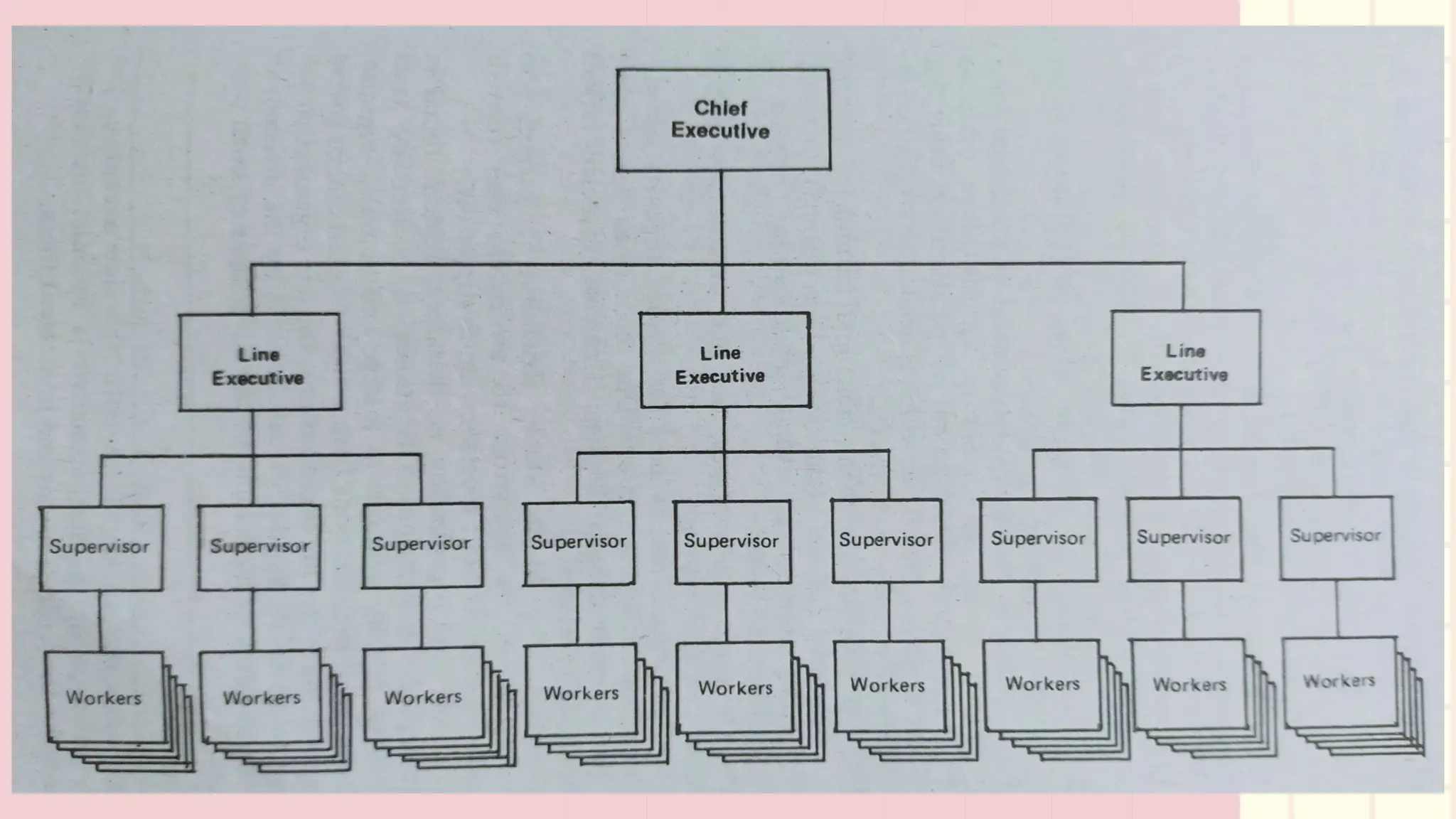
• Line Organization is the
simplest and oldest
form organization
structure where
authority is delegated
directly from top to
bottom.
• In a chart, this is shown
by an unbroken line.
LINE
ORGANIZATION
CHARACTERISTICS
Authority is delegated directly in a continuo
us line.
No separate staff executives; line executives
perform both line and staff functions.
Each executive exercises line authority over
subordinates.
Individuals on the same level are independe
nt
of each other and report only to their
immediate superior.
ADVANTAGES
Simplicity: Clear lines of responsibility,
authority, and accountability.
.
1
2 Decision-
Making: Facilitates prompt decision-
making due to its straightforward structur
e.
ADVANTAGES
Discipline and Control: Clear chain of
command aids in discipline and control.
3
4 Flexibility: Adapts to changing conditions
and demands.
DISADVANTAGES
Administrative Load: Can lead to an excessi
ve load of administrative responsibility.
1
2 Centralization: Encourages centralization o
f
Control, lengthening the chain of comman
d.
DISADVANTAGES
Lack of Specialization: Prevents developmen
t
of specialization beyond basic line function
s.
3
4 Recruitment Challenges: Difficulty in recruiti
ng multi-skilled personnel.
Best Use Case:
 Ideal for small organizations with stable management a
nd operations.
 Due to size, it can avoid inherent defects and is cost-
effective without needing specialized staff services.
 Not suited for large, complex organizations.
 Small organizations will continue to use line organizatio
n due to its simplicity and cost-effectiveness.
STAFF
FUNCTION
• supports line executives in decision-
making and implementation
STAFF FUNCTIONS
Davis and Filley said:
Staff units provide secondary
values to help line achieve
primary objectives effectively and
economically.
• purely an advisory service
• should align with the needs of line
executives
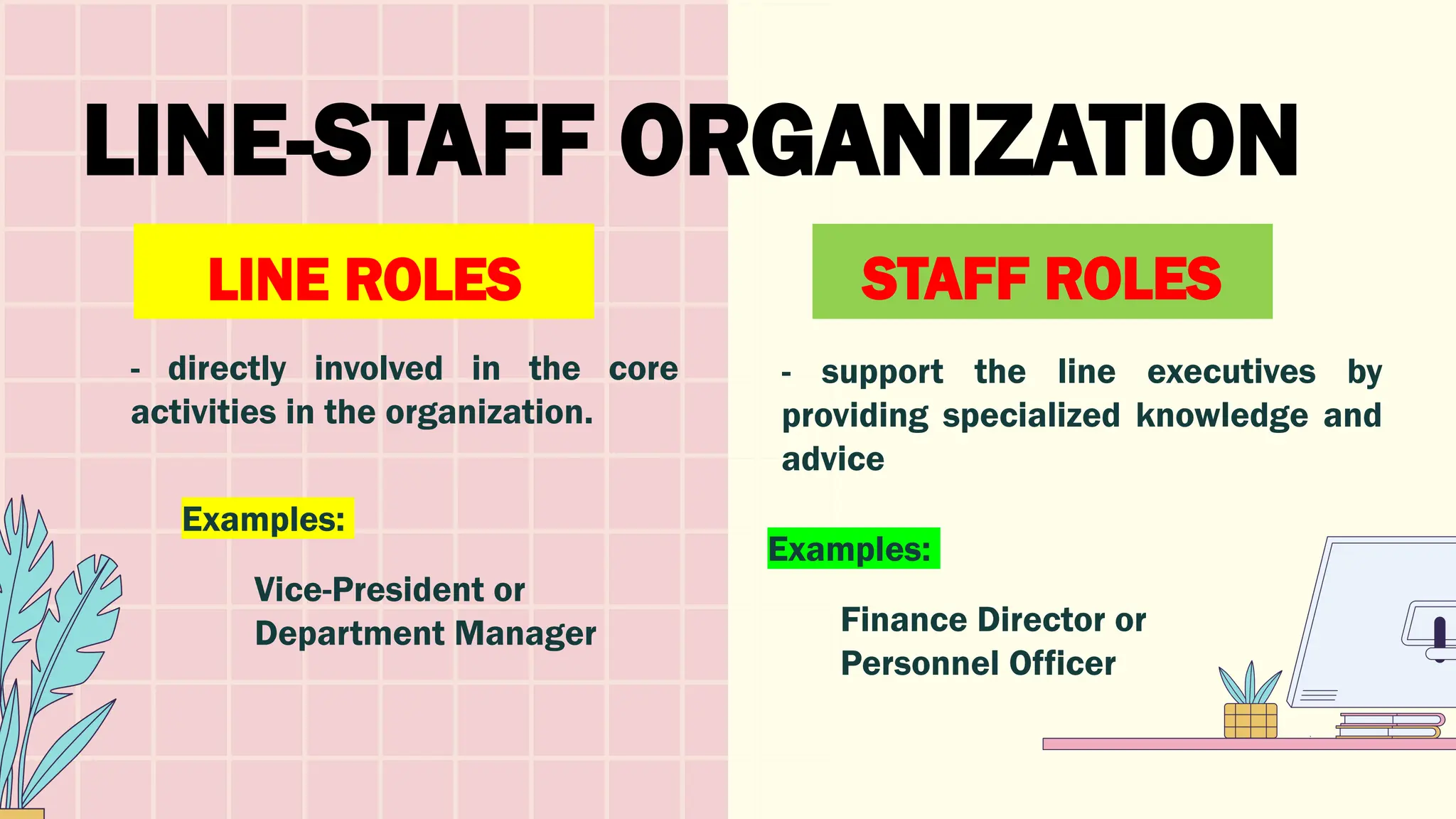
LINE-STAFF ORGANIZATION
LINE ROLES STAFF ROLES
- directly involved in the core
activities in the organization.
- support the line executives by
providing specialized knowledge and
advice
Examples:
Vice-President or
Department Manager
Examples:
Finance Director or
Personnel Officer
ADVANTAGES:
2
1
 Clear Responsibility
 Expert Support
 Focus on Main Tasks
 Easier Hiring and Training
DISADVANTAGES:
2
1
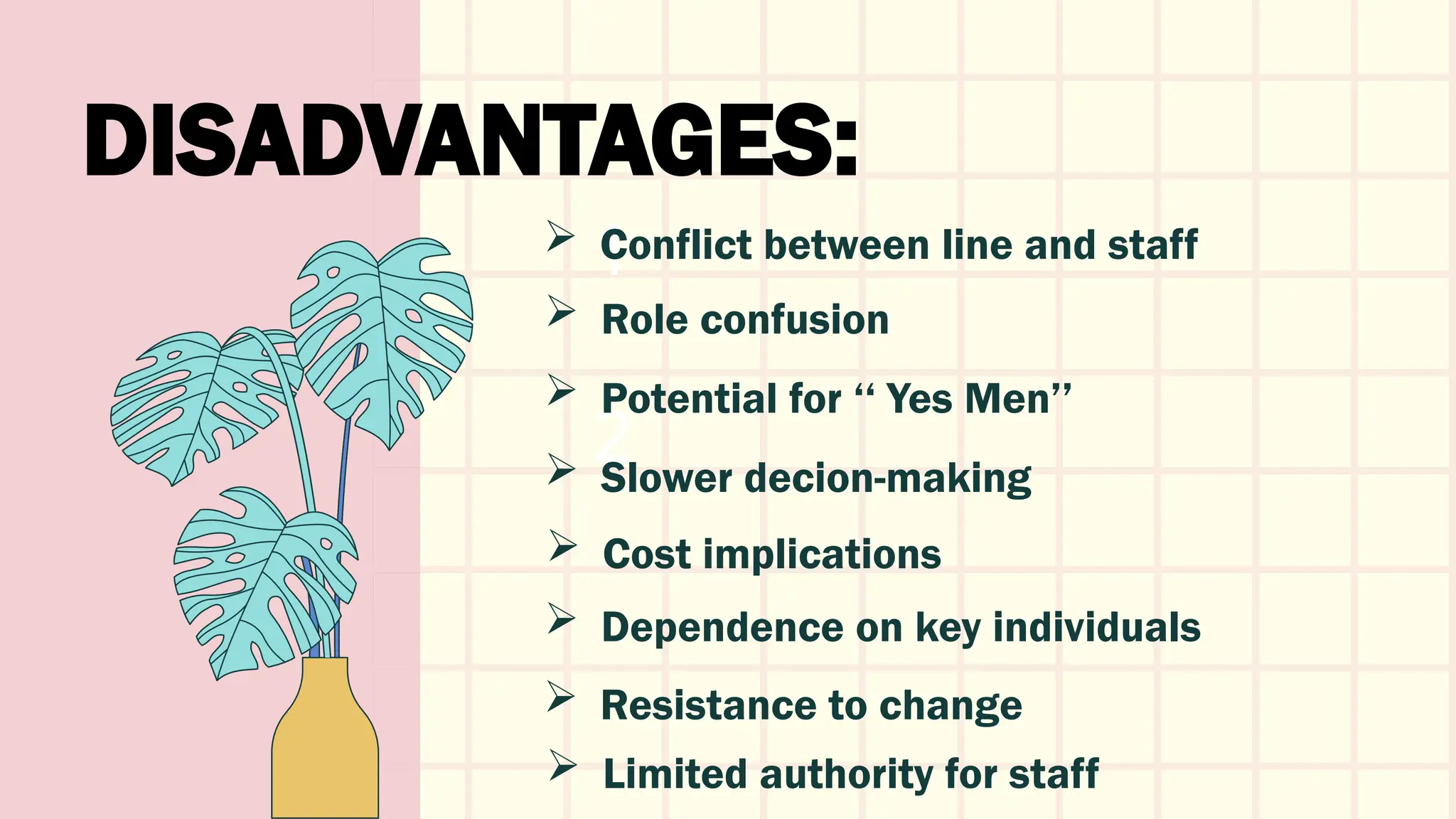
 Conflict between line and staff
 Role confusion
 Potential for ‘‘ Yes Men’’
 Slower decion-making
 Cost implications
 Dependence on key individuals
 Resistance to change
 Limited authority for staff
DOES ANYONE HAVE
ANY QUESTIONS?
FINAL THOUGHTS:
‘‘Line and staff organization is
vital for large, complex organizations
to operate effectively, balancing
authority and support.’’
THANK
YOU
for your attention

Line Organization is the simplest and oldest form organization structure where authority is delegated directly from top to bottom.

  • 1.
  • 2.
    Classification of governmentinstitutions based on the following categories: 1. Those that perform purely governmental service functions, -such as the Department of Public Works and Highways, Postal Services Office, LGU etc. 2. Those that are organized for business, -such as the Development Bank of the Philippines, the Philippine National Railways, PAGCOR etc 3. Those that are organized to dispense justice, -such as the Supreme Court, the Department of Justice; etc. 4. Those that are organized on a quasi-judicial basis which exercise administrative as well as judicial functions, -such as the Securities and Exchange Commission, LTFRB, CSC COMELEC,, etc
  • 3.
    Definition: • Line Organizationis the simplest and oldest form organization structure where authority is delegated directly from top to bottom. • In a chart, this is shown by an unbroken line. LINE ORGANIZATION
  • 4.
    CHARACTERISTICS Authority is delegateddirectly in a continuo us line. No separate staff executives; line executives perform both line and staff functions. Each executive exercises line authority over subordinates. Individuals on the same level are independe nt of each other and report only to their immediate superior.
  • 6.
    ADVANTAGES Simplicity: Clear linesof responsibility, authority, and accountability. . 1 2 Decision- Making: Facilitates prompt decision- making due to its straightforward structur e.
  • 7.
    ADVANTAGES Discipline and Control:Clear chain of command aids in discipline and control. 3 4 Flexibility: Adapts to changing conditions and demands.
  • 8.
    DISADVANTAGES Administrative Load: Canlead to an excessi ve load of administrative responsibility. 1 2 Centralization: Encourages centralization o f Control, lengthening the chain of comman d.
  • 9.
    DISADVANTAGES Lack of Specialization:Prevents developmen t of specialization beyond basic line function s. 3 4 Recruitment Challenges: Difficulty in recruiti ng multi-skilled personnel.
  • 10.
    Best Use Case: Ideal for small organizations with stable management a nd operations.  Due to size, it can avoid inherent defects and is cost- effective without needing specialized staff services.  Not suited for large, complex organizations.  Small organizations will continue to use line organizatio n due to its simplicity and cost-effectiveness.
  • 11.
  • 12.
    • supports lineexecutives in decision- making and implementation STAFF FUNCTIONS Davis and Filley said: Staff units provide secondary values to help line achieve primary objectives effectively and economically. • purely an advisory service • should align with the needs of line executives
  • 13.
    LINE-STAFF ORGANIZATION LINE ROLESSTAFF ROLES - directly involved in the core activities in the organization. - support the line executives by providing specialized knowledge and advice Examples: Vice-President or Department Manager Examples: Finance Director or Personnel Officer
  • 14.
    ADVANTAGES: 2 1  Clear Responsibility Expert Support  Focus on Main Tasks  Easier Hiring and Training
  • 15.
    DISADVANTAGES: 2 1  Conflict betweenline and staff  Role confusion  Potential for ‘‘ Yes Men’’  Slower decion-making  Cost implications  Dependence on key individuals  Resistance to change  Limited authority for staff
  • 16.
    DOES ANYONE HAVE ANYQUESTIONS? FINAL THOUGHTS: ‘‘Line and staff organization is vital for large, complex organizations to operate effectively, balancing authority and support.’’
  • 17.