Nicole McKenzie’s Presentation on:
0-17 secs:
production
company
+ sound to
go with it
18 secs:
productions
production
25 -31 secs:
Distribution
company
and another
production
company
32 secs:
another
production
company
36 secs:
another
production
company
39 secs:
association
company
41 secs:
film by...
44 secs:
main actors
name
46 secs:
actors name
49 secs:
and ...
actors name
55 secs:
blank
screen +
voice over
voice over begins but fades in and out – not continuous
58 secs:
opening
shot
1:03 panning
shot
establishing
the scene
1:06
another
panning
shot
1:10
tracking
shot
(forwards)
3 :46 -
directed
by...
1:16
tracking shot
(forwards)
1:17
another
panning
shot
1:22
another
panning
shot
1:23 tracking
shot then crane
shot- starting off
on ground level
then getting
higher and
higher
1:46 Ariel –
extreme long
shot shot
establishing
time and
location.
1:49 mid-shot
following the
long shot.
1:23 fade in music (stops at certain points)
1:55 Ariel –
tracking ; long
shot
2:01 Point
of view
shot
2:03 close
up shot
2:04
match on
action –
interest
shot
2:08 close
up shot
2:13
panning
shot
2:25 close
up shot +
tracking
shot
2:36
continuous
tracking
shot with
spiral
effect
added
2:41
TITLE
2:44 – 3:01
actors’ name
3:02 music
supervisors
names
3:04
music by
3:04 – 3:21
music by;
cast by;
costume
designer;
editors;
production
designers;
director of
photography
.
3:21 –
Line
producer;
co-producer;
executive
producer
(s);
produced
by...
3:39
based
on
3:42
screenplay
by..
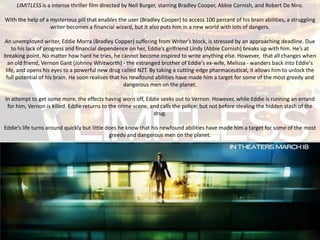
LIMITLESS is a intense thriller film directed by Neil Burger, starring Bradley Cooper, Abbie Cornish, and Robert De Niro.
With the help of a mysterious pill that enables the user (Bradley Cooper) to access 100 percent of his brain abilities, a struggling
writer becomes a financial wizard, but it also puts him in a new world with lots of dangers.
An unemployed writer, Eddie Morra (Bradley Copper) suffering from Writer’s block, is stressed by an approaching deadline. Due
to his lack of progress and financial dependence on her, Eddie’s girlfriend Lindy (Abbie Cornish) breaks up with him. He’s at
breaking point. No matter how hard he tries, he cannot become inspired to write anything else. However, that all changes when
an old friend, Vernon Gant (Johnny Whitworth) - the estranged brother of Eddie's ex-wife, Melissa - wanders back into Eddie's
life, and opens his eyes to a powerful new drug called NZT. By taking a cutting-edge pharmaceutical, it allows him to unlock the
full potential of his brain. He soon realises that his newfound abilities have made him a target for some of the most greedy and
dangerous men on the planet.
In attempt to get some more, the effects having worn off, Eddie seeks out to Vernon. However, while Eddie is running an errand
for him, Vernon is killed. Eddie returns to the crime scene, and calls the police; but not before stealing the hidden stash of the
drug.
Eddie’s life turns around quickly but little does he know that his newfound abilities have made him a target for some of the most
greedy and dangerous men on the planet.
In the
order as
shown
in the
movie
credits
Movie
title in
bold
Synopsis of the film
Main
actors
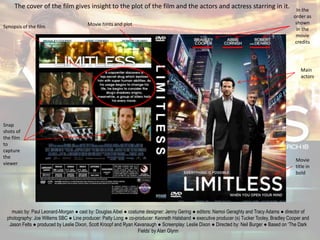
music by: Paul Leonard-Morgan ● cast by: Douglas Aibel ● costume designer: Jenny Gering ● editors: Namoi Geraghty and Tracy Adams ● director of
photography: Joe Willems SBC ● Line producer: Patty Long ● co-producer: Kenneth Halsband ● executive producer (s) Tucker Tooley, Bradley Cooper and
Jason Felts ● produced by Leslie Dixon, Scott Kroopf and Ryan Kavanaugh ● Screenplay: Leslie Dixon ● Directed by: Neil Burger ● Based on ‘The Dark
Fields’ by Alan Glynn
Movie hints and plot
Snap
shots of
the film
to
capture
the
viewer
The cover of the film gives insight to the plot of the film and the actors and actress starring in it.
There is also a Portuguese version of this film
Bradley Cooper
Bradley Cooper plays Eddie Morra a struggling
writer, who’s about to lose everything due to financial
problems when he is introduced to a new pill that enables
him to access 100% of his brains ability.
He then becomes a financial success, tripling his
investments in less than a day, but murdering
extortionists are after him, putting him in a new world
with lots of dangers.
Bradley Cooper was
born in
Philadelphia, Penns
ylvania. He is the
son of Gloria
Campano and
Charlie Cooper who
was a stockbroker.
He has a
sister, Holly.
Bradley graduated
from the Honours
English program at
Georgetown
University in 1009
and move to New
York straight away
to enrol in the
Masters of Fine Arts
program at the
Actors Studio
Drama School at
New School
University.
Bradley started his
professional
career, appearing in
Sex in the
City, alongside
Sarah Jessica Parker
(1998) and in the
series, The Beat
(2000).
Bradley had to skip
his graduation
ceremony from the
actor’s studio in
order to star in his
first feature film; et
Hot American
Summer.
He has been in
many amazing
films, such as, Silver
Linings
Playbook, Limitless
and The Hangover
series of films.
He has even been
voted the ‘Sexiest
Man Alive’ more
than once.
About Bradley:
Main Actors/Actresses
Robert De Niro plays Carl Can
Loon, Eddie Morra’s, new
boss, whose character becomes
more undetermined as the story
plays out.
Abbie Cornish plays Lindy, Eddies
girlfriend who becomes effected
by Eddied decisions. She too, has
some courageous choices to make.
Andrew Howard plays brutally violent
loan shark, seeking out new
opportunities, not only make
money, but grand investments.
This is the very first image that the audience see. To get to this stage of the frame, there was a sort of
zooming-out-of-the-galaxy effect, with other additional effects within. As it zoomed out, there was a
time-warp sound effect in relation to the logo, emphasising their space theme.
This is also the production company that produced this film.
The next visual, is the production’s production company – Virgin. The frame begins with
the writing of ‘Virgin’, in unison with the sound of a pen, as if someone were writing it. It
then has ‘Virgin’ zoomed out with the boarder lines, whilst the word ‘produced’ fades in
from the left, in a smooth transition.
From these points, each title appears simultaneously to the sound of tools and
banging from the next scene. There is also a faint sound of talking, giving the
audience a little bit of information about the upcoming scenes. These sounds are
associated with anger and violence which allows the audience to infer that
something bad is about to happen, creating tension and suspense. This means that
audience are kept guessing and excited.
The sound appears in the form of a crescendo and increases more as the main titles
are coming toward the end.
They are at their loudest when the actors’ names appear on screen...
Introducing the
characters
These are the first names of cast that
appear on the screen and the main
characters through-out the film.
This allows the audience to know who to
expect in the movie and hopefully persuade
them to continue watching.
They appear on-screen using a fade-in and
zoom-in effect. It also appears in sync with
the sound of the next scene on top (the
banging of tools, and faint talking, from the
previous slide.)
This is the final screen in-between the actors’ names and
first shot of the actual scene – It is also where a continuous
voice over of the main characters voice comes in; he’s
narrating the scene from a futuristic point of view, creating
dramatic irony for the audience, as this beginning part of the
film, is actually the end.
This narration and the sound of the scene become a sound
bridge, allowing a pleasant connection between the titles
and the scenes of the film; and the sound of the scene that
was placed on top of the titles, is a form of Foley sound , as it
was placed on top of the scene, but sounds as if it’s meant to
be in it (i.e, diegetic sound).
This is the first shot that the audience see. Along with the intense
drumming on the door, it gives the audience an idea that
someone is trying to break in – making sense of the sounds heard
before. This creates tension and concern for the characters’ well-
being.
There is a slow panning movement across the scene, providing the
audience with the setting.
The bashing on the door is still audible, hinting to audience that something
bad is happening or about to happen. Also, as the sound hasn’t end yet, it
makes clear to the audience that the perpetrator isn’t going to give up
anytime soon.
Also, there is a faint fade in of music, that gradually increases as the scene
progresses.
A close up shot then follows, highlighting where the sound is
coming from and making clear the intensity of the forced entrance.
These two shots are also short and sweet, but they’re panning shots.
Not only does this establish more of the location of the scene, but it
shows vital information about the scene; this being, that there is a
security breach and attackers somewhere in the building.
This, the audience can infer, is the men trying to force an entry through
the door in the previous shots.
The voice-over continues here, asking a inquisitive question about life.
This suggests that, he character is near the end of his life, reflecting
back on past experiences that has put him in the position he is currently
in.
This shot was a short, face-paced zooming shot, intended to establish the name
of the building, where the scene was set. As the pace of shots increase, so does
the tension of the film, as it suggests that the climax of the scene is closer.
Next, there is a slow-moving tracking shot, moving towards the sound of
danger, forcing the audience to feel anxious and nervous about what’s about
to happen.
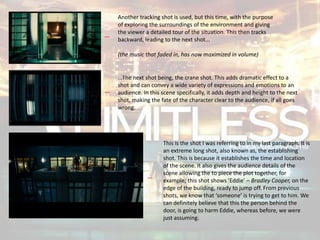
Another tracking shot is used, but this time, with the purpose
of exploring the surroundings of the environment and giving
the viewer a detailed tour of the situation. This then tracks
backward, leading to the next shot...
(the music that faded in, has now maximized in volume)
...The next shot being, the crane shot. This adds dramatic effect to a
shot and can convey a wide variety of expressions and emotions to an
audience. In this scene specifically, it adds depth and height to the next
shot, making the fate of the character clear to the audience, if all goes
wrong.
This is the shot I was referring to in my last paragraph. It is
an extreme long shot, also known as, the establishing
shot. This is because it establishes the time and location
of the scene. It also gives the audience details of the
scene allowing the to piece the plot together, for
example; this shot shows ‘Eddie’ – Bradley Cooper, on the
edge of the building, ready to jump off. From previous
shots, we know that ‘someone’ is trying to get to him. We
can definitely believe that this the person behind the
door, is going to harm Eddie, whereas before, we were
just assuming.
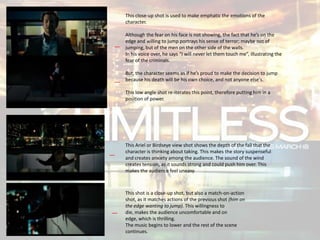
This Ariel or Birdseye view shot shows the depth of the fall that the
character is thinking about taking. This makes the story suspenseful
and creates anxiety among the audience. The sound of the wind
creates tension, as it sounds strong and could push him over. This
makes the audience feel uneasy.
This close-up shot is used to make emphatic the emotions of the
character.
Although the fear on his face is not showing, the fact that he’s on the
edge and willing to jump portrays his sense of terror; maybe not of
jumping, but of the men on the other side of the walls.
In his voice over, he says “I will never let them touch me”, illustrating the
fear of the criminals.
But, the character seems as if he’s proud to make the decision to jump
because his death will be his own choice, and not anyone else's.
This low angle shot re-iterates this point, therefore putting him in a
position of power.
This shot is a close-up shot, but also a match-on-action
shot, as it matches actions of the previous shot (him on
the edge wanting to jump). This willingness to
die, makes the audience uncomfortable and on
edge, which is thrilling.
The music begins to lower and the rest of the scene
continues.
The rest of the titles emerge following a drop shot of the building. The camera tracks through the city, establishing
the location and setting of the whole film.
Also, allows the audience to assume that this is where the film is set (New York).
The soundtrack and the sound of the city (ambient sound) is playing while this is occurring.
This continues until the city is merged into a image of a cell. These cells then take over the frame, also with titles
being displayed on them (see image above – far right)
The editing of the film has been done in such a way that the last scene, is shown first- This creates dramatic irony as
the audience now know what to expect.
However, this is unclear until after the title sequence, when the story goes back in time.
The narration (non-diegetic sound) explains that the character that they see after the title sequence, is the same
character, but in the past.
From this point on, the time is continuous and consecutive – with the effect of fast forwarding through time at some
points.
However, this said, the film is edited in a way that portrays continuity.

Limitless

  • 1.
  • 2.
    0-17 secs: production company + soundto go with it 18 secs: productions production 25 -31 secs: Distribution company and another production company 32 secs: another production company 36 secs: another production company 39 secs: association company 41 secs: film by... 44 secs: main actors name 46 secs: actors name 49 secs: and ... actors name 55 secs: blank screen + voice over voice over begins but fades in and out – not continuous 58 secs: opening shot 1:03 panning shot establishing the scene 1:06 another panning shot 1:10 tracking shot (forwards) 3 :46 - directed by... 1:16 tracking shot (forwards) 1:17 another panning shot 1:22 another panning shot 1:23 tracking shot then crane shot- starting off on ground level then getting higher and higher 1:46 Ariel – extreme long shot shot establishing time and location. 1:49 mid-shot following the long shot. 1:23 fade in music (stops at certain points) 1:55 Ariel – tracking ; long shot 2:01 Point of view shot 2:03 close up shot 2:04 match on action – interest shot 2:08 close up shot 2:13 panning shot 2:25 close up shot + tracking shot 2:36 continuous tracking shot with spiral effect added 2:41 TITLE 2:44 – 3:01 actors’ name 3:02 music supervisors names 3:04 music by 3:04 – 3:21 music by; cast by; costume designer; editors; production designers; director of photography . 3:21 – Line producer; co-producer; executive producer (s); produced by... 3:39 based on 3:42 screenplay by..
  • 3.
    LIMITLESS is aintense thriller film directed by Neil Burger, starring Bradley Cooper, Abbie Cornish, and Robert De Niro. With the help of a mysterious pill that enables the user (Bradley Cooper) to access 100 percent of his brain abilities, a struggling writer becomes a financial wizard, but it also puts him in a new world with lots of dangers. An unemployed writer, Eddie Morra (Bradley Copper) suffering from Writer’s block, is stressed by an approaching deadline. Due to his lack of progress and financial dependence on her, Eddie’s girlfriend Lindy (Abbie Cornish) breaks up with him. He’s at breaking point. No matter how hard he tries, he cannot become inspired to write anything else. However, that all changes when an old friend, Vernon Gant (Johnny Whitworth) - the estranged brother of Eddie's ex-wife, Melissa - wanders back into Eddie's life, and opens his eyes to a powerful new drug called NZT. By taking a cutting-edge pharmaceutical, it allows him to unlock the full potential of his brain. He soon realises that his newfound abilities have made him a target for some of the most greedy and dangerous men on the planet. In attempt to get some more, the effects having worn off, Eddie seeks out to Vernon. However, while Eddie is running an errand for him, Vernon is killed. Eddie returns to the crime scene, and calls the police; but not before stealing the hidden stash of the drug. Eddie’s life turns around quickly but little does he know that his newfound abilities have made him a target for some of the most greedy and dangerous men on the planet.
  • 4.
    In the order as shown inthe movie credits Movie title in bold Synopsis of the film Main actors music by: Paul Leonard-Morgan ● cast by: Douglas Aibel ● costume designer: Jenny Gering ● editors: Namoi Geraghty and Tracy Adams ● director of photography: Joe Willems SBC ● Line producer: Patty Long ● co-producer: Kenneth Halsband ● executive producer (s) Tucker Tooley, Bradley Cooper and Jason Felts ● produced by Leslie Dixon, Scott Kroopf and Ryan Kavanaugh ● Screenplay: Leslie Dixon ● Directed by: Neil Burger ● Based on ‘The Dark Fields’ by Alan Glynn Movie hints and plot Snap shots of the film to capture the viewer The cover of the film gives insight to the plot of the film and the actors and actress starring in it.
  • 5.
    There is alsoa Portuguese version of this film
  • 6.
    Bradley Cooper Bradley Cooperplays Eddie Morra a struggling writer, who’s about to lose everything due to financial problems when he is introduced to a new pill that enables him to access 100% of his brains ability. He then becomes a financial success, tripling his investments in less than a day, but murdering extortionists are after him, putting him in a new world with lots of dangers. Bradley Cooper was born in Philadelphia, Penns ylvania. He is the son of Gloria Campano and Charlie Cooper who was a stockbroker. He has a sister, Holly. Bradley graduated from the Honours English program at Georgetown University in 1009 and move to New York straight away to enrol in the Masters of Fine Arts program at the Actors Studio Drama School at New School University. Bradley started his professional career, appearing in Sex in the City, alongside Sarah Jessica Parker (1998) and in the series, The Beat (2000). Bradley had to skip his graduation ceremony from the actor’s studio in order to star in his first feature film; et Hot American Summer. He has been in many amazing films, such as, Silver Linings Playbook, Limitless and The Hangover series of films. He has even been voted the ‘Sexiest Man Alive’ more than once. About Bradley: Main Actors/Actresses
  • 7.
    Robert De Niroplays Carl Can Loon, Eddie Morra’s, new boss, whose character becomes more undetermined as the story plays out. Abbie Cornish plays Lindy, Eddies girlfriend who becomes effected by Eddied decisions. She too, has some courageous choices to make. Andrew Howard plays brutally violent loan shark, seeking out new opportunities, not only make money, but grand investments.
  • 8.
    This is thevery first image that the audience see. To get to this stage of the frame, there was a sort of zooming-out-of-the-galaxy effect, with other additional effects within. As it zoomed out, there was a time-warp sound effect in relation to the logo, emphasising their space theme. This is also the production company that produced this film. The next visual, is the production’s production company – Virgin. The frame begins with the writing of ‘Virgin’, in unison with the sound of a pen, as if someone were writing it. It then has ‘Virgin’ zoomed out with the boarder lines, whilst the word ‘produced’ fades in from the left, in a smooth transition. From these points, each title appears simultaneously to the sound of tools and banging from the next scene. There is also a faint sound of talking, giving the audience a little bit of information about the upcoming scenes. These sounds are associated with anger and violence which allows the audience to infer that something bad is about to happen, creating tension and suspense. This means that audience are kept guessing and excited. The sound appears in the form of a crescendo and increases more as the main titles are coming toward the end. They are at their loudest when the actors’ names appear on screen...
  • 9.
    Introducing the characters These arethe first names of cast that appear on the screen and the main characters through-out the film. This allows the audience to know who to expect in the movie and hopefully persuade them to continue watching. They appear on-screen using a fade-in and zoom-in effect. It also appears in sync with the sound of the next scene on top (the banging of tools, and faint talking, from the previous slide.) This is the final screen in-between the actors’ names and first shot of the actual scene – It is also where a continuous voice over of the main characters voice comes in; he’s narrating the scene from a futuristic point of view, creating dramatic irony for the audience, as this beginning part of the film, is actually the end. This narration and the sound of the scene become a sound bridge, allowing a pleasant connection between the titles and the scenes of the film; and the sound of the scene that was placed on top of the titles, is a form of Foley sound , as it was placed on top of the scene, but sounds as if it’s meant to be in it (i.e, diegetic sound).
  • 10.
    This is thefirst shot that the audience see. Along with the intense drumming on the door, it gives the audience an idea that someone is trying to break in – making sense of the sounds heard before. This creates tension and concern for the characters’ well- being. There is a slow panning movement across the scene, providing the audience with the setting. The bashing on the door is still audible, hinting to audience that something bad is happening or about to happen. Also, as the sound hasn’t end yet, it makes clear to the audience that the perpetrator isn’t going to give up anytime soon. Also, there is a faint fade in of music, that gradually increases as the scene progresses. A close up shot then follows, highlighting where the sound is coming from and making clear the intensity of the forced entrance.
  • 11.
    These two shotsare also short and sweet, but they’re panning shots. Not only does this establish more of the location of the scene, but it shows vital information about the scene; this being, that there is a security breach and attackers somewhere in the building. This, the audience can infer, is the men trying to force an entry through the door in the previous shots. The voice-over continues here, asking a inquisitive question about life. This suggests that, he character is near the end of his life, reflecting back on past experiences that has put him in the position he is currently in. This shot was a short, face-paced zooming shot, intended to establish the name of the building, where the scene was set. As the pace of shots increase, so does the tension of the film, as it suggests that the climax of the scene is closer. Next, there is a slow-moving tracking shot, moving towards the sound of danger, forcing the audience to feel anxious and nervous about what’s about to happen.
  • 12.
    Another tracking shotis used, but this time, with the purpose of exploring the surroundings of the environment and giving the viewer a detailed tour of the situation. This then tracks backward, leading to the next shot... (the music that faded in, has now maximized in volume) ...The next shot being, the crane shot. This adds dramatic effect to a shot and can convey a wide variety of expressions and emotions to an audience. In this scene specifically, it adds depth and height to the next shot, making the fate of the character clear to the audience, if all goes wrong. This is the shot I was referring to in my last paragraph. It is an extreme long shot, also known as, the establishing shot. This is because it establishes the time and location of the scene. It also gives the audience details of the scene allowing the to piece the plot together, for example; this shot shows ‘Eddie’ – Bradley Cooper, on the edge of the building, ready to jump off. From previous shots, we know that ‘someone’ is trying to get to him. We can definitely believe that this the person behind the door, is going to harm Eddie, whereas before, we were just assuming.
  • 13.
    This Ariel orBirdseye view shot shows the depth of the fall that the character is thinking about taking. This makes the story suspenseful and creates anxiety among the audience. The sound of the wind creates tension, as it sounds strong and could push him over. This makes the audience feel uneasy. This close-up shot is used to make emphatic the emotions of the character. Although the fear on his face is not showing, the fact that he’s on the edge and willing to jump portrays his sense of terror; maybe not of jumping, but of the men on the other side of the walls. In his voice over, he says “I will never let them touch me”, illustrating the fear of the criminals. But, the character seems as if he’s proud to make the decision to jump because his death will be his own choice, and not anyone else's. This low angle shot re-iterates this point, therefore putting him in a position of power. This shot is a close-up shot, but also a match-on-action shot, as it matches actions of the previous shot (him on the edge wanting to jump). This willingness to die, makes the audience uncomfortable and on edge, which is thrilling. The music begins to lower and the rest of the scene continues.
  • 14.
    The rest ofthe titles emerge following a drop shot of the building. The camera tracks through the city, establishing the location and setting of the whole film. Also, allows the audience to assume that this is where the film is set (New York). The soundtrack and the sound of the city (ambient sound) is playing while this is occurring. This continues until the city is merged into a image of a cell. These cells then take over the frame, also with titles being displayed on them (see image above – far right) The editing of the film has been done in such a way that the last scene, is shown first- This creates dramatic irony as the audience now know what to expect. However, this is unclear until after the title sequence, when the story goes back in time. The narration (non-diegetic sound) explains that the character that they see after the title sequence, is the same character, but in the past. From this point on, the time is continuous and consecutive – with the effect of fast forwarding through time at some points. However, this said, the film is edited in a way that portrays continuity.