Limited Liability Partnership
INTRODUCTION
 Limited liability partnership is a new form of business entity a form of
business model which combines the advantages of a corporate
structure and traditional partnership structure.
 Traditional partnership – (mutual agency among partners) –
(unlimited liability) – (uncertainty of life) = LLP form of organisation
 Main drawback of company form of organisation is excessive legal
compliance that too has been reduced by LLP form of organisation.
 LLP combines the advantages of flexibility of organising management
on the basis of an agreement and tax benefit like traditional
partnership firm and limited liability and status of body corporate
like a company
 It is a hybrid between a company and traditional partnership, much
closer to private company form.
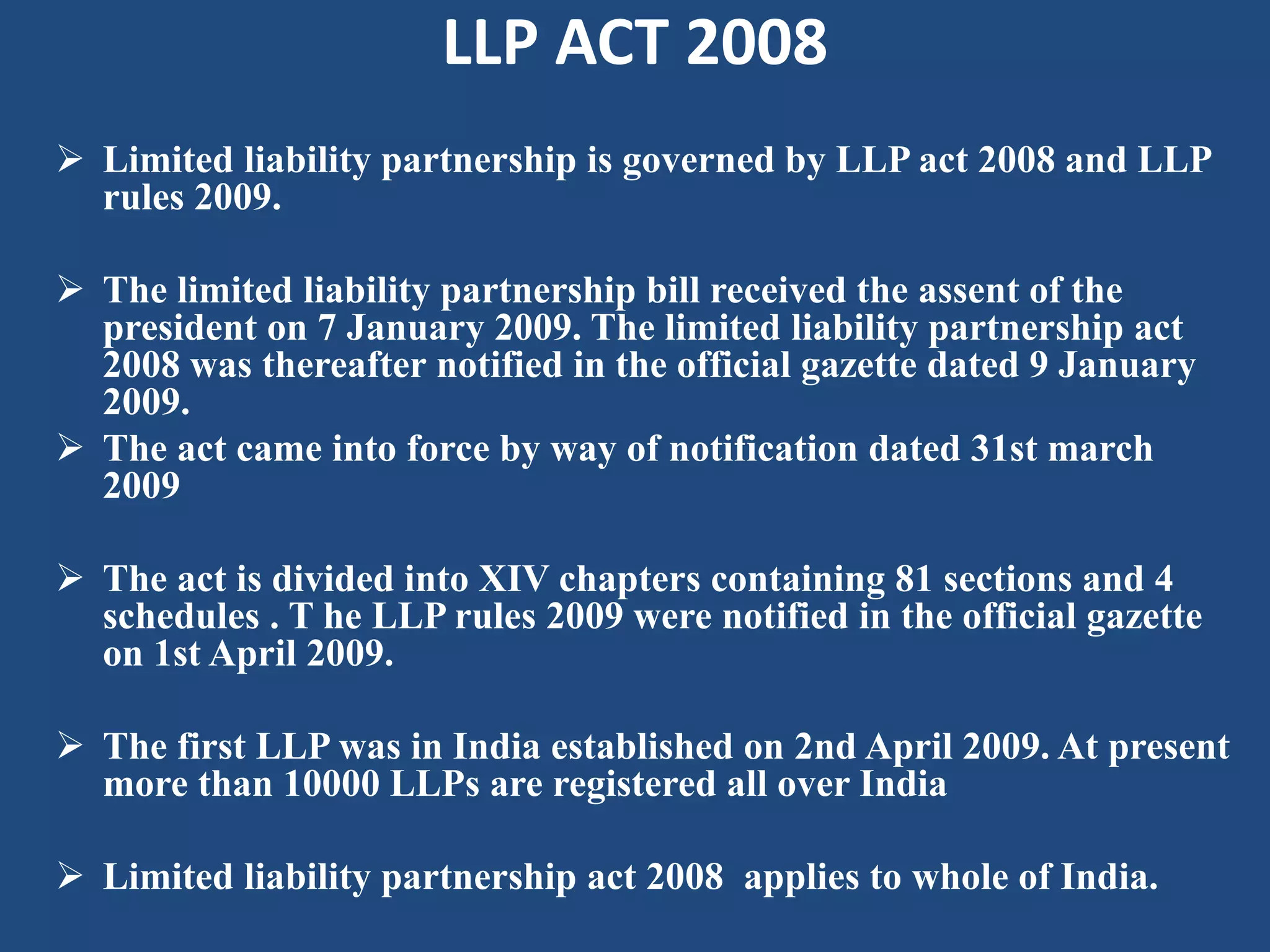
LLP ACT 2008
 Limited liability partnership is governed by LLP act 2008 and LLP
rules 2009.
 The limited liability partnership bill received the assent of the
president on 7 January 2009. The limited liability partnership act
2008 was thereafter notified in the official gazette dated 9 January
2009.
 The act came into force by way of notification dated 31st march
2009
 The act is divided into XIV chapters containing 81 sections and 4
schedules . T he LLP rules 2009 were notified in the official gazette
on 1st April 2009.
 The first LLP was in India established on 2nd April 2009. At present
more than 10000 LLPs are registered all over India
 Limited liability partnership act 2008 applies to whole of India.
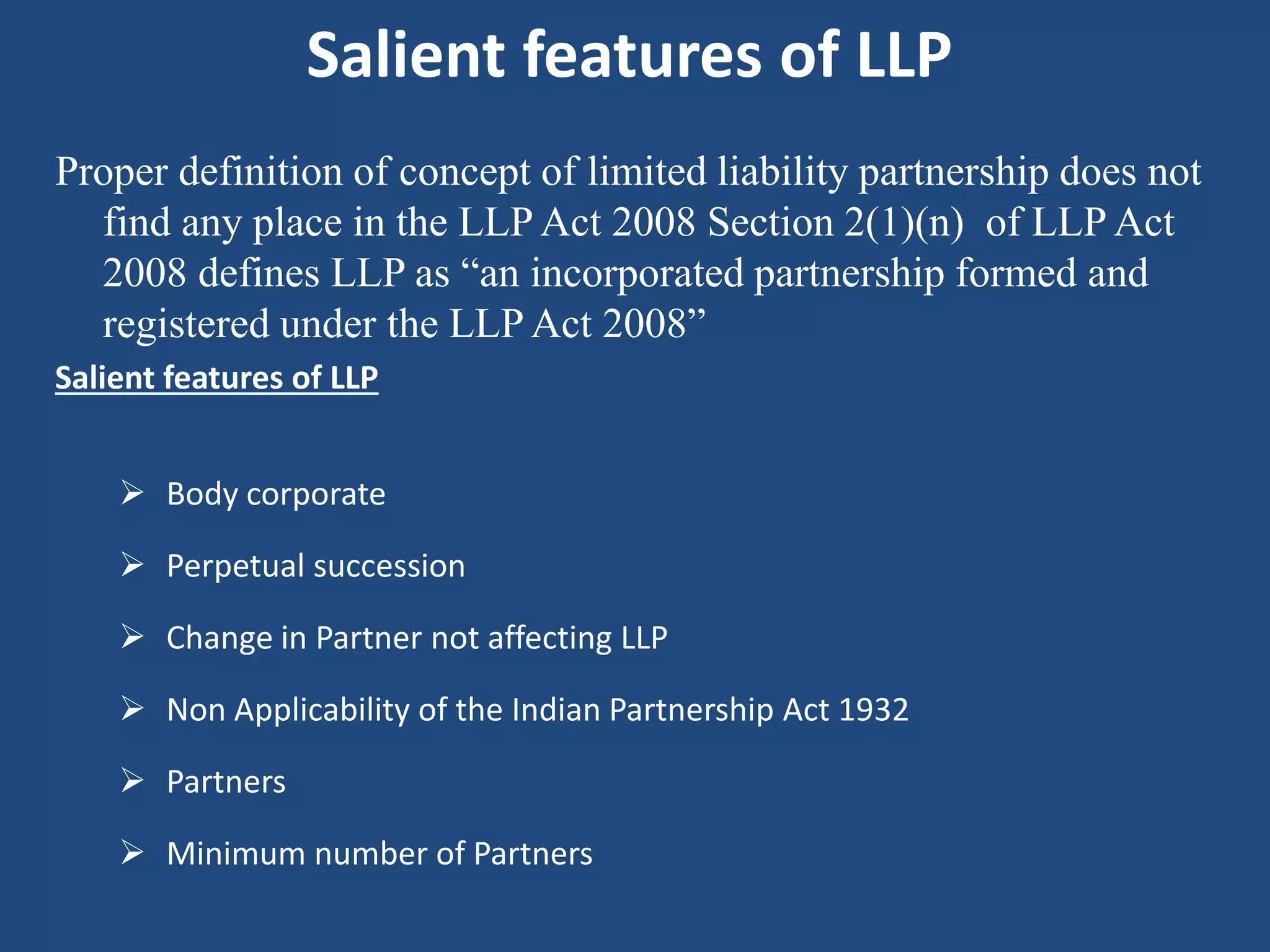
Salient features of LLP
Proper definition of concept of limited liability partnership does not
find any place in the LLP Act 2008 Section 2(1)(n) of LLP Act
2008 defines LLP as “an incorporated partnership formed and
registered under the LLP Act 2008”
Salient features of LLP
 Body corporate
 Perpetual succession
 Change in Partner not affecting LLP
 Non Applicability of the Indian Partnership Act 1932
 Partners
 Minimum number of Partners
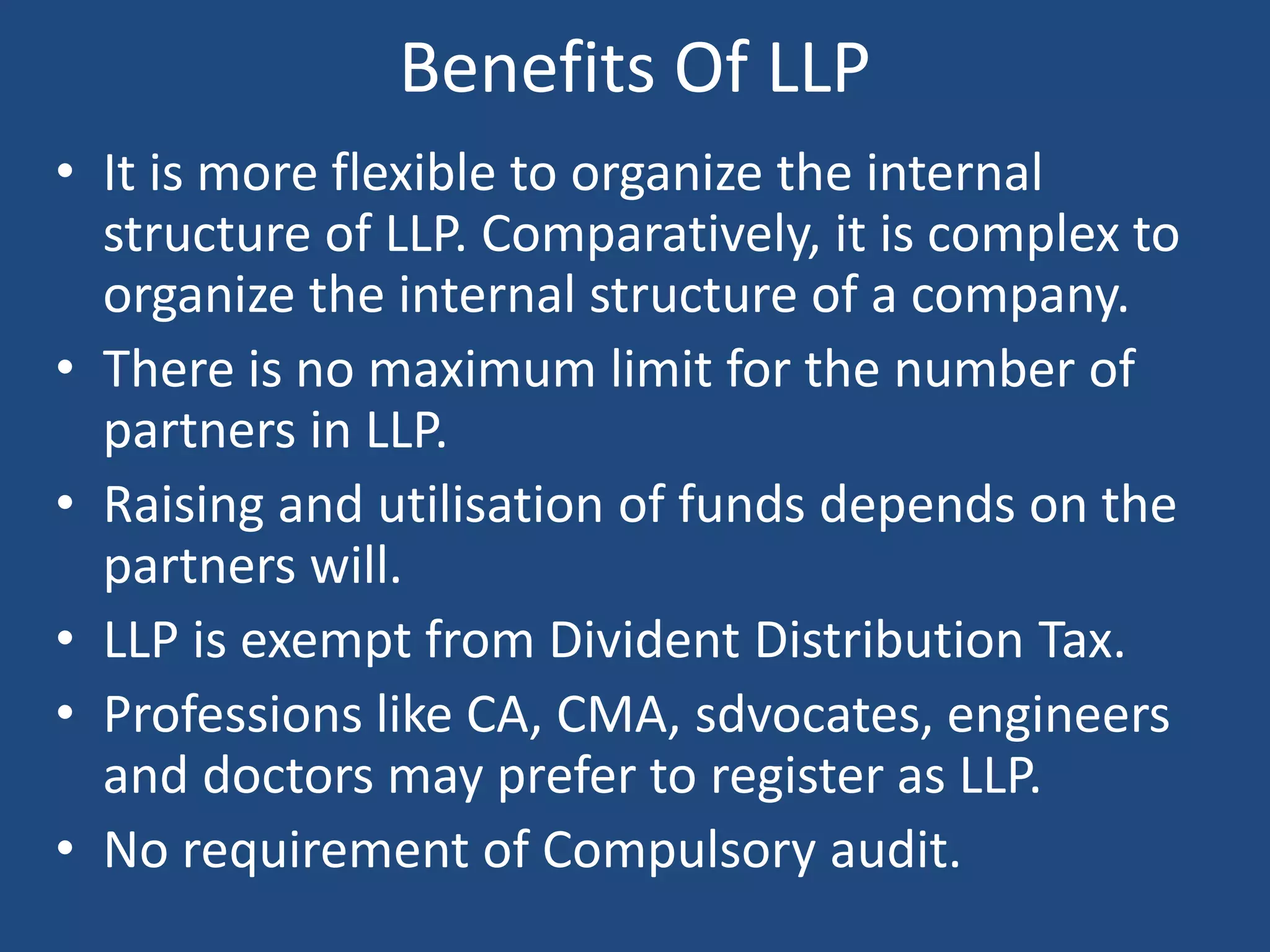
Benefits Of LLP
• It is more flexible to organize the internal
structure of LLP. Comparatively, it is complex to
organize the internal structure of a company.
• There is no maximum limit for the number of
partners in LLP.
• Raising and utilisation of funds depends on the
partners will.
• LLP is exempt from Divident Distribution Tax.
• Professions like CA, CMA, sdvocates, engineers
and doctors may prefer to register as LLP.
• No requirement of Compulsory audit.
Disadvantages of LLP
• Any act of a partner without the other partner
may bind the LLP.
• LLP cannot raise money from public.
• Angel investors and venture capital firms
generally prefer not to invest in LLP.
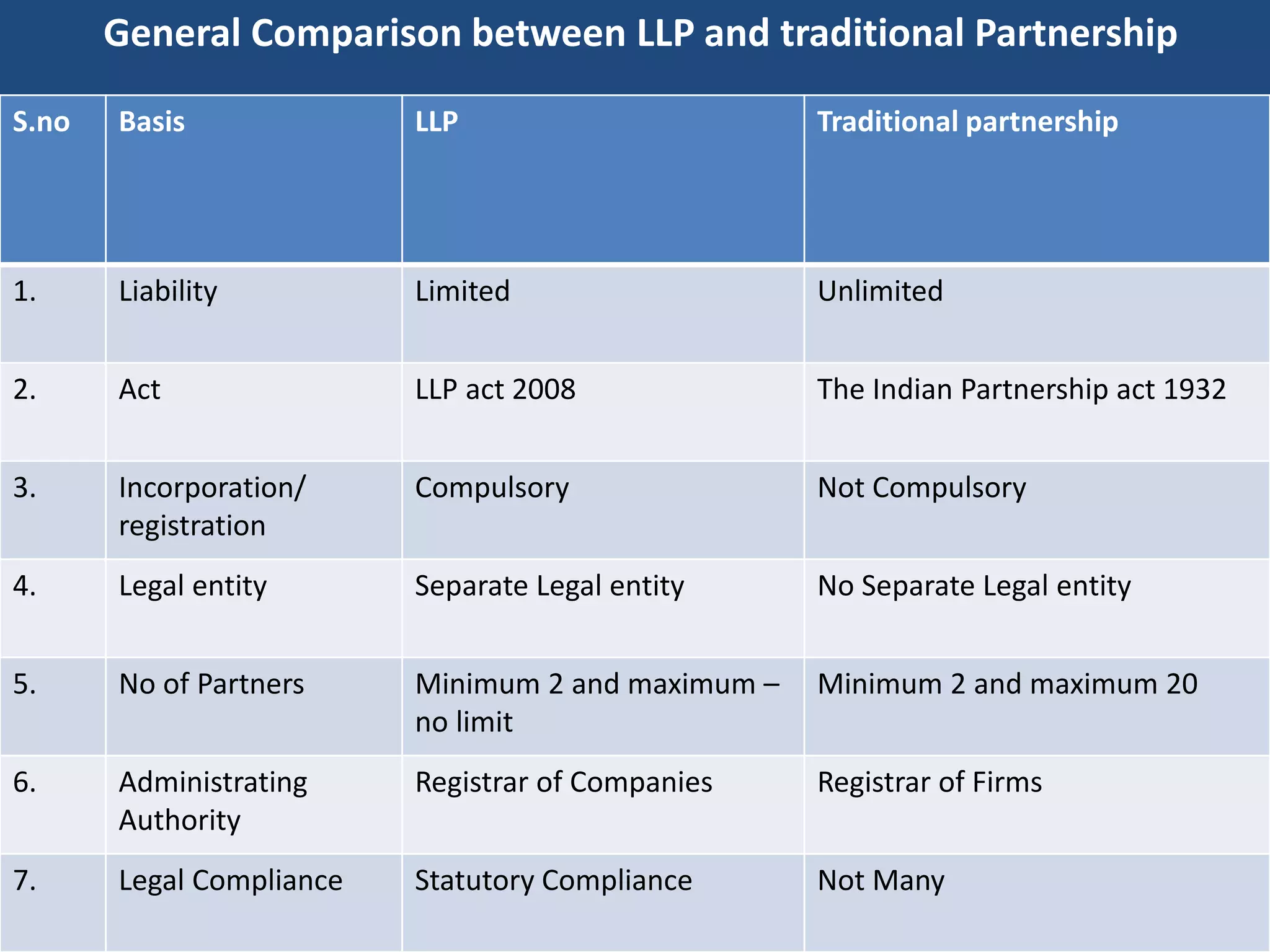
S.no Basis LLP Traditional partnership
1. Liability Limited Unlimited
2. Act LLP act 2008 The Indian Partnership act 1932
3. Incorporation/
registration
Compulsory Not Compulsory
4. Legal entity Separate Legal entity No Separate Legal entity
5. No of Partners Minimum 2 and maximum –
no limit
Minimum 2 and maximum 20
6. Administrating
Authority
Registrar of Companies Registrar of Firms
7. Legal Compliance Statutory Compliance Not Many
General Comparison between LLP and traditional Partnership
Limited Liability Partnership.pptx

Limited Liability Partnership.pptx

  • 1.
  • 2.
    INTRODUCTION  Limited liabilitypartnership is a new form of business entity a form of business model which combines the advantages of a corporate structure and traditional partnership structure.  Traditional partnership – (mutual agency among partners) – (unlimited liability) – (uncertainty of life) = LLP form of organisation  Main drawback of company form of organisation is excessive legal compliance that too has been reduced by LLP form of organisation.  LLP combines the advantages of flexibility of organising management on the basis of an agreement and tax benefit like traditional partnership firm and limited liability and status of body corporate like a company  It is a hybrid between a company and traditional partnership, much closer to private company form.
  • 3.
    LLP ACT 2008 Limited liability partnership is governed by LLP act 2008 and LLP rules 2009.  The limited liability partnership bill received the assent of the president on 7 January 2009. The limited liability partnership act 2008 was thereafter notified in the official gazette dated 9 January 2009.  The act came into force by way of notification dated 31st march 2009  The act is divided into XIV chapters containing 81 sections and 4 schedules . T he LLP rules 2009 were notified in the official gazette on 1st April 2009.  The first LLP was in India established on 2nd April 2009. At present more than 10000 LLPs are registered all over India  Limited liability partnership act 2008 applies to whole of India.
  • 4.
    Salient features ofLLP Proper definition of concept of limited liability partnership does not find any place in the LLP Act 2008 Section 2(1)(n) of LLP Act 2008 defines LLP as “an incorporated partnership formed and registered under the LLP Act 2008” Salient features of LLP  Body corporate  Perpetual succession  Change in Partner not affecting LLP  Non Applicability of the Indian Partnership Act 1932  Partners  Minimum number of Partners
  • 5.
    Benefits Of LLP •It is more flexible to organize the internal structure of LLP. Comparatively, it is complex to organize the internal structure of a company. • There is no maximum limit for the number of partners in LLP. • Raising and utilisation of funds depends on the partners will. • LLP is exempt from Divident Distribution Tax. • Professions like CA, CMA, sdvocates, engineers and doctors may prefer to register as LLP. • No requirement of Compulsory audit.
  • 6.
    Disadvantages of LLP •Any act of a partner without the other partner may bind the LLP. • LLP cannot raise money from public. • Angel investors and venture capital firms generally prefer not to invest in LLP.
  • 7.
    S.no Basis LLPTraditional partnership 1. Liability Limited Unlimited 2. Act LLP act 2008 The Indian Partnership act 1932 3. Incorporation/ registration Compulsory Not Compulsory 4. Legal entity Separate Legal entity No Separate Legal entity 5. No of Partners Minimum 2 and maximum – no limit Minimum 2 and maximum 20 6. Administrating Authority Registrar of Companies Registrar of Firms 7. Legal Compliance Statutory Compliance Not Many General Comparison between LLP and traditional Partnership