ALBUM COVER
ANALYSIS
Tha Carter III & Tha Carter IV – Lil Wayne
1.
2.
3.
4.
5.
1.
2.
3.
4.
Circled Points – Genre & Mise En
Scene
Tha Carter III:
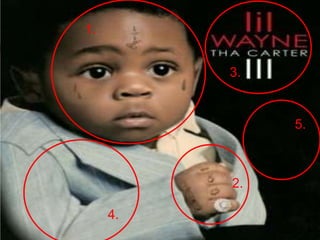
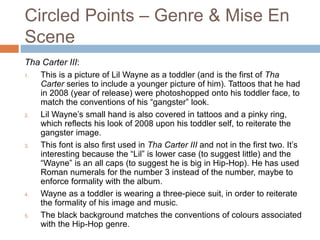
1. This is a picture of Lil Wayne as a toddler (and is the first of Tha
Carter series to include a younger picture of him). Tattoos that he had
in 2008 (year of release) were photoshopped onto his toddler face, to
match the conventions of his “gangster” look.
2. Lil Wayne’s small hand is also covered in tattoos and a pinky ring,
which reflects his look of 2008 upon his toddler self, to reiterate the
gangster image.
3. This font is also first used in Tha Carter III and not in the first two. It’s
interesting because the “Lil” is lower case (to suggest little) and the
“Wayne” is an all caps (to suggest he is big in Hip-Hop). He has used
Roman numerals for the number 3 instead of the number, maybe to
enforce formality with the album.
4. Wayne as a toddler is wearing a three-piece suit, in order to reiterate
the formality of his image and music.
5. The black background matches the conventions of colours associated
with the Hip-Hop genre.
Circled Points – Genre & Mise En
Scene
Tha Carter IV:
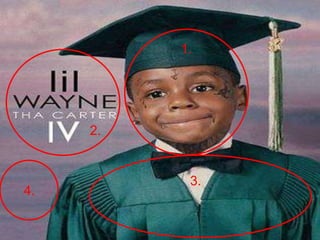
1. This is a picture of Lil Wayne as an older child (and is the second
of Tha Carter series to include a younger picture of him). Tattoos
that he had in 2011 (year of release) were photoshopped onto his
face, to match the conventions of his “gangster” look.
2. This font is also first used in Tha Carter III and not in the first two.
It’s interesting because the “Lil” is lower case (to suggest little) and
the “Wayne” is an all caps (to suggest he is big in Hip-Hop). He
has used Roman numerals for the number 4 instead of the
number, maybe to enforce formality with the album.
3. In this picture, Wayne is dressed in a graduation gown, possibly to
suggest that he has graduated in the industry and has found his
success from Tha Carter III and IV has a stronger message to
enforce as it is an upgrade from III.
4. The background colour challenges the conventional colours of the
Hip-Hop genre, possibly to display the idea of change that the
picture of him is exerting.
Circled Points – Star Image
 From Tha Carter III, we learn that this album is the “birth” of his
Carter image, and subliminally ignores I and II. The birth is signified
by the picture of him as a toddler, but also reflects his current image
due to the photoshopped tattoos on his face. The suit that he is
wearing also exerts formality, along with using Roman numerals for
the album number, as Wayne possibly wants to convey a sense of
seriousness with the album and his career as a whole.
 From Tha Carter IV, we learn that Wayne has “grown up” or
progressed from the last album… He has graduated. This explains
the reason for having a picture of him as an older child dressed in a
green graduation gown. Another indication of his growth is that
there are more tattoos photoshopped onto him, because since III he
has acquired more tattoos.
Circled Points – Target
Audience
 Lil Wayne’s target audience is people who enjoy Hip-Hop and
mainly his specific type. These are rebellious people, who may
choose to get tattoos or some form of mark of their creativity to
suggest that they won’t conform to society’s pressures or rules.
 Tha Carter III has captured this idea of target audience perfectly,
and that is one of the reasons why it ultimately ended up being his
most successful album.
 Tha Carter IV captured the target audience in a different way as it
depicted Wayne “growing up”, so if his loyal fans enjoyed this
album, they had essentially “grown up” with him. The initial purpose
of this release was for Wayne to take his fans on a journey through
his life.
Circled Points – Synthetic Artist
 Wayne is a synthetic artist, and so are most Hip-Hop artists who
breakthrough the charts and are associated with large record labels,
in this case YMCMB (Young Money Entertainment and Cash Money
Records).
 The album cover itself is also part of the synthetic image because
synthetic artists usually centre the album entirely on themselves,
which Wayne has clearly done on both album covers.

LIL WAYNE ALBUM COVER ANALYSIS

  • 1.
    ALBUM COVER ANALYSIS Tha CarterIII & Tha Carter IV – Lil Wayne
  • 2.
  • 3.
  • 4.
    Circled Points –Genre & Mise En Scene Tha Carter III: 1. This is a picture of Lil Wayne as a toddler (and is the first of Tha Carter series to include a younger picture of him). Tattoos that he had in 2008 (year of release) were photoshopped onto his toddler face, to match the conventions of his “gangster” look. 2. Lil Wayne’s small hand is also covered in tattoos and a pinky ring, which reflects his look of 2008 upon his toddler self, to reiterate the gangster image. 3. This font is also first used in Tha Carter III and not in the first two. It’s interesting because the “Lil” is lower case (to suggest little) and the “Wayne” is an all caps (to suggest he is big in Hip-Hop). He has used Roman numerals for the number 3 instead of the number, maybe to enforce formality with the album. 4. Wayne as a toddler is wearing a three-piece suit, in order to reiterate the formality of his image and music. 5. The black background matches the conventions of colours associated with the Hip-Hop genre.
  • 5.
    Circled Points –Genre & Mise En Scene Tha Carter IV: 1. This is a picture of Lil Wayne as an older child (and is the second of Tha Carter series to include a younger picture of him). Tattoos that he had in 2011 (year of release) were photoshopped onto his face, to match the conventions of his “gangster” look. 2. This font is also first used in Tha Carter III and not in the first two. It’s interesting because the “Lil” is lower case (to suggest little) and the “Wayne” is an all caps (to suggest he is big in Hip-Hop). He has used Roman numerals for the number 4 instead of the number, maybe to enforce formality with the album. 3. In this picture, Wayne is dressed in a graduation gown, possibly to suggest that he has graduated in the industry and has found his success from Tha Carter III and IV has a stronger message to enforce as it is an upgrade from III. 4. The background colour challenges the conventional colours of the Hip-Hop genre, possibly to display the idea of change that the picture of him is exerting.
  • 6.
    Circled Points –Star Image  From Tha Carter III, we learn that this album is the “birth” of his Carter image, and subliminally ignores I and II. The birth is signified by the picture of him as a toddler, but also reflects his current image due to the photoshopped tattoos on his face. The suit that he is wearing also exerts formality, along with using Roman numerals for the album number, as Wayne possibly wants to convey a sense of seriousness with the album and his career as a whole.  From Tha Carter IV, we learn that Wayne has “grown up” or progressed from the last album… He has graduated. This explains the reason for having a picture of him as an older child dressed in a green graduation gown. Another indication of his growth is that there are more tattoos photoshopped onto him, because since III he has acquired more tattoos.
  • 7.
    Circled Points –Target Audience  Lil Wayne’s target audience is people who enjoy Hip-Hop and mainly his specific type. These are rebellious people, who may choose to get tattoos or some form of mark of their creativity to suggest that they won’t conform to society’s pressures or rules.  Tha Carter III has captured this idea of target audience perfectly, and that is one of the reasons why it ultimately ended up being his most successful album.  Tha Carter IV captured the target audience in a different way as it depicted Wayne “growing up”, so if his loyal fans enjoyed this album, they had essentially “grown up” with him. The initial purpose of this release was for Wayne to take his fans on a journey through his life.
  • 8.
    Circled Points –Synthetic Artist  Wayne is a synthetic artist, and so are most Hip-Hop artists who breakthrough the charts and are associated with large record labels, in this case YMCMB (Young Money Entertainment and Cash Money Records).  The album cover itself is also part of the synthetic image because synthetic artists usually centre the album entirely on themselves, which Wayne has clearly done on both album covers.