Lighting
Lauren Benson
UNIT 65:TECHNICAL
STAGE OPERATIONS
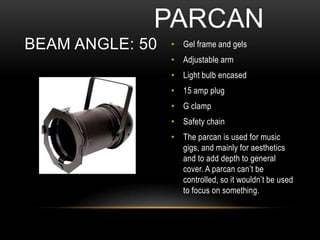
• Gel frame and gels
• Adjustable arm
• Light bulb encased
• 15 amp plug
• G clamp
• Safety chain
• The parcan is used for music
gigs, and mainly for aesthetics
and to add depth to general
cover. A parcan can’t be
controlled, so it wouldn’t be used
to focus on something.
PARCAN
BEAM ANGLE: 50
• If I wanted to create a chase effect at a music gig I
would use a parcan. This is because parcans are used
for aesthetic purposes and would give depth to general
cover. I would use it over a profile because a profile
would give a defined light, instead of diffused. Profiles
also could be used elsewhere at the gig instead,
creating effects for example with a gobo or an iris. I
would also use a parcan over a birdie because a birdie’s
bulb is halogen (100 watt) which is not as powerful as a
parcan’s 500 watt bulb.
COMPARE & CONTRAST: PARCAN
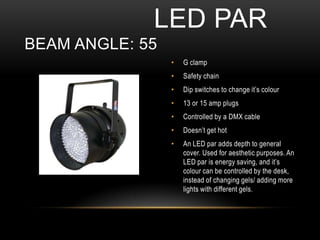
• G clamp
• Safety chain
• Dip switches to change it’s colour
• 13 or 15 amp plugs
• Controlled by a DMX cable
• Doesn’t get hot
• An LED par adds depth to general
cover. Used for aesthetic purposes. An
LED par is energy saving, and it’s
colour can be controlled by the desk,
instead of changing gels/ adding more
lights with different gels.
LED PAR
BEAM ANGLE: 55
• If I wanted to provide multiple colour, enabling the scene
mood to change, I would use an LED par. This is because
it is connected to the desk with a DMX cable, allowing it’s
colour to be changed from the desk as opposed to
changing gels or adding more lights. I would use a LED
par over a parcan because I would have to change a
parcan’s gel frame or add more lights. I would also use an
LED par over a flood light for the same reason that I
would have to change it’s gels or add more lights. An LED
par is also energy saving and can produce primary
colours.
COMPARE & CONTRAST: LED PAR
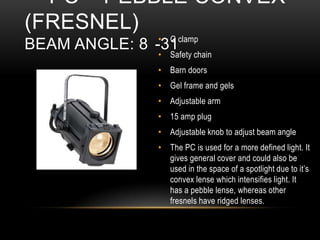
• G clamp
• Safety chain
• Barn doors
• Gel frame and gels
• Adjustable arm
• 15 amp plug
• Adjustable knob to adjust beam angle
• The PC is used for a more defined light. It
gives general cover and could also be
used in the space of a spotlight due to it’s
convex lense which intensifies light. It
has a pebble lense, whereas other
fresnels have ridged lenses.
PC – PEBBLE CONVEX
(FRESNEL)
BEAM ANGLE: 8 -31
• If a situation occurred when I need to isolate an actor on
stage, but couldn’t access a profile if, for example, they
were broken, I would use a PC. This is because a PC
has the same pebble convex lense as a spotlight,
allowing a defined, focused circle of light around an
actor. I would use a PC over another fresnel such as a
CCT because a CCT has a ridged glass lense, causing
it’s light to be diffused. It also can’t be focused. I would
also use a PC over a Selecon, because it is also a
diffused light like the CCT, and also cannot be focused.
COMPARE & CONTRAST: PC FRESNEL
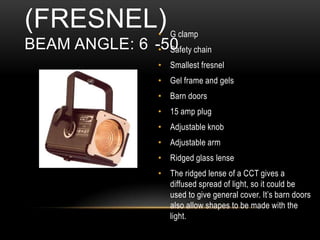
• G clamp
• Safety chain
• Smallest fresnel
• Gel frame and gels
• Barn doors
• 15 amp plug
• Adjustable knob
• Adjustable arm
• Ridged glass lense
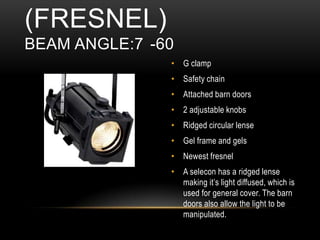
• The ridged lense of a CCT gives a
diffused spread of light, so it could be
used to give general cover. It’s barn doors
also allow shapes to be made with the
light.
(FRESNEL)
BEAM ANGLE: 6 -50
• If I needed side lights on a boom for a dance
performance I would use a CCT. This is because it gives
a diffused spread of light due to its ridged lense. Shapes
can also be created using it’s barn doors which could be
used in the performance for aesthetic purposes. I would
use a CCT over a profile because a profile is too defined,
and a light such as a CCT can do the job instead, saving
the profiles for using gobos, iris’ etc. I would also use a
CCT over a pinspot. This is because a pinspot is not
powerful enough.
COMPARE & CONTRAST: CCT FRESNEL
• G clamp
• Safety chain
• Attached barn doors
• 2 adjustable knobs
• Ridged circular lense
• Gel frame and gels
• Newest fresnel
• A selecon has a ridged lense
making it’s light diffused, which is
used for general cover. The barn
doors also allow the light to be
manipulated.
(FRESNEL)
BEAM ANGLE:7 -60
• If I wanted to create general cover for a show, I
would use a selecon. This is because it can give
a diffused spread of light. I could also use a CCT
in this situation, but I wouldn’t use a selecon and
a CCT together because the light would become
patchy, which is why only one type of light should
be used in general cover. I would use a selecon
over a parcan because a parcan would only be
used to add depth to general cover.
COMPARE & CONTRAST: SELECON FRESNEL
• G clamp
• Safety chain
• Gel frames and gels
• Barn doors
• 15 amp plug
• 1000 watt (double a single fresnel)
• Ridged glass lense
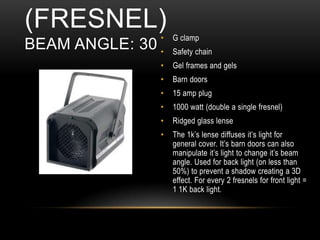
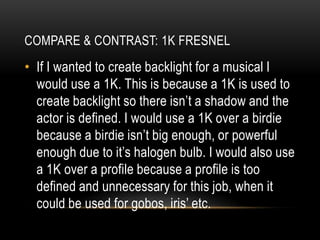
• The 1k’s lense diffuses it’s light for
general cover. It’s barn doors can also
manipulate it’s light to change it’s beam
angle. Used for back light (on less than
50%) to prevent a shadow creating a 3D
effect. For every 2 fresnels for front light =
1 1K back light.
(FRESNEL)
BEAM ANGLE: 30
• If I wanted to create backlight for a musical I
would use a 1K. This is because a 1K is used to
create backlight so there isn’t a shadow and the
actor is defined. I would use a 1K over a birdie
because a birdie isn’t big enough, or powerful
enough due to it’s halogen bulb. I would also use
a 1K over a profile because a profile is too
defined and unnecessary for this job, when it
could be used for gobos, iris’ etc.
COMPARE & CONTRAST: 1K FRESNEL
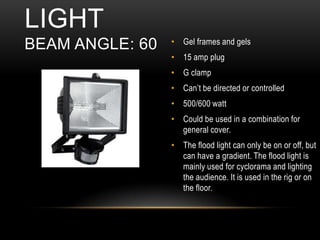
• Gel frames and gels
• 15 amp plug
• G clamp
• Can’t be directed or controlled
• 500/600 watt
• Could be used in a combination for
general cover.
• The flood light can only be on or off, but
can have a gradient. The flood light is
mainly used for cyclorama and lighting
the audience. It is used in the rig or on
the floor.
LIGHT
BEAM ANGLE: 60
• If I wanted to light a cyclorama I would use a
flood light. This is because I could add gels to
a flood light, the hang them from above and
angle them for aesthetic purposes. I would use
a flood light over a profile because a profile is
too defined and it could be used elsewhere due
to it’s ability to hold a gobo/iris etc. I would also
use it over a birdie because a birdie is too
small and it isn’t powerful enough.
COMPARE & CONTRAST: FLOOD LIGHT
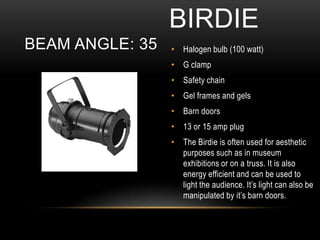
• Halogen bulb (100 watt)
• G clamp
• Safety chain
• Gel frames and gels
• Barn doors
• 13 or 15 amp plug
• The Birdie is often used for aesthetic
purposes such as in museum
exhibitions or on a truss. It is also
energy efficient and can be used to
light the audience. It’s light can also be
manipulated by it’s barn doors.
BIRDIE
BEAM ANGLE: 35
• If I wanted to light the audience I would use a birdie
because they are small and their bulb is only 100 watt,
which will allow the audience to be lit, whilst not pulling
attention away from the stage. A birdie would only be
used for seating or walk ways in a theatre. I would use a
birdie over a selecon because a selecon would give too
much general cover. I would also use a birdie over a
parcan because parcans are too big, and there would be
too much focus on the audience.
COMPARE & CONTRAST: BIRDIE
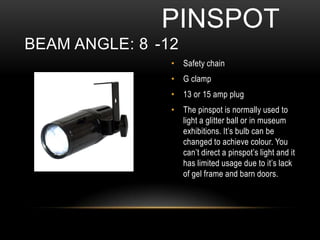
• Safety chain
• G clamp
• 13 or 15 amp plug
• The pinspot is normally used to
light a glitter ball or in museum
exhibitions. It’s bulb can be
changed to achieve colour. You
can’t direct a pinspot’s light and it
has limited usage due to it’s lack
of gel frame and barn doors.
PINSPOT
BEAM ANGLE: 8 -12
• If a show wanted to use a glitter ball, I would use a
pinspot.. This is because it is small, and is a direct light.
It is also good for aesthetic purposes. To light a glitter
ball I would have to use 2 or 4 pinspots for it to be
effective. I would use pinspots over a flood light
because a flood light would light too much causing the
glitter ball to have no effect. I would also use a pinspot
over an LED par, because an LED par would also flood
the area, and it would colour it when a glitter ball ideally
needs a white light.
COMPARE & CONTRAST: PINSPOT
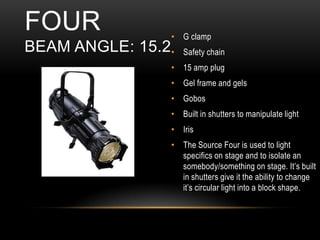
• G clamp
• Safety chain
• 15 amp plug
• Gel frame and gels
• Gobos
• Built in shutters to manipulate light
• Iris
• The Source Four is used to light
specifics on stage and to isolate an
somebody/something on stage. It’s built
in shutters give it the ability to change
it’s circular light into a block shape.
FOUR
BEAM ANGLE: 15.2
• If I wanted to isolate an actor on stage I would
use a source four. This is because it’s shutters
can manipulate it’s light enabling onstage
isolation. I would use it over a flood light because
a flood can’t be manipulated to create an isolated
section. I would also use a source four over a
selecon because a selecon can’t give a defined
edge to it’s light due to it’s ridged lense.
COMPARE & CONTRAST: SOURCE FOUR
• G clamp
• Safety chain
• 15 amp plug
• Shutters to manipulate light
• Gel frame and gels
• Gobos
• Iris
• 2 adjustments (one to focus and one to
blur and make bigger)
• The Minuette Profile is used to light
specifics and isolate
somebody/something on stage. It’s
shutters manipulate light into any shape.
PROFILE
BEAM ANGLE: 6 -48
• If I wanted to create the illusion of a window on stage I
would use a minuette profile due to it’s ability to use a
gobo, which I would need to create this. I would use a
minuette profile over a parcan because a parcan can’t be
controlled or directed, and it’s beam angle is too big. I
would also use a minuette profile over a CCT. This is
because a CCT gives a diffused light as opposed to a
defined light due to it’s ridged lense. It also can’t hold a
gobo which this situation needs.
COMPARE & CONTRAST: MINUETTE PROFILE

Lighting unit 65

  • 1.
  • 2.
    • Gel frameand gels • Adjustable arm • Light bulb encased • 15 amp plug • G clamp • Safety chain • The parcan is used for music gigs, and mainly for aesthetics and to add depth to general cover. A parcan can’t be controlled, so it wouldn’t be used to focus on something. PARCAN BEAM ANGLE: 50
  • 3.
    • If Iwanted to create a chase effect at a music gig I would use a parcan. This is because parcans are used for aesthetic purposes and would give depth to general cover. I would use it over a profile because a profile would give a defined light, instead of diffused. Profiles also could be used elsewhere at the gig instead, creating effects for example with a gobo or an iris. I would also use a parcan over a birdie because a birdie’s bulb is halogen (100 watt) which is not as powerful as a parcan’s 500 watt bulb. COMPARE & CONTRAST: PARCAN
  • 4.
    • G clamp •Safety chain • Dip switches to change it’s colour • 13 or 15 amp plugs • Controlled by a DMX cable • Doesn’t get hot • An LED par adds depth to general cover. Used for aesthetic purposes. An LED par is energy saving, and it’s colour can be controlled by the desk, instead of changing gels/ adding more lights with different gels. LED PAR BEAM ANGLE: 55
  • 5.
    • If Iwanted to provide multiple colour, enabling the scene mood to change, I would use an LED par. This is because it is connected to the desk with a DMX cable, allowing it’s colour to be changed from the desk as opposed to changing gels or adding more lights. I would use a LED par over a parcan because I would have to change a parcan’s gel frame or add more lights. I would also use an LED par over a flood light for the same reason that I would have to change it’s gels or add more lights. An LED par is also energy saving and can produce primary colours. COMPARE & CONTRAST: LED PAR
  • 6.
    • G clamp •Safety chain • Barn doors • Gel frame and gels • Adjustable arm • 15 amp plug • Adjustable knob to adjust beam angle • The PC is used for a more defined light. It gives general cover and could also be used in the space of a spotlight due to it’s convex lense which intensifies light. It has a pebble lense, whereas other fresnels have ridged lenses. PC – PEBBLE CONVEX (FRESNEL) BEAM ANGLE: 8 -31
  • 7.
    • If asituation occurred when I need to isolate an actor on stage, but couldn’t access a profile if, for example, they were broken, I would use a PC. This is because a PC has the same pebble convex lense as a spotlight, allowing a defined, focused circle of light around an actor. I would use a PC over another fresnel such as a CCT because a CCT has a ridged glass lense, causing it’s light to be diffused. It also can’t be focused. I would also use a PC over a Selecon, because it is also a diffused light like the CCT, and also cannot be focused. COMPARE & CONTRAST: PC FRESNEL
  • 8.
    • G clamp •Safety chain • Smallest fresnel • Gel frame and gels • Barn doors • 15 amp plug • Adjustable knob • Adjustable arm • Ridged glass lense • The ridged lense of a CCT gives a diffused spread of light, so it could be used to give general cover. It’s barn doors also allow shapes to be made with the light. (FRESNEL) BEAM ANGLE: 6 -50
  • 9.
    • If Ineeded side lights on a boom for a dance performance I would use a CCT. This is because it gives a diffused spread of light due to its ridged lense. Shapes can also be created using it’s barn doors which could be used in the performance for aesthetic purposes. I would use a CCT over a profile because a profile is too defined, and a light such as a CCT can do the job instead, saving the profiles for using gobos, iris’ etc. I would also use a CCT over a pinspot. This is because a pinspot is not powerful enough. COMPARE & CONTRAST: CCT FRESNEL
  • 10.
    • G clamp •Safety chain • Attached barn doors • 2 adjustable knobs • Ridged circular lense • Gel frame and gels • Newest fresnel • A selecon has a ridged lense making it’s light diffused, which is used for general cover. The barn doors also allow the light to be manipulated. (FRESNEL) BEAM ANGLE:7 -60
  • 11.
    • If Iwanted to create general cover for a show, I would use a selecon. This is because it can give a diffused spread of light. I could also use a CCT in this situation, but I wouldn’t use a selecon and a CCT together because the light would become patchy, which is why only one type of light should be used in general cover. I would use a selecon over a parcan because a parcan would only be used to add depth to general cover. COMPARE & CONTRAST: SELECON FRESNEL
  • 12.
    • G clamp •Safety chain • Gel frames and gels • Barn doors • 15 amp plug • 1000 watt (double a single fresnel) • Ridged glass lense • The 1k’s lense diffuses it’s light for general cover. It’s barn doors can also manipulate it’s light to change it’s beam angle. Used for back light (on less than 50%) to prevent a shadow creating a 3D effect. For every 2 fresnels for front light = 1 1K back light. (FRESNEL) BEAM ANGLE: 30
  • 13.
    • If Iwanted to create backlight for a musical I would use a 1K. This is because a 1K is used to create backlight so there isn’t a shadow and the actor is defined. I would use a 1K over a birdie because a birdie isn’t big enough, or powerful enough due to it’s halogen bulb. I would also use a 1K over a profile because a profile is too defined and unnecessary for this job, when it could be used for gobos, iris’ etc. COMPARE & CONTRAST: 1K FRESNEL
  • 14.
    • Gel framesand gels • 15 amp plug • G clamp • Can’t be directed or controlled • 500/600 watt • Could be used in a combination for general cover. • The flood light can only be on or off, but can have a gradient. The flood light is mainly used for cyclorama and lighting the audience. It is used in the rig or on the floor. LIGHT BEAM ANGLE: 60
  • 15.
    • If Iwanted to light a cyclorama I would use a flood light. This is because I could add gels to a flood light, the hang them from above and angle them for aesthetic purposes. I would use a flood light over a profile because a profile is too defined and it could be used elsewhere due to it’s ability to hold a gobo/iris etc. I would also use it over a birdie because a birdie is too small and it isn’t powerful enough. COMPARE & CONTRAST: FLOOD LIGHT
  • 16.
    • Halogen bulb(100 watt) • G clamp • Safety chain • Gel frames and gels • Barn doors • 13 or 15 amp plug • The Birdie is often used for aesthetic purposes such as in museum exhibitions or on a truss. It is also energy efficient and can be used to light the audience. It’s light can also be manipulated by it’s barn doors. BIRDIE BEAM ANGLE: 35
  • 17.
    • If Iwanted to light the audience I would use a birdie because they are small and their bulb is only 100 watt, which will allow the audience to be lit, whilst not pulling attention away from the stage. A birdie would only be used for seating or walk ways in a theatre. I would use a birdie over a selecon because a selecon would give too much general cover. I would also use a birdie over a parcan because parcans are too big, and there would be too much focus on the audience. COMPARE & CONTRAST: BIRDIE
  • 18.
    • Safety chain •G clamp • 13 or 15 amp plug • The pinspot is normally used to light a glitter ball or in museum exhibitions. It’s bulb can be changed to achieve colour. You can’t direct a pinspot’s light and it has limited usage due to it’s lack of gel frame and barn doors. PINSPOT BEAM ANGLE: 8 -12
  • 19.
    • If ashow wanted to use a glitter ball, I would use a pinspot.. This is because it is small, and is a direct light. It is also good for aesthetic purposes. To light a glitter ball I would have to use 2 or 4 pinspots for it to be effective. I would use pinspots over a flood light because a flood light would light too much causing the glitter ball to have no effect. I would also use a pinspot over an LED par, because an LED par would also flood the area, and it would colour it when a glitter ball ideally needs a white light. COMPARE & CONTRAST: PINSPOT
  • 20.
    • G clamp •Safety chain • 15 amp plug • Gel frame and gels • Gobos • Built in shutters to manipulate light • Iris • The Source Four is used to light specifics on stage and to isolate an somebody/something on stage. It’s built in shutters give it the ability to change it’s circular light into a block shape. FOUR BEAM ANGLE: 15.2
  • 21.
    • If Iwanted to isolate an actor on stage I would use a source four. This is because it’s shutters can manipulate it’s light enabling onstage isolation. I would use it over a flood light because a flood can’t be manipulated to create an isolated section. I would also use a source four over a selecon because a selecon can’t give a defined edge to it’s light due to it’s ridged lense. COMPARE & CONTRAST: SOURCE FOUR
  • 22.
    • G clamp •Safety chain • 15 amp plug • Shutters to manipulate light • Gel frame and gels • Gobos • Iris • 2 adjustments (one to focus and one to blur and make bigger) • The Minuette Profile is used to light specifics and isolate somebody/something on stage. It’s shutters manipulate light into any shape. PROFILE BEAM ANGLE: 6 -48
  • 23.
    • If Iwanted to create the illusion of a window on stage I would use a minuette profile due to it’s ability to use a gobo, which I would need to create this. I would use a minuette profile over a parcan because a parcan can’t be controlled or directed, and it’s beam angle is too big. I would also use a minuette profile over a CCT. This is because a CCT gives a diffused light as opposed to a defined light due to it’s ridged lense. It also can’t hold a gobo which this situation needs. COMPARE & CONTRAST: MINUETTE PROFILE