Lighting Overview
Lighting Overview
Lecture Created 9/8/10
Updated 10/13/14
by John M. Grace,
film worker and instructor
D.A.T.A. Charter High School
Albuquerque, NM
© 2010, John M. Grace
Free to use in the classroom
under a Creative Commons
attribution license
3-Point Lighting
3-Point Lighting
3-Point lighting is the lighting technique used
by cinematographers on most professional
productions. It is easy to understand but it
takes a lifetime to master.
In addition to 3-Point
lighting, there are also 5-
Point and 7-Point lighting
scenarios which we will
also discuss and analyze.
3-Point Lighting
3-Point Lighting
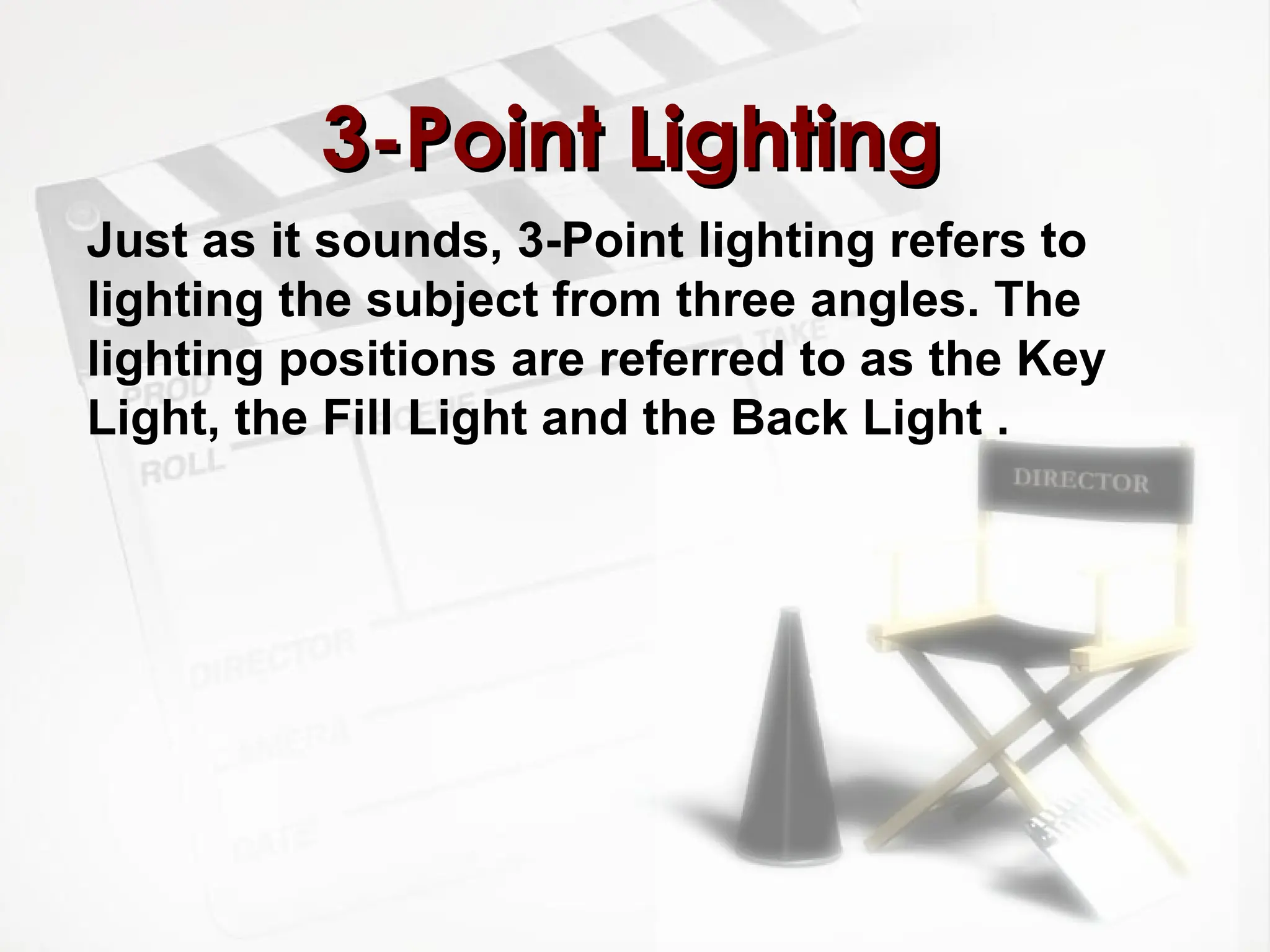
Just as it sounds, 3-Point lighting refers to
lighting the subject from three angles. The
lighting positions are referred to as the Key
Light, the Fill Light and the Back Light .
3-Point Lighting
3-Point Lighting
Just as it sounds, 3-Point lighting refers to
lighting the subject from three angles. The
lighting positions are referred to as the Key
Light, the Fill Light and the Back Light .
Camera
3-Point Lighting
3-Point Lighting
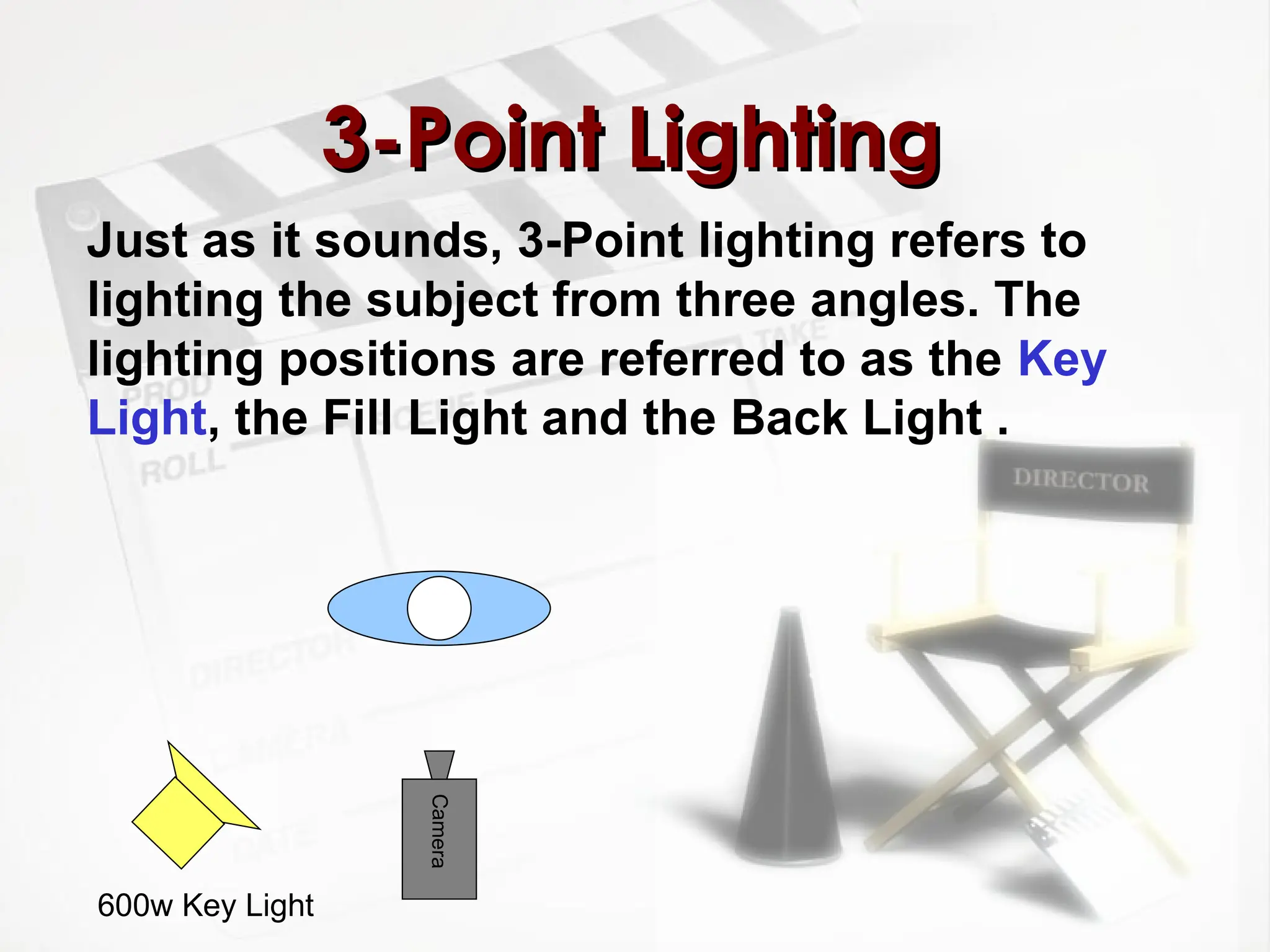
Just as it sounds, 3-Point lighting refers to
lighting the subject from three angles. The
lighting positions are referred to as the Key
Light, the Fill Light and the Back Light .
Camera
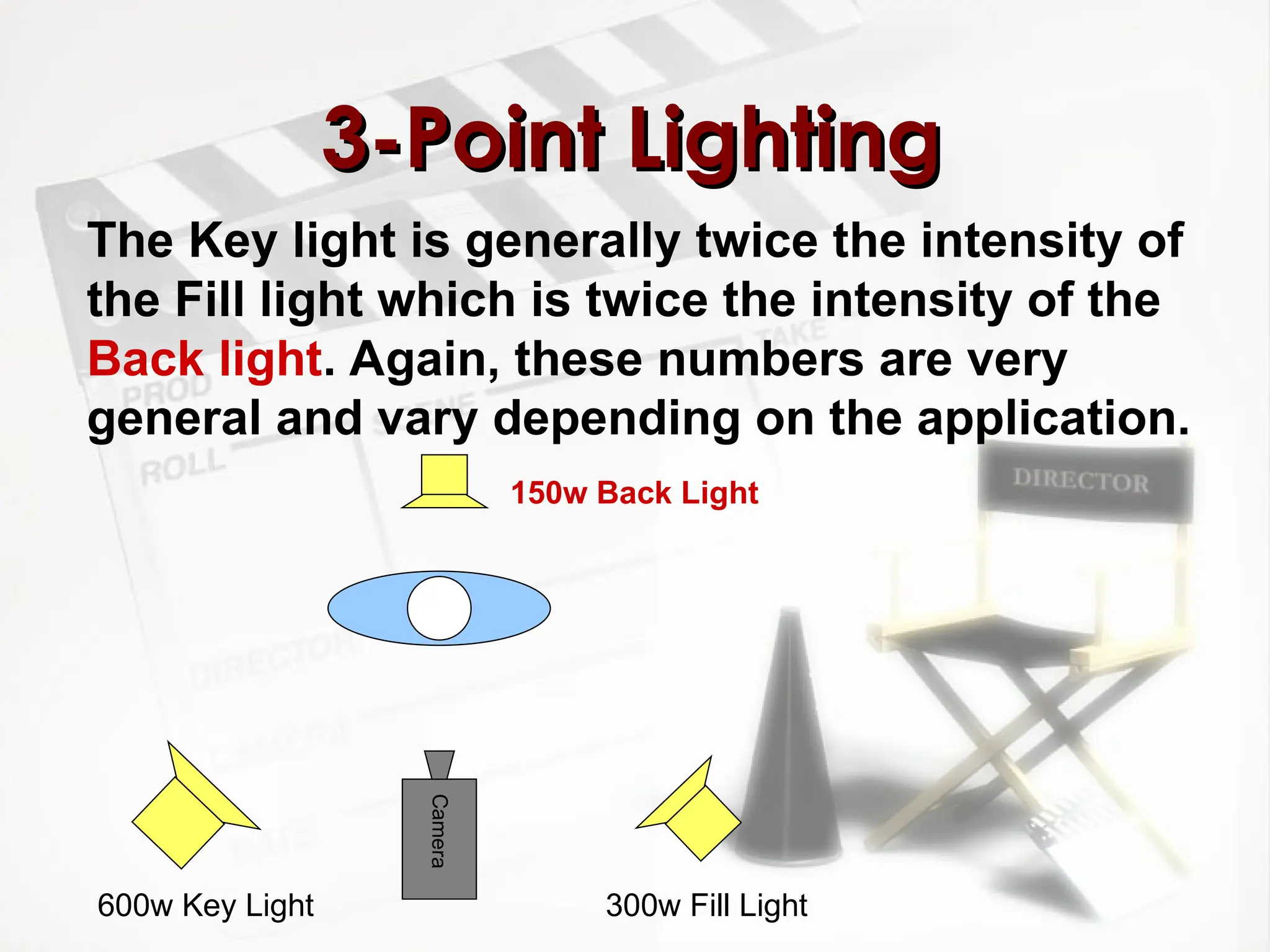
600w Key Light
3-Point Lighting
3-Point Lighting
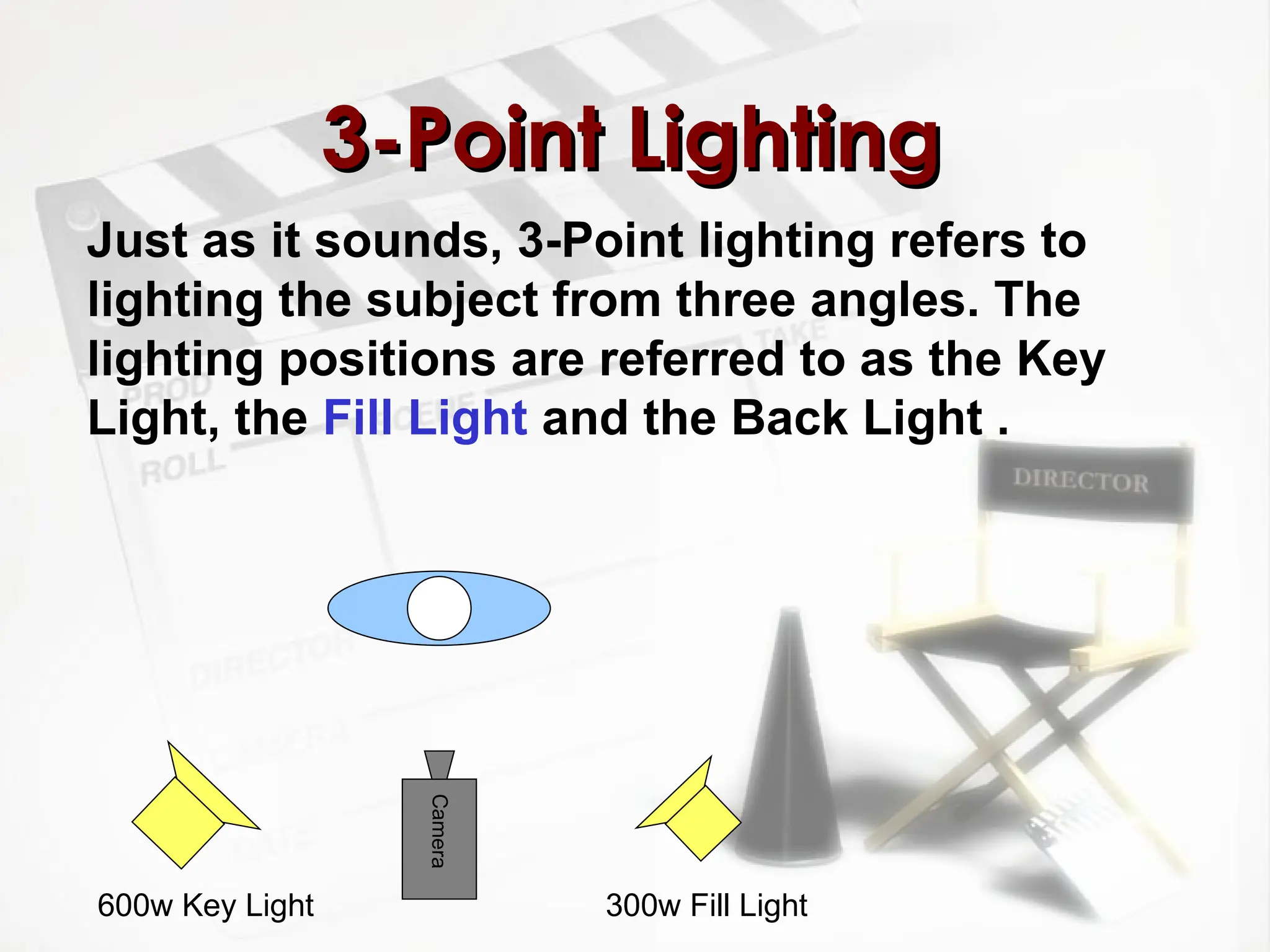
Just as it sounds, 3-Point lighting refers to
lighting the subject from three angles. The
lighting positions are referred to as the Key
Light, the Fill Light and the Back Light .
Camera
600w Key Light 300w Fill Light
3-Point Lighting
3-Point Lighting
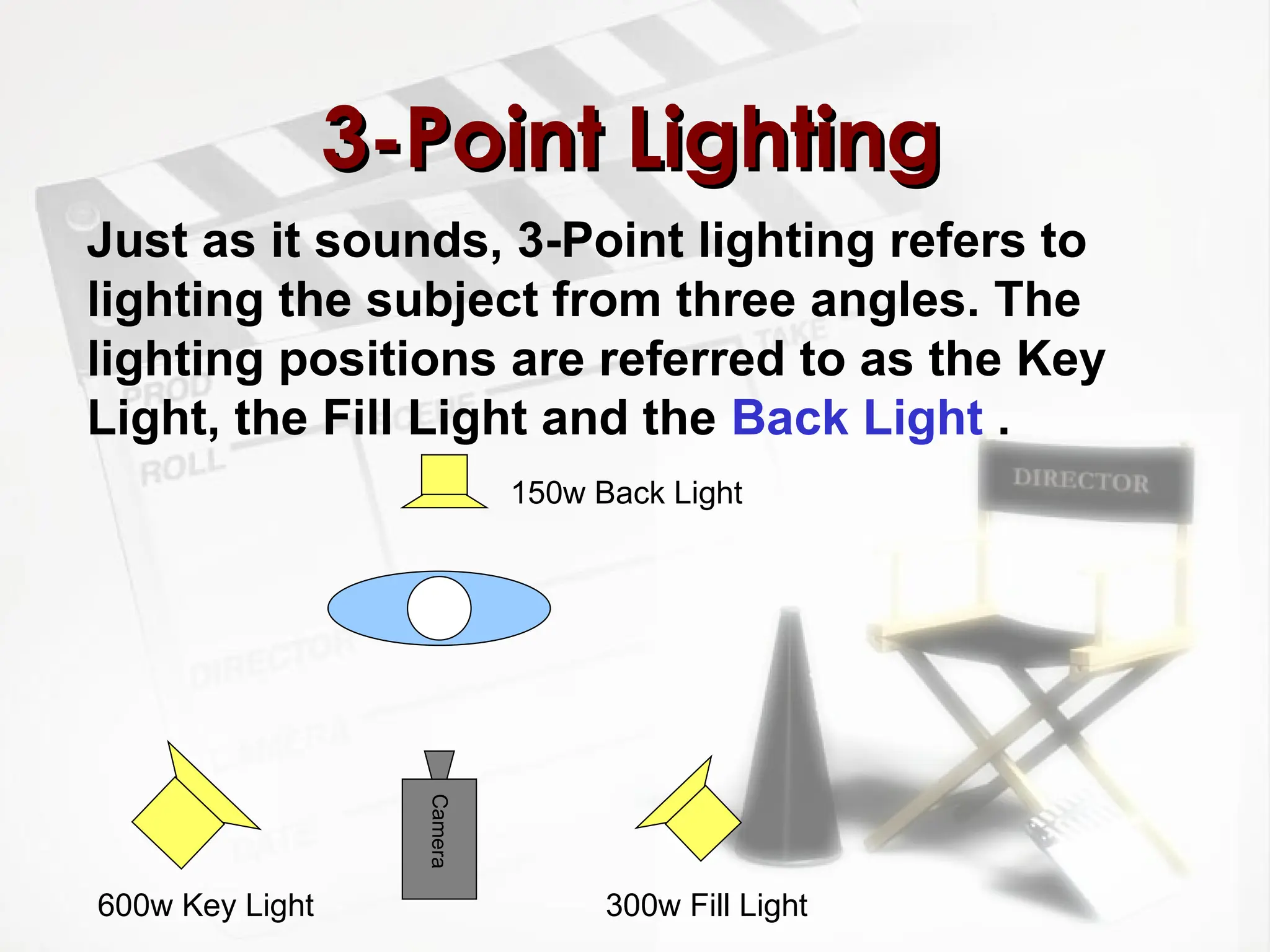
Just as it sounds, 3-Point lighting refers to
lighting the subject from three angles. The
lighting positions are referred to as the Key
Light, the Fill Light and the Back Light .
Camera
150w Back Light
600w Key Light 300w Fill Light
3-Point Lighting
3-Point Lighting
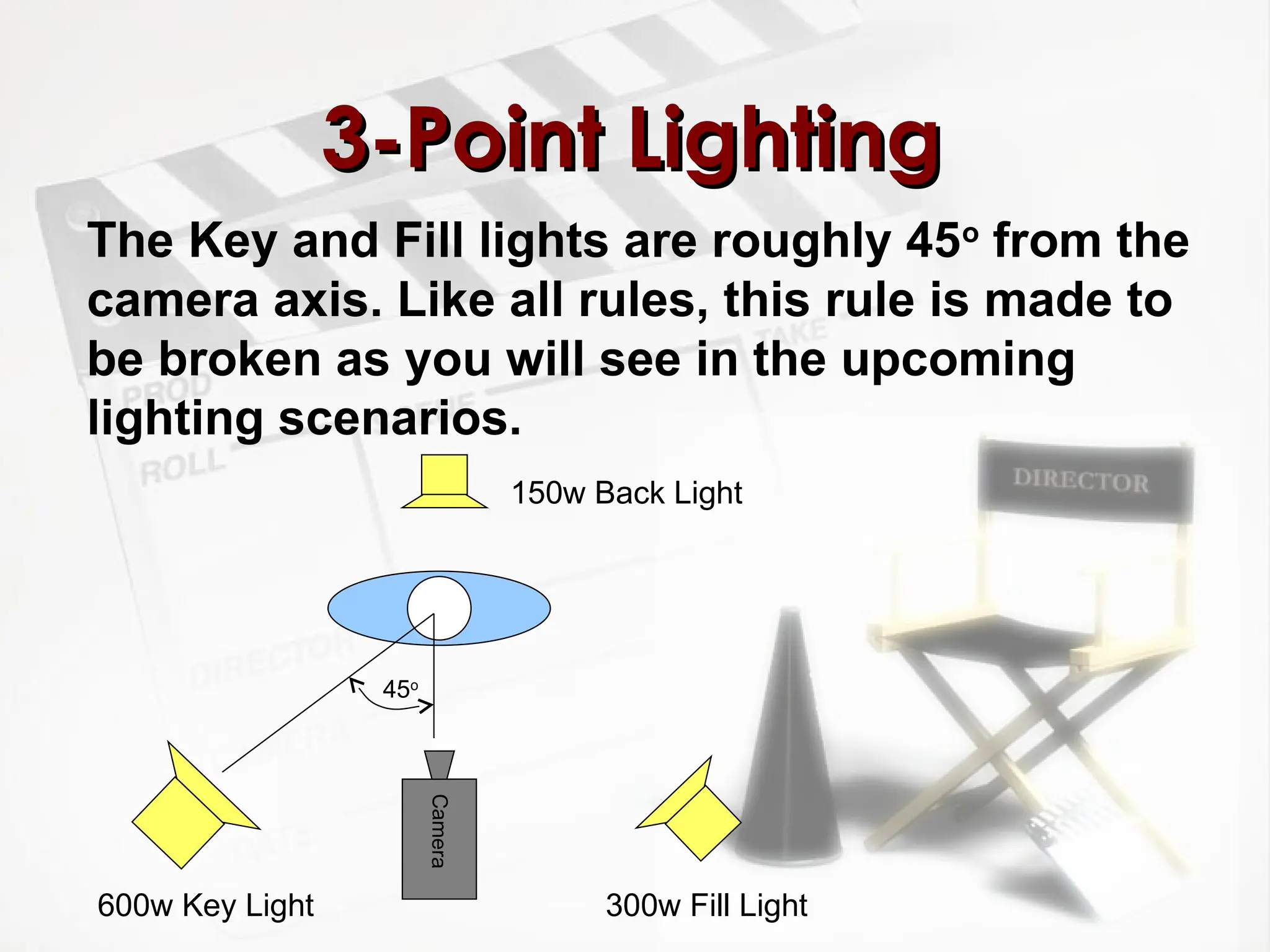
The Key and Fill lights are roughly 45o
from the
camera axis. Like all rules, this rule is made to
be broken as you will see in the upcoming
lighting scenarios.
Camera
150w Back Light
600w Key Light 300w Fill Light
45o
3-Point Lighting
3-Point Lighting
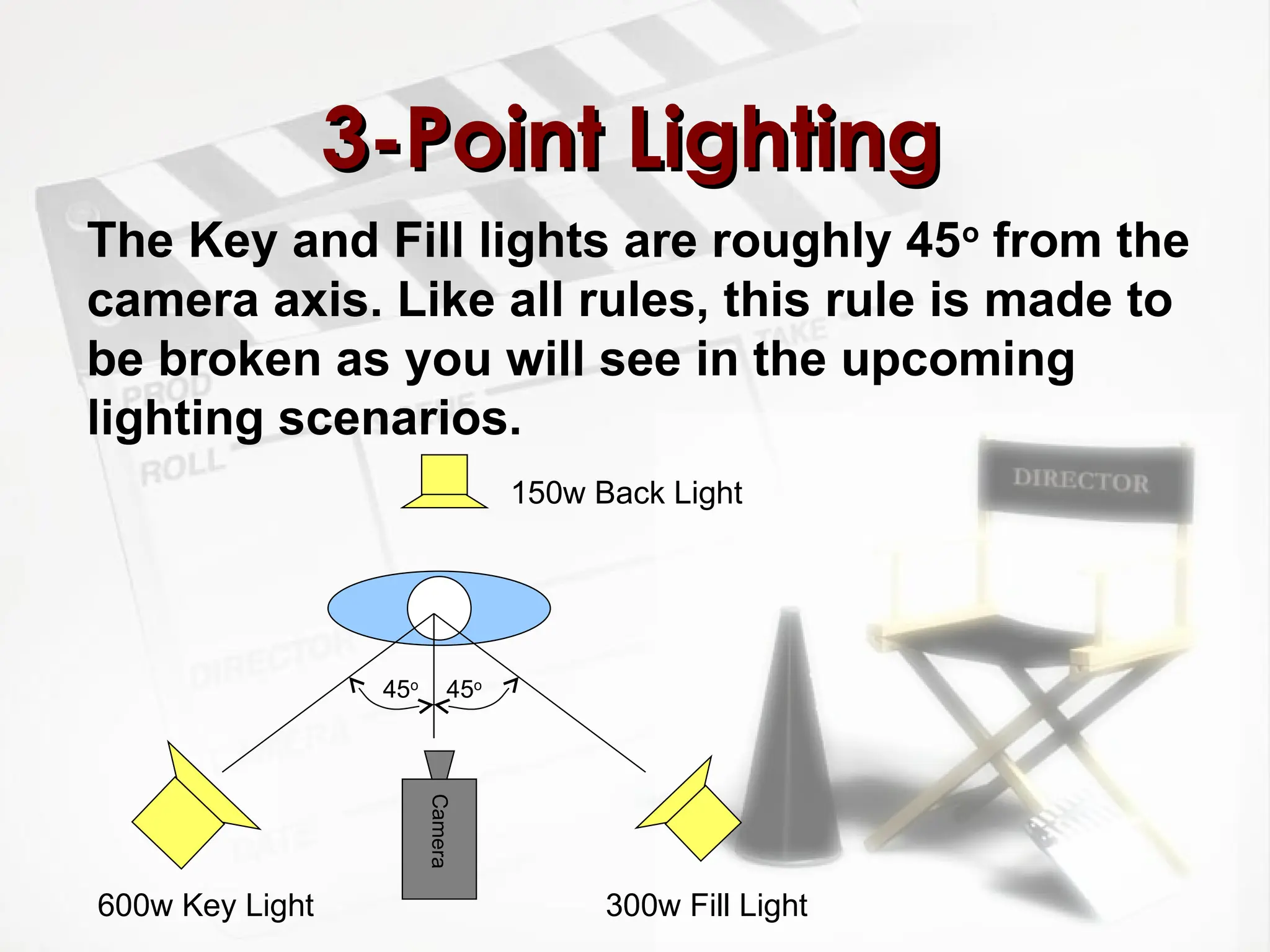
The Key and Fill lights are roughly 45o
from the
camera axis. Like all rules, this rule is made to
be broken as you will see in the upcoming
lighting scenarios.
Camera
150w Back Light
600w Key Light 300w Fill Light
45o
45o
3-Point Lighting
3-Point Lighting
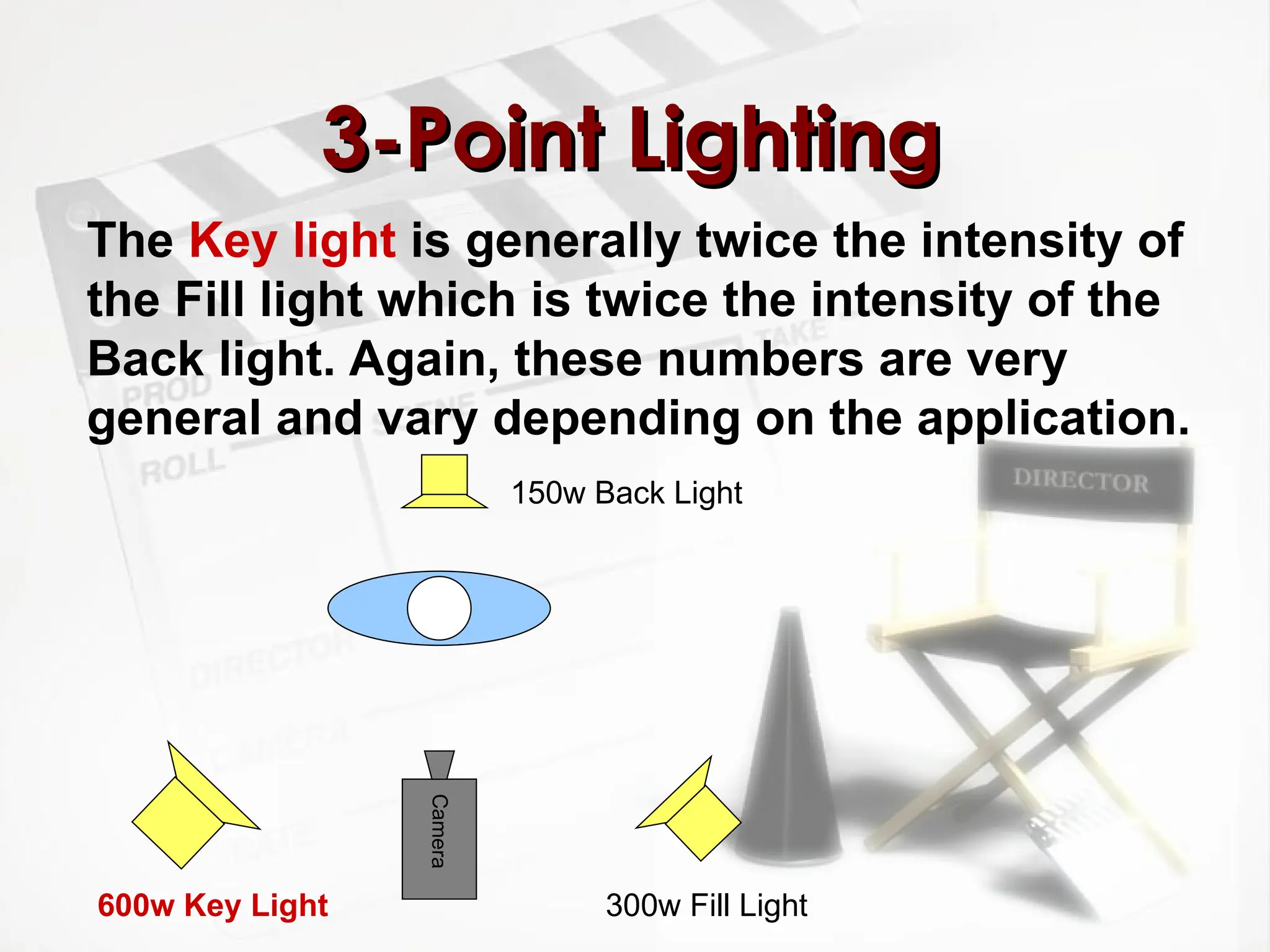
The Key light is generally twice the intensity of
the Fill light which is twice the intensity of the
Back light. Again, these numbers are very
general and vary depending on the application.
Camera
150w Back Light
600w Key Light 300w Fill Light
3-Point Lighting
3-Point Lighting
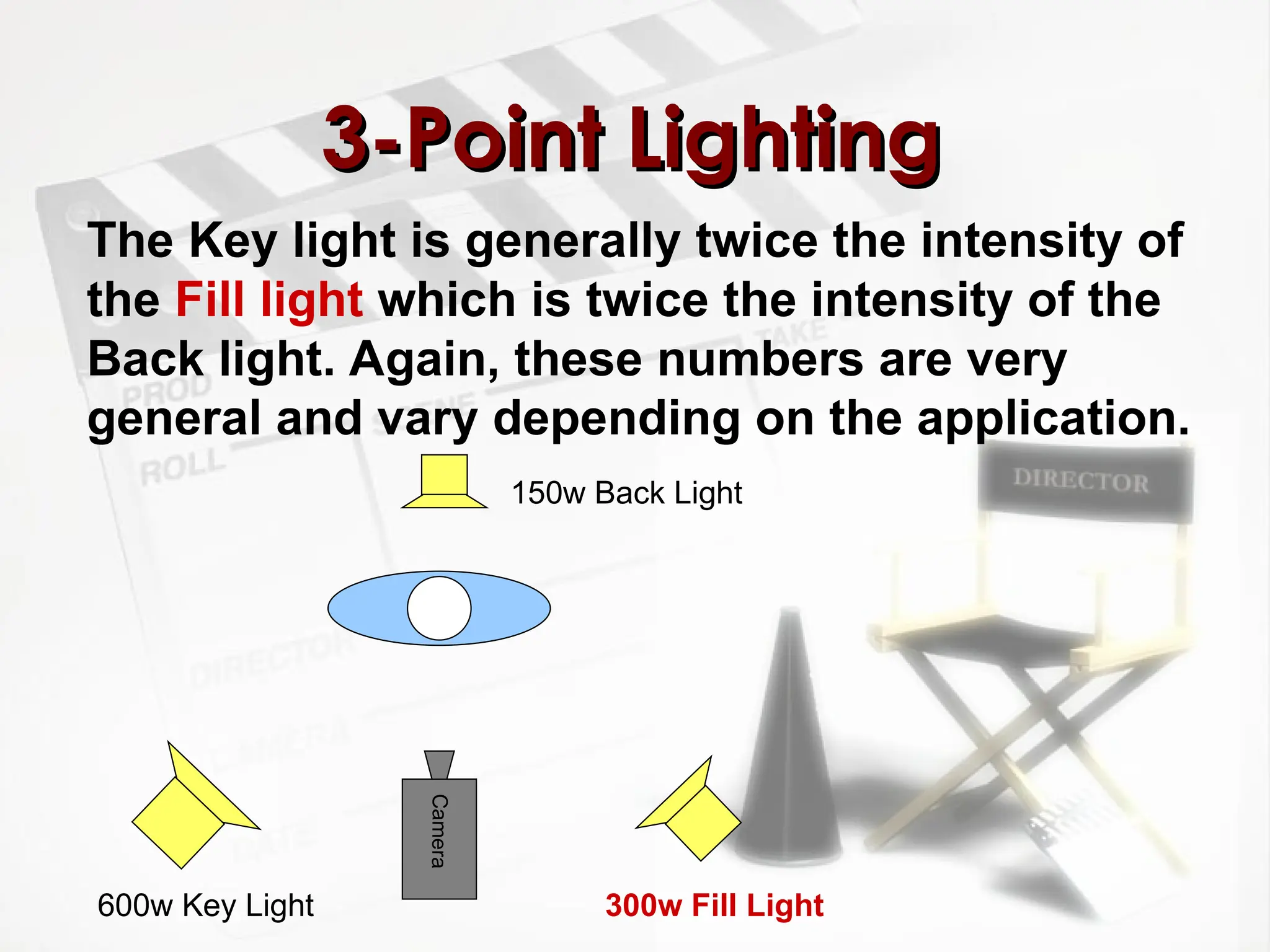
The Key light is generally twice the intensity of
the Fill light which is twice the intensity of the
Back light. Again, these numbers are very
general and vary depending on the application.
Camera
150w Back Light
600w Key Light 300w Fill Light
3-Point Lighting
3-Point Lighting
The Key light is generally twice the intensity of
the Fill light which is twice the intensity of the
Back light. Again, these numbers are very
general and vary depending on the application.
Camera
150w Back Light
600w Key Light 300w Fill Light
There are two primary and two secondary
types of lighting used in film and television.
The primary types are Tungsten and HMI.
Types of Lighting
Types of Lighting
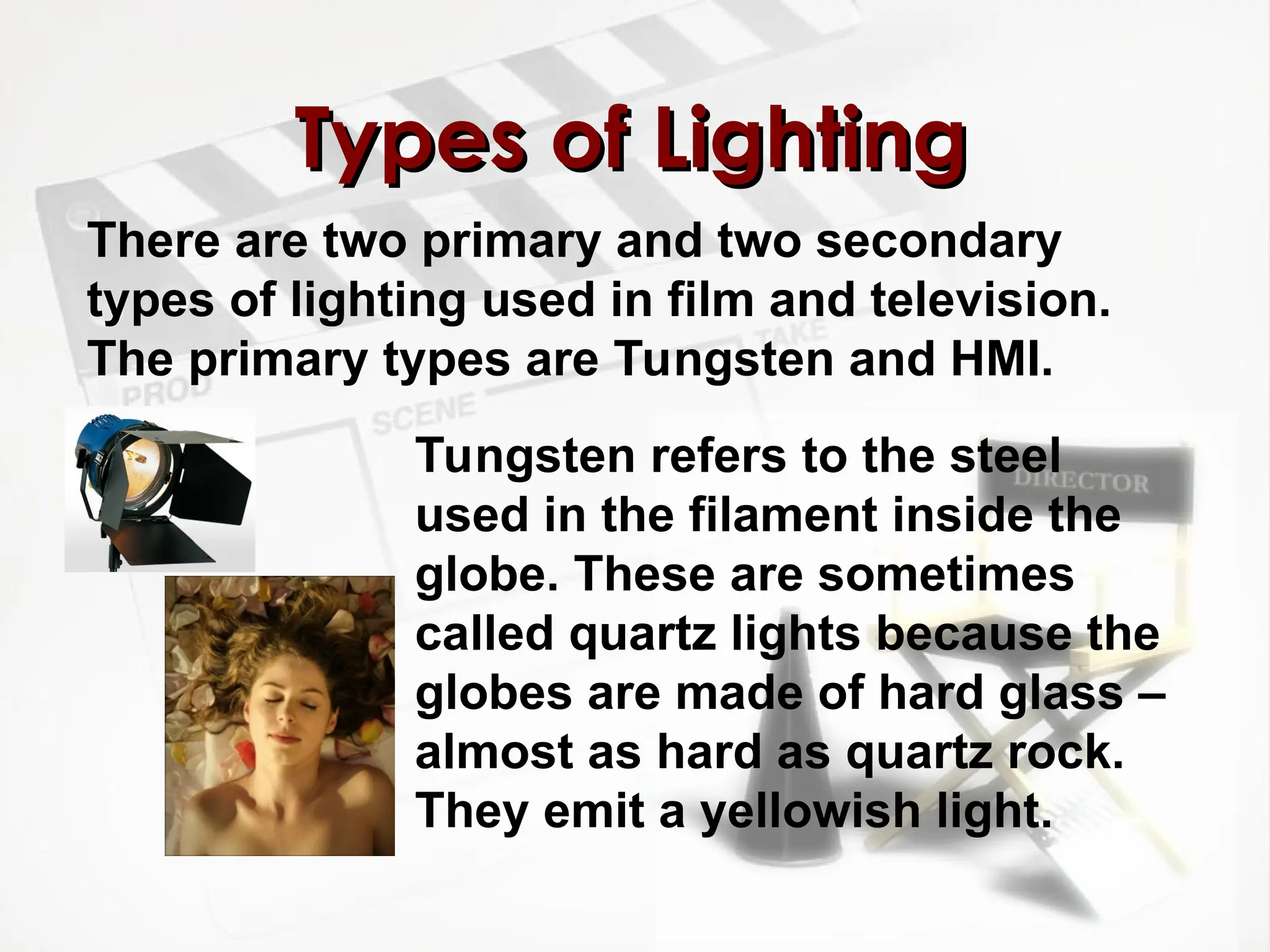
Tungsten refers to the steel
used in the filament inside the
globe. These are sometimes
called quartz lights because the
globes are made of hard glass –
almost as hard as quartz rock.
They emit a yellowish light.
There are two primary and two secondary
types of lighting used in film and television.
The primary types are Tungsten and HMI.
Types of Lighting
Types of Lighting
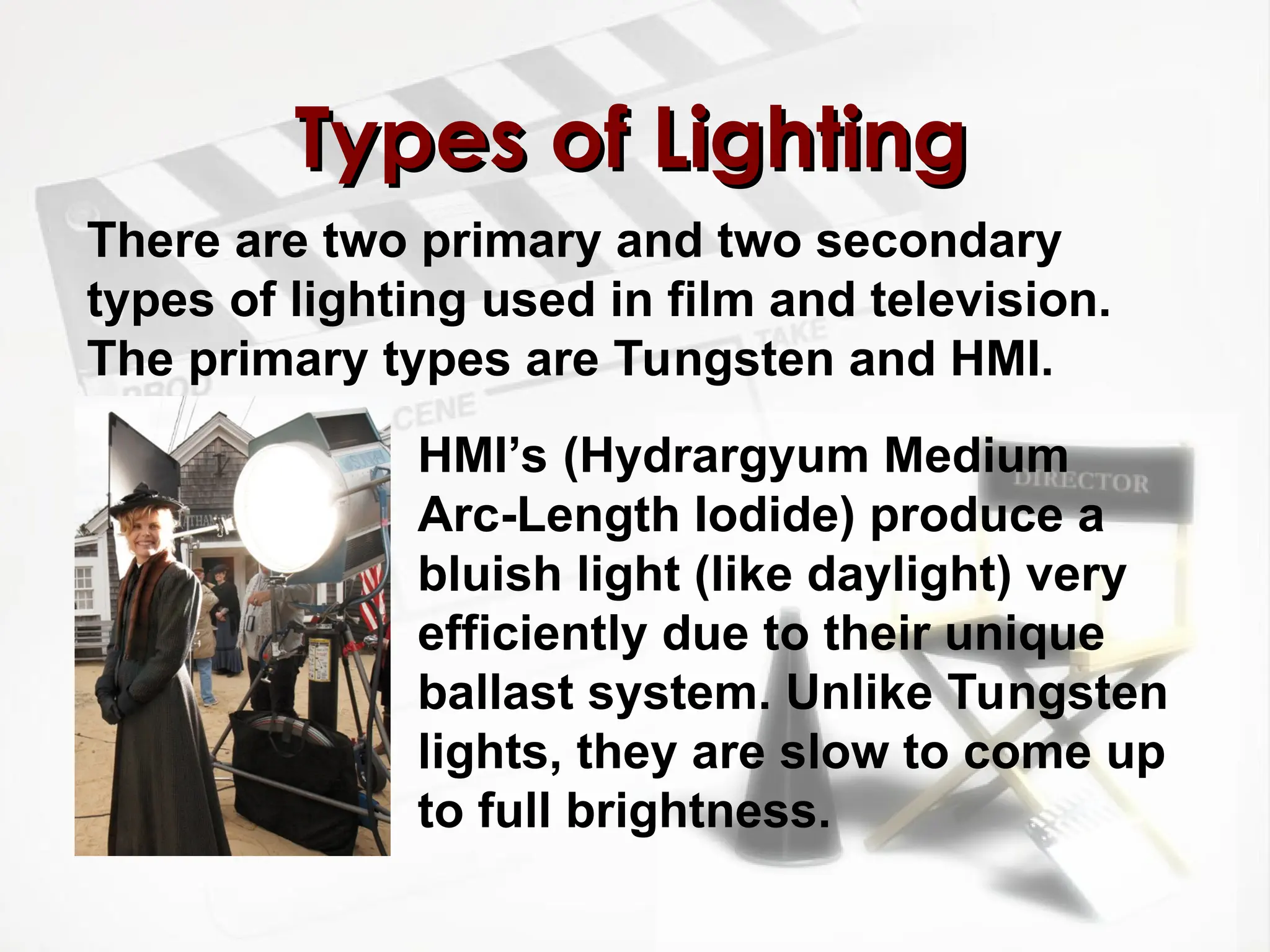
HMI’s (Hydrargyum Medium
Arc-Length Iodide) produce a
bluish light (like daylight) very
efficiently due to their unique
ballast system. Unlike Tungsten
lights, they are slow to come up
to full brightness.
There are two primary and two secondary
types of lighting used in film and television.
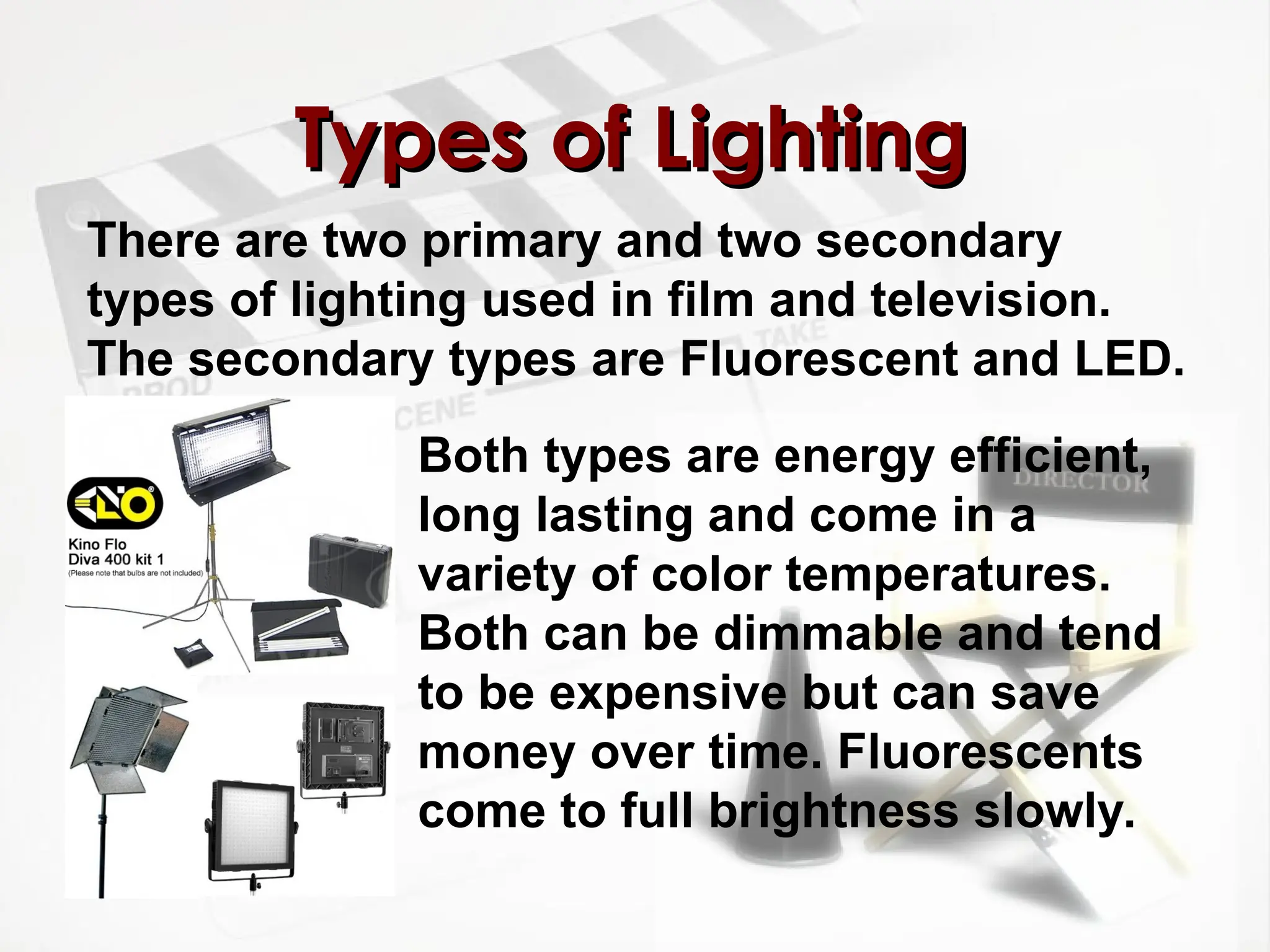
The secondary types are Fluorescent and LED.
Types of Lighting
Types of Lighting
Both types are energy efficient,
long lasting and come in a
variety of color temperatures.
Both can be dimmable and tend
to be expensive but can save
money over time. Fluorescents
come to full brightness slowly.
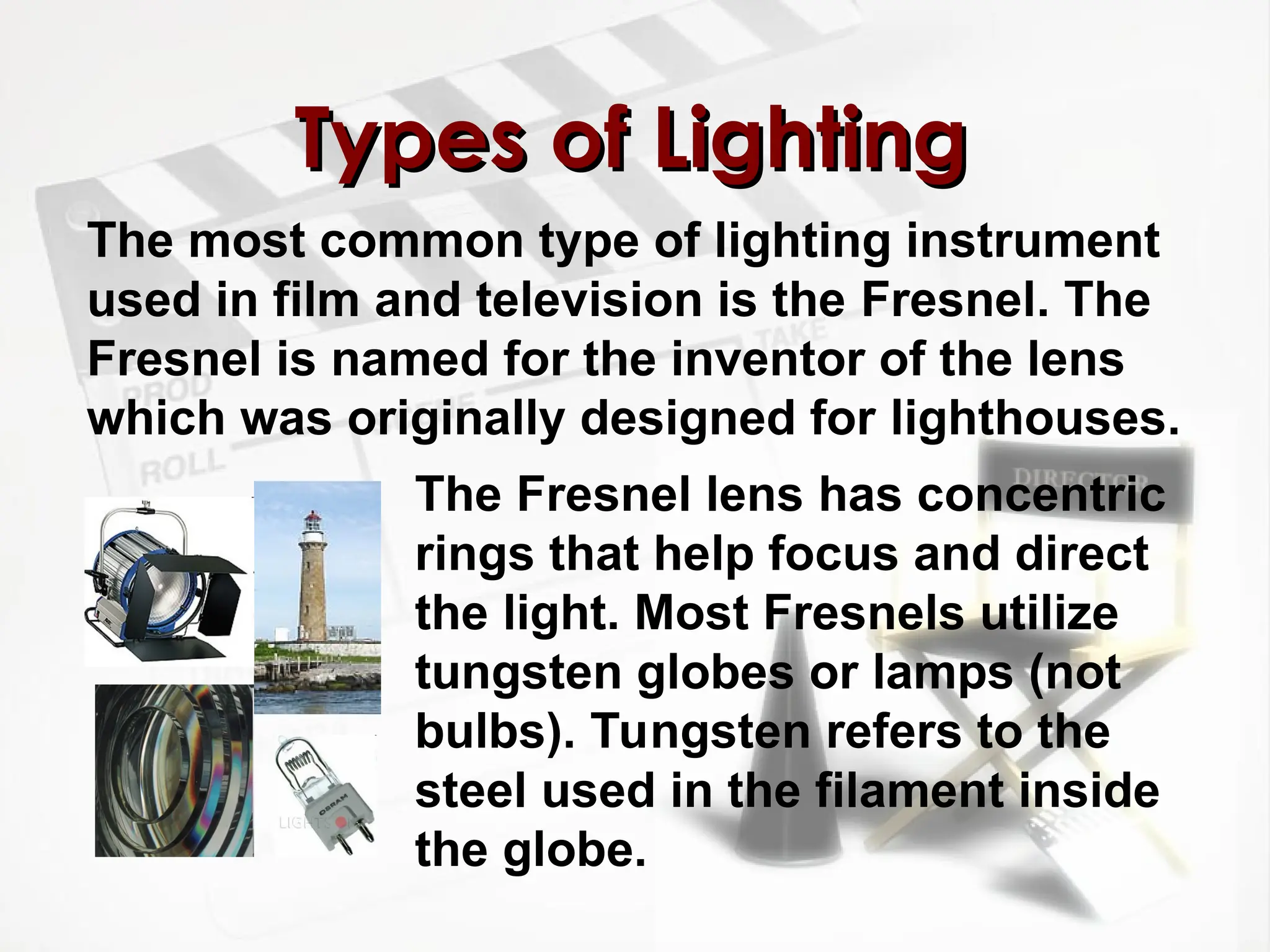
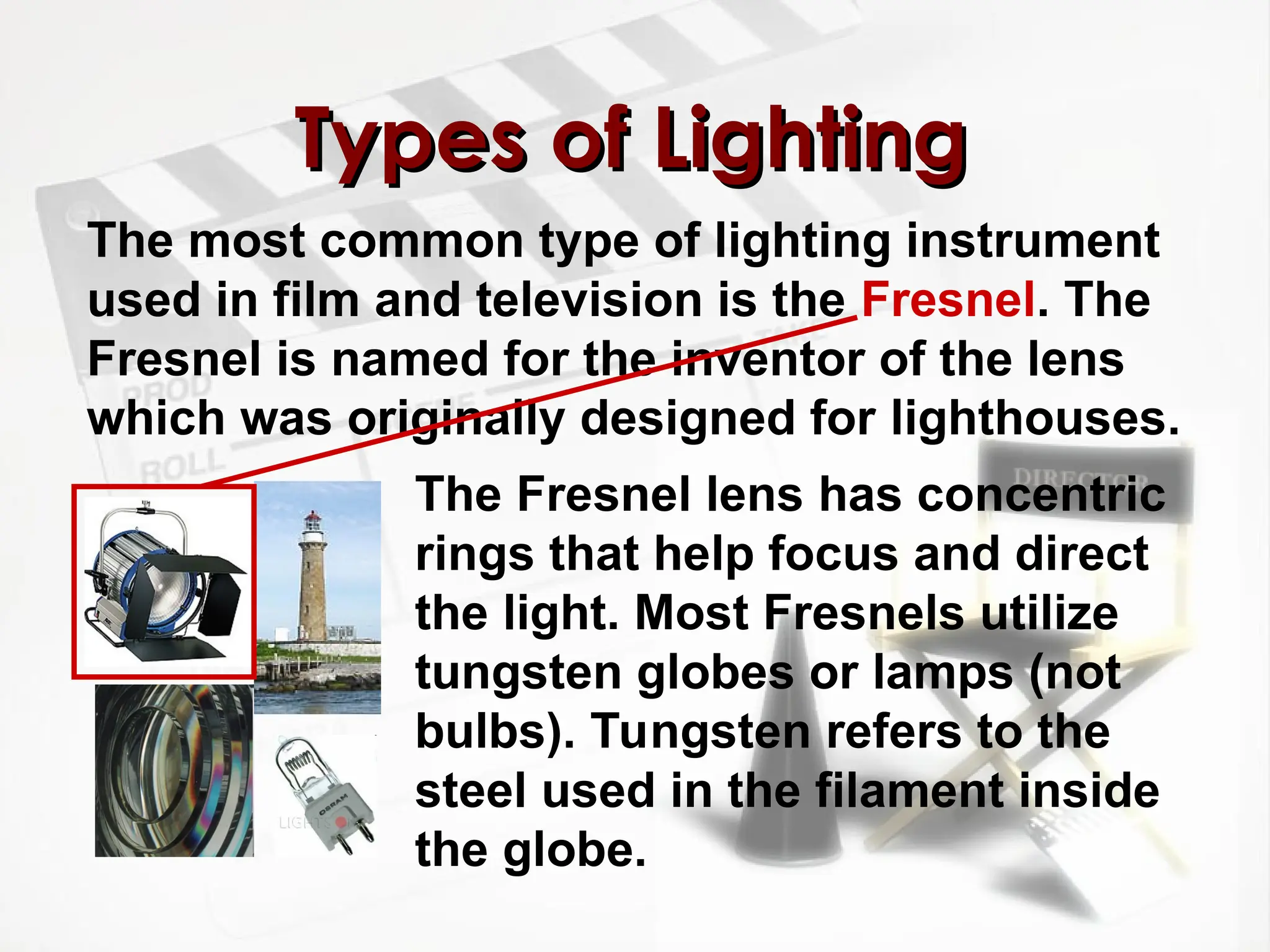
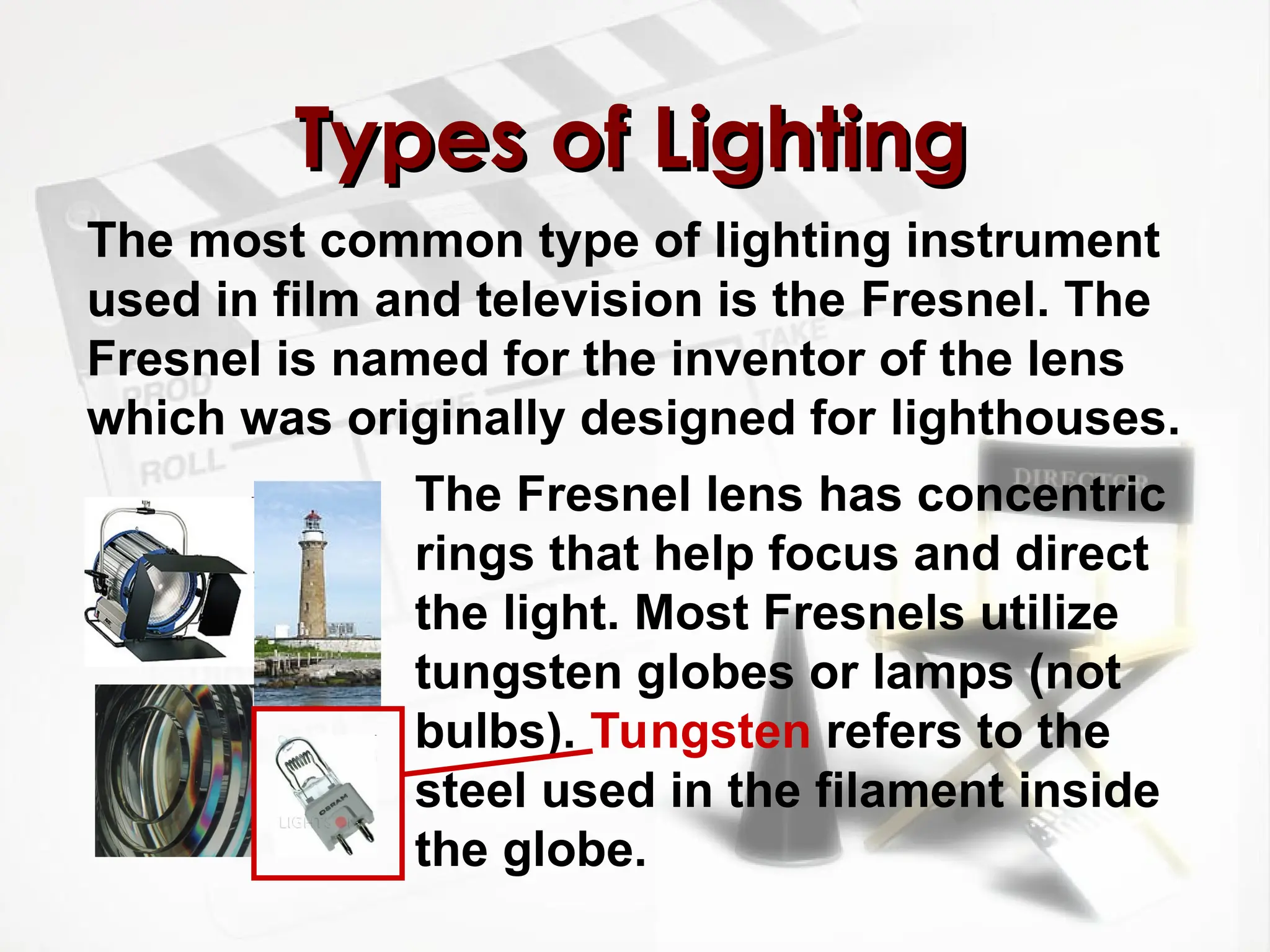
The most common type of lighting instrument
used in film and television is the Fresnel. The
Fresnel is named for the inventor of the lens
which was originally designed for lighthouses.
Types of Lighting
Types of Lighting
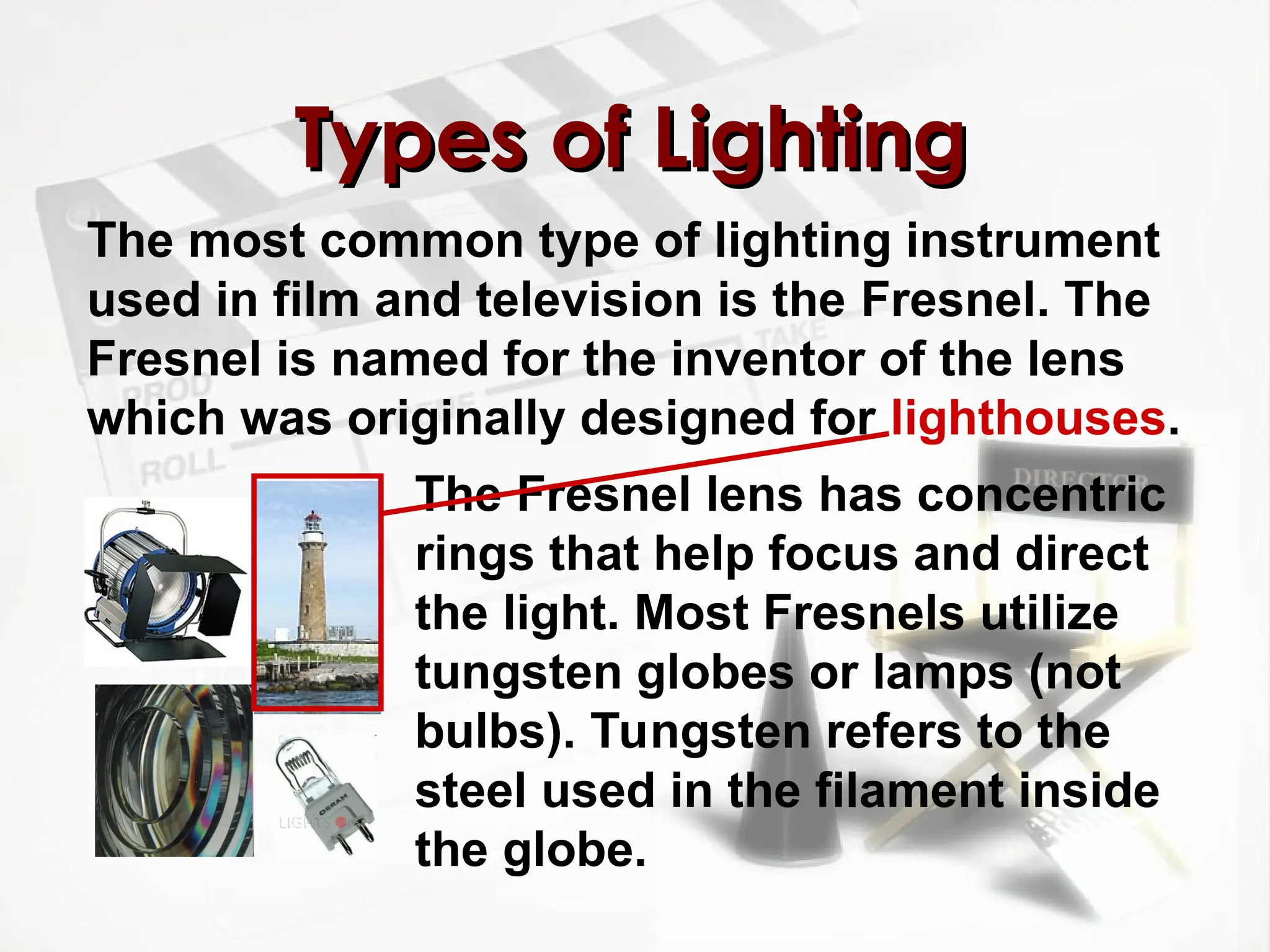
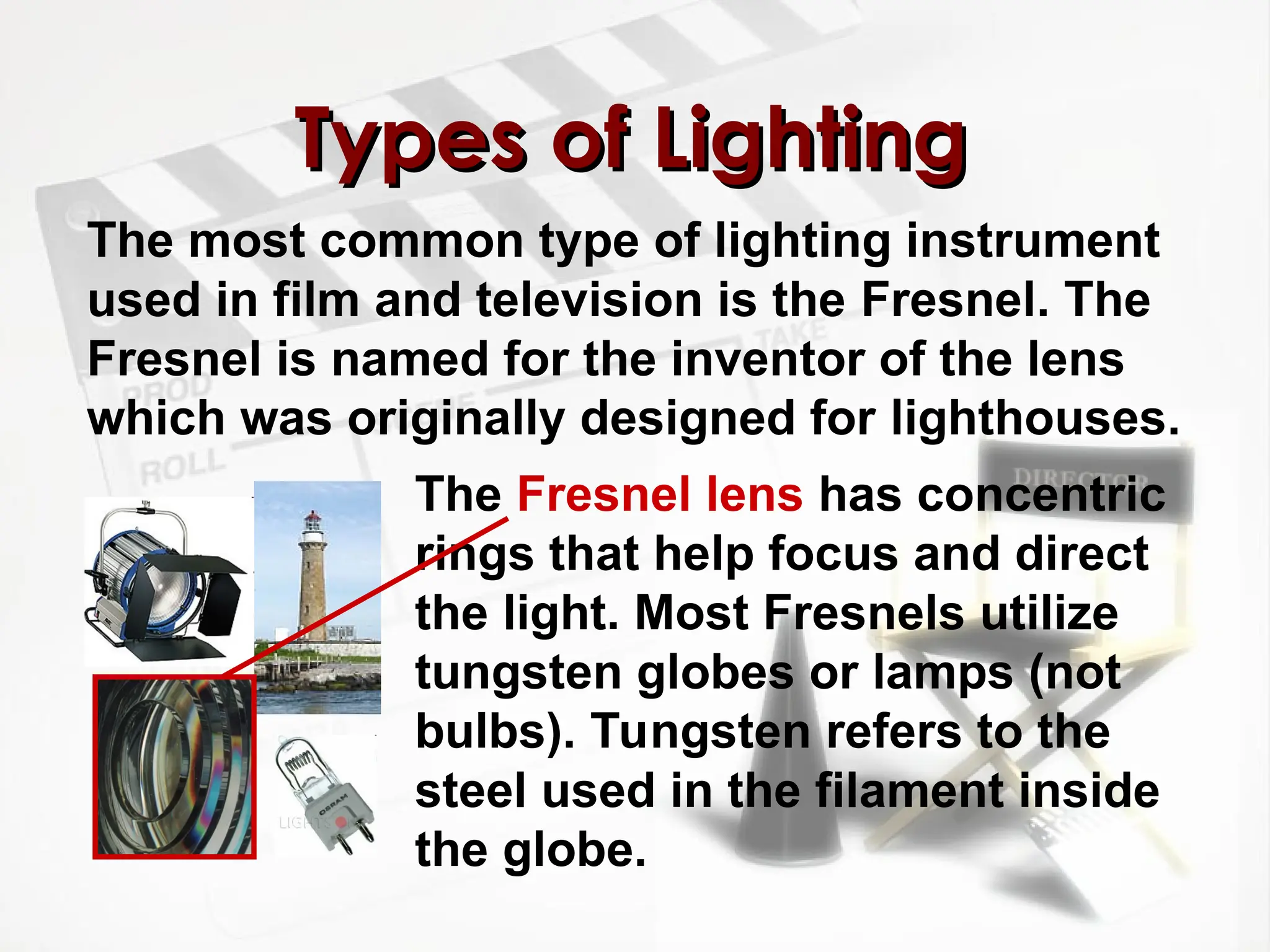
The Fresnel lens has concentric
rings that help focus and direct
the light. Most Fresnels utilize
tungsten globes or lamps (not
bulbs). Tungsten refers to the
steel used in the filament inside
the globe.
The most common type of lighting instrument
used in film and television is the Fresnel. The
Fresnel is named for the inventor of the lens
which was originally designed for lighthouses.
Types of Lighting
Types of Lighting
The Fresnel lens has concentric
rings that help focus and direct
the light. Most Fresnels utilize
tungsten globes or lamps (not
bulbs). Tungsten refers to the
steel used in the filament inside
the globe.
The most common type of lighting instrument
used in film and television is the Fresnel. The
Fresnel is named for the inventor of the lens
which was originally designed for lighthouses.
Types of Lighting
Types of Lighting
The Fresnel lens has concentric
rings that help focus and direct
the light. Most Fresnels utilize
tungsten globes or lamps (not
bulbs). Tungsten refers to the
steel used in the filament inside
the globe.
The most common type of lighting instrument
used in film and television is the Fresnel. The
Fresnel is named for the inventor of the lens
which was originally designed for lighthouses.
Types of Lighting
Types of Lighting
The Fresnel lens has concentric
rings that help focus and direct
the light. Most Fresnels utilize
tungsten globes or lamps (not
bulbs). Tungsten refers to the
steel used in the filament inside
the globe.
The most common type of lighting instrument
used in film and television is the Fresnel. The
Fresnel is named for the inventor of the lens
which was originally designed for lighthouses.
Types of Lighting
Types of Lighting
The Fresnel lens has concentric
rings that help focus and direct
the light. Most Fresnels utilize
tungsten globes or lamps (not
bulbs). Tungsten refers to the
steel used in the filament inside
the globe.
Types of Lighting
Types of Lighting
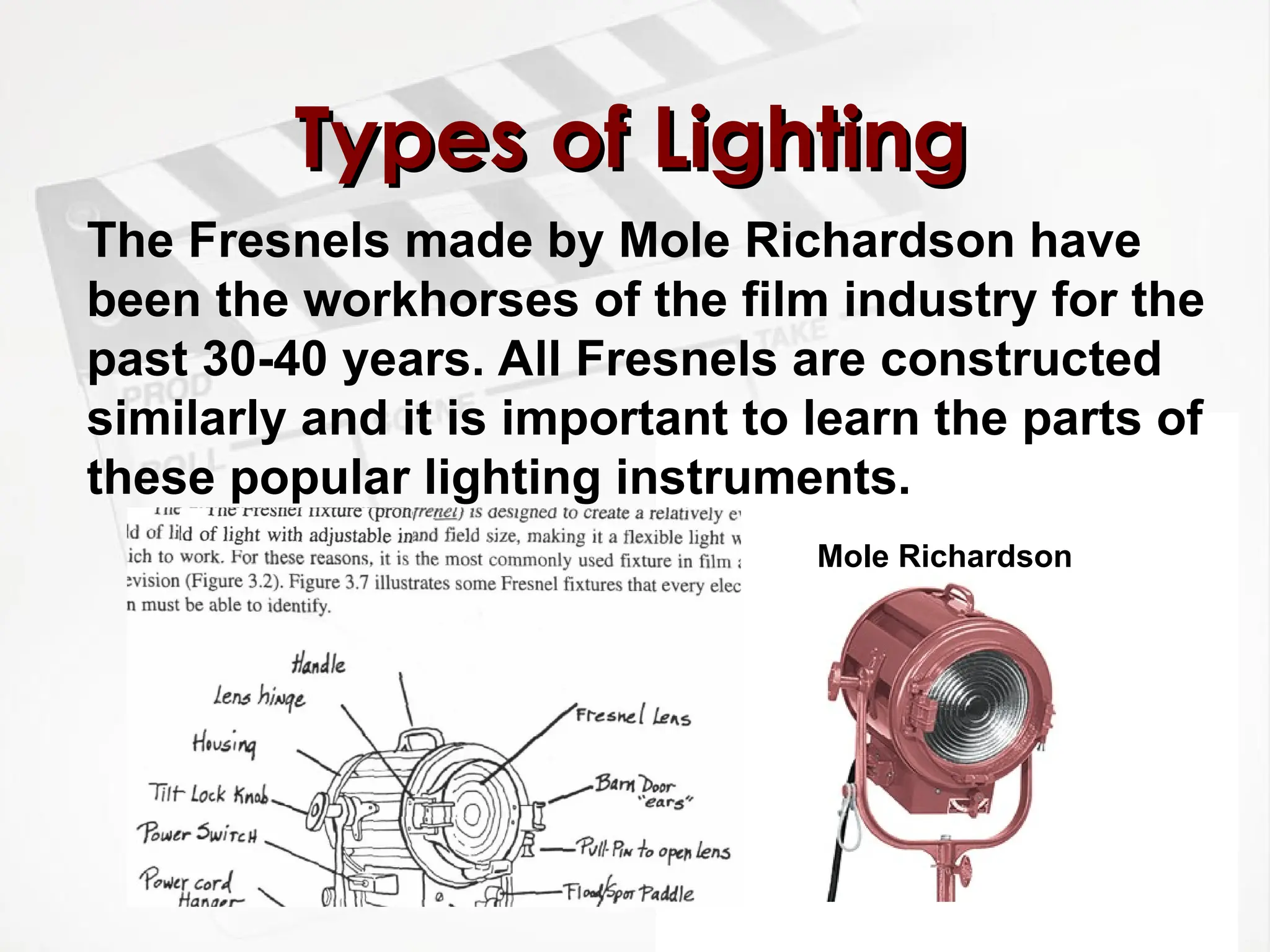
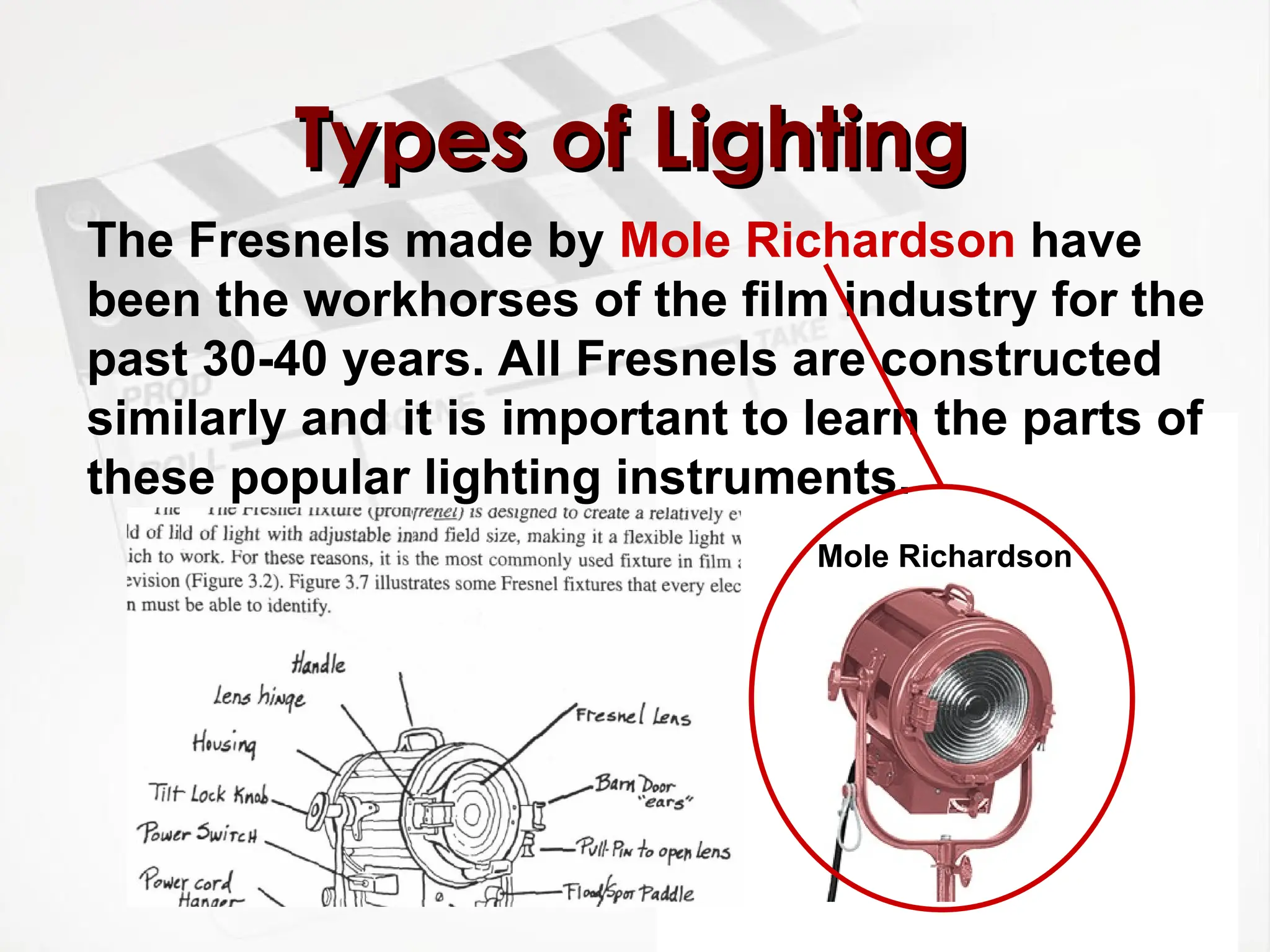
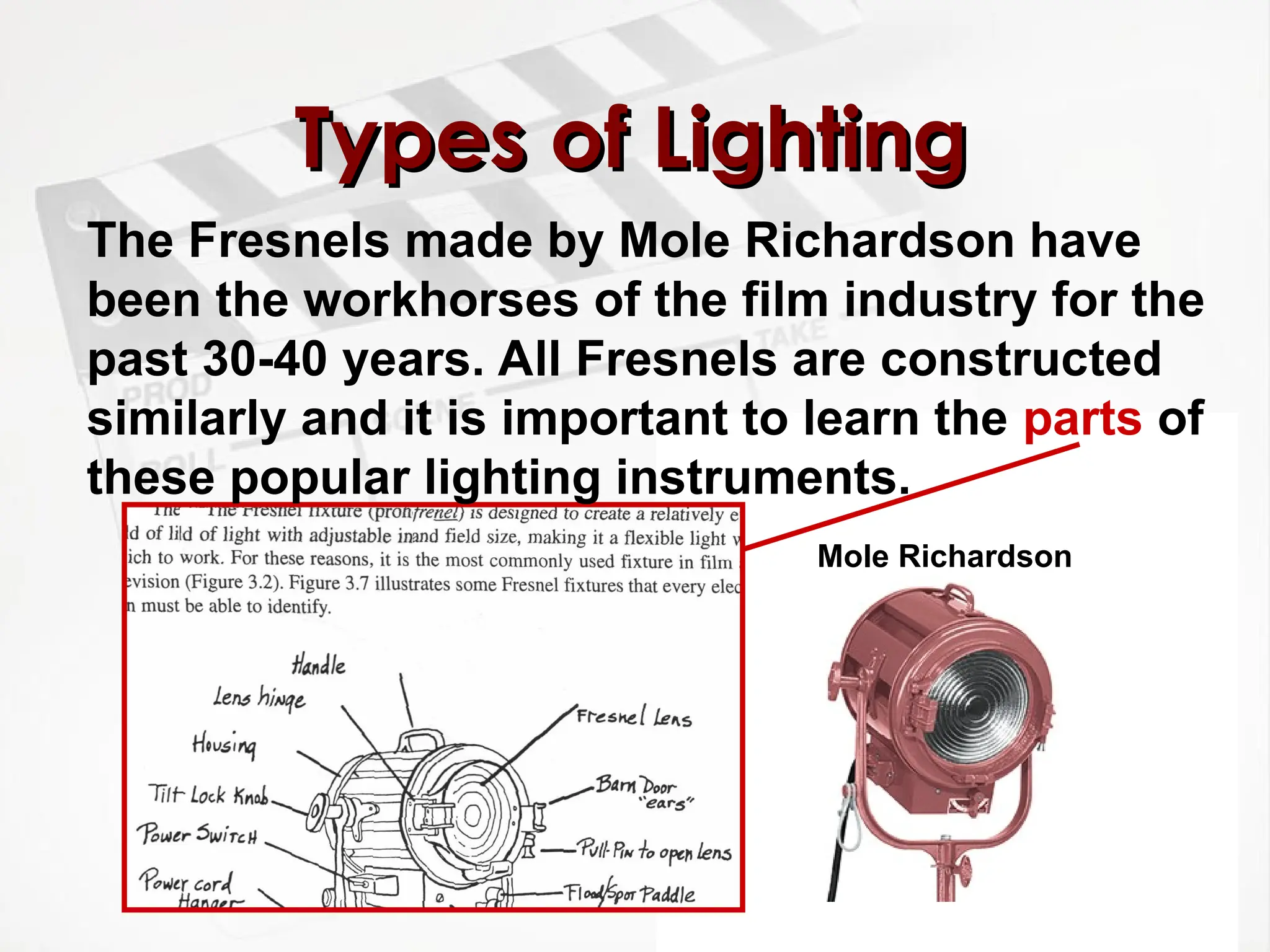
The Fresnels made by Mole Richardson have
been the workhorses of the film industry for the
past 30-40 years. All Fresnels are constructed
similarly and it is important to learn the parts of
these popular lighting instruments.
Mole Richardson
Types of Lighting
Types of Lighting
The Fresnels made by Mole Richardson have
been the workhorses of the film industry for the
past 30-40 years. All Fresnels are constructed
similarly and it is important to learn the parts of
these popular lighting instruments.
Mole Richardson
Types of Lighting
Types of Lighting
The Fresnels made by Mole Richardson have
been the workhorses of the film industry for the
past 30-40 years. All Fresnels are constructed
similarly and it is important to learn the parts of
these popular lighting instruments.
Mole Richardson
Types of Lighting
Types of Lighting
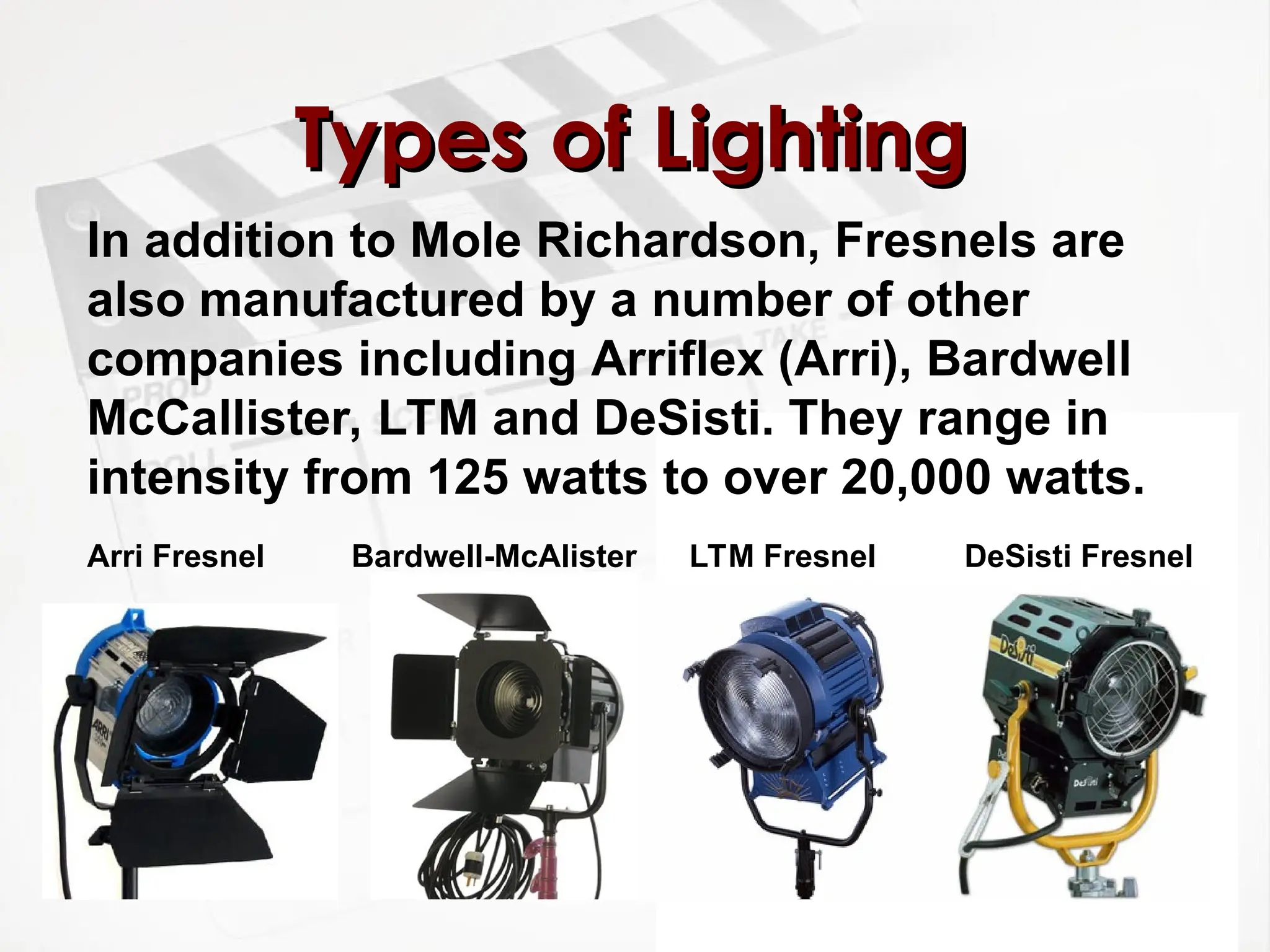
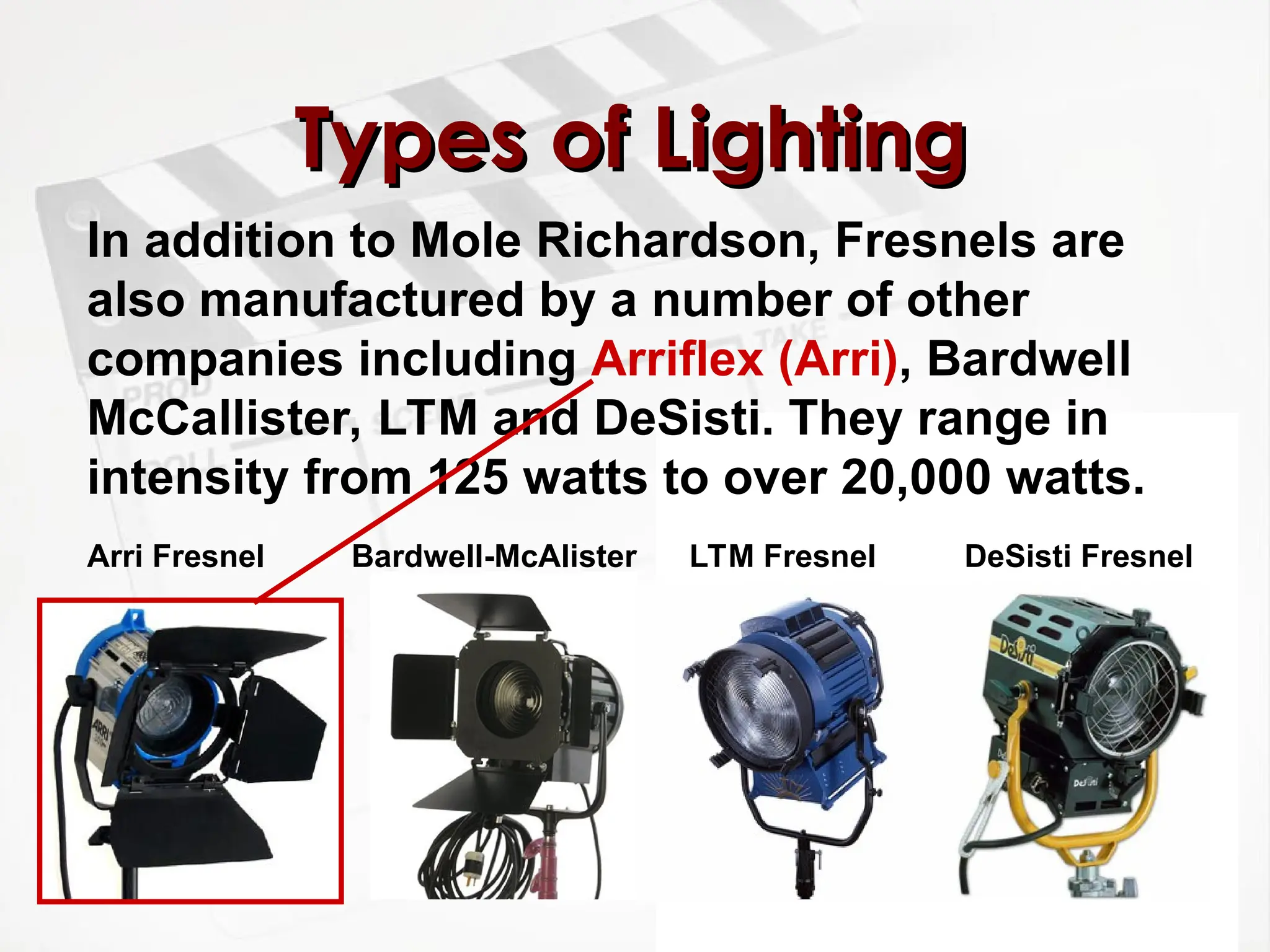
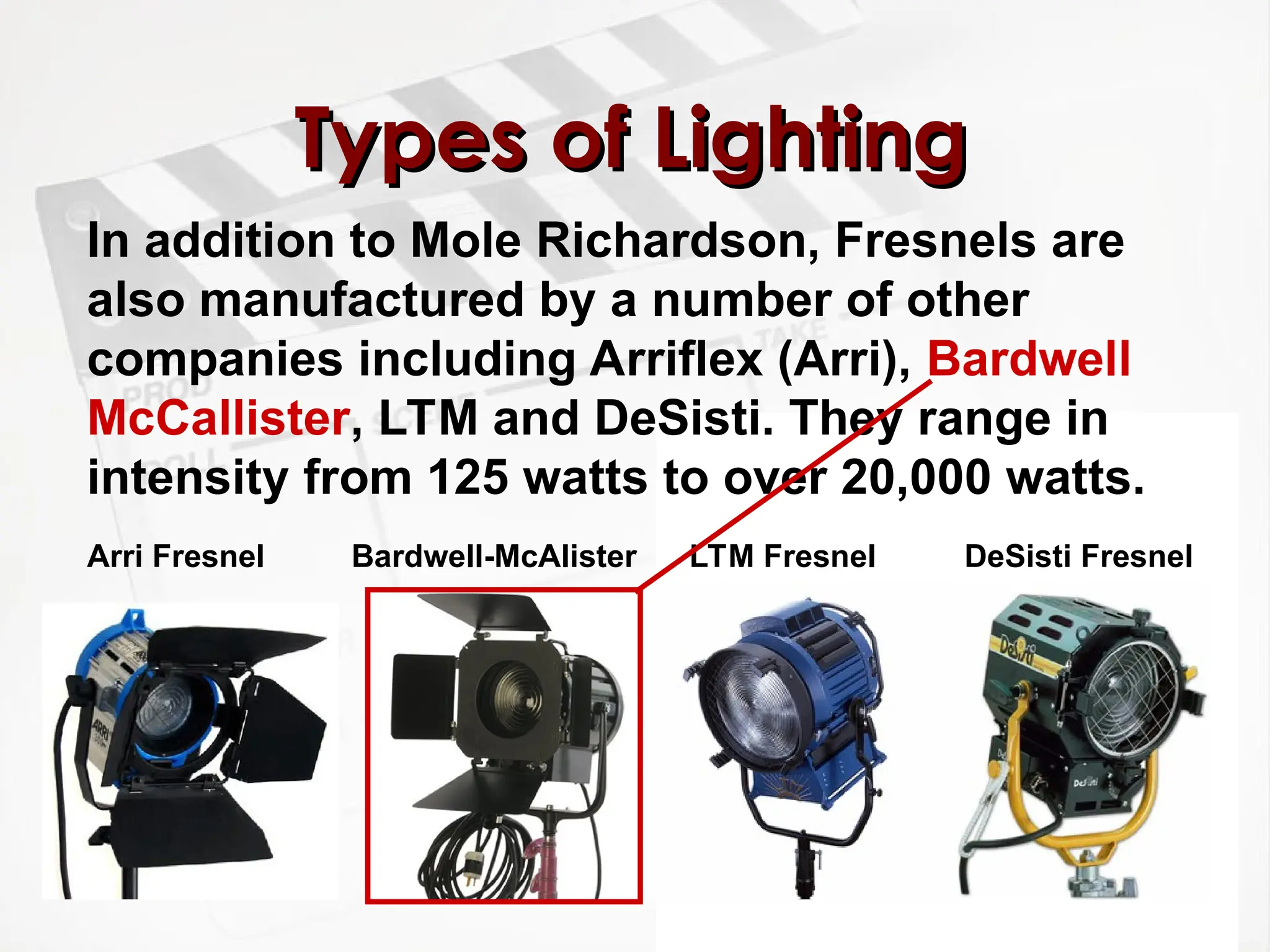
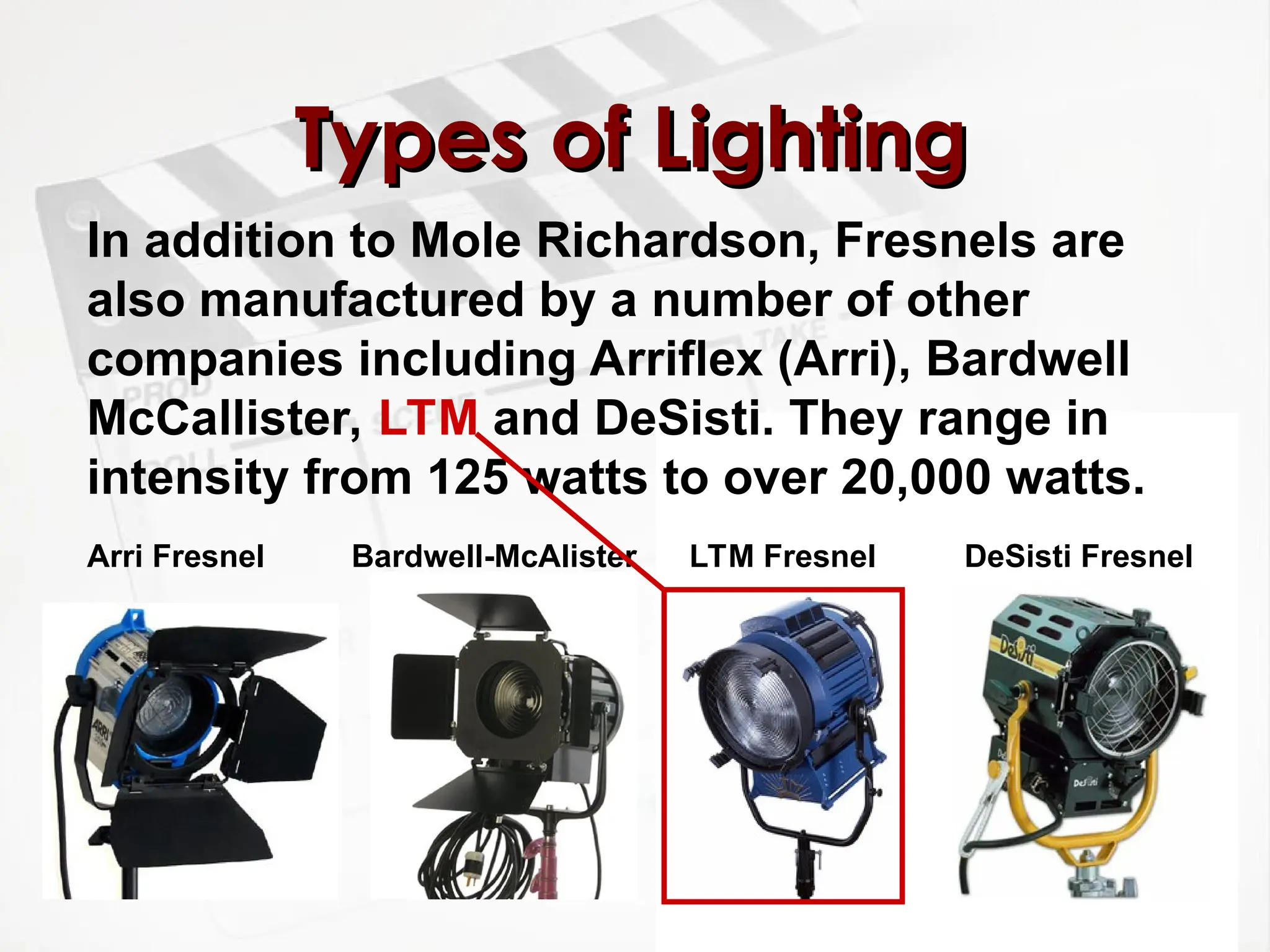
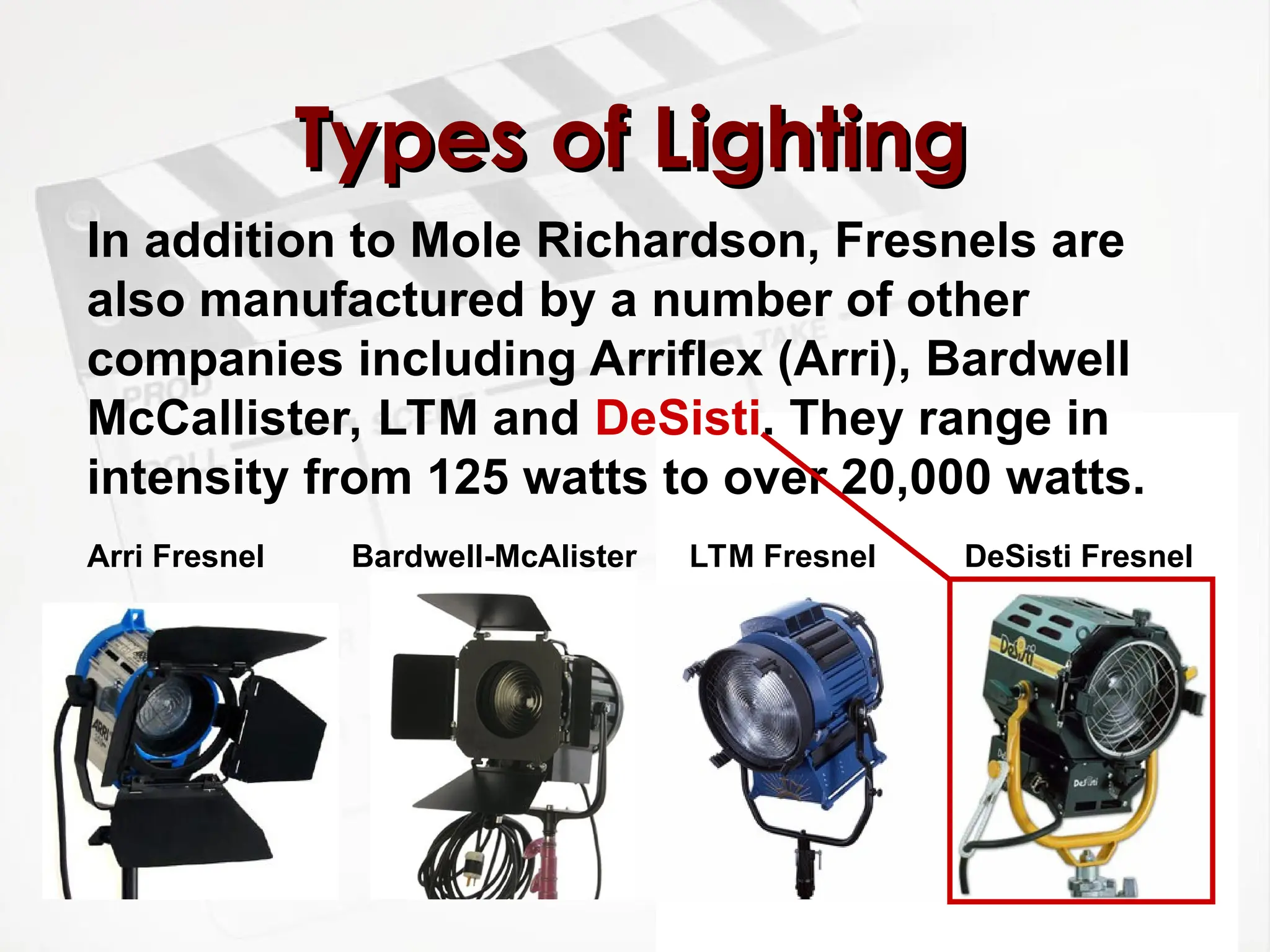
In addition to Mole Richardson, Fresnels are
also manufactured by a number of other
companies including Arriflex (Arri), Bardwell
McCallister, LTM and DeSisti. They range in
intensity from 125 watts to over 20,000 watts.
DeSisti Fresnel
LTM Fresnel
Bardwell-McAlister
Arri Fresnel
Types of Lighting
Types of Lighting
In addition to Mole Richardson, Fresnels are
also manufactured by a number of other
companies including Arriflex (Arri), Bardwell
McCallister, LTM and DeSisti. They range in
intensity from 125 watts to over 20,000 watts.
DeSisti Fresnel
LTM Fresnel
Bardwell-McAlister
Arri Fresnel
Types of Lighting
Types of Lighting
In addition to Mole Richardson, Fresnels are
also manufactured by a number of other
companies including Arriflex (Arri), Bardwell
McCallister, LTM and DeSisti. They range in
intensity from 125 watts to over 20,000 watts.
DeSisti Fresnel
LTM Fresnel
Bardwell-McAlister
Arri Fresnel
Types of Lighting
Types of Lighting
In addition to Mole Richardson, Fresnels are
also manufactured by a number of other
companies including Arriflex (Arri), Bardwell
McCallister, LTM and DeSisti. They range in
intensity from 125 watts to over 20,000 watts.
DeSisti Fresnel
LTM Fresnel
Bardwell-McAlister
Arri Fresnel
Types of Lighting
Types of Lighting
In addition to Mole Richardson, Fresnels are
also manufactured by a number of other
companies including Arriflex (Arri), Bardwell
McCallister, LTM and DeSisti. They range in
intensity from 125 watts to over 20,000 watts.
DeSisti Fresnel
LTM Fresnel
Bardwell-McAlister
Arri Fresnel
Types of Lighting
Types of Lighting
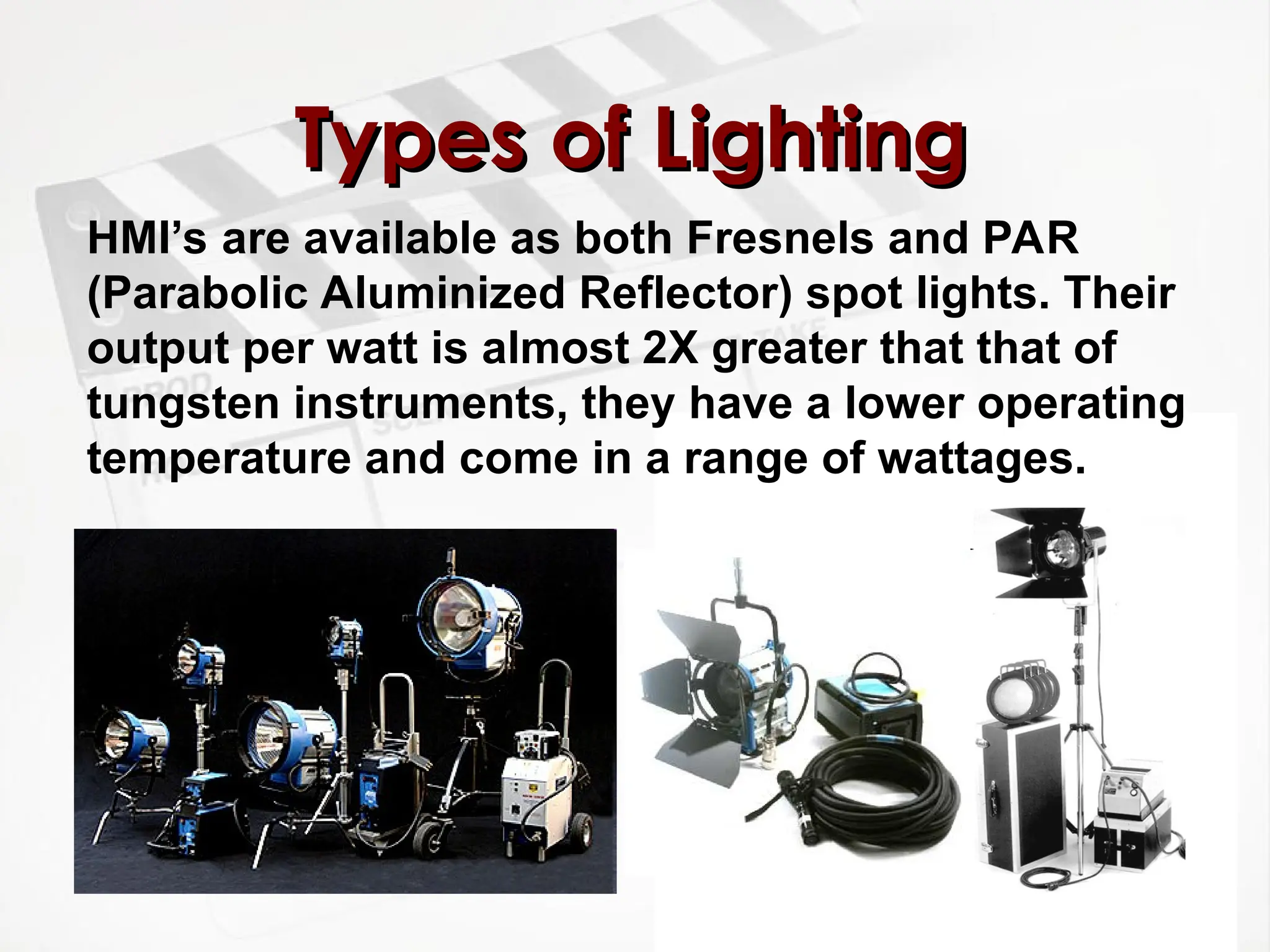
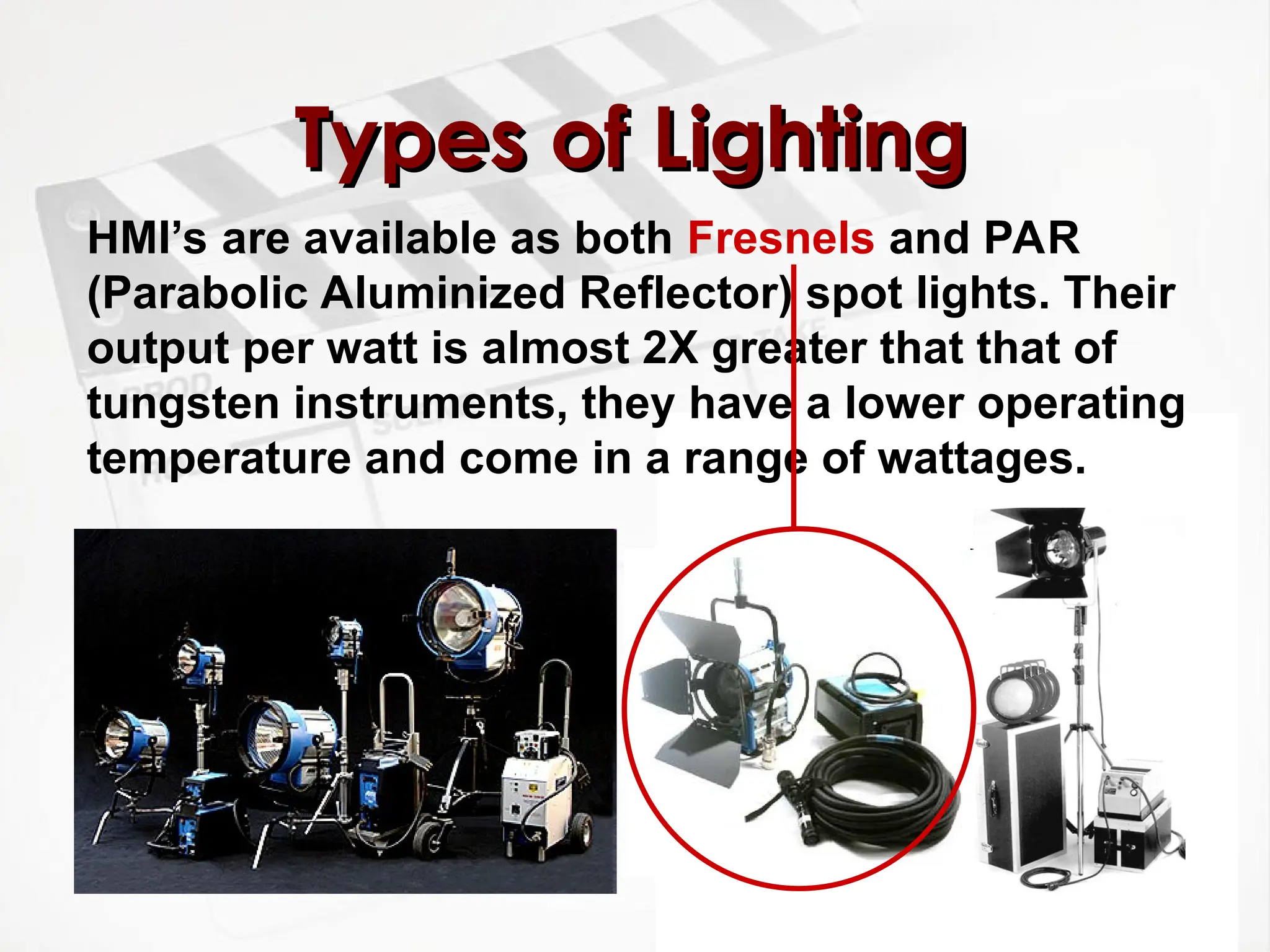
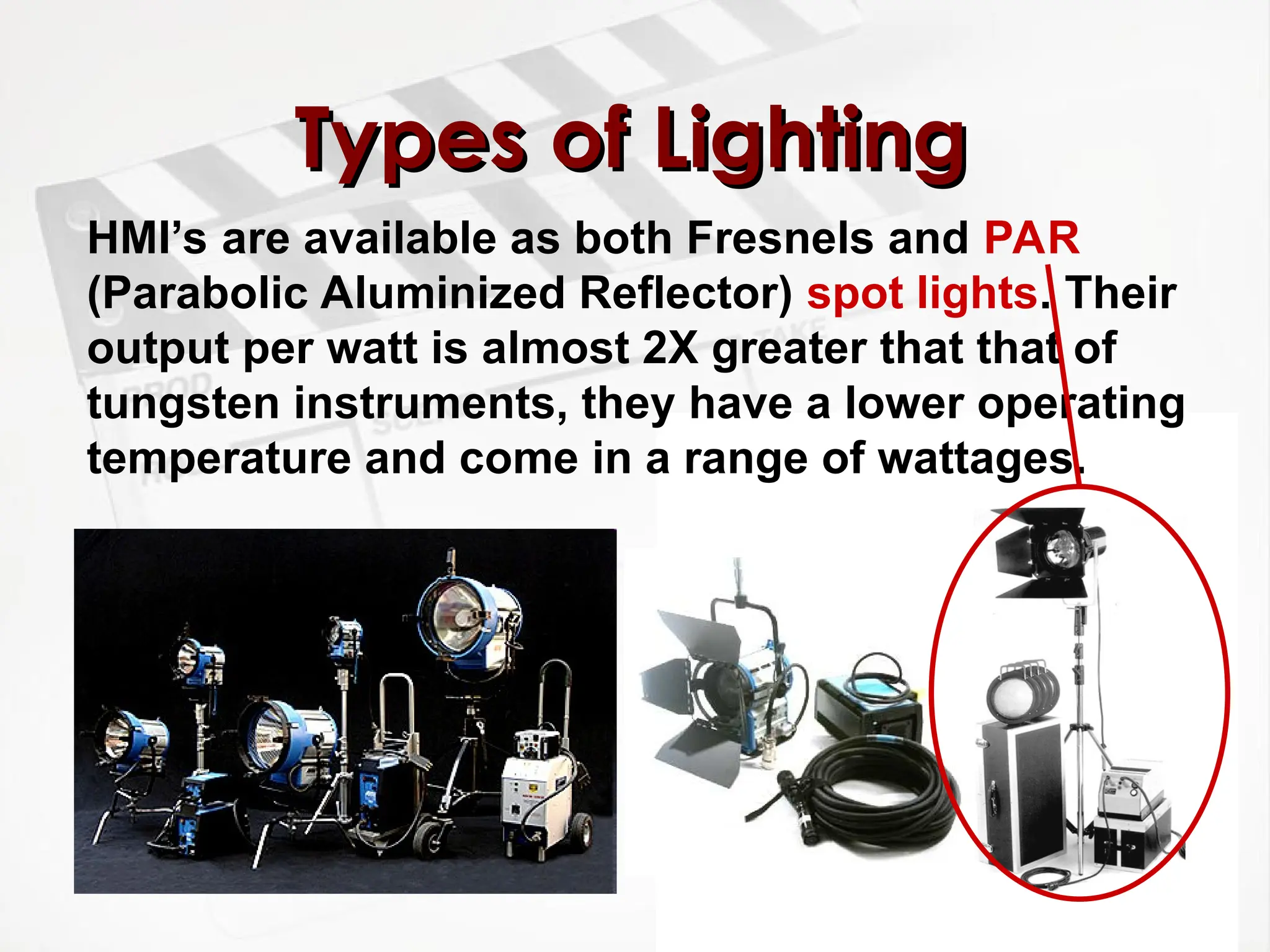
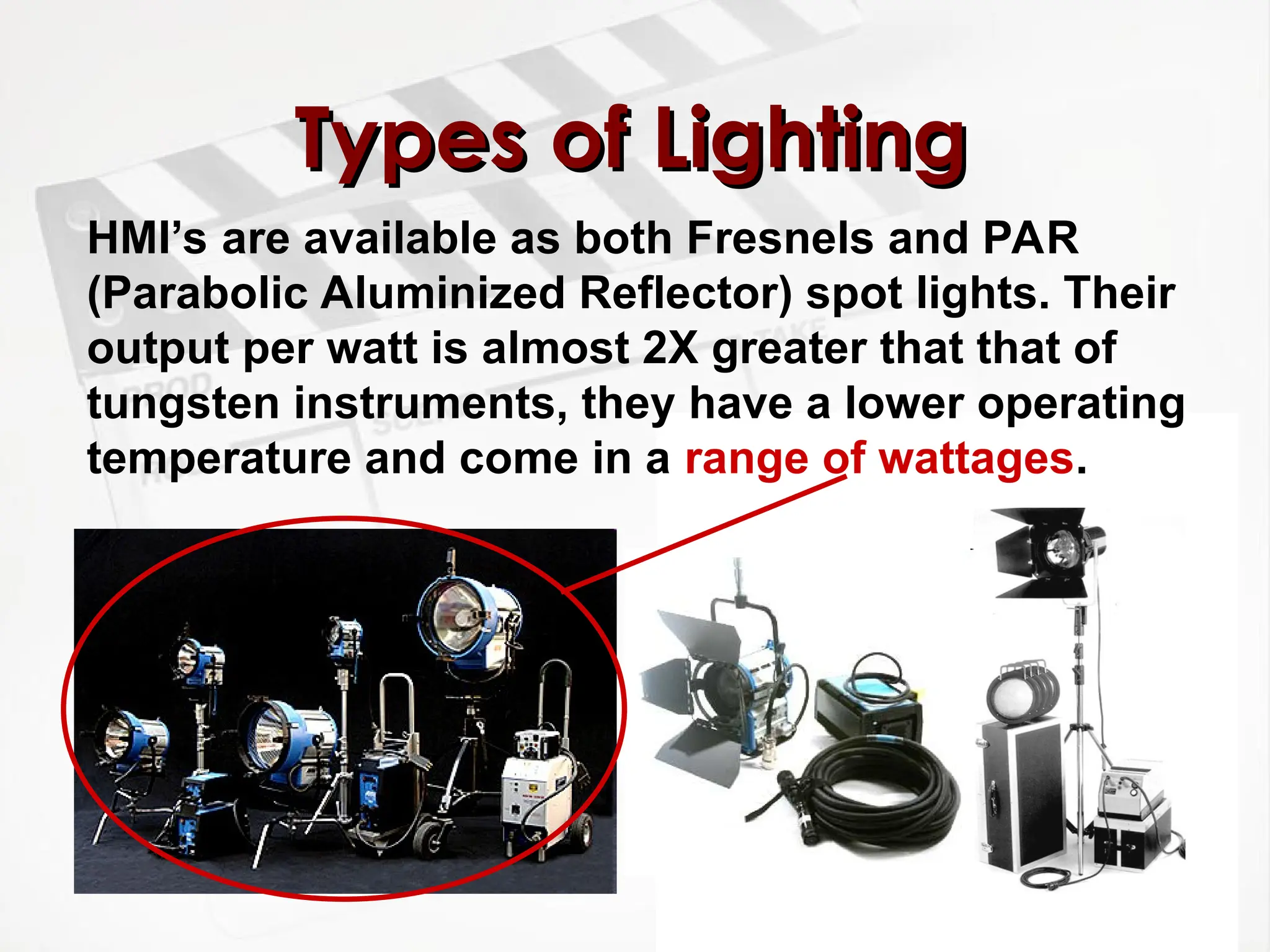
HMI’s are available as both Fresnels and PAR
(Parabolic Aluminized Reflector) spot lights. Their
output per watt is almost 2X greater that that of
tungsten instruments, they have a lower operating
temperature and come in a range of wattages.
Types of Lighting
Types of Lighting
HMI’s are available as both Fresnels and PAR
(Parabolic Aluminized Reflector) spot lights. Their
output per watt is almost 2X greater that that of
tungsten instruments, they have a lower operating
temperature and come in a range of wattages.
Types of Lighting
Types of Lighting
HMI’s are available as both Fresnels and PAR
(Parabolic Aluminized Reflector) spot lights. Their
output per watt is almost 2X greater that that of
tungsten instruments, they have a lower operating
temperature and come in a range of wattages.
Types of Lighting
Types of Lighting
HMI’s are available as both Fresnels and PAR
(Parabolic Aluminized Reflector) spot lights. Their
output per watt is almost 2X greater that that of
tungsten instruments, they have a lower operating
temperature and come in a range of wattages.
Lighting 101
Lighting 101
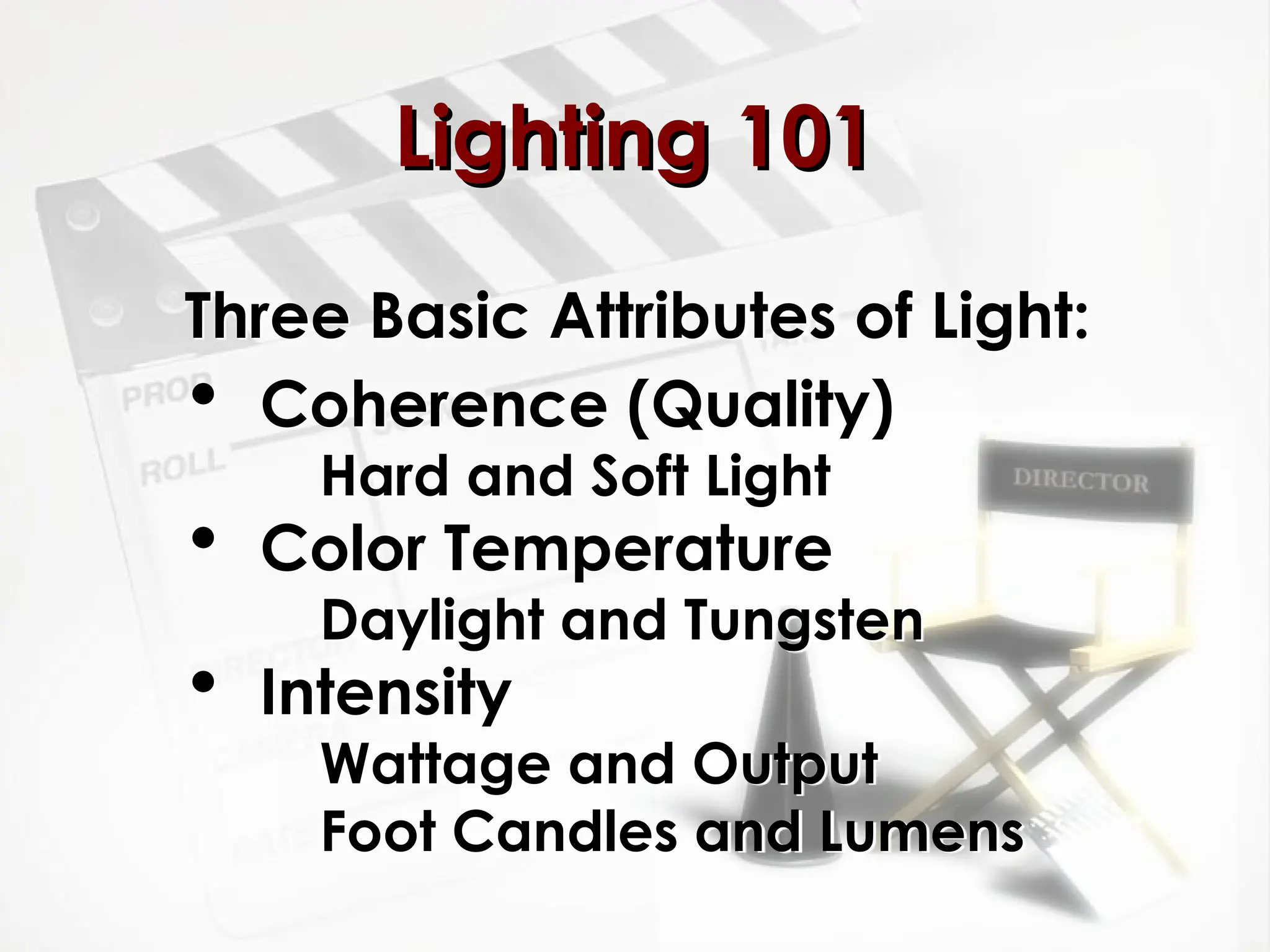
Three Basic Attributes of Light:
 Coherence (Quality)
Hard and Soft Light
 Color Temperature
Daylight and Tungsten
 Intensity
Wattage and Output
Foot Candles and Lumens
Lighting 101
Lighting 101
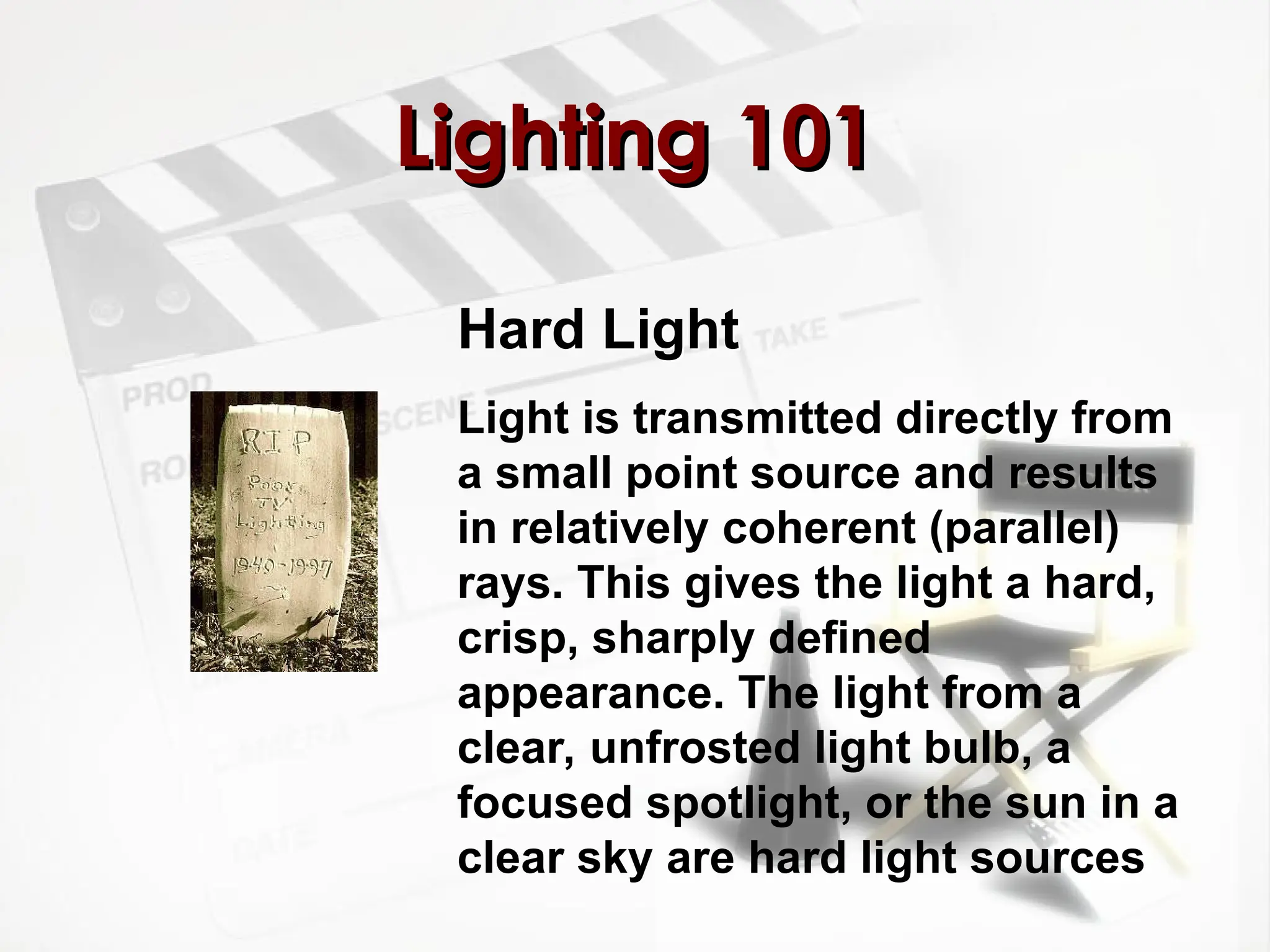
Hard Light
Light is transmitted directly from
a small point source and results
in relatively coherent (parallel)
rays. This gives the light a hard,
crisp, sharply defined
appearance. The light from a
clear, unfrosted light bulb, a
focused spotlight, or the sun in a
clear sky are hard light sources
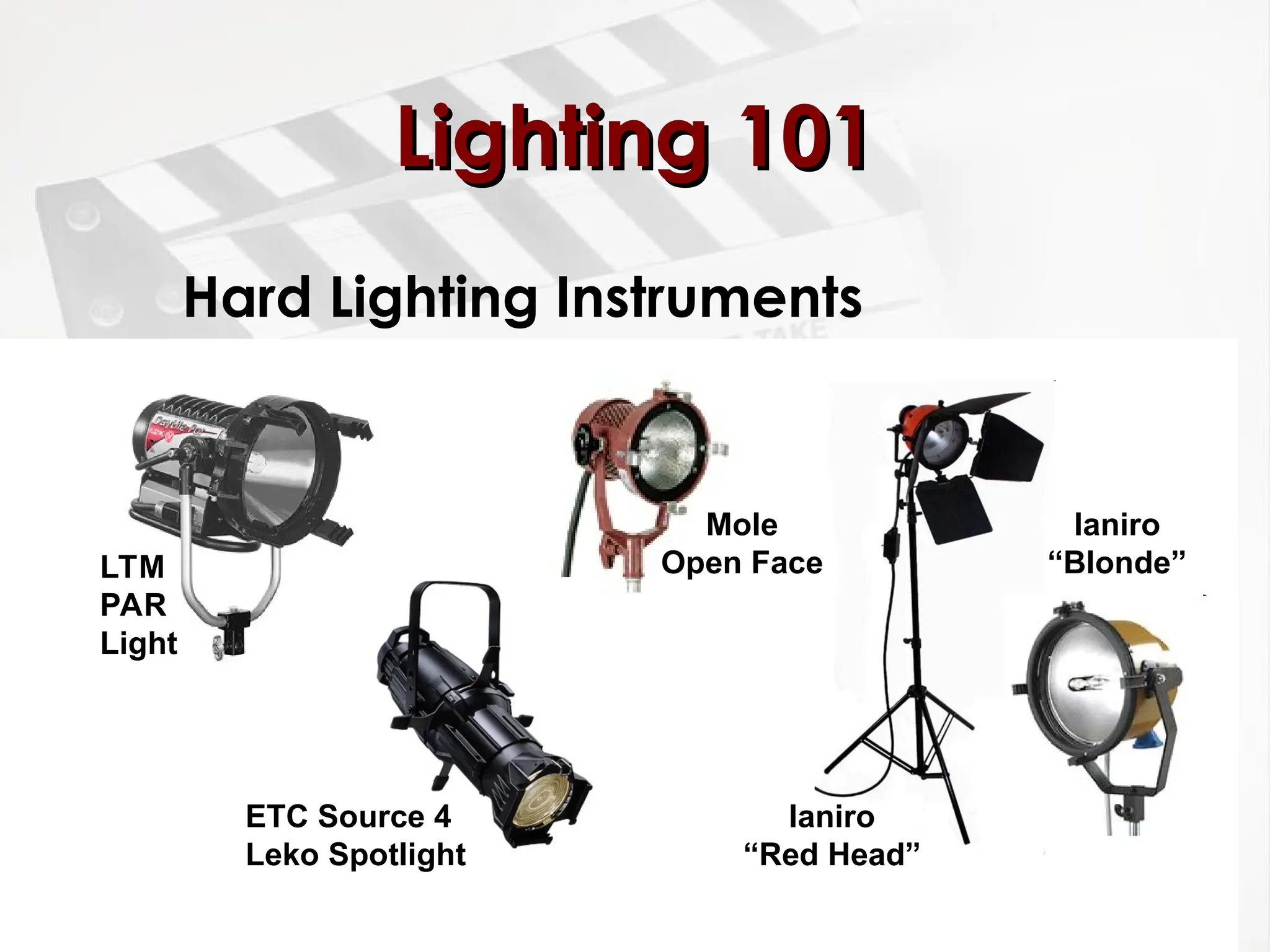
Hard Lighting Instruments
Lighting 101
Lighting 101
LTM
PAR
Light
Ianiro
“Red Head”
ETC Source 4
Leko Spotlight
Mole
Open Face
Ianiro
“Blonde”
Soft Light
Lighting 101
Lighting 101
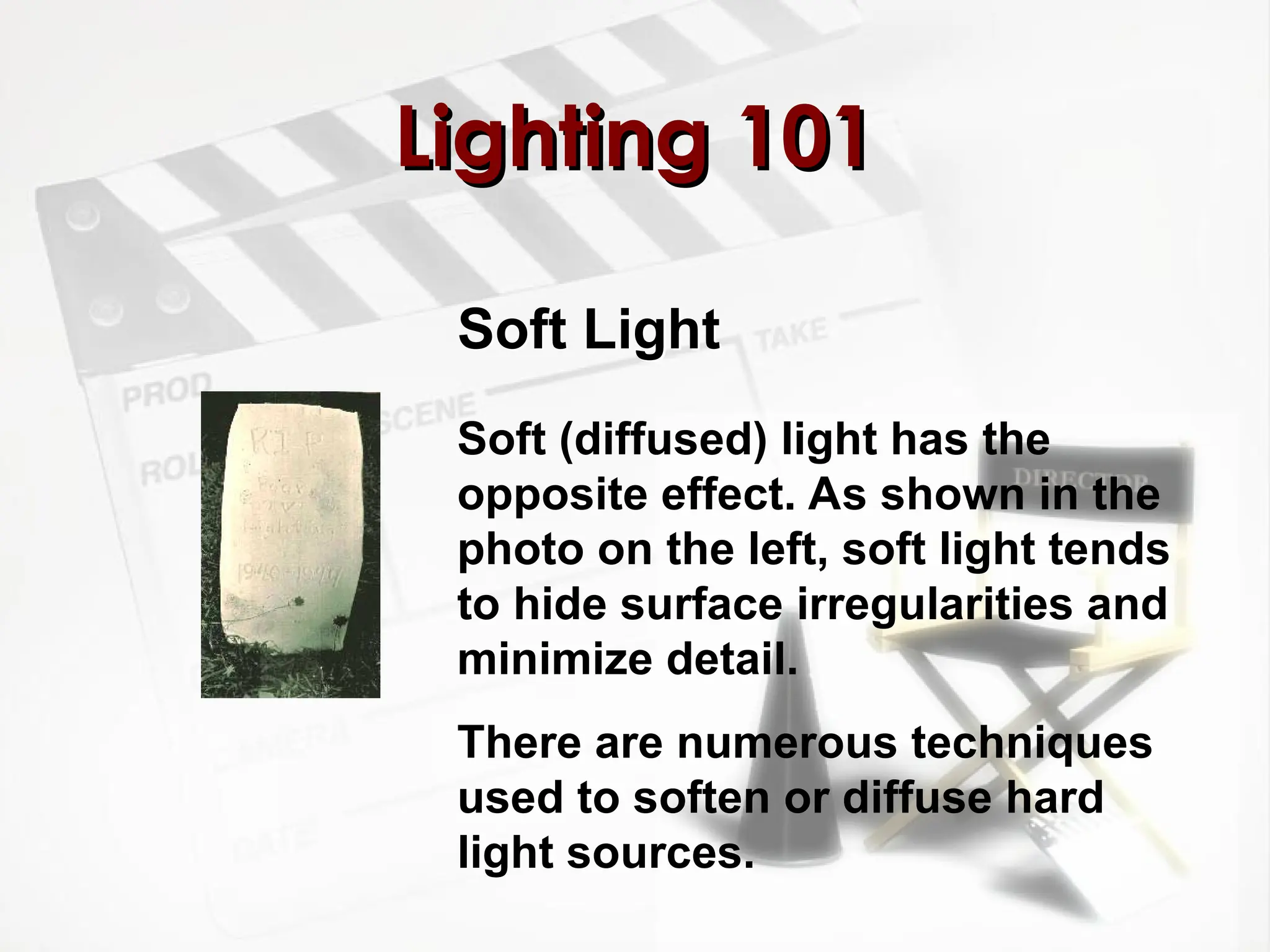
Soft (diffused) light has the
opposite effect. As shown in the
photo on the left, soft light tends
to hide surface irregularities and
minimize detail.
There are numerous techniques
used to soften or diffuse hard
light sources.
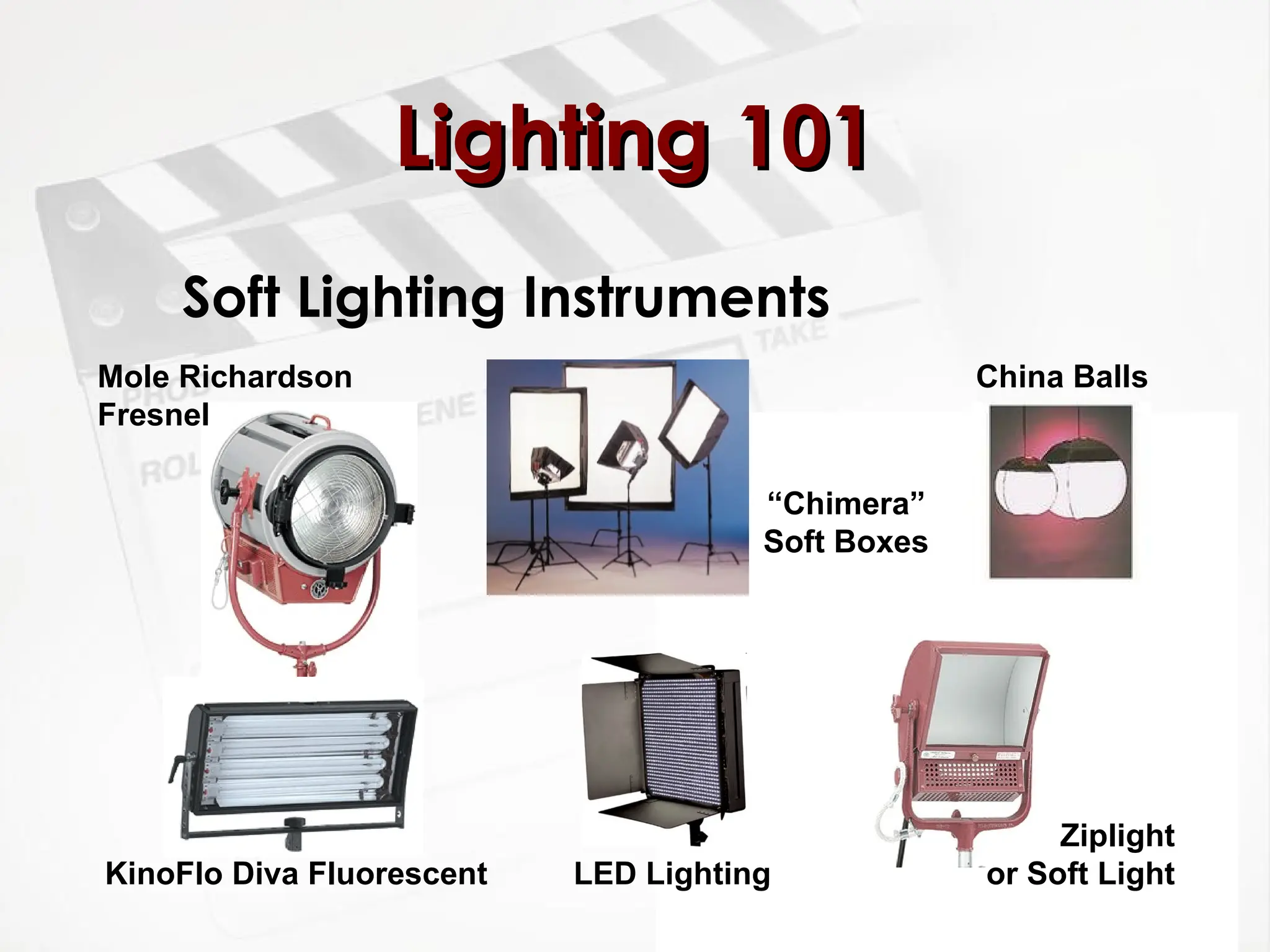
Soft Lighting Instruments
Lighting 101
Lighting 101
China Balls
“Chimera”
Soft Boxes
Mole Richardson
Fresnel
LED Lighting
Ziplight
or Soft Light
KinoFlo Diva Fluorescent
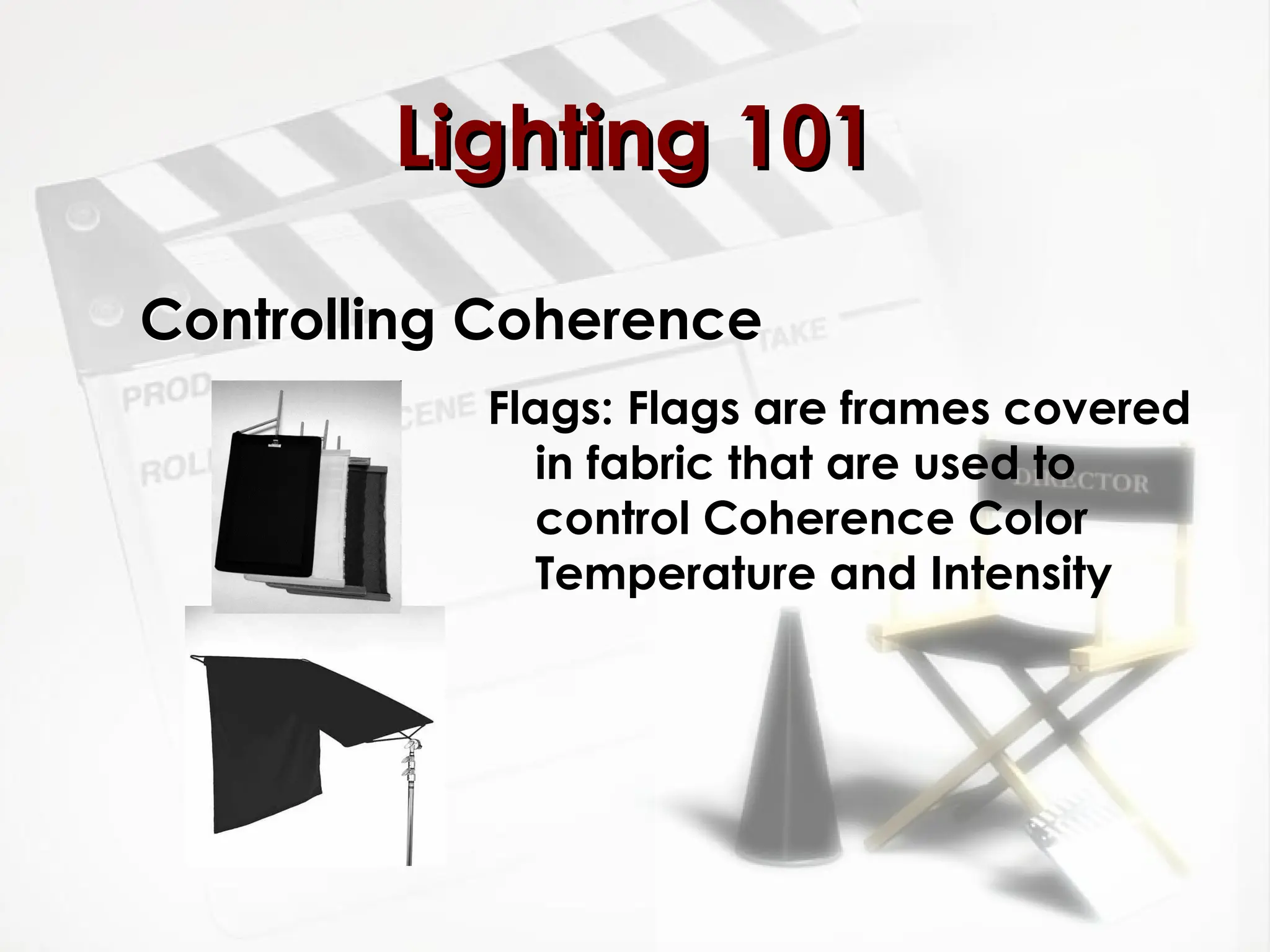
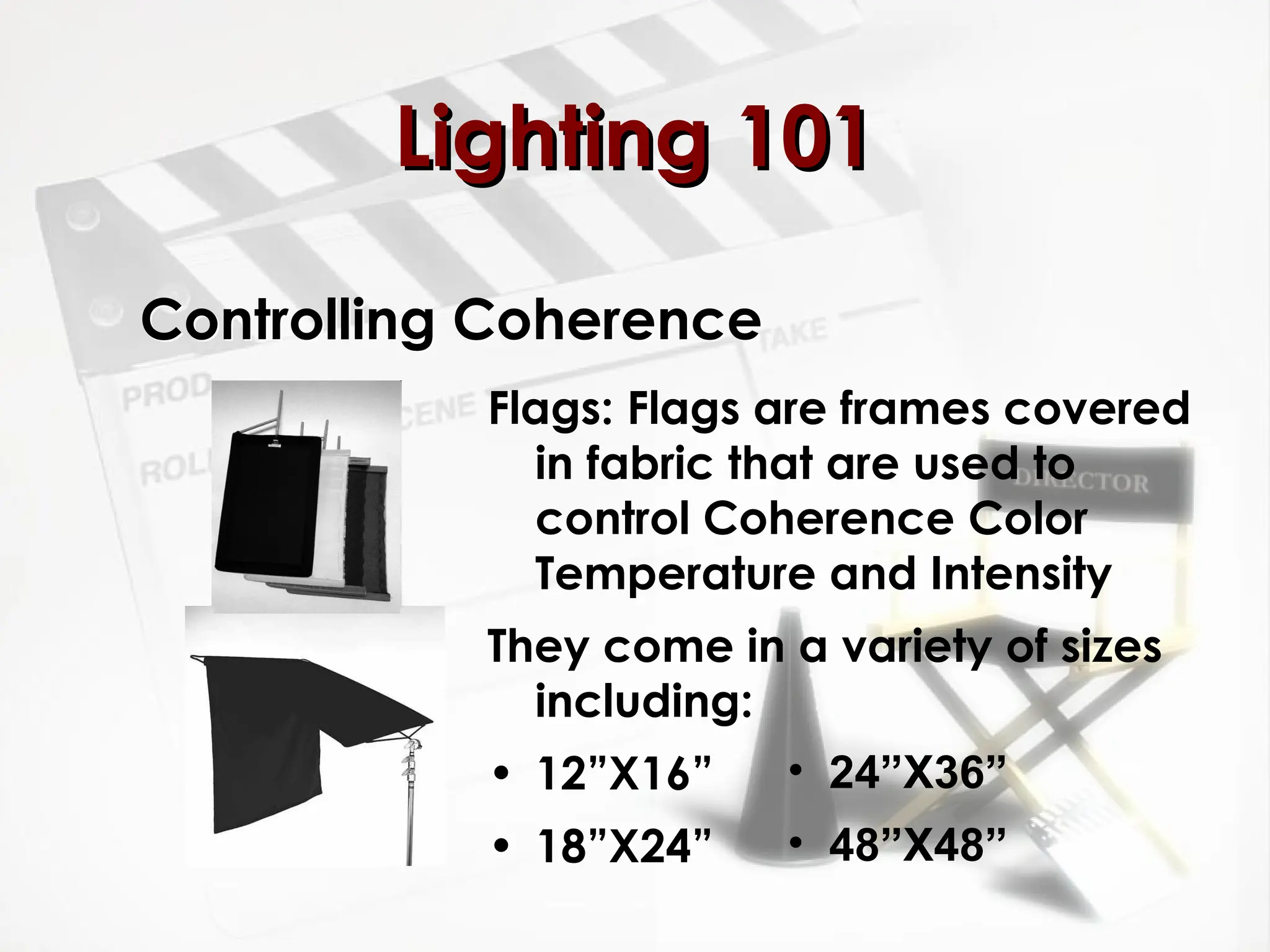
Controlling Coherence
Flags: Flags are frames covered
in fabric that are used to
control Coherence Color
Temperature and Intensity
Lighting 101
Lighting 101
Controlling Coherence
Flags: Flags are frames covered
in fabric that are used to
control Coherence Color
Temperature and Intensity
They come in a variety of sizes
including:
• 12”X16”
• 18”X24”
Lighting 101
Lighting 101
• 24”X36”
• 48”X48”
Controlling Coherence
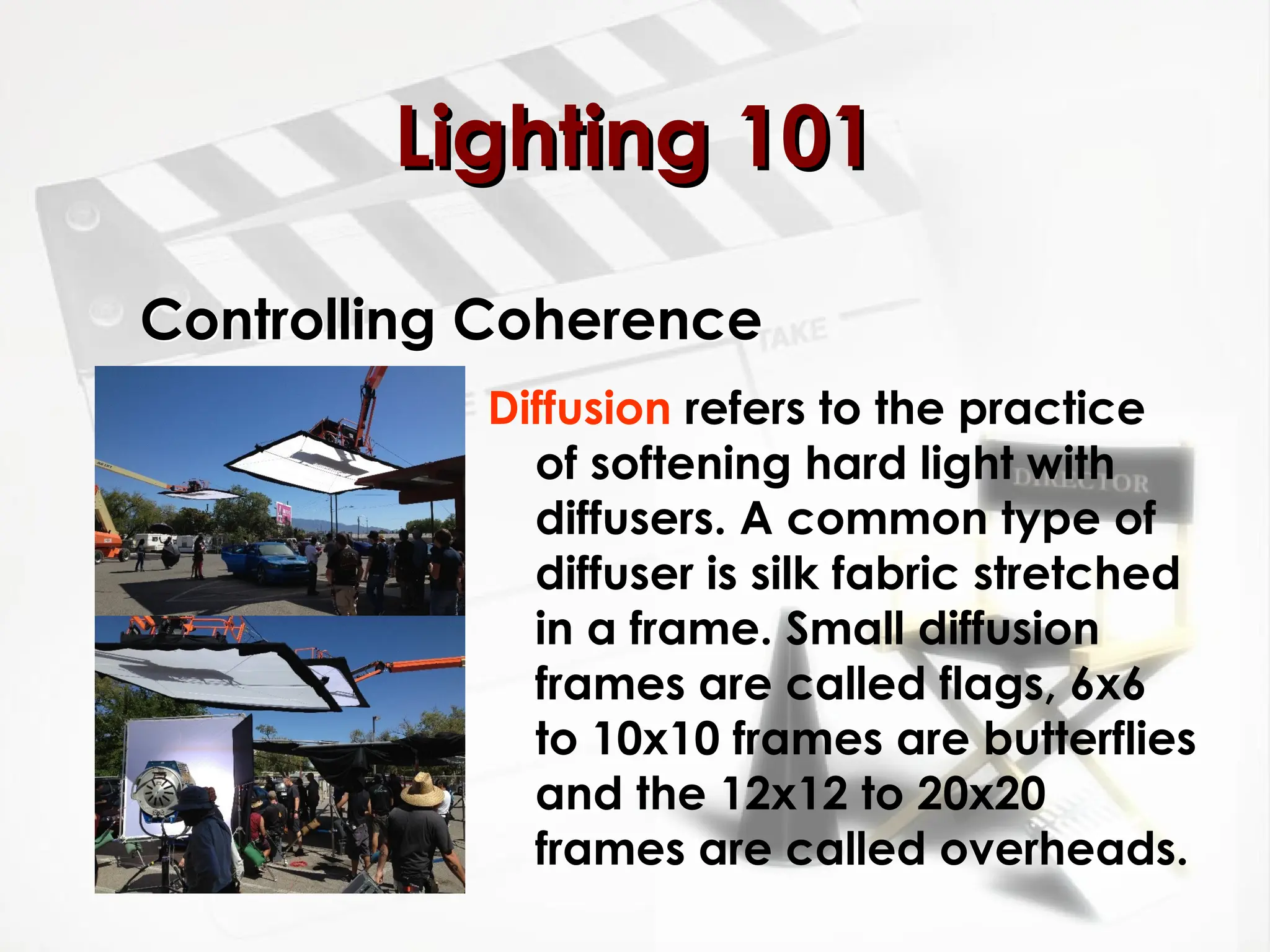
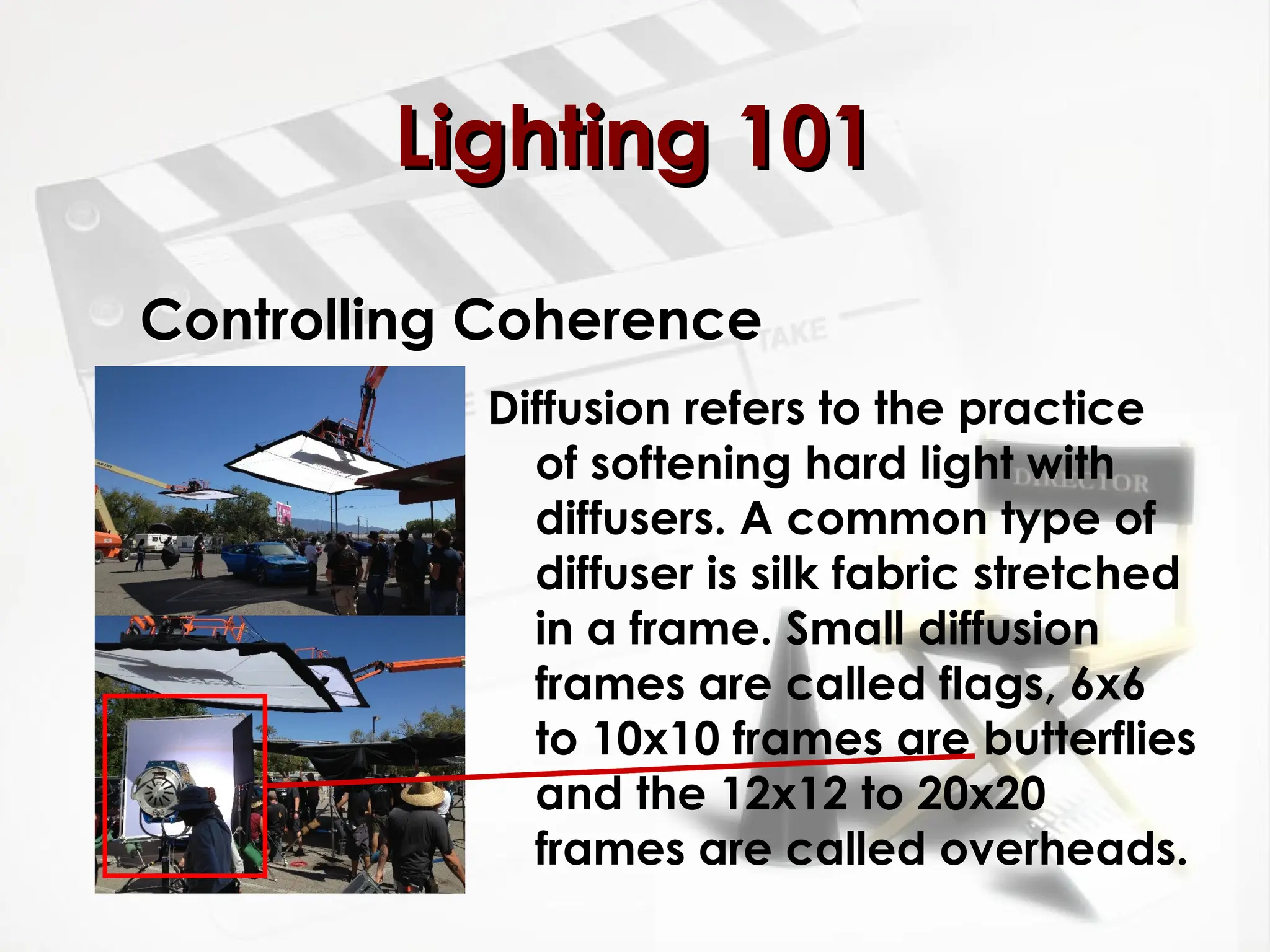
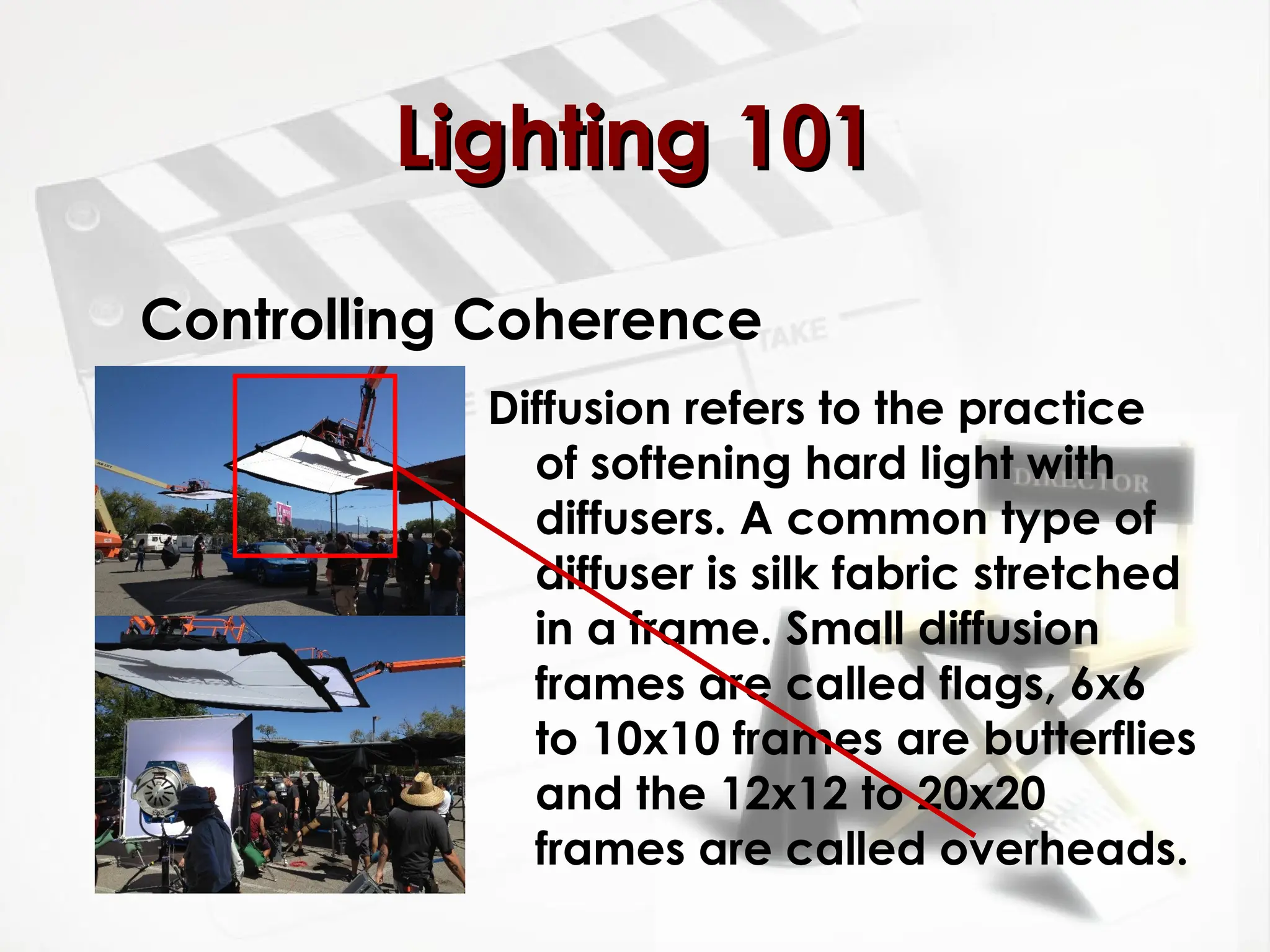
Diffusion refers to the practice
of softening hard light with
diffusers. A common type of
diffuser is silk fabric stretched
in a frame. Small diffusion
frames are called flags, 6x6
to 10x10 frames are butterflies
and the 12x12 to 20x20
frames are called overheads.
Lighting 101
Lighting 101
Controlling Coherence
Diffusion refers to the practice
of softening hard light with
diffusers. A common type of
diffuser is silk fabric stretched
in a frame. Small diffusion
frames are called flags, 6x6
to 10x10 frames are butterflies
and the 12x12 to 20x20
frames are called overheads.
Lighting 101
Lighting 101
Controlling Coherence
Diffusion refers to the practice
of softening hard light with
diffusers. A common type of
diffuser is silk fabric stretched
in a frame. Small diffusion
frames are called flags, 6x6
to 10x10 frames are butterflies
and the 12x12 to 20x20
frames are called overheads.
Lighting 101
Lighting 101
Controlling Coherence
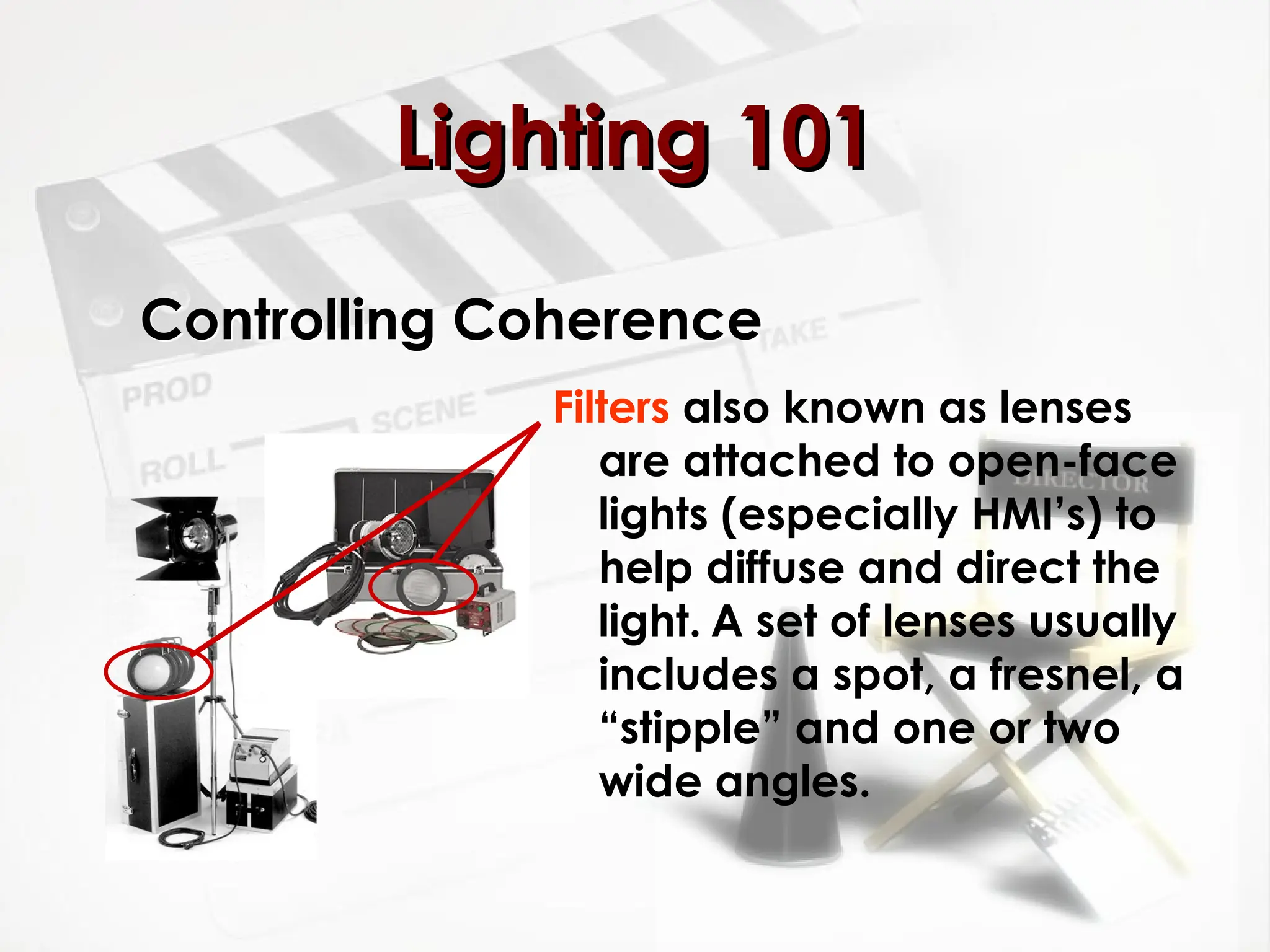
Filters also known as lenses
are attached to open-face
lights (especially HMI’s) to
help diffuse and direct the
light. A set of lenses usually
includes a spot, a fresnel, a
“stipple” and one or two
wide angles.
Lighting 101
Lighting 101
Controlling Coherence
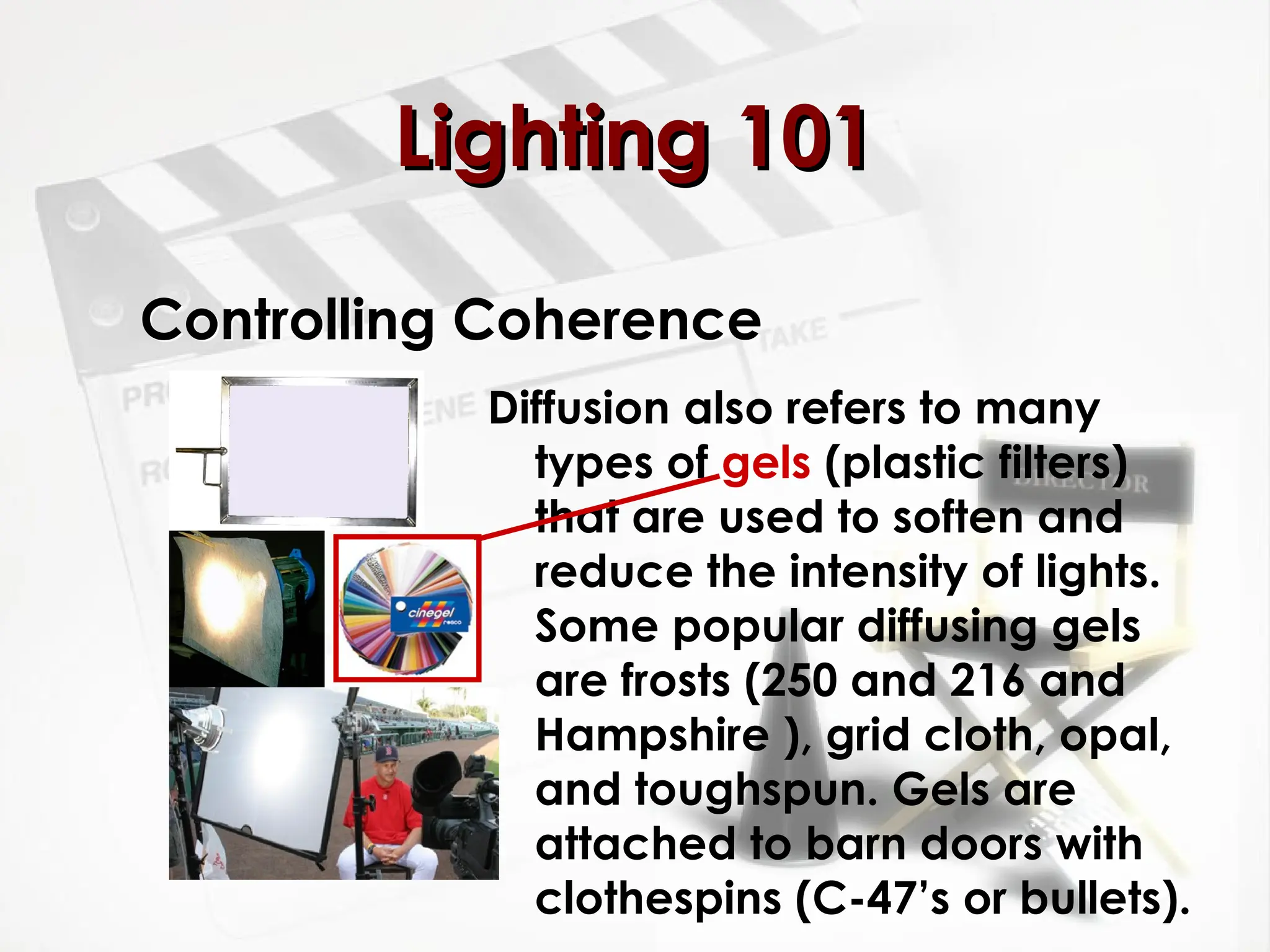
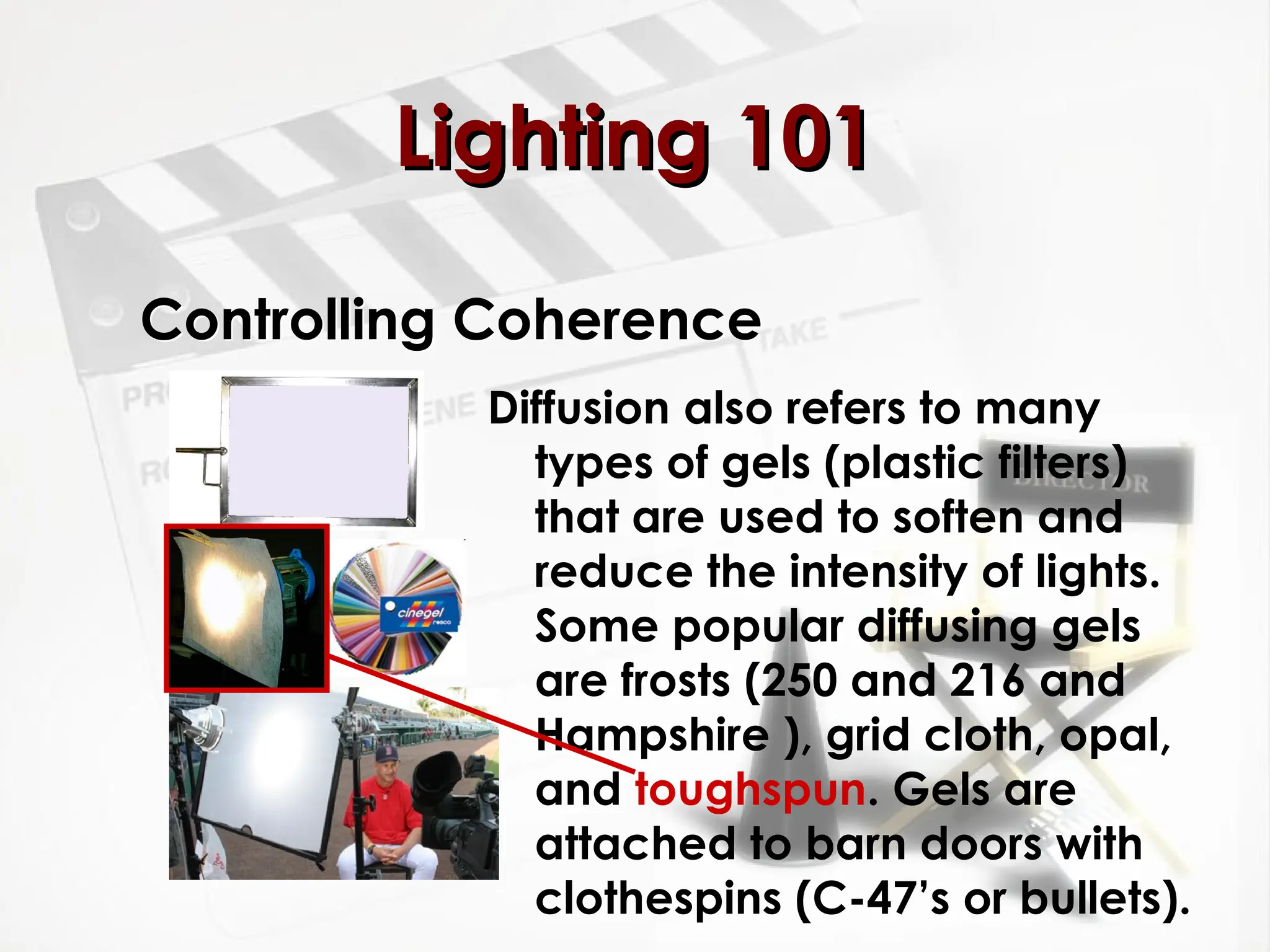
Diffusion also refers to many
types of gels (plastic filters)
that are used to soften and
reduce the intensity of lights.
Some popular diffusing gels
are frosts (250 and 216 and
Hampshire ), grid cloth, opal,
and toughspun. Gels are
attached to barn doors with
clothespins (C-47’s or bullets).
Lighting 101
Lighting 101
Controlling Coherence
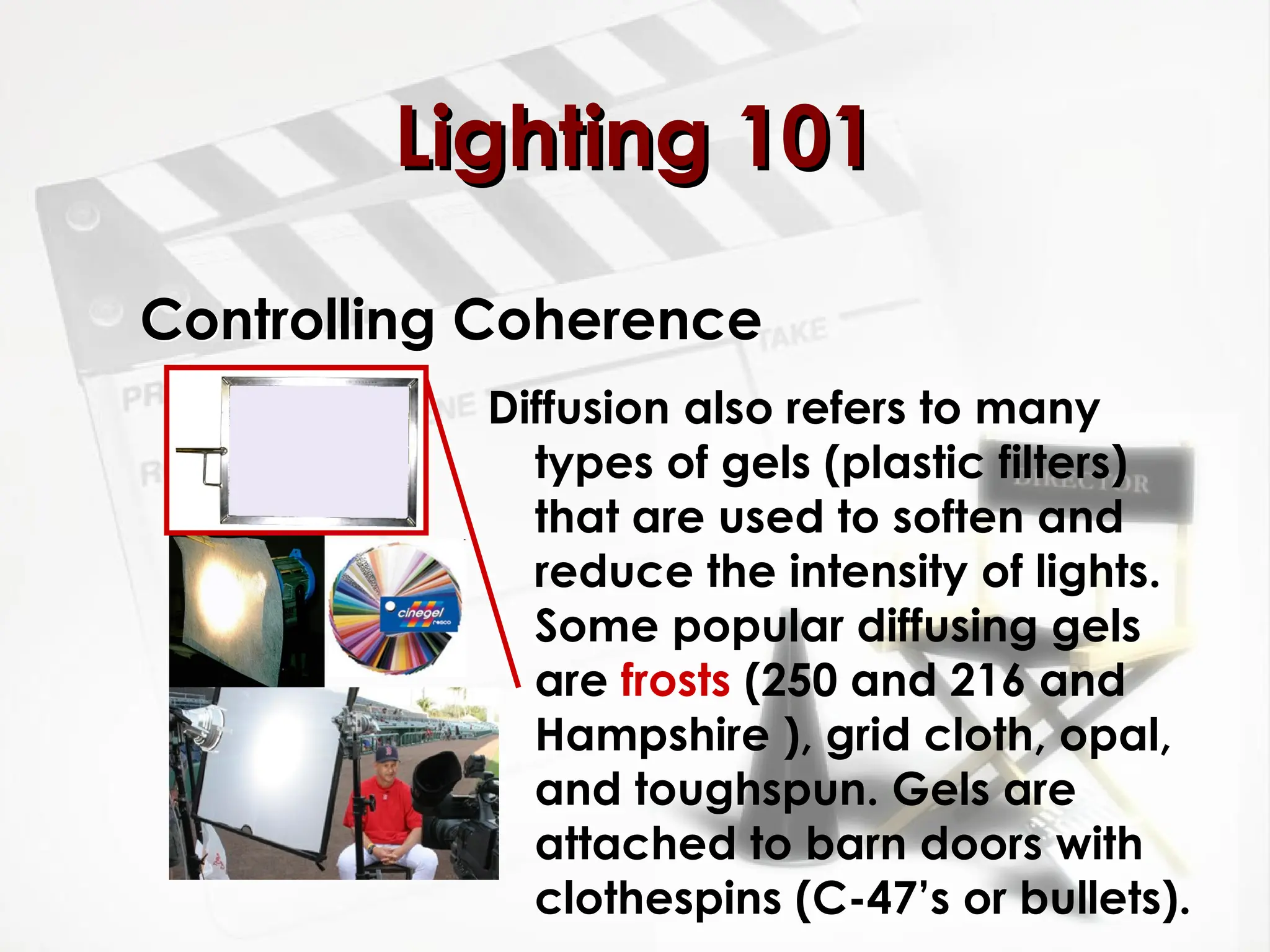
Diffusion also refers to many
types of gels (plastic filters)
that are used to soften and
reduce the intensity of lights.
Some popular diffusing gels
are frosts (250 and 216 and
Hampshire ), grid cloth, opal,
and toughspun. Gels are
attached to barn doors with
clothespins (C-47’s or bullets).
Lighting 101
Lighting 101
Controlling Coherence
Diffusion also refers to many
types of gels (plastic filters)
that are used to soften and
reduce the intensity of lights.
Some popular diffusing gels
are frosts (250 and 216 and
Hampshire ), grid cloth, opal,
and toughspun. Gels are
attached to barn doors with
clothespins (C-47’s or bullets).
Lighting 101
Lighting 101
Color Temperature
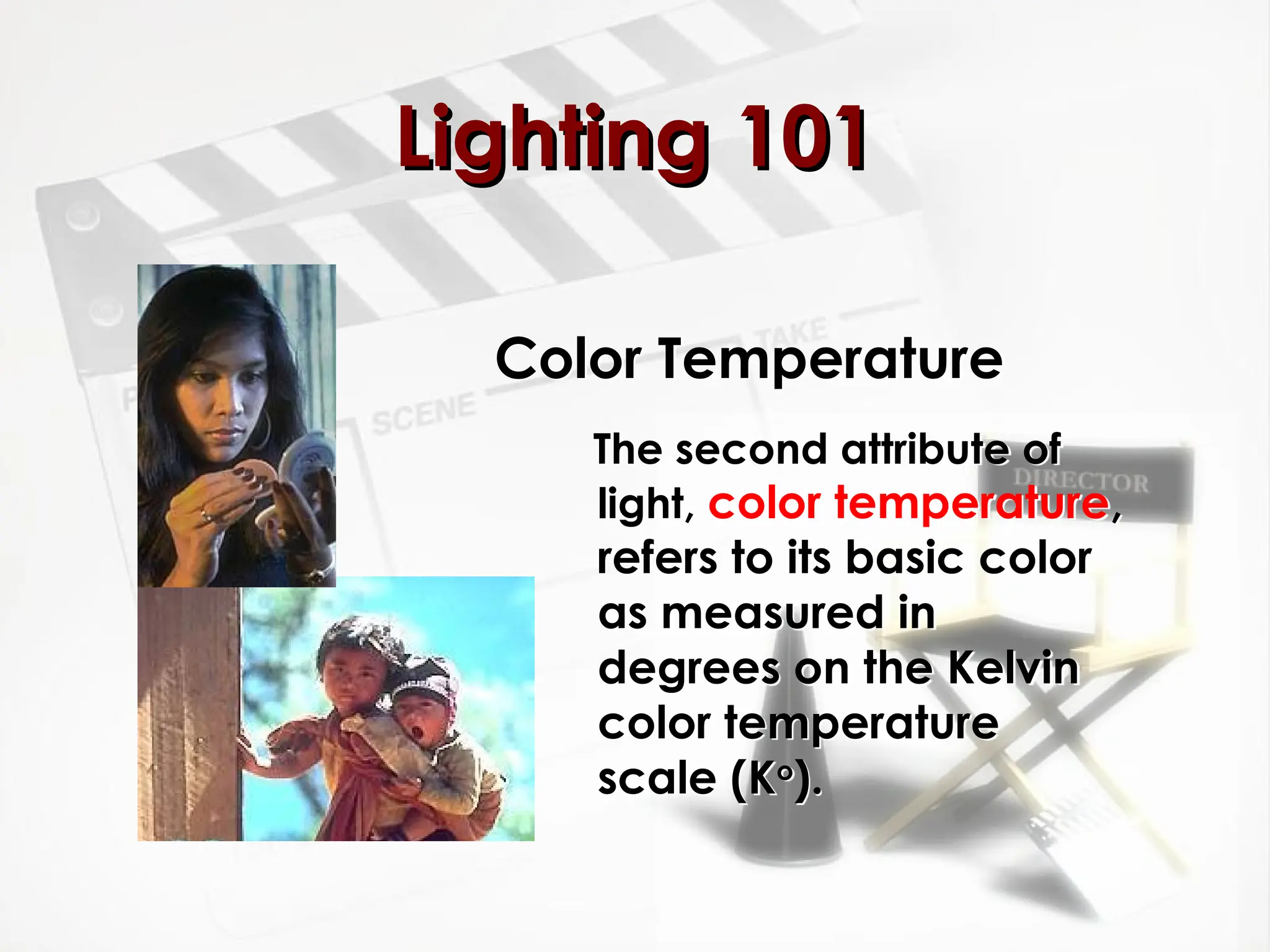
The second attribute of
light, color temperature,
refers to its basic color
as measured in
degrees on the Kelvin
color temperature
scale (Ko
).
Lighting 101
Lighting 101
Color Temperature
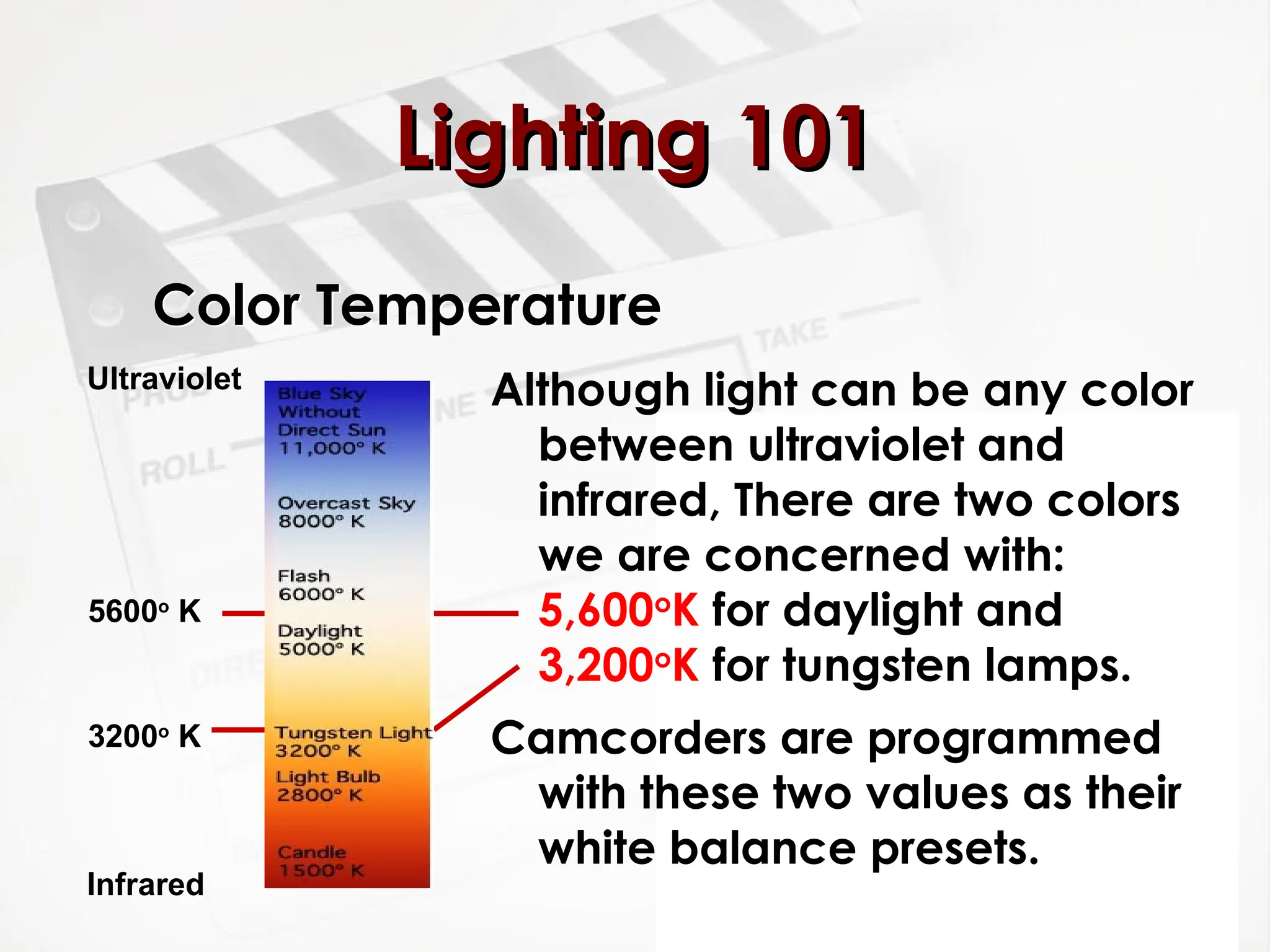
Although light can be any color
between ultraviolet and
infrared, There are two colors
we are concerned with:
5,600o
K for daylight and
3,200o
K for tungsten lamps.
Camcorders are programmed
with these two values as their
white balance presets.
Lighting 101
Lighting 101
Infrared
Ultraviolet
5600o
K
3200o
K
Color Temperature
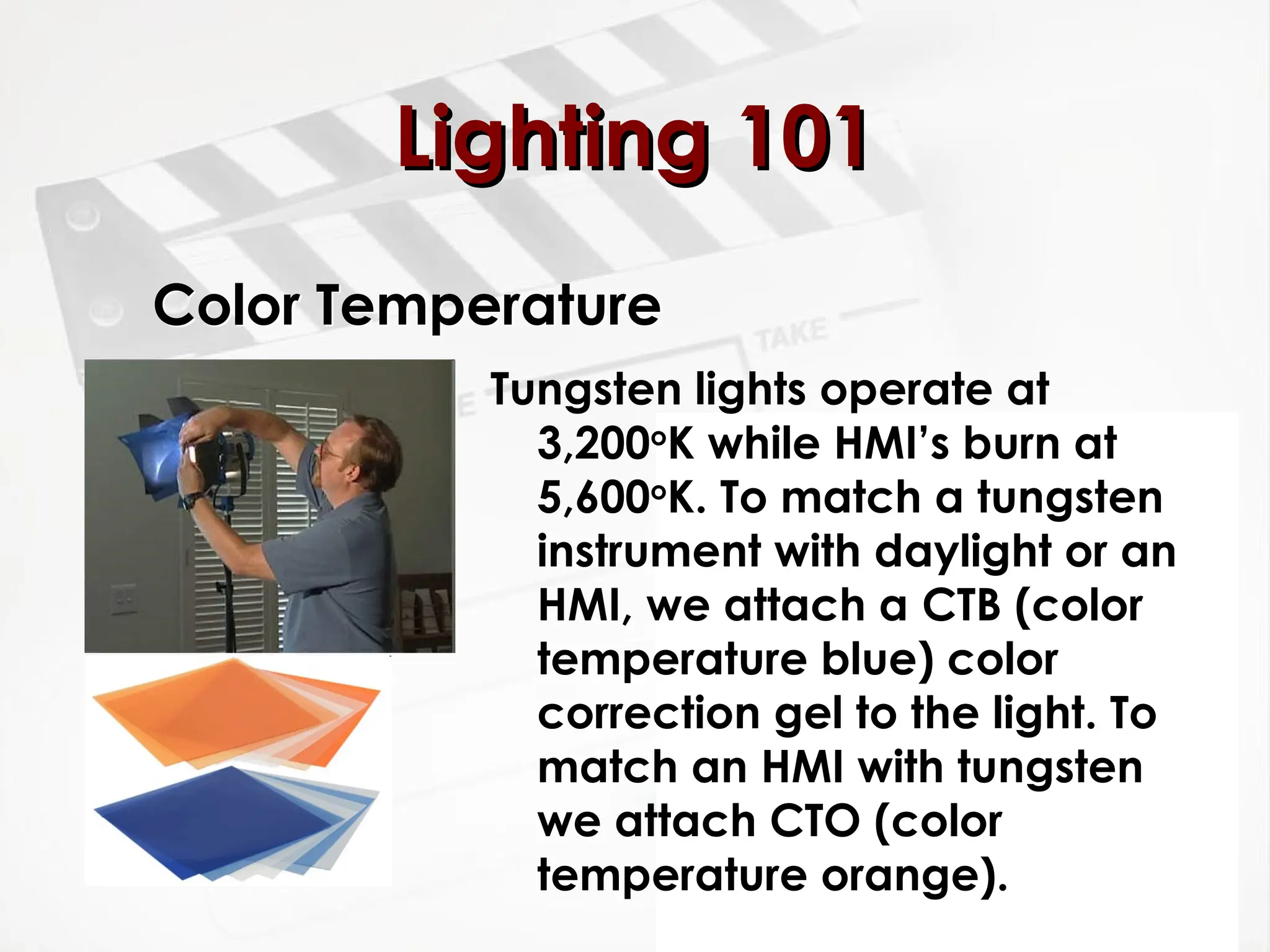
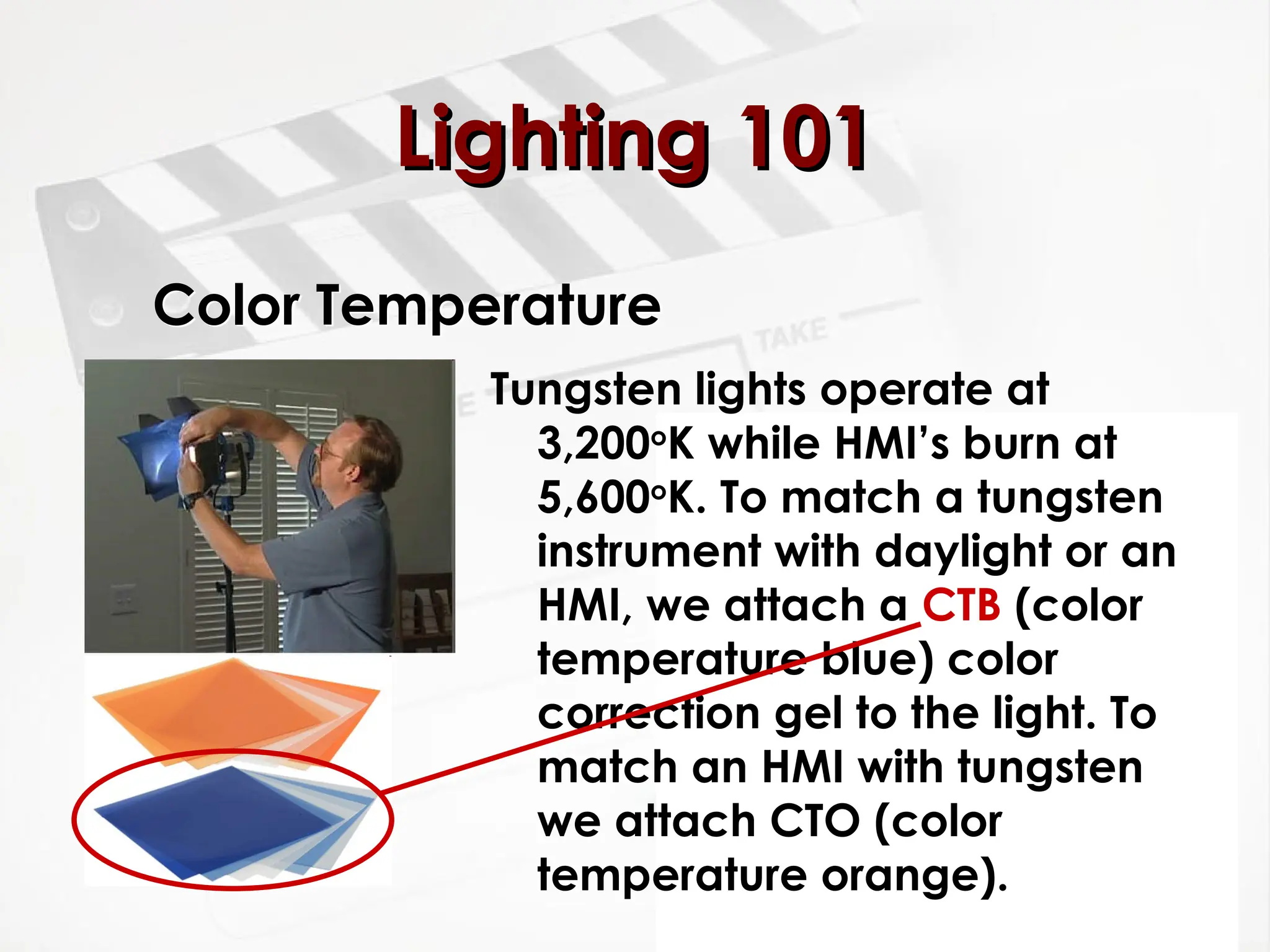
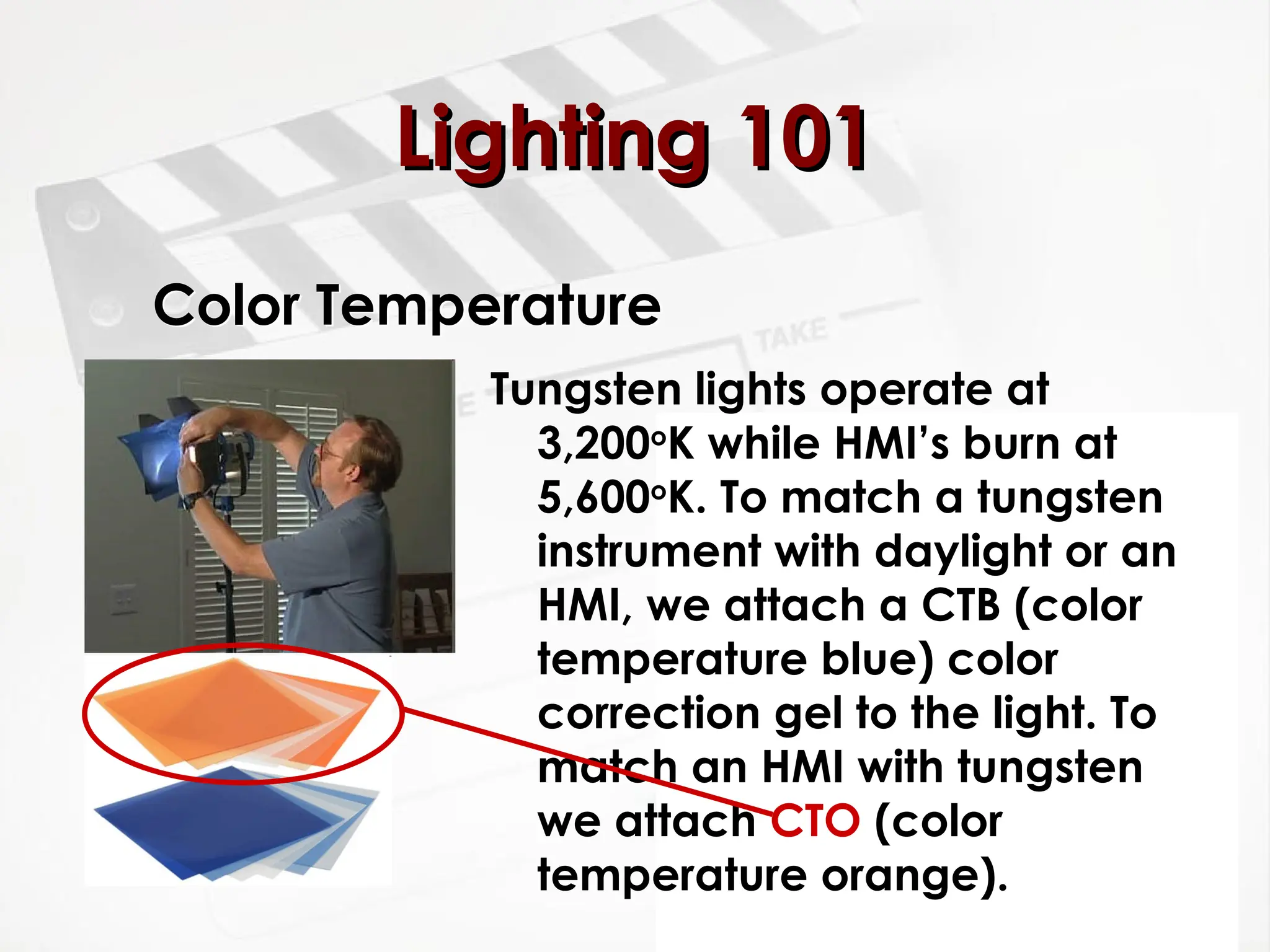
Tungsten lights operate at
3,200o
K while HMI’s burn at
5,600o
K. To match a tungsten
instrument with daylight or an
HMI, we attach a CTB (color
temperature blue) color
correction gel to the light. To
match an HMI with tungsten
we attach CTO (color
temperature orange).
Lighting 101
Lighting 101
Color Temperature
Tungsten lights operate at
3,200o
K while HMI’s burn at
5,600o
K. To match a tungsten
instrument with daylight or an
HMI, we attach a CTB (color
temperature blue) color
correction gel to the light. To
match an HMI with tungsten
we attach CTO (color
temperature orange).
Lighting 101
Lighting 101
Color Temperature
Tungsten lights operate at
3,200o
K while HMI’s burn at
5,600o
K. To match a tungsten
instrument with daylight or an
HMI, we attach a CTB (color
temperature blue) color
correction gel to the light. To
match an HMI with tungsten
we attach CTO (color
temperature orange).
Lighting 101
Lighting 101
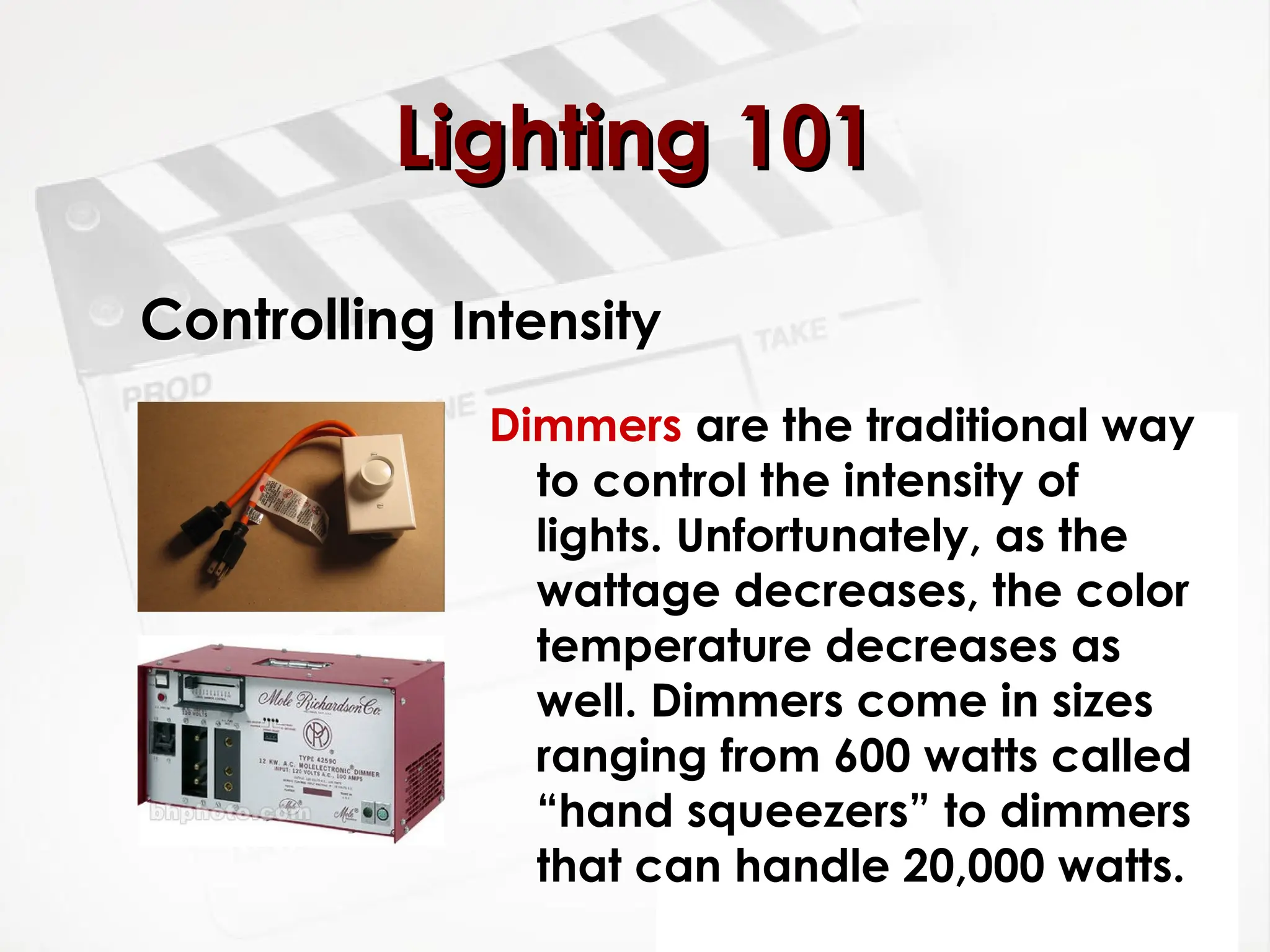
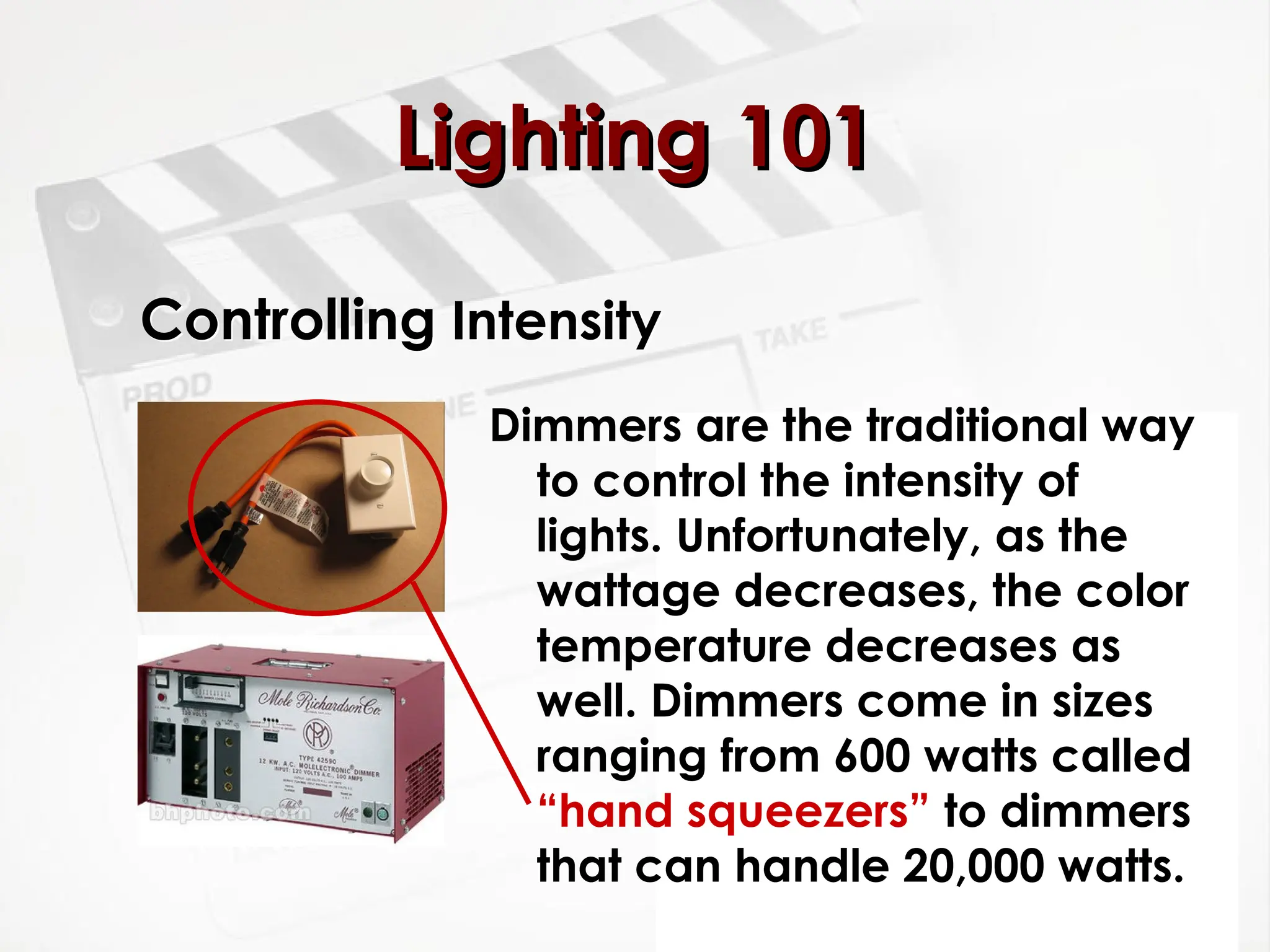
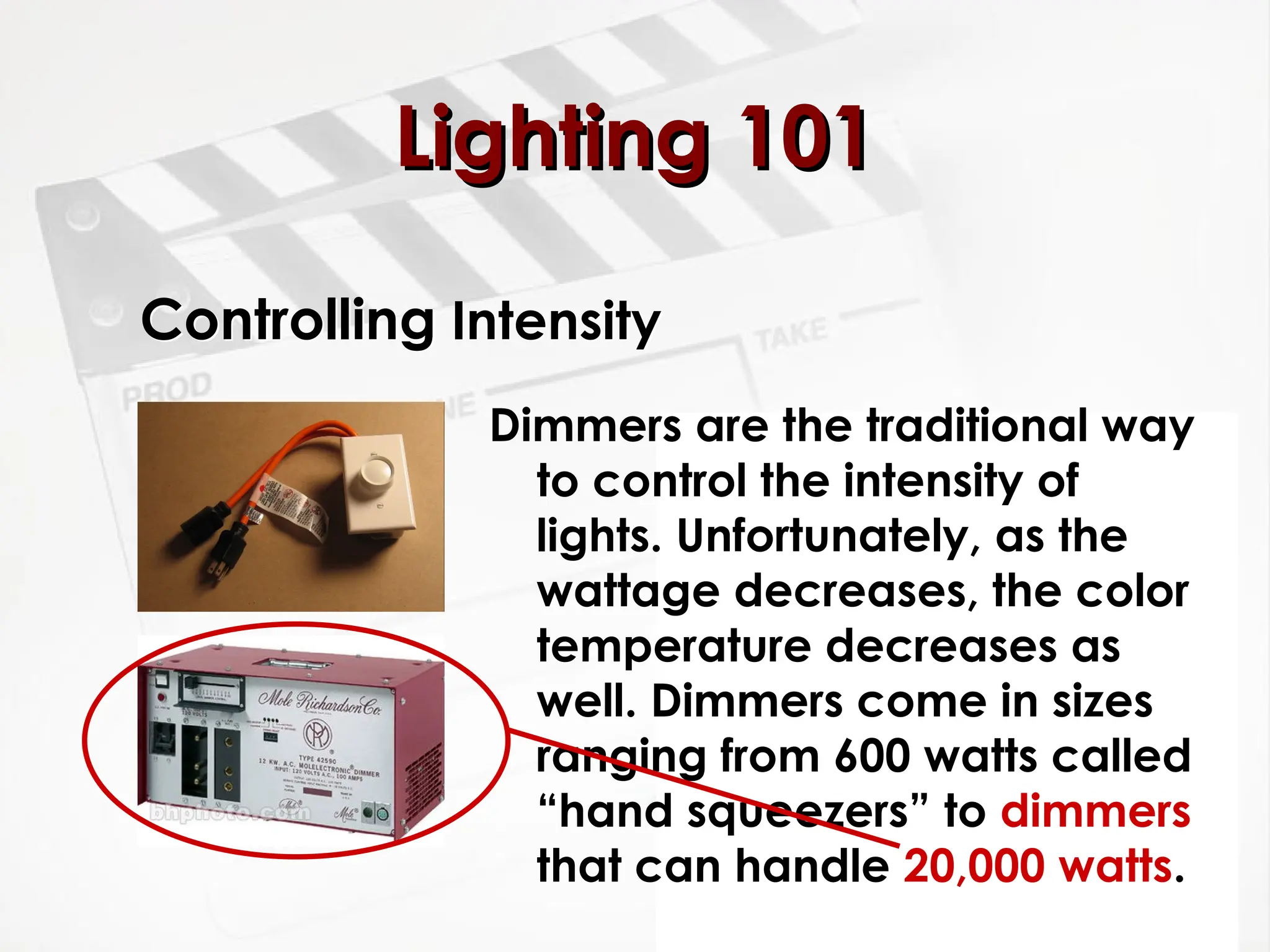
Controlling Intensity
Dimmers are the traditional way
to control the intensity of
lights. Unfortunately, as the
wattage decreases, the color
temperature decreases as
well. Dimmers come in sizes
ranging from 600 watts called
“hand squeezers” to dimmers
that can handle 20,000 watts.
Lighting 101
Lighting 101
Controlling Intensity
Dimmers are the traditional way
to control the intensity of
lights. Unfortunately, as the
wattage decreases, the color
temperature decreases as
well. Dimmers come in sizes
ranging from 600 watts called
“hand squeezers” to dimmers
that can handle 20,000 watts.
Lighting 101
Lighting 101
Controlling Intensity
Dimmers are the traditional way
to control the intensity of
lights. Unfortunately, as the
wattage decreases, the color
temperature decreases as
well. Dimmers come in sizes
ranging from 600 watts called
“hand squeezers” to dimmers
that can handle 20,000 watts.
Lighting 101
Lighting 101
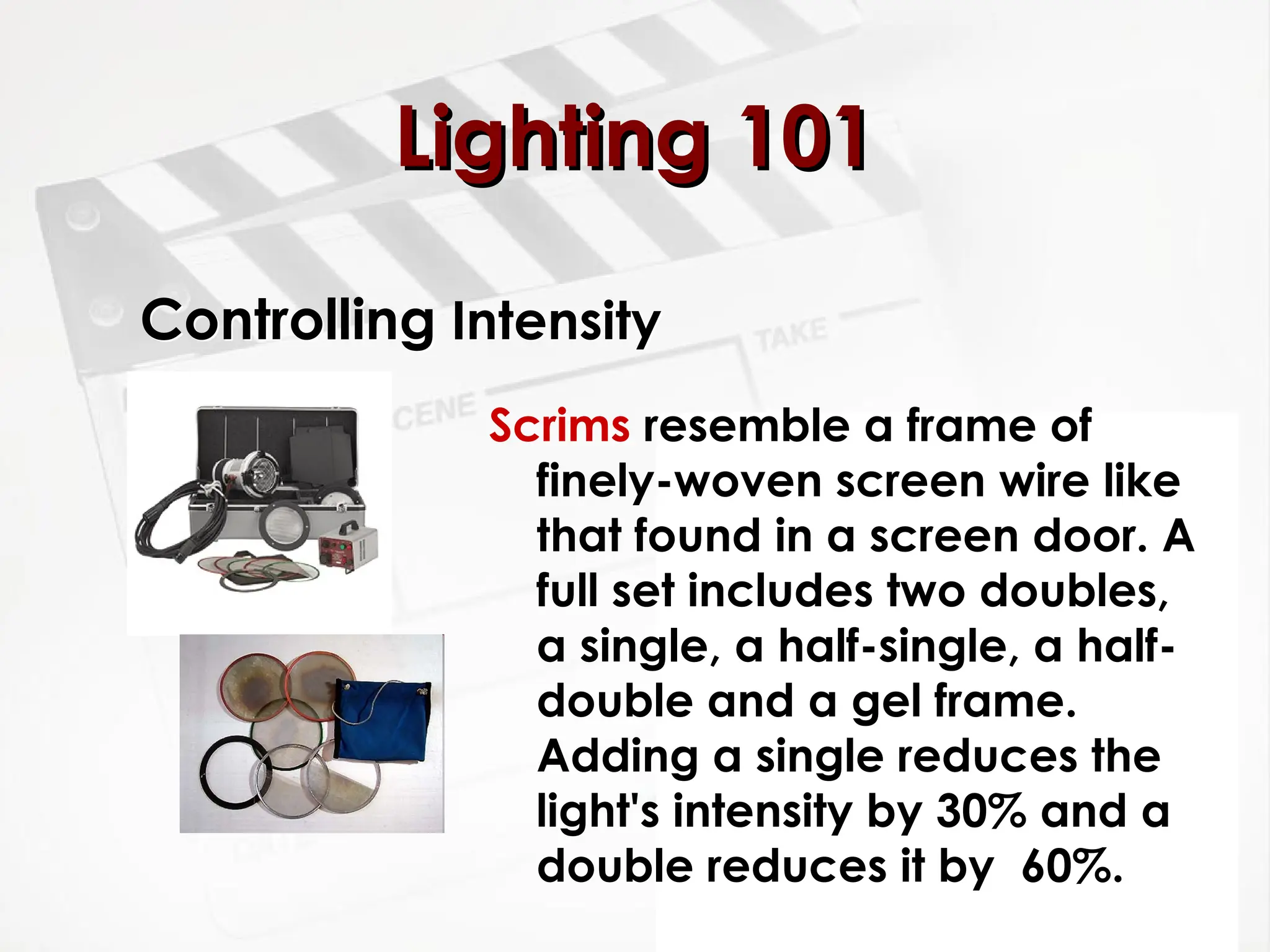
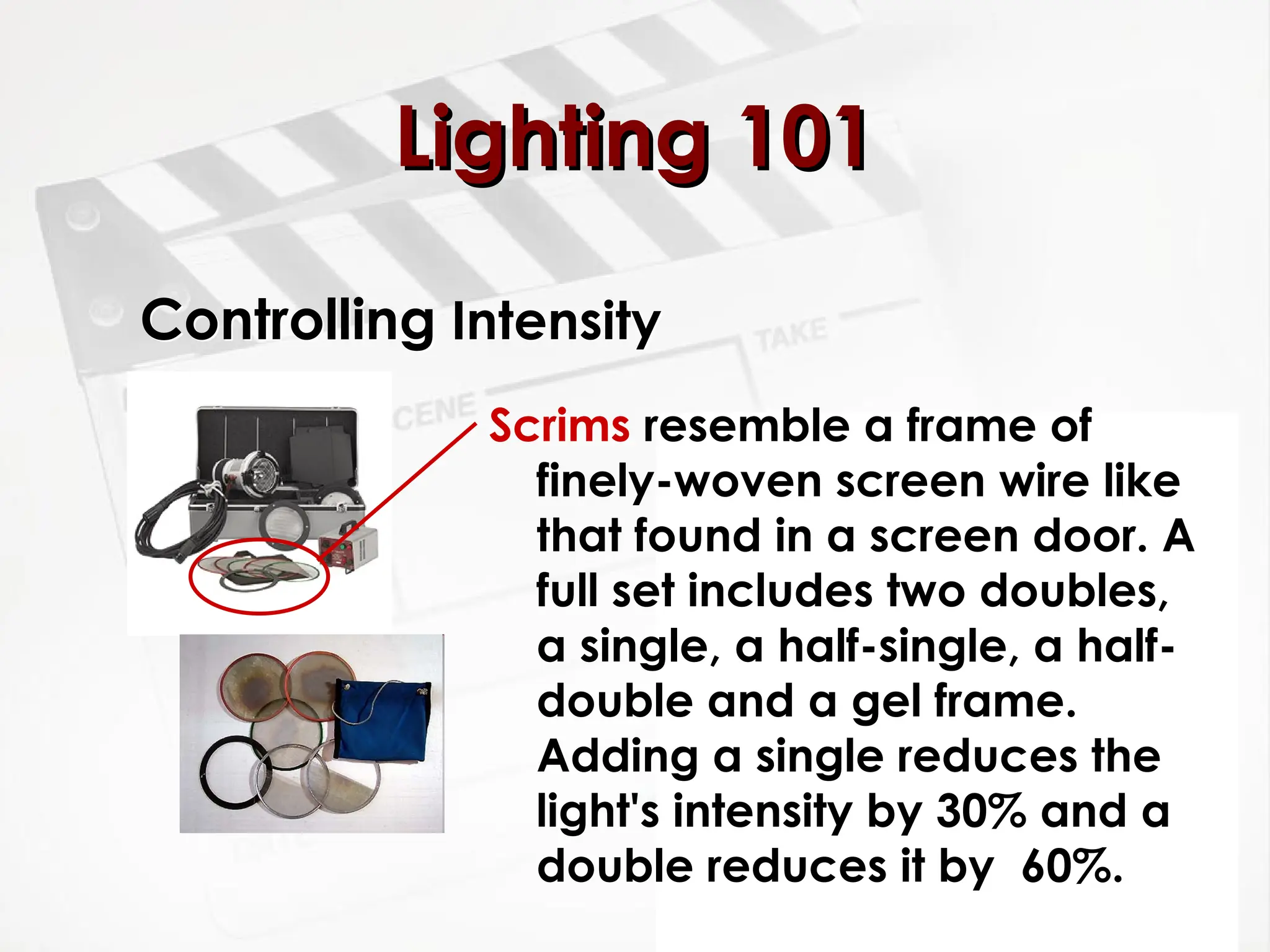
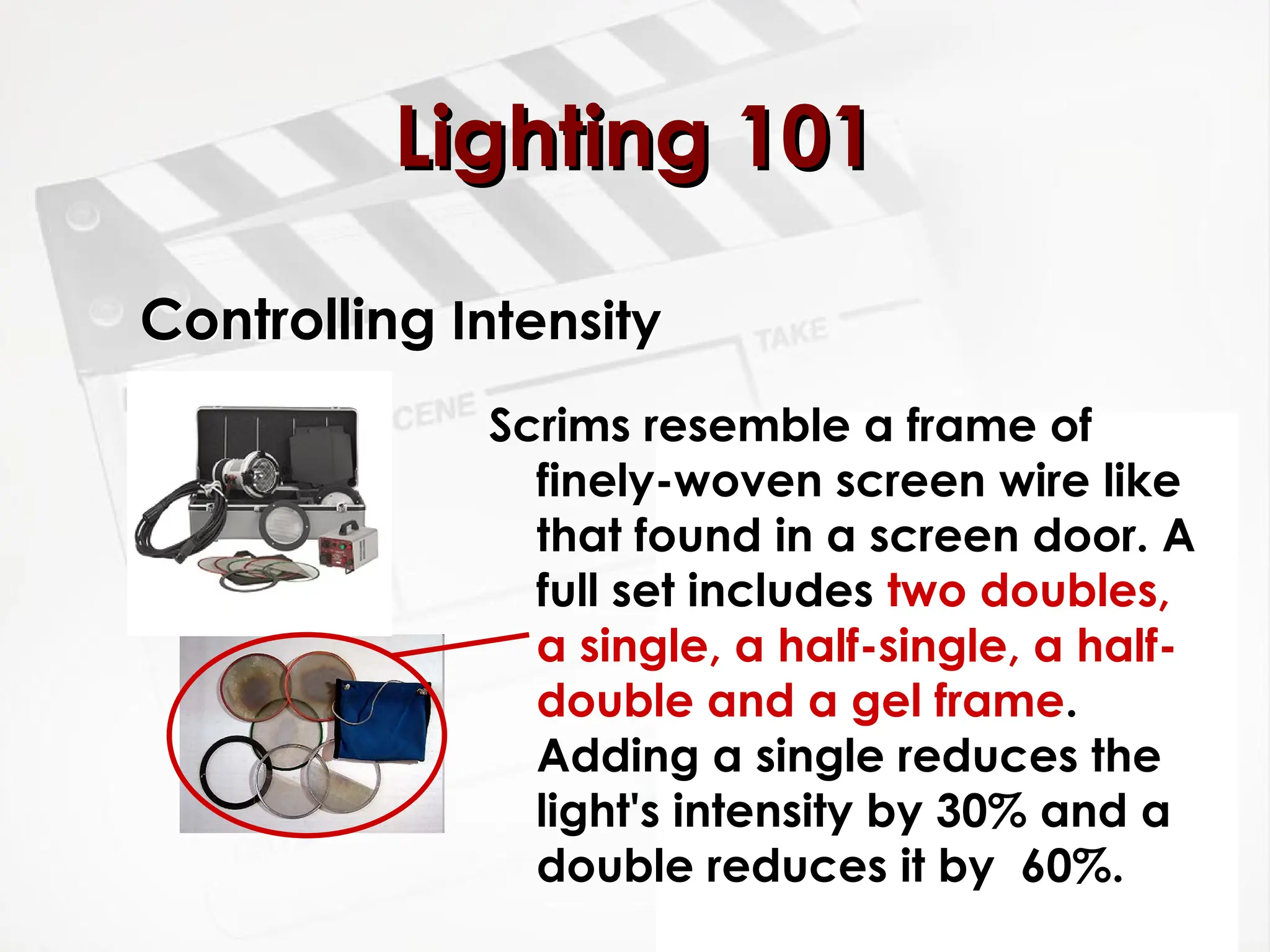
Controlling Intensity
Scrims resemble a frame of
finely-woven screen wire like
that found in a screen door. A
full set includes two doubles,
a single, a half-single, a half-
double and a gel frame.
Adding a single reduces the
light's intensity by 30% and a
double reduces it by 60%.
Lighting 101
Lighting 101
Controlling Intensity
Scrims resemble a frame of
finely-woven screen wire like
that found in a screen door. A
full set includes two doubles,
a single, a half-single, a half-
double and a gel frame.
Adding a single reduces the
light's intensity by 30% and a
double reduces it by 60%.
Lighting 101
Lighting 101
Controlling Intensity
Scrims resemble a frame of
finely-woven screen wire like
that found in a screen door. A
full set includes two doubles,
a single, a half-single, a half-
double and a gel frame.
Adding a single reduces the
light's intensity by 30% and a
double reduces it by 60%.
Lighting 101
Lighting 101
Controlling Intensity
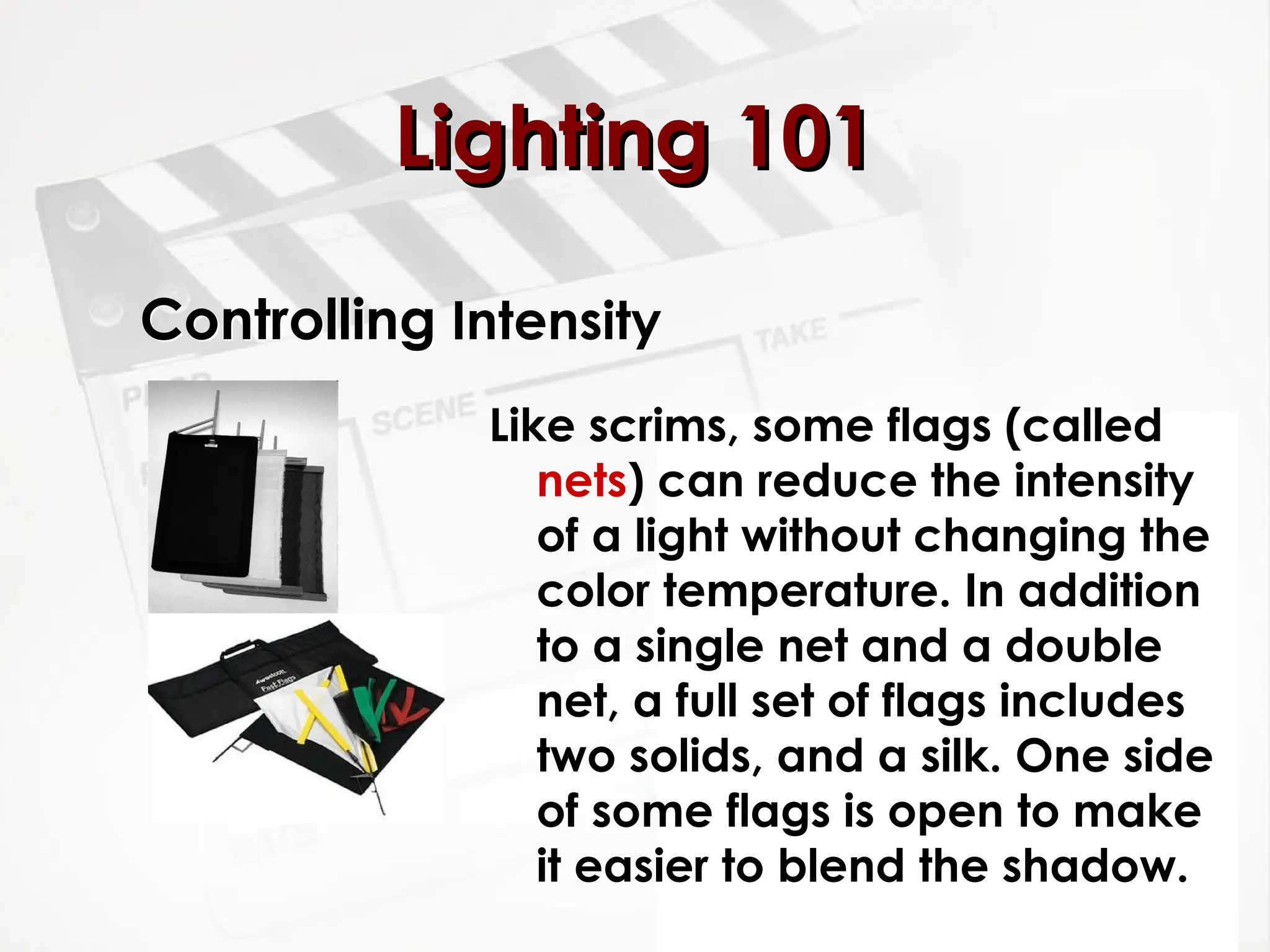
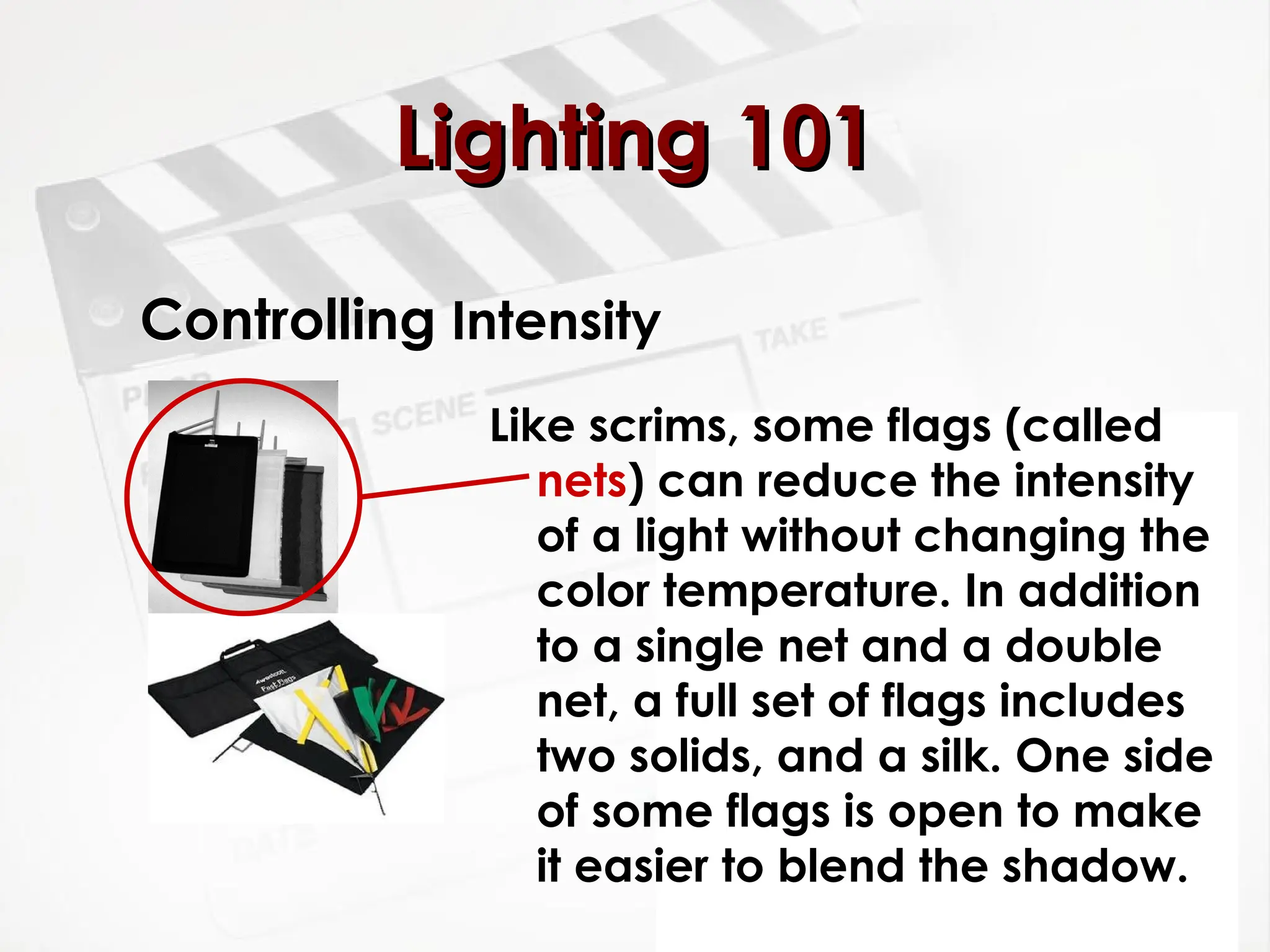
Like scrims, some flags (called
nets) can reduce the intensity
of a light without changing the
color temperature. In addition
to a single net and a double
net, a full set of flags includes
two solids, and a silk. One side
of some flags is open to make
it easier to blend the shadow.
Lighting 101
Lighting 101
Controlling Intensity
Like scrims, some flags (called
nets) can reduce the intensity
of a light without changing the
color temperature. In addition
to a single net and a double
net, a full set of flags includes
two solids, and a silk. One side
of some flags is open to make
it easier to blend the shadow.
Lighting 101
Lighting 101
• Director of Photography
Oversees all the visual aspects of the film
The Electric Department
• Director of Photography
• Gaffer
The Electric Department
• Director of Photography
• Gaffer
(AKA: Chief Lighting Technician or CLT)
The Electric Department
• Director of Photography
• Gaffer
(AKA: Chief Lighting Technician or CLT)
• Best Boy Electric (AKA: ACLT)
The Electric Department
• Director of Photography
• Gaffer
(AKA: Chief Lighting Technician or CLT)
• Best Boy Electric (AKA: ACLT)
• Electricians/Lamp Operators
The Electric Department
• Director of Photography
• Gaffer
(AKA: Chief Lighting Technician or CLT)
• Best Boy Electric (AKA: ACLT)
• Electricians/Lamp Operators
• Generator Operator
The Electric Department
• Director of Photography
• Gaffer
(AKA: Chief Lighting Technician or CLT)
• Best Boy Electric (AKA: ACLT)
• Electricians/Lamp Operators
• Generator Operator
• Rigging Crew (same as above)
The Electric Department
Thanks for your attention
End of Lighting Overview
This presentation is
continued on the PPT
entitled “Lighting Analysis”
Lighting Overviewvcvcvccvccvcvcvcvcvcv.ppt

  • 1.
    Lighting Overview Lighting Overview LectureCreated 9/8/10 Updated 10/13/14 by John M. Grace, film worker and instructor D.A.T.A. Charter High School Albuquerque, NM © 2010, John M. Grace Free to use in the classroom under a Creative Commons attribution license
  • 2.
    3-Point Lighting 3-Point Lighting 3-Pointlighting is the lighting technique used by cinematographers on most professional productions. It is easy to understand but it takes a lifetime to master. In addition to 3-Point lighting, there are also 5- Point and 7-Point lighting scenarios which we will also discuss and analyze.
  • 3.
    3-Point Lighting 3-Point Lighting Justas it sounds, 3-Point lighting refers to lighting the subject from three angles. The lighting positions are referred to as the Key Light, the Fill Light and the Back Light .
  • 4.
    3-Point Lighting 3-Point Lighting Justas it sounds, 3-Point lighting refers to lighting the subject from three angles. The lighting positions are referred to as the Key Light, the Fill Light and the Back Light . Camera
  • 5.
    3-Point Lighting 3-Point Lighting Justas it sounds, 3-Point lighting refers to lighting the subject from three angles. The lighting positions are referred to as the Key Light, the Fill Light and the Back Light . Camera 600w Key Light
  • 6.
    3-Point Lighting 3-Point Lighting Justas it sounds, 3-Point lighting refers to lighting the subject from three angles. The lighting positions are referred to as the Key Light, the Fill Light and the Back Light . Camera 600w Key Light 300w Fill Light
  • 7.
    3-Point Lighting 3-Point Lighting Justas it sounds, 3-Point lighting refers to lighting the subject from three angles. The lighting positions are referred to as the Key Light, the Fill Light and the Back Light . Camera 150w Back Light 600w Key Light 300w Fill Light
  • 8.
    3-Point Lighting 3-Point Lighting TheKey and Fill lights are roughly 45o from the camera axis. Like all rules, this rule is made to be broken as you will see in the upcoming lighting scenarios. Camera 150w Back Light 600w Key Light 300w Fill Light 45o
  • 9.
    3-Point Lighting 3-Point Lighting TheKey and Fill lights are roughly 45o from the camera axis. Like all rules, this rule is made to be broken as you will see in the upcoming lighting scenarios. Camera 150w Back Light 600w Key Light 300w Fill Light 45o 45o
  • 10.
    3-Point Lighting 3-Point Lighting TheKey light is generally twice the intensity of the Fill light which is twice the intensity of the Back light. Again, these numbers are very general and vary depending on the application. Camera 150w Back Light 600w Key Light 300w Fill Light
  • 11.
    3-Point Lighting 3-Point Lighting TheKey light is generally twice the intensity of the Fill light which is twice the intensity of the Back light. Again, these numbers are very general and vary depending on the application. Camera 150w Back Light 600w Key Light 300w Fill Light
  • 12.
    3-Point Lighting 3-Point Lighting TheKey light is generally twice the intensity of the Fill light which is twice the intensity of the Back light. Again, these numbers are very general and vary depending on the application. Camera 150w Back Light 600w Key Light 300w Fill Light
  • 13.
    There are twoprimary and two secondary types of lighting used in film and television. The primary types are Tungsten and HMI. Types of Lighting Types of Lighting Tungsten refers to the steel used in the filament inside the globe. These are sometimes called quartz lights because the globes are made of hard glass – almost as hard as quartz rock. They emit a yellowish light.
  • 14.
    There are twoprimary and two secondary types of lighting used in film and television. The primary types are Tungsten and HMI. Types of Lighting Types of Lighting HMI’s (Hydrargyum Medium Arc-Length Iodide) produce a bluish light (like daylight) very efficiently due to their unique ballast system. Unlike Tungsten lights, they are slow to come up to full brightness.
  • 15.
    There are twoprimary and two secondary types of lighting used in film and television. The secondary types are Fluorescent and LED. Types of Lighting Types of Lighting Both types are energy efficient, long lasting and come in a variety of color temperatures. Both can be dimmable and tend to be expensive but can save money over time. Fluorescents come to full brightness slowly.
  • 16.
    The most commontype of lighting instrument used in film and television is the Fresnel. The Fresnel is named for the inventor of the lens which was originally designed for lighthouses. Types of Lighting Types of Lighting The Fresnel lens has concentric rings that help focus and direct the light. Most Fresnels utilize tungsten globes or lamps (not bulbs). Tungsten refers to the steel used in the filament inside the globe.
  • 17.
    The most commontype of lighting instrument used in film and television is the Fresnel. The Fresnel is named for the inventor of the lens which was originally designed for lighthouses. Types of Lighting Types of Lighting The Fresnel lens has concentric rings that help focus and direct the light. Most Fresnels utilize tungsten globes or lamps (not bulbs). Tungsten refers to the steel used in the filament inside the globe.
  • 18.
    The most commontype of lighting instrument used in film and television is the Fresnel. The Fresnel is named for the inventor of the lens which was originally designed for lighthouses. Types of Lighting Types of Lighting The Fresnel lens has concentric rings that help focus and direct the light. Most Fresnels utilize tungsten globes or lamps (not bulbs). Tungsten refers to the steel used in the filament inside the globe.
  • 19.
    The most commontype of lighting instrument used in film and television is the Fresnel. The Fresnel is named for the inventor of the lens which was originally designed for lighthouses. Types of Lighting Types of Lighting The Fresnel lens has concentric rings that help focus and direct the light. Most Fresnels utilize tungsten globes or lamps (not bulbs). Tungsten refers to the steel used in the filament inside the globe.
  • 20.
    The most commontype of lighting instrument used in film and television is the Fresnel. The Fresnel is named for the inventor of the lens which was originally designed for lighthouses. Types of Lighting Types of Lighting The Fresnel lens has concentric rings that help focus and direct the light. Most Fresnels utilize tungsten globes or lamps (not bulbs). Tungsten refers to the steel used in the filament inside the globe.
  • 21.
    Types of Lighting Typesof Lighting The Fresnels made by Mole Richardson have been the workhorses of the film industry for the past 30-40 years. All Fresnels are constructed similarly and it is important to learn the parts of these popular lighting instruments. Mole Richardson
  • 22.
    Types of Lighting Typesof Lighting The Fresnels made by Mole Richardson have been the workhorses of the film industry for the past 30-40 years. All Fresnels are constructed similarly and it is important to learn the parts of these popular lighting instruments. Mole Richardson
  • 23.
    Types of Lighting Typesof Lighting The Fresnels made by Mole Richardson have been the workhorses of the film industry for the past 30-40 years. All Fresnels are constructed similarly and it is important to learn the parts of these popular lighting instruments. Mole Richardson
  • 24.
    Types of Lighting Typesof Lighting In addition to Mole Richardson, Fresnels are also manufactured by a number of other companies including Arriflex (Arri), Bardwell McCallister, LTM and DeSisti. They range in intensity from 125 watts to over 20,000 watts. DeSisti Fresnel LTM Fresnel Bardwell-McAlister Arri Fresnel
  • 25.
    Types of Lighting Typesof Lighting In addition to Mole Richardson, Fresnels are also manufactured by a number of other companies including Arriflex (Arri), Bardwell McCallister, LTM and DeSisti. They range in intensity from 125 watts to over 20,000 watts. DeSisti Fresnel LTM Fresnel Bardwell-McAlister Arri Fresnel
  • 26.
    Types of Lighting Typesof Lighting In addition to Mole Richardson, Fresnels are also manufactured by a number of other companies including Arriflex (Arri), Bardwell McCallister, LTM and DeSisti. They range in intensity from 125 watts to over 20,000 watts. DeSisti Fresnel LTM Fresnel Bardwell-McAlister Arri Fresnel
  • 27.
    Types of Lighting Typesof Lighting In addition to Mole Richardson, Fresnels are also manufactured by a number of other companies including Arriflex (Arri), Bardwell McCallister, LTM and DeSisti. They range in intensity from 125 watts to over 20,000 watts. DeSisti Fresnel LTM Fresnel Bardwell-McAlister Arri Fresnel
  • 28.
    Types of Lighting Typesof Lighting In addition to Mole Richardson, Fresnels are also manufactured by a number of other companies including Arriflex (Arri), Bardwell McCallister, LTM and DeSisti. They range in intensity from 125 watts to over 20,000 watts. DeSisti Fresnel LTM Fresnel Bardwell-McAlister Arri Fresnel
  • 29.
    Types of Lighting Typesof Lighting HMI’s are available as both Fresnels and PAR (Parabolic Aluminized Reflector) spot lights. Their output per watt is almost 2X greater that that of tungsten instruments, they have a lower operating temperature and come in a range of wattages.
  • 30.
    Types of Lighting Typesof Lighting HMI’s are available as both Fresnels and PAR (Parabolic Aluminized Reflector) spot lights. Their output per watt is almost 2X greater that that of tungsten instruments, they have a lower operating temperature and come in a range of wattages.
  • 31.
    Types of Lighting Typesof Lighting HMI’s are available as both Fresnels and PAR (Parabolic Aluminized Reflector) spot lights. Their output per watt is almost 2X greater that that of tungsten instruments, they have a lower operating temperature and come in a range of wattages.
  • 32.
    Types of Lighting Typesof Lighting HMI’s are available as both Fresnels and PAR (Parabolic Aluminized Reflector) spot lights. Their output per watt is almost 2X greater that that of tungsten instruments, they have a lower operating temperature and come in a range of wattages.
  • 33.
    Lighting 101 Lighting 101 ThreeBasic Attributes of Light:  Coherence (Quality) Hard and Soft Light  Color Temperature Daylight and Tungsten  Intensity Wattage and Output Foot Candles and Lumens
  • 34.
    Lighting 101 Lighting 101 HardLight Light is transmitted directly from a small point source and results in relatively coherent (parallel) rays. This gives the light a hard, crisp, sharply defined appearance. The light from a clear, unfrosted light bulb, a focused spotlight, or the sun in a clear sky are hard light sources
  • 35.
    Hard Lighting Instruments Lighting101 Lighting 101 LTM PAR Light Ianiro “Red Head” ETC Source 4 Leko Spotlight Mole Open Face Ianiro “Blonde”
  • 36.
    Soft Light Lighting 101 Lighting101 Soft (diffused) light has the opposite effect. As shown in the photo on the left, soft light tends to hide surface irregularities and minimize detail. There are numerous techniques used to soften or diffuse hard light sources.
  • 37.
    Soft Lighting Instruments Lighting101 Lighting 101 China Balls “Chimera” Soft Boxes Mole Richardson Fresnel LED Lighting Ziplight or Soft Light KinoFlo Diva Fluorescent
  • 38.
    Controlling Coherence Flags: Flagsare frames covered in fabric that are used to control Coherence Color Temperature and Intensity Lighting 101 Lighting 101
  • 39.
    Controlling Coherence Flags: Flagsare frames covered in fabric that are used to control Coherence Color Temperature and Intensity They come in a variety of sizes including: • 12”X16” • 18”X24” Lighting 101 Lighting 101 • 24”X36” • 48”X48”
  • 40.
    Controlling Coherence Diffusion refersto the practice of softening hard light with diffusers. A common type of diffuser is silk fabric stretched in a frame. Small diffusion frames are called flags, 6x6 to 10x10 frames are butterflies and the 12x12 to 20x20 frames are called overheads. Lighting 101 Lighting 101
  • 41.
    Controlling Coherence Diffusion refersto the practice of softening hard light with diffusers. A common type of diffuser is silk fabric stretched in a frame. Small diffusion frames are called flags, 6x6 to 10x10 frames are butterflies and the 12x12 to 20x20 frames are called overheads. Lighting 101 Lighting 101
  • 42.
    Controlling Coherence Diffusion refersto the practice of softening hard light with diffusers. A common type of diffuser is silk fabric stretched in a frame. Small diffusion frames are called flags, 6x6 to 10x10 frames are butterflies and the 12x12 to 20x20 frames are called overheads. Lighting 101 Lighting 101
  • 43.
    Controlling Coherence Filters alsoknown as lenses are attached to open-face lights (especially HMI’s) to help diffuse and direct the light. A set of lenses usually includes a spot, a fresnel, a “stipple” and one or two wide angles. Lighting 101 Lighting 101
  • 44.
    Controlling Coherence Diffusion alsorefers to many types of gels (plastic filters) that are used to soften and reduce the intensity of lights. Some popular diffusing gels are frosts (250 and 216 and Hampshire ), grid cloth, opal, and toughspun. Gels are attached to barn doors with clothespins (C-47’s or bullets). Lighting 101 Lighting 101
  • 45.
    Controlling Coherence Diffusion alsorefers to many types of gels (plastic filters) that are used to soften and reduce the intensity of lights. Some popular diffusing gels are frosts (250 and 216 and Hampshire ), grid cloth, opal, and toughspun. Gels are attached to barn doors with clothespins (C-47’s or bullets). Lighting 101 Lighting 101
  • 46.
    Controlling Coherence Diffusion alsorefers to many types of gels (plastic filters) that are used to soften and reduce the intensity of lights. Some popular diffusing gels are frosts (250 and 216 and Hampshire ), grid cloth, opal, and toughspun. Gels are attached to barn doors with clothespins (C-47’s or bullets). Lighting 101 Lighting 101
  • 47.
    Color Temperature The secondattribute of light, color temperature, refers to its basic color as measured in degrees on the Kelvin color temperature scale (Ko ). Lighting 101 Lighting 101
  • 48.
    Color Temperature Although lightcan be any color between ultraviolet and infrared, There are two colors we are concerned with: 5,600o K for daylight and 3,200o K for tungsten lamps. Camcorders are programmed with these two values as their white balance presets. Lighting 101 Lighting 101 Infrared Ultraviolet 5600o K 3200o K
  • 49.
    Color Temperature Tungsten lightsoperate at 3,200o K while HMI’s burn at 5,600o K. To match a tungsten instrument with daylight or an HMI, we attach a CTB (color temperature blue) color correction gel to the light. To match an HMI with tungsten we attach CTO (color temperature orange). Lighting 101 Lighting 101
  • 50.
    Color Temperature Tungsten lightsoperate at 3,200o K while HMI’s burn at 5,600o K. To match a tungsten instrument with daylight or an HMI, we attach a CTB (color temperature blue) color correction gel to the light. To match an HMI with tungsten we attach CTO (color temperature orange). Lighting 101 Lighting 101
  • 51.
    Color Temperature Tungsten lightsoperate at 3,200o K while HMI’s burn at 5,600o K. To match a tungsten instrument with daylight or an HMI, we attach a CTB (color temperature blue) color correction gel to the light. To match an HMI with tungsten we attach CTO (color temperature orange). Lighting 101 Lighting 101
  • 52.
    Controlling Intensity Dimmers arethe traditional way to control the intensity of lights. Unfortunately, as the wattage decreases, the color temperature decreases as well. Dimmers come in sizes ranging from 600 watts called “hand squeezers” to dimmers that can handle 20,000 watts. Lighting 101 Lighting 101
  • 53.
    Controlling Intensity Dimmers arethe traditional way to control the intensity of lights. Unfortunately, as the wattage decreases, the color temperature decreases as well. Dimmers come in sizes ranging from 600 watts called “hand squeezers” to dimmers that can handle 20,000 watts. Lighting 101 Lighting 101
  • 54.
    Controlling Intensity Dimmers arethe traditional way to control the intensity of lights. Unfortunately, as the wattage decreases, the color temperature decreases as well. Dimmers come in sizes ranging from 600 watts called “hand squeezers” to dimmers that can handle 20,000 watts. Lighting 101 Lighting 101
  • 55.
    Controlling Intensity Scrims resemblea frame of finely-woven screen wire like that found in a screen door. A full set includes two doubles, a single, a half-single, a half- double and a gel frame. Adding a single reduces the light's intensity by 30% and a double reduces it by 60%. Lighting 101 Lighting 101
  • 56.
    Controlling Intensity Scrims resemblea frame of finely-woven screen wire like that found in a screen door. A full set includes two doubles, a single, a half-single, a half- double and a gel frame. Adding a single reduces the light's intensity by 30% and a double reduces it by 60%. Lighting 101 Lighting 101
  • 57.
    Controlling Intensity Scrims resemblea frame of finely-woven screen wire like that found in a screen door. A full set includes two doubles, a single, a half-single, a half- double and a gel frame. Adding a single reduces the light's intensity by 30% and a double reduces it by 60%. Lighting 101 Lighting 101
  • 58.
    Controlling Intensity Like scrims,some flags (called nets) can reduce the intensity of a light without changing the color temperature. In addition to a single net and a double net, a full set of flags includes two solids, and a silk. One side of some flags is open to make it easier to blend the shadow. Lighting 101 Lighting 101
  • 59.
    Controlling Intensity Like scrims,some flags (called nets) can reduce the intensity of a light without changing the color temperature. In addition to a single net and a double net, a full set of flags includes two solids, and a silk. One side of some flags is open to make it easier to blend the shadow. Lighting 101 Lighting 101
  • 60.
    • Director ofPhotography Oversees all the visual aspects of the film The Electric Department The Electric Department
  • 61.
    • Director ofPhotography • Gaffer The Electric Department The Electric Department
  • 62.
    • Director ofPhotography • Gaffer (AKA: Chief Lighting Technician or CLT) The Electric Department The Electric Department
  • 63.
    • Director ofPhotography • Gaffer (AKA: Chief Lighting Technician or CLT) • Best Boy Electric (AKA: ACLT) The Electric Department The Electric Department
  • 64.
    • Director ofPhotography • Gaffer (AKA: Chief Lighting Technician or CLT) • Best Boy Electric (AKA: ACLT) • Electricians/Lamp Operators The Electric Department The Electric Department
  • 65.
    • Director ofPhotography • Gaffer (AKA: Chief Lighting Technician or CLT) • Best Boy Electric (AKA: ACLT) • Electricians/Lamp Operators • Generator Operator The Electric Department The Electric Department
  • 66.
    • Director ofPhotography • Gaffer (AKA: Chief Lighting Technician or CLT) • Best Boy Electric (AKA: ACLT) • Electricians/Lamp Operators • Generator Operator • Rigging Crew (same as above) The Electric Department The Electric Department
  • 67.
    Thanks for yourattention End of Lighting Overview End of Lighting Overview This presentation is continued on the PPT entitled “Lighting Analysis”