The Effects of
Lighting Conditions on
Facial Encoding
Software
Lynn, Ben, Ashley, Allison, Jaein
Our Study
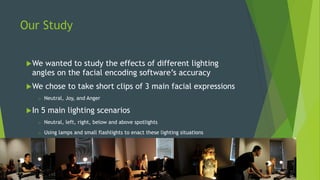
u We wanted to study the effects of different lighting
angles on the facial encoding software’s accuracy
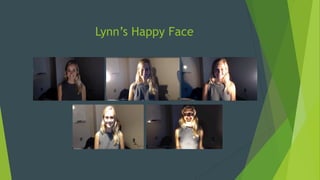
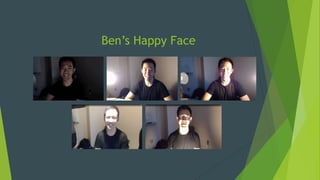
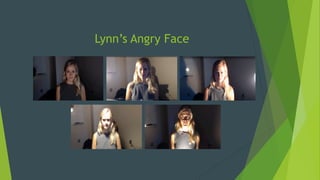
u We chose to take short clips of 3 main facial expressions
o  Neutral, Joy, and Anger
u In 5 main lighting scenarios
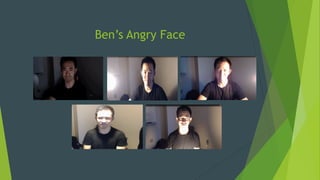
o  Neutral, left, right, below and above spotlights
o  Using lamps and small flashlights to enact these lighting situations
Advantages to this method
u Took videos so that the software could gather an accurate
average of the data and give a general reading rather
than using a picture
u We used a neutral light setting to gauge how the software
would normally rate these expressions
u Used both male and female subjects to ensure expression
analysis wasn’t gender specific
Disadvantages to this method
u  Facial expressions may not be consistent across lighting
scenarios and may naturally alter the data we receive
u  Facial expressions aren’t “natural” and the software may
pick up on that and skew the data
Neutral Expression Data Analysis
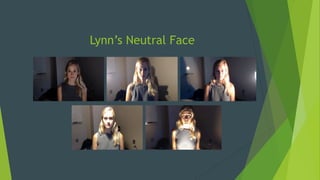
Lynn’s Neutral Face
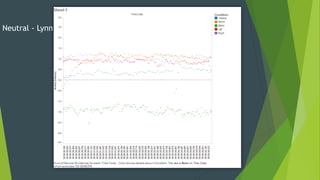
Neutral - Lynn
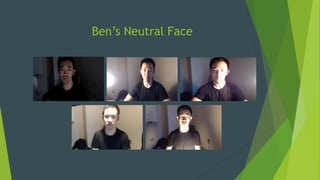
Ben’s Neutral Face
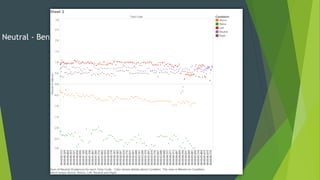
Neutral - Ben
Happy Expression Data Analysis
Lynn’s Happy Face
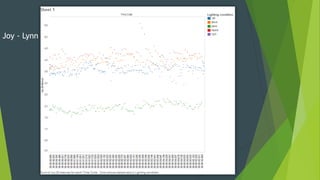
Joy - Lynn
Ben’s Happy Face
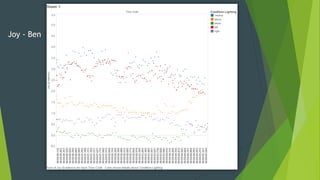
Joy - Ben
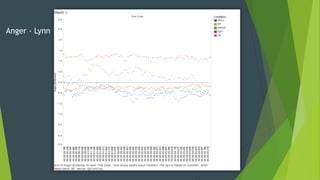
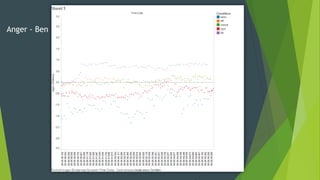
Anger Expression Data Analysis
Lynn’s Angry Face
Anger - Lynn
Ben’s Angry Face
Anger - Ben
Findings & Conclusion
u  Most of our analyses showed that lighting below the subjects
will have the lowest accuracy rating compared to the other
lighting scenarios
u  Joy was the easiest for the software to detect so the ratings
were generally higher across all lighting scenarios
u  Our study highlighted the some extreme lighting scenarios
and in a real-time study, it would most likely not affect the
data
o  it is something to keep in mind when analyzing data going forward
Questions?

lighting

  • 1.
    The Effects of LightingConditions on Facial Encoding Software Lynn, Ben, Ashley, Allison, Jaein
  • 2.
    Our Study u We wantedto study the effects of different lighting angles on the facial encoding software’s accuracy u We chose to take short clips of 3 main facial expressions o  Neutral, Joy, and Anger u In 5 main lighting scenarios o  Neutral, left, right, below and above spotlights o  Using lamps and small flashlights to enact these lighting situations
  • 3.
    Advantages to thismethod u Took videos so that the software could gather an accurate average of the data and give a general reading rather than using a picture u We used a neutral light setting to gauge how the software would normally rate these expressions u Used both male and female subjects to ensure expression analysis wasn’t gender specific
  • 4.
    Disadvantages to thismethod u  Facial expressions may not be consistent across lighting scenarios and may naturally alter the data we receive u  Facial expressions aren’t “natural” and the software may pick up on that and skew the data
  • 5.
  • 6.
  • 7.
  • 8.
  • 9.
  • 10.
  • 11.
  • 12.
  • 13.
  • 14.
  • 15.
  • 16.
  • 17.
  • 18.
  • 19.
  • 20.
    Findings & Conclusion u Most of our analyses showed that lighting below the subjects will have the lowest accuracy rating compared to the other lighting scenarios u  Joy was the easiest for the software to detect so the ratings were generally higher across all lighting scenarios u  Our study highlighted the some extreme lighting scenarios and in a real-time study, it would most likely not affect the data o  it is something to keep in mind when analyzing data going forward
  • 21.