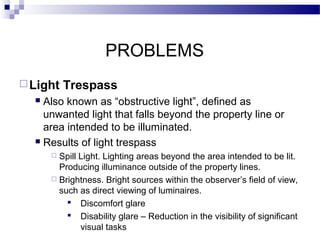
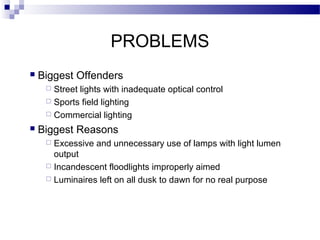
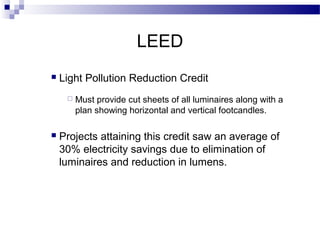
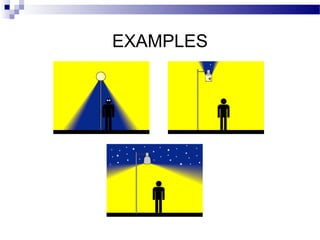
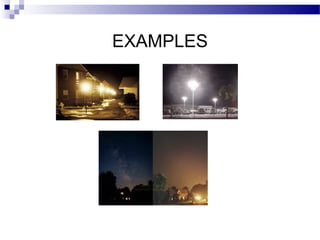
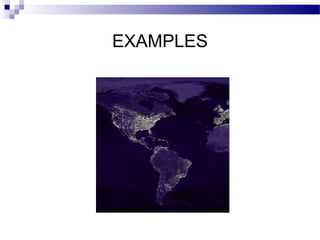
This document discusses the problems of light trespass and light pollution from outdoor lighting. It defines light trespass as unwanted light falling beyond the intended area, which can cause spill light and brightness issues that negatively impact neighbors and drivers. Common offenders are street lights, sports fields, and commercial lighting using excessive lamps. Solutions include using luminaires that control light above the horizontal plane like cut-off designs, shields to reduce reflections, and reviewing lighting systems. The document also discusses how light pollution affects the environment and sea turtles and birds, and how the LEED program addresses light pollution reduction.




![Ebc lighting sources[1]](https://cdn.slidesharecdn.com/ss_thumbnails/ebclightingsources1-140206162253-phpapp02-thumbnail.jpg?width=640&height=640&fit=bounds)
![Daylighting[1]](https://cdn.slidesharecdn.com/ss_thumbnails/daylighting1-140206162046-phpapp01-thumbnail.jpg?width=640&height=640&fit=bounds)
![Ebc sustainable quality_lighting[1]](https://cdn.slidesharecdn.com/ss_thumbnails/ebcsustainablequalitylighting1-140206161537-phpapp02-thumbnail.jpg?width=640&height=640&fit=bounds)
![Ebc lighting sources[1]](https://cdn.slidesharecdn.com/ss_thumbnails/ebclightingsources1-140206161534-phpapp01-thumbnail.jpg?width=640&height=640&fit=bounds)
![Ebc sustainable quality_lighting[1]](https://cdn.slidesharecdn.com/ss_thumbnails/ebcsustainablequalitylighting1-140206161334-phpapp02-thumbnail.jpg?width=640&height=640&fit=bounds)
![Ebc lighting sources[1]](https://cdn.slidesharecdn.com/ss_thumbnails/ebclightingsources1-140206161331-phpapp02-thumbnail.jpg?width=640&height=640&fit=bounds)
![Daylighting[1]](https://cdn.slidesharecdn.com/ss_thumbnails/daylighting1-140206160135-phpapp02-thumbnail.jpg?width=640&height=640&fit=bounds)
![Daylighting[1]](https://cdn.slidesharecdn.com/ss_thumbnails/daylighting1-140206155956-phpapp01-thumbnail.jpg?width=640&height=640&fit=bounds)
![Daylighting[1]](https://cdn.slidesharecdn.com/ss_thumbnails/daylighting1-140206155541-phpapp01-thumbnail.jpg?width=640&height=640&fit=bounds)
![Daylighting[1]](https://cdn.slidesharecdn.com/ss_thumbnails/daylighting1-140206155256-phpapp02-thumbnail.jpg?width=640&height=640&fit=bounds)
![Fire alarm system_nec_september[1]](https://cdn.slidesharecdn.com/ss_thumbnails/firealarmsystemnecseptember1-140206154838-phpapp01-thumbnail.jpg?width=640&height=640&fit=bounds)
![Fire alarm system_nec_september[1]](https://cdn.slidesharecdn.com/ss_thumbnails/firealarmsystemnecseptember1-140206154711-phpapp02-thumbnail.jpg?width=640&height=640&fit=bounds)
![Fire alarm system_ne-audible_signaling[1]](https://cdn.slidesharecdn.com/ss_thumbnails/firealarmsystemne-audiblesignaling1-140206153700-phpapp02-thumbnail.jpg?width=640&height=640&fit=bounds)
![Fire alarm system_ne-audible_signaling[1]](https://cdn.slidesharecdn.com/ss_thumbnails/firealarmsystemne-audiblesignaling1-140206153556-phpapp01-thumbnail.jpg?width=640&height=640&fit=bounds)
![Fire alarm system_ne-audible_signaling[1]](https://cdn.slidesharecdn.com/ss_thumbnails/firealarmsystemne-audiblesignaling1-140206153426-phpapp02-thumbnail.jpg?width=640&height=640&fit=bounds)
![Fire alarm -_internal[1]](https://cdn.slidesharecdn.com/ss_thumbnails/firealarm-internal1-140206152926-phpapp02-thumbnail.jpg?width=640&height=640&fit=bounds)
![Fire alarm -_internal[1]](https://cdn.slidesharecdn.com/ss_thumbnails/firealarm-internal1-140206151153-phpapp02-thumbnail.jpg?width=640&height=640&fit=bounds)
![130920 fire alarm_intelligibility[1]](https://cdn.slidesharecdn.com/ss_thumbnails/130920firealarmintelligibility1-140206150722-phpapp02-thumbnail.jpg?width=640&height=640&fit=bounds)
![130920 fire alarm_intelligibility[1]](https://cdn.slidesharecdn.com/ss_thumbnails/130920firealarmintelligibility1-140206150436-phpapp02-thumbnail.jpg?width=640&height=640&fit=bounds)
![130906 fire alarm_2013_nfpa_72_changes[1]](https://cdn.slidesharecdn.com/ss_thumbnails/130906firealarm2013nfpa72changes1-140206150113-phpapp01-thumbnail.jpg?width=640&height=640&fit=bounds)


