Outdoor Light Pollution
Reduction
Presents By:
PAUL PANKAJ PRADIP
VASAVA PRATIKKUMAR SANJAYBHAI
PATEL HARSH VINODBHAI
MACHHI DEEP VINODBHAI
PIYUSH PANDEY
(216450306016)
(216450306017)
(216450306018)
(216450306019)
(216450306020)
LINE OF PRESENTATION
• Introduction
• Light pollution and types
• Causes of light pollution
• Effect of light pollution
• Mitigation
• Conclusion
• References
Introduction
●Light pollution also called photo pollution or
luminescence pollution refers to a brightening of night
sky due to scattering of artificial light by gaseous
molecule and dust particle in the air.
●The scattering result in an orange foggy glow that
spread out over the horizon. it blights the night sky a
precious natural resource and an area of scientific and
educational interest.
●light pollution is a consequences of poor engineering
practices that are both unnecessary and to a large
extent, avoidable its fallout is waste of money and
energy as well as degradation of the environment.
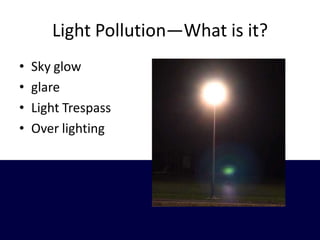
Light Pollution—What is it?
• Sky glow
• glare
• Light Trespass
• Over lighting
Types of light pollution
• Sky glow
➢Most of the times the lightning are not endowed
with adequate shielding provisions as a result the
light is reflected by the object it illuminates and spills
away into the sky.
➢In the atmosphere it is refracted causing orange
color sky glow sky glow refers to the glow effect that
can be seen over populated areas.
light trespass
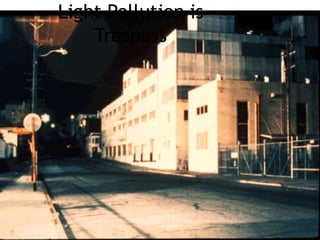
➢Light may go across property lines and
illuminates some one else premises. This
condition is called light trespass.
➢This is not only a nuisance but also a security
risk. A common light trespass problem occur
when a beam of light from one house enters a
window of another house.
➢This may lead to sleep deprivation or blocking
of a evening view.
Light Pollution is
Trespass
glare
➢The condition of glare result when more
than necessary illumination is applied to an
area leading to several ill effects, including
eye irritation.
➢Causes by high contrast between light and
dark areas, glare can also make difficult for
human eye to adjust to the difference in
brightness
Light Pollution is
Glare
Light clutter
➢Refers to excessive groups of lights. Grouping
of light may generate confusion, distract from
obstacles and potentially cause accident
clutter is particularly noticeable as roads
where the street light are badly designed or
where brightly light advertising surrounds the
roads ways.
causes
➢Light pollution is a side effect of industrialized
civilization it is cause due to excessive use of
arificial lights by humans.
➢the powerful artificial light, which are used to
illuminates offices, factories, sports stadium,
street, parks and sometime even housing
complexes obscure the night sky
➢Unlike the sunlight, the artificial light which are
thrust into the sky have many hues and colors
causes
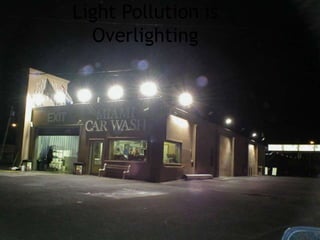
• Over-illumination by artificial light stems from a
number of factors, such as-
Not using timers or occupancy sensors to put off light
when needed.
Not specifying the optimum level of light that is
desirable in particular premises.
Improper architecture, especially of offices.
Improper choice of fixture and bulbs which do not
direct light into the area that needed its most.
Inadequate maintenance of lighting devices
•
•
•
•
•
Light Pollution is
Overlighting
Effect of light pollution
• Human health
➢Exposure to light at night suppresses the production of
hormone, melatonin. The latter is synthesized in the brain’s
pineal gland only when the eye signal it is dark.
➢ Production begins around nightfall, peaks between 1-2 AM,
and shuts off during day. Hence melatonin is often referred to
as the hormonal expression of darkness.
➢Melatonin has several beneficial effect. It boosts the immune
system, lowers cholesterol. Protects the body’s cardiovascular
system, stabilize the biological rhythm and restore the night
cycle of rest and repair in its absence, a person suffer from
chronic fatigue
➢.
Effect fauna
• Lightning from high-rise office buildings confuses migratory birds.
The avian crash into the buildings and die. In urban areas, wear
night lighting is very intense, sky scrappers injure or kill an
estimated 24000 birds each year.
Artificial light along the sea beaches confuses baby turtle. It has
been observed that the turtles crawls instinctively to the brightest
visible objects- normally reflection of stars and moon
The nocturnal frog are blinded by even dim light. Their ability to
hunt is drastically reduced.
Outdoor lighting causes a significant decline in the population of
moth by exposing them to predators. It also disturb the flight,
vision, migration and feeding habits of moths.
Pumas travelling at night avoid brightly lit areas. They lose their
track and miss crucial landscape linkage at places wear light
pollution intense.
•
•
•
•
Effect on flora
• Light pollution around lakes prevent zoo plankton
like daphnia from consuming surface algae. This
causes the algae colonies to bloom. The lake
becomes stratified due to eutrophication.
• Night blooming flower depend on nocturnal
insect for pollination. However, light pollution
interferes with ability of these insect to navigate.
Therefore in intense light they lose their ability to
be potential pollinators. As a result species of
night flowering plant are register decline.
mitigation
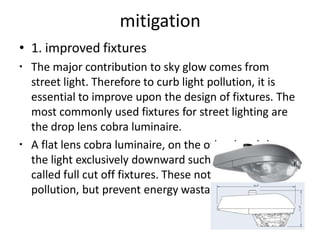
• 1. improved fixtures
▪ The major contribution to sky glow comes from
street light. Therefore to curb light pollution, it is
essential to improve upon the design of fixtures. The
most commonly used fixtures for street lighting are
the drop lens cobra luminaire.
▪ A flat lens cobra luminaire, on the other hand thrusts
the light exclusively downward such fixture are also
called full cut off fixtures. These not only curtail light
pollution, but prevent energy wastage too.
• Improved light sources
▪ Different types of light sources are used under
different circumstances. Over the years, sodium
lamps have come to be regarded as best bargain for
street lights. These give good visibility to the
motorist even during foggy weather. Further, these
have low operational costs and remarkable efficiency
in terms of lumens per watt. Moreover, sodium
lamps give out light of narrow wavelength.
conclusion
• Over the past 120 years- since the invention of
Edison’s bulb-human beings have deviated
from natures age old protections that are
afforded by rest and repair during sleep and
darkness. Just as we need daily exposure to
natural sunlight to reset our biological clocks,
we need ton sleep in total darkness to reset
our diurnal rhythm. Light during darkness is a
potentially serious threat, not only to human
being, but to other organism as well.
references
•
•
•
•
Books
Roger A kirch(2005) At Days close: night in time past;
Catherine Rich(2006) Ecological consequences of Artificial Night Lightning
GS sodhi(2009) Fundamental concept of Environmental chemistry. 3rdEd.
Delhi: Narosa
•
•
•
Websites
Pollution Issues http://www.pollutionissues.co.uk/noiseandlight [accessed
20/8/2012]
Sources of light pollution http://www.nature.nps.gov/night/sources.cfm
[accessed 19/8/2012]
Pollution control http://www.dorsetforyou.com/384726 [accessed
20/8/2012]
Pollution http://www.curiosity.discovery.com/question/what-effect-
pollution-humans. [accessed 20/8/2012]
5 ways u can reduce light pollution
http://www.mnn.com/yourhome/remodeling-design/stories/5-ways-you-
can-reduce-lightpollution [accessed 19/8/2012]
•
•
•
•
Outdoor Light Pollution Reduction.pptx

Outdoor Light Pollution Reduction.pptx

  • 1.
    Outdoor Light Pollution Reduction PresentsBy: PAUL PANKAJ PRADIP VASAVA PRATIKKUMAR SANJAYBHAI PATEL HARSH VINODBHAI MACHHI DEEP VINODBHAI PIYUSH PANDEY (216450306016) (216450306017) (216450306018) (216450306019) (216450306020)
  • 2.
    LINE OF PRESENTATION •Introduction • Light pollution and types • Causes of light pollution • Effect of light pollution • Mitigation • Conclusion • References
  • 3.
    Introduction ●Light pollution alsocalled photo pollution or luminescence pollution refers to a brightening of night sky due to scattering of artificial light by gaseous molecule and dust particle in the air. ●The scattering result in an orange foggy glow that spread out over the horizon. it blights the night sky a precious natural resource and an area of scientific and educational interest. ●light pollution is a consequences of poor engineering practices that are both unnecessary and to a large extent, avoidable its fallout is waste of money and energy as well as degradation of the environment.
  • 4.
    Light Pollution—What isit? • Sky glow • glare • Light Trespass • Over lighting
  • 5.
    Types of lightpollution • Sky glow ➢Most of the times the lightning are not endowed with adequate shielding provisions as a result the light is reflected by the object it illuminates and spills away into the sky. ➢In the atmosphere it is refracted causing orange color sky glow sky glow refers to the glow effect that can be seen over populated areas.
  • 6.
    light trespass ➢Light maygo across property lines and illuminates some one else premises. This condition is called light trespass. ➢This is not only a nuisance but also a security risk. A common light trespass problem occur when a beam of light from one house enters a window of another house. ➢This may lead to sleep deprivation or blocking of a evening view.
  • 7.
  • 8.
    glare ➢The condition ofglare result when more than necessary illumination is applied to an area leading to several ill effects, including eye irritation. ➢Causes by high contrast between light and dark areas, glare can also make difficult for human eye to adjust to the difference in brightness
  • 9.
  • 10.
    Light clutter ➢Refers toexcessive groups of lights. Grouping of light may generate confusion, distract from obstacles and potentially cause accident clutter is particularly noticeable as roads where the street light are badly designed or where brightly light advertising surrounds the roads ways.
  • 11.
    causes ➢Light pollution isa side effect of industrialized civilization it is cause due to excessive use of arificial lights by humans. ➢the powerful artificial light, which are used to illuminates offices, factories, sports stadium, street, parks and sometime even housing complexes obscure the night sky ➢Unlike the sunlight, the artificial light which are thrust into the sky have many hues and colors
  • 12.
    causes • Over-illumination byartificial light stems from a number of factors, such as- Not using timers or occupancy sensors to put off light when needed. Not specifying the optimum level of light that is desirable in particular premises. Improper architecture, especially of offices. Improper choice of fixture and bulbs which do not direct light into the area that needed its most. Inadequate maintenance of lighting devices • • • • •
  • 13.
  • 14.
    Effect of lightpollution • Human health ➢Exposure to light at night suppresses the production of hormone, melatonin. The latter is synthesized in the brain’s pineal gland only when the eye signal it is dark. ➢ Production begins around nightfall, peaks between 1-2 AM, and shuts off during day. Hence melatonin is often referred to as the hormonal expression of darkness. ➢Melatonin has several beneficial effect. It boosts the immune system, lowers cholesterol. Protects the body’s cardiovascular system, stabilize the biological rhythm and restore the night cycle of rest and repair in its absence, a person suffer from chronic fatigue ➢.
  • 15.
    Effect fauna • Lightningfrom high-rise office buildings confuses migratory birds. The avian crash into the buildings and die. In urban areas, wear night lighting is very intense, sky scrappers injure or kill an estimated 24000 birds each year. Artificial light along the sea beaches confuses baby turtle. It has been observed that the turtles crawls instinctively to the brightest visible objects- normally reflection of stars and moon The nocturnal frog are blinded by even dim light. Their ability to hunt is drastically reduced. Outdoor lighting causes a significant decline in the population of moth by exposing them to predators. It also disturb the flight, vision, migration and feeding habits of moths. Pumas travelling at night avoid brightly lit areas. They lose their track and miss crucial landscape linkage at places wear light pollution intense. • • • •
  • 16.
    Effect on flora •Light pollution around lakes prevent zoo plankton like daphnia from consuming surface algae. This causes the algae colonies to bloom. The lake becomes stratified due to eutrophication. • Night blooming flower depend on nocturnal insect for pollination. However, light pollution interferes with ability of these insect to navigate. Therefore in intense light they lose their ability to be potential pollinators. As a result species of night flowering plant are register decline.
  • 17.
    mitigation • 1. improvedfixtures ▪ The major contribution to sky glow comes from street light. Therefore to curb light pollution, it is essential to improve upon the design of fixtures. The most commonly used fixtures for street lighting are the drop lens cobra luminaire. ▪ A flat lens cobra luminaire, on the other hand thrusts the light exclusively downward such fixture are also called full cut off fixtures. These not only curtail light pollution, but prevent energy wastage too.
  • 18.
    • Improved lightsources ▪ Different types of light sources are used under different circumstances. Over the years, sodium lamps have come to be regarded as best bargain for street lights. These give good visibility to the motorist even during foggy weather. Further, these have low operational costs and remarkable efficiency in terms of lumens per watt. Moreover, sodium lamps give out light of narrow wavelength.
  • 19.
    conclusion • Over thepast 120 years- since the invention of Edison’s bulb-human beings have deviated from natures age old protections that are afforded by rest and repair during sleep and darkness. Just as we need daily exposure to natural sunlight to reset our biological clocks, we need ton sleep in total darkness to reset our diurnal rhythm. Light during darkness is a potentially serious threat, not only to human being, but to other organism as well.
  • 20.
    references • • • • Books Roger A kirch(2005)At Days close: night in time past; Catherine Rich(2006) Ecological consequences of Artificial Night Lightning GS sodhi(2009) Fundamental concept of Environmental chemistry. 3rdEd. Delhi: Narosa • • • Websites Pollution Issues http://www.pollutionissues.co.uk/noiseandlight [accessed 20/8/2012] Sources of light pollution http://www.nature.nps.gov/night/sources.cfm [accessed 19/8/2012] Pollution control http://www.dorsetforyou.com/384726 [accessed 20/8/2012] Pollution http://www.curiosity.discovery.com/question/what-effect- pollution-humans. [accessed 20/8/2012] 5 ways u can reduce light pollution http://www.mnn.com/yourhome/remodeling-design/stories/5-ways-you- can-reduce-lightpollution [accessed 19/8/2012] • • • •