The Guardian Life Insurance Company of America  7 Hanover Square, New York, NY 10004   BASICS #1 LIFE  INSURANCE
Insure: DEFINITIONS : To make certain , especially by taking necessary measures and precautions.
LIFE INSURANCE BASICS DEFINITIONS: Insurance: Coverage by contract  whereby one party undertakes to  indemnify  or  guarantee  another against loss by a specified contingency or peril,  or, the means of eliminating or reducing the financial burden of risk by dividing the losses they produce among many individuals.
LIFE INSURANCE BASICS DEFINITIONS: Indemnify: To make compensation for   incurred hurt, loss, or damage.
LIFE INSURANCE BASICS DEFINITIONS: Life Insurance   Insurance providing for  payment  of a stipulated sum to a designated beneficiary  upon death of  the insured .
Beneficiary : LIFE INSURANCE BASICS DEFINITIONS: The  person named to  receive proceeds   or benefits.
Risk Management: LIFE INSURANCE BASICS DEFINITIONS: The use of all the  alternative methods of dealing with risk ... - waiving of liability or exercising  insurance to indemnify transfer of risk  - conscious act of keeping   or assuming risk retention of risk reduction of risk avoidance of risk
Premium : LIFE INSURANCE BASICS DEFINITIONS:   Consideration paid  for a contract of of insurance.
Consideration : LIFE INSURANCE BASICS DEFINITIONS:   An act, or the  promise  thereof done or given by one party  in return for the act or promise of another.
Policy Dividends: LIFE INSURANCE BASICS DEFINITIONS: Return of unneeded premium ,  and are not subject to income taxation.
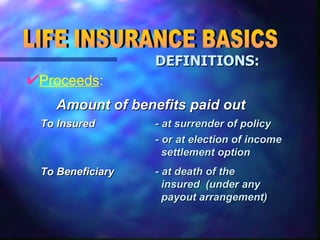
Proceeds : LIFE INSURANCE BASICS DEFINITIONS: - at death of the  insured  (under any  payout arrangement) To Beneficiary - or at election of income  settlement option - at surrender of policy To Insured Amount of benefits paid out
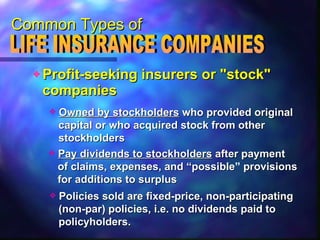
Common Types of Profit-seeking insurers or "stock" companies LIFE INSURANCE COMPANIES  Policies sold are fixed-price, non-participating  (non-par) policies, i.e. no dividends paid to  policyholders. Pay dividends to stockholders  after payment of claims, expenses, and “possible ”  provisions  for additions to surplus Owned by stockholders  who provided original capital or who acquired stock from other  stockholders
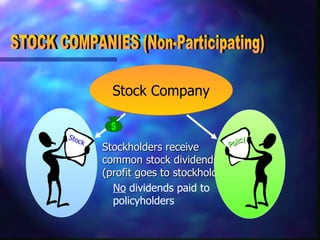
STOCK COMPANIES (Non-Participating) Stock Company Stockholders receive common stock dividends (profit goes to stockholders) No  dividends paid to policyholders Stock Policy
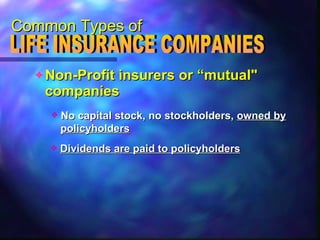
Common Types of Non-Profit insurers or “mutual" companies LIFE INSURANCE COMPANIES  Dividends are paid to policyholders No capital stock, no stockholders,  owned by policyholders
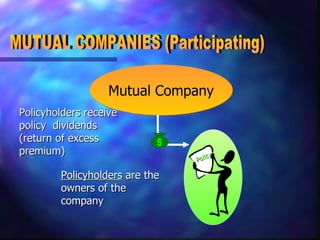
MUTUAL COMPANIES (Participating) Mutual Company Policyholders receive policy  dividends (return of excess premium) Policyholders  are the owners of the company Policy
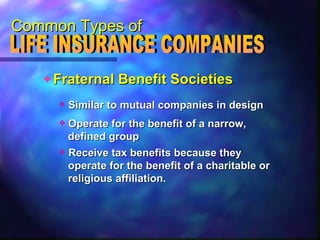
Common Types of Fraternal Benefit Societies LIFE INSURANCE COMPANIES  Receive tax benefits because they  operate for the benefit of a charitable or  religious affiliation. Operate for the benefit of a narrow, defined group Similar to mutual companies in design
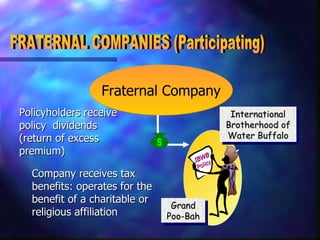
FRATERNAL COMPANIES (Participating) Fraternal Company Policyholders receive policy  dividends (return of excess premium) Company receives tax benefits: operates for the benefit of a charitable or religious affiliation Grand Poo-Bah International Brotherhood of Water Buffalo IBWB Policy
The Guardian Life Insurance Company of America  7 Hanover Square, New York, NY 10004   See Different Types of Life Insurance Covered In BASICS #2 LIFE  INSURANCE

Life Insurance Basics 1

  • 1.
    The Guardian LifeInsurance Company of America 7 Hanover Square, New York, NY 10004 BASICS #1 LIFE INSURANCE
  • 2.
    Insure: DEFINITIONS :To make certain , especially by taking necessary measures and precautions.
  • 3.
    LIFE INSURANCE BASICSDEFINITIONS: Insurance: Coverage by contract whereby one party undertakes to indemnify or guarantee another against loss by a specified contingency or peril, or, the means of eliminating or reducing the financial burden of risk by dividing the losses they produce among many individuals.
  • 4.
    LIFE INSURANCE BASICSDEFINITIONS: Indemnify: To make compensation for incurred hurt, loss, or damage.
  • 5.
    LIFE INSURANCE BASICSDEFINITIONS: Life Insurance Insurance providing for payment of a stipulated sum to a designated beneficiary upon death of the insured .
  • 6.
    Beneficiary : LIFEINSURANCE BASICS DEFINITIONS: The person named to receive proceeds or benefits.
  • 7.
    Risk Management: LIFEINSURANCE BASICS DEFINITIONS: The use of all the alternative methods of dealing with risk ... - waiving of liability or exercising insurance to indemnify transfer of risk - conscious act of keeping or assuming risk retention of risk reduction of risk avoidance of risk
  • 8.
    Premium : LIFEINSURANCE BASICS DEFINITIONS: Consideration paid for a contract of of insurance.
  • 9.
    Consideration : LIFEINSURANCE BASICS DEFINITIONS: An act, or the promise thereof done or given by one party in return for the act or promise of another.
  • 10.
    Policy Dividends: LIFEINSURANCE BASICS DEFINITIONS: Return of unneeded premium , and are not subject to income taxation.
  • 11.
    Proceeds : LIFEINSURANCE BASICS DEFINITIONS: - at death of the insured (under any payout arrangement) To Beneficiary - or at election of income settlement option - at surrender of policy To Insured Amount of benefits paid out
  • 12.
    Common Types ofProfit-seeking insurers or "stock" companies LIFE INSURANCE COMPANIES Policies sold are fixed-price, non-participating (non-par) policies, i.e. no dividends paid to policyholders. Pay dividends to stockholders after payment of claims, expenses, and “possible ” provisions for additions to surplus Owned by stockholders who provided original capital or who acquired stock from other stockholders
  • 13.
    STOCK COMPANIES (Non-Participating)Stock Company Stockholders receive common stock dividends (profit goes to stockholders) No dividends paid to policyholders Stock Policy
  • 14.
    Common Types ofNon-Profit insurers or “mutual" companies LIFE INSURANCE COMPANIES Dividends are paid to policyholders No capital stock, no stockholders, owned by policyholders
  • 15.
    MUTUAL COMPANIES (Participating)Mutual Company Policyholders receive policy dividends (return of excess premium) Policyholders are the owners of the company Policy
  • 16.
    Common Types ofFraternal Benefit Societies LIFE INSURANCE COMPANIES Receive tax benefits because they operate for the benefit of a charitable or religious affiliation. Operate for the benefit of a narrow, defined group Similar to mutual companies in design
  • 17.
    FRATERNAL COMPANIES (Participating)Fraternal Company Policyholders receive policy dividends (return of excess premium) Company receives tax benefits: operates for the benefit of a charitable or religious affiliation Grand Poo-Bah International Brotherhood of Water Buffalo IBWB Policy
  • 18.
    The Guardian LifeInsurance Company of America 7 Hanover Square, New York, NY 10004 See Different Types of Life Insurance Covered In BASICS #2 LIFE INSURANCE