©ClaysnowLimited2014
Lies, damn lies and estimates
Seb Rose
Claysnow Limited
www.claysnow.co.uk
@sebrose
Tuesday, 15 April 14
©ClaysnowLimited2014
Tuesday, 15 April 14
©ClaysnowLimited2014
DISRAELI
Tuesday, 15 April 14
©ClaysnowLimited2014
Tuesday, 15 April 14
©ClaysnowLimited2014
Tuesday, 15 April 14
©ClaysnowLimited2014
Tuesday, 15 April 14
©ClaysnowLimited2014
Tuesday, 15 April 14
©ClaysnowLimited2014
Tuesday, 15 April 14
©ClaysnowLimited2014
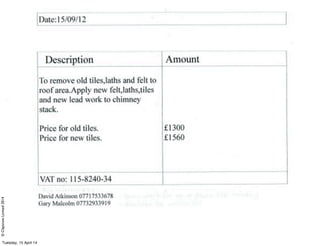
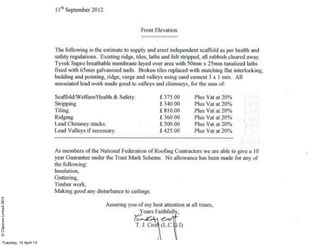
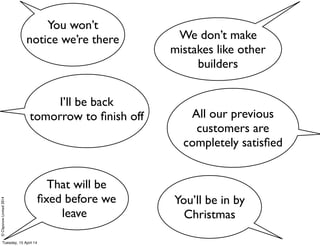
I’ll be back
tomorrow to finish off
You’ll be in by
Christmas
That will be
fixed before we
leave
All our previous
customers are
completely satisfied
We don’t make
mistakes like other
builders
You won’t
notice we’re there
Tuesday, 15 April 14
©ClaysnowLimited2014
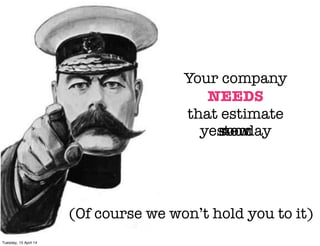
Your company
NEEDS
that estimate
soonnowyesterday
(Of course we won’t hold you to it)
Tuesday, 15 April 14
©ClaysnowLimited2014
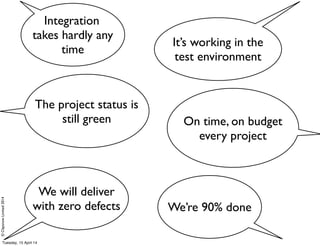
The project status is
still green
We’re 90% done
We will deliver
with zero defects
On time, on budget
every project
It’s working in the
test environment
Integration
takes hardly any
time
Tuesday, 15 April 14
©ClaysnowLimited2014
Prediction is very difficult,
especially about the future.
Niels Bohr, physicist
Tuesday, 15 April 14
©ClaysnowLimited2014
Tuesday, 15 April 14
©ClaysnowLimited2014
The primary purpose of an estimate is not to
predict a project’s outcome;
it is to determine whether a project’s targets
are realistic enough to allow the project
to be controlled to meet them.
Steve McConnell, Software Estimation (2006)
Tuesday, 15 April 14
©ClaysnowLimited2014
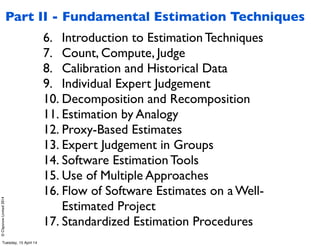
6. Introduction to Estimation Techniques
7. Count, Compute, Judge
8. Calibration and Historical Data
9. Individual Expert Judgement
10. Decomposition and Recomposition
11. Estimation by Analogy
12. Proxy-Based Estimates
13. Expert Judgement in Groups
14. Software Estimation Tools
15. Use of Multiple Approaches
16. Flow of Software Estimates on a Well-
Estimated Project
17. Standardized Estimation Procedures
Part II - Fundamental Estimation Techniques
Tuesday, 15 April 14
©ClaysnowLimited2014
Tuesday, 15 April 14
©ClaysnowLimited2014
Tuesday, 15 April 14
©ClaysnowLimited2014
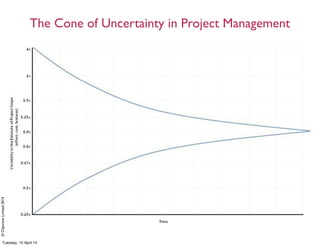
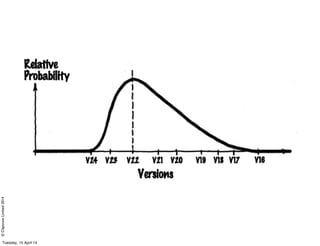
The Cone of Uncertainty in Project Management
Tuesday, 15 April 14
©ClaysnowLimited2014
Tuesday, 15 April 14
©ClaysnowLimited2014
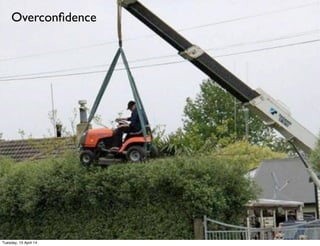
Overconfidence
Tuesday, 15 April 14
©ClaysnowLimited2014
For each of the next 10 quantitative questions,
give a lower and an upper bound,
such that you believe
with about 90% certainty that the
correct answer lies within the interval given.
This means that you should expect to guess
correctly for about 9 questions out of 10.
Laurent Bossavit, www.bossavit.com, @morendil
Tuesday, 15 April 14
©ClaysnowLimited2014
Example:
Q. How many people are in this room?
You ‘guess’ an interval:
Low: 30, High: 100
Tuesday, 15 April 14
©ClaysnowLimited2014
What was the date of birth of Bram Stoker, author
of Dracula?
Question 1:
Tuesday, 15 April 14
©ClaysnowLimited2014
What is the population of the Republic of Brazil?
Question 2:
Tuesday, 15 April 14
©ClaysnowLimited2014
What is the height, in meters, of the tallest living
redwood tree?
Question 3:
Tuesday, 15 April 14
©ClaysnowLimited2014
How many standardized (ISO 6346) steel shipping
containers exist in the world?
Question 4:
Tuesday, 15 April 14
©ClaysnowLimited2014
How many Boeing 747 (all models) have been built
at this date?
Question 5:
Tuesday, 15 April 14
©ClaysnowLimited2014
What is the total number of human deaths
attributed to H5N1 “avian” flu?
Question 6:
Tuesday, 15 April 14
©ClaysnowLimited2014
How many Syrian conflict refugees were registered
by UNHCR as of 1 Nov 2012?
Question 7:
Tuesday, 15 April 14
©ClaysnowLimited2014
What was the total wine production of France in
2009, in hectolitres?
Question 8:
Tuesday, 15 April 14
©ClaysnowLimited2014
How many Olympics medals altogether have been
won to date by Austrian athletes?
Question 9:
Tuesday, 15 April 14
©ClaysnowLimited2014
What is the half-life, in years, of the isotope
Plutonium 239?
Question 10:
Tuesday, 15 April 14
©ClaysnowLimited2014
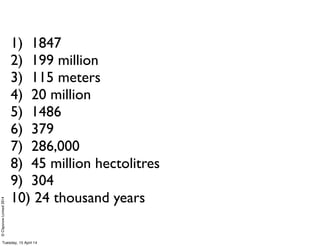
1) 1847
2) 199 million
3) 115 meters
4) 20 million
5) 1486
6) 379
7) 286,000
8) 45 million hectolitres
9) 304
10) 24 thousand years
Tuesday, 15 April 14
©ClaysnowLimited2014
How did you do?
Tuesday, 15 April 14
©ClaysnowLimited2014
"We aren't really bad at estimating.
What we are really bad at is enumerating
all the assumptions that lie behind our
estimates."
-Paul Rook
Tuesday, 15 April 14
©ClaysnowLimited2014
Why do we estimate?
Tuesday, 15 April 14
©ClaysnowLimited2014
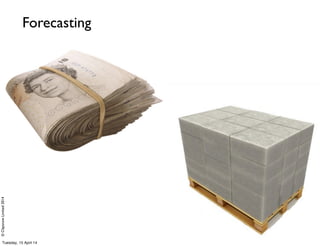
Forecasting
Tuesday, 15 April 14
©ClaysnowLimited2014
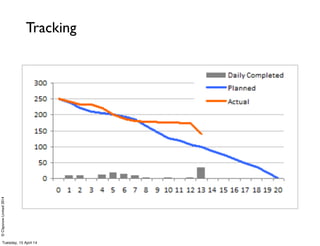
Tracking
Tuesday, 15 April 14
©ClaysnowLimited2014
Tuesday, 15 April 14
©ClaysnowLimited2014
“A boundary object is a concept in
sociology to describe information used in
different ways by different communities.
They are plastic, interpreted differently
across communities but with enough
immutable content to maintain integrity”
--Wikipedia
Estimates are Boundary Objects
Tuesday, 15 April 14
©ClaysnowLimited2014
“They are weakly structured in common
use, and become strongly structured in
individual-site use. They may be abstract or
concrete.
They have different meanings in different
social worlds but their structure is common
enough to more than one world to make
them recognizable means of translation.
The creation and management of boundary
objects is key in developing and maintaining
coherence across intersecting social worlds.”
-- Leigh & Griesemer
Tuesday, 15 April 14
©ClaysnowLimited2014
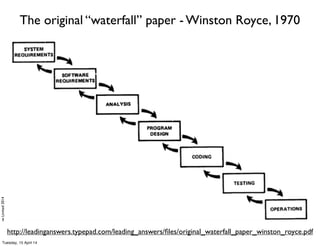
http://leadinganswers.typepad.com/leading_answers/files/original_waterfall_paper_winston_royce.pdf
The original “waterfall” paper - Winston Royce, 1970
Tuesday, 15 April 14
©ClaysnowLimited2014
Tuesday, 15 April 14
©ClaysnowLimited2014
Tuesday, 15 April 14
©ClaysnowLimited2014
Tuesday, 15 April 14
©ClaysnowLimited2014
Tuesday, 15 April 14
©ClaysnowLimited2014
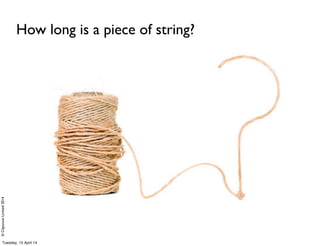
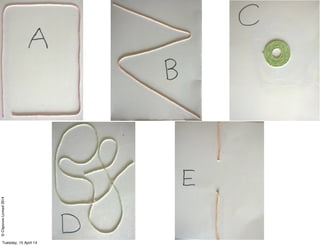
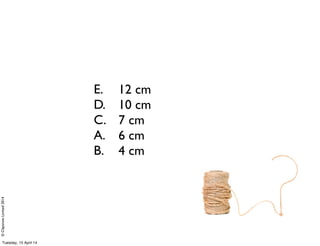
How long is a piece of string?
Tuesday, 15 April 14
©ClaysnowLimited2014
Tuesday, 15 April 14
©ClaysnowLimited2014
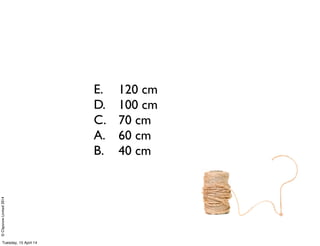
120 cm
100 cm
70 cm
60 cm
40 cm
E.
D.
C.
A.
B.
Tuesday, 15 April 14
©ClaysnowLimited2014
... these studies which have for a few years
now given rise to the claim that "research
shows that people are better at relative
than absolute estimation" do not in fact
seem to square with that claim.
This doesn't entail that relative estimation
doesn't work - only that it is not proven.
http://guide.agilealliance.org/guide/relative.html
Tuesday, 15 April 14
©ClaysnowLimited2014
Tuesday, 15 April 14
©ClaysnowLimited2014
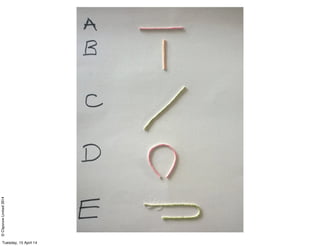
12 cm
10 cm
7 cm
6 cm
4 cm
E.
D.
C.
A.
B.
Tuesday, 15 April 14
©ClaysnowLimited2014
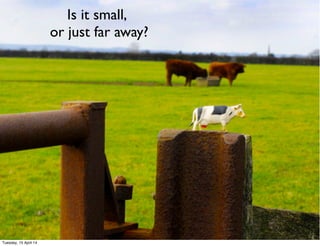
Is it small,
or just far away?
Tuesday, 15 April 14
©ClaysnowLimited2014
Tuesday, 15 April 14
©ClaysnowLimited2014
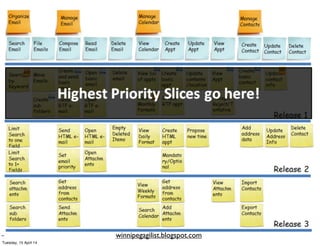
winnipegagilist.blogspot.com
Tuesday, 15 April 14
©ClaysnowLimited2014
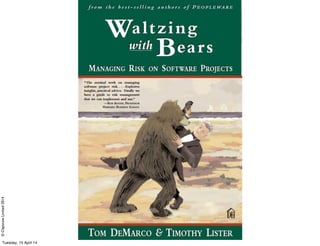
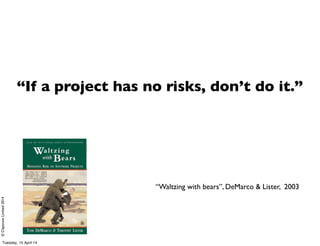
“If a project has no risks, don’t do it.”
“Waltzing with bears”, DeMarco & Lister, 2003
Tuesday, 15 April 14
There are known knowns; there are things we
know that we know.
There are known unknowns; that is to say there
are things that, we now know we don't know.
But there are also unknown unknowns
– there are things we do not know we
don't know.
Tuesday, 15 April 14
ASSUME
YOU'RE
IGNORANT
Tuesday, 15 April 14
©ClaysnowLimited2014
“... during an inception, when we are
most ignorant
about most aspects of the project,
the best use
we can possibly make of the time available
is to attempt to
identify and reduce
our ignorance”
http://dannorth.net/2010/08/30/introducing-deliberate-discovery/
Deliberate discovery
Tuesday, 15 April 14
©ClaysnowLimited2014
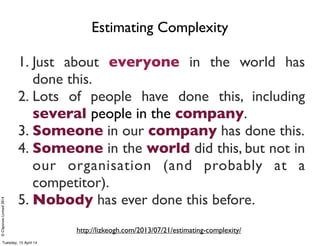
1. Just about everyone in the world has
done this.
2. Lots of people have done this, including
several people in the company.
3. Someone in our company has done this.
4. Someone in the world did this, but not in
our organisation (and probably at a
competitor).
5. Nobody has ever done this before.
http://lizkeogh.com/2013/07/21/estimating-complexity/
Estimating Complexity
Tuesday, 15 April 14
©ClaysnowLimited2014
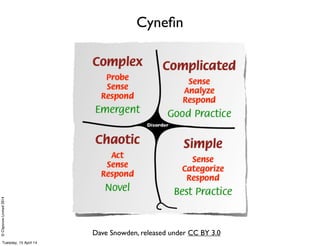
Dave Snowden, released under CC BY 3.0
Cynefin
Tuesday, 15 April 14
©ClaysnowLimited2014
http://www.tylerjanderson.com/case-study-roi-of-facebook-advertising/
Tuesday, 15 April 14
©ClaysnowLimited2014
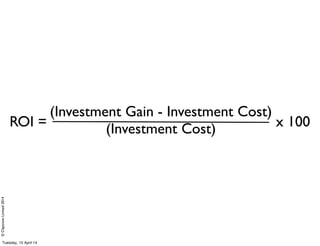
ROI = x 100
(Investment Gain - Investment Cost)
(Investment Cost)
Tuesday, 15 April 14
©ClaysnowLimited2014
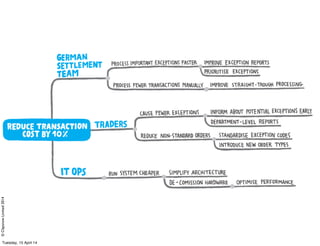
Impact mapping
http://impactmapping.org/about.php
Tuesday, 15 April 14
©ClaysnowLimited2014
Tuesday, 15 April 14
©ClaysnowLimited2014
Cost of delay
http://blackswanfarming.com/cost-of-delay/
... is a way of communicating the
impact of time on value.
Tuesday, 15 April 14
©ClaysnowLimited2014
Cost of delay
http://blackswanfarming.com/cost-of-delay/
1.Better Decision-making – by making the
economic trade-offs visible
2.Better Prioritisation – by using CD3 (Cost of
Delay Divided by Duration) we deliver more
total value
3.By changing the focus – from efficiency and
cost (which encourages the wrong
behaviours), to speed and value
Tuesday, 15 April 14
©ClaysnowLimited2014
#NoEstimates
http://neilkillick.com/2013/02/08/noestimates-part-2-contract-negotiation-and-the-old-banger/
http://neilkillick.com/2013/01/31/noestimates-part-1-doing-scrum-without-estimates/
Remove the unknowns
Estimating sprint velocity is waste
Iterate, don’t estimate
Shift focus to “small”
Agile team, same old contract
Quality is variable, not fixed
Don’t deliver requirements, deliver what the
customer wants
Tuesday, 15 April 14
©ClaysnowLimited2014
... crying
“No estimates,
no backlogs,
no deadlines”
... [is] not very
effective nor efficient.
http://xprogramming.com/articles/artifacts-are-not-the-problem/
Tuesday, 15 April 14
©ClaysnowLimited2014
Done conventionally, software projects offer
almost no information, and almost no
control, to those who are given the
responsibility to manage them.
... the people in charge of spending money
to get software really do need control and
information.
Saying “no” doesn’t help them.
http://xprogramming.com/articles/artifacts-are-not-the-problem/
Tuesday, 15 April 14
©ClaysnowLimited2014
Giving software projects an API
... [is] about
“yes, yes, yes”.
http://xprogramming.com/articles/artifacts-are-not-the-problem/
Tuesday, 15 April 14
©ClaysnowLimited2014
All models are wrong,
but some are useful
George Box, statistician
Tuesday, 15 April 14
©ClaysnowLimited2014
Dear Customer
... when we start an IT project, we don’t know
how much time and effort it will take to
complete.
Consequently, we don’t know how much it will
cost.
http://www.agileconnection.com/article/dear-customer-truth-about-it-projects?page=0%2C0
Tuesday, 15 April 14
©ClaysnowLimited2014
Dear Customer
http://www.agileconnection.com/article/dear-customer-truth-about-it-projects?page=0%2C0
... the more details you try to give us
beforehand, the more likely your desires are to
change.
Each time you give us more detail, you are
offering more hostages to fortune.
Tuesday, 15 April 14
©ClaysnowLimited2014
“Old fogies know
your estimates will be bogus.
They know you
won’t
get them right.
They know you
won’t
hit the deadline with
full scope”
http://xprogramming.com/articles/artifacts-are-not-the-problem/
Tuesday, 15 April 14
©ClaysnowLimited2014
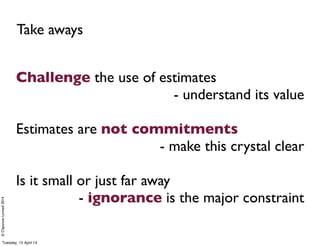
Challenge the use of estimates
- understand its value
Estimates are not commitments
- make this crystal clear
Is it small or just far away
- ignorance is the major constraint
Take aways
Tuesday, 15 April 14
©ClaysnowLimited2014
-JVM
Seb Rose,
Available 2014
(hopefully)
Tuesday, 15 April 14
Seb	
  Rose
Twi$er:	
  	
   @sebrose
Blog:	
  	
   	
   www.claysnow.co.uk
E-­‐mail:	
   	
   seb@claysnow.co.uk
Tuesday, 15 April 14
©ClaysnowLimited2014
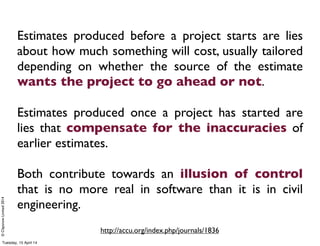
Estimates produced before a project starts are lies
about how much something will cost, usually tailored
depending on whether the source of the estimate
wants the project to go ahead or not.
Estimates produced once a project has started are
lies that compensate for the inaccuracies of
earlier estimates.
Both contribute towards an illusion of control
that is no more real in software than it is in civil
engineering.
http://accu.org/index.php/journals/1836
Tuesday, 15 April 14

Lies, damn lies, estimates