Lecture 4: Random variables and probability
distributions (Random variables, Discrete
probability distributions)
Random variable
Statistics is concerned with making inferences about popu-
lations and population characteristics.
It is often important to allocate a numerical description to
the outcome, e.g., the number of defectives that occur.
Recall previous examples, e.g., throwing a pair of dice, the
two numbers are the outcome, but their sum is a random
variable ...
FECU c Wafaa S. Sayed 2 / 21
Random variable
Statistics is concerned with making inferences about popu-
lations and population characteristics.
It is often important to allocate a numerical description to
the outcome, e.g., the number of defectives that occur.
Recall previous examples, e.g., throwing a pair of dice, the
two numbers are the outcome, but their sum is a random
variable ...
Definition 3.1
A random variable is a function that associates a real number
with each element in the sample space.
FECU c Wafaa S. Sayed 2 / 21
Random variable
Statistics is concerned with making inferences about popu-
lations and population characteristics.
It is often important to allocate a numerical description to
the outcome, e.g., the number of defectives that occur.
Recall previous examples, e.g., throwing a pair of dice, the
two numbers are the outcome, but their sum is a random
variable ...
Definition 3.1
A random variable is a function that associates a real number
with each element in the sample space.
These values are, of course, random quantities determined
by the outcome of the experiment.
We shall use a capital letter, say X, to denote a random
variable and its corresponding small letter, x, for one of its
values.
FECU c Wafaa S. Sayed 2 / 21
Illustrative examples
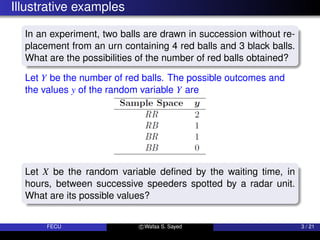
In an experiment, two balls are drawn in succession without re-
placement from an urn containing 4 red balls and 3 black balls.
What are the possibilities of the number of red balls obtained?
FECU c Wafaa S. Sayed 3 / 21
Illustrative examples
In an experiment, two balls are drawn in succession without re-
placement from an urn containing 4 red balls and 3 black balls.
What are the possibilities of the number of red balls obtained?
Let Y be the number of red balls.
FECU c Wafaa S. Sayed 3 / 21
Illustrative examples
In an experiment, two balls are drawn in succession without re-
placement from an urn containing 4 red balls and 3 black balls.
What are the possibilities of the number of red balls obtained?
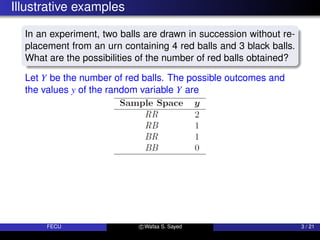
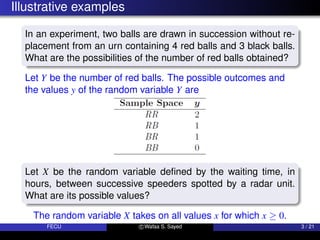
Let Y be the number of red balls. The possible outcomes and
the values y of the random variable Y are
FECU c Wafaa S. Sayed 3 / 21
Illustrative examples
In an experiment, two balls are drawn in succession without re-
placement from an urn containing 4 red balls and 3 black balls.
What are the possibilities of the number of red balls obtained?
Let Y be the number of red balls. The possible outcomes and
the values y of the random variable Y are
FECU c Wafaa S. Sayed 3 / 21
Illustrative examples
In an experiment, two balls are drawn in succession without re-
placement from an urn containing 4 red balls and 3 black balls.
What are the possibilities of the number of red balls obtained?
Let Y be the number of red balls. The possible outcomes and
the values y of the random variable Y are
Let X be the random variable defined by the waiting time, in
hours, between successive speeders spotted by a radar unit.
What are its possible values?
FECU c Wafaa S. Sayed 3 / 21
Illustrative examples
In an experiment, two balls are drawn in succession without re-
placement from an urn containing 4 red balls and 3 black balls.
What are the possibilities of the number of red balls obtained?
Let Y be the number of red balls. The possible outcomes and
the values y of the random variable Y are
Let X be the random variable defined by the waiting time, in
hours, between successive speeders spotted by a radar unit.
What are its possible values?
The random variable X takes on all values x for which x ≥ 0.
FECU c Wafaa S. Sayed 3 / 21
Do you notice any difference?
FECU c Wafaa S. Sayed 4 / 21
Discrete random variables (finite or countable)
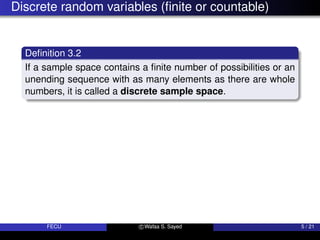
Definition 3.2
If a sample space contains a finite number of possibilities or an
unending sequence with as many elements as there are whole
numbers, it is called a discrete sample space.
FECU c Wafaa S. Sayed 5 / 21
Discrete random variables (finite or countable)
Definition 3.2
If a sample space contains a finite number of possibilities or an
unending sequence with as many elements as there are whole
numbers, it is called a discrete sample space.
A random variable is called a discrete random variable if its
set of possible outcomes is countable.
In most practical problems, discrete random variables rep-
resent count data, such as the number of defectives in a
sample of k items or the number of highway fatalities per
year in a given state.
FECU c Wafaa S. Sayed 5 / 21
Continuous random variables (uncountable)
Definition 3.3
If a sample space contains an infinite number of possibilities
equal to the number of points on a line segment, it is called a
continuous sample space.
FECU c Wafaa S. Sayed 6 / 21
Continuous random variables (uncountable)
Definition 3.3
If a sample space contains an infinite number of possibilities
equal to the number of points on a line segment, it is called a
continuous sample space.
A random variable is called a continuous random variable
if its possible outcomes fall in an entire interval of numbers
and are not discrete or whole numbers. They can take on
values on a continuous scale.
In most practical problems, continuous random variables
represent measured data, such as all possible heights, weights,
temperatures, distance, or life periods.
FECU c Wafaa S. Sayed 6 / 21
More discrete examples
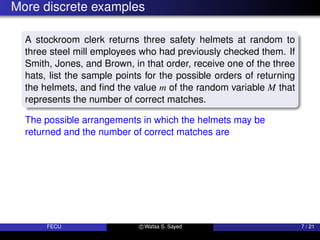
A stockroom clerk returns three safety helmets at random to
three steel mill employees who had previously checked them. If
Smith, Jones, and Brown, in that order, receive one of the three
hats, list the sample points for the possible orders of returning
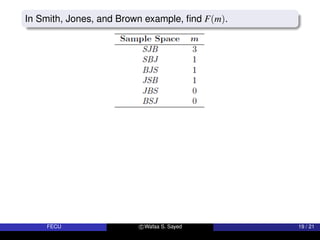
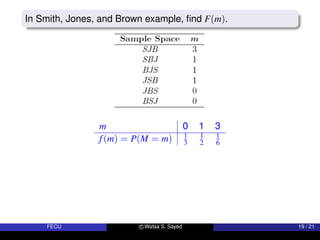
the helmets, and find the value m of the random variable M that
represents the number of correct matches.
FECU c Wafaa S. Sayed 7 / 21
More discrete examples
A stockroom clerk returns three safety helmets at random to
three steel mill employees who had previously checked them. If
Smith, Jones, and Brown, in that order, receive one of the three
hats, list the sample points for the possible orders of returning
the helmets, and find the value m of the random variable M that
represents the number of correct matches.
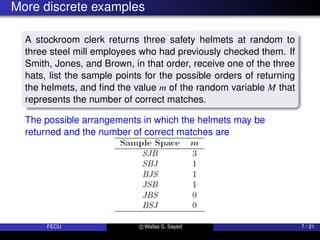
The possible arrangements in which the helmets may be
returned and the number of correct matches are
FECU c Wafaa S. Sayed 7 / 21
More discrete examples
A stockroom clerk returns three safety helmets at random to
three steel mill employees who had previously checked them. If
Smith, Jones, and Brown, in that order, receive one of the three
hats, list the sample points for the possible orders of returning
the helmets, and find the value m of the random variable M that
represents the number of correct matches.
The possible arrangements in which the helmets may be
returned and the number of correct matches are
FECU c Wafaa S. Sayed 7 / 21
More discrete examples
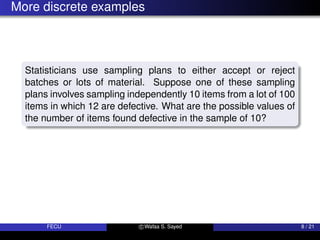
Statisticians use sampling plans to either accept or reject
batches or lots of material. Suppose one of these sampling
plans involves sampling independently 10 items from a lot of 100
items in which 12 are defective. What are the possible values of
the number of items found defective in the sample of 10?
FECU c Wafaa S. Sayed 8 / 21
More discrete examples
Statisticians use sampling plans to either accept or reject
batches or lots of material. Suppose one of these sampling
plans involves sampling independently 10 items from a lot of 100
items in which 12 are defective. What are the possible values of
the number of items found defective in the sample of 10?
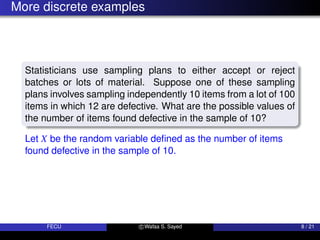
Let X be the random variable defined as the number of items
found defective in the sample of 10.
FECU c Wafaa S. Sayed 8 / 21
More discrete examples
Statisticians use sampling plans to either accept or reject
batches or lots of material. Suppose one of these sampling
plans involves sampling independently 10 items from a lot of 100
items in which 12 are defective. What are the possible values of
the number of items found defective in the sample of 10?
Let X be the random variable defined as the number of items
found defective in the sample of 10. In this case, the random
variable takes on the values 0, 1, 2, . . . , 9, 10.
FECU c Wafaa S. Sayed 8 / 21
More discrete examples
When a die is thrown until a 5 occurs, we obtain a sam-
ple space with an unending sequence of elements, S =
{F, NF, NNF, NNNF, . . . }, where F and N represent, respectively,
the occurrence and non-occurrence of a 5.
FECU c Wafaa S. Sayed 9 / 21
More discrete examples
When a die is thrown until a 5 occurs, we obtain a sam-
ple space with an unending sequence of elements, S =
{F, NF, NNF, NNNF, . . . }, where F and N represent, respectively,
the occurrence and non-occurrence of a 5.
Even in this experiment, the number of elements can be equated
to the number of whole numbers so that there is a first element,
a second element, a third element, and so on, and in this sense
can be counted.
FECU c Wafaa S. Sayed 9 / 21
More discrete examples
When a die is thrown until a 5 occurs, we obtain a sam-
ple space with an unending sequence of elements, S =
{F, NF, NNF, NNNF, . . . }, where F and N represent, respectively,
the occurrence and non-occurrence of a 5.
Even in this experiment, the number of elements can be equated
to the number of whole numbers so that there is a first element,
a second element, a third element, and so on, and in this sense
can be counted.
Countable but not finite
FECU c Wafaa S. Sayed 9 / 21
More discrete examples
Suppose a sampling plan involves sampling items from a pro-
cess until a defective is observed. The evaluation of the process
will depend on how many consecutive items are observed.
FECU c Wafaa S. Sayed 10 / 21
More discrete examples
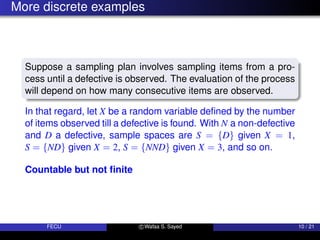
Suppose a sampling plan involves sampling items from a pro-
cess until a defective is observed. The evaluation of the process
will depend on how many consecutive items are observed.
In that regard, let X be a random variable defined by the number
of items observed till a defective is found. With N a non-defective
and D a defective, sample spaces are S = {D} given X = 1,
S = {ND} given X = 2, S = {NND} given X = 3, and so on.
Countable but not finite
FECU c Wafaa S. Sayed 10 / 21
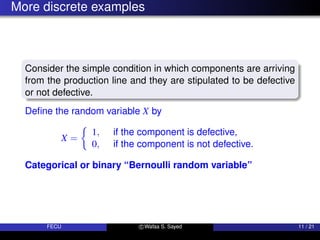
More discrete examples
Consider the simple condition in which components are arriving
from the production line and they are stipulated to be defective
or not defective.
FECU c Wafaa S. Sayed 11 / 21
More discrete examples
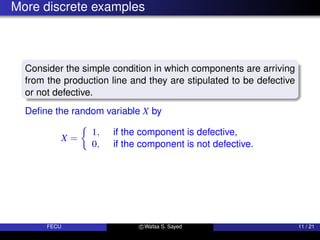
Consider the simple condition in which components are arriving
from the production line and they are stipulated to be defective
or not defective.
Define the random variable X by
X =

1, if the component is defective,
0, if the component is not defective.
FECU c Wafaa S. Sayed 11 / 21
More discrete examples
Consider the simple condition in which components are arriving
from the production line and they are stipulated to be defective
or not defective.
Define the random variable X by
X =

1, if the component is defective,
0, if the component is not defective.
Categorical or binary “Bernoulli random variable”
FECU c Wafaa S. Sayed 11 / 21
Yet, one more continuous example
Interest centers around the proportion of people who respond to
a certain mail order solicitation. Let X be that proportion.
FECU c Wafaa S. Sayed 12 / 21
Yet, one more continuous example
Interest centers around the proportion of people who respond to
a certain mail order solicitation. Let X be that proportion.
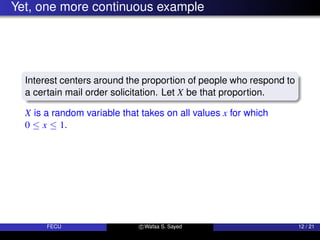
X is a random variable that takes on all values x for which
0 ≤ x ≤ 1.
FECU c Wafaa S. Sayed 12 / 21
Yet, one more continuous example
Interest centers around the proportion of people who respond to
a certain mail order solicitation. Let X be that proportion.
X is a random variable that takes on all values x for which
0 ≤ x ≤ 1.
Don’t confuse with probability!
FECU c Wafaa S. Sayed 12 / 21
Discrete probability distributions
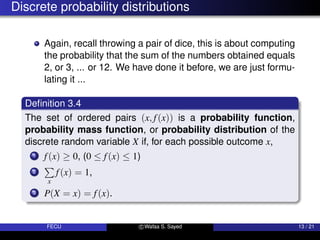
Again, recall throwing a pair of dice, this is about computing
the probability that the sum of the numbers obtained equals
2, or 3, ... or 12. We have done it before, we are just formu-
lating it ...
Definition 3.4
The set of ordered pairs (x, f(x)) is a probability function,
probability mass function, or probability distribution of the
discrete random variable X if, for each possible outcome x,
1 f(x) ≥ 0, (0 ≤ f(x) ≤ 1)
2
P
x
f(x) = 1,
3 P(X = x) = f(x).
FECU c Wafaa S. Sayed 13 / 21
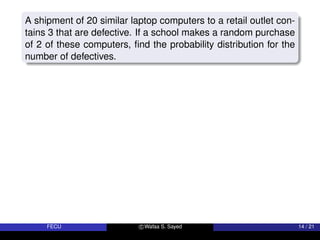
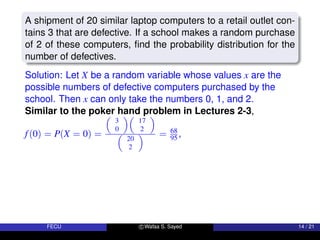
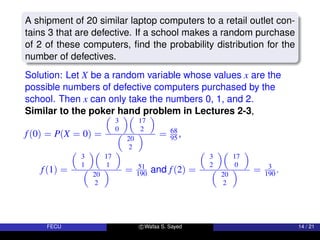
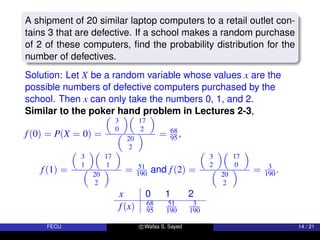
A shipment of 20 similar laptop computers to a retail outlet con-
tains 3 that are defective. If a school makes a random purchase
of 2 of these computers, find the probability distribution for the
number of defectives.
FECU c Wafaa S. Sayed 14 / 21
A shipment of 20 similar laptop computers to a retail outlet con-
tains 3 that are defective. If a school makes a random purchase
of 2 of these computers, find the probability distribution for the
number of defectives.
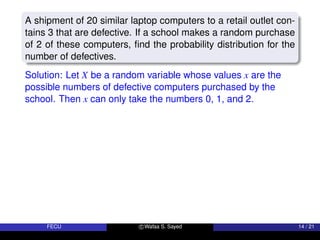
Solution: Let X be a random variable whose values x are the
possible numbers of defective computers purchased by the
school. Then x can only take the numbers 0, 1, and 2.
FECU c Wafaa S. Sayed 14 / 21
A shipment of 20 similar laptop computers to a retail outlet con-
tains 3 that are defective. If a school makes a random purchase
of 2 of these computers, find the probability distribution for the
number of defectives.
Solution: Let X be a random variable whose values x are the
possible numbers of defective computers purchased by the
school. Then x can only take the numbers 0, 1, and 2.
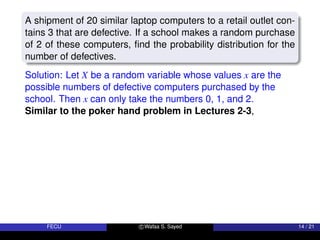
Similar to the poker hand problem in Lectures 2-3,
FECU c Wafaa S. Sayed 14 / 21
A shipment of 20 similar laptop computers to a retail outlet con-
tains 3 that are defective. If a school makes a random purchase
of 2 of these computers, find the probability distribution for the
number of defectives.
Solution: Let X be a random variable whose values x are the
possible numbers of defective computers purchased by the
school. Then x can only take the numbers 0, 1, and 2.
Similar to the poker hand problem in Lectures 2-3,
f(0) = P(X = 0) =

3
0

17
2


20
2
 = 68
95 ,
FECU c Wafaa S. Sayed 14 / 21
A shipment of 20 similar laptop computers to a retail outlet con-
tains 3 that are defective. If a school makes a random purchase
of 2 of these computers, find the probability distribution for the
number of defectives.
Solution: Let X be a random variable whose values x are the
possible numbers of defective computers purchased by the
school. Then x can only take the numbers 0, 1, and 2.
Similar to the poker hand problem in Lectures 2-3,
f(0) = P(X = 0) =

3
0

17
2


20
2
 = 68
95 ,
f(1) =

3
1

17
1


20
2
 = 51
190 and f(2) =

3
2

17
0


20
2
 = 3
190 .
FECU c Wafaa S. Sayed 14 / 21
A shipment of 20 similar laptop computers to a retail outlet con-
tains 3 that are defective. If a school makes a random purchase
of 2 of these computers, find the probability distribution for the
number of defectives.
Solution: Let X be a random variable whose values x are the
possible numbers of defective computers purchased by the
school. Then x can only take the numbers 0, 1, and 2.
Similar to the poker hand problem in Lectures 2-3,
f(0) = P(X = 0) =

3
0

17
2


20
2
 = 68
95 ,
f(1) =

3
1

17
1


20
2
 = 51
190 and f(2) =

3
2

17
0


20
2
 = 3
190 .
x 0 1 2
f(x) 68
95
51
190
3
190
FECU c Wafaa S. Sayed 14 / 21
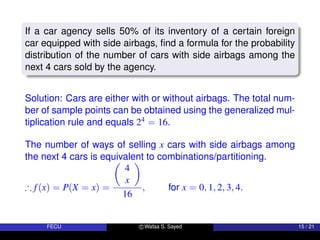
If a car agency sells 50% of its inventory of a certain foreign
car equipped with side airbags, find a formula for the probability
distribution of the number of cars with side airbags among the
next 4 cars sold by the agency.
FECU c Wafaa S. Sayed 15 / 21
If a car agency sells 50% of its inventory of a certain foreign
car equipped with side airbags, find a formula for the probability
distribution of the number of cars with side airbags among the
next 4 cars sold by the agency.
Solution: Cars are either with or without airbags.
FECU c Wafaa S. Sayed 15 / 21
If a car agency sells 50% of its inventory of a certain foreign
car equipped with side airbags, find a formula for the probability
distribution of the number of cars with side airbags among the
next 4 cars sold by the agency.
Solution: Cars are either with or without airbags. The total num-
ber of sample points can be obtained using
FECU c Wafaa S. Sayed 15 / 21
If a car agency sells 50% of its inventory of a certain foreign
car equipped with side airbags, find a formula for the probability
distribution of the number of cars with side airbags among the
next 4 cars sold by the agency.
Solution: Cars are either with or without airbags. The total num-
ber of sample points can be obtained using the generalized mul-
tiplication rule and equals
FECU c Wafaa S. Sayed 15 / 21
If a car agency sells 50% of its inventory of a certain foreign
car equipped with side airbags, find a formula for the probability
distribution of the number of cars with side airbags among the
next 4 cars sold by the agency.
Solution: Cars are either with or without airbags. The total num-
ber of sample points can be obtained using the generalized mul-
tiplication rule and equals 24 = 16.
FECU c Wafaa S. Sayed 15 / 21
If a car agency sells 50% of its inventory of a certain foreign
car equipped with side airbags, find a formula for the probability
distribution of the number of cars with side airbags among the
next 4 cars sold by the agency.
Solution: Cars are either with or without airbags. The total num-
ber of sample points can be obtained using the generalized mul-
tiplication rule and equals 24 = 16.
The number of ways of selling x cars with side airbags among
the next 4 cars is equivalent to
FECU c Wafaa S. Sayed 15 / 21
If a car agency sells 50% of its inventory of a certain foreign
car equipped with side airbags, find a formula for the probability
distribution of the number of cars with side airbags among the
next 4 cars sold by the agency.
Solution: Cars are either with or without airbags. The total num-
ber of sample points can be obtained using the generalized mul-
tiplication rule and equals 24 = 16.
The number of ways of selling x cars with side airbags among
the next 4 cars is equivalent to combinations/partitioning.
FECU c Wafaa S. Sayed 15 / 21
If a car agency sells 50% of its inventory of a certain foreign
car equipped with side airbags, find a formula for the probability
distribution of the number of cars with side airbags among the
next 4 cars sold by the agency.
Solution: Cars are either with or without airbags. The total num-
ber of sample points can be obtained using the generalized mul-
tiplication rule and equals 24 = 16.
The number of ways of selling x cars with side airbags among
the next 4 cars is equivalent to combinations/partitioning.
∴ f(x) = P(X = x) =

4
x

16
, for x = 0, 1, 2, 3, 4.
FECU c Wafaa S. Sayed 15 / 21
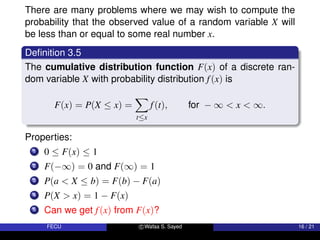
There are many problems where we may wish to compute the
probability that the observed value of a random variable X will
be less than or equal to some real number x.
Definition 3.5
The cumulative distribution function F(x) of a discrete ran-
dom variable X with probability distribution f(x) is
F(x) = P(X ≤ x) =
X
t≤x
f(t), for − ∞  x  ∞.
Properties:
1 0 ≤ F(x) ≤ 1
2 F(−∞) = 0 and F(∞) = 1
3 P(a  X ≤ b) = F(b) − F(a)
4 P(X  x) = 1 − F(x)
5 Can we get f(x) from F(x)?
FECU c Wafaa S. Sayed 16 / 21
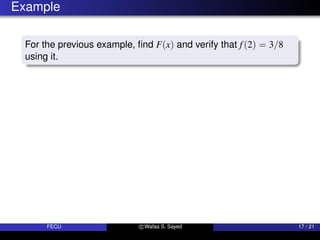
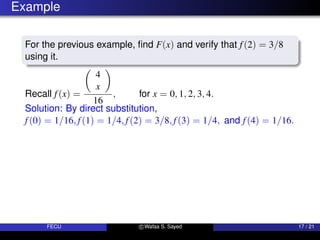
Example
For the previous example, find F(x) and verify that f(2) = 3/8
using it.
FECU c Wafaa S. Sayed 17 / 21
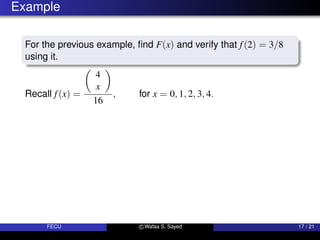
Example
For the previous example, find F(x) and verify that f(2) = 3/8
using it.
Recall f(x) =

4
x

16
, for x = 0, 1, 2, 3, 4.
FECU c Wafaa S. Sayed 17 / 21
Example
For the previous example, find F(x) and verify that f(2) = 3/8
using it.
Recall f(x) =

4
x

16
, for x = 0, 1, 2, 3, 4.
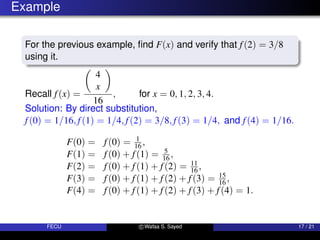
Solution: By direct substitution,
f(0) = 1/16, f(1) = 1/4, f(2) = 3/8, f(3) = 1/4, and f(4) = 1/16.
FECU c Wafaa S. Sayed 17 / 21
Example
For the previous example, find F(x) and verify that f(2) = 3/8
using it.
Recall f(x) =

4
x

16
, for x = 0, 1, 2, 3, 4.
Solution: By direct substitution,
f(0) = 1/16, f(1) = 1/4, f(2) = 3/8, f(3) = 1/4, and f(4) = 1/16.
F(0) = f(0) = 1
16 ,
F(1) = f(0) + f(1) = 5
16 ,
F(2) = f(0) + f(1) + f(2) = 11
16 ,
F(3) = f(0) + f(1) + f(2) + f(3) = 15
16 ,
F(4) = f(0) + f(1) + f(2) + f(3) + f(4) = 1.
FECU c Wafaa S. Sayed 17 / 21
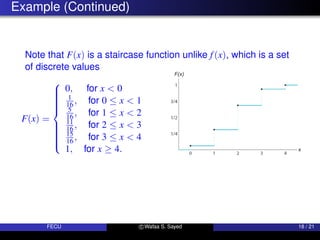
Example (Continued)
Note that F(x) is a staircase function unlike f(x), which is a set
of discrete values
F(x) =















0, for x  0
1
16 , for 0 ≤ x  1
5
16 , for 1 ≤ x  2
11
16 , for 2 ≤ x  3
15
16 , for 3 ≤ x  4
1, for x ≥ 4.
FECU c Wafaa S. Sayed 18 / 21
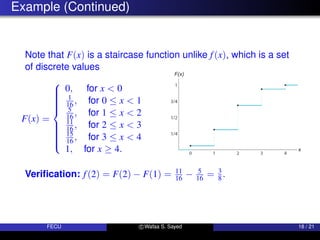
Example (Continued)
Note that F(x) is a staircase function unlike f(x), which is a set
of discrete values
F(x) =















0, for x  0
1
16 , for 0 ≤ x  1
5
16 , for 1 ≤ x  2
11
16 , for 2 ≤ x  3
15
16 , for 3 ≤ x  4
1, for x ≥ 4.
Verification: f(2) = F(2) − F(1) = 11
16 − 5
16 = 3
8.
FECU c Wafaa S. Sayed 18 / 21
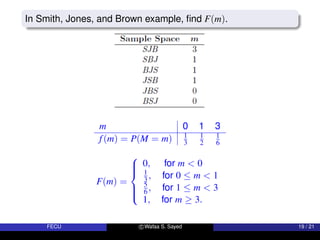
In Smith, Jones, and Brown example, find F(m).
FECU c Wafaa S. Sayed 19 / 21
In Smith, Jones, and Brown example, find F(m).
m 0 1 3
f(m) = P(M = m) 1
3
1
2
1
6
FECU c Wafaa S. Sayed 19 / 21
In Smith, Jones, and Brown example, find F(m).
m 0 1 3
f(m) = P(M = m) 1
3
1
2
1
6
F(m) =







0, for m  0
1
3 , for 0 ≤ m  1
5
6 , for 1 ≤ m  3
1, for m ≥ 3.
FECU c Wafaa S. Sayed 19 / 21
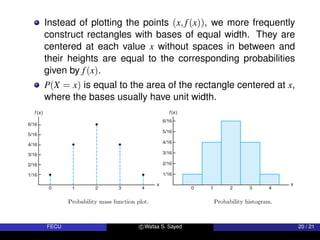
Instead of plotting the points (x, f(x)), we more frequently
construct rectangles with bases of equal width. They are
centered at each value x without spaces in between and
their heights are equal to the corresponding probabilities
given by f(x).
P(X = x) is equal to the area of the rectangle centered at x,
where the bases usually have unit width.
FECU c Wafaa S. Sayed 20 / 21
Thank You

Licture 4 - Random Variables and Probability Distributions

  • 1.
    Lecture 4: Randomvariables and probability distributions (Random variables, Discrete probability distributions)
  • 2.
    Random variable Statistics isconcerned with making inferences about popu- lations and population characteristics. It is often important to allocate a numerical description to the outcome, e.g., the number of defectives that occur. Recall previous examples, e.g., throwing a pair of dice, the two numbers are the outcome, but their sum is a random variable ... FECU c Wafaa S. Sayed 2 / 21
  • 3.
    Random variable Statistics isconcerned with making inferences about popu- lations and population characteristics. It is often important to allocate a numerical description to the outcome, e.g., the number of defectives that occur. Recall previous examples, e.g., throwing a pair of dice, the two numbers are the outcome, but their sum is a random variable ... Definition 3.1 A random variable is a function that associates a real number with each element in the sample space. FECU c Wafaa S. Sayed 2 / 21
  • 4.
    Random variable Statistics isconcerned with making inferences about popu- lations and population characteristics. It is often important to allocate a numerical description to the outcome, e.g., the number of defectives that occur. Recall previous examples, e.g., throwing a pair of dice, the two numbers are the outcome, but their sum is a random variable ... Definition 3.1 A random variable is a function that associates a real number with each element in the sample space. These values are, of course, random quantities determined by the outcome of the experiment. We shall use a capital letter, say X, to denote a random variable and its corresponding small letter, x, for one of its values. FECU c Wafaa S. Sayed 2 / 21
  • 5.
    Illustrative examples In anexperiment, two balls are drawn in succession without re- placement from an urn containing 4 red balls and 3 black balls. What are the possibilities of the number of red balls obtained? FECU c Wafaa S. Sayed 3 / 21
  • 6.
    Illustrative examples In anexperiment, two balls are drawn in succession without re- placement from an urn containing 4 red balls and 3 black balls. What are the possibilities of the number of red balls obtained? Let Y be the number of red balls. FECU c Wafaa S. Sayed 3 / 21
  • 7.
    Illustrative examples In anexperiment, two balls are drawn in succession without re- placement from an urn containing 4 red balls and 3 black balls. What are the possibilities of the number of red balls obtained? Let Y be the number of red balls. The possible outcomes and the values y of the random variable Y are FECU c Wafaa S. Sayed 3 / 21
  • 8.
    Illustrative examples In anexperiment, two balls are drawn in succession without re- placement from an urn containing 4 red balls and 3 black balls. What are the possibilities of the number of red balls obtained? Let Y be the number of red balls. The possible outcomes and the values y of the random variable Y are FECU c Wafaa S. Sayed 3 / 21
  • 9.
    Illustrative examples In anexperiment, two balls are drawn in succession without re- placement from an urn containing 4 red balls and 3 black balls. What are the possibilities of the number of red balls obtained? Let Y be the number of red balls. The possible outcomes and the values y of the random variable Y are Let X be the random variable defined by the waiting time, in hours, between successive speeders spotted by a radar unit. What are its possible values? FECU c Wafaa S. Sayed 3 / 21
  • 10.
    Illustrative examples In anexperiment, two balls are drawn in succession without re- placement from an urn containing 4 red balls and 3 black balls. What are the possibilities of the number of red balls obtained? Let Y be the number of red balls. The possible outcomes and the values y of the random variable Y are Let X be the random variable defined by the waiting time, in hours, between successive speeders spotted by a radar unit. What are its possible values? The random variable X takes on all values x for which x ≥ 0. FECU c Wafaa S. Sayed 3 / 21
  • 11.
    Do you noticeany difference? FECU c Wafaa S. Sayed 4 / 21
  • 12.
    Discrete random variables(finite or countable) Definition 3.2 If a sample space contains a finite number of possibilities or an unending sequence with as many elements as there are whole numbers, it is called a discrete sample space. FECU c Wafaa S. Sayed 5 / 21
  • 13.
    Discrete random variables(finite or countable) Definition 3.2 If a sample space contains a finite number of possibilities or an unending sequence with as many elements as there are whole numbers, it is called a discrete sample space. A random variable is called a discrete random variable if its set of possible outcomes is countable. In most practical problems, discrete random variables rep- resent count data, such as the number of defectives in a sample of k items or the number of highway fatalities per year in a given state. FECU c Wafaa S. Sayed 5 / 21
  • 14.
    Continuous random variables(uncountable) Definition 3.3 If a sample space contains an infinite number of possibilities equal to the number of points on a line segment, it is called a continuous sample space. FECU c Wafaa S. Sayed 6 / 21
  • 15.
    Continuous random variables(uncountable) Definition 3.3 If a sample space contains an infinite number of possibilities equal to the number of points on a line segment, it is called a continuous sample space. A random variable is called a continuous random variable if its possible outcomes fall in an entire interval of numbers and are not discrete or whole numbers. They can take on values on a continuous scale. In most practical problems, continuous random variables represent measured data, such as all possible heights, weights, temperatures, distance, or life periods. FECU c Wafaa S. Sayed 6 / 21
  • 16.
    More discrete examples Astockroom clerk returns three safety helmets at random to three steel mill employees who had previously checked them. If Smith, Jones, and Brown, in that order, receive one of the three hats, list the sample points for the possible orders of returning the helmets, and find the value m of the random variable M that represents the number of correct matches. FECU c Wafaa S. Sayed 7 / 21
  • 17.
    More discrete examples Astockroom clerk returns three safety helmets at random to three steel mill employees who had previously checked them. If Smith, Jones, and Brown, in that order, receive one of the three hats, list the sample points for the possible orders of returning the helmets, and find the value m of the random variable M that represents the number of correct matches. The possible arrangements in which the helmets may be returned and the number of correct matches are FECU c Wafaa S. Sayed 7 / 21
  • 18.
    More discrete examples Astockroom clerk returns three safety helmets at random to three steel mill employees who had previously checked them. If Smith, Jones, and Brown, in that order, receive one of the three hats, list the sample points for the possible orders of returning the helmets, and find the value m of the random variable M that represents the number of correct matches. The possible arrangements in which the helmets may be returned and the number of correct matches are FECU c Wafaa S. Sayed 7 / 21
  • 19.
    More discrete examples Statisticiansuse sampling plans to either accept or reject batches or lots of material. Suppose one of these sampling plans involves sampling independently 10 items from a lot of 100 items in which 12 are defective. What are the possible values of the number of items found defective in the sample of 10? FECU c Wafaa S. Sayed 8 / 21
  • 20.
    More discrete examples Statisticiansuse sampling plans to either accept or reject batches or lots of material. Suppose one of these sampling plans involves sampling independently 10 items from a lot of 100 items in which 12 are defective. What are the possible values of the number of items found defective in the sample of 10? Let X be the random variable defined as the number of items found defective in the sample of 10. FECU c Wafaa S. Sayed 8 / 21
  • 21.
    More discrete examples Statisticiansuse sampling plans to either accept or reject batches or lots of material. Suppose one of these sampling plans involves sampling independently 10 items from a lot of 100 items in which 12 are defective. What are the possible values of the number of items found defective in the sample of 10? Let X be the random variable defined as the number of items found defective in the sample of 10. In this case, the random variable takes on the values 0, 1, 2, . . . , 9, 10. FECU c Wafaa S. Sayed 8 / 21
  • 22.
    More discrete examples Whena die is thrown until a 5 occurs, we obtain a sam- ple space with an unending sequence of elements, S = {F, NF, NNF, NNNF, . . . }, where F and N represent, respectively, the occurrence and non-occurrence of a 5. FECU c Wafaa S. Sayed 9 / 21
  • 23.
    More discrete examples Whena die is thrown until a 5 occurs, we obtain a sam- ple space with an unending sequence of elements, S = {F, NF, NNF, NNNF, . . . }, where F and N represent, respectively, the occurrence and non-occurrence of a 5. Even in this experiment, the number of elements can be equated to the number of whole numbers so that there is a first element, a second element, a third element, and so on, and in this sense can be counted. FECU c Wafaa S. Sayed 9 / 21
  • 24.
    More discrete examples Whena die is thrown until a 5 occurs, we obtain a sam- ple space with an unending sequence of elements, S = {F, NF, NNF, NNNF, . . . }, where F and N represent, respectively, the occurrence and non-occurrence of a 5. Even in this experiment, the number of elements can be equated to the number of whole numbers so that there is a first element, a second element, a third element, and so on, and in this sense can be counted. Countable but not finite FECU c Wafaa S. Sayed 9 / 21
  • 25.
    More discrete examples Supposea sampling plan involves sampling items from a pro- cess until a defective is observed. The evaluation of the process will depend on how many consecutive items are observed. FECU c Wafaa S. Sayed 10 / 21
  • 26.
    More discrete examples Supposea sampling plan involves sampling items from a pro- cess until a defective is observed. The evaluation of the process will depend on how many consecutive items are observed. In that regard, let X be a random variable defined by the number of items observed till a defective is found. With N a non-defective and D a defective, sample spaces are S = {D} given X = 1, S = {ND} given X = 2, S = {NND} given X = 3, and so on. Countable but not finite FECU c Wafaa S. Sayed 10 / 21
  • 27.
    More discrete examples Considerthe simple condition in which components are arriving from the production line and they are stipulated to be defective or not defective. FECU c Wafaa S. Sayed 11 / 21
  • 28.
    More discrete examples Considerthe simple condition in which components are arriving from the production line and they are stipulated to be defective or not defective. Define the random variable X by X = 1, if the component is defective, 0, if the component is not defective. FECU c Wafaa S. Sayed 11 / 21
  • 29.
    More discrete examples Considerthe simple condition in which components are arriving from the production line and they are stipulated to be defective or not defective. Define the random variable X by X = 1, if the component is defective, 0, if the component is not defective. Categorical or binary “Bernoulli random variable” FECU c Wafaa S. Sayed 11 / 21
  • 30.
    Yet, one morecontinuous example Interest centers around the proportion of people who respond to a certain mail order solicitation. Let X be that proportion. FECU c Wafaa S. Sayed 12 / 21
  • 31.
    Yet, one morecontinuous example Interest centers around the proportion of people who respond to a certain mail order solicitation. Let X be that proportion. X is a random variable that takes on all values x for which 0 ≤ x ≤ 1. FECU c Wafaa S. Sayed 12 / 21
  • 32.
    Yet, one morecontinuous example Interest centers around the proportion of people who respond to a certain mail order solicitation. Let X be that proportion. X is a random variable that takes on all values x for which 0 ≤ x ≤ 1. Don’t confuse with probability! FECU c Wafaa S. Sayed 12 / 21
  • 33.
    Discrete probability distributions Again,recall throwing a pair of dice, this is about computing the probability that the sum of the numbers obtained equals 2, or 3, ... or 12. We have done it before, we are just formu- lating it ... Definition 3.4 The set of ordered pairs (x, f(x)) is a probability function, probability mass function, or probability distribution of the discrete random variable X if, for each possible outcome x, 1 f(x) ≥ 0, (0 ≤ f(x) ≤ 1) 2 P x f(x) = 1, 3 P(X = x) = f(x). FECU c Wafaa S. Sayed 13 / 21
  • 34.
    A shipment of20 similar laptop computers to a retail outlet con- tains 3 that are defective. If a school makes a random purchase of 2 of these computers, find the probability distribution for the number of defectives. FECU c Wafaa S. Sayed 14 / 21
  • 35.
    A shipment of20 similar laptop computers to a retail outlet con- tains 3 that are defective. If a school makes a random purchase of 2 of these computers, find the probability distribution for the number of defectives. Solution: Let X be a random variable whose values x are the possible numbers of defective computers purchased by the school. Then x can only take the numbers 0, 1, and 2. FECU c Wafaa S. Sayed 14 / 21
  • 36.
    A shipment of20 similar laptop computers to a retail outlet con- tains 3 that are defective. If a school makes a random purchase of 2 of these computers, find the probability distribution for the number of defectives. Solution: Let X be a random variable whose values x are the possible numbers of defective computers purchased by the school. Then x can only take the numbers 0, 1, and 2. Similar to the poker hand problem in Lectures 2-3, FECU c Wafaa S. Sayed 14 / 21
  • 37.
    A shipment of20 similar laptop computers to a retail outlet con- tains 3 that are defective. If a school makes a random purchase of 2 of these computers, find the probability distribution for the number of defectives. Solution: Let X be a random variable whose values x are the possible numbers of defective computers purchased by the school. Then x can only take the numbers 0, 1, and 2. Similar to the poker hand problem in Lectures 2-3, f(0) = P(X = 0) = 3 0 17 2 20 2 = 68 95 , FECU c Wafaa S. Sayed 14 / 21
  • 38.
    A shipment of20 similar laptop computers to a retail outlet con- tains 3 that are defective. If a school makes a random purchase of 2 of these computers, find the probability distribution for the number of defectives. Solution: Let X be a random variable whose values x are the possible numbers of defective computers purchased by the school. Then x can only take the numbers 0, 1, and 2. Similar to the poker hand problem in Lectures 2-3, f(0) = P(X = 0) = 3 0 17 2 20 2 = 68 95 , f(1) = 3 1 17 1 20 2 = 51 190 and f(2) = 3 2 17 0 20 2 = 3 190 . FECU c Wafaa S. Sayed 14 / 21
  • 39.
    A shipment of20 similar laptop computers to a retail outlet con- tains 3 that are defective. If a school makes a random purchase of 2 of these computers, find the probability distribution for the number of defectives. Solution: Let X be a random variable whose values x are the possible numbers of defective computers purchased by the school. Then x can only take the numbers 0, 1, and 2. Similar to the poker hand problem in Lectures 2-3, f(0) = P(X = 0) = 3 0 17 2 20 2 = 68 95 , f(1) = 3 1 17 1 20 2 = 51 190 and f(2) = 3 2 17 0 20 2 = 3 190 . x 0 1 2 f(x) 68 95 51 190 3 190 FECU c Wafaa S. Sayed 14 / 21
  • 40.
    If a caragency sells 50% of its inventory of a certain foreign car equipped with side airbags, find a formula for the probability distribution of the number of cars with side airbags among the next 4 cars sold by the agency. FECU c Wafaa S. Sayed 15 / 21
  • 41.
    If a caragency sells 50% of its inventory of a certain foreign car equipped with side airbags, find a formula for the probability distribution of the number of cars with side airbags among the next 4 cars sold by the agency. Solution: Cars are either with or without airbags. FECU c Wafaa S. Sayed 15 / 21
  • 42.
    If a caragency sells 50% of its inventory of a certain foreign car equipped with side airbags, find a formula for the probability distribution of the number of cars with side airbags among the next 4 cars sold by the agency. Solution: Cars are either with or without airbags. The total num- ber of sample points can be obtained using FECU c Wafaa S. Sayed 15 / 21
  • 43.
    If a caragency sells 50% of its inventory of a certain foreign car equipped with side airbags, find a formula for the probability distribution of the number of cars with side airbags among the next 4 cars sold by the agency. Solution: Cars are either with or without airbags. The total num- ber of sample points can be obtained using the generalized mul- tiplication rule and equals FECU c Wafaa S. Sayed 15 / 21
  • 44.
    If a caragency sells 50% of its inventory of a certain foreign car equipped with side airbags, find a formula for the probability distribution of the number of cars with side airbags among the next 4 cars sold by the agency. Solution: Cars are either with or without airbags. The total num- ber of sample points can be obtained using the generalized mul- tiplication rule and equals 24 = 16. FECU c Wafaa S. Sayed 15 / 21
  • 45.
    If a caragency sells 50% of its inventory of a certain foreign car equipped with side airbags, find a formula for the probability distribution of the number of cars with side airbags among the next 4 cars sold by the agency. Solution: Cars are either with or without airbags. The total num- ber of sample points can be obtained using the generalized mul- tiplication rule and equals 24 = 16. The number of ways of selling x cars with side airbags among the next 4 cars is equivalent to FECU c Wafaa S. Sayed 15 / 21
  • 46.
    If a caragency sells 50% of its inventory of a certain foreign car equipped with side airbags, find a formula for the probability distribution of the number of cars with side airbags among the next 4 cars sold by the agency. Solution: Cars are either with or without airbags. The total num- ber of sample points can be obtained using the generalized mul- tiplication rule and equals 24 = 16. The number of ways of selling x cars with side airbags among the next 4 cars is equivalent to combinations/partitioning. FECU c Wafaa S. Sayed 15 / 21
  • 47.
    If a caragency sells 50% of its inventory of a certain foreign car equipped with side airbags, find a formula for the probability distribution of the number of cars with side airbags among the next 4 cars sold by the agency. Solution: Cars are either with or without airbags. The total num- ber of sample points can be obtained using the generalized mul- tiplication rule and equals 24 = 16. The number of ways of selling x cars with side airbags among the next 4 cars is equivalent to combinations/partitioning. ∴ f(x) = P(X = x) = 4 x 16 , for x = 0, 1, 2, 3, 4. FECU c Wafaa S. Sayed 15 / 21
  • 48.
    There are manyproblems where we may wish to compute the probability that the observed value of a random variable X will be less than or equal to some real number x. Definition 3.5 The cumulative distribution function F(x) of a discrete ran- dom variable X with probability distribution f(x) is F(x) = P(X ≤ x) = X t≤x f(t), for − ∞ x ∞. Properties: 1 0 ≤ F(x) ≤ 1 2 F(−∞) = 0 and F(∞) = 1 3 P(a X ≤ b) = F(b) − F(a) 4 P(X x) = 1 − F(x) 5 Can we get f(x) from F(x)? FECU c Wafaa S. Sayed 16 / 21
  • 49.
    Example For the previousexample, find F(x) and verify that f(2) = 3/8 using it. FECU c Wafaa S. Sayed 17 / 21
  • 50.
    Example For the previousexample, find F(x) and verify that f(2) = 3/8 using it. Recall f(x) = 4 x 16 , for x = 0, 1, 2, 3, 4. FECU c Wafaa S. Sayed 17 / 21
  • 51.
    Example For the previousexample, find F(x) and verify that f(2) = 3/8 using it. Recall f(x) = 4 x 16 , for x = 0, 1, 2, 3, 4. Solution: By direct substitution, f(0) = 1/16, f(1) = 1/4, f(2) = 3/8, f(3) = 1/4, and f(4) = 1/16. FECU c Wafaa S. Sayed 17 / 21
  • 52.
    Example For the previousexample, find F(x) and verify that f(2) = 3/8 using it. Recall f(x) = 4 x 16 , for x = 0, 1, 2, 3, 4. Solution: By direct substitution, f(0) = 1/16, f(1) = 1/4, f(2) = 3/8, f(3) = 1/4, and f(4) = 1/16. F(0) = f(0) = 1 16 , F(1) = f(0) + f(1) = 5 16 , F(2) = f(0) + f(1) + f(2) = 11 16 , F(3) = f(0) + f(1) + f(2) + f(3) = 15 16 , F(4) = f(0) + f(1) + f(2) + f(3) + f(4) = 1. FECU c Wafaa S. Sayed 17 / 21
  • 53.
    Example (Continued) Note thatF(x) is a staircase function unlike f(x), which is a set of discrete values F(x) =                0, for x 0 1 16 , for 0 ≤ x 1 5 16 , for 1 ≤ x 2 11 16 , for 2 ≤ x 3 15 16 , for 3 ≤ x 4 1, for x ≥ 4. FECU c Wafaa S. Sayed 18 / 21
  • 54.
    Example (Continued) Note thatF(x) is a staircase function unlike f(x), which is a set of discrete values F(x) =                0, for x 0 1 16 , for 0 ≤ x 1 5 16 , for 1 ≤ x 2 11 16 , for 2 ≤ x 3 15 16 , for 3 ≤ x 4 1, for x ≥ 4. Verification: f(2) = F(2) − F(1) = 11 16 − 5 16 = 3 8. FECU c Wafaa S. Sayed 18 / 21
  • 55.
    In Smith, Jones,and Brown example, find F(m). FECU c Wafaa S. Sayed 19 / 21
  • 56.
    In Smith, Jones,and Brown example, find F(m). m 0 1 3 f(m) = P(M = m) 1 3 1 2 1 6 FECU c Wafaa S. Sayed 19 / 21
  • 57.
    In Smith, Jones,and Brown example, find F(m). m 0 1 3 f(m) = P(M = m) 1 3 1 2 1 6 F(m) =        0, for m 0 1 3 , for 0 ≤ m 1 5 6 , for 1 ≤ m 3 1, for m ≥ 3. FECU c Wafaa S. Sayed 19 / 21
  • 58.
    Instead of plottingthe points (x, f(x)), we more frequently construct rectangles with bases of equal width. They are centered at each value x without spaces in between and their heights are equal to the corresponding probabilities given by f(x). P(X = x) is equal to the area of the rectangle centered at x, where the bases usually have unit width. FECU c Wafaa S. Sayed 20 / 21
  • 59.