Licensing in Composite Projects 
Protecode Webinar Series 
December 2014 
Confidential Protecode Inc. 2014 1
Confidential Protecode Inc. 2014 
Agenda 
 Open Source Software Adoption and Creation 
 OSS Structure: Genesis vs Composite Projects 
 Licensing in Composite OSS Projects 
 Examples 
 Wrap-up and Q/A 
2 
Tiberius Forrester, 
Director, Solution 
Architecture 
tforrester@protecode.com
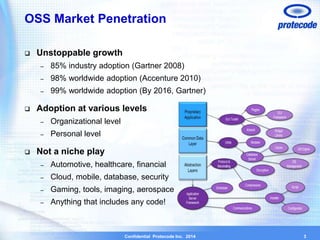
OSS Market Penetration 
Confidential Protecode Inc. 2014 
 Unstoppable growth 
– 85% industry adoption (Gartner 2008) 
– 98% worldwide adoption (Accenture 2010) 
– 99% worldwide adoption (By 2016, Gartner) 
 Adoption at various levels 
– Organizational level 
– Personal level 
 Not a niche play 
– Automotive, healthcare, financial 
– Cloud, mobile, database, security 
– Gaming, tools, imaging, aerospace 
– Anything that includes any code! 
3
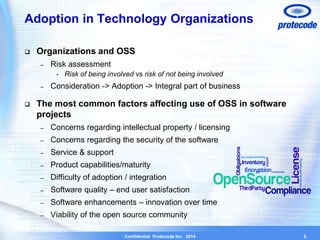
Open Source Software 
Confidential Protecode Inc. 2014 
 What is OSS 
– A software development and distribution model where software license 
guarantees certain freedoms 
– Also see OSI definition (http://opensource.org) 
 The value 
– Faster, functions, easier integration and customisation 
– Interoperability, adoption of open standards 
– No license costs 
– Freedom from vendor lock ins 
– Allows rapid development of complex software systems 
– Hundreds of thousands of projects available 
• Protecode GIPS Statistics: 
– 2.2M packages, 
– 0.5B OSS files 
– 20B lines of code! 
4
Adoption in Technology Organizations 
 Organizations and OSS 
Confidential Protecode Inc. 2014 
– Risk assessment 
• Risk of being involved vs risk of not being involved 
– Consideration -> Adoption -> Integral part of business 
 The most common factors affecting use of OSS in software 
projects 
– Concerns regarding intellectual property / licensing 
– Concerns regarding the security of the software 
– Service & support 
– Product capabilities/maturity 
– Difficulty of adoption / integration 
– Software quality – end user satisfaction 
– Software enhancements – innovation over time 
– Viability of the open source community 
5
Licensing challenges of OSS 
 Produced by large number of developers over time 
– Bazaar model: policy of fast and frequent releases, release 
candidates, possibility of governance impairments 
 Questionable due diligence efforts of committers 
– Re-licensing efforts may not have been correctly handled 
Confidential Protecode Inc. 2014 
 Code may: 
– Contain nested packages with their own set of issues 
– Contain code from books or community websites 
– Implement patents 
– Implement specifications that are subject to a license 
– Contain code generated by a tool where the output could 
be a derivative of input 
– Contain or implement APIs that may have their own 
obligations 
6
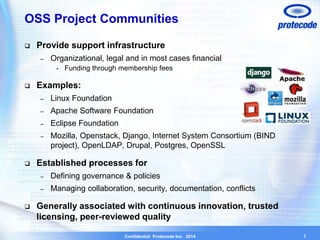
OSS Project Communities 
 Provide support infrastructure 
– Organizational, legal and in most cases financial 
• Funding through membership fees 
Confidential Protecode Inc. 2014 
 Examples: 
– Linux Foundation 
– Apache Software Foundation 
– Eclipse Foundation 
– Mozilla, Openstack, Django, Internet System Consortium (BIND 
project), OpenLDAP, Drupal, Postgres, OpenSSL 
 Established processes for 
– Defining governance & policies 
– Managing collaboration, security, documentation, conflicts 
 Generally associated with continuous innovation, trusted 
licensing, peer-reviewed quality 
7
OSS Project Types 
Confidential Protecode Inc. 2014 
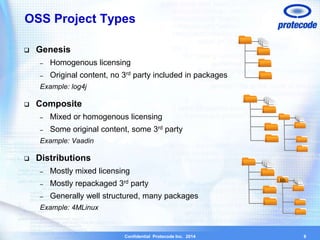
 Genesis 
– Homogenous licensing 
– Original content, no 3rd party included in packages 
Example: log4j 
 Composite 
– Mixed or homogenous licensing 
– Some original content, some 3rd party 
Example: Vaadin 
 Distributions 
– Mostly mixed licensing 
– Mostly repackaged 3rd party 
– Generally well structured, many packages 
Example: 4MLinux 
8 
lib
Licensing in Composite Projects 
Confidential Protecode Inc. 2014 
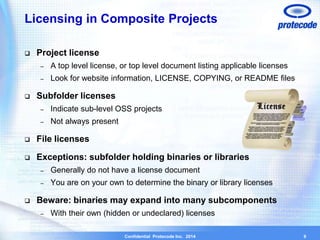
 Project license 
– A top level license, or top level document listing applicable licenses 
– Look for website information, LICENSE, COPYING, or README files 
 Subfolder licenses 
– Indicate sub-level OSS projects 
– Not always present 
 File licenses 
 Exceptions: subfolder holding binaries or libraries 
– Generally do not have a license document 
– You are on your own to determine the binary or library licenses 
 Beware: binaries may expand into many subcomponents 
– With their own (hidden or undeclared) licenses 
9
Licenses and Copyrights in Headers 
Confidential Protecode Inc. 2014 
10 
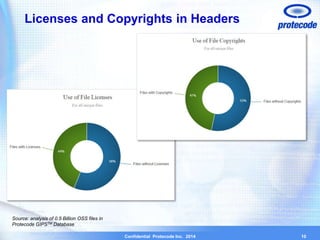
Source: analysis of 0.5 Billion OSS files in 
Protecode GIPSTM Database
Project and License Mixes 
Confidential Protecode Inc. 2014 
11 
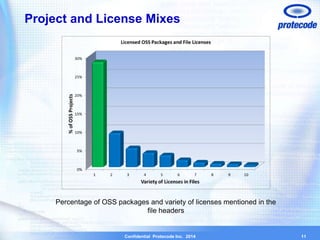
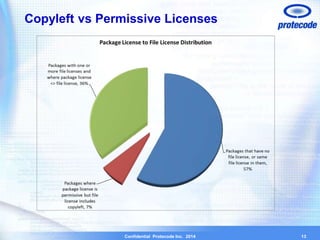
Percentage of OSS packages and variety of licenses mentioned in the 
file headers
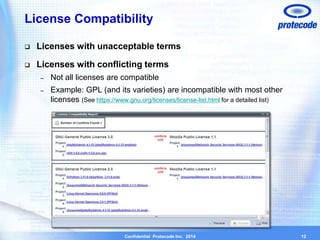
License Compatibility 
 Licenses with unacceptable terms 
 Licenses with conflicting terms 
– Not all licenses are compatible 
– Example: GPL (and its varieties) are incompatible with most other 
licenses (See https://www.gnu.org/licenses/license-list.html for a detailed list) 
Confidential Protecode Inc. 2014 
12
Copyleft vs Permissive Licenses 
Confidential Protecode Inc. 2014 
13
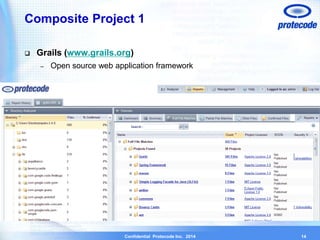
Composite Project 1 
 Grails (www.grails.org) 
– Open source web application framework 
Confidential Protecode Inc. 2014 
14
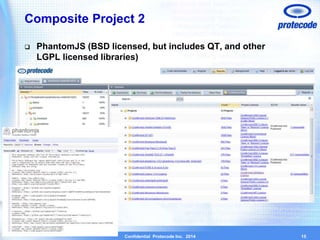
Composite Project 2 
 PhantomJS (BSD licensed, but includes QT, and other 
LGPL licensed libraries) 
Confidential Protecode Inc. 2014 
15
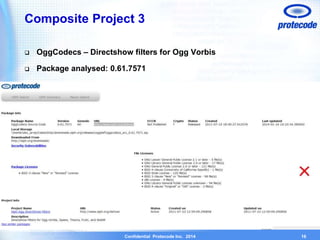
Composite Project 3 
 OggCodecs – Directshow filters for Ogg Vorbis 
 Package analysed: 0.61.7571 
Confidential Protecode Inc. 2014 
16
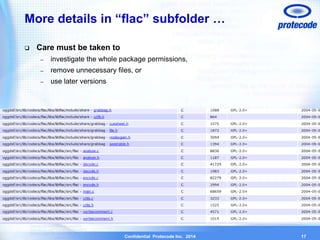
More details in “flac” subfolder … 
Confidential Protecode Inc. 2014 
 Care must be taken to 
– investigate the whole package permissions, 
– remove unnecessary files, or 
– use later versions 
17
Confidential Protecode Inc. 2014 
Wrap up 
18 
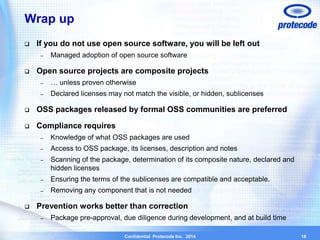
 If you do not use open source software, you will be left out 
– Managed adoption of open source software 
 Open source projects are composite projects 
– … unless proven otherwise 
– Declared licenses may not match the visible, or hidden, sublicenses 
 OSS packages released by formal OSS communities are preferred 
 Compliance requires 
– Knowledge of what OSS packages are used 
– Access to OSS package, its licenses, description and notes 
– Scanning of the package, determination of its composite nature, declared and 
hidden licenses 
– Ensuring the terms of the sublicenses are compatible and acceptable. 
– Removing any component that is not needed 
 Prevention works better than correction 
– Package pre-approval, due diligence during development, and at build time
About Protecode 
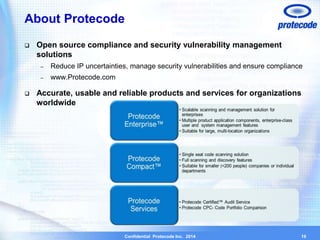
 Open source compliance and security vulnerability management 
Confidential Protecode Inc. 2014 
solutions 
– Reduce IP uncertainties, manage security vulnerabilities and ensure compliance 
– www.Protecode.com 
 Accurate, usable and reliable products and services for organizations 
worldwide 
19
Confidential Protecode Inc. 2014 
Q/A 
20
Because Code Travels 
www.protecode.com 
Confidential Protecode Inc. 2014

Licensing in Composite Projects

  • 1.
    Licensing in CompositeProjects Protecode Webinar Series December 2014 Confidential Protecode Inc. 2014 1
  • 2.
    Confidential Protecode Inc.2014 Agenda  Open Source Software Adoption and Creation  OSS Structure: Genesis vs Composite Projects  Licensing in Composite OSS Projects  Examples  Wrap-up and Q/A 2 Tiberius Forrester, Director, Solution Architecture tforrester@protecode.com
  • 3.
    OSS Market Penetration Confidential Protecode Inc. 2014  Unstoppable growth – 85% industry adoption (Gartner 2008) – 98% worldwide adoption (Accenture 2010) – 99% worldwide adoption (By 2016, Gartner)  Adoption at various levels – Organizational level – Personal level  Not a niche play – Automotive, healthcare, financial – Cloud, mobile, database, security – Gaming, tools, imaging, aerospace – Anything that includes any code! 3
  • 4.
    Open Source Software Confidential Protecode Inc. 2014  What is OSS – A software development and distribution model where software license guarantees certain freedoms – Also see OSI definition (http://opensource.org)  The value – Faster, functions, easier integration and customisation – Interoperability, adoption of open standards – No license costs – Freedom from vendor lock ins – Allows rapid development of complex software systems – Hundreds of thousands of projects available • Protecode GIPS Statistics: – 2.2M packages, – 0.5B OSS files – 20B lines of code! 4
  • 5.
    Adoption in TechnologyOrganizations  Organizations and OSS Confidential Protecode Inc. 2014 – Risk assessment • Risk of being involved vs risk of not being involved – Consideration -> Adoption -> Integral part of business  The most common factors affecting use of OSS in software projects – Concerns regarding intellectual property / licensing – Concerns regarding the security of the software – Service & support – Product capabilities/maturity – Difficulty of adoption / integration – Software quality – end user satisfaction – Software enhancements – innovation over time – Viability of the open source community 5
  • 6.
    Licensing challenges ofOSS  Produced by large number of developers over time – Bazaar model: policy of fast and frequent releases, release candidates, possibility of governance impairments  Questionable due diligence efforts of committers – Re-licensing efforts may not have been correctly handled Confidential Protecode Inc. 2014  Code may: – Contain nested packages with their own set of issues – Contain code from books or community websites – Implement patents – Implement specifications that are subject to a license – Contain code generated by a tool where the output could be a derivative of input – Contain or implement APIs that may have their own obligations 6
  • 7.
    OSS Project Communities  Provide support infrastructure – Organizational, legal and in most cases financial • Funding through membership fees Confidential Protecode Inc. 2014  Examples: – Linux Foundation – Apache Software Foundation – Eclipse Foundation – Mozilla, Openstack, Django, Internet System Consortium (BIND project), OpenLDAP, Drupal, Postgres, OpenSSL  Established processes for – Defining governance & policies – Managing collaboration, security, documentation, conflicts  Generally associated with continuous innovation, trusted licensing, peer-reviewed quality 7
  • 8.
    OSS Project Types Confidential Protecode Inc. 2014  Genesis – Homogenous licensing – Original content, no 3rd party included in packages Example: log4j  Composite – Mixed or homogenous licensing – Some original content, some 3rd party Example: Vaadin  Distributions – Mostly mixed licensing – Mostly repackaged 3rd party – Generally well structured, many packages Example: 4MLinux 8 lib
  • 9.
    Licensing in CompositeProjects Confidential Protecode Inc. 2014  Project license – A top level license, or top level document listing applicable licenses – Look for website information, LICENSE, COPYING, or README files  Subfolder licenses – Indicate sub-level OSS projects – Not always present  File licenses  Exceptions: subfolder holding binaries or libraries – Generally do not have a license document – You are on your own to determine the binary or library licenses  Beware: binaries may expand into many subcomponents – With their own (hidden or undeclared) licenses 9
  • 10.
    Licenses and Copyrightsin Headers Confidential Protecode Inc. 2014 10 Source: analysis of 0.5 Billion OSS files in Protecode GIPSTM Database
  • 11.
    Project and LicenseMixes Confidential Protecode Inc. 2014 11 Percentage of OSS packages and variety of licenses mentioned in the file headers
  • 12.
    License Compatibility Licenses with unacceptable terms  Licenses with conflicting terms – Not all licenses are compatible – Example: GPL (and its varieties) are incompatible with most other licenses (See https://www.gnu.org/licenses/license-list.html for a detailed list) Confidential Protecode Inc. 2014 12
  • 13.
    Copyleft vs PermissiveLicenses Confidential Protecode Inc. 2014 13
  • 14.
    Composite Project 1  Grails (www.grails.org) – Open source web application framework Confidential Protecode Inc. 2014 14
  • 15.
    Composite Project 2  PhantomJS (BSD licensed, but includes QT, and other LGPL licensed libraries) Confidential Protecode Inc. 2014 15
  • 16.
    Composite Project 3  OggCodecs – Directshow filters for Ogg Vorbis  Package analysed: 0.61.7571 Confidential Protecode Inc. 2014 16
  • 17.
    More details in“flac” subfolder … Confidential Protecode Inc. 2014  Care must be taken to – investigate the whole package permissions, – remove unnecessary files, or – use later versions 17
  • 18.
    Confidential Protecode Inc.2014 Wrap up 18  If you do not use open source software, you will be left out – Managed adoption of open source software  Open source projects are composite projects – … unless proven otherwise – Declared licenses may not match the visible, or hidden, sublicenses  OSS packages released by formal OSS communities are preferred  Compliance requires – Knowledge of what OSS packages are used – Access to OSS package, its licenses, description and notes – Scanning of the package, determination of its composite nature, declared and hidden licenses – Ensuring the terms of the sublicenses are compatible and acceptable. – Removing any component that is not needed  Prevention works better than correction – Package pre-approval, due diligence during development, and at build time
  • 19.
    About Protecode Open source compliance and security vulnerability management Confidential Protecode Inc. 2014 solutions – Reduce IP uncertainties, manage security vulnerabilities and ensure compliance – www.Protecode.com  Accurate, usable and reliable products and services for organizations worldwide 19
  • 20.
  • 21.
    Because Code Travels www.protecode.com Confidential Protecode Inc. 2014