THE
HEARTREVEALED
RADIOLOGY IN THE DIAGNOSIS AND
MANAGEMENT OF CARDIAC CONDITIONS
Editors: Jens Bremerich & Rodrigo Salgado
THE
HEART
REVEALED
RADIOLOGY IN THE DIAGNOSIS AND
MANAGEMENT OF CARDIAC CONDITIONS
Editors: Jens Bremerich & Rodrigo Salgado
Table of Contents 5
THE HEART REVEALED RADIOLOGY IN THE DIAGNOSIS AND MANAGEMENT OF CARDIAC CONDITIONS
INTERNATIONAL
DAY OF
RADIOLOGYAN INITIATIVE OF THE ESR, ACR AND RSNA
Published by
The European Society of Radiology (ESR)
October 2018
In cooperation with
The European Society of Cardiovascular Radiology
Editors:
Jens Bremerich & Rodrigo Salgado
Managing Editor:
Julia Patuzzi
Art Direction & Layout:
trafikant – Handel mit Gestaltung, Ronald Talasz
Coordination:
ESR Office, Am Gestade 1, 1010 Vienna, Austria
Phone: (+ 43 1) 533 40 64-0
E-Mail: communications@myESR.org
www.myESR.org
Photo Credits:
Unless otherwise indicated, all images are used by courtesy of the authors of the
respective chapters. Authors’ portraits provided by themselves.
ISBN: 978-3-9504388-5-7
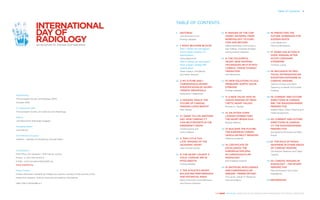
TABLE OF CONTENTS
6	EDITORIAL
Jens Bremerich and
Rodrigo Salgado
10	 1: BASIC BUILDING BLOCKS
	 Part I: What can we expect
from a basic ­cardiac CT
examination
Gorka Bastarrika
	 Part II: What can we expect
from a basic ­cardiac MR
examination
Farah Cadour, Axel Bartoli
and Alexis Jacquier
30	 2: MY FUTURE AND I:
­CARDIOVASCULAR RISK
STRATIFICATION OF ASYMP-
TOMATIC ­INDIVIDUALS
Rozemarijn Vliegenthart
38	 3: IMAGING TRIALS: THE
FUTURE OF CARDIAC
­IMAGING LOOKS BRIGHT
Marc Dewey
46	 4: I WANT TO LIVE ANOTHER
DAY: HOW CARDIAC CT
CAN HELP PATIENTS IN THE
EMERGENCY ROOM
Harold Goerne and
Suhny Abbara
58	 5: TOO LITTLE TOO
LATE: IMAGING OF THE
­ISCHAEMIC HEART
Jean-Nicolas Dacher
64	 6: THE HEART CAUGHT A
COLD: CARDIAC MRI IN
MYOCARDITIS
Charles Peebles
72	 7: THE ATHLETE’S HEART:
BALANCING PERFORMANCE
AND POTENTIAL RISKS
Marco Francone, Anna Palmisano
and Antonio Esposito
84	 8: IMAGING OF THE COR-
ONARY ARTERIES: FROM
MORPHOLOGY TO FUNC-
TION AND BEYOND
Fabian Bamberg, Corinna Storz,
Ilias Tsiflikas, Christoph Schabel
and Konstantin Nikolaou
94	 9: THE COLOURFUL
HEART: NEW MAPPING
­TECHNIQUES HELP IN MYO-
CARDIAL TISSUE CHARAC-
TERISATION
Jens Bremerich
102	10: NEW SOLUTIONS TO OLD
PROBLEMS: AORTIC VALVE
STENOSIS
Rodrigo Salgado
112	 11: A NEW VALVE: NON-IN-
VASIVE IMAGING OF PROS-
THETIC HEART VALVES
Ricardo P.J. Budde
118	 12: AN OFTEN-OVER-
LOOKED CONNECTION:
THE HEART-BRAIN AXIS
Birgitta Velthuis
126	13: BUILDING THE FUTURE:
THE EUROPEAN CARDIO-
VASCULAR MR/CT REGISTRY
Matthias Gutberlet
138	14: CERTIFICATE OF
­EXCELLENCE: THE
­EUROPEAN DIPLOMA
IN CARDIOVASCULAR
­RADIOLOGY
Karl-Friedrich Kreitner
146	15: ARTIFICIAL INTELLIGENCE
AND CARDIOVASCULAR
­DISEASE – FRIEND OR FOE?
Tim Leiner, Jelmer M. Wolterink
and Ivana Išgum
156	16: PREDICTING THE
FUTURE: SCREENING FOR
SUDDEN DEATH
Luigi Natale and
Veronica Bordonaro
170	17: WHEN THE ACTION IS
OVER: IMAGING AFTER
ACUTE CORONARY
­SYNDROME
Christian Loewe
178	18: INFLUENCE OF PRO-
TOCOL OPTIMISATION ON
RADIATION EXPOSURE IN
CARDIAC IMAGING
Valentin Sinitsyn and Maria
Glazkova, on behalf of EuroSafe
Imaging
188	19: CURRENT AND FUTURE
DIRECTIONS IN CARDIAC
MRI: THE RADIOGRAPHERS’
PERSPECTIVE
Aideen Fallon, Alison Fletcher and
Vasilis Syrgiamiotis
198	20: CURRENT AND FUTURE
DIRECTIONS IN CARDIAC
CT: THE RADIOGRAPHERS’
PERSPECTIVE
Konstantinos Michalos and Helle
Precht
208	21: THE ROLE OF RADIO­
GRAPHERS IN OTHER AREAS
OF CARDIAC IMAGING
Christopher Steelman and Diego
Catania
218	22: CARDIAC IMAGING IN
RADIOLOGY – THE EFOMP
PERSPECTIVE
Mika Kortesniemi and Touko
Kaasalainen
228	REFERENCES
Editorial 76 Editorial 
THE HEART REVEALED RADIOLOGY IN THE DIAGNOSIS AND MANAGEMENT OF CARDIAC CONDITIONSTHE HEART REVEALED RADIOLOGY IN THE DIAGNOSIS AND MANAGEMENT OF CARDIAC CONDITIONS
Considering the rise in risk factors such as
obesity and arterial hypertension, together
with the increasingly ageing Western
population, it is evident that cardiac and
cardiovascular disease will remain at the
forefront of the global healthcare agenda
for the foreseeable future. Several trials
and registries are currently running to
provide better insights through imaging
(chapters 3, 13).
Nevertheless, the progress that has been
made in the last 50 years is nothing short
of astonishing. Procedures like heart trans-
plants, complex valvular interventions
and treatment of coronary artery disease
have, among others, made such spectac-
ular advances that they are now routinely
performed in specialised centres all over the
world. However, timely detection of disease,
correct evaluation of its extension, and the
outlining of possible treatment options still
predicate the eventual success of many pro-
cedures. It is here that cardiac imaging plays
an often-pivotal role, guiding the referring
physician to the best possible patient out-
come. For the cardiac radiologist, computed
tomography (CT) and magnetic resonance
imaging (MRI) are the main tools for non-in-
vasive cardiac imaging (chapter 1).
While there has been continuous develop-
ment of imaging techniques in other sub-
specialties, the progress made during the
last decade in non-invasive cardiac imaging
stands out among other achievements.
Today, we can routinely and safely inves-
tigate potential coronary artery disease in
patients; earlier, classic invasive angiog-
raphy was the only available method for
direct coronary artery visualisation (chapter
8). Our understanding of risk stratification
and prognosis prediction, even in asymp-
tomatic patients, using simple tools like
the non-invasive quantification of coronary
calcium is developing significantly as the
results of large trials come in (chapter 2).
The integration of CT during the triage of
patients with acute chest pain has proven
beneficial, resulting in quicker and safer
discharge of patients in selected cases
(chapter 4).
Beyond coronary arteries, MR imaging
today provides valuable information for
correctly characterising myocardial tissue,
as such helping the clinician with, among
other things, the evaluation of athlete’s
heart, infectious/inflammatory disease,
prevention of sudden death, and the evalu-
ation of ischaemic heart disease (chapters
5–7, 16–17). Also, this book will shed more
light on, what may at first glance appear as,
unsuspected connections like the heart-
brain axis (chapter 12).
Radiology has always been one of the first
specialties to incorporate new technologies
to achieve better results. New tissue map-
ping MRI techniques, evolving application
like pre- and post-procedural evaluation
of prosthetic heart valves, and of course
the introduction of artificial intelligence as
diagnostic tool will be addressed (chapters
9–11, 15).
Finally, since there is no ‘I’ in a team, several
chapters further explain insights from and
the important role of radiographers and
medical physicists, who form an essential
part of every radiology department (chap-
ters 18–21).
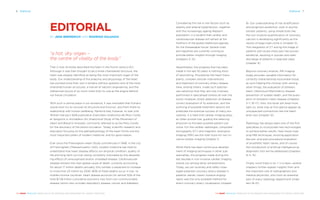
EDITORIAL	
BY JENS BREMERICH AND RODRIGO SALGADO
“a hot, dry organ –
the centre of vitality of the body”
That is how Aristotle described the heart in the fourth century B.C.
Although it was then thought to be a three-chambered structure, the
heart was already identified as being the most important organ of the
body. Our understanding of the anatomy and physiology of the heart
has evolved since then, but it remains without question one of the most
cherished human structures, a marvel of nature’s engineering, and the
referenced source of so much more than its role as the engine behind
our blood circulation.
With such a central place in our existence, it was inevitable that humans
would soon try to uncover its structure and function, and from there its
relationship with human wellbeing. Mankind had, however, to wait until
William Harvey’s 1628 publication Exercitatio Anatomica de Motu Cordis
et Sanguinis in Animalibus (An Anatomical Study of the Movement of
Heart and Blood in Animals), commonly referred to as De Motu Cordis,
for the discovery of the blood circulation. Today, scientific research and
education focusing on the pathophysiology of the heart forms one the
most important pillars of modern medicine, and for good reason.
Ever since the Framingham Heart Study commenced in 1948, in the city
of Framingham (Massachusetts, USA), modern medicine has tried to
understand how heart disease affects our physical condition, quality of
life and long-term survival, being constantly motivated by the devastat-
ing effects of unrecognised and/or untreated disease. Cardiovascular
disease remains the main global cause of death, currently accounting
for about 17 million deaths annually; this number is expected to increase
to more than 23 million by 2030. 80% of these deaths occur in low- to
middle-income countries. Heart disease accounts for almost 52% of the
total $7.28 trillion cumulative economic loss from non-communicable
disease (which also includes respiratory disease, cancer and diabetes).
8 Editorial 
THE HEART REVEALED RADIOLOGY IN THE DIAGNOSIS AND MANAGEMENT OF CARDIAC CONDITIONS
The European Society of Cardiovascular
Radiology (ESCR) is, as always, devoted to
promoting cardiac radiology and assuring
the high-quality performance of our mem-
bers through accreditation (chapter 14).
With this book, together with the European
Society of Radiology (ESR), we thank you
for your interest in the International Day of
Radiology 2018, and we hope that you enjoy
reading this publication.
Further reading:
	 Laslett LJ et al. The Worldwide Environment of Cardi-
ovascular Disease: Prevalence, Diagnosis, Therapy, and
Policy Issues: A Report From the American College
of Cardiology. J Am Coll Cardiol. 2012 Dec 25;60(25
Suppl):S1-49. doi: 10.1016/j.jacc.2012.11.00.
	 World Health Organization. Cardiovascular Disease:
Global Atlas on Cardiovascular Disease Prevention and
Control. WHO, Geneva, Switzerland (2012).
	 S.C. Smith Jr et al. Our time: a call to save preventable
death from cardiovascular disease (heart disease and
stroke). J Am Coll Cardiol, 60 (2012), pp. 2343-2348.
	 GHSi. Shifting paradigm: how the BRICS are
reshaping global health and development 2012.
http://www.ghsinitiatives.org/brics-report
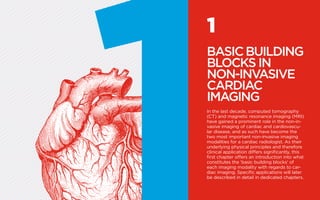
1
BASICBUILDING
BLOCKS IN
NON-INVASIVE
CARDIAC
IMAGING
In the last decade, computed tomography
(CT) and magnetic resonance imaging (MRI)
have gained a prominent role in the non-in-
vasive imaging of cardiac and cardiovascu-
lar disease, and as such have become the
two most important non-invasive imaging
modalities for a cardiac radiologist. As their
underlying physical principles and therefore
clinical application differs significantly, this
first chapter offers an introduction into what
constitutes the ‘basic building blocks’ of
each imaging modality with regards to car-
diac imaging. Specific applications will later
be described in detail in dedicated chapters.
Chapter 1 | BASIC BUILDING BLOCKS IN NON-INVASIVE CARDIAC IMAGING 13
THE HEART REVEALED RADIOLOGY IN THE DIAGNOSIS AND MANAGEMENT OF CARDIAC CONDITIONS
BASIC ASPECTS OF
CARDIAC CT
Adequate patient selection and preparation
are mandatory factors to obtain optimal
image quality cardiac CT examinations3
.
From a clinical perspective, CCTA is currently
mostly indicated in symptomatic patients
with a low to intermediate risk of CAD (Fig-
ure 1). There are some contraindications to
cardiac CT. These include renal insufficiency,
a known history of severe contrast reaction,
clinical instability and pregnancy. Other
patient-related variables that may also affect
the diagnostic accuracy of the test include
morbid obesity, an inability to collaborate
with breath-hold instructions and/or scan
acquisition, heart rate variability and arrhyth-
mia, and contraindications to beta-blocker
medication or nitrates.
Even if more recently developed CT systems
allow for the scanning of patients with high
and irregular heart rates, slow heart rates are
preferred for cardiac CT imaging, not just
because of the improved image quality. This
approach also allows significant dose savings
by applying sequential or even single heart-
beat CCTA acquisition techniques (Figure 2).
In general, beta-blocker premedication is
used to lower the heart rate below 60 beats
per minute. Among different drugs, meto-
prolol has become the standard. In subjects
weighing less than 80 kg an initial dose of 50
mg of metoprolol is administered, whereas
for heavier subjects, 100 mg of metoprolol is
administered one hour before the examina-
tion4
. If the heart rate remains high, additional
metoprolol may be given intravenously. An
alternative approach to oral premedication
BASIC BUILDING BLOCKS IN
NON-INVASIVE CARDIAC IMAGING
Part I:
WHAT CAN WE
EXPECT FROM A
BASIC ­CARDIAC CT
EXAMINATION
BY GORKA BASTARRIKA
WHY CARDIAC CT?
Cardiovascular disease (CVD), and in particular coronary artery
disease (CAD), is the leading cause of morbidity and mortality in
developed countries. According to the European cardiovascular
disease statistics in 2017, it is estimated that CVD causes 3.9 million
deaths in Europe each year and accounts for 45% of all deaths in
Europe1
. Conventional coronary angiography is the gold standard
to image the coronary vasculature and to assess the presence and
severity of CAD. However, this technique is not without complica-
tions. It is estimated that coronary catheterisation causes major
complications in 1.3% of cases and has a 0.05% in-lab mortality
rate2
.
Advances in cardiac computed tomography (CT) and significant
improvements in spatial and temporal resolution have allowed for
accurate and rapid, yet non-invasive evaluation of the coronary
vasculature. In particular, since the advent of 64-row multidetector
computed tomography scanners, coronary CT angiography (CCTA)
holds the key to replacing diagnostic cardiac catheterisation in vari-
ous clinical scenarios.
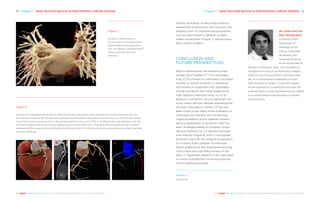
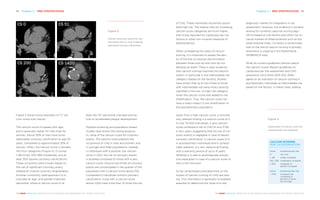
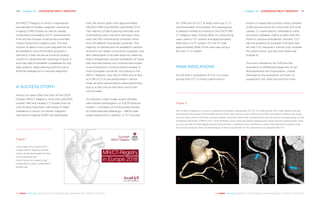
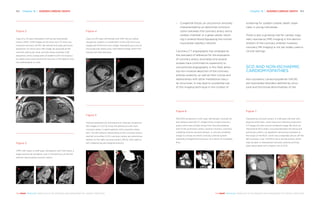
Figure 1
Coronary CT angiography per-
formed on a 58-year-old man
with atypical chest pain. (A)
3D-cinematic rendering. Curved
planar reformats of the right
coronary artery (B), left circum-
flex coronary artery (C), and left
anterior descending coronary
artery (D). The study showed mild
luminal irregularities and allowed to
exclude significant coronary artery
stenosis.
A
B C D
Chapter 1 | BASIC BUILDING BLOCKS IN NON-INVASIVE CARDIAC IMAGING 15
THE HEART REVEALED RADIOLOGY IN THE DIAGNOSIS AND MANAGEMENT OF CARDIAC CONDITIONS
14 Chapter 1 | BASIC BUILDING BLOCKS IN NON-INVASIVE CARDIAC IMAGING
THE HEART REVEALED RADIOLOGY IN THE DIAGNOSIS AND MANAGEMENT OF CARDIAC CONDITIONS
unnecessary conventional coronary angio­
graphy procedures9
.
Initial recommendations for when the use
of CT in cardiac imaging was considered
appropriate were endorsed by American
and European cardiac and cardiac imaging
societies10, 11
, noting that, in general, cardiac
CT should be performed in symptomatic
subjects, especially if the symptoms, age and
sex were suggestive of a low or intermediate
probability of suffering significant coronary
stenosis.
Most recent recommendations extend the
appropriate use of cardiac CT to different
clinical scenarios, confirming the previously
established indications and increasing their
number12
. In the field of detection of CAD in
symptomatic patients without known heart
disease, CCTA is appropriate in patients with
interpretable ECG, who are able to exercise
and who are presenting with an intermediate
pre-test probability of CAD. Similarly, it is
appropriate in individuals with uninterpret-
able ECG or who are unable to exercise and
have low or intermediate pre-test probabil-
ity of CAD (Figure 3). In patients with acute
symptoms, CCTA is appropriate in cases of
normal ECG and cardiac biomarkers and
low or intermediate pre-test probability of
CAD, and in patients with uninterpretable
ECG or non-diagnostic or equivocal cardiac
biomarkers and low or intermediate pre-test
is the intravenous administration of the drug,
usually starting with 5 mg. In patients with
contraindications to beta-blockers, short-act-
ing calcium channel blockers or ivabradine
may be viable alternatives. The use of nitrates
(400–800 mg of sublingual nitro-glycer-
ine) just before the CT examination is also
highly recommended in the absence of
contraindications, so as to achieve coronary
vasodilatation4
.
Cardiac CT should only be performed in
cases where the results have the potential to
influence patient management or prognosis5
.
Thus, besides the clinical benefit, radiation
exposure should also be considered when
ordering the test and carrying out the exam-
ination. From a technical perspective, the
radiation dose should be kept to a minimum
and all available strategies to avoid the use
of unnecessary radiation should be applied.
These include tailoring the tube voltage6
and
tube current7
to patient habitus and using
automated radiation exposure control tech-
niques (i.e. ECG-based tube current modu-
lation), limiting the scan range to the clinical
indication, and using the optimal cardiac
ECG-gating technique for each case (ret-
rospective, prospective or single-heartbeat
acquisition)8
.
CARDIAC CT IN THE
CLINICAL SETTING
The clinical indications of cardiac CT are
predominantly based on its high neg-
ative predictive value. CCTA allows for
CAD to be ruled out with great certainty
in symptomatic individuals, thus avoiding
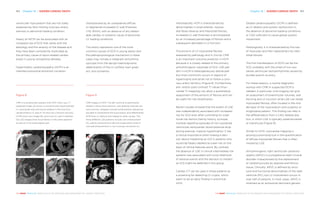
Figure 2
Coronary CT angiography per-
formed using single-heartbeat
high-pitch spiral acquisition in a
46-year-old woman with atypical
chest pain and shortness of breath.
(A) 3D-cinematic rendering. Curved
planar reformats of the right
coronary artery (B), left anterior
descending coronary artery (C),
and left circumflex coronary artery
(D). The study allowed for the
exclusion of significant coronary
artery disease. A radiation dose
of 0.65 mSv was employed in this
study.
A
B C D
A
B C D
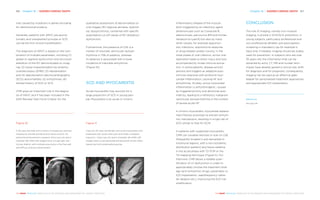
Figure 3
Coronary CT angiography performed on a 57-year-old
man with atypical chest pain and intermediate pre-test
probability of CAD. (A) 3D-cinematic rendering. Curved
planar reformats of the right coronary artery (B), left
anterior descending coronary artery (C), and left circum-
flex coronary artery (D). The study showed scattered cal-
cified and non-calcified plaques (arrows) predominantly
involving the left anterior descending and left circumflex
coronary arteries. The study allowed ruling out significant
coronary artery stenosis.
Chapter 1 | BASIC BUILDING BLOCKS IN NON-INVASIVE CARDIAC IMAGING 17
THE HEART REVEALED RADIOLOGY IN THE DIAGNOSIS AND MANAGEMENT OF CARDIAC CONDITIONS
16 Chapter 1 | BASIC BUILDING BLOCKS IN NON-INVASIVE CARDIAC IMAGING
THE HEART REVEALED RADIOLOGY IN THE DIAGNOSIS AND MANAGEMENT OF CARDIAC CONDITIONS
probability of CAD. Non-contrast cardiac CT
performed to quantify coronary artery calcifi-
cation is appropriate to detect CAD and to
assess risk in asymptomatic patients with a
family history of premature coronary heart
disease and in individuals with no known
CAD and intermediate global coronary heart
disease risk.
CCTA is also encouraged to detect CAD in
other clinical scenarios, such as newly diag-
nosed or newly established clinical heart
failure in patients without known coronary
disease and low or intermediate pre-test
probability of CAD, and in the preoperative
evaluation of the coronary arteries in patients
with intermediate pre-test probability of CAD
undergoing non-coronary cardiac surgery.
After prior test results, CCTA should be
performed when exercise ECG and imaging
results are discordant, when stress imaging
results are equivocal or in cases with normal
previous stress imaging results and new or
worsening clinical symptoms. In the clinical
scenario of risk assessment after surgical
or percutaneous coronary revascularisa-
tion, CCTA is considered appropriate in the
evaluation of graft patency after CABG in
symptomatic patients (Figure 4), and in the
assessment of prior left main coronary stent
with stent diameter ≥3 mm (Figure 5).
Finally, CCTA is considered appropriate in
the assessment of coronary anomalies and
complex adult congenital heart disease, in
the evaluation of left ventricular function fol-
lowing acute myocardial infarction or in heart
failure patients when inadequate images
have been obtained from other non-invasive
methods, in the assessment of morphology
and quantification of right ventricular func-
tion, in the characterisation of native and
prosthetic cardiac valves in cases of clinical
suspicion of significant valvular dysfunc-
tion with non-diagnostic images from other
techniques (Figure 6), and in other clinical
scenarios, such as the evaluation of cardiac
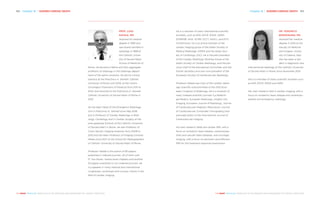
Figure 4
Coronary CT angiography performed on a 69-year-old man
with chest pain and prior history of coronary artery bypass
surgery. (A) 3D-cinematic rendering. (B) Colour-coded per-
fusion map of the left ventricle in the three-chamber view.
(C) Colour-coded perfusion map of the left ventricle in the
short axis view. (D) 3D-volume rendered perfusion recon-
struction. The study revealed occlusion of the saphenous
vein to left anterior descending coronary artery graft (arrow
in A). Myocardial perfusion images demonstrated hypoper-
fusion of the mid and apical inferolateral segments (arrow in
B) and the apical anterior segment (arrow in C) in keeping
with prior myocardial infarction. The patient also had a left
apical thrombus (*). Volume rendered images nicely showed
the perfusion deficit (arrowheads in D).
Figure 5
Coronary CT angiography
performed on a 64-year-old
asymptomatic patient with prior
stent implantation in the left main
coronary artery. (A) Cross-sectional
image of the left main coronary
artery. (B) Para-sagittal view of
the left main coronary artery. (C)
Oblique axial view of the left main
coronary artery. (D) 3D-volume
rendered image. The stent was pat-
ent (arrows) and only showed mild
intimal hyperplasia causing less than
25% coronary stenosis (arrowhead).
A
B
C
D
A C
B
D
Figure 6
CT angiography of the aorta per-
formed on a 37-year-old man. (A)
3D-cinematic rendering. (B) Multi-
planar reformat of the aortic valve.
The study revealed mild dilation of
the ascending aorta and a bicuspid
aortic valve (arrow in B). Incidentally,
a coronary anomaly consisting of
abnormal origin of the right coronary
artery from almost the sinotubular
junction was also noted (arrowhead).
A B
Chapter 1 | BASIC BUILDING BLOCKS IN NON-INVASIVE CARDIAC IMAGING 19
THE HEART REVEALED RADIOLOGY IN THE DIAGNOSIS AND MANAGEMENT OF CARDIAC CONDITIONS
18 Chapter 1 | BASIC BUILDING BLOCKS IN NON-INVASIVE CARDIAC IMAGING
THE HEART REVEALED RADIOLOGY IN THE DIAGNOSIS AND MANAGEMENT OF CARDIAC CONDITIONS
Figure 8
Coronary CT angiography performed on a 56-year-old man with atypical chest pain and prior inconclusive stress test. (A)
3D-cinematic rendering. (B) Curved planar reformat of the left anterior descending coronary artery. (C) 3D-cinematic render-
ing of the coronary vasculature. (D) CT-derived fractional flow reserve (CT-FFR). A 70–99% stenosis was depicted in the mid
left anterior descending coronary artery segment (arrows) (CAD-RADS 4A). CT-derived FFR value obtained with a research
prototype (ctFFR, syngo.via Frontier, Siemens Healthineers) was 0.71, reflecting that the coronary stenosis was likely haemody-
namically significant.
Figure 7
Cardiac CT performed on a
74-year-old man with paroxysmal
atrial fibrillation requiring pulmo-
nary vein ablation. Normal anatomy
of the pulmonary veins was
observed.
masses, evaluation of pericardial anatomy,
assessment of pulmonary and coronary vein
anatomy prior to interventional procedures,
such as radiofrequency ablation or pace-
maker implantation (Figure 7), and previous
redo cardiac surgery12
.
CONCLUSION AND
FUTURE PERSPECTIVES
Recent development has allowed a wide-
spread use of cardiac CT. From the begin-
ning, CCTA showed its usefulness in a certain
number of clinical scenarios in individuals
with known or suspected CAD. Nowadays,
clinical indications are mostly based on its
high negative predictive value, i.e. on its
ability to confidently rule out significant cor-
onary artery stenosis. Besides evaluating the
coronary vasculature, cardiac CT has also
been shown to be useful in the evaluation of
cardiovascular anatomy and morphology.
Ongoing research points towards compre-
hensive assessment of ischaemic heart dis-
ease. Strategies based on complex compu-
tational methods (i.e. CT-derived fractional
flow reserve) (Figure 8) and CT myocardial
perfusion may fulfil this integrative approach
to coronary artery disease. Furthermore,
recent publications also emphasise the prog-
nostic value and cost-effectiveness of car-
diac CT. Significant research is still warranted
to further evaluate the full clinical potential
of this imaging technique.
References
See page 229
A B C D
DR. GORKA BASTAR-
RIKA, MD,PHD,EBCR
is Director of the
Department of
Radiology of the
Clínica Universidad
de Navarra, and
Associate Professor
at the Universidad de
Navarra in Pamplona, Spain. He is President of
the Spanish Society of Cardiothoracic Imaging
(SEICAT) and ECR and ESCR committee mem-
ber. As a cardiothoracic radiologist, his main
field of interest is cardiac CT and MR imaging.
He has authored or co-authored more than 130
scientific papers in peer-reviewed journals, edited
or co-edited three books and given numerous
invited lectures.
Chapter 1 | BASIC BUILDING BLOCKS IN NON-INVASIVE CARDIAC IMAGING 21
THE HEART REVEALED RADIOLOGY IN THE DIAGNOSIS AND MANAGEMENT OF CARDIAC CONDITIONS
contraction. In clinical practice, all
sequences could be useful to detect ana-
tomical abnormalities. However, anatom-
ical parameters are particularly crucial in
defining thoracic aorta aneurysm and the
indications to treat thoracic aorta aneu-
rysm are based on anatomical measure-
ments. To assess the ascending aortic
anatomy, 3D bright blood free breathing
steady state free precession sequences
yield multiplanar reconstructions.
Ascending aortic aneurysm measure-
ments should be taken perpendicular to
the vessel of interest. The largest diame-
ter perpendicular to the great axis is con-
sidered as the reference diameter (Figure
1). Exploration of the ascending aorta
should include exploration of the aortic
valve in particular to detect constitutional
abnormalities such as bicuspid valves or
valvular regurgitation or stenosis.
MR FUNCTIONAL
ASSESSMENT
Left ventricular (LV) volumes and mass
assessment are well-known markers of
LV systolic function. Steady state free
precession (SSFP) sequences are the
gold standard for assessing chamber
volume and mass. SSFP sequences
require k-space sampling over several
heartbeats and must be performed with
short breath holds (usually from 8–12
seconds). SSFP sequences have a high
signal to noise ratio and provide a T2/T1
BASIC BUILDING BLOCKS IN
NON-INVASIVE CARDIAC IMAGING
Part II:
WHAT CAN WE
EXPECT FROM A
BASIC ­CARDIAC
MR EXAMINATION
BY FARAH CADOUR, AXEL BARTOLI AND ALEXIS JACQUIER
WHY CARDIAC MR?
With technical progress, cardiac magnetic resonance (CMR) imaging has
become part of mainstream cardiology imaging practice. The develop-
ment of increasing magnetic field strengths and surface coil channels,
rapid k-space sampling, postprocessing techniques, and sophisticated
sequences for myocardial characterisation have made cardiac MR a pow-
erful tool in the workup of many complex cardiac disorders. Consensus
statements from several international cardiac associations include car-
diac MR as a primary imaging technique. In this chapter, we will outline
the CMR biomarkers assessable in clinical practice that give an optimal
evaluation of anatomy, function, perfusion, flow, and tissue characterisa-
tion. This chapter will also provide an overview of the CMR capabilities in
cardiac imaging, but it does not intend to be exhaustive.
BASIC MR ANATOMY EVALUATION
All cardiac imaging sequences are acquired using electrocardio-
graphic gating to overcome image-blurring secondary to cardiac
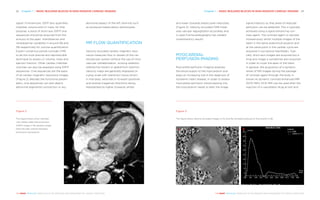
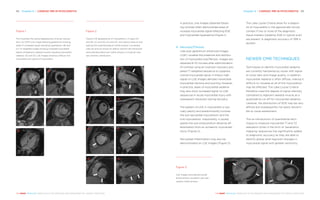
Figure 1
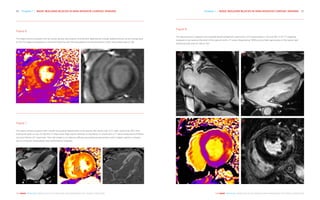
This figure shows an example of a 3D bright blood sequence (free breathing, 6 min acquisition time). (A) A native image of the
3D stack is displayed. (B) shows a reconstructed view perpendicular to the great axis of the aortic root. Note that the aortic
valve is bicuspid without raphe. A 3D volume rendering of the ascending aorta is displayed in (C).
A B C
Chapter 1 | BASIC BUILDING BLOCKS IN NON-INVASIVE CARDIAC IMAGING 23
THE HEART REVEALED RADIOLOGY IN THE DIAGNOSIS AND MANAGEMENT OF CARDIAC CONDITIONS
22 Chapter 1 | BASIC BUILDING BLOCKS IN NON-INVASIVE CARDIAC IMAGING
THE HEART REVEALED RADIOLOGY IN THE DIAGNOSIS AND MANAGEMENT OF CARDIAC CONDITIONS
signal. Furthermore, SSFP also quantifies
chamber volume and LV mass; for that
purpose, a stack of short-axis SSFP cine
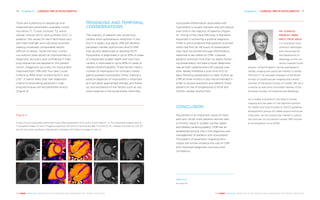
sequences should be acquired from the
annulus to the apex. Interobserver and
intraobserver variability is around 5% and
3% respectively for volume quantification.
Expert consensus panels consider CMR
to be the most precise and reproducible
technique to assess LV volume, mass and
ejection fraction. Other cardiac chamber
volumes can also be assessed using SSFP
sequences. Cine sequences are the basis

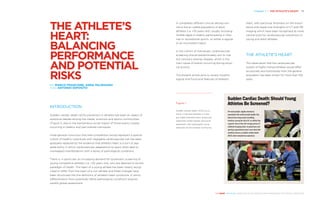
of all cardiac magnetic resonance images
(Figure 2). Besides the functional param-
eters, cine sequences can also depict
abnormal segmental contraction or any
abnormal aspect of the left ventricle such
as excessive trabeculation phenotypes.
MR FLOW QUANTIFICATION
Velocity-encoded cardiac magnetic reso-
nance measures flow in vessels of the car-
diovascular system without the use of intra-
vascular catheterisation, ionising radiation
radioactive tracers or gadolinium injection.
Velocity maps are generally displayed on
a grey scale with stationary tissue shown
in mid-grey, velocities in forward (positive)
and reverse (negative) directions being
represented as higher (towards white)
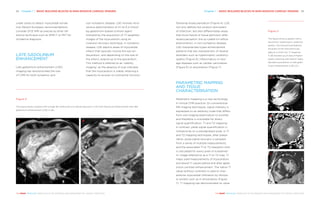
Figure 2
This figure shows a four chamber
view steady state free precession
(SSFP) image in the diastolic phase.
Note the high contrast between
blood and myocardium.
Figure 3
This figure shows velocity-encoded images in (A) and the corresponding aortic flow profile in (B).
A B
and lower (towards black) pixel intensities
(Figure 3). Velocity-encoded CMR meas-
ures valvular regurgitation accurately and
is used if echocardiography has yielded
unsatisfactory results.
MYOCARDIAL
PERFUSION IMAGING
Myocardial perfusion imaging assesses
the blood supply to the myocardium and
plays an increasing role in the diagnosis of
ischaemic heart disease. In order to assess
myocardial perfusion, blood passing into
the myocardium needs to alter the image
signal intensity so that areas of reduced
perfusion can be detected. This is typically
achieved using a signal enhancing con-
trast agent. The contrast agent is injected
intravenously whilst multiple images of the
heart in the same anatomical position and
at the same point in the cardiac cycle are
acquired in successive heartbeats. Typi-
cally, short-axis images are acquired but a
long axis image is sometimes also acquired
in order to cover the apex of the heart.
In general, the acquisition of a dynamic
series of MR images during the passage
of contrast agent through the body is
known as dynamic contrast-enhanced MRI
(DCE-MRI). DCE-MRI can be used after the
injection of a vasodilator drug at rest and
Chapter 1 | BASIC BUILDING BLOCKS IN NON-INVASIVE CARDIAC IMAGING 25
THE HEART REVEALED RADIOLOGY IN THE DIAGNOSIS AND MANAGEMENT OF CARDIAC CONDITIONS
24 Chapter 1 | BASIC BUILDING BLOCKS IN NON-INVASIVE CARDIAC IMAGING
THE HEART REVEALED RADIOLOGY IN THE DIAGNOSIS AND MANAGEMENT OF CARDIAC CONDITIONS
under stress to detect myocardial ischae-
mia. Recent European recommendations
consider DCE-MRI as precise as other ref-
erence technique such as SPECT or PET for
ischaemia diagnosis.
LATE GADOLINIUM
ENHANCEMENT
Late gadolinium enhancement (LGE)
imaging has revolutionised the role
of CMR for both ischaemic and
non-ischaemic disease. LGE involves intra-
venous administration of 0.1 to 0.2 mmol/
kg gadolinium-based contrast agent
followed by the acquisition of T1 weighted
images of the myocardium using an
inversion recovery technique. In ischaemic
disease, LGE depicts areas of myocardial
infarct that typically involve the sub-en-
docardium, and depending on the size of
the infarct, extend up to the epicardium.
This method is referred to as ‘viability
imaging’, as the absence of scar indicates
that the myocardium is viable, retaining a
capacity to recover its contractile function
Figure 4
This figure shows a patient with a huge left ventricular (LV) apical aneurysm in (A) with transmural enhancement after late
­gadolinium enhancement (LGE) in (B).
Figure 5
This figure shows a patient with a
sarcomeric hypertrophic cardiomy-
opathy. The maximal end diastolic
thickness of the interventricular
septum is 21mm (A). T1 mapping
in (B) showed up an area of higher
signal, matching with area of highly
fibrosed myocardium on late gado-
linium enhancement (LGE) (C).
A
A
B
C
B
following revascularisation (Figure 4). LGE
not only defines the location and extent
of infarction, but also differentiates areas
that show failure of tissue perfusion after
revascularisation, the so-called no-reflow
phenomenon. In non-ischaemic disease,
LGE characterises hyper-enhancement
patterns that are characteristic of several
disorders such as hypertrophic cardiomy-
opathy (Figure 5), inflammatory or stor-
age diseases such as cardiac sarcoidosis
(Figure 6) or amyloidosis (Figure 7).
PARAMETRIC MAPPING
AND TISSUE
CHARACTERISATION
Parametric mapping is a new technology
in clinical CMR practice. On conventional
MR imaging techniques, signal intensity is
expressed on an arbitrary scale that differs
from one imaging examination to another
and therefore is unsuitable for direct
signal quantification. T1 and T2 mapping,
in contrast, yields signal quantification in
milliseconds on a standardised scale. In T1
and T2 mapping techniques, after prepa-
ration, pulse signal recovery is sampled
from a series of multiple measurements,
and the associated T1 or T2 relaxation time
is calculated for every pixel of a paramet-
ric image referred to as a T1 or T2 map. T1
maps yield measurements of myocardium
and blood T1 values before and after gado-
linium contrast enhancement. The native T1
value (without contrast) is used to char-
acterise myocardial infiltration by fibrosis
or protein such as in amyloidosis (Figure
7). T1 mapping has demonstrated its value
Chapter 1 | BASIC BUILDING BLOCKS IN NON-INVASIVE CARDIAC IMAGING 27
THE HEART REVEALED RADIOLOGY IN THE DIAGNOSIS AND MANAGEMENT OF CARDIAC CONDITIONS
26 Chapter 1 | BASIC BUILDING BLOCKS IN NON-INVASIVE CARDIAC IMAGING
THE HEART REVEALED RADIOLOGY IN THE DIAGNOSIS AND MANAGEMENT OF CARDIAC CONDITIONS
Figure 7
This figure shows a patient with overall myocardial hypertrophy involving the left ventricular (LV), right ventricular (RV) and
both atrial walls on (A). On (B) the T1 map shows high signal intensity of the entire LV whole with a T1 value measured at 1542ms
(normal 1150ms (3T machine)). The LGE image in (C) depicts diffuse myocardial enhancement with a higher signal in compari-
son to LV blood. Amyloidosis was confirmed on biopsies.
Figure 8
This figure shows a patient with a global disseminated left ventricular (LV) hypertrophy in (A) and (B). In (C) T1 mapping
revealed a low value at the level of the septum with a T1 value measured at 798ms and a high signal area on the lateral wall
matching with area of LGE on (D).
A B C
A
C
B
D
Figure 6
This figure shows a patient with an acute cardiac sarcoidosis involvement depicted by a large oedema shown as an orange area
on the T2 mapping sequence in (A) and matching with the late gadolinium enhancement (LGE) myocardial area on (B).
A B
Chapter 1 | BASIC BUILDING BLOCKS IN NON-INVASIVE CARDIAC IMAGING 29
THE HEART REVEALED RADIOLOGY IN THE DIAGNOSIS AND MANAGEMENT OF CARDIAC CONDITIONS
28 Chapter 1 | BASIC BUILDING BLOCKS IN NON-INVASIVE CARDIAC IMAGING
THE HEART REVEALED RADIOLOGY IN THE DIAGNOSIS AND MANAGEMENT OF CARDIAC CONDITIONS
DR. FARAH CADOUR
is a 2nd
year resident
in radiology in Hôpital
de la Timone, Mar-
seille, France, in the
training programme
of Aix-Marseille
University.
DR. AXEL BARTOLI
is a 3rd
year resident
in radiology in Hôpital
de la Timone, Mar-
seille, France, in the
training programme
of Aix-Marseille
University.
PROF. ALEXIS
­JACQUIER
is a cardiac radiolo-
gist in Hôpital de la
Timone, Marseille,
France. He trained
in Marseille and Lyon
in cardiac radiol-
ogy and did his PhD
programme in San Francisco, USA, with Maythem
Saeed and Charles Higgins.
Since 2006, he has integrated the CEMEREM
research lab (http://crmbm.univ-amu.fr) in the
cardiovascular group. He has a special interest
in cardiac MRI. He has authored or co-authored
more than 90 peer-reviewed publications and
has given numerous invited lectures, tutorials and
refresher courses at national and international
meetings.
From 2014 to 2017 he was chairman of the mem-
bership committee of the European Society of
Cardiovascular Radiology (ESCR). He was chair-
man of the Scientific Subcommittee for cardiac
imaging at ECR 2018. He is vice president of
the French Society of Cardiovascular Radiology
(Société Française d’imagerie cardiovasculaire,
SFICV).
in assessing myocardial involvement in
Fabry’s disease and shown a decrease in
T1 value in the myocardium (Figure 8). T2
mapping is less sensitive to motion and coil
artefact compared to T2 weighted images
and is used to quantify oedema and for
follow-up (Figure 6).
CONCLUSION
Over the past decade, CMR has developed
from an exciting novelty to become an
integral part of today’s clinical routine. The
unique ability of CMR to comprehensively
assess cardiac morphology, function, and
tissue structure has provided new pathophys-
iologic insights, improving our understanding
of ischaemic cardiomyopathies and non-is-
chaemic cardiomyopathies and facilitating
early diagnosis.
2
RISK
STRATIFICATION
Chapter 2 | RISK STRATIFICATION 33
THE HEART REVEALED RADIOLOGY IN THE DIAGNOSIS AND MANAGEMENT OF CARDIAC CONDITIONS
(CT). Coronary calcium scanning was first
made possible in the late eighties with
electron-beam tomography. Nowadays, any
CT system with at least 16 detectors can be
used for this purpose. The CT calcium scor-
ing protocol is highly standardised (Figure 1)
and involves an electrocardiographically
(ECG)-triggered CT scan. A CT scan for
calcium scoring involves a radiation dose of
typically 1 mSv or less. This dose is insig-
nificant compared to annual background
radiation.
The amount of coronary calcification is
typically expressed as a calcium score
according to Agatston’s method (Figure 2).
With the use of semi-automated software,
a calcium score can be calculated within
a couple of minutes by radiology tech-
nicians. The variability in calcium scores
within and between observers is low.
However, there are differences in calcium
scores between CT systems from different
vendors that can result in a difference in
risk classification in some individuals. At
the very least, it is important to perform
repeated calcium scoring as much as pos-
sible on the same CT system.
A positive calcium score indicates the
presence of coronary atherosclerosis.
While CT-detected coronary calcification
only allows evaluation of the calcified
component of coronary plaques, a good
correlation has been found between the
calcium score and the total coronary
plaque burden as determined by intravas-
cular ultrasound and histology. Therefore,
the calcium score is a good measure for
the total extent of coronary atherosclero-
sis, including stable and vulnerable plaque.
MY FUTURE
AND I: CARDIO­
VASCULAR
­RISK STRATIFI­
CATION OF
ASYMPTOMATIC
INDIVIDUALS
BY ROZEMARIJN VLIEGENTHART
In the coming decades, a continuing increase in the number of cases of
coronary heart disease (CHD) is expected. This is caused by, amongst
others, the increasing prevalence of obesity and diabetes, and the rising
numbers of elderly citizens. The morbidity and mortality toll of CHD is
high. In many cases, a coronary event occurs acutely, without earlier signs
suggesting CHD. So how can we identify individuals in the asymptomatic
population at high risk of CHD, and prevent coronary events? Cardiovas-
cular risk estimation in the general population is based on determining risk
factors such as hypertension and smoking. Risk factor levels can be used
to calculate a risk-scoring algorithm, like the European SCORE, and guide
medical therapy. Unfortunately, risk factor based algorithms are neither
highly sensitive nor specific. Accurate identification of asymptomatic indi-
viduals who will develop a coronary event is challenging.
Evaluation of the extent of atherosclerotic plaque, which underlies CHD,
can improve cardiovascular risk evaluation. Amongst the non-invasive
measures of atherosclerosis, focus has turned to assessment of coro-
nary calcification by non-contrast-enhanced computed tomography
Figure 1
Standardised protocol for CT
­calcium scoring
Figure 2
Calculation of the calcium score
according to Agatston’s method
CALCIUM SCORING:
METHODOLOGY
•	 At least 16-MDCT system
•	 Standardised protocol
Axial scan mode
Prospective ECG ­triggering
Tube voltage 120 kVp
Reconstructed slice
thickness 3 mm
Calcium score according to
Agatston
•	 Radiation dose typically
1 mSv (< 3 mSv)
CALCIUM SCORING:
AGATSTON’S METHOD
Score per calcified lesion:
Area of voxels
≥ 130 HU
x
Factor
(voxel with
highest HU)
Total score: add score for all
calcified lesions
Agatston,
JACC 1990
1 = 130 – 199 HU
2 = 200 – 299 HU
3 = 300 – 399 HU
4 = ≥ 400 HU
Chapter 2 | RISK STRATIFICATION 3534 Chapter 2 | RISK STRATIFICATION
THE HEART REVEALED RADIOLOGY IN THE DIAGNOSIS AND MANAGEMENT OF CARDIAC CONDITIONSTHE HEART REVEALED RADIOLOGY IN THE DIAGNOSIS AND MANAGEMENT OF CARDIAC CONDITIONS
Figure 3 shows some examples of CT cal-
cium score scan results.
The calcium score increases with age,
and is generally higher for men than for
women. About 50% of men have some
detectable coronary calcification at age 50
years, compared to approximately 25% of
women. Often, the calcium score is divided
into four categories (Figure 4): 0 (none),
1–99 (mild), 100–299 (moderate), and at
least 300 (severe coronary calcification).
These cut-points were chosen based on
the risk of significant coronary artery
disease at invasive coronary angiography.
Another commonly used approach is to
calculate an age- and gender-matched
percentile, where a calcium score of at
least the 75th
percentile indicates prema-
ture or accelerated plaque development.
Multiple screening and population-based
studies have shown the strong prognos-
tic value of the calcium score for coronary
events. The calcium score predicts the
occurrence of CHD in men and women, and
in younger and older populations. Already
in individuals with a positive, low calcium
score (1–100), the risk of coronary events
is doubled compared to those with a zero
calcium score. Around two thirds of coronary
events are concentrated in the quarter of the
population with a calcium score above 100.
Compared to individuals without coronary
calcification, those with a calcium score
above 1,000 have more than 10 times the risk
of CHD. These individuals should be consid-
ered high risk. The relative risks for increasing
calcium score categories are much higher
than those reported for cardiovascular risk
factors or other non-invasive measures of
atherosclerosis.
When considering the utility of calcium
scoring, it is important to assess the abil-
ity of the test to improve discrimination
between those who do and who do not
develop an event. There is clear evidence
that calcium scoring improves this discrim-
ination, in particular in the intermediate risk
category (based on risk factors). Studies
have shown that up to two thirds of those
with intermediate risk were more correctly
classified in the low- or high-risk category
when the calcium score was added to risk
stratification. Thus, the calcium score can
have a major impact in risk stratification of
the asymptomatic population.
Apart from a high calcium score, a clinically
very relevant finding is a calcium score of 0.
In over 70,000 individuals, a zero calcium
score conferred a risk of CHD of only 0.5%
in four years, suggesting that the risk of cor-
onary events is negligible in case of absent
coronary calcification. A calcium score of 0,
in asymptomatic individuals and in sympto-
matic patients, is a very reassuring finding
with a warranty period of up to 15 years.
Whether it is safe to downregulate preven-
tive medication in case of a calcium score of
zero is still unknown.
So far, randomised controlled trials on the
impact of calcium scoring on CHD are lack-
ing. This information is generally considered
essential to determine the value of a new
Figure 3
Calcium score scan results for four
individuals with no, mild, moderate
and severe coronary calcification
Figure 4
Classification of calcium score into
cardiovascular risk categories
CALCIUM SCORING:
RISK CATEGORISATION
Score	 Cardiovascular risk
0	 very low
1 – 99	 mildly increased
100 – 299	 moderately increased
≥ 300	 moderate to
	 severly increased
Score	 Cardiovascular risk
> 75 %	 increased risk
	 compared to
	 persons of same
	 sex and age
diagnostic marker for integration in risk
assessment. However, this evidence is similarly
lacking for currently used risk scoring algo-
rithms based on risk factors and other non-in-
vasive markers of atherosclerosis such as the
ankle-brachial index. Currently, a randomised
trial on the role of calcium scoring in primary
prevention is ongoing in the Netherlands
(ROBINSCA trial).
What do current guidelines mention about
the calcium score? Recent guidelines on
cardiovascular risk assessment and CHD
prevention (ACC/AHA 2013; ESC 2016)
agree on an indication of calcium scoring in
asymptomatic individuals at intermediate risk
based on risk factors. In these cases, adding
Chapter 2 | RISK STRATIFICATION 3736 Chapter 2 | RISK STRATIFICATION
THE HEART REVEALED RADIOLOGY IN THE DIAGNOSIS AND MANAGEMENT OF CARDIAC CONDITIONSTHE HEART REVEALED RADIOLOGY IN THE DIAGNOSIS AND MANAGEMENT OF CARDIAC CONDITIONS
PROF. ROZEMARIJN
VLIEGENTHART, MD,
PHD, EBCR
is a radiologist and
tenure track professor
at University Medical
Center Groningen,
The Netherlands. She
is project leader on
large-scale imaging studies in early detection
of cardiothoracic disease, such as ImaLife and
Concrete, and has received a number of grants as
(co-)applicant. She is Secretary of the European
Society of Cardiovascular Radiology, and Chair
of the cardiovascular section of the Radiological
Society of the Netherlands. Professor Vliegen-
thart served as Chair of the cardiac scientific
subcommittee for ECR 2015, and as member car-
diac of the Programme Planning Committee for
ECR 2018. She is Section Editor for Cardiac for
the European Journal of Radiology. She has (co)
authored over 160 peer-reviewed articles ­
(H factor 34).
the calcium score as a risk modifier can lead
to upward or downward risk reclassification.
This assists in decision-making regarding
the start of preventive medication. In the US
guideline, the recommendation is to reclas-
sify an individual into the higher-risk cate-
gory in case of a calcium score of at least
300, or at least 75% percentile for their age
and gender. The 2016 SCCT/STR guideline
states that because of its strong prognostic
value, coronary calcification should be eval-
uated and reported on all routine non-con-
trast, non-ECG-triggered chest CT scans. In
this setting, the amount of coronary calcium
can be visually estimated as none, mild, mod-
erate and severe (Figure 3).
In conclusion, CT calcium scoring is an
increasingly important radiological examina-
tion. CT calcium scoring is limited to a very
low radiation dose, can be performed in a
high throughput fashion, is a technician only
examination, and has virtually no contrain-
dications. Strengths of CT calcium scoring
include the high level of standardisation, the
extensive evidence base for its risk stratifi-
cation potential in the general population
and its role in cardiovascular prevention
guidelines.
References
See page 230
3
CARDIAC
IMAGING
TRIALS
500 patients
Low-intermediate-risk chest pain at the emergency
department, including low-positive troponins
Excluded: history of CAD
7 sites
in the Netherlands
30-day follow-up:
cardiac CT vs standard care
Revascularizations (primary): 17% vs 13% (p=0.40)
Invasive angiography: 17% vs 13% (P=0.20)
ACS at discharge: 9% vs 7% (NS)
Length of stay: 6.3 vs 6.3 hours (NS)
Discharge from the ED: 65% vs 59% P=0.16)
Diagnostic cost: €337 vs €511 (P<O.01)
Cardiac CT
(N=250)
STANDARD
CARE
(N=250)
600 patients
Admitted with acute on-set chest pain and indication
for non-invasive diagnostic testing
Patients were recruited
from a single center in the
greater Copenhagen area,
Denmark
Results
CT more frequently identified CAD (12% vs. 4%, p=0.001)
CT increased the revacularisation rate (10% vs 4%, p=0.005)
At intermediate term follow-up
CT reduced cardiac events (11% vs 16%, p=0.04)
(cardiac death or hospitalisations for acute myocardial
infarction, unstable angina pectoris or chest pain)
Computed
tomography
Stress test
with exercise
bicycle test or
SPECT
Chapter 3 | CARDIAC IMAGING TRIALS 41
THE HEART REVEALED RADIOLOGY IN THE DIAGNOSIS AND MANAGEMENT OF CARDIAC CONDITIONS
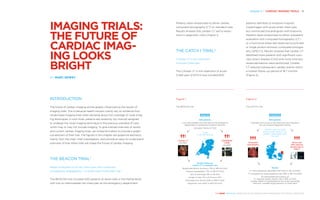
Patients were randomised to either cardiac
computed tomography (CT) or standard care.
Results showed that cardiac CT led to reduc-
tions in diagnostic costs (Figure 1).
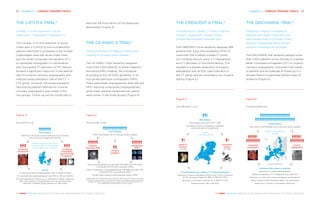
THE CATCH I TRIAL2
CArdiac cT in the treatment
of acute CHest pain
The CArdiac cT in the treatment of acute
CHest pain (CATCH) trial included 600
patients admitted to Hvidovre hospital,
Copenhagen with acute onset chest pain,
but normal electrocardiogram and troponins.
Patients were randomised to either outpatient
evaluation with computed tomography (CT)
or a functional stress test (exercise bicycle test
or single photon emission computed tomogra-
phy (SPECT)). Results showed that cardiac CT
identified more patients with significant coro-
nary artery disease (CAD) and more coronary
revascularisations were performed. Cardiac
CT reduced subsequent cardiac events within
a median follow-up period of 18.7 months
(Figure 2).
IMAGING TRIALS:
THE FUTURE OF
CARDIAC IMAG-
ING ­LOOKS
BRIGHT
BY MARC DEWEY
INTRODUCTION
The future of cardiac imaging will be greatly influenced by the results of
imaging trials. This is because health insurers mainly rely on evidence from
randomised imaging trials when deciding about the coverage of novel imag-
ing techniques. In such trials, patients are randomly (by chance) assigned
to undergo the novel imaging technique or the previous standard of care,
which may or may not include imaging. To give a broad overview of recent
and current cardiac imaging trials, we invited all trialists to provide a graph-
ical abstract of their trial. The figures in this chapter are graphical abstracts,
mainly from the trials’ chief investigators, and provide an easy-to-understand
overview of how these trials will shape the future of cardiac imaging.
THE BEACON TRIAL1
Better Evaluation of Acute Chest pain with computed
tomography angiography – a randomised cONtrolled trial
The BEACON trial included 500 patients at seven sites in the Netherlands
with low-to-intermediate risk chest pain at the emergency department.
Figure 1
The BEACON trial
Figure 2
The CATCH I trial
600 Patients
Admitted with acute on-set chest pain and indication
for non-invasive diagnostic testing
Patients were recruited from
a single center in the greater
Copenhagen area, Denmark
Results
CT reduced invasive angiographies (14% vs. 30%, p<0.001)
CT reduced total revascularisation rate (7% vs. 14%, p=0.0045)
At intermediate term follow-up no difference in safety measures
was found (death or hospitalisations for acute myocardial
infarction, unstable angina pectoris or chest pain)
Computed
tomography
Computed
tomography
and myo­cardial
CT perfusion
268 patients
With stable chest pain (PTP > 10%)
Excluded: known CA, pregnancy, allergies,
contraindications to adenosine
4 sites
in the Netherlands
8-months follow-up: cardiac CT vs functional testing
Proportion invasive angiograms with an ESC class I indication
for PCI (primary endpoint): 88% vs 50% (P=0.017)
Secondary noninvasive testing: 1% vs 28% (P<O.05)
Adverse events: 3% vs 3% (NS)
Tiered CT
Protocol
(N=130)
Functional
testing
(N=138)
3,500 patients
With low-to-intermediate risk of coronary artery disease
Patients from all over
Europe
Outcomes that matter to patients
Reduction in cardiovascular death?
Better acceptance of CT imaging test by patients?
Reduction in major and minor procedural complications?
Better quality of life? Reduced health care spending?
Reduction in stroke or myocardial infarction?
Computed
tomography
Invasive
angiography
1,202 Patients
With intermediate risk of coronary artery disease
Fewer angiographies one year after MR (18%) and MPS (16%)
compared with UK NICE guideline (43%)
Fewer unnecessary angiographies after MR (8%) and MPS (7%)
compared with UK guideline (29%)
Similar major adverse cardiovascular events (2.5%)
Images taken from: Greenwood JP et al (2012) Cardiovascular magnetic resonance
and single-photon emission computed tomography for diagnosis of coronary heart
disease (CE-MARC): a prospective trial. Lancet. 2012 Feb 4;379(9814):453-60.
doi: 10.1016/S0140-6736(11)61335-4. Open Access
Magnetic
resonance (MR)
Scintigraphy
(MPS)
UK NICE
guideline
Chapter 3 | CARDIAC IMAGING TRIALS 4342 Chapter 3 | CARDIAC IMAGING TRIALS
THE HEART REVEALED RADIOLOGY IN THE DIAGNOSIS AND MANAGEMENT OF CARDIAC CONDITIONSTHE HEART REVEALED RADIOLOGY IN THE DIAGNOSIS AND MANAGEMENT OF CARDIAC CONDITIONS
THE CRESCENT II TRIAL5
Comprehensive Cardiac CT Versus Exercise
Testing in Suspected Coronary Artery
Disease Randomized Controlled trial
The CRESCENT II trial randomly assigned 268
patients with a pre-test probability (PTP) of
more than 10% to either a tiered CT proto-
col including calcium score, CT angiography
and CT perfusion or functional testing. This
resulted in a greater proportion of invasive
angiograms with an ESC class indication in
the CT group and less secondary non-invasive
testing (Figure 5).
THE DISCHARGE TRIAL6
Diagnostic Imaging Strategies for
Patients with Stable Chest Pain and
Intermediate Risk of Coronary Artery
Disease: comparative effectiveness
research of existing technologies
The DISCHARGE trial randomly assigns more
than 3,500 patients across Europe to undergo
either computed tomography (CT) or invasive
coronary angiography. Outcomes that matter
to patients will be collected at follow-up in a
blinded fashion to generate highest levels of
evidence (Figure 6).
THE CATCH II TRIAL3
CArdiac cT in the treatment of acute
CHest pain – myocardial CT perfusion II
The CArdiac cT in the treatment of acute
CHest pain 2 (CATCH II) trial included 600
patients admitted to a hospital in the Greater
Copenhagen area with acute onset chest
pain for either computed tomography (CT)
or computed tomography in combination
with myocardial CT perfusion (CTP). Results
showed a significant reduction in the referral
rate for invasive coronary angiography and
reduced revascularisation rate in the CT +
CTP group. However, the revascularisation
rate among patients referred for invasive
coronary angiography was similar in the
two groups. Follow-up will be conducted to
examine the implications of the diagnostic
approaches (Figure 3).
THE CE-MARC II TRIAL4
Clinical Evaluation of MAgnetic Resonance
imaging in Coronary heart disease II
The CE-MARC II trial randomly assigned
more than 1,200 patients to either magnetic
resonance (MR) imaging, the procedure
according to the UK NICE guideline, or to
myocardial perfusion scintigraphy (MPS).
There were fewer angiographies after MR and
MPS, reducing unnecessary angiographies,
while major adverse cardiovascular events
were similar in the three groups (Figure 4).
Figure 3
The CATCH II trial
Figure 4
The CE-MARC II trial
Figure 5
The CRESCENT II trial
Figure 6
The DISCHARGE trial
www.dischargetrial.eu
918 Patients
Typical angina and positive exercise test
or 2 cardiovascular risk factors
Patients from 16 sites
in 4 European countries
Similar MACE rate of 3.3 vs. 3.9%
(death, myocardial infarction, or repeat target
vessel revascularisation)
Reduced negative angiography rate
by MR-informed decisions (8.1 vs. 35.6%)
MR-informed
Decisions
FFR-informed
Decisions
4,146 Patients
With suspected angina
due to coronary artery disease
Change in diagnosis in 25%
Change in investigations in 15%
Change in treatments in 23%
50% reduction in
myocardial infarction
Standard care Standard care
+ Computed tomography
Figure 7
The MR-INFORM trial
Figure 8
The SCOT-Heart trial
Chapter 3 | CARDIAC IMAGING TRIALS 4544 Chapter 3 | CARDIAC IMAGING TRIALS
THE HEART REVEALED RADIOLOGY IN THE DIAGNOSIS AND MANAGEMENT OF CARDIAC CONDITIONSTHE HEART REVEALED RADIOLOGY IN THE DIAGNOSIS AND MANAGEMENT OF CARDIAC CONDITIONS
CONCLUSION
The randomised imaging trials outlined above
show that the future of cardiac imaging looks
bright. Cardiac CT is expected to play a cen-
tral role in the management of patients with
suspected coronary artery disease while car-
diac MRI will enable us to better understand
the clinical implications of myocardial ischae-
mia and infarction for individual patients, thus
allowing ‘personalised radiology’ to become a
clinical reality.
References
See page 230
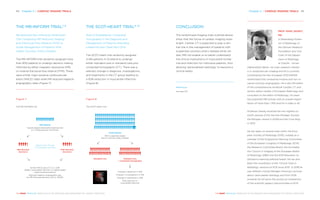
THE MR-INFORM TRIAL7, 8
Randomised Non-inferiority Multicenter
Trial Comparing MR Perfusion Imaging
and Fractional Flow Reserve (FFR) to
Guide Management of Patients With
Stable Coronary Artery Disease
The MR-INFORM trial randomly assigned more
than 900 patients to undergo decision making
informed by either magnetic resonance (MR)
or invasive fractional flow reserve (FFR). There
were similar major adverse cardiovascular
event (MACE) rates while MR reduced negative
angiography rates (Figure 7).
THE SCOT-HEART TRIAL9, 10
Role of Multidetector Computed
Tomography in the Diagnosis and
Management of Patients Attending
a Rapid Access Chest Pain Clinic
The SCOT-Heart trial randomly assigned
4,146 patients in Scotland to undergo
either standard care or standard care plus
computed tomography (CT). There was a
relevant change in diagnosis, investigations,
and treatments in the CT group leading to
a 50% reduction in myocardial infarction
(Figure 8).
PROF. MARC DEWEY,
MD
is Heisenberg Profes-
sor of Radiology of
the German Research
Foundation and Vice
Chair of the Depart-
ment of Radiology
at Charité – Univer-
sitätsmedizin Berlin. His main research interest
is in cardiovascular imaging and he is currently
coordinating the Pan-European DISCHARGE
randomised trial comparing invasive and non-in-
vasive coronary angiography. He is also the editor
of the comprehensive textbook Cardiac CT, and
section editor cardiac of European Radiology and
consultant to the editor of Radiology. His team
has published 190 articles with an overall impact
factor of more than 1.300 and his h-index is 42.
Professor Dewey received the two highest sci-
entific awards of the German Röntgen Society;
the Röntgen Award in 2009 and the Curie Ring
in 2012.
He has taken on several roles within the Euro-
pean Society of Radiology (ESR), notably as a
member of the Programme Planning Committee
of the European Congress of Radiology (ECR),
the Research Committee Board, the Accredita-
tion Council in Imaging of the European Board
of Radiology (EBR) and the ESR Education on
Demand e-learning editorial board. He has also
been the coordinator of the ‘Clinical Trials in
Radiology’ sessions at ECR since 2015. In 2018 he
was Wilhelm Conrad Röntgen Honorary Lecturer
about value-based radiology and from 2019
onwards he will serve the society as chairperson
of the scientific papers subcommittee of ECR.
4
CARDIAC CT
IN THE
­EMERGENCY
ROOM
Chapter 4 | CARDIAC CT IN THE ­EMERGENCY ROOM 49
THE HEART REVEALED RADIOLOGY IN THE DIAGNOSIS AND MANAGEMENT OF CARDIAC CONDITIONS
In the context of ACS, clinical suspicion
is supported by early risk stratification
through clinical history, electrocardiogram,
cardiac biomarkers and criteria such as the
TIMI risk score. However, this doesn’t make
it possible to detect patients who can be
discharged from ED earlier and safely.
This leads to prolonged stays, saturation
of hospital services and high costs for
patients who do not really require it, since
up to 85% of patients with chest pain do
not have ACS.
Recent efforts have focused on the reduc-
tion of the length of stay as a result of accu-
rate early identification of patients who can
safely be discharged from ED versus those
who require in-hospital observation. Of
particular interest is the group of patients
with ACP, negative first troponin, negative/
non-diagnostic ECG and low to intermediate
risk (TIMI risk score <4).
Coronary CT angiography may help to
reach this goal, since it has proven to
be clinically useful as an alternative or in
addition to functional tests (according to
several prospective trials such as PROMISE
and SCOT-HEART) and has also proved
to be a powerful tool in safely identifying
patients who can be discharged from ED
(supported in 4 large randomised trials:
CT-STAT, ACRIN-PA, ROMICAT II and
CT-COMPARE), due to its high sensitivity
(86–100%) and a high negative predictive
value (93–100%).
Up to 8% of patients with ACS may have
negative ECG and negative cardiac bio-
markers, which leads to a missed diagnosis
and an increase not only in morbidity and
mortality but also in malpractice litigation.
In these cases, coronary CT angiography
may help clinicians to guide management.
In this chapter, we are going to focus on
coronary CT angiography rather than aortic
or pulmonary CT angiography.
EVOLUTION OF
CARDIAC CT
Imaging the heart using CT is a technolog-
ical challenge, since it requires scanning
very small vessels (coronary arteries) that
are in constant motion, therefore a high
spatial and temporal resolution is needed.
In the 1980s, the use of electron beam CT
made it possible to obtain images of the
heart with a high temporal resolution but
low spatial resolution, even so it was the
essential modality to establish the basis for
a calcium score. In the 1990s, single-slice
helical CT systems were introduced, utilising
new slip-ring technology. Multi-detector
row CT (also known as MDCT or multi-slice
CT) followed soon thereafter, increasing
the coverage in z-plane, and since then, the
number of detectors has increased from 4
(1998) to 320 (2008) allowing a coverage
of up to 16cm within a single rotation, which
has made it possible to scan the entire heart
in a single gantry rotation. At the same
time, rotation speed increased from 1 to
0.25 seconds which increases the tempo-
ral resolution significantly. Dual source CT
further improves the temporal resolution by
a factor of 2, without increasing the rota-
tion speed. New detector systems allow
spatial resolutions closer to conventional
angiography. These incredible technological
I WANT TO LIVE
ANOTHER DAY:
HOW CARDIAC
­CT CAN HELP
PATIENTS IN
THE EMER-
GENCY ROOM
BY HAROLD GOERNE AND SUHNY ABBARA
INTRODUCTION
Chest pain is the second most common cause of admission to
emergency departments (ED) in the United States after abdominal
pain according to data from the National Center for Health Sta-
tistics. It is estimated that around 9 million patients per year are
admitted to the ED for this reason, costing up to $15 billion. One
of the biggest concerns for doctors and patients is to ascertain
whether the chest pain is due to a life-threatening cardiovascular
condition, such as acute coronary syndrome (ACS) (ST segment
elevation myocardial infarction = STEMI, NSTEMI = non-STEMI,
unstable angina), acute aortic syndrome (dissection, intramural
haematoma, penetrating atherosclerotic ulcer) or acute pulmonary
embolism. In most of these scenarios, prompt intervention is essen-
tial, especially in STEMI, in which early identification and treatment
is fundamental to changing the course of the disease, which could
otherwise be fatal.
Chapter 4 | CARDIAC CT IN THE ­EMERGENCY ROOM 5150 Chapter 4 | CARDIAC CT IN THE ­EMERGENCY ROOM
THE HEART REVEALED RADIOLOGY IN THE DIAGNOSIS AND MANAGEMENT OF CARDIAC CONDITIONSTHE HEART REVEALED RADIOLOGY IN THE DIAGNOSIS AND MANAGEMENT OF CARDIAC CONDITIONS
motion abnormalities. This mode is ideal
for patients with high HR or arrhythmias; it
is also the mode of choice when assessing
motion of mechanical prosthetic valves.
Its disadvantage is the higher radiation
dose need, this can, however, be signifi-
cantly reduced with tube current modu-
lation technique. A third mode, high-pitch
helical, has a very low radiation dose but
can only be performed on second and
third generation dual-source scanners
and most sites only use this mode at HR
<60bps. Iterative reconstruction is an
option offered by all vendors as a strat-
egy for significant dose reduction without
sacrificing signal to noise ratio.
CORONARY CTA
IN EMERGENCY
DEPARTMENTS
It is very important to establish strategies
between the ED team and the cardiovas-
cular imaging team to ensure the correct
use of coronary CTA, which in turn allows
for more efficient patient care. The oral
β-blocker can be administered in ED one
hour prior to the study (usually metopr-
olol 50–100mg) or intravenously in the
CT room (metoprolol 5mg every 5 min-
utes for up to 5 doses) until reaching a
heart rate of less than 60bps. Sublingual
nitro-glycerine (0.8mg) is given in the CT
room 5 minutes prior to the scan acquisi-
tion. Serum creatinine value is necessary
to evaluate renal function. Good intravas-
cular access is important because high
injection flow rates of contrast medium
are used (usually 6 ml/s). The iodine
advances make it possible for CT coronary
angiography to be used routinely in clinical
practice today.
TECHNICAL
CONSIDERATIONS
For coronary CTA, it is recommended to
use at least a 64 detector CT scanner, but
the quality of the study depends not only
on the number of detectors and rota-
tion speed, but also on multiple technical
factors. These include aspects relating to
the patient such as their ability to maintain
apnoea breath hold, which is essential to
perform the study, otherwise it would be
an absolute contraindication; their weight,
which will determine the kVp and the
amount of contrast medium; their heart
rate, which ideally should be less than 60
beats per second, for which it is neces-
sary to use β-blockers (oral or intravenous
metoprolol) and the use of vasodilators
such as nitro-glycerine, which helps to bet-
ter visualise coronary arteries. It is impor-
tant to check for possible contraindications
with these medications.
Prospective ECG-triggering is currently
the most common acquisition mode; it
obtains images in one or several phases
of the cardiac cycle with a step and
shoot method. It has the advantage of
emitting a low dose and the disadvan-
tage of not recording all phases of the
cardiac cycle. In contrast, retrospective
ECG-gating collects data throughout the
entire cardiac cycle, making it possible
to evaluate ventricular function and wall
concentration should usually be high, at
about 350–370 mg/ml.
CT acquisition should be performed by
cardiac trained technical and nursing staff
and reviewed by an expert in cardiovascular
imaging. Once the study is done, communi-
cation between the cardiovascular radiology
staff and the emergency department staff
is important, so as to make decisions and
establish management of the condition as
soon as possible.
The study should be reviewed in a ded-
icated workstation with adequate post-
processing software for coronary CT angi-
ography, allowing for evaluation of DICOM
data in axial plane, multiplanar reformation
(MPR), maximum intensity projection
(MIP), curved planar reconstruction (CPR),
volume rendering technique (VRT) and
cardiac function analysis for retrospective
mode scans.
Coronary arteries are evaluated at their
origin and course; coronary CTA is an
excellent modality to demonstrate anom-
alous origins that may be cause of ischae-
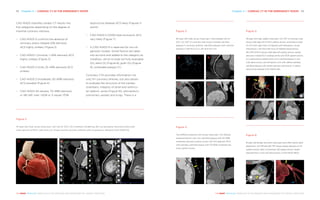
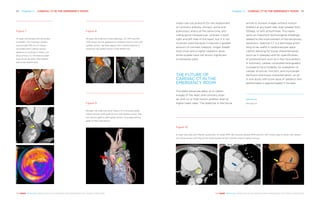
mia, such as the interarterial course (Fig-
ure 1). A normal CTA coronary confirms the
absence of coronary disease. The presence
of atherosclerosis requires the assessment
of two parameters: the degree of stenosis
and the characteristics of the plaque.
Recently, the introduction of CAD-RADS
as a standardised system for report-
ing coronary CTA makes it possible to
avoid a lexicon variability, in addition to
the fact that it provides management
recommendations.
Figure 1
50-year-old male with recurrent
chest pain after exercise. (A) VRT of
coronary tree, (B) VRT of the heart, (C)
MIP, (D) MPR, shows anomalous origin
of right coronary artery from left sinus
of Valsalva with interarterial course
and extrinsic compression in proximal
segment with severe stenosis (arrows).
(PA: Pulmonary Artery, Ao: Aorta).
A
C
B
D
Chapter 4 | CARDIAC CT IN THE ­EMERGENCY ROOM 5352 Chapter 4 | CARDIAC CT IN THE ­EMERGENCY ROOM
THE HEART REVEALED RADIOLOGY IN THE DIAGNOSIS AND MANAGEMENT OF CARDIAC CONDITIONSTHE HEART REVEALED RADIOLOGY IN THE DIAGNOSIS AND MANAGEMENT OF CARDIAC CONDITIONS
obstructive disease) ACS likely (Figures 5
and 6)
−− CAD-RADS 5 (100% total occlusion) ACS
very likely (Figure 7)
−− A CAD-RADS N is reserved for non-di-
agnostic studies. Some factors are taken
into account and added to the category as
modifiers, which include not fully evaluable
(N), stent (S) (Figure 8), graft (G) (Figure
9), vulnerable plaque (V)
Coronary CTA provides information not
only for coronary arteries, but also allows
to evaluate the structure of the cardiac
chambers, integrity of atrial and ventricu-
lar septum, aorta (Figure 10), pericardium,
pulmonary vessels and lungs. There is a
CAD-RADS classifies cardiac CT results into
five categories depending on the degree of
maximal coronary stenosis:
−− CAD-RADS 0 confirms the absence of
coronary artery disease (0% stenosis)
ACS highly unlikely (Figure 2)
−− CAD-RADS 1 (minimal, 1–24% stenosis) ACS
highly unlikely (Figure 3)
−− CAD-RADS 2 (mild, 25–49% stenosis) ACS
unlikely
−− CAD-RADS 3 (moderate, 50–69% stenosis)
ACS possible (Figure 4)
−− CAD-RADS 4A (severe, 70–99% stenosis)
or 4B (left main >50% or 3-vessel >70%
Figure 2
47-year-old male, acute chest pain, low risk for ACS. (A) Cinematic rendering, (B) Curved planar reconstructions and
cross-section of RCA, LAD and LCX, shows normal coronary arteries with no plaque or stenosis (CAD-RADS 0).
A B
Figure 3
60-year-old male, acute chest pain, intermediate risk for
ACS. (A) VRT of coronary tree shows multiple calcified
plaques in coronary arteries. Calcified plaques with minimal
stenosis in (B) RCA, (C) LAD and (D) LCX.
Figure 4
Two different patients with acute chest pain. (A) Obtuse
marginal branch with non-calcified plaque with 50–69%
moderate stenosis (yellow arrow), (B) Mid segment RCA
with partially calcified plaque with 50-69% moderate ste-
nosis (green arrow).
A
A
C
B
B
D
Figure 5
56-year-old male, stable chest pain. (A) VRT of coronary tree
shows high take-off of RCA (yellow arrow), anomalous origin
of LCX from right sinus of Valsalva with retroaortic course
(red arrow), LAD from left sinus of Valsalva (blue arrow).
(B) CPR of RCA shows high take-off (yellow arrow), severe
stenosis in distal RCA (orange arrow) and PDA (green arrow),
(C) subocclusive predominant non-calcified plaque in mid
LAD (blue arrow), (D) retroaortic LCX with diffuse partially
calcified plaques with severe stenosis (red arrow). 3 vessel
obstructive disease (CAD-RADS 4B).
A B
Figure 6
61-year-old female, recurrent chest pain even after recent stent
placement. (A) MIP and (B) VRT shows severe stenosis of LM
(yellow arrow), stent in proximal LAD (green arrow), severe
reduced flow in mid LAD (blue arrow). (CAD-RADS 4B/S).
A
C
B
D
Chapter 4 | CARDIAC CT IN THE ­EMERGENCY ROOM 5554 Chapter 4 | CARDIAC CT IN THE ­EMERGENCY ROOM
THE HEART REVEALED RADIOLOGY IN THE DIAGNOSIS AND MANAGEMENT OF CARDIAC CONDITIONSTHE HEART REVEALED RADIOLOGY IN THE DIAGNOSIS AND MANAGEMENT OF CARDIAC CONDITIONS
triple-rule-out protocol for the assessment
of coronary arteries, thoracic aorta and
pulmonary artery at the same time, pro-
viding good intravascular contrast in both
right and left side of the heart, but it is not
routinely used because it requires a greater
amount of contrast medium, longer breath
hold times and a higher radiation dose,
while studies have not shown significant
incremental yield.
THE FUTURE OF
CARDIAC CT IN THE
EMERGENCY ROOM
The latest advances allow us to obtain
images of the heart and coronary arter-
ies with no or little motion artefact even at
higher heart rates. The objective in the future
will be to achieve images without motion
artefact at any heart rate, even greater than
100bps, or with arrhythmias. This repre-
sents an important technological challenge
related to the improvement of the temporary
resolution. Spectral CT is a technique prom-
ising to be useful in cardiovascular appli-
cations allowing for tissue characterisation
(such as in plaques) and for quantification
of enhancement such as in the myocardium.
In summary, cardiac computed tomography
is posed to be a modality for evaluation of
cardiac structure, function, and myocardial
perfusion and tissue characterisation, an all
in one study with a low dose of radiation and
performable in approximately 5 minutes.
References
See page 231
Figure 8
55-year-old male with chest tightness. (A) VRT and (B)
CPR shows normal appearance of patent stent in mid LAD
(yellow arrow), calcified plaque with minimal stenosis in
proximal LAD (green arrow) (CAD-RADS 1/S).
Figure 9
69-year-old male with prior history of 3 coronary grafts.
Patent arterial LIMA graft to mid LAD (yellow arrow). Pat-
ent venous graft to OM1 (green arrow). Occluded venous
graft to PDA (red arrow).
A B
Figure 10
21-year-old male with Marfan syndrome. (A) axial MPR, (B) coronal oblique MPR and (C) VRT shows type A aortic root dissec-
tion (blue arrow) with flap at the ostial border of left coronary artery (yellow arrow).
A B C
Figure 7
70-year-old female with shortness
of breath. (A) Cinematic render-
ing and (B) CPR of LCX shows
occluded stent (yellow arrow),
absence of contrast in distal LCX
(blue arrow), (C) thickening polar
map shows akinetic inferolateral
wall (CAD-RADS 5/S).
A
B
C
56 Chapter 4 | CARDIAC CT IN THE ­EMERGENCY ROOM
THE HEART REVEALED RADIOLOGY IN THE DIAGNOSIS AND MANAGEMENT OF CARDIAC CONDITIONS
DR. HAROLD
GOERNE
is a Cardiovascu-
lar Radiologist and
professor of cardiac
imaging in Western
National Medical
Center of Social Secu-
rity Mexican Institute
(Centro Médico Nacional de Occidente IMSS) and
Imaging and Diagnosis Center (Centro de Imagen
y Diagnóstico CID) in Guadalajara, Jalisco, Méx-
ico. He completed his radiology residency in 2011.
Since then he has shown a special interest in car-
diac imaging. In 2012, he was trained in cardiac
imaging in Cardiology National Institute (Insti-
tuto Nacional de Cardiología Ignacio Chávez) in
Mexico City. Then in February 2017, he completed
one year of a visiting senior fellowship in cardiac
imaging in the Division of Cardiothoracic Imaging,
Department of Radiology, University of Texas
Southwestern Medical Center, Dallas, TX, USA.
­­His job and publications are focused on cardiac
­CT and MRI.
PROF. DR. SUHNY
ABBARA, FACR,
FSCCT
is chief of the Car-
diothoracic Imag-
ing Division at UT
Southwestern Medical
Center in Dallas,
Texas. He graduated
from Heinrich-Heine-University, Düsseldorf,
Germany, where he also completed 18 months of
vascular surgery, followed by radiology train-
ing at Georgetown University, Washington, DC,
Massachusetts General Hospital, Harvard Medical
School, Boston. During his time as faculty at
MGH, he served as director of the Clinical Cardiac
Imaging Section and its fellowship; he also rose
to the rank of associate professor of radiology at
Harvard Medical School.
Professor Abbara served on several scientific
journal editorial boards and he was chosen to
lead the RSNA journal Radiology: Cardiotho-
racic Imaging as the Editor. He has co-authored
250 peer-reviewed PubMed-referenced articles
resulting in an h-index of more than 50. He has
authored several textbooks and numerous book
chapters and clinical guidelines. He chairs the
cardiac panels for the ACR Appropriateness
criteria. Professor Abbara has served as president
of the Certification Board of Cardiac CT (CBCCT)
and is President of the Society for Cardiovascular
Computed Tomography (SCCT).
5
THE
ISCHAEMIC
HEART
Chapter 5 | THE ISCHAEMIC HEART 61
THE HEART REVEALED RADIOLOGY IN THE DIAGNOSIS AND MANAGEMENT OF CARDIAC CONDITIONS
Cardiac MRI is now a standardised examination5
.
It includes at least the following pulse sequences:
−− Multiplanar CINE imaging, allowing the
evaluation of ejection fraction and other
ventricular functional parameters including
volumes and myocardial mass
−− First-pass perfusion imaging under vasodi-
lator stress (stress perfusion imaging)
−− Delayed enhancement pulse sequences
are acquired, in order to detect myocardial
infarction or fibrosis
The principle of stress first-pass perfusion MR
imaging is to induce a vasodilatation of healthy
coronary arteries pharmacologically. Adeno-
sine or regadenoson are mainly used for this
purpose after contra-indications have been
excluded. They are being used off-label for this
purpose. At the peak effect of the vasodilator,
a bolus of gadolinium chelate is administered
while a real-time T1-weighted sequence is run.
In case of stenosis of one or several of the
three main coronary arteries, the blood flow
is redirected towards the healthy territories
(vascular steal phenomenon) and decreased
perfusion of the subendocardial myocardium
is observed in the diseased segments.
Analysis of first-pass perfusion is usually qualita-
tive, although quantification is possible. This may
allow for microvascular disease to be detected.
It is also possible to complete the examination
with a rest first-pass study after the vasodilator
effect was suppressed (spontaneously after
adenosine or after aminophylline injection for
regadenoson).
Rest perfusion imaging is normal in case of
reversible ischaemia.
The results of perfusion imaging need to be
compared to other pulse sequences and in
particular to delayed enhancement imag-
ing that can detect the scar of a myocardial
infarction. Hence, it is possible to assess both
myocardial ischaemia and viability during the
same 30–40 minutes MR session. Comparing
the results of the MR scan to the coronary
angiogram (if available) is also helpful for the
management of the patient.
If substantial areas of inducible ischaemia
are detected by stress MR, this represents a
strong argument for revascularisation (either
by percutaneous transluminal coronary
angioplasty or by bypass grafting). Inducible
ischaemia and/or myocardial infarction have a
high prognostic value regarding cardiac death
or major cardiovascular events.
Obviously, this examination needs to be
performed under optimal safety conditions.
Pre-procedural ECG is required as well as con-
tinuous monitoring of the patient’s vital param-
eters during the examination and particularly
during the stress test. In our institution, two
physicians attend the examination; one takes
care of the patient’s safety, while the other one
pilots the examination with the technician.
Considering all those advantages, we wonder
why stress MRI is not practised more often
worldwide to detect coronary artery disease.
We already mentioned its limited availability.
While MR scans are routinely used for brain
studies, this is not currently the case for the
heart. Another reason is probably that physical
exercise, the most physiological stress, cannot
TOO LITTLE TOO
LATE: IMAG-
ING OF THE
­ISCHAEMIC
HEART
BY JEAN-NICOLAS DACHER
Coronary artery disease (CAD) remains a
major cause of mortality in the western world.
During the twentieth century, radiology as a medical specialty was barely
involved in the detection and treatment of CAD. Technical innovation in MRI
and CT has completely changed the situation on the turn of the century.
Coronary artery disease/stenosis can induce ischaemia. Ischaemia is
defined as an insufficient delivery of oxygen to the myocardium. Until
recently, gated SPECT (a relatively expensive technique delivering ionising
radiation) was the only diagnostic tool available to reach this diagnosis.
Since 2013 and the new statement on stable angina issued by the Euro-
pean Society of Cardiology1
, MRI was recognised as a valid and at least
equivalent alternative to isotope studies. A number of studies and
meta-analyses even claim that MR is superior to SPECT. The absence of
radiation and radioactive effluent are strong arguments for using MRI in
addition to its spatial and temporal resolution, while its main drawback lays
in its limited availability.
This recommendation was grounded on multiple studies2–4
that showed
correlation between MRI and the reference studies of CAD that are coro-
nary angiography and fractional flow reserve.
Chapter 5 | THE ISCHAEMIC HEART 6362 Chapter 5 | THE ISCHAEMIC HEART
THE HEART REVEALED RADIOLOGY IN THE DIAGNOSIS AND MANAGEMENT OF CARDIAC CONDITIONSTHE HEART REVEALED RADIOLOGY IN THE DIAGNOSIS AND MANAGEMENT OF CARDIAC CONDITIONS
yet be used in MRI. Also, there is a large and
old amount of scientific evidence pleading for
gated SPECT. Many cardiologists still consider
MRI as a research tool. Finally, cardiac MRI is
insufficiently recognised and reimbursed by
health systems in Western countries and this is
probably one of the most problematic features.
CONCLUSION
In summary, nowadays a stress cardiac MRI is a
safe alternative to other stress tests in cardiol-
ogy used to detect ischaemia. The examination
is quite short, requires the use of a vasodilator
drug and its diagnostic capabilities are excellent.
The limited costs, the absence of radioactive
effluent and the absence of radiation are unique
advantages of cardiac MRI over gated SPECT.
Cardiac MR should definitely be employed more
often by cardiologists worldwide.
Figure 2
Abnormal stress perfusion imaging in a 48-year-old
male patient complaining of chest pain while exercising.
Systolic function was impaired (ejection fraction: 35%).
Stress perfusion imaging showing decreased signal in the
sub endocardium of the inferior basal segments (right
coronary artery territory) (green arrows) (A). Vasodilation
had been obtained after intravenous injection of 400 μg
Regadenoson for 10 seconds. Subsequent rest perfusion
(B) after an injection of 125mg IV aminophylline was
normal. Delayed enhancement did not show scarring (C).
Percutaneous angioplasty of the right coronary artery
was performed. Six months later, the patient was free of
symptoms and ejection fraction had increased by 7%.
A
B
C
Figure 3
This 32-year-old man with a long history of hypertension was
referred to CT for chest pain. A severe dual stenosis of the left
anterior descending artery (LAD) was disclosed (A). Stress
MR (400 μg Regadenoson) was positive in the apical septum
(B). Based on this result, revascularisation was performed.
A B
A
B
C
D
Figure 1
Normal stress perfusion imaging in a 45-year-old female
patient with chest pain and normal systolic function. Vas-
odilation occurred after an intravenous injection of 400 μg
Regadenoson for 10 seconds. Heart rate increased from 70
to 90 beats per minute. Four successive short axis views
of the same dynamic sequence (saturation recovery) are
shown.
(A) Baseline image (prior to gadolinium chelate bolus).
(B) Enhancement of the right ventricle. (C) Enhancement
of the left ventricle and lung. (D) Synchronous (normal)
enhancement of the myocardium. Both CINE and delayed
enhancement pulse sequence (not shown) were normal.
PROF. JEAN-NICO-
LAS DACHER
is a French cardiac
radiologist appointed
as Professor of Radi-
ology by the Univer-
sity of Normandy in
Rouen since 1999. He
is practising cardiac
MR and CT and devotes a significant part of his
time to the evaluation of congenital heart disease
(CHD) in children and adults. This particular inter-
est in CHD relates to his initial training in paediat-
ric radiology. Professor Dacher is also interested
in imaging of the myocardium, coronary artery
disease and valvular heart disease (Rouen is the
place where Alain Cribier performed the first
in-man transarterial implantation of aortic pros-
thesis (TAVR) in 2002).
Professor Dacher is a member of the Société
Française de Radiologie (SFR), Société Française
d’Imagerie Cardiovasculaire (SFICV), European
Society of Radiology (ESR) and European Soci-
ety of Cardiovascular Radiology (ESCR). Author
of 200 articles referenced in PubMed and several
book chapters, Jean-Nicolas Dacher is an active
teacher of cardiac imaging in the French-speak-
ing community and outside it. Currently, he acts
as a member of the Cardiac Scientific Committee
of European Radiology and Diagnostic and Inter-
ventional Imaging.
References
See page 231
6
CARDIAC
MRI IN
­MYOCARDITIS
Chapter 6 | CARDIAC MRI IN MYOCARDITIS 67
THE HEART REVEALED RADIOLOGY IN THE DIAGNOSIS AND MANAGEMENT OF CARDIAC CONDITIONS
common cause of myocarditis in Europe and
North America, with Parvovirus B19 and human
herpes virus 6 (HHV 6) being the most fre-
quent in myocardial biopsy. Unfortunately, the
rate of endomyocardial biopsy (EMB), which
is required for definitive diagnosis, is relatively
low, so the true prevalence, aetiology and
outcome for viral myocarditis is poorly under-
stood. The diagnosis is usually suspected in
younger patients without risk factors for cor-
onary artery disease who present with chest
pain and malaise, often following a prodromal
viral illness. Clinical findings are often absent
or non-specific, ECG changes are variable, and
biomarkers such as cardiac troponin do not
differentiate from ischaemic myocardial disease
and may be normal. The European Society of
Cardiology guidelines2
have, none-the-less,
recommended clinical and diagnostic criteria
for the diagnosis of myocarditis. The diagnos-
tic criteria include ECG, troponin, functional or
structural abnormalities on imaging, and tissue
characterisation by CMR.
CARDIAC MRI CRITERIA FOR
THE DIAGNOSIS OF MYOCAR­­-
DITIS (LAKE LOUISE CRITERIA)
The ability of CMR to identify myocardial
inflammation and scar as well as function
has given it a unique role in establishing the
diagnosis of myocarditis3
. These diagnostic
tools include;
1.	 Function
Steady-state free precession (SSFP) cine
imaging is the gold standard to access
cardiac morphology and function. Patients
with myocarditis may show regional wall
motion abnormalities involving the right
ventricle (RV) and the left ventricle (LV) or
more global ventricular dysfunction. When
present, impaired ventricular function has a
worse prognosis. Cine MRI plays an impor-
tant role in the exclusion of other causes
of raised troponin such as hypertrophic
cardiomyopathy. Transient increases in
myocardial thickness are however seen in
myocarditis and reflect myocardial inflam-
mation and increased intra- and extracellu-
lar volume.
Cine images are also useful in identifying
pericardial thickening and effusion, indicat-
ing pericarditis, which is present in 30–50%
of patients with myocarditis.
2.	 Oedema
Tissue characterisation sequences, such
as T2 weighted imaging, with or with-
out fat suppression, visualise myocardial
oedema. A myocardial signal intensity
(SI) to skeletal muscle SI ration of >2.0 is
consistent with myocardial oedema. These
sequences tend to be susceptible to arte-
fact and field inhomogeneity which can
make achieving diagnostic image quality
challenging (Figure 1).
3.	 Hyperaemia
Early post gadolinium contrast images
(EGE) help identify myocardial inflamma-
tion. T1 weighted images early post gado-
linium, showing a global SI enhancement
ratio of myocardium over skeletal muscle
of >4.0 or an absolute myocardial enhance-
ment of >45% is consistent with myocarditis.
THE HEART
CAUGHT A COLD:
CARDIAC MRI IN
MYOCARDITIS
BY CHARLES PEEBLES
INTRODUCTION
Chest pain is a common cause of presentation to medical services with a
wide differential diagnosis. Patients are triaged according to the nature of
the chest pain, clinical findings, ECG, and cardiac biomarkers1
. Those with
ST elevation and positive troponin levels (5–10%) follow an established
clinical pathway for acute myocardial infarction with early revascularisation
strategies involving Primary Percutaneous Coronary Intervention (PPCI)
or thrombolysis (if PPCI is unavailable). At the other end of the spectrum,
many patients are diagnosed with non-cardiac chest pain and are managed
appropriately. A significant proportion of patients (40%) will have troponin
positive chest pain but no ST elevation and the differential lies between
non-ST elevation MI, unstable angina, or other forms of acute myocardial
injury such as myocarditis. Prior to the widespread availability of cardiac
MR (CMR), most of these patients would undergo an invasive coronary
angiogram with 10–15% having normal coronary arteries. The ability of CMR
to identify and characterise myocardial inflammation has revolutionised
the diagnosis of myocarditis. This chapter will illustrate the appearance of
myocarditis with standard and more advanced CMR techniques.
MYOCARDITIS AETIOLOGY
The causes of myocarditis include three main groups; infection, immune
mediated, and toxic myocarditis. Viral infections are thought to be the most
Chapter 6 | CARDIAC MRI IN MYOCARDITIS 6968 Chapter 6 | CARDIAC MRI IN MYOCARDITIS
THE HEART REVEALED RADIOLOGY IN THE DIAGNOSIS AND MANAGEMENT OF CARDIAC CONDITIONSTHE HEART REVEALED RADIOLOGY IN THE DIAGNOSIS AND MANAGEMENT OF CARDIAC CONDITIONS
In practice, cine images obtained follow-
ing contrast often demonstrate areas of
increase myocardial signal reflecting EGE
and myocardial hyperaemia (Figure 1).
4.	 Necrosis/Fibrosis
Late post gadolinium enhanced images
(LGE) visualise the presence and distribu-
tion of myocardial scar/fibrosis. Images are
obtained 8–10 minutes after administration
of contrast using an inversion-recovery pre-
pared T1 weighted sequence to suppress
normal myocardial signal. In theory high
signal on LGE images denotes irreversible
myocardial necrosis and scarring, however,
in practice, areas of myocardial oedema
may also show increased signal on LGE
sequences in acute myocardial injury with
subsequent resolution during recovery.
The pattern of LGE in myocarditis is typ-
ically patchy and predominantly involves
the sub-epicardial myocardium and the
mid myocardium. Importantly, it usually
spares the sub-endocardium allowing dif-
ferentiation from an ischaemic myocardial
injury (Figure 2).
Pericardial inflammation may also be
demonstrated on LGE images (Figure 3).
Figure 3
LGE images showing pericardial
enhancement consistent with peri-
carditis (white arrows).
A B
Figure 1
This illustrates the typical appearances of acute myocar-
ditis. (A) SSFP cine image following gadolinium showing
areas of increased signal indicating hyperaemia. (B) and
(C) T2 weighted images showing increased myocardial
signal compared to skeletal muscle indicating myocardial
oedema. (D) and (E) LGE images showing a diffuse mid
myocardial scar typical of myocarditis.
A
C
E
B
D
Figure 2
Typical LGE appearances of myocarditis in 3 cases (A)
and (B), (C) and (D), (E) and (F), with patchy areas of scar
sparing the subendocardium (white arrows). Conversely
case (G) and (H) shows an inferior wall MI with transmural
and subendocardial scar (white arrows) in a typical coro-
nary territory distribution.
A
C
E
G
F
H
B
D
The Lake Louise Criteria allow for a diagno-
sis of myocarditis in the appropriate clinical
context if two or more of the diagnostic
tissue markers (oedema, EGE or typical scar)
are present. A diagnostic accuracy of 78% is
quoted.
NEWER CMR TECHNIQUES
Techniques to identify myocardial oedema
are currently hampered by issues with signal
to noise ratio and image quality. In addition,
myocardial oedema is often diffuse, making it
difficult to visualise as all of the myocardium
may be affected. The Lake Louise Criteria
therefore used the degree of signal intensity
compared to adjacent skeletal muscle as a
quantitative cut off for myocardial oedema.
Likewise, the distribution of EGE may be very
diffuse and subsequently not easily discerni-
ble to visual assessment.
The re-introduction of quantitative tech-
niques to measure myocardial T1 and T2
relaxation times in the form of ‘parametric
mapping’ sequences has significantly added
to diagnostic accuracy as they are able to
identify global (and regional) changes in
myocardial signal with greater sensitivity.
Chapter 6 | CARDIAC MRI IN MYOCARDITIS 7170 Chapter 6 | CARDIAC MRI IN MYOCARDITIS
THE HEART REVEALED RADIOLOGY IN THE DIAGNOSIS AND MANAGEMENT OF CARDIAC CONDITIONSTHE HEART REVEALED RADIOLOGY IN THE DIAGNOSIS AND MANAGEMENT OF CARDIAC CONDITIONS
DR. CHARLES
­PEEBLES, MBBS,
MRCP, FRCR, EBCR
is a consultant cardi-
othoracic radiologist,
and clinical lead for
the Department of
Radiology, at the Uni-
versity Hospital South-
ampton, United Kingdom. He has specialised in
cardiac imaging with particular interest in cardiac
MRI and CT. He has been President of the British
Society of Cardiovascular Imaging and a board
member of the British Society of Cardiac MR. He is
currently an executive committee member of the
European Society of Cardiovascular Radiology.
He is widely published in the field of cardiac
imaging and has been on the National Institute
for Health and Care Excellence (NICE) guideline
development groups for stable angina and acute
chest pain. He has a particular interest in educa-
tion and has run successful Cardiac MRI courses
at Southampton since 2009.
There are a plethora of sequences and
measurement parameters available includ-
ing native T1, T1 post contrast, T2, extra-­
cellular volume (ECV) and synthetic EVC. In
addition, the values for each technique vary
with field strength and individual scanners
making universally comparable results
difficult to obtain. None-the-less, numer-
ous authors have shown an improvement in
diagnostic accuracy and confidence if map-
ping sequences are applied to this patient
cohort. Diagnostic accuracy for myocarditis
improved from 79% with the Lake Louise
Criteria to 90% when combining ECV and
LGE4
. It seems likely that new diagnostic
criteria incorporating parametric map-
ping techniques will be published shortly
(Figure 4).
PROGNOSIS AND TEMPORAL
CONSIDERATIONS
The majority of patients with acute myo-
carditis show spontaneous resolution in the
first 2–4 weeks, but about 25% will develop
persistent cardiac dysfunction and 12–25%
may acutely deteriorate or develop DCM1
.
Myocarditis is diagnosed in up to 20% of cases
of unexpected sudden death and viral myo-
carditis is implicated in up to 60% of cases of
dilated cardiomyopathy. These factors have a
number of implications for clinicians investi-
gating possible myocarditis; firstly, making a
positive diagnosis of myocarditis is important
as it will allow appropriate therapy and follow
up, and avoidance of risk factors such as vig-
orous exercise in the acute phase. Secondly,
Figure 4
A case of acute myocarditis performed 5 days after presentation (A–E) and 3 months later (F–J). The myocardial oedema seen on
T2 weighted images (A) and T1 mapping sequences (B) and (C) has resolved after 3 months (F–H). Likewise, the extent of LGE (D)
and (E) has shown significant improvement compared with follow-up images (I) and (J).
A C E
G I
B D
F H J
myocardial inflammation associated with
myocarditis is usually transient and will reduce
over time in the majority of patients (Figure
4). Timing of the initial MRI scan is therefore
important in achieving a positive diagnosis.
There is some evidence that patients scanned
within the first 24–48 hours of presentation
may have not elicited enough inflammatory
response to be visible on CMR. Likewise,
patients scanned more than six weeks follow-
ing presentation will have a lower diagnostic
rate as both oedema and LGE subside over
time. Ideally therefore a scan time of 5–10
days following presentation is ideal. Follow up
CMR at three months is also recommended in
order to access resolution and identify those
patients at risk of progressing to DCM and
chronic cardiac dysfunction.
CONCLUSION
Myocarditis is an important cause of chest
pain and, whilst most patients recover well,
a minority result in sudden cardiac death
and dilated cardiomyopathy. CMR has an
established pivotal role in the diagnosis and
management of patients with myocarditis.
The advent of parametric mapping tech-
niques will further enhance the role of CMR
with improved diagnostic accuracy and
confidence.
References
See page 232
7
THE
ATHLETE’S
HEART
Chapter 7 | THE ATHLETE’S HEART 75
THE HEART REVEALED RADIOLOGY IN THE DIAGNOSIS AND MANAGEMENT OF CARDIAC CONDITIONS
A completely different clinical setting con-
cerns the so-called population of adult
athletes (i.e. >35 years old), usually including
middle-aged or elderly participating in infor-
mal or recreational sports, on either a regular
or an inconsistent basis1
.
In this cohort of individuals, cardiovascular
screening should predominately aim to rule
out coronary arteries disease, which is the
main cause of events occurring during physi-
cal activity.
The present article aims to review morpho-
logical and functional features of athlete’s
heart, with particular emphasis on the impor-
tance and respective strengths of CT and MR
imaging which have been recognised as novel
central tools for cardiovascular prevention in
young and adult athletes.
THE ATHLETE’S HEART
The observation that the cardiovascular
system of highly trained athletes would differ
structurally and functionally from the general
population has been known for more than 100
years.
THE ATHLETE’S
­HEART:
­BALANCING
PERFORMANCE
AND POTENTIAL
RISKS
BY MARCO FRANCONE, ANNA PALMISANO
AND ANTONIO ESPOSITO
INTRODUCTION
Sudden cardiac death (SCD) prevention in athletes has been an object of
extensive debate among the media, scientists and sports communities
(Figure 1), due to the tremendous social impact of those events usually
occurring in healthy and well-trained individuals.
Initial general conviction that elite competitors would represent a special
cohort of healthy individuals with negligible cardiovascular risk has been
gradually replaced by the evidence that athlete’s heart is a sort of sep-
arate entity in which cardiovascular adaptations to sport often lead to
overlapped manifestations with a series of pathological conditions.
There is, in particular, an increasing demand for systematic screening of
young competitive athletes (i.e. <35 years old), who are deemed to be the
paradigm of health. The heart of a young athlete has been clearly recog-
nised to differ from the heart of a non-athlete and these changes have
been structured into the definition of athlete’s heart syndrome, in which
differentiation from potentially lethal pathological conditions requires
careful global assessment.
Figure 1
Sudden cardiac death (SCD) occur-
rence in top-level athletes is a rare
but highly exposed event, producing
significant media interest and social
awareness, with subsequent social
pressures on the medical community.
Chapter 7 | THE ATHLETE’S HEART 7776 Chapter 7 | THE ATHLETE’S HEART
THE HEART REVEALED RADIOLOGY IN THE DIAGNOSIS AND MANAGEMENT OF CARDIAC CONDITIONSTHE HEART REVEALED RADIOLOGY IN THE DIAGNOSIS AND MANAGEMENT OF CARDIAC CONDITIONS
young population, considering the signif-
icantly larger impact of road accidents,
infections, suicide and many other causes.
It is estimated that approximately
3.6/100,000 young athletes die per year,
among which 1/100,000 is a result of cardi-
ovascular death, which is more common in
males. SCD in young athletes usually occurs
on the athletic field in the absence of prior
symptoms4
.
The aetiology of SCD in athletes <35 years is
mostly inherited and is due to structural heart
diseases, mainly hypertrophic cardiomyopathy
(HCM) and arrhythmogenic right ventricular
dysplasia/cardiomyopathy (ARVD/C). In con-
trast, the vast majority of SCD in athletes >35
years is a consequence of acquired disease, in
particular coronary artery disease (CAD).
A large number of congenital and often clini-
cally silent cardiovascular diseases have been
‘Athlete’s heart’ was firstly described in
18992
when Dr. Henschen empirically
reported the enlargement of the heart in
a cohort of cross-country skiers, by sim-
ply using chest percussion. He concluded
that both dilatation and hypertrophy were
present.
The impact of training on cardiac remod-
elling was better defined in the last two
decades, as a result of greater accessibility to
large populations of trained athletes studied
with advanced non-invasive imaging tech-
niques, but, unfortunately, a certain degree
of overlap exists between the normal adap-
tation to intensive training and pathological
conditions that may lead to increased risk of
sport-related SCD.
Athlete’s heart is generally regarded as a
benign physiological adaptation with an
increase in cardiac mass and volume, with
normal systolic function, diastolic function
and high-energy phosphates (PCr, ATP)
content3
. Different types of conditioning
usually induce different degrees and forms of
cardiovascular system remodelling. Endur-
ance training, sometimes also described as
dynamic, isotonic or aerobic training, such
as long-distance running and swimming,
predominantly produces a volume overload.
Strength exercises, also referred as static,
isometric, power or anaerobic training, such
as weightlifting, cause largely a pressure
overload. Finally, sports such as cycling and
rowing are examples of combined endurance
and strength exercises.
Left (LV) and right ventricles (RV) remod-
elling develop relatively rapidly and are
most impressive in endurance athletes.
Remodelling is dynamic in nature, being
reversible with cessation of training.
Cross-sectional studies of endurance athletes
demonstrate that LV wall thickness is 15%
to 20% greater than in sedentary controls,
and LV volume is 10% larger. The RV is also
enlarged, with elite athletes demonstrating
10% increases in RV dimensions. These struc-
tural changes are favourable and necessary
to compete (Figure 2).
Training-induced cardiovascular remodelling
may be associated with ECG abnormalities,
occurring in approximately 40% of trained
athletes. Most common ECG abnormali-
ties include early repolarisation patterns,
increased QRS voltages, diffuse T-wave
inversion, and deep Q waves. The height-
ened vagal tone that accompanies train-
ing may lead to innocent arrhythmias and
conduction alterations (sinus bradyarrhyth-
mias, junctional rhythm, and first-degree
AV block), but it is fundamental to be aware
that exercise may act as a trigger for lethal
ventricular tachyarrhythmias in patients with
susceptibility due to underlying and unsus-
pected cardiac diseases.
PREVENTION OF SCD
IN YOUNG ATHLETES
SCD of young trained athletes, usually
during sport activity, is an event with an
impressive media resonance due to a
devastating emotional impact to the com-
munity at large; it leads subsequently to
a substantial increase in awareness about
the underlined clinical conditions, although
it represents a minor cause of death in a
Figure 2
These illustrations show differences in the mechanisms of cardiac adaption to endurance vs. strength sports.
Normal heart
Endurance training
Mild to moderate LV and
RV enlargement and hypertrophy
Normal or slightly reduced LV EF
Strength training
Concentric LV hypertrophy
Normal ro hyperdynamic LVEF
Chapter 7 | THE ATHLETE’S HEART 7978 Chapter 7 | THE ATHLETE’S HEART
THE HEART REVEALED RADIOLOGY IN THE DIAGNOSIS AND MANAGEMENT OF CARDIAC CONDITIONSTHE HEART REVEALED RADIOLOGY IN THE DIAGNOSIS AND MANAGEMENT OF CARDIAC CONDITIONS
causally linked to SCD in young athletes at
autopsy. In the United States, HCM has been
consistently reported to be the single most
common cardiovascular cause, accounting
for approximately one third of the deaths.
The second most frequent cause of these
deaths in athletes is a congenital coronary
artery anomaly of wrong sinus origin (most
commonly, left main coronary artery origin
from right sinus of Valsalva with inter-arterious
course; Figure 3). Diagnosis requires a high
index of suspicion in young athletes present-
ing with exertional chest pain and/or syncope,
but symptoms are present in <50% of cases.
Other conditions account for a much smaller
proportion (5% to 8%) of the cardiovascular
deaths in young athletes: they include myo-
carditis, valvular heart disease, ARVD/C and
ion-channel disorders3
.
An alternative demographic profile has
emerged from the Veneto region of
north-eastern Italy, in which ARVD/C is
reported to be the most common cause of
athletic field deaths. Such results, contrasting
sharply with the results in the U.S., could be
based on a unique regional genetic substrate.
A multi-modality imaging approach to
athlete’s heart aims to differentiate physi-
ological changes due to intensive training
from serious cardiac diseases with similar
morphological features. A truly comprehen-
sive assessment of the athlete’s heart should
begin with an exercise ECG and echocardio-
graphic examination. Abnormal ECG pat-
terns are present in ≈40% of trained athletes,
occurring twice as often in men than women,
and particularly in those participating in
endurance sports. Therefore, most athletes
have ECGs that are within normal limits or
that show only minimal alterations. Standard
echocardiography has a pivotal role in mor-
pho-functional assessment of athlete’s heart,
in differentiating physiological and patholog-
ical LV hypertrophy and in the identification
of regional wall motion abnormalities. For
inconclusive echocardiography or findings
suspected for cardiomyopathies, the execu-
tion of cardiac magnetic resonance (CMR) is
indicated.
CMR offers the advantage of a highly repro-
ducible morpho-functional evaluation, a
higher capability to detect regional wall
motion abnormalities also of the right ven-
tricle, and an undisputed advantage in tis-
sue characterisation. The Late Gadolinium
Enhancement (LGE) technique allows char-
acterising the myocardium in relation to the
presence of myocardial scars and definition of
scars pattern, providing diagnostic informa-
tion with high sensitivity and specificity. The
detection, quantification and pattern analysis
of fibrosis results are useful for the risk stratifi-
cation, being directly correlated to major car-
diac adverse events. Moreover, CMR is useful
for the identification of reversible conditions
due to the capability to detect myocardial
oedema (Figure 4).
Hence, CMR may be a valuable support in the
difficult differentiation of a physiologically
adapted athlete’s heart from subtle patho-
logical conditions potentially underlined as a
sport-related SCD. A particularly difficult dif-
ferential diagnosis is between a physiological
ventricular hypertrophy and the early stage of
an HCM.
HCM is characterised by the presence of LV
or biventricular pathological wall thickening
Figure 3
‘Inter-arterial’ malignant course
of right coronary artery arising
from the left sinus of Valsalva in
a 16-year-old football player with
recent syncope during intense
training. Functional malignancy
is attributable to the anomalous
course of the vessel leading to arte-
rial compression during the systolic
phase, enhanced by the inotropic
and chronotropic effect of intense
physical activity.
Figure 4
CMR comprehensive multiparametric approach in three different forms of left
ventricular hypertrophy.
Top row (A) shows a case of physiological concentric hypertrophy observed
in a 27-year-old professional rower (mean myocardial wall thickness 12–14mm).
Increased wall thickness is not associated with pathological accumulation of
gadolinium on LGE images nor with substantial changes of native T1 on map-
ping sequences (T1 normal value: 950–1000 msec).
In the middle row (B), an asymmetric form of hypertrophic cardiomyopathy is
displayed occurring in a 26-year-old asymptomatic amateur tennis player. CMR
images show a remarkable pathological asymmetric anterio-septal hypertrophy
(anterior-septal wall thickness: 16–21mm), matching with extensive myocardial
damage consistent with the presence of multiple patchy areas of non-ischaemic
LGE (see arrows) associated with remarkably increased values of native T1
(average of 1,176 msec).
Lower row (C) is a case of cardiac primary amyloidosis manifesting with a
severe concentric biventricular hypertrophy in a 42-year-old marathon runner
with occasional depiction of abnormal low voltage on limb leads at ECG.
Parietal wall thickness is severely increased (ranging between 12–16mm in all
segments), and is associated with a typical inhomogeneous appearance of the
myocardium on LGE, depending on the extracellular deposition of amorphic
amyloid material. Presence of extensive intra-cellular amyloid accumulation.
Native T1 is also increased (average of 1,289 msec), reflecting the widespread
and substantial extracellular infiltration of amyloid.
A
C
B
Aortic
valve
pulmonary
valve
RCA
LAD
CX
Chapter 7 | THE ATHLETE’S HEART 8180 Chapter 7 | THE ATHLETE’S HEART
THE HEART REVEALED RADIOLOGY IN THE DIAGNOSIS AND MANAGEMENT OF CARDIAC CONDITIONSTHE HEART REVEALED RADIOLOGY IN THE DIAGNOSIS AND MANAGEMENT OF CARDIAC CONDITIONS
non-sustained by increased afterload. It
causes reduction and obstruction of LV
lumen and a high risk of SCD mainly related
to life-threatening arrhythmias occurring on
a scar substrate characterising the disease.
In the differentiation of an early HCM from a
physiological hypertrophy, CMR may play a
fundamental role, first of all with a detailed
morpho-functional evaluation of both ventri-
cles that may detect an unbalanced hyper-
trophy not compatible with a physiological
adaptation to sport activities. Moreover, the
CMR ability to detect myocardial scars with
typical HCM pattern, visible on LGE images
in about half of HCM (range 33–79%), is very
useful. LGE has a high sensitivity (1 gram
focal myocardial damage can be depicted)
and strong correlation with histology, but
the absence of LGE cannot be used to
reliably exclude the possibility of an HCM.
Novel CMR techniques may also provide
useful information, first of all the native
and post-contrast T1-mapping, which can
assess the total extent of myocardial extra-
cellular space, rather than the detection of
regional dense scars identified by traditional
LGE. T1-mapping may emerge as a reliable
diagnostic imaging marker in differentiating
pathologic from physiologic hypertrophy, but
further investigations are needed to eventu-
ally define this role.
In athletes who present with unexplained
chest pain or syncope, anomalous origin of
the coronary arteries from the wrong sinus
should be suspected. An anomalous course
of either the right or left coronary from the
opposite sinus with a course between the
great vessels is associated with potentially
increased risk during intense activity. The
majority of these patients have a normal
12-lead ECG, hence a high index of suspi-
cion is often needed to prompt testing for
diagnosis. In this regard, the role of CMR is
limited, seeing as coronary MR angiography
is not widely available. Otherwise, coronary
computed tomography angiography makes
non-invasive depicting of the coronary tree
with a very low radiation exposure possible.
CMR is also a fundamental tool for the diag-
nosis of ARVD/C, being capable of providing
an accurate evaluation of RV volumes/global
function and a detailed assessment of RV wall
regional motion abnormalities, associated
with the unique possibility to detect fibrous/
fatty replacement of the RV free wall. CMR
can be particularly advantageous given the
limitations inherent in assessing the RV on
echocardiography. Moreover, the capability
of myocardial characterisation offered by the
CMR, although not included in the official
diagnostic criteria, could be relevant in par-
ticular with athletes, since RV dilation is usu-
ally observed as part of the benign remod-
elling induced by training, while RV free wall
fatty/fibrotic replacement is a finding not
associated with athlete’s heart.
Acute myocarditis is implicated in 5–22% of
athletes’ SCD in <35. Early symptoms may
be very subtle. When diagnosis is verified,
athletes are declared ineligible for com-
petitive sport for at least 6 months. CMR is
fundamental for the diagnosis allowing for
the detection of oedema, hyperaemia and
myocardial necrosis, typically localised in the
midmyocardial or epicardial layer with a non-
coronary distribution.
PREVENTION OF SCD
IN ADULT ATHLETES
The main cause of SCD in adult athletes is
coronary artery disease (CAD). The relation-
ship between intense exercise training and
CAD is controversial. Although ischaemic
heart disease is the final common mani-
festation, triggers are likely multifactorial
being dependent on sympathetic activation,
electrolyte and metabolic factors, activation
of the haemostatic system, and haemody-
namic effects on vulnerable coronary plaque.
In particular, plaque rupture is considered to
be an important mechanism of SCD in older
athletes, that occurs among coronary lesions
that bring about mild to moderate stenoses
and is likely attributable due to the mechani-
cal effect and parietal wall stress induced by
the activity itself5
.
Screening of individuals at risk should
therefore necessarily include a combination
of luminal and plaque assessment, not only
to simply rule-out severe lesions but, most
importantly, to identify high-risk plaques
in a pre-clinical phase. In adult competitive
athletes, timely detection of atherosclerotic
lesions by coronary CT angiography (CCTA)
has been proved to be superior to traditional
non-invasive techniques.
Clear guidelines for screening athletes to
CCTA are still lacking in the literature. This
is due to the lack of prospective studies in
large athlete populations. There is, however,
a growing clinical utilisation of this technique
in adult athletes in a series of clinical scenar-
ios including screening after resuscitation,
in asymptomatic competitive athletes with
positive ECG or in the presence of equivo-
cal symptoms for ischaemic heart disease
in competitive athletes with normal or near
normal ECG.
The so-called ‘sub-millisievert’ new gener-
ation of CT scanner will certainly bring to a
further expansion of the utilisation of CCTA
also in this specific clinical setting, due to a
substantial reduction of the procedural bio-
logical risk.
CONCLUSION
Imaging plays a primary role in screening,
diagnosis and follow-up of an athlete’s heart,
bringing new light into the so-called ‘grey
zone’ between physiological adaptation of an
athlete’s heart and pathologic expression of
cardiac diseases.
Wider availability and recent outstanding
technical implementation of both CT and MR
imaging have further enhanced our under-
standing of the complexity of an athlete’s
heart.
Advanced imaging techniques became a
routine part of the comprehensive pre-par-
ticipation eligibility screening which is
performed in selected apparently healthy
athletes and recommended by main interna-
tional guidelines.
References
See page 232
Chapter 7 | THE ATHLETE’S HEART 8382 Chapter 7 | THE ATHLETE’S HEART
THE HEART REVEALED RADIOLOGY IN THE DIAGNOSIS AND MANAGEMENT OF CARDIAC CONDITIONSTHE HEART REVEALED RADIOLOGY IN THE DIAGNOSIS AND MANAGEMENT OF CARDIAC CONDITIONS
PROF. MARCO
FRANCONE
is Professor of Radi-
ology at Sapienza
University of Rome.
He is an internation-
ally recognised expert
in cardiac imaging
and a speaker for the
most important international radiological and
cardiological meetings. These include the Euro-
pean Congress of Radiology (ECR), the European
School of Radiology (ESOR) and the meetings of
the European Society of Cardiovascular Radiol-
ogy (ESCR), Cardiovascular and Interventional
Radiological Society of Europe (CIRSE), Radio-
logical Society of North America (RSNA) and the
American College of Cardiology (ACC).
His prominent field of research is cardiovascular
imaging with both CT and MR with specific focus
on myocardial infarction and cardiomyopathies.
He is author and co-author of more than 100
indexed articles with an impact factor higher
than 500.
Professor Francone is also scientific chair-
man of the ESCR and was recently elected
as President of the Italian College of Cardiac
Radiology – Italian Society of Radiology. He
is also actively involved in the activities of the
European Society of Radiology, having served
as a cardiac imaging subcommittee member for
the European Congress of Radiology between
2017–2019 and was recently appointed as
Scientific Subcommittee Chairperson for the
2020 meeting. He is also a member of the ESR
Research Committee, until 2020.
DR. ANNA
­PALMISANO
is a PhD student in
molecular medicine at
Vita-Salute San Raf-
faele University and
radiologist at the San
Raffaele University
Hospital. Her clinical
and research activity is mainly focused on cardio-
vascular imaging, with special focus on ischaemic
and inflammatory cardiomyopathy. She collabo-
rates with the Preclinical Imaging Facility of the
Experimental Imaging Center at San Raffaele Uni-
versity Hospital, where she is involved in several
preclinical studies on ischaemic cardiomyopathy.
DR. ANTONIO
ESPOSITO
is Associate Profes-
sor of Radiology at
Vita-Salute San Raf-
faele University. He
works as a radiologist
at the San Raffaele
University Hospital,
where he covers the role of Coordinator of Cardi-
ovascular Imaging in the Radiology Department,
directed by Professor Alessandro Del Maschio. In
the same University Hospital, Antonio Esposito is
also Deputy Director of the Experimental Imaging
Center of the campus, which is the centre col-
lecting all the imaging technologies and relative
expertise needed to support the preclinical and
clinical biomedical research of the institution.
Finally, Antonio Esposito is the Facility Manager
of the Preclinical Imaging Facility of the same
hospital.
8
IMAGING OF
CORONARY
ARTERIES
Chapter 8 | IMAGING OF CORONARY ARTERIES 87
THE HEART REVEALED RADIOLOGY IN THE DIAGNOSIS AND MANAGEMENT OF CARDIAC CONDITIONS
Clinically, with its high negative predictive
value ranging from 97–99%, CCTA repre-
sents a reliable diagnostic imaging tool to
rule out obstructive CAD, especially in low
to intermediate risk settings2–5
. As such,
large-scale registries and prospective trials
have shown that CCTA serves as a valuable
alternative to invasive diagnostic testing in
patients with stable angina6–8
and low- to
intermediate pre-test likelihood of CAD
(e.g. asymptomatic, younger patients) and
in those with less extensive coronary artery
calcification, especially in patients who are
unable to undergo stress testing for func-
tional testing5, 8
. An example of a negative
coronary CT angiography in a relatively
young female patient with suspected CAD is
provided in Figure 1.
There is strong evidence that CCTA
improves the efficiency of clinical deci-
sion making in the emergency department
in the case of acute chest pain, resulting
in a shorter length of hospitalisation and
reduced costs9
. Furthermore, CCTA is being
used for the visualisation and assessment of
coronary atherosclerotic plaque, three-di-
mensional vessel trajectories and anatomical
features of the coronary vessel segments
as well as detection of pathological coro-
nary artery alterations such as calcifications
or occlusions. CCTA is therefore rapidly
gaining recognition as a reliable and highly
IMAGING OF
THE CORONARY
ARTERIES: FROM
MORPHOLOGY
TO FUNCTION
AND BEYOND
BY FABIAN BAMBERG, CORINNA STORZ,
ILIAS TSIFLIKAS, CHRISTOPH SCHABEL
AND KONSTANTIN NIKOLAOU
CLINICAL VALUE OF
CORONARY CT ANGIOGRAPHY
Coronary artery disease (CAD) still is one of the leading causes of
death worldwide and remains responsible for approximately 610,000
deaths per year in the United States1
. Technical developments such as
wide detectors, dual source configuration, low kV scanning and high-
pitch acquisitions as well as iterative reconstruction algorithms have
allowed coronary CT angio­graphy (CCTA) to become established as
an imaging modality that provides high temporal and spatial resolu-
tion at low radiation exposure, for motion-free cardiac imaging and
detailed visualisation of coronary or myocardial pathology. Conse-
quently, CCTA has emerged as a non-­invasive, robust and well-estab-
lished diagnostic tool for the assessment and evaluation of patients
with known or suspected CAD. There is a large body of evidence,
demonstrating a high diagnostic accuracy with a sensitivity ranging
from 94–99% and a specificity of 64–83% for the detection of coro-
nary stenosis2
.
Figure 1
Coronary CT of a 48-year-old female with exertional atypical chest pain. The CT reveals the absence of coronary atherosclerotic
plaque or stenosis. (A) Axial slice demonstrating the left main coronary artery (asterisk) and the left anterior descending coronary
artery (arrowhead). (B) Origin of the right coronary artery (white arrow) and proximal segment of the left anterior descending cor-
onary artery (arrowhead) and left circumflex coronary artery (open arrow). (C) Volume rendered three-dimensional reconstruction
showing the left anterior descending coronary artery as well as the branch of the right coronary artery and the circumflex coronary
artery. (D–F) Multiplanar curved reconstructions of the right coronary artery (D), the left anterior descending coronary artery (E)
and the circumflex coronary artery (F) demonstrating the absence of coronary atherosclerotic plaque or coronary artery stenosis.
AA=ascending aorta, LA=left atrium, RV=right ventricle.
A CB D FE
Chapter 8 | IMAGING OF CORONARY ARTERIES 8988 Chapter 8 | IMAGING OF CORONARY ARTERIES
THE HEART REVEALED RADIOLOGY IN THE DIAGNOSIS AND MANAGEMENT OF CARDIAC CONDITIONSTHE HEART REVEALED RADIOLOGY IN THE DIAGNOSIS AND MANAGEMENT OF CARDIAC CONDITIONS
MORPHOLOGIC ASSESSMENT
OF ATHEROSCLEROTIC
PLAQUE
Given its high spatial resolution, CCTA offers
the unique potential to non-invasively visual-
ise, characterise and quantify atherosclerotic
plaque15
. The notion of vulnerable plaques is
a rather complex concept; however specific
high-risk plaque features can be identified
on standard CCTA datasets. Several adverse
features associated with vulnerable plaques
have already been identified and include the
presence of positive remodelling, low-atten-
uation plaque, spotty calcifications and the
napkin ring sign (see a typical low-attenua-
tion plaque in Figure 3) 16–19
. In contrast, larger
calcification is more likely to be found in sta-
ble coronary lesions. Although the evidence
is still very limited, detailed assessment of
plaque morphology for the presence of high-
risk plaque features in patients presenting
to the ED with acute chest pain but nega-
tive initial electrocardiogram and troponin
provides incremental diagnostic value as the
presence of high-risk plaque increases the
likelihood of ACS, independent of significant
CAD and clinical risk assessment, including
age, sex, and number of cardiovascular risk
factors20
. Thus, identification of such high-risk
plaques may improve risk estimates for the
individual patient and may be of use in the
selection of patients who could benefit from
revascularisation.
FUNCTIONAL ASSESSMENT
OF ATHEROSCLEROSIS:
FFR AND PERFUSION
Given its established value in morphologic
imaging of CAD, much research efforts over
the last years have focused on providing
information beyond the assessment of cor-
onary stenosis and plaque. To date, CCTA
offers two different approaches to assess
the functional relevance of a given stenosis:
a) myocardial perfusion imaging and b) the
calculation of a CT-based fractional flow
reserve (CT-FFR). CT myocardial perfusion
is based on the first-pass effect of iodinated
contrast media through the myocardium
during vasodilator stress (pharmacologically
induced using regadenoson, adenosine, or
dipyridamole). The study can either be per-
formed by obtaining one single scan during
maximum enhancement (also referred to as
acquisitions, given that high anatomical
resolution with short examination times can
be combined with low radiation exposure.
Specifically, high-pitch CT (pitch >3), low
kV (as low as 70 kV), and iterative recon-
struction algorithms have resulted in cardi-
ovascular exams with radiation exposure of
<1 mSv13
. Nowadays, for a detailed visual-
isation of the cardiac anatomy, ECG-trig-
gered protocols are recommended,
although it has also been demonstrated
that the detection of the coronary arteries
even in a non-ECG-triggered spiral mode
with high temporal resolution is possible14
.
Most paediatric cases will be scanned in a
prospective ECG-triggered sequential scan
(‘step-and-shoot mode’) or high-pitch scan
whereas retrospective ECG-gating should
be avoided due to high radiation exposure
(see a low dose coronary CT angiography
of a 6-month-old girl with Kawasaki Dis-
ease in Figure 2).
useful imaging tool in the pre-procedural
planning of cardiovascular interventions,
providing improved success rates for revas-
cularisation and post-procedural outcome
after percutaneous techniques10
. Besides its
diagnostic value, there is also an increasing
role of CCTA to predict cardiovascular risk
over time, as several follow-up studies report
an excellent prognosis for patients negative
in CCTA for any CAD or coronary athero-
sclerosis, whereas outcome in patients with
obstructive and also non-obstructive CAD is
substantially worse11, 12
.
LOW DOSE CORONARY
CT ANGIOGRAPHY AND
PAEDIATRIC IMAGING
Paediatric imaging has emerged as a par-
ticularly valuable setting for low dose CCTA
Figure 2
6-months-old girl with Kawasaki disease and suspected
coronary artery aneurysms in echocardiography. Coronary
CT scanned in ECG-gated high-pitch mode revealed aneu-
rysms in the right coronary artery (RCA; white arrow) and
the left anterior descending artery (LAD; white arrowhead).
Note the good image quality despite an average heart rate
of 154 beats per minute. Scan parameters: 70 kVp, 149 eff.
mAs with automated dose-modulation leading to a DLP of
5.8 mGy*cm resp. an effective dose of 0.5 mSv. (A) curved
multi-planar reconstruction (MPR) of the RCA; (B) curved
MPR of the LAD; (C) Volume rendering technique (VRT) of
the heart with view on the RCA; (D) VRT of the heart with
view on the LAD.
A
A B
C
B
D
Figure 3
Coronary CT of an atherosclerotic
plaque in the LAD, demonstrat-
ing high-risk plaque features,
including low-attenuation and
positive remodelling in the prox-
imal segment of the left anterior
descending coronary artery. (A)
curved multiplanar reformat and
corresponding cross-section of the
vessel (B).
Chapter 8 | IMAGING OF CORONARY ARTERIES 9190 Chapter 8 | IMAGING OF CORONARY ARTERIES
THE HEART REVEALED RADIOLOGY IN THE DIAGNOSIS AND MANAGEMENT OF CARDIAC CONDITIONSTHE HEART REVEALED RADIOLOGY IN THE DIAGNOSIS AND MANAGEMENT OF CARDIAC CONDITIONS
CONCLUSION
Cardiac CT imaging and coronary CT
angiography have developed incredibly
quickly over the past 10–15 years. Today,
this technique is readily and widely avail-
able and has reached a point of great
robustness and, together with the potential
of low-dose acquisition at the same time, it
will become ever more important in clinical
routine management of cardiac patients.
New insights into the functional assessment
of coronary blood flow and myocardial
perfusion are fascinating and will make this
technique even more valuable in the future.
References
See page 232
‘static’ or ‘snapshot/single-shot’ perfusion
imaging) or by acquiring multiple scans dur-
ing contrast passage (i.e. ‘dynamic’ imaging
of perfusion). The benefit of the ‘snap-
shot’ protocol is the reduction of radiation
exposure, whereas the ‘dynamic’ protocol
enables the quantification of absolute myo-
cardial blood flow and volume. Perfusion
defects as obtained by these techniques are
identified as areas of hypo-attenuated myo-
cardium compared to perfusion at baseline.
While reversible malperfusion indicates
ischaemic myocardium, persistent perfusion
defects are considered to represent myo-
cardial scar tissue21, 22
.
The calculation of the FFR using flow
dynamics from coronary computed
tomography angiography (CCTA) images
is another non-invasive method for the
assessment of flow dynamics23
. This novel
approach allows lesion-specific flow
analysis throughout the coronary tree
without additional imaging or vasodi-
lator stress. The currently most widely
used technique (known as FFR-CT) uses
a complex reconstruction algorithm to
create a three-dimensional (3D) model
of the coronary arteries and assess the
left ventricular mass, which is directly
proportional to the total blood flow at
rest. By combining the information of
branch diameter from the 3D model
and resting blood flow, it is possible to
specifically calculate the blood flow for
each coronary segment (see an example
in Figure 4). Freely available and simpli-
fied approaches using a one-dimensional
(1D) analysis (cFFR) are currently being
investigated24
.
Figure 4
Example of a CT-based derivation
of fractional flow reserve model
(CT-FFR, upper bar) and source
coronary CT datasets demonstrating
diffuse calcified and non-calcified
plaques with haemodynamically
relevant coronary stenosis present
in the distal left anterior descending
coronary artery (also A) and a large
diagonal branch (red colour-coding
in the FFR model) whereas the
right coronary artery and the left
circumflex coronary artery (C and B,
respectively) have diffuse coronary
artery disease without haemody-
namically-relevant coronary lesions.
A B C
Chapter 8 | IMAGING OF CORONARY ARTERIES 9392 Chapter 8 | IMAGING OF CORONARY ARTERIES
THE HEART REVEALED RADIOLOGY IN THE DIAGNOSIS AND MANAGEMENT OF CARDIAC CONDITIONSTHE HEART REVEALED RADIOLOGY IN THE DIAGNOSIS AND MANAGEMENT OF CARDIAC CONDITIONS
PROF. FABIAN
­BAMBERG, MPH
is currently serving
as the Associate
Chair of Radiology
at the Department
of Diagnostic and
Interventional Radiol-
ogy at the University
of Tübingen, Germany. He received his medical
degree from the University of Witten-Herdecke,
Germany and graduated as a Masters of Public
Health from Harvard School of Public Health in
2007. After serving as a faculty member in the
Cardiac MR PET CT Program at Massachusetts
General Hospital, Harvard Medical School, Bos-
ton, MA, he joined the Department of Radiology
in Munich, Germany in 2008, where he completed
his residency and fellowship at the Ludwig-Maxi-
milians-University and subsequently directed the
MRI programme as an attending physician.
Scientifically, Professor Bamberg has published
over 300 original article and books. His research
focuses on the assessment of novel imaging tech-
nologies in a clinical and epidemiological context,
with a special emphasis on diagnostic accuracy,
impact on clinical decision making, and cost-ef-
fectiveness. He has received many research
prices by the RSNA and the German Radiological
Society and is a member of the editorial board
of the Journal of Cardiovascular CT. Professor
Bamberg is the principle investigator of the Ger-
man National Cohort MRI Study, a large popula-
tion-based whole-body imaging trial in 30,000
participants from the general population.
DR. CHRISTOPH
SCHABEL
is a senior physician
at the Department of
Diagnostic and Inter-
ventional Radiology,
University of Tübin-
gen, Germany. He
graduated from the
University of Tübingen in 2010. He completed his
residency in radiology at the University of Tübin-
gen in 2016. He did his medical thesis at Harvard
Medical School, Boston, USA and accomplished
a research fellowship in abdominal radiology at
Duke University, Durham, NC, USA. His research
focuses on thoracic and abdominal CT imaging.
DR. CORINNA
STORZ
is a 3rd
year resident in
diagnostic radiology
at the University of
Tübingen, Germany.
She graduated from
the Technical Uni-
versity of Munich in
2015 and her research focuses on novel imaging
biomarkers for disease characterisation, particu-
larly in the field of cardiovascular and metabolic
imaging.
PROF. KONSTANTIN
NIKOLAOU
is a Professor of
Radiology and Chair-
man of the Depart-
ment of Diagnostic
and Interventional
Radiology at the
Eberhard-Karl-Uni-
versity in Tübingen, Germany. Professor Niko-
laou received his MD from the Ludwig-Maxi-
milians-University of Munich in the year 2000,
where he also became an Assistant Professor at
the Department of Clinical Radiology, University
Hospitals Munich, after finalising his PhD thesis
on the topic of modern cardiovascular computed
tomography techniques in 2007. He was the Vice
Chair of the same department from 2007 to 2014.
Professor Nikolaou joined the Eberhard-Karl-Uni-
versity Tübingen in April 2014 as Chairman of
the Department of Diagnostic and Interventional
Radiology. His main fields of interest are multimo-
dality and multi-parametric imaging modalities in
oncology as well as non-invasive imaging of car-
diovascular diseases; he has authored and co-au-
thored over 300 peer-reviewed publications.
Professor Nikolaou is a member of the Executive
Board of the German Radiological Society (DRG)
as well as a member of the Executive Committee
of the European Society for Hybrid, Molecular
and Translational Imaging (ESHIMT) and of the
European Society of Cardiovascular Imaging
(ESCR), a member of the Research Committee
of the European Society of Radiology (ESR) and
an honorary member of the Greek Society of
Radiology.
DR. ILIAS TSIFLIKAS
is a paediatric radi-
ologist and deputy
head of the section of
Paediatric Radiology
of the Department of
Diagnostic and Inter-
ventional Radiology
at University Hospital
of Tübingen. He trained in Tübingen in general
radiology and paediatric radiology. Since 2006
he has been an active researcher, with his main
research interests in CT and radiation protection.
Dr. Tsiflikas has authored or co-authored more
than 50 peer-reviewed publications and has given
numerous invited lectures, tutorials and refresher
courses at national and international meetings.
9
NEW MR
­MYOCARDIUM
MAPPING
TECHNIQUES
Chapter 9 | NEW MR MYOCARDIUM MAPPING TECHNIQUES 97
THE HEART REVEALED RADIOLOGY IN THE DIAGNOSIS AND MANAGEMENT OF CARDIAC CONDITIONS
chapter reviews established (see Table) and
evolving clinical applications, limitations, and
future developments of parametric mapping.
PHYSIOLOGY AND
MICROSTRUCTURE
Magnetic resonance probes density and mag-
netic microenvironment of water protons.
Moreover, fluid-shifts between intra- and
extracellular myocardial compartments are
reflected in the biodistribution of standard
extracellular contrast agents. Many cardiac
pathologies are associated with alterations of
intra- and extracellular structures and char-
acteristic effects on magnetic parameters.
The shortening of native T1 time is observed
in glycosphingolipid deposition such as in
Anderson-Fabry, the shortening of T2 and
particularly T2* are typical features of iron
deposition such as in primary or secondary
haemochromatosis. Parametric T2* mapping
is now accepted as a clinical tool to moni-
tor iron deposition in thalassaemia and to
guide therapy (Figure 1). The prolongation
of T2, on the other hand, is found in oedema
as an indicator of acute disease (Figure 2).
Extracellular volume expansion is found in
interstitial amyloid deposition or replace-
ment of infarcted myocardium by collagen
also referred to as replacement fibrosis e.g.
after infarction (Figure 3). Reactive or diffuse
fibrosis may occur in oncologic patients
during chemotherapy with cardiotoxic med-
ication. Several studies support the notion
that parametric mapping might be useful to
identify myocardial damage before functional
abnormalities occur. Early detection might
reduce the burden of heart failure in patients
cured of cancer.
TECHNIQUES AND
CONFOUNDERS
Longitudinal relaxation is the process of
proton spins returning to equilibrium after
excitation. This process is described by
the T1 time. Long T1 times are found in
THE COLOURFUL
HEART: NEW
MAPPING
TECHNIQUES
HELP IN MYO-
CARDIAL TISSUE
CHARACTER-
ISATION
BY JENS BREMERICH
INTRODUCTION
Parametric mapping is another dimension of cardiac MR beyond morphol-
ogy and function. It enables quantitative characterisation of myocardial
tissue. For more than a decade, T2* mapping has been established as a
clinical tool for quantification of iron deposition in the heart and to guide
chelation therapy in patients with haemochromatosis or thalassaemia.
Moreover, T2-mapping has been applied to distinguish acute from chronic
diseases such as myocarditis. More recent developments are T1-mapping
before and after contrast injection. Knowledge of T1 times before/after
contrast and haematocrit enable the calculation of extracellular volumes
(ECV). Expansion of ECV is found in interstitial accumulation of fluids
in oedema, collagen in fibrosis, or amyloid in amyloidosis. Shrinking of
ECV may occur in athlete’s heart when myocytes are hypertrophied. This
Table
Pathologies with typical parameter alterations
PARAMETER DECREASE MILD INCREASE SEVERE INCREASE
T1 native Anderson-Fabry, iron overload, fat,
athlete’s heart,
haemorrhage
Diffuse fibrosis, scar,
subacute/chronic inflammation
Acute infarct,
acute inflammation,
amyloidosis
ECV Athlete’s heart Diffuse fibrosis Scar, amyloidosis
T2 Iron overload, haemorrhage Subacute inflammation Acute inflammation,
acute ischaemia, acute infarct
T2* Iron overload, haemorrhage
Chapter 9 | NEW MR MYOCARDIUM MAPPING TECHNIQUES 9998 Chapter 9 | NEW MR MYOCARDIUM MAPPING TECHNIQUES
THE HEART REVEALED RADIOLOGY IN THE DIAGNOSIS AND MANAGEMENT OF CARDIAC CONDITIONSTHE HEART REVEALED RADIOLOGY IN THE DIAGNOSIS AND MANAGEMENT OF CARDIAC CONDITIONS
cerebrospinal fluid, short T1 times in fluids
containing protein or Gadolinium. Longitudi-
nal relaxation is probed by repeated meas-
urements with inversion and/or saturation
prepared sequences with variable delays
between preparation and excitation pulses.
Recovery values are subsequently fitted with
an exponential curve to obtain T1 time. These
repeated measurements are time-consuming
and various pulse sequence schemes have
been explored to shorten acquisition and
enable breath-hold imaging. Please note that
the choice of pulse sequence scheme has an
effect on T1 times because of confounders
such as longitudinal relaxation, magnetisa-
tion transfer, preparation pulse efficiency, flip
angle, heart rate, and off-resonance effects.
Extracellular volumes may be calculated
based on pre- and post-contrast T1. This
calculation, however, requires knowledge of
haematocrit from blood samples. Techniques
using a synthetic haematocrit based on MR
data without blood sampling are currently
under investigation but still require validation.
Transverse relaxation is the process of coher-
ence loss of proton spins after excitation.
Measurement of transverse relaxation time is
based on acquisition with variable echo times
and/or with T2 preparation pulses. The fitting
of signal decay curves with an exponential
fit provides T2 or T2* times. Relevant con-
founders are susceptibility to off-resonance
and T1 effects. Given these confounders for
longitudinal and transverse relaxation, ranges
of normal values shall be defined for every
scanner/sequence combination for both,
female and male healthy volunteers. A rea-
sonable approach would be to scan 20–50
volunteers for each group and to define the
range of normal values as the mean +/- of
two standard deviations1
.
Mapping T2* is a robust clinical tool and typ-
ically based on multi-echo gradient recalled
Figure 1
Short axis T2*-maps from two different patients referred for assessment of iron overload. Relaxation times were measured in
the septum to minimise confounding magnetic field inhomogeneities. In the patient with genetic haemochromatosis (A) T2*
was normal (39 ms). In the patient with myelodysplastic syndrome (B) T2* was abnormal (9 ms), thus indicating a high risk of
developing heart failure.
Figure 2
Short axis maps in a 17-year-old boy with acute myocarditis three weeks after gastroenteritis. Native T1 (A) and T2 (B) are
prolonged indicating oedema in acute disease. Post-contrast T1 (C) is shortened and late Gadolinium enhanced image (D) show
subepicardial late enhancement with non-ischaemic pattern.
A
A B C D
B
Figure 3
Short axis maps in a 62-year-old man with infarct in the inferolateral wall. Native T1 (A) is prolonged, post-contrast T1 (B) is
shortened and late gadolinium enhancement shows subendocardial injury with ischaemic pattern.
A B C
Chapter 9 | NEW MR MYOCARDIUM MAPPING TECHNIQUES 101100 Chapter 9 | NEW MR MYOCARDIUM MAPPING TECHNIQUES
THE HEART REVEALED RADIOLOGY IN THE DIAGNOSIS AND MANAGEMENT OF CARDIAC CONDITIONSTHE HEART REVEALED RADIOLOGY IN THE DIAGNOSIS AND MANAGEMENT OF CARDIAC CONDITIONS
are required to introduce this application
into clinical routine.
EMERGING APPLICATIONS
Perfusion imaging based on native T1
mapping might be useful to distinguish
normal from abnormal perfusion reserve.
Response to adenosine stress native T1 times
increases in normal myocardium but remains
unchanged in ischaemic myocardium. The
first results support the notion that native T1
mapping may be useful to detect ischaemia.
Further clinical studies, however, are required
to explore this interesting application.
CONCLUSION
Parametric mapping adds another dimension
to cardiac MR beyond function and morphol-
ogy. Today T2*-mapping is recommended
in clinical guidelines, whereas T1-, T2- and
ECV-mapping are not yet fully integrated in
clinical workflows. Their clinical impact, how-
ever, appears very promising.
References
See page 234
echo (GRE) sequences, which are now avail-
able for breath-hold acquisitions. This tech-
nique is recommended in clinical guidelines
for management of iron overload. Unlike
other parametric mapping parameters, T2*
values are not classified as normal versus
abnormal, but rather stratified in a 3-tier risk
model for developing heart failure (T2* > 20
ms = low risk; 10–20 ms = intermediate risk;
and < 10 ms = high risk).
CLINICAL APPLICATIONS
Abnormally thickened myocardium may be
a diagnostic challenge because it can have
several causes. Parametric tissue mapping
can help to specify the aetiology. Myocardial
thickening is frequently associated with ECV
expansion, which can occur in amyloidosis,
hypertrophic cardiomyopathy, aortic stenosis,
and hypertensive heart disease2
. The role of
ECV for diagnosis and its impact on thera-
peutic decisions, however, still needs to be
clarified in more detail.
Among conditions with ECV expansion, amy-
loid disease is particularly remarkable, since
expansion may be massive and may reflect
different subtypes with different outcomes3
.
Expansion of ECV is also observed in acute
myocarditis or in scarring such as after
infarction. Moreover, ECV mapping has been
shown to enable distinction of primary hyper-
trophic cardiomyopathy from hypertrophy
secondary to arterial hypertension which has
implications for treatment4
.
Anderson-Fabry disease is character-
ised by native T1 shortening, reflecting
intramyocardial sphingolipid storage. Short-
ening of native T1 is found in few conditions
only, thus raising the suspicion of this rare
disease even in the absence of myocardial
thickening5
. In the same patient, areas with
prolonged native T1 and T2 associated with
LGE may be present. These findings may be
interpreted as active inflammation and scar
formation.
Iron overload is also among the few condi-
tions presenting with the shortening of native
T1. Unlike Anderson-Fabry, iron overload is
associated with substantial T2* shortening.
This marker is well established to identify
iron deposition after repeated blood trans-
fusions such as in thalassaemia major or in
increased intestinal iron absorption in heredi-
tary haemochromatosis. Although potentially
resulting in heart failure, these diseases can
be treated efficiently when detected early.
This underlines the importance of early
diagnosis. Parametric T2* mapping is recom-
mended in clinical guidelines.
Diffuse myocardial fibrosis with excess
collagen is another application, because
parametric mapping may identify cardiac
involvement before functional changes
occur. Unlike replacement fibrosis after
infarct, diffuse fibrosis may be related to
chemotherapy with cardiotoxic agents that
stimulate collagen proliferation. Early detec-
tion of cardiac damage is helpful to modify
therapy and avoid an outcome of cured can-
cer but damaged heart. Diffuse fibrosis is
suspected in prolonged native T1, expanded
ECV and shortened T1 after contrast admin-
istration. Among these parameters, ECV
expansion seems to be the most sensitive
parameter. More clinical studies, however,
PROF. JENS
BREMERICH, MD,
EBCR, MHBA, FSCMR
is Professor of Radiol-
ogy and section head
of Cardiothoracic
Imaging at University
Hospital Basel, Swit-
zerland. He attended
medical school in Montpellier in France, Edin-
burgh in the UK, Indianapolis in the USA, and Hei-
delberg in Germany, where he received his MD in
1991. Following a residency in cardiovascular and
pulmonary medicine at Heidelberg, he trained in
nuclear medicine and radiology at Basel Univer-
sity Hospital. Moreover, he researched cardiopul-
monary MRI at the University of California in San
Francisco during a two-year research fellowship
with Dr. Charles B. Higgins. He explored the dis-
tribution and magnetic effects of various contrast
agents in the myocardium and pulmonary vessels.
Currently, Professor Bremerich is president of
the European Society of Cardiovascular Radiol-
ogy. Professor Bremerich is a strong advocate
of a fruitful cooperation between radiology, MR
physics and clinical disciplines as is carried out at
Basel University Hospital.
10
TREATMENT
OF ­AORTIC
VALVE
­STENOSIS
Chapter 10 | TREATMENT OF AORTIC VALVE STENOSIS 105
THE HEART REVEALED RADIOLOGY IN THE DIAGNOSIS AND MANAGEMENT OF CARDIAC CONDITIONS
EVOLVING TREATMENT
OPTIONS
Elective surgical valve replacement remains
the standard of care for symptomatic aortic
valve stenosis, replacing the diseased native
valve with a new prosthetic heart valve. While
this type of cardiothoracic surgery is now-
adays a routinely performed procedure in
specialised centres, it remains nevertheless
an extensive operation with associated risks,
and given the nature of the condition, often
performed in patients of older age.
As such, some patients have a significantly
elevated risk of surgery-related complications
and death, making them unsuitable candi-
dates for surgery. Until recently, no other
curative therapies remained for these patients,
leaving them only supportive palliative care.
Fortunately, recent developments in tran-
scatheter-based therapies now offer an alter-
native therapeutic strategy for this nonsurgical
patient population, as the native aortic valve
can now be replaced by the deployment of a
new bioprosthetic transcatheter heart valve
(THV), brought in place via a nonsurgical end-
ovascular, transaortic, or transapical pathway.
This procedure is known as transcatheter
aortic valve replacement (TAVR) (also called
transcatheter aortic valve implantation (TAVI)
or percutaneous aortic valve replacement).
Despite such an increasing number of patients
eligible for curative treatment, not every
individual can receive such a THV. Several
anatomic and technical criteria must be met
in order to safely receive such a prosthetic
device, including a suitable THV size (Figure 1).
In contrast to surgical valve replacement,
valve selection and matching to the patient’s
anatomy is now not performed under direct
surgical inspection but on the basis of
pre-procedural imaging findings. Therefore,
non-invasive imaging plays a crucial role in
both patient selection and evaluation of the
patient’s anatomy in order to achieve maxi-
mum procedural success.
UNDERSTANDING
THE PROCEDURE
Basically, a TAVR procedure consists of
deploying a THV in the aortic root after trans-
porting the device from a chosen entry point.
Device transport can be in a retrograde fash-
ion using the femoral or subclavian artery as
an endovascular access point (the most com-
monly implemented and preferred approach),
or anterograde through the apex of the left
ventricle. Evidently, these transport pathways
must be free of luminal narrowing or any other
pathology that may obstruct the passage of
the device. Also, even extensive tortuosity
with kinking and coiling of the iliac arteries
without narrowing, a phenomenon which can
be seen in older patients with long-standing
arterial hypertension, can pose significant
problems during device transport.
Therefore, other access options also exist
as new ways are explored to increase the
number of eligible patients with inaccessible
first-choice entry pathways. These including
a suprasternal approach through the brachio-
cephalic trunk, an anterior approach through
a minimal right anterior thoracotomy, or a
NEW SOLUTIONS
TO OLD PROB-
LEMS: AORTIC
VALVE STENOSIS
BY RODRIGO SALGADO
AORTIC VALVE STENOSIS
Aortic valve stenosis is the most common valvular heart disease in the
Western world. This condition is especially significant considering the
ageing Western population. The overall prevalence is estimated to be
5%, with 2%–3% of individuals over the age of 75 developing severe
aortic valve stenosis, evolving from a non-symptomatic valve with
thickened and calcified leaflets into an increasingly degenerative valve
with extensive calcified and immobile leaflets. Concomitantly, symptoms
progress from mild to severe, with increasing fatigue and shortness of
breath being common complaints, eventually invariably leading to heart
failure and death. The final symptomatic stage is short and rapidly pro-
gressive and is associated with a 2-year survival rate of 50% or less. By
comparison, even some metastatic malignancies have a better progno-
sis at this point.
The final diagnosis is routinely made with Doppler echocardiography,
providing a functional and morphological assessment of the aortic
valve. Aortic valve stenosis is hereby defined as an obstruction of the
left ventricular outflow tract at or near the level of the aortic valve,
with an aortic stenosis jet velocity of over 4 m/sec, a mean gradient
of over 40–50mm Hg, and an aortic valve area of less than 1.0 cm2
.
Critical aortic valve stenosis is reached when the valve area is less than
0.6 cm2
.
Chapter 10 | TREATMENT OF AORTIC VALVE STENOSIS 107106 Chapter 10 | TREATMENT OF AORTIC VALVE STENOSIS
THE HEART REVEALED RADIOLOGY IN THE DIAGNOSIS AND MANAGEMENT OF CARDIAC CONDITIONSTHE HEART REVEALED RADIOLOGY IN THE DIAGNOSIS AND MANAGEMENT OF CARDIAC CONDITIONS
PRE-PROCEDURAL
CT IMAGING OF THE
AORTIC ROOT
A true 3D imaging modality like computed
tomography (CT) allows exquisite visualis-
ation of the aortic root, providing all neces-
sary anatomical information (Figures 2–5).
Firstly, in order to achieve the best possible
outcome and avoid peri- and post-proce-
dural complications, the new THV must of
course fit the native anatomy as closely as
possible, avoiding the associated problems
arising from over- or undersizing of the
prosthetic valve. If the valve is too large,
several complications can occur, including
aortic rupture and device migration. Con-
versely, a valve that is too small can lead to
leakage of blood between the THV and the
aortic wall, the so-called paravalvular leak-
age. There is well-established evidence that
this leakage may be related, at least in part,
to preoperative undersizing of the aortic
partial mini-sternotomy for transaortic place-
ment through the ascending aorta.
Once the device is transported to the aortic
root, it will be deployed using a device-specific
method. All current clinically implemented
THV fall into two categories: balloon-expand-
able or self-expandable valves. The two most
used and most clinically implemented THV
worldwide are currently the balloon-expand-
able Sapien series from Edwards Lifesciences
(Irvine, California, USA) and the self-expand-
able Corevalve/Evolut range from Medtronic
(Minneapolis, Minnesota, USA) (Figure 1).
During deployment, a balloon-expandable
valve will expand using the radial strength of
the accompanying balloon, and commonly
force its circular design on the pre-existing
oval-shaped annular morphology. Conversely,
a self-expandable valve will deploy until it
encounters the resistance of the annular wall,
conforming itself to the mostly oval-shaped
anatomy of the aortic annulus.
After deployment, the THV will have crushed
the native valve against the aortic root wall, as
such functionally replacing the diseased valve
and restoring valve function.
Figure 1
Current available sizes of the two most commonly clinically implemented transcatheter heart valves, the Sapien series of
Edward Lifesciences (A) and the Corevalve/Evolut series of Medtronic (B). The indicated size ranges correspond to the required
aortic annulus diameter, assuming a circular morphology of this anatomic landmark. With the two models combined, a patient
is currently able to receive this kind of prosthetic heart valve when the annular diameter lies in the range of 16–29 mm. The
development of these devices is a continuous work in progress, and new models and sizes are already in the clinical test phase
in order to accommodate to the largest number of patients and to minimise the risk of complications associated with first-gen-
eration devices.
A B
Figure 2
3D volume-rendered image of the heart illustrating the
double-oblique orientation of the aortic root (asterisk).
The horizontal line corresponds to a true axial image as
acquired with CT. This figure clearly illustrates that, in
order to correctly obtain critical measurements required to
maximise procedural success, a re-orientation of the meas-
urement plane in a double-oblique fashion along the axis
of the aortic root is necessary. This is one of the reasons
that currently CT is considered an essential imaging tool,
improving pre-procedural planimetry of the annulus and
aortic root over conventional ultrasound measurements.
Figure 3
Composite image illustrating the crown-like configuration
of the aortic valve leaflets within the aortic root, extending
from the sino-tubular junction (blue) to the most basal
attachment plane, hereby defining the so-called annular
plane (green). The CT images on the right illustrate the
varying cross-sectional morphology of the aortic root,
being mostly circular at the level of the sino-tubular junc-
tion, but becoming more clover-leaf shaped at mid-level
and usually ending in an ellipsoid or oval morphology at
the annular level.
Chapter 10 | TREATMENT OF AORTIC VALVE STENOSIS 109108 Chapter 10 | TREATMENT OF AORTIC VALVE STENOSIS
THE HEART REVEALED RADIOLOGY IN THE DIAGNOSIS AND MANAGEMENT OF CARDIAC CONDITIONSTHE HEART REVEALED RADIOLOGY IN THE DIAGNOSIS AND MANAGEMENT OF CARDIAC CONDITIONS
accessible access routes. A carefully cho-
sen access route is therefore one of the
key components of procedural eligibility
and success, since in a given case, different
pathways may be associated with poten-
tially different risks for peri- and post-
procedural vascular and embolic cerebro-
vascular complications.
Modern CT equipment allows the com-
plete anatomical evaluation of a TAVI can-
didate in one examination, delivering with
only one intravenous contrast-medium
injection all necessary pre-procedural
information. As technology progresses,
the latest CT-scanners allow this investiga-
tion with as little as 30–50 cc of contrast
medium, as such minimising the impact on
an often already depressed renal function.
Furthermore, ECG-gated scan techniques
allow evaluation of the aortic valve at dif-
ferent phases of the cardiac cycle, provid-
ing measurements in the preferred systolic
phase.
annulus, with the subsequent choice of an
undersized transcatheter valve and incor-
rect device positioning. Furthermore, other
reports indicate that even mild leakage,
which was previously generally considered
to be of little clinical significance, is never-
theless an underappreciated contributor to
late all-cause mortality. Finally, this leakage
has been also associated with extensive
native valve calcifications which may limit
proper THV expansion when displaced dur-
ing prosthetic valve deployment (Figure 6).
A correctly chosen valve size will therefore
lead to the best functional recovery with the
least complications.
Secondly, non-invasive CT imaging is
essential to evaluate the patency of a safe
transport path for the THV to the aortic
root. Any obstruction along a specific path-
way, e.g. a significant tortuosity or luminal
narrowing of the iliac arteries (Figure 7), is
clearly visualised, guiding the performing
physician or surgeon to safer and more
Figure 4
Volume-rendered CT image of the so-called annulus. The
aortic annulus is a virtual structure, formed by connecting
the nadirs of the basal insertion sites of the aortic leaflets
(dashed red line). The sinuses of Valsalva are here coloured
in red (left sinus) and purple (non-coronary sinus), with the
different coronary arteries also labelled. LAD: left anterior
descending artery; LCX: left circumflex artery; RCA: right
coronary artery.
Figure 5
Volume-rendered image of a Med­tronic Corevalve tran-
scatheter heart valve in place, extending from the annular
plane in the ascending aorta. The coronary arteries are
coloured in red.
Figure 6
Post-procedural image of a deployed Medtronic Corevalve
in the aortic root. The deployment of this valve is here
clearly compromised by extensive calcifications (asterisk)
limiting expansion and deforming the valve (arrow). As
such, extensive calcification may under certain conditions
compromise valve deployment and diminish its functional
effect, sometimes leading to paravalvular leakage between
the incompletely deployed valve and the aortic wall.
Figure 7
Volume-rendered CT image of the
abdominal aorta and iliac arteries.
The prominent tortuosity of the
left common iliac artery (arrow)
forms an additional risk factor for
safe device transport. Therefore,
pre-procedural screening of the
different access routes with CT
is essential for procedural safety,
indicating in this case that for this
patient, the right iliac arteries pro-
vide a less hazardous route.
Chapter 10 | TREATMENT OF AORTIC VALVE STENOSIS 111110 Chapter 10 | TREATMENT OF AORTIC VALVE STENOSIS
THE HEART REVEALED RADIOLOGY IN THE DIAGNOSIS AND MANAGEMENT OF CARDIAC CONDITIONSTHE HEART REVEALED RADIOLOGY IN THE DIAGNOSIS AND MANAGEMENT OF CARDIAC CONDITIONS
Finally, as this is an invariably older popula-
tion, CT provides simultaneous evaluation of
sometimes unsuspected but clinically relevant
non-vascular incidental findings, with varying
degrees of impact on the TAVI procedure and
clinical outcome.
RECENT DEVELOPMENTS
AND FUTURE
PERSPECTIVES
As our understanding of the pathophysiol-
ogy of aortic valve stenosis evolves, a clear
relation has been established between the
amount of valve leaflet calcifications and the
likelihood of having severe valve stenosis.
This is important, as in certain conditions
(e.g. patients with low left ventricular output)
the clinically suspected diagnosis of valve
stenosis cannot be confirmed using Doppler
ultrasound, due to paradoxical results falsely
indicating less severe stenosis (the so-called
low-flow, low-gradient subpopulation). In
these specific patients, recent investigations
have shown that a simple quantification of
leaflet calcification can provide diagnostic
information in confirming the diagnosis of
severe valve stenosis independently of the
ultrasound results.
Finally, recent multicentre studies have indi-
cated the at least non-inferiority of the TAVI
procedure compared to surgical replacement
in the population of only intermediate surgi-
cal risk. While at this stage it is still not com-
mon practice to use TAVI outside the patient
population with high surgical risk, these
results indicate that the potential population
which may benefit from TAVI may expand in
the future, potentially leading to fewer open
surgical procedures. Nevertheless, important
questions remain to be solved, including still
unknown data regarding the long-term dura-
bility of THV. This is a crucial point before
applying this technique in younger patients.
CONCLUSION
One cannot deny that the introduction of
transcatheter valve replacement techniques
has a significant impact on the treatment
of aortic valve stenosis, providing a ther-
apeutic option in patients who previously
could only be offered palliative supportive
care. While currently it is only indicated in
high-risk patients, recent reports suggest
a potential expansion of the applicable
population in the future. Therefore, it is
safe to state that the impact of TAVI on the
treatment of valvular heart disease will only
increase as more evidence and experience
is gathered.
References
See page 234
DR. RODRIGO
­SALGADO, MD,
PHD, EBCR
is a consultant
radiologist at
Antwerp University
Hospital, a staff
member at the Holy
Heart Hospital Lier
and the current president of the non-invasive
cardiovascular imaging section of the Belgian
Society of Radiology. He has special expertise
in non-invasive cardiovascular imaging with
CT and MR, with a focus on emerging CT/MR
imaging technologies and non-invasive imaging
evaluation of cardiovascular interventions. In
this capacity, and also as an executive board
member of the ESCR, he enjoys teaching and
promoting non-invasive cardiovascular imag-
ing to residents and other radiologists through
lectures and workshops at national and interna-
tional meetings.
He will be the future congress president of the
annual ESCR meeting, to be held in Antwerp,
Belgium, on October 24–26, 2019.
11
PROSTHETIC
HEART VALVES
Chapter 11 | PROSTHETIC HEART VALVES 115
THE HEART REVEALED RADIOLOGY IN THE DIAGNOSIS AND MANAGEMENT OF CARDIAC CONDITIONS
associated risks. Prosthetic heart valve dys-
function may occur and known mechanisms
of dysfunction include thrombus formation on
the valve, pannus tissue ingrowth underneath
the valve causing obstruction, and structural
valve failure. The gravest and most feared
complication after prosthetic valve implan-
tation is an infection of the prosthetic heart
valve which is called endocarditis. The infec-
tion may lead to severe damage and destruc-
tion of the tissue surrounding the valve. Fur-
thermore, vegetations may form on the valve
that both can hamper valve leaflet motion as
well as embolise to other parts of the body
thereby causing abscesses in organs such as
the brain or spleen. Unfortunately, prosthetic
heart valve endocarditis is notoriously difficult
to diagnose.
PROSTHETIC HEART
VALVE ASSESSMENT
Traditionally, echocardiography has been the
technique of choice for valve assessment.
It offers many advantages as it is non-inva-
sive, readily available, non-expensive and
provides not only anatomical but also func-
tional information on valve function. However,
echocardiography has its limitations and the
artefacts generated by the prosthetic heart
valves may hamper assessment. Therefore,
in case of (suspected) prosthetic valve dys-
function, echocardiography can often not
determine the exact cause of dysfunction, or
in case of endocarditis, detect perivalvular
mycotic aneurysms or abscesses.
In the last decade, CT has emerged as a val-
uable tool for prosthetic heart valve assess-
ment, providing detailed anatomical assess-
ment as well as functional analysis of valve
leaflet motion1
. Most valve types generate
limited artefacts and CT offers unparalleled
detail of the (peri)valvular regions (Figure 1).
CT has earned its reputation in the assess-
ment of prosthetic heart valves and provides
information on the cause of prosthetic valve
dysfunction that is complementary to echo-
cardiography, especially since reduced dose
acquisition protocols are now available2
.
Furthermore, it can be used to monitor the
effects of treatment as illustrated in Figure 2.
For endocarditis, CT is especially well suited
to visualising mycotic aneurysms in the aortic
root and to demonstrating their relation to
the coronary arteries and extension towards
other parts of the heart. Positron emission
A NEW VALVE:
NON-INVASIVE
IMAGING OF
PROSTHETIC
HEART VALVES
BY RICARDO P.J. BUDDE
HEART VALVE REPLACEMENT
Hundreds of thousands of patients annually undergo heart valve replace-
ment to replace a defective native heart valve. Traditionally, heart valve
replacement required open heart surgery. After opening the sternum, the
heart is exposed and opened to excise the defective native valve and sub-
sequently implant a prosthetic valve. There are two main groups of surgical
prosthetic heart valve types: biological and mechanical. Mechanical valves
often have two semi-lunar discs that are mounted in a ring, whereas biolog-
ical valves are made of porcine or bovine tissue. The mechanical valves are
designed to last for decades but require lifelong anticoagulation with all its
inherent risks. Biological valves do not require anticoagulation but degener-
ate and need to be replaced after approximately 15 years.
In the last decade, a minimally invasive alternative procedure was devel-
oped called transcatheter aortic valve implantation (TAVI, see also chapter
10). In TAVI, the native aortic valve is not excised but a new stent-mounted
biological valve is placed within the diseased native valve. Since data on
long-term valve durability are not yet available TAVI is currently limited to
older and high-risk patients. However, with improvements in valve design,
it will likely also be employed in younger and lower risk patients.
Although valve replacement is a very effective way to treat valve disease,
it also presents the patient with artificial material in their heart with all
Figure 1
Three-dimensional volume-rendered CT image of two
mechanical prosthetic heart valves. Note the detail of the
valve that can be seen including the hinge points of the
valve leaflets.
Chapter 11 | PROSTHETIC HEART VALVES 117116 Chapter 11 | PROSTHETIC HEART VALVES
THE HEART REVEALED RADIOLOGY IN THE DIAGNOSIS AND MANAGEMENT OF CARDIAC CONDITIONSTHE HEART REVEALED RADIOLOGY IN THE DIAGNOSIS AND MANAGEMENT OF CARDIAC CONDITIONS
Figure 2
Thrombus formation on a mechanical heart valve pros-
thesis. In the left upper and lower hand panels, the valve
is seen en face and perpendicular to the valve leaflets.
Note that one of the two leaflets does not open at all
due to thrombus formation (arrowheads) on the valve,
whereas the other leaflet opens incompletely. After
thrombolysis (right-hand images) there is complete open-
ing of the right-hand valve leaflet. The left-hand leaflet
is still stuck, but there is a reduction in the amount of
thrombus on the valve leaflet (arrowheads) demonstrat-
ing the effects of the treatment.
Figure 3
Endocarditis PET/CT. PET/CT image
of an infected aortic valve pros-
thesis. Note the avid tracer uptake
around the valve indicative of active
infection.
DR. RICARDO
BUDDE, MD, PHD,
EBCR
is a radiologist
and associate pro-
fessor of cardio-
vascular radiology
at Erasmus MC,
Rotterdam, the
Netherlands. He obtained both his MD and an
MSc in Medical Biology from Utrecht Univer-
sity. His PhD thesis concerned epicardial ultra-
sound in (minimally invasive) coronary artery
bypass surgery. He trained as a radiologist at
the University Medical Center Utrecht and his
registration as a radiologist was completed in
2013. He completed a fellowship in cardiovas-
cular radiology as well as successfully passed
the European Diploma in Cardiac Imaging
examination in 2014. Subsequently, he joined
the Erasmus MC as a staff radiologist special-
ising in cardiovascular and thoracic radiology
and is clinical section chief for cardiovascular
radiology.
He is actively involved in scientific research
and has (co-)authored over 125 publications
published in peer-reviewed journals, writ-
ten several book chapters, has given many
(invited) lectures at (inter)national meetings
and serves as daily supervisor for multiple
PhD students. His main research interests
include imaging of (prosthetic) heart valves,
aortic disease, endocarditis, imaging to opti-
mise cardiac surgery and interventions as well
as dose reduction techniques for CT imaging.
The Dutch Heart Foundation has awarded him
two large research grants as principle investi-
gator including a prestigious Dekker grant.
Dr. Budde is an active member of the Euro-
pean Society of Cardiovascular Radiology as
well as Fellow of the Society of Cardiovascular
Computed Tomography. He is also co-director
of the Hands-on Cardiac CT course at Eras-
mus MC (www.skillslab.nl).
tomography (PET) with CT (PET/CT) pro-
vides another dimension to a diagnosis
of endocarditis3
(Figure 3). Using labelled
glucose which accumulates in infected tissue,
endocarditis can now even be diagnosed
before structural damage occurs.
CONCLUSION
As outlined above, both CT and PET/CT have
established their role for assessment of pros-
thetic heart valves in daily clinical practice.
However, especially for endocarditis, the pos-
sibilities of PET/CT have only scratched the
surface. With the development of new very
specific tracers that bind to specific strains of
bacteria, or even antibiotics, patient-tailored
diagnosis, treatment monitoring and adapta-
tions are on the horizon. Furthermore, a base-
line CT scan in each patient who underwent
prosthetic heart valve implantation may prove
beneficial4
. The future is bright for prosthetic
heart valve assessment with CT and PET/CT.
References
See page 235
12
HEART-
BRAIN
AXIS
Chapter 12 | HEART-BRAIN AXIS 121
THE HEART REVEALED RADIOLOGY IN THE DIAGNOSIS AND MANAGEMENT OF CARDIAC CONDITIONS
substrate of atherosclerosis, are already seen
in many children. It progresses throughout
adult life and is activated by changes that
trigger lipoprotein dysregulation and inflam-
matory response. The disease progresses in
young adulthood (<40 years) with exposure
to unhealthy modifiable lifestyle factors (sed-
entary lifestyle, unhealthy diet, obesity, smok-
ing; see Figure 1) and other cardiovascular
risk factors such as hypertension, diabetes,
high cholesterol and dyslipidaemia. The PESA
(Progression of Early Subclinical Atheroscle-
rosis) study2
, which evaluates the systemic
extent of atherosclerosis in the carotid, coro-
nary, abdominal aortic and iliofemoral arter-
ies, showed that subclinical atherosclerosis
was present in 63% of asymptomatic persons
aged 40–54 years of age (Figure 2).
Atherosclerosis remains a subclinical process
in most people, with clinical atherosclero-
sis only being the tip of the iceberg. Many
people with atherosclerosis will not have
obvious clinical symptoms. More than half of
the persons who die suddenly because of a
heart attack do not have forewarning of their
coronary heart disease. Only a minority of
people who experience an ischaemic brain
stroke have experienced earlier symptoms
such as a transient ischaemic attack (TIA), a
temporary neurological dysfunction caused
by focal ischaemia but without acute infarc-
tion. As a consequence, we face an enormous
challenge to know which asymptomatic
persons are at risk and should be screened
and receive appropriate lifestyle advice and
possibly even medication. Although pre-
ventive strategies and improved treatment
have reduced death rates of ischaemic heart
and brain disease, they still remain in the top
causes of death3
.
Traditional risk scores are good at identifying
people at high risk, but poor at differentiat-
ing intermediate and low risk. Imaging can
help reclassify the traditional risk scores,
AN OFTEN-
OVERLOOKED
CONNECTION:
THE HEART-
BRAIN AXIS
BY BIRGITTA VELTHUIS
“A good heart these days is hard
to find”, sung by Feargal Shar-
key in 1985, rings increasingly
true in our ageing population.
In addition, if you don’t have a good heart, what are the chances that
your brain will still function well at an advanced age? The two are more
strongly connected than most people realise. With the older population
growing, an increasing number of people will suffer from cardiovascular
disease, myocardial and brain infarction, heart failure, atrial fibrillation,
cognitive decline or eventually dementia. This combination of cardiac and
brain disease is a growing global health burden with a large socioeco-
nomic impact1
.
ATHEROSCLEROSIS
Atherosclerosis is a systemic disease that develops over decades and
forms a major component of multi-organ cardiovascular disease, mor-
bidity and mortality. The initial phase of endothelial dysfunction starts in
childhood. Autopsy studies have revealed that the fatty streaks, an early
Figure 1
Atherosclerosis is a systemic disease which progresses
during a lifespan with exposure to lifestyle factors such as
smoking, obesity, and a sedentary lifestyle.
Figure 2
Cardiovascular diseases of the brain and heart are espe-
cially affected by atherosclerosis of the carotid (yellow
arrow) and coronary (red arrow) arteries.
Chapter 12 | HEART-BRAIN AXIS 123122 Chapter 12 | HEART-BRAIN AXIS
THE HEART REVEALED RADIOLOGY IN THE DIAGNOSIS AND MANAGEMENT OF CARDIAC CONDITIONSTHE HEART REVEALED RADIOLOGY IN THE DIAGNOSIS AND MANAGEMENT OF CARDIAC CONDITIONS
FROM HEART TO BRAIN
Emboli from the heart (cardioemboli) are one
of the main causes (20–30%) of acute ischae-
mic brain stroke9
. Atrial fibrillation is preva-
lent in the older population and is the main
source of cardioemboli (Figure 3). Other
causes include ventricular thrombi, often in
patients with ischaemic or non-ischaemic
heart failure, valve disease, and paroxysmal
right-to-left venous emboli through an open
connection between the right and left side
of the heart (patent foramen ovale or atrial
septal defect). Another source of ischaemic
stroke is atherosclerotic plaque or dissection
of the aorta or carotid/vertebral arteries.
Current CT scanners enable coverage of the
heart to the brain in seconds using one con-
trast bolus. Imaging the heart, thoracic aorta,
neck arteries and intracranial arteries in
patients admitted with acute ischaemic brain
stroke symptoms can not only demonstrate
the site and extent of the occlusion, but also
the possible causes of the stroke, which may
assist short-term treatment decision-making.
FROM BRAIN TO HEART
Stress is a well-known phenomenon that can
affect the heart. Acute emotional and even
physical stress can lead to a detrimental cas-
cade of events, including release of catecho-
lamines, which can result in a stress cardio-
myopathy (Figure 4). Stress cardiomyopathy
is also called Takotsubo cardiomyopathy,
as the ventricle with apical hypokinesia and
ballooning resembles a Japanese pot used to
catch an octopus, or broken-heart syndrome
due to the association with acute emotional
stress. This occurs most often in middle-aged
women and is usually a self-limiting disease
with a good prognosis.
An intracranial aneurysm is found in 3% of
the population. Acute subarachnoid haem-
orrhage due to the rupture of an intracranial
aneurysm is often associated with the worst
headache a patient has ever experienced
and an acute rise of intracranial pressure, and
thereby acute stress. These patients often
show a temporary cardiac dysfunction and
rise in troponines, similar to other forms of
stress cardiomyopathy. Although the cardiac
dysfunction is temporary, those with signs of
stress cardiomyopathy have perfusion defi-
cits of the brain in the acute phase, a higher
chance of delayed cerebral ischaemia, and a
worse long-term prognosis10
.
CONCLUSION
In conclusion, the heart-brain axis is often
overlooked, but remains essential in under-
standing the aetiology of cardiovascular
disease, assessing systemic disease such
as atherosclerosis, and improving diagnosis
and prognosis both in the asymptomatic and
symptomatic population. “A good heart these
days is hard to find, so please be gentle with
this heart of mine.”
References
See page 235
Atherosclerosis is best viewed using CT
imaging when it is in an early phase. A
non-contrast coronary artery calcium score
is the most effective imaging tool to modify
risk score calculation with only a minimal
radiation dose. Additional contrast-enhanced
CT angiography can depict the non-calcified
plaque, and thereby the total atherosclerotic
burden, and can also assess high-risk plaque
characteristics associated with plaque rup-
ture and luminal stenosis. Although additional
coronary calcium scoring testing is only
advocated for persons with intermediate
risk, there is also benefit in populations with
traditional low-risk classification6
. ‘Low-risk’
subgroups that may benefit from a low dose
calcium score are middle-aged women with a
history of hypertensive pregnancy complica-
tions such as preeclampsia and middle-aged
sportspersons engaged in high-level endur-
ance sports7, 8
.
especially at young to middle age when one
can still expect preventive measures to have
the most effect. The European Society of
Cardiology guidelines do not recommend
routine screening with imaging modalities
to predict future events in clinical practice.
They consider imaging to be a risk modifier
in cardiovascular risk assessment, i.e. it helps
reclassify risk in individuals with calculated
cardiovascular risks based on the major
conventional risk factors around the deci-
sion-making thresholds4
.
One of the earliest measures of vascular
disease is increased arterial stiffness. This
can be measured in various indirect ways
but magnetic resonance imaging (MRI) is
the most effective direct measurement. MRI
measures of arterial stiffness are associated
with future cardiovascular events according
to the Dallas study5
.
Figure 3
Atrial fibrillation is prevalent in the elderly, and thrombus
formation in slow flowing parts of the heart such as the left
atrial appendage (red arrow) is the most important source
of cardioembolic brain stroke (yellow arrow).
Figure 4
Acute stress, including a subarachnoid haemorrhage
(yellow arrow) from a ruptured cerebral aneurysm, can
cause temporary dysfunction of the heart (red arrows), a
so-called stress cardiomyopathy.
124 Chapter 12 | HEART-BRAIN AXIS
THE HEART REVEALED RADIOLOGY IN THE DIAGNOSIS AND MANAGEMENT OF CARDIAC CONDITIONS
PROF. BIRGITTA
VELTHUIS, MD, PHD
grew up in Malawi and
Zimbabwe, Africa.
She completed her
medical and radiology
training in Utrecht,
the Netherlands. She
obtained her PhD
degree with her thesis ‘CT angiography in patients
with subarachnoid hemorrhage’ in 1998, in Utrecht.
Since 1999 she has worked as a radiologist at the
University Medical Center Utrecht (UMCU) and is
specialised in cardiovascular and neurovascular
non-invasive CT and MRI imaging. She supervises
the cardiovascular radiology training programme in
the UMCU. She is a board member of the cardio-
vascular section of the Dutch Society of Radiology
and the European Society of Cardiovascular Radiol-
ogy (ESCR).
As professor in radiology of the heart-brain axis,
she investigates the heart-brain connection in
various diseases such as atherosclerosis, cardi-
oembolic stroke and stress cardiomyopathy, as
well as interaction with gender, ethnicity, genetic
background and lifestyle. Furthermore, her
neurovascular research concentrates on CT and
MRI imaging in patients with ischaemic stroke,
intracerebral haemorrhage, subarachnoid haem-
orrhage and cognitive decline. Her cardiovascular
research focuses on imaging of cardiomyopa-
thies, cardiac failure and sports cardiology.
13
EUROPEAN
MR/CT
REGISTRY
Chapter 13 | EUROPEAN MR/CT REGISTRY 129
THE HEART REVEALED RADIOLOGY IN THE DIAGNOSIS AND MANAGEMENT OF CARDIAC CONDITIONS
However, according to the annual German
Heart Report1
from 2016, approximately 1
million invasive cardiac catheterisations were
performed in 2014 in Germany, but percuta-
neous coronary interventions (PCIs) followed
only in 40%.
Note
This means that up to 60% of invasive cardiac
catheterisations would not have been neces-
sary if alternative methods for diagnosing cor-
onary artery disease or other heart diseases
could do the job just as well.
NON-INVASIVE
ALTERNATIVES TO CARDIAC
CATHETERISATION
Despite the fact that nowadays diagnostic
cardiac catheterisation is a ‘low-risk’ pro-
cedure in experienced hands, the risk is not
‘zero’. Therefore it is desirable to reduce the
burden on both the patient and on the health
system. This describes not only the situation in
Germany, but also in almost the entire Euro-
pean Union. The goal is to decrease invasive
procedures in favour of non-invasive diagnos-
tic testing, without jeopardising diagnostic
and therapeutic safety. The latter has already
been proven in the last decade for almost all
other non-invasive imaging tests like the func-
tional techniques stress echocardiography,
myocardial perfusion SPECT, and in recent
years also for stress perfusion or dobutamine
stress magnetic resonance imaging (MRI),
without the need for radiation exposure. But in
recent years also the morphological technique
cardiac computed tomography (CCT) has
rapidly developed in terms of speed, spatial
resolution and radiation dose reduction and is
therefore nowadays the main direct compet-
itor of invasive coronary angiography (ICA).
Like in ICA, direct visualisation of the coronary
arteries is possible with CCT without the use
of an invasive procedure and with lower or at
least comparable radiation exposure.
WHY HAVEN’T
ALTERNATIVE NON-
INVASIVE METHODS
REPLACED INVASIVE
DIAGNOSTIC CATHETER-
ISATION YET?
To replace ICA, the following prerequisites
have to be fulfilled:
−− Widespread use and availability of the
alternative techniques in clinical routine
−− High-quality services provided by the
radiologist
−− Important results not only in academic
centres
−− Full coverage by health insurance compa-
nies, in particular by compulsory health
insurance
FOUNDING OF THE
ESCR CARDIAC MR/
CT REGISTRY IN 2012
In September 2012, the European Society of
Cardiovascular Radiology (ESCR) launched
BUILDING THE
FUTURE: THE
EUROPEAN
CARDIOVAS-
CULAR MR/
CT REGISTRY
BY MATTHIAS GUTBERLET
Can it help us to avoid ­unnecessary
invasive catheterisation?
BACKGROUND
Cardiovascular diseases and especially coronary artery disease (CAD) are
still the most common diseases in industrialised countries and the number
of people suffering from these diseases is still increasing. Early diagnosis
and adequate treatment is crucial and has helped to reduce mortality over
the last decades dramatically. The first invasive cardiac catheterisation was
performed in 1929, almost 100 years ago, by Werner Forßmann, a sur-
geon in Berlin as a self-experiment. However, it took an additional 30 years
before the first left heart catheterisation and the first selective coronary
angiography were successfully performed by the paediatric cardiologist
Mason Sones and the radiologist Melvin Judkins, respectively. Another
almost 20 years were then needed before the first coronary angioplasty
was successfully executed by Andreas Grüntzig in 1977. From that time on,
the success story of minimal invasive treatment of heart diseases began
and has certainly not come to an end with the minimal invasive cathe-
ter-based treatment of valve diseases.
Chapter 13 | EUROPEAN MR/CT REGISTRY 131130 Chapter 13 | EUROPEAN MR/CT REGISTRY
THE HEART REVEALED RADIOLOGY IN THE DIAGNOSIS AND MANAGEMENT OF CARDIAC CONDITIONSTHE HEART REVEALED RADIOLOGY IN THE DIAGNOSIS AND MANAGEMENT OF CARDIAC CONDITIONS
the MR/CT Registry in which a representa-
tive sample of cardiac magnetic resonance
imaging (CMR) studies as well as cardiac
computed tomography (CCT) examinations
from all over Europe could be documented
(https://www.mrct-registry.org). The sub-
mission of data is now a pre-requisite for the
accreditation and certification process in
Germany. It also serves as a tool for quality
control in cardiovascular radiology (Figure 1)
and may help to establish a database for big
data analysis, deep learning and the use of
artificial intelligence to improve diagnosis.
A SUCCESS STORY!
Almost six years after the start of the ESCR
Cardiac MR/CT Registry, more than 220,000
cardiac MRI and cardiac CT studies from all
over Europe have been submitted. A slight
imbalance in favour of cardiac magnetic
resonance imaging (CMR) has developed
over the recent years with approximately
118,000 CMRs and 93,000 submitted CCTs.
The majority of participating institutes and
contributing users are from Germany. How-
ever, the 300 contributing institutes come
from 33 different European countries. The
majority of centres are not academic centres
anymore, but larger community hospitals, and
also radiologists in private practice; meaning
that a widespread use and availability of these
new and fascinating non-invasive techniques
is accomplished in clinical routine already in
most European countries. According to the
MR/CT Registry only 2% of CMRs and as few
as 0.3% of CCTs are performed in clinical
trials, all other examinations were performed
due to a real clinical indication and a real
clinical need.
To maintain a high image quality besides
well-trained radiologists (i.e. ESCR Diploma
holders – members of the European Board
of Cardiovascular Radiology – EBCR) ade-
quate equipment is needed. A 1.5T scanner
for CMR and for CCT at least a 64-row CT is
recommended. Fortunately, this prerequisite
is already fulfilled according to the ESCR MR/
CT Registry data. Almost 80% of contributing
users used a 1.5T system and approximately
20% even a 3.0T system. On the CT side
approximately 99% of the users are using a
64-row CT or higher.
MAIN INDICATIONS
As the direct competitor of ICA, it is unsur-
prising that CCT is mainly performed in
known or suspected coronary artery disease
(CAD) and accounts for more than 2/3 of all
cardiac CT examinations, followed by valve
and aortic diseases, mainly to plan interven-
tional or surgical procedures. Actually, CCT
has the potential to evaluate CAD even bet-
ter than ICA, because it cannot only visualise
the vessel lumen, but also the vessel wall
(Figure 2).
The main indications for CMR are the
evaluation or differential diagnosis of car-
diomyopathies and myocarditis, closely
followed by the evaluation of known or
suspected CAD. Both account for more
Figure 1
Cover page of the recent ESCR
Cardiac MR/CT Registry booklet,
which can be downloaded for free
via the following URL:
https://www.mrct-registry.org/
images/ESCR_2018_CardiacMRCT-
booklet.pdf
Figure 2
Non-invasive imaging by coronary computed tomography angiography (CCTA) in a male patient with a high-degree stenosis
(narrowing of the vessel) of the middle section of the right coronary artery (RCA) using a 3D-visualisation method, that shows
only the inner lumen of the three coronary vessels (‘coronary vessel tree’) and the aortic root (A) and the corresponding ‘curved
multiplanar reformats’ (CPRs) in (B, C) from different views, which also allows assessing the vessel wall two-dimensionally. Here
you can see that the high degree stenosis (blue arrow) is caused by a non-calcified, so-called ‘low-attenuation’ plaque, which
has a worse prognosis than calcified plaques. A direct visualisation of the vessel wall is not possible with ICA.
A B C
Chapter 13 | EUROPEAN MR/CT REGISTRY 133132 Chapter 13 | EUROPEAN MR/CT REGISTRY
THE HEART REVEALED RADIOLOGY IN THE DIAGNOSIS AND MANAGEMENT OF CARDIAC CONDITIONSTHE HEART REVEALED RADIOLOGY IN THE DIAGNOSIS AND MANAGEMENT OF CARDIAC CONDITIONS
than 80% of all indications. Around 20%
of indications are equally distributed
between congenital heart disease and
valve disease. Therefore, the strength of
CMR is the differential diagnosis and the
strength of Cardiac CT the fast and relia-
ble rule out of CAD, especially in patients
with a low intermediate pre-test probabil-
ity (PTP)1
.
An estimate of the PTP can be achieved
only by taking the age, gender and symp-
toms into account (Table 1). According to
the current guidelines for the manage-
ment of patients with suspected stable
CAD, only patients with an intermediate
pre-test probability between 15–85%
should be referred to a non-invasive imag-
ing test, patients with a high PTP > 85%
of CAD should be referred directly to ICA
and in patients with a low PTP < 15% other
causes of chest pain should be evaluated
first1, 2
.
MAJOR COMPLICATIONS
IN CMR/CCT
CCT and CMR are very safe methods.
According to the documented cases in the
ESCR Cardiac MR/CT Registry, the overall
adverse event rate in CCT was as low as
0.44% and in CMR slightly higher with
0.5%, because it includes stress MRI with a
pharmacological stressor like adenosine in
91%, regadenoson in 7% or dobutamine in
2% (Figure 3) to evaluate myocardial per-
fusion in suspected or known CAD with an
intrinsically higher risk3
. However, severe
adverse events such as an allergic shock
or resuscitation occurred only in 1:10,000
patients.
CLINICAL CONSEQUENCES
One of the major goals of using differ-
ent non-invasive imaging methods is to
avoid unnecessary ICAs, which could be
achieved in approximately 1/3 of CMR
examinations and approximately 37% of
CCTs. 22% of all CCTs and 6% of CMRs
had a direct impact on interventional
procedures. A direct referral to the cath
lab was only necessary in 2.5–4.9%. All
other patients could be discharged or
only required a change of drug regime
(Table 2).
RADIATION EXPOSURE
In clinical trials, CCT can be performed
under certain circumstances (low and
stable heart rate, latest CT equipment etc.)
with a radiation exposure as low as < 1 mSv.
However, in a clinical standard scenario
this can’t be always achieved, especially if
not only the heart, but also the aorta, i.e.
pre-interventionally before transcatheter
aortic valve implantation (TAVI), has to be
assessed. Nevertheless, the results of the
ESCR Cardiac MR/CT Registry revealed
that even in a clinical scenario dose reduc-
tion protocols, like ‘step-and-shoot’ or the
so-called ‘flash-mode’ are used in more
than 50% of all patients, resulting in a
Table 2
CLINICAL CONSEQUENCES CARDIAC MR CARDIAC CT
No further invasive diagnostics 32.5% 36.6%
Impact on interventional
procedure
6% 21.7%
Direct referral to catheter
laboratory
2.5% 4.9%
Patient discharge 4.4% 3.3%
Change of drug regime 5.6% 2.4%
Multiple clinical consequences for one imaging study possible
Figure 3
Distribution of the different pharmacological substances
used in stress-MRI according to the documented cases
in the ESCR MR/CT Registry. Figure from the MR/CT Reg-
istry booklet 2018.
Table 1
Pre-test probability of obstructive CHD in patients with stable chest pain to estimate the need for further diagnostic tests on
the cardiology care level
TYPICAL ANGINA PECTORIS ATYPICAL ANGINA PECTORIS NON-ANGINAL CHEST PAIN
Age* [years] Men Women Men Women Men Women
30–39 59% 28% 29% 10% 18% 5%
40–49 69% 37% 38% 14% 25% 8%
50–59 77% 47% 49% 20% 34% 12%
60–69 84% 58% 59% 28% 44% 17%
70–79 89% 68% 69% 37% 54% 24%
>80 93% 76% 78% 47% 65% 32%
This data is based on the following definition of anginal symptoms: (A) squeezing pain located either retrosternally or in neck,
shoulder, jaw or arm, (B) aggravated by physical exertion or emotional stress, (C) improved with rest and/or nitro-glycerine
within 5 minutes. The combined presence of the following features define typical angina pectoris if three of the features are
present and atypical angina pectoris if two are present, while one or none of the features defines non-cardiac chest pain.
* The calculated probabilities for the age groups represent the estimates for patients aged 35, 45, 55, 65, 75, and 85 years,
respectively (modified from reference 1).
ESCR Cardiac MR/CT Registry
Stress-MR (n=27165)
(01/01/2018)
91%
Stress-Adenosin
7%
Stress-Regadenoson
2%
Stress-Dobutamin
Chapter 13 | EUROPEAN MR/CT REGISTRY 135134 Chapter 13 | EUROPEAN MR/CT REGISTRY
THE HEART REVEALED RADIOLOGY IN THE DIAGNOSIS AND MANAGEMENT OF CARDIAC CONDITIONSTHE HEART REVEALED RADIOLOGY IN THE DIAGNOSIS AND MANAGEMENT OF CARDIAC CONDITIONS
tomography angiography (CCTA) as the
first line method in suspected stable coro-
nary artery disease, which is therefore also
covered by the National Health Service
(NHS). On the other hand, unlike the NHS,
CMR and CCT is not covered by the com-
pulsory health insurance in Germany and
an affected patient has to apply for health
insurance coverage individually. Therefore,
these valuable methods can be provided
in Germany and other European countries
mainly in inpatients during their hospital
treatment, and during their ambulatory
treatment only if privately insured or as a
self-paying patient.
CONCLUSION
According to the results of the ESCR Car-
diac MR/CT Registry, non-invasive imaging
techniques, especially CMR and CCT have
the potential to replace unnecessary inva-
sive catheterisation for diagnosing cardio-
vascular diseases. Invasive cardiac cathe-
terisation should only be used to guide and
perform cardiovascular interventions in the
near future. The non-invasive methods CMR
and CCT have proven their widespread use
in clinical routine by radiologists alone or
together with cardiologists and its bene-
fits for our patients. Especially cardiovas-
cular CT helped up to 2/3 of the patients
to avoid invasive cardiac catheterisation.
The ESCR cardiovascular MR/CT Registry
is one example of how carefully collected
and documented medical data provides
evidence that new radiological techniques
help to improve medical care and especially
to ensure optimal patient care and maybe
replace other less cost-effective and less
gentle methods in the near future.
Furthermore, the documentation and
being a pre-requisite for accreditation and
certification of medical personnel and
institutions help to maintain certain quality
standards in performing these new diag-
nostic tools. We hope that these new and
very beneficial methods for the patients
will be reimbursed by more and more
health services throughout Europe in the
near future.
The ESCR Cardiac MR/CT Registry may
also serve us to build the future by estab-
lishing a database for big data analysis,
deep learning and the use of artificial intel-
ligence to improve diagnosis.
References
See page 236
median radiation exposure of 4.21 mSv and
lower (Figure 4), which is within the range
of a median radiation exposure with ICA.
WHO IS PERFORMING
AND REPORTING IT?
Most CMRs and CCTs are performed and
reported on by radiologists (Figure 5)
according to the ESCR MR/CT Registry
data. But up to 1/3 of the examinations
are reported on together, in consensus
reading between cardiologists and radiol-
ogists, which might be a very good way to
keep high-quality standards in less experi-
enced or not yet certified imaging centres.
WILL MY INSURANCE
COMPANY PAY FOR
CARDIAC MR AND/
OR CARDIAC CT?
Despite the proven value and support by
national and international guidelines to
perform non-invasive imaging techniques
in diagnosing cardiovascular disease
rather than using invasive procedures like
ICA, the reimbursement policy of health
insurance systems and companies varies
substantially throughout Europe. The most
progressive approach was introduced in
the UK in 2016 by the National Institute
for Health and Care Excellence (NICE).
On the one hand the NICE-Guidelines
recommend using coronary computed
Figure 4
‘Box-plots’ of the mean effective dose for the most
commonly used four acquisition techniques in cardiac
computed tomography (CCT). It demonstrates that even
in a clinical scenario, dose reduction protocols, like ‘step-
and-shoot’ or the so-called ‘flash-mode’ are used in more
than 50% of all patients, resulting in a median radiation
exposure of 4.21 mSv or lower, which is within the range
of a median radiation exposure with invasive coronary
angiography (ICA).
Figure 5
Pie charts of the distribution of radiologists reporting
on cardiac CT and cardiac MRI and consensus reading
together with cardiologists according to the ESCR Car-
diac MR/CT Registry (from the 2018 Booklet).
ESCR Cardiac MR/CT Registry
Who did the CMR reporting
(01/01/2018)
CT
MR
82.2%
Radiologist
17.0%
Consensus Reading
0.6%
Cardiologist
0.2%
Seperate Reading
71.7%
Radiologist
27.7%
Consensus Reading
0.5%
Cardiologist
0.1%
Seperate Reading
16.6%
11.93 mSV
Standard
retrospective
18.8%
8.51 mSV
Retrospective
tube current
27.4%
4.21 mSV
(IQR: 1.89 – 4.72 mSv)
step and shoot
26.8%
3.21 mSV
(IQR: 1.81 – 6.51 mSv)
Flash ECG
effectivedose[mSv]
0
20
40
136 Chapter 13 | EUROPEAN MR/CT REGISTRY
THE HEART REVEALED RADIOLOGY IN THE DIAGNOSIS AND MANAGEMENT OF CARDIAC CONDITIONS
PROF. DR. MATTHIAS
GUTBERLET, MD, PHD,
EBCR
is Professor of Radi-
ology and Chairman
of the Department
of Diagnostic and
Interventional Radi-
ology at the Heart
Center Leipzig – University Leipzig since 2007.
He started his career in cardiology at the German
Heart Center and at the Department of Radiology
and Nuclear Medicine at the Charité, Berlin in
1995. He is an internationally renowned expert in
cardiovascular imaging.
His main research interests are non-invasive
cardiovascular imaging with a multimodality
approach (MRI, MDCT, SPECT, PET and MR/
PET), especially for coronary heart disease,
cardiomyopathies/myocarditis and congenital
heart disease, as well as image-guided therapy.
He has authored or co-authored more than
200 peer-reviewed publications, a textbook
on Imaging in Congenital Heart Disease and
Image-guided Therapy and has given numer-
ous invited lectures, tutorials and refresher
courses at national and international meetings.
He has also been the organiser of the annual
interdisciplinary cardiovascular imaging meet-
ing in Leipzig ‘Deutsche Kardiodiagnostiktage’
since 2013.
From 2014 to 2016, Professor Gutberlet was
chairman of the board of the cardiovascular
imaging group of the German Radiological
Society (DRG) and from 2014–2017 also the
president of the European Society of Cardi-
ovascular Radiology (ESCR). He is currently
Chair of the ESCR Steering Committee for the
Cardiac MR/CT Registry and a member of the
current writing committee for the National Care
Guidelines (Nationale Versorgungs Leitlinie
– NVL) for stable coronary artery disease in
Germany.
14
CERTIFICATE OF
EXCELLENCE
EBCR
Chapter 14 | CERTIFICATE OF EXCELLENCE EBCR 141
THE HEART REVEALED RADIOLOGY IN THE DIAGNOSIS AND MANAGEMENT OF CARDIAC CONDITIONS
interpret and report cardiac CT and MR
examinations independently. The EBCR
Diploma represents a recognised qualification
in cardiovascular radiology (CR). The EBCR
Diploma will assist cardiovascular radiologists
in the promotion of their skills and experi-
ence in CR when dealing with other clinical
colleagues and with the general public. Since
its conception in 2011, the EBCR Diploma has
officially been endorsed by the European
Society of Radiology (ESR)2
.
REQUIREMENTS
According to the ESR criteria for subspe-
cialty diploma endorsement, candidates for
the EBCR diploma should be board certified
radiologists with a radiology residency which
preferably lasts no less than five years. After
that time, a subspecialty training of at least
two years is necessary. This provides the can-
didates with an in-depth training and experi-
ence in cardiovascular radiology.
EVIDENCE OF TRAINING
IN CARDIOVASCULAR
RADIOLOGY
The evidence of training in cardiovascular
radiology is as follows: all candidates pres-
ent a documentation or logbook with a total
record of their experience in cardiovascular
CT and MR examinations. This documenta-
tion can be done in three ways, either by a
RIS statistic printout of cardiovascular MR
and CT cases or a logbook self-declaration
with names of patients (initials) and nature of
examination or an active participation in the
CT/MR Registry of the ESCR (for details on
this registry see chapter 13). The minimum
qualifications required for entry to the exami-
nation are the following:
The candidate should have experience in
−− At least 150/300 (life-cases/data-base-
cases) cardiac CT studies; at least 100
of the CT life-cases should be contrast
enhanced scans
−− At least 100/300 (life-cases/data-base-
cases) cardiac MR studies
−− At least 100 non-coronary vascular CT
cases
−− At least 50 vascular MR cases
The curriculum vitae should include the
records of training posts in cardiovascular
radiology, scientific and educational activi-
ties in particular. A letter of support is also
needed from the candidate’s cardiovascular
radiology programme director or head of the
department, confirming the candidate’s train-
ing, especially after their board certification.
EVIDENCE OF EDUCATION
IN CARDIOVASCULAR
RADIOLOGY
The evidence of education in cardiovascu-
lar radiology consists of various activities:
50 CME credits category 1 in cardiovascular
imaging with various modalities (e.g. 50%
CT and 50% MR) are required. Furthermore,
CERTIFICATE OF
EXCELLENCE:
THE EUROPEAN
DIPLOMA
IN CARDIO­
VASCULAR
RADIOLOGY
BY KARL-FRIEDRICH KREITNER
INTRODUCTION
The European Society of Cardiovascular Radiology (ESCR) introduced the
European Board of Cardiac Radiology Diploma in 2011 in Amsterdam. The
aim of this initiative was to standardise training and expertise in cardiac
radiology across Europe. Therefore, the level of knowledge requested
for the diploma corresponds to the curricular content for full subspe-
cialisation in the field of radiology provided by the European Society of
Radiology (ESR) European Training Curriculum for Subspecialisation in
Radiology (Level III)1
. As this training curriculum also includes the part of
vascular radiology, the society changed the name of the diploma to the
European Board of Cardiovascular Radiology (EBCR) Diploma.
AIMS
The EBCR Diploma is a common European qualification in cardiac radi-
ology and confirms specific competence of radiologists to perform,
Chapter 14 | CERTIFICATE OF EXCELLENCE EBCR 143142 Chapter 14 | CERTIFICATE OF EXCELLENCE EBCR
THE HEART REVEALED RADIOLOGY IN THE DIAGNOSIS AND MANAGEMENT OF CARDIAC CONDITIONSTHE HEART REVEALED RADIOLOGY IN THE DIAGNOSIS AND MANAGEMENT OF CARDIAC CONDITIONS
each candidate a series of – at least two
– cases, where the examiners will test the
candidate’s knowledge of all aspects of the
cases under discussion – indication, clinical
background, diagnosis, differential diagno-
sis, technical parameters, limitation, etc.
After the written and oral examination,
an examiners meeting will be held. At this
meeting, the results of both components of
the exam will be added together to produce
a total score for the examination for each
candidate. The scores for each candidate
will be reviewed and potential fail candi-
dates will be discussed. At the end of the
meeting, a list of pass and fail candidates
will be produced and candidates informed
accordingly by email. There will be no pub-
lication of the scores, but just of ‘passed’ or
‘failed’.
Successful candidates will be awarded the
EBCR Diploma and may add EBCR (Euro-
pean Board of Cardiovascular Radiology)
to their name. The diploma is granted for a
period of five years. After five years, renewal
is requested after proof of continuous activ-
ity in cardiovascular radiology. The examina-
tion itself does not need to be retaken after
five years.
CONCLUSION
The European Diploma in Cardiovascular
Radiology is undoubtedly a certificate of
excellence and helps to improve the stand-
ard of cardiac imaging in Europe. The aim
must be that the number of diploma hold-
ers is sufficiently high in every European
country in order to guarantee a nationwide
supply of high expertise in this important
field of radiology.
Since the start of the Diploma on the occa-
sion of the Annual ESCR Meeting in Amster-
dam in 2011, there have been 179 colleagues
that successfully passed the examination.
Only one candidate failed up to now. Per
year, between 20 and 25 colleagues apply
for the diploma. Currently, there are 159
diploma holders who have a valid certificate
and there are 20 colleagues who need to
renew their diploma.
We are on the right path to achieving our
aims, but nevertheless, this requires the
enthusiasm and continuous support of all
persons who are engaged in the field of
cardiovascular radiology.
References
See page 236
the candidates should take part in the ESCR
Educational Programme that includes educa-
tional webinars, educational workshops and
ESCR Educational Courses:
−− ESCR offers online webinars on a monthly
basis, about 50% of them are dedicated
to education. From 2019, the education
webinars will each concern a main topic.
−− ESCR is offering a growing number of
educational hands-on workshops for
small groups. There are workshops pro-
vided as pre-conference workshops prior
to the Annual Meetings as well as prior
to the European Congress of Radiology
(ECR). Additionally, there are further
workshops on different occasions in
preparation. Details of these workshops
can be checked on the ESCR website
for continuous updates on endorsed or
ESCR-organised workshops.
−− The main ESCR educational course is
integrated into the annual meeting of
the ESCR with a multiple choice exam-
ination (Cardiovascular Imaging – CI
Examination) at the end. Additionally, the
ESCR will endorse educational courses
as organised by other ESCR members
and ESCR member societies, and may
organise additional educational events to
prepare for the diploma.
−− The Cardiovascular Imaging Examination
was introduced by the ESCR during the
Annual Scientific Meeting 2009 in Leipzig
as a written multiple choice examina-
tion. In 2010, on occasion of the Annual
Congress in Prague, the examination was
offered on a computer-based system,
using the online self assessment tool by
the ESR. The examination is offered on a
regular basis at the ESCR Annual Scien-
tific Meetings every year. The CI Exam-
ination is a web-based test; candidates
are asked 24 multiple choice questions
(MCQ). Questions are related to the
topics covered by educational sessions
during the respective congress. Some
general/basic questions, not related to
the educational sessions, may also be
included.
DIPLOMA EXAMINATION
If all of the above-mentioned requirements
are fulfilled, the applicant may undergo the
written and oral examinations for the Euro-
pean Diploma in Cardiovascular Radiology
that are offered at the annual meeting of the
ESCR as well as during ECR.
Only a limited number of candidates can be
accepted for these exams at each meeting.
Therefore, applications will be accepted on
a first come, first served basis depending on
the date of receipt of the appropriate appli-
cation form. Early application is therefore
recommended.
The written examination consists of 30
multiple choice questions and lasts 45 min-
utes. Candidates will be tested in all aspects
relevant to cardiovascular radiology such as
anatomy, physiology, embryology, clinical
practice, pathology, and cardiovascular CT
and MR. The oral exam consists of a 20-min-
ute oral examination by ESCR represent-
atives in English. The examiners will show
144 Chapter 14 | CERTIFICATE OF EXCELLENCE EBCR
THE HEART REVEALED RADIOLOGY IN THE DIAGNOSIS AND MANAGEMENT OF CARDIAC CONDITIONS
PROF. DR.
KARL-FRIEDRICH
KREITNER, MD, PHD
is professor of radi-
ology at the Depart-
ment of Diagnostic
and Interventional
Radiology at Uni-
versitätsmedizin
Mainz, Johannes Gutenberg University in Mainz,
Germany.
He received his medical degree from that same
institution in 1985 and was board certified in
diagnostic radiology in 1991; since 2008 he has
held a full professorship. He held visiting pro-
fessorships at the University of Toronto and at
McMaster University, Hamilton, Ontario, Canada
(2011), at the University of Zürich (2013) and the
University of Vienna (2018).
Professor Kreitner has authored more than 200
publications in peer-reviewed journals, more than
20 book chapters and has delivered more than
500 talks at national or international meetings.
15
ARTIFICIAL
INTELLIGENCE
AND
CARDIO­
VASCULAR
DISEASE
Chapter 15 | ARTIFICIAL INTELLIGENCE AND CARDIOVASCULAR DISEASE  149
THE HEART REVEALED RADIOLOGY IN THE DIAGNOSIS AND MANAGEMENT OF CARDIAC CONDITIONS
computerised analysis. In this chapter, we
will try to outline some basic concepts and
what we think will be the impact of these
developments in cardiovascular radiology.
WHAT IS AI? – SOME
BASIC CONCEPTS
Artificial intelligence can be defined as
computer systems that can perform tasks
that normally require human intelligence.
Machine learning (ML) refers to a branch
of AI in which computers are trained to
make a decision based on data without
being programmed with explicit rules. In
other words, it is not necessary to define
all the relevant features associated with a
certain condition or disease in the com-
puter programme, the computer learns
these from examples. In order to better
understand the way ML works it is impor-
tant to briefly review the key differences in
the way ML algorithms are trained.
ML algorithms can be trained in a num-
ber of ways, depending on the availabil-
ity of labelled data. Supervised learning
refers to training an algorithm based on
a large number of examples with labels,
for instance the presence or absence of
coronary stenosis in a coronary computed
tomography (CT) dataset. Based on the
training dataset a model or classifier is
built that can process new, unseen cor-
onary CT data and generate an output
that states whether or not a stenosis is
present. Conversely, unsupervised learning
does not rely on labelled data but seeks to
find patterns in the data. Based on these
observed patterns, groups or clusters can
be identified that are similar and separable
from other groups. Subsequently, a model
can be built that can assign group or
cluster membership to new, unseen data.
There is a range of learning paradigms
between supervised and unsupervised
learning. In some cases, labels may be
available on for instance the patient level
but not on a vessel level. Finding a vessel
with stenosis categorises then as weakly
supervised learning. In other cases, labels
may be available for a subset of training
data that may not be sufficient for accu-
rate classification. This is also known as
semi-supervised learning.
Modern ML techniques differ in the way
that information is extracted from the input.
Radiomics is a process typically referring
to supervised ML learning that consists of
extracting a large number of quantitative
features from radiology images and subse-
quent classification using an ML classifier
to determine diagnosis or perform predic-
tion. An important issue with radiomics is
that many of the extracted features may
be redundant or suboptimal for the task
at hand. In contrast, deep learning (DL)
techniques extract descriptive features
from data at increasing levels of abstraction
and immediately use these for the given
classification task. The most popular DL
techniques are based on artificial convolu-
tional neural networks (CNNs) with multiple
(also known as ‘hidden’) layers between the
input and output layers (Figure 1). Over the
past years, it has become clear that DL is
very well suited for many relevant tasks in
radiology such as detecting abnormalities
in images, delineating anatomical struc-
tures or classifying findings.
ARTIFICIAL
INTELLIGENCE
AND CARDIO-
VASCULAR
DISEASE –
FRIEND
OR FOE?
BY TIM LEINER, JELMER M. WOLTERINK AND IVANA IŠGUM
Every medical conference these
days has sessions and keynote lec-
tures on ‘artificial intelligence’ (AI),
‘machine learning’ and/or ‘deep learn-
ing’. The tremendous impact of these
technologies in many domains of life
from searching the internet to lan-
guage translation and discovery of
the Higgs boson is undeniable and it
is certain that they will also change
the medical profession substantially.
Disciplines such as radiology and pathology are especially well-suited
for the application of AI because these specialists now almost exclu-
sively work with digital images which lend themselves very well to
Chapter 15 | ARTIFICIAL INTELLIGENCE AND CARDIOVASCULAR DISEASE  151150 Chapter 15 | ARTIFICIAL INTELLIGENCE AND CARDIOVASCULAR DISEASE
THE HEART REVEALED RADIOLOGY IN THE DIAGNOSIS AND MANAGEMENT OF CARDIAC CONDITIONSTHE HEART REVEALED RADIOLOGY IN THE DIAGNOSIS AND MANAGEMENT OF CARDIAC CONDITIONS
especially advantageous for less-experi-
enced radiographers, for follow-up imaging
as well as complex cases.
Image reconstruction
and improvement of
image quality
Machine learning has great promise in
CT and MR image reconstruction. Deep
learning with CNNs has been successfully
applied for very fast reconstruction of
highly accelerated cardiac MR acquisitions
as an alternative to much slower current
state of the art methods such as com-
pressed sensing. Conversely, DL has been
applied in CT image reconstruction as well.
Several research groups have shown that
high-quality CT images of the heart can be
reconstructed from low-dose acquisitions
with an up to 80% lower radiation dose
(Figure 2).
Post-processing and
image analysis
One of the most obvious applications of ML
and DL in cardiovascular imaging is image
post-processing and analysis. One of the
most important and also labour-intensive
tasks in cardiac MR is contouring of the
left and right ventricles at end-systole and
end-diastole in order to obtain cardiac ejec-
tion fractions and myocardial mass (Figure
3). Many research groups have now shown
that this process can be fully-automated with
highly reliable results using ML algorithms
and several commercial software packages
have already incorporated this technol-
ogy. Another application in cardiovascular
AI AND CARDIOVASCULAR
IMAGING
AI has many potential uses in cardiovascular
imaging. Although detection of abnormalities
and image interpretation are the first appli-
cations that may come to mind, the impact
will be much broader. Virtually all steps of the
radiological workflow, from decision support
with regard to the indication to perform an
imaging test to predicting prognosis from the
resulting images, can be improved by using
ML. Below we briefly review how ML is and
potentially can be used in clinical practice.
Decision support
Cardiovascular medicine is increasingly
guideline driven. Many professional socie-
ties have issued guidelines with the aim of
providing standardised and evidence-based
care to patients with suspected or known
cardiovascular disease. Using this informa-
tion in clinical practice can be a daunting
task. The European Society of Cardiology
currently lists 49 categories of guidelines
for example. It is self-evident that no sin-
gle person can master the intricacies of all
these guidelines on a day to day basis. It is
expected that ML-based decision support
systems can help the clinician and radiolo-
gist select the best imaging tests in individ-
ual patients.
Image acquisition
Hardware vendors are now selling the first
AI-based commercial products that help
the technologist select the optimal imag-
ing protocol in individual patients, including
the selection of the precise location and
extent of image acquisition. Automated
identification of the heart and prescription
of scan planes is now possible. This may be
Figure 2
Deep learning methods can be used to transform a CT image acquired at an extremely low dose (20% of routine dose) into a
high-quality image resembling an image of the same patient acquired at a routine dose.
Figure 1
Neural networks consist of input layers to which input signals are clamped, and hidden and output layers containing processing
elements that transform input from the previous layer using non-linear activation functions. This way, the input is transformed
into the desired output, such as a classification label.
Chapter 15 | ARTIFICIAL INTELLIGENCE AND CARDIOVASCULAR DISEASE  153152 Chapter 15 | ARTIFICIAL INTELLIGENCE AND CARDIOVASCULAR DISEASE
THE HEART REVEALED RADIOLOGY IN THE DIAGNOSIS AND MANAGEMENT OF CARDIAC CONDITIONSTHE HEART REVEALED RADIOLOGY IN THE DIAGNOSIS AND MANAGEMENT OF CARDIAC CONDITIONS
imaging that comes to mind is automated
determination of aortic volumes to determine
the degree of expansion due to pumping
action of the heart or to assess volume and
rate of growth of an abnormally enlarged or
aneurysmal aorta.
Interpretation and diagnosis
Researchers are now attempting to gen-
erate complete radiology reports from
images only. DL algorithms are being
trained to do this by showing them large
datasets of hundreds of thousands to mil-
lions of combinations of imaging and the
corresponding radiology reports. Although
this has not been attempted specifically in
cardiovascular radiology, it is expected that
this will happen in the future. However, in
many patients, information obtained with
cardiac imaging tests is just one part of the
total clinical picture.
Opportunistic screening
and prognosis
One of the most promising applications
of AI and ML in cardiovascular imaging
is fully automated detection, quantifica-
tion and reporting of relevant prognostic
information. This may be more detailed
information relevant to the clinical problem
for which imaging was requested, but also
information visible in the images outside
of the organ of interest. For instance, more
detailed analysis of cardiac motion pat-
terns in patients with pulmonary hyper-
tension has been shown to have a better
predictive value for adverse outcomes
compared to right ventricular ejection
fraction, which is currently used for this
purpose. Another example is fully auto-
mated identification of vascular calcifica-
tions in lung cancer screening CT scans
(Figure 4).
Combining imaging with
other data sources
A final area where AI can be of high value
in the future is by combining the results
from imaging examinations with other data
such as information in electronic health
records, laboratory data, genetic analyses
and medication use. Combining these data
will for instance yield new insights into
which combinations of clinical variables are
associated with certain imaging findings
or effectiveness and side effects of new
cardiovascular drugs.
AI – FRIEND OR FOE?
The way radiology is being practised will
fundamentally change over the next years
as ML and DL algorithms make their way
into clinical practice. There is no doubt that
some tasks that are now performed by
radiologists or radiographers will be per-
formed by computers in the near future.
We strongly believe, however, that AI offers
an opportunity to make radiologists more
accurate, more productive and to deliver
better care precisely tailored to individual
patients. AI will quickly become one of our
best friends.
References
See page 236
Figure 3
Results of fully automatic segmen-
tation of the left ventricular cavity
(green), left ventricular myocar-
dium (blue) and right ventricular
cavity (yellow) in cardiac cine MR.
Manual reference annotations are
shown in red.
Figure 4
Fully automatically identified calci-
fications in the thoracic aorta and
coronary arteries in chest CT.
YELLOW: Thoracic aorta, RED: Left anterior descending artery,
GREEN: Left circumflex artery, BLUE: Right coronary artery
Chapter 15 | ARTIFICIAL INTELLIGENCE AND CARDIOVASCULAR DISEASE  155154 Chapter 15 | ARTIFICIAL INTELLIGENCE AND CARDIOVASCULAR DISEASE
THE HEART REVEALED RADIOLOGY IN THE DIAGNOSIS AND MANAGEMENT OF CARDIAC CONDITIONSTHE HEART REVEALED RADIOLOGY IN THE DIAGNOSIS AND MANAGEMENT OF CARDIAC CONDITIONS
PROF. TIM LEINER,
MD, PHD, EBCR,
FSCCT, FSCMR,
FISMRM
received his MD and
PhD from Maastricht
University Medical
School. Following
his PhD, he was a
postdoctoral research
fellow at Beth Israel Deaconess Medical Center /
Harvard Medical School in Boston under Profes-
sor Warren Manning.
Professor Leiner is presently tenured Professor
of Radiology at the Department of Radiology,
Utrecht University Medical Center in Utrecht, the
Netherlands, and Past President of the Interna-
tional Working Group on MR Angiography (cur-
rently known as Society for Magnetic Resonance
Angiography). His research interests centre on
the development and implementation of new MR
techniques for cardiovascular imaging.
Professor Leiner has served as faculty member
and member of the organising committees at
the annual meetings of the European Society for
Magnetic Resonance in Medicine and Biology
(ESMRMB), International Society for Magnetic
Resonance in Medicine (ISMRM), Society for Car-
diovascular Magnetic Resonance (SCMR), Euro-
pean Society of Radiology (ESR), Radiological
Society of North America (RSNA), and at annual
meetings of the Dutch Radiological Society. He
chaired the Scientific Programme Committee of
the ESMRMB in 2017.
Professor Leiner has served on the Editorial
Board of European Radiology and currently
serves as Deputy Editor on the Editorial Board of
the Journal of Magnetic Resonance Imaging and
as Associate Editor at the Journal of Cardiovas-
cular Magnetic Resonance (JCMR). He has been
special issue editor of three issues of Investiga-
tive Radiology on 3T imaging.
He has served on the Board of Trustees of the
ISMRM from 2006–2009 and is the author of
over 250 original papers, review articles and book
chapters as well as editor of several electronic
radiology textbooks. Professor Leiner has been
elected to the ISMRM Executive Committee in
2018 and will serve as President of the ISMRM
from 2020–21.
DR. JELMER M.
­WOLTERINK
is a postdoctoral
researcher at the
Image Sciences Insti-
tute, which is part of
the University Medical
Center Utrecht in
the Netherlands. He
obtained his PhD
in 2017 with a thesis entitled Machine learning
based analysis of cardiovascular images. His
main research interests are the development
and evaluation of machine learning methods for
cardiac CT and MR images, in particular using
deep neural networks. He has authored and
co-authored peer-reviewed publications on these
topics in journals and at international confer-
ences. His current research focus is on generative
models for simulation and synthesis of cardiovas-
cular images.
DR. IVANA IŠGUM
is an Associate Pro-
fessor at the Image
Sciences Institute of
the University Med-
ical Center Utrecht
where she leads the
Quantitative Medical
Image Analysis group.
Her group is focusing on the development of
algorithms for quantitative analysis of medical
images to enable automatic patient risk profiling
and prognosis using techniques from the fields
of machine learning and image processing. The
main application areas of her research are cardi-
ovascular image analysis and the analysis of the
developing neonatal brain.
She has been a member of the programme
committees of the major image analysis confer-
ences, programme co-chair of the 1st
International
Conference on Medical Imaging with Deep Learn-
ing and co-organiser of several image analysis
challenges and workshops. She has co-authored
more than 70 peer-reviewed journal publications
and more than 35 conference papers.
16
SUDDEN
CARDIAC
DEATH
Chapter 16 | SUDDEN CARDIAC DEATH 159
THE HEART REVEALED RADIOLOGY IN THE DIAGNOSIS AND MANAGEMENT OF CARDIAC CONDITIONS
prevalence of cardiomyopathies and channel-
opathies, myocarditis and substance abuse,
while in older populations, chronic degen-
erative diseases like coronary artery disease
(CAD), valvular heart diseases and heart
failure (HF) predominate.
Attempts to predict SCD and to provide relia-
ble markers of SCD represent one of the most
active areas of investigation in cardiology
during recent years.
The complex pathophysiology of SCD is
based on the presence of a specific abnor-
mal, structural or electrophysiological sub-
strate that interacts with a functional trigger,
resulting in acute haemodynamic collapse,
which can differ widely based on the under-
lying cause.
SCD primary prevention involves the
implantation of ICDs (implantable cardio-
verter defibrillators); however, the difficulties
in understanding the direct pathophysio-
logic markers of arrhythmic substrate of
SCD make precise and individualised pre-
ventive therapies an enormous challenge.
Current practice guidelines for selecting
candidates for ICD therapy rely on left
ventricular (LV) ejection fraction (EF) <35%
as the criterion to determine candidacy. EF,
however, is an inadequate surrogate of the
underlying myocardial substrate predispos-
ing to SCD and thus is neither sensitive nor
specific. Moreover, in the vast majority of
patients who receive ICD, the device may
never be utilised for the treatment of sponta-
neous ventricular arrhythmias. Moreover, an
inappropriate ICD implantation could result
in a very low quality of life.
Therefore, new diagnostic tools for better
risk stratification are necessary, and they
should aim to reveal the direct markers of
arrhythmogenic substrates, by recognising
structural heart disease (SHD).
IMAGING TECHNIQUES
In clinical settings, echocardiography is
the first imaging modality of choice as it
is inexpensive and non-invasive. It is also
easily accessible and it is routinely used
in the assessment of patients with sus-
pected SHD, allowing for the evaluation of
regional and global ventricular function,
myocardial wall thickness and thickening
and chambers diameters.
However, in patients with a structurally
normal heart and potentially increased
SCD risk, CMR and CT are advisable as
they can significantly improve diagnostic
accuracy. For example, in SHD such as
arrhythmogenic right ventricular dysplasia
(ARVD) or anomalous origin of coronary
arteries, CMR or CT can be of particular
value.
Cardiac magnetic resonance (CMR)
represents a non-invasive technique to
characterise myocardial tissue and provide
important details about myocardial struc-
ture and composition, abnormalities of
which define the direct pathophysiologic
substrate for SCD.
The presence and extent of myocar-
dial tissue heterogeneity with regions
of scar and interstitial fibrosis provide
PREDICTING
THE FUTURE:
SCREENING FOR
SUDDEN DEATH
BY LUIGI NATALE AND VERONICA BORDONARO
DEFINITION AND EPIDEMIOLOGY
Sudden cardiac death (SCD) / sudden cardiac arrest (SCA) refers to an
unexpected death or arrest from a cardiovascular cause that occurs rapidly
outside of the hospital or the emergency room.
More precisely, according to the 2015 ESC guidelines, “the term SCD is used
when: (1) a congenital, or acquired, potentially fatal cardiac condition was
known to be present during life, (2) autopsy has identified a cardiac or vas-
cular anomaly as the probable cause of the event, (3) no obvious extra-car-
diac causes have been identified by post-mortem examination and there-
fore an arrhythmic event is a likely cause of death”.
SCD represents a devastating public health problem that is responsible
for 15%–20% of all deaths and, although resuscitation rates are generally
improving, the majority of individuals who experience a sudden cardiac
arrest will not survive.
The majority of SCDs occurs in the adult population, with the absolute rate
increasing with age, while 1% occurs in people who are under 35 years old.
There are also recognised differences in SCD incidences in certain popu-
lation groups: the risk of SCD is higher in men than in women and it is also
increased among people of colour.
Cardiac diseases associated with SCD differ between young and older
individuals: in young subjects, and particularly in athletes, there is a
Chapter 16 | SUDDEN CARDIAC DEATH 161160 Chapter 16 | SUDDEN CARDIAC DEATH
THE HEART REVEALED RADIOLOGY IN THE DIAGNOSIS AND MANAGEMENT OF CARDIAC CONDITIONSTHE HEART REVEALED RADIOLOGY IN THE DIAGNOSIS AND MANAGEMENT OF CARDIAC CONDITIONS
arteries but it also represents a non-in-
vasive technique which allows for the
quantification of stenosis and which
provides information about character-
istics of plaques and their vulnerability
(Figure 1).
CMR in ischaemic cardiomyopathy (ICM)
can accurately quantify left ventricular EF
and mass, which are strong predictors of
ventricular arrhythmias. Also, the pres-
ence and extent of LGE correlates with
outcomes. The myocardial scar extent,
assessed by CMR-LGE, correlates closely
with pathological quantification of irrevers-
ible myocardial injury at all stages of infarct
evolution beyond the acute event period
(Figures 2 and 3).
The infarcted myocardium can be divided
into 1) core infarct zone; 2) grey or peri-in-
farct zone; and 3) total infarct core peri-in-
farct zones. Recent evidence suggests that
the heterogeneity in scar tissue can create
electrical dispersion and areas of slow
conduction that are a substrate for elec-
trical re-entry and malignant arrhythmia
(Figure 4).
This leads to an increasing use of CMR not
only for risk stratification but also to guide
ICD implantation or ablation therapy.
Non-atherosclerotic CAD
Many non-atherosclerotic CADs, includ-
ing anomalous origin of coronary arteries,
acute dissection, myocardial bridging,
vasculitis and coronary artery spasm, can
be the pathophysiologic substrate for SCD,
especially in young people and particularly
in athletes.
More specifically, coronary artery anomalies
can be divided into haemodynamically signifi-
cant anomalies, which may be associated with
shunting, ischaemia, or sudden cardiac death,
and anomalies that are usually not haemody-
namically significant.
Haemodynamically significant anomalies
include:
−− Coronary artery atresia, which is a rare
condition with only a handful of cases
recorded in the literature (Figure 5)
−− Anomalous origin from the pulmonary
artery, also known as ALCAPA/ARCAPA
(anomalous origin of the left/right coro-
nary artery from the pulmonary artery), in
which the development of a collateral cir-
culation from the right pulmonary artery
to the anomalous left coronary circulation
and the decrease of pulmonary vascular
resistance result in the steal of blood flow
from the myocardium to the pulmonary
trunk (Figure 6)
−− Interarterial course, in which a coronary
artery arises off a contralateral sinus
of Valsalva, with a course between the
aortic root and pulmonary artery. This is
the coronary anomaly more commonly
associated with SDC, leading to it being
described as ‘malignant’ (Figure 7). Sev-
eral reasons have been suggested for the
association between this coronary anom-
aly and SCD, but the most important
include the associated presence of a slit-
like orifice or otherwise stenotic ostium,
an acute angle between the anomalous
coronary artery and the aorta and an
intramural aortic segment
a substrate for ventricular arrhythmias,
both in ischaemic and non-ischaemic
cardiomyopathies.
Furthermore, the extent and architecture of
fibrosis, even in the absence of contractile
dysfunction, leads to electrophysiological
derangements that increase the risk of
scar-related re-entry ventricular arrhyth-
mias and of SCD.
CMR allows the visualisation of myocardial
scars with the late gadolinium enhancement
(LGE) technique, with proven histopatholog-
ical correlation. Furthermore, the geographic
distribution of LGE helps distinguish among
different types of cardiomyopathies.
Because of its high spatial resolution, CMR
can differentiate different scar patterns
and detects areas with interstitial fibro-
sis or oedema with T1- and T2-mapping
techniques.
SCD AND CORONARY
ARTERY DISEASE (CAD)
Atherosclerotic CAD
About 75–80% of SCD in patients over 40
years of age is caused by atherosclerotic
CAD; SCD in these individuals is often
the consequence of cardiac arrhythmia,
induced by an abrupt condition of throm-
bosis and acute myocardial event, caused
by coronary artery plaque rupture, fissur-
ing or haemorrhage.
The risk of SCD is increased in the presence
of lipid-rich vulnerable plaques with posi-
tive remodelling, multivessel involvement or
in the case of abrupt proximal obstruction
rather than progressive diffuse stenosis with
collateral vessels formation.
In this setting, coronary CT angiography
(CCTA) does not only provide informa-
tion about the anatomy of the coronary
Figure 1
Case of a 51-year-old male with
effort-induced chest pain. Coronary
CT angiography shows a significant
stenosis of the left main trunk due
to a non-calcified eccentric plaque
with positive remodelling (vulnera-
ble plaque). An angled appearance
of the vessel at the level of its origin
from the cusp is also evident.
A B
C
Chapter 16 | SUDDEN CARDIAC DEATH 163162 Chapter 16 | SUDDEN CARDIAC DEATH
THE HEART REVEALED RADIOLOGY IN THE DIAGNOSIS AND MANAGEMENT OF CARDIAC CONDITIONSTHE HEART REVEALED RADIOLOGY IN THE DIAGNOSIS AND MANAGEMENT OF CARDIAC CONDITIONS
−− Congenital fistula, an uncommon anomaly
characterised by an abnormal communi-
cation between the coronary artery and a
cardiac chamber or a great vessel, result-
ing in arterial blood bypassing the normal
myocardial capillary network
Coronary CT angiography has emerged as
the standard of reference for the evaluation
of coronary artery anomalies and several
studies have confirmed its superiority to
conventional angiography in this field, allow-
ing non-invasive depiction of the coronary
arteries anatomy, as well as their course and
relationships with other mediastinal vascu-
lar structures. It may lead to a potential use
of this imaging technique in the context of
screening for sudden cardiac death, espe-
cially in young individuals.
There is also a growing role for cardiac mag-
netic resonance (MR) imaging in the demon-
stration of the coronary arteries; however,
coronary MR imaging is not yet widely used in
clinical settings.
SCD AND NON-ISCHAEMIC
CARDIOMYOPATHIES
Non-ischaemic cardiomyopathies (NICM)
are myocardial disorders defined by struc-
tural and functional abnormalities of the
Figure 2
Case of a 72-year-old patient with acute myocardial
infarct (AMI). CMR images of (A) short axis T2 short tau
inversion recovery (STIR), (B) resting first-pass perfusion
sequence, (C) short axis LGE image, all acquired at the
mid-left ventricular level, and (D) three-chamber LGE
sequence, show a large area of oedema with microvascu-
lar obstruction and transmural necrosis in the septum and
the anterolateral LV wall.
Figure 3
CMR-LGE views in a 69-year-old patient with CAD show a
large transmural ischaemic scar in the territory of the left
anterior descending coronary artery.
A
A CB
C
B
D
Figure 4
Case of a 67-year-old female with AMI; the so-called
‘doughnut’ pattern is visible both in the LGE short axis
image and STIR short axis image, representing a core of
microvascular obstruction and haemorrhage within the
transmural infarcted area.
Figure 5
Volume rendered (A) and maximum intensity projection
(B) images of a CCTA show the atresia of a left main
coronary artery in adult patients with a positive stress
test. The left anterior descending (LAD) coronary artery
and left circumflex (LCX) coronary artery are diminutive
relative to the right coronary artery (RCA), with right to
left collateral (acute marginal branch).
B
B
A
A
Figure 6
ARCAPA syndrome in a 67-year-old female. Coronal (A)
and oblique axial (B) CT images show a right coronary
artery which abnormally arises from the anterolateral
wall of the pulmonary artery; several coronary-coronary
collateral arteries are also present. A volume-rendered
image (C) shows an entire coronary arterial system
markedly enlarged and tortuous, as a result of increased
flow.
A CB
Figure 7
Interarterial coronary artery in a 48-year-old man with
atypical chest pain. Axial maximum intensity projection
CT image (A) and volume-rendered image (B) show an
interarterial RCA artery coursing between the aorta and
pulmonary artery. An apparent narrowing is present at
the origin of the RCA, which has a separate ostium off the
left coronary cusp. The RCA has a slit-like orifice, which
may be seen in interarterial coronary arteries and has
been associated with a higher risk of SCD.
BA
Chapter 16 | SUDDEN CARDIAC DEATH 165164 Chapter 16 | SUDDEN CARDIAC DEATH
THE HEART REVEALED RADIOLOGY IN THE DIAGNOSIS AND MANAGEMENT OF CARDIAC CONDITIONSTHE HEART REVEALED RADIOLOGY IN THE DIAGNOSIS AND MANAGEMENT OF CARDIAC CONDITIONS
Histologically, HCM is characterised by
abnormalities in small arteries, myocar-
dial fibres disarray and interstitial fibrosis;
increased LV wall thickness is accompanied
by an increased percentage of fibrosis and a
subsequent decrease in LV function.
The amount of LV myocardial fibrosis
assessed by pathology and in vivo by CMR
is an important outcome predictor in HCM
because it is closely related to the primary
arrhythmogenic substrate of SCD. LGE pat-
tern in HCM is heterogeneously distributed
but most commonly occurs in regions of
hypertrophy and tends not to follow a coro-
nary artery territory (Figure 8). Furthermore,
pre- and/or post-contrast T1 values (myo-
cardial T1 mapping) can allow a quantitative
assessment of the amount of fibrosis and can
be useful for risk stratification.
Recent studies showed that the extent of LGE
was independently associated with increased
risk for SCD even after controlling for tradi-
tional risk factors (family history, syncope,
multiple repetitive episodes of non-sustained
ventricular tachycardia, blood pressure drop
during exercise, massive hypertrophy): it has
a clinical importance when making a deci-
sion about implanting an ICD in patients who
would be falsely labelled as lower risk on the
basis of clinical features alone. By contrast,
the absence of LGE in clinical intermediate risk
patients was associated with a low likelihood
of adverse events and the decision to implant
an ICD might be deferred in this group.
Cardiac CT can be used in these patients as
a screening for detecting LV crypts, which
seem to be an early finding in preclinical
HCM.
Dilated cardiomyopathy (DCM) is defined
as LV dilation and systolic dysfunction in
the absence of abnormal loading conditions
or CAD sufficient to cause global systolic
impairment.
Histologically, it is characterised by the loss
of myocytes and their replacement by inter-
stitial fibrosis.
The first manifestation of DCM can be the
SCD, probably with the onset of non-sus-
tained ventricular tachyarrhythmia caused by
bundle-branch re-entry.
For these reasons, a routine diagnostic
workup with CMR in suspected DCM is
needed. In particular, cine imaging can give
an assessment of biventricular volumes, wall
thinning and LV function while LGE can reveal
myocardial fibrosis, often located in the mid-
dle layer of the myocardium with a patchy or
longitudinal pattern. This finding can help in
the differentiation from a CAD-related dila-
tion, in which LGE is typically subendocardial
or transmural (Figure 9).
Similar to HCM, myocardial mapping is
proving a promising tool in the quantification
of diffuse myocardial fibrosis that is often
missed by LGE.
Arrhythmogenic right ventricular cardiomy-
opathy (ARVC) is a progressive heart muscle
disorder characterised by the replacement
of cardiomyocytes by adipose and fibrous
tissue. Clinically, ARVC is defined by struc-
tural and functional abnormalities of the right
ventricle (RV), but LV involvement occurs in
over half of patients. In most cases, ARVC is
inherited as an autosomal dominant genetic
ventricular myocardium that are not solely
explained by flow-limiting coronary artery
stenosis or abnormal loading condition.
Nearly all NICM can be associated with an
increased risk of SCD that varies with the
aetiology and the severity of the disease and
they have been consistently implicated as
the primary cause of sport-related cardiac
arrest in young competitive athletes.
Hypertrophic cardiomyopathy (HCM) is an
inherited autosomal dominant condition
characterised by an unexplained diffuse
or segmental increased LV wall thickness
(>12–15mm), with an absence of any detect-
able cardiac or systemic cause of abnormal
LV loading conditions.
This entity represents one of the most
common causes of SCD in young adults and
the pathophysiological mechanism in these
cases may include a malignant arrhythmia,
syncope from the abrupt haemodynamic
deterioration of the LV outflow tract gradi-
ent, and ischaemia.
Figure 9
CMR images of DCM. The left ventricle is significantly
dilated in these three patients, with globally reduced sys-
tolic function. Delayed contrast-enhancement sequences
are able to characterise the myocardium and differentiate
DCM from LV dysfunction related to other causes. The
three different LGE patterns include non-enhancement
(A), patchy enhancement (B) and longitudinal striae of
mid-wall enhancement in non-coronary territories (C).
Figure 8
CMR in a symptomatic patient with HCM. Short axis T1
weighted image (A) shows a concentrically hypertrophied
LV myocardial wall with tissue oedema in the mid-myo-
cardial anterior LV wall on T2 short tau inversion recovery
(STIR) short axis image (B); short axis (C) and 4 chamber
(D) LGE images show focal fibrosis in the same segment
as well as in the anteroseptal wall.
A
C
B
D
A
C
B
Chapter 16 | SUDDEN CARDIAC DEATH 167166 Chapter 16 | SUDDEN CARDIAC DEATH
THE HEART REVEALED RADIOLOGY IN THE DIAGNOSIS AND MANAGEMENT OF CARDIAC CONDITIONSTHE HEART REVEALED RADIOLOGY IN THE DIAGNOSIS AND MANAGEMENT OF CARDIAC CONDITIONS
trait caused by mutations in genes encoding
for desmosomal proteins.
Generally, patients with ARVC are asymp-
tomatic and unexplained syncope or SCD
can be the first clinical manifestation.
The diagnosis of ARVC is based on the com-
bination of multiple parameters, including (1)
global or regional dysfunction and structural
alteration of the RV demonstrated on imag-
ing; (2) tissue characterisation by endomy-
ocardial biopsy (EMB); (3) repolarisation
and (4) depolarisation electrocardiographic
(ECG) abnormalities; (5) arrhythmias; (6)
familial history of SCD or SCA.
CMR plays an important role in the diagno-
sis of ARVC and it has been included in the
2010 Revised Task Force Criteria, for the
qualitative assessment of abnormalities on
cine images (RV regional akinesia, dyskine-
sia, dyssynchrony), combined with specific
quantitative cut-off values of RV dilatation/
dysfunction.
Furthermore, the presence of LGE is a
marker of inducible ventricular tachyar-
rhythmia in 75% of patients, whereas
its absence is associated with a lower
incidence of inducible arrhythmia
(Figure 10).
SCD AND MYOCARDITIS
Acute myocarditis may account for a
large proportion of SCD in young peo-
ple. Myocarditis is an acute or chronic
inflammatory disease of the myocar-
dium triggered by an infectious agent
(enteroviruses such as Coxsackie B,
adenoviruses, parvovirus B19 and human
herpesvirus type 6) but also by many
other causes, for example opportun-
istic infections, autoimmune response
or drug-related cardiac toxicity. In the
initial phase of viral infection, active viral
replication leads to direct injury and lysis
accompanied by innate immune activa-
tion. In some patients, disease activity
persists and triggers an adaptive auto-
immune response with profound myo-
cardial inflammation, causing HF and
arrhythmias. Acutely, active myocardial
inflammation is arrhythmogenic, caused
by triggered activity and abnormal auto-
maticity, leading to a refractory malignant
ventricular tachyarrhythmia in the context
of severe acute HF.
In chronic myocarditis, myocardial replace-
ment fibrosis promotes re-entrant arrhyth-
mic mechanisms, resulting in a high risk of
SCD similar to that for DCM.
In patients with suspected myocarditis,
CMR can visualise necrosis or scar on LGE
(frequently located in sub-epicardial or
intramural regions, with a non-ischaemic
distribution pattern) and tissue oedema
in the acute phase with T2-STIR or the
T2-mapping technique (Figure 11). Fur-
thermore, CMR allows a reliable quan-
tification of LV dysfunction in order to
appropriately choose the treatment strat-
egy (anti-arrhythmic drugs, pacemaker or
ICD implantation, radiofrequency cathe-
ter ablation etc.), improving the SCD risk
stratification.
Figure 10
A 26-year-old male with a history of dyspnoea, exercise
intolerance and left bundle branch block at ECG. No
abnormal enhancement is present. Short axis (A) and 4
chamber (B) CMR-LGE images show a huge right ven-
tricular dilation with multiple aneurysms in the free wall
and diffuse contrast enhancement.
Figure 11
Case of a 45-year-old female with acute myocarditis who
presented with acute chest pain and mildly increased
troponin-I. Short axis (A) and 4-chamber (B) CMR-LGE
images show a sub-epicardial enhancement at the infero-
lateral wall with endocardial sparing.
A AB B
CONCLUSION
The role of imaging, namely non-invasive
imaging, is pivotal in SCD/SCA prevention; in
young subjects, particularly professional and
non-professional athletes, pre-participation
screening is mandatory (as for example in
Italy) and, if needed, imaging should be widely
used for prevention. In subjects who are over
35 years old, the information that can be
obtained by echo, CT, MR and nuclear tech-
niques have already gained a clinical role, both
for diagnosis and for prognosis; consequently,
imaging can be used as an effective gate-
keeper for personalised treatment approaches
and appropriate ICD implantation.
References
See page 236
Chapter 16 | SUDDEN CARDIAC DEATH 169168 Chapter 16 | SUDDEN CARDIAC DEATH
THE HEART REVEALED RADIOLOGY IN THE DIAGNOSIS AND MANAGEMENT OF CARDIAC CONDITIONSTHE HEART REVEALED RADIOLOGY IN THE DIAGNOSIS AND MANAGEMENT OF CARDIAC CONDITIONS
PROF. LUIGI
NATALE, MD
received his medical
degree in 1985 and
was board certified in
radiology in 1989 at
the Catholic Univer-
sity of Sacred Heart
School of Medicine of
Rome. He became a fellow and then aggregate
professor of radiology in the radiology depart-
ment of the same university. He did his clinical
practice at the Policlinico A. Gemelli, Catholic
University of Rome until 2010, at the Centro
Oncologico Fiorentino of Florence from 2011 to
2013, and returned to the Policlinico A. Gemelli,
Catholic University of Sacred Heart of Rome in
2013.
He has been Head of the Emergency Radiology
Unit in Policlinico A. Gemelli since May 2018,
and is Professor of Cardiac Radiology in Radi-
ology, Cardiology and in Cardiac Surgery at the
post-graduate Schools of the Catholic University
of Sacred Heart in Rome. He was Professor of
Cross-Section Imaging Anatomy from 2008 to
2012 and has been Professor of Imaging Contrast
Media since 2017, at the School for Radiographers
of Catholic University of Sacred Heart of Rome.
Professor Natale is the author of 85 papers
published in indexed journals, 45 of them with
IF, two books, twelve book chapters and another
35 papers published in non-indexed journals. He
is a speaker in many national and international
congresses, workshops and courses, mainly in the
field of cardiac imaging.
He is a member of many international scientific
societies, such as ESR, ESCR, RSNA, ARRS,
ESMRMB, AHA, SCMR, SCCT, NASCI, and ESTI.
Furthermore, he is an active member of the
cardiac imaging group of the Italian Society of
Medical Radiology (SIRM) and the Italian Soci-
ety of Cardiology (SIC). He is the past president
of the Cardiac Radiology Working Group of the
Italian Society of Cardiac Radiology, and the pre-
vious chief of the educational committee, and the
former secretary and now vice-president of the
European Society of Cardiovascular Radiology.
Professor Natale was chair of the cardiac radiol-
ogy scientific subcommittee of the 2012 Euro-
pean Congress of Radiology. He is a reviewer of
many indexed scientific journals (La Radiolo-
gia Medica, European Radiology, Insights into
Imaging, European Journal of Radiology, Journal
of Cardiovascular Magnetic Resonance, Journal
of Cardiovascular Computed Tomography) and
associate editor of the International Journal of
Cardiovascular Imaging.
His main research fields are cardiac MRI, with a
focus on ischaemic heart disease, cardiomyopa-
thies and valvular heart diseases, and oncologic
imaging, with a focus on perfusion and diffusion
MRI for the treatment response assessment.
DR. VERONICA
­BORDONARO, MD
received her medical
degree in 2014 at the
Faculty of Medicine
and Surgery, Univer-
sity of Catania, Italy.
She has been a resi-
dent in diagnostic and
interventional radiology at the Catholic University
of Sacred Heart in Rome since November 2015.
She is a member of many scientific societies such
as ESR, ESCR, RSNA and SIRM.
Her main research field is cardiac imaging, with a
focus on ischaemic heart disease and cardiomyo-
pathies and emergency radiology.
17
IMAGING
­AFTER ACUTE
CORONARY
SYNDROME
Chapter 17 | IMAGING AFTER ACUTE CORONARY SYNDROME 173
THE HEART REVEALED RADIOLOGY IN THE DIAGNOSIS AND MANAGEMENT OF CARDIAC CONDITIONS
IMAGING IN ACUTE
CORONARY SYNDROME
The basic aim in the treatment of acute myo-
cardial infarction is the revascularisation of the
culprit artery to restore the myocardial blood
flow. Strong evidence exists that early revas-
cularisation is an important factor for a good
clinical outcome and for prevention of ischae-
mic heart failure. Thus, after the – usually
preclinically established – diagnosis of ACS,
patients are directly sent to the cath lab for
revascularisation, and no additional imaging
tests are carried out so as not to lose any time.
However, in up to 30% of patients with myo-
cardial infarction, functional myocardial
recovery is not reached despite good primary
technical success at acute percutaneous cor-
onary intervention (PCI). Possible reasons for
this unfavourable result of acute revasculari-
sation are manifold: the time between coro-
nary artery occlusion and technical successful
revascularisation could have been too long,
which could lead to early myocardial necrosis
in combination with lack of collateral vessels.
Another possible reason could be the persis-
tent occlusion of microvasculature regardless
the restored perfusion within the main epi-
cardial vessels. The reperfusion can also lead
to additional myocardial damage, and in 30%
of the patients the revascularisation is not
complete. Furthermore, in case of multives-
sel disease and multiple coronary lesions, the
usual attempt at the revascularisation of only
the culprit artery might have been insufficient
for full recovery of myocardial function.
The lack of functional recovery after success-
ful revascularisation is known to be a pre-
dicting factor for dismal outcomes like heart
failure and for a high probability of recurring
major cardiovascular events, especially of
re-infarctions. Therefore, the early identifica-
tion of patients with limited or lack of func-
tional recovery is important to improve the
clinical situation, and to prevent complications
and further cardiovascular events.
WHEN THE ACTION IS OVER
– IMAGING AFTER ACUTE
CORONARY SYNDROME
Several studies have been published during
the last decade demonstrating the outstand-
ing potential of cardiac MR derived biomark-
ers in the risk stratification and management
of patients after technically successful treat-
ment of ACS. The aim of using cardiac MR
in this patient population is to assess the
WHEN THE
ACTION IS
OVER: IMAGING
AFTER ACUTE
CORONARY
SYNDROME	
BY CHRISTIAN LOEWE
While cardiovascular imaging by
means of cardiac CT and cardiac MR
plays almost no role in the diagnosis
of acute coronary syndromes (ACS),
the importance of cardiac MR in the
management of patients after treatment
of an ACS is continuously increasing.
The probability of early complications, of delayed or missing recov-
ery and risk of secondary events could be estimated and predicted
by cardiac MR derived biomarkers, underlining the outstanding
potential of cardiac MR in the management of this rather vulner-
able patient population. With further evidence, the guidelines for
patient management after treatment of an ACS could be changed
to include cardiac MR in the near future.
Figure 1
LGE thickness: 57-year-old man. MR performed on day 4 after STEMI (acute
occlusion of LAD). LGE imaging obtained 15 min after administration of 0.2
mmol/kg body weight Gadovist® shows non-transmural subendocardial. Func-
tional recovery of this area is very likely.
Chapter 17 | IMAGING AFTER ACUTE CORONARY SYNDROME 175174 Chapter 17 | IMAGING AFTER ACUTE CORONARY SYNDROME
THE HEART REVEALED RADIOLOGY IN THE DIAGNOSIS AND MANAGEMENT OF CARDIAC CONDITIONSTHE HEART REVEALED RADIOLOGY IN THE DIAGNOSIS AND MANAGEMENT OF CARDIAC CONDITIONS
and established. It is an index calculated by the
relation between the myocardial tissue at risk
(as assessed by using T2 STIR) and the ‘really’
necrotic tissue (as identified by means of LGE).
The higher the MSI, the more myocardial tissue
was ‘saved’ by the early revascularisation, and
the better the prognosis will be with regard to
re-infarctions and functional recovery. How-
ever, despite rather good evidence about the
correlation between MSI and outcome, the
technique itself is still under major discussion:
first, the extent of oedema after revascularisa-
tion is dependent on time; it makes a differ-
ence if the post-ACS MR scan is performed
on day 2 or on day 6. Second, cooling of the
patients, as used for brain ischaemia for years,
is applied at least in several studies to ACS
patients as well, and reduction of body tem-
perature will reduce the oedema (and possibly
the tissue at risk) leading to a virtual decrease
of the MSI. Third, as mentioned previously,
the technique of oedema quantification is not
finally optimised and established and is still a
matter of investigation.
Regardless all these known limitations and
pending questions about optimal imaging
technique, the MSI is a very accurate and
clinically useful test to prove the success of
the revascularisation and to foresee dismal
clinical outcome providing the possibility
for early adaption of the individual patient’s
treatment plan.
LGE transmurality
Whereas the MSI is a main indicator for the
success of the revascularisation procedure
itself, the LGE transmurality is an indicator for
the severity of the ACS and the extent of the
myocardial death. A transmural LGE, as well as
an LGE involving four connected myocardial
treatment success, to predict the outcome,
to indicate the early need for further treat-
ment and to assess treatment or event related
complications.
The calculation of the
myocardial salvage index
Cardiac MR is able to directly visualise the
myocardial necrosis. The extent of late gad-
olinium enhancement (LGE) in the ischaemic
myocardial territory represents an important
predictor of the functional recovery of the
ischaemic myocardium. Although it has been
shown recently that MR-LGE overestimates
the ‘real’ necrosis in the acute setting within
few days after the ACS and revascularisation
due to additional inflammatory processes and
haemorrhage, LGE is one of the most powerful
biomarkers for the assessment of treatment
success and prediction of functional recovery.
However, in patients with recurrent events,
the differentiation between acute and pre-ex-
isting necrotic changes can be challenging.
Despite this, it is of major importance for
outcome prediction. For this differentiation,
oedema imaging has to be added to the LGE.
Traditionally, oedema imaging was performed
using T2-STIR sequences, but it has been
shown that T2-STIR is vulnerable to artefacts
and inhomogeneities in the signal intensity.
Therefore, T2 mapping was introduced as a
powerful alternative and is currently under
investigation for this application. Addition-
ally, diffusion-weighted techniques are under
evaluation as well for accurate diagnosis of
myocardial oedema.
To sensitively assess the treatment success of
an acute revascularisation for ACS, the myo-
cardial salvage index (MSI) was introduced
Figure 2
LGE transmurality and MSI:
54-year-old man. MR performed
on day 5 after STEMI (acute occlu-
sion of RCA). (A) T2-STIR shows
extensive myocardial oedema in
the posterior wall. (B) LGE imaging
obtained 15 min after administra-
tion of 0.2 mmol/kg body weight
Gadovist® shows transmural LGE
indicating transmural scar at the
posterior wall. However, the area of
scar is smaller as compared to the
oedema.
A
B
A
Figure 3
LGE and MVO: 47-year-old man.
MR performed on day 4 after
STEMI (acute occlusion of LAD).
(A, B) LGE imaging obtained 15 min
after administration of 0.2 mmol/
kg body weight Gadovist® (short
axis). There is extensive LGE in
the anterior septum as well as the
anterior wall. However, there is a
huge ‘black’ area within the LGE
indicating extensive MVO.
B
Chapter 17 | IMAGING AFTER ACUTE CORONARY SYNDROME 177176 Chapter 17 | IMAGING AFTER ACUTE CORONARY SYNDROME
THE HEART REVEALED RADIOLOGY IN THE DIAGNOSIS AND MANAGEMENT OF CARDIAC CONDITIONSTHE HEART REVEALED RADIOLOGY IN THE DIAGNOSIS AND MANAGEMENT OF CARDIAC CONDITIONS
segments, represent a clear predictor for
lack of future functional recovery. Conse-
quently, these patients are at high risk for a
reverse remodelling of the left ventricle and
the generation of a left ventricular aneurysm.
These patients are in need of very special
follow up care to quickly adapt their medica-
tion (including anti thrombotic medication!)
to the unfavourable myocardial situation and
to give early indication regarding cardiac
surgery if required. Additionally, the proof of
lacking transmurality by means of MR LGE
can be the basis for decision making of further
revascularisation.
Visualisation of microvascular
obstructions
After a successful revascularisation of the
culprit artery by means of acute PCI, so-called
microvascular obstruction (MVO) might occur
in the region of the re-perfused myocardium
due to microemboli of plaque material during
PCI. Although the exact pathogenesis of MVO
is not fully understood yet and although it is
not clear if it is really caused by the reperfusion
or by microemboli during the initial rupture
of the culprit plaque, it is well known that the
presence of MVO is a predictor for unfavoura-
ble outcomes. Patients with MVO have a higher
likelihood of early complications, show a
higher incidence of reverse LV remodelling and
even a higher mortality. Cardiac MR allows the
direct visualisation of areas with MVO, which
can easily be identified as non-enhanced
areas within the ischaemic LGE. There is an
excellent correlation between the presence
of MVO and TIMI flow graduation at invasive
angiography. The presence and extent of MVO
is not only dependent upon the initial situation
(duration of occlusion and size of infarction)
but also from the timing of the imaging after
the procedure and will continuously decrease
during the first weeks. To accurately assess the
MVO and to use it accordingly to predict risk
of complications and outcome, the MR study
should be performed between day 2 and day
7, underlining again the value of an early car-
diac MR after acute PCI for ACS.
Evaluation of complications
The early MR after acute PCI for ACS should
also be used to identify possible treatment-re-
lated complications early. These possible
complications include papillary necrosis, mitral
regurgitation, aneurysms and pseudo-aneu-
rysms. All of these complications have the
potential to deteriorate the clinical situation
of the patients and to negatively affect the
clinical outcome. Early identification allows for
early secondary intervention, intensified follow
up and/or medical intervention.
CONCLUSION
Whereas MR imaging does not play any role
prior to acute PCI in ACS, a lot of substantial
information about treatment success, the pres-
ence of complications and expected outcome
and recurrent events can be gained by means
of cardiac MR after the treatment of ACS. LGE
transmurality, the myocardial salvage index
and detection of microvascular obstruction
are the most powerful MR derived biomarkers.
Based on the already existing evidence, car-
diac MR should become a standard procedure
after technically successful PCI for ACS.
References
See page 237
PROF. CHRISTIAN
LOEWE
is a cardiovascular
radiologist and Head
of the Division of Car-
diovascular and Inter-
ventional Radiology
at the Department
of Bioimaging and
Image-Guided Therapy at the Medical University
of Vienna, Austria.
He is highly interested and active in radiological
education, exemplified by a couple of functions
and activities: He is actively involved within
the Austrian Roentgen Society and has been
responsible for the Austrian Board examination
for years. Furthermore, he has been a member
of the Executive Committee of the European
Society of Cardiovascular Radiology (ESCR) for
the past five years and Chairman of the Edu-
cational Committee and the European Board
of Cardiovascular Radiology (EBCR) within the
ESCR. He is a member of the Programme Plan-
ning Committee of ECR 2018, 2019 and 2020
and he is a member of the Steering Commit-
tee of the European School of Radiology. He
founded Vienna Heart, a successful teaching
initiative to train radiologists in modern cardiac
imaging. He is also chairman of the Accred-
itation Council in Imaging (ACI) responsible
for the accreditation of radiological events on
behalf of the UEMS.
Professor Loewe served as member of the
Editorial Board for European Radiology for ten
years and served for two periods as Associate
Editor for Radiology. He has published more
than 100 scientific articles in peer-reviewed
journals and given more than 300 invited
lectures so far.
His main focus is cardiac imaging, imaging
peripheral arteries, diagnosis and treatment of
aortic diseases, as well as minimally invasive
treatment of oncological diseases.
18
RADIATION
EXPOSURE
Chapter 18 | RADIATION EXPOSURE 181
THE HEART REVEALED RADIOLOGY IN THE DIAGNOSIS AND MANAGEMENT OF CARDIAC CONDITIONS
The dose delivered by CCTA can vary sub-
stantially depending on patient characteristics
and the settings of multiple scanner operating
parameters. The major configurable CCTA
settings that can affect the dose are: tube
voltage (kV), tube current (mA), and various
other parameters of the scan protocol, such as
type of ECG-gating, pitch, slice thickness, scan
length, and the type of image reconstruction
(standard or iterative).
STRATEGIES TO REDUCE
RADIATION DOSES IN CCTA
Today CCTA should be carried out with low-
dose protocols whenever possible. There are
a number of different strategies to reduce or
minimise the radiation exposure to a patient
during CCTA.
The most important ones are as follows:
−− Prospective ECG-gating
−− Reduction of tube voltage (kV) and tube
current (mA) in combination with iterative
image reconstruction
−− Tube current modulation (in case of retro-
spective gating)
−− Adjustment of pitch settings
−− Tailoring of the scan length to the
necessary parameters (avoidance of
overscanning)
−− Faster data acquisition (high-pitch
scanning)
In the case of CCTA, radiologists have to find
an optimal balance between image quality,
good contrast to noise ratio, and acceptable
low radiation dose.
Prospective ECG-gating
In the case of CCTA, ECG-gating is oblig-
atory in order to get movement-free diag-
nostic datasets of the heart and vessels.
Coronary CTA can be performed with retro-
spective and prospective ECG-gating (Figure
1). CCTA with retrospective ECG-gating
allows for data reconstruction of the whole
scan volume at any time point within the
cardiac cycle. But employing this technique
makes high radiation doses (range 8–16
mSv) unavoidable, unless special measures
to decrease radiation are taken. In the case
of CCTA with prospective ECG-gating, the
images are obtained only in predetermined,
fixed R-R intervals (usually 60–70%). With
this approach, it becomes impossible to
obtain reconstructions in all the phases of
the cardiac cycle, but radiation doses can be
reduced significantly. CTA performed with
a prospective ECG-gating (as opposed to
a retrospective one) provides a substantial
(3–6 fold) decrease in the effective radiation
dose without compromising on image qual-
ity. Prospective-gated CCTA works very well
in patients with low heart rate (HR) (60–65
beats per minute); though, in cases of high
HR, the use of prospective ECG-gating can
lead to non-diagnostic images due to motion
artefacts. Low dose CCTA with prospective
gating has become a new standard for diag-
nostic evaluation of CA and the heart cham-
bers’ morphology when there is no need
for functional information. It is suitable even
for static (single-shot) studies of myocar-
dial perfusion at stress and rest. CCTA with
­INFLUENCE
OF PROTOCOL
OPTIMISATION
ON RADIATION
EXPOSURE
IN CARDIAC
IMAGING	
BY VALENTIN SINITSYN AND MARIA GLAZKOVA,
ON BEHALF OF EUROSAFE IMAGING
We are living in the era of low-
dose cardiac and coronary CT
Coronary and cardiac computed tomography angiography (CCTA) is a
non-invasive modality that is used more and more frequently in mod-
ern healthcare as a valid alternative to invasive coronary angiography
for assessment of coronary atherosclerosis and many other cardiac dis-
eases, as well as targeted indications like left atrium and pulmonary vein
assessment or cardiac and aorta imaging before transcatheter aortic valve
replacement (TAVI). There is a general trend towards increased use of
CCTA for diagnostic imaging of the heart and coronary arteries (CA). CCTA
has been included in different national and international cardiac referral
guidelines. However, wider use of this modality has been criticised by some
experts because of the relatively high levels of radiation to which patients
are exposed. Yet the situation with regards to radiation exposure associated
with CCTA has changed dramatically: we have entered the era of low-dose
CCTA, and it is important that radiologists be aware of how to perform low-
dose cardiac and coronary CT.
Chapter 18 | RADIATION EXPOSURE 183182 Chapter 18 | RADIATION EXPOSURE
THE HEART REVEALED RADIOLOGY IN THE DIAGNOSIS AND MANAGEMENT OF CARDIAC CONDITIONSTHE HEART REVEALED RADIOLOGY IN THE DIAGNOSIS AND MANAGEMENT OF CARDIAC CONDITIONS
retrospective gating is used when one needs
information about the function of heart
chambers and valves or in patients with
arrhythmias. Recently, novel motion-cor-
rection (MC) algorithms have been devel-
oped by several manufacturers. These MC
algorithms use information from adjacent
cardiac phases obtained with prospectively
gated CCTA within a single cardiac cycle.
Such an approach minimises the artefacts
related to CA motion. These MC algorithms
can improve the image quality of prospective
gated low-dose CCTA even in patients with
higher HR (Figure 2).
Reduction of tube voltage
and current combined with
the iterative reconstruction
Reduction of tube voltage (kV) decreases
radiation dose roughly proportionally to
the square of the voltage settings. Thus,
decreasing the tube voltage from 120
to 100 kV reduces the radiation dose by
almost 40% whilst decreasing it from 120
to 80 kV reduces the dose by 60–70% (if
the tube current remains constant). The kV
settings are predefined or selected by the
operator according to the subject’s body
mass index (BMI) and indications of the
study. There are some simple rough recom-
mendations for selecting the optimal tube
voltage for CCTA: 120 kV for patients with
a BMI of more than 30 kg/m2
, 100 kV for
a BMI from 21 to 29 kg/m2
, and 80 kV for
a BMI of less than 21 kg/m2
. Consequently,
the selection of tube voltage settings is in
some way a trade-off between image noise
and radiation dose. Modern CT scanners
with iterative image reconstruction CCTA
can, in most cases, be performed with a
low tube voltage without any loss in image
quality. It is well known that low tube cur-
rent/voltage leads to reduced exposure to
radiation for patients, but also to increased
image noise. Due to the introduction of
iterative image reconstruction, the radi-
ation dose can be substantially reduced
(by 30–70% in comparison to traditional
filter back projection) without any losses
of fine details on images (Figure 3). Com-
bined application of prospective ECG-gat-
ing, low tube current voltage and iterative
reconstruction allows for significant reduc-
tions in radiation dose – to below 1–2 mSv
(Figure 4).
Tube current modulation
Tube current modulation is an important
tool for decreasing the radiation dose in
cases where retrospective cardiac gating is
necessary – for example, when the evalu-
ation of cardiac chambers, valve function,
or dynamic myocardial perfusion studies
are needed. The tube current is selected
and modified based upon patient weight
and/or BMI, thoracic diameter or noise
measurement. Most modern scanners offer
tube current modulation based upon the
thickness of the body estimated from the
topogram. For CCTA with retrospective
ECG-gating, the tube current can be mod-
ulated at different phases of the cardiac
cycle, for example, full tube current can be
applied at the end- or mid-diastolic phases
used for imaging of CA and decreased
tube current can be used in other phases
for heart chamber visualisation where
lower image quality is acceptable. ECG-
tube current modulation can reduce the
radiation dose of coronary CTA by up to
60% in comparison to scans with fixed
tube current settings.
Figure 2
65-year-old male patient with an
average HR >65 bpm. The VR and
MPR made with standard prospec-
tive-gated CCTA show motion
artefact in the middle segment of
RCA (A). In the case in which the
MC algorithm was applied (B), no
artefacts are seen. Radiation dose
3.8 mSv.
A
B
Figure 1
Coronary CTA with prospective (A) and retrospective (B) gating. In the case of (A), the centre of the triggering window was
set at 70–80% of the RR interval. For (B), images could be reconstructed in every phase of the cardiac cycle without any corre-
sponding increase of radiation exposure.
A
B
Chapter 18 | RADIATION EXPOSURE 185184 Chapter 18 | RADIATION EXPOSURE
THE HEART REVEALED RADIOLOGY IN THE DIAGNOSIS AND MANAGEMENT OF CARDIAC CONDITIONSTHE HEART REVEALED RADIOLOGY IN THE DIAGNOSIS AND MANAGEMENT OF CARDIAC CONDITIONS
Adjustment of pitch value
Distance travelled by the CT table divided
by x-ray beam width denotes pitch. Radi-
ation exposure for helical scanning at a
pitch of 1 is comparable to that obtained
during axial scanning. Scanning with pitch
settings >1 is associated with a decrease
of radiation exposure. A specialised form
of helical scanning (‘high pitch’ or ‘super-
helical’) has been developed for use
in new ‘fast’ CT systems like the latest
generation of dual-source CT (DSCT),
or wide-detector, systems. According to
different studies, the mean dose during
high pitch scanning is very low (it could
be in sub-millisievert range) without any
associated decrease in image quality. High
pitch scanning is particularly beneficial
in diagnosis of CA anomalies and cardiac
anatomy assessment of congenital heart
diseases in children and young patients. So
far, the main limitation of this technique is
its dependence on low HR (typically less
than 65 bpm), but this disadvantage may
disappear with further improvements in CT
techniques.
CONCLUSION
Just ten years ago, CCTA was associated
with relatively high radiation exposure.
According to the data from the ACC/
HRS/NASCI/SCAI/SCCT Expert Consen-
sus Document on Optimal Use of Ionising
Radiation in Cardiovascular Imaging (2018)1
,
the radiation dose during cardiac CTA can
range from 0.5 to 30 mSv (Table). However,
in most cases of CCTA, this is no longer a
big problem.
In summary, we would like to stress the most
effective ways to decrease radiation expo-
sure in coronary and cardiac imaging2, 3
:
1.	 Selection of the right indications for the
examination (e.g. use iGuide4 from ESR)
2.	 Details such as the patient’s age, sex,
weight, and height must be taken into
consideration
3.	 Scan length should be tailored according
to the aim of the study
4.	 Prospective ECG-gated CTA should be
used in most cases when sufficient image
quality can be expected
5.	 Retrospective ECG-gated CCTA should
be done with tube current modulation
Figure 4
Coronary CTA with prospective (A)
and retrospective (B) ECG-gating.
The radiation dose was decreased
from 19.4 to 1.37 mSv thanks to
prospective ECG-gating and low
tube voltage without any loss in
image quality.
A
B
Figure 3
Low-dose CCTA with prospective ECG-gating and low tube voltage (100 kV) in
a patient with a BMI of 30.5 kg/m2. Iterative reconstruction allows the study to
be performed with low radiation exposure without any loss of image quality due
to the use of iterative image reconstruction. Radiation dose 1.59 mSv.
Table
Typical effective doses for different CCTA scanning
­protocols
SCANNING PROTOCOL RANGE OF
EFFECTIVE
DOSES (MSV)
CCTA, retrospective gating,
no tube current modulation
8–30
CCTA, retrospective gating,
with current modulation
6–18
CCTA, prospective triggering 0.5–7
CCT, high-pitch helical <0.5–3
CTA, pre-TAVR: coronary (multiphase)
and chest/abdomen/pelvis
5–50
Calcium score <0.5–3
Chapter 18 | RADIATION EXPOSURE 187186 Chapter 18 | RADIATION EXPOSURE
THE HEART REVEALED RADIOLOGY IN THE DIAGNOSIS AND MANAGEMENT OF CARDIAC CONDITIONSTHE HEART REVEALED RADIOLOGY IN THE DIAGNOSIS AND MANAGEMENT OF CARDIAC CONDITIONS
PROF. VALENTIN
SINITSYN, MD, PHD,
FACR (HON), EBCR
is Chair of Radiology
at the Medical Faculty
of Moscow Lomon-
osov State University,
Moscow. He is one of
the pioneers of car-
diac MRI and CT in Russia. His research interests
are concentrated on cardiac imaging, abdominal
radiology, contrast media and computer appli-
cations in radiology. Professor Sinitsyn is the
President of the Russian Society of Radiology,
past-President of the European Society of Cardi-
ovascular Radiology (ESCR) and was Congress
President of ECR 2014.
DR. MARIA
­GLAZKOVA, PHD
is a radiologist in the
Federal Centre of
Medicine and Rehabil-
itation, Moscow. She
graduated from the
Lomonosov Moscow
State University in
2011 and began her residency in radiology at the
Federal Center of Medicine and Rehabilitation,
where she became a certified radiologist in 2013.
Dr. Glazkova’s special field of interest is cardiac
radiology.
6.	 Iterative image reconstruction (com-
bined with appropriate decreases of tube
voltage and current) is recommended for
CCTA in all examinations (if the scanner
has this option)
7.	 New technical features (e.g. high-pitch
scanning, motion correction algorithms)
should be used when possible and
appropriate
ABOUT EUROSAFE IMAGING
EuroSafe Imaging is the European Society of
Radiology’s flagship campaign to promote
quality and safety in medical imaging. The
mission of EuroSafe Imaging is to support
and strengthen medical radiation protection
across Europe following a holistic, inclusive
approach. Radiation protection focuses on
three cornerstones, namely justification of
any medical exposure, optimisation of the
imaging task to keep the exposure as low
as reasonably achievable, as well as dose
limits. EuroSafe Imaging has launched its
Call for Action 2018 to guide all activities,
which build upon these principles. The ESR’s
EuroSafe Imaging campaign is pleased to
present this article focusing on protocol
optimisation in cardiac imaging.
References
See page 237
19
CARDIAC MRI:
THE RADIO­
GRAPHERS’
­PERSPECTIVE
Chapter 19 | CARDIAC MRI: THE RADIO­GRAPHERS’ ­PERSPECTIVE 191
THE HEART REVEALED RADIOLOGY IN THE DIAGNOSIS AND MANAGEMENT OF CARDIAC CONDITIONS
and wall motion abnormalities, and is the
gold standard for evaluating ventricular func-
tion and volume in both left and right ventri-
cles, making it an ideal imaging modality for
serial monitoring (Figure 1).
Non-contrast tissue characterisation utilises
T1 black-blood imaging to show fatty infiltra-
tion or deposition (Figure 2) and T2 black-
blood imaging for oedema from acute myo-
cardial infarct (MI) (Figure 3A) or myocarditis
(Figure 3B). These techniques are also useful
in soft tissue differentiation for assessing
myocardial and extra-cardiac structures and
masses (Figure 4). T2* imaging can be used
to demonstrate iron deposition in patients
with haemochromatosis or thalassaemia.
Myocardial fibrosis or infiltration can be
assessed after the administration of a gado-
linium-based contrast agent. It is possible to
assess three phases – first pass (which can be
acquired at stress using a pharmacological
stress agent), early enhancement and late
enhancement. Late gadolinium enhancement
(LGE) imaging is acquired 5–10 minutes after
the administration of a contrast agent. The
LGE technique allows for the differentia-
tion between ischaemic and non-ischaemic
cardiomyopathies depending on the specific
patterns of focal fibrosis (Figure 5) and pro-
vides valuable information on the aetiology
of pathology to help guide treatment and
predict adverse outcomes.
FUTURE DIRECTIONS
T1-mapping is a technique for paramet-
ric mapping of myocardial relaxation
times in CMR. It is used for imaging focal
and diffuse fibrosis and, in combination
with contrast-enhanced T1-mapping and
CURRENT
AND FUTURE
DIRECTION IN
CARDIAC MRI:
THE RADIO­
GRAPHERS’
PERSPECTIVE
BY AIDEEN FALLON, ALISON FLETCHER AND
VASILIS SYRGIAMIOTIS
INTRODUCTION
Cardiac magnetic resonance imaging (CMR) is a rapidly growing area of
cardiac imaging throughout the world. Rapid technological advances and
developments have seen it provide unique imaging capabilities and accu-
racy. It provides high spatial and temporal resolution imaging which is
non-invasive and which produces no ionising radiation. CMR uses different
pulse sequences to visualise the myocardium, valves and great vessels. In
a single scan, ventricular volumes and function can be assessed together
with evaluation of myocardial fibrosis, iron loading, flow quantification, tis-
sue characterisation and myocardial perfusion.
TECHNIQUES UTILISED
Cine imaging can be acquired in any plane, provides highly reproducible
imaging of cardiac morphology and function as well as myocardial mass
Figure 1
Cine images showing (A) asymmetrical myocardial hypertrophy in the basal septum due to hypertrophic cardiomyopathy (B)
thinned anterior wall due to previous left anterior descending infarct (C) double inlet right ventricle.
A B C
Chapter 19 | CARDIAC MRI: THE RADIO­GRAPHERS’ ­PERSPECTIVE 193192 Chapter 19 | CARDIAC MRI: THE RADIO­GRAPHERS’ ­PERSPECTIVE
THE HEART REVEALED RADIOLOGY IN THE DIAGNOSIS AND MANAGEMENT OF CARDIAC CONDITIONSTHE HEART REVEALED RADIOLOGY IN THE DIAGNOSIS AND MANAGEMENT OF CARDIAC CONDITIONS
blood haematocrit, calculating the extra-
cellular volume (ECV) fraction. Oedema,
from inflammation or acute infarction, and
increased interstitial space from fibrosis
or amyloid deposition are the two most
important reasons for an increased native
(non-contrast) T1. Lipid or iron overload
are the two most important for decreased
native T1. Native T1-mapping is possible
in patients where poor renal function is a
contraindication to contrast administration
and so LGE cannot be performed. ECV
is a marker of tissue remodelling and an
increased ECV is most often due to exces-
sive collagen deposition1
.
Blood flow in the heart and great vessels is
multidirectional and pulsatile and 4D phase
contrast CMR has enabled visualisation of mul-
ti-directional flow features. In the aorta, areas
of high-velocity flow close to vessel walls may
indicate altered fluid mechanical effects on
the vessel wall, and in complex congenital
heart disease studies using 4D flow, imaging is
showing potential applications2
.
CMR has also become an important com-
ponent of risk stratification and procedural
planning in congenital and paediatric heart
diseases. Innovative approaches to image
acquisition and reconstruction are leading
Figure 2
T1 axial image showing fatty fibrosis
of right ventricular free wall in
arrhythmogenic right ventricular
cardiomyopathy.
Figure 3
T2 short axis images showing (A) oedema in right coronary
artery territory (inferior wall) due to late presentation myo-
cardial infarct, with microvascular obstruction, (B) oedema
in non-coronary artery territories in acute myocarditis.
A B
Figure 4
Axial image of cardiac mass with (A) T1 weighting and (B) T2 weighting.
A B
Figure 5
Late gadolinium enhancement images showing (A) subendocardial LGE due to myocardial infarct in right coronary artery territory and
(B) epicardial LGE in acute myocarditis.
A B
Chapter 19 | CARDIAC MRI: THE RADIO­GRAPHERS’ ­PERSPECTIVE 195194 Chapter 19 | CARDIAC MRI: THE RADIO­GRAPHERS’ ­PERSPECTIVE
THE HEART REVEALED RADIOLOGY IN THE DIAGNOSIS AND MANAGEMENT OF CARDIAC CONDITIONSTHE HEART REVEALED RADIOLOGY IN THE DIAGNOSIS AND MANAGEMENT OF CARDIAC CONDITIONS
The process of undergoing a CMR exam-
ination may be a daunting experience for
patients. The CMR radiographer must have
the necessary skill set to effectively com-
municate with patients in order to both allay
anxiety of undergoing the examination and
in relation to the potential outcomes of the
examination. This soft skills set is vital in order
to maximise patient compliance, which is
essential for the examination. Patients must be
able to cooperate with the process by remain-
ing still and repeatedly holding their breath.
The MR radiographer plays a crucial role in
preparing the patient for this by explaining the
MR procedure and educating and reassuring
them regarding the different aspects of it, for
example, the effects of pharmacological stress
agents, to a level that is appropriate for each
individual patient regardless of age. Whilst
advances in technology have reduced scan
times or negated the need to breath-hold
entirely, patient compliance is still essential.
In order to tailor the examination to the
patient presentation and pathology, the radi-
ographer must have knowledge of pathologi-
cal processes – the presentation of conditions
and also CMR imaging appearances. In con-
junction with this, the radiographer must also
have knowledge and understanding of con-
trast agents used in MRI, and pharmacological
stress agents which may be used within the
CMR department. In order to optimise the
examination, the radiographer must tailor the
image acquisition parameters to the patient’s
physiology e.g. the use of differing ECG gating
and triggering techniques when arrhythmias
are present, and adjustment of parameters
to alter sequence acquisition times for the
patient’s breath-holding capability, whilst still
maintaining image quality. In order to ensure
accurate measurements and flow quantifi-
cation, the CMR radiographer must acquire
imaging in correct and appropriate planes,
and where serial monitoring is required it is
essential that the images be reproducible.
In some CMR centres, it is the radiographer
who supervises particular CMR scan lists,
including vasodilator stress CMR, so advanced
knowledge is needed for decision making and
safe practice.
Whilst carrying out this role the radiographer
must also make sure that all hardware and
software is operating appropriately. As such
the radiographer has an important role to
play, in conjunction with other professions in
the quality assurance programme of the CMR
department. An appropriate and timely qual-
ity assurance programme is necessary and
indeed required for some newer CMR tech-
niques, such as parametric mapping3
.
CONCLUSION
The rapid advances and continued devel-
opments in CMR now see it provide unique
imaging capabilities and accuracy. It has
changed the work-up of patients, aids
diagnosis and assists in determining appro-
priate treatment paths, therapeutic response
and risk stratification. The MR radiographer
plays a crucial and vital role in this, ensuring
patient safety and compliance when under-
going the examination and undertaking the
examination with a high level of skill and
technical expertise. They must also provide
accurate and reproducible images, tailor
the examination to the patient’s needs, and
the way toward fast, high-resolution, 3- and
4-dimensional datasets for delineation of
cardiac anatomy, function, and flow. Moreover,
techniques for assessing the composition of
the myocardium may help clarify the patho-
physiology of late complications, identify
patients at risk of heart failure and assist in the
evaluation of therapeutic strategies. Tradi-
tional techniques account for cardiac motion
due to respiration by tracking the diaphragm,
but newer techniques, such as self-navigated
3D whole heart imaging, track the cardiac
position itself and provide robust 3D clinical
datasets in patients with congenital heart
disease.
Improvements in reconstruction algorithms
allow for accelerated, time-resolved, 3D
velocity-encoded flow imaging whilst main-
taining spatial and temporal resolution. These
novel techniques, along with the use of newer
contrast agents that afford better signal
to noise ratio, may eventually allow for the
fusion of anatomic and flow data into a single,
comprehensive dynamic 3D dataset that can
be reformatted in order to analyse cardiac
structure, function, and blood flow. The CMR
guided cardiac catheterisation in congenital
heart disease may eventually allow for simul-
taneous measurements of pressure and flow,
providing insights into chamber compliance,
vascular impedance, and myocardial contrac-
tility. As spatial resolution improves, foetal
CMR may produce valuable information on the
link between foetal blood flow derangements
in congenital heart disease and neurode-
velopmental outcomes. CMR based feature
tracking may yield new knowledge on regional
and global myocardial function and defor-
mation, allowing for a further refinement of
patient-specific risk of adverse outcomes.
New developments in hardware include res-
piratory detection through the scanner table
and receiver coil developments to allow for
detection of a vectorcardiogram, eliminating
the need for respiratory bellows, navigator
bands or an ECG. The combined develop-
ment of rapid, real-time MRI sequences,
together with MR compatible catheters and
guidewires, show promising potential for MR
guided catheter-based interventions.
THE ROLE OF THE MR
RADIOGRAPHER
The advent of CMR has changed the
work-up of patients with suspected cardiac
and cardiac-related pathologies, aiding
diagnosis and assisting in determining
appropriate treatment paths, therapeutic
response and risk stratification. The CMR
exam is tailored to the patient presenta-
tion and pathology and produces many
challenges that the MR radiographer must
overcome.
The MR radiographer must have a deep
understanding and knowledge of the prin-
ciples of MRI, MRI sequences and dedicated
CMR sequences, and detailed anatomical
knowledge of the cardiovascular system.
This information must build upon the
knowledge already gained in undergraduate
education and experience, through higher
education and training. The high magnetic
field strengths used in MRI present signif-
icant safety considerations and radiogra-
phers must have extensive knowledge and
understanding related to MRI safety in order
to ensure patient and staff safety.
Chapter 19 | CARDIAC MRI: THE RADIO­GRAPHERS’ ­PERSPECTIVE 197196 Chapter 19 | CARDIAC MRI: THE RADIO­GRAPHERS’ ­PERSPECTIVE
THE HEART REVEALED RADIOLOGY IN THE DIAGNOSIS AND MANAGEMENT OF CARDIAC CONDITIONSTHE HEART REVEALED RADIOLOGY IN THE DIAGNOSIS AND MANAGEMENT OF CARDIAC CONDITIONS
also fully image any pathology that may
be present, all in a single scan sitting. By
using this skill and expertise, and through
a combination of the sequences available,
CMR is an ideal imaging modality for both
adults and paediatrics. In addition, the
implementation of radiographers core skills
enables new and advanced techniques to
be implemented effectively and efficiently
for improved patient outcomes.
References
See page 237
ALISON FLETCHER
qualified as a diag-
nostic radiographer
in 1992 from Bristol
University, UK. She
has 22 years of expe-
rience in MRI with 16
years dedicated to
cardiac MRI. She has
worked in all areas of CMR and is currently the
lead research radiographer at the Acute Vascular
Imaging Centre, University of Oxford, UK.
Ms. Fletcher is extensively involved in CMR edu-
cation nationally and internationally and was the
radiographer member of the Board of Trustees of
the Society of Cardiovascular MR from 2014–2017,
and is still actively involved with SCMR.
Ms. Fletcher was invited to co-author this chapter
on behalf of the European Federation of Radiog-
rapher Societies (EFRS).
AIDEEN FALLON
is the Cardiovascular
Magnetic Resonance
(CMR) Clinical Spe-
cialist Radiographer
at the Centre for Car-
diovascular Magnetic
Resonance at Black-
rock Clinic, Dublin,
Ireland; the only dedicated CMR imaging centre
in Ireland. She is a member of the Irish Institute of
Radiography and Radiation Therapy. Ms. Fal-
lon is committed to the provision of healthcare
and CMR imaging of the highest standards and
has been continually committed to furthering
the education and professional development of
radiographers. She has undertaken further post-
graduate studies in the area of MRI and has con-
ducted research in CMR, leading to a Research
Master’s degree award (NFQ Level 9). Her special
areas of interest are T1 and T2-mapping. She has
presented aspects of the T1-mapping research
she has undertaken and has spoken on the topic
of CMR imaging at national and international
conferences.
Ms. Fallon was invited to co-author this chapter
on behalf of the European Federation of Radi-
ographer Societies (EFRS). Through its member
organisations, the EFRS represents more than
100,000 radiographers and 8,000 radiography
students in Europe.
VASILIS
­SYRGIAMIOTIS
is a radiographer in
the MRI-CT depart-
ment of the General
Children’s Hospital in
Athens. He obtained
his BSc degree in the
Radiography Depart-
ment of the ATEI Institute of Athens. He special-
ised in MRI in Karolinska – Huddinge University
Hospital of Stockholm, Sweden. He has a Master
degree from the Faculty of Medicine in the Uni-
versity of Athens. His thesis was about the effect
of ionising radiation in children and pregnant
women. He is currently a candidate PhD student
at the Faculty of Medicine.
His research interests include optimisation in
paediatric medical imaging and radiation protec-
tion. He is a lab assistant in the Faculty of Health
and Welfare professions in the Department of
Radiographers in the ATEI Institute of Athens.
He teaches MRI and CT for BSc students. He
supervises and coordinates the work of several
radiographer students in the medical imaging
field. He also teaches medical physicists.
Mr. Syrgiamiotis is a European Federation of
Radiographer Societies (EFRS) Board member
and was invited to co-author this chapter for the
EFRS.
20
CARDIAC CT:
THE RADIO­
GRAPHERS’
PERSPECTIVE
Chapter 20 | CARDIAC CT: THE RADIO­GRAPHERS’ ­PERSPECTIVE 201
THE HEART REVEALED RADIOLOGY IN THE DIAGNOSIS AND MANAGEMENT OF CARDIAC CONDITIONS
imaging the coronary arteries is the use
of CT. CT has accomplished something
very important; the ability to capture the
moving heart without motion in a non-in-
terventional procedure.
EXAMINATION PROCESS
The coronary CT angiography (CCTA) is
a method that first appeared in the year
2000, with a 4-slice CT system and later in
2002 with a 16-multidetector (MD) CT. Next
generation CT scanners with 64-detector
rows were implemented in 2004. These
CT scanners integrated new and improved
manufacturing features that introduced a
better temporal resolution by decreasing the
rotation time, improving the spatial resolu-
tion that offered a more accurate imaging
of the heart. The introduction of isometric
voxel increased the image quality by making
it possible to have the same spatial resolution
in every plan. In 2016 the 320-detector CT
scanner was implemented with new possibil-
ities to scan the entire heart in one rotation,
increasing spatial and temporal resolution as
lowering artefacts.
As CCTA is a non-invasive imaging method,
the patient does not need any medical obser-
vation, nor hospitalisation, after its comple-
tion. The diagnostic efficacy of CCTA keeps
improving, but CCTA still has limitations, even
if all the new technical developments are
used. In case of no findings, CCTA is 100%
accurate, whereas in case of any stenosis, the
degree of stenosis is usually overestimated
due to the method’s barriers. Therefore,
other modalities such as digital subtraction
angiography, magnetic resonance imaging,
optical coherence tomography or intravascu-
lar ultrasound could be taken into considera-
tion in order to compare findings.
The examination of CCTA consists of three
main parts:
1.	 Patient preparation:
The patients’ blood pressure and heart
rate are measured and a venflon (18G) is
placed in a vein in the preparation room.
To obtain the best image quality, the
heart rate should be below 65-75 BPM,
depending on the individual CT scanner.
If the heart rate is too high, beta-block-
ers are administered (in absence of con-
tra-indications). These low heart rates
are maintained for the whole procedure,
to avoid motion artefacts. In the newer
CT scanners, however, it is possible to
scan the patient with a higher heart
rate, but then the scan is reconstructed
in two phases (40 and 75%) to ensure
diagnostic quality without motion arte-
facts.
At this preparation stage, specific
breath-hold instructions or extended
breath hold exercises are given to the
patient. A clear communication and
close cooperation between the patient
and the radiographer is made to obtain
a stable and low heart rhythm. The
patient is correctly centred in all three
plans with arms above the head. If pre-
ferred, nitro-glycerine could be given
just before the examination to enhance
the visibility of the coronary arteries
(Figures 1, 2).
CURRENT
AND FUTURE
­DIRECTIONS IN
CARDIAC CT:
THE RADIO­
GRAPHERS’
PERSPECTIVE
BY KONSTANTINOS MICHALOS AND HELLE PRECHT
TECHNOLOGY EVOLUTION AND CORONARY
COMPUTED TOMOGRAPHY ANGIOGRAPHY
The vast technological advancement over the past decades has helped
with the evolution of medical imaging. Especially in the field of com-
puted tomography (CT), fast rotation time, larger and more sensitive
detectors, newly developed x-ray tubes and more advanced process-
ing software have been established for more precise CT images. To use
the full extent of the CT scanner and focus on the individual patient,
the radiographer’s work has become more diverse and complex
according to the technological development.
This technological evolution has been of great importance to the
field of coronary artery disease (CAD). Contemporary lifestyle, con-
sumption habits (non-healthy food, smoking, etc.) and mostly stress
are some of the elements that have led to a noteworthy increase in
the number of cardiovascular patients. One very reliable choice for
Chapter 20 | CARDIAC CT: THE RADIO­GRAPHERS’ ­PERSPECTIVE 203202 Chapter 20 | CARDIAC CT: THE RADIO­GRAPHERS’ ­PERSPECTIVE
THE HEART REVEALED RADIOLOGY IN THE DIAGNOSIS AND MANAGEMENT OF CARDIAC CONDITIONSTHE HEART REVEALED RADIOLOGY IN THE DIAGNOSIS AND MANAGEMENT OF CARDIAC CONDITIONS
Figure 4
Non-iodine-contrast calcium scoring with the calcium
marked in the coronary arteries.
Figure 1
Placement of the ECG electrodes on the patient placed on
the scanner bed.
Figure 2
Heart rate planning prospective ECG triggering, scanning in
the 75% phase of the cardiac cycle and R-R interval.
Figure 3
CCTA acquisition planning showing the field of view
(FOV).
A B
2.	 Main examination (acquisition):
This part of the examination consists of
the calcium scoring scan (CS) and the
main CCTA (Figure 3). During CS, plain
non-contrast images from the heart
are made (Figure 4). The calcium score
scan shows and allows calculation of the
amount of calcification in the coronary
artery wall. The CS images are used to
plan the main CCTA protocol that takes
place right after the CS acquisition. For
the main CCTA, the heart-beat-trigger-
ing images are acquired, with simulta-
neous intravenous contrast medium
administration. See Table for specific
technical CCTA and iodine contrast
information.
3.	 Post-processing:
The acquired image data undertake further
post-processing techniques to achieve the
best possible diagnostic images for the
individual patient. These include iterative
reconstructions in order to form a series of
images of the coronaries arteries’ multi-
planar reconstruction (MPR, Figure 5) and
vessel tracking is used and combined with
3D rendering, fly-through and other types
of vessel presentation images (Figure 6).
Table
Protocol examples used in clinical CCTA for an average 60-year-old cardiac patient (175cm and 90kg)
INDICATIVE TECHNICAL PROTOCOLS FOR CCTA
CT technique Greece Denmark
CT scanner Toshiba Aquilion Prime Revolution CT from GE Healthcare
Detectors 80 256 Gemstone (GSI)
kV Auto-kV 100
mA Auto-mA 412
Collimation 80 x 0.5mm 256 x 0.625mm
Slice thickness 0.5mm 0.625mm
Rotation time Auto, according to pitch selection from breath
exercise prior to CCTA (~0.35 sec)
0.28 sec
Pitch Auto adjusted from breath exercise Axial
Scan length 120mm 140mm
Scanning time 4 sec 0.28 sec
Effective dose 2-4 mSv (according to heart rate) 1–1.3 mSv
Iodine contrast protocol flow 5-6 mL/sec (according to heart rate) 6 ml/sec
Iodine contrast According to BMI
Approx. 90mL iodine contrast /
50 mL saline flash
60 ml iodine contrast /
50 ml salty water
Iodine contrast timing Bolus tracking Scan in smart prep mode, contrast
tracked manually and scan started
R R RR
Chapter 20 | CARDIAC CT: THE RADIO­GRAPHERS’ ­PERSPECTIVE 205204 Chapter 20 | CARDIAC CT: THE RADIO­GRAPHERS’ ­PERSPECTIVE
THE HEART REVEALED RADIOLOGY IN THE DIAGNOSIS AND MANAGEMENT OF CARDIAC CONDITIONSTHE HEART REVEALED RADIOLOGY IN THE DIAGNOSIS AND MANAGEMENT OF CARDIAC CONDITIONS
FUTURE DEVELOPMENTS
The latest MDCT scanners provide an
extended range of both hardware and
software advances, as the processing power
of computers has reached an extremely
high level. The great speed of computing
processing has allowed vendors to produce
model-based iterative reconstruction algo-
rithms for image processing. The radiogra-
pher can hereby maximise image quality in
order to make a more accurate diagnosis
possible by increasing the spatial resolution,
while at the same time maintaining radiation
dose at a minimum level.
Another very useful feature is the automatic
tube voltage adaptation and the organ-
based tube current modulation. This allows
system software to select a kV according
to patient size and to reduce the mA in the
anterior-posterior position. These two fea-
tures can reduce the radiation dose and still
keep the image quality high. In other words,
a full volumetric calculation of the scanning
anatomic region takes place in real time,
with the goal being to protect the patient
from radiation. In accordance with the latest
developments of the improved and more
sensitive material used for the detectors,
highest image quality is achieved in combi-
nation with the necessary radioprotective
techniques.
Recent technical advances can assess
dynamic myocardial perfusion by scanning
the heart multiple times over the same area.
Hereby CCTA does include haemodynamic
information on ischaemia and infarction.
This gives physiology information based
on the dynamic procedure in the imaging
technique but does result in a higher radi-
ation dose to the patient. An additional
new technical feature is dual energy (DE)
technique. DE CCTA exploits the fact that
tissues in the human body and the intra-
vascular iodine-based contrast media have
unique spectral characteristics when pene-
trated by different x-ray energy levels. This
property could enable the mapping of the
iodine (and thus blood) distribution within
the myocardium at a lower radiation dose
but without dynamic information of the
myocardium. Another development is frac-
tional flow reserve (FFR) C. This enables the
calculation of rest and hyperaemic pressure
fields in coronary arteries without additional
imaging and modification of CT acquisition
protocols. The FFR is a physiologic measure
of coronary stenosis expressing the amount
of coronary flow still attainable despite the
presence of a stenosis and could potentially
identify ischaemia in CAD patients.
THE RADIOGRAPHER’S
ROLE
It would be no exaggeration to mention
that cutting-edge technology needs to be
handled by specially trained personnel. The
radiographer’s role involves special educa-
tion and skills in order to provide patients
with high-quality healthcare services. They
aim to reach a quick and accurate diagnosis,
with a minimum of radiation dose.
A CCTA is a quite demanding examination,
requiring the radiographer’s active par-
ticipation. CCTA is by no means a routine
exam. Thus, as they are participating in a
Figure 5
Curved multiplanar reconstruction (MPR) of the left coronary artery.
A B
Figure 6
Volume rendering technique (VRT) images showing the coronary tree with and without the myocardium.
A B C
Chapter 20 | CARDIAC CT: THE RADIO­GRAPHERS’ ­PERSPECTIVE 207206 Chapter 20 | CARDIAC CT: THE RADIO­GRAPHERS’ ­PERSPECTIVE
THE HEART REVEALED RADIOLOGY IN THE DIAGNOSIS AND MANAGEMENT OF CARDIAC CONDITIONSTHE HEART REVEALED RADIOLOGY IN THE DIAGNOSIS AND MANAGEMENT OF CARDIAC CONDITIONS
KONSTANTINOS
MICHALOS
is a diagnostic
radiographer at the
Computed Tomogra-
phy Department of
the General Hospital
of Corinth, Greece.
He has specialised
in coronary computed tomography angiogra-
phy (CCTA) since the very first instalment of a
64-multidetector CT system in the private diag-
nostic reference centre of Dr. Athanasios Plo-
tas – ‘Iatriki S.A.’ in Loutraki of Corinth, in 2007,
where he worked as chief radiographer and PACS
manager.
Mr. Michalos has co-authored the technical chap-
ters of the CCTA examination of the first publica-
tion about it in Greece. He has co-authored two
more books regarding radiation protection and
many publications in the Greek official journal of
radiographers. He has also given many lectures
and has participated in numerous electronic post-
ers in national meetings and congresses. Since
2009, he has been a member of the board of the
Greek Society of Radiographers (STRAEPT) and
for the last two years, he has been one of its two
representatives to the European Federation of
Radiographer Societies (EFRS).
Currently, he is an undergraduate student at the
Hellenic Open University, in the Department of
Computer Science, combining his prior medical
field studies with the tools, innovation and gen-
eral knowledge that computing technology offers
to radiology.
HELLE PRECHT
completed training
as a radiographer in
2003 and was a clini-
cal radiographer until
2006. Previously she
was an application
specialist on Canon
Digital Radiography
systems for Santax Medico. Since 2006 she
has been a senior lecturer at University College
Lillebælt, Radiographer education in Odense
and has completed a Master of Science in digital
radiography and software optimisation at Ber-
gen University, Norway. From 2011 till 2015, she
specialised in coronary computed tomography
angiography (CCTA) with the PhD thesis Influ-
ence of Image Reconstructions on Image Quality
in CCTA, in vivo and ex vivo from Odense Univer-
sity Hospital (OUH), Svendborg and University of
Southern Denmark (SDU). From 2011–2013, she
served as a member of the management team for
the EFRS educational wing and has participated
actively in the radiographer scientific committee
in 2016 and 2017 for the ECR.
Since 2012 she has been dedicated to research
involving CCTA and optimisation of image quality
and radiation dose. This is shown in multiple sci-
entific publications, a great research cooperation
network all over Europe and active participation in
a number of congresses. Currently, Ms. Precht is
employed at OUH, Medical Research Department,
Svendborg focusing on optimisation within CCTA
testing new technical possibilities, employed as a
researcher at the University of Southern Denmark
and associate professor at University College Lil-
lebælt, Odense with a broad spectrum of research
projects both nationally and internationally.
special examination, the radiographer is
required to show certain communication
skills, to make the patient feel comfortable
in the examination room and successfully
cooperate for the breath-holding involved,
so that motion-free images are produced
for an accurate diagnosis. The radiographer
also has to demonstrate adequate compre-
hension of the patient’s ECG, iodine con-
trast protocol and knowledge of how the
differentiation of the heart rate during the
scan can affect image quality, especially in
previous CT systems (e.g. 64-MDCT) where
more than one heart cycle is needed for
reconstruction.
Furthermore, the radiographer needs to be
fully aware of the CT system’s capabilities.
They should continuously be technically
informed of the CT scanner’s hardware
and software applications, to combine all
technical parameter with the best process-
ing software to provide cardiologists and
radiologists with the highest possible CCTA
image quality. Therefore a patient-centred
healthcare system should always be the
radiographer’s priority.
THE EFRS’S CONTRIBUTION
TO THE SPECIALISED
CT RADIOGRAPHER
The European Federation of Radiographer
Societies (EFRS) has always supported this
expanding role of radiographers since its
foundation. The annual general meetings and
the annual European congress of the EFRS
during each year’s European Congress of
Radiology (ECR) are only some of the EFRS’s
acts to keep the professionals up-to-date.
A very important accomplishment of the
EFRS has been the benchmarking of the
standards a radiographer should meet in
their department, establishing the criteria,
knowledge and skills to have for a success-
ful practice of the profession. Additionally,
the EFRS official journal Radiography keeps
radiographers informed about the latest sci-
entific research of the profession worldwide.
On top of the broadened research network
that the EFRS maintains, where any regis-
tered radiographer is able to actively partic-
ipate, annual events also take place, where
radiographers obtain continual professional
education (CPD) to keep up-to-date with
the current trends and learn new imaging
protocols and therapies.
CONCLUSION
A CCTA is a quite demanding examination
regarding anatomy, physiology and new
technical developments, requiring the radi-
ographer to have in-depth knowledge and
experience to produce optimised images for
diagnosis.
21
RADIO­
GRAPHERS
IN ­OTHER
­CARDIAC
­IMAGING
AREAS
Chapter 21 | RADIOGRAPHERS IN OTHER CARDIAC IMAGING AREAS 211
THE HEART REVEALED RADIOLOGY IN THE DIAGNOSIS AND MANAGEMENT OF CARDIAC CONDITIONS
HISTORY
The cath lab has come a long way since 1929
when Nobel Prize winner Werner Forssmann
performed the first cardiac catheterisation on
himself. Under local anaesthesia, Forssmann
inserted a catheter into a vein in his arm. Not
knowing if the catheter might pierce a vein,
he walked downstairs to the x-ray depart-
ment where, under the guidance of a fluoro-
scope, he advanced the catheter 65cm into
his right ventricular cavity3
. Medical imaging
and invasive cardiology have been insepara-
ble ever since.
CATH LAB RADIOGRAPHER
Radiographers specialising in the cath
lab possess a broad knowledge base and
refined psychomotor skills. However, the
cath lab radiographer’s responsibilities
are unique and extend far beyond that of
medical imaging. A cath lab radiographer
is a multi-talented professional who liter-
ally works side-by-side with cardiologists.
Radiographers share the knowledge and
skills necessary to assist in a collection
of increasingly sophisticated procedures.
Lifesaving procedures often create an
environment of high stress and emotion,
and the cath lab radiographer demon-
strates poise and a level of composure not
common among other medical imaging
professionals. The anxiety of the patient
during these life-changing procedures is
well documented4, 5
and is associated with
worse outcomes in coronary artery disease
patients. Fortunately, the European Federa-
tion of Radiographer Societies (EFRS) Level
6 radiographer is well prepared to “appraise
the needs of patients and exercise sound
clinical reasoning skills in order to provide
appropriate, holistic and context-specific
care in a broad range of situations within the
clinical setting”6
.
Working under the guidance of a licensed
physician, the cath lab radiographer:
−− performs or reviews a baseline patient
assessment
−− evaluates patient response to diagnos-
tic or interventional manoeuvres and
medications
−− provides patient care and often drug
administration commonly used in the car-
diac catheterisation laboratory
−− provides procedural (scrub) assistance
−− operates all imaging technology
−− performs physiologic monitoring and case
documentation
−− performs pre-cardiac and post-cardiac
patient care activities and procedures
−− contributes to the cath lab team’s efforts
to provide emotional support prior to,
during and after the procedure
The radiographer also coordinates access
to supporting imaging such as computed
tomography and ensures the availability of
a wide range of equipment ensuring diag-
nostic and interventional procedures are
carried out with optimum efficiency.
THE ROLE
OF RADIO­
GRAPHERS IN
OTHER AREAS
OF CARDIAC
IMAGING
BY CHRISTOPHER STEELMAN AND DIEGO CATANIA
INTRODUCTION
The cardiac catheterisation laboratory is one of the most unique med-
ical environments in existence today. Also known as the ‘cath lab’, it is
where a multidisciplinary team diagnoses and treats congenital and
acquired heart disease. Since the emergence of the cath lab in the
1980s, the use of percutaneous intervention, a minimally invasive proce-
dure that uses only small incisions to access the heart, has grown expo-
nentially. With rapidly evolving technology and expanding indications,
percutaneous transluminal coronary angioplasty (PTCA) has grown to
equal stature with coronary artery bypass grafting as the number of
annual PTCA procedures grew to 300,000 in 19901
. Today, coronary
angioplasty is performed on more than 2 million patients in the world
annually2
. And from the beginning, the radiographer has played a fun-
damental role in the multi-professional teams who treat patients with
life and limb threatening diseases. Contributing far more than an exper-
tise in imaging, today’s cath lab radiographer has accepted the chal-
lenge of rapidly developing technology and the incredible procedures
they enable.
Chapter 21 | RADIOGRAPHERS IN OTHER CARDIAC IMAGING AREAS 213212 Chapter 21 | RADIOGRAPHERS IN OTHER CARDIAC IMAGING AREAS
THE HEART REVEALED RADIOLOGY IN THE DIAGNOSIS AND MANAGEMENT OF CARDIAC CONDITIONSTHE HEART REVEALED RADIOLOGY IN THE DIAGNOSIS AND MANAGEMENT OF CARDIAC CONDITIONS
of developing radiation-induced cancer and
cataracts for medical staff, and there is the
potential for cancer and tissue reactions
(erythema, dermal atrophy, and ulcers)
for patients. Although increasingly com-
plex procedures demand longer fluoros-
copy time, cineradiography time or both8
,
innovative technologic advancements
and diligent adherence to best practices
have greatly reduced the radiation dose to
patients and operators. The radiographer
plays a central role in ensuring the proper
use of radiation protection tools and tech-
niques ensure that the radiation doses to
patients and staff are as low as possible.
RADIATION SAFETY
ADVOCATE
Radiographers are specifically trained to
operate medical imaging equipment in a
manner that optimises image quality and
minimises patient and clinical personnel
exposure. ALARA stands for ‘as low as
reasonably achievable’. This fundamental
principle of radiation protection is taught
to radiographers on their first day. It is
the primary goal of all radiographers, but
there are few places where this principle is
more important than the cath lab. Radia-
tion exposure to patients in diagnostic and
interventional procedures has been esti-
mated to be hundreds to a thousand times
more than a chest radiograph9
. It is the
radiographer who is educationally prepared
and clinically competent to ensure that not
only the patient’s but the entire cath lab
team’s exposure is ‘as low as reasonably
achievable’.
CATH LAB RADIOGRAPHER
TRAINING
It takes many years for a radiographer to
become astute in this clinically complex envi-
ronment. Radiographers who perform medi-
cal imaging examinations have met stringent
educational and credentialing standards. The
Education Qualifications Framework Level 6
published by the EFRS and the International
Society of Radiographers and Radiologi-
cal Technologists (ISRRT) defines the core
knowledge, skills, and competences that ena-
ble the radiographer to contribute to the care
of the patient6
. Today’s cath lab radiographer
is equipped with knowledge of radiation
physics, radiation biology, x-ray image forma-
tion, and the operation of an x-ray cinefluoro-
graphic unit.
The radiographer is responsible for under-
standing each level of complexity relative to
radiation safety, cardiac anatomy, physiol-
ogy, and haemodynamics, and the technical
aspects of all the equipment utilised during
any cardiac or vascular procedure. They are
masters of the delicate interplay of technol-
ogy and anatomy that is required to achieve
optimum outcomes. The competent radiolog-
ical technologist is informed about current
modifications and advances in procedures, as
well as developments in the industry itself.
To keep pace with new and increasingly
sophisticated procedures, the cath lab radi-
ographer commits to a career-long contin-
uing educational process. The EFRS recom-
mends lifelong learning for all radiographers
to support service and personal develop-
ment. Continuous Professional Development
(CPD) is defined as “the continuous learning
The modern cath lab employs an array of
imaging technology, all of which must be
mastered by the radiographer. Intravascular
ultrasound (IVUS) and optical coherence
tomography (OCT) provide detailed images
and critical information necessary for
accurate vascular assessment. As a proce-
dural assistant, the radiographer displays
an exceptional knowledge of the prepa-
ration and use of wires, balloon catheters,
stents and a myriad of other devices. The
radiographer employs not only their knowl-
edge but also their skills to ensure opti-
mum outcomes. In addition to the cardiac
cath lab, you will also find radiographers
assisting with procedures in interventional
radiology, paediatrics, neurology and
electrophysiology.
MULTIDISCIPLINARY
PRACTICE
The increasingly complex procedures of
the cath lab require highly coordinated
multidisciplinary teams. Recent develop-
ments in cardiac surgery and interven-
tional cardiology and new percutaneous
alternatives have led to the creation of
integrated, hybrid cath lab/operating
rooms that enable both surgical and
intravascular procedures. The radiogra-
pher works with a team of professionals
including cardiologists, cardiac surgeons,
sonographers, vascular surgeons, anaes-
thesiologists, engineers and nurses. There
is mutual trust in the cath lab and an
expectation that each member excels in
their area of expertise for the benefit of
the patient. The cath lab team performs
their tasks with efficiency and precision,
moving about the cath lab in a well-chore-
ographed routine. And although the radi-
ographer is associated mainly with their
expertise in medical imaging skills, they are
a vital member of the cath lab team and
contribute to all phases of patient care.
CATH LAB PROCEDURES
The minimally invasive treatment that
continues to define the cardiac cath lab
is angioplasty and the use of coronary
stents. Arteries once thought to be for-
ever occluded are now being restored
with sophisticated techniques enabled by
novel technology. For a great number of
patients, a procedure in the cath lab is a
welcome alternative to coronary artery
bypass surgery. However, in recent years
there have been striking advancements in
the number of procedures that the cath lab
offers as an alternative to surgery. It has
been predicted that 50% of the financial
return from cardiac cath labs will be from
non-coronary procedures by 20207
. Heart
valve repairs and replacements, left atrial
appendage (LAA) occlusions, heart failure
interventional device therapies, closures of
atrial septal defects (ASDs) and ventricular
septal defects (VSDs) and patent foramen
ovale (PFOs) can all be treated in the cath
lab.
There are many new interventional tech-
nologies on the horizon. However, these
procedures are only possible with the appli-
cation of ionising radiation. Radiation dose
has been associated with an additional risk
Chapter 21 | RADIOGRAPHERS IN OTHER CARDIAC IMAGING AREAS 215214 Chapter 21 | RADIOGRAPHERS IN OTHER CARDIAC IMAGING AREAS
THE HEART REVEALED RADIOLOGY IN THE DIAGNOSIS AND MANAGEMENT OF CARDIAC CONDITIONSTHE HEART REVEALED RADIOLOGY IN THE DIAGNOSIS AND MANAGEMENT OF CARDIAC CONDITIONS
process required to maintain, develop and
improve one’s knowledge, skills and compe-
tences to work effectively and safely”10
.
Credentialing in this healthcare setting has
grown proportionally to the new forms of
treatment that are enabled by advancing
technologies. Many of these specialties and
subspecialties have national and interna-
tional exams which healthcare workers can
pursue. This is also true in the cath lab. The
Registered Cardiovascular Invasive Special-
ist11
is one example of a credential earned by
cath lab radiographers around the world. In
addition to their radiography training, the
cath lab radiographer often seeks creden-
tials in sonography, electrophysiology and
a growing list of other areas. The cath lab
radiographer who earns these secondary
credentials demonstrates not only funda-
mental knowledge but also a dedication to
their professional development.
THE FUTURE
Mortality from myocardial infarction has
dropped dramatically – by 80% since the
1950s – due to technological advancements,
and the cath lab has contributed to that
success12
. Future technology capability will
enable more sophisticated procedures,
improving patient and operator safety,
and expand the use of minimally invasive
cardiovascular procedures into areas that
were previously only the domain of sur-
geons. The fusion of x-ray and MRI/CTA are
already changing the way catheterisations
are performed on patients with cardiovas-
cular disease. Radiographers will soon be
performing advanced 3-D imaging to facili-
tate more accurate navigation inside vessels
and device placement. Advanced visual-
isation will include free-floating and 3-D
holographic images, and robotic systems
for peripheral, coronary and electrophysiol-
ogy procedures will soon become standard
practice in the cath lab. Ionising radiation
could soon be eliminated from the cath lab
as the use of MRI image guidance replaces
x-ray based imaging. The ability to visualise
all the patient’s anatomy, not just an x-ray
of unblocked coronary artery lumens, holds
tremendous potential.
From the first cardiac catheterisation, when
Werner Forssmann walked to the x-ray
department to confirm the placement of a
catheter in his arm, to the use of sophisti-
cated three-dimensional imaging to replace
valves in a heart, the radiographer has con-
tributed to the diagnosis and treatment of
millions of patients.
CONCLUSION
This chapter attempts to demonstrate the
rapidly evolving role of the radiographer.
Although the challenges are many, with
the support and guidance of the EFRS and
ISRRT and an unwavering dedication to
patient care, the radiographer will continue
to make significant contributions to the car-
diovascular care team.
References
See page 238
Chapter 21 | RADIOGRAPHERS IN OTHER CARDIAC IMAGING AREAS 217216 Chapter 21 | RADIOGRAPHERS IN OTHER CARDIAC IMAGING AREAS
THE HEART REVEALED RADIOLOGY IN THE DIAGNOSIS AND MANAGEMENT OF CARDIAC CONDITIONSTHE HEART REVEALED RADIOLOGY IN THE DIAGNOSIS AND MANAGEMENT OF CARDIAC CONDITIONS
CHRISTOPHER
STEELMAN, MS, RT
(R) (CI) (ARRT), RCIS
is the Program Direc-
tor of the School of
Invasive Cardiovas-
cular Technology at
Hoffman Heart and
Vascular Institute in
Hartford, Connecticut, USA.
Mr. Steelman is currently the chairman of the
American Society of Radiologic Technologists
(ASRT) Cardiovascular Interventional (CI)
Curriculum Workgroup, the World Radiography
Educational Trust Foundation and the ASRT Inter-
national Outreach Review Committee. He has
served as chairman of the ASRT Cardiac Interven-
tional & Vascular Interventional Chapter.
Mr. Steelman was also a member of the American
Registry of Radiologic Technologists Continuing
Qualification Requirements Advisory Commit-
tee and was a consultant to the CI Radiography
Examination Committee for eight years. He
represents invasive cardiovascular technologists
on Cardiac Credentialing International’s Board of
Advisors. He serves the International Society of
Radiographers and Radiological Technologists as
a Regional Coordinator of Professional Practice.
He has addressed international audiences and
shares his writings in books, journals and periodi-
cals. He sits on the editorial board of two profes-
sional publications.
Mr. Steelman was invited to lead the authorship of
this chapter on behalf of the International Society
of Radiographers and Radiological Technologists
(ISRRT).
DIEGO CATANIA
has a degree in
radiography from the
University of Ferr-
ara, Italy, a Diploma
in Management of
Health Techniques
from the University
of Pavia, Italy and a
course on Management of Health Services Organi-
sation from the University Bocconi, Milan, Italy.
He is the President of the Milan Professional Body of
Radiographers. He is Radiography Service Manager
at the scientific institute IRCCS ‘Eugenio Medea’ in
Milan and radiographer consultant in several cath
labs and interventional labs. He has been Manager in
Development of Diagnostic and Research Laborato-
ries at San Raffaele Institute, Milan, Italy.
Mr. Catania is founder and CEO of A.I.T.R.I., the
Italian Association of Interventional Radiogra-
phers, a national scientific association accredited
by the Italian Ministry of Health. He conducts
research and training programmes aimed at all
health professionals. Since its foundation, he
has worked with the purpose to increase and
improve the teaching and research in diagnostic
disciplines especially in the area of interventional
radiology, through the organisation of national
and international conferences. He was given an
award by the National Federation of Colleges
TSRM (radiographers’ professional body). He
has developed the ‘Guidelines and Operational
Standards for Radiographers and Medical Radiol-
ogy Technicians in Radiology and Interventional
Cardiology’ and is Study Group member for Qual-
ity Assurance in Interventional Radiology at the
Italian National Institute of Health.
Mr. Catania has extensive and in-depth experi-
ence in cath labs and interventional radiography.
He is presently a lecturer in interventional
radiography at the University of Bologna, MSc
Interventional Radiology and Neuroradiology and
has been a lecturer of management, professional
ethics and bioethics at the University of Milan,
and a lecturer of interventional techniques at the
University of Milan.
He is the author of numerous national and inter-
national scientific papers and articles.
He is an Executive Board Member of the Euro-
pean Federation of Radiographer Societies
(EFRS) since 2017 and has been a member of the
Financial Committee and Election Committee of
the EFRS.
22
CARDIAC
IMAGING IN
RADIOLOGY –
THE EFOMP
PERSPECTIVE
Chapter 22 | CARDIAC IMAGING IN RADIOLOGY – THE EFOMP PERSPECTIVE 221
THE HEART REVEALED RADIOLOGY IN THE DIAGNOSIS AND MANAGEMENT OF CARDIAC CONDITIONS
to ionising radiation are described4
. Med-
ical physicists are responsible for the
standardisation and calibration of medi-
cal equipment, so as to further ensure the
accuracy and safety of the applications and
physical methods used in clinical settings3
.
Emphasised by the on-going technological
development of healthcare equipment and
applications, the successful execution of
tasks fulfilled by medical physicists builds
increasingly upon clinically relevant parame-
ters and multiprofessional collaboration. The
need to increase multiprofessional working
also extends to other healthcare profes-
sions. Cardiac radiology is a good example
of a field where these high technical and
professional demands must be fulfilled
consistently.
EVOLVING MODALITIES
FOR RADIOLOGICAL
CARDIAC IMAGING
In CAD, catheterisation angiography has been
the gold standard for a long time. However,
there is a small but real risk of complications
arising from invasive coronary angiography
and because of that, non-invasive imaging
examinations have been developed for the
diagnostics and treatment chain of more
stable and medically treatable states of
diseases1, 2, 5
. Luckily, imaging modalities such
as computed tomography (CT), magnetic
resonance imaging (MRI), gated single photon
computed tomography (GSPECT), positron
emission tomography (PET) and ultrasound
have evolved significantly over the past couple
of decades and can provide what is needed
for non-invasive and reliable imaging of the
heart6–12
. In this chapter, we will refrain from
going into extensive technical details regard-
ing cardiac imaging technology. Instead, we
will only briefly review the aspects of CT and
MRI relevant for the considerations of medical
physicists when they purchase new scanners
and optimise their applications.
COMPUTED
TOMOGRAPHY (CT)
The evolution of CT technology has moved
quickly in various directions among CT ven-
dors. Generally, cardiac applications with CT
were boosted over a decade ago by scanners
with 64 slices and above9, 13
. In recent years,
CT gantry rotation times have been reduced
to less than 0.3 seconds, reaching 0.25–0.27
seconds in several scanner models, and a new
goal of a 0.2 second rotation time is currently
being pursued14
. Rotation time has a clear
impact on cardiac CT imaging because it
directly affects the temporal resolution, which
is an essential factor in image quality and
relates to the clinical range of cardiac pulse
rates.
In addition to the reduced rotation times,
dual-source scanners, wider detector cover-
age, iterative reconstructions and motion-ar-
tefact corrections have made improvements
to cardiac CT image quality and coverage
of the whole heart in one fast axial or helical
scan possible7, 14
. Examples of 3D coronary CT
images obtained with dual-source scanner are
shown in Figure 1.
In order to acquire a comprehensive
set of image data from all cardiac cycle
CARDIAC
IMAGING IN
RADIOLOGY
– THE EFOMP
PERSPECTIVE
BY MIKA KORTESNIEMI AND TOUKO KAASALAINEN
INTRODUCTION
Medical imaging of the heart involves high temporal and spatial resolu-
tion1
. It also affects patient populations in modern society with a higher
prevalence of cardiac diseases. This in turn has an effect on the overall
economy and quality of life. Coronary artery disease (CAD) causes more
than 17 million deaths per year and is the leading cause of mortality glob-
ally2
. Therefore, the technical, clinical, and socio-economical stakes are
high when we consider cardiac imaging. Along with the technical devel-
opment and demands of cost-efficiency in healthcare services, there is a
continuous pressure to improve competence and patient safety, as well
as the specialisation and efficiency of the diagnostic process. This also
affects medical physicists3
. The optimal usage of equipment described
by patient flow, the optimal utilisation of equipment features indicated by
specialised diagnostic protocols and radiological optimisation (for radia-
tion protection) are all relevant topics in which medical physicists must be
competent.
The requirements for sufficient competence for medical physicists and
a definition of their professional responsibility are also laid down by the
European Union Council Directive 2013/59/Euratom. Here the basic
safety standards for protection against dangers arising from exposure
Chapter 22 | CARDIAC IMAGING IN RADIOLOGY – THE EFOMP PERSPECTIVE 223222 Chapter 22 | CARDIAC IMAGING IN RADIOLOGY – THE EFOMP PERSPECTIVE
THE HEART REVEALED RADIOLOGY IN THE DIAGNOSIS AND MANAGEMENT OF CARDIAC CONDITIONSTHE HEART REVEALED RADIOLOGY IN THE DIAGNOSIS AND MANAGEMENT OF CARDIAC CONDITIONS
dynamics to determine the blood flow for
all segments of the coronary circulation
non-invasively and to depict lesion specific
ischaemia20, 21
.
MAGNETIC RESONANCE
IMAGING (MRI)
Cardiovascular magnetic resonance (CMR)
imaging has become a routinely used imag-
ing modality in the diagnosis of cardiovascu-
lar diseases without exposing the patient to
ionising radiation22
. CMR does not only make
accurate assessment of myocardial morphol-
ogy and function possible, but also shows
focal fibrosis and infiltration. Late gadolin-
ium-enhancement (LGE) imaging is one of
the most important applications of CMR. It is
widely used in predicting adverse cardiovas-
cular outcomes e.g. in ischaemic and non-is-
chaemic heart diseases as LGE has proved to
be associated with increased risk of all-cause
mortality and sudden cardiac deaths23
. Thus,
LGE imaging is used to guide risk stratifica-
tion and patient management.
Improvements in MRI technology and the
introduction of novel MRI sequences have
enabled more reliable quantitative myocar-
dial tissue characterisation. For example,
pre- and post-contrast pixel-wise T1 map-
ping has become a promising technique for
non-invasive evaluation of diffuse myocardial
fibrosis and inflammation, whereas T2 map-
ping and T2* mapping are used for oedema
imaging and iron deposition determinations
respectively24–27
. The T1 relaxation time (a
measure of how fast the nuclear spin magne-
tisation recovers back to its equilibrium state
after a radiofrequency pulse) of myocardium
is becoming an essential biomarker for a
variety of pathological conditions24
. By using
both pre- and post-contrast T1 mapping and
patient haematocrit, it is possible to deter-
mine extracellular volume (ECV), which in
turn aims to quantify the relative expansion
phases for left ventricle function and wall
motion evaluation, continuous exposure
and scanning is required. This involves a
higher radiation exposure for the patient.
However, if the image data is only required
from a certain cardiac phase, the ECG-
gated scan may reduce radiation dose
considerably, because the exposure is
given only for a fraction of the overall
scan time5
. These dose saving features are
included in all modern cardiac CT scanner
configurations.
Contrast-enhanced CT provides anatomical
data and it may extend to cardiac CT perfu-
sion studies (CCTP) with functional stenosis
assessment during vasodilation stress typ-
ically induced with adenosine15, 16
. Dual-en-
ergy CT cardiac perfusion scans may
further improve diagnostic quality by pro-
viding iodine maps and by decreasing the
beam hardening artefacts in the images17–19
.
The more recent cardiac imaging applica-
tions also include CT fractional flow reserve
imaging (CT-FFR) using computational flow
A
C
B
D
Figure 1
Volume renderings of the cardiac CT data showing an anomaly where all coronary arteries begin from the right coronary cusp
and the left main branch follows the interarterial route between the pulmonary branch and the aorta. Accurate 3D representa-
tion during the CT examination facilitates the interpretation of the complex cardiac anatomy for the clinicians. The cardiac CT
scan was performed with a dual-source CT scanner (120 kVp, CTDIvol 11 mGy, DLP 190 mGycm, effective dose 3 mSv, 75 ms
temporal resolution, 55 bpm pulse rate). Images courtesy of Dr. Sari Kivistö, HUS Medical Imaging Center, Finland.
A B
Figure 2
A pre-contrast T1 map (A), post-contrast T1 map (B),
calculated ECV map (C) and LGE image (D) of a patient
with suspected sarcoidosis. 3T CMR examination revealed
hypertrophy in the anterior septum, and in the same area,
a large enhancement in LGE image was seen (marked
with *). The post-contrast T1 map showed significantly
decreased T1 relaxation time (~220 ms) in this area of the
myocardium compared to the normal myocardium (~520
ms). The corresponding ECV was increased up to a value
of 75, whereas ECV was less than 30% in the normal
myocardium. Patient haematocrit was 42%. Images were
acquired in HUS Medical Imaging Center, Finland.
Chapter 22 | CARDIAC IMAGING IN RADIOLOGY – THE EFOMP PERSPECTIVE 225224 Chapter 22 | CARDIAC IMAGING IN RADIOLOGY – THE EFOMP PERSPECTIVE
THE HEART REVEALED RADIOLOGY IN THE DIAGNOSIS AND MANAGEMENT OF CARDIAC CONDITIONSTHE HEART REVEALED RADIOLOGY IN THE DIAGNOSIS AND MANAGEMENT OF CARDIAC CONDITIONS
optimally connected to an ECG-signal
source for clinically relevant testing30, 31
.
The dosimetry for the determination of
radiation exposure in x-ray cardiac imaging
may also require the use of more developed
methods, especially when dosimetry results
are used for the optimisation of clinical scans.
Patient-specific dosimetry goes beyond the
standard methods by definition. All these
aspects indicate that medical physicists need
to have sufficient training and knowledge to
make an effective contribution to the multi-
professional imaging team.
This also calls for appropriate continual
professional development of the medical
physicists currently working in radiology and
cardiology departments, so as to update and
maintain their knowledge32
. This knowledge
must be paralleled by technical develop-
ments in cardiac imaging modalities, covering
angiography equipment, CT, MRI, and ultra-
sound systems – and should extend to hybrid
devices used in the middle ground between
radiology, cardiology, and nuclear medicine.
Such a unique level of multidisciplinarity and
multi-professionality also makes for excellent
research topics (e.g. Euramet 15HLT05 Empir
project33
), and further down the line, may
demonstrate the increasing value of modern
diagnostics to healthcare.
CONCLUSION
Cardiac imaging in radiology is highly
demanding both technically and profession-
ally. The medical physicists’ professional role
in cardiac imaging mainly involves quality
assurance, dosimetry and optimisation. Opti-
misation of cardiac imaging technique should
be a multiprofessional effort with adequate
combined knowledge and competence, so
as to utilise the advanced features of mod-
ern diagnostic modalities, which in turn
emphasise the benefits of latest CT and MRI
applications.
ACKNOWLEDGEMENTS
Dr. Marco Brambilla (President of the Euro-
pean Federation of Organisations for Medical
Physics – EFOMP) is acknowledged for valua-
ble comments in the preparation of this chap-
ter. Dr. Sari Kivistö and Dr. Miia Holmström
(radiologists in HUS) are acknowledged for
their guidance in the image examples.
References
See page 239
of the extracellular matrix as a result of dif-
fuse fibrosis (Figure 2). CMR can also be used
for myocardial perfusion imaging in diagnos-
ing CAD.
Traditionally, clinical CMR studies have
been performed at 1.5T due to artefact-free
images. However, recent developments in
MRI technology (e.g. multi-transmit paral-
lel radiofrequency transmission technol-
ogy) have shifted clinical studies more and
more towards 3T, as higher magnetic field
strength is known to improve signal-to-noise
and contrast-to-noise ratios. Regardless
of the benefits and developments in MRI
technology, 3T CMR may still suffer from the
presence of image artefacts due to B1 inho-
mogeneity and also because of problems in
ECG-gating.
MEDICAL PHYSICIST ROLE
IN CARDIAC RADIOLOGY
In radiology, medical physicists are mainly
involved in quality assurance, dosimetry
and optimisation3
. Optimisation is a com-
prehensive task and is a cornerstone of the
responsibilities of a medical physicist. In
any radiological examination there should
be a joint effort to bind the knowledge of
radiologists, cardiologists, technologists
and medical physicists together in order
to reach optimal image quality compared
to cost or risk parameters. Cardiac imag-
ing forms a specific sub-field of radiology,
which also includes implementation of new
imaging methods and clinical applications.
Optimisation of imaging parameters is a
common and highly demanding challenge
in CT protocols as well as in MRI sequences.
Depending on the indication, appropriate
cardiac cycle specific gating of raw data
acquisition affects both image quality
through motion artefacts, and radiation
exposure in CT due to the effective cumu-
lative scan time. Selection of the optimal
temporal scan window is not a straightfor-
ward task in CT because the most static
phase of the cardiac cycle may occur in
the phase of diastole, usually in stable and
lower <70 bpm pulse frequencies – or dur-
ing the end-systolic phase with faster and
more irregular beat patterns28, 29
. Therefore,
in-depth knowledge of the scanner features
and clinical process is needed in order to
handle the overall patient flow and to main-
tain consistent image quality with various
individual patients.
In CMR, image quality may also be lower
than ideal due to heart and respiratory
motion, not forgetting the impacts of
implants and prosthesis on image quality.
For example, CMR examinations in patients
with cardiac pacing devices may require the
presence of a medical physicist to opti-
mise pulse sequences. Cardiac imaging in
radiology may also involve methods where
standard quality assurance does not provide
full coverage through standard metrics, e.g.
in iodine maps in dual-energy CT, dynamic
ECG-triggering or gating for motion com-
pensation, blood flow and volume quanti-
fication, and also spectroscopic and meta-
bolic imaging extending to specifics such as
iron loading levels. Therefore, more elabo-
rate quality assurance methods relating to
cardiac imaging require specific equipment
such as dynamic motion, flow-controlled,
or material specific phantoms, which are
226 Chapter 22 | CARDIAC IMAGING IN RADIOLOGY – THE EFOMP PERSPECTIVE
THE HEART REVEALED RADIOLOGY IN THE DIAGNOSIS AND MANAGEMENT OF CARDIAC CONDITIONS
DR. TOUKO
­KAASALAINEN
works as a Medical
Physicist at the HUS
Medical Imaging
Center, University of
Helsinki and Helsinki
University Hospital,
Finland. His profes-
sional and research interests specifically relate
to CMR examinations, CT optimisation, quality
assurance, and radiation protection in diagnostic
radiology. Additionally, Dr. Kaasalainen is involved
in clinical audits in the field of radiology, and he is
the current representative of Finland in the ESR
Quality, Safety and Standard Committee.
DR. MIKA
KORTESNIEMI
works as the Chief
Physicist and Adjunct
Professor at the HUS
Medical Imaging
Center, University of
Helsinki and Helsinki
University Hospital,
Finland. He is the current chair of the EFOMP
Science Committee (European Federation of
Organisations for Medical Physics). His profes-
sional focus is on quality assurance, dosimetry,
optimisation and radiation protection in x-ray
modalities, especially regarding multi-slice CT
technology. The research work is primarily related
to radiological optimisation, and currently focuses
on the use of anthropomorphic phantoms and
Monte Carlo simulations. In addition to his posi-
tion at HUS Medical Imaging Center and EFOMP,
Dr. Kortesniemi is also involved in IAEA, ICRP and
ESR tasks, and quality audits in radiology.
References 229
THE HEART REVEALED RADIOLOGY IN THE DIAGNOSIS AND MANAGEMENT OF CARDIAC CONDITIONS
Chapter 1:
BASIC BUILDING BLOCKS IN
NON-INVASIVE CARDIAC
IMAGING
Part I:
WHAT CAN WE EXPECT
FROM A BASIC CARDIAC CT
EXAMINATION
By Gorka Bastarrika
1	 Haberland U, Klotz E,
Abolmaali N. Performance
assessment of dynamic spiral
scan modes with variable pitch
for quantitative perfusion
computed tomography. Invest
Radiol. 2010;45(7):378-86.
2	 Lloyd-Jones D, Adams R,
Carnethon M, De Simone G,
Ferguson TB, Flegal K, et
al. Heart disease and stroke
statistics--2009 update: a
report from the American
Heart Association Statistics
Committee and Stroke Statis-
tics Subcommittee. Circulation.
2009;119(3):480-6.
3	 Abbara S, Blanke P, Maroules
CD, Cheezum M, Choi AD, Han
BK, et al. SCCT guidelines for
the performance and acqui-
sition of coronary computed
tomographic angiography:
A report of the Society of
Cardiovascular Computed
Tomography Guidelines
Committee: Endorsed by
the North American Society
for Cardiovascular Imaging
(NASCI). Journal of cardiovas-
cular computed tomography.
2016;10(6):435-49.
4	 Pannu HK, Sullivan C, Lai
S, Fishman EK. Evaluation
of the effectiveness of oral
Beta-blockade in patients for
coronary computed tomo-
graphic angiography. Journal
of computer assisted tomogra-
phy. 2008;32(2):247-51.
5	 Brenner DJ, Hall EJ. Com-
puted tomography – an
increasing source of radi-
ation exposure. The New
England journal of medicine.
2007;357(22):2277-84.
6	 Hausleiter J, Martinoff S,
Hadamitzky M, Martuscelli E,
Pschierer I, Feuchtner GM, et
al. Image quality and radia-
tion exposure with a low tube
voltage protocol for coronary
CT angiography results of the
PROTECTION II Trial. JACC
Cardiovascular imaging.
2010;3(11):1113-23.
7	 Menke J. Comparison of differ-
ent body size parameters for
individual dose adaptation in
body CT of adults. Radiology.
2005;236(2):565-71.
8	 Hausleiter J, Meyer TS,
Martuscelli E, Spagnolo P,
Yamamoto H, Carrascosa P, et
al. Image quality and radiation
exposure with prospectively
ECG-triggered axial scanning
for coronary CT angiography:
the multicenter, multivendor,
randomized PROTECTION-III
study. JACC Cardiovascular
imaging. 2012;5(5):484-93.
9	 Vanhoenacker PK, Heijen-
brok-Kal MH, Van Heste R,
Decramer I, Van Hoe LR, Wijns
W, et al. Diagnostic perfor-
mance of multidetector CT
angiography for assessment
of coronary artery disease:
meta-analysis. Radiology.
2007;244(2):419-28.
10	 Hendel RC, Patel MR, Kramer
CM, Poon M, Hendel RC, Carr
JC, et al. ACCF/ACR/SCCT/
SCMR/ASNC/NASCI/SCAI/SIR
2006 appropriateness criteria
for cardiac computed tomog-
raphy and cardiac magnetic
resonance imaging: a report
of the American College of
Cardiology Foundation Quality
Strategic Directions Commit-
tee Appropriateness Criteria
Working Group, American
College of Radiology, Society
of Cardiovascular Computed
Tomography, Society for
Cardiovascular Magnetic
Resonance, American Society
of Nuclear Cardiology, North
American Society for Cardiac
Imaging, Society for Cardi-
ovascular Angiography and
Interventions, and Society
of Interventional Radiol-
ogy. Journal of the Ameri-
can College of Cardiology.
2006;48(7):1475-97.
11	 Schroeder S, Achenbach
S, Bengel F, Burgstahler C,
Cademartiri F, de Feyter P, et
al. Cardiac computed tomog-
raphy: indications, applica-
tions, limitations, and training
requirements: report of a
Writing Group deployed by the
Working Group Nuclear Car-
diology and Cardiac CT of the
European Society of Cardiol-
ogy and the European Council
of Nuclear Cardiology. Eur
Heart J. 2008;29(4):531-56.
12	 Taylor AJ, Cerqueira M,
Hodgson JM, Mark D, Min J,
O’Gara P, et al. ACCF/SCCT/
ACR/AHA/ASE/ASNC/NASCI/REFERENCES
References 231230 References
THE HEART REVEALED RADIOLOGY IN THE DIAGNOSIS AND MANAGEMENT OF CARDIAC CONDITIONSTHE HEART REVEALED RADIOLOGY IN THE DIAGNOSIS AND MANAGEMENT OF CARDIAC CONDITIONS
the management of patients
with stable coronary artery
disease. J Cardiovasc Magn
Reson. 2012 Sep 19;14:65. doi:
10.1186/1532-429X-14-65.
8 	 Nagel E et al. Stress Perfusion
Imaging to Guide the Manage-
ment of Patients With Stable
Coronary Artery Disease -
MR-INFORM. Presented at the
American College of Cardiol-
ogy Annual Scientific Session
(ACC 2017), Washington, DC,
March 17, 2017.
9	 Newby D et al. CT coronary
angiography in patients
with suspected angina due
to coronary heart disease
(SCOT-HEART): an open-la-
bel, parallel-group, multi-
centre trial. Lancet. 2015
Jun 13;385(9985):2383-
91. doi: 10.1016/
S0140-6736(15)60291-4.
10	 Williams MC et al. Use of
Coronary Computed Tomo-
graphic Angiography to Guide
Management of Patients
With Coronary Disease. J
Am Coll Cardiol. 2016 Apr
19;67(15):1759-1768. doi:
10.1016/j.jacc.2016.02.026.
Chapter 4:
I WANT TO LIVE ANOTHER DAY:
HOW CARDIAC CT CAN HELP
PATIENTS IN THE EMERGENCY
ROOM
By Harold Goerne and Suhny Abbara
	 Raff GL, Chinnaiyan KM,
Cury RC, Garcia MT, Hecht
HS, Hollander JE, et al. SCCT
guidelines on the use of coro-
nary computed tomographic
angiography for patients
presenting with acute chest
pain to the emergency depart-
ment: a report of the Society
of Cardiovascular Computed
Tomography Guidelines
Committee. Vol. 8, Journal
of Cardiovascular Computed
Tomography. 2014. pp. 254–71.
	 Cury RC, Abbara S, Achen-
bach S, Agatston A, Berman
DS, Budoff MJ, et al. CAD-
RADS(TM) Coronary Artery
Disease – Reporting and Data
System. An expert consensus
document of the Society of
Cardiovascular Computed
Tomography (SCCT), the
American College of Radiology
(ACR) and the North American
Society for Cardiovascular
Imaging (NASCI). Endorsed by
the American College of Car-
diology. J Cardiovasc Comput
Tomogr. 2016 Jun;15.
	 Hurlock GS, Higashino H,
Mochizuki T. History of cardiac
computed tomography: single
to 320-detector row multislice
computed tomography. Int
J Cardiovasc Imaging. 2009
Apr;25 Suppl 1:31–42.
	 Galperin-Aizenberg M, Cook
TS, Hollander JE, Litt HI.
Cardiac CT angiography in
the emergency department.
AJR Am J Roentgenol. 2015
Mar;204(3):463–74.
Chapter 5:
TOO LITTLE TOO LATE: IMAGING
OF THE ISCHAEMIC HEART
By Jean-Nicolas Dacher
1	 Montalescot G, Sechtem U,
Achenbach S et al. 2013 ESC
guidelines on the management
of stable coronary artery
disease: the Task Force on
the management of stable
coronary artery disease
of the European Society
of Cardiology. Eur Heart J
2013;34:2949-3003.
2	 Schwitter J, Wacker CM,
Wilke N et al. MR-IMPACT II:
Magnetic Resonance Imag-
ing for Myocardial Perfusion
Assessment in Coronary artery
disease Trial: perfusion-car-
diac magnetic resonance
vs. single-photon emission
computed tomography for the
detection of coronary artery
disease: a comparative multi-
centre, multivendor trial. Eur
Heart J 2013;34:775-781.
3	 Greenwood JP, Maredia N,
Younger JF et al. Cardiovas-
cular magnetic resonance and
single-photon emission com-
puted tomography for diagno-
sis of coronary heart disease
(CE-MARC): a prospective trial.
Lancet 2012;379:453-460.
4	 Watkins S, McGeoch R, Lyne
J et al. Validation of magnetic
resonance myocardial perfu-
sion imaging with fractional
flow reserve for the detec-
tion of significant coronary
heart disease. Circulation
2009;120:2207-2213.
5	 Hendel RC, Friedrich MG,
Schulz-Menger J et al. CMR
First-Pass Perfusion for Sus-
pected Inducible Myocardial
Ischemia. JACC Cardiovascular
Imaging 2016;9:1338-1348.
SCAI/SCMR 2010 appropri-
ate use criteria for cardiac
computed tomography. A
report of the American College
of Cardiology Foundation
Appropriate Use Criteria Task
Force, the Society of Cardio-
vascular Computed Tomogra-
phy, the American College of
Radiology, the American Heart
Association, the American
Society of Echocardiogra-
phy, the American Society of
Nuclear Cardiology, the North
American Society for Cardio-
vascular Imaging, the Society
for Cardiovascular Angiog-
raphy and Interventions, and
the Society for Cardiovascular
Magnetic Resonance. J Am
Coll Cardiol. 2010;56(22):1864-
94. Bastarrika G, Lee YS,
Huda W, Ruzsics B, Costello
P, Schoepf UJ. CT of coronary
artery disease. Radiology.
2009;253(2):317-38.
Chapter 2:
MY FUTURE AND I:
CARDIOVASCULAR RISK
STRATIFICATION OF
ASYMPTOMATIC INDIVIDUALS
By Rozemarijn Vliegenthart
	 2016 SCCT/STR guidelines for
coronary artery calcium scor-
ing of noncontrast noncardiac
chest CT scans: A report of
the Society of Cardiovascular
Computed Tomography and
Society of Thoracic Radiology.
Hecht HS, Cronin P, Blaha
MJ, et al. J Thorac Imaging.
2017;32(5):W54-W66.
	 2016 European Guidelines
on cardiovascular disease
prevention in clinical practice:
The Sixth Joint Task Force
of the European Society
of Cardiology and Other
Societies on Cardiovascular
Disease Prevention in Clinical
Practice. Piepoli MF, Hoes AW,
Agewall S, et al; ESC Scientific
Document Group. Eur Heart J.
2016;37(29):2315-2381.
	 Computed tomography
coronary artery calcium
scoring: review of evidence
base and cost-effective-
ness in cardiovascular risk
prediction. Vliegenthart R,
Morris PB. J Thorac Imaging.
2012;27(5):296-303.
	 Coronary artery calcium
screening: current status and
recommendations from the
European Society of Cardiac
Imaging and North American
Society for Cardiovascular
Imaging. Oudkerk M, Stillman
AE, Halliburton SS, et al. Eur
Radiol. 2008;18(12):2785-807.
Chapter 3:
IMAGING TRIALS: THE FUTURE
OF CARDIAC IMAGING LOOKS
BRIGHT
By Marc Dewey
1.	 Dedic A. et al Coronary CT
Angiography for Suspected
ACS in the Era of High-Sensi-
tivity Troponins: Randomized
Multicenter Study J Am Coll
Cardiol. 2016 Jan 5;67(1):16-26.
doi: 10.1016/j.jacc.2015.10.045.
2	 Linde JJ et al. Long-Term
Clinical Impact of Coronary
CT Angiography in Patients
With Recent Acute-Onset
Chest Pain: The Randomized
Controlled CATCH Trial. JACC
Cardiovasc Imaging. 2015
Dec;8(12):1404-1413. doi:
10.1016/j.jcmg.2015.07.015.
3	 Sørgaard MH et al. Value of
Myocardial Perfusion Assess-
ment With Coronary Com-
puted Tomography Angiog-
raphy in Patients With Recent
Acute-Onset Chest Pain. JACC
Cardiovasc Imaging. 2017 Dec
8. pii: S1936-878X(17)30992-0.
doi: 10.1016/j.jcmg.2017.09.022.
4	 Greenwood JP et al. Cardio-
vascular magnetic resonance
and single-photon emission
computed tomography
for diagnosis of coronary
heart disease (CE-MARC):
a prospective trial. Lancet.
2012 Feb 4;379(9814):453-
60. doi: 10.1016/
S0140-6736(11)61335-4.
5	 Lubbers M et al. Compre-
hensive Cardiac CT With
Myocardial Perfusion Imaging
Versus Functional Testing in
Suspected Coronary Artery
Disease: The Multicenter,
Randomized CRESCENT-II
Trial. JACC Cardiovasc
Imaging. 2017 Dec 8. pii:
S1936-878X(17)30993-2. doi:
10.1016/j.jcmg.2017.10.010.
6	 Napp AE et al. Computed
tomography versus invasive
coronary angiography: design
and methods of the prag-
matic randomised multicentre
DISCHARGE trial. Eur Radiol.
2017 Jul;27(7):2957-2968. doi:
10.1007/s00330-016-4620-z.
7	 Hussain ST et al. Design
and rationale of the MR-IN-
FORM study: stress perfusion
cardiovascular magnetic
resonance imaging to guide
References 233232 References
THE HEART REVEALED RADIOLOGY IN THE DIAGNOSIS AND MANAGEMENT OF CARDIAC CONDITIONSTHE HEART REVEALED RADIOLOGY IN THE DIAGNOSIS AND MANAGEMENT OF CARDIAC CONDITIONS
4	 Marwan M, Hausleiter J,
Abbara S et al (2014) Multi-
center Evaluation Of Coronary
Dual-Source CT angiography
in patients with intermediate
Risk of Coronary Artery Sten-
oses (MEDIC): study design
and rationale. J Cardiovasc
Comput Tomogr 8:183-188.
5	 Meijboom WB, Meijs MF, Schu-
ijf JD et al (2008) Diagnostic
accuracy of 64-slice computed
tomography coronary angiog-
raphy: a prospective, multi-
center, multivendor study. J
Am Coll Cardiol 52:2135-2144.
6	 Douglas PS, Hoffmann U, Patel
MR et al (2015) Outcomes
of anatomical versus func-
tional testing for coronary
artery disease. N Engl J Med
372:1291-1300.
7	 Otaki Y, Arsanjani R, Gran-
sar H et al (2012) What have
we learned from CONFIRM?
Prognostic implications from a
prospective multicenter inter-
national observational cohort
study of consecutive patients
undergoing coronary com-
puted tomographic angiogra-
phy. J Nucl Cardiol 19:787-795.
8	 Task Force M, Montalescot
G, Sechtem U et al (2013)
2013 ESC guidelines on the
management of stable coro-
nary artery disease: the Task
Force on the management of
stable coronary artery disease
of the European Society
of Cardiology. Eur Heart J
34:2949-3003.
9	 Hoffmann U, Truong QA,
Schoenfeld DA et al (2012)
Coronary CT angiography
versus standard evaluation in
acute chest pain. N Engl J Med
367:299-308.
10	 Opolski MP, Achenbach S
(2015) CT Angiography for
Revascularization of CTO:
Crossing the Borders of
Diagnosis and Treatment.
JACC Cardiovasc Imaging
8:846-858.
11	 Hadamitzky M, Achenbach
S, Al-Mallah M et al (2013)
Optimized prognostic score for
coronary computed tomo-
graphic angiography: results
from the CONFIRM registry
(COronary CT Angiogra-
phy EvaluatioN For Clinical
Outcomes: An InteRnational
Multicenter Registry). J Am
Coll Cardiol 62:468-476.
12	 Dougoud S, Fuchs TA, Stehli J
et al (2014) Prognostic value
of coronary CT angiography
on long-term follow-up of 6.9
years. Int J Cardiovasc Imaging
30:969-976.
13	 Rompel O, Glockler M, Janka R
et al (2016) Third-generation
dual-source 70-kVp chest CT
angiography with advanced
iterative reconstruction in
young children: image quality
and radiation dose reduction.
Pediatr Radiol 46:462-472.
14	 Bridoux A, Hutt A, Faivre JB
et al (2015) Coronary artery
visibility in free-breathing
young children on non-gated
chest CT: impact of tempo-
ral resolution. Pediatr Radiol
45:1761-1770.
15	 Nance JW, Jr., Bamberg
F, Schoepf UJ et al (2011)
Coronary atherosclerosis in
African American and white
patients with acute chest pain:
characterization with coronary
CT angiography. Radiology
260:373-380.
16	 Motoyama S, Kondo T, Sarai
M et al (2007) Multislice com-
puted tomographic charac-
teristics of coronary lesions in
acute coronary syndromes. J
Am Coll Cardiol 50:319-326.
17	 Maurovich-Horvat P, Schlett
CL, Alkadhi H et al (2012) The
napkin-ring sign indicates
advanced atherosclerotic
lesions in coronary CT angi-
ography. JACC Cardiovasc
Imaging 5:1243-1252.
18	 Otsuka K, Fukuda S, Tanaka A
et al (2013) Napkin-ring sign
on coronary CT angiography
for the prediction of acute
coronary syndrome. JACC Car-
diovasc Imaging 6:448-457.
19	 Motoyama S, Sarai M, Harigaya
H et al (2009) Computed
tomographic angiography
characteristics of atheroscle-
rotic plaques subsequently
resulting in acute coronary
syndrome. J Am Coll Cardiol
54:49-57.
20	 Puchner SB, Liu T, Mayrhofer
T et al (2014) High-risk plaque
detected on coronary CT angi-
ography predicts acute coro-
nary syndromes independent
of significant stenosis in acute
chest pain: results from the
ROMICAT-II trial. J Am Coll
Cardiol 64:684-692.
21	 George RT, Jerosch-Her-
old M, Silva C et al (2007)
Chapter 6:
THE HEART CAUGHT A COLD:
CARDIAC MRI IN MYOCARDITIS
By Charles Peebles
1	 Roffi M, Patrono C, Collet JP,
Mueller C, Valgimigli M, et al.
2015 ESC Guidelines for the
management of acute coro-
nary syndromes in patients
presenting without persistent
ST-segment elevation: Task
Force for the Management of
Acute Coronary Syndromes
in Patients Presenting without
Persistent ST-Segment Eleva-
tion of the European Society
of Cardiology. Eur Heart J
2016;37:267-315.
2	 Caforio ALP, Pankuweit S,
Arbustini E, et al. Current state
of knowledge on aetiology,
diagnosis, management and
therapy of myocarditis. A Posi-
tion statement of the European
Society of Cardiology Working
Group on Myocardial and
Pericardial Diseases. Eur Heart
J 2013;34:2636–48.
3	 Friedrich G, Sechtem U,
Schulz-Menger J, et al. Inter-
national Consensus Group
on Cardiovascular Magnetic
Resonance in Myocarditis.
Cardiovascular magnetic res-
onance in myocarditis: a JACC
white paper. J Am Coll Cardiol
2009;53:1475–87.
4	 Radunski UK, Lund GK,
Stehning C, Schnackenburg B,
Bohnen S, Adam G, Blanken-
berg S, Muellerleile K. CMR in
patients with severe myocardi-
tis: diagnostic value of quanti-
tative tissue markers including
extracellular volume imaging.
JACC Cardiovasc Imaging.
2014;7:667–75.
Chapter 7:
THE ATHLETE’S HEART:
BALANCING PERFORMANCE ­
AND POTENTIAL RISKS
By Marco Francone, Anna Palmisano and
Antonio Esposito
1	 Maron BJ et al., World Heart
Federation; International
Federation of Sports Medicine;
American Heart Associa-
tion Committee on Exercise,
Cardiac Rehabilitation, and
Prevention. Recommendations
for preparticipation screening
and the assessment of cardio-
vascular disease in master ath-
letes: an advisory for health-
care professionals from the
working groups of the World
Heart Federation, the Inter-
national Federation of Sports
Medicine, and the American
Heart Association Committee
on Exercise, Cardiac Rehabili-
tation, and Prevention. Circula-
tion 2001;103:327–34.
2	 Henschen S. Skilanglauf und
Skiwettlauf: eine medizinische
Sportstudie. Mitt Med Klin
Upsala (Jena). 1899;2:15–18.
3	 Perseghin G et al. Effect of
the sporting discipline on
the right and left ventricular
morphology and function of
elite male track runners: a
magnetic resonance imaging
and phosphorus 31 spectros-
copy study. Am Heart J. 2007
Nov;154(5):937-42.
4	 Aljaroudi WA et al. Role of
CMR imaging in risk stratifica-
tion for sudden cardiac death.
JACC Cardiovasc Imaging.
2013 Mar;6(3):392-406.
5	 Chugh SS et al: Sudden car-
diac death in the older athlete.
J Am Coll Cardiol. 2015 Feb
10;65(5):493-502.
Chapter 8:
IMAGING OF THE CORONARY
ARTERIES: FROM MORPHOLOGY
TO FUNCTION AND BEYOND
By Fabian Bamberg, Corinna Storz,
Ilias Tsiflikas, Christoph Schabel and
Konstantin Nikolaou
1	 Benjamin EJ, Blaha MJ, Chiuve
SE et al (2017) Heart Disease
and Stroke Statistics-2017
Update: A Report From the
American Heart Association.
Circulation 135:e146-e603.
2	 Budoff MJ, Dowe D, Jollis
JG et al (2008) Diagnostic
performance of 64-multide-
tector row coronary computed
tomographic angiography for
evaluation of coronary artery
stenosis in individuals without
known coronary artery dis-
ease: results from the prospec-
tive multicenter ACCURACY
(Assessment by Coronary
Computed Tomographic
Angiography of Individuals
Undergoing Invasive Coronary
Angiography) trial. J Am Coll
Cardiol 52:1724-1732.
3	 Hadamitzky M, Taubert S,
Deseive S et al (2013) Prognos-
tic value of coronary com-
puted tomography angiogra-
phy during 5 years of follow-up
in patients with suspected
coronary artery disease. Eur
Heart J 34:3277-3285.
References 235234 References
THE HEART REVEALED RADIOLOGY IN THE DIAGNOSIS AND MANAGEMENT OF CARDIAC CONDITIONSTHE HEART REVEALED RADIOLOGY IN THE DIAGNOSIS AND MANAGEMENT OF CARDIAC CONDITIONS
With Aortic Stenosis. Circ
Cardiovasc Imaging. 2018
Mar;11(3):e007146. doi: 10.1161/
CIRCIMAGING.117.007146.
	 Salgado RA et al. Preproce-
dural CT evaluation of tran-
scatheter aortic valve replace-
ment: what the radiologist
needs to know. Radiographics.
2014 Oct;34(6):1491-514. doi:
10.1148/rg.346125076.
Chapter 11:
A NEW VALVE: NON-INVASIVE
IMAGING OF PROSTHETIC ­
HEART VALVES
By Ricardo P.J. Budde
1	 Sucha D, Symersky P, Tanis
W, Mali WPThM, Leiner T,
Herwerden van LA, Budde
RPJ. Multimodality imaging
assessment of prosthetic
heart valves. Circulation
Cardiovasc Imaging. 2015
Sep;8(9):e003703. doi: 10.1161/
CIRCIMAGING.115.003703.
2	 Faure ME, Swart LE, Dijkshoorn
ML, Bekkers JA, Straten van M,
Nieman K, Parizel PP, Krestin
GP, Budde RPJ. Advanced CT
acquisition protocol with a
third generation dual-source
CT scanner and iterative
reconstruction technique for
comprehensive prosthetic
heart valve assessment.
Eur Radiol. 2017 Dec 12. doi:
10.1007/s00330-017-5163-7.
[Epub ahead of print].
3	 Sucha D, Chamuleau SAJ,
Symersky P, Meijs MFL,
Brink van den RBA, Mol de
BAJM, Mali WPThM, Habets
J, Herwerden van LA, Budde
RPJ. Baseline MDCT findings
after prosthetic heart valve
implantation provide impor-
tant complementary informa-
tion to echocardiography for
follow-up purposes. Eur Radiol.
2016;26:997-1006.
4	 Swart LE, Scholtens AM, Tanis
W, Nieman K, Bogers AJJC,
Verzijlbergen FJ, Krestin GP,
Roos-Hesselink JW, Budde
RPJ. 18F-FDG PET/CT and
CT angiography in prosthetic
heart valve endocarditis: from
guidelines to clinical practice.
Eur Heart J. 2018 Jan 16. doi:
10.1093/eurheartj/ehx784.
[Epub ahead of print].
Chapter 12:
AN OFTEN-OVERLOOKED
CONNECTION: THE HEART-­
BRAIN AXIS
By Birgitta Velthuis
1	 Qiu C, Fratiglioni L. A major
role for cardiovascular burden
in age-related cognitive
decline. Nat Rev Cardiol.
2015;12(5):267-77.
2	 Fernández-Friera L, Peñalvo
JL, Fernández-Ortiz A, et al.
Prevalence, vascular distribu-
tion, and multiterritorial extent
of subclinical atherosclerosis
in a middle-aged cohort: The
PESA (Progression of Early
Subclinical Atherosclerosis)
Study. Circulation. 2015 Jun
16;131(24):2104-13.
3	 Tarkin JM; Dweck MR;
Evans NR, et al. Imaging
atherosclerosis. Circ Res.
2016;118:750-769.
4	 Piepoli MF, Hoes AW, Agewall
S, et al. 2016 European
guidelines on cardiovascular
disease prevention in clinical
practice. EHJ 2016;37:2315-81.
5	 Maroules CD, Khera A, Ayers C,
et al. Cardiovascular outcome
associations among cardio-
vascular magnetic resonance
measures of arterial stiffness:
the Dallas heart study. Journal
of Cardiovascular Magnetic
Resonance 2014;16:33.
6	 Silverman MG, Blaha MJ,
Krumholz HM, et al. Impact of
coronary artery calcium on
coronary heart disease events
in individuals at the extremes
of traditional risk factor bur-
den: the Multi-Ethnic Study of
Atherosclerosis. Eur Heart J.
2014;35(33):2232-41.
7	 Zoet GA, Benschop L,
Boersma E, et al. CREW
consortium. Prevalence of
subclinical coronary artery
disease assessed by coro-
nary Computed Tomography
angiography in 45- to 55-year-
old women with a history of
preeclampsia. Circulation.
2018;137(8):877-79.
8	 Aengevaeren VL, Mosterd A,
Braber TL, et al. Relationship
between lifelong exercise vol-
ume and coronary atheroscle-
rosis in athletes. Circulation.
2017;136(2):138-48.
9	 Hur J, Choi BW. Cardiac CT
imaging for ischemic stroke:
current and evolving clinical
applications. Radiology. 2017
Apr;283(1):14-28.
10	 Cremers CHP, van der Bilt
IAC, van der Schaaf IC, et al.
Relationship between cardiac
Quantification of myocardial
perfusion using dynamic
64-detector computed
tomography. Invest Radiol
42:815-822.
22	 Dweck MR, Williams MC, Moss
AJ, Newby DE, Fayad ZA
(2016) Computed Tomogra-
phy and Cardiac Magnetic
Resonance in Ischemic Heart
Disease. J Am Coll Cardiol
68:2201-2216.
23	 Pijls NH, De Bruyne B, Peels
K et al (1996) Measurement
of fractional flow reserve to
assess the functional severity
of coronary-artery stenoses. N
Engl J Med 334:1703-1708.
24	 Nakanishi R, Budoff MJ (2016)
Noninvasive FFR derived from
coronary CT angiography in
the management of coronary
artery disease: technology
and clinical update. Vascular
Health and Risk Management
12:269-278.
Chapter 9:
THE COLOURFUL HEART:
NEW MAPPING TECHNIQUES
HELP IN MYOCARDIAL TISSUE
CHARACTERISATION
By Jens Bremerich
1	 Kawel-Boehm N, Maceira A,
Valsangiacomo-Buechel ER,
Vogel-Claussen J, Turkbey EB,
Williams R, Plein S, Tee M, Eng
J, Bluemke DA. Normal values
for cardiovascular magnetic
resonance in adults and
children. Journal of Cardio-
vascular Magnetic Resonance
2015;17:29.
2	 Treibel TA, Kozor R, Menacho
K, Castelletti S, Bulluck H, Ros-
mini S, Nordin S, Maestrini V,
Fontana M, Moon JC. Left Ven-
tricular Hypertrophy Revisited.
Cell and Matrix Expansion have
disease specific relationships.
Circulation 2017;136:2519–2521.
3	 Martinez-Naharro A, Treibel
TA, Abdel-Gadir A, Bulluck H,
Zumbo G, Knight DS, Kotecha
T, Francis R, Hutt DF, Rezk T,
Rosmini S, Quarta CC, Whelan
CJ, Kellman P, Gillmore JD,
Moon JC, Hawkins PN, Fontana
M. Magnetic Resonance in
Transthyretin Cardiac Amy-
loidosis. J Am Coll Cardiol
2017;70:466–77.
4	 Swoboda PP, McDiarmid AK,
Erhayiem B, Broadbent DA,
Dobson LE, Garg P, Ferguson
C, Page SP, Greenwood JP,
Plein S. Assessing Myocar-
dial Extracellular Volume by
T1-Mapping to Distinguish
Hypertrophic Cardiomyo-
pathy From Athlete’s Heart.
J Am Coll Cardiol 2016
10;67(18):2189-2190.
5	 Sado DM, White SK, Piechnik
SK, Banypersad SM, Trei-
bel T, Captur G, Fontana M,
Maestrini V, Flett AS, Robson
MD, Lachmann RH, Murphy E,
Mehta A, Hughes D, Neu-
bauer S, Elliott PM, Moon JC.
Identification and assessment
of Anderson-Fabry Disease by
Cardiovascular Magnetic Reso-
nance Noncontrast Myocardial
T1-mapping. Circ Cardiovasc
Imaging 2013;6:392-398.
Chapter 10:
NEW SOLUTIONS TO OLD
PROBLEMS: AORTIC VALVE
STENOSIS
By Rodrigo Salgado
	 Benjamin EJ, Virani SS, Calla-
way CW et al (2018) Heart Dis-
ease and Stroke Statistics-2018
Update: A Report from the
American Heart Association.
Circulation 137:e67-e492.
	 Baumgartner HC, Hung JC-C,
Bermejo J et al (2017) Recom-
mendations on the echocar-
diographic assessment of
aortic valve stenosis: a focused
update from the European
Association of Cardiovascular
Imaging and the American
Society of Echocardiography.
Eur Heart J Cardiovasc Imag-
ing 18:254-275.
	 Kodali SK et al. Two-year out-
comes after transcatheter or
surgical aortic-valve replace-
ment. N Engl J Med. 2012
May 3;366(18):1686-95. doi:
10.1056/NEJMoa1200384.
	 Lean MB et al. Transcatheter
aortic-valve implantation for
aortic stenosis in patients
who cannot undergo surgery.
N Engl J Med. 2010 Oct
21;363(17):1597-607. doi:
10.1056/NEJMoa1008232.
	 Makkar RR et al. Transcathe-
ter aortic-valve replacement
for inoperable severe aortic
stenosis. N Engl J Med. 2012
May 3;366(18):1696-704. doi:
10.1056/NEJMoa1202277.
	 Pawade T et al. Computed
Tomography Aortic Valve
Calcium Scoring in Patients
References 237236 References
THE HEART REVEALED RADIOLOGY IN THE DIAGNOSIS AND MANAGEMENT OF CARDIAC CONDITIONSTHE HEART REVEALED RADIOLOGY IN THE DIAGNOSIS AND MANAGEMENT OF CARDIAC CONDITIONS
	 Hayashi M, Shimizu W, Albert
CM (2015). The spectrum of
epidemiology underlying sud-
den cardiac death. Circulation
research, 116(12), 1887-1906.
	 Suzuki T, Nazarian S, Jer-
osch-Herold M, Chugh SS
(2016). Imaging for assessment
of sudden death risk: current
role and future prospects. EP
Europace, 18(10), 1491-1500.
	 Yousuf O, Chrispin J, Tomaselli
GF, Berger RD (2015). Clinical
management and prevention
of sudden cardiac death.
Circulation research, 116(12),
2020-2040.
	 Authors/Task Force Members,
Priori SG, Blomström-Lun-
dqvist C, Mazzanti A, Blom
N, Borggrefe M, Hindricks G
(2015). 2015 ESC Guidelines for
the management of patients
with ventricular arrhythmias
and the prevention of sudden
cardiac death: The Task
Force for the Management
of Patients with Ventricular
Arrhythmias and the Preven-
tion of Sudden Cardiac Death
of the European Society of
Cardiology (ESC) Endorsed
by: Association for European
Paediatric and Congenital Car-
diology (AEPC). EP Europace,
17(11), 1601-1687.
Chapter 17:
WHEN THE ACTION IS OVER:
IMAGING AFTER ACUTE
CORONARY SYNDROME
By Christian Loewe
	 F. Saremi. Cardiac MR Imaging
in Acute Coronary Syndrome:
Application and Image
Interpretation. Radiology
2017:282(1):17-32.
	 Eitel I, Desch S, Fuernau G, et
al. Prognostic significance and
determinants of myocardial
salvage assessed by cardio-
vascular magnetic resonance
in acute reperfused myocardial
infarction. J Am Coll Cardiol
2010;55(22):2470–2479.
	 Eitel I, de Waha S, Wöhrle
J, et al. Comprehensive
prognosis assessment by
CMR imaging after ST-seg-
ment elevation myocardial
infarction. J Am Coll Cardiol
2014;64(12):1217–1226.
	 Kramer CM, Rogers WJ Jr,
Mankad S, Theobald TM,
Pakstis DL, Hu YL. Contractile
reserve and contrast uptake
pattern by magnetic resonance
imaging and functional recov-
ery after reperfused myo-
cardial infarction. J Am Coll
Cardiol 2000;36(6):1835–1840.
	 Larose E, Rodés-Cabau J,
Pibarot P, et al. Predicting
late myocardial recovery and
outcomes in the early hours
of ST-segment elevation
myocardial infarction tradi-
tional measures compared
with microvascular obstruc-
tion, salvaged myocardium,
and necrosis characteristics
by cardiovascular magnetic
resonance. J Am Coll Cardiol
2010;55(22):2459–2469.
Chapter 18:
INFLUENCE OF PROTOCOL
OPTIMISATION ON RADIATION
EXPOSURE IN CARDIAC IMAGING
By Valentin Sinitsyn and Maria Glazkova,
on behalf of EuroSafe Imaging
1	 Hirshfeld JW Jr, Ferrari VA,
Bengel FM, Bergersen L,
Chambers CE. Et al. ACC/HRS/
NASCI/SCAI/SCCT Expert
Consensus Document on Opti-
mal Use of Ionizing Radiation in
Cardiovascular Imaging – Best
Practices for Safety and Effec-
tiveness. J Am Coll Cardiol.
2018. S0735-1097(18)33224-8.
2	 Hedgire SS, Baliyan V, Gho-
shhajra BB, Kalra MK. Recent
advances in cardiac computed
tomography dose reduction
strategies: a review of scientific
evidence and technical devel-
opments. J Med Imaging (Bell-
ingham). 2017 Jul;4(3):031211.
3	 Hedgire S, Ghoshhajra B,
Kalra M. Dose optimization in
cardiac CT. Phys Med. 2017
Sep;41:97-103.
4	 ESR iGuide: Clinical Decision
Support using European Imag-
ing Referral Guidelines: https://
www.myESR.org/ESRiGuide
Chapter 19:
CURRENT AND FUTURE
DIRECTION IN CARDIAC MRI: THE
RADIOGRAPHERS’ PERSPECTIVE
By Aideen Fallon, Alison Fletcher and
Vasilis Syrgiamiotis
1	 Haaf P, Gard P, Messroghli DR,
Broadbent DA, Greenwood JP,
Plein S. Cardiac T1 Mapping
and Extracellular Volume
(ECV) in clinical practice: a
dysfunction and cerebral per-
fusion in patients with aneurys-
mal subarachnoid hemorrhage.
Neurocrit Care 2016;24:202-6.
Chapter 13:
BUILDING THE FUTURE: THE
EUROPEAN CARDIOVASCULAR
MR/CT REGISTRY
By Matthias Gutberlet
1	 Albus C, Barkhausen J, Fleck E,
Haasenritter J, Lindner O, Sil-
ber S, on behalf of the German
National Disease Manage-
ment Guideline ‘Chronic CHD’
development group: Clinical
practice guideline: The diagno-
sis of chronic coronary heart
disease. Dtsch Arztebl Int
2017; 114: 712–9. DOI: 10.3238/
arztebl.2017.0712.
2	 Bundesärztekammer (BÄK),
Kassenärztliche Bundesv-
ereinigung (KBV), Arbeits-
gemeinschaft der Wissen-
schaftlichen Medizinischen
Fachgesellschaften (AWMF):
Nationale Versorgungs Leitlinie
Chronische KHK – Leitlinien-
report, 4. Auflage. Version
1. http://doi.org/ 10.6101/
AZQ/000264 (last accessed
on 26 June 2017).
3	 ESCR Cardiac MR/CT Booklet
2018.
https://www.mrct-registry.org/
images/ESCR_2018_CardiacM-
RCTbooklet.pdf
Chapter 14:
CERTIFICATE OF EXCELLENCE:
THE EUROPEAN DIPLOMA IN
CARDIOVASCULAR RADIOLOGY
By Karl-Friedrich Kreitner
1	 ESR European Training Curric-
ulum for Subspecialisation in
Radiology: https://www.myesr.
org/media/2840
2	 European Diploma in Cardio-
vascular Imaging: http://www.
escr.org/cms/website.php?id=/
en/education/diploma.htm
Chapter 15:
ARTIFICIAL INTELLIGENCE AND
CARDIOVASCULAR DISEASE –
FRIEND OR FOE?
By Tim Leiner, Jelmer M. Wolterink and
Ivana Išgum
	 Langs G, Röhrich S, Hof-
manninger J, Prayer F, Pan J,
Herold C, Prosch H. Machine
learning: from radiomics to
discovery and routine. Radiol-
oge 2018 Jun 19. doi: 10.1007/
s00117-018-0407-3 [Epub
ahead of print].
	 Choy G, Khalilzadeh O,
Michalski M, Do S, Samir AE,
Pianykh OS, Geis JR, Pand-
haripande PV, Brink JA, Dreyer
KJ. Current Applications and
Future Impact of Machine
Learning in Radiology. Radiol-
ogy 2018 Jun 26. doi: 10.1148/
radiol.2018171820 [Epub ahead
of print].
	 Litjens G, Kooi T, Bejnordi
BE, et al. A survey on deep
learning in medical image
analysis. Med Image Anal
2017;42:60-88.
	 Dreyer KJ and Geis JR. When
machines think: Radiolo-
gy’s next frontier. Radiology
2017;285:713-718.
	 Gillies RJ, Kinahan PE, Hricak
H. Radiomics: Images are more
than pictures, they are data.
Radiology 2016;278:563-77.
Chapter 16:
PREDICTING THE FUTURE:
SCREENING FOR SUDDEN DEATH
By Luigi Natale and Veronica Bordonaro
	 AlJaroudi WA, Flamm SD,
Saliba W, Wilkoff BL, Kwon D
(2013). Role of CMR imag-
ing in risk stratification for
sudden cardiac death. JACC:
Cardiovascular Imaging, 6(3),
392-406.
	 Wu KC (2017). Sudden cardiac
death substrate imaged by
magnetic resonance imaging:
From Investigational tool to
clinical applications. Circula-
tion: Cardiovascular Imaging,
10(7), e005461.
	 Kim SS, Ko SM, Choi SI, Choi
BH, Stillman AE (2016). Sudden
cardiac death from structural
heart diseases in adults: imag-
ing findings with cardiovas-
cular computed tomography
and magnetic resonance. The
International Journal of Cardio-
vascular Imaging, 32(1), 21-43.
	 Shriki JE, Shinbane JS, Rashid
MA, Hindoyan A, Withey JG,
DeFrance A, Wilcox A (2012).
Identifying, characterizing, and
classifying congenital anom-
alies of the coronary arteries.
Radiographics, 32(2), 453-468.
References 239238 References
THE HEART REVEALED RADIOLOGY IN THE DIAGNOSIS AND MANAGEMENT OF CARDIAC CONDITIONSTHE HEART REVEALED RADIOLOGY IN THE DIAGNOSIS AND MANAGEMENT OF CARDIAC CONDITIONS
comprehensive review. Journal
of Cardiovascular Magnetic
Resonance 2016, 18:89.
2	 Dyverfeldt P, Bissell M, Barker
AJ, Bolger AF, Carlhäll C-J,
Ebbers T, Francios CJ, Frydry-
chowicz A, Geiger J, Giese D,
Hope MD, Kilner PJ, Kozerke S,
Myerson S, Neubauer S, Wie-
ben O, Markl M. 4D flow cardi-
ovascular magnetic resonance
consensus statement. Journal
of Cardiovascular Magnetic
Resonance 2015, 17:72.
3	 Messroghli DR, Moon J, Fer-
reira VM, Grosse-Wortmann L,
He T, Kellman P, Mascherbauer
J, Nezafat R, Salerno M, Schel-
bert EB, Taylor AJ, Thompson
R, Ugander M, van Heeswijk
RB, Friedrich MG (2017)
Clinical recommendations
for cardiovascular magnetic
resonance mapping of T1, T2,
T2* and extracellular volume:
A consensus statement by the
Society for Cardiovascular
Magnetic Resonance (SCMR)
endorsed by the European
Association for Cardiovascular
Imaging (EACVI), Journal of
Cardiovascular Magnetic Reso-
nance, 19:75.
Chapter 21:
THE ROLE OF RADIOGRAPHERS
IN OTHER AREAS OF CARDIAC
IMAGING
By Christopher Steelman and Diego
Catania
1	 Moscucci M, ed. Baim & Gross-
man’s Cardiac Catheterization,
Angiography, and Intervention.
Philadelphia, PA: Wolters Klu-
wer Health; 2013.
2	 Belenkov IN, Samko AN,
Batyraliev TA, Pershukov IV.
[Coronary angioplasty: view
through 30 years]. Kardi-
ologiia. 2007;47(9):4-14.
3	 The Nobel Foundation. Werner
Forssmann - Biographical.
https://www.nobelprize.org/
nobel_prizes/medicine/laure-
ates/1956/forssmann-bio.html
Accessed June 17, 2018.
4	 Delewi R, Vlastra W, Rohling
WJ, et al. Anxiety levels of
patients undergoing cor-
onary procedures in the
catheterization laboratory.
International Journal of Car-
diology. 2017;228:926-930.
doi:10.1016/j.ijcard.2016.11.043.
5	 Astin F, Jones K, Thompson
DR. Prevalence and patterns
of anxiety and depression in
patients undergoing elective
percutaneous transluminal
coronary angioplasty. Heart &
Lung: The Journal of Acute and
Critical Care. 2005;34(6):393-
401. doi:10.1016/j.
hrtlng.2005.05.002.
6	 European Qualifications
Framework (EQF) Level 6
Benchmarking Document:
Radiographers. European
Federation of Radiographer
Societies website
https://www.efrs.eu/pub-
lications#publication_1261
Accessed June 17, 2018.
7	 The Cath Lab of the Future.
DAIC. https://www.dicardiol-
ogy.com/article/cath-lab-fu-
ture. Published June 17, 2014.
Accessed June 17, 2018.
8	 Kim KP, Miller DL. Minimising
radiation exposure to phy-
sicians performing fluoro-
scopically guided cardiac
catheterisation procedures: a
review. Radiation Protection
Dosimetry. 2009;133(4):227-
233. doi:10.1093/rpd/ncp052.
9	 Good practices in interven-
tional fluoroscopy. https://
www.iaea.org/resources/rpop/
health-professionals/interven-
tional-procedures/good-prac-
tices-in-interventional-fluoros-
copy. Published August 7, 2017.
Accessed June 18, 2018.
10	 European Federation of
Radiographer Societies. Con-
tinuous professional devel-
opment recommendations
and guidance notes. https://
www.efrs.eu/publications/
see/2018_EFRS_Radiogra-
pher_CPD_recommenda-
tions_and_guidance_notes?-
file=1253 Published January
2018. Accessed June 17, 2018.
11	 Cardiovascular Credentialing
International
http://www.cci-online.org/.
Accessed June 18, 2018.
12	 The Cath Lab of the Future.
DAIC. https://www.dicardiol-
ogy.com/article/cath-lab-fu-
ture. Published June 17, 2014.
Accessed June 18, 2018.
Chapter 22:
CARDIAC IMAGING IN
RADIOLOGY – THE EFOMP
PERSPECTIVE
By Mika Kortesniemi and Touko
Kaasalainen
1	 Desjardins B, Kazerooni EA.
ECG-gated cardiac CT. AJR
Am J Roentgenol. 2004
Apr;182(4):993-1010.
2	 Mangla A, Oliveros E, Williams
KA Sr, Kalra DK. Cardiac
Imaging in the Diagnosis of
Coronary Artery Disease.
Curr Probl Cardiol. 2017
Oct;42(10):316-366.
3	 Evans S, Christofides S, Bram-
billa M. The European Federa-
tion of Organisations for Med-
ical Physics. Policy Statement
No. 7.1: The roles, responsibili-
ties and status of the medical
physicist including the criteria
for the staffing levels in a
Medical Physics Department
approved by EFOMP Council
on 5th February 2016. Phys
Med. 2016 Apr;32(4):533-540.
4	 European Union Council Direc-
tive 2013/59/EURATOM. Off J
Eur Union 2014;L 013.
5	 Shapiro BP, Young PM, Kan-
tor B, et al. Radiation dose
reduction in CT coronary
angiography. Curr Cariol Rep
2010;12:59-67.
6	 Midiri M, La Grutta L, Grasse-
donio E, Toia P, Guglielmi
G. Non invasive imaging of
myocardial infarction with
computed tomography and
magnetic resonance. Curr Vasc
Pharmacol. 2015;13(1):64-77.
7	 Dweck MR, Williams MC, Moss
AJ, Newby DE, Fayad ZA.
Computed Tomography and
Cardiac Magnetic Resonance
in Ischemic Heart Disease.
J Am Coll Cardiol. 2016 Nov
15;68(20):2201-2216.
8	 Ben-Haim S, Kennedy J, Keidar
Z. Novel Cadmium Zinc Tel-
luride Devices for Myocardial
Perfusion Imaging-Techno-
logical Aspects and Clinical
Applications. Semin Nucl Med.
2016 Jul;46(4):273-285.
9	 Mordi IR, Badar AA, Irving RJ,
Weir-McCall JR, Houston JG,
Lang CC. Efficacy of noninva-
sive cardiac imaging tests in
diagnosis and management of
stable coronary artery disease.
Vasc Health Risk Manag. 2017
Nov 21;13:427-437.
10	 La Grutta L, Toia P, Maffei E,
Cademartiri F, Lagalla R, Midiri
M. Infarct characterization
using CT. Cardiovasc Diagn
Ther. 2017 Apr;7(2):171-188.
11	 Danad I, Raijmakers PG,
Driessen RS, Leipsic J, Raju
R, Naoum C, Knuuti J, Mäki
M, Underwood RS, Min JK,
Elmore K, Stuijfzand WJ, van
Royen N, Tulevski II, Somsen
AG, Huisman MC, van Lingen
AA, Heymans MW, van de Ven
PM, van Kuijk C, Lammertsma
AA, van Rossum AC, Knaapen
P. Comparison of Coronary CT
Angiography, SPECT, PET, and
Hybrid Imaging for Diagnosis
of Ischemic Heart Disease
Determined by Fractional Flow
Reserve. JAMA Cardiol. 2017
Oct 1;2(10):1100-1107.
12	 Vanhoenacker PK, Heijen-
brok-Kal MH, Van Heste R,
Decramer I, Van Hoe LR, Wijns
W, Hunink MG. Diagnostic per-
formance of multidetector CT
angiography for assessment
of coronary artery disease:
meta-analysis. Radiology. 2007
Aug;244(2):419-428.
13	 Danad I, Fayad ZA, Willemink
MJ, Min JK. New Applications
of Cardiac Computed Tomog-
raphy: Dual-Energy, Spectral,
and Molecular CT Imaging.
JACC Cardiovasc Imaging.
2015 Jun;8(6):710-723.
14	 Kalisz K, Buethe J, Saboo
SS, Abbara S, Halliburton S,
Rajiah P. Artifacts at Car-
diac CT: Physics and Solu-
tions. Radiographics. 2016
Nov-Dec;36(7):2064-2083.
15	 Caruso D, Eid M, Schoepf
UJ, Jin KN, Varga-Szemes A,
Tesche C, Mangold S, Spandor-
fer A, Laghi A, De Cecco CN.
Dynamic CT myocardial per-
fusion imaging. Eur J Radiol.
2016 Oct;85(10):1893-1899.
16	 Branch KR, Haley RD, Bitten-
court MS, Patel AR, Hulten E,
Blankstein R. Myocardial com-
puted tomography perfusion.
Cardiovasc Diagn Ther. 2017
Oct;7(5):452-462.
17	 Ko SM, Choi JW, Song MG,
Shin JK, Chee HK, Chung HW,
Kim DH. Myocardial perfusion
imaging using adenosine-in-
duced stress dual-energy
computed tomography of the
heart: comparison with cardiac
magnetic resonance imaging
and conventional coronary
References 241240 References
THE HEART REVEALED RADIOLOGY IN THE DIAGNOSIS AND MANAGEMENT OF CARDIAC CONDITIONSTHE HEART REVEALED RADIOLOGY IN THE DIAGNOSIS AND MANAGEMENT OF CARDIAC CONDITIONS
angiography. Eur Radiol. 2011
Jan;21(1):26-35.
18	 Jin KN, De Cecco CN, Caruso
D, Tesche C, Spandorfer A,
Varga-Szemes A, Schoepf
UJ. Myocardial perfusion
imaging with dual energy
CT. Eur J Radiol. 2016
Oct;85(10):1914-1921.
19	 Carrascosa P, Capunay C.
Myocardial CT perfusion imag-
ing for ischemia detection.
Cardiovasc Diagn Ther. 2017
Apr;7(2):112-128.
20	 Pontone G, Muscogiuri G,
Andreini D, Guaricci AI,
Guglielmo M, Mushtaq S,
Baggiano A, Conte E, Beltrama
V, Annoni A, Formenti A,
Mancini E, Rabbat MG, Pepi M.
The New Frontier of Cardiac
Computed Tomography
Angiography: Fractional Flow
Reserve and Stress Myocar-
dial Perfusion. Curr Treat
Options Cardiovasc Med. 2016
Dec;18(12):74.
21	 Cademartiri F, Seitun S,
Clemente A, La Grutta L, Toia
P, Runza G, Midiri M, Maffei
E. Myocardial blood flow
quantification for evaluation
of coronary artery disease
by computed tomography.
Cardiovasc Diagn Ther. 2017
Apr;7(2):129-150.
22	 Krishnamurthy R, Cheong B,
Muthupillai R. Tools for cardio-
vascular magnetic resonance
imaging. Cardiovasc Diagn
Ther. 2014;4:104-125.
23	 Green JJ, Berger JS, Kramer
CM, Salerno M. Prognos-
tic value of late gadolinium
enhancement in clinical
outcomes for hypertrophic
cardiomyopathy. J Am Coll
Cardio Img 2012;5:370-377.
24	 White SK, Sado DM, Flett
AS, Moon JC. Characterising
the myocardial interstitial
space: the clinical relevance of
non-invasive imaging. Heart
2012;98:773-779.
25	 Taylor AJ, Salerno M, Dhar-
makumar R, et al. T1 mapping:
Basic techniques and clinical
applications. J Am Coll Cardio
ImgJACC: Cardiovasc Imaging
2016;9:67-81.
26	 Bull S, White SK, Piechnik SK
et al. Human non-contrast T1
values and correlation with his-
tology in diffuse fibrosis. Heart
2013;99:932-937.
27	 Kim PK, Hong YJ, Im DJ, et al.
Myocardial T1 and T2 map-
ping: Techniques and clinical
applications. Korean J Radiol.
2017;18:113-131.
28	 Ruzsics B, Gebregziabher M,
Lee H, Brothers RL, All-
mendinger T, Vogt S, Costello
P, Schoepf UJ. Coronary CT
angiography: automatic cardi-
ac-phase selection for image
reconstruction. Eur Radiol.
2009 Aug;19(8):1906-1913.
29	 Hassan A, Nazir SA, Alkadhi H.
Technical challenges of coro-
nary CT angiography: today
and tomorrow. Eur J Radiol.
2011 Aug;79(2):161-171.
30	 Boll DT, Merkle EM, Paulson
EK, Mirza RA, Fleiter TR. Calci-
fied vascular plaque speci-
mens: assessment with cardiac
dual-energy multidetector CT
in anthropomorphically mov-
ing heart phantom. Radiology.
2008 Oct;249(1):119-126.
31	 Van der Werf NR, Willemink
MJ, Willems TP, Vliegenthart R,
Greuter MJW, Leiner T. Influ-
ence of heart rate on coronary
calcium scores: a multi-manu-
facturer phantom study. Int J
Cardiovasc Imaging. 2017 Dec
28. doi: 10.1007/s10554-017-
1293-x. [Epub ahead of print]
32	 Christofides S, Isidoro J, Peszn-
yak C, Cremers F, Figueira R,
van Swol C, Evans S, Torresin
A. The European Federation
of Organisations for Medical
Physics Policy Statement No.
10.1: Recommended Guidelines
on National Schemes for Con-
tinuing Professional Develop-
ment of Medical Physicists.
Phys Med. 2016 Jan;32(1):7-11.
33	 Empir project, Metrology for
multi-modality imaging of
impaired tissue perfusion,
Euramet 15HLT05 Perfusim-
aging, 2016-2019, link: http://
www.ptb.de/emrp/perfusim-
aging-project.html (accessed
5-Jun-2018).
Further reading
	 Greenwood JP, Maredia N,
Younger JF, et al. Cardiovas-
cular magnetic resonance and
single-photon emission com-
puted tomography for diagno-
sis of coronary heart disease
(CE-MARC): a prospective trial.
Lancet 2012;379:453-460.
	 Halliburton SS, Tanabe Y,
Partovi S, Rajiah P. The role
of advanced reconstruction
algorithms in cardiac CT.
Cardiovasc Diagn Ther. 2017
Oct;7(5):527-538.
	 Hsiao EM, Rybicki FJ, Steigner
M. CT coronary angiography:
256-slice and 320-detector
row scanners. Curr Cardiol
Rep. 2010 Jan;12(1):68-75.
Libro del Día Internacional Radiología 2018

Libro del Día Internacional Radiología 2018

  • 1.
    THE HEARTREVEALED RADIOLOGY IN THEDIAGNOSIS AND MANAGEMENT OF CARDIAC CONDITIONS Editors: Jens Bremerich & Rodrigo Salgado
  • 2.
    THE HEART REVEALED RADIOLOGY IN THEDIAGNOSIS AND MANAGEMENT OF CARDIAC CONDITIONS Editors: Jens Bremerich & Rodrigo Salgado
  • 3.
    Table of Contents 5 THEHEART REVEALED RADIOLOGY IN THE DIAGNOSIS AND MANAGEMENT OF CARDIAC CONDITIONS INTERNATIONAL DAY OF RADIOLOGYAN INITIATIVE OF THE ESR, ACR AND RSNA Published by The European Society of Radiology (ESR) October 2018 In cooperation with The European Society of Cardiovascular Radiology Editors: Jens Bremerich & Rodrigo Salgado Managing Editor: Julia Patuzzi Art Direction & Layout: trafikant – Handel mit Gestaltung, Ronald Talasz Coordination: ESR Office, Am Gestade 1, 1010 Vienna, Austria Phone: (+ 43 1) 533 40 64-0 E-Mail: communications@myESR.org www.myESR.org Photo Credits: Unless otherwise indicated, all images are used by courtesy of the authors of the respective chapters. Authors’ portraits provided by themselves. ISBN: 978-3-9504388-5-7 TABLE OF CONTENTS 6 EDITORIAL Jens Bremerich and Rodrigo Salgado 10 1: BASIC BUILDING BLOCKS Part I: What can we expect from a basic ­cardiac CT examination Gorka Bastarrika Part II: What can we expect from a basic ­cardiac MR examination Farah Cadour, Axel Bartoli and Alexis Jacquier 30 2: MY FUTURE AND I: ­CARDIOVASCULAR RISK STRATIFICATION OF ASYMP- TOMATIC ­INDIVIDUALS Rozemarijn Vliegenthart 38 3: IMAGING TRIALS: THE FUTURE OF CARDIAC ­IMAGING LOOKS BRIGHT Marc Dewey 46 4: I WANT TO LIVE ANOTHER DAY: HOW CARDIAC CT CAN HELP PATIENTS IN THE EMERGENCY ROOM Harold Goerne and Suhny Abbara 58 5: TOO LITTLE TOO LATE: IMAGING OF THE ­ISCHAEMIC HEART Jean-Nicolas Dacher 64 6: THE HEART CAUGHT A COLD: CARDIAC MRI IN MYOCARDITIS Charles Peebles 72 7: THE ATHLETE’S HEART: BALANCING PERFORMANCE AND POTENTIAL RISKS Marco Francone, Anna Palmisano and Antonio Esposito 84 8: IMAGING OF THE COR- ONARY ARTERIES: FROM MORPHOLOGY TO FUNC- TION AND BEYOND Fabian Bamberg, Corinna Storz, Ilias Tsiflikas, Christoph Schabel and Konstantin Nikolaou 94 9: THE COLOURFUL HEART: NEW MAPPING ­TECHNIQUES HELP IN MYO- CARDIAL TISSUE CHARAC- TERISATION Jens Bremerich 102 10: NEW SOLUTIONS TO OLD PROBLEMS: AORTIC VALVE STENOSIS Rodrigo Salgado 112 11: A NEW VALVE: NON-IN- VASIVE IMAGING OF PROS- THETIC HEART VALVES Ricardo P.J. Budde 118 12: AN OFTEN-OVER- LOOKED CONNECTION: THE HEART-BRAIN AXIS Birgitta Velthuis 126 13: BUILDING THE FUTURE: THE EUROPEAN CARDIO- VASCULAR MR/CT REGISTRY Matthias Gutberlet 138 14: CERTIFICATE OF ­EXCELLENCE: THE ­EUROPEAN DIPLOMA IN CARDIOVASCULAR ­RADIOLOGY Karl-Friedrich Kreitner 146 15: ARTIFICIAL INTELLIGENCE AND CARDIOVASCULAR ­DISEASE – FRIEND OR FOE? Tim Leiner, Jelmer M. Wolterink and Ivana Išgum 156 16: PREDICTING THE FUTURE: SCREENING FOR SUDDEN DEATH Luigi Natale and Veronica Bordonaro 170 17: WHEN THE ACTION IS OVER: IMAGING AFTER ACUTE CORONARY ­SYNDROME Christian Loewe 178 18: INFLUENCE OF PRO- TOCOL OPTIMISATION ON RADIATION EXPOSURE IN CARDIAC IMAGING Valentin Sinitsyn and Maria Glazkova, on behalf of EuroSafe Imaging 188 19: CURRENT AND FUTURE DIRECTIONS IN CARDIAC MRI: THE RADIOGRAPHERS’ PERSPECTIVE Aideen Fallon, Alison Fletcher and Vasilis Syrgiamiotis 198 20: CURRENT AND FUTURE DIRECTIONS IN CARDIAC CT: THE RADIOGRAPHERS’ PERSPECTIVE Konstantinos Michalos and Helle Precht 208 21: THE ROLE OF RADIO­ GRAPHERS IN OTHER AREAS OF CARDIAC IMAGING Christopher Steelman and Diego Catania 218 22: CARDIAC IMAGING IN RADIOLOGY – THE EFOMP PERSPECTIVE Mika Kortesniemi and Touko Kaasalainen 228 REFERENCES
  • 4.
    Editorial 76 Editorial  THE HEART REVEALED RADIOLOGY INTHE DIAGNOSIS AND MANAGEMENT OF CARDIAC CONDITIONSTHE HEART REVEALED RADIOLOGY IN THE DIAGNOSIS AND MANAGEMENT OF CARDIAC CONDITIONS Considering the rise in risk factors such as obesity and arterial hypertension, together with the increasingly ageing Western population, it is evident that cardiac and cardiovascular disease will remain at the forefront of the global healthcare agenda for the foreseeable future. Several trials and registries are currently running to provide better insights through imaging (chapters 3, 13). Nevertheless, the progress that has been made in the last 50 years is nothing short of astonishing. Procedures like heart trans- plants, complex valvular interventions and treatment of coronary artery disease have, among others, made such spectac- ular advances that they are now routinely performed in specialised centres all over the world. However, timely detection of disease, correct evaluation of its extension, and the outlining of possible treatment options still predicate the eventual success of many pro- cedures. It is here that cardiac imaging plays an often-pivotal role, guiding the referring physician to the best possible patient out- come. For the cardiac radiologist, computed tomography (CT) and magnetic resonance imaging (MRI) are the main tools for non-in- vasive cardiac imaging (chapter 1). While there has been continuous develop- ment of imaging techniques in other sub- specialties, the progress made during the last decade in non-invasive cardiac imaging stands out among other achievements. Today, we can routinely and safely inves- tigate potential coronary artery disease in patients; earlier, classic invasive angiog- raphy was the only available method for direct coronary artery visualisation (chapter 8). Our understanding of risk stratification and prognosis prediction, even in asymp- tomatic patients, using simple tools like the non-invasive quantification of coronary calcium is developing significantly as the results of large trials come in (chapter 2). The integration of CT during the triage of patients with acute chest pain has proven beneficial, resulting in quicker and safer discharge of patients in selected cases (chapter 4). Beyond coronary arteries, MR imaging today provides valuable information for correctly characterising myocardial tissue, as such helping the clinician with, among other things, the evaluation of athlete’s heart, infectious/inflammatory disease, prevention of sudden death, and the evalu- ation of ischaemic heart disease (chapters 5–7, 16–17). Also, this book will shed more light on, what may at first glance appear as, unsuspected connections like the heart- brain axis (chapter 12). Radiology has always been one of the first specialties to incorporate new technologies to achieve better results. New tissue map- ping MRI techniques, evolving application like pre- and post-procedural evaluation of prosthetic heart valves, and of course the introduction of artificial intelligence as diagnostic tool will be addressed (chapters 9–11, 15). Finally, since there is no ‘I’ in a team, several chapters further explain insights from and the important role of radiographers and medical physicists, who form an essential part of every radiology department (chap- ters 18–21). EDITORIAL BY JENS BREMERICH AND RODRIGO SALGADO “a hot, dry organ – the centre of vitality of the body” That is how Aristotle described the heart in the fourth century B.C. Although it was then thought to be a three-chambered structure, the heart was already identified as being the most important organ of the body. Our understanding of the anatomy and physiology of the heart has evolved since then, but it remains without question one of the most cherished human structures, a marvel of nature’s engineering, and the referenced source of so much more than its role as the engine behind our blood circulation. With such a central place in our existence, it was inevitable that humans would soon try to uncover its structure and function, and from there its relationship with human wellbeing. Mankind had, however, to wait until William Harvey’s 1628 publication Exercitatio Anatomica de Motu Cordis et Sanguinis in Animalibus (An Anatomical Study of the Movement of Heart and Blood in Animals), commonly referred to as De Motu Cordis, for the discovery of the blood circulation. Today, scientific research and education focusing on the pathophysiology of the heart forms one the most important pillars of modern medicine, and for good reason. Ever since the Framingham Heart Study commenced in 1948, in the city of Framingham (Massachusetts, USA), modern medicine has tried to understand how heart disease affects our physical condition, quality of life and long-term survival, being constantly motivated by the devastat- ing effects of unrecognised and/or untreated disease. Cardiovascular disease remains the main global cause of death, currently accounting for about 17 million deaths annually; this number is expected to increase to more than 23 million by 2030. 80% of these deaths occur in low- to middle-income countries. Heart disease accounts for almost 52% of the total $7.28 trillion cumulative economic loss from non-communicable disease (which also includes respiratory disease, cancer and diabetes).
  • 5.
    8 Editorial  THE HEART REVEALED RADIOLOGY INTHE DIAGNOSIS AND MANAGEMENT OF CARDIAC CONDITIONS The European Society of Cardiovascular Radiology (ESCR) is, as always, devoted to promoting cardiac radiology and assuring the high-quality performance of our mem- bers through accreditation (chapter 14). With this book, together with the European Society of Radiology (ESR), we thank you for your interest in the International Day of Radiology 2018, and we hope that you enjoy reading this publication. Further reading: Laslett LJ et al. The Worldwide Environment of Cardi- ovascular Disease: Prevalence, Diagnosis, Therapy, and Policy Issues: A Report From the American College of Cardiology. J Am Coll Cardiol. 2012 Dec 25;60(25 Suppl):S1-49. doi: 10.1016/j.jacc.2012.11.00. World Health Organization. Cardiovascular Disease: Global Atlas on Cardiovascular Disease Prevention and Control. WHO, Geneva, Switzerland (2012). S.C. Smith Jr et al. Our time: a call to save preventable death from cardiovascular disease (heart disease and stroke). J Am Coll Cardiol, 60 (2012), pp. 2343-2348. GHSi. Shifting paradigm: how the BRICS are reshaping global health and development 2012. http://www.ghsinitiatives.org/brics-report
  • 6.
    1 BASICBUILDING BLOCKS IN NON-INVASIVE CARDIAC IMAGING In thelast decade, computed tomography (CT) and magnetic resonance imaging (MRI) have gained a prominent role in the non-in- vasive imaging of cardiac and cardiovascu- lar disease, and as such have become the two most important non-invasive imaging modalities for a cardiac radiologist. As their underlying physical principles and therefore clinical application differs significantly, this first chapter offers an introduction into what constitutes the ‘basic building blocks’ of each imaging modality with regards to car- diac imaging. Specific applications will later be described in detail in dedicated chapters.
  • 7.
    Chapter 1 | BASIC BUILDINGBLOCKS IN NON-INVASIVE CARDIAC IMAGING 13 THE HEART REVEALED RADIOLOGY IN THE DIAGNOSIS AND MANAGEMENT OF CARDIAC CONDITIONS BASIC ASPECTS OF CARDIAC CT Adequate patient selection and preparation are mandatory factors to obtain optimal image quality cardiac CT examinations3 . From a clinical perspective, CCTA is currently mostly indicated in symptomatic patients with a low to intermediate risk of CAD (Fig- ure 1). There are some contraindications to cardiac CT. These include renal insufficiency, a known history of severe contrast reaction, clinical instability and pregnancy. Other patient-related variables that may also affect the diagnostic accuracy of the test include morbid obesity, an inability to collaborate with breath-hold instructions and/or scan acquisition, heart rate variability and arrhyth- mia, and contraindications to beta-blocker medication or nitrates. Even if more recently developed CT systems allow for the scanning of patients with high and irregular heart rates, slow heart rates are preferred for cardiac CT imaging, not just because of the improved image quality. This approach also allows significant dose savings by applying sequential or even single heart- beat CCTA acquisition techniques (Figure 2). In general, beta-blocker premedication is used to lower the heart rate below 60 beats per minute. Among different drugs, meto- prolol has become the standard. In subjects weighing less than 80 kg an initial dose of 50 mg of metoprolol is administered, whereas for heavier subjects, 100 mg of metoprolol is administered one hour before the examina- tion4 . If the heart rate remains high, additional metoprolol may be given intravenously. An alternative approach to oral premedication BASIC BUILDING BLOCKS IN NON-INVASIVE CARDIAC IMAGING Part I: WHAT CAN WE EXPECT FROM A BASIC ­CARDIAC CT EXAMINATION BY GORKA BASTARRIKA WHY CARDIAC CT? Cardiovascular disease (CVD), and in particular coronary artery disease (CAD), is the leading cause of morbidity and mortality in developed countries. According to the European cardiovascular disease statistics in 2017, it is estimated that CVD causes 3.9 million deaths in Europe each year and accounts for 45% of all deaths in Europe1 . Conventional coronary angiography is the gold standard to image the coronary vasculature and to assess the presence and severity of CAD. However, this technique is not without complica- tions. It is estimated that coronary catheterisation causes major complications in 1.3% of cases and has a 0.05% in-lab mortality rate2 . Advances in cardiac computed tomography (CT) and significant improvements in spatial and temporal resolution have allowed for accurate and rapid, yet non-invasive evaluation of the coronary vasculature. In particular, since the advent of 64-row multidetector computed tomography scanners, coronary CT angiography (CCTA) holds the key to replacing diagnostic cardiac catheterisation in vari- ous clinical scenarios. Figure 1 Coronary CT angiography per- formed on a 58-year-old man with atypical chest pain. (A) 3D-cinematic rendering. Curved planar reformats of the right coronary artery (B), left circum- flex coronary artery (C), and left anterior descending coronary artery (D). The study showed mild luminal irregularities and allowed to exclude significant coronary artery stenosis. A B C D
  • 8.
    Chapter 1 | BASIC BUILDINGBLOCKS IN NON-INVASIVE CARDIAC IMAGING 15 THE HEART REVEALED RADIOLOGY IN THE DIAGNOSIS AND MANAGEMENT OF CARDIAC CONDITIONS 14 Chapter 1 | BASIC BUILDING BLOCKS IN NON-INVASIVE CARDIAC IMAGING THE HEART REVEALED RADIOLOGY IN THE DIAGNOSIS AND MANAGEMENT OF CARDIAC CONDITIONS unnecessary conventional coronary angio­ graphy procedures9 . Initial recommendations for when the use of CT in cardiac imaging was considered appropriate were endorsed by American and European cardiac and cardiac imaging societies10, 11 , noting that, in general, cardiac CT should be performed in symptomatic subjects, especially if the symptoms, age and sex were suggestive of a low or intermediate probability of suffering significant coronary stenosis. Most recent recommendations extend the appropriate use of cardiac CT to different clinical scenarios, confirming the previously established indications and increasing their number12 . In the field of detection of CAD in symptomatic patients without known heart disease, CCTA is appropriate in patients with interpretable ECG, who are able to exercise and who are presenting with an intermediate pre-test probability of CAD. Similarly, it is appropriate in individuals with uninterpret- able ECG or who are unable to exercise and have low or intermediate pre-test probabil- ity of CAD (Figure 3). In patients with acute symptoms, CCTA is appropriate in cases of normal ECG and cardiac biomarkers and low or intermediate pre-test probability of CAD, and in patients with uninterpretable ECG or non-diagnostic or equivocal cardiac biomarkers and low or intermediate pre-test is the intravenous administration of the drug, usually starting with 5 mg. In patients with contraindications to beta-blockers, short-act- ing calcium channel blockers or ivabradine may be viable alternatives. The use of nitrates (400–800 mg of sublingual nitro-glycer- ine) just before the CT examination is also highly recommended in the absence of contraindications, so as to achieve coronary vasodilatation4 . Cardiac CT should only be performed in cases where the results have the potential to influence patient management or prognosis5 . Thus, besides the clinical benefit, radiation exposure should also be considered when ordering the test and carrying out the exam- ination. From a technical perspective, the radiation dose should be kept to a minimum and all available strategies to avoid the use of unnecessary radiation should be applied. These include tailoring the tube voltage6 and tube current7 to patient habitus and using automated radiation exposure control tech- niques (i.e. ECG-based tube current modu- lation), limiting the scan range to the clinical indication, and using the optimal cardiac ECG-gating technique for each case (ret- rospective, prospective or single-heartbeat acquisition)8 . CARDIAC CT IN THE CLINICAL SETTING The clinical indications of cardiac CT are predominantly based on its high neg- ative predictive value. CCTA allows for CAD to be ruled out with great certainty in symptomatic individuals, thus avoiding Figure 2 Coronary CT angiography per- formed using single-heartbeat high-pitch spiral acquisition in a 46-year-old woman with atypical chest pain and shortness of breath. (A) 3D-cinematic rendering. Curved planar reformats of the right coronary artery (B), left anterior descending coronary artery (C), and left circumflex coronary artery (D). The study allowed for the exclusion of significant coronary artery disease. A radiation dose of 0.65 mSv was employed in this study. A B C D A B C D Figure 3 Coronary CT angiography performed on a 57-year-old man with atypical chest pain and intermediate pre-test probability of CAD. (A) 3D-cinematic rendering. Curved planar reformats of the right coronary artery (B), left anterior descending coronary artery (C), and left circum- flex coronary artery (D). The study showed scattered cal- cified and non-calcified plaques (arrows) predominantly involving the left anterior descending and left circumflex coronary arteries. The study allowed ruling out significant coronary artery stenosis.
  • 9.
    Chapter 1 | BASIC BUILDINGBLOCKS IN NON-INVASIVE CARDIAC IMAGING 17 THE HEART REVEALED RADIOLOGY IN THE DIAGNOSIS AND MANAGEMENT OF CARDIAC CONDITIONS 16 Chapter 1 | BASIC BUILDING BLOCKS IN NON-INVASIVE CARDIAC IMAGING THE HEART REVEALED RADIOLOGY IN THE DIAGNOSIS AND MANAGEMENT OF CARDIAC CONDITIONS probability of CAD. Non-contrast cardiac CT performed to quantify coronary artery calcifi- cation is appropriate to detect CAD and to assess risk in asymptomatic patients with a family history of premature coronary heart disease and in individuals with no known CAD and intermediate global coronary heart disease risk. CCTA is also encouraged to detect CAD in other clinical scenarios, such as newly diag- nosed or newly established clinical heart failure in patients without known coronary disease and low or intermediate pre-test probability of CAD, and in the preoperative evaluation of the coronary arteries in patients with intermediate pre-test probability of CAD undergoing non-coronary cardiac surgery. After prior test results, CCTA should be performed when exercise ECG and imaging results are discordant, when stress imaging results are equivocal or in cases with normal previous stress imaging results and new or worsening clinical symptoms. In the clinical scenario of risk assessment after surgical or percutaneous coronary revascularisa- tion, CCTA is considered appropriate in the evaluation of graft patency after CABG in symptomatic patients (Figure 4), and in the assessment of prior left main coronary stent with stent diameter ≥3 mm (Figure 5). Finally, CCTA is considered appropriate in the assessment of coronary anomalies and complex adult congenital heart disease, in the evaluation of left ventricular function fol- lowing acute myocardial infarction or in heart failure patients when inadequate images have been obtained from other non-invasive methods, in the assessment of morphology and quantification of right ventricular func- tion, in the characterisation of native and prosthetic cardiac valves in cases of clinical suspicion of significant valvular dysfunc- tion with non-diagnostic images from other techniques (Figure 6), and in other clinical scenarios, such as the evaluation of cardiac Figure 4 Coronary CT angiography performed on a 69-year-old man with chest pain and prior history of coronary artery bypass surgery. (A) 3D-cinematic rendering. (B) Colour-coded per- fusion map of the left ventricle in the three-chamber view. (C) Colour-coded perfusion map of the left ventricle in the short axis view. (D) 3D-volume rendered perfusion recon- struction. The study revealed occlusion of the saphenous vein to left anterior descending coronary artery graft (arrow in A). Myocardial perfusion images demonstrated hypoper- fusion of the mid and apical inferolateral segments (arrow in B) and the apical anterior segment (arrow in C) in keeping with prior myocardial infarction. The patient also had a left apical thrombus (*). Volume rendered images nicely showed the perfusion deficit (arrowheads in D). Figure 5 Coronary CT angiography performed on a 64-year-old asymptomatic patient with prior stent implantation in the left main coronary artery. (A) Cross-sectional image of the left main coronary artery. (B) Para-sagittal view of the left main coronary artery. (C) Oblique axial view of the left main coronary artery. (D) 3D-volume rendered image. The stent was pat- ent (arrows) and only showed mild intimal hyperplasia causing less than 25% coronary stenosis (arrowhead). A B C D A C B D Figure 6 CT angiography of the aorta per- formed on a 37-year-old man. (A) 3D-cinematic rendering. (B) Multi- planar reformat of the aortic valve. The study revealed mild dilation of the ascending aorta and a bicuspid aortic valve (arrow in B). Incidentally, a coronary anomaly consisting of abnormal origin of the right coronary artery from almost the sinotubular junction was also noted (arrowhead). A B
  • 10.
    Chapter 1 | BASIC BUILDINGBLOCKS IN NON-INVASIVE CARDIAC IMAGING 19 THE HEART REVEALED RADIOLOGY IN THE DIAGNOSIS AND MANAGEMENT OF CARDIAC CONDITIONS 18 Chapter 1 | BASIC BUILDING BLOCKS IN NON-INVASIVE CARDIAC IMAGING THE HEART REVEALED RADIOLOGY IN THE DIAGNOSIS AND MANAGEMENT OF CARDIAC CONDITIONS Figure 8 Coronary CT angiography performed on a 56-year-old man with atypical chest pain and prior inconclusive stress test. (A) 3D-cinematic rendering. (B) Curved planar reformat of the left anterior descending coronary artery. (C) 3D-cinematic render- ing of the coronary vasculature. (D) CT-derived fractional flow reserve (CT-FFR). A 70–99% stenosis was depicted in the mid left anterior descending coronary artery segment (arrows) (CAD-RADS 4A). CT-derived FFR value obtained with a research prototype (ctFFR, syngo.via Frontier, Siemens Healthineers) was 0.71, reflecting that the coronary stenosis was likely haemody- namically significant. Figure 7 Cardiac CT performed on a 74-year-old man with paroxysmal atrial fibrillation requiring pulmo- nary vein ablation. Normal anatomy of the pulmonary veins was observed. masses, evaluation of pericardial anatomy, assessment of pulmonary and coronary vein anatomy prior to interventional procedures, such as radiofrequency ablation or pace- maker implantation (Figure 7), and previous redo cardiac surgery12 . CONCLUSION AND FUTURE PERSPECTIVES Recent development has allowed a wide- spread use of cardiac CT. From the begin- ning, CCTA showed its usefulness in a certain number of clinical scenarios in individuals with known or suspected CAD. Nowadays, clinical indications are mostly based on its high negative predictive value, i.e. on its ability to confidently rule out significant cor- onary artery stenosis. Besides evaluating the coronary vasculature, cardiac CT has also been shown to be useful in the evaluation of cardiovascular anatomy and morphology. Ongoing research points towards compre- hensive assessment of ischaemic heart dis- ease. Strategies based on complex compu- tational methods (i.e. CT-derived fractional flow reserve) (Figure 8) and CT myocardial perfusion may fulfil this integrative approach to coronary artery disease. Furthermore, recent publications also emphasise the prog- nostic value and cost-effectiveness of car- diac CT. Significant research is still warranted to further evaluate the full clinical potential of this imaging technique. References See page 229 A B C D DR. GORKA BASTAR- RIKA, MD,PHD,EBCR is Director of the Department of Radiology of the Clínica Universidad de Navarra, and Associate Professor at the Universidad de Navarra in Pamplona, Spain. He is President of the Spanish Society of Cardiothoracic Imaging (SEICAT) and ECR and ESCR committee mem- ber. As a cardiothoracic radiologist, his main field of interest is cardiac CT and MR imaging. He has authored or co-authored more than 130 scientific papers in peer-reviewed journals, edited or co-edited three books and given numerous invited lectures.
  • 11.
    Chapter 1 | BASIC BUILDINGBLOCKS IN NON-INVASIVE CARDIAC IMAGING 21 THE HEART REVEALED RADIOLOGY IN THE DIAGNOSIS AND MANAGEMENT OF CARDIAC CONDITIONS contraction. In clinical practice, all sequences could be useful to detect ana- tomical abnormalities. However, anatom- ical parameters are particularly crucial in defining thoracic aorta aneurysm and the indications to treat thoracic aorta aneu- rysm are based on anatomical measure- ments. To assess the ascending aortic anatomy, 3D bright blood free breathing steady state free precession sequences yield multiplanar reconstructions. Ascending aortic aneurysm measure- ments should be taken perpendicular to the vessel of interest. The largest diame- ter perpendicular to the great axis is con- sidered as the reference diameter (Figure 1). Exploration of the ascending aorta should include exploration of the aortic valve in particular to detect constitutional abnormalities such as bicuspid valves or valvular regurgitation or stenosis. MR FUNCTIONAL ASSESSMENT Left ventricular (LV) volumes and mass assessment are well-known markers of LV systolic function. Steady state free precession (SSFP) sequences are the gold standard for assessing chamber volume and mass. SSFP sequences require k-space sampling over several heartbeats and must be performed with short breath holds (usually from 8–12 seconds). SSFP sequences have a high signal to noise ratio and provide a T2/T1 BASIC BUILDING BLOCKS IN NON-INVASIVE CARDIAC IMAGING Part II: WHAT CAN WE EXPECT FROM A BASIC ­CARDIAC MR EXAMINATION BY FARAH CADOUR, AXEL BARTOLI AND ALEXIS JACQUIER WHY CARDIAC MR? With technical progress, cardiac magnetic resonance (CMR) imaging has become part of mainstream cardiology imaging practice. The develop- ment of increasing magnetic field strengths and surface coil channels, rapid k-space sampling, postprocessing techniques, and sophisticated sequences for myocardial characterisation have made cardiac MR a pow- erful tool in the workup of many complex cardiac disorders. Consensus statements from several international cardiac associations include car- diac MR as a primary imaging technique. In this chapter, we will outline the CMR biomarkers assessable in clinical practice that give an optimal evaluation of anatomy, function, perfusion, flow, and tissue characterisa- tion. This chapter will also provide an overview of the CMR capabilities in cardiac imaging, but it does not intend to be exhaustive. BASIC MR ANATOMY EVALUATION All cardiac imaging sequences are acquired using electrocardio- graphic gating to overcome image-blurring secondary to cardiac Figure 1 This figure shows an example of a 3D bright blood sequence (free breathing, 6 min acquisition time). (A) A native image of the 3D stack is displayed. (B) shows a reconstructed view perpendicular to the great axis of the aortic root. Note that the aortic valve is bicuspid without raphe. A 3D volume rendering of the ascending aorta is displayed in (C). A B C
  • 12.
    Chapter 1 | BASIC BUILDINGBLOCKS IN NON-INVASIVE CARDIAC IMAGING 23 THE HEART REVEALED RADIOLOGY IN THE DIAGNOSIS AND MANAGEMENT OF CARDIAC CONDITIONS 22 Chapter 1 | BASIC BUILDING BLOCKS IN NON-INVASIVE CARDIAC IMAGING THE HEART REVEALED RADIOLOGY IN THE DIAGNOSIS AND MANAGEMENT OF CARDIAC CONDITIONS signal. Furthermore, SSFP also quantifies chamber volume and LV mass; for that purpose, a stack of short-axis SSFP cine sequences should be acquired from the annulus to the apex. Interobserver and intraobserver variability is around 5% and 3% respectively for volume quantification. Expert consensus panels consider CMR to be the most precise and reproducible technique to assess LV volume, mass and ejection fraction. Other cardiac chamber volumes can also be assessed using SSFP sequences. Cine sequences are the basis of all cardiac magnetic resonance images (Figure 2). Besides the functional param- eters, cine sequences can also depict abnormal segmental contraction or any abnormal aspect of the left ventricle such as excessive trabeculation phenotypes. MR FLOW QUANTIFICATION Velocity-encoded cardiac magnetic reso- nance measures flow in vessels of the car- diovascular system without the use of intra- vascular catheterisation, ionising radiation radioactive tracers or gadolinium injection. Velocity maps are generally displayed on a grey scale with stationary tissue shown in mid-grey, velocities in forward (positive) and reverse (negative) directions being represented as higher (towards white) Figure 2 This figure shows a four chamber view steady state free precession (SSFP) image in the diastolic phase. Note the high contrast between blood and myocardium. Figure 3 This figure shows velocity-encoded images in (A) and the corresponding aortic flow profile in (B). A B and lower (towards black) pixel intensities (Figure 3). Velocity-encoded CMR meas- ures valvular regurgitation accurately and is used if echocardiography has yielded unsatisfactory results. MYOCARDIAL PERFUSION IMAGING Myocardial perfusion imaging assesses the blood supply to the myocardium and plays an increasing role in the diagnosis of ischaemic heart disease. In order to assess myocardial perfusion, blood passing into the myocardium needs to alter the image signal intensity so that areas of reduced perfusion can be detected. This is typically achieved using a signal enhancing con- trast agent. The contrast agent is injected intravenously whilst multiple images of the heart in the same anatomical position and at the same point in the cardiac cycle are acquired in successive heartbeats. Typi- cally, short-axis images are acquired but a long axis image is sometimes also acquired in order to cover the apex of the heart. In general, the acquisition of a dynamic series of MR images during the passage of contrast agent through the body is known as dynamic contrast-enhanced MRI (DCE-MRI). DCE-MRI can be used after the injection of a vasodilator drug at rest and
  • 13.
    Chapter 1 | BASIC BUILDINGBLOCKS IN NON-INVASIVE CARDIAC IMAGING 25 THE HEART REVEALED RADIOLOGY IN THE DIAGNOSIS AND MANAGEMENT OF CARDIAC CONDITIONS 24 Chapter 1 | BASIC BUILDING BLOCKS IN NON-INVASIVE CARDIAC IMAGING THE HEART REVEALED RADIOLOGY IN THE DIAGNOSIS AND MANAGEMENT OF CARDIAC CONDITIONS under stress to detect myocardial ischae- mia. Recent European recommendations consider DCE-MRI as precise as other ref- erence technique such as SPECT or PET for ischaemia diagnosis. LATE GADOLINIUM ENHANCEMENT Late gadolinium enhancement (LGE) imaging has revolutionised the role of CMR for both ischaemic and non-ischaemic disease. LGE involves intra- venous administration of 0.1 to 0.2 mmol/ kg gadolinium-based contrast agent followed by the acquisition of T1 weighted images of the myocardium using an inversion recovery technique. In ischaemic disease, LGE depicts areas of myocardial infarct that typically involve the sub-en- docardium, and depending on the size of the infarct, extend up to the epicardium. This method is referred to as ‘viability imaging’, as the absence of scar indicates that the myocardium is viable, retaining a capacity to recover its contractile function Figure 4 This figure shows a patient with a huge left ventricular (LV) apical aneurysm in (A) with transmural enhancement after late ­gadolinium enhancement (LGE) in (B). Figure 5 This figure shows a patient with a sarcomeric hypertrophic cardiomy- opathy. The maximal end diastolic thickness of the interventricular septum is 21mm (A). T1 mapping in (B) showed up an area of higher signal, matching with area of highly fibrosed myocardium on late gado- linium enhancement (LGE) (C). A A B C B following revascularisation (Figure 4). LGE not only defines the location and extent of infarction, but also differentiates areas that show failure of tissue perfusion after revascularisation, the so-called no-reflow phenomenon. In non-ischaemic disease, LGE characterises hyper-enhancement patterns that are characteristic of several disorders such as hypertrophic cardiomy- opathy (Figure 5), inflammatory or stor- age diseases such as cardiac sarcoidosis (Figure 6) or amyloidosis (Figure 7). PARAMETRIC MAPPING AND TISSUE CHARACTERISATION Parametric mapping is a new technology in clinical CMR practice. On conventional MR imaging techniques, signal intensity is expressed on an arbitrary scale that differs from one imaging examination to another and therefore is unsuitable for direct signal quantification. T1 and T2 mapping, in contrast, yields signal quantification in milliseconds on a standardised scale. In T1 and T2 mapping techniques, after prepa- ration, pulse signal recovery is sampled from a series of multiple measurements, and the associated T1 or T2 relaxation time is calculated for every pixel of a paramet- ric image referred to as a T1 or T2 map. T1 maps yield measurements of myocardium and blood T1 values before and after gado- linium contrast enhancement. The native T1 value (without contrast) is used to char- acterise myocardial infiltration by fibrosis or protein such as in amyloidosis (Figure 7). T1 mapping has demonstrated its value
  • 14.
    Chapter 1 | BASIC BUILDINGBLOCKS IN NON-INVASIVE CARDIAC IMAGING 27 THE HEART REVEALED RADIOLOGY IN THE DIAGNOSIS AND MANAGEMENT OF CARDIAC CONDITIONS 26 Chapter 1 | BASIC BUILDING BLOCKS IN NON-INVASIVE CARDIAC IMAGING THE HEART REVEALED RADIOLOGY IN THE DIAGNOSIS AND MANAGEMENT OF CARDIAC CONDITIONS Figure 7 This figure shows a patient with overall myocardial hypertrophy involving the left ventricular (LV), right ventricular (RV) and both atrial walls on (A). On (B) the T1 map shows high signal intensity of the entire LV whole with a T1 value measured at 1542ms (normal 1150ms (3T machine)). The LGE image in (C) depicts diffuse myocardial enhancement with a higher signal in compari- son to LV blood. Amyloidosis was confirmed on biopsies. Figure 8 This figure shows a patient with a global disseminated left ventricular (LV) hypertrophy in (A) and (B). In (C) T1 mapping revealed a low value at the level of the septum with a T1 value measured at 798ms and a high signal area on the lateral wall matching with area of LGE on (D). A B C A C B D Figure 6 This figure shows a patient with an acute cardiac sarcoidosis involvement depicted by a large oedema shown as an orange area on the T2 mapping sequence in (A) and matching with the late gadolinium enhancement (LGE) myocardial area on (B). A B
  • 15.
    Chapter 1 | BASIC BUILDINGBLOCKS IN NON-INVASIVE CARDIAC IMAGING 29 THE HEART REVEALED RADIOLOGY IN THE DIAGNOSIS AND MANAGEMENT OF CARDIAC CONDITIONS 28 Chapter 1 | BASIC BUILDING BLOCKS IN NON-INVASIVE CARDIAC IMAGING THE HEART REVEALED RADIOLOGY IN THE DIAGNOSIS AND MANAGEMENT OF CARDIAC CONDITIONS DR. FARAH CADOUR is a 2nd year resident in radiology in Hôpital de la Timone, Mar- seille, France, in the training programme of Aix-Marseille University. DR. AXEL BARTOLI is a 3rd year resident in radiology in Hôpital de la Timone, Mar- seille, France, in the training programme of Aix-Marseille University. PROF. ALEXIS ­JACQUIER is a cardiac radiolo- gist in Hôpital de la Timone, Marseille, France. He trained in Marseille and Lyon in cardiac radiol- ogy and did his PhD programme in San Francisco, USA, with Maythem Saeed and Charles Higgins. Since 2006, he has integrated the CEMEREM research lab (http://crmbm.univ-amu.fr) in the cardiovascular group. He has a special interest in cardiac MRI. He has authored or co-authored more than 90 peer-reviewed publications and has given numerous invited lectures, tutorials and refresher courses at national and international meetings. From 2014 to 2017 he was chairman of the mem- bership committee of the European Society of Cardiovascular Radiology (ESCR). He was chair- man of the Scientific Subcommittee for cardiac imaging at ECR 2018. He is vice president of the French Society of Cardiovascular Radiology (Société Française d’imagerie cardiovasculaire, SFICV). in assessing myocardial involvement in Fabry’s disease and shown a decrease in T1 value in the myocardium (Figure 8). T2 mapping is less sensitive to motion and coil artefact compared to T2 weighted images and is used to quantify oedema and for follow-up (Figure 6). CONCLUSION Over the past decade, CMR has developed from an exciting novelty to become an integral part of today’s clinical routine. The unique ability of CMR to comprehensively assess cardiac morphology, function, and tissue structure has provided new pathophys- iologic insights, improving our understanding of ischaemic cardiomyopathies and non-is- chaemic cardiomyopathies and facilitating early diagnosis.
  • 16.
  • 17.
    Chapter 2 | RISK STRATIFICATION 33 THEHEART REVEALED RADIOLOGY IN THE DIAGNOSIS AND MANAGEMENT OF CARDIAC CONDITIONS (CT). Coronary calcium scanning was first made possible in the late eighties with electron-beam tomography. Nowadays, any CT system with at least 16 detectors can be used for this purpose. The CT calcium scor- ing protocol is highly standardised (Figure 1) and involves an electrocardiographically (ECG)-triggered CT scan. A CT scan for calcium scoring involves a radiation dose of typically 1 mSv or less. This dose is insig- nificant compared to annual background radiation. The amount of coronary calcification is typically expressed as a calcium score according to Agatston’s method (Figure 2). With the use of semi-automated software, a calcium score can be calculated within a couple of minutes by radiology tech- nicians. The variability in calcium scores within and between observers is low. However, there are differences in calcium scores between CT systems from different vendors that can result in a difference in risk classification in some individuals. At the very least, it is important to perform repeated calcium scoring as much as pos- sible on the same CT system. A positive calcium score indicates the presence of coronary atherosclerosis. While CT-detected coronary calcification only allows evaluation of the calcified component of coronary plaques, a good correlation has been found between the calcium score and the total coronary plaque burden as determined by intravas- cular ultrasound and histology. Therefore, the calcium score is a good measure for the total extent of coronary atherosclero- sis, including stable and vulnerable plaque. MY FUTURE AND I: CARDIO­ VASCULAR ­RISK STRATIFI­ CATION OF ASYMPTOMATIC INDIVIDUALS BY ROZEMARIJN VLIEGENTHART In the coming decades, a continuing increase in the number of cases of coronary heart disease (CHD) is expected. This is caused by, amongst others, the increasing prevalence of obesity and diabetes, and the rising numbers of elderly citizens. The morbidity and mortality toll of CHD is high. In many cases, a coronary event occurs acutely, without earlier signs suggesting CHD. So how can we identify individuals in the asymptomatic population at high risk of CHD, and prevent coronary events? Cardiovas- cular risk estimation in the general population is based on determining risk factors such as hypertension and smoking. Risk factor levels can be used to calculate a risk-scoring algorithm, like the European SCORE, and guide medical therapy. Unfortunately, risk factor based algorithms are neither highly sensitive nor specific. Accurate identification of asymptomatic indi- viduals who will develop a coronary event is challenging. Evaluation of the extent of atherosclerotic plaque, which underlies CHD, can improve cardiovascular risk evaluation. Amongst the non-invasive measures of atherosclerosis, focus has turned to assessment of coro- nary calcification by non-contrast-enhanced computed tomography Figure 1 Standardised protocol for CT ­calcium scoring Figure 2 Calculation of the calcium score according to Agatston’s method CALCIUM SCORING: METHODOLOGY • At least 16-MDCT system • Standardised protocol Axial scan mode Prospective ECG ­triggering Tube voltage 120 kVp Reconstructed slice thickness 3 mm Calcium score according to Agatston • Radiation dose typically 1 mSv (< 3 mSv) CALCIUM SCORING: AGATSTON’S METHOD Score per calcified lesion: Area of voxels ≥ 130 HU x Factor (voxel with highest HU) Total score: add score for all calcified lesions Agatston, JACC 1990 1 = 130 – 199 HU 2 = 200 – 299 HU 3 = 300 – 399 HU 4 = ≥ 400 HU
  • 18.
    Chapter 2 | RISK STRATIFICATION 3534 Chapter2 | RISK STRATIFICATION THE HEART REVEALED RADIOLOGY IN THE DIAGNOSIS AND MANAGEMENT OF CARDIAC CONDITIONSTHE HEART REVEALED RADIOLOGY IN THE DIAGNOSIS AND MANAGEMENT OF CARDIAC CONDITIONS Figure 3 shows some examples of CT cal- cium score scan results. The calcium score increases with age, and is generally higher for men than for women. About 50% of men have some detectable coronary calcification at age 50 years, compared to approximately 25% of women. Often, the calcium score is divided into four categories (Figure 4): 0 (none), 1–99 (mild), 100–299 (moderate), and at least 300 (severe coronary calcification). These cut-points were chosen based on the risk of significant coronary artery disease at invasive coronary angiography. Another commonly used approach is to calculate an age- and gender-matched percentile, where a calcium score of at least the 75th percentile indicates prema- ture or accelerated plaque development. Multiple screening and population-based studies have shown the strong prognos- tic value of the calcium score for coronary events. The calcium score predicts the occurrence of CHD in men and women, and in younger and older populations. Already in individuals with a positive, low calcium score (1–100), the risk of coronary events is doubled compared to those with a zero calcium score. Around two thirds of coronary events are concentrated in the quarter of the population with a calcium score above 100. Compared to individuals without coronary calcification, those with a calcium score above 1,000 have more than 10 times the risk of CHD. These individuals should be consid- ered high risk. The relative risks for increasing calcium score categories are much higher than those reported for cardiovascular risk factors or other non-invasive measures of atherosclerosis. When considering the utility of calcium scoring, it is important to assess the abil- ity of the test to improve discrimination between those who do and who do not develop an event. There is clear evidence that calcium scoring improves this discrim- ination, in particular in the intermediate risk category (based on risk factors). Studies have shown that up to two thirds of those with intermediate risk were more correctly classified in the low- or high-risk category when the calcium score was added to risk stratification. Thus, the calcium score can have a major impact in risk stratification of the asymptomatic population. Apart from a high calcium score, a clinically very relevant finding is a calcium score of 0. In over 70,000 individuals, a zero calcium score conferred a risk of CHD of only 0.5% in four years, suggesting that the risk of cor- onary events is negligible in case of absent coronary calcification. A calcium score of 0, in asymptomatic individuals and in sympto- matic patients, is a very reassuring finding with a warranty period of up to 15 years. Whether it is safe to downregulate preven- tive medication in case of a calcium score of zero is still unknown. So far, randomised controlled trials on the impact of calcium scoring on CHD are lack- ing. This information is generally considered essential to determine the value of a new Figure 3 Calcium score scan results for four individuals with no, mild, moderate and severe coronary calcification Figure 4 Classification of calcium score into cardiovascular risk categories CALCIUM SCORING: RISK CATEGORISATION Score Cardiovascular risk 0 very low 1 – 99 mildly increased 100 – 299 moderately increased ≥ 300 moderate to severly increased Score Cardiovascular risk > 75 % increased risk compared to persons of same sex and age diagnostic marker for integration in risk assessment. However, this evidence is similarly lacking for currently used risk scoring algo- rithms based on risk factors and other non-in- vasive markers of atherosclerosis such as the ankle-brachial index. Currently, a randomised trial on the role of calcium scoring in primary prevention is ongoing in the Netherlands (ROBINSCA trial). What do current guidelines mention about the calcium score? Recent guidelines on cardiovascular risk assessment and CHD prevention (ACC/AHA 2013; ESC 2016) agree on an indication of calcium scoring in asymptomatic individuals at intermediate risk based on risk factors. In these cases, adding
  • 19.
    Chapter 2 | RISK STRATIFICATION 3736 Chapter2 | RISK STRATIFICATION THE HEART REVEALED RADIOLOGY IN THE DIAGNOSIS AND MANAGEMENT OF CARDIAC CONDITIONSTHE HEART REVEALED RADIOLOGY IN THE DIAGNOSIS AND MANAGEMENT OF CARDIAC CONDITIONS PROF. ROZEMARIJN VLIEGENTHART, MD, PHD, EBCR is a radiologist and tenure track professor at University Medical Center Groningen, The Netherlands. She is project leader on large-scale imaging studies in early detection of cardiothoracic disease, such as ImaLife and Concrete, and has received a number of grants as (co-)applicant. She is Secretary of the European Society of Cardiovascular Radiology, and Chair of the cardiovascular section of the Radiological Society of the Netherlands. Professor Vliegen- thart served as Chair of the cardiac scientific subcommittee for ECR 2015, and as member car- diac of the Programme Planning Committee for ECR 2018. She is Section Editor for Cardiac for the European Journal of Radiology. She has (co) authored over 160 peer-reviewed articles ­ (H factor 34). the calcium score as a risk modifier can lead to upward or downward risk reclassification. This assists in decision-making regarding the start of preventive medication. In the US guideline, the recommendation is to reclas- sify an individual into the higher-risk cate- gory in case of a calcium score of at least 300, or at least 75% percentile for their age and gender. The 2016 SCCT/STR guideline states that because of its strong prognostic value, coronary calcification should be eval- uated and reported on all routine non-con- trast, non-ECG-triggered chest CT scans. In this setting, the amount of coronary calcium can be visually estimated as none, mild, mod- erate and severe (Figure 3). In conclusion, CT calcium scoring is an increasingly important radiological examina- tion. CT calcium scoring is limited to a very low radiation dose, can be performed in a high throughput fashion, is a technician only examination, and has virtually no contrain- dications. Strengths of CT calcium scoring include the high level of standardisation, the extensive evidence base for its risk stratifi- cation potential in the general population and its role in cardiovascular prevention guidelines. References See page 230
  • 20.
  • 21.
    500 patients Low-intermediate-risk chestpain at the emergency department, including low-positive troponins Excluded: history of CAD 7 sites in the Netherlands 30-day follow-up: cardiac CT vs standard care Revascularizations (primary): 17% vs 13% (p=0.40) Invasive angiography: 17% vs 13% (P=0.20) ACS at discharge: 9% vs 7% (NS) Length of stay: 6.3 vs 6.3 hours (NS) Discharge from the ED: 65% vs 59% P=0.16) Diagnostic cost: €337 vs €511 (P<O.01) Cardiac CT (N=250) STANDARD CARE (N=250) 600 patients Admitted with acute on-set chest pain and indication for non-invasive diagnostic testing Patients were recruited from a single center in the greater Copenhagen area, Denmark Results CT more frequently identified CAD (12% vs. 4%, p=0.001) CT increased the revacularisation rate (10% vs 4%, p=0.005) At intermediate term follow-up CT reduced cardiac events (11% vs 16%, p=0.04) (cardiac death or hospitalisations for acute myocardial infarction, unstable angina pectoris or chest pain) Computed tomography Stress test with exercise bicycle test or SPECT Chapter 3 | CARDIAC IMAGING TRIALS 41 THE HEART REVEALED RADIOLOGY IN THE DIAGNOSIS AND MANAGEMENT OF CARDIAC CONDITIONS Patients were randomised to either cardiac computed tomography (CT) or standard care. Results showed that cardiac CT led to reduc- tions in diagnostic costs (Figure 1). THE CATCH I TRIAL2 CArdiac cT in the treatment of acute CHest pain The CArdiac cT in the treatment of acute CHest pain (CATCH) trial included 600 patients admitted to Hvidovre hospital, Copenhagen with acute onset chest pain, but normal electrocardiogram and troponins. Patients were randomised to either outpatient evaluation with computed tomography (CT) or a functional stress test (exercise bicycle test or single photon emission computed tomogra- phy (SPECT)). Results showed that cardiac CT identified more patients with significant coro- nary artery disease (CAD) and more coronary revascularisations were performed. Cardiac CT reduced subsequent cardiac events within a median follow-up period of 18.7 months (Figure 2). IMAGING TRIALS: THE FUTURE OF CARDIAC IMAG- ING ­LOOKS BRIGHT BY MARC DEWEY INTRODUCTION The future of cardiac imaging will be greatly influenced by the results of imaging trials. This is because health insurers mainly rely on evidence from randomised imaging trials when deciding about the coverage of novel imag- ing techniques. In such trials, patients are randomly (by chance) assigned to undergo the novel imaging technique or the previous standard of care, which may or may not include imaging. To give a broad overview of recent and current cardiac imaging trials, we invited all trialists to provide a graph- ical abstract of their trial. The figures in this chapter are graphical abstracts, mainly from the trials’ chief investigators, and provide an easy-to-understand overview of how these trials will shape the future of cardiac imaging. THE BEACON TRIAL1 Better Evaluation of Acute Chest pain with computed tomography angiography – a randomised cONtrolled trial The BEACON trial included 500 patients at seven sites in the Netherlands with low-to-intermediate risk chest pain at the emergency department. Figure 1 The BEACON trial Figure 2 The CATCH I trial
  • 22.
    600 Patients Admitted withacute on-set chest pain and indication for non-invasive diagnostic testing Patients were recruited from a single center in the greater Copenhagen area, Denmark Results CT reduced invasive angiographies (14% vs. 30%, p<0.001) CT reduced total revascularisation rate (7% vs. 14%, p=0.0045) At intermediate term follow-up no difference in safety measures was found (death or hospitalisations for acute myocardial infarction, unstable angina pectoris or chest pain) Computed tomography Computed tomography and myo­cardial CT perfusion 268 patients With stable chest pain (PTP > 10%) Excluded: known CA, pregnancy, allergies, contraindications to adenosine 4 sites in the Netherlands 8-months follow-up: cardiac CT vs functional testing Proportion invasive angiograms with an ESC class I indication for PCI (primary endpoint): 88% vs 50% (P=0.017) Secondary noninvasive testing: 1% vs 28% (P<O.05) Adverse events: 3% vs 3% (NS) Tiered CT Protocol (N=130) Functional testing (N=138) 3,500 patients With low-to-intermediate risk of coronary artery disease Patients from all over Europe Outcomes that matter to patients Reduction in cardiovascular death? Better acceptance of CT imaging test by patients? Reduction in major and minor procedural complications? Better quality of life? Reduced health care spending? Reduction in stroke or myocardial infarction? Computed tomography Invasive angiography 1,202 Patients With intermediate risk of coronary artery disease Fewer angiographies one year after MR (18%) and MPS (16%) compared with UK NICE guideline (43%) Fewer unnecessary angiographies after MR (8%) and MPS (7%) compared with UK guideline (29%) Similar major adverse cardiovascular events (2.5%) Images taken from: Greenwood JP et al (2012) Cardiovascular magnetic resonance and single-photon emission computed tomography for diagnosis of coronary heart disease (CE-MARC): a prospective trial. Lancet. 2012 Feb 4;379(9814):453-60. doi: 10.1016/S0140-6736(11)61335-4. Open Access Magnetic resonance (MR) Scintigraphy (MPS) UK NICE guideline Chapter 3 | CARDIAC IMAGING TRIALS 4342 Chapter 3 | CARDIAC IMAGING TRIALS THE HEART REVEALED RADIOLOGY IN THE DIAGNOSIS AND MANAGEMENT OF CARDIAC CONDITIONSTHE HEART REVEALED RADIOLOGY IN THE DIAGNOSIS AND MANAGEMENT OF CARDIAC CONDITIONS THE CRESCENT II TRIAL5 Comprehensive Cardiac CT Versus Exercise Testing in Suspected Coronary Artery Disease Randomized Controlled trial The CRESCENT II trial randomly assigned 268 patients with a pre-test probability (PTP) of more than 10% to either a tiered CT proto- col including calcium score, CT angiography and CT perfusion or functional testing. This resulted in a greater proportion of invasive angiograms with an ESC class indication in the CT group and less secondary non-invasive testing (Figure 5). THE DISCHARGE TRIAL6 Diagnostic Imaging Strategies for Patients with Stable Chest Pain and Intermediate Risk of Coronary Artery Disease: comparative effectiveness research of existing technologies The DISCHARGE trial randomly assigns more than 3,500 patients across Europe to undergo either computed tomography (CT) or invasive coronary angiography. Outcomes that matter to patients will be collected at follow-up in a blinded fashion to generate highest levels of evidence (Figure 6). THE CATCH II TRIAL3 CArdiac cT in the treatment of acute CHest pain – myocardial CT perfusion II The CArdiac cT in the treatment of acute CHest pain 2 (CATCH II) trial included 600 patients admitted to a hospital in the Greater Copenhagen area with acute onset chest pain for either computed tomography (CT) or computed tomography in combination with myocardial CT perfusion (CTP). Results showed a significant reduction in the referral rate for invasive coronary angiography and reduced revascularisation rate in the CT + CTP group. However, the revascularisation rate among patients referred for invasive coronary angiography was similar in the two groups. Follow-up will be conducted to examine the implications of the diagnostic approaches (Figure 3). THE CE-MARC II TRIAL4 Clinical Evaluation of MAgnetic Resonance imaging in Coronary heart disease II The CE-MARC II trial randomly assigned more than 1,200 patients to either magnetic resonance (MR) imaging, the procedure according to the UK NICE guideline, or to myocardial perfusion scintigraphy (MPS). There were fewer angiographies after MR and MPS, reducing unnecessary angiographies, while major adverse cardiovascular events were similar in the three groups (Figure 4). Figure 3 The CATCH II trial Figure 4 The CE-MARC II trial Figure 5 The CRESCENT II trial Figure 6 The DISCHARGE trial www.dischargetrial.eu
  • 23.
    918 Patients Typical anginaand positive exercise test or 2 cardiovascular risk factors Patients from 16 sites in 4 European countries Similar MACE rate of 3.3 vs. 3.9% (death, myocardial infarction, or repeat target vessel revascularisation) Reduced negative angiography rate by MR-informed decisions (8.1 vs. 35.6%) MR-informed Decisions FFR-informed Decisions 4,146 Patients With suspected angina due to coronary artery disease Change in diagnosis in 25% Change in investigations in 15% Change in treatments in 23% 50% reduction in myocardial infarction Standard care Standard care + Computed tomography Figure 7 The MR-INFORM trial Figure 8 The SCOT-Heart trial Chapter 3 | CARDIAC IMAGING TRIALS 4544 Chapter 3 | CARDIAC IMAGING TRIALS THE HEART REVEALED RADIOLOGY IN THE DIAGNOSIS AND MANAGEMENT OF CARDIAC CONDITIONSTHE HEART REVEALED RADIOLOGY IN THE DIAGNOSIS AND MANAGEMENT OF CARDIAC CONDITIONS CONCLUSION The randomised imaging trials outlined above show that the future of cardiac imaging looks bright. Cardiac CT is expected to play a cen- tral role in the management of patients with suspected coronary artery disease while car- diac MRI will enable us to better understand the clinical implications of myocardial ischae- mia and infarction for individual patients, thus allowing ‘personalised radiology’ to become a clinical reality. References See page 230 THE MR-INFORM TRIAL7, 8 Randomised Non-inferiority Multicenter Trial Comparing MR Perfusion Imaging and Fractional Flow Reserve (FFR) to Guide Management of Patients With Stable Coronary Artery Disease The MR-INFORM trial randomly assigned more than 900 patients to undergo decision making informed by either magnetic resonance (MR) or invasive fractional flow reserve (FFR). There were similar major adverse cardiovascular event (MACE) rates while MR reduced negative angiography rates (Figure 7). THE SCOT-HEART TRIAL9, 10 Role of Multidetector Computed Tomography in the Diagnosis and Management of Patients Attending a Rapid Access Chest Pain Clinic The SCOT-Heart trial randomly assigned 4,146 patients in Scotland to undergo either standard care or standard care plus computed tomography (CT). There was a relevant change in diagnosis, investigations, and treatments in the CT group leading to a 50% reduction in myocardial infarction (Figure 8). PROF. MARC DEWEY, MD is Heisenberg Profes- sor of Radiology of the German Research Foundation and Vice Chair of the Depart- ment of Radiology at Charité – Univer- sitätsmedizin Berlin. His main research interest is in cardiovascular imaging and he is currently coordinating the Pan-European DISCHARGE randomised trial comparing invasive and non-in- vasive coronary angiography. He is also the editor of the comprehensive textbook Cardiac CT, and section editor cardiac of European Radiology and consultant to the editor of Radiology. His team has published 190 articles with an overall impact factor of more than 1.300 and his h-index is 42. Professor Dewey received the two highest sci- entific awards of the German Röntgen Society; the Röntgen Award in 2009 and the Curie Ring in 2012. He has taken on several roles within the Euro- pean Society of Radiology (ESR), notably as a member of the Programme Planning Committee of the European Congress of Radiology (ECR), the Research Committee Board, the Accredita- tion Council in Imaging of the European Board of Radiology (EBR) and the ESR Education on Demand e-learning editorial board. He has also been the coordinator of the ‘Clinical Trials in Radiology’ sessions at ECR since 2015. In 2018 he was Wilhelm Conrad Röntgen Honorary Lecturer about value-based radiology and from 2019 onwards he will serve the society as chairperson of the scientific papers subcommittee of ECR.
  • 24.
  • 25.
    Chapter 4 | CARDIAC CTIN THE ­EMERGENCY ROOM 49 THE HEART REVEALED RADIOLOGY IN THE DIAGNOSIS AND MANAGEMENT OF CARDIAC CONDITIONS In the context of ACS, clinical suspicion is supported by early risk stratification through clinical history, electrocardiogram, cardiac biomarkers and criteria such as the TIMI risk score. However, this doesn’t make it possible to detect patients who can be discharged from ED earlier and safely. This leads to prolonged stays, saturation of hospital services and high costs for patients who do not really require it, since up to 85% of patients with chest pain do not have ACS. Recent efforts have focused on the reduc- tion of the length of stay as a result of accu- rate early identification of patients who can safely be discharged from ED versus those who require in-hospital observation. Of particular interest is the group of patients with ACP, negative first troponin, negative/ non-diagnostic ECG and low to intermediate risk (TIMI risk score <4). Coronary CT angiography may help to reach this goal, since it has proven to be clinically useful as an alternative or in addition to functional tests (according to several prospective trials such as PROMISE and SCOT-HEART) and has also proved to be a powerful tool in safely identifying patients who can be discharged from ED (supported in 4 large randomised trials: CT-STAT, ACRIN-PA, ROMICAT II and CT-COMPARE), due to its high sensitivity (86–100%) and a high negative predictive value (93–100%). Up to 8% of patients with ACS may have negative ECG and negative cardiac bio- markers, which leads to a missed diagnosis and an increase not only in morbidity and mortality but also in malpractice litigation. In these cases, coronary CT angiography may help clinicians to guide management. In this chapter, we are going to focus on coronary CT angiography rather than aortic or pulmonary CT angiography. EVOLUTION OF CARDIAC CT Imaging the heart using CT is a technolog- ical challenge, since it requires scanning very small vessels (coronary arteries) that are in constant motion, therefore a high spatial and temporal resolution is needed. In the 1980s, the use of electron beam CT made it possible to obtain images of the heart with a high temporal resolution but low spatial resolution, even so it was the essential modality to establish the basis for a calcium score. In the 1990s, single-slice helical CT systems were introduced, utilising new slip-ring technology. Multi-detector row CT (also known as MDCT or multi-slice CT) followed soon thereafter, increasing the coverage in z-plane, and since then, the number of detectors has increased from 4 (1998) to 320 (2008) allowing a coverage of up to 16cm within a single rotation, which has made it possible to scan the entire heart in a single gantry rotation. At the same time, rotation speed increased from 1 to 0.25 seconds which increases the tempo- ral resolution significantly. Dual source CT further improves the temporal resolution by a factor of 2, without increasing the rota- tion speed. New detector systems allow spatial resolutions closer to conventional angiography. These incredible technological I WANT TO LIVE ANOTHER DAY: HOW CARDIAC ­CT CAN HELP PATIENTS IN THE EMER- GENCY ROOM BY HAROLD GOERNE AND SUHNY ABBARA INTRODUCTION Chest pain is the second most common cause of admission to emergency departments (ED) in the United States after abdominal pain according to data from the National Center for Health Sta- tistics. It is estimated that around 9 million patients per year are admitted to the ED for this reason, costing up to $15 billion. One of the biggest concerns for doctors and patients is to ascertain whether the chest pain is due to a life-threatening cardiovascular condition, such as acute coronary syndrome (ACS) (ST segment elevation myocardial infarction = STEMI, NSTEMI = non-STEMI, unstable angina), acute aortic syndrome (dissection, intramural haematoma, penetrating atherosclerotic ulcer) or acute pulmonary embolism. In most of these scenarios, prompt intervention is essen- tial, especially in STEMI, in which early identification and treatment is fundamental to changing the course of the disease, which could otherwise be fatal.
  • 26.
    Chapter 4 | CARDIAC CTIN THE ­EMERGENCY ROOM 5150 Chapter 4 | CARDIAC CT IN THE ­EMERGENCY ROOM THE HEART REVEALED RADIOLOGY IN THE DIAGNOSIS AND MANAGEMENT OF CARDIAC CONDITIONSTHE HEART REVEALED RADIOLOGY IN THE DIAGNOSIS AND MANAGEMENT OF CARDIAC CONDITIONS motion abnormalities. This mode is ideal for patients with high HR or arrhythmias; it is also the mode of choice when assessing motion of mechanical prosthetic valves. Its disadvantage is the higher radiation dose need, this can, however, be signifi- cantly reduced with tube current modu- lation technique. A third mode, high-pitch helical, has a very low radiation dose but can only be performed on second and third generation dual-source scanners and most sites only use this mode at HR <60bps. Iterative reconstruction is an option offered by all vendors as a strat- egy for significant dose reduction without sacrificing signal to noise ratio. CORONARY CTA IN EMERGENCY DEPARTMENTS It is very important to establish strategies between the ED team and the cardiovas- cular imaging team to ensure the correct use of coronary CTA, which in turn allows for more efficient patient care. The oral β-blocker can be administered in ED one hour prior to the study (usually metopr- olol 50–100mg) or intravenously in the CT room (metoprolol 5mg every 5 min- utes for up to 5 doses) until reaching a heart rate of less than 60bps. Sublingual nitro-glycerine (0.8mg) is given in the CT room 5 minutes prior to the scan acquisi- tion. Serum creatinine value is necessary to evaluate renal function. Good intravas- cular access is important because high injection flow rates of contrast medium are used (usually 6 ml/s). The iodine advances make it possible for CT coronary angiography to be used routinely in clinical practice today. TECHNICAL CONSIDERATIONS For coronary CTA, it is recommended to use at least a 64 detector CT scanner, but the quality of the study depends not only on the number of detectors and rota- tion speed, but also on multiple technical factors. These include aspects relating to the patient such as their ability to maintain apnoea breath hold, which is essential to perform the study, otherwise it would be an absolute contraindication; their weight, which will determine the kVp and the amount of contrast medium; their heart rate, which ideally should be less than 60 beats per second, for which it is neces- sary to use β-blockers (oral or intravenous metoprolol) and the use of vasodilators such as nitro-glycerine, which helps to bet- ter visualise coronary arteries. It is impor- tant to check for possible contraindications with these medications. Prospective ECG-triggering is currently the most common acquisition mode; it obtains images in one or several phases of the cardiac cycle with a step and shoot method. It has the advantage of emitting a low dose and the disadvan- tage of not recording all phases of the cardiac cycle. In contrast, retrospective ECG-gating collects data throughout the entire cardiac cycle, making it possible to evaluate ventricular function and wall concentration should usually be high, at about 350–370 mg/ml. CT acquisition should be performed by cardiac trained technical and nursing staff and reviewed by an expert in cardiovascular imaging. Once the study is done, communi- cation between the cardiovascular radiology staff and the emergency department staff is important, so as to make decisions and establish management of the condition as soon as possible. The study should be reviewed in a ded- icated workstation with adequate post- processing software for coronary CT angi- ography, allowing for evaluation of DICOM data in axial plane, multiplanar reformation (MPR), maximum intensity projection (MIP), curved planar reconstruction (CPR), volume rendering technique (VRT) and cardiac function analysis for retrospective mode scans. Coronary arteries are evaluated at their origin and course; coronary CTA is an excellent modality to demonstrate anom- alous origins that may be cause of ischae- mia, such as the interarterial course (Fig- ure 1). A normal CTA coronary confirms the absence of coronary disease. The presence of atherosclerosis requires the assessment of two parameters: the degree of stenosis and the characteristics of the plaque. Recently, the introduction of CAD-RADS as a standardised system for report- ing coronary CTA makes it possible to avoid a lexicon variability, in addition to the fact that it provides management recommendations. Figure 1 50-year-old male with recurrent chest pain after exercise. (A) VRT of coronary tree, (B) VRT of the heart, (C) MIP, (D) MPR, shows anomalous origin of right coronary artery from left sinus of Valsalva with interarterial course and extrinsic compression in proximal segment with severe stenosis (arrows). (PA: Pulmonary Artery, Ao: Aorta). A C B D
  • 27.
    Chapter 4 | CARDIAC CTIN THE ­EMERGENCY ROOM 5352 Chapter 4 | CARDIAC CT IN THE ­EMERGENCY ROOM THE HEART REVEALED RADIOLOGY IN THE DIAGNOSIS AND MANAGEMENT OF CARDIAC CONDITIONSTHE HEART REVEALED RADIOLOGY IN THE DIAGNOSIS AND MANAGEMENT OF CARDIAC CONDITIONS obstructive disease) ACS likely (Figures 5 and 6) −− CAD-RADS 5 (100% total occlusion) ACS very likely (Figure 7) −− A CAD-RADS N is reserved for non-di- agnostic studies. Some factors are taken into account and added to the category as modifiers, which include not fully evaluable (N), stent (S) (Figure 8), graft (G) (Figure 9), vulnerable plaque (V) Coronary CTA provides information not only for coronary arteries, but also allows to evaluate the structure of the cardiac chambers, integrity of atrial and ventricu- lar septum, aorta (Figure 10), pericardium, pulmonary vessels and lungs. There is a CAD-RADS classifies cardiac CT results into five categories depending on the degree of maximal coronary stenosis: −− CAD-RADS 0 confirms the absence of coronary artery disease (0% stenosis) ACS highly unlikely (Figure 2) −− CAD-RADS 1 (minimal, 1–24% stenosis) ACS highly unlikely (Figure 3) −− CAD-RADS 2 (mild, 25–49% stenosis) ACS unlikely −− CAD-RADS 3 (moderate, 50–69% stenosis) ACS possible (Figure 4) −− CAD-RADS 4A (severe, 70–99% stenosis) or 4B (left main >50% or 3-vessel >70% Figure 2 47-year-old male, acute chest pain, low risk for ACS. (A) Cinematic rendering, (B) Curved planar reconstructions and cross-section of RCA, LAD and LCX, shows normal coronary arteries with no plaque or stenosis (CAD-RADS 0). A B Figure 3 60-year-old male, acute chest pain, intermediate risk for ACS. (A) VRT of coronary tree shows multiple calcified plaques in coronary arteries. Calcified plaques with minimal stenosis in (B) RCA, (C) LAD and (D) LCX. Figure 4 Two different patients with acute chest pain. (A) Obtuse marginal branch with non-calcified plaque with 50–69% moderate stenosis (yellow arrow), (B) Mid segment RCA with partially calcified plaque with 50-69% moderate ste- nosis (green arrow). A A C B B D Figure 5 56-year-old male, stable chest pain. (A) VRT of coronary tree shows high take-off of RCA (yellow arrow), anomalous origin of LCX from right sinus of Valsalva with retroaortic course (red arrow), LAD from left sinus of Valsalva (blue arrow). (B) CPR of RCA shows high take-off (yellow arrow), severe stenosis in distal RCA (orange arrow) and PDA (green arrow), (C) subocclusive predominant non-calcified plaque in mid LAD (blue arrow), (D) retroaortic LCX with diffuse partially calcified plaques with severe stenosis (red arrow). 3 vessel obstructive disease (CAD-RADS 4B). A B Figure 6 61-year-old female, recurrent chest pain even after recent stent placement. (A) MIP and (B) VRT shows severe stenosis of LM (yellow arrow), stent in proximal LAD (green arrow), severe reduced flow in mid LAD (blue arrow). (CAD-RADS 4B/S). A C B D
  • 28.
    Chapter 4 | CARDIAC CTIN THE ­EMERGENCY ROOM 5554 Chapter 4 | CARDIAC CT IN THE ­EMERGENCY ROOM THE HEART REVEALED RADIOLOGY IN THE DIAGNOSIS AND MANAGEMENT OF CARDIAC CONDITIONSTHE HEART REVEALED RADIOLOGY IN THE DIAGNOSIS AND MANAGEMENT OF CARDIAC CONDITIONS triple-rule-out protocol for the assessment of coronary arteries, thoracic aorta and pulmonary artery at the same time, pro- viding good intravascular contrast in both right and left side of the heart, but it is not routinely used because it requires a greater amount of contrast medium, longer breath hold times and a higher radiation dose, while studies have not shown significant incremental yield. THE FUTURE OF CARDIAC CT IN THE EMERGENCY ROOM The latest advances allow us to obtain images of the heart and coronary arter- ies with no or little motion artefact even at higher heart rates. The objective in the future will be to achieve images without motion artefact at any heart rate, even greater than 100bps, or with arrhythmias. This repre- sents an important technological challenge related to the improvement of the temporary resolution. Spectral CT is a technique prom- ising to be useful in cardiovascular appli- cations allowing for tissue characterisation (such as in plaques) and for quantification of enhancement such as in the myocardium. In summary, cardiac computed tomography is posed to be a modality for evaluation of cardiac structure, function, and myocardial perfusion and tissue characterisation, an all in one study with a low dose of radiation and performable in approximately 5 minutes. References See page 231 Figure 8 55-year-old male with chest tightness. (A) VRT and (B) CPR shows normal appearance of patent stent in mid LAD (yellow arrow), calcified plaque with minimal stenosis in proximal LAD (green arrow) (CAD-RADS 1/S). Figure 9 69-year-old male with prior history of 3 coronary grafts. Patent arterial LIMA graft to mid LAD (yellow arrow). Pat- ent venous graft to OM1 (green arrow). Occluded venous graft to PDA (red arrow). A B Figure 10 21-year-old male with Marfan syndrome. (A) axial MPR, (B) coronal oblique MPR and (C) VRT shows type A aortic root dissec- tion (blue arrow) with flap at the ostial border of left coronary artery (yellow arrow). A B C Figure 7 70-year-old female with shortness of breath. (A) Cinematic render- ing and (B) CPR of LCX shows occluded stent (yellow arrow), absence of contrast in distal LCX (blue arrow), (C) thickening polar map shows akinetic inferolateral wall (CAD-RADS 5/S). A B C
  • 29.
    56 Chapter 4 | CARDIAC CTIN THE ­EMERGENCY ROOM THE HEART REVEALED RADIOLOGY IN THE DIAGNOSIS AND MANAGEMENT OF CARDIAC CONDITIONS DR. HAROLD GOERNE is a Cardiovascu- lar Radiologist and professor of cardiac imaging in Western National Medical Center of Social Secu- rity Mexican Institute (Centro Médico Nacional de Occidente IMSS) and Imaging and Diagnosis Center (Centro de Imagen y Diagnóstico CID) in Guadalajara, Jalisco, Méx- ico. He completed his radiology residency in 2011. Since then he has shown a special interest in car- diac imaging. In 2012, he was trained in cardiac imaging in Cardiology National Institute (Insti- tuto Nacional de Cardiología Ignacio Chávez) in Mexico City. Then in February 2017, he completed one year of a visiting senior fellowship in cardiac imaging in the Division of Cardiothoracic Imaging, Department of Radiology, University of Texas Southwestern Medical Center, Dallas, TX, USA. ­­His job and publications are focused on cardiac ­CT and MRI. PROF. DR. SUHNY ABBARA, FACR, FSCCT is chief of the Car- diothoracic Imag- ing Division at UT Southwestern Medical Center in Dallas, Texas. He graduated from Heinrich-Heine-University, Düsseldorf, Germany, where he also completed 18 months of vascular surgery, followed by radiology train- ing at Georgetown University, Washington, DC, Massachusetts General Hospital, Harvard Medical School, Boston. During his time as faculty at MGH, he served as director of the Clinical Cardiac Imaging Section and its fellowship; he also rose to the rank of associate professor of radiology at Harvard Medical School. Professor Abbara served on several scientific journal editorial boards and he was chosen to lead the RSNA journal Radiology: Cardiotho- racic Imaging as the Editor. He has co-authored 250 peer-reviewed PubMed-referenced articles resulting in an h-index of more than 50. He has authored several textbooks and numerous book chapters and clinical guidelines. He chairs the cardiac panels for the ACR Appropriateness criteria. Professor Abbara has served as president of the Certification Board of Cardiac CT (CBCCT) and is President of the Society for Cardiovascular Computed Tomography (SCCT).
  • 30.
  • 31.
    Chapter 5 | THE ISCHAEMICHEART 61 THE HEART REVEALED RADIOLOGY IN THE DIAGNOSIS AND MANAGEMENT OF CARDIAC CONDITIONS Cardiac MRI is now a standardised examination5 . It includes at least the following pulse sequences: −− Multiplanar CINE imaging, allowing the evaluation of ejection fraction and other ventricular functional parameters including volumes and myocardial mass −− First-pass perfusion imaging under vasodi- lator stress (stress perfusion imaging) −− Delayed enhancement pulse sequences are acquired, in order to detect myocardial infarction or fibrosis The principle of stress first-pass perfusion MR imaging is to induce a vasodilatation of healthy coronary arteries pharmacologically. Adeno- sine or regadenoson are mainly used for this purpose after contra-indications have been excluded. They are being used off-label for this purpose. At the peak effect of the vasodilator, a bolus of gadolinium chelate is administered while a real-time T1-weighted sequence is run. In case of stenosis of one or several of the three main coronary arteries, the blood flow is redirected towards the healthy territories (vascular steal phenomenon) and decreased perfusion of the subendocardial myocardium is observed in the diseased segments. Analysis of first-pass perfusion is usually qualita- tive, although quantification is possible. This may allow for microvascular disease to be detected. It is also possible to complete the examination with a rest first-pass study after the vasodilator effect was suppressed (spontaneously after adenosine or after aminophylline injection for regadenoson). Rest perfusion imaging is normal in case of reversible ischaemia. The results of perfusion imaging need to be compared to other pulse sequences and in particular to delayed enhancement imag- ing that can detect the scar of a myocardial infarction. Hence, it is possible to assess both myocardial ischaemia and viability during the same 30–40 minutes MR session. Comparing the results of the MR scan to the coronary angiogram (if available) is also helpful for the management of the patient. If substantial areas of inducible ischaemia are detected by stress MR, this represents a strong argument for revascularisation (either by percutaneous transluminal coronary angioplasty or by bypass grafting). Inducible ischaemia and/or myocardial infarction have a high prognostic value regarding cardiac death or major cardiovascular events. Obviously, this examination needs to be performed under optimal safety conditions. Pre-procedural ECG is required as well as con- tinuous monitoring of the patient’s vital param- eters during the examination and particularly during the stress test. In our institution, two physicians attend the examination; one takes care of the patient’s safety, while the other one pilots the examination with the technician. Considering all those advantages, we wonder why stress MRI is not practised more often worldwide to detect coronary artery disease. We already mentioned its limited availability. While MR scans are routinely used for brain studies, this is not currently the case for the heart. Another reason is probably that physical exercise, the most physiological stress, cannot TOO LITTLE TOO LATE: IMAG- ING OF THE ­ISCHAEMIC HEART BY JEAN-NICOLAS DACHER Coronary artery disease (CAD) remains a major cause of mortality in the western world. During the twentieth century, radiology as a medical specialty was barely involved in the detection and treatment of CAD. Technical innovation in MRI and CT has completely changed the situation on the turn of the century. Coronary artery disease/stenosis can induce ischaemia. Ischaemia is defined as an insufficient delivery of oxygen to the myocardium. Until recently, gated SPECT (a relatively expensive technique delivering ionising radiation) was the only diagnostic tool available to reach this diagnosis. Since 2013 and the new statement on stable angina issued by the Euro- pean Society of Cardiology1 , MRI was recognised as a valid and at least equivalent alternative to isotope studies. A number of studies and meta-analyses even claim that MR is superior to SPECT. The absence of radiation and radioactive effluent are strong arguments for using MRI in addition to its spatial and temporal resolution, while its main drawback lays in its limited availability. This recommendation was grounded on multiple studies2–4 that showed correlation between MRI and the reference studies of CAD that are coro- nary angiography and fractional flow reserve.
  • 32.
    Chapter 5 | THE ISCHAEMICHEART 6362 Chapter 5 | THE ISCHAEMIC HEART THE HEART REVEALED RADIOLOGY IN THE DIAGNOSIS AND MANAGEMENT OF CARDIAC CONDITIONSTHE HEART REVEALED RADIOLOGY IN THE DIAGNOSIS AND MANAGEMENT OF CARDIAC CONDITIONS yet be used in MRI. Also, there is a large and old amount of scientific evidence pleading for gated SPECT. Many cardiologists still consider MRI as a research tool. Finally, cardiac MRI is insufficiently recognised and reimbursed by health systems in Western countries and this is probably one of the most problematic features. CONCLUSION In summary, nowadays a stress cardiac MRI is a safe alternative to other stress tests in cardiol- ogy used to detect ischaemia. The examination is quite short, requires the use of a vasodilator drug and its diagnostic capabilities are excellent. The limited costs, the absence of radioactive effluent and the absence of radiation are unique advantages of cardiac MRI over gated SPECT. Cardiac MR should definitely be employed more often by cardiologists worldwide. Figure 2 Abnormal stress perfusion imaging in a 48-year-old male patient complaining of chest pain while exercising. Systolic function was impaired (ejection fraction: 35%). Stress perfusion imaging showing decreased signal in the sub endocardium of the inferior basal segments (right coronary artery territory) (green arrows) (A). Vasodilation had been obtained after intravenous injection of 400 μg Regadenoson for 10 seconds. Subsequent rest perfusion (B) after an injection of 125mg IV aminophylline was normal. Delayed enhancement did not show scarring (C). Percutaneous angioplasty of the right coronary artery was performed. Six months later, the patient was free of symptoms and ejection fraction had increased by 7%. A B C Figure 3 This 32-year-old man with a long history of hypertension was referred to CT for chest pain. A severe dual stenosis of the left anterior descending artery (LAD) was disclosed (A). Stress MR (400 μg Regadenoson) was positive in the apical septum (B). Based on this result, revascularisation was performed. A B A B C D Figure 1 Normal stress perfusion imaging in a 45-year-old female patient with chest pain and normal systolic function. Vas- odilation occurred after an intravenous injection of 400 μg Regadenoson for 10 seconds. Heart rate increased from 70 to 90 beats per minute. Four successive short axis views of the same dynamic sequence (saturation recovery) are shown. (A) Baseline image (prior to gadolinium chelate bolus). (B) Enhancement of the right ventricle. (C) Enhancement of the left ventricle and lung. (D) Synchronous (normal) enhancement of the myocardium. Both CINE and delayed enhancement pulse sequence (not shown) were normal. PROF. JEAN-NICO- LAS DACHER is a French cardiac radiologist appointed as Professor of Radi- ology by the Univer- sity of Normandy in Rouen since 1999. He is practising cardiac MR and CT and devotes a significant part of his time to the evaluation of congenital heart disease (CHD) in children and adults. This particular inter- est in CHD relates to his initial training in paediat- ric radiology. Professor Dacher is also interested in imaging of the myocardium, coronary artery disease and valvular heart disease (Rouen is the place where Alain Cribier performed the first in-man transarterial implantation of aortic pros- thesis (TAVR) in 2002). Professor Dacher is a member of the Société Française de Radiologie (SFR), Société Française d’Imagerie Cardiovasculaire (SFICV), European Society of Radiology (ESR) and European Soci- ety of Cardiovascular Radiology (ESCR). Author of 200 articles referenced in PubMed and several book chapters, Jean-Nicolas Dacher is an active teacher of cardiac imaging in the French-speak- ing community and outside it. Currently, he acts as a member of the Cardiac Scientific Committee of European Radiology and Diagnostic and Inter- ventional Imaging. References See page 231
  • 33.
  • 34.
    Chapter 6 | CARDIAC MRIIN MYOCARDITIS 67 THE HEART REVEALED RADIOLOGY IN THE DIAGNOSIS AND MANAGEMENT OF CARDIAC CONDITIONS common cause of myocarditis in Europe and North America, with Parvovirus B19 and human herpes virus 6 (HHV 6) being the most fre- quent in myocardial biopsy. Unfortunately, the rate of endomyocardial biopsy (EMB), which is required for definitive diagnosis, is relatively low, so the true prevalence, aetiology and outcome for viral myocarditis is poorly under- stood. The diagnosis is usually suspected in younger patients without risk factors for cor- onary artery disease who present with chest pain and malaise, often following a prodromal viral illness. Clinical findings are often absent or non-specific, ECG changes are variable, and biomarkers such as cardiac troponin do not differentiate from ischaemic myocardial disease and may be normal. The European Society of Cardiology guidelines2 have, none-the-less, recommended clinical and diagnostic criteria for the diagnosis of myocarditis. The diagnos- tic criteria include ECG, troponin, functional or structural abnormalities on imaging, and tissue characterisation by CMR. CARDIAC MRI CRITERIA FOR THE DIAGNOSIS OF MYOCAR­­- DITIS (LAKE LOUISE CRITERIA) The ability of CMR to identify myocardial inflammation and scar as well as function has given it a unique role in establishing the diagnosis of myocarditis3 . These diagnostic tools include; 1. Function Steady-state free precession (SSFP) cine imaging is the gold standard to access cardiac morphology and function. Patients with myocarditis may show regional wall motion abnormalities involving the right ventricle (RV) and the left ventricle (LV) or more global ventricular dysfunction. When present, impaired ventricular function has a worse prognosis. Cine MRI plays an impor- tant role in the exclusion of other causes of raised troponin such as hypertrophic cardiomyopathy. Transient increases in myocardial thickness are however seen in myocarditis and reflect myocardial inflam- mation and increased intra- and extracellu- lar volume. Cine images are also useful in identifying pericardial thickening and effusion, indicat- ing pericarditis, which is present in 30–50% of patients with myocarditis. 2. Oedema Tissue characterisation sequences, such as T2 weighted imaging, with or with- out fat suppression, visualise myocardial oedema. A myocardial signal intensity (SI) to skeletal muscle SI ration of >2.0 is consistent with myocardial oedema. These sequences tend to be susceptible to arte- fact and field inhomogeneity which can make achieving diagnostic image quality challenging (Figure 1). 3. Hyperaemia Early post gadolinium contrast images (EGE) help identify myocardial inflamma- tion. T1 weighted images early post gado- linium, showing a global SI enhancement ratio of myocardium over skeletal muscle of >4.0 or an absolute myocardial enhance- ment of >45% is consistent with myocarditis. THE HEART CAUGHT A COLD: CARDIAC MRI IN MYOCARDITIS BY CHARLES PEEBLES INTRODUCTION Chest pain is a common cause of presentation to medical services with a wide differential diagnosis. Patients are triaged according to the nature of the chest pain, clinical findings, ECG, and cardiac biomarkers1 . Those with ST elevation and positive troponin levels (5–10%) follow an established clinical pathway for acute myocardial infarction with early revascularisation strategies involving Primary Percutaneous Coronary Intervention (PPCI) or thrombolysis (if PPCI is unavailable). At the other end of the spectrum, many patients are diagnosed with non-cardiac chest pain and are managed appropriately. A significant proportion of patients (40%) will have troponin positive chest pain but no ST elevation and the differential lies between non-ST elevation MI, unstable angina, or other forms of acute myocardial injury such as myocarditis. Prior to the widespread availability of cardiac MR (CMR), most of these patients would undergo an invasive coronary angiogram with 10–15% having normal coronary arteries. The ability of CMR to identify and characterise myocardial inflammation has revolutionised the diagnosis of myocarditis. This chapter will illustrate the appearance of myocarditis with standard and more advanced CMR techniques. MYOCARDITIS AETIOLOGY The causes of myocarditis include three main groups; infection, immune mediated, and toxic myocarditis. Viral infections are thought to be the most
  • 35.
    Chapter 6 | CARDIAC MRIIN MYOCARDITIS 6968 Chapter 6 | CARDIAC MRI IN MYOCARDITIS THE HEART REVEALED RADIOLOGY IN THE DIAGNOSIS AND MANAGEMENT OF CARDIAC CONDITIONSTHE HEART REVEALED RADIOLOGY IN THE DIAGNOSIS AND MANAGEMENT OF CARDIAC CONDITIONS In practice, cine images obtained follow- ing contrast often demonstrate areas of increase myocardial signal reflecting EGE and myocardial hyperaemia (Figure 1). 4. Necrosis/Fibrosis Late post gadolinium enhanced images (LGE) visualise the presence and distribu- tion of myocardial scar/fibrosis. Images are obtained 8–10 minutes after administration of contrast using an inversion-recovery pre- pared T1 weighted sequence to suppress normal myocardial signal. In theory high signal on LGE images denotes irreversible myocardial necrosis and scarring, however, in practice, areas of myocardial oedema may also show increased signal on LGE sequences in acute myocardial injury with subsequent resolution during recovery. The pattern of LGE in myocarditis is typ- ically patchy and predominantly involves the sub-epicardial myocardium and the mid myocardium. Importantly, it usually spares the sub-endocardium allowing dif- ferentiation from an ischaemic myocardial injury (Figure 2). Pericardial inflammation may also be demonstrated on LGE images (Figure 3). Figure 3 LGE images showing pericardial enhancement consistent with peri- carditis (white arrows). A B Figure 1 This illustrates the typical appearances of acute myocar- ditis. (A) SSFP cine image following gadolinium showing areas of increased signal indicating hyperaemia. (B) and (C) T2 weighted images showing increased myocardial signal compared to skeletal muscle indicating myocardial oedema. (D) and (E) LGE images showing a diffuse mid myocardial scar typical of myocarditis. A C E B D Figure 2 Typical LGE appearances of myocarditis in 3 cases (A) and (B), (C) and (D), (E) and (F), with patchy areas of scar sparing the subendocardium (white arrows). Conversely case (G) and (H) shows an inferior wall MI with transmural and subendocardial scar (white arrows) in a typical coro- nary territory distribution. A C E G F H B D The Lake Louise Criteria allow for a diagno- sis of myocarditis in the appropriate clinical context if two or more of the diagnostic tissue markers (oedema, EGE or typical scar) are present. A diagnostic accuracy of 78% is quoted. NEWER CMR TECHNIQUES Techniques to identify myocardial oedema are currently hampered by issues with signal to noise ratio and image quality. In addition, myocardial oedema is often diffuse, making it difficult to visualise as all of the myocardium may be affected. The Lake Louise Criteria therefore used the degree of signal intensity compared to adjacent skeletal muscle as a quantitative cut off for myocardial oedema. Likewise, the distribution of EGE may be very diffuse and subsequently not easily discerni- ble to visual assessment. The re-introduction of quantitative tech- niques to measure myocardial T1 and T2 relaxation times in the form of ‘parametric mapping’ sequences has significantly added to diagnostic accuracy as they are able to identify global (and regional) changes in myocardial signal with greater sensitivity.
  • 36.
    Chapter 6 | CARDIAC MRIIN MYOCARDITIS 7170 Chapter 6 | CARDIAC MRI IN MYOCARDITIS THE HEART REVEALED RADIOLOGY IN THE DIAGNOSIS AND MANAGEMENT OF CARDIAC CONDITIONSTHE HEART REVEALED RADIOLOGY IN THE DIAGNOSIS AND MANAGEMENT OF CARDIAC CONDITIONS DR. CHARLES ­PEEBLES, MBBS, MRCP, FRCR, EBCR is a consultant cardi- othoracic radiologist, and clinical lead for the Department of Radiology, at the Uni- versity Hospital South- ampton, United Kingdom. He has specialised in cardiac imaging with particular interest in cardiac MRI and CT. He has been President of the British Society of Cardiovascular Imaging and a board member of the British Society of Cardiac MR. He is currently an executive committee member of the European Society of Cardiovascular Radiology. He is widely published in the field of cardiac imaging and has been on the National Institute for Health and Care Excellence (NICE) guideline development groups for stable angina and acute chest pain. He has a particular interest in educa- tion and has run successful Cardiac MRI courses at Southampton since 2009. There are a plethora of sequences and measurement parameters available includ- ing native T1, T1 post contrast, T2, extra-­ cellular volume (ECV) and synthetic EVC. In addition, the values for each technique vary with field strength and individual scanners making universally comparable results difficult to obtain. None-the-less, numer- ous authors have shown an improvement in diagnostic accuracy and confidence if map- ping sequences are applied to this patient cohort. Diagnostic accuracy for myocarditis improved from 79% with the Lake Louise Criteria to 90% when combining ECV and LGE4 . It seems likely that new diagnostic criteria incorporating parametric map- ping techniques will be published shortly (Figure 4). PROGNOSIS AND TEMPORAL CONSIDERATIONS The majority of patients with acute myo- carditis show spontaneous resolution in the first 2–4 weeks, but about 25% will develop persistent cardiac dysfunction and 12–25% may acutely deteriorate or develop DCM1 . Myocarditis is diagnosed in up to 20% of cases of unexpected sudden death and viral myo- carditis is implicated in up to 60% of cases of dilated cardiomyopathy. These factors have a number of implications for clinicians investi- gating possible myocarditis; firstly, making a positive diagnosis of myocarditis is important as it will allow appropriate therapy and follow up, and avoidance of risk factors such as vig- orous exercise in the acute phase. Secondly, Figure 4 A case of acute myocarditis performed 5 days after presentation (A–E) and 3 months later (F–J). The myocardial oedema seen on T2 weighted images (A) and T1 mapping sequences (B) and (C) has resolved after 3 months (F–H). Likewise, the extent of LGE (D) and (E) has shown significant improvement compared with follow-up images (I) and (J). A C E G I B D F H J myocardial inflammation associated with myocarditis is usually transient and will reduce over time in the majority of patients (Figure 4). Timing of the initial MRI scan is therefore important in achieving a positive diagnosis. There is some evidence that patients scanned within the first 24–48 hours of presentation may have not elicited enough inflammatory response to be visible on CMR. Likewise, patients scanned more than six weeks follow- ing presentation will have a lower diagnostic rate as both oedema and LGE subside over time. Ideally therefore a scan time of 5–10 days following presentation is ideal. Follow up CMR at three months is also recommended in order to access resolution and identify those patients at risk of progressing to DCM and chronic cardiac dysfunction. CONCLUSION Myocarditis is an important cause of chest pain and, whilst most patients recover well, a minority result in sudden cardiac death and dilated cardiomyopathy. CMR has an established pivotal role in the diagnosis and management of patients with myocarditis. The advent of parametric mapping tech- niques will further enhance the role of CMR with improved diagnostic accuracy and confidence. References See page 232
  • 37.
  • 38.
    Chapter 7 | THE ATHLETE’SHEART 75 THE HEART REVEALED RADIOLOGY IN THE DIAGNOSIS AND MANAGEMENT OF CARDIAC CONDITIONS A completely different clinical setting con- cerns the so-called population of adult athletes (i.e. >35 years old), usually including middle-aged or elderly participating in infor- mal or recreational sports, on either a regular or an inconsistent basis1 . In this cohort of individuals, cardiovascular screening should predominately aim to rule out coronary arteries disease, which is the main cause of events occurring during physi- cal activity. The present article aims to review morpho- logical and functional features of athlete’s heart, with particular emphasis on the impor- tance and respective strengths of CT and MR imaging which have been recognised as novel central tools for cardiovascular prevention in young and adult athletes. THE ATHLETE’S HEART The observation that the cardiovascular system of highly trained athletes would differ structurally and functionally from the general population has been known for more than 100 years. THE ATHLETE’S ­HEART: ­BALANCING PERFORMANCE AND POTENTIAL RISKS BY MARCO FRANCONE, ANNA PALMISANO AND ANTONIO ESPOSITO INTRODUCTION Sudden cardiac death (SCD) prevention in athletes has been an object of extensive debate among the media, scientists and sports communities (Figure 1), due to the tremendous social impact of those events usually occurring in healthy and well-trained individuals. Initial general conviction that elite competitors would represent a special cohort of healthy individuals with negligible cardiovascular risk has been gradually replaced by the evidence that athlete’s heart is a sort of sep- arate entity in which cardiovascular adaptations to sport often lead to overlapped manifestations with a series of pathological conditions. There is, in particular, an increasing demand for systematic screening of young competitive athletes (i.e. <35 years old), who are deemed to be the paradigm of health. The heart of a young athlete has been clearly recog- nised to differ from the heart of a non-athlete and these changes have been structured into the definition of athlete’s heart syndrome, in which differentiation from potentially lethal pathological conditions requires careful global assessment. Figure 1 Sudden cardiac death (SCD) occur- rence in top-level athletes is a rare but highly exposed event, producing significant media interest and social awareness, with subsequent social pressures on the medical community.
  • 39.
    Chapter 7 | THE ATHLETE’SHEART 7776 Chapter 7 | THE ATHLETE’S HEART THE HEART REVEALED RADIOLOGY IN THE DIAGNOSIS AND MANAGEMENT OF CARDIAC CONDITIONSTHE HEART REVEALED RADIOLOGY IN THE DIAGNOSIS AND MANAGEMENT OF CARDIAC CONDITIONS young population, considering the signif- icantly larger impact of road accidents, infections, suicide and many other causes. It is estimated that approximately 3.6/100,000 young athletes die per year, among which 1/100,000 is a result of cardi- ovascular death, which is more common in males. SCD in young athletes usually occurs on the athletic field in the absence of prior symptoms4 . The aetiology of SCD in athletes <35 years is mostly inherited and is due to structural heart diseases, mainly hypertrophic cardiomyopathy (HCM) and arrhythmogenic right ventricular dysplasia/cardiomyopathy (ARVD/C). In con- trast, the vast majority of SCD in athletes >35 years is a consequence of acquired disease, in particular coronary artery disease (CAD). A large number of congenital and often clini- cally silent cardiovascular diseases have been ‘Athlete’s heart’ was firstly described in 18992 when Dr. Henschen empirically reported the enlargement of the heart in a cohort of cross-country skiers, by sim- ply using chest percussion. He concluded that both dilatation and hypertrophy were present. The impact of training on cardiac remod- elling was better defined in the last two decades, as a result of greater accessibility to large populations of trained athletes studied with advanced non-invasive imaging tech- niques, but, unfortunately, a certain degree of overlap exists between the normal adap- tation to intensive training and pathological conditions that may lead to increased risk of sport-related SCD. Athlete’s heart is generally regarded as a benign physiological adaptation with an increase in cardiac mass and volume, with normal systolic function, diastolic function and high-energy phosphates (PCr, ATP) content3 . Different types of conditioning usually induce different degrees and forms of cardiovascular system remodelling. Endur- ance training, sometimes also described as dynamic, isotonic or aerobic training, such as long-distance running and swimming, predominantly produces a volume overload. Strength exercises, also referred as static, isometric, power or anaerobic training, such as weightlifting, cause largely a pressure overload. Finally, sports such as cycling and rowing are examples of combined endurance and strength exercises. Left (LV) and right ventricles (RV) remod- elling develop relatively rapidly and are most impressive in endurance athletes. Remodelling is dynamic in nature, being reversible with cessation of training. Cross-sectional studies of endurance athletes demonstrate that LV wall thickness is 15% to 20% greater than in sedentary controls, and LV volume is 10% larger. The RV is also enlarged, with elite athletes demonstrating 10% increases in RV dimensions. These struc- tural changes are favourable and necessary to compete (Figure 2). Training-induced cardiovascular remodelling may be associated with ECG abnormalities, occurring in approximately 40% of trained athletes. Most common ECG abnormali- ties include early repolarisation patterns, increased QRS voltages, diffuse T-wave inversion, and deep Q waves. The height- ened vagal tone that accompanies train- ing may lead to innocent arrhythmias and conduction alterations (sinus bradyarrhyth- mias, junctional rhythm, and first-degree AV block), but it is fundamental to be aware that exercise may act as a trigger for lethal ventricular tachyarrhythmias in patients with susceptibility due to underlying and unsus- pected cardiac diseases. PREVENTION OF SCD IN YOUNG ATHLETES SCD of young trained athletes, usually during sport activity, is an event with an impressive media resonance due to a devastating emotional impact to the com- munity at large; it leads subsequently to a substantial increase in awareness about the underlined clinical conditions, although it represents a minor cause of death in a Figure 2 These illustrations show differences in the mechanisms of cardiac adaption to endurance vs. strength sports. Normal heart Endurance training Mild to moderate LV and RV enlargement and hypertrophy Normal or slightly reduced LV EF Strength training Concentric LV hypertrophy Normal ro hyperdynamic LVEF
  • 40.
    Chapter 7 | THE ATHLETE’SHEART 7978 Chapter 7 | THE ATHLETE’S HEART THE HEART REVEALED RADIOLOGY IN THE DIAGNOSIS AND MANAGEMENT OF CARDIAC CONDITIONSTHE HEART REVEALED RADIOLOGY IN THE DIAGNOSIS AND MANAGEMENT OF CARDIAC CONDITIONS causally linked to SCD in young athletes at autopsy. In the United States, HCM has been consistently reported to be the single most common cardiovascular cause, accounting for approximately one third of the deaths. The second most frequent cause of these deaths in athletes is a congenital coronary artery anomaly of wrong sinus origin (most commonly, left main coronary artery origin from right sinus of Valsalva with inter-arterious course; Figure 3). Diagnosis requires a high index of suspicion in young athletes present- ing with exertional chest pain and/or syncope, but symptoms are present in <50% of cases. Other conditions account for a much smaller proportion (5% to 8%) of the cardiovascular deaths in young athletes: they include myo- carditis, valvular heart disease, ARVD/C and ion-channel disorders3 . An alternative demographic profile has emerged from the Veneto region of north-eastern Italy, in which ARVD/C is reported to be the most common cause of athletic field deaths. Such results, contrasting sharply with the results in the U.S., could be based on a unique regional genetic substrate. A multi-modality imaging approach to athlete’s heart aims to differentiate physi- ological changes due to intensive training from serious cardiac diseases with similar morphological features. A truly comprehen- sive assessment of the athlete’s heart should begin with an exercise ECG and echocardio- graphic examination. Abnormal ECG pat- terns are present in ≈40% of trained athletes, occurring twice as often in men than women, and particularly in those participating in endurance sports. Therefore, most athletes have ECGs that are within normal limits or that show only minimal alterations. Standard echocardiography has a pivotal role in mor- pho-functional assessment of athlete’s heart, in differentiating physiological and patholog- ical LV hypertrophy and in the identification of regional wall motion abnormalities. For inconclusive echocardiography or findings suspected for cardiomyopathies, the execu- tion of cardiac magnetic resonance (CMR) is indicated. CMR offers the advantage of a highly repro- ducible morpho-functional evaluation, a higher capability to detect regional wall motion abnormalities also of the right ven- tricle, and an undisputed advantage in tis- sue characterisation. The Late Gadolinium Enhancement (LGE) technique allows char- acterising the myocardium in relation to the presence of myocardial scars and definition of scars pattern, providing diagnostic informa- tion with high sensitivity and specificity. The detection, quantification and pattern analysis of fibrosis results are useful for the risk stratifi- cation, being directly correlated to major car- diac adverse events. Moreover, CMR is useful for the identification of reversible conditions due to the capability to detect myocardial oedema (Figure 4). Hence, CMR may be a valuable support in the difficult differentiation of a physiologically adapted athlete’s heart from subtle patho- logical conditions potentially underlined as a sport-related SCD. A particularly difficult dif- ferential diagnosis is between a physiological ventricular hypertrophy and the early stage of an HCM. HCM is characterised by the presence of LV or biventricular pathological wall thickening Figure 3 ‘Inter-arterial’ malignant course of right coronary artery arising from the left sinus of Valsalva in a 16-year-old football player with recent syncope during intense training. Functional malignancy is attributable to the anomalous course of the vessel leading to arte- rial compression during the systolic phase, enhanced by the inotropic and chronotropic effect of intense physical activity. Figure 4 CMR comprehensive multiparametric approach in three different forms of left ventricular hypertrophy. Top row (A) shows a case of physiological concentric hypertrophy observed in a 27-year-old professional rower (mean myocardial wall thickness 12–14mm). Increased wall thickness is not associated with pathological accumulation of gadolinium on LGE images nor with substantial changes of native T1 on map- ping sequences (T1 normal value: 950–1000 msec). In the middle row (B), an asymmetric form of hypertrophic cardiomyopathy is displayed occurring in a 26-year-old asymptomatic amateur tennis player. CMR images show a remarkable pathological asymmetric anterio-septal hypertrophy (anterior-septal wall thickness: 16–21mm), matching with extensive myocardial damage consistent with the presence of multiple patchy areas of non-ischaemic LGE (see arrows) associated with remarkably increased values of native T1 (average of 1,176 msec). Lower row (C) is a case of cardiac primary amyloidosis manifesting with a severe concentric biventricular hypertrophy in a 42-year-old marathon runner with occasional depiction of abnormal low voltage on limb leads at ECG. Parietal wall thickness is severely increased (ranging between 12–16mm in all segments), and is associated with a typical inhomogeneous appearance of the myocardium on LGE, depending on the extracellular deposition of amorphic amyloid material. Presence of extensive intra-cellular amyloid accumulation. Native T1 is also increased (average of 1,289 msec), reflecting the widespread and substantial extracellular infiltration of amyloid. A C B Aortic valve pulmonary valve RCA LAD CX
  • 41.
    Chapter 7 | THE ATHLETE’SHEART 8180 Chapter 7 | THE ATHLETE’S HEART THE HEART REVEALED RADIOLOGY IN THE DIAGNOSIS AND MANAGEMENT OF CARDIAC CONDITIONSTHE HEART REVEALED RADIOLOGY IN THE DIAGNOSIS AND MANAGEMENT OF CARDIAC CONDITIONS non-sustained by increased afterload. It causes reduction and obstruction of LV lumen and a high risk of SCD mainly related to life-threatening arrhythmias occurring on a scar substrate characterising the disease. In the differentiation of an early HCM from a physiological hypertrophy, CMR may play a fundamental role, first of all with a detailed morpho-functional evaluation of both ventri- cles that may detect an unbalanced hyper- trophy not compatible with a physiological adaptation to sport activities. Moreover, the CMR ability to detect myocardial scars with typical HCM pattern, visible on LGE images in about half of HCM (range 33–79%), is very useful. LGE has a high sensitivity (1 gram focal myocardial damage can be depicted) and strong correlation with histology, but the absence of LGE cannot be used to reliably exclude the possibility of an HCM. Novel CMR techniques may also provide useful information, first of all the native and post-contrast T1-mapping, which can assess the total extent of myocardial extra- cellular space, rather than the detection of regional dense scars identified by traditional LGE. T1-mapping may emerge as a reliable diagnostic imaging marker in differentiating pathologic from physiologic hypertrophy, but further investigations are needed to eventu- ally define this role. In athletes who present with unexplained chest pain or syncope, anomalous origin of the coronary arteries from the wrong sinus should be suspected. An anomalous course of either the right or left coronary from the opposite sinus with a course between the great vessels is associated with potentially increased risk during intense activity. The majority of these patients have a normal 12-lead ECG, hence a high index of suspi- cion is often needed to prompt testing for diagnosis. In this regard, the role of CMR is limited, seeing as coronary MR angiography is not widely available. Otherwise, coronary computed tomography angiography makes non-invasive depicting of the coronary tree with a very low radiation exposure possible. CMR is also a fundamental tool for the diag- nosis of ARVD/C, being capable of providing an accurate evaluation of RV volumes/global function and a detailed assessment of RV wall regional motion abnormalities, associated with the unique possibility to detect fibrous/ fatty replacement of the RV free wall. CMR can be particularly advantageous given the limitations inherent in assessing the RV on echocardiography. Moreover, the capability of myocardial characterisation offered by the CMR, although not included in the official diagnostic criteria, could be relevant in par- ticular with athletes, since RV dilation is usu- ally observed as part of the benign remod- elling induced by training, while RV free wall fatty/fibrotic replacement is a finding not associated with athlete’s heart. Acute myocarditis is implicated in 5–22% of athletes’ SCD in <35. Early symptoms may be very subtle. When diagnosis is verified, athletes are declared ineligible for com- petitive sport for at least 6 months. CMR is fundamental for the diagnosis allowing for the detection of oedema, hyperaemia and myocardial necrosis, typically localised in the midmyocardial or epicardial layer with a non- coronary distribution. PREVENTION OF SCD IN ADULT ATHLETES The main cause of SCD in adult athletes is coronary artery disease (CAD). The relation- ship between intense exercise training and CAD is controversial. Although ischaemic heart disease is the final common mani- festation, triggers are likely multifactorial being dependent on sympathetic activation, electrolyte and metabolic factors, activation of the haemostatic system, and haemody- namic effects on vulnerable coronary plaque. In particular, plaque rupture is considered to be an important mechanism of SCD in older athletes, that occurs among coronary lesions that bring about mild to moderate stenoses and is likely attributable due to the mechani- cal effect and parietal wall stress induced by the activity itself5 . Screening of individuals at risk should therefore necessarily include a combination of luminal and plaque assessment, not only to simply rule-out severe lesions but, most importantly, to identify high-risk plaques in a pre-clinical phase. In adult competitive athletes, timely detection of atherosclerotic lesions by coronary CT angiography (CCTA) has been proved to be superior to traditional non-invasive techniques. Clear guidelines for screening athletes to CCTA are still lacking in the literature. This is due to the lack of prospective studies in large athlete populations. There is, however, a growing clinical utilisation of this technique in adult athletes in a series of clinical scenar- ios including screening after resuscitation, in asymptomatic competitive athletes with positive ECG or in the presence of equivo- cal symptoms for ischaemic heart disease in competitive athletes with normal or near normal ECG. The so-called ‘sub-millisievert’ new gener- ation of CT scanner will certainly bring to a further expansion of the utilisation of CCTA also in this specific clinical setting, due to a substantial reduction of the procedural bio- logical risk. CONCLUSION Imaging plays a primary role in screening, diagnosis and follow-up of an athlete’s heart, bringing new light into the so-called ‘grey zone’ between physiological adaptation of an athlete’s heart and pathologic expression of cardiac diseases. Wider availability and recent outstanding technical implementation of both CT and MR imaging have further enhanced our under- standing of the complexity of an athlete’s heart. Advanced imaging techniques became a routine part of the comprehensive pre-par- ticipation eligibility screening which is performed in selected apparently healthy athletes and recommended by main interna- tional guidelines. References See page 232
  • 42.
    Chapter 7 | THE ATHLETE’SHEART 8382 Chapter 7 | THE ATHLETE’S HEART THE HEART REVEALED RADIOLOGY IN THE DIAGNOSIS AND MANAGEMENT OF CARDIAC CONDITIONSTHE HEART REVEALED RADIOLOGY IN THE DIAGNOSIS AND MANAGEMENT OF CARDIAC CONDITIONS PROF. MARCO FRANCONE is Professor of Radi- ology at Sapienza University of Rome. He is an internation- ally recognised expert in cardiac imaging and a speaker for the most important international radiological and cardiological meetings. These include the Euro- pean Congress of Radiology (ECR), the European School of Radiology (ESOR) and the meetings of the European Society of Cardiovascular Radiol- ogy (ESCR), Cardiovascular and Interventional Radiological Society of Europe (CIRSE), Radio- logical Society of North America (RSNA) and the American College of Cardiology (ACC). His prominent field of research is cardiovascular imaging with both CT and MR with specific focus on myocardial infarction and cardiomyopathies. He is author and co-author of more than 100 indexed articles with an impact factor higher than 500. Professor Francone is also scientific chair- man of the ESCR and was recently elected as President of the Italian College of Cardiac Radiology – Italian Society of Radiology. He is also actively involved in the activities of the European Society of Radiology, having served as a cardiac imaging subcommittee member for the European Congress of Radiology between 2017–2019 and was recently appointed as Scientific Subcommittee Chairperson for the 2020 meeting. He is also a member of the ESR Research Committee, until 2020. DR. ANNA ­PALMISANO is a PhD student in molecular medicine at Vita-Salute San Raf- faele University and radiologist at the San Raffaele University Hospital. Her clinical and research activity is mainly focused on cardio- vascular imaging, with special focus on ischaemic and inflammatory cardiomyopathy. She collabo- rates with the Preclinical Imaging Facility of the Experimental Imaging Center at San Raffaele Uni- versity Hospital, where she is involved in several preclinical studies on ischaemic cardiomyopathy. DR. ANTONIO ESPOSITO is Associate Profes- sor of Radiology at Vita-Salute San Raf- faele University. He works as a radiologist at the San Raffaele University Hospital, where he covers the role of Coordinator of Cardi- ovascular Imaging in the Radiology Department, directed by Professor Alessandro Del Maschio. In the same University Hospital, Antonio Esposito is also Deputy Director of the Experimental Imaging Center of the campus, which is the centre col- lecting all the imaging technologies and relative expertise needed to support the preclinical and clinical biomedical research of the institution. Finally, Antonio Esposito is the Facility Manager of the Preclinical Imaging Facility of the same hospital.
  • 43.
  • 44.
    Chapter 8 | IMAGING OFCORONARY ARTERIES 87 THE HEART REVEALED RADIOLOGY IN THE DIAGNOSIS AND MANAGEMENT OF CARDIAC CONDITIONS Clinically, with its high negative predictive value ranging from 97–99%, CCTA repre- sents a reliable diagnostic imaging tool to rule out obstructive CAD, especially in low to intermediate risk settings2–5 . As such, large-scale registries and prospective trials have shown that CCTA serves as a valuable alternative to invasive diagnostic testing in patients with stable angina6–8 and low- to intermediate pre-test likelihood of CAD (e.g. asymptomatic, younger patients) and in those with less extensive coronary artery calcification, especially in patients who are unable to undergo stress testing for func- tional testing5, 8 . An example of a negative coronary CT angiography in a relatively young female patient with suspected CAD is provided in Figure 1. There is strong evidence that CCTA improves the efficiency of clinical deci- sion making in the emergency department in the case of acute chest pain, resulting in a shorter length of hospitalisation and reduced costs9 . Furthermore, CCTA is being used for the visualisation and assessment of coronary atherosclerotic plaque, three-di- mensional vessel trajectories and anatomical features of the coronary vessel segments as well as detection of pathological coro- nary artery alterations such as calcifications or occlusions. CCTA is therefore rapidly gaining recognition as a reliable and highly IMAGING OF THE CORONARY ARTERIES: FROM MORPHOLOGY TO FUNCTION AND BEYOND BY FABIAN BAMBERG, CORINNA STORZ, ILIAS TSIFLIKAS, CHRISTOPH SCHABEL AND KONSTANTIN NIKOLAOU CLINICAL VALUE OF CORONARY CT ANGIOGRAPHY Coronary artery disease (CAD) still is one of the leading causes of death worldwide and remains responsible for approximately 610,000 deaths per year in the United States1 . Technical developments such as wide detectors, dual source configuration, low kV scanning and high- pitch acquisitions as well as iterative reconstruction algorithms have allowed coronary CT angio­graphy (CCTA) to become established as an imaging modality that provides high temporal and spatial resolu- tion at low radiation exposure, for motion-free cardiac imaging and detailed visualisation of coronary or myocardial pathology. Conse- quently, CCTA has emerged as a non-­invasive, robust and well-estab- lished diagnostic tool for the assessment and evaluation of patients with known or suspected CAD. There is a large body of evidence, demonstrating a high diagnostic accuracy with a sensitivity ranging from 94–99% and a specificity of 64–83% for the detection of coro- nary stenosis2 . Figure 1 Coronary CT of a 48-year-old female with exertional atypical chest pain. The CT reveals the absence of coronary atherosclerotic plaque or stenosis. (A) Axial slice demonstrating the left main coronary artery (asterisk) and the left anterior descending coronary artery (arrowhead). (B) Origin of the right coronary artery (white arrow) and proximal segment of the left anterior descending cor- onary artery (arrowhead) and left circumflex coronary artery (open arrow). (C) Volume rendered three-dimensional reconstruction showing the left anterior descending coronary artery as well as the branch of the right coronary artery and the circumflex coronary artery. (D–F) Multiplanar curved reconstructions of the right coronary artery (D), the left anterior descending coronary artery (E) and the circumflex coronary artery (F) demonstrating the absence of coronary atherosclerotic plaque or coronary artery stenosis. AA=ascending aorta, LA=left atrium, RV=right ventricle. A CB D FE
  • 45.
    Chapter 8 | IMAGING OFCORONARY ARTERIES 8988 Chapter 8 | IMAGING OF CORONARY ARTERIES THE HEART REVEALED RADIOLOGY IN THE DIAGNOSIS AND MANAGEMENT OF CARDIAC CONDITIONSTHE HEART REVEALED RADIOLOGY IN THE DIAGNOSIS AND MANAGEMENT OF CARDIAC CONDITIONS MORPHOLOGIC ASSESSMENT OF ATHEROSCLEROTIC PLAQUE Given its high spatial resolution, CCTA offers the unique potential to non-invasively visual- ise, characterise and quantify atherosclerotic plaque15 . The notion of vulnerable plaques is a rather complex concept; however specific high-risk plaque features can be identified on standard CCTA datasets. Several adverse features associated with vulnerable plaques have already been identified and include the presence of positive remodelling, low-atten- uation plaque, spotty calcifications and the napkin ring sign (see a typical low-attenua- tion plaque in Figure 3) 16–19 . In contrast, larger calcification is more likely to be found in sta- ble coronary lesions. Although the evidence is still very limited, detailed assessment of plaque morphology for the presence of high- risk plaque features in patients presenting to the ED with acute chest pain but nega- tive initial electrocardiogram and troponin provides incremental diagnostic value as the presence of high-risk plaque increases the likelihood of ACS, independent of significant CAD and clinical risk assessment, including age, sex, and number of cardiovascular risk factors20 . Thus, identification of such high-risk plaques may improve risk estimates for the individual patient and may be of use in the selection of patients who could benefit from revascularisation. FUNCTIONAL ASSESSMENT OF ATHEROSCLEROSIS: FFR AND PERFUSION Given its established value in morphologic imaging of CAD, much research efforts over the last years have focused on providing information beyond the assessment of cor- onary stenosis and plaque. To date, CCTA offers two different approaches to assess the functional relevance of a given stenosis: a) myocardial perfusion imaging and b) the calculation of a CT-based fractional flow reserve (CT-FFR). CT myocardial perfusion is based on the first-pass effect of iodinated contrast media through the myocardium during vasodilator stress (pharmacologically induced using regadenoson, adenosine, or dipyridamole). The study can either be per- formed by obtaining one single scan during maximum enhancement (also referred to as acquisitions, given that high anatomical resolution with short examination times can be combined with low radiation exposure. Specifically, high-pitch CT (pitch >3), low kV (as low as 70 kV), and iterative recon- struction algorithms have resulted in cardi- ovascular exams with radiation exposure of <1 mSv13 . Nowadays, for a detailed visual- isation of the cardiac anatomy, ECG-trig- gered protocols are recommended, although it has also been demonstrated that the detection of the coronary arteries even in a non-ECG-triggered spiral mode with high temporal resolution is possible14 . Most paediatric cases will be scanned in a prospective ECG-triggered sequential scan (‘step-and-shoot mode’) or high-pitch scan whereas retrospective ECG-gating should be avoided due to high radiation exposure (see a low dose coronary CT angiography of a 6-month-old girl with Kawasaki Dis- ease in Figure 2). useful imaging tool in the pre-procedural planning of cardiovascular interventions, providing improved success rates for revas- cularisation and post-procedural outcome after percutaneous techniques10 . Besides its diagnostic value, there is also an increasing role of CCTA to predict cardiovascular risk over time, as several follow-up studies report an excellent prognosis for patients negative in CCTA for any CAD or coronary athero- sclerosis, whereas outcome in patients with obstructive and also non-obstructive CAD is substantially worse11, 12 . LOW DOSE CORONARY CT ANGIOGRAPHY AND PAEDIATRIC IMAGING Paediatric imaging has emerged as a par- ticularly valuable setting for low dose CCTA Figure 2 6-months-old girl with Kawasaki disease and suspected coronary artery aneurysms in echocardiography. Coronary CT scanned in ECG-gated high-pitch mode revealed aneu- rysms in the right coronary artery (RCA; white arrow) and the left anterior descending artery (LAD; white arrowhead). Note the good image quality despite an average heart rate of 154 beats per minute. Scan parameters: 70 kVp, 149 eff. mAs with automated dose-modulation leading to a DLP of 5.8 mGy*cm resp. an effective dose of 0.5 mSv. (A) curved multi-planar reconstruction (MPR) of the RCA; (B) curved MPR of the LAD; (C) Volume rendering technique (VRT) of the heart with view on the RCA; (D) VRT of the heart with view on the LAD. A A B C B D Figure 3 Coronary CT of an atherosclerotic plaque in the LAD, demonstrat- ing high-risk plaque features, including low-attenuation and positive remodelling in the prox- imal segment of the left anterior descending coronary artery. (A) curved multiplanar reformat and corresponding cross-section of the vessel (B).
  • 46.
    Chapter 8 | IMAGING OFCORONARY ARTERIES 9190 Chapter 8 | IMAGING OF CORONARY ARTERIES THE HEART REVEALED RADIOLOGY IN THE DIAGNOSIS AND MANAGEMENT OF CARDIAC CONDITIONSTHE HEART REVEALED RADIOLOGY IN THE DIAGNOSIS AND MANAGEMENT OF CARDIAC CONDITIONS CONCLUSION Cardiac CT imaging and coronary CT angiography have developed incredibly quickly over the past 10–15 years. Today, this technique is readily and widely avail- able and has reached a point of great robustness and, together with the potential of low-dose acquisition at the same time, it will become ever more important in clinical routine management of cardiac patients. New insights into the functional assessment of coronary blood flow and myocardial perfusion are fascinating and will make this technique even more valuable in the future. References See page 232 ‘static’ or ‘snapshot/single-shot’ perfusion imaging) or by acquiring multiple scans dur- ing contrast passage (i.e. ‘dynamic’ imaging of perfusion). The benefit of the ‘snap- shot’ protocol is the reduction of radiation exposure, whereas the ‘dynamic’ protocol enables the quantification of absolute myo- cardial blood flow and volume. Perfusion defects as obtained by these techniques are identified as areas of hypo-attenuated myo- cardium compared to perfusion at baseline. While reversible malperfusion indicates ischaemic myocardium, persistent perfusion defects are considered to represent myo- cardial scar tissue21, 22 . The calculation of the FFR using flow dynamics from coronary computed tomography angiography (CCTA) images is another non-invasive method for the assessment of flow dynamics23 . This novel approach allows lesion-specific flow analysis throughout the coronary tree without additional imaging or vasodi- lator stress. The currently most widely used technique (known as FFR-CT) uses a complex reconstruction algorithm to create a three-dimensional (3D) model of the coronary arteries and assess the left ventricular mass, which is directly proportional to the total blood flow at rest. By combining the information of branch diameter from the 3D model and resting blood flow, it is possible to specifically calculate the blood flow for each coronary segment (see an example in Figure 4). Freely available and simpli- fied approaches using a one-dimensional (1D) analysis (cFFR) are currently being investigated24 . Figure 4 Example of a CT-based derivation of fractional flow reserve model (CT-FFR, upper bar) and source coronary CT datasets demonstrating diffuse calcified and non-calcified plaques with haemodynamically relevant coronary stenosis present in the distal left anterior descending coronary artery (also A) and a large diagonal branch (red colour-coding in the FFR model) whereas the right coronary artery and the left circumflex coronary artery (C and B, respectively) have diffuse coronary artery disease without haemody- namically-relevant coronary lesions. A B C
  • 47.
    Chapter 8 | IMAGING OFCORONARY ARTERIES 9392 Chapter 8 | IMAGING OF CORONARY ARTERIES THE HEART REVEALED RADIOLOGY IN THE DIAGNOSIS AND MANAGEMENT OF CARDIAC CONDITIONSTHE HEART REVEALED RADIOLOGY IN THE DIAGNOSIS AND MANAGEMENT OF CARDIAC CONDITIONS PROF. FABIAN ­BAMBERG, MPH is currently serving as the Associate Chair of Radiology at the Department of Diagnostic and Interventional Radiol- ogy at the University of Tübingen, Germany. He received his medical degree from the University of Witten-Herdecke, Germany and graduated as a Masters of Public Health from Harvard School of Public Health in 2007. After serving as a faculty member in the Cardiac MR PET CT Program at Massachusetts General Hospital, Harvard Medical School, Bos- ton, MA, he joined the Department of Radiology in Munich, Germany in 2008, where he completed his residency and fellowship at the Ludwig-Maxi- milians-University and subsequently directed the MRI programme as an attending physician. Scientifically, Professor Bamberg has published over 300 original article and books. His research focuses on the assessment of novel imaging tech- nologies in a clinical and epidemiological context, with a special emphasis on diagnostic accuracy, impact on clinical decision making, and cost-ef- fectiveness. He has received many research prices by the RSNA and the German Radiological Society and is a member of the editorial board of the Journal of Cardiovascular CT. Professor Bamberg is the principle investigator of the Ger- man National Cohort MRI Study, a large popula- tion-based whole-body imaging trial in 30,000 participants from the general population. DR. CHRISTOPH SCHABEL is a senior physician at the Department of Diagnostic and Inter- ventional Radiology, University of Tübin- gen, Germany. He graduated from the University of Tübingen in 2010. He completed his residency in radiology at the University of Tübin- gen in 2016. He did his medical thesis at Harvard Medical School, Boston, USA and accomplished a research fellowship in abdominal radiology at Duke University, Durham, NC, USA. His research focuses on thoracic and abdominal CT imaging. DR. CORINNA STORZ is a 3rd year resident in diagnostic radiology at the University of Tübingen, Germany. She graduated from the Technical Uni- versity of Munich in 2015 and her research focuses on novel imaging biomarkers for disease characterisation, particu- larly in the field of cardiovascular and metabolic imaging. PROF. KONSTANTIN NIKOLAOU is a Professor of Radiology and Chair- man of the Depart- ment of Diagnostic and Interventional Radiology at the Eberhard-Karl-Uni- versity in Tübingen, Germany. Professor Niko- laou received his MD from the Ludwig-Maxi- milians-University of Munich in the year 2000, where he also became an Assistant Professor at the Department of Clinical Radiology, University Hospitals Munich, after finalising his PhD thesis on the topic of modern cardiovascular computed tomography techniques in 2007. He was the Vice Chair of the same department from 2007 to 2014. Professor Nikolaou joined the Eberhard-Karl-Uni- versity Tübingen in April 2014 as Chairman of the Department of Diagnostic and Interventional Radiology. His main fields of interest are multimo- dality and multi-parametric imaging modalities in oncology as well as non-invasive imaging of car- diovascular diseases; he has authored and co-au- thored over 300 peer-reviewed publications. Professor Nikolaou is a member of the Executive Board of the German Radiological Society (DRG) as well as a member of the Executive Committee of the European Society for Hybrid, Molecular and Translational Imaging (ESHIMT) and of the European Society of Cardiovascular Imaging (ESCR), a member of the Research Committee of the European Society of Radiology (ESR) and an honorary member of the Greek Society of Radiology. DR. ILIAS TSIFLIKAS is a paediatric radi- ologist and deputy head of the section of Paediatric Radiology of the Department of Diagnostic and Inter- ventional Radiology at University Hospital of Tübingen. He trained in Tübingen in general radiology and paediatric radiology. Since 2006 he has been an active researcher, with his main research interests in CT and radiation protection. Dr. Tsiflikas has authored or co-authored more than 50 peer-reviewed publications and has given numerous invited lectures, tutorials and refresher courses at national and international meetings.
  • 48.
  • 49.
    Chapter 9 | NEW MRMYOCARDIUM MAPPING TECHNIQUES 97 THE HEART REVEALED RADIOLOGY IN THE DIAGNOSIS AND MANAGEMENT OF CARDIAC CONDITIONS chapter reviews established (see Table) and evolving clinical applications, limitations, and future developments of parametric mapping. PHYSIOLOGY AND MICROSTRUCTURE Magnetic resonance probes density and mag- netic microenvironment of water protons. Moreover, fluid-shifts between intra- and extracellular myocardial compartments are reflected in the biodistribution of standard extracellular contrast agents. Many cardiac pathologies are associated with alterations of intra- and extracellular structures and char- acteristic effects on magnetic parameters. The shortening of native T1 time is observed in glycosphingolipid deposition such as in Anderson-Fabry, the shortening of T2 and particularly T2* are typical features of iron deposition such as in primary or secondary haemochromatosis. Parametric T2* mapping is now accepted as a clinical tool to moni- tor iron deposition in thalassaemia and to guide therapy (Figure 1). The prolongation of T2, on the other hand, is found in oedema as an indicator of acute disease (Figure 2). Extracellular volume expansion is found in interstitial amyloid deposition or replace- ment of infarcted myocardium by collagen also referred to as replacement fibrosis e.g. after infarction (Figure 3). Reactive or diffuse fibrosis may occur in oncologic patients during chemotherapy with cardiotoxic med- ication. Several studies support the notion that parametric mapping might be useful to identify myocardial damage before functional abnormalities occur. Early detection might reduce the burden of heart failure in patients cured of cancer. TECHNIQUES AND CONFOUNDERS Longitudinal relaxation is the process of proton spins returning to equilibrium after excitation. This process is described by the T1 time. Long T1 times are found in THE COLOURFUL HEART: NEW MAPPING TECHNIQUES HELP IN MYO- CARDIAL TISSUE CHARACTER- ISATION BY JENS BREMERICH INTRODUCTION Parametric mapping is another dimension of cardiac MR beyond morphol- ogy and function. It enables quantitative characterisation of myocardial tissue. For more than a decade, T2* mapping has been established as a clinical tool for quantification of iron deposition in the heart and to guide chelation therapy in patients with haemochromatosis or thalassaemia. Moreover, T2-mapping has been applied to distinguish acute from chronic diseases such as myocarditis. More recent developments are T1-mapping before and after contrast injection. Knowledge of T1 times before/after contrast and haematocrit enable the calculation of extracellular volumes (ECV). Expansion of ECV is found in interstitial accumulation of fluids in oedema, collagen in fibrosis, or amyloid in amyloidosis. Shrinking of ECV may occur in athlete’s heart when myocytes are hypertrophied. This Table Pathologies with typical parameter alterations PARAMETER DECREASE MILD INCREASE SEVERE INCREASE T1 native Anderson-Fabry, iron overload, fat, athlete’s heart, haemorrhage Diffuse fibrosis, scar, subacute/chronic inflammation Acute infarct, acute inflammation, amyloidosis ECV Athlete’s heart Diffuse fibrosis Scar, amyloidosis T2 Iron overload, haemorrhage Subacute inflammation Acute inflammation, acute ischaemia, acute infarct T2* Iron overload, haemorrhage
  • 50.
    Chapter 9 | NEW MRMYOCARDIUM MAPPING TECHNIQUES 9998 Chapter 9 | NEW MR MYOCARDIUM MAPPING TECHNIQUES THE HEART REVEALED RADIOLOGY IN THE DIAGNOSIS AND MANAGEMENT OF CARDIAC CONDITIONSTHE HEART REVEALED RADIOLOGY IN THE DIAGNOSIS AND MANAGEMENT OF CARDIAC CONDITIONS cerebrospinal fluid, short T1 times in fluids containing protein or Gadolinium. Longitudi- nal relaxation is probed by repeated meas- urements with inversion and/or saturation prepared sequences with variable delays between preparation and excitation pulses. Recovery values are subsequently fitted with an exponential curve to obtain T1 time. These repeated measurements are time-consuming and various pulse sequence schemes have been explored to shorten acquisition and enable breath-hold imaging. Please note that the choice of pulse sequence scheme has an effect on T1 times because of confounders such as longitudinal relaxation, magnetisa- tion transfer, preparation pulse efficiency, flip angle, heart rate, and off-resonance effects. Extracellular volumes may be calculated based on pre- and post-contrast T1. This calculation, however, requires knowledge of haematocrit from blood samples. Techniques using a synthetic haematocrit based on MR data without blood sampling are currently under investigation but still require validation. Transverse relaxation is the process of coher- ence loss of proton spins after excitation. Measurement of transverse relaxation time is based on acquisition with variable echo times and/or with T2 preparation pulses. The fitting of signal decay curves with an exponential fit provides T2 or T2* times. Relevant con- founders are susceptibility to off-resonance and T1 effects. Given these confounders for longitudinal and transverse relaxation, ranges of normal values shall be defined for every scanner/sequence combination for both, female and male healthy volunteers. A rea- sonable approach would be to scan 20–50 volunteers for each group and to define the range of normal values as the mean +/- of two standard deviations1 . Mapping T2* is a robust clinical tool and typ- ically based on multi-echo gradient recalled Figure 1 Short axis T2*-maps from two different patients referred for assessment of iron overload. Relaxation times were measured in the septum to minimise confounding magnetic field inhomogeneities. In the patient with genetic haemochromatosis (A) T2* was normal (39 ms). In the patient with myelodysplastic syndrome (B) T2* was abnormal (9 ms), thus indicating a high risk of developing heart failure. Figure 2 Short axis maps in a 17-year-old boy with acute myocarditis three weeks after gastroenteritis. Native T1 (A) and T2 (B) are prolonged indicating oedema in acute disease. Post-contrast T1 (C) is shortened and late Gadolinium enhanced image (D) show subepicardial late enhancement with non-ischaemic pattern. A A B C D B Figure 3 Short axis maps in a 62-year-old man with infarct in the inferolateral wall. Native T1 (A) is prolonged, post-contrast T1 (B) is shortened and late gadolinium enhancement shows subendocardial injury with ischaemic pattern. A B C
  • 51.
    Chapter 9 | NEW MRMYOCARDIUM MAPPING TECHNIQUES 101100 Chapter 9 | NEW MR MYOCARDIUM MAPPING TECHNIQUES THE HEART REVEALED RADIOLOGY IN THE DIAGNOSIS AND MANAGEMENT OF CARDIAC CONDITIONSTHE HEART REVEALED RADIOLOGY IN THE DIAGNOSIS AND MANAGEMENT OF CARDIAC CONDITIONS are required to introduce this application into clinical routine. EMERGING APPLICATIONS Perfusion imaging based on native T1 mapping might be useful to distinguish normal from abnormal perfusion reserve. Response to adenosine stress native T1 times increases in normal myocardium but remains unchanged in ischaemic myocardium. The first results support the notion that native T1 mapping may be useful to detect ischaemia. Further clinical studies, however, are required to explore this interesting application. CONCLUSION Parametric mapping adds another dimension to cardiac MR beyond function and morphol- ogy. Today T2*-mapping is recommended in clinical guidelines, whereas T1-, T2- and ECV-mapping are not yet fully integrated in clinical workflows. Their clinical impact, how- ever, appears very promising. References See page 234 echo (GRE) sequences, which are now avail- able for breath-hold acquisitions. This tech- nique is recommended in clinical guidelines for management of iron overload. Unlike other parametric mapping parameters, T2* values are not classified as normal versus abnormal, but rather stratified in a 3-tier risk model for developing heart failure (T2* > 20 ms = low risk; 10–20 ms = intermediate risk; and < 10 ms = high risk). CLINICAL APPLICATIONS Abnormally thickened myocardium may be a diagnostic challenge because it can have several causes. Parametric tissue mapping can help to specify the aetiology. Myocardial thickening is frequently associated with ECV expansion, which can occur in amyloidosis, hypertrophic cardiomyopathy, aortic stenosis, and hypertensive heart disease2 . The role of ECV for diagnosis and its impact on thera- peutic decisions, however, still needs to be clarified in more detail. Among conditions with ECV expansion, amy- loid disease is particularly remarkable, since expansion may be massive and may reflect different subtypes with different outcomes3 . Expansion of ECV is also observed in acute myocarditis or in scarring such as after infarction. Moreover, ECV mapping has been shown to enable distinction of primary hyper- trophic cardiomyopathy from hypertrophy secondary to arterial hypertension which has implications for treatment4 . Anderson-Fabry disease is character- ised by native T1 shortening, reflecting intramyocardial sphingolipid storage. Short- ening of native T1 is found in few conditions only, thus raising the suspicion of this rare disease even in the absence of myocardial thickening5 . In the same patient, areas with prolonged native T1 and T2 associated with LGE may be present. These findings may be interpreted as active inflammation and scar formation. Iron overload is also among the few condi- tions presenting with the shortening of native T1. Unlike Anderson-Fabry, iron overload is associated with substantial T2* shortening. This marker is well established to identify iron deposition after repeated blood trans- fusions such as in thalassaemia major or in increased intestinal iron absorption in heredi- tary haemochromatosis. Although potentially resulting in heart failure, these diseases can be treated efficiently when detected early. This underlines the importance of early diagnosis. Parametric T2* mapping is recom- mended in clinical guidelines. Diffuse myocardial fibrosis with excess collagen is another application, because parametric mapping may identify cardiac involvement before functional changes occur. Unlike replacement fibrosis after infarct, diffuse fibrosis may be related to chemotherapy with cardiotoxic agents that stimulate collagen proliferation. Early detec- tion of cardiac damage is helpful to modify therapy and avoid an outcome of cured can- cer but damaged heart. Diffuse fibrosis is suspected in prolonged native T1, expanded ECV and shortened T1 after contrast admin- istration. Among these parameters, ECV expansion seems to be the most sensitive parameter. More clinical studies, however, PROF. JENS BREMERICH, MD, EBCR, MHBA, FSCMR is Professor of Radiol- ogy and section head of Cardiothoracic Imaging at University Hospital Basel, Swit- zerland. He attended medical school in Montpellier in France, Edin- burgh in the UK, Indianapolis in the USA, and Hei- delberg in Germany, where he received his MD in 1991. Following a residency in cardiovascular and pulmonary medicine at Heidelberg, he trained in nuclear medicine and radiology at Basel Univer- sity Hospital. Moreover, he researched cardiopul- monary MRI at the University of California in San Francisco during a two-year research fellowship with Dr. Charles B. Higgins. He explored the dis- tribution and magnetic effects of various contrast agents in the myocardium and pulmonary vessels. Currently, Professor Bremerich is president of the European Society of Cardiovascular Radiol- ogy. Professor Bremerich is a strong advocate of a fruitful cooperation between radiology, MR physics and clinical disciplines as is carried out at Basel University Hospital.
  • 52.
  • 53.
    Chapter 10 | TREATMENT OFAORTIC VALVE STENOSIS 105 THE HEART REVEALED RADIOLOGY IN THE DIAGNOSIS AND MANAGEMENT OF CARDIAC CONDITIONS EVOLVING TREATMENT OPTIONS Elective surgical valve replacement remains the standard of care for symptomatic aortic valve stenosis, replacing the diseased native valve with a new prosthetic heart valve. While this type of cardiothoracic surgery is now- adays a routinely performed procedure in specialised centres, it remains nevertheless an extensive operation with associated risks, and given the nature of the condition, often performed in patients of older age. As such, some patients have a significantly elevated risk of surgery-related complications and death, making them unsuitable candi- dates for surgery. Until recently, no other curative therapies remained for these patients, leaving them only supportive palliative care. Fortunately, recent developments in tran- scatheter-based therapies now offer an alter- native therapeutic strategy for this nonsurgical patient population, as the native aortic valve can now be replaced by the deployment of a new bioprosthetic transcatheter heart valve (THV), brought in place via a nonsurgical end- ovascular, transaortic, or transapical pathway. This procedure is known as transcatheter aortic valve replacement (TAVR) (also called transcatheter aortic valve implantation (TAVI) or percutaneous aortic valve replacement). Despite such an increasing number of patients eligible for curative treatment, not every individual can receive such a THV. Several anatomic and technical criteria must be met in order to safely receive such a prosthetic device, including a suitable THV size (Figure 1). In contrast to surgical valve replacement, valve selection and matching to the patient’s anatomy is now not performed under direct surgical inspection but on the basis of pre-procedural imaging findings. Therefore, non-invasive imaging plays a crucial role in both patient selection and evaluation of the patient’s anatomy in order to achieve maxi- mum procedural success. UNDERSTANDING THE PROCEDURE Basically, a TAVR procedure consists of deploying a THV in the aortic root after trans- porting the device from a chosen entry point. Device transport can be in a retrograde fash- ion using the femoral or subclavian artery as an endovascular access point (the most com- monly implemented and preferred approach), or anterograde through the apex of the left ventricle. Evidently, these transport pathways must be free of luminal narrowing or any other pathology that may obstruct the passage of the device. Also, even extensive tortuosity with kinking and coiling of the iliac arteries without narrowing, a phenomenon which can be seen in older patients with long-standing arterial hypertension, can pose significant problems during device transport. Therefore, other access options also exist as new ways are explored to increase the number of eligible patients with inaccessible first-choice entry pathways. These including a suprasternal approach through the brachio- cephalic trunk, an anterior approach through a minimal right anterior thoracotomy, or a NEW SOLUTIONS TO OLD PROB- LEMS: AORTIC VALVE STENOSIS BY RODRIGO SALGADO AORTIC VALVE STENOSIS Aortic valve stenosis is the most common valvular heart disease in the Western world. This condition is especially significant considering the ageing Western population. The overall prevalence is estimated to be 5%, with 2%–3% of individuals over the age of 75 developing severe aortic valve stenosis, evolving from a non-symptomatic valve with thickened and calcified leaflets into an increasingly degenerative valve with extensive calcified and immobile leaflets. Concomitantly, symptoms progress from mild to severe, with increasing fatigue and shortness of breath being common complaints, eventually invariably leading to heart failure and death. The final symptomatic stage is short and rapidly pro- gressive and is associated with a 2-year survival rate of 50% or less. By comparison, even some metastatic malignancies have a better progno- sis at this point. The final diagnosis is routinely made with Doppler echocardiography, providing a functional and morphological assessment of the aortic valve. Aortic valve stenosis is hereby defined as an obstruction of the left ventricular outflow tract at or near the level of the aortic valve, with an aortic stenosis jet velocity of over 4 m/sec, a mean gradient of over 40–50mm Hg, and an aortic valve area of less than 1.0 cm2 . Critical aortic valve stenosis is reached when the valve area is less than 0.6 cm2 .
  • 54.
    Chapter 10 | TREATMENT OFAORTIC VALVE STENOSIS 107106 Chapter 10 | TREATMENT OF AORTIC VALVE STENOSIS THE HEART REVEALED RADIOLOGY IN THE DIAGNOSIS AND MANAGEMENT OF CARDIAC CONDITIONSTHE HEART REVEALED RADIOLOGY IN THE DIAGNOSIS AND MANAGEMENT OF CARDIAC CONDITIONS PRE-PROCEDURAL CT IMAGING OF THE AORTIC ROOT A true 3D imaging modality like computed tomography (CT) allows exquisite visualis- ation of the aortic root, providing all neces- sary anatomical information (Figures 2–5). Firstly, in order to achieve the best possible outcome and avoid peri- and post-proce- dural complications, the new THV must of course fit the native anatomy as closely as possible, avoiding the associated problems arising from over- or undersizing of the prosthetic valve. If the valve is too large, several complications can occur, including aortic rupture and device migration. Con- versely, a valve that is too small can lead to leakage of blood between the THV and the aortic wall, the so-called paravalvular leak- age. There is well-established evidence that this leakage may be related, at least in part, to preoperative undersizing of the aortic partial mini-sternotomy for transaortic place- ment through the ascending aorta. Once the device is transported to the aortic root, it will be deployed using a device-specific method. All current clinically implemented THV fall into two categories: balloon-expand- able or self-expandable valves. The two most used and most clinically implemented THV worldwide are currently the balloon-expand- able Sapien series from Edwards Lifesciences (Irvine, California, USA) and the self-expand- able Corevalve/Evolut range from Medtronic (Minneapolis, Minnesota, USA) (Figure 1). During deployment, a balloon-expandable valve will expand using the radial strength of the accompanying balloon, and commonly force its circular design on the pre-existing oval-shaped annular morphology. Conversely, a self-expandable valve will deploy until it encounters the resistance of the annular wall, conforming itself to the mostly oval-shaped anatomy of the aortic annulus. After deployment, the THV will have crushed the native valve against the aortic root wall, as such functionally replacing the diseased valve and restoring valve function. Figure 1 Current available sizes of the two most commonly clinically implemented transcatheter heart valves, the Sapien series of Edward Lifesciences (A) and the Corevalve/Evolut series of Medtronic (B). The indicated size ranges correspond to the required aortic annulus diameter, assuming a circular morphology of this anatomic landmark. With the two models combined, a patient is currently able to receive this kind of prosthetic heart valve when the annular diameter lies in the range of 16–29 mm. The development of these devices is a continuous work in progress, and new models and sizes are already in the clinical test phase in order to accommodate to the largest number of patients and to minimise the risk of complications associated with first-gen- eration devices. A B Figure 2 3D volume-rendered image of the heart illustrating the double-oblique orientation of the aortic root (asterisk). The horizontal line corresponds to a true axial image as acquired with CT. This figure clearly illustrates that, in order to correctly obtain critical measurements required to maximise procedural success, a re-orientation of the meas- urement plane in a double-oblique fashion along the axis of the aortic root is necessary. This is one of the reasons that currently CT is considered an essential imaging tool, improving pre-procedural planimetry of the annulus and aortic root over conventional ultrasound measurements. Figure 3 Composite image illustrating the crown-like configuration of the aortic valve leaflets within the aortic root, extending from the sino-tubular junction (blue) to the most basal attachment plane, hereby defining the so-called annular plane (green). The CT images on the right illustrate the varying cross-sectional morphology of the aortic root, being mostly circular at the level of the sino-tubular junc- tion, but becoming more clover-leaf shaped at mid-level and usually ending in an ellipsoid or oval morphology at the annular level.
  • 55.
    Chapter 10 | TREATMENT OFAORTIC VALVE STENOSIS 109108 Chapter 10 | TREATMENT OF AORTIC VALVE STENOSIS THE HEART REVEALED RADIOLOGY IN THE DIAGNOSIS AND MANAGEMENT OF CARDIAC CONDITIONSTHE HEART REVEALED RADIOLOGY IN THE DIAGNOSIS AND MANAGEMENT OF CARDIAC CONDITIONS accessible access routes. A carefully cho- sen access route is therefore one of the key components of procedural eligibility and success, since in a given case, different pathways may be associated with poten- tially different risks for peri- and post- procedural vascular and embolic cerebro- vascular complications. Modern CT equipment allows the com- plete anatomical evaluation of a TAVI can- didate in one examination, delivering with only one intravenous contrast-medium injection all necessary pre-procedural information. As technology progresses, the latest CT-scanners allow this investiga- tion with as little as 30–50 cc of contrast medium, as such minimising the impact on an often already depressed renal function. Furthermore, ECG-gated scan techniques allow evaluation of the aortic valve at dif- ferent phases of the cardiac cycle, provid- ing measurements in the preferred systolic phase. annulus, with the subsequent choice of an undersized transcatheter valve and incor- rect device positioning. Furthermore, other reports indicate that even mild leakage, which was previously generally considered to be of little clinical significance, is never- theless an underappreciated contributor to late all-cause mortality. Finally, this leakage has been also associated with extensive native valve calcifications which may limit proper THV expansion when displaced dur- ing prosthetic valve deployment (Figure 6). A correctly chosen valve size will therefore lead to the best functional recovery with the least complications. Secondly, non-invasive CT imaging is essential to evaluate the patency of a safe transport path for the THV to the aortic root. Any obstruction along a specific path- way, e.g. a significant tortuosity or luminal narrowing of the iliac arteries (Figure 7), is clearly visualised, guiding the performing physician or surgeon to safer and more Figure 4 Volume-rendered CT image of the so-called annulus. The aortic annulus is a virtual structure, formed by connecting the nadirs of the basal insertion sites of the aortic leaflets (dashed red line). The sinuses of Valsalva are here coloured in red (left sinus) and purple (non-coronary sinus), with the different coronary arteries also labelled. LAD: left anterior descending artery; LCX: left circumflex artery; RCA: right coronary artery. Figure 5 Volume-rendered image of a Med­tronic Corevalve tran- scatheter heart valve in place, extending from the annular plane in the ascending aorta. The coronary arteries are coloured in red. Figure 6 Post-procedural image of a deployed Medtronic Corevalve in the aortic root. The deployment of this valve is here clearly compromised by extensive calcifications (asterisk) limiting expansion and deforming the valve (arrow). As such, extensive calcification may under certain conditions compromise valve deployment and diminish its functional effect, sometimes leading to paravalvular leakage between the incompletely deployed valve and the aortic wall. Figure 7 Volume-rendered CT image of the abdominal aorta and iliac arteries. The prominent tortuosity of the left common iliac artery (arrow) forms an additional risk factor for safe device transport. Therefore, pre-procedural screening of the different access routes with CT is essential for procedural safety, indicating in this case that for this patient, the right iliac arteries pro- vide a less hazardous route.
  • 56.
    Chapter 10 | TREATMENT OFAORTIC VALVE STENOSIS 111110 Chapter 10 | TREATMENT OF AORTIC VALVE STENOSIS THE HEART REVEALED RADIOLOGY IN THE DIAGNOSIS AND MANAGEMENT OF CARDIAC CONDITIONSTHE HEART REVEALED RADIOLOGY IN THE DIAGNOSIS AND MANAGEMENT OF CARDIAC CONDITIONS Finally, as this is an invariably older popula- tion, CT provides simultaneous evaluation of sometimes unsuspected but clinically relevant non-vascular incidental findings, with varying degrees of impact on the TAVI procedure and clinical outcome. RECENT DEVELOPMENTS AND FUTURE PERSPECTIVES As our understanding of the pathophysiol- ogy of aortic valve stenosis evolves, a clear relation has been established between the amount of valve leaflet calcifications and the likelihood of having severe valve stenosis. This is important, as in certain conditions (e.g. patients with low left ventricular output) the clinically suspected diagnosis of valve stenosis cannot be confirmed using Doppler ultrasound, due to paradoxical results falsely indicating less severe stenosis (the so-called low-flow, low-gradient subpopulation). In these specific patients, recent investigations have shown that a simple quantification of leaflet calcification can provide diagnostic information in confirming the diagnosis of severe valve stenosis independently of the ultrasound results. Finally, recent multicentre studies have indi- cated the at least non-inferiority of the TAVI procedure compared to surgical replacement in the population of only intermediate surgi- cal risk. While at this stage it is still not com- mon practice to use TAVI outside the patient population with high surgical risk, these results indicate that the potential population which may benefit from TAVI may expand in the future, potentially leading to fewer open surgical procedures. Nevertheless, important questions remain to be solved, including still unknown data regarding the long-term dura- bility of THV. This is a crucial point before applying this technique in younger patients. CONCLUSION One cannot deny that the introduction of transcatheter valve replacement techniques has a significant impact on the treatment of aortic valve stenosis, providing a ther- apeutic option in patients who previously could only be offered palliative supportive care. While currently it is only indicated in high-risk patients, recent reports suggest a potential expansion of the applicable population in the future. Therefore, it is safe to state that the impact of TAVI on the treatment of valvular heart disease will only increase as more evidence and experience is gathered. References See page 234 DR. RODRIGO ­SALGADO, MD, PHD, EBCR is a consultant radiologist at Antwerp University Hospital, a staff member at the Holy Heart Hospital Lier and the current president of the non-invasive cardiovascular imaging section of the Belgian Society of Radiology. He has special expertise in non-invasive cardiovascular imaging with CT and MR, with a focus on emerging CT/MR imaging technologies and non-invasive imaging evaluation of cardiovascular interventions. In this capacity, and also as an executive board member of the ESCR, he enjoys teaching and promoting non-invasive cardiovascular imag- ing to residents and other radiologists through lectures and workshops at national and interna- tional meetings. He will be the future congress president of the annual ESCR meeting, to be held in Antwerp, Belgium, on October 24–26, 2019.
  • 57.
  • 58.
    Chapter 11 | PROSTHETIC HEARTVALVES 115 THE HEART REVEALED RADIOLOGY IN THE DIAGNOSIS AND MANAGEMENT OF CARDIAC CONDITIONS associated risks. Prosthetic heart valve dys- function may occur and known mechanisms of dysfunction include thrombus formation on the valve, pannus tissue ingrowth underneath the valve causing obstruction, and structural valve failure. The gravest and most feared complication after prosthetic valve implan- tation is an infection of the prosthetic heart valve which is called endocarditis. The infec- tion may lead to severe damage and destruc- tion of the tissue surrounding the valve. Fur- thermore, vegetations may form on the valve that both can hamper valve leaflet motion as well as embolise to other parts of the body thereby causing abscesses in organs such as the brain or spleen. Unfortunately, prosthetic heart valve endocarditis is notoriously difficult to diagnose. PROSTHETIC HEART VALVE ASSESSMENT Traditionally, echocardiography has been the technique of choice for valve assessment. It offers many advantages as it is non-inva- sive, readily available, non-expensive and provides not only anatomical but also func- tional information on valve function. However, echocardiography has its limitations and the artefacts generated by the prosthetic heart valves may hamper assessment. Therefore, in case of (suspected) prosthetic valve dys- function, echocardiography can often not determine the exact cause of dysfunction, or in case of endocarditis, detect perivalvular mycotic aneurysms or abscesses. In the last decade, CT has emerged as a val- uable tool for prosthetic heart valve assess- ment, providing detailed anatomical assess- ment as well as functional analysis of valve leaflet motion1 . Most valve types generate limited artefacts and CT offers unparalleled detail of the (peri)valvular regions (Figure 1). CT has earned its reputation in the assess- ment of prosthetic heart valves and provides information on the cause of prosthetic valve dysfunction that is complementary to echo- cardiography, especially since reduced dose acquisition protocols are now available2 . Furthermore, it can be used to monitor the effects of treatment as illustrated in Figure 2. For endocarditis, CT is especially well suited to visualising mycotic aneurysms in the aortic root and to demonstrating their relation to the coronary arteries and extension towards other parts of the heart. Positron emission A NEW VALVE: NON-INVASIVE IMAGING OF PROSTHETIC HEART VALVES BY RICARDO P.J. BUDDE HEART VALVE REPLACEMENT Hundreds of thousands of patients annually undergo heart valve replace- ment to replace a defective native heart valve. Traditionally, heart valve replacement required open heart surgery. After opening the sternum, the heart is exposed and opened to excise the defective native valve and sub- sequently implant a prosthetic valve. There are two main groups of surgical prosthetic heart valve types: biological and mechanical. Mechanical valves often have two semi-lunar discs that are mounted in a ring, whereas biolog- ical valves are made of porcine or bovine tissue. The mechanical valves are designed to last for decades but require lifelong anticoagulation with all its inherent risks. Biological valves do not require anticoagulation but degener- ate and need to be replaced after approximately 15 years. In the last decade, a minimally invasive alternative procedure was devel- oped called transcatheter aortic valve implantation (TAVI, see also chapter 10). In TAVI, the native aortic valve is not excised but a new stent-mounted biological valve is placed within the diseased native valve. Since data on long-term valve durability are not yet available TAVI is currently limited to older and high-risk patients. However, with improvements in valve design, it will likely also be employed in younger and lower risk patients. Although valve replacement is a very effective way to treat valve disease, it also presents the patient with artificial material in their heart with all Figure 1 Three-dimensional volume-rendered CT image of two mechanical prosthetic heart valves. Note the detail of the valve that can be seen including the hinge points of the valve leaflets.
  • 59.
    Chapter 11 | PROSTHETIC HEARTVALVES 117116 Chapter 11 | PROSTHETIC HEART VALVES THE HEART REVEALED RADIOLOGY IN THE DIAGNOSIS AND MANAGEMENT OF CARDIAC CONDITIONSTHE HEART REVEALED RADIOLOGY IN THE DIAGNOSIS AND MANAGEMENT OF CARDIAC CONDITIONS Figure 2 Thrombus formation on a mechanical heart valve pros- thesis. In the left upper and lower hand panels, the valve is seen en face and perpendicular to the valve leaflets. Note that one of the two leaflets does not open at all due to thrombus formation (arrowheads) on the valve, whereas the other leaflet opens incompletely. After thrombolysis (right-hand images) there is complete open- ing of the right-hand valve leaflet. The left-hand leaflet is still stuck, but there is a reduction in the amount of thrombus on the valve leaflet (arrowheads) demonstrat- ing the effects of the treatment. Figure 3 Endocarditis PET/CT. PET/CT image of an infected aortic valve pros- thesis. Note the avid tracer uptake around the valve indicative of active infection. DR. RICARDO BUDDE, MD, PHD, EBCR is a radiologist and associate pro- fessor of cardio- vascular radiology at Erasmus MC, Rotterdam, the Netherlands. He obtained both his MD and an MSc in Medical Biology from Utrecht Univer- sity. His PhD thesis concerned epicardial ultra- sound in (minimally invasive) coronary artery bypass surgery. He trained as a radiologist at the University Medical Center Utrecht and his registration as a radiologist was completed in 2013. He completed a fellowship in cardiovas- cular radiology as well as successfully passed the European Diploma in Cardiac Imaging examination in 2014. Subsequently, he joined the Erasmus MC as a staff radiologist special- ising in cardiovascular and thoracic radiology and is clinical section chief for cardiovascular radiology. He is actively involved in scientific research and has (co-)authored over 125 publications published in peer-reviewed journals, writ- ten several book chapters, has given many (invited) lectures at (inter)national meetings and serves as daily supervisor for multiple PhD students. His main research interests include imaging of (prosthetic) heart valves, aortic disease, endocarditis, imaging to opti- mise cardiac surgery and interventions as well as dose reduction techniques for CT imaging. The Dutch Heart Foundation has awarded him two large research grants as principle investi- gator including a prestigious Dekker grant. Dr. Budde is an active member of the Euro- pean Society of Cardiovascular Radiology as well as Fellow of the Society of Cardiovascular Computed Tomography. He is also co-director of the Hands-on Cardiac CT course at Eras- mus MC (www.skillslab.nl). tomography (PET) with CT (PET/CT) pro- vides another dimension to a diagnosis of endocarditis3 (Figure 3). Using labelled glucose which accumulates in infected tissue, endocarditis can now even be diagnosed before structural damage occurs. CONCLUSION As outlined above, both CT and PET/CT have established their role for assessment of pros- thetic heart valves in daily clinical practice. However, especially for endocarditis, the pos- sibilities of PET/CT have only scratched the surface. With the development of new very specific tracers that bind to specific strains of bacteria, or even antibiotics, patient-tailored diagnosis, treatment monitoring and adapta- tions are on the horizon. Furthermore, a base- line CT scan in each patient who underwent prosthetic heart valve implantation may prove beneficial4 . The future is bright for prosthetic heart valve assessment with CT and PET/CT. References See page 235
  • 60.
  • 61.
    Chapter 12 | HEART-BRAIN AXIS 121 THEHEART REVEALED RADIOLOGY IN THE DIAGNOSIS AND MANAGEMENT OF CARDIAC CONDITIONS substrate of atherosclerosis, are already seen in many children. It progresses throughout adult life and is activated by changes that trigger lipoprotein dysregulation and inflam- matory response. The disease progresses in young adulthood (<40 years) with exposure to unhealthy modifiable lifestyle factors (sed- entary lifestyle, unhealthy diet, obesity, smok- ing; see Figure 1) and other cardiovascular risk factors such as hypertension, diabetes, high cholesterol and dyslipidaemia. The PESA (Progression of Early Subclinical Atheroscle- rosis) study2 , which evaluates the systemic extent of atherosclerosis in the carotid, coro- nary, abdominal aortic and iliofemoral arter- ies, showed that subclinical atherosclerosis was present in 63% of asymptomatic persons aged 40–54 years of age (Figure 2). Atherosclerosis remains a subclinical process in most people, with clinical atherosclero- sis only being the tip of the iceberg. Many people with atherosclerosis will not have obvious clinical symptoms. More than half of the persons who die suddenly because of a heart attack do not have forewarning of their coronary heart disease. Only a minority of people who experience an ischaemic brain stroke have experienced earlier symptoms such as a transient ischaemic attack (TIA), a temporary neurological dysfunction caused by focal ischaemia but without acute infarc- tion. As a consequence, we face an enormous challenge to know which asymptomatic persons are at risk and should be screened and receive appropriate lifestyle advice and possibly even medication. Although pre- ventive strategies and improved treatment have reduced death rates of ischaemic heart and brain disease, they still remain in the top causes of death3 . Traditional risk scores are good at identifying people at high risk, but poor at differentiat- ing intermediate and low risk. Imaging can help reclassify the traditional risk scores, AN OFTEN- OVERLOOKED CONNECTION: THE HEART- BRAIN AXIS BY BIRGITTA VELTHUIS “A good heart these days is hard to find”, sung by Feargal Shar- key in 1985, rings increasingly true in our ageing population. In addition, if you don’t have a good heart, what are the chances that your brain will still function well at an advanced age? The two are more strongly connected than most people realise. With the older population growing, an increasing number of people will suffer from cardiovascular disease, myocardial and brain infarction, heart failure, atrial fibrillation, cognitive decline or eventually dementia. This combination of cardiac and brain disease is a growing global health burden with a large socioeco- nomic impact1 . ATHEROSCLEROSIS Atherosclerosis is a systemic disease that develops over decades and forms a major component of multi-organ cardiovascular disease, mor- bidity and mortality. The initial phase of endothelial dysfunction starts in childhood. Autopsy studies have revealed that the fatty streaks, an early Figure 1 Atherosclerosis is a systemic disease which progresses during a lifespan with exposure to lifestyle factors such as smoking, obesity, and a sedentary lifestyle. Figure 2 Cardiovascular diseases of the brain and heart are espe- cially affected by atherosclerosis of the carotid (yellow arrow) and coronary (red arrow) arteries.
  • 62.
    Chapter 12 | HEART-BRAIN AXIS 123122 Chapter12 | HEART-BRAIN AXIS THE HEART REVEALED RADIOLOGY IN THE DIAGNOSIS AND MANAGEMENT OF CARDIAC CONDITIONSTHE HEART REVEALED RADIOLOGY IN THE DIAGNOSIS AND MANAGEMENT OF CARDIAC CONDITIONS FROM HEART TO BRAIN Emboli from the heart (cardioemboli) are one of the main causes (20–30%) of acute ischae- mic brain stroke9 . Atrial fibrillation is preva- lent in the older population and is the main source of cardioemboli (Figure 3). Other causes include ventricular thrombi, often in patients with ischaemic or non-ischaemic heart failure, valve disease, and paroxysmal right-to-left venous emboli through an open connection between the right and left side of the heart (patent foramen ovale or atrial septal defect). Another source of ischaemic stroke is atherosclerotic plaque or dissection of the aorta or carotid/vertebral arteries. Current CT scanners enable coverage of the heart to the brain in seconds using one con- trast bolus. Imaging the heart, thoracic aorta, neck arteries and intracranial arteries in patients admitted with acute ischaemic brain stroke symptoms can not only demonstrate the site and extent of the occlusion, but also the possible causes of the stroke, which may assist short-term treatment decision-making. FROM BRAIN TO HEART Stress is a well-known phenomenon that can affect the heart. Acute emotional and even physical stress can lead to a detrimental cas- cade of events, including release of catecho- lamines, which can result in a stress cardio- myopathy (Figure 4). Stress cardiomyopathy is also called Takotsubo cardiomyopathy, as the ventricle with apical hypokinesia and ballooning resembles a Japanese pot used to catch an octopus, or broken-heart syndrome due to the association with acute emotional stress. This occurs most often in middle-aged women and is usually a self-limiting disease with a good prognosis. An intracranial aneurysm is found in 3% of the population. Acute subarachnoid haem- orrhage due to the rupture of an intracranial aneurysm is often associated with the worst headache a patient has ever experienced and an acute rise of intracranial pressure, and thereby acute stress. These patients often show a temporary cardiac dysfunction and rise in troponines, similar to other forms of stress cardiomyopathy. Although the cardiac dysfunction is temporary, those with signs of stress cardiomyopathy have perfusion defi- cits of the brain in the acute phase, a higher chance of delayed cerebral ischaemia, and a worse long-term prognosis10 . CONCLUSION In conclusion, the heart-brain axis is often overlooked, but remains essential in under- standing the aetiology of cardiovascular disease, assessing systemic disease such as atherosclerosis, and improving diagnosis and prognosis both in the asymptomatic and symptomatic population. “A good heart these days is hard to find, so please be gentle with this heart of mine.” References See page 235 Atherosclerosis is best viewed using CT imaging when it is in an early phase. A non-contrast coronary artery calcium score is the most effective imaging tool to modify risk score calculation with only a minimal radiation dose. Additional contrast-enhanced CT angiography can depict the non-calcified plaque, and thereby the total atherosclerotic burden, and can also assess high-risk plaque characteristics associated with plaque rup- ture and luminal stenosis. Although additional coronary calcium scoring testing is only advocated for persons with intermediate risk, there is also benefit in populations with traditional low-risk classification6 . ‘Low-risk’ subgroups that may benefit from a low dose calcium score are middle-aged women with a history of hypertensive pregnancy complica- tions such as preeclampsia and middle-aged sportspersons engaged in high-level endur- ance sports7, 8 . especially at young to middle age when one can still expect preventive measures to have the most effect. The European Society of Cardiology guidelines do not recommend routine screening with imaging modalities to predict future events in clinical practice. They consider imaging to be a risk modifier in cardiovascular risk assessment, i.e. it helps reclassify risk in individuals with calculated cardiovascular risks based on the major conventional risk factors around the deci- sion-making thresholds4 . One of the earliest measures of vascular disease is increased arterial stiffness. This can be measured in various indirect ways but magnetic resonance imaging (MRI) is the most effective direct measurement. MRI measures of arterial stiffness are associated with future cardiovascular events according to the Dallas study5 . Figure 3 Atrial fibrillation is prevalent in the elderly, and thrombus formation in slow flowing parts of the heart such as the left atrial appendage (red arrow) is the most important source of cardioembolic brain stroke (yellow arrow). Figure 4 Acute stress, including a subarachnoid haemorrhage (yellow arrow) from a ruptured cerebral aneurysm, can cause temporary dysfunction of the heart (red arrows), a so-called stress cardiomyopathy.
  • 63.
    124 Chapter 12 | HEART-BRAIN AXIS THEHEART REVEALED RADIOLOGY IN THE DIAGNOSIS AND MANAGEMENT OF CARDIAC CONDITIONS PROF. BIRGITTA VELTHUIS, MD, PHD grew up in Malawi and Zimbabwe, Africa. She completed her medical and radiology training in Utrecht, the Netherlands. She obtained her PhD degree with her thesis ‘CT angiography in patients with subarachnoid hemorrhage’ in 1998, in Utrecht. Since 1999 she has worked as a radiologist at the University Medical Center Utrecht (UMCU) and is specialised in cardiovascular and neurovascular non-invasive CT and MRI imaging. She supervises the cardiovascular radiology training programme in the UMCU. She is a board member of the cardio- vascular section of the Dutch Society of Radiology and the European Society of Cardiovascular Radiol- ogy (ESCR). As professor in radiology of the heart-brain axis, she investigates the heart-brain connection in various diseases such as atherosclerosis, cardi- oembolic stroke and stress cardiomyopathy, as well as interaction with gender, ethnicity, genetic background and lifestyle. Furthermore, her neurovascular research concentrates on CT and MRI imaging in patients with ischaemic stroke, intracerebral haemorrhage, subarachnoid haem- orrhage and cognitive decline. Her cardiovascular research focuses on imaging of cardiomyopa- thies, cardiac failure and sports cardiology.
  • 64.
  • 65.
    Chapter 13 | EUROPEAN MR/CTREGISTRY 129 THE HEART REVEALED RADIOLOGY IN THE DIAGNOSIS AND MANAGEMENT OF CARDIAC CONDITIONS However, according to the annual German Heart Report1 from 2016, approximately 1 million invasive cardiac catheterisations were performed in 2014 in Germany, but percuta- neous coronary interventions (PCIs) followed only in 40%. Note This means that up to 60% of invasive cardiac catheterisations would not have been neces- sary if alternative methods for diagnosing cor- onary artery disease or other heart diseases could do the job just as well. NON-INVASIVE ALTERNATIVES TO CARDIAC CATHETERISATION Despite the fact that nowadays diagnostic cardiac catheterisation is a ‘low-risk’ pro- cedure in experienced hands, the risk is not ‘zero’. Therefore it is desirable to reduce the burden on both the patient and on the health system. This describes not only the situation in Germany, but also in almost the entire Euro- pean Union. The goal is to decrease invasive procedures in favour of non-invasive diagnos- tic testing, without jeopardising diagnostic and therapeutic safety. The latter has already been proven in the last decade for almost all other non-invasive imaging tests like the func- tional techniques stress echocardiography, myocardial perfusion SPECT, and in recent years also for stress perfusion or dobutamine stress magnetic resonance imaging (MRI), without the need for radiation exposure. But in recent years also the morphological technique cardiac computed tomography (CCT) has rapidly developed in terms of speed, spatial resolution and radiation dose reduction and is therefore nowadays the main direct compet- itor of invasive coronary angiography (ICA). Like in ICA, direct visualisation of the coronary arteries is possible with CCT without the use of an invasive procedure and with lower or at least comparable radiation exposure. WHY HAVEN’T ALTERNATIVE NON- INVASIVE METHODS REPLACED INVASIVE DIAGNOSTIC CATHETER- ISATION YET? To replace ICA, the following prerequisites have to be fulfilled: −− Widespread use and availability of the alternative techniques in clinical routine −− High-quality services provided by the radiologist −− Important results not only in academic centres −− Full coverage by health insurance compa- nies, in particular by compulsory health insurance FOUNDING OF THE ESCR CARDIAC MR/ CT REGISTRY IN 2012 In September 2012, the European Society of Cardiovascular Radiology (ESCR) launched BUILDING THE FUTURE: THE EUROPEAN CARDIOVAS- CULAR MR/ CT REGISTRY BY MATTHIAS GUTBERLET Can it help us to avoid ­unnecessary invasive catheterisation? BACKGROUND Cardiovascular diseases and especially coronary artery disease (CAD) are still the most common diseases in industrialised countries and the number of people suffering from these diseases is still increasing. Early diagnosis and adequate treatment is crucial and has helped to reduce mortality over the last decades dramatically. The first invasive cardiac catheterisation was performed in 1929, almost 100 years ago, by Werner Forßmann, a sur- geon in Berlin as a self-experiment. However, it took an additional 30 years before the first left heart catheterisation and the first selective coronary angiography were successfully performed by the paediatric cardiologist Mason Sones and the radiologist Melvin Judkins, respectively. Another almost 20 years were then needed before the first coronary angioplasty was successfully executed by Andreas Grüntzig in 1977. From that time on, the success story of minimal invasive treatment of heart diseases began and has certainly not come to an end with the minimal invasive cathe- ter-based treatment of valve diseases.
  • 66.
    Chapter 13 | EUROPEAN MR/CTREGISTRY 131130 Chapter 13 | EUROPEAN MR/CT REGISTRY THE HEART REVEALED RADIOLOGY IN THE DIAGNOSIS AND MANAGEMENT OF CARDIAC CONDITIONSTHE HEART REVEALED RADIOLOGY IN THE DIAGNOSIS AND MANAGEMENT OF CARDIAC CONDITIONS the MR/CT Registry in which a representa- tive sample of cardiac magnetic resonance imaging (CMR) studies as well as cardiac computed tomography (CCT) examinations from all over Europe could be documented (https://www.mrct-registry.org). The sub- mission of data is now a pre-requisite for the accreditation and certification process in Germany. It also serves as a tool for quality control in cardiovascular radiology (Figure 1) and may help to establish a database for big data analysis, deep learning and the use of artificial intelligence to improve diagnosis. A SUCCESS STORY! Almost six years after the start of the ESCR Cardiac MR/CT Registry, more than 220,000 cardiac MRI and cardiac CT studies from all over Europe have been submitted. A slight imbalance in favour of cardiac magnetic resonance imaging (CMR) has developed over the recent years with approximately 118,000 CMRs and 93,000 submitted CCTs. The majority of participating institutes and contributing users are from Germany. How- ever, the 300 contributing institutes come from 33 different European countries. The majority of centres are not academic centres anymore, but larger community hospitals, and also radiologists in private practice; meaning that a widespread use and availability of these new and fascinating non-invasive techniques is accomplished in clinical routine already in most European countries. According to the MR/CT Registry only 2% of CMRs and as few as 0.3% of CCTs are performed in clinical trials, all other examinations were performed due to a real clinical indication and a real clinical need. To maintain a high image quality besides well-trained radiologists (i.e. ESCR Diploma holders – members of the European Board of Cardiovascular Radiology – EBCR) ade- quate equipment is needed. A 1.5T scanner for CMR and for CCT at least a 64-row CT is recommended. Fortunately, this prerequisite is already fulfilled according to the ESCR MR/ CT Registry data. Almost 80% of contributing users used a 1.5T system and approximately 20% even a 3.0T system. On the CT side approximately 99% of the users are using a 64-row CT or higher. MAIN INDICATIONS As the direct competitor of ICA, it is unsur- prising that CCT is mainly performed in known or suspected coronary artery disease (CAD) and accounts for more than 2/3 of all cardiac CT examinations, followed by valve and aortic diseases, mainly to plan interven- tional or surgical procedures. Actually, CCT has the potential to evaluate CAD even bet- ter than ICA, because it cannot only visualise the vessel lumen, but also the vessel wall (Figure 2). The main indications for CMR are the evaluation or differential diagnosis of car- diomyopathies and myocarditis, closely followed by the evaluation of known or suspected CAD. Both account for more Figure 1 Cover page of the recent ESCR Cardiac MR/CT Registry booklet, which can be downloaded for free via the following URL: https://www.mrct-registry.org/ images/ESCR_2018_CardiacMRCT- booklet.pdf Figure 2 Non-invasive imaging by coronary computed tomography angiography (CCTA) in a male patient with a high-degree stenosis (narrowing of the vessel) of the middle section of the right coronary artery (RCA) using a 3D-visualisation method, that shows only the inner lumen of the three coronary vessels (‘coronary vessel tree’) and the aortic root (A) and the corresponding ‘curved multiplanar reformats’ (CPRs) in (B, C) from different views, which also allows assessing the vessel wall two-dimensionally. Here you can see that the high degree stenosis (blue arrow) is caused by a non-calcified, so-called ‘low-attenuation’ plaque, which has a worse prognosis than calcified plaques. A direct visualisation of the vessel wall is not possible with ICA. A B C
  • 67.
    Chapter 13 | EUROPEAN MR/CTREGISTRY 133132 Chapter 13 | EUROPEAN MR/CT REGISTRY THE HEART REVEALED RADIOLOGY IN THE DIAGNOSIS AND MANAGEMENT OF CARDIAC CONDITIONSTHE HEART REVEALED RADIOLOGY IN THE DIAGNOSIS AND MANAGEMENT OF CARDIAC CONDITIONS than 80% of all indications. Around 20% of indications are equally distributed between congenital heart disease and valve disease. Therefore, the strength of CMR is the differential diagnosis and the strength of Cardiac CT the fast and relia- ble rule out of CAD, especially in patients with a low intermediate pre-test probabil- ity (PTP)1 . An estimate of the PTP can be achieved only by taking the age, gender and symp- toms into account (Table 1). According to the current guidelines for the manage- ment of patients with suspected stable CAD, only patients with an intermediate pre-test probability between 15–85% should be referred to a non-invasive imag- ing test, patients with a high PTP > 85% of CAD should be referred directly to ICA and in patients with a low PTP < 15% other causes of chest pain should be evaluated first1, 2 . MAJOR COMPLICATIONS IN CMR/CCT CCT and CMR are very safe methods. According to the documented cases in the ESCR Cardiac MR/CT Registry, the overall adverse event rate in CCT was as low as 0.44% and in CMR slightly higher with 0.5%, because it includes stress MRI with a pharmacological stressor like adenosine in 91%, regadenoson in 7% or dobutamine in 2% (Figure 3) to evaluate myocardial per- fusion in suspected or known CAD with an intrinsically higher risk3 . However, severe adverse events such as an allergic shock or resuscitation occurred only in 1:10,000 patients. CLINICAL CONSEQUENCES One of the major goals of using differ- ent non-invasive imaging methods is to avoid unnecessary ICAs, which could be achieved in approximately 1/3 of CMR examinations and approximately 37% of CCTs. 22% of all CCTs and 6% of CMRs had a direct impact on interventional procedures. A direct referral to the cath lab was only necessary in 2.5–4.9%. All other patients could be discharged or only required a change of drug regime (Table 2). RADIATION EXPOSURE In clinical trials, CCT can be performed under certain circumstances (low and stable heart rate, latest CT equipment etc.) with a radiation exposure as low as < 1 mSv. However, in a clinical standard scenario this can’t be always achieved, especially if not only the heart, but also the aorta, i.e. pre-interventionally before transcatheter aortic valve implantation (TAVI), has to be assessed. Nevertheless, the results of the ESCR Cardiac MR/CT Registry revealed that even in a clinical scenario dose reduc- tion protocols, like ‘step-and-shoot’ or the so-called ‘flash-mode’ are used in more than 50% of all patients, resulting in a Table 2 CLINICAL CONSEQUENCES CARDIAC MR CARDIAC CT No further invasive diagnostics 32.5% 36.6% Impact on interventional procedure 6% 21.7% Direct referral to catheter laboratory 2.5% 4.9% Patient discharge 4.4% 3.3% Change of drug regime 5.6% 2.4% Multiple clinical consequences for one imaging study possible Figure 3 Distribution of the different pharmacological substances used in stress-MRI according to the documented cases in the ESCR MR/CT Registry. Figure from the MR/CT Reg- istry booklet 2018. Table 1 Pre-test probability of obstructive CHD in patients with stable chest pain to estimate the need for further diagnostic tests on the cardiology care level TYPICAL ANGINA PECTORIS ATYPICAL ANGINA PECTORIS NON-ANGINAL CHEST PAIN Age* [years] Men Women Men Women Men Women 30–39 59% 28% 29% 10% 18% 5% 40–49 69% 37% 38% 14% 25% 8% 50–59 77% 47% 49% 20% 34% 12% 60–69 84% 58% 59% 28% 44% 17% 70–79 89% 68% 69% 37% 54% 24% >80 93% 76% 78% 47% 65% 32% This data is based on the following definition of anginal symptoms: (A) squeezing pain located either retrosternally or in neck, shoulder, jaw or arm, (B) aggravated by physical exertion or emotional stress, (C) improved with rest and/or nitro-glycerine within 5 minutes. The combined presence of the following features define typical angina pectoris if three of the features are present and atypical angina pectoris if two are present, while one or none of the features defines non-cardiac chest pain. * The calculated probabilities for the age groups represent the estimates for patients aged 35, 45, 55, 65, 75, and 85 years, respectively (modified from reference 1). ESCR Cardiac MR/CT Registry Stress-MR (n=27165) (01/01/2018) 91% Stress-Adenosin 7% Stress-Regadenoson 2% Stress-Dobutamin
  • 68.
    Chapter 13 | EUROPEAN MR/CTREGISTRY 135134 Chapter 13 | EUROPEAN MR/CT REGISTRY THE HEART REVEALED RADIOLOGY IN THE DIAGNOSIS AND MANAGEMENT OF CARDIAC CONDITIONSTHE HEART REVEALED RADIOLOGY IN THE DIAGNOSIS AND MANAGEMENT OF CARDIAC CONDITIONS tomography angiography (CCTA) as the first line method in suspected stable coro- nary artery disease, which is therefore also covered by the National Health Service (NHS). On the other hand, unlike the NHS, CMR and CCT is not covered by the com- pulsory health insurance in Germany and an affected patient has to apply for health insurance coverage individually. Therefore, these valuable methods can be provided in Germany and other European countries mainly in inpatients during their hospital treatment, and during their ambulatory treatment only if privately insured or as a self-paying patient. CONCLUSION According to the results of the ESCR Car- diac MR/CT Registry, non-invasive imaging techniques, especially CMR and CCT have the potential to replace unnecessary inva- sive catheterisation for diagnosing cardio- vascular diseases. Invasive cardiac cathe- terisation should only be used to guide and perform cardiovascular interventions in the near future. The non-invasive methods CMR and CCT have proven their widespread use in clinical routine by radiologists alone or together with cardiologists and its bene- fits for our patients. Especially cardiovas- cular CT helped up to 2/3 of the patients to avoid invasive cardiac catheterisation. The ESCR cardiovascular MR/CT Registry is one example of how carefully collected and documented medical data provides evidence that new radiological techniques help to improve medical care and especially to ensure optimal patient care and maybe replace other less cost-effective and less gentle methods in the near future. Furthermore, the documentation and being a pre-requisite for accreditation and certification of medical personnel and institutions help to maintain certain quality standards in performing these new diag- nostic tools. We hope that these new and very beneficial methods for the patients will be reimbursed by more and more health services throughout Europe in the near future. The ESCR Cardiac MR/CT Registry may also serve us to build the future by estab- lishing a database for big data analysis, deep learning and the use of artificial intel- ligence to improve diagnosis. References See page 236 median radiation exposure of 4.21 mSv and lower (Figure 4), which is within the range of a median radiation exposure with ICA. WHO IS PERFORMING AND REPORTING IT? Most CMRs and CCTs are performed and reported on by radiologists (Figure 5) according to the ESCR MR/CT Registry data. But up to 1/3 of the examinations are reported on together, in consensus reading between cardiologists and radiol- ogists, which might be a very good way to keep high-quality standards in less experi- enced or not yet certified imaging centres. WILL MY INSURANCE COMPANY PAY FOR CARDIAC MR AND/ OR CARDIAC CT? Despite the proven value and support by national and international guidelines to perform non-invasive imaging techniques in diagnosing cardiovascular disease rather than using invasive procedures like ICA, the reimbursement policy of health insurance systems and companies varies substantially throughout Europe. The most progressive approach was introduced in the UK in 2016 by the National Institute for Health and Care Excellence (NICE). On the one hand the NICE-Guidelines recommend using coronary computed Figure 4 ‘Box-plots’ of the mean effective dose for the most commonly used four acquisition techniques in cardiac computed tomography (CCT). It demonstrates that even in a clinical scenario, dose reduction protocols, like ‘step- and-shoot’ or the so-called ‘flash-mode’ are used in more than 50% of all patients, resulting in a median radiation exposure of 4.21 mSv or lower, which is within the range of a median radiation exposure with invasive coronary angiography (ICA). Figure 5 Pie charts of the distribution of radiologists reporting on cardiac CT and cardiac MRI and consensus reading together with cardiologists according to the ESCR Car- diac MR/CT Registry (from the 2018 Booklet). ESCR Cardiac MR/CT Registry Who did the CMR reporting (01/01/2018) CT MR 82.2% Radiologist 17.0% Consensus Reading 0.6% Cardiologist 0.2% Seperate Reading 71.7% Radiologist 27.7% Consensus Reading 0.5% Cardiologist 0.1% Seperate Reading 16.6% 11.93 mSV Standard retrospective 18.8% 8.51 mSV Retrospective tube current 27.4% 4.21 mSV (IQR: 1.89 – 4.72 mSv) step and shoot 26.8% 3.21 mSV (IQR: 1.81 – 6.51 mSv) Flash ECG effectivedose[mSv] 0 20 40
  • 69.
    136 Chapter 13 | EUROPEAN MR/CTREGISTRY THE HEART REVEALED RADIOLOGY IN THE DIAGNOSIS AND MANAGEMENT OF CARDIAC CONDITIONS PROF. DR. MATTHIAS GUTBERLET, MD, PHD, EBCR is Professor of Radi- ology and Chairman of the Department of Diagnostic and Interventional Radi- ology at the Heart Center Leipzig – University Leipzig since 2007. He started his career in cardiology at the German Heart Center and at the Department of Radiology and Nuclear Medicine at the Charité, Berlin in 1995. He is an internationally renowned expert in cardiovascular imaging. His main research interests are non-invasive cardiovascular imaging with a multimodality approach (MRI, MDCT, SPECT, PET and MR/ PET), especially for coronary heart disease, cardiomyopathies/myocarditis and congenital heart disease, as well as image-guided therapy. He has authored or co-authored more than 200 peer-reviewed publications, a textbook on Imaging in Congenital Heart Disease and Image-guided Therapy and has given numer- ous invited lectures, tutorials and refresher courses at national and international meetings. He has also been the organiser of the annual interdisciplinary cardiovascular imaging meet- ing in Leipzig ‘Deutsche Kardiodiagnostiktage’ since 2013. From 2014 to 2016, Professor Gutberlet was chairman of the board of the cardiovascular imaging group of the German Radiological Society (DRG) and from 2014–2017 also the president of the European Society of Cardi- ovascular Radiology (ESCR). He is currently Chair of the ESCR Steering Committee for the Cardiac MR/CT Registry and a member of the current writing committee for the National Care Guidelines (Nationale Versorgungs Leitlinie – NVL) for stable coronary artery disease in Germany.
  • 70.
  • 71.
    Chapter 14 | CERTIFICATE OFEXCELLENCE EBCR 141 THE HEART REVEALED RADIOLOGY IN THE DIAGNOSIS AND MANAGEMENT OF CARDIAC CONDITIONS interpret and report cardiac CT and MR examinations independently. The EBCR Diploma represents a recognised qualification in cardiovascular radiology (CR). The EBCR Diploma will assist cardiovascular radiologists in the promotion of their skills and experi- ence in CR when dealing with other clinical colleagues and with the general public. Since its conception in 2011, the EBCR Diploma has officially been endorsed by the European Society of Radiology (ESR)2 . REQUIREMENTS According to the ESR criteria for subspe- cialty diploma endorsement, candidates for the EBCR diploma should be board certified radiologists with a radiology residency which preferably lasts no less than five years. After that time, a subspecialty training of at least two years is necessary. This provides the can- didates with an in-depth training and experi- ence in cardiovascular radiology. EVIDENCE OF TRAINING IN CARDIOVASCULAR RADIOLOGY The evidence of training in cardiovascular radiology is as follows: all candidates pres- ent a documentation or logbook with a total record of their experience in cardiovascular CT and MR examinations. This documenta- tion can be done in three ways, either by a RIS statistic printout of cardiovascular MR and CT cases or a logbook self-declaration with names of patients (initials) and nature of examination or an active participation in the CT/MR Registry of the ESCR (for details on this registry see chapter 13). The minimum qualifications required for entry to the exami- nation are the following: The candidate should have experience in −− At least 150/300 (life-cases/data-base- cases) cardiac CT studies; at least 100 of the CT life-cases should be contrast enhanced scans −− At least 100/300 (life-cases/data-base- cases) cardiac MR studies −− At least 100 non-coronary vascular CT cases −− At least 50 vascular MR cases The curriculum vitae should include the records of training posts in cardiovascular radiology, scientific and educational activi- ties in particular. A letter of support is also needed from the candidate’s cardiovascular radiology programme director or head of the department, confirming the candidate’s train- ing, especially after their board certification. EVIDENCE OF EDUCATION IN CARDIOVASCULAR RADIOLOGY The evidence of education in cardiovascu- lar radiology consists of various activities: 50 CME credits category 1 in cardiovascular imaging with various modalities (e.g. 50% CT and 50% MR) are required. Furthermore, CERTIFICATE OF EXCELLENCE: THE EUROPEAN DIPLOMA IN CARDIO­ VASCULAR RADIOLOGY BY KARL-FRIEDRICH KREITNER INTRODUCTION The European Society of Cardiovascular Radiology (ESCR) introduced the European Board of Cardiac Radiology Diploma in 2011 in Amsterdam. The aim of this initiative was to standardise training and expertise in cardiac radiology across Europe. Therefore, the level of knowledge requested for the diploma corresponds to the curricular content for full subspe- cialisation in the field of radiology provided by the European Society of Radiology (ESR) European Training Curriculum for Subspecialisation in Radiology (Level III)1 . As this training curriculum also includes the part of vascular radiology, the society changed the name of the diploma to the European Board of Cardiovascular Radiology (EBCR) Diploma. AIMS The EBCR Diploma is a common European qualification in cardiac radi- ology and confirms specific competence of radiologists to perform,
  • 72.
    Chapter 14 | CERTIFICATE OFEXCELLENCE EBCR 143142 Chapter 14 | CERTIFICATE OF EXCELLENCE EBCR THE HEART REVEALED RADIOLOGY IN THE DIAGNOSIS AND MANAGEMENT OF CARDIAC CONDITIONSTHE HEART REVEALED RADIOLOGY IN THE DIAGNOSIS AND MANAGEMENT OF CARDIAC CONDITIONS each candidate a series of – at least two – cases, where the examiners will test the candidate’s knowledge of all aspects of the cases under discussion – indication, clinical background, diagnosis, differential diagno- sis, technical parameters, limitation, etc. After the written and oral examination, an examiners meeting will be held. At this meeting, the results of both components of the exam will be added together to produce a total score for the examination for each candidate. The scores for each candidate will be reviewed and potential fail candi- dates will be discussed. At the end of the meeting, a list of pass and fail candidates will be produced and candidates informed accordingly by email. There will be no pub- lication of the scores, but just of ‘passed’ or ‘failed’. Successful candidates will be awarded the EBCR Diploma and may add EBCR (Euro- pean Board of Cardiovascular Radiology) to their name. The diploma is granted for a period of five years. After five years, renewal is requested after proof of continuous activ- ity in cardiovascular radiology. The examina- tion itself does not need to be retaken after five years. CONCLUSION The European Diploma in Cardiovascular Radiology is undoubtedly a certificate of excellence and helps to improve the stand- ard of cardiac imaging in Europe. The aim must be that the number of diploma hold- ers is sufficiently high in every European country in order to guarantee a nationwide supply of high expertise in this important field of radiology. Since the start of the Diploma on the occa- sion of the Annual ESCR Meeting in Amster- dam in 2011, there have been 179 colleagues that successfully passed the examination. Only one candidate failed up to now. Per year, between 20 and 25 colleagues apply for the diploma. Currently, there are 159 diploma holders who have a valid certificate and there are 20 colleagues who need to renew their diploma. We are on the right path to achieving our aims, but nevertheless, this requires the enthusiasm and continuous support of all persons who are engaged in the field of cardiovascular radiology. References See page 236 the candidates should take part in the ESCR Educational Programme that includes educa- tional webinars, educational workshops and ESCR Educational Courses: −− ESCR offers online webinars on a monthly basis, about 50% of them are dedicated to education. From 2019, the education webinars will each concern a main topic. −− ESCR is offering a growing number of educational hands-on workshops for small groups. There are workshops pro- vided as pre-conference workshops prior to the Annual Meetings as well as prior to the European Congress of Radiology (ECR). Additionally, there are further workshops on different occasions in preparation. Details of these workshops can be checked on the ESCR website for continuous updates on endorsed or ESCR-organised workshops. −− The main ESCR educational course is integrated into the annual meeting of the ESCR with a multiple choice exam- ination (Cardiovascular Imaging – CI Examination) at the end. Additionally, the ESCR will endorse educational courses as organised by other ESCR members and ESCR member societies, and may organise additional educational events to prepare for the diploma. −− The Cardiovascular Imaging Examination was introduced by the ESCR during the Annual Scientific Meeting 2009 in Leipzig as a written multiple choice examina- tion. In 2010, on occasion of the Annual Congress in Prague, the examination was offered on a computer-based system, using the online self assessment tool by the ESR. The examination is offered on a regular basis at the ESCR Annual Scien- tific Meetings every year. The CI Exam- ination is a web-based test; candidates are asked 24 multiple choice questions (MCQ). Questions are related to the topics covered by educational sessions during the respective congress. Some general/basic questions, not related to the educational sessions, may also be included. DIPLOMA EXAMINATION If all of the above-mentioned requirements are fulfilled, the applicant may undergo the written and oral examinations for the Euro- pean Diploma in Cardiovascular Radiology that are offered at the annual meeting of the ESCR as well as during ECR. Only a limited number of candidates can be accepted for these exams at each meeting. Therefore, applications will be accepted on a first come, first served basis depending on the date of receipt of the appropriate appli- cation form. Early application is therefore recommended. The written examination consists of 30 multiple choice questions and lasts 45 min- utes. Candidates will be tested in all aspects relevant to cardiovascular radiology such as anatomy, physiology, embryology, clinical practice, pathology, and cardiovascular CT and MR. The oral exam consists of a 20-min- ute oral examination by ESCR represent- atives in English. The examiners will show
  • 73.
    144 Chapter 14 | CERTIFICATE OFEXCELLENCE EBCR THE HEART REVEALED RADIOLOGY IN THE DIAGNOSIS AND MANAGEMENT OF CARDIAC CONDITIONS PROF. DR. KARL-FRIEDRICH KREITNER, MD, PHD is professor of radi- ology at the Depart- ment of Diagnostic and Interventional Radiology at Uni- versitätsmedizin Mainz, Johannes Gutenberg University in Mainz, Germany. He received his medical degree from that same institution in 1985 and was board certified in diagnostic radiology in 1991; since 2008 he has held a full professorship. He held visiting pro- fessorships at the University of Toronto and at McMaster University, Hamilton, Ontario, Canada (2011), at the University of Zürich (2013) and the University of Vienna (2018). Professor Kreitner has authored more than 200 publications in peer-reviewed journals, more than 20 book chapters and has delivered more than 500 talks at national or international meetings.
  • 74.
  • 75.
    Chapter 15 | ARTIFICIAL INTELLIGENCEAND CARDIOVASCULAR DISEASE  149 THE HEART REVEALED RADIOLOGY IN THE DIAGNOSIS AND MANAGEMENT OF CARDIAC CONDITIONS computerised analysis. In this chapter, we will try to outline some basic concepts and what we think will be the impact of these developments in cardiovascular radiology. WHAT IS AI? – SOME BASIC CONCEPTS Artificial intelligence can be defined as computer systems that can perform tasks that normally require human intelligence. Machine learning (ML) refers to a branch of AI in which computers are trained to make a decision based on data without being programmed with explicit rules. In other words, it is not necessary to define all the relevant features associated with a certain condition or disease in the com- puter programme, the computer learns these from examples. In order to better understand the way ML works it is impor- tant to briefly review the key differences in the way ML algorithms are trained. ML algorithms can be trained in a num- ber of ways, depending on the availabil- ity of labelled data. Supervised learning refers to training an algorithm based on a large number of examples with labels, for instance the presence or absence of coronary stenosis in a coronary computed tomography (CT) dataset. Based on the training dataset a model or classifier is built that can process new, unseen cor- onary CT data and generate an output that states whether or not a stenosis is present. Conversely, unsupervised learning does not rely on labelled data but seeks to find patterns in the data. Based on these observed patterns, groups or clusters can be identified that are similar and separable from other groups. Subsequently, a model can be built that can assign group or cluster membership to new, unseen data. There is a range of learning paradigms between supervised and unsupervised learning. In some cases, labels may be available on for instance the patient level but not on a vessel level. Finding a vessel with stenosis categorises then as weakly supervised learning. In other cases, labels may be available for a subset of training data that may not be sufficient for accu- rate classification. This is also known as semi-supervised learning. Modern ML techniques differ in the way that information is extracted from the input. Radiomics is a process typically referring to supervised ML learning that consists of extracting a large number of quantitative features from radiology images and subse- quent classification using an ML classifier to determine diagnosis or perform predic- tion. An important issue with radiomics is that many of the extracted features may be redundant or suboptimal for the task at hand. In contrast, deep learning (DL) techniques extract descriptive features from data at increasing levels of abstraction and immediately use these for the given classification task. The most popular DL techniques are based on artificial convolu- tional neural networks (CNNs) with multiple (also known as ‘hidden’) layers between the input and output layers (Figure 1). Over the past years, it has become clear that DL is very well suited for many relevant tasks in radiology such as detecting abnormalities in images, delineating anatomical struc- tures or classifying findings. ARTIFICIAL INTELLIGENCE AND CARDIO- VASCULAR DISEASE – FRIEND OR FOE? BY TIM LEINER, JELMER M. WOLTERINK AND IVANA IŠGUM Every medical conference these days has sessions and keynote lec- tures on ‘artificial intelligence’ (AI), ‘machine learning’ and/or ‘deep learn- ing’. The tremendous impact of these technologies in many domains of life from searching the internet to lan- guage translation and discovery of the Higgs boson is undeniable and it is certain that they will also change the medical profession substantially. Disciplines such as radiology and pathology are especially well-suited for the application of AI because these specialists now almost exclu- sively work with digital images which lend themselves very well to
  • 76.
    Chapter 15 | ARTIFICIAL INTELLIGENCEAND CARDIOVASCULAR DISEASE  151150 Chapter 15 | ARTIFICIAL INTELLIGENCE AND CARDIOVASCULAR DISEASE THE HEART REVEALED RADIOLOGY IN THE DIAGNOSIS AND MANAGEMENT OF CARDIAC CONDITIONSTHE HEART REVEALED RADIOLOGY IN THE DIAGNOSIS AND MANAGEMENT OF CARDIAC CONDITIONS especially advantageous for less-experi- enced radiographers, for follow-up imaging as well as complex cases. Image reconstruction and improvement of image quality Machine learning has great promise in CT and MR image reconstruction. Deep learning with CNNs has been successfully applied for very fast reconstruction of highly accelerated cardiac MR acquisitions as an alternative to much slower current state of the art methods such as com- pressed sensing. Conversely, DL has been applied in CT image reconstruction as well. Several research groups have shown that high-quality CT images of the heart can be reconstructed from low-dose acquisitions with an up to 80% lower radiation dose (Figure 2). Post-processing and image analysis One of the most obvious applications of ML and DL in cardiovascular imaging is image post-processing and analysis. One of the most important and also labour-intensive tasks in cardiac MR is contouring of the left and right ventricles at end-systole and end-diastole in order to obtain cardiac ejec- tion fractions and myocardial mass (Figure 3). Many research groups have now shown that this process can be fully-automated with highly reliable results using ML algorithms and several commercial software packages have already incorporated this technol- ogy. Another application in cardiovascular AI AND CARDIOVASCULAR IMAGING AI has many potential uses in cardiovascular imaging. Although detection of abnormalities and image interpretation are the first appli- cations that may come to mind, the impact will be much broader. Virtually all steps of the radiological workflow, from decision support with regard to the indication to perform an imaging test to predicting prognosis from the resulting images, can be improved by using ML. Below we briefly review how ML is and potentially can be used in clinical practice. Decision support Cardiovascular medicine is increasingly guideline driven. Many professional socie- ties have issued guidelines with the aim of providing standardised and evidence-based care to patients with suspected or known cardiovascular disease. Using this informa- tion in clinical practice can be a daunting task. The European Society of Cardiology currently lists 49 categories of guidelines for example. It is self-evident that no sin- gle person can master the intricacies of all these guidelines on a day to day basis. It is expected that ML-based decision support systems can help the clinician and radiolo- gist select the best imaging tests in individ- ual patients. Image acquisition Hardware vendors are now selling the first AI-based commercial products that help the technologist select the optimal imag- ing protocol in individual patients, including the selection of the precise location and extent of image acquisition. Automated identification of the heart and prescription of scan planes is now possible. This may be Figure 2 Deep learning methods can be used to transform a CT image acquired at an extremely low dose (20% of routine dose) into a high-quality image resembling an image of the same patient acquired at a routine dose. Figure 1 Neural networks consist of input layers to which input signals are clamped, and hidden and output layers containing processing elements that transform input from the previous layer using non-linear activation functions. This way, the input is transformed into the desired output, such as a classification label.
  • 77.
    Chapter 15 | ARTIFICIAL INTELLIGENCEAND CARDIOVASCULAR DISEASE  153152 Chapter 15 | ARTIFICIAL INTELLIGENCE AND CARDIOVASCULAR DISEASE THE HEART REVEALED RADIOLOGY IN THE DIAGNOSIS AND MANAGEMENT OF CARDIAC CONDITIONSTHE HEART REVEALED RADIOLOGY IN THE DIAGNOSIS AND MANAGEMENT OF CARDIAC CONDITIONS imaging that comes to mind is automated determination of aortic volumes to determine the degree of expansion due to pumping action of the heart or to assess volume and rate of growth of an abnormally enlarged or aneurysmal aorta. Interpretation and diagnosis Researchers are now attempting to gen- erate complete radiology reports from images only. DL algorithms are being trained to do this by showing them large datasets of hundreds of thousands to mil- lions of combinations of imaging and the corresponding radiology reports. Although this has not been attempted specifically in cardiovascular radiology, it is expected that this will happen in the future. However, in many patients, information obtained with cardiac imaging tests is just one part of the total clinical picture. Opportunistic screening and prognosis One of the most promising applications of AI and ML in cardiovascular imaging is fully automated detection, quantifica- tion and reporting of relevant prognostic information. This may be more detailed information relevant to the clinical problem for which imaging was requested, but also information visible in the images outside of the organ of interest. For instance, more detailed analysis of cardiac motion pat- terns in patients with pulmonary hyper- tension has been shown to have a better predictive value for adverse outcomes compared to right ventricular ejection fraction, which is currently used for this purpose. Another example is fully auto- mated identification of vascular calcifica- tions in lung cancer screening CT scans (Figure 4). Combining imaging with other data sources A final area where AI can be of high value in the future is by combining the results from imaging examinations with other data such as information in electronic health records, laboratory data, genetic analyses and medication use. Combining these data will for instance yield new insights into which combinations of clinical variables are associated with certain imaging findings or effectiveness and side effects of new cardiovascular drugs. AI – FRIEND OR FOE? The way radiology is being practised will fundamentally change over the next years as ML and DL algorithms make their way into clinical practice. There is no doubt that some tasks that are now performed by radiologists or radiographers will be per- formed by computers in the near future. We strongly believe, however, that AI offers an opportunity to make radiologists more accurate, more productive and to deliver better care precisely tailored to individual patients. AI will quickly become one of our best friends. References See page 236 Figure 3 Results of fully automatic segmen- tation of the left ventricular cavity (green), left ventricular myocar- dium (blue) and right ventricular cavity (yellow) in cardiac cine MR. Manual reference annotations are shown in red. Figure 4 Fully automatically identified calci- fications in the thoracic aorta and coronary arteries in chest CT. YELLOW: Thoracic aorta, RED: Left anterior descending artery, GREEN: Left circumflex artery, BLUE: Right coronary artery
  • 78.
    Chapter 15 | ARTIFICIAL INTELLIGENCEAND CARDIOVASCULAR DISEASE  155154 Chapter 15 | ARTIFICIAL INTELLIGENCE AND CARDIOVASCULAR DISEASE THE HEART REVEALED RADIOLOGY IN THE DIAGNOSIS AND MANAGEMENT OF CARDIAC CONDITIONSTHE HEART REVEALED RADIOLOGY IN THE DIAGNOSIS AND MANAGEMENT OF CARDIAC CONDITIONS PROF. TIM LEINER, MD, PHD, EBCR, FSCCT, FSCMR, FISMRM received his MD and PhD from Maastricht University Medical School. Following his PhD, he was a postdoctoral research fellow at Beth Israel Deaconess Medical Center / Harvard Medical School in Boston under Profes- sor Warren Manning. Professor Leiner is presently tenured Professor of Radiology at the Department of Radiology, Utrecht University Medical Center in Utrecht, the Netherlands, and Past President of the Interna- tional Working Group on MR Angiography (cur- rently known as Society for Magnetic Resonance Angiography). His research interests centre on the development and implementation of new MR techniques for cardiovascular imaging. Professor Leiner has served as faculty member and member of the organising committees at the annual meetings of the European Society for Magnetic Resonance in Medicine and Biology (ESMRMB), International Society for Magnetic Resonance in Medicine (ISMRM), Society for Car- diovascular Magnetic Resonance (SCMR), Euro- pean Society of Radiology (ESR), Radiological Society of North America (RSNA), and at annual meetings of the Dutch Radiological Society. He chaired the Scientific Programme Committee of the ESMRMB in 2017. Professor Leiner has served on the Editorial Board of European Radiology and currently serves as Deputy Editor on the Editorial Board of the Journal of Magnetic Resonance Imaging and as Associate Editor at the Journal of Cardiovas- cular Magnetic Resonance (JCMR). He has been special issue editor of three issues of Investiga- tive Radiology on 3T imaging. He has served on the Board of Trustees of the ISMRM from 2006–2009 and is the author of over 250 original papers, review articles and book chapters as well as editor of several electronic radiology textbooks. Professor Leiner has been elected to the ISMRM Executive Committee in 2018 and will serve as President of the ISMRM from 2020–21. DR. JELMER M. ­WOLTERINK is a postdoctoral researcher at the Image Sciences Insti- tute, which is part of the University Medical Center Utrecht in the Netherlands. He obtained his PhD in 2017 with a thesis entitled Machine learning based analysis of cardiovascular images. His main research interests are the development and evaluation of machine learning methods for cardiac CT and MR images, in particular using deep neural networks. He has authored and co-authored peer-reviewed publications on these topics in journals and at international confer- ences. His current research focus is on generative models for simulation and synthesis of cardiovas- cular images. DR. IVANA IŠGUM is an Associate Pro- fessor at the Image Sciences Institute of the University Med- ical Center Utrecht where she leads the Quantitative Medical Image Analysis group. Her group is focusing on the development of algorithms for quantitative analysis of medical images to enable automatic patient risk profiling and prognosis using techniques from the fields of machine learning and image processing. The main application areas of her research are cardi- ovascular image analysis and the analysis of the developing neonatal brain. She has been a member of the programme committees of the major image analysis confer- ences, programme co-chair of the 1st International Conference on Medical Imaging with Deep Learn- ing and co-organiser of several image analysis challenges and workshops. She has co-authored more than 70 peer-reviewed journal publications and more than 35 conference papers.
  • 79.
  • 80.
    Chapter 16 | SUDDEN CARDIACDEATH 159 THE HEART REVEALED RADIOLOGY IN THE DIAGNOSIS AND MANAGEMENT OF CARDIAC CONDITIONS prevalence of cardiomyopathies and channel- opathies, myocarditis and substance abuse, while in older populations, chronic degen- erative diseases like coronary artery disease (CAD), valvular heart diseases and heart failure (HF) predominate. Attempts to predict SCD and to provide relia- ble markers of SCD represent one of the most active areas of investigation in cardiology during recent years. The complex pathophysiology of SCD is based on the presence of a specific abnor- mal, structural or electrophysiological sub- strate that interacts with a functional trigger, resulting in acute haemodynamic collapse, which can differ widely based on the under- lying cause. SCD primary prevention involves the implantation of ICDs (implantable cardio- verter defibrillators); however, the difficulties in understanding the direct pathophysio- logic markers of arrhythmic substrate of SCD make precise and individualised pre- ventive therapies an enormous challenge. Current practice guidelines for selecting candidates for ICD therapy rely on left ventricular (LV) ejection fraction (EF) <35% as the criterion to determine candidacy. EF, however, is an inadequate surrogate of the underlying myocardial substrate predispos- ing to SCD and thus is neither sensitive nor specific. Moreover, in the vast majority of patients who receive ICD, the device may never be utilised for the treatment of sponta- neous ventricular arrhythmias. Moreover, an inappropriate ICD implantation could result in a very low quality of life. Therefore, new diagnostic tools for better risk stratification are necessary, and they should aim to reveal the direct markers of arrhythmogenic substrates, by recognising structural heart disease (SHD). IMAGING TECHNIQUES In clinical settings, echocardiography is the first imaging modality of choice as it is inexpensive and non-invasive. It is also easily accessible and it is routinely used in the assessment of patients with sus- pected SHD, allowing for the evaluation of regional and global ventricular function, myocardial wall thickness and thickening and chambers diameters. However, in patients with a structurally normal heart and potentially increased SCD risk, CMR and CT are advisable as they can significantly improve diagnostic accuracy. For example, in SHD such as arrhythmogenic right ventricular dysplasia (ARVD) or anomalous origin of coronary arteries, CMR or CT can be of particular value. Cardiac magnetic resonance (CMR) represents a non-invasive technique to characterise myocardial tissue and provide important details about myocardial struc- ture and composition, abnormalities of which define the direct pathophysiologic substrate for SCD. The presence and extent of myocar- dial tissue heterogeneity with regions of scar and interstitial fibrosis provide PREDICTING THE FUTURE: SCREENING FOR SUDDEN DEATH BY LUIGI NATALE AND VERONICA BORDONARO DEFINITION AND EPIDEMIOLOGY Sudden cardiac death (SCD) / sudden cardiac arrest (SCA) refers to an unexpected death or arrest from a cardiovascular cause that occurs rapidly outside of the hospital or the emergency room. More precisely, according to the 2015 ESC guidelines, “the term SCD is used when: (1) a congenital, or acquired, potentially fatal cardiac condition was known to be present during life, (2) autopsy has identified a cardiac or vas- cular anomaly as the probable cause of the event, (3) no obvious extra-car- diac causes have been identified by post-mortem examination and there- fore an arrhythmic event is a likely cause of death”. SCD represents a devastating public health problem that is responsible for 15%–20% of all deaths and, although resuscitation rates are generally improving, the majority of individuals who experience a sudden cardiac arrest will not survive. The majority of SCDs occurs in the adult population, with the absolute rate increasing with age, while 1% occurs in people who are under 35 years old. There are also recognised differences in SCD incidences in certain popu- lation groups: the risk of SCD is higher in men than in women and it is also increased among people of colour. Cardiac diseases associated with SCD differ between young and older individuals: in young subjects, and particularly in athletes, there is a
  • 81.
    Chapter 16 | SUDDEN CARDIACDEATH 161160 Chapter 16 | SUDDEN CARDIAC DEATH THE HEART REVEALED RADIOLOGY IN THE DIAGNOSIS AND MANAGEMENT OF CARDIAC CONDITIONSTHE HEART REVEALED RADIOLOGY IN THE DIAGNOSIS AND MANAGEMENT OF CARDIAC CONDITIONS arteries but it also represents a non-in- vasive technique which allows for the quantification of stenosis and which provides information about character- istics of plaques and their vulnerability (Figure 1). CMR in ischaemic cardiomyopathy (ICM) can accurately quantify left ventricular EF and mass, which are strong predictors of ventricular arrhythmias. Also, the pres- ence and extent of LGE correlates with outcomes. The myocardial scar extent, assessed by CMR-LGE, correlates closely with pathological quantification of irrevers- ible myocardial injury at all stages of infarct evolution beyond the acute event period (Figures 2 and 3). The infarcted myocardium can be divided into 1) core infarct zone; 2) grey or peri-in- farct zone; and 3) total infarct core peri-in- farct zones. Recent evidence suggests that the heterogeneity in scar tissue can create electrical dispersion and areas of slow conduction that are a substrate for elec- trical re-entry and malignant arrhythmia (Figure 4). This leads to an increasing use of CMR not only for risk stratification but also to guide ICD implantation or ablation therapy. Non-atherosclerotic CAD Many non-atherosclerotic CADs, includ- ing anomalous origin of coronary arteries, acute dissection, myocardial bridging, vasculitis and coronary artery spasm, can be the pathophysiologic substrate for SCD, especially in young people and particularly in athletes. More specifically, coronary artery anomalies can be divided into haemodynamically signifi- cant anomalies, which may be associated with shunting, ischaemia, or sudden cardiac death, and anomalies that are usually not haemody- namically significant. Haemodynamically significant anomalies include: −− Coronary artery atresia, which is a rare condition with only a handful of cases recorded in the literature (Figure 5) −− Anomalous origin from the pulmonary artery, also known as ALCAPA/ARCAPA (anomalous origin of the left/right coro- nary artery from the pulmonary artery), in which the development of a collateral cir- culation from the right pulmonary artery to the anomalous left coronary circulation and the decrease of pulmonary vascular resistance result in the steal of blood flow from the myocardium to the pulmonary trunk (Figure 6) −− Interarterial course, in which a coronary artery arises off a contralateral sinus of Valsalva, with a course between the aortic root and pulmonary artery. This is the coronary anomaly more commonly associated with SDC, leading to it being described as ‘malignant’ (Figure 7). Sev- eral reasons have been suggested for the association between this coronary anom- aly and SCD, but the most important include the associated presence of a slit- like orifice or otherwise stenotic ostium, an acute angle between the anomalous coronary artery and the aorta and an intramural aortic segment a substrate for ventricular arrhythmias, both in ischaemic and non-ischaemic cardiomyopathies. Furthermore, the extent and architecture of fibrosis, even in the absence of contractile dysfunction, leads to electrophysiological derangements that increase the risk of scar-related re-entry ventricular arrhyth- mias and of SCD. CMR allows the visualisation of myocardial scars with the late gadolinium enhancement (LGE) technique, with proven histopatholog- ical correlation. Furthermore, the geographic distribution of LGE helps distinguish among different types of cardiomyopathies. Because of its high spatial resolution, CMR can differentiate different scar patterns and detects areas with interstitial fibro- sis or oedema with T1- and T2-mapping techniques. SCD AND CORONARY ARTERY DISEASE (CAD) Atherosclerotic CAD About 75–80% of SCD in patients over 40 years of age is caused by atherosclerotic CAD; SCD in these individuals is often the consequence of cardiac arrhythmia, induced by an abrupt condition of throm- bosis and acute myocardial event, caused by coronary artery plaque rupture, fissur- ing or haemorrhage. The risk of SCD is increased in the presence of lipid-rich vulnerable plaques with posi- tive remodelling, multivessel involvement or in the case of abrupt proximal obstruction rather than progressive diffuse stenosis with collateral vessels formation. In this setting, coronary CT angiography (CCTA) does not only provide informa- tion about the anatomy of the coronary Figure 1 Case of a 51-year-old male with effort-induced chest pain. Coronary CT angiography shows a significant stenosis of the left main trunk due to a non-calcified eccentric plaque with positive remodelling (vulnera- ble plaque). An angled appearance of the vessel at the level of its origin from the cusp is also evident. A B C
  • 82.
    Chapter 16 | SUDDEN CARDIACDEATH 163162 Chapter 16 | SUDDEN CARDIAC DEATH THE HEART REVEALED RADIOLOGY IN THE DIAGNOSIS AND MANAGEMENT OF CARDIAC CONDITIONSTHE HEART REVEALED RADIOLOGY IN THE DIAGNOSIS AND MANAGEMENT OF CARDIAC CONDITIONS −− Congenital fistula, an uncommon anomaly characterised by an abnormal communi- cation between the coronary artery and a cardiac chamber or a great vessel, result- ing in arterial blood bypassing the normal myocardial capillary network Coronary CT angiography has emerged as the standard of reference for the evaluation of coronary artery anomalies and several studies have confirmed its superiority to conventional angiography in this field, allow- ing non-invasive depiction of the coronary arteries anatomy, as well as their course and relationships with other mediastinal vascu- lar structures. It may lead to a potential use of this imaging technique in the context of screening for sudden cardiac death, espe- cially in young individuals. There is also a growing role for cardiac mag- netic resonance (MR) imaging in the demon- stration of the coronary arteries; however, coronary MR imaging is not yet widely used in clinical settings. SCD AND NON-ISCHAEMIC CARDIOMYOPATHIES Non-ischaemic cardiomyopathies (NICM) are myocardial disorders defined by struc- tural and functional abnormalities of the Figure 2 Case of a 72-year-old patient with acute myocardial infarct (AMI). CMR images of (A) short axis T2 short tau inversion recovery (STIR), (B) resting first-pass perfusion sequence, (C) short axis LGE image, all acquired at the mid-left ventricular level, and (D) three-chamber LGE sequence, show a large area of oedema with microvascu- lar obstruction and transmural necrosis in the septum and the anterolateral LV wall. Figure 3 CMR-LGE views in a 69-year-old patient with CAD show a large transmural ischaemic scar in the territory of the left anterior descending coronary artery. A A CB C B D Figure 4 Case of a 67-year-old female with AMI; the so-called ‘doughnut’ pattern is visible both in the LGE short axis image and STIR short axis image, representing a core of microvascular obstruction and haemorrhage within the transmural infarcted area. Figure 5 Volume rendered (A) and maximum intensity projection (B) images of a CCTA show the atresia of a left main coronary artery in adult patients with a positive stress test. The left anterior descending (LAD) coronary artery and left circumflex (LCX) coronary artery are diminutive relative to the right coronary artery (RCA), with right to left collateral (acute marginal branch). B B A A Figure 6 ARCAPA syndrome in a 67-year-old female. Coronal (A) and oblique axial (B) CT images show a right coronary artery which abnormally arises from the anterolateral wall of the pulmonary artery; several coronary-coronary collateral arteries are also present. A volume-rendered image (C) shows an entire coronary arterial system markedly enlarged and tortuous, as a result of increased flow. A CB Figure 7 Interarterial coronary artery in a 48-year-old man with atypical chest pain. Axial maximum intensity projection CT image (A) and volume-rendered image (B) show an interarterial RCA artery coursing between the aorta and pulmonary artery. An apparent narrowing is present at the origin of the RCA, which has a separate ostium off the left coronary cusp. The RCA has a slit-like orifice, which may be seen in interarterial coronary arteries and has been associated with a higher risk of SCD. BA
  • 83.
    Chapter 16 | SUDDEN CARDIACDEATH 165164 Chapter 16 | SUDDEN CARDIAC DEATH THE HEART REVEALED RADIOLOGY IN THE DIAGNOSIS AND MANAGEMENT OF CARDIAC CONDITIONSTHE HEART REVEALED RADIOLOGY IN THE DIAGNOSIS AND MANAGEMENT OF CARDIAC CONDITIONS Histologically, HCM is characterised by abnormalities in small arteries, myocar- dial fibres disarray and interstitial fibrosis; increased LV wall thickness is accompanied by an increased percentage of fibrosis and a subsequent decrease in LV function. The amount of LV myocardial fibrosis assessed by pathology and in vivo by CMR is an important outcome predictor in HCM because it is closely related to the primary arrhythmogenic substrate of SCD. LGE pat- tern in HCM is heterogeneously distributed but most commonly occurs in regions of hypertrophy and tends not to follow a coro- nary artery territory (Figure 8). Furthermore, pre- and/or post-contrast T1 values (myo- cardial T1 mapping) can allow a quantitative assessment of the amount of fibrosis and can be useful for risk stratification. Recent studies showed that the extent of LGE was independently associated with increased risk for SCD even after controlling for tradi- tional risk factors (family history, syncope, multiple repetitive episodes of non-sustained ventricular tachycardia, blood pressure drop during exercise, massive hypertrophy): it has a clinical importance when making a deci- sion about implanting an ICD in patients who would be falsely labelled as lower risk on the basis of clinical features alone. By contrast, the absence of LGE in clinical intermediate risk patients was associated with a low likelihood of adverse events and the decision to implant an ICD might be deferred in this group. Cardiac CT can be used in these patients as a screening for detecting LV crypts, which seem to be an early finding in preclinical HCM. Dilated cardiomyopathy (DCM) is defined as LV dilation and systolic dysfunction in the absence of abnormal loading conditions or CAD sufficient to cause global systolic impairment. Histologically, it is characterised by the loss of myocytes and their replacement by inter- stitial fibrosis. The first manifestation of DCM can be the SCD, probably with the onset of non-sus- tained ventricular tachyarrhythmia caused by bundle-branch re-entry. For these reasons, a routine diagnostic workup with CMR in suspected DCM is needed. In particular, cine imaging can give an assessment of biventricular volumes, wall thinning and LV function while LGE can reveal myocardial fibrosis, often located in the mid- dle layer of the myocardium with a patchy or longitudinal pattern. This finding can help in the differentiation from a CAD-related dila- tion, in which LGE is typically subendocardial or transmural (Figure 9). Similar to HCM, myocardial mapping is proving a promising tool in the quantification of diffuse myocardial fibrosis that is often missed by LGE. Arrhythmogenic right ventricular cardiomy- opathy (ARVC) is a progressive heart muscle disorder characterised by the replacement of cardiomyocytes by adipose and fibrous tissue. Clinically, ARVC is defined by struc- tural and functional abnormalities of the right ventricle (RV), but LV involvement occurs in over half of patients. In most cases, ARVC is inherited as an autosomal dominant genetic ventricular myocardium that are not solely explained by flow-limiting coronary artery stenosis or abnormal loading condition. Nearly all NICM can be associated with an increased risk of SCD that varies with the aetiology and the severity of the disease and they have been consistently implicated as the primary cause of sport-related cardiac arrest in young competitive athletes. Hypertrophic cardiomyopathy (HCM) is an inherited autosomal dominant condition characterised by an unexplained diffuse or segmental increased LV wall thickness (>12–15mm), with an absence of any detect- able cardiac or systemic cause of abnormal LV loading conditions. This entity represents one of the most common causes of SCD in young adults and the pathophysiological mechanism in these cases may include a malignant arrhythmia, syncope from the abrupt haemodynamic deterioration of the LV outflow tract gradi- ent, and ischaemia. Figure 9 CMR images of DCM. The left ventricle is significantly dilated in these three patients, with globally reduced sys- tolic function. Delayed contrast-enhancement sequences are able to characterise the myocardium and differentiate DCM from LV dysfunction related to other causes. The three different LGE patterns include non-enhancement (A), patchy enhancement (B) and longitudinal striae of mid-wall enhancement in non-coronary territories (C). Figure 8 CMR in a symptomatic patient with HCM. Short axis T1 weighted image (A) shows a concentrically hypertrophied LV myocardial wall with tissue oedema in the mid-myo- cardial anterior LV wall on T2 short tau inversion recovery (STIR) short axis image (B); short axis (C) and 4 chamber (D) LGE images show focal fibrosis in the same segment as well as in the anteroseptal wall. A C B D A C B
  • 84.
    Chapter 16 | SUDDEN CARDIACDEATH 167166 Chapter 16 | SUDDEN CARDIAC DEATH THE HEART REVEALED RADIOLOGY IN THE DIAGNOSIS AND MANAGEMENT OF CARDIAC CONDITIONSTHE HEART REVEALED RADIOLOGY IN THE DIAGNOSIS AND MANAGEMENT OF CARDIAC CONDITIONS trait caused by mutations in genes encoding for desmosomal proteins. Generally, patients with ARVC are asymp- tomatic and unexplained syncope or SCD can be the first clinical manifestation. The diagnosis of ARVC is based on the com- bination of multiple parameters, including (1) global or regional dysfunction and structural alteration of the RV demonstrated on imag- ing; (2) tissue characterisation by endomy- ocardial biopsy (EMB); (3) repolarisation and (4) depolarisation electrocardiographic (ECG) abnormalities; (5) arrhythmias; (6) familial history of SCD or SCA. CMR plays an important role in the diagno- sis of ARVC and it has been included in the 2010 Revised Task Force Criteria, for the qualitative assessment of abnormalities on cine images (RV regional akinesia, dyskine- sia, dyssynchrony), combined with specific quantitative cut-off values of RV dilatation/ dysfunction. Furthermore, the presence of LGE is a marker of inducible ventricular tachyar- rhythmia in 75% of patients, whereas its absence is associated with a lower incidence of inducible arrhythmia (Figure 10). SCD AND MYOCARDITIS Acute myocarditis may account for a large proportion of SCD in young peo- ple. Myocarditis is an acute or chronic inflammatory disease of the myocar- dium triggered by an infectious agent (enteroviruses such as Coxsackie B, adenoviruses, parvovirus B19 and human herpesvirus type 6) but also by many other causes, for example opportun- istic infections, autoimmune response or drug-related cardiac toxicity. In the initial phase of viral infection, active viral replication leads to direct injury and lysis accompanied by innate immune activa- tion. In some patients, disease activity persists and triggers an adaptive auto- immune response with profound myo- cardial inflammation, causing HF and arrhythmias. Acutely, active myocardial inflammation is arrhythmogenic, caused by triggered activity and abnormal auto- maticity, leading to a refractory malignant ventricular tachyarrhythmia in the context of severe acute HF. In chronic myocarditis, myocardial replace- ment fibrosis promotes re-entrant arrhyth- mic mechanisms, resulting in a high risk of SCD similar to that for DCM. In patients with suspected myocarditis, CMR can visualise necrosis or scar on LGE (frequently located in sub-epicardial or intramural regions, with a non-ischaemic distribution pattern) and tissue oedema in the acute phase with T2-STIR or the T2-mapping technique (Figure 11). Fur- thermore, CMR allows a reliable quan- tification of LV dysfunction in order to appropriately choose the treatment strat- egy (anti-arrhythmic drugs, pacemaker or ICD implantation, radiofrequency cathe- ter ablation etc.), improving the SCD risk stratification. Figure 10 A 26-year-old male with a history of dyspnoea, exercise intolerance and left bundle branch block at ECG. No abnormal enhancement is present. Short axis (A) and 4 chamber (B) CMR-LGE images show a huge right ven- tricular dilation with multiple aneurysms in the free wall and diffuse contrast enhancement. Figure 11 Case of a 45-year-old female with acute myocarditis who presented with acute chest pain and mildly increased troponin-I. Short axis (A) and 4-chamber (B) CMR-LGE images show a sub-epicardial enhancement at the infero- lateral wall with endocardial sparing. A AB B CONCLUSION The role of imaging, namely non-invasive imaging, is pivotal in SCD/SCA prevention; in young subjects, particularly professional and non-professional athletes, pre-participation screening is mandatory (as for example in Italy) and, if needed, imaging should be widely used for prevention. In subjects who are over 35 years old, the information that can be obtained by echo, CT, MR and nuclear tech- niques have already gained a clinical role, both for diagnosis and for prognosis; consequently, imaging can be used as an effective gate- keeper for personalised treatment approaches and appropriate ICD implantation. References See page 236
  • 85.
    Chapter 16 | SUDDEN CARDIACDEATH 169168 Chapter 16 | SUDDEN CARDIAC DEATH THE HEART REVEALED RADIOLOGY IN THE DIAGNOSIS AND MANAGEMENT OF CARDIAC CONDITIONSTHE HEART REVEALED RADIOLOGY IN THE DIAGNOSIS AND MANAGEMENT OF CARDIAC CONDITIONS PROF. LUIGI NATALE, MD received his medical degree in 1985 and was board certified in radiology in 1989 at the Catholic Univer- sity of Sacred Heart School of Medicine of Rome. He became a fellow and then aggregate professor of radiology in the radiology depart- ment of the same university. He did his clinical practice at the Policlinico A. Gemelli, Catholic University of Rome until 2010, at the Centro Oncologico Fiorentino of Florence from 2011 to 2013, and returned to the Policlinico A. Gemelli, Catholic University of Sacred Heart of Rome in 2013. He has been Head of the Emergency Radiology Unit in Policlinico A. Gemelli since May 2018, and is Professor of Cardiac Radiology in Radi- ology, Cardiology and in Cardiac Surgery at the post-graduate Schools of the Catholic University of Sacred Heart in Rome. He was Professor of Cross-Section Imaging Anatomy from 2008 to 2012 and has been Professor of Imaging Contrast Media since 2017, at the School for Radiographers of Catholic University of Sacred Heart of Rome. Professor Natale is the author of 85 papers published in indexed journals, 45 of them with IF, two books, twelve book chapters and another 35 papers published in non-indexed journals. He is a speaker in many national and international congresses, workshops and courses, mainly in the field of cardiac imaging. He is a member of many international scientific societies, such as ESR, ESCR, RSNA, ARRS, ESMRMB, AHA, SCMR, SCCT, NASCI, and ESTI. Furthermore, he is an active member of the cardiac imaging group of the Italian Society of Medical Radiology (SIRM) and the Italian Soci- ety of Cardiology (SIC). He is the past president of the Cardiac Radiology Working Group of the Italian Society of Cardiac Radiology, and the pre- vious chief of the educational committee, and the former secretary and now vice-president of the European Society of Cardiovascular Radiology. Professor Natale was chair of the cardiac radiol- ogy scientific subcommittee of the 2012 Euro- pean Congress of Radiology. He is a reviewer of many indexed scientific journals (La Radiolo- gia Medica, European Radiology, Insights into Imaging, European Journal of Radiology, Journal of Cardiovascular Magnetic Resonance, Journal of Cardiovascular Computed Tomography) and associate editor of the International Journal of Cardiovascular Imaging. His main research fields are cardiac MRI, with a focus on ischaemic heart disease, cardiomyopa- thies and valvular heart diseases, and oncologic imaging, with a focus on perfusion and diffusion MRI for the treatment response assessment. DR. VERONICA ­BORDONARO, MD received her medical degree in 2014 at the Faculty of Medicine and Surgery, Univer- sity of Catania, Italy. She has been a resi- dent in diagnostic and interventional radiology at the Catholic University of Sacred Heart in Rome since November 2015. She is a member of many scientific societies such as ESR, ESCR, RSNA and SIRM. Her main research field is cardiac imaging, with a focus on ischaemic heart disease and cardiomyo- pathies and emergency radiology.
  • 86.
  • 87.
    Chapter 17 | IMAGING AFTERACUTE CORONARY SYNDROME 173 THE HEART REVEALED RADIOLOGY IN THE DIAGNOSIS AND MANAGEMENT OF CARDIAC CONDITIONS IMAGING IN ACUTE CORONARY SYNDROME The basic aim in the treatment of acute myo- cardial infarction is the revascularisation of the culprit artery to restore the myocardial blood flow. Strong evidence exists that early revas- cularisation is an important factor for a good clinical outcome and for prevention of ischae- mic heart failure. Thus, after the – usually preclinically established – diagnosis of ACS, patients are directly sent to the cath lab for revascularisation, and no additional imaging tests are carried out so as not to lose any time. However, in up to 30% of patients with myo- cardial infarction, functional myocardial recovery is not reached despite good primary technical success at acute percutaneous cor- onary intervention (PCI). Possible reasons for this unfavourable result of acute revasculari- sation are manifold: the time between coro- nary artery occlusion and technical successful revascularisation could have been too long, which could lead to early myocardial necrosis in combination with lack of collateral vessels. Another possible reason could be the persis- tent occlusion of microvasculature regardless the restored perfusion within the main epi- cardial vessels. The reperfusion can also lead to additional myocardial damage, and in 30% of the patients the revascularisation is not complete. Furthermore, in case of multives- sel disease and multiple coronary lesions, the usual attempt at the revascularisation of only the culprit artery might have been insufficient for full recovery of myocardial function. The lack of functional recovery after success- ful revascularisation is known to be a pre- dicting factor for dismal outcomes like heart failure and for a high probability of recurring major cardiovascular events, especially of re-infarctions. Therefore, the early identifica- tion of patients with limited or lack of func- tional recovery is important to improve the clinical situation, and to prevent complications and further cardiovascular events. WHEN THE ACTION IS OVER – IMAGING AFTER ACUTE CORONARY SYNDROME Several studies have been published during the last decade demonstrating the outstand- ing potential of cardiac MR derived biomark- ers in the risk stratification and management of patients after technically successful treat- ment of ACS. The aim of using cardiac MR in this patient population is to assess the WHEN THE ACTION IS OVER: IMAGING AFTER ACUTE CORONARY SYNDROME BY CHRISTIAN LOEWE While cardiovascular imaging by means of cardiac CT and cardiac MR plays almost no role in the diagnosis of acute coronary syndromes (ACS), the importance of cardiac MR in the management of patients after treatment of an ACS is continuously increasing. The probability of early complications, of delayed or missing recov- ery and risk of secondary events could be estimated and predicted by cardiac MR derived biomarkers, underlining the outstanding potential of cardiac MR in the management of this rather vulner- able patient population. With further evidence, the guidelines for patient management after treatment of an ACS could be changed to include cardiac MR in the near future. Figure 1 LGE thickness: 57-year-old man. MR performed on day 4 after STEMI (acute occlusion of LAD). LGE imaging obtained 15 min after administration of 0.2 mmol/kg body weight Gadovist® shows non-transmural subendocardial. Func- tional recovery of this area is very likely.
  • 88.
    Chapter 17 | IMAGING AFTERACUTE CORONARY SYNDROME 175174 Chapter 17 | IMAGING AFTER ACUTE CORONARY SYNDROME THE HEART REVEALED RADIOLOGY IN THE DIAGNOSIS AND MANAGEMENT OF CARDIAC CONDITIONSTHE HEART REVEALED RADIOLOGY IN THE DIAGNOSIS AND MANAGEMENT OF CARDIAC CONDITIONS and established. It is an index calculated by the relation between the myocardial tissue at risk (as assessed by using T2 STIR) and the ‘really’ necrotic tissue (as identified by means of LGE). The higher the MSI, the more myocardial tissue was ‘saved’ by the early revascularisation, and the better the prognosis will be with regard to re-infarctions and functional recovery. How- ever, despite rather good evidence about the correlation between MSI and outcome, the technique itself is still under major discussion: first, the extent of oedema after revascularisa- tion is dependent on time; it makes a differ- ence if the post-ACS MR scan is performed on day 2 or on day 6. Second, cooling of the patients, as used for brain ischaemia for years, is applied at least in several studies to ACS patients as well, and reduction of body tem- perature will reduce the oedema (and possibly the tissue at risk) leading to a virtual decrease of the MSI. Third, as mentioned previously, the technique of oedema quantification is not finally optimised and established and is still a matter of investigation. Regardless all these known limitations and pending questions about optimal imaging technique, the MSI is a very accurate and clinically useful test to prove the success of the revascularisation and to foresee dismal clinical outcome providing the possibility for early adaption of the individual patient’s treatment plan. LGE transmurality Whereas the MSI is a main indicator for the success of the revascularisation procedure itself, the LGE transmurality is an indicator for the severity of the ACS and the extent of the myocardial death. A transmural LGE, as well as an LGE involving four connected myocardial treatment success, to predict the outcome, to indicate the early need for further treat- ment and to assess treatment or event related complications. The calculation of the myocardial salvage index Cardiac MR is able to directly visualise the myocardial necrosis. The extent of late gad- olinium enhancement (LGE) in the ischaemic myocardial territory represents an important predictor of the functional recovery of the ischaemic myocardium. Although it has been shown recently that MR-LGE overestimates the ‘real’ necrosis in the acute setting within few days after the ACS and revascularisation due to additional inflammatory processes and haemorrhage, LGE is one of the most powerful biomarkers for the assessment of treatment success and prediction of functional recovery. However, in patients with recurrent events, the differentiation between acute and pre-ex- isting necrotic changes can be challenging. Despite this, it is of major importance for outcome prediction. For this differentiation, oedema imaging has to be added to the LGE. Traditionally, oedema imaging was performed using T2-STIR sequences, but it has been shown that T2-STIR is vulnerable to artefacts and inhomogeneities in the signal intensity. Therefore, T2 mapping was introduced as a powerful alternative and is currently under investigation for this application. Addition- ally, diffusion-weighted techniques are under evaluation as well for accurate diagnosis of myocardial oedema. To sensitively assess the treatment success of an acute revascularisation for ACS, the myo- cardial salvage index (MSI) was introduced Figure 2 LGE transmurality and MSI: 54-year-old man. MR performed on day 5 after STEMI (acute occlu- sion of RCA). (A) T2-STIR shows extensive myocardial oedema in the posterior wall. (B) LGE imaging obtained 15 min after administra- tion of 0.2 mmol/kg body weight Gadovist® shows transmural LGE indicating transmural scar at the posterior wall. However, the area of scar is smaller as compared to the oedema. A B A Figure 3 LGE and MVO: 47-year-old man. MR performed on day 4 after STEMI (acute occlusion of LAD). (A, B) LGE imaging obtained 15 min after administration of 0.2 mmol/ kg body weight Gadovist® (short axis). There is extensive LGE in the anterior septum as well as the anterior wall. However, there is a huge ‘black’ area within the LGE indicating extensive MVO. B
  • 89.
    Chapter 17 | IMAGING AFTERACUTE CORONARY SYNDROME 177176 Chapter 17 | IMAGING AFTER ACUTE CORONARY SYNDROME THE HEART REVEALED RADIOLOGY IN THE DIAGNOSIS AND MANAGEMENT OF CARDIAC CONDITIONSTHE HEART REVEALED RADIOLOGY IN THE DIAGNOSIS AND MANAGEMENT OF CARDIAC CONDITIONS segments, represent a clear predictor for lack of future functional recovery. Conse- quently, these patients are at high risk for a reverse remodelling of the left ventricle and the generation of a left ventricular aneurysm. These patients are in need of very special follow up care to quickly adapt their medica- tion (including anti thrombotic medication!) to the unfavourable myocardial situation and to give early indication regarding cardiac surgery if required. Additionally, the proof of lacking transmurality by means of MR LGE can be the basis for decision making of further revascularisation. Visualisation of microvascular obstructions After a successful revascularisation of the culprit artery by means of acute PCI, so-called microvascular obstruction (MVO) might occur in the region of the re-perfused myocardium due to microemboli of plaque material during PCI. Although the exact pathogenesis of MVO is not fully understood yet and although it is not clear if it is really caused by the reperfusion or by microemboli during the initial rupture of the culprit plaque, it is well known that the presence of MVO is a predictor for unfavoura- ble outcomes. Patients with MVO have a higher likelihood of early complications, show a higher incidence of reverse LV remodelling and even a higher mortality. Cardiac MR allows the direct visualisation of areas with MVO, which can easily be identified as non-enhanced areas within the ischaemic LGE. There is an excellent correlation between the presence of MVO and TIMI flow graduation at invasive angiography. The presence and extent of MVO is not only dependent upon the initial situation (duration of occlusion and size of infarction) but also from the timing of the imaging after the procedure and will continuously decrease during the first weeks. To accurately assess the MVO and to use it accordingly to predict risk of complications and outcome, the MR study should be performed between day 2 and day 7, underlining again the value of an early car- diac MR after acute PCI for ACS. Evaluation of complications The early MR after acute PCI for ACS should also be used to identify possible treatment-re- lated complications early. These possible complications include papillary necrosis, mitral regurgitation, aneurysms and pseudo-aneu- rysms. All of these complications have the potential to deteriorate the clinical situation of the patients and to negatively affect the clinical outcome. Early identification allows for early secondary intervention, intensified follow up and/or medical intervention. CONCLUSION Whereas MR imaging does not play any role prior to acute PCI in ACS, a lot of substantial information about treatment success, the pres- ence of complications and expected outcome and recurrent events can be gained by means of cardiac MR after the treatment of ACS. LGE transmurality, the myocardial salvage index and detection of microvascular obstruction are the most powerful MR derived biomarkers. Based on the already existing evidence, car- diac MR should become a standard procedure after technically successful PCI for ACS. References See page 237 PROF. CHRISTIAN LOEWE is a cardiovascular radiologist and Head of the Division of Car- diovascular and Inter- ventional Radiology at the Department of Bioimaging and Image-Guided Therapy at the Medical University of Vienna, Austria. He is highly interested and active in radiological education, exemplified by a couple of functions and activities: He is actively involved within the Austrian Roentgen Society and has been responsible for the Austrian Board examination for years. Furthermore, he has been a member of the Executive Committee of the European Society of Cardiovascular Radiology (ESCR) for the past five years and Chairman of the Edu- cational Committee and the European Board of Cardiovascular Radiology (EBCR) within the ESCR. He is a member of the Programme Plan- ning Committee of ECR 2018, 2019 and 2020 and he is a member of the Steering Commit- tee of the European School of Radiology. He founded Vienna Heart, a successful teaching initiative to train radiologists in modern cardiac imaging. He is also chairman of the Accred- itation Council in Imaging (ACI) responsible for the accreditation of radiological events on behalf of the UEMS. Professor Loewe served as member of the Editorial Board for European Radiology for ten years and served for two periods as Associate Editor for Radiology. He has published more than 100 scientific articles in peer-reviewed journals and given more than 300 invited lectures so far. His main focus is cardiac imaging, imaging peripheral arteries, diagnosis and treatment of aortic diseases, as well as minimally invasive treatment of oncological diseases.
  • 90.
  • 91.
    Chapter 18 | RADIATION EXPOSURE 181 THEHEART REVEALED RADIOLOGY IN THE DIAGNOSIS AND MANAGEMENT OF CARDIAC CONDITIONS The dose delivered by CCTA can vary sub- stantially depending on patient characteristics and the settings of multiple scanner operating parameters. The major configurable CCTA settings that can affect the dose are: tube voltage (kV), tube current (mA), and various other parameters of the scan protocol, such as type of ECG-gating, pitch, slice thickness, scan length, and the type of image reconstruction (standard or iterative). STRATEGIES TO REDUCE RADIATION DOSES IN CCTA Today CCTA should be carried out with low- dose protocols whenever possible. There are a number of different strategies to reduce or minimise the radiation exposure to a patient during CCTA. The most important ones are as follows: −− Prospective ECG-gating −− Reduction of tube voltage (kV) and tube current (mA) in combination with iterative image reconstruction −− Tube current modulation (in case of retro- spective gating) −− Adjustment of pitch settings −− Tailoring of the scan length to the necessary parameters (avoidance of overscanning) −− Faster data acquisition (high-pitch scanning) In the case of CCTA, radiologists have to find an optimal balance between image quality, good contrast to noise ratio, and acceptable low radiation dose. Prospective ECG-gating In the case of CCTA, ECG-gating is oblig- atory in order to get movement-free diag- nostic datasets of the heart and vessels. Coronary CTA can be performed with retro- spective and prospective ECG-gating (Figure 1). CCTA with retrospective ECG-gating allows for data reconstruction of the whole scan volume at any time point within the cardiac cycle. But employing this technique makes high radiation doses (range 8–16 mSv) unavoidable, unless special measures to decrease radiation are taken. In the case of CCTA with prospective ECG-gating, the images are obtained only in predetermined, fixed R-R intervals (usually 60–70%). With this approach, it becomes impossible to obtain reconstructions in all the phases of the cardiac cycle, but radiation doses can be reduced significantly. CTA performed with a prospective ECG-gating (as opposed to a retrospective one) provides a substantial (3–6 fold) decrease in the effective radiation dose without compromising on image qual- ity. Prospective-gated CCTA works very well in patients with low heart rate (HR) (60–65 beats per minute); though, in cases of high HR, the use of prospective ECG-gating can lead to non-diagnostic images due to motion artefacts. Low dose CCTA with prospective gating has become a new standard for diag- nostic evaluation of CA and the heart cham- bers’ morphology when there is no need for functional information. It is suitable even for static (single-shot) studies of myocar- dial perfusion at stress and rest. CCTA with ­INFLUENCE OF PROTOCOL OPTIMISATION ON RADIATION EXPOSURE IN CARDIAC IMAGING BY VALENTIN SINITSYN AND MARIA GLAZKOVA, ON BEHALF OF EUROSAFE IMAGING We are living in the era of low- dose cardiac and coronary CT Coronary and cardiac computed tomography angiography (CCTA) is a non-invasive modality that is used more and more frequently in mod- ern healthcare as a valid alternative to invasive coronary angiography for assessment of coronary atherosclerosis and many other cardiac dis- eases, as well as targeted indications like left atrium and pulmonary vein assessment or cardiac and aorta imaging before transcatheter aortic valve replacement (TAVI). There is a general trend towards increased use of CCTA for diagnostic imaging of the heart and coronary arteries (CA). CCTA has been included in different national and international cardiac referral guidelines. However, wider use of this modality has been criticised by some experts because of the relatively high levels of radiation to which patients are exposed. Yet the situation with regards to radiation exposure associated with CCTA has changed dramatically: we have entered the era of low-dose CCTA, and it is important that radiologists be aware of how to perform low- dose cardiac and coronary CT.
  • 92.
    Chapter 18 | RADIATION EXPOSURE 183182 Chapter18 | RADIATION EXPOSURE THE HEART REVEALED RADIOLOGY IN THE DIAGNOSIS AND MANAGEMENT OF CARDIAC CONDITIONSTHE HEART REVEALED RADIOLOGY IN THE DIAGNOSIS AND MANAGEMENT OF CARDIAC CONDITIONS retrospective gating is used when one needs information about the function of heart chambers and valves or in patients with arrhythmias. Recently, novel motion-cor- rection (MC) algorithms have been devel- oped by several manufacturers. These MC algorithms use information from adjacent cardiac phases obtained with prospectively gated CCTA within a single cardiac cycle. Such an approach minimises the artefacts related to CA motion. These MC algorithms can improve the image quality of prospective gated low-dose CCTA even in patients with higher HR (Figure 2). Reduction of tube voltage and current combined with the iterative reconstruction Reduction of tube voltage (kV) decreases radiation dose roughly proportionally to the square of the voltage settings. Thus, decreasing the tube voltage from 120 to 100 kV reduces the radiation dose by almost 40% whilst decreasing it from 120 to 80 kV reduces the dose by 60–70% (if the tube current remains constant). The kV settings are predefined or selected by the operator according to the subject’s body mass index (BMI) and indications of the study. There are some simple rough recom- mendations for selecting the optimal tube voltage for CCTA: 120 kV for patients with a BMI of more than 30 kg/m2 , 100 kV for a BMI from 21 to 29 kg/m2 , and 80 kV for a BMI of less than 21 kg/m2 . Consequently, the selection of tube voltage settings is in some way a trade-off between image noise and radiation dose. Modern CT scanners with iterative image reconstruction CCTA can, in most cases, be performed with a low tube voltage without any loss in image quality. It is well known that low tube cur- rent/voltage leads to reduced exposure to radiation for patients, but also to increased image noise. Due to the introduction of iterative image reconstruction, the radi- ation dose can be substantially reduced (by 30–70% in comparison to traditional filter back projection) without any losses of fine details on images (Figure 3). Com- bined application of prospective ECG-gat- ing, low tube current voltage and iterative reconstruction allows for significant reduc- tions in radiation dose – to below 1–2 mSv (Figure 4). Tube current modulation Tube current modulation is an important tool for decreasing the radiation dose in cases where retrospective cardiac gating is necessary – for example, when the evalu- ation of cardiac chambers, valve function, or dynamic myocardial perfusion studies are needed. The tube current is selected and modified based upon patient weight and/or BMI, thoracic diameter or noise measurement. Most modern scanners offer tube current modulation based upon the thickness of the body estimated from the topogram. For CCTA with retrospective ECG-gating, the tube current can be mod- ulated at different phases of the cardiac cycle, for example, full tube current can be applied at the end- or mid-diastolic phases used for imaging of CA and decreased tube current can be used in other phases for heart chamber visualisation where lower image quality is acceptable. ECG- tube current modulation can reduce the radiation dose of coronary CTA by up to 60% in comparison to scans with fixed tube current settings. Figure 2 65-year-old male patient with an average HR >65 bpm. The VR and MPR made with standard prospec- tive-gated CCTA show motion artefact in the middle segment of RCA (A). In the case in which the MC algorithm was applied (B), no artefacts are seen. Radiation dose 3.8 mSv. A B Figure 1 Coronary CTA with prospective (A) and retrospective (B) gating. In the case of (A), the centre of the triggering window was set at 70–80% of the RR interval. For (B), images could be reconstructed in every phase of the cardiac cycle without any corre- sponding increase of radiation exposure. A B
  • 93.
    Chapter 18 | RADIATION EXPOSURE 185184 Chapter18 | RADIATION EXPOSURE THE HEART REVEALED RADIOLOGY IN THE DIAGNOSIS AND MANAGEMENT OF CARDIAC CONDITIONSTHE HEART REVEALED RADIOLOGY IN THE DIAGNOSIS AND MANAGEMENT OF CARDIAC CONDITIONS Adjustment of pitch value Distance travelled by the CT table divided by x-ray beam width denotes pitch. Radi- ation exposure for helical scanning at a pitch of 1 is comparable to that obtained during axial scanning. Scanning with pitch settings >1 is associated with a decrease of radiation exposure. A specialised form of helical scanning (‘high pitch’ or ‘super- helical’) has been developed for use in new ‘fast’ CT systems like the latest generation of dual-source CT (DSCT), or wide-detector, systems. According to different studies, the mean dose during high pitch scanning is very low (it could be in sub-millisievert range) without any associated decrease in image quality. High pitch scanning is particularly beneficial in diagnosis of CA anomalies and cardiac anatomy assessment of congenital heart diseases in children and young patients. So far, the main limitation of this technique is its dependence on low HR (typically less than 65 bpm), but this disadvantage may disappear with further improvements in CT techniques. CONCLUSION Just ten years ago, CCTA was associated with relatively high radiation exposure. According to the data from the ACC/ HRS/NASCI/SCAI/SCCT Expert Consen- sus Document on Optimal Use of Ionising Radiation in Cardiovascular Imaging (2018)1 , the radiation dose during cardiac CTA can range from 0.5 to 30 mSv (Table). However, in most cases of CCTA, this is no longer a big problem. In summary, we would like to stress the most effective ways to decrease radiation expo- sure in coronary and cardiac imaging2, 3 : 1. Selection of the right indications for the examination (e.g. use iGuide4 from ESR) 2. Details such as the patient’s age, sex, weight, and height must be taken into consideration 3. Scan length should be tailored according to the aim of the study 4. Prospective ECG-gated CTA should be used in most cases when sufficient image quality can be expected 5. Retrospective ECG-gated CCTA should be done with tube current modulation Figure 4 Coronary CTA with prospective (A) and retrospective (B) ECG-gating. The radiation dose was decreased from 19.4 to 1.37 mSv thanks to prospective ECG-gating and low tube voltage without any loss in image quality. A B Figure 3 Low-dose CCTA with prospective ECG-gating and low tube voltage (100 kV) in a patient with a BMI of 30.5 kg/m2. Iterative reconstruction allows the study to be performed with low radiation exposure without any loss of image quality due to the use of iterative image reconstruction. Radiation dose 1.59 mSv. Table Typical effective doses for different CCTA scanning ­protocols SCANNING PROTOCOL RANGE OF EFFECTIVE DOSES (MSV) CCTA, retrospective gating, no tube current modulation 8–30 CCTA, retrospective gating, with current modulation 6–18 CCTA, prospective triggering 0.5–7 CCT, high-pitch helical <0.5–3 CTA, pre-TAVR: coronary (multiphase) and chest/abdomen/pelvis 5–50 Calcium score <0.5–3
  • 94.
    Chapter 18 | RADIATION EXPOSURE 187186 Chapter18 | RADIATION EXPOSURE THE HEART REVEALED RADIOLOGY IN THE DIAGNOSIS AND MANAGEMENT OF CARDIAC CONDITIONSTHE HEART REVEALED RADIOLOGY IN THE DIAGNOSIS AND MANAGEMENT OF CARDIAC CONDITIONS PROF. VALENTIN SINITSYN, MD, PHD, FACR (HON), EBCR is Chair of Radiology at the Medical Faculty of Moscow Lomon- osov State University, Moscow. He is one of the pioneers of car- diac MRI and CT in Russia. His research interests are concentrated on cardiac imaging, abdominal radiology, contrast media and computer appli- cations in radiology. Professor Sinitsyn is the President of the Russian Society of Radiology, past-President of the European Society of Cardi- ovascular Radiology (ESCR) and was Congress President of ECR 2014. DR. MARIA ­GLAZKOVA, PHD is a radiologist in the Federal Centre of Medicine and Rehabil- itation, Moscow. She graduated from the Lomonosov Moscow State University in 2011 and began her residency in radiology at the Federal Center of Medicine and Rehabilitation, where she became a certified radiologist in 2013. Dr. Glazkova’s special field of interest is cardiac radiology. 6. Iterative image reconstruction (com- bined with appropriate decreases of tube voltage and current) is recommended for CCTA in all examinations (if the scanner has this option) 7. New technical features (e.g. high-pitch scanning, motion correction algorithms) should be used when possible and appropriate ABOUT EUROSAFE IMAGING EuroSafe Imaging is the European Society of Radiology’s flagship campaign to promote quality and safety in medical imaging. The mission of EuroSafe Imaging is to support and strengthen medical radiation protection across Europe following a holistic, inclusive approach. Radiation protection focuses on three cornerstones, namely justification of any medical exposure, optimisation of the imaging task to keep the exposure as low as reasonably achievable, as well as dose limits. EuroSafe Imaging has launched its Call for Action 2018 to guide all activities, which build upon these principles. The ESR’s EuroSafe Imaging campaign is pleased to present this article focusing on protocol optimisation in cardiac imaging. References See page 237
  • 95.
  • 96.
    Chapter 19 | CARDIAC MRI:THE RADIO­GRAPHERS’ ­PERSPECTIVE 191 THE HEART REVEALED RADIOLOGY IN THE DIAGNOSIS AND MANAGEMENT OF CARDIAC CONDITIONS and wall motion abnormalities, and is the gold standard for evaluating ventricular func- tion and volume in both left and right ventri- cles, making it an ideal imaging modality for serial monitoring (Figure 1). Non-contrast tissue characterisation utilises T1 black-blood imaging to show fatty infiltra- tion or deposition (Figure 2) and T2 black- blood imaging for oedema from acute myo- cardial infarct (MI) (Figure 3A) or myocarditis (Figure 3B). These techniques are also useful in soft tissue differentiation for assessing myocardial and extra-cardiac structures and masses (Figure 4). T2* imaging can be used to demonstrate iron deposition in patients with haemochromatosis or thalassaemia. Myocardial fibrosis or infiltration can be assessed after the administration of a gado- linium-based contrast agent. It is possible to assess three phases – first pass (which can be acquired at stress using a pharmacological stress agent), early enhancement and late enhancement. Late gadolinium enhancement (LGE) imaging is acquired 5–10 minutes after the administration of a contrast agent. The LGE technique allows for the differentia- tion between ischaemic and non-ischaemic cardiomyopathies depending on the specific patterns of focal fibrosis (Figure 5) and pro- vides valuable information on the aetiology of pathology to help guide treatment and predict adverse outcomes. FUTURE DIRECTIONS T1-mapping is a technique for paramet- ric mapping of myocardial relaxation times in CMR. It is used for imaging focal and diffuse fibrosis and, in combination with contrast-enhanced T1-mapping and CURRENT AND FUTURE DIRECTION IN CARDIAC MRI: THE RADIO­ GRAPHERS’ PERSPECTIVE BY AIDEEN FALLON, ALISON FLETCHER AND VASILIS SYRGIAMIOTIS INTRODUCTION Cardiac magnetic resonance imaging (CMR) is a rapidly growing area of cardiac imaging throughout the world. Rapid technological advances and developments have seen it provide unique imaging capabilities and accu- racy. It provides high spatial and temporal resolution imaging which is non-invasive and which produces no ionising radiation. CMR uses different pulse sequences to visualise the myocardium, valves and great vessels. In a single scan, ventricular volumes and function can be assessed together with evaluation of myocardial fibrosis, iron loading, flow quantification, tis- sue characterisation and myocardial perfusion. TECHNIQUES UTILISED Cine imaging can be acquired in any plane, provides highly reproducible imaging of cardiac morphology and function as well as myocardial mass Figure 1 Cine images showing (A) asymmetrical myocardial hypertrophy in the basal septum due to hypertrophic cardiomyopathy (B) thinned anterior wall due to previous left anterior descending infarct (C) double inlet right ventricle. A B C
  • 97.
    Chapter 19 | CARDIAC MRI:THE RADIO­GRAPHERS’ ­PERSPECTIVE 193192 Chapter 19 | CARDIAC MRI: THE RADIO­GRAPHERS’ ­PERSPECTIVE THE HEART REVEALED RADIOLOGY IN THE DIAGNOSIS AND MANAGEMENT OF CARDIAC CONDITIONSTHE HEART REVEALED RADIOLOGY IN THE DIAGNOSIS AND MANAGEMENT OF CARDIAC CONDITIONS blood haematocrit, calculating the extra- cellular volume (ECV) fraction. Oedema, from inflammation or acute infarction, and increased interstitial space from fibrosis or amyloid deposition are the two most important reasons for an increased native (non-contrast) T1. Lipid or iron overload are the two most important for decreased native T1. Native T1-mapping is possible in patients where poor renal function is a contraindication to contrast administration and so LGE cannot be performed. ECV is a marker of tissue remodelling and an increased ECV is most often due to exces- sive collagen deposition1 . Blood flow in the heart and great vessels is multidirectional and pulsatile and 4D phase contrast CMR has enabled visualisation of mul- ti-directional flow features. In the aorta, areas of high-velocity flow close to vessel walls may indicate altered fluid mechanical effects on the vessel wall, and in complex congenital heart disease studies using 4D flow, imaging is showing potential applications2 . CMR has also become an important com- ponent of risk stratification and procedural planning in congenital and paediatric heart diseases. Innovative approaches to image acquisition and reconstruction are leading Figure 2 T1 axial image showing fatty fibrosis of right ventricular free wall in arrhythmogenic right ventricular cardiomyopathy. Figure 3 T2 short axis images showing (A) oedema in right coronary artery territory (inferior wall) due to late presentation myo- cardial infarct, with microvascular obstruction, (B) oedema in non-coronary artery territories in acute myocarditis. A B Figure 4 Axial image of cardiac mass with (A) T1 weighting and (B) T2 weighting. A B Figure 5 Late gadolinium enhancement images showing (A) subendocardial LGE due to myocardial infarct in right coronary artery territory and (B) epicardial LGE in acute myocarditis. A B
  • 98.
    Chapter 19 | CARDIAC MRI:THE RADIO­GRAPHERS’ ­PERSPECTIVE 195194 Chapter 19 | CARDIAC MRI: THE RADIO­GRAPHERS’ ­PERSPECTIVE THE HEART REVEALED RADIOLOGY IN THE DIAGNOSIS AND MANAGEMENT OF CARDIAC CONDITIONSTHE HEART REVEALED RADIOLOGY IN THE DIAGNOSIS AND MANAGEMENT OF CARDIAC CONDITIONS The process of undergoing a CMR exam- ination may be a daunting experience for patients. The CMR radiographer must have the necessary skill set to effectively com- municate with patients in order to both allay anxiety of undergoing the examination and in relation to the potential outcomes of the examination. This soft skills set is vital in order to maximise patient compliance, which is essential for the examination. Patients must be able to cooperate with the process by remain- ing still and repeatedly holding their breath. The MR radiographer plays a crucial role in preparing the patient for this by explaining the MR procedure and educating and reassuring them regarding the different aspects of it, for example, the effects of pharmacological stress agents, to a level that is appropriate for each individual patient regardless of age. Whilst advances in technology have reduced scan times or negated the need to breath-hold entirely, patient compliance is still essential. In order to tailor the examination to the patient presentation and pathology, the radi- ographer must have knowledge of pathologi- cal processes – the presentation of conditions and also CMR imaging appearances. In con- junction with this, the radiographer must also have knowledge and understanding of con- trast agents used in MRI, and pharmacological stress agents which may be used within the CMR department. In order to optimise the examination, the radiographer must tailor the image acquisition parameters to the patient’s physiology e.g. the use of differing ECG gating and triggering techniques when arrhythmias are present, and adjustment of parameters to alter sequence acquisition times for the patient’s breath-holding capability, whilst still maintaining image quality. In order to ensure accurate measurements and flow quantifi- cation, the CMR radiographer must acquire imaging in correct and appropriate planes, and where serial monitoring is required it is essential that the images be reproducible. In some CMR centres, it is the radiographer who supervises particular CMR scan lists, including vasodilator stress CMR, so advanced knowledge is needed for decision making and safe practice. Whilst carrying out this role the radiographer must also make sure that all hardware and software is operating appropriately. As such the radiographer has an important role to play, in conjunction with other professions in the quality assurance programme of the CMR department. An appropriate and timely qual- ity assurance programme is necessary and indeed required for some newer CMR tech- niques, such as parametric mapping3 . CONCLUSION The rapid advances and continued devel- opments in CMR now see it provide unique imaging capabilities and accuracy. It has changed the work-up of patients, aids diagnosis and assists in determining appro- priate treatment paths, therapeutic response and risk stratification. The MR radiographer plays a crucial and vital role in this, ensuring patient safety and compliance when under- going the examination and undertaking the examination with a high level of skill and technical expertise. They must also provide accurate and reproducible images, tailor the examination to the patient’s needs, and the way toward fast, high-resolution, 3- and 4-dimensional datasets for delineation of cardiac anatomy, function, and flow. Moreover, techniques for assessing the composition of the myocardium may help clarify the patho- physiology of late complications, identify patients at risk of heart failure and assist in the evaluation of therapeutic strategies. Tradi- tional techniques account for cardiac motion due to respiration by tracking the diaphragm, but newer techniques, such as self-navigated 3D whole heart imaging, track the cardiac position itself and provide robust 3D clinical datasets in patients with congenital heart disease. Improvements in reconstruction algorithms allow for accelerated, time-resolved, 3D velocity-encoded flow imaging whilst main- taining spatial and temporal resolution. These novel techniques, along with the use of newer contrast agents that afford better signal to noise ratio, may eventually allow for the fusion of anatomic and flow data into a single, comprehensive dynamic 3D dataset that can be reformatted in order to analyse cardiac structure, function, and blood flow. The CMR guided cardiac catheterisation in congenital heart disease may eventually allow for simul- taneous measurements of pressure and flow, providing insights into chamber compliance, vascular impedance, and myocardial contrac- tility. As spatial resolution improves, foetal CMR may produce valuable information on the link between foetal blood flow derangements in congenital heart disease and neurode- velopmental outcomes. CMR based feature tracking may yield new knowledge on regional and global myocardial function and defor- mation, allowing for a further refinement of patient-specific risk of adverse outcomes. New developments in hardware include res- piratory detection through the scanner table and receiver coil developments to allow for detection of a vectorcardiogram, eliminating the need for respiratory bellows, navigator bands or an ECG. The combined develop- ment of rapid, real-time MRI sequences, together with MR compatible catheters and guidewires, show promising potential for MR guided catheter-based interventions. THE ROLE OF THE MR RADIOGRAPHER The advent of CMR has changed the work-up of patients with suspected cardiac and cardiac-related pathologies, aiding diagnosis and assisting in determining appropriate treatment paths, therapeutic response and risk stratification. The CMR exam is tailored to the patient presenta- tion and pathology and produces many challenges that the MR radiographer must overcome. The MR radiographer must have a deep understanding and knowledge of the prin- ciples of MRI, MRI sequences and dedicated CMR sequences, and detailed anatomical knowledge of the cardiovascular system. This information must build upon the knowledge already gained in undergraduate education and experience, through higher education and training. The high magnetic field strengths used in MRI present signif- icant safety considerations and radiogra- phers must have extensive knowledge and understanding related to MRI safety in order to ensure patient and staff safety.
  • 99.
    Chapter 19 | CARDIAC MRI:THE RADIO­GRAPHERS’ ­PERSPECTIVE 197196 Chapter 19 | CARDIAC MRI: THE RADIO­GRAPHERS’ ­PERSPECTIVE THE HEART REVEALED RADIOLOGY IN THE DIAGNOSIS AND MANAGEMENT OF CARDIAC CONDITIONSTHE HEART REVEALED RADIOLOGY IN THE DIAGNOSIS AND MANAGEMENT OF CARDIAC CONDITIONS also fully image any pathology that may be present, all in a single scan sitting. By using this skill and expertise, and through a combination of the sequences available, CMR is an ideal imaging modality for both adults and paediatrics. In addition, the implementation of radiographers core skills enables new and advanced techniques to be implemented effectively and efficiently for improved patient outcomes. References See page 237 ALISON FLETCHER qualified as a diag- nostic radiographer in 1992 from Bristol University, UK. She has 22 years of expe- rience in MRI with 16 years dedicated to cardiac MRI. She has worked in all areas of CMR and is currently the lead research radiographer at the Acute Vascular Imaging Centre, University of Oxford, UK. Ms. Fletcher is extensively involved in CMR edu- cation nationally and internationally and was the radiographer member of the Board of Trustees of the Society of Cardiovascular MR from 2014–2017, and is still actively involved with SCMR. Ms. Fletcher was invited to co-author this chapter on behalf of the European Federation of Radiog- rapher Societies (EFRS). AIDEEN FALLON is the Cardiovascular Magnetic Resonance (CMR) Clinical Spe- cialist Radiographer at the Centre for Car- diovascular Magnetic Resonance at Black- rock Clinic, Dublin, Ireland; the only dedicated CMR imaging centre in Ireland. She is a member of the Irish Institute of Radiography and Radiation Therapy. Ms. Fal- lon is committed to the provision of healthcare and CMR imaging of the highest standards and has been continually committed to furthering the education and professional development of radiographers. She has undertaken further post- graduate studies in the area of MRI and has con- ducted research in CMR, leading to a Research Master’s degree award (NFQ Level 9). Her special areas of interest are T1 and T2-mapping. She has presented aspects of the T1-mapping research she has undertaken and has spoken on the topic of CMR imaging at national and international conferences. Ms. Fallon was invited to co-author this chapter on behalf of the European Federation of Radi- ographer Societies (EFRS). Through its member organisations, the EFRS represents more than 100,000 radiographers and 8,000 radiography students in Europe. VASILIS ­SYRGIAMIOTIS is a radiographer in the MRI-CT depart- ment of the General Children’s Hospital in Athens. He obtained his BSc degree in the Radiography Depart- ment of the ATEI Institute of Athens. He special- ised in MRI in Karolinska – Huddinge University Hospital of Stockholm, Sweden. He has a Master degree from the Faculty of Medicine in the Uni- versity of Athens. His thesis was about the effect of ionising radiation in children and pregnant women. He is currently a candidate PhD student at the Faculty of Medicine. His research interests include optimisation in paediatric medical imaging and radiation protec- tion. He is a lab assistant in the Faculty of Health and Welfare professions in the Department of Radiographers in the ATEI Institute of Athens. He teaches MRI and CT for BSc students. He supervises and coordinates the work of several radiographer students in the medical imaging field. He also teaches medical physicists. Mr. Syrgiamiotis is a European Federation of Radiographer Societies (EFRS) Board member and was invited to co-author this chapter for the EFRS.
  • 100.
  • 101.
    Chapter 20 | CARDIAC CT:THE RADIO­GRAPHERS’ ­PERSPECTIVE 201 THE HEART REVEALED RADIOLOGY IN THE DIAGNOSIS AND MANAGEMENT OF CARDIAC CONDITIONS imaging the coronary arteries is the use of CT. CT has accomplished something very important; the ability to capture the moving heart without motion in a non-in- terventional procedure. EXAMINATION PROCESS The coronary CT angiography (CCTA) is a method that first appeared in the year 2000, with a 4-slice CT system and later in 2002 with a 16-multidetector (MD) CT. Next generation CT scanners with 64-detector rows were implemented in 2004. These CT scanners integrated new and improved manufacturing features that introduced a better temporal resolution by decreasing the rotation time, improving the spatial resolu- tion that offered a more accurate imaging of the heart. The introduction of isometric voxel increased the image quality by making it possible to have the same spatial resolution in every plan. In 2016 the 320-detector CT scanner was implemented with new possibil- ities to scan the entire heart in one rotation, increasing spatial and temporal resolution as lowering artefacts. As CCTA is a non-invasive imaging method, the patient does not need any medical obser- vation, nor hospitalisation, after its comple- tion. The diagnostic efficacy of CCTA keeps improving, but CCTA still has limitations, even if all the new technical developments are used. In case of no findings, CCTA is 100% accurate, whereas in case of any stenosis, the degree of stenosis is usually overestimated due to the method’s barriers. Therefore, other modalities such as digital subtraction angiography, magnetic resonance imaging, optical coherence tomography or intravascu- lar ultrasound could be taken into considera- tion in order to compare findings. The examination of CCTA consists of three main parts: 1. Patient preparation: The patients’ blood pressure and heart rate are measured and a venflon (18G) is placed in a vein in the preparation room. To obtain the best image quality, the heart rate should be below 65-75 BPM, depending on the individual CT scanner. If the heart rate is too high, beta-block- ers are administered (in absence of con- tra-indications). These low heart rates are maintained for the whole procedure, to avoid motion artefacts. In the newer CT scanners, however, it is possible to scan the patient with a higher heart rate, but then the scan is reconstructed in two phases (40 and 75%) to ensure diagnostic quality without motion arte- facts. At this preparation stage, specific breath-hold instructions or extended breath hold exercises are given to the patient. A clear communication and close cooperation between the patient and the radiographer is made to obtain a stable and low heart rhythm. The patient is correctly centred in all three plans with arms above the head. If pre- ferred, nitro-glycerine could be given just before the examination to enhance the visibility of the coronary arteries (Figures 1, 2). CURRENT AND FUTURE ­DIRECTIONS IN CARDIAC CT: THE RADIO­ GRAPHERS’ PERSPECTIVE BY KONSTANTINOS MICHALOS AND HELLE PRECHT TECHNOLOGY EVOLUTION AND CORONARY COMPUTED TOMOGRAPHY ANGIOGRAPHY The vast technological advancement over the past decades has helped with the evolution of medical imaging. Especially in the field of com- puted tomography (CT), fast rotation time, larger and more sensitive detectors, newly developed x-ray tubes and more advanced process- ing software have been established for more precise CT images. To use the full extent of the CT scanner and focus on the individual patient, the radiographer’s work has become more diverse and complex according to the technological development. This technological evolution has been of great importance to the field of coronary artery disease (CAD). Contemporary lifestyle, con- sumption habits (non-healthy food, smoking, etc.) and mostly stress are some of the elements that have led to a noteworthy increase in the number of cardiovascular patients. One very reliable choice for
  • 102.
    Chapter 20 | CARDIAC CT:THE RADIO­GRAPHERS’ ­PERSPECTIVE 203202 Chapter 20 | CARDIAC CT: THE RADIO­GRAPHERS’ ­PERSPECTIVE THE HEART REVEALED RADIOLOGY IN THE DIAGNOSIS AND MANAGEMENT OF CARDIAC CONDITIONSTHE HEART REVEALED RADIOLOGY IN THE DIAGNOSIS AND MANAGEMENT OF CARDIAC CONDITIONS Figure 4 Non-iodine-contrast calcium scoring with the calcium marked in the coronary arteries. Figure 1 Placement of the ECG electrodes on the patient placed on the scanner bed. Figure 2 Heart rate planning prospective ECG triggering, scanning in the 75% phase of the cardiac cycle and R-R interval. Figure 3 CCTA acquisition planning showing the field of view (FOV). A B 2. Main examination (acquisition): This part of the examination consists of the calcium scoring scan (CS) and the main CCTA (Figure 3). During CS, plain non-contrast images from the heart are made (Figure 4). The calcium score scan shows and allows calculation of the amount of calcification in the coronary artery wall. The CS images are used to plan the main CCTA protocol that takes place right after the CS acquisition. For the main CCTA, the heart-beat-trigger- ing images are acquired, with simulta- neous intravenous contrast medium administration. See Table for specific technical CCTA and iodine contrast information. 3. Post-processing: The acquired image data undertake further post-processing techniques to achieve the best possible diagnostic images for the individual patient. These include iterative reconstructions in order to form a series of images of the coronaries arteries’ multi- planar reconstruction (MPR, Figure 5) and vessel tracking is used and combined with 3D rendering, fly-through and other types of vessel presentation images (Figure 6). Table Protocol examples used in clinical CCTA for an average 60-year-old cardiac patient (175cm and 90kg) INDICATIVE TECHNICAL PROTOCOLS FOR CCTA CT technique Greece Denmark CT scanner Toshiba Aquilion Prime Revolution CT from GE Healthcare Detectors 80 256 Gemstone (GSI) kV Auto-kV 100 mA Auto-mA 412 Collimation 80 x 0.5mm 256 x 0.625mm Slice thickness 0.5mm 0.625mm Rotation time Auto, according to pitch selection from breath exercise prior to CCTA (~0.35 sec) 0.28 sec Pitch Auto adjusted from breath exercise Axial Scan length 120mm 140mm Scanning time 4 sec 0.28 sec Effective dose 2-4 mSv (according to heart rate) 1–1.3 mSv Iodine contrast protocol flow 5-6 mL/sec (according to heart rate) 6 ml/sec Iodine contrast According to BMI Approx. 90mL iodine contrast / 50 mL saline flash 60 ml iodine contrast / 50 ml salty water Iodine contrast timing Bolus tracking Scan in smart prep mode, contrast tracked manually and scan started R R RR
  • 103.
    Chapter 20 | CARDIAC CT:THE RADIO­GRAPHERS’ ­PERSPECTIVE 205204 Chapter 20 | CARDIAC CT: THE RADIO­GRAPHERS’ ­PERSPECTIVE THE HEART REVEALED RADIOLOGY IN THE DIAGNOSIS AND MANAGEMENT OF CARDIAC CONDITIONSTHE HEART REVEALED RADIOLOGY IN THE DIAGNOSIS AND MANAGEMENT OF CARDIAC CONDITIONS FUTURE DEVELOPMENTS The latest MDCT scanners provide an extended range of both hardware and software advances, as the processing power of computers has reached an extremely high level. The great speed of computing processing has allowed vendors to produce model-based iterative reconstruction algo- rithms for image processing. The radiogra- pher can hereby maximise image quality in order to make a more accurate diagnosis possible by increasing the spatial resolution, while at the same time maintaining radiation dose at a minimum level. Another very useful feature is the automatic tube voltage adaptation and the organ- based tube current modulation. This allows system software to select a kV according to patient size and to reduce the mA in the anterior-posterior position. These two fea- tures can reduce the radiation dose and still keep the image quality high. In other words, a full volumetric calculation of the scanning anatomic region takes place in real time, with the goal being to protect the patient from radiation. In accordance with the latest developments of the improved and more sensitive material used for the detectors, highest image quality is achieved in combi- nation with the necessary radioprotective techniques. Recent technical advances can assess dynamic myocardial perfusion by scanning the heart multiple times over the same area. Hereby CCTA does include haemodynamic information on ischaemia and infarction. This gives physiology information based on the dynamic procedure in the imaging technique but does result in a higher radi- ation dose to the patient. An additional new technical feature is dual energy (DE) technique. DE CCTA exploits the fact that tissues in the human body and the intra- vascular iodine-based contrast media have unique spectral characteristics when pene- trated by different x-ray energy levels. This property could enable the mapping of the iodine (and thus blood) distribution within the myocardium at a lower radiation dose but without dynamic information of the myocardium. Another development is frac- tional flow reserve (FFR) C. This enables the calculation of rest and hyperaemic pressure fields in coronary arteries without additional imaging and modification of CT acquisition protocols. The FFR is a physiologic measure of coronary stenosis expressing the amount of coronary flow still attainable despite the presence of a stenosis and could potentially identify ischaemia in CAD patients. THE RADIOGRAPHER’S ROLE It would be no exaggeration to mention that cutting-edge technology needs to be handled by specially trained personnel. The radiographer’s role involves special educa- tion and skills in order to provide patients with high-quality healthcare services. They aim to reach a quick and accurate diagnosis, with a minimum of radiation dose. A CCTA is a quite demanding examination, requiring the radiographer’s active par- ticipation. CCTA is by no means a routine exam. Thus, as they are participating in a Figure 5 Curved multiplanar reconstruction (MPR) of the left coronary artery. A B Figure 6 Volume rendering technique (VRT) images showing the coronary tree with and without the myocardium. A B C
  • 104.
    Chapter 20 | CARDIAC CT:THE RADIO­GRAPHERS’ ­PERSPECTIVE 207206 Chapter 20 | CARDIAC CT: THE RADIO­GRAPHERS’ ­PERSPECTIVE THE HEART REVEALED RADIOLOGY IN THE DIAGNOSIS AND MANAGEMENT OF CARDIAC CONDITIONSTHE HEART REVEALED RADIOLOGY IN THE DIAGNOSIS AND MANAGEMENT OF CARDIAC CONDITIONS KONSTANTINOS MICHALOS is a diagnostic radiographer at the Computed Tomogra- phy Department of the General Hospital of Corinth, Greece. He has specialised in coronary computed tomography angiogra- phy (CCTA) since the very first instalment of a 64-multidetector CT system in the private diag- nostic reference centre of Dr. Athanasios Plo- tas – ‘Iatriki S.A.’ in Loutraki of Corinth, in 2007, where he worked as chief radiographer and PACS manager. Mr. Michalos has co-authored the technical chap- ters of the CCTA examination of the first publica- tion about it in Greece. He has co-authored two more books regarding radiation protection and many publications in the Greek official journal of radiographers. He has also given many lectures and has participated in numerous electronic post- ers in national meetings and congresses. Since 2009, he has been a member of the board of the Greek Society of Radiographers (STRAEPT) and for the last two years, he has been one of its two representatives to the European Federation of Radiographer Societies (EFRS). Currently, he is an undergraduate student at the Hellenic Open University, in the Department of Computer Science, combining his prior medical field studies with the tools, innovation and gen- eral knowledge that computing technology offers to radiology. HELLE PRECHT completed training as a radiographer in 2003 and was a clini- cal radiographer until 2006. Previously she was an application specialist on Canon Digital Radiography systems for Santax Medico. Since 2006 she has been a senior lecturer at University College Lillebælt, Radiographer education in Odense and has completed a Master of Science in digital radiography and software optimisation at Ber- gen University, Norway. From 2011 till 2015, she specialised in coronary computed tomography angiography (CCTA) with the PhD thesis Influ- ence of Image Reconstructions on Image Quality in CCTA, in vivo and ex vivo from Odense Univer- sity Hospital (OUH), Svendborg and University of Southern Denmark (SDU). From 2011–2013, she served as a member of the management team for the EFRS educational wing and has participated actively in the radiographer scientific committee in 2016 and 2017 for the ECR. Since 2012 she has been dedicated to research involving CCTA and optimisation of image quality and radiation dose. This is shown in multiple sci- entific publications, a great research cooperation network all over Europe and active participation in a number of congresses. Currently, Ms. Precht is employed at OUH, Medical Research Department, Svendborg focusing on optimisation within CCTA testing new technical possibilities, employed as a researcher at the University of Southern Denmark and associate professor at University College Lil- lebælt, Odense with a broad spectrum of research projects both nationally and internationally. special examination, the radiographer is required to show certain communication skills, to make the patient feel comfortable in the examination room and successfully cooperate for the breath-holding involved, so that motion-free images are produced for an accurate diagnosis. The radiographer also has to demonstrate adequate compre- hension of the patient’s ECG, iodine con- trast protocol and knowledge of how the differentiation of the heart rate during the scan can affect image quality, especially in previous CT systems (e.g. 64-MDCT) where more than one heart cycle is needed for reconstruction. Furthermore, the radiographer needs to be fully aware of the CT system’s capabilities. They should continuously be technically informed of the CT scanner’s hardware and software applications, to combine all technical parameter with the best process- ing software to provide cardiologists and radiologists with the highest possible CCTA image quality. Therefore a patient-centred healthcare system should always be the radiographer’s priority. THE EFRS’S CONTRIBUTION TO THE SPECIALISED CT RADIOGRAPHER The European Federation of Radiographer Societies (EFRS) has always supported this expanding role of radiographers since its foundation. The annual general meetings and the annual European congress of the EFRS during each year’s European Congress of Radiology (ECR) are only some of the EFRS’s acts to keep the professionals up-to-date. A very important accomplishment of the EFRS has been the benchmarking of the standards a radiographer should meet in their department, establishing the criteria, knowledge and skills to have for a success- ful practice of the profession. Additionally, the EFRS official journal Radiography keeps radiographers informed about the latest sci- entific research of the profession worldwide. On top of the broadened research network that the EFRS maintains, where any regis- tered radiographer is able to actively partic- ipate, annual events also take place, where radiographers obtain continual professional education (CPD) to keep up-to-date with the current trends and learn new imaging protocols and therapies. CONCLUSION A CCTA is a quite demanding examination regarding anatomy, physiology and new technical developments, requiring the radi- ographer to have in-depth knowledge and experience to produce optimised images for diagnosis.
  • 105.
  • 106.
    Chapter 21 | RADIOGRAPHERS INOTHER CARDIAC IMAGING AREAS 211 THE HEART REVEALED RADIOLOGY IN THE DIAGNOSIS AND MANAGEMENT OF CARDIAC CONDITIONS HISTORY The cath lab has come a long way since 1929 when Nobel Prize winner Werner Forssmann performed the first cardiac catheterisation on himself. Under local anaesthesia, Forssmann inserted a catheter into a vein in his arm. Not knowing if the catheter might pierce a vein, he walked downstairs to the x-ray depart- ment where, under the guidance of a fluoro- scope, he advanced the catheter 65cm into his right ventricular cavity3 . Medical imaging and invasive cardiology have been insepara- ble ever since. CATH LAB RADIOGRAPHER Radiographers specialising in the cath lab possess a broad knowledge base and refined psychomotor skills. However, the cath lab radiographer’s responsibilities are unique and extend far beyond that of medical imaging. A cath lab radiographer is a multi-talented professional who liter- ally works side-by-side with cardiologists. Radiographers share the knowledge and skills necessary to assist in a collection of increasingly sophisticated procedures. Lifesaving procedures often create an environment of high stress and emotion, and the cath lab radiographer demon- strates poise and a level of composure not common among other medical imaging professionals. The anxiety of the patient during these life-changing procedures is well documented4, 5 and is associated with worse outcomes in coronary artery disease patients. Fortunately, the European Federa- tion of Radiographer Societies (EFRS) Level 6 radiographer is well prepared to “appraise the needs of patients and exercise sound clinical reasoning skills in order to provide appropriate, holistic and context-specific care in a broad range of situations within the clinical setting”6 . Working under the guidance of a licensed physician, the cath lab radiographer: −− performs or reviews a baseline patient assessment −− evaluates patient response to diagnos- tic or interventional manoeuvres and medications −− provides patient care and often drug administration commonly used in the car- diac catheterisation laboratory −− provides procedural (scrub) assistance −− operates all imaging technology −− performs physiologic monitoring and case documentation −− performs pre-cardiac and post-cardiac patient care activities and procedures −− contributes to the cath lab team’s efforts to provide emotional support prior to, during and after the procedure The radiographer also coordinates access to supporting imaging such as computed tomography and ensures the availability of a wide range of equipment ensuring diag- nostic and interventional procedures are carried out with optimum efficiency. THE ROLE OF RADIO­ GRAPHERS IN OTHER AREAS OF CARDIAC IMAGING BY CHRISTOPHER STEELMAN AND DIEGO CATANIA INTRODUCTION The cardiac catheterisation laboratory is one of the most unique med- ical environments in existence today. Also known as the ‘cath lab’, it is where a multidisciplinary team diagnoses and treats congenital and acquired heart disease. Since the emergence of the cath lab in the 1980s, the use of percutaneous intervention, a minimally invasive proce- dure that uses only small incisions to access the heart, has grown expo- nentially. With rapidly evolving technology and expanding indications, percutaneous transluminal coronary angioplasty (PTCA) has grown to equal stature with coronary artery bypass grafting as the number of annual PTCA procedures grew to 300,000 in 19901 . Today, coronary angioplasty is performed on more than 2 million patients in the world annually2 . And from the beginning, the radiographer has played a fun- damental role in the multi-professional teams who treat patients with life and limb threatening diseases. Contributing far more than an exper- tise in imaging, today’s cath lab radiographer has accepted the chal- lenge of rapidly developing technology and the incredible procedures they enable.
  • 107.
    Chapter 21 | RADIOGRAPHERS INOTHER CARDIAC IMAGING AREAS 213212 Chapter 21 | RADIOGRAPHERS IN OTHER CARDIAC IMAGING AREAS THE HEART REVEALED RADIOLOGY IN THE DIAGNOSIS AND MANAGEMENT OF CARDIAC CONDITIONSTHE HEART REVEALED RADIOLOGY IN THE DIAGNOSIS AND MANAGEMENT OF CARDIAC CONDITIONS of developing radiation-induced cancer and cataracts for medical staff, and there is the potential for cancer and tissue reactions (erythema, dermal atrophy, and ulcers) for patients. Although increasingly com- plex procedures demand longer fluoros- copy time, cineradiography time or both8 , innovative technologic advancements and diligent adherence to best practices have greatly reduced the radiation dose to patients and operators. The radiographer plays a central role in ensuring the proper use of radiation protection tools and tech- niques ensure that the radiation doses to patients and staff are as low as possible. RADIATION SAFETY ADVOCATE Radiographers are specifically trained to operate medical imaging equipment in a manner that optimises image quality and minimises patient and clinical personnel exposure. ALARA stands for ‘as low as reasonably achievable’. This fundamental principle of radiation protection is taught to radiographers on their first day. It is the primary goal of all radiographers, but there are few places where this principle is more important than the cath lab. Radia- tion exposure to patients in diagnostic and interventional procedures has been esti- mated to be hundreds to a thousand times more than a chest radiograph9 . It is the radiographer who is educationally prepared and clinically competent to ensure that not only the patient’s but the entire cath lab team’s exposure is ‘as low as reasonably achievable’. CATH LAB RADIOGRAPHER TRAINING It takes many years for a radiographer to become astute in this clinically complex envi- ronment. Radiographers who perform medi- cal imaging examinations have met stringent educational and credentialing standards. The Education Qualifications Framework Level 6 published by the EFRS and the International Society of Radiographers and Radiologi- cal Technologists (ISRRT) defines the core knowledge, skills, and competences that ena- ble the radiographer to contribute to the care of the patient6 . Today’s cath lab radiographer is equipped with knowledge of radiation physics, radiation biology, x-ray image forma- tion, and the operation of an x-ray cinefluoro- graphic unit. The radiographer is responsible for under- standing each level of complexity relative to radiation safety, cardiac anatomy, physiol- ogy, and haemodynamics, and the technical aspects of all the equipment utilised during any cardiac or vascular procedure. They are masters of the delicate interplay of technol- ogy and anatomy that is required to achieve optimum outcomes. The competent radiolog- ical technologist is informed about current modifications and advances in procedures, as well as developments in the industry itself. To keep pace with new and increasingly sophisticated procedures, the cath lab radi- ographer commits to a career-long contin- uing educational process. The EFRS recom- mends lifelong learning for all radiographers to support service and personal develop- ment. Continuous Professional Development (CPD) is defined as “the continuous learning The modern cath lab employs an array of imaging technology, all of which must be mastered by the radiographer. Intravascular ultrasound (IVUS) and optical coherence tomography (OCT) provide detailed images and critical information necessary for accurate vascular assessment. As a proce- dural assistant, the radiographer displays an exceptional knowledge of the prepa- ration and use of wires, balloon catheters, stents and a myriad of other devices. The radiographer employs not only their knowl- edge but also their skills to ensure opti- mum outcomes. In addition to the cardiac cath lab, you will also find radiographers assisting with procedures in interventional radiology, paediatrics, neurology and electrophysiology. MULTIDISCIPLINARY PRACTICE The increasingly complex procedures of the cath lab require highly coordinated multidisciplinary teams. Recent develop- ments in cardiac surgery and interven- tional cardiology and new percutaneous alternatives have led to the creation of integrated, hybrid cath lab/operating rooms that enable both surgical and intravascular procedures. The radiogra- pher works with a team of professionals including cardiologists, cardiac surgeons, sonographers, vascular surgeons, anaes- thesiologists, engineers and nurses. There is mutual trust in the cath lab and an expectation that each member excels in their area of expertise for the benefit of the patient. The cath lab team performs their tasks with efficiency and precision, moving about the cath lab in a well-chore- ographed routine. And although the radi- ographer is associated mainly with their expertise in medical imaging skills, they are a vital member of the cath lab team and contribute to all phases of patient care. CATH LAB PROCEDURES The minimally invasive treatment that continues to define the cardiac cath lab is angioplasty and the use of coronary stents. Arteries once thought to be for- ever occluded are now being restored with sophisticated techniques enabled by novel technology. For a great number of patients, a procedure in the cath lab is a welcome alternative to coronary artery bypass surgery. However, in recent years there have been striking advancements in the number of procedures that the cath lab offers as an alternative to surgery. It has been predicted that 50% of the financial return from cardiac cath labs will be from non-coronary procedures by 20207 . Heart valve repairs and replacements, left atrial appendage (LAA) occlusions, heart failure interventional device therapies, closures of atrial septal defects (ASDs) and ventricular septal defects (VSDs) and patent foramen ovale (PFOs) can all be treated in the cath lab. There are many new interventional tech- nologies on the horizon. However, these procedures are only possible with the appli- cation of ionising radiation. Radiation dose has been associated with an additional risk
  • 108.
    Chapter 21 | RADIOGRAPHERS INOTHER CARDIAC IMAGING AREAS 215214 Chapter 21 | RADIOGRAPHERS IN OTHER CARDIAC IMAGING AREAS THE HEART REVEALED RADIOLOGY IN THE DIAGNOSIS AND MANAGEMENT OF CARDIAC CONDITIONSTHE HEART REVEALED RADIOLOGY IN THE DIAGNOSIS AND MANAGEMENT OF CARDIAC CONDITIONS process required to maintain, develop and improve one’s knowledge, skills and compe- tences to work effectively and safely”10 . Credentialing in this healthcare setting has grown proportionally to the new forms of treatment that are enabled by advancing technologies. Many of these specialties and subspecialties have national and interna- tional exams which healthcare workers can pursue. This is also true in the cath lab. The Registered Cardiovascular Invasive Special- ist11 is one example of a credential earned by cath lab radiographers around the world. In addition to their radiography training, the cath lab radiographer often seeks creden- tials in sonography, electrophysiology and a growing list of other areas. The cath lab radiographer who earns these secondary credentials demonstrates not only funda- mental knowledge but also a dedication to their professional development. THE FUTURE Mortality from myocardial infarction has dropped dramatically – by 80% since the 1950s – due to technological advancements, and the cath lab has contributed to that success12 . Future technology capability will enable more sophisticated procedures, improving patient and operator safety, and expand the use of minimally invasive cardiovascular procedures into areas that were previously only the domain of sur- geons. The fusion of x-ray and MRI/CTA are already changing the way catheterisations are performed on patients with cardiovas- cular disease. Radiographers will soon be performing advanced 3-D imaging to facili- tate more accurate navigation inside vessels and device placement. Advanced visual- isation will include free-floating and 3-D holographic images, and robotic systems for peripheral, coronary and electrophysiol- ogy procedures will soon become standard practice in the cath lab. Ionising radiation could soon be eliminated from the cath lab as the use of MRI image guidance replaces x-ray based imaging. The ability to visualise all the patient’s anatomy, not just an x-ray of unblocked coronary artery lumens, holds tremendous potential. From the first cardiac catheterisation, when Werner Forssmann walked to the x-ray department to confirm the placement of a catheter in his arm, to the use of sophisti- cated three-dimensional imaging to replace valves in a heart, the radiographer has con- tributed to the diagnosis and treatment of millions of patients. CONCLUSION This chapter attempts to demonstrate the rapidly evolving role of the radiographer. Although the challenges are many, with the support and guidance of the EFRS and ISRRT and an unwavering dedication to patient care, the radiographer will continue to make significant contributions to the car- diovascular care team. References See page 238
  • 109.
    Chapter 21 | RADIOGRAPHERS INOTHER CARDIAC IMAGING AREAS 217216 Chapter 21 | RADIOGRAPHERS IN OTHER CARDIAC IMAGING AREAS THE HEART REVEALED RADIOLOGY IN THE DIAGNOSIS AND MANAGEMENT OF CARDIAC CONDITIONSTHE HEART REVEALED RADIOLOGY IN THE DIAGNOSIS AND MANAGEMENT OF CARDIAC CONDITIONS CHRISTOPHER STEELMAN, MS, RT (R) (CI) (ARRT), RCIS is the Program Direc- tor of the School of Invasive Cardiovas- cular Technology at Hoffman Heart and Vascular Institute in Hartford, Connecticut, USA. Mr. Steelman is currently the chairman of the American Society of Radiologic Technologists (ASRT) Cardiovascular Interventional (CI) Curriculum Workgroup, the World Radiography Educational Trust Foundation and the ASRT Inter- national Outreach Review Committee. He has served as chairman of the ASRT Cardiac Interven- tional & Vascular Interventional Chapter. Mr. Steelman was also a member of the American Registry of Radiologic Technologists Continuing Qualification Requirements Advisory Commit- tee and was a consultant to the CI Radiography Examination Committee for eight years. He represents invasive cardiovascular technologists on Cardiac Credentialing International’s Board of Advisors. He serves the International Society of Radiographers and Radiological Technologists as a Regional Coordinator of Professional Practice. He has addressed international audiences and shares his writings in books, journals and periodi- cals. He sits on the editorial board of two profes- sional publications. Mr. Steelman was invited to lead the authorship of this chapter on behalf of the International Society of Radiographers and Radiological Technologists (ISRRT). DIEGO CATANIA has a degree in radiography from the University of Ferr- ara, Italy, a Diploma in Management of Health Techniques from the University of Pavia, Italy and a course on Management of Health Services Organi- sation from the University Bocconi, Milan, Italy. He is the President of the Milan Professional Body of Radiographers. He is Radiography Service Manager at the scientific institute IRCCS ‘Eugenio Medea’ in Milan and radiographer consultant in several cath labs and interventional labs. He has been Manager in Development of Diagnostic and Research Laborato- ries at San Raffaele Institute, Milan, Italy. Mr. Catania is founder and CEO of A.I.T.R.I., the Italian Association of Interventional Radiogra- phers, a national scientific association accredited by the Italian Ministry of Health. He conducts research and training programmes aimed at all health professionals. Since its foundation, he has worked with the purpose to increase and improve the teaching and research in diagnostic disciplines especially in the area of interventional radiology, through the organisation of national and international conferences. He was given an award by the National Federation of Colleges TSRM (radiographers’ professional body). He has developed the ‘Guidelines and Operational Standards for Radiographers and Medical Radiol- ogy Technicians in Radiology and Interventional Cardiology’ and is Study Group member for Qual- ity Assurance in Interventional Radiology at the Italian National Institute of Health. Mr. Catania has extensive and in-depth experi- ence in cath labs and interventional radiography. He is presently a lecturer in interventional radiography at the University of Bologna, MSc Interventional Radiology and Neuroradiology and has been a lecturer of management, professional ethics and bioethics at the University of Milan, and a lecturer of interventional techniques at the University of Milan. He is the author of numerous national and inter- national scientific papers and articles. He is an Executive Board Member of the Euro- pean Federation of Radiographer Societies (EFRS) since 2017 and has been a member of the Financial Committee and Election Committee of the EFRS.
  • 110.
  • 111.
    Chapter 22 | CARDIAC IMAGINGIN RADIOLOGY – THE EFOMP PERSPECTIVE 221 THE HEART REVEALED RADIOLOGY IN THE DIAGNOSIS AND MANAGEMENT OF CARDIAC CONDITIONS to ionising radiation are described4 . Med- ical physicists are responsible for the standardisation and calibration of medi- cal equipment, so as to further ensure the accuracy and safety of the applications and physical methods used in clinical settings3 . Emphasised by the on-going technological development of healthcare equipment and applications, the successful execution of tasks fulfilled by medical physicists builds increasingly upon clinically relevant parame- ters and multiprofessional collaboration. The need to increase multiprofessional working also extends to other healthcare profes- sions. Cardiac radiology is a good example of a field where these high technical and professional demands must be fulfilled consistently. EVOLVING MODALITIES FOR RADIOLOGICAL CARDIAC IMAGING In CAD, catheterisation angiography has been the gold standard for a long time. However, there is a small but real risk of complications arising from invasive coronary angiography and because of that, non-invasive imaging examinations have been developed for the diagnostics and treatment chain of more stable and medically treatable states of diseases1, 2, 5 . Luckily, imaging modalities such as computed tomography (CT), magnetic resonance imaging (MRI), gated single photon computed tomography (GSPECT), positron emission tomography (PET) and ultrasound have evolved significantly over the past couple of decades and can provide what is needed for non-invasive and reliable imaging of the heart6–12 . In this chapter, we will refrain from going into extensive technical details regard- ing cardiac imaging technology. Instead, we will only briefly review the aspects of CT and MRI relevant for the considerations of medical physicists when they purchase new scanners and optimise their applications. COMPUTED TOMOGRAPHY (CT) The evolution of CT technology has moved quickly in various directions among CT ven- dors. Generally, cardiac applications with CT were boosted over a decade ago by scanners with 64 slices and above9, 13 . In recent years, CT gantry rotation times have been reduced to less than 0.3 seconds, reaching 0.25–0.27 seconds in several scanner models, and a new goal of a 0.2 second rotation time is currently being pursued14 . Rotation time has a clear impact on cardiac CT imaging because it directly affects the temporal resolution, which is an essential factor in image quality and relates to the clinical range of cardiac pulse rates. In addition to the reduced rotation times, dual-source scanners, wider detector cover- age, iterative reconstructions and motion-ar- tefact corrections have made improvements to cardiac CT image quality and coverage of the whole heart in one fast axial or helical scan possible7, 14 . Examples of 3D coronary CT images obtained with dual-source scanner are shown in Figure 1. In order to acquire a comprehensive set of image data from all cardiac cycle CARDIAC IMAGING IN RADIOLOGY – THE EFOMP PERSPECTIVE BY MIKA KORTESNIEMI AND TOUKO KAASALAINEN INTRODUCTION Medical imaging of the heart involves high temporal and spatial resolu- tion1 . It also affects patient populations in modern society with a higher prevalence of cardiac diseases. This in turn has an effect on the overall economy and quality of life. Coronary artery disease (CAD) causes more than 17 million deaths per year and is the leading cause of mortality glob- ally2 . Therefore, the technical, clinical, and socio-economical stakes are high when we consider cardiac imaging. Along with the technical devel- opment and demands of cost-efficiency in healthcare services, there is a continuous pressure to improve competence and patient safety, as well as the specialisation and efficiency of the diagnostic process. This also affects medical physicists3 . The optimal usage of equipment described by patient flow, the optimal utilisation of equipment features indicated by specialised diagnostic protocols and radiological optimisation (for radia- tion protection) are all relevant topics in which medical physicists must be competent. The requirements for sufficient competence for medical physicists and a definition of their professional responsibility are also laid down by the European Union Council Directive 2013/59/Euratom. Here the basic safety standards for protection against dangers arising from exposure
  • 112.
    Chapter 22 | CARDIAC IMAGINGIN RADIOLOGY – THE EFOMP PERSPECTIVE 223222 Chapter 22 | CARDIAC IMAGING IN RADIOLOGY – THE EFOMP PERSPECTIVE THE HEART REVEALED RADIOLOGY IN THE DIAGNOSIS AND MANAGEMENT OF CARDIAC CONDITIONSTHE HEART REVEALED RADIOLOGY IN THE DIAGNOSIS AND MANAGEMENT OF CARDIAC CONDITIONS dynamics to determine the blood flow for all segments of the coronary circulation non-invasively and to depict lesion specific ischaemia20, 21 . MAGNETIC RESONANCE IMAGING (MRI) Cardiovascular magnetic resonance (CMR) imaging has become a routinely used imag- ing modality in the diagnosis of cardiovascu- lar diseases without exposing the patient to ionising radiation22 . CMR does not only make accurate assessment of myocardial morphol- ogy and function possible, but also shows focal fibrosis and infiltration. Late gadolin- ium-enhancement (LGE) imaging is one of the most important applications of CMR. It is widely used in predicting adverse cardiovas- cular outcomes e.g. in ischaemic and non-is- chaemic heart diseases as LGE has proved to be associated with increased risk of all-cause mortality and sudden cardiac deaths23 . Thus, LGE imaging is used to guide risk stratifica- tion and patient management. Improvements in MRI technology and the introduction of novel MRI sequences have enabled more reliable quantitative myocar- dial tissue characterisation. For example, pre- and post-contrast pixel-wise T1 map- ping has become a promising technique for non-invasive evaluation of diffuse myocardial fibrosis and inflammation, whereas T2 map- ping and T2* mapping are used for oedema imaging and iron deposition determinations respectively24–27 . The T1 relaxation time (a measure of how fast the nuclear spin magne- tisation recovers back to its equilibrium state after a radiofrequency pulse) of myocardium is becoming an essential biomarker for a variety of pathological conditions24 . By using both pre- and post-contrast T1 mapping and patient haematocrit, it is possible to deter- mine extracellular volume (ECV), which in turn aims to quantify the relative expansion phases for left ventricle function and wall motion evaluation, continuous exposure and scanning is required. This involves a higher radiation exposure for the patient. However, if the image data is only required from a certain cardiac phase, the ECG- gated scan may reduce radiation dose considerably, because the exposure is given only for a fraction of the overall scan time5 . These dose saving features are included in all modern cardiac CT scanner configurations. Contrast-enhanced CT provides anatomical data and it may extend to cardiac CT perfu- sion studies (CCTP) with functional stenosis assessment during vasodilation stress typ- ically induced with adenosine15, 16 . Dual-en- ergy CT cardiac perfusion scans may further improve diagnostic quality by pro- viding iodine maps and by decreasing the beam hardening artefacts in the images17–19 . The more recent cardiac imaging applica- tions also include CT fractional flow reserve imaging (CT-FFR) using computational flow A C B D Figure 1 Volume renderings of the cardiac CT data showing an anomaly where all coronary arteries begin from the right coronary cusp and the left main branch follows the interarterial route between the pulmonary branch and the aorta. Accurate 3D representa- tion during the CT examination facilitates the interpretation of the complex cardiac anatomy for the clinicians. The cardiac CT scan was performed with a dual-source CT scanner (120 kVp, CTDIvol 11 mGy, DLP 190 mGycm, effective dose 3 mSv, 75 ms temporal resolution, 55 bpm pulse rate). Images courtesy of Dr. Sari Kivistö, HUS Medical Imaging Center, Finland. A B Figure 2 A pre-contrast T1 map (A), post-contrast T1 map (B), calculated ECV map (C) and LGE image (D) of a patient with suspected sarcoidosis. 3T CMR examination revealed hypertrophy in the anterior septum, and in the same area, a large enhancement in LGE image was seen (marked with *). The post-contrast T1 map showed significantly decreased T1 relaxation time (~220 ms) in this area of the myocardium compared to the normal myocardium (~520 ms). The corresponding ECV was increased up to a value of 75, whereas ECV was less than 30% in the normal myocardium. Patient haematocrit was 42%. Images were acquired in HUS Medical Imaging Center, Finland.
  • 113.
    Chapter 22 | CARDIAC IMAGINGIN RADIOLOGY – THE EFOMP PERSPECTIVE 225224 Chapter 22 | CARDIAC IMAGING IN RADIOLOGY – THE EFOMP PERSPECTIVE THE HEART REVEALED RADIOLOGY IN THE DIAGNOSIS AND MANAGEMENT OF CARDIAC CONDITIONSTHE HEART REVEALED RADIOLOGY IN THE DIAGNOSIS AND MANAGEMENT OF CARDIAC CONDITIONS optimally connected to an ECG-signal source for clinically relevant testing30, 31 . The dosimetry for the determination of radiation exposure in x-ray cardiac imaging may also require the use of more developed methods, especially when dosimetry results are used for the optimisation of clinical scans. Patient-specific dosimetry goes beyond the standard methods by definition. All these aspects indicate that medical physicists need to have sufficient training and knowledge to make an effective contribution to the multi- professional imaging team. This also calls for appropriate continual professional development of the medical physicists currently working in radiology and cardiology departments, so as to update and maintain their knowledge32 . This knowledge must be paralleled by technical develop- ments in cardiac imaging modalities, covering angiography equipment, CT, MRI, and ultra- sound systems – and should extend to hybrid devices used in the middle ground between radiology, cardiology, and nuclear medicine. Such a unique level of multidisciplinarity and multi-professionality also makes for excellent research topics (e.g. Euramet 15HLT05 Empir project33 ), and further down the line, may demonstrate the increasing value of modern diagnostics to healthcare. CONCLUSION Cardiac imaging in radiology is highly demanding both technically and profession- ally. The medical physicists’ professional role in cardiac imaging mainly involves quality assurance, dosimetry and optimisation. Opti- misation of cardiac imaging technique should be a multiprofessional effort with adequate combined knowledge and competence, so as to utilise the advanced features of mod- ern diagnostic modalities, which in turn emphasise the benefits of latest CT and MRI applications. ACKNOWLEDGEMENTS Dr. Marco Brambilla (President of the Euro- pean Federation of Organisations for Medical Physics – EFOMP) is acknowledged for valua- ble comments in the preparation of this chap- ter. Dr. Sari Kivistö and Dr. Miia Holmström (radiologists in HUS) are acknowledged for their guidance in the image examples. References See page 239 of the extracellular matrix as a result of dif- fuse fibrosis (Figure 2). CMR can also be used for myocardial perfusion imaging in diagnos- ing CAD. Traditionally, clinical CMR studies have been performed at 1.5T due to artefact-free images. However, recent developments in MRI technology (e.g. multi-transmit paral- lel radiofrequency transmission technol- ogy) have shifted clinical studies more and more towards 3T, as higher magnetic field strength is known to improve signal-to-noise and contrast-to-noise ratios. Regardless of the benefits and developments in MRI technology, 3T CMR may still suffer from the presence of image artefacts due to B1 inho- mogeneity and also because of problems in ECG-gating. MEDICAL PHYSICIST ROLE IN CARDIAC RADIOLOGY In radiology, medical physicists are mainly involved in quality assurance, dosimetry and optimisation3 . Optimisation is a com- prehensive task and is a cornerstone of the responsibilities of a medical physicist. In any radiological examination there should be a joint effort to bind the knowledge of radiologists, cardiologists, technologists and medical physicists together in order to reach optimal image quality compared to cost or risk parameters. Cardiac imag- ing forms a specific sub-field of radiology, which also includes implementation of new imaging methods and clinical applications. Optimisation of imaging parameters is a common and highly demanding challenge in CT protocols as well as in MRI sequences. Depending on the indication, appropriate cardiac cycle specific gating of raw data acquisition affects both image quality through motion artefacts, and radiation exposure in CT due to the effective cumu- lative scan time. Selection of the optimal temporal scan window is not a straightfor- ward task in CT because the most static phase of the cardiac cycle may occur in the phase of diastole, usually in stable and lower <70 bpm pulse frequencies – or dur- ing the end-systolic phase with faster and more irregular beat patterns28, 29 . Therefore, in-depth knowledge of the scanner features and clinical process is needed in order to handle the overall patient flow and to main- tain consistent image quality with various individual patients. In CMR, image quality may also be lower than ideal due to heart and respiratory motion, not forgetting the impacts of implants and prosthesis on image quality. For example, CMR examinations in patients with cardiac pacing devices may require the presence of a medical physicist to opti- mise pulse sequences. Cardiac imaging in radiology may also involve methods where standard quality assurance does not provide full coverage through standard metrics, e.g. in iodine maps in dual-energy CT, dynamic ECG-triggering or gating for motion com- pensation, blood flow and volume quanti- fication, and also spectroscopic and meta- bolic imaging extending to specifics such as iron loading levels. Therefore, more elabo- rate quality assurance methods relating to cardiac imaging require specific equipment such as dynamic motion, flow-controlled, or material specific phantoms, which are
  • 114.
    226 Chapter 22 | CARDIAC IMAGINGIN RADIOLOGY – THE EFOMP PERSPECTIVE THE HEART REVEALED RADIOLOGY IN THE DIAGNOSIS AND MANAGEMENT OF CARDIAC CONDITIONS DR. TOUKO ­KAASALAINEN works as a Medical Physicist at the HUS Medical Imaging Center, University of Helsinki and Helsinki University Hospital, Finland. His profes- sional and research interests specifically relate to CMR examinations, CT optimisation, quality assurance, and radiation protection in diagnostic radiology. Additionally, Dr. Kaasalainen is involved in clinical audits in the field of radiology, and he is the current representative of Finland in the ESR Quality, Safety and Standard Committee. DR. MIKA KORTESNIEMI works as the Chief Physicist and Adjunct Professor at the HUS Medical Imaging Center, University of Helsinki and Helsinki University Hospital, Finland. He is the current chair of the EFOMP Science Committee (European Federation of Organisations for Medical Physics). His profes- sional focus is on quality assurance, dosimetry, optimisation and radiation protection in x-ray modalities, especially regarding multi-slice CT technology. The research work is primarily related to radiological optimisation, and currently focuses on the use of anthropomorphic phantoms and Monte Carlo simulations. In addition to his posi- tion at HUS Medical Imaging Center and EFOMP, Dr. Kortesniemi is also involved in IAEA, ICRP and ESR tasks, and quality audits in radiology.
  • 115.
    References 229 THE HEART REVEALED RADIOLOGY INTHE DIAGNOSIS AND MANAGEMENT OF CARDIAC CONDITIONS Chapter 1: BASIC BUILDING BLOCKS IN NON-INVASIVE CARDIAC IMAGING Part I: WHAT CAN WE EXPECT FROM A BASIC CARDIAC CT EXAMINATION By Gorka Bastarrika 1 Haberland U, Klotz E, Abolmaali N. Performance assessment of dynamic spiral scan modes with variable pitch for quantitative perfusion computed tomography. Invest Radiol. 2010;45(7):378-86. 2 Lloyd-Jones D, Adams R, Carnethon M, De Simone G, Ferguson TB, Flegal K, et al. Heart disease and stroke statistics--2009 update: a report from the American Heart Association Statistics Committee and Stroke Statis- tics Subcommittee. Circulation. 2009;119(3):480-6. 3 Abbara S, Blanke P, Maroules CD, Cheezum M, Choi AD, Han BK, et al. SCCT guidelines for the performance and acqui- sition of coronary computed tomographic angiography: A report of the Society of Cardiovascular Computed Tomography Guidelines Committee: Endorsed by the North American Society for Cardiovascular Imaging (NASCI). Journal of cardiovas- cular computed tomography. 2016;10(6):435-49. 4 Pannu HK, Sullivan C, Lai S, Fishman EK. Evaluation of the effectiveness of oral Beta-blockade in patients for coronary computed tomo- graphic angiography. Journal of computer assisted tomogra- phy. 2008;32(2):247-51. 5 Brenner DJ, Hall EJ. Com- puted tomography – an increasing source of radi- ation exposure. The New England journal of medicine. 2007;357(22):2277-84. 6 Hausleiter J, Martinoff S, Hadamitzky M, Martuscelli E, Pschierer I, Feuchtner GM, et al. Image quality and radia- tion exposure with a low tube voltage protocol for coronary CT angiography results of the PROTECTION II Trial. JACC Cardiovascular imaging. 2010;3(11):1113-23. 7 Menke J. Comparison of differ- ent body size parameters for individual dose adaptation in body CT of adults. Radiology. 2005;236(2):565-71. 8 Hausleiter J, Meyer TS, Martuscelli E, Spagnolo P, Yamamoto H, Carrascosa P, et al. Image quality and radiation exposure with prospectively ECG-triggered axial scanning for coronary CT angiography: the multicenter, multivendor, randomized PROTECTION-III study. JACC Cardiovascular imaging. 2012;5(5):484-93. 9 Vanhoenacker PK, Heijen- brok-Kal MH, Van Heste R, Decramer I, Van Hoe LR, Wijns W, et al. Diagnostic perfor- mance of multidetector CT angiography for assessment of coronary artery disease: meta-analysis. Radiology. 2007;244(2):419-28. 10 Hendel RC, Patel MR, Kramer CM, Poon M, Hendel RC, Carr JC, et al. ACCF/ACR/SCCT/ SCMR/ASNC/NASCI/SCAI/SIR 2006 appropriateness criteria for cardiac computed tomog- raphy and cardiac magnetic resonance imaging: a report of the American College of Cardiology Foundation Quality Strategic Directions Commit- tee Appropriateness Criteria Working Group, American College of Radiology, Society of Cardiovascular Computed Tomography, Society for Cardiovascular Magnetic Resonance, American Society of Nuclear Cardiology, North American Society for Cardiac Imaging, Society for Cardi- ovascular Angiography and Interventions, and Society of Interventional Radiol- ogy. Journal of the Ameri- can College of Cardiology. 2006;48(7):1475-97. 11 Schroeder S, Achenbach S, Bengel F, Burgstahler C, Cademartiri F, de Feyter P, et al. Cardiac computed tomog- raphy: indications, applica- tions, limitations, and training requirements: report of a Writing Group deployed by the Working Group Nuclear Car- diology and Cardiac CT of the European Society of Cardiol- ogy and the European Council of Nuclear Cardiology. Eur Heart J. 2008;29(4):531-56. 12 Taylor AJ, Cerqueira M, Hodgson JM, Mark D, Min J, O’Gara P, et al. ACCF/SCCT/ ACR/AHA/ASE/ASNC/NASCI/REFERENCES
  • 116.
    References 231230 References THE HEART REVEALED RADIOLOGY INTHE DIAGNOSIS AND MANAGEMENT OF CARDIAC CONDITIONSTHE HEART REVEALED RADIOLOGY IN THE DIAGNOSIS AND MANAGEMENT OF CARDIAC CONDITIONS the management of patients with stable coronary artery disease. J Cardiovasc Magn Reson. 2012 Sep 19;14:65. doi: 10.1186/1532-429X-14-65. 8 Nagel E et al. Stress Perfusion Imaging to Guide the Manage- ment of Patients With Stable Coronary Artery Disease - MR-INFORM. Presented at the American College of Cardiol- ogy Annual Scientific Session (ACC 2017), Washington, DC, March 17, 2017. 9 Newby D et al. CT coronary angiography in patients with suspected angina due to coronary heart disease (SCOT-HEART): an open-la- bel, parallel-group, multi- centre trial. Lancet. 2015 Jun 13;385(9985):2383- 91. doi: 10.1016/ S0140-6736(15)60291-4. 10 Williams MC et al. Use of Coronary Computed Tomo- graphic Angiography to Guide Management of Patients With Coronary Disease. J Am Coll Cardiol. 2016 Apr 19;67(15):1759-1768. doi: 10.1016/j.jacc.2016.02.026. Chapter 4: I WANT TO LIVE ANOTHER DAY: HOW CARDIAC CT CAN HELP PATIENTS IN THE EMERGENCY ROOM By Harold Goerne and Suhny Abbara Raff GL, Chinnaiyan KM, Cury RC, Garcia MT, Hecht HS, Hollander JE, et al. SCCT guidelines on the use of coro- nary computed tomographic angiography for patients presenting with acute chest pain to the emergency depart- ment: a report of the Society of Cardiovascular Computed Tomography Guidelines Committee. Vol. 8, Journal of Cardiovascular Computed Tomography. 2014. pp. 254–71. Cury RC, Abbara S, Achen- bach S, Agatston A, Berman DS, Budoff MJ, et al. CAD- RADS(TM) Coronary Artery Disease – Reporting and Data System. An expert consensus document of the Society of Cardiovascular Computed Tomography (SCCT), the American College of Radiology (ACR) and the North American Society for Cardiovascular Imaging (NASCI). Endorsed by the American College of Car- diology. J Cardiovasc Comput Tomogr. 2016 Jun;15. Hurlock GS, Higashino H, Mochizuki T. History of cardiac computed tomography: single to 320-detector row multislice computed tomography. Int J Cardiovasc Imaging. 2009 Apr;25 Suppl 1:31–42. Galperin-Aizenberg M, Cook TS, Hollander JE, Litt HI. Cardiac CT angiography in the emergency department. AJR Am J Roentgenol. 2015 Mar;204(3):463–74. Chapter 5: TOO LITTLE TOO LATE: IMAGING OF THE ISCHAEMIC HEART By Jean-Nicolas Dacher 1 Montalescot G, Sechtem U, Achenbach S et al. 2013 ESC guidelines on the management of stable coronary artery disease: the Task Force on the management of stable coronary artery disease of the European Society of Cardiology. Eur Heart J 2013;34:2949-3003. 2 Schwitter J, Wacker CM, Wilke N et al. MR-IMPACT II: Magnetic Resonance Imag- ing for Myocardial Perfusion Assessment in Coronary artery disease Trial: perfusion-car- diac magnetic resonance vs. single-photon emission computed tomography for the detection of coronary artery disease: a comparative multi- centre, multivendor trial. Eur Heart J 2013;34:775-781. 3 Greenwood JP, Maredia N, Younger JF et al. Cardiovas- cular magnetic resonance and single-photon emission com- puted tomography for diagno- sis of coronary heart disease (CE-MARC): a prospective trial. Lancet 2012;379:453-460. 4 Watkins S, McGeoch R, Lyne J et al. Validation of magnetic resonance myocardial perfu- sion imaging with fractional flow reserve for the detec- tion of significant coronary heart disease. Circulation 2009;120:2207-2213. 5 Hendel RC, Friedrich MG, Schulz-Menger J et al. CMR First-Pass Perfusion for Sus- pected Inducible Myocardial Ischemia. JACC Cardiovascular Imaging 2016;9:1338-1348. SCAI/SCMR 2010 appropri- ate use criteria for cardiac computed tomography. A report of the American College of Cardiology Foundation Appropriate Use Criteria Task Force, the Society of Cardio- vascular Computed Tomogra- phy, the American College of Radiology, the American Heart Association, the American Society of Echocardiogra- phy, the American Society of Nuclear Cardiology, the North American Society for Cardio- vascular Imaging, the Society for Cardiovascular Angiog- raphy and Interventions, and the Society for Cardiovascular Magnetic Resonance. J Am Coll Cardiol. 2010;56(22):1864- 94. Bastarrika G, Lee YS, Huda W, Ruzsics B, Costello P, Schoepf UJ. CT of coronary artery disease. Radiology. 2009;253(2):317-38. Chapter 2: MY FUTURE AND I: CARDIOVASCULAR RISK STRATIFICATION OF ASYMPTOMATIC INDIVIDUALS By Rozemarijn Vliegenthart 2016 SCCT/STR guidelines for coronary artery calcium scor- ing of noncontrast noncardiac chest CT scans: A report of the Society of Cardiovascular Computed Tomography and Society of Thoracic Radiology. Hecht HS, Cronin P, Blaha MJ, et al. J Thorac Imaging. 2017;32(5):W54-W66. 2016 European Guidelines on cardiovascular disease prevention in clinical practice: The Sixth Joint Task Force of the European Society of Cardiology and Other Societies on Cardiovascular Disease Prevention in Clinical Practice. Piepoli MF, Hoes AW, Agewall S, et al; ESC Scientific Document Group. Eur Heart J. 2016;37(29):2315-2381. Computed tomography coronary artery calcium scoring: review of evidence base and cost-effective- ness in cardiovascular risk prediction. Vliegenthart R, Morris PB. J Thorac Imaging. 2012;27(5):296-303. Coronary artery calcium screening: current status and recommendations from the European Society of Cardiac Imaging and North American Society for Cardiovascular Imaging. Oudkerk M, Stillman AE, Halliburton SS, et al. Eur Radiol. 2008;18(12):2785-807. Chapter 3: IMAGING TRIALS: THE FUTURE OF CARDIAC IMAGING LOOKS BRIGHT By Marc Dewey 1. Dedic A. et al Coronary CT Angiography for Suspected ACS in the Era of High-Sensi- tivity Troponins: Randomized Multicenter Study J Am Coll Cardiol. 2016 Jan 5;67(1):16-26. doi: 10.1016/j.jacc.2015.10.045. 2 Linde JJ et al. Long-Term Clinical Impact of Coronary CT Angiography in Patients With Recent Acute-Onset Chest Pain: The Randomized Controlled CATCH Trial. JACC Cardiovasc Imaging. 2015 Dec;8(12):1404-1413. doi: 10.1016/j.jcmg.2015.07.015. 3 Sørgaard MH et al. Value of Myocardial Perfusion Assess- ment With Coronary Com- puted Tomography Angiog- raphy in Patients With Recent Acute-Onset Chest Pain. JACC Cardiovasc Imaging. 2017 Dec 8. pii: S1936-878X(17)30992-0. doi: 10.1016/j.jcmg.2017.09.022. 4 Greenwood JP et al. Cardio- vascular magnetic resonance and single-photon emission computed tomography for diagnosis of coronary heart disease (CE-MARC): a prospective trial. Lancet. 2012 Feb 4;379(9814):453- 60. doi: 10.1016/ S0140-6736(11)61335-4. 5 Lubbers M et al. Compre- hensive Cardiac CT With Myocardial Perfusion Imaging Versus Functional Testing in Suspected Coronary Artery Disease: The Multicenter, Randomized CRESCENT-II Trial. JACC Cardiovasc Imaging. 2017 Dec 8. pii: S1936-878X(17)30993-2. doi: 10.1016/j.jcmg.2017.10.010. 6 Napp AE et al. Computed tomography versus invasive coronary angiography: design and methods of the prag- matic randomised multicentre DISCHARGE trial. Eur Radiol. 2017 Jul;27(7):2957-2968. doi: 10.1007/s00330-016-4620-z. 7 Hussain ST et al. Design and rationale of the MR-IN- FORM study: stress perfusion cardiovascular magnetic resonance imaging to guide
  • 117.
    References 233232 References THE HEART REVEALED RADIOLOGY INTHE DIAGNOSIS AND MANAGEMENT OF CARDIAC CONDITIONSTHE HEART REVEALED RADIOLOGY IN THE DIAGNOSIS AND MANAGEMENT OF CARDIAC CONDITIONS 4 Marwan M, Hausleiter J, Abbara S et al (2014) Multi- center Evaluation Of Coronary Dual-Source CT angiography in patients with intermediate Risk of Coronary Artery Sten- oses (MEDIC): study design and rationale. J Cardiovasc Comput Tomogr 8:183-188. 5 Meijboom WB, Meijs MF, Schu- ijf JD et al (2008) Diagnostic accuracy of 64-slice computed tomography coronary angiog- raphy: a prospective, multi- center, multivendor study. J Am Coll Cardiol 52:2135-2144. 6 Douglas PS, Hoffmann U, Patel MR et al (2015) Outcomes of anatomical versus func- tional testing for coronary artery disease. N Engl J Med 372:1291-1300. 7 Otaki Y, Arsanjani R, Gran- sar H et al (2012) What have we learned from CONFIRM? Prognostic implications from a prospective multicenter inter- national observational cohort study of consecutive patients undergoing coronary com- puted tomographic angiogra- phy. J Nucl Cardiol 19:787-795. 8 Task Force M, Montalescot G, Sechtem U et al (2013) 2013 ESC guidelines on the management of stable coro- nary artery disease: the Task Force on the management of stable coronary artery disease of the European Society of Cardiology. Eur Heart J 34:2949-3003. 9 Hoffmann U, Truong QA, Schoenfeld DA et al (2012) Coronary CT angiography versus standard evaluation in acute chest pain. N Engl J Med 367:299-308. 10 Opolski MP, Achenbach S (2015) CT Angiography for Revascularization of CTO: Crossing the Borders of Diagnosis and Treatment. JACC Cardiovasc Imaging 8:846-858. 11 Hadamitzky M, Achenbach S, Al-Mallah M et al (2013) Optimized prognostic score for coronary computed tomo- graphic angiography: results from the CONFIRM registry (COronary CT Angiogra- phy EvaluatioN For Clinical Outcomes: An InteRnational Multicenter Registry). J Am Coll Cardiol 62:468-476. 12 Dougoud S, Fuchs TA, Stehli J et al (2014) Prognostic value of coronary CT angiography on long-term follow-up of 6.9 years. Int J Cardiovasc Imaging 30:969-976. 13 Rompel O, Glockler M, Janka R et al (2016) Third-generation dual-source 70-kVp chest CT angiography with advanced iterative reconstruction in young children: image quality and radiation dose reduction. Pediatr Radiol 46:462-472. 14 Bridoux A, Hutt A, Faivre JB et al (2015) Coronary artery visibility in free-breathing young children on non-gated chest CT: impact of tempo- ral resolution. Pediatr Radiol 45:1761-1770. 15 Nance JW, Jr., Bamberg F, Schoepf UJ et al (2011) Coronary atherosclerosis in African American and white patients with acute chest pain: characterization with coronary CT angiography. Radiology 260:373-380. 16 Motoyama S, Kondo T, Sarai M et al (2007) Multislice com- puted tomographic charac- teristics of coronary lesions in acute coronary syndromes. J Am Coll Cardiol 50:319-326. 17 Maurovich-Horvat P, Schlett CL, Alkadhi H et al (2012) The napkin-ring sign indicates advanced atherosclerotic lesions in coronary CT angi- ography. JACC Cardiovasc Imaging 5:1243-1252. 18 Otsuka K, Fukuda S, Tanaka A et al (2013) Napkin-ring sign on coronary CT angiography for the prediction of acute coronary syndrome. JACC Car- diovasc Imaging 6:448-457. 19 Motoyama S, Sarai M, Harigaya H et al (2009) Computed tomographic angiography characteristics of atheroscle- rotic plaques subsequently resulting in acute coronary syndrome. J Am Coll Cardiol 54:49-57. 20 Puchner SB, Liu T, Mayrhofer T et al (2014) High-risk plaque detected on coronary CT angi- ography predicts acute coro- nary syndromes independent of significant stenosis in acute chest pain: results from the ROMICAT-II trial. J Am Coll Cardiol 64:684-692. 21 George RT, Jerosch-Her- old M, Silva C et al (2007) Chapter 6: THE HEART CAUGHT A COLD: CARDIAC MRI IN MYOCARDITIS By Charles Peebles 1 Roffi M, Patrono C, Collet JP, Mueller C, Valgimigli M, et al. 2015 ESC Guidelines for the management of acute coro- nary syndromes in patients presenting without persistent ST-segment elevation: Task Force for the Management of Acute Coronary Syndromes in Patients Presenting without Persistent ST-Segment Eleva- tion of the European Society of Cardiology. Eur Heart J 2016;37:267-315. 2 Caforio ALP, Pankuweit S, Arbustini E, et al. Current state of knowledge on aetiology, diagnosis, management and therapy of myocarditis. A Posi- tion statement of the European Society of Cardiology Working Group on Myocardial and Pericardial Diseases. Eur Heart J 2013;34:2636–48. 3 Friedrich G, Sechtem U, Schulz-Menger J, et al. Inter- national Consensus Group on Cardiovascular Magnetic Resonance in Myocarditis. Cardiovascular magnetic res- onance in myocarditis: a JACC white paper. J Am Coll Cardiol 2009;53:1475–87. 4 Radunski UK, Lund GK, Stehning C, Schnackenburg B, Bohnen S, Adam G, Blanken- berg S, Muellerleile K. CMR in patients with severe myocardi- tis: diagnostic value of quanti- tative tissue markers including extracellular volume imaging. JACC Cardiovasc Imaging. 2014;7:667–75. Chapter 7: THE ATHLETE’S HEART: BALANCING PERFORMANCE ­ AND POTENTIAL RISKS By Marco Francone, Anna Palmisano and Antonio Esposito 1 Maron BJ et al., World Heart Federation; International Federation of Sports Medicine; American Heart Associa- tion Committee on Exercise, Cardiac Rehabilitation, and Prevention. Recommendations for preparticipation screening and the assessment of cardio- vascular disease in master ath- letes: an advisory for health- care professionals from the working groups of the World Heart Federation, the Inter- national Federation of Sports Medicine, and the American Heart Association Committee on Exercise, Cardiac Rehabili- tation, and Prevention. Circula- tion 2001;103:327–34. 2 Henschen S. Skilanglauf und Skiwettlauf: eine medizinische Sportstudie. Mitt Med Klin Upsala (Jena). 1899;2:15–18. 3 Perseghin G et al. Effect of the sporting discipline on the right and left ventricular morphology and function of elite male track runners: a magnetic resonance imaging and phosphorus 31 spectros- copy study. Am Heart J. 2007 Nov;154(5):937-42. 4 Aljaroudi WA et al. Role of CMR imaging in risk stratifica- tion for sudden cardiac death. JACC Cardiovasc Imaging. 2013 Mar;6(3):392-406. 5 Chugh SS et al: Sudden car- diac death in the older athlete. J Am Coll Cardiol. 2015 Feb 10;65(5):493-502. Chapter 8: IMAGING OF THE CORONARY ARTERIES: FROM MORPHOLOGY TO FUNCTION AND BEYOND By Fabian Bamberg, Corinna Storz, Ilias Tsiflikas, Christoph Schabel and Konstantin Nikolaou 1 Benjamin EJ, Blaha MJ, Chiuve SE et al (2017) Heart Disease and Stroke Statistics-2017 Update: A Report From the American Heart Association. Circulation 135:e146-e603. 2 Budoff MJ, Dowe D, Jollis JG et al (2008) Diagnostic performance of 64-multide- tector row coronary computed tomographic angiography for evaluation of coronary artery stenosis in individuals without known coronary artery dis- ease: results from the prospec- tive multicenter ACCURACY (Assessment by Coronary Computed Tomographic Angiography of Individuals Undergoing Invasive Coronary Angiography) trial. J Am Coll Cardiol 52:1724-1732. 3 Hadamitzky M, Taubert S, Deseive S et al (2013) Prognos- tic value of coronary com- puted tomography angiogra- phy during 5 years of follow-up in patients with suspected coronary artery disease. Eur Heart J 34:3277-3285.
  • 118.
    References 235234 References THE HEART REVEALED RADIOLOGY INTHE DIAGNOSIS AND MANAGEMENT OF CARDIAC CONDITIONSTHE HEART REVEALED RADIOLOGY IN THE DIAGNOSIS AND MANAGEMENT OF CARDIAC CONDITIONS With Aortic Stenosis. Circ Cardiovasc Imaging. 2018 Mar;11(3):e007146. doi: 10.1161/ CIRCIMAGING.117.007146. Salgado RA et al. Preproce- dural CT evaluation of tran- scatheter aortic valve replace- ment: what the radiologist needs to know. Radiographics. 2014 Oct;34(6):1491-514. doi: 10.1148/rg.346125076. Chapter 11: A NEW VALVE: NON-INVASIVE IMAGING OF PROSTHETIC ­ HEART VALVES By Ricardo P.J. Budde 1 Sucha D, Symersky P, Tanis W, Mali WPThM, Leiner T, Herwerden van LA, Budde RPJ. Multimodality imaging assessment of prosthetic heart valves. Circulation Cardiovasc Imaging. 2015 Sep;8(9):e003703. doi: 10.1161/ CIRCIMAGING.115.003703. 2 Faure ME, Swart LE, Dijkshoorn ML, Bekkers JA, Straten van M, Nieman K, Parizel PP, Krestin GP, Budde RPJ. Advanced CT acquisition protocol with a third generation dual-source CT scanner and iterative reconstruction technique for comprehensive prosthetic heart valve assessment. Eur Radiol. 2017 Dec 12. doi: 10.1007/s00330-017-5163-7. [Epub ahead of print]. 3 Sucha D, Chamuleau SAJ, Symersky P, Meijs MFL, Brink van den RBA, Mol de BAJM, Mali WPThM, Habets J, Herwerden van LA, Budde RPJ. Baseline MDCT findings after prosthetic heart valve implantation provide impor- tant complementary informa- tion to echocardiography for follow-up purposes. Eur Radiol. 2016;26:997-1006. 4 Swart LE, Scholtens AM, Tanis W, Nieman K, Bogers AJJC, Verzijlbergen FJ, Krestin GP, Roos-Hesselink JW, Budde RPJ. 18F-FDG PET/CT and CT angiography in prosthetic heart valve endocarditis: from guidelines to clinical practice. Eur Heart J. 2018 Jan 16. doi: 10.1093/eurheartj/ehx784. [Epub ahead of print]. Chapter 12: AN OFTEN-OVERLOOKED CONNECTION: THE HEART-­ BRAIN AXIS By Birgitta Velthuis 1 Qiu C, Fratiglioni L. A major role for cardiovascular burden in age-related cognitive decline. Nat Rev Cardiol. 2015;12(5):267-77. 2 Fernández-Friera L, Peñalvo JL, Fernández-Ortiz A, et al. Prevalence, vascular distribu- tion, and multiterritorial extent of subclinical atherosclerosis in a middle-aged cohort: The PESA (Progression of Early Subclinical Atherosclerosis) Study. Circulation. 2015 Jun 16;131(24):2104-13. 3 Tarkin JM; Dweck MR; Evans NR, et al. Imaging atherosclerosis. Circ Res. 2016;118:750-769. 4 Piepoli MF, Hoes AW, Agewall S, et al. 2016 European guidelines on cardiovascular disease prevention in clinical practice. EHJ 2016;37:2315-81. 5 Maroules CD, Khera A, Ayers C, et al. Cardiovascular outcome associations among cardio- vascular magnetic resonance measures of arterial stiffness: the Dallas heart study. Journal of Cardiovascular Magnetic Resonance 2014;16:33. 6 Silverman MG, Blaha MJ, Krumholz HM, et al. Impact of coronary artery calcium on coronary heart disease events in individuals at the extremes of traditional risk factor bur- den: the Multi-Ethnic Study of Atherosclerosis. Eur Heart J. 2014;35(33):2232-41. 7 Zoet GA, Benschop L, Boersma E, et al. CREW consortium. Prevalence of subclinical coronary artery disease assessed by coro- nary Computed Tomography angiography in 45- to 55-year- old women with a history of preeclampsia. Circulation. 2018;137(8):877-79. 8 Aengevaeren VL, Mosterd A, Braber TL, et al. Relationship between lifelong exercise vol- ume and coronary atheroscle- rosis in athletes. Circulation. 2017;136(2):138-48. 9 Hur J, Choi BW. Cardiac CT imaging for ischemic stroke: current and evolving clinical applications. Radiology. 2017 Apr;283(1):14-28. 10 Cremers CHP, van der Bilt IAC, van der Schaaf IC, et al. Relationship between cardiac Quantification of myocardial perfusion using dynamic 64-detector computed tomography. Invest Radiol 42:815-822. 22 Dweck MR, Williams MC, Moss AJ, Newby DE, Fayad ZA (2016) Computed Tomogra- phy and Cardiac Magnetic Resonance in Ischemic Heart Disease. J Am Coll Cardiol 68:2201-2216. 23 Pijls NH, De Bruyne B, Peels K et al (1996) Measurement of fractional flow reserve to assess the functional severity of coronary-artery stenoses. N Engl J Med 334:1703-1708. 24 Nakanishi R, Budoff MJ (2016) Noninvasive FFR derived from coronary CT angiography in the management of coronary artery disease: technology and clinical update. Vascular Health and Risk Management 12:269-278. Chapter 9: THE COLOURFUL HEART: NEW MAPPING TECHNIQUES HELP IN MYOCARDIAL TISSUE CHARACTERISATION By Jens Bremerich 1 Kawel-Boehm N, Maceira A, Valsangiacomo-Buechel ER, Vogel-Claussen J, Turkbey EB, Williams R, Plein S, Tee M, Eng J, Bluemke DA. Normal values for cardiovascular magnetic resonance in adults and children. Journal of Cardio- vascular Magnetic Resonance 2015;17:29. 2 Treibel TA, Kozor R, Menacho K, Castelletti S, Bulluck H, Ros- mini S, Nordin S, Maestrini V, Fontana M, Moon JC. Left Ven- tricular Hypertrophy Revisited. Cell and Matrix Expansion have disease specific relationships. Circulation 2017;136:2519–2521. 3 Martinez-Naharro A, Treibel TA, Abdel-Gadir A, Bulluck H, Zumbo G, Knight DS, Kotecha T, Francis R, Hutt DF, Rezk T, Rosmini S, Quarta CC, Whelan CJ, Kellman P, Gillmore JD, Moon JC, Hawkins PN, Fontana M. Magnetic Resonance in Transthyretin Cardiac Amy- loidosis. J Am Coll Cardiol 2017;70:466–77. 4 Swoboda PP, McDiarmid AK, Erhayiem B, Broadbent DA, Dobson LE, Garg P, Ferguson C, Page SP, Greenwood JP, Plein S. Assessing Myocar- dial Extracellular Volume by T1-Mapping to Distinguish Hypertrophic Cardiomyo- pathy From Athlete’s Heart. J Am Coll Cardiol 2016 10;67(18):2189-2190. 5 Sado DM, White SK, Piechnik SK, Banypersad SM, Trei- bel T, Captur G, Fontana M, Maestrini V, Flett AS, Robson MD, Lachmann RH, Murphy E, Mehta A, Hughes D, Neu- bauer S, Elliott PM, Moon JC. Identification and assessment of Anderson-Fabry Disease by Cardiovascular Magnetic Reso- nance Noncontrast Myocardial T1-mapping. Circ Cardiovasc Imaging 2013;6:392-398. Chapter 10: NEW SOLUTIONS TO OLD PROBLEMS: AORTIC VALVE STENOSIS By Rodrigo Salgado Benjamin EJ, Virani SS, Calla- way CW et al (2018) Heart Dis- ease and Stroke Statistics-2018 Update: A Report from the American Heart Association. Circulation 137:e67-e492. Baumgartner HC, Hung JC-C, Bermejo J et al (2017) Recom- mendations on the echocar- diographic assessment of aortic valve stenosis: a focused update from the European Association of Cardiovascular Imaging and the American Society of Echocardiography. Eur Heart J Cardiovasc Imag- ing 18:254-275. Kodali SK et al. Two-year out- comes after transcatheter or surgical aortic-valve replace- ment. N Engl J Med. 2012 May 3;366(18):1686-95. doi: 10.1056/NEJMoa1200384. Lean MB et al. Transcatheter aortic-valve implantation for aortic stenosis in patients who cannot undergo surgery. N Engl J Med. 2010 Oct 21;363(17):1597-607. doi: 10.1056/NEJMoa1008232. Makkar RR et al. Transcathe- ter aortic-valve replacement for inoperable severe aortic stenosis. N Engl J Med. 2012 May 3;366(18):1696-704. doi: 10.1056/NEJMoa1202277. Pawade T et al. Computed Tomography Aortic Valve Calcium Scoring in Patients
  • 119.
    References 237236 References THE HEART REVEALED RADIOLOGY INTHE DIAGNOSIS AND MANAGEMENT OF CARDIAC CONDITIONSTHE HEART REVEALED RADIOLOGY IN THE DIAGNOSIS AND MANAGEMENT OF CARDIAC CONDITIONS Hayashi M, Shimizu W, Albert CM (2015). The spectrum of epidemiology underlying sud- den cardiac death. Circulation research, 116(12), 1887-1906. Suzuki T, Nazarian S, Jer- osch-Herold M, Chugh SS (2016). Imaging for assessment of sudden death risk: current role and future prospects. EP Europace, 18(10), 1491-1500. Yousuf O, Chrispin J, Tomaselli GF, Berger RD (2015). Clinical management and prevention of sudden cardiac death. Circulation research, 116(12), 2020-2040. Authors/Task Force Members, Priori SG, Blomström-Lun- dqvist C, Mazzanti A, Blom N, Borggrefe M, Hindricks G (2015). 2015 ESC Guidelines for the management of patients with ventricular arrhythmias and the prevention of sudden cardiac death: The Task Force for the Management of Patients with Ventricular Arrhythmias and the Preven- tion of Sudden Cardiac Death of the European Society of Cardiology (ESC) Endorsed by: Association for European Paediatric and Congenital Car- diology (AEPC). EP Europace, 17(11), 1601-1687. Chapter 17: WHEN THE ACTION IS OVER: IMAGING AFTER ACUTE CORONARY SYNDROME By Christian Loewe F. Saremi. Cardiac MR Imaging in Acute Coronary Syndrome: Application and Image Interpretation. Radiology 2017:282(1):17-32. Eitel I, Desch S, Fuernau G, et al. Prognostic significance and determinants of myocardial salvage assessed by cardio- vascular magnetic resonance in acute reperfused myocardial infarction. J Am Coll Cardiol 2010;55(22):2470–2479. Eitel I, de Waha S, Wöhrle J, et al. Comprehensive prognosis assessment by CMR imaging after ST-seg- ment elevation myocardial infarction. J Am Coll Cardiol 2014;64(12):1217–1226. Kramer CM, Rogers WJ Jr, Mankad S, Theobald TM, Pakstis DL, Hu YL. Contractile reserve and contrast uptake pattern by magnetic resonance imaging and functional recov- ery after reperfused myo- cardial infarction. J Am Coll Cardiol 2000;36(6):1835–1840. Larose E, Rodés-Cabau J, Pibarot P, et al. Predicting late myocardial recovery and outcomes in the early hours of ST-segment elevation myocardial infarction tradi- tional measures compared with microvascular obstruc- tion, salvaged myocardium, and necrosis characteristics by cardiovascular magnetic resonance. J Am Coll Cardiol 2010;55(22):2459–2469. Chapter 18: INFLUENCE OF PROTOCOL OPTIMISATION ON RADIATION EXPOSURE IN CARDIAC IMAGING By Valentin Sinitsyn and Maria Glazkova, on behalf of EuroSafe Imaging 1 Hirshfeld JW Jr, Ferrari VA, Bengel FM, Bergersen L, Chambers CE. Et al. ACC/HRS/ NASCI/SCAI/SCCT Expert Consensus Document on Opti- mal Use of Ionizing Radiation in Cardiovascular Imaging – Best Practices for Safety and Effec- tiveness. J Am Coll Cardiol. 2018. S0735-1097(18)33224-8. 2 Hedgire SS, Baliyan V, Gho- shhajra BB, Kalra MK. Recent advances in cardiac computed tomography dose reduction strategies: a review of scientific evidence and technical devel- opments. J Med Imaging (Bell- ingham). 2017 Jul;4(3):031211. 3 Hedgire S, Ghoshhajra B, Kalra M. Dose optimization in cardiac CT. Phys Med. 2017 Sep;41:97-103. 4 ESR iGuide: Clinical Decision Support using European Imag- ing Referral Guidelines: https:// www.myESR.org/ESRiGuide Chapter 19: CURRENT AND FUTURE DIRECTION IN CARDIAC MRI: THE RADIOGRAPHERS’ PERSPECTIVE By Aideen Fallon, Alison Fletcher and Vasilis Syrgiamiotis 1 Haaf P, Gard P, Messroghli DR, Broadbent DA, Greenwood JP, Plein S. Cardiac T1 Mapping and Extracellular Volume (ECV) in clinical practice: a dysfunction and cerebral per- fusion in patients with aneurys- mal subarachnoid hemorrhage. Neurocrit Care 2016;24:202-6. Chapter 13: BUILDING THE FUTURE: THE EUROPEAN CARDIOVASCULAR MR/CT REGISTRY By Matthias Gutberlet 1 Albus C, Barkhausen J, Fleck E, Haasenritter J, Lindner O, Sil- ber S, on behalf of the German National Disease Manage- ment Guideline ‘Chronic CHD’ development group: Clinical practice guideline: The diagno- sis of chronic coronary heart disease. Dtsch Arztebl Int 2017; 114: 712–9. DOI: 10.3238/ arztebl.2017.0712. 2 Bundesärztekammer (BÄK), Kassenärztliche Bundesv- ereinigung (KBV), Arbeits- gemeinschaft der Wissen- schaftlichen Medizinischen Fachgesellschaften (AWMF): Nationale Versorgungs Leitlinie Chronische KHK – Leitlinien- report, 4. Auflage. Version 1. http://doi.org/ 10.6101/ AZQ/000264 (last accessed on 26 June 2017). 3 ESCR Cardiac MR/CT Booklet 2018. https://www.mrct-registry.org/ images/ESCR_2018_CardiacM- RCTbooklet.pdf Chapter 14: CERTIFICATE OF EXCELLENCE: THE EUROPEAN DIPLOMA IN CARDIOVASCULAR RADIOLOGY By Karl-Friedrich Kreitner 1 ESR European Training Curric- ulum for Subspecialisation in Radiology: https://www.myesr. org/media/2840 2 European Diploma in Cardio- vascular Imaging: http://www. escr.org/cms/website.php?id=/ en/education/diploma.htm Chapter 15: ARTIFICIAL INTELLIGENCE AND CARDIOVASCULAR DISEASE – FRIEND OR FOE? By Tim Leiner, Jelmer M. Wolterink and Ivana Išgum Langs G, Röhrich S, Hof- manninger J, Prayer F, Pan J, Herold C, Prosch H. Machine learning: from radiomics to discovery and routine. Radiol- oge 2018 Jun 19. doi: 10.1007/ s00117-018-0407-3 [Epub ahead of print]. Choy G, Khalilzadeh O, Michalski M, Do S, Samir AE, Pianykh OS, Geis JR, Pand- haripande PV, Brink JA, Dreyer KJ. Current Applications and Future Impact of Machine Learning in Radiology. Radiol- ogy 2018 Jun 26. doi: 10.1148/ radiol.2018171820 [Epub ahead of print]. Litjens G, Kooi T, Bejnordi BE, et al. A survey on deep learning in medical image analysis. Med Image Anal 2017;42:60-88. Dreyer KJ and Geis JR. When machines think: Radiolo- gy’s next frontier. Radiology 2017;285:713-718. Gillies RJ, Kinahan PE, Hricak H. Radiomics: Images are more than pictures, they are data. Radiology 2016;278:563-77. Chapter 16: PREDICTING THE FUTURE: SCREENING FOR SUDDEN DEATH By Luigi Natale and Veronica Bordonaro AlJaroudi WA, Flamm SD, Saliba W, Wilkoff BL, Kwon D (2013). Role of CMR imag- ing in risk stratification for sudden cardiac death. JACC: Cardiovascular Imaging, 6(3), 392-406. Wu KC (2017). Sudden cardiac death substrate imaged by magnetic resonance imaging: From Investigational tool to clinical applications. Circula- tion: Cardiovascular Imaging, 10(7), e005461. Kim SS, Ko SM, Choi SI, Choi BH, Stillman AE (2016). Sudden cardiac death from structural heart diseases in adults: imag- ing findings with cardiovas- cular computed tomography and magnetic resonance. The International Journal of Cardio- vascular Imaging, 32(1), 21-43. Shriki JE, Shinbane JS, Rashid MA, Hindoyan A, Withey JG, DeFrance A, Wilcox A (2012). Identifying, characterizing, and classifying congenital anom- alies of the coronary arteries. Radiographics, 32(2), 453-468.
  • 120.
    References 239238 References THE HEART REVEALED RADIOLOGY INTHE DIAGNOSIS AND MANAGEMENT OF CARDIAC CONDITIONSTHE HEART REVEALED RADIOLOGY IN THE DIAGNOSIS AND MANAGEMENT OF CARDIAC CONDITIONS comprehensive review. Journal of Cardiovascular Magnetic Resonance 2016, 18:89. 2 Dyverfeldt P, Bissell M, Barker AJ, Bolger AF, Carlhäll C-J, Ebbers T, Francios CJ, Frydry- chowicz A, Geiger J, Giese D, Hope MD, Kilner PJ, Kozerke S, Myerson S, Neubauer S, Wie- ben O, Markl M. 4D flow cardi- ovascular magnetic resonance consensus statement. Journal of Cardiovascular Magnetic Resonance 2015, 17:72. 3 Messroghli DR, Moon J, Fer- reira VM, Grosse-Wortmann L, He T, Kellman P, Mascherbauer J, Nezafat R, Salerno M, Schel- bert EB, Taylor AJ, Thompson R, Ugander M, van Heeswijk RB, Friedrich MG (2017) Clinical recommendations for cardiovascular magnetic resonance mapping of T1, T2, T2* and extracellular volume: A consensus statement by the Society for Cardiovascular Magnetic Resonance (SCMR) endorsed by the European Association for Cardiovascular Imaging (EACVI), Journal of Cardiovascular Magnetic Reso- nance, 19:75. Chapter 21: THE ROLE OF RADIOGRAPHERS IN OTHER AREAS OF CARDIAC IMAGING By Christopher Steelman and Diego Catania 1 Moscucci M, ed. Baim & Gross- man’s Cardiac Catheterization, Angiography, and Intervention. Philadelphia, PA: Wolters Klu- wer Health; 2013. 2 Belenkov IN, Samko AN, Batyraliev TA, Pershukov IV. [Coronary angioplasty: view through 30 years]. Kardi- ologiia. 2007;47(9):4-14. 3 The Nobel Foundation. Werner Forssmann - Biographical. https://www.nobelprize.org/ nobel_prizes/medicine/laure- ates/1956/forssmann-bio.html Accessed June 17, 2018. 4 Delewi R, Vlastra W, Rohling WJ, et al. Anxiety levels of patients undergoing cor- onary procedures in the catheterization laboratory. International Journal of Car- diology. 2017;228:926-930. doi:10.1016/j.ijcard.2016.11.043. 5 Astin F, Jones K, Thompson DR. Prevalence and patterns of anxiety and depression in patients undergoing elective percutaneous transluminal coronary angioplasty. Heart & Lung: The Journal of Acute and Critical Care. 2005;34(6):393- 401. doi:10.1016/j. hrtlng.2005.05.002. 6 European Qualifications Framework (EQF) Level 6 Benchmarking Document: Radiographers. European Federation of Radiographer Societies website https://www.efrs.eu/pub- lications#publication_1261 Accessed June 17, 2018. 7 The Cath Lab of the Future. DAIC. https://www.dicardiol- ogy.com/article/cath-lab-fu- ture. Published June 17, 2014. Accessed June 17, 2018. 8 Kim KP, Miller DL. Minimising radiation exposure to phy- sicians performing fluoro- scopically guided cardiac catheterisation procedures: a review. Radiation Protection Dosimetry. 2009;133(4):227- 233. doi:10.1093/rpd/ncp052. 9 Good practices in interven- tional fluoroscopy. https:// www.iaea.org/resources/rpop/ health-professionals/interven- tional-procedures/good-prac- tices-in-interventional-fluoros- copy. Published August 7, 2017. Accessed June 18, 2018. 10 European Federation of Radiographer Societies. Con- tinuous professional devel- opment recommendations and guidance notes. https:// www.efrs.eu/publications/ see/2018_EFRS_Radiogra- pher_CPD_recommenda- tions_and_guidance_notes?- file=1253 Published January 2018. Accessed June 17, 2018. 11 Cardiovascular Credentialing International http://www.cci-online.org/. Accessed June 18, 2018. 12 The Cath Lab of the Future. DAIC. https://www.dicardiol- ogy.com/article/cath-lab-fu- ture. Published June 17, 2014. Accessed June 18, 2018. Chapter 22: CARDIAC IMAGING IN RADIOLOGY – THE EFOMP PERSPECTIVE By Mika Kortesniemi and Touko Kaasalainen 1 Desjardins B, Kazerooni EA. ECG-gated cardiac CT. AJR Am J Roentgenol. 2004 Apr;182(4):993-1010. 2 Mangla A, Oliveros E, Williams KA Sr, Kalra DK. Cardiac Imaging in the Diagnosis of Coronary Artery Disease. Curr Probl Cardiol. 2017 Oct;42(10):316-366. 3 Evans S, Christofides S, Bram- billa M. The European Federa- tion of Organisations for Med- ical Physics. Policy Statement No. 7.1: The roles, responsibili- ties and status of the medical physicist including the criteria for the staffing levels in a Medical Physics Department approved by EFOMP Council on 5th February 2016. Phys Med. 2016 Apr;32(4):533-540. 4 European Union Council Direc- tive 2013/59/EURATOM. Off J Eur Union 2014;L 013. 5 Shapiro BP, Young PM, Kan- tor B, et al. Radiation dose reduction in CT coronary angiography. Curr Cariol Rep 2010;12:59-67. 6 Midiri M, La Grutta L, Grasse- donio E, Toia P, Guglielmi G. Non invasive imaging of myocardial infarction with computed tomography and magnetic resonance. Curr Vasc Pharmacol. 2015;13(1):64-77. 7 Dweck MR, Williams MC, Moss AJ, Newby DE, Fayad ZA. Computed Tomography and Cardiac Magnetic Resonance in Ischemic Heart Disease. J Am Coll Cardiol. 2016 Nov 15;68(20):2201-2216. 8 Ben-Haim S, Kennedy J, Keidar Z. Novel Cadmium Zinc Tel- luride Devices for Myocardial Perfusion Imaging-Techno- logical Aspects and Clinical Applications. Semin Nucl Med. 2016 Jul;46(4):273-285. 9 Mordi IR, Badar AA, Irving RJ, Weir-McCall JR, Houston JG, Lang CC. Efficacy of noninva- sive cardiac imaging tests in diagnosis and management of stable coronary artery disease. Vasc Health Risk Manag. 2017 Nov 21;13:427-437. 10 La Grutta L, Toia P, Maffei E, Cademartiri F, Lagalla R, Midiri M. Infarct characterization using CT. Cardiovasc Diagn Ther. 2017 Apr;7(2):171-188. 11 Danad I, Raijmakers PG, Driessen RS, Leipsic J, Raju R, Naoum C, Knuuti J, Mäki M, Underwood RS, Min JK, Elmore K, Stuijfzand WJ, van Royen N, Tulevski II, Somsen AG, Huisman MC, van Lingen AA, Heymans MW, van de Ven PM, van Kuijk C, Lammertsma AA, van Rossum AC, Knaapen P. Comparison of Coronary CT Angiography, SPECT, PET, and Hybrid Imaging for Diagnosis of Ischemic Heart Disease Determined by Fractional Flow Reserve. JAMA Cardiol. 2017 Oct 1;2(10):1100-1107. 12 Vanhoenacker PK, Heijen- brok-Kal MH, Van Heste R, Decramer I, Van Hoe LR, Wijns W, Hunink MG. Diagnostic per- formance of multidetector CT angiography for assessment of coronary artery disease: meta-analysis. Radiology. 2007 Aug;244(2):419-428. 13 Danad I, Fayad ZA, Willemink MJ, Min JK. New Applications of Cardiac Computed Tomog- raphy: Dual-Energy, Spectral, and Molecular CT Imaging. JACC Cardiovasc Imaging. 2015 Jun;8(6):710-723. 14 Kalisz K, Buethe J, Saboo SS, Abbara S, Halliburton S, Rajiah P. Artifacts at Car- diac CT: Physics and Solu- tions. Radiographics. 2016 Nov-Dec;36(7):2064-2083. 15 Caruso D, Eid M, Schoepf UJ, Jin KN, Varga-Szemes A, Tesche C, Mangold S, Spandor- fer A, Laghi A, De Cecco CN. Dynamic CT myocardial per- fusion imaging. Eur J Radiol. 2016 Oct;85(10):1893-1899. 16 Branch KR, Haley RD, Bitten- court MS, Patel AR, Hulten E, Blankstein R. Myocardial com- puted tomography perfusion. Cardiovasc Diagn Ther. 2017 Oct;7(5):452-462. 17 Ko SM, Choi JW, Song MG, Shin JK, Chee HK, Chung HW, Kim DH. Myocardial perfusion imaging using adenosine-in- duced stress dual-energy computed tomography of the heart: comparison with cardiac magnetic resonance imaging and conventional coronary
  • 121.
    References 241240 References THE HEART REVEALED RADIOLOGY INTHE DIAGNOSIS AND MANAGEMENT OF CARDIAC CONDITIONSTHE HEART REVEALED RADIOLOGY IN THE DIAGNOSIS AND MANAGEMENT OF CARDIAC CONDITIONS angiography. Eur Radiol. 2011 Jan;21(1):26-35. 18 Jin KN, De Cecco CN, Caruso D, Tesche C, Spandorfer A, Varga-Szemes A, Schoepf UJ. Myocardial perfusion imaging with dual energy CT. Eur J Radiol. 2016 Oct;85(10):1914-1921. 19 Carrascosa P, Capunay C. Myocardial CT perfusion imag- ing for ischemia detection. Cardiovasc Diagn Ther. 2017 Apr;7(2):112-128. 20 Pontone G, Muscogiuri G, Andreini D, Guaricci AI, Guglielmo M, Mushtaq S, Baggiano A, Conte E, Beltrama V, Annoni A, Formenti A, Mancini E, Rabbat MG, Pepi M. The New Frontier of Cardiac Computed Tomography Angiography: Fractional Flow Reserve and Stress Myocar- dial Perfusion. Curr Treat Options Cardiovasc Med. 2016 Dec;18(12):74. 21 Cademartiri F, Seitun S, Clemente A, La Grutta L, Toia P, Runza G, Midiri M, Maffei E. Myocardial blood flow quantification for evaluation of coronary artery disease by computed tomography. Cardiovasc Diagn Ther. 2017 Apr;7(2):129-150. 22 Krishnamurthy R, Cheong B, Muthupillai R. Tools for cardio- vascular magnetic resonance imaging. Cardiovasc Diagn Ther. 2014;4:104-125. 23 Green JJ, Berger JS, Kramer CM, Salerno M. Prognos- tic value of late gadolinium enhancement in clinical outcomes for hypertrophic cardiomyopathy. J Am Coll Cardio Img 2012;5:370-377. 24 White SK, Sado DM, Flett AS, Moon JC. Characterising the myocardial interstitial space: the clinical relevance of non-invasive imaging. Heart 2012;98:773-779. 25 Taylor AJ, Salerno M, Dhar- makumar R, et al. T1 mapping: Basic techniques and clinical applications. J Am Coll Cardio ImgJACC: Cardiovasc Imaging 2016;9:67-81. 26 Bull S, White SK, Piechnik SK et al. Human non-contrast T1 values and correlation with his- tology in diffuse fibrosis. Heart 2013;99:932-937. 27 Kim PK, Hong YJ, Im DJ, et al. Myocardial T1 and T2 map- ping: Techniques and clinical applications. Korean J Radiol. 2017;18:113-131. 28 Ruzsics B, Gebregziabher M, Lee H, Brothers RL, All- mendinger T, Vogt S, Costello P, Schoepf UJ. Coronary CT angiography: automatic cardi- ac-phase selection for image reconstruction. Eur Radiol. 2009 Aug;19(8):1906-1913. 29 Hassan A, Nazir SA, Alkadhi H. Technical challenges of coro- nary CT angiography: today and tomorrow. Eur J Radiol. 2011 Aug;79(2):161-171. 30 Boll DT, Merkle EM, Paulson EK, Mirza RA, Fleiter TR. Calci- fied vascular plaque speci- mens: assessment with cardiac dual-energy multidetector CT in anthropomorphically mov- ing heart phantom. Radiology. 2008 Oct;249(1):119-126. 31 Van der Werf NR, Willemink MJ, Willems TP, Vliegenthart R, Greuter MJW, Leiner T. Influ- ence of heart rate on coronary calcium scores: a multi-manu- facturer phantom study. Int J Cardiovasc Imaging. 2017 Dec 28. doi: 10.1007/s10554-017- 1293-x. [Epub ahead of print] 32 Christofides S, Isidoro J, Peszn- yak C, Cremers F, Figueira R, van Swol C, Evans S, Torresin A. The European Federation of Organisations for Medical Physics Policy Statement No. 10.1: Recommended Guidelines on National Schemes for Con- tinuing Professional Develop- ment of Medical Physicists. Phys Med. 2016 Jan;32(1):7-11. 33 Empir project, Metrology for multi-modality imaging of impaired tissue perfusion, Euramet 15HLT05 Perfusim- aging, 2016-2019, link: http:// www.ptb.de/emrp/perfusim- aging-project.html (accessed 5-Jun-2018). Further reading Greenwood JP, Maredia N, Younger JF, et al. Cardiovas- cular magnetic resonance and single-photon emission com- puted tomography for diagno- sis of coronary heart disease (CE-MARC): a prospective trial. Lancet 2012;379:453-460. Halliburton SS, Tanabe Y, Partovi S, Rajiah P. The role of advanced reconstruction algorithms in cardiac CT. Cardiovasc Diagn Ther. 2017 Oct;7(5):527-538. Hsiao EM, Rybicki FJ, Steigner M. CT coronary angiography: 256-slice and 320-detector row scanners. Curr Cardiol Rep. 2010 Jan;12(1):68-75.