Leveraging
Big Data
Why and How ?
Louis WEHENKEL
Montefiore Institute - University of Liège - Belgium
Three main messages
A. To exploit Big Data opportunities, we first need to
model the concerned Ecosystem
- Internal and external data generating processes
- The exogenous actors: customers, governments, competition
- Our key performance indicators and targets
A. The concerned Technology and Science are both
moving very fast
B. We need to synergize Short-term and Long-term
goals to develop a viable strategy
Weather,
Environment
Rest of the
society &
economy
Electric Power
System
T&D Operators
Regulators
Consumers Producers
Markets Suppliers
Example: the “Electric Energy” ecosystem…
The Ecosystem of Journalism ?
The Ecosystem of Journalism !
“Exogenous”
Data Sources
People
in their
Bubbles
Technology and Science
Trends in Technology
The main tools becoming available at low cost
 Sensors and the Internet of Things
 High-throughput data collection empowered
 Cloud storage, GPUs, and HPC
 Massive computational data exploitation empowered
 Virtual reality and Computer vision
 Versatile Human-Computer interaction empowered
Trends in Science
The main results in Data Science and Artificial Intelligence
 The ‘Machine Learning wave’
 The ‘Natural Language Processing wave’
 The ‘Robotics wave’
 The ‘Augmented Intelligence wave’
WHY ?
First, we need to
understand the
expectations of
consumers
Consumer Expectations
What is expected from the media industry by individuals, social groups,
governments, and economies ?
 The shorter-term practical utility of Big-Data to consumers
 How we would like the world to be for us now and here…
 The longer-term impact in terms of ethical aspects
 How we prepare the world for our children and grand-children…
What can/should the ‘Media industry’ offer to
encounter these expectations ?
Second, we need to
understand the rest
of the data intensive
industry
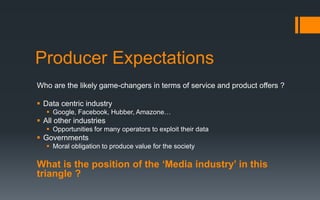
Producer Expectations
Who are the likely game-changers in terms of service and product offers ?
 Data centric industry
 Google, Facebook, Hubber, Amazone…
 All other industries
 Opportunities for many operators to exploit their data
 Governments
 Moral obligation to produce value for the society
What is the position of the ‘Media industry’ in this
triangle ?
HOW ?
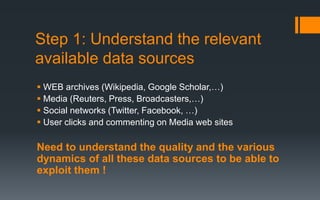
Step 1: Understand the relevant
available data sources
 WEB archives (Wikipedia, Google Scholar,…)
 Media (Reuters, Press, Broadcasters,…)
 Social networks (Twitter, Facebook, …)
 User clicks and commenting on Media web sites
Need to understand the quality and the various
dynamics of all these data sources to be able to
exploit them !
Step 2: Define a big data project in
terms of its objectives
 Define a specific context and a specific problem
 Define the “short-term” goals (1 – 3 years)
 Define the “long-term” goals (5 – 10 years)
 NB: both types of goals must be associated a priori with their
KPIs, and their horizon of evaluation
Need to synergize the possibility to exploit low
hanging fruits with the wish to fulfill the intrinsic
mission !
Step 3: Implement the project and
collect customer feedback
 Use agile methods to exploit early feedback from developers
and from customers
 Carefully choose what technology has to be developed ‘in-
house’ and what technology should be ‘imported’
 Define strategic ‘alliances’ in terms of technology development
and CRM strategy
Need to ensure fast success stories to enable
sustainability
Summary
We need to build on 4 exogenous
trends to define a business model
 Trends in the world of Science
 what we will able to do in principle
 Trends in the world of Technology
 what kind of affordable tools will be available to do this
 Trends in the world of Producers
 who will be able to provide the set of services and products
 Trends in the world of Consumers
 what would the utility of these services/products be to society
 Quick wins / low hanging fruits, and
 Sustainable business models
Ensure a synergy between
Understand the ecosystem
 Data sources, actors, trends in science and tech
 Explicit KPIs and evaluation horizon
We need to
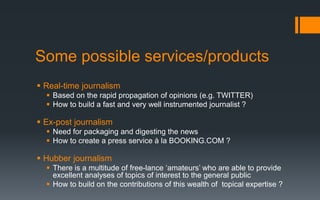
Some possible services/products
 Real-time journalism
 Based on the rapid propagation of opinions (e.g. TWITTER)
 How to build a fast and very well instrumented journalist ?
 Ex-post journalism
 Need for packaging and digesting the news
 How to create a press service à la BOOKING.COM ?
 Hubber journalism
 There is a multitude of free-lance ‘amateurs’ who are able to provide
excellent analyses of topics of interest to the general public
 How to build on the contributions of this wealth of topical expertise ?
Leveraging Big Data : why and how ?

Leveraging Big Data : why and how ?

  • 1.
    Leveraging Big Data Why andHow ? Louis WEHENKEL Montefiore Institute - University of Liège - Belgium
  • 2.
    Three main messages A.To exploit Big Data opportunities, we first need to model the concerned Ecosystem - Internal and external data generating processes - The exogenous actors: customers, governments, competition - Our key performance indicators and targets A. The concerned Technology and Science are both moving very fast B. We need to synergize Short-term and Long-term goals to develop a viable strategy
  • 3.
    Weather, Environment Rest of the society& economy Electric Power System T&D Operators Regulators Consumers Producers Markets Suppliers Example: the “Electric Energy” ecosystem…
  • 4.
    The Ecosystem ofJournalism ?
  • 5.
    The Ecosystem ofJournalism ! “Exogenous” Data Sources People in their Bubbles
  • 6.
  • 7.
    Trends in Technology Themain tools becoming available at low cost  Sensors and the Internet of Things  High-throughput data collection empowered  Cloud storage, GPUs, and HPC  Massive computational data exploitation empowered  Virtual reality and Computer vision  Versatile Human-Computer interaction empowered
  • 8.
    Trends in Science Themain results in Data Science and Artificial Intelligence  The ‘Machine Learning wave’  The ‘Natural Language Processing wave’  The ‘Robotics wave’  The ‘Augmented Intelligence wave’
  • 9.
  • 10.
    First, we needto understand the expectations of consumers
  • 11.
    Consumer Expectations What isexpected from the media industry by individuals, social groups, governments, and economies ?  The shorter-term practical utility of Big-Data to consumers  How we would like the world to be for us now and here…  The longer-term impact in terms of ethical aspects  How we prepare the world for our children and grand-children… What can/should the ‘Media industry’ offer to encounter these expectations ?
  • 12.
    Second, we needto understand the rest of the data intensive industry
  • 13.
    Producer Expectations Who arethe likely game-changers in terms of service and product offers ?  Data centric industry  Google, Facebook, Hubber, Amazone…  All other industries  Opportunities for many operators to exploit their data  Governments  Moral obligation to produce value for the society What is the position of the ‘Media industry’ in this triangle ?
  • 14.
  • 15.
    Step 1: Understandthe relevant available data sources  WEB archives (Wikipedia, Google Scholar,…)  Media (Reuters, Press, Broadcasters,…)  Social networks (Twitter, Facebook, …)  User clicks and commenting on Media web sites Need to understand the quality and the various dynamics of all these data sources to be able to exploit them !
  • 16.
    Step 2: Definea big data project in terms of its objectives  Define a specific context and a specific problem  Define the “short-term” goals (1 – 3 years)  Define the “long-term” goals (5 – 10 years)  NB: both types of goals must be associated a priori with their KPIs, and their horizon of evaluation Need to synergize the possibility to exploit low hanging fruits with the wish to fulfill the intrinsic mission !
  • 17.
    Step 3: Implementthe project and collect customer feedback  Use agile methods to exploit early feedback from developers and from customers  Carefully choose what technology has to be developed ‘in- house’ and what technology should be ‘imported’  Define strategic ‘alliances’ in terms of technology development and CRM strategy Need to ensure fast success stories to enable sustainability
  • 18.
  • 19.
    We need tobuild on 4 exogenous trends to define a business model  Trends in the world of Science  what we will able to do in principle  Trends in the world of Technology  what kind of affordable tools will be available to do this  Trends in the world of Producers  who will be able to provide the set of services and products  Trends in the world of Consumers  what would the utility of these services/products be to society
  • 20.
     Quick wins/ low hanging fruits, and  Sustainable business models Ensure a synergy between Understand the ecosystem  Data sources, actors, trends in science and tech  Explicit KPIs and evaluation horizon We need to
  • 21.
    Some possible services/products Real-time journalism  Based on the rapid propagation of opinions (e.g. TWITTER)  How to build a fast and very well instrumented journalist ?  Ex-post journalism  Need for packaging and digesting the news  How to create a press service à la BOOKING.COM ?  Hubber journalism  There is a multitude of free-lance ‘amateurs’ who are able to provide excellent analyses of topics of interest to the general public  How to build on the contributions of this wealth of topical expertise ?