Created by BT and Cyber Security Challenge UK
TOPIC: Computer Networks
LEARNING OBJECTIVES:
• Define a computer network
• Benefits and risks of computer networks
• The main types of computer network
Teacher Activity Pupil Activity
Starter activity
(5-10 mins)
[individual/paired
or group]
Define what a computer network is:
A computer network is a telecommunications network which
allows computers to exchange data
Discuss (individual/paired or
group) what you think a
computer network is
Created by BT and Cyber Security Challenge UK
Main activity one
(15 mins)
[individual/paired
or group]
Explain the benefits and risks of a computer network:
Benefits:
• Optimisation
- Files can be backed up in case of a disaster
• Storage Space
- Storage could be up to terabits of space which would need
massive storage houses were they to be stored by paper format
- You can additionally get extra space through Google Drive
• Save money
- Computer networks allows you to store information which can
be accessed by other individuals, complete multiple tasks using
different software applications and be able to communicate
instantly. All which could possibly take up to a day to do could be
done within a couple hours.
• Secure
- Users cannot see other users’ files unlike on stand-alone
machines.
• Instant Communication
- Using WhatsApp/Lync, you are able to talk to someone across
the world instantly
Risks of Computer networks
• Redundant technology
- Redundant technology causes security risks as companies stop
patching old systems, which introduces more risk
• Cyber attacks
- Due to the cyber threats, you could be at risk of a cyber-attack and
information could be stolen from your server. You could be fined
depending on what type of information was being stored
• Denial of service
- You could be denied access to information intentionally/
accidentally which could cost your business and loss your
information.
• Computers are expensive to manage and maintain
- Hence you may in turn not patch and systems and put your network
at greater risk.
Class discussion (individual/
paired or group) or have mix
and match cards: What you
think the benefits and risks are
of a computer network
The pupils need to come up with
as many different benefits as
they can think of in 5 minutes
The pupils need come up with
as many different risks they can
think of in 5 minutes
Class discussion
Note down the most sensible
answers for the benefits and
risks of a computer network.
Ensure that realistic reasons
have also been stated
Created by BT and Cyber Security Challenge UK
Plenary one
(5-10 mins)
Assess learning against the learning objectives
• This is an open activity whereby the teacher will decide on the best
approach to do this based on the pedagogical approach your school
takes on assessment.
For example:
• 5 minute timed writing exercise
on what has been learned so far
• Fill in class notes
• Have a discussion
• Answer open questions
• Answer directed questions
Note down the most sensible
answers for the benefits and
risks of a computer network.
Ensure that realistic reasons
have also been stated
Created by BT and Cyber Security Challenge UK
Main activity two
(15 mins)
[individual/paired
or group]
The main types of computer network:
o Personal Area Network (PAN)
o Local Area Network (LAN)
o Wide Area Network (WAN)
Personal Area Network (PAN)
A PAN is a very small network that usually consists of personal devices
that interconnect including; computers, tablets, phones, Bluetooth
headsets, printers.
Bluetooth PAN
A Bluetooth PAN is where Bluetooth enabled devices would connect
together to form a network an example of this would be a phone and
a hands-free headset connecting together in which voice is transferred
between the two devices.
Local Area Network (LAN)
A local area network (LAN) is a group of computers and associated
devices that share a common communications line or wireless link
to a server. Typically, a LAN encompasses computers and peripherals
connected to a server within a distinct geographic area such as an
office or a commercial establishment. Computers and other mobile
devices use a LAN connection to share resources such as a printer
or network storage.
Advantages
•Speed - One of the major advantages with LANs are the speeds
they can reach. A LAN can operate up to 30x faster than a WAN
•Cost - Another advantage to having a LAN connection is the cost. It
is relatively cheap to have as it tends to require less hassle to set up
and less advanced infrastructure to keep it running.
•Ease of Setup - A LAN connection tends to require some relatively
simple things to set it up. All you need is some Ethernet cables, a
network switch, and you are good to go. Alternatively, you can also
see LANs being done over Wi-Fi, or you can use Wi-Fi in conjunction
with standard Ethernet connections to create a LAN available to all
kinds of devices, whether it be a smartphone or a desktop computer.
Disadvantages
•Limited to small area - The major disadvantage with a LAN is inher-
ent in its name. “Local” Area Networks are only good as far as you
can reach an Ethernet cable or Wi-Fi signal. Simply put, you cannot
buy an Ethernet cable that will reach throughout an entire building,
and a Wi-Fi connection rapidly deteriorates as you get further than
a few dozen meters away.
Class discussion (individual/
paired or group)
List all the devices they can
think of with Bluetooth and how
they interact.
An example would be a phone
and a wireless speaker. To test
the range of Bluetooth they can
play music through the speaker
and measure the clarity with
each metre they go further from
the speaker. This will help con-
solidate the various facts about
Bluetooth PANs.
Note down the advantages and
disadvantages of LAN
Note down the advantages and
disadvantages of WAN
Created by BT and Cyber Security Challenge UK
Main activity two
(15 mins)
[individual/paired
or group]
Wide Area Network (WAN)
A wide area network is a computer network that extends over a large
geographical distance. A WAN connects different smaller networks,
including local area networks (LAN). This ensures that computers and
users in one location can communicate with computers and users in
other locations. The internet is a big example of WAN.
Advantages:
•Allow for much larger and more intricate network
•Can cover near infinite geographical distance
•Sharing of data
Disadvantages:
•Speed is slower compared to LAN due to size – the further the
distance the slower the network.
•Harder to set up
High cost – technology required for WAN is expensive
Plenary two
(5-10 mins)
Assess learning against the learning objectives
This is an open activity whereby the teacher will decide on the best
approach to do this based on the pedagogical approach your school
takes on assessment.
For example:
• 5 minute timed writing exercise
on what has been learned so far
• Fill in class notes
• Have a discussion
• Answer open questions
• Answer directed questions
Homework
(optional)
Teacher choice based on homework policy of school. For example:
Draw or label a diagram the
different networks (PAN, LAN,
WAN)
Created by BT and Cyber Security Challenge UK
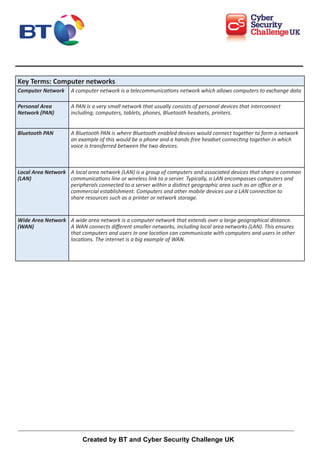
Key Terms: Computer networks
Computer Network A computer network is a telecommunications network which allows computers to exchange data
Personal Area
Network (PAN)
A PAN is a very small network that usually consists of personal devices that interconnect
including; computers, tablets, phones, Bluetooth headsets, printers.
Bluetooth PAN A Bluetooth PAN is where Bluetooth enabled devices would connect together to form a network
an example of this would be a phone and a hands-free headset connecting together in which
voice is transferred between the two devices.
Local Area Network
(LAN)
A local area network (LAN) is a group of computers and associated devices that share a common
communications line or wireless link to a server. Typically, a LAN encompasses computers and
peripherals connected to a server within a distinct geographic area such as an office or a
commercial establishment. Computers and other mobile devices use a LAN connection to
share resources such as a printer or network storage.
Wide Area Network
(WAN)
A wide area network is a computer network that extends over a large geographical distance.
A WAN connects different smaller networks, including local area networks (LAN). This ensures
that computers and users in one location can communicate with computers and users in other
locations. The internet is a big example of WAN.

Lesson-Plan-Computer-Networks.pdf

  • 1.
    Created by BTand Cyber Security Challenge UK TOPIC: Computer Networks LEARNING OBJECTIVES: • Define a computer network • Benefits and risks of computer networks • The main types of computer network Teacher Activity Pupil Activity Starter activity (5-10 mins) [individual/paired or group] Define what a computer network is: A computer network is a telecommunications network which allows computers to exchange data Discuss (individual/paired or group) what you think a computer network is
  • 2.
    Created by BTand Cyber Security Challenge UK Main activity one (15 mins) [individual/paired or group] Explain the benefits and risks of a computer network: Benefits: • Optimisation - Files can be backed up in case of a disaster • Storage Space - Storage could be up to terabits of space which would need massive storage houses were they to be stored by paper format - You can additionally get extra space through Google Drive • Save money - Computer networks allows you to store information which can be accessed by other individuals, complete multiple tasks using different software applications and be able to communicate instantly. All which could possibly take up to a day to do could be done within a couple hours. • Secure - Users cannot see other users’ files unlike on stand-alone machines. • Instant Communication - Using WhatsApp/Lync, you are able to talk to someone across the world instantly Risks of Computer networks • Redundant technology - Redundant technology causes security risks as companies stop patching old systems, which introduces more risk • Cyber attacks - Due to the cyber threats, you could be at risk of a cyber-attack and information could be stolen from your server. You could be fined depending on what type of information was being stored • Denial of service - You could be denied access to information intentionally/ accidentally which could cost your business and loss your information. • Computers are expensive to manage and maintain - Hence you may in turn not patch and systems and put your network at greater risk. Class discussion (individual/ paired or group) or have mix and match cards: What you think the benefits and risks are of a computer network The pupils need to come up with as many different benefits as they can think of in 5 minutes The pupils need come up with as many different risks they can think of in 5 minutes Class discussion Note down the most sensible answers for the benefits and risks of a computer network. Ensure that realistic reasons have also been stated
  • 3.
    Created by BTand Cyber Security Challenge UK Plenary one (5-10 mins) Assess learning against the learning objectives • This is an open activity whereby the teacher will decide on the best approach to do this based on the pedagogical approach your school takes on assessment. For example: • 5 minute timed writing exercise on what has been learned so far • Fill in class notes • Have a discussion • Answer open questions • Answer directed questions Note down the most sensible answers for the benefits and risks of a computer network. Ensure that realistic reasons have also been stated
  • 4.
    Created by BTand Cyber Security Challenge UK Main activity two (15 mins) [individual/paired or group] The main types of computer network: o Personal Area Network (PAN) o Local Area Network (LAN) o Wide Area Network (WAN) Personal Area Network (PAN) A PAN is a very small network that usually consists of personal devices that interconnect including; computers, tablets, phones, Bluetooth headsets, printers. Bluetooth PAN A Bluetooth PAN is where Bluetooth enabled devices would connect together to form a network an example of this would be a phone and a hands-free headset connecting together in which voice is transferred between the two devices. Local Area Network (LAN) A local area network (LAN) is a group of computers and associated devices that share a common communications line or wireless link to a server. Typically, a LAN encompasses computers and peripherals connected to a server within a distinct geographic area such as an office or a commercial establishment. Computers and other mobile devices use a LAN connection to share resources such as a printer or network storage. Advantages •Speed - One of the major advantages with LANs are the speeds they can reach. A LAN can operate up to 30x faster than a WAN •Cost - Another advantage to having a LAN connection is the cost. It is relatively cheap to have as it tends to require less hassle to set up and less advanced infrastructure to keep it running. •Ease of Setup - A LAN connection tends to require some relatively simple things to set it up. All you need is some Ethernet cables, a network switch, and you are good to go. Alternatively, you can also see LANs being done over Wi-Fi, or you can use Wi-Fi in conjunction with standard Ethernet connections to create a LAN available to all kinds of devices, whether it be a smartphone or a desktop computer. Disadvantages •Limited to small area - The major disadvantage with a LAN is inher- ent in its name. “Local” Area Networks are only good as far as you can reach an Ethernet cable or Wi-Fi signal. Simply put, you cannot buy an Ethernet cable that will reach throughout an entire building, and a Wi-Fi connection rapidly deteriorates as you get further than a few dozen meters away. Class discussion (individual/ paired or group) List all the devices they can think of with Bluetooth and how they interact. An example would be a phone and a wireless speaker. To test the range of Bluetooth they can play music through the speaker and measure the clarity with each metre they go further from the speaker. This will help con- solidate the various facts about Bluetooth PANs. Note down the advantages and disadvantages of LAN Note down the advantages and disadvantages of WAN
  • 5.
    Created by BTand Cyber Security Challenge UK Main activity two (15 mins) [individual/paired or group] Wide Area Network (WAN) A wide area network is a computer network that extends over a large geographical distance. A WAN connects different smaller networks, including local area networks (LAN). This ensures that computers and users in one location can communicate with computers and users in other locations. The internet is a big example of WAN. Advantages: •Allow for much larger and more intricate network •Can cover near infinite geographical distance •Sharing of data Disadvantages: •Speed is slower compared to LAN due to size – the further the distance the slower the network. •Harder to set up High cost – technology required for WAN is expensive Plenary two (5-10 mins) Assess learning against the learning objectives This is an open activity whereby the teacher will decide on the best approach to do this based on the pedagogical approach your school takes on assessment. For example: • 5 minute timed writing exercise on what has been learned so far • Fill in class notes • Have a discussion • Answer open questions • Answer directed questions Homework (optional) Teacher choice based on homework policy of school. For example: Draw or label a diagram the different networks (PAN, LAN, WAN)
  • 6.
    Created by BTand Cyber Security Challenge UK Key Terms: Computer networks Computer Network A computer network is a telecommunications network which allows computers to exchange data Personal Area Network (PAN) A PAN is a very small network that usually consists of personal devices that interconnect including; computers, tablets, phones, Bluetooth headsets, printers. Bluetooth PAN A Bluetooth PAN is where Bluetooth enabled devices would connect together to form a network an example of this would be a phone and a hands-free headset connecting together in which voice is transferred between the two devices. Local Area Network (LAN) A local area network (LAN) is a group of computers and associated devices that share a common communications line or wireless link to a server. Typically, a LAN encompasses computers and peripherals connected to a server within a distinct geographic area such as an office or a commercial establishment. Computers and other mobile devices use a LAN connection to share resources such as a printer or network storage. Wide Area Network (WAN) A wide area network is a computer network that extends over a large geographical distance. A WAN connects different smaller networks, including local area networks (LAN). This ensures that computers and users in one location can communicate with computers and users in other locations. The internet is a big example of WAN.