Lean Six Sigma Green Belt
Certification Course
Project: Define Phase
Case Study: Introduction
This case study is a project simulation. As we complete each Phase of the DMAIC (Define, Measure,
Analyze, Improve, and Control) process, different aspects of the case study will be presented to you.
You will be given background information, instructions, data sets, project updates, and all necessary
information to work through each step of the project and answer questions.
Note:
You will be using only some of the DMAIC tools and techniques in the case study to practice solving a
single problem.
The provided solutions are not the perfect answers; they are only one of many potential solutions.
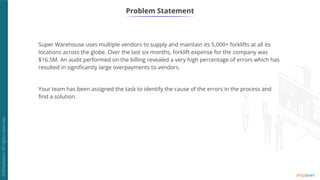
Problem Statement
Super Warehouse uses multiple vendors to supply and maintain its 5,000+ forklifts at all its
locations across the globe. Over the last six months, forklift expense for the company was
$16.5M. An audit performed on the billing revealed a very high percentage of errors which has
resulted in significantly large overpayments to vendors.
Your team has been assigned the task to identify the cause of the errors in the process and
find a solution.
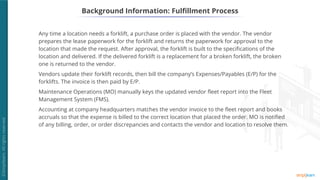
Background Information: Fulfillment Process
Any time a location needs a forklift, a purchase order is placed with the vendor. The vendor
prepares the lease paperwork for the forklift and returns the paperwork for approval to the
location that made the request. After approval, the forklift is built to the specifications of the
location and delivered. If the delivered forklift is a replacement for a broken forklift, the broken
one is returned to the vendor.
Vendors update their forklift records, then bill the company’s Expenses/Payables (E/P) for the
forklifts. The invoice is then paid by E/P.
Maintenance Operations (MO) manually keys the updated vendor fleet report into the Fleet
Management System (FMS).
Accounting at company headquarters matches the vendor invoice to the fleet report and books
accruals so that the expense is billed to the correct location that placed the order. MO is notified
of any billing, order, or order discrepancies and contacts the vendor and location to resolve them.
Project Update: The Voice of the Customer
Your project team wants to gather information from the locations and departments that
support the forklift procurement process. To accomplish this task, your team decides to
create and present a survey about the current situation.
The team brainstorms to create a list of questions for the survey and starts gathering
information to identify reasons for billing inaccuracies.
You will find the responses to the survey on the next slide.
The quotes in the following table represent the responses from the survey.
VoC responses
We were billed for a forklift that was returned three
months ago.
We don’t have that lift at our location even though it is
listed in the fleet report.
I never received that forklift. I submitted the changes to update the fleet report but
still cannot find the lift in the report.
The charges are right, but the lease amount is wrong. I need the serial number instead of the model number
to track lifts.
I don’t have anything by that serial number here. I am doubled billed for the same piece of equipment.
We are getting billed for items like fuel with no
explanation.
The vendor tracking numbers, and serial numbers
don’t match.
Vendor statements seem to be off every month. I have a credit on my P&L but no explanation as to
why.
We were billed for charges from third-party delivery
agents.
I have charges on my P&L and not sure what they are
for.
The vendor is overcharging for this forklift. I wish we could automate the system since everything
is manual.
Project Update: The Voice of the Customer
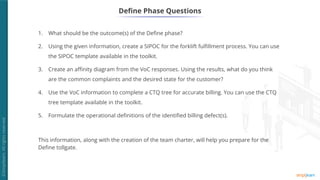
Define Phase Questions
1. What should be the outcome(s) of the Define phase?
2. Using the given information, create a SIPOC for the forklift fulfillment process. You can use
the SIPOC template available in the toolkit.
3. Create an affinity diagram from the VoC responses. Using the results, what do you think
are the common complaints and the desired state for the customer?
4. Use the VoC information to complete a CTQ tree for accurate billing. You can use the CTQ
tree template available in the toolkit.
5. Formulate the operational definitions of the identified billing defect(s).
This information, along with the creation of the team charter, will help you prepare for the
Define tollgate.
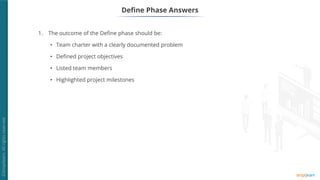
1. The outcome of the Define phase should be:
• Team charter with a clearly documented problem
• Defined project objectives
• Listed team members
• Highlighted project milestones
Define Phase Answers
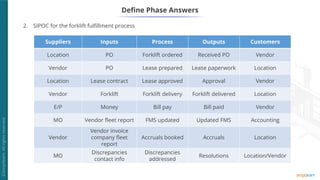
2. SIPOC for the forklift fulfillment process
Suppliers Inputs Process Outputs Customers
Location PO Forklift ordered Received PO Vendor
Vendor PO Lease prepared Lease paperwork Location
Location Lease contract Lease approved Approval Vendor
Vendor Forklift Forklift delivery Forklift delivered Location
E/P Money Bill pay Bill paid Vendor
MO Vendor fleet report FMS updated Updated FMS Accounting
Vendor
Vendor invoice
company fleet
report
Accruals booked Accruals Location
MO
Discrepancies
contact info
Discrepancies
addressed
Resolutions Location/Vendor
Define Phase Answers
3. Affinity Diagram shows the need to improve charges, billing, forklift tracking, accounting, and processes.
Charges Billing Tracking Accounting Process
The charges are
right but the lease
amount is wrong.
We were billed for a
forklift that was
returned three
months ago.
I never received that forklift.
I have a credit on
my P&L but no
explanation as to
why.
I wish we could
automate the system
since everything is
manual.
Vendor
statements seem
to be off every
month.
We are getting billed
for items like fuel
with no explanation.
I don’t have anything by
that serial number here.
I have charges on
my P&L and not
sure what they are
for.
I submitted the
changes to update the
fleet report but still
cannot find the lift in
the report.
We were billed for
charges from third
party delivery
agents.
I am doubled billed
for the same piece of
equipment.
We don’t have that lift at
our location even though it
is listed in the fleet report.
The vendor is
overcharging for
this forklift.
I need the serial number
instead of model number to
track lifts.
The vendor tracking
numbers, and serial
numbers don’t match.
Define Phase Answers
4. CTQ tree for accurate billing
Accurate
fulfillment
process
Accuracy
Bill accurate
Fleet report
accurate
Better tracking
Unique identifier
Visibility
Easy reconciliation
Fast
Accurate
reconciliation
Visibility
Need Driver CTQs
Define Phase Answers
5. A developed operational definition for a defect in billing could be:
Billing should accurately specify the actual costs of the forklifts, match the on-hand inventory,
and attribute the expenses to the correct locations within 30 days.
Define Phase Answers

Lesson_2.7_Project 01_Define_Phase_Forklift_Process.pdf

  • 1.
    Lean Six SigmaGreen Belt Certification Course
  • 2.
  • 3.
    Case Study: Introduction Thiscase study is a project simulation. As we complete each Phase of the DMAIC (Define, Measure, Analyze, Improve, and Control) process, different aspects of the case study will be presented to you. You will be given background information, instructions, data sets, project updates, and all necessary information to work through each step of the project and answer questions. Note: You will be using only some of the DMAIC tools and techniques in the case study to practice solving a single problem. The provided solutions are not the perfect answers; they are only one of many potential solutions.
  • 4.
    Problem Statement Super Warehouseuses multiple vendors to supply and maintain its 5,000+ forklifts at all its locations across the globe. Over the last six months, forklift expense for the company was $16.5M. An audit performed on the billing revealed a very high percentage of errors which has resulted in significantly large overpayments to vendors. Your team has been assigned the task to identify the cause of the errors in the process and find a solution.
  • 5.
    Background Information: FulfillmentProcess Any time a location needs a forklift, a purchase order is placed with the vendor. The vendor prepares the lease paperwork for the forklift and returns the paperwork for approval to the location that made the request. After approval, the forklift is built to the specifications of the location and delivered. If the delivered forklift is a replacement for a broken forklift, the broken one is returned to the vendor. Vendors update their forklift records, then bill the company’s Expenses/Payables (E/P) for the forklifts. The invoice is then paid by E/P. Maintenance Operations (MO) manually keys the updated vendor fleet report into the Fleet Management System (FMS). Accounting at company headquarters matches the vendor invoice to the fleet report and books accruals so that the expense is billed to the correct location that placed the order. MO is notified of any billing, order, or order discrepancies and contacts the vendor and location to resolve them.
  • 6.
    Project Update: TheVoice of the Customer Your project team wants to gather information from the locations and departments that support the forklift procurement process. To accomplish this task, your team decides to create and present a survey about the current situation. The team brainstorms to create a list of questions for the survey and starts gathering information to identify reasons for billing inaccuracies. You will find the responses to the survey on the next slide.
  • 7.
    The quotes inthe following table represent the responses from the survey. VoC responses We were billed for a forklift that was returned three months ago. We don’t have that lift at our location even though it is listed in the fleet report. I never received that forklift. I submitted the changes to update the fleet report but still cannot find the lift in the report. The charges are right, but the lease amount is wrong. I need the serial number instead of the model number to track lifts. I don’t have anything by that serial number here. I am doubled billed for the same piece of equipment. We are getting billed for items like fuel with no explanation. The vendor tracking numbers, and serial numbers don’t match. Vendor statements seem to be off every month. I have a credit on my P&L but no explanation as to why. We were billed for charges from third-party delivery agents. I have charges on my P&L and not sure what they are for. The vendor is overcharging for this forklift. I wish we could automate the system since everything is manual. Project Update: The Voice of the Customer
  • 8.
    Define Phase Questions 1.What should be the outcome(s) of the Define phase? 2. Using the given information, create a SIPOC for the forklift fulfillment process. You can use the SIPOC template available in the toolkit. 3. Create an affinity diagram from the VoC responses. Using the results, what do you think are the common complaints and the desired state for the customer? 4. Use the VoC information to complete a CTQ tree for accurate billing. You can use the CTQ tree template available in the toolkit. 5. Formulate the operational definitions of the identified billing defect(s). This information, along with the creation of the team charter, will help you prepare for the Define tollgate.
  • 9.
    1. The outcomeof the Define phase should be: • Team charter with a clearly documented problem • Defined project objectives • Listed team members • Highlighted project milestones Define Phase Answers
  • 10.
    2. SIPOC forthe forklift fulfillment process Suppliers Inputs Process Outputs Customers Location PO Forklift ordered Received PO Vendor Vendor PO Lease prepared Lease paperwork Location Location Lease contract Lease approved Approval Vendor Vendor Forklift Forklift delivery Forklift delivered Location E/P Money Bill pay Bill paid Vendor MO Vendor fleet report FMS updated Updated FMS Accounting Vendor Vendor invoice company fleet report Accruals booked Accruals Location MO Discrepancies contact info Discrepancies addressed Resolutions Location/Vendor Define Phase Answers
  • 11.
    3. Affinity Diagramshows the need to improve charges, billing, forklift tracking, accounting, and processes. Charges Billing Tracking Accounting Process The charges are right but the lease amount is wrong. We were billed for a forklift that was returned three months ago. I never received that forklift. I have a credit on my P&L but no explanation as to why. I wish we could automate the system since everything is manual. Vendor statements seem to be off every month. We are getting billed for items like fuel with no explanation. I don’t have anything by that serial number here. I have charges on my P&L and not sure what they are for. I submitted the changes to update the fleet report but still cannot find the lift in the report. We were billed for charges from third party delivery agents. I am doubled billed for the same piece of equipment. We don’t have that lift at our location even though it is listed in the fleet report. The vendor is overcharging for this forklift. I need the serial number instead of model number to track lifts. The vendor tracking numbers, and serial numbers don’t match. Define Phase Answers
  • 12.
    4. CTQ treefor accurate billing Accurate fulfillment process Accuracy Bill accurate Fleet report accurate Better tracking Unique identifier Visibility Easy reconciliation Fast Accurate reconciliation Visibility Need Driver CTQs Define Phase Answers
  • 13.
    5. A developedoperational definition for a defect in billing could be: Billing should accurately specify the actual costs of the forklifts, match the on-hand inventory, and attribute the expenses to the correct locations within 30 days. Define Phase Answers