Advanced Software Engineering
Paolo Bottoni
Block 6: Introduction to graphs
Overview
• Introduction to graphs
• Computing with graphs
• Graphs as metamodels
Block6GraIntro 2
Advanced Software Engineering
Introduction to graphs
• Graphs
• Labelled
• Typed
• Attributed
• Examples of models
Block6GraIntro 3
Advanced Software Engineering
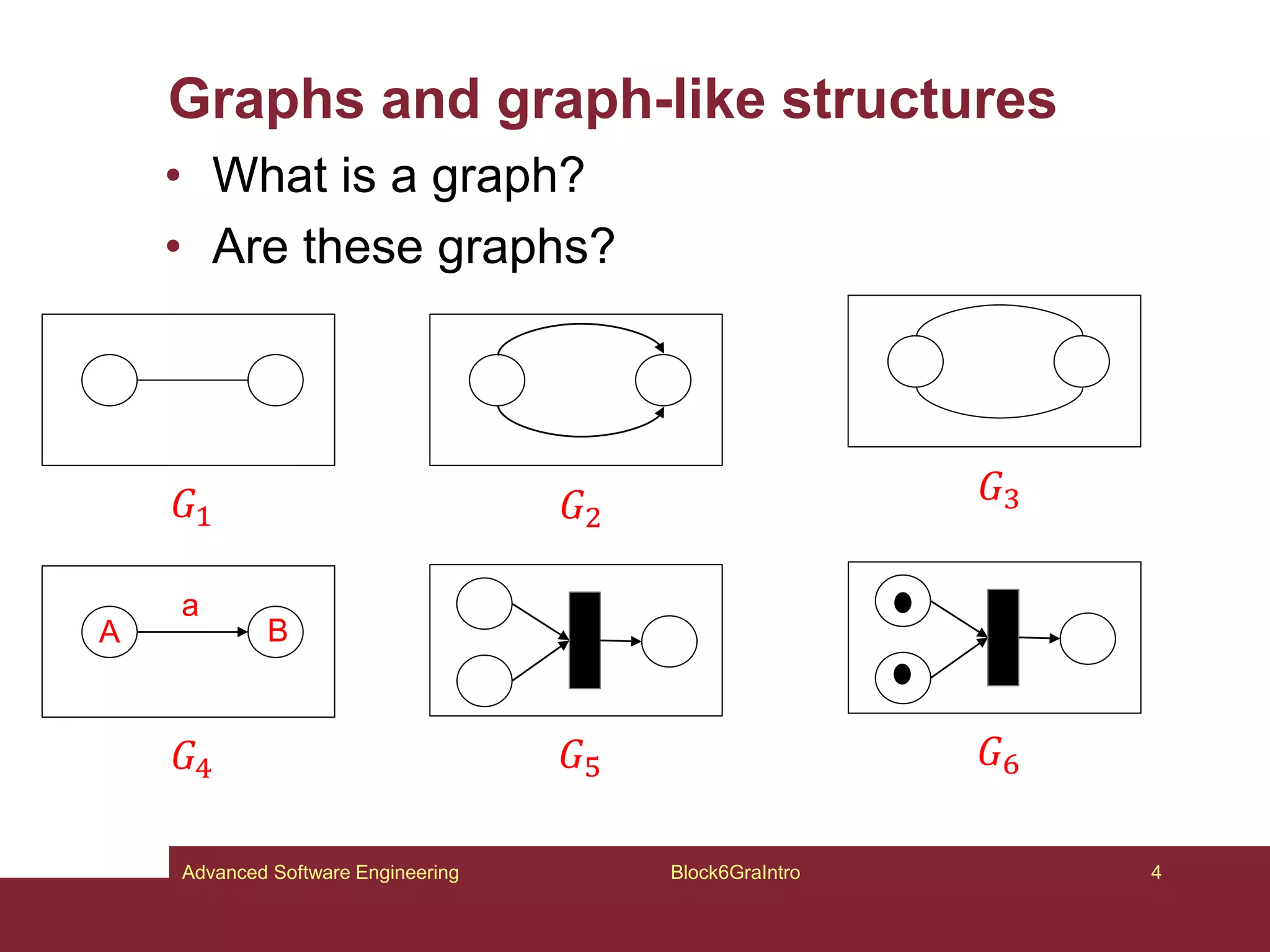
Graphs and graph-like structures
• What is a graph?
• Are these graphs?
Block6GraIntro 4
Advanced Software Engineering
𝐺1
𝐺3
𝐺2
𝐺4
A B
a
𝐺5 𝐺6
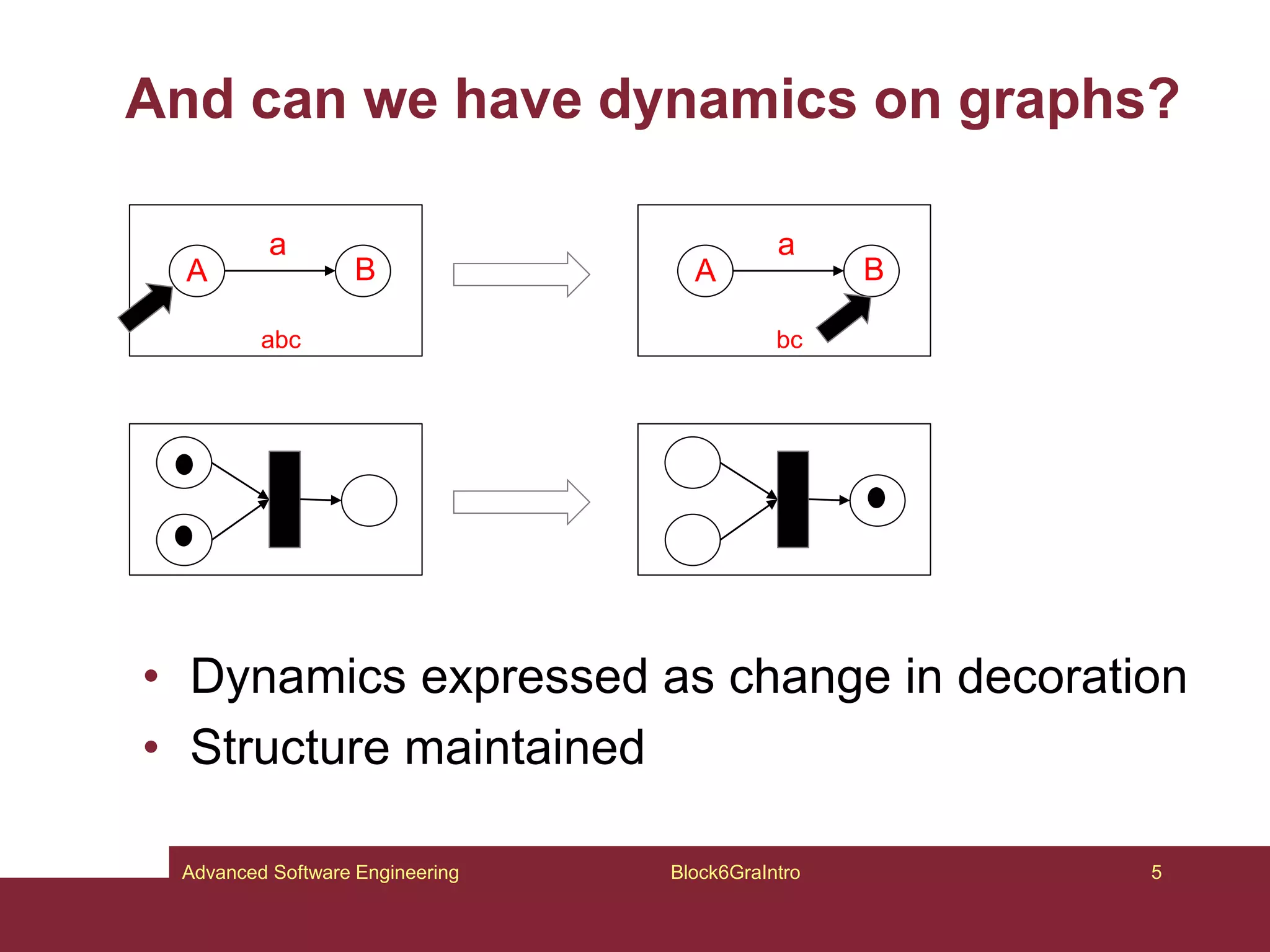
And can we have dynamics on graphs?
• Dynamics expressed as change in decoration
• Structure maintained
Block6GraIntro 5
Advanced Software Engineering
A B
a
abc
A B
a
bc
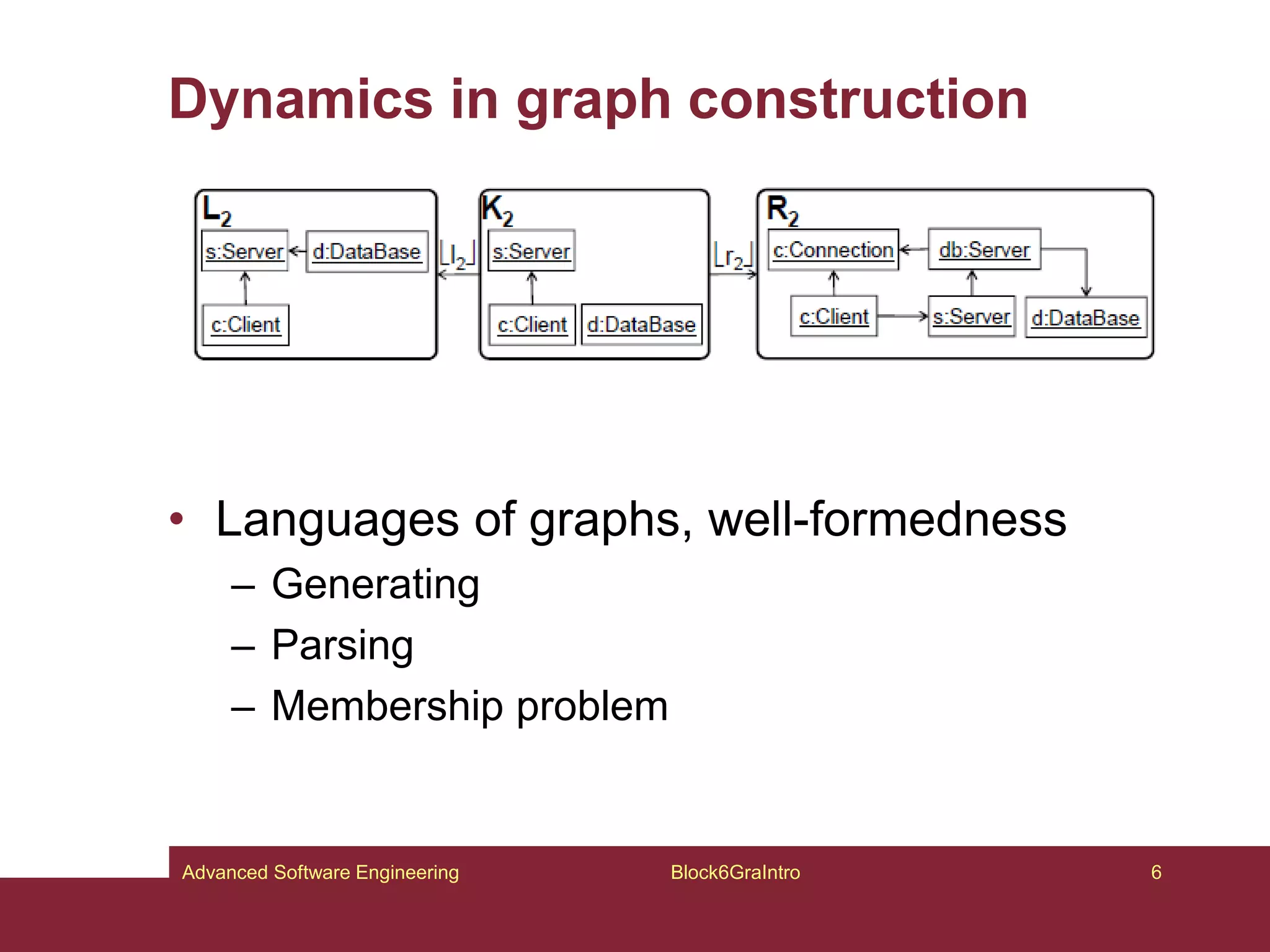
Dynamics in graph construction
• Languages of graphs, well-formedness
– Generating
– Parsing
– Membership problem
Block6GraIntro 6
Advanced Software Engineering
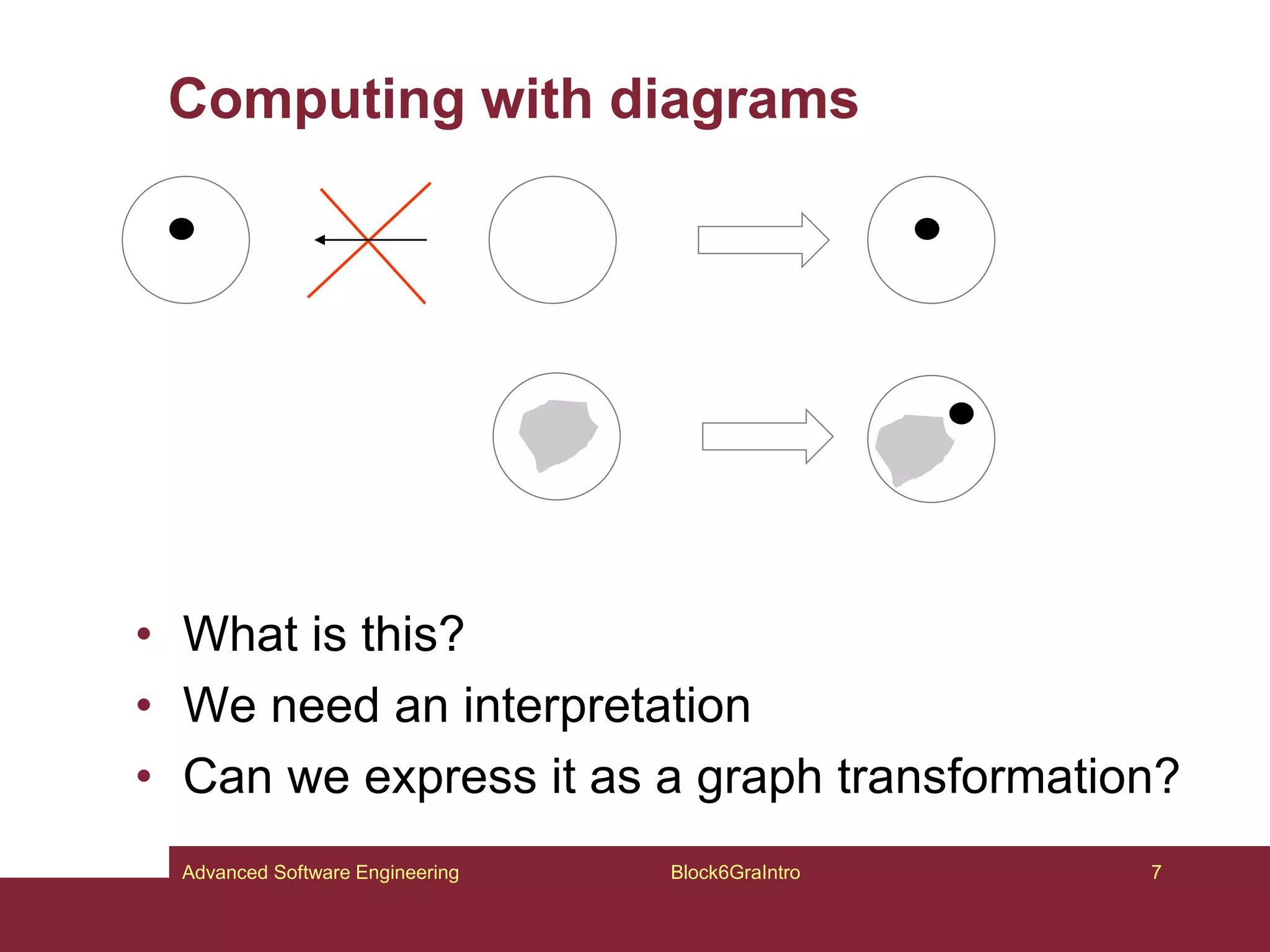
Computing with diagrams
• What is this?
• We need an interpretation
• Can we express it as a graph transformation?
Block6GraIntro 7
Advanced Software Engineering
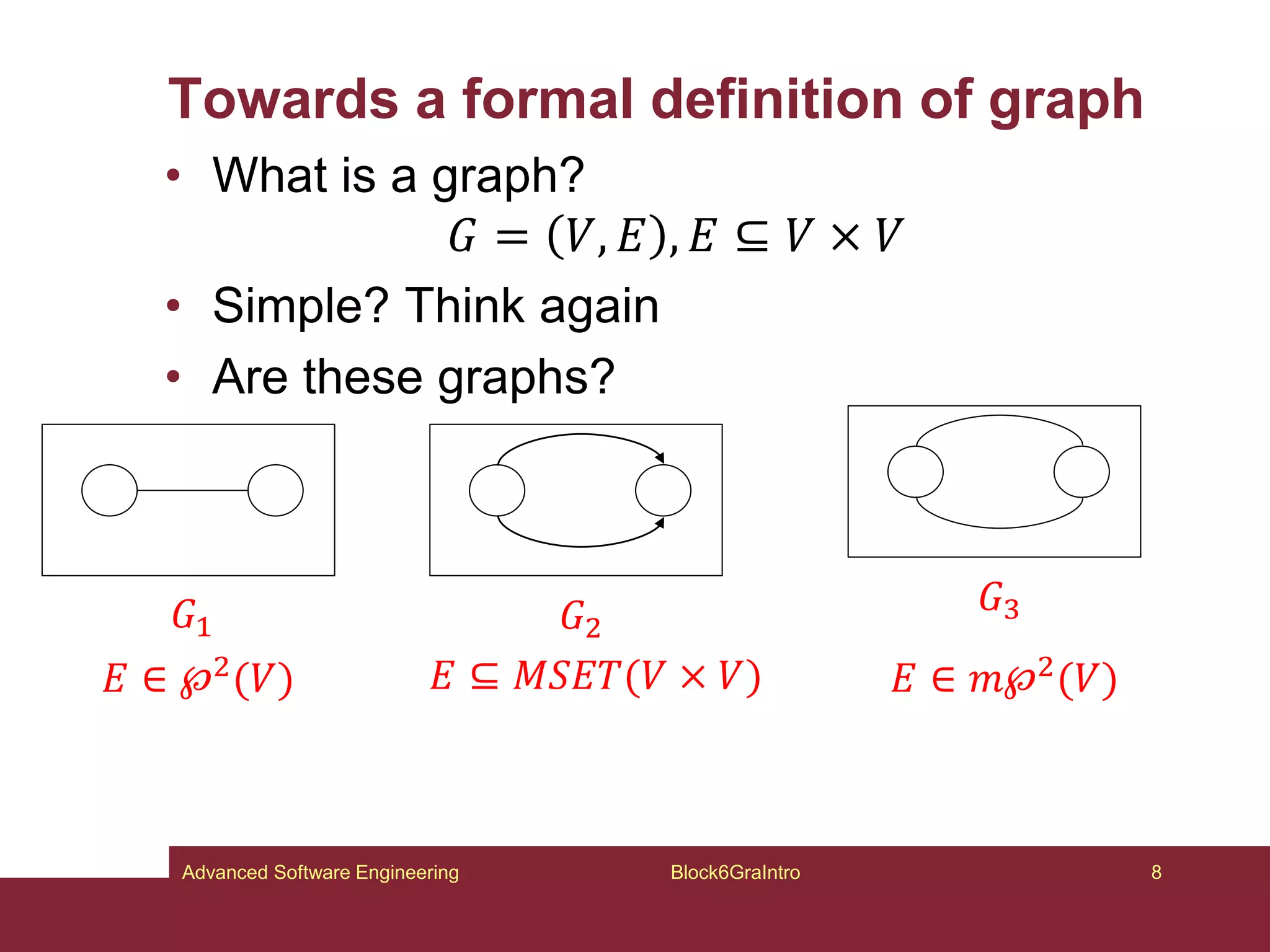
Towards a formal definition of graph
• What is a graph?
𝐺 = 𝑉, 𝐸 , 𝐸 ⊆ 𝑉 × 𝑉
• Simple? Think again
• Are these graphs?
Block6GraIntro 8
Advanced Software Engineering
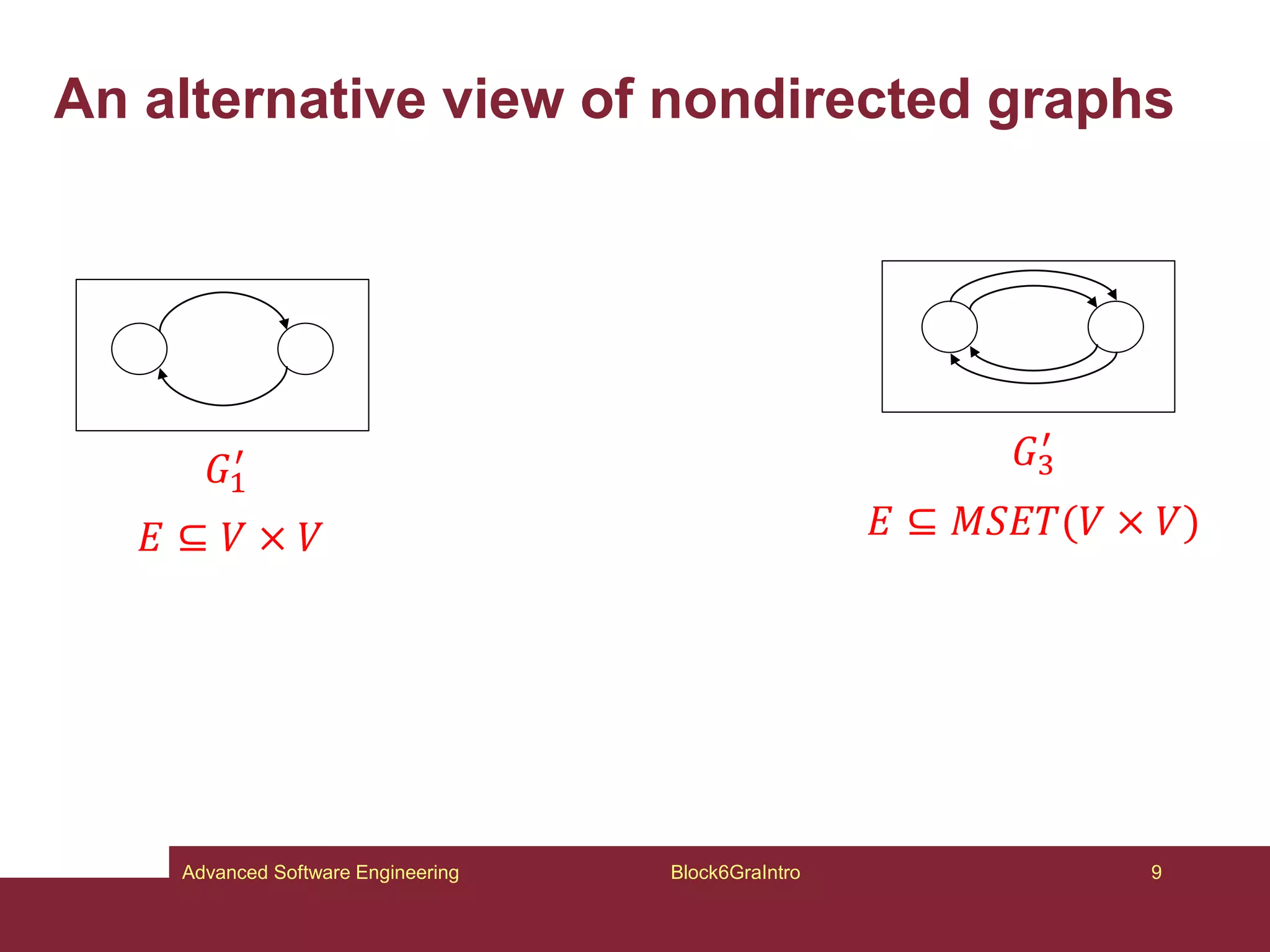
𝐺1
𝐺3
𝐸 ∈ ℘2
(𝑉) 𝐸 ∈ 𝑚℘2
(𝑉)
𝐸 ⊆ 𝑀𝑆𝐸𝑇(𝑉 × 𝑉)
𝐺2
An alternative view of nondirected graphs
Block6GraIntro 9
Advanced Software Engineering
𝐺1
′ 𝐺3
′
𝐸 ⊆ 𝑉 × 𝑉 𝐸 ⊆ 𝑀𝑆𝐸𝑇(𝑉 × 𝑉)
Towards a formal definition of graph
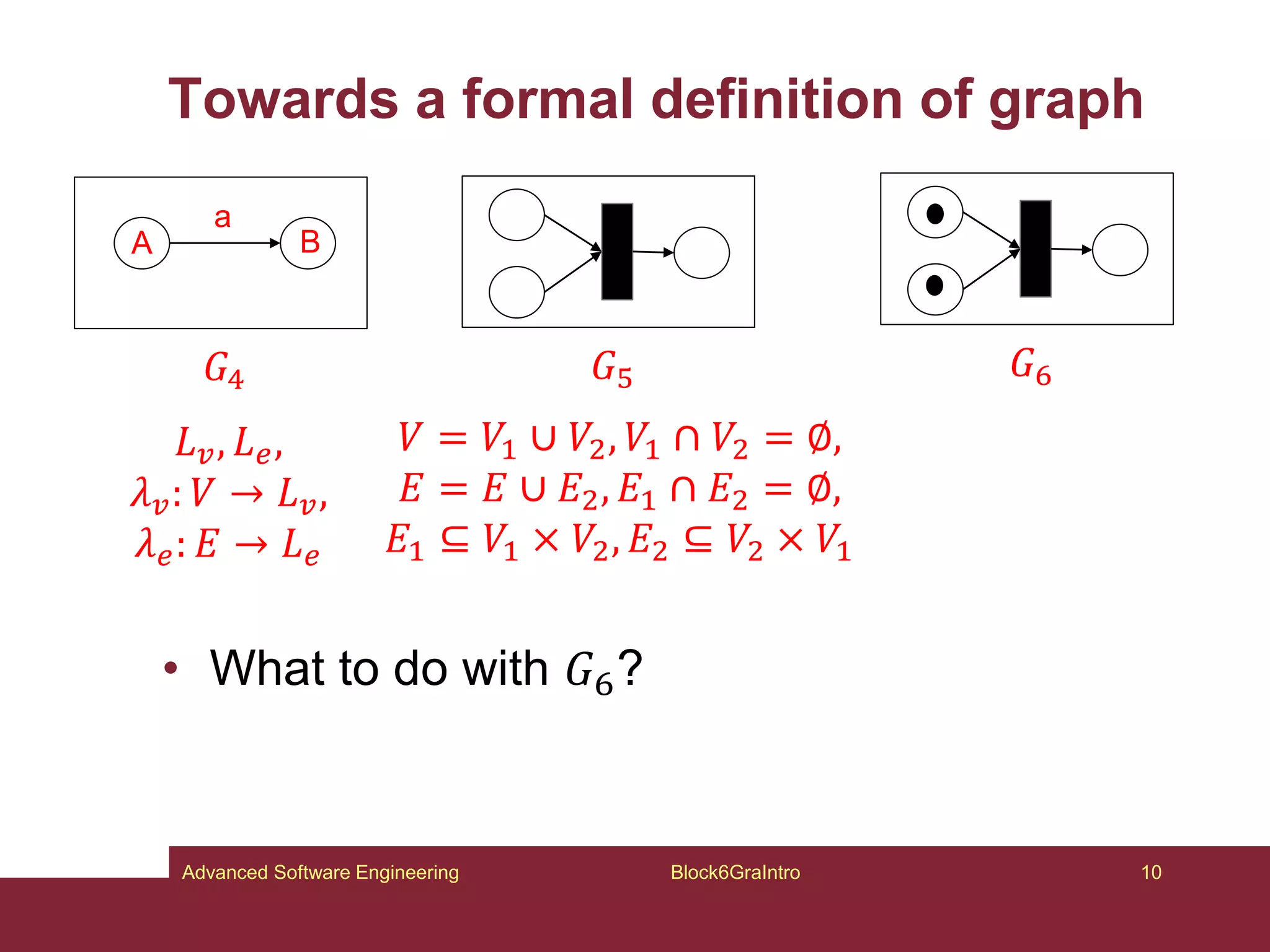
• What to do with 𝐺6?
Block6GraIntro 10
Advanced Software Engineering
𝐿𝑣, 𝐿𝑒,
𝜆𝑣: 𝑉 → 𝐿𝑣,
𝜆𝑒: 𝐸 → 𝐿𝑒
𝐺4
A B
a
𝐺5 𝐺6
𝑉 = 𝑉1 ∪ 𝑉2, 𝑉1 ∩ 𝑉2 = ∅,
𝐸 = 𝐸 ∪ 𝐸2, 𝐸1 ∩ 𝐸2 = ∅,
𝐸1 ⊆ 𝑉1 × 𝑉2, 𝐸2 ⊆ 𝑉2 × 𝑉1
A more general definition of graph
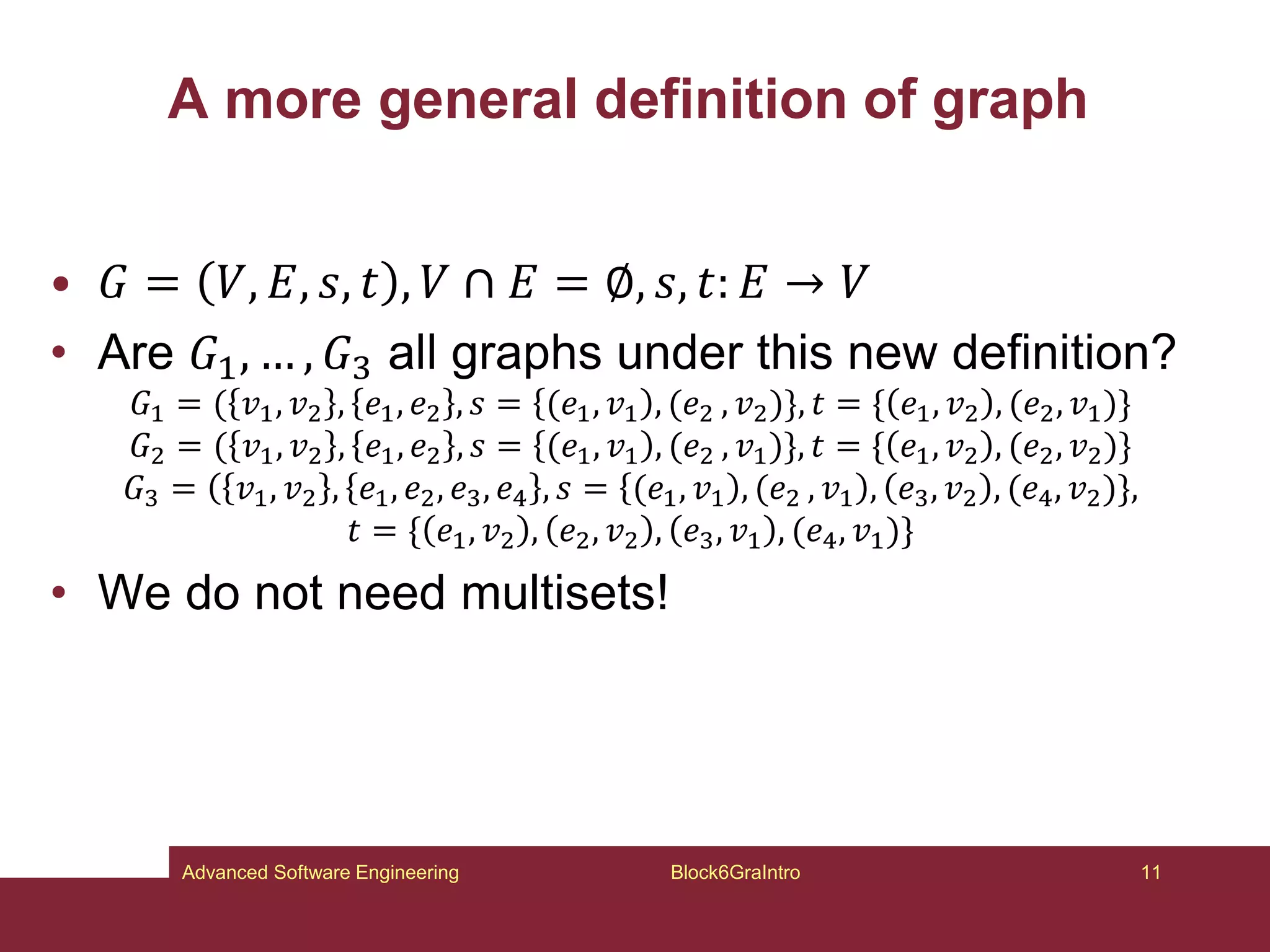
• 𝐺 = 𝑉, 𝐸, 𝑠, 𝑡 , 𝑉 ∩ 𝐸 = ∅, 𝑠, 𝑡: 𝐸 → 𝑉
• Are 𝐺1, … , 𝐺3 all graphs under this new definition?
𝐺1 = ( 𝑣1, 𝑣2 , 𝑒1, 𝑒2 , 𝑠 = (𝑒1, 𝑣1 , (𝑒2 , 𝑣2)}, 𝑡 = { 𝑒1, 𝑣2 , (𝑒2, 𝑣1)}
𝐺2 = ( 𝑣1, 𝑣2 , 𝑒1, 𝑒2 , 𝑠 = (𝑒1, 𝑣1 , (𝑒2 , 𝑣1)}, 𝑡 = { 𝑒1, 𝑣2 , (𝑒2, 𝑣2)}
𝐺3 = 𝑣1, 𝑣2 , 𝑒1, 𝑒2, 𝑒3, 𝑒4 , 𝑠 = (𝑒1, 𝑣1 , (𝑒2 , 𝑣1 , 𝑒3, 𝑣2 , (𝑒4, 𝑣2)},
𝑡 = { 𝑒1, 𝑣2 , 𝑒2, 𝑣2 , 𝑒3, 𝑣1 , (𝑒4, 𝑣1)}
• We do not need multisets!
Block6GraIntro 11
Advanced Software Engineering
Adding labels and partitioning
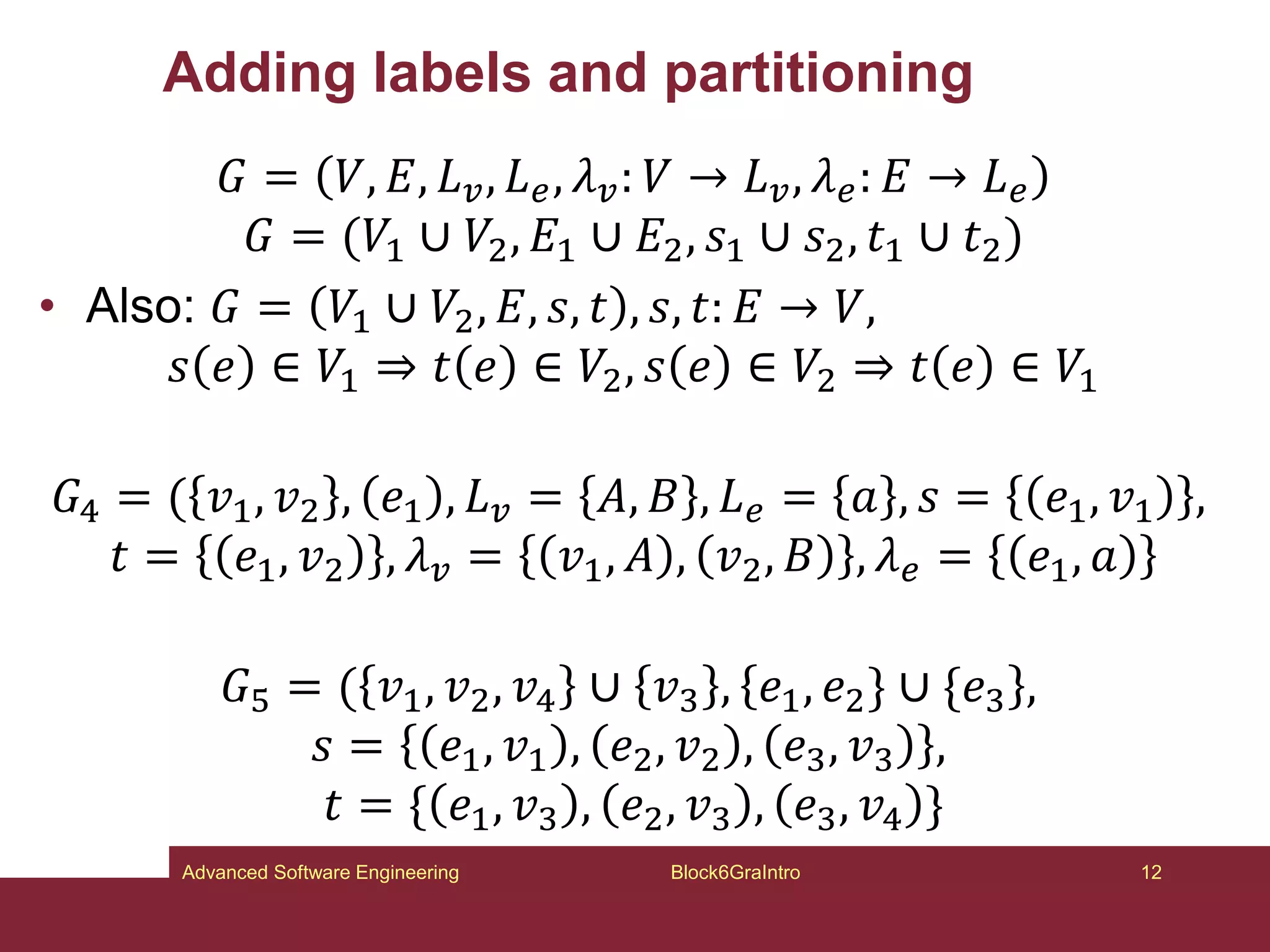
𝐺 = 𝑉, 𝐸, 𝐿𝑣, 𝐿𝑒, 𝜆𝑣: 𝑉 → 𝐿𝑣, 𝜆𝑒: 𝐸 → 𝐿𝑒
𝐺 = (𝑉1 ∪ 𝑉2, 𝐸1 ∪ 𝐸2, 𝑠1 ∪ 𝑠2, 𝑡1 ∪ 𝑡2)
• Also: 𝐺 = 𝑉1 ∪ 𝑉2, 𝐸, 𝑠, 𝑡 , 𝑠, 𝑡: 𝐸 → 𝑉,
𝑠 𝑒 ∈ 𝑉1 ⇒ 𝑡 𝑒 ∈ 𝑉2, 𝑠 𝑒 ∈ 𝑉2 ⇒ 𝑡 𝑒 ∈ 𝑉1
𝐺4 = ( 𝑣1, 𝑣2 , 𝑒1 , 𝐿𝑣 = 𝐴, 𝐵 , 𝐿𝑒 = 𝑎 , 𝑠 = 𝑒1, 𝑣1 ,
𝑡 = 𝑒1, 𝑣2 , 𝜆𝑣 = 𝑣1, 𝐴 , 𝑣2, 𝐵 , 𝜆𝑒 = 𝑒1, 𝑎
𝐺5 = ( 𝑣1, 𝑣2, 𝑣4 ∪ 𝑣3 , 𝑒1, 𝑒2} ∪ {𝑒3 ,
𝑠 = 𝑒1, 𝑣1 , 𝑒2, 𝑣2 , 𝑒3, 𝑣3 ,
𝑡 = { 𝑒1, 𝑣3 , 𝑒2, 𝑣3 , 𝑒3, 𝑣4 }
Block6GraIntro 12
Advanced Software Engineering
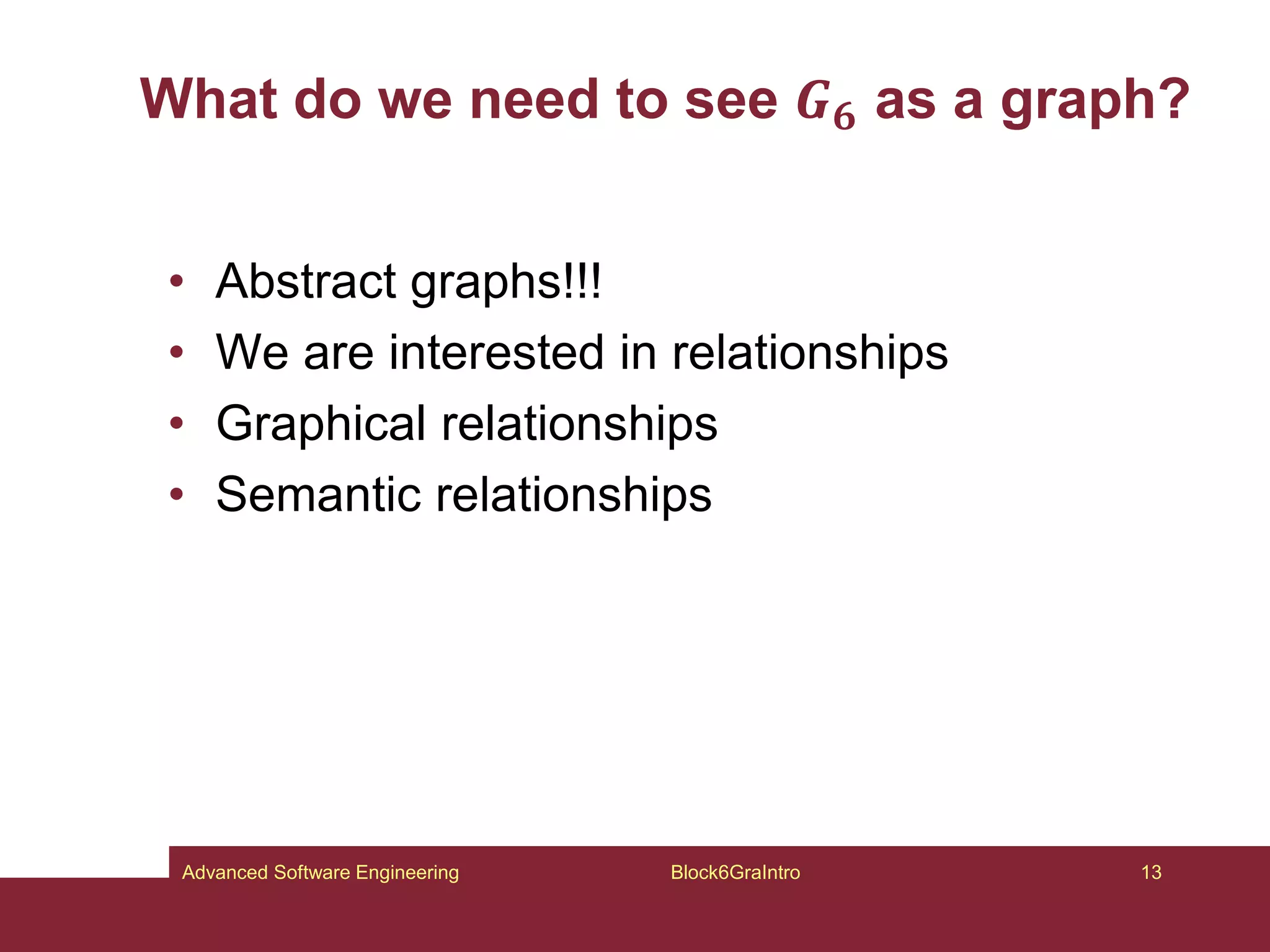
What do we need to see 𝑮𝟔 as a graph?
• Abstract graphs!!!
• We are interested in relationships
• Graphical relationships
• Semantic relationships
Block6GraIntro 13
Advanced Software Engineering
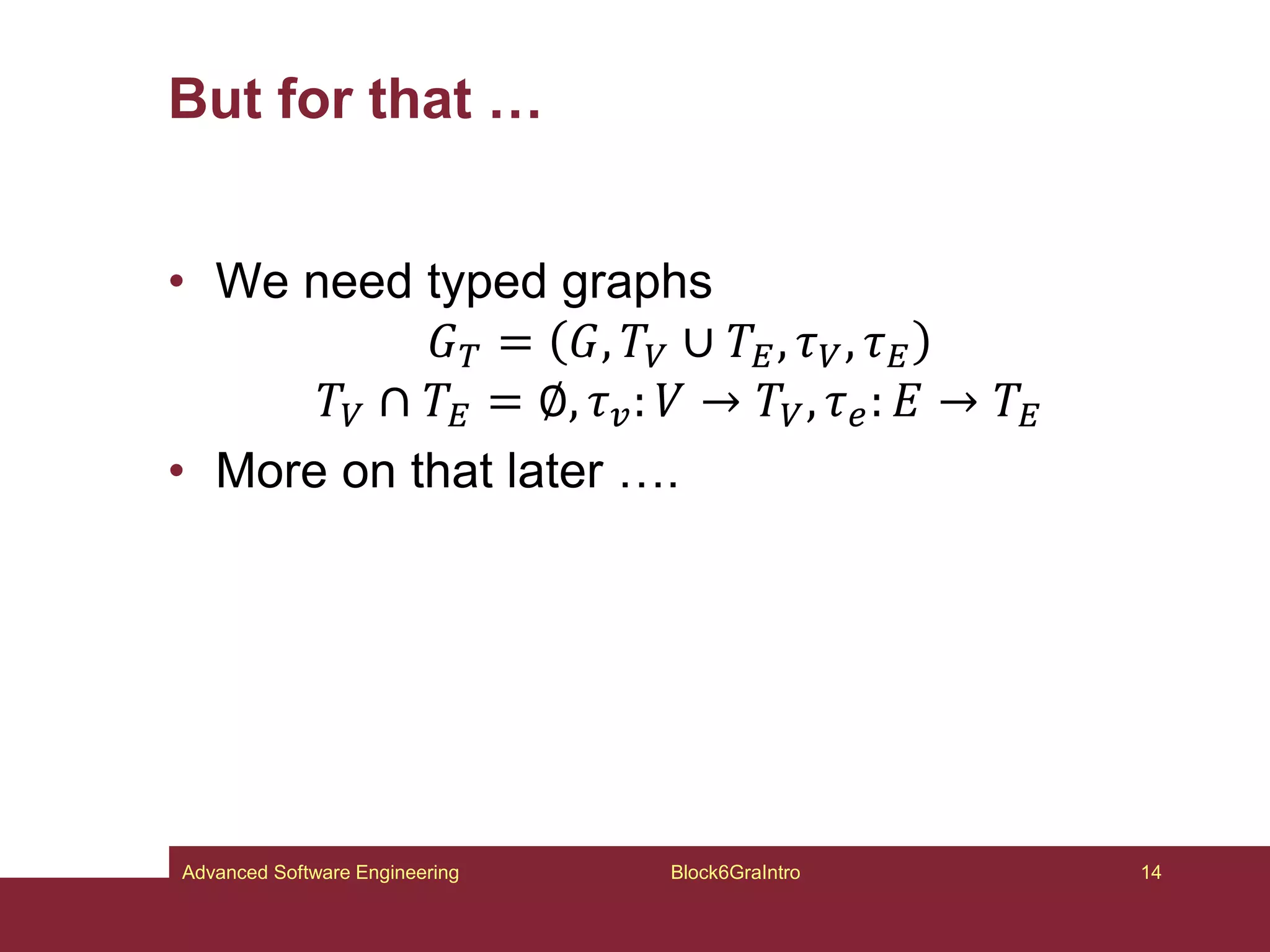
But for that …
• We need typed graphs
𝐺𝑇 = 𝐺, 𝑇𝑉 ∪ 𝑇𝐸, 𝜏𝑉, 𝜏𝐸
𝑇𝑉 ∩ 𝑇𝐸 = ∅, 𝜏𝑣: 𝑉 → 𝑇𝑉, 𝜏𝑒: 𝐸 → 𝑇𝐸
• More on that later ….
Block6GraIntro 14
Advanced Software Engineering
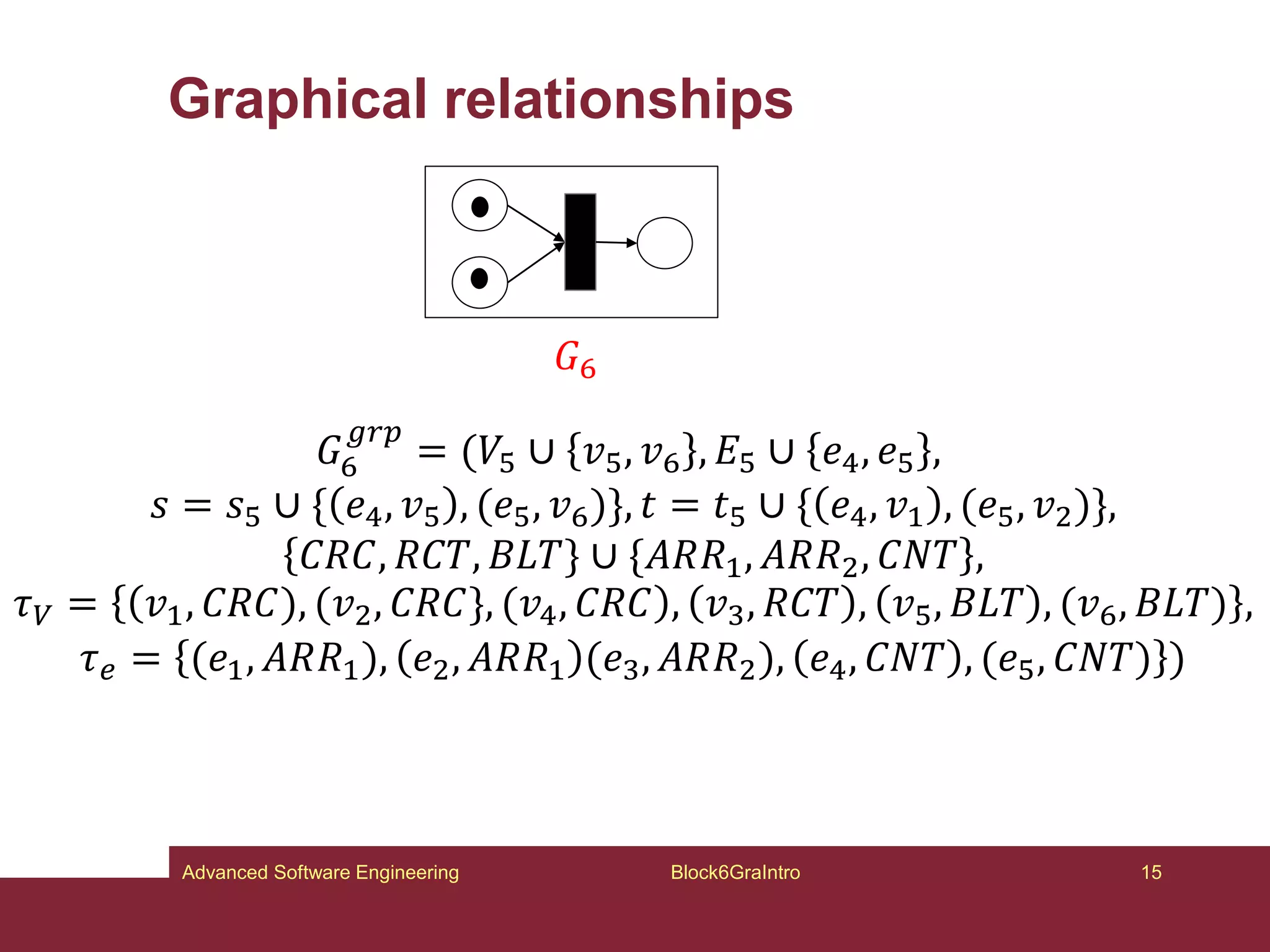
Graphical relationships
Block6GraIntro 15
Advanced Software Engineering
𝐺6
𝐺6
𝑔𝑟𝑝
= (𝑉5 ∪ 𝑣5, 𝑣6 , 𝐸5 ∪ 𝑒4, 𝑒5 ,
𝑠 = 𝑠5 ∪ { 𝑒4, 𝑣5 , (𝑒5, 𝑣6)}, 𝑡 = 𝑡5 ∪ { 𝑒4, 𝑣1 , (𝑒5, 𝑣2)},
𝐶𝑅𝐶, 𝑅𝐶𝑇, 𝐵𝐿𝑇} ∪ {𝐴𝑅𝑅1, 𝐴𝑅𝑅2, 𝐶𝑁𝑇 ,
𝜏𝑉 = 𝑣1, 𝐶𝑅𝐶), (𝑣2, 𝐶𝑅𝐶}, (𝑣4, 𝐶𝑅𝐶 , 𝑣3, 𝑅𝐶𝑇 , 𝑣5, 𝐵𝐿𝑇 , (𝑣6, 𝐵𝐿𝑇) ,
𝜏𝑒 = (𝑒1, 𝐴𝑅𝑅1), 𝑒2, 𝐴𝑅𝑅1 (𝑒3, 𝐴𝑅𝑅2), 𝑒4, 𝐶𝑁𝑇 , (𝑒5, 𝐶𝑁𝑇) )
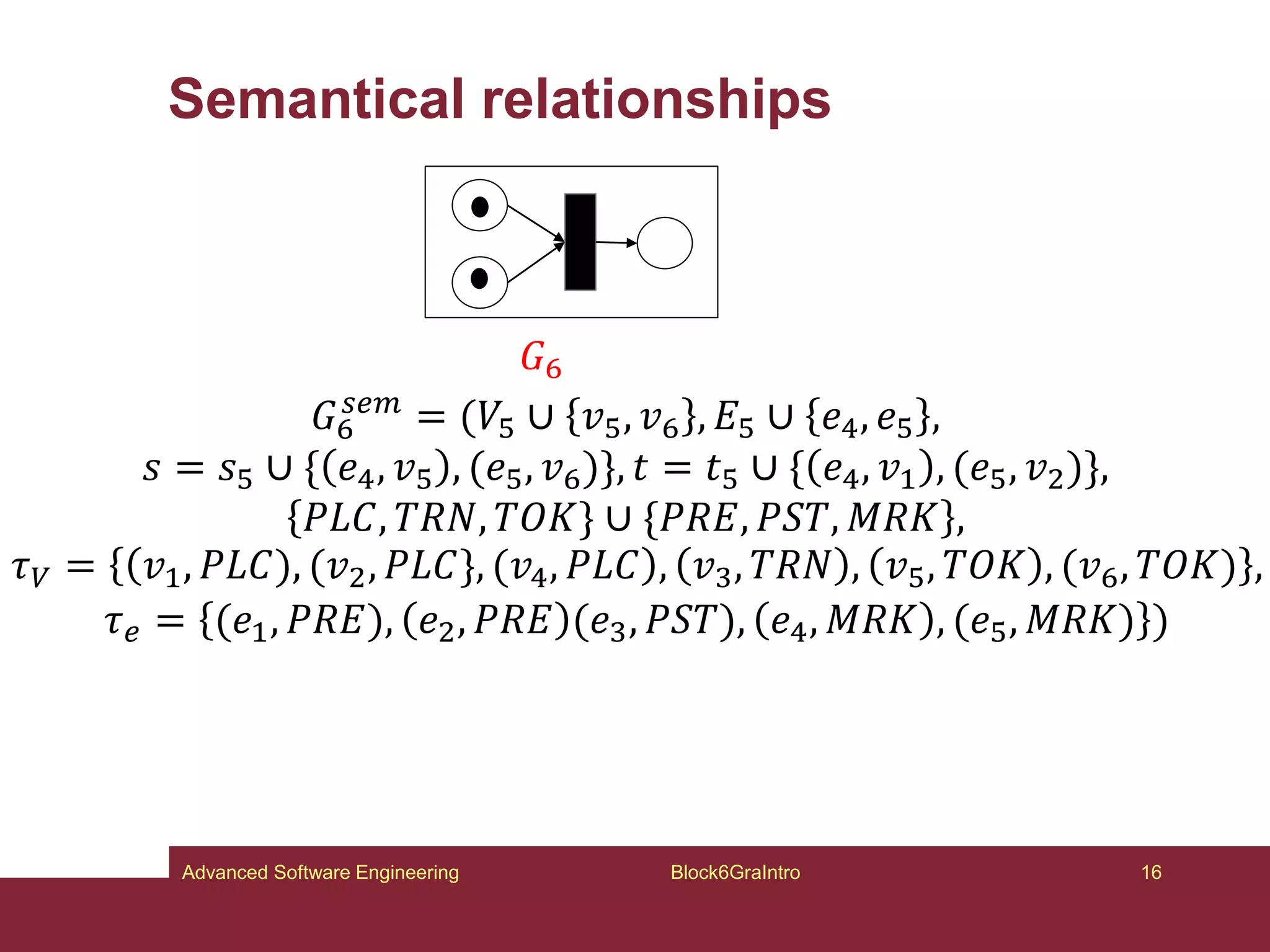
Semantical relationships
Block6GraIntro 16
Advanced Software Engineering
𝐺6
𝐺6
𝑠𝑒𝑚
= (𝑉5 ∪ 𝑣5, 𝑣6 , 𝐸5 ∪ 𝑒4, 𝑒5 ,
𝑠 = 𝑠5 ∪ { 𝑒4, 𝑣5 , (𝑒5, 𝑣6)}, 𝑡 = 𝑡5 ∪ { 𝑒4, 𝑣1 , (𝑒5, 𝑣2)},
𝑃𝐿𝐶, 𝑇𝑅𝑁, 𝑇𝑂𝐾} ∪ {𝑃𝑅𝐸, 𝑃𝑆𝑇, 𝑀𝑅𝐾 ,
𝜏𝑉 = 𝑣1, 𝑃𝐿𝐶), (𝑣2, 𝑃𝐿𝐶}, (𝑣4, 𝑃𝐿𝐶 , 𝑣3, 𝑇𝑅𝑁 , 𝑣5, 𝑇𝑂𝐾 , (𝑣6, 𝑇𝑂𝐾) ,
𝜏𝑒 = (𝑒1, 𝑃𝑅𝐸), 𝑒2, 𝑃𝑅𝐸 (𝑒3, 𝑃𝑆𝑇), 𝑒4, 𝑀𝑅𝐾 , (𝑒5, 𝑀𝑅𝐾) )
Graphical-semantical mapping
Block6GraIntro 17
Advanced Software Engineering
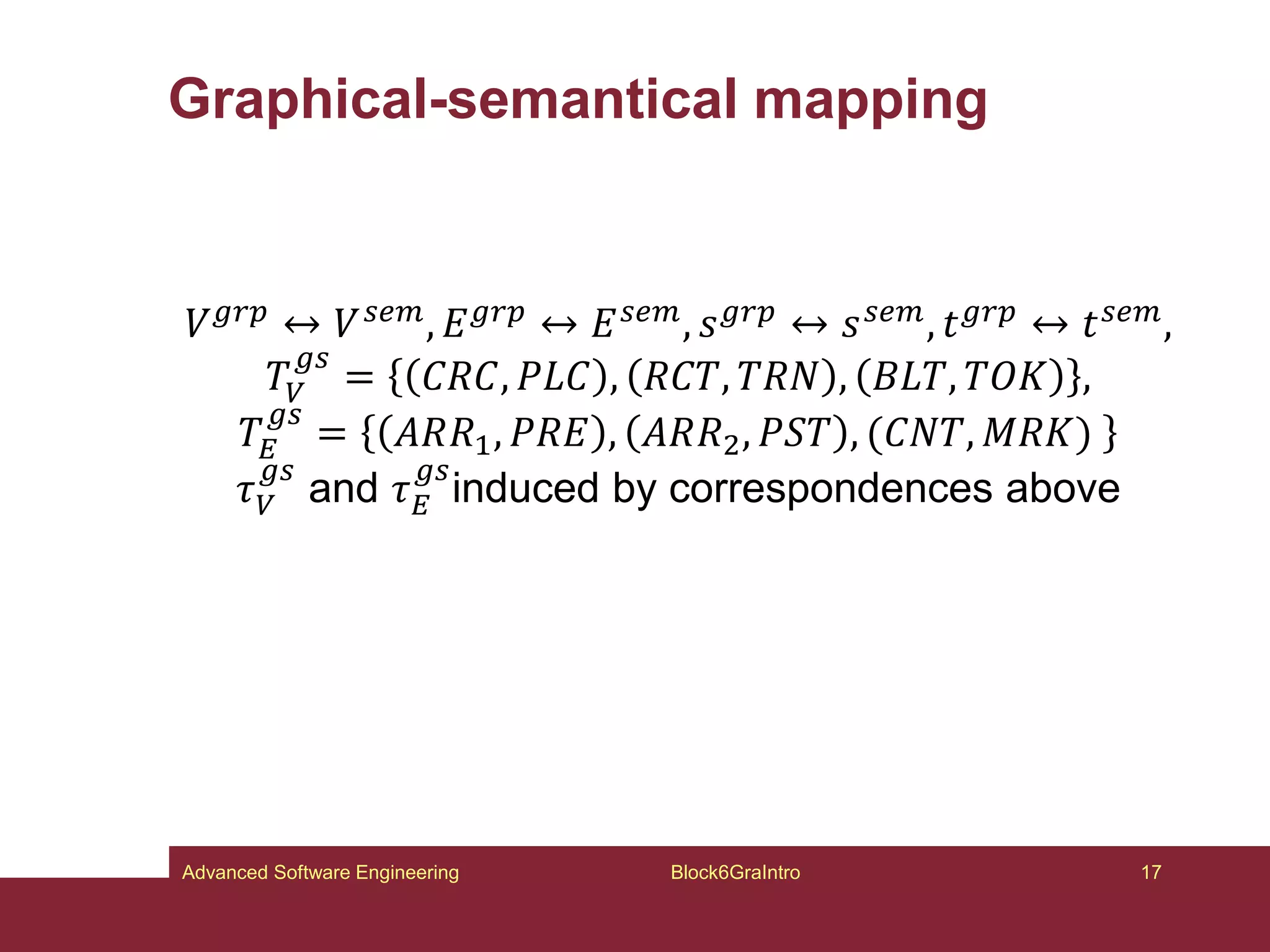
𝑉𝑔𝑟𝑝 ↔ 𝑉𝑠𝑒𝑚, 𝐸𝑔𝑟𝑝 ↔ 𝐸𝑠𝑒𝑚, 𝑠𝑔𝑟𝑝 ↔ 𝑠𝑠𝑒𝑚, 𝑡𝑔𝑟𝑝 ↔ 𝑡𝑠𝑒𝑚,
𝑇𝑉
𝑔𝑠
= 𝐶𝑅𝐶, 𝑃𝐿𝐶 , 𝑅𝐶𝑇, 𝑇𝑅𝑁 , 𝐵𝐿𝑇, 𝑇𝑂𝐾 ,
𝑇𝐸
𝑔𝑠
= 𝐴𝑅𝑅1, 𝑃𝑅𝐸 , 𝐴𝑅𝑅2, 𝑃𝑆𝑇 , (𝐶𝑁𝑇, 𝑀𝑅𝐾)
𝜏𝑉
𝑔𝑠
and 𝜏𝐸
𝑔𝑠
induced by correspondences above
Can we do this graphically?
• Define a type graph
• Establish typing
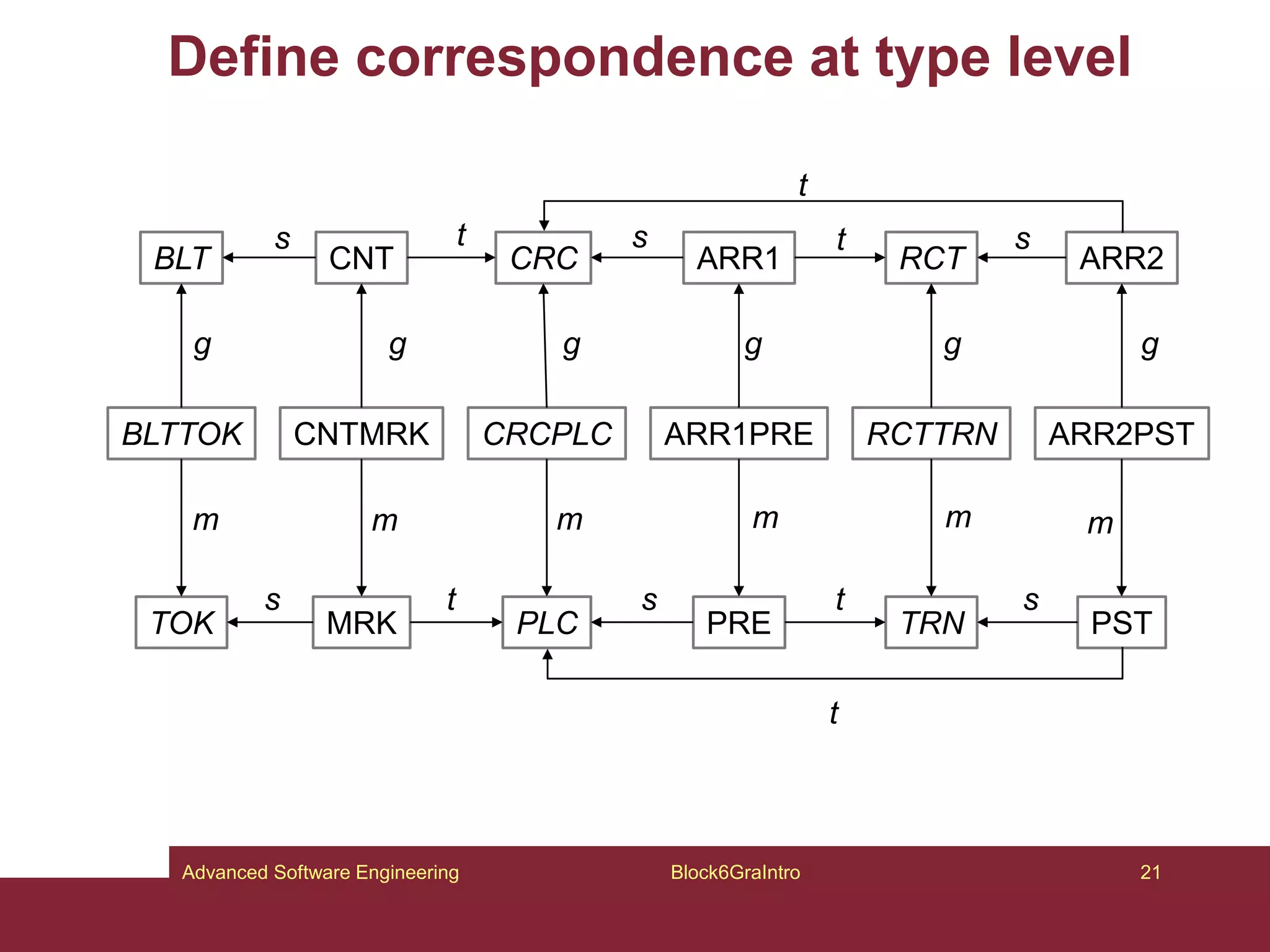
• Define correspondence at type level
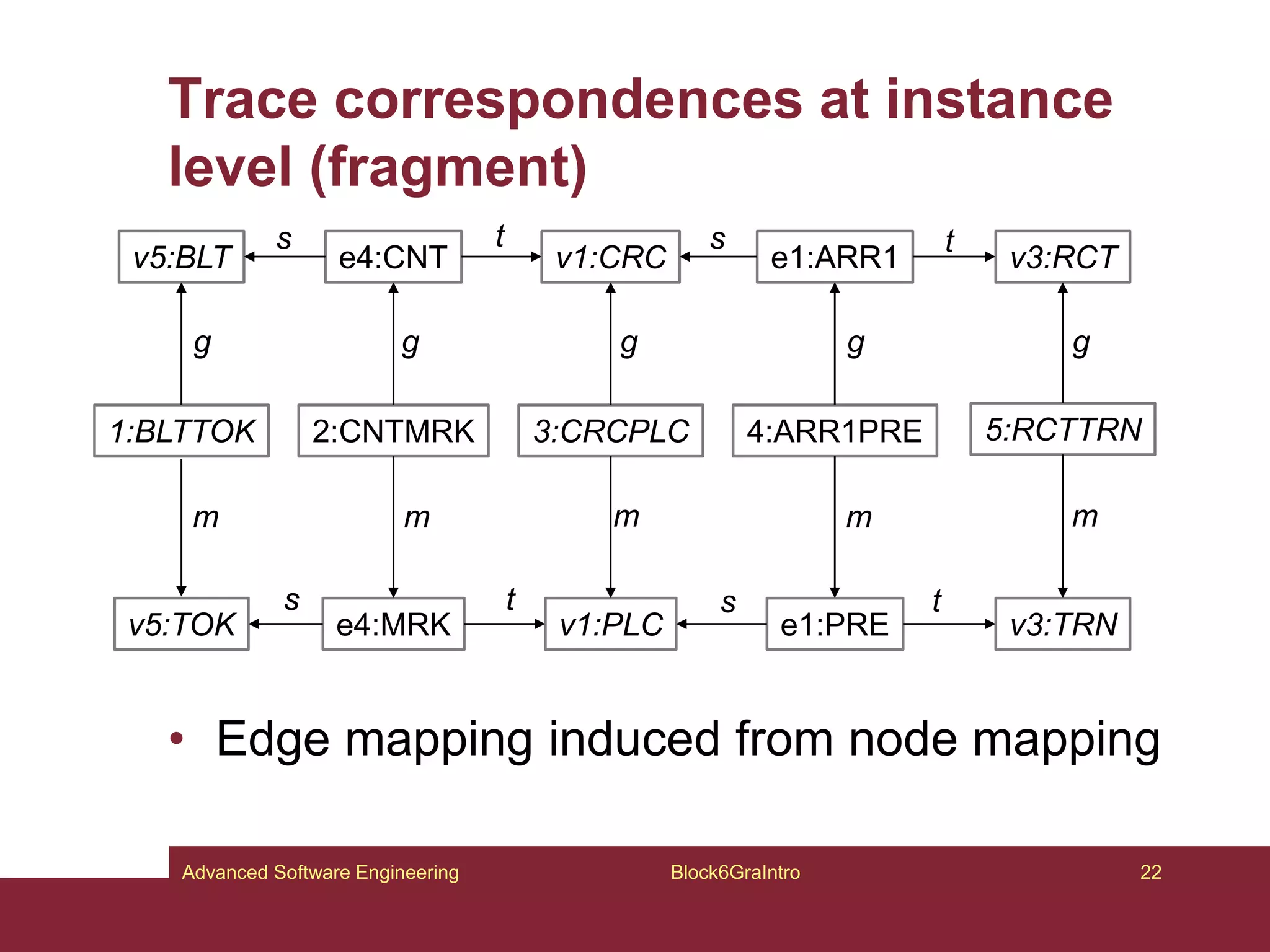
• Trace correspondence at instance level
Block6GraIntro 18
Advanced Software Engineering
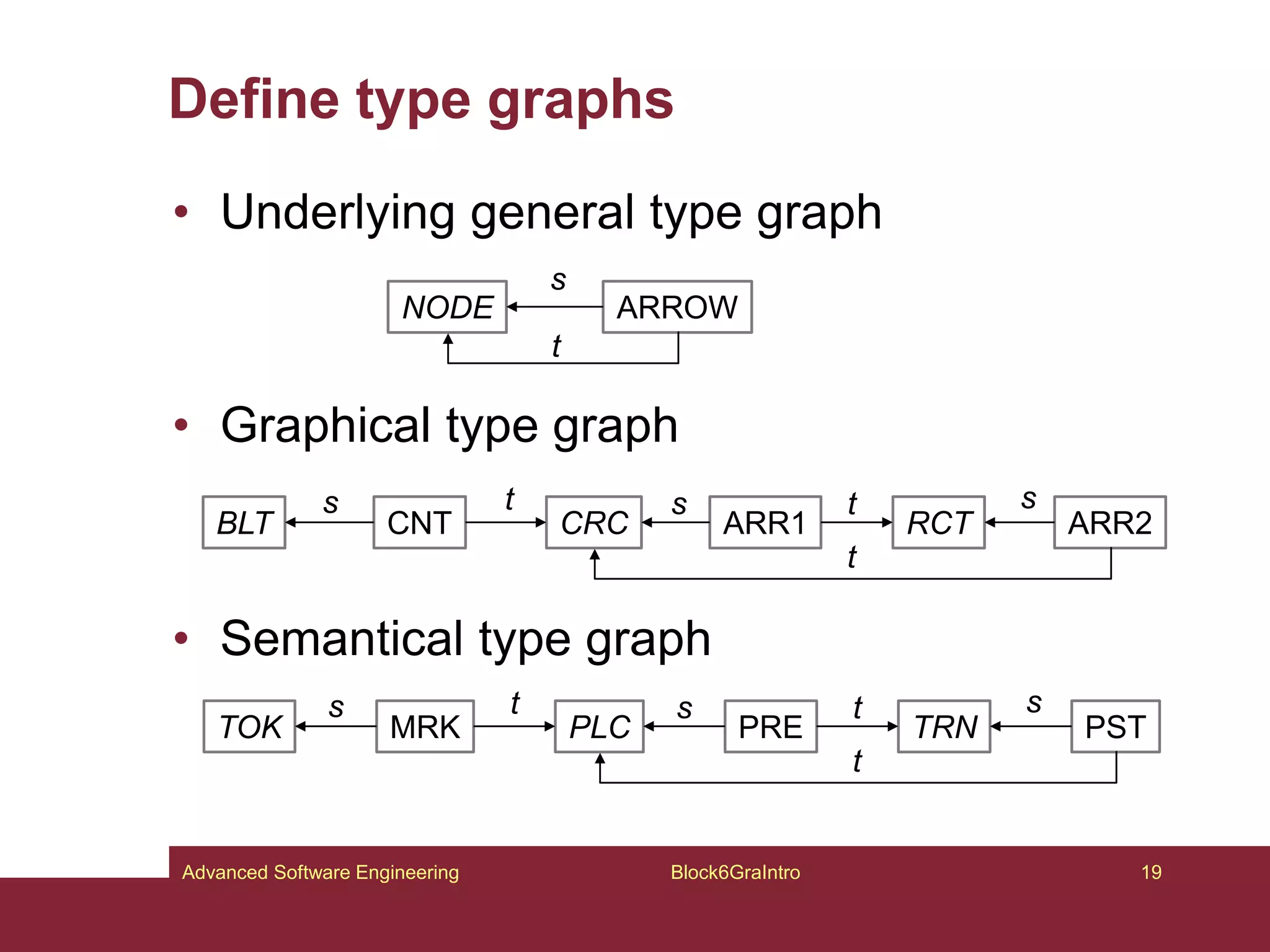
Define type graphs
• Underlying general type graph
• Graphical type graph
• Semantical type graph
Block6GraIntro 19
Advanced Software Engineering
PRE TRN
PLC PST
MRK
TOK
s s
s
t
t
t
ARROW
NODE
s
t
ARR1 RCT
CRC ARR2
CNT
BLT
s s
s
t
t
t
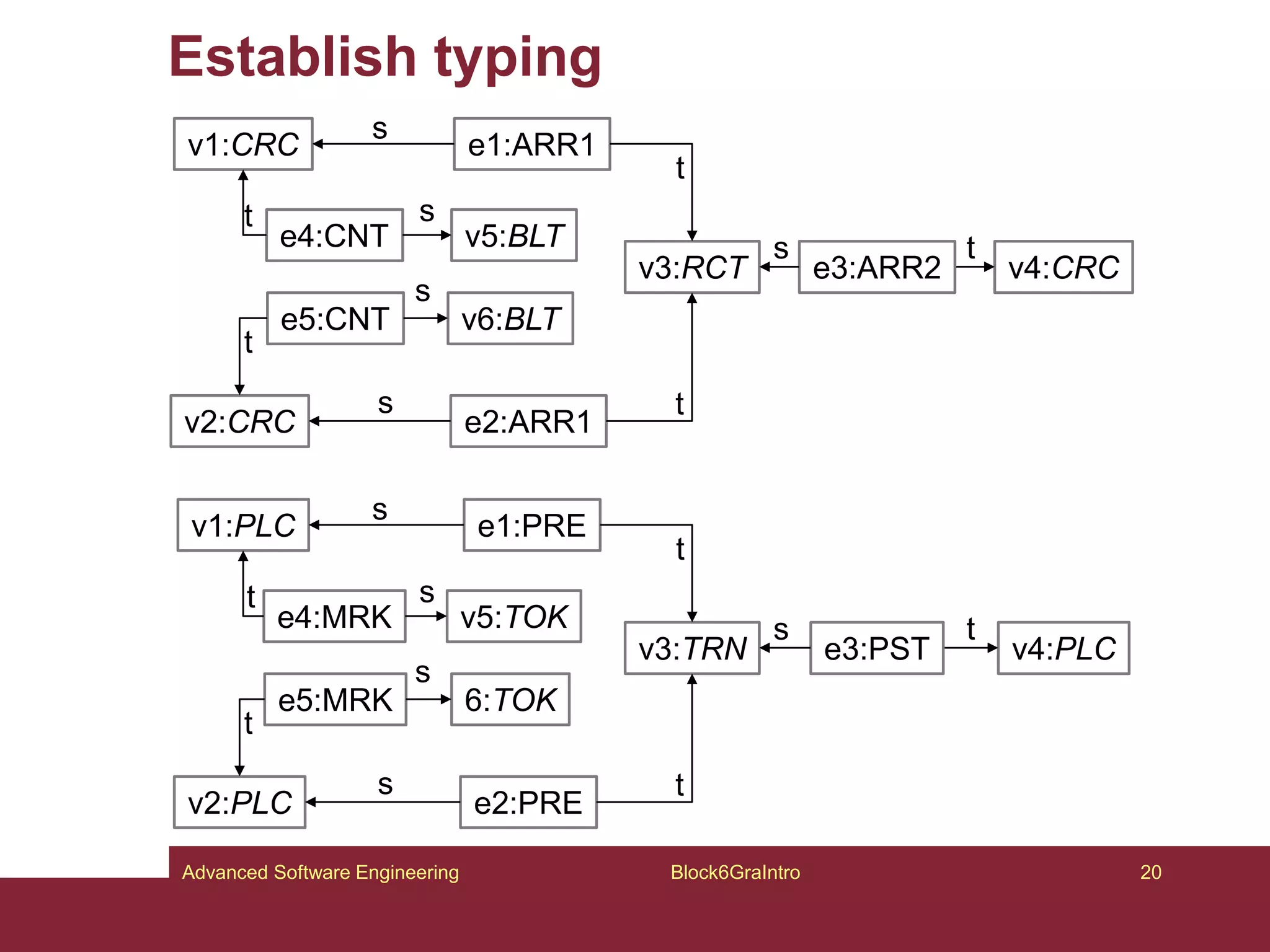
Establish typing
Block6GraIntro 20
Advanced Software Engineering
e1:ARR1
v2:CRC
v4:CRC
v3:RCT
v1:CRC
e2:ARR1
e3:ARR2
e4:CNT v5:BLT
e5:CNT v6:BLT
s
s
s
s
s
t
t
t
t
t
e1:PRE
v2:PLC
v4:PLC
v3:TRN
v1:PLC
e2:PRE
e3:PST
e4:MRK v5:TOK
e5:MRK 6:TOK
s
s
s
s
s
t
t
t
t
t
Define correspondence at type level
Block6GraIntro 21
Advanced Software Engineering
PRE TRN
PLC PST
MRK
TOK
s s
s
t
t
t
ARR1 RCT
CRC ARR2
CNT
BLT
s s
s
t
t
t
ARR1PRE RCTTRN
CRCPLC ARR2PST
CNTMRK
BLTTOK
g
m
g g g g g
m m m m m
Trace correspondences at instance
level (fragment)
• Edge mapping induced from node mapping
Block6GraIntro 22
Advanced Software Engineering
e1:PRE v3:TRN
v1:PLC
e4:MRK
v5:TOK
s
s t
t
e1:ARR1 v3:RCT
v1:CRC
e4:CNT
v5:BLT
s
s t
t
4:ARR1PRE 5:RCTTRN
3:CRCPLC
2:CNTMRK
1:BLTTOK
g
m
g g g g
m m m m
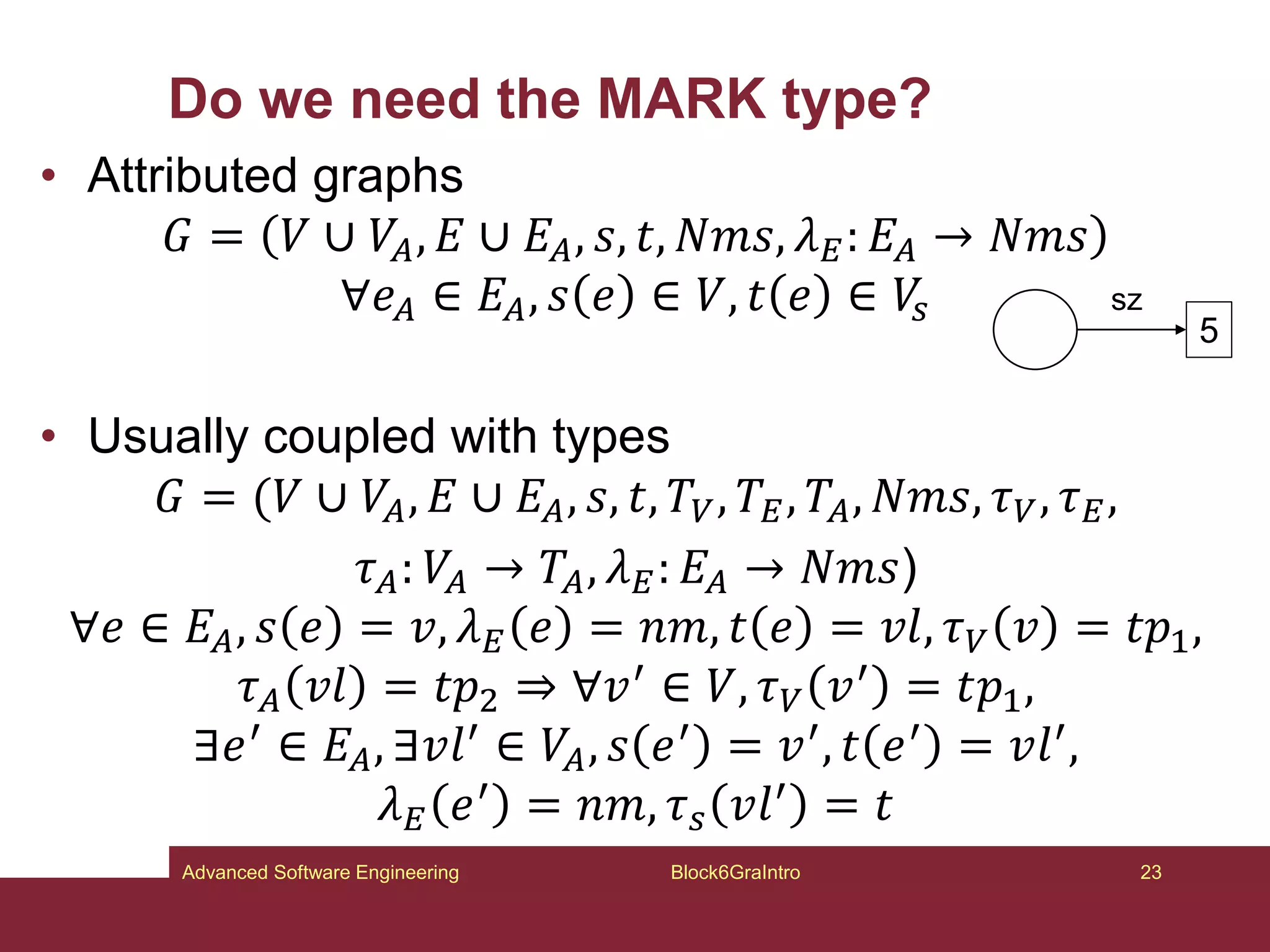
Do we need the MARK type?
• Attributed graphs
𝐺 = 𝑉 ∪ 𝑉𝐴, 𝐸 ∪ 𝐸𝐴, 𝑠, 𝑡, 𝑁𝑚𝑠, 𝜆𝐸: 𝐸𝐴 → 𝑁𝑚𝑠
∀𝑒𝐴 ∈ 𝐸𝐴, 𝑠 𝑒 ∈ 𝑉, 𝑡 𝑒 ∈ 𝑉
𝑠
• Usually coupled with types
𝐺 = (𝑉 ∪ 𝑉𝐴, 𝐸 ∪ 𝐸𝐴, 𝑠, 𝑡, 𝑇𝑉, 𝑇𝐸, 𝑇𝐴, 𝑁𝑚𝑠, 𝜏𝑉, 𝜏𝐸,
𝜏𝐴: 𝑉𝐴 → 𝑇𝐴, 𝜆𝐸: 𝐸𝐴 → 𝑁𝑚𝑠)
∀𝑒 ∈ 𝐸𝐴, 𝑠 𝑒 = 𝑣, 𝜆𝐸 𝑒 = 𝑛𝑚, 𝑡 𝑒 = 𝑣𝑙, 𝜏𝑉 𝑣 = 𝑡𝑝1,
𝜏𝐴 𝑣𝑙 = 𝑡𝑝2 ⇒ ∀𝑣′ ∈ 𝑉, 𝜏𝑉 𝑣′ = 𝑡𝑝1,
∃𝑒′ ∈ 𝐸𝐴, ∃𝑣𝑙′ ∈ 𝑉𝐴, 𝑠 𝑒′ = 𝑣′, 𝑡 𝑒′ = 𝑣𝑙′,
𝜆𝐸 𝑒′ = 𝑛𝑚, 𝜏𝑠 𝑣𝑙′ = 𝑡
Block6GraIntro 23
Advanced Software Engineering
5
sz
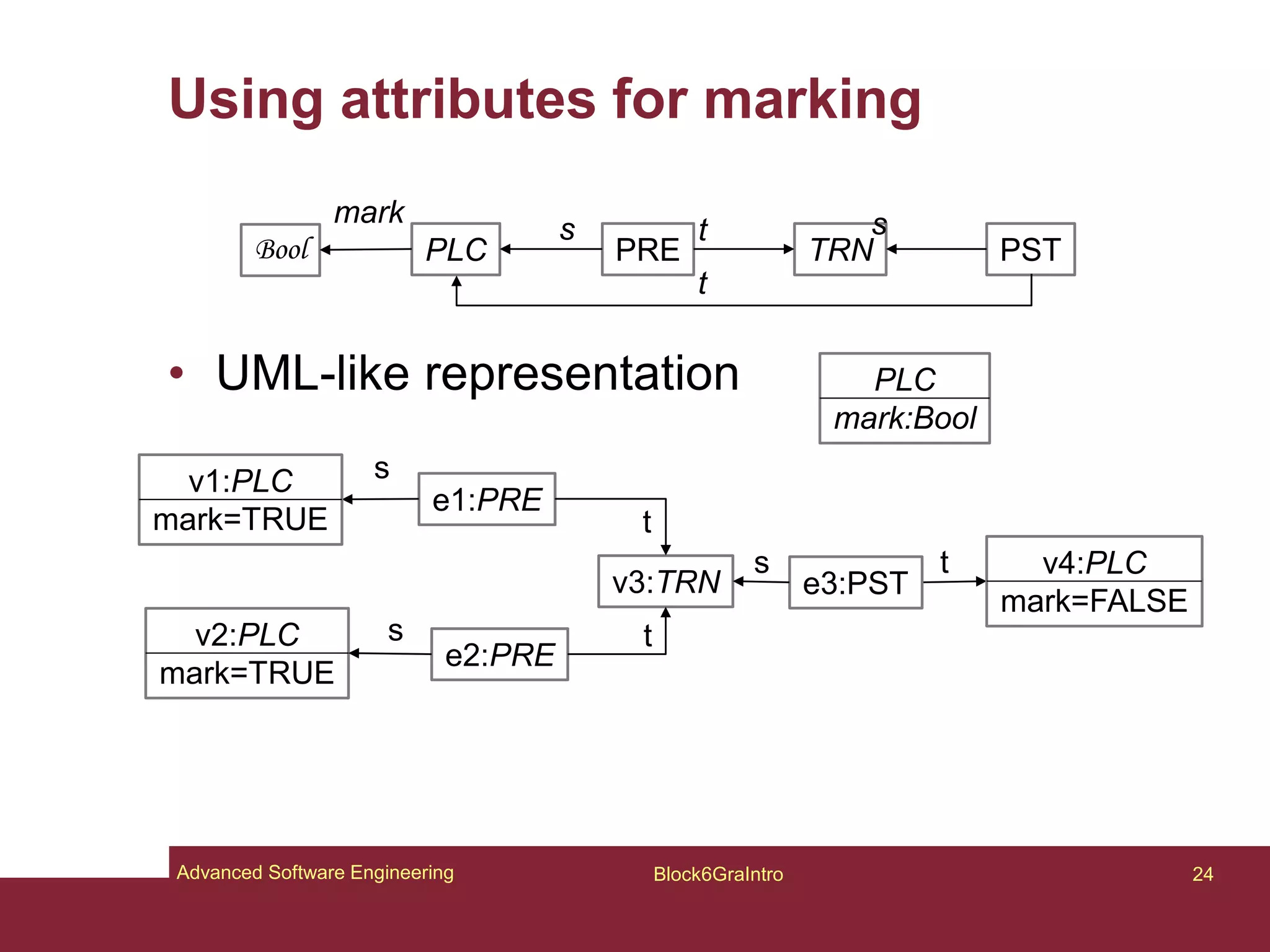
Using attributes for marking
• UML-like representation
Block6GraIntro 24
Advanced Software Engineering
PRE TRN
PLC PST
Bool
s s
mark
t
t
PLC
mark:Bool
e1:PRE
v3:TRN
v2:PLC
mark=TRUE
e2:PRE
e3:PST
s
s
s
t
t
v1:PLC
mark=TRUE
t
v4:PLC
mark=FALSE
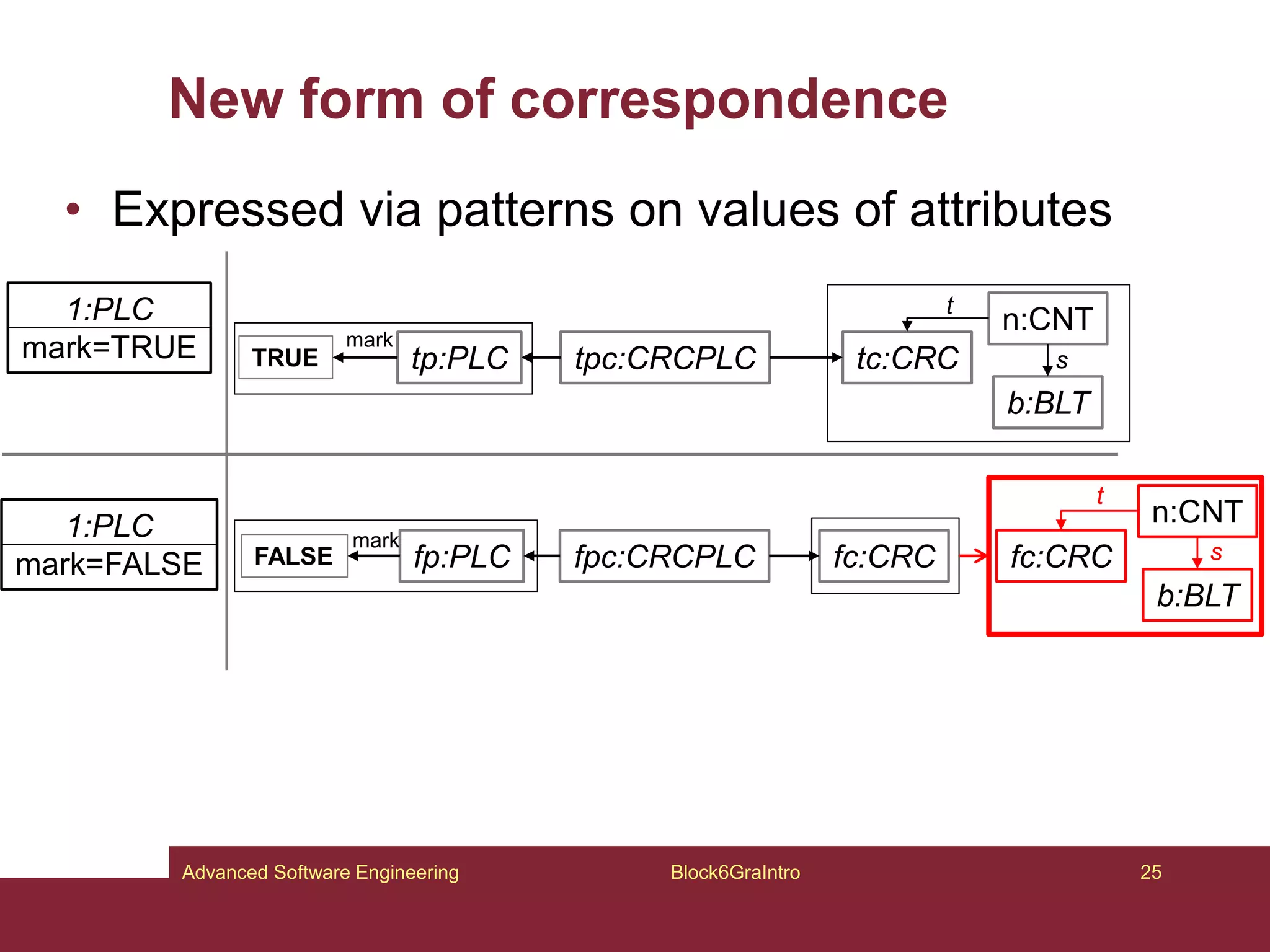
New form of correspondence
• Expressed via patterns on values of attributes
Block6GraIntro 25
Advanced Software Engineering
1:PLC
mark=TRUE
1:PLC
mark=FALSE
tp:PLC
TRUE
mark
fp:PLC
FALSE
mark
tpc:CRCPLC
fpc:CRCPLC
n:CNT
b:BLT
s
tc:CRC
fc:CRC
n:CNT
b:BLT
s
fc:CRC
t
t
What is left to do
• Defining languages
– Graph grammars
– Wellformedness constraint
– Controlling parsing
• Defining dynamics
– Graph transformations
– Application conditions
– Controlling transformations
Block6GraIntro 26
Advanced Software Engineering

Lesson6IntroductionToGraphs.pdf

  • 1.
    Advanced Software Engineering PaoloBottoni Block 6: Introduction to graphs
  • 2.
    Overview • Introduction tographs • Computing with graphs • Graphs as metamodels Block6GraIntro 2 Advanced Software Engineering
  • 3.
    Introduction to graphs •Graphs • Labelled • Typed • Attributed • Examples of models Block6GraIntro 3 Advanced Software Engineering
  • 4.
    Graphs and graph-likestructures • What is a graph? • Are these graphs? Block6GraIntro 4 Advanced Software Engineering 𝐺1 𝐺3 𝐺2 𝐺4 A B a 𝐺5 𝐺6
  • 5.
    And can wehave dynamics on graphs? • Dynamics expressed as change in decoration • Structure maintained Block6GraIntro 5 Advanced Software Engineering A B a abc A B a bc
  • 6.
    Dynamics in graphconstruction • Languages of graphs, well-formedness – Generating – Parsing – Membership problem Block6GraIntro 6 Advanced Software Engineering
  • 7.
    Computing with diagrams •What is this? • We need an interpretation • Can we express it as a graph transformation? Block6GraIntro 7 Advanced Software Engineering
  • 8.
    Towards a formaldefinition of graph • What is a graph? 𝐺 = 𝑉, 𝐸 , 𝐸 ⊆ 𝑉 × 𝑉 • Simple? Think again • Are these graphs? Block6GraIntro 8 Advanced Software Engineering 𝐺1 𝐺3 𝐸 ∈ ℘2 (𝑉) 𝐸 ∈ 𝑚℘2 (𝑉) 𝐸 ⊆ 𝑀𝑆𝐸𝑇(𝑉 × 𝑉) 𝐺2
  • 9.
    An alternative viewof nondirected graphs Block6GraIntro 9 Advanced Software Engineering 𝐺1 ′ 𝐺3 ′ 𝐸 ⊆ 𝑉 × 𝑉 𝐸 ⊆ 𝑀𝑆𝐸𝑇(𝑉 × 𝑉)
  • 10.
    Towards a formaldefinition of graph • What to do with 𝐺6? Block6GraIntro 10 Advanced Software Engineering 𝐿𝑣, 𝐿𝑒, 𝜆𝑣: 𝑉 → 𝐿𝑣, 𝜆𝑒: 𝐸 → 𝐿𝑒 𝐺4 A B a 𝐺5 𝐺6 𝑉 = 𝑉1 ∪ 𝑉2, 𝑉1 ∩ 𝑉2 = ∅, 𝐸 = 𝐸 ∪ 𝐸2, 𝐸1 ∩ 𝐸2 = ∅, 𝐸1 ⊆ 𝑉1 × 𝑉2, 𝐸2 ⊆ 𝑉2 × 𝑉1
  • 11.
    A more generaldefinition of graph • 𝐺 = 𝑉, 𝐸, 𝑠, 𝑡 , 𝑉 ∩ 𝐸 = ∅, 𝑠, 𝑡: 𝐸 → 𝑉 • Are 𝐺1, … , 𝐺3 all graphs under this new definition? 𝐺1 = ( 𝑣1, 𝑣2 , 𝑒1, 𝑒2 , 𝑠 = (𝑒1, 𝑣1 , (𝑒2 , 𝑣2)}, 𝑡 = { 𝑒1, 𝑣2 , (𝑒2, 𝑣1)} 𝐺2 = ( 𝑣1, 𝑣2 , 𝑒1, 𝑒2 , 𝑠 = (𝑒1, 𝑣1 , (𝑒2 , 𝑣1)}, 𝑡 = { 𝑒1, 𝑣2 , (𝑒2, 𝑣2)} 𝐺3 = 𝑣1, 𝑣2 , 𝑒1, 𝑒2, 𝑒3, 𝑒4 , 𝑠 = (𝑒1, 𝑣1 , (𝑒2 , 𝑣1 , 𝑒3, 𝑣2 , (𝑒4, 𝑣2)}, 𝑡 = { 𝑒1, 𝑣2 , 𝑒2, 𝑣2 , 𝑒3, 𝑣1 , (𝑒4, 𝑣1)} • We do not need multisets! Block6GraIntro 11 Advanced Software Engineering
  • 12.
    Adding labels andpartitioning 𝐺 = 𝑉, 𝐸, 𝐿𝑣, 𝐿𝑒, 𝜆𝑣: 𝑉 → 𝐿𝑣, 𝜆𝑒: 𝐸 → 𝐿𝑒 𝐺 = (𝑉1 ∪ 𝑉2, 𝐸1 ∪ 𝐸2, 𝑠1 ∪ 𝑠2, 𝑡1 ∪ 𝑡2) • Also: 𝐺 = 𝑉1 ∪ 𝑉2, 𝐸, 𝑠, 𝑡 , 𝑠, 𝑡: 𝐸 → 𝑉, 𝑠 𝑒 ∈ 𝑉1 ⇒ 𝑡 𝑒 ∈ 𝑉2, 𝑠 𝑒 ∈ 𝑉2 ⇒ 𝑡 𝑒 ∈ 𝑉1 𝐺4 = ( 𝑣1, 𝑣2 , 𝑒1 , 𝐿𝑣 = 𝐴, 𝐵 , 𝐿𝑒 = 𝑎 , 𝑠 = 𝑒1, 𝑣1 , 𝑡 = 𝑒1, 𝑣2 , 𝜆𝑣 = 𝑣1, 𝐴 , 𝑣2, 𝐵 , 𝜆𝑒 = 𝑒1, 𝑎 𝐺5 = ( 𝑣1, 𝑣2, 𝑣4 ∪ 𝑣3 , 𝑒1, 𝑒2} ∪ {𝑒3 , 𝑠 = 𝑒1, 𝑣1 , 𝑒2, 𝑣2 , 𝑒3, 𝑣3 , 𝑡 = { 𝑒1, 𝑣3 , 𝑒2, 𝑣3 , 𝑒3, 𝑣4 } Block6GraIntro 12 Advanced Software Engineering
  • 13.
    What do weneed to see 𝑮𝟔 as a graph? • Abstract graphs!!! • We are interested in relationships • Graphical relationships • Semantic relationships Block6GraIntro 13 Advanced Software Engineering
  • 14.
    But for that… • We need typed graphs 𝐺𝑇 = 𝐺, 𝑇𝑉 ∪ 𝑇𝐸, 𝜏𝑉, 𝜏𝐸 𝑇𝑉 ∩ 𝑇𝐸 = ∅, 𝜏𝑣: 𝑉 → 𝑇𝑉, 𝜏𝑒: 𝐸 → 𝑇𝐸 • More on that later …. Block6GraIntro 14 Advanced Software Engineering
  • 15.
    Graphical relationships Block6GraIntro 15 AdvancedSoftware Engineering 𝐺6 𝐺6 𝑔𝑟𝑝 = (𝑉5 ∪ 𝑣5, 𝑣6 , 𝐸5 ∪ 𝑒4, 𝑒5 , 𝑠 = 𝑠5 ∪ { 𝑒4, 𝑣5 , (𝑒5, 𝑣6)}, 𝑡 = 𝑡5 ∪ { 𝑒4, 𝑣1 , (𝑒5, 𝑣2)}, 𝐶𝑅𝐶, 𝑅𝐶𝑇, 𝐵𝐿𝑇} ∪ {𝐴𝑅𝑅1, 𝐴𝑅𝑅2, 𝐶𝑁𝑇 , 𝜏𝑉 = 𝑣1, 𝐶𝑅𝐶), (𝑣2, 𝐶𝑅𝐶}, (𝑣4, 𝐶𝑅𝐶 , 𝑣3, 𝑅𝐶𝑇 , 𝑣5, 𝐵𝐿𝑇 , (𝑣6, 𝐵𝐿𝑇) , 𝜏𝑒 = (𝑒1, 𝐴𝑅𝑅1), 𝑒2, 𝐴𝑅𝑅1 (𝑒3, 𝐴𝑅𝑅2), 𝑒4, 𝐶𝑁𝑇 , (𝑒5, 𝐶𝑁𝑇) )
  • 16.
    Semantical relationships Block6GraIntro 16 AdvancedSoftware Engineering 𝐺6 𝐺6 𝑠𝑒𝑚 = (𝑉5 ∪ 𝑣5, 𝑣6 , 𝐸5 ∪ 𝑒4, 𝑒5 , 𝑠 = 𝑠5 ∪ { 𝑒4, 𝑣5 , (𝑒5, 𝑣6)}, 𝑡 = 𝑡5 ∪ { 𝑒4, 𝑣1 , (𝑒5, 𝑣2)}, 𝑃𝐿𝐶, 𝑇𝑅𝑁, 𝑇𝑂𝐾} ∪ {𝑃𝑅𝐸, 𝑃𝑆𝑇, 𝑀𝑅𝐾 , 𝜏𝑉 = 𝑣1, 𝑃𝐿𝐶), (𝑣2, 𝑃𝐿𝐶}, (𝑣4, 𝑃𝐿𝐶 , 𝑣3, 𝑇𝑅𝑁 , 𝑣5, 𝑇𝑂𝐾 , (𝑣6, 𝑇𝑂𝐾) , 𝜏𝑒 = (𝑒1, 𝑃𝑅𝐸), 𝑒2, 𝑃𝑅𝐸 (𝑒3, 𝑃𝑆𝑇), 𝑒4, 𝑀𝑅𝐾 , (𝑒5, 𝑀𝑅𝐾) )
  • 17.
    Graphical-semantical mapping Block6GraIntro 17 AdvancedSoftware Engineering 𝑉𝑔𝑟𝑝 ↔ 𝑉𝑠𝑒𝑚, 𝐸𝑔𝑟𝑝 ↔ 𝐸𝑠𝑒𝑚, 𝑠𝑔𝑟𝑝 ↔ 𝑠𝑠𝑒𝑚, 𝑡𝑔𝑟𝑝 ↔ 𝑡𝑠𝑒𝑚, 𝑇𝑉 𝑔𝑠 = 𝐶𝑅𝐶, 𝑃𝐿𝐶 , 𝑅𝐶𝑇, 𝑇𝑅𝑁 , 𝐵𝐿𝑇, 𝑇𝑂𝐾 , 𝑇𝐸 𝑔𝑠 = 𝐴𝑅𝑅1, 𝑃𝑅𝐸 , 𝐴𝑅𝑅2, 𝑃𝑆𝑇 , (𝐶𝑁𝑇, 𝑀𝑅𝐾) 𝜏𝑉 𝑔𝑠 and 𝜏𝐸 𝑔𝑠 induced by correspondences above
  • 18.
    Can we dothis graphically? • Define a type graph • Establish typing • Define correspondence at type level • Trace correspondence at instance level Block6GraIntro 18 Advanced Software Engineering
  • 19.
    Define type graphs •Underlying general type graph • Graphical type graph • Semantical type graph Block6GraIntro 19 Advanced Software Engineering PRE TRN PLC PST MRK TOK s s s t t t ARROW NODE s t ARR1 RCT CRC ARR2 CNT BLT s s s t t t
  • 20.
    Establish typing Block6GraIntro 20 AdvancedSoftware Engineering e1:ARR1 v2:CRC v4:CRC v3:RCT v1:CRC e2:ARR1 e3:ARR2 e4:CNT v5:BLT e5:CNT v6:BLT s s s s s t t t t t e1:PRE v2:PLC v4:PLC v3:TRN v1:PLC e2:PRE e3:PST e4:MRK v5:TOK e5:MRK 6:TOK s s s s s t t t t t
  • 21.
    Define correspondence attype level Block6GraIntro 21 Advanced Software Engineering PRE TRN PLC PST MRK TOK s s s t t t ARR1 RCT CRC ARR2 CNT BLT s s s t t t ARR1PRE RCTTRN CRCPLC ARR2PST CNTMRK BLTTOK g m g g g g g m m m m m
  • 22.
    Trace correspondences atinstance level (fragment) • Edge mapping induced from node mapping Block6GraIntro 22 Advanced Software Engineering e1:PRE v3:TRN v1:PLC e4:MRK v5:TOK s s t t e1:ARR1 v3:RCT v1:CRC e4:CNT v5:BLT s s t t 4:ARR1PRE 5:RCTTRN 3:CRCPLC 2:CNTMRK 1:BLTTOK g m g g g g m m m m
  • 23.
    Do we needthe MARK type? • Attributed graphs 𝐺 = 𝑉 ∪ 𝑉𝐴, 𝐸 ∪ 𝐸𝐴, 𝑠, 𝑡, 𝑁𝑚𝑠, 𝜆𝐸: 𝐸𝐴 → 𝑁𝑚𝑠 ∀𝑒𝐴 ∈ 𝐸𝐴, 𝑠 𝑒 ∈ 𝑉, 𝑡 𝑒 ∈ 𝑉 𝑠 • Usually coupled with types 𝐺 = (𝑉 ∪ 𝑉𝐴, 𝐸 ∪ 𝐸𝐴, 𝑠, 𝑡, 𝑇𝑉, 𝑇𝐸, 𝑇𝐴, 𝑁𝑚𝑠, 𝜏𝑉, 𝜏𝐸, 𝜏𝐴: 𝑉𝐴 → 𝑇𝐴, 𝜆𝐸: 𝐸𝐴 → 𝑁𝑚𝑠) ∀𝑒 ∈ 𝐸𝐴, 𝑠 𝑒 = 𝑣, 𝜆𝐸 𝑒 = 𝑛𝑚, 𝑡 𝑒 = 𝑣𝑙, 𝜏𝑉 𝑣 = 𝑡𝑝1, 𝜏𝐴 𝑣𝑙 = 𝑡𝑝2 ⇒ ∀𝑣′ ∈ 𝑉, 𝜏𝑉 𝑣′ = 𝑡𝑝1, ∃𝑒′ ∈ 𝐸𝐴, ∃𝑣𝑙′ ∈ 𝑉𝐴, 𝑠 𝑒′ = 𝑣′, 𝑡 𝑒′ = 𝑣𝑙′, 𝜆𝐸 𝑒′ = 𝑛𝑚, 𝜏𝑠 𝑣𝑙′ = 𝑡 Block6GraIntro 23 Advanced Software Engineering 5 sz
  • 24.
    Using attributes formarking • UML-like representation Block6GraIntro 24 Advanced Software Engineering PRE TRN PLC PST Bool s s mark t t PLC mark:Bool e1:PRE v3:TRN v2:PLC mark=TRUE e2:PRE e3:PST s s s t t v1:PLC mark=TRUE t v4:PLC mark=FALSE
  • 25.
    New form ofcorrespondence • Expressed via patterns on values of attributes Block6GraIntro 25 Advanced Software Engineering 1:PLC mark=TRUE 1:PLC mark=FALSE tp:PLC TRUE mark fp:PLC FALSE mark tpc:CRCPLC fpc:CRCPLC n:CNT b:BLT s tc:CRC fc:CRC n:CNT b:BLT s fc:CRC t t
  • 26.
    What is leftto do • Defining languages – Graph grammars – Wellformedness constraint – Controlling parsing • Defining dynamics – Graph transformations – Application conditions – Controlling transformations Block6GraIntro 26 Advanced Software Engineering