Where do you
usually get
information?
Use information from news
reports, speeches, informative
talks, panel discussions, etc. in
everyday conversations and
exchanges.
Identify materials as
primary, secondary
or tertiary sources;
Gather information
from primary,
secondary or
tertiary sources; and
Appreciate the
importance of primary,
secondary and tertiary
sources of information.
Directions: Group students into two. According to the
stated quotation, each group of ten members sends a
representative to receive an information from the trainer.
The message must be passed from one delegate to the
next, and so forth. The final participant in the group will
write the message on the whiteboard. The group(s) that
will effectively write the message will get an incentive.
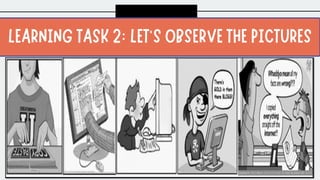
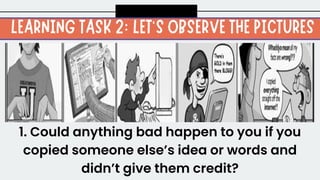
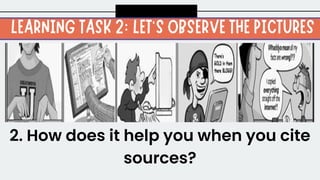
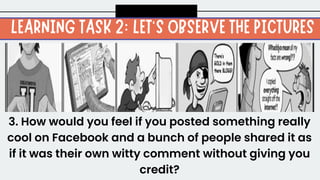
Directions: Observe the following
pictures below and answer the
questions the follow.
1. Could anything bad happen to you if you
copied someone else’s idea or words and
didn’t give them credit?
2. How does it help you when you cite
sources?
3. How would you feel if you posted something really
cool on Facebook and a bunch of people shared it as
if it was their own witty comment without giving you
credit?
It is important to let the reader of
your writing know where you
found your ideas. Whenever you
have taken something from
another author (theory, opinion,
idea, example, conclusion, or
findings) you must say where the
original can be found. In other
words, you must acknowledge
and cite your sources.
to provide details or
background to what you
are writing.
to give authority to
what you are writing.
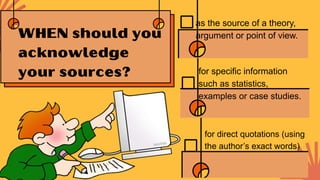
as the source of a theory,
argument or point of view.
for specific information
such as statistics,
examples or case studies.
for direct quotations (using
the author’s exact words)
Directions: Identify if the given item is a
primary, secondary or tertiary source. Write
your answers in your notebook.
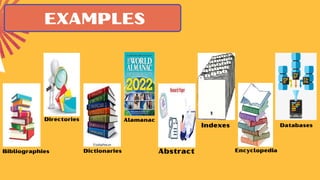
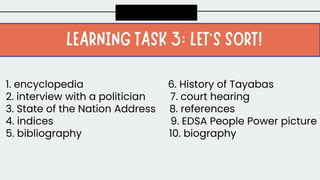
1. encyclopedia 6. History of Tayabas
2. interview with a politician 7. court hearing
3. State of the Nation Address 8. references
4. indices 9. EDSA People Power picture
5. bibliography 10. biography
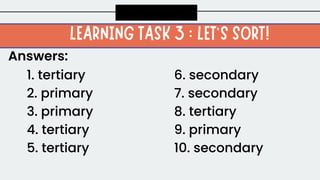
Answers:
1. tertiary
2. primary
3. primary
4. tertiary
5. tertiary
6. secondary
7. secondary
8. tertiary
9. primary
10. secondary
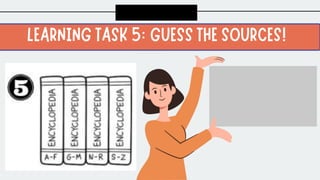
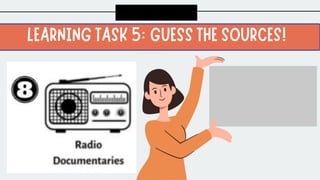
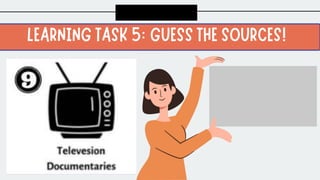
Directions: Classify and tell whether the
materials listed below is primary,
secondary, or tertiary source.
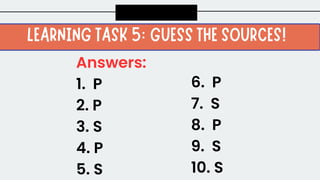
Answers:
1. P
2. P
3. S
4. P
5. S
6. P
7. S
8. P
9. S
10. S
Directions: In a short bond paper, cut
at least 5 examples of the following:
 Primary Sources
 Secondary Sources
 Tertiary Sources

Lesson1_Information from Various Sources.pptx

  • 5.
    Where do you usuallyget information?
  • 7.
    Use information fromnews reports, speeches, informative talks, panel discussions, etc. in everyday conversations and exchanges.
  • 8.
    Identify materials as primary,secondary or tertiary sources;
  • 9.
  • 10.
    Appreciate the importance ofprimary, secondary and tertiary sources of information.
  • 12.
    Directions: Group studentsinto two. According to the stated quotation, each group of ten members sends a representative to receive an information from the trainer. The message must be passed from one delegate to the next, and so forth. The final participant in the group will write the message on the whiteboard. The group(s) that will effectively write the message will get an incentive.
  • 15.
    Directions: Observe thefollowing pictures below and answer the questions the follow.
  • 17.
    1. Could anythingbad happen to you if you copied someone else’s idea or words and didn’t give them credit?
  • 18.
    2. How doesit help you when you cite sources?
  • 19.
    3. How wouldyou feel if you posted something really cool on Facebook and a bunch of people shared it as if it was their own witty comment without giving you credit?
  • 20.
    It is importantto let the reader of your writing know where you found your ideas. Whenever you have taken something from another author (theory, opinion, idea, example, conclusion, or findings) you must say where the original can be found. In other words, you must acknowledge and cite your sources.
  • 22.
    to provide detailsor background to what you are writing. to give authority to what you are writing.
  • 23.
    as the sourceof a theory, argument or point of view. for specific information such as statistics, examples or case studies. for direct quotations (using the author’s exact words)
  • 43.
    Directions: Identify ifthe given item is a primary, secondary or tertiary source. Write your answers in your notebook.
  • 44.
    1. encyclopedia 6.History of Tayabas 2. interview with a politician 7. court hearing 3. State of the Nation Address 8. references 4. indices 9. EDSA People Power picture 5. bibliography 10. biography
  • 45.
    Answers: 1. tertiary 2. primary 3.primary 4. tertiary 5. tertiary 6. secondary 7. secondary 8. tertiary 9. primary 10. secondary
  • 47.
    Directions: Classify andtell whether the materials listed below is primary, secondary, or tertiary source.
  • 58.
    Answers: 1. P 2. P 3.S 4. P 5. S 6. P 7. S 8. P 9. S 10. S
  • 60.
    Directions: In ashort bond paper, cut at least 5 examples of the following:  Primary Sources  Secondary Sources  Tertiary Sources