OBJECTIVES
At the end of the 50-
minute discussion, the
students are able to:
a. define source; and
b. differentiate primary
from secondary sources.
MOTIVATION: BROKEN TELEPHONE
GAME
1.Group yourselves into three
(3).
2.Form a line.
3.The leader will memorize
the message.
4.Pass the message until it
reaches the last person in
line.
5.Say the message.
TASK 1: MATCH IT!
Direction: Match
the photo in
Column A with its
description in
Column B.
1. A. A print periodical
containing miscellaneous
pieces (such as articles,
stories, poems) and often
illustrated
2. B. A record of events,
transactions, or observations
kept daily or at frequent
intervals.
(record of personal
activities, reflections, or
feelings)
3. C. A reference source in print or electronic
form containing words usually
alphabetically arranged along with
information about their forms,
pronunciations, functions, etymologies,
meanings, and syntactic and idiomatic uses.
4. D. A paper that is printed and distributed
usually daily or weekly and that contains
news, articles of opinion, features, and
advertising.
5. E. A recording of a motion picture or
television program for playing through a
television set
SOURCES – are
references that you
use in gathering
information like
books, encyclopedia,
newspaper, magazine,
webpage and other
materials.
TASK 2 :PICK ME UP
Direction: Classify the
following sources of
information according to its
kind.
Diary Letters
Journal Photographs
Encyclopedia Videos
Textbooks Dictionary
Newspaper Interview
Magazine Speech
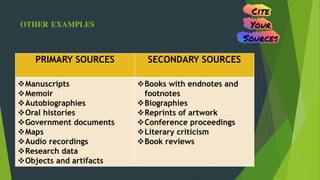
PRIMARY SOURCES SECONDARY SOURCES
Manuscripts
Memoir
Autobiographies
Oral histories
Government documents
Maps
Audio recordings
Research data
Objects and artifacts
Books with endnotes and
footnotes
Biographies
Reprints of artwork
Conference proceedings
Literary criticism
Book reviews
OTHER EXAMPLES
TASK 3: ART TIME
Direction: Draw one
primary and one
secondary source that
you usually use when
you need information.
Excellent (4) Good (3) Satisfactory
(2)
Needs Improvement
(1)
Following
Activity
Directions
All directions were
followed.
You followed
most
directions.
You followed
some
directions.
None of the directions
were followed.
Use of
Creativity
You used your own
ideas and
imagination.
You used your
own ideas most
of the time.
You used some
imagination.
You did not use your
own ideas or
imagination.
Behavior in
Class
You were respectful
and well-behaved.
You behaved
well for most
of the class.
You
misbehaved
during most of
class.
You were not
respectful and
behaved poorly.
Effort put
into the
activity
You took your time
and worked hard on
the project.
You worked
hard for most
of the time.
You put a small
effort into the
activity.
You rushed through
and did not work hard.
RUBRICS FOR GRADING
ASSIGNMENT
Directions: Write an
essay on the importance
of using reliable and
credible sources. Write
it in your notebook.
“In a world full of fake news,
be the truth.”
Sources.pptx

Sources.pptx

  • 1.
    OBJECTIVES At the endof the 50- minute discussion, the students are able to: a. define source; and b. differentiate primary from secondary sources.
  • 2.
    MOTIVATION: BROKEN TELEPHONE GAME 1.Groupyourselves into three (3). 2.Form a line. 3.The leader will memorize the message. 4.Pass the message until it reaches the last person in line. 5.Say the message.
  • 3.
    TASK 1: MATCHIT! Direction: Match the photo in Column A with its description in Column B.
  • 4.
    1. A. Aprint periodical containing miscellaneous pieces (such as articles, stories, poems) and often illustrated 2. B. A record of events, transactions, or observations kept daily or at frequent intervals. (record of personal activities, reflections, or feelings)
  • 5.
    3. C. Areference source in print or electronic form containing words usually alphabetically arranged along with information about their forms, pronunciations, functions, etymologies, meanings, and syntactic and idiomatic uses. 4. D. A paper that is printed and distributed usually daily or weekly and that contains news, articles of opinion, features, and advertising. 5. E. A recording of a motion picture or television program for playing through a television set
  • 7.
    SOURCES – are referencesthat you use in gathering information like books, encyclopedia, newspaper, magazine, webpage and other materials.
  • 8.
    TASK 2 :PICKME UP Direction: Classify the following sources of information according to its kind.
  • 9.
    Diary Letters Journal Photographs EncyclopediaVideos Textbooks Dictionary Newspaper Interview Magazine Speech PRIMARY SOURCES SECONDARY SOURCES
  • 11.
    PRIMARY SOURCES SECONDARYSOURCES Manuscripts Memoir Autobiographies Oral histories Government documents Maps Audio recordings Research data Objects and artifacts Books with endnotes and footnotes Biographies Reprints of artwork Conference proceedings Literary criticism Book reviews OTHER EXAMPLES
  • 12.
    TASK 3: ARTTIME Direction: Draw one primary and one secondary source that you usually use when you need information.
  • 13.
    Excellent (4) Good(3) Satisfactory (2) Needs Improvement (1) Following Activity Directions All directions were followed. You followed most directions. You followed some directions. None of the directions were followed. Use of Creativity You used your own ideas and imagination. You used your own ideas most of the time. You used some imagination. You did not use your own ideas or imagination. Behavior in Class You were respectful and well-behaved. You behaved well for most of the class. You misbehaved during most of class. You were not respectful and behaved poorly. Effort put into the activity You took your time and worked hard on the project. You worked hard for most of the time. You put a small effort into the activity. You rushed through and did not work hard. RUBRICS FOR GRADING
  • 14.
    ASSIGNMENT Directions: Write an essayon the importance of using reliable and credible sources. Write it in your notebook.
  • 16.
    “In a worldfull of fake news, be the truth.”