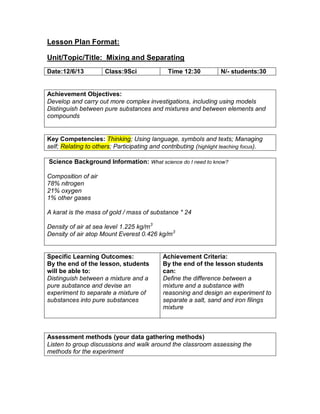
Lesson Plan Format:
Unit/Topic/Title: Mixing and Separating
Achievement Objectives:
Develop and carry out more complex investigations, including using models
Distinguish between pure substances and mixtures and between elements and
compounds
Key Competencies: Thinking; Using language, symbols and texts; Managing
self; Relating to others; Participating and contributing (highlight teaching focus).
Science Background Information: What science do I need to know?
Composition of air
78% nitrogen
21% oxygen
1% other gases
A karat is the mass of gold / mass of substance * 24
Density of air at sea level 1.225 kg/m3
Density of air atop Mount Everest 0.426 kg/m3
Specific Learning Outcomes:
By the end of the lesson, students
will be able to:
Distinguish between a mixture and a
pure substance and devise an
experiment to separate a mixture of
substances into pure substances
Achievement Criteria:
By the end of the lesson students
can:
Define the difference between a
mixture and a substance with
reasoning and design an experiment to
separate a salt, sand and iron filings
mixture
Assessment methods (your data gathering methods)
Listen to group discussions and walk around the classroom assessing the
methods for the experiment
Date:12/6/13 Class:9Sci Time 12:30 N/- students:30
Learning Activities (in sequence)
Time line
5
15
20
Introduction
Teacher Moves
Today we are learning: how
separate substances in a
mixture by designing an
experiment
We know we have learnt if: we
can design an experiment to
separate salt, sand and iron
filings.
Put up power point where the
students must decide whether
the shown substance is a
mixture or a pure substance.
Substances include alcohol, a
gold ring and clean air
MIXING AND
SEPARATING.pptx
Bring up the slide of air and ask
whether this is a mixture or
pure substance. Ask for
students opinions and if it is a
mixture, what is in air. Record
their answers on the board and
on a scale of 0% to 100%, get
the students estimate the
composition as a class so it can
be compared to the actual
composition.
Atop Mount Everest, the air is
almost three times thinner,
therefore only one third of the
oxygen
After the class estimates the
composition of air, let the class
know the makeup of air and get
the class to fill out page 28 in
Student Moves
Amongst their groups, the
students discuss whether they
think it is a mixture or pure
substance and then they share
with the class
Students discuss amongst their
groups whether air is a mixture
or substance and then if they
guess substance, try and
determine the composition of air.
Students try and explain why
there is less oxygen atop mount
Everst using they learnt in the
particle nature of matter. The
answer should be that there is
the same amount of oxygen in
the air but because the air is
less dense, each breath brings
in less air particles therefore
there is less oxygen uptake.
the SciPad, air composition pie
graph
Main Activities (attach notes, Power Points, developed resources)
Time Line
25
30
Teacher Moves
Filtration
Ask the students to define what
filtration is and get them to fill
out page 28 in the SciPad
Give the scenario for the
experiment which is to
separate iron filings, sand and
salt. The students are given the
aim but must come up with the
method and equipment used.
Discuss safety considerations
Walk around the class and help
students develop a method.
Don’t give the method but give
them simple hints such as iron
filings being a metal and salt
being soluble.
Student moves
Students discuss in their groups
what filtration is and then
discuss the question on page
28 as a group
Students brainstorm ideas on
how these substances can be
separated. Once they have
method, they must write this
method and write the equipment
which is required
Closure/Finishing (Revisit learning intentions and success criteria; strategies to wrap up,
reflect on learning,)
Timeline
50
Teacher Moves
At the end of the lesson,
further prompt groups who
have no idea how to undertake
this experiment. Check that
methods are complete and
required equipment is listed.
Student Moves
If already haven’t done so, the
students write their method in
preparation for the next lesson
Materials / Resources / Equipment required
Projector
Safety considerations

Lesson plan 9 sci 12.6.13

  • 1.
    Lesson Plan Format: Unit/Topic/Title:Mixing and Separating Achievement Objectives: Develop and carry out more complex investigations, including using models Distinguish between pure substances and mixtures and between elements and compounds Key Competencies: Thinking; Using language, symbols and texts; Managing self; Relating to others; Participating and contributing (highlight teaching focus). Science Background Information: What science do I need to know? Composition of air 78% nitrogen 21% oxygen 1% other gases A karat is the mass of gold / mass of substance * 24 Density of air at sea level 1.225 kg/m3 Density of air atop Mount Everest 0.426 kg/m3 Specific Learning Outcomes: By the end of the lesson, students will be able to: Distinguish between a mixture and a pure substance and devise an experiment to separate a mixture of substances into pure substances Achievement Criteria: By the end of the lesson students can: Define the difference between a mixture and a substance with reasoning and design an experiment to separate a salt, sand and iron filings mixture Assessment methods (your data gathering methods) Listen to group discussions and walk around the classroom assessing the methods for the experiment Date:12/6/13 Class:9Sci Time 12:30 N/- students:30
  • 2.
    Learning Activities (insequence) Time line 5 15 20 Introduction Teacher Moves Today we are learning: how separate substances in a mixture by designing an experiment We know we have learnt if: we can design an experiment to separate salt, sand and iron filings. Put up power point where the students must decide whether the shown substance is a mixture or a pure substance. Substances include alcohol, a gold ring and clean air MIXING AND SEPARATING.pptx Bring up the slide of air and ask whether this is a mixture or pure substance. Ask for students opinions and if it is a mixture, what is in air. Record their answers on the board and on a scale of 0% to 100%, get the students estimate the composition as a class so it can be compared to the actual composition. Atop Mount Everest, the air is almost three times thinner, therefore only one third of the oxygen After the class estimates the composition of air, let the class know the makeup of air and get the class to fill out page 28 in Student Moves Amongst their groups, the students discuss whether they think it is a mixture or pure substance and then they share with the class Students discuss amongst their groups whether air is a mixture or substance and then if they guess substance, try and determine the composition of air. Students try and explain why there is less oxygen atop mount Everst using they learnt in the particle nature of matter. The answer should be that there is the same amount of oxygen in the air but because the air is less dense, each breath brings in less air particles therefore there is less oxygen uptake.
  • 3.
    the SciPad, aircomposition pie graph Main Activities (attach notes, Power Points, developed resources) Time Line 25 30 Teacher Moves Filtration Ask the students to define what filtration is and get them to fill out page 28 in the SciPad Give the scenario for the experiment which is to separate iron filings, sand and salt. The students are given the aim but must come up with the method and equipment used. Discuss safety considerations Walk around the class and help students develop a method. Don’t give the method but give them simple hints such as iron filings being a metal and salt being soluble. Student moves Students discuss in their groups what filtration is and then discuss the question on page 28 as a group Students brainstorm ideas on how these substances can be separated. Once they have method, they must write this method and write the equipment which is required Closure/Finishing (Revisit learning intentions and success criteria; strategies to wrap up, reflect on learning,) Timeline 50 Teacher Moves At the end of the lesson, further prompt groups who have no idea how to undertake this experiment. Check that methods are complete and required equipment is listed. Student Moves If already haven’t done so, the students write their method in preparation for the next lesson Materials / Resources / Equipment required Projector Safety considerations