Pagel, M. (2017). Q&A: What is human language, when did it evolve and why should we care? BMC Biology, 15(1).
https://doi.org/10.1186/s12915-017-0405-3
Instructions: Encircle the letter of the
correct answer.
1. What is the origin of the term "Kinesics"?
A. Latin
B. English
C. Greek
D. Spanish
Pagel, M. (2017). Q&A: What is human language, when did it evolve and why should we care? BMC Biology, 15(1).
https://doi.org/10.1186/s12915-017-0405-3
Instructions: Encircle the letter of the
correct answer.
2. Who is credited with coining the term
"Kinesics"?
A. John Smith
B. Ray Birdwhistell
C. Jane Doe
D. Mark Johnson
Pagel, M. (2017). Q&A: What is human language, when did it evolve and why should we care? BMC Biology, 15(1).
https://doi.org/10.1186/s12915-017-0405-3
Instructions: Encircle the letter of the
correct answer.
3. How did Ray Birdwhistell describe a single
body movement in the context of Kinesics?
A. Kinetics
B. Phonetics
C. Kine
D. Gesture
Pagel, M. (2017). Q&A: What is human language, when did it evolve and why should we care? BMC Biology, 15(1).
https://doi.org/10.1186/s12915-017-0405-3
Instructions: Encircle the letter of the
correct answer.
4. What did Ray Birdwhistell develop to
describe and analyze kinesics behavior?
A. Alphabet
B. System of Notation
C. Vocabulary
D. Dictionary
Pagel, M. (2017). Q&A: What is human language, when did it evolve and why should we care? BMC Biology, 15(1).
https://doi.org/10.1186/s12915-017-0405-3
Instructions: Encircle the letter of the
correct answer.
5. Which of the following best defines
Kinesics?
A. The study of the Earth's motion
B. The study of sound waves
C. The study of body language and movement
D. The study of written language
Pagel, M. (2017). Q&A: What is human language, when did it evolve and why should we care? BMC Biology, 15(1).
https://doi.org/10.1186/s12915-017-0405-3
Instructions: Encircle the letter of the
correct answer.
6. Which of the following is NOT a part of
Kinesics?
A. Face
B. Arms
C. Voice
D. Legs
Pagel, M. (2017). Q&A: What is human language, when did it evolve and why should we care? BMC Biology, 15(1).
https://doi.org/10.1186/s12915-017-0405-3
Instructions: Encircle the letter of the
correct answer.
7. Which nonverbal behavior is commonly
associated with conveying happiness or
friendliness?
A. Rolling your eyes
B. Crossing your arms
C. Smiling
D. Raising your eyebrows
Pagel, M. (2017). Q&A: What is human language, when did it evolve and why should we care? BMC Biology, 15(1).
https://doi.org/10.1186/s12915-017-0405-3
Instructions: Encircle the letter of the
correct answer.
8. What does nodding your head typically
signify in nonverbal communication?
A. Agreement or understanding
B. Surprise or disbelief
C. Defensiveness or resistance
D. Uncertainty or indifference
Pagel, M. (2017). Q&A: What is human language, when did it evolve and why should we care? BMC Biology, 15(1).
https://doi.org/10.1186/s12915-017-0405-3
Instructions: Encircle the letter of the
correct answer.
9. Which term refers to the study of human
use of space and its impact on behavior and
communication?
A. Phonetics
B. Kinesics
C. Proxemics
D. Whistle languages
Pagel, M. (2017). Q&A: What is human language, when did it evolve and why should we care? BMC Biology, 15(1).
https://doi.org/10.1186/s12915-017-0405-3
Instructions: Encircle the letter of the
correct answer.
10. What is the primary method of
communication in "Whistle languages"?
A. Written language
B. Verbal language
C. Whistling
D. Sign language
THE DEVELOPMENT AND
EVOLUTION OF LANGUAGE
Pagel, M. (2017). Q&A: What is human language, when did it evolve and why should we care? BMC Biology, 15(1).
https://doi.org/10.1186/s12915-017-0405-3
Language likely emerged and evolved
between 50,000 and 100,000 years
ago, as a result of biological, social, and
environmental factors that favored the
survival and development of Homo
Pagel, M. (2017). Q&A: What is human language, when did it evolve
and why should we care? BMC Biology, 15(1).
https://doi.org/10.1186/s12915-017-0405-3
WHEN DOES A COMMUNICATION
SYSTEM BECOME LANGUAGE?
No definitive answer!
WHEN DOES A COMMUNICATION
SYSTEM BECOME LANGUAGE?
Possible factors that distinguish a language
from a communication system are:
• Symbolism
• Structure
• Creativity
• Function
WHEN DOES A COMMUNICATION
SYSTEM BECOME LANGUAGE?
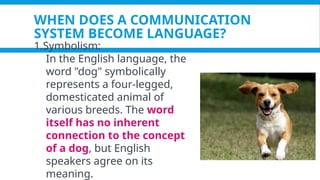
1.Symbolism:
In the English language, the
word "dog" symbolically
represents a four-legged,
domesticated animal of
various breeds. The word
itself has no inherent
connection to the concept
of a dog, but English
speakers agree on its
meaning.
Give your own
examples.
WHEN DOES A COMMUNICATION
SYSTEM BECOME LANGUAGE?
2. Structure:
Spanish has a complex
grammatical structure that
dictates how words must be
ordered in sentences. For
example, in Spanish, the
adjective typically comes after
the noun, as in "casa grande"
(big house), whereas in English,
it comes before, as in "big
WHEN DOES A COMMUNICATION
SYSTEM BECOME LANGUAGE?
2. Structure:
Japanese employs a complex system of
honorifics and verb conjugations that dictate the
level of politeness and formality in
communication. For instance, the verb "to eat"
in Japanese can be expressed as "tabemasu"
(casual), "tabemasu" (polite), or "meshiagaru"
(very polite) depending on the social context and
the level of respect or politeness required.
Give your own
examples.
WHEN DOES A COMMUNICATION
SYSTEM BECOME LANGUAGE?
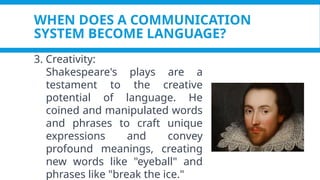
3. Creativity:
Shakespeare's plays are a
testament to the creative
potential of language. He
coined and manipulated words
and phrases to craft unique
expressions and convey
profound meanings, creating
new words like "eyeball" and
phrases like "break the ice."
Give your own
examples.
WHEN DOES A COMMUNICATION
SYSTEM BECOME LANGUAGE?
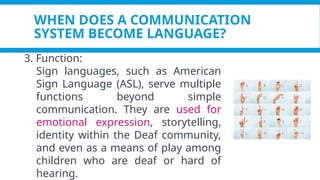
3. Function:
Sign languages, such as American
Sign Language (ASL), serve multiple
functions beyond simple
communication. They are used for
emotional expression, storytelling,
identity within the Deaf community,
and even as a means of play among
children who are deaf or hard of
hearing.
Give your own
examples.
Pagel, M. (2017). Q&A: What is human language, when did it evolve and why should we care? BMC Biology, 15(1).
https://doi.org/10.1186/s12915-017-0405-3
Language likely emerged and evolved
between 50,000 and 100,000 years
ago, as a result of biological, social, and
environmental factors that favored the
survival and development of Homo
Pagel, M. (2017). Q&A: What is human language, when did it evolve
and why should we care? BMC Biology, 15(1).
https://doi.org/10.1186/s12915-017-0405-3
MILESTONE OF HUMAN EVOLUTION
 Guide Questions:
1. 1. When did the story of human evolution start, and
what significant event marked the beginning of this
journey?
2. 2. What is the connection between Homo sapiens and
chimpanzees, and when did their lineages separate?
3. 3. How many early human species are mentioned in the
text, and what is their significance in our family tree?
4. 4. How does natural selection play a role in shaping the
physical and behavioral traits of early humans?
Pagel, M. (2017). Q&A: What is human language, when did it evolve and why should we care? BMC Biology, 15(1).
https://doi.org/10.1186/s12915-017-0405-3
TIMELINE
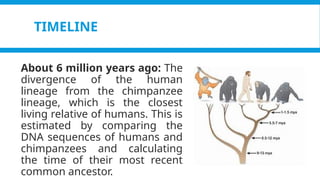
About 6 million years ago: The
divergence of the human
lineage from the chimpanzee
lineage, which is the closest
living relative of humans. This is
estimated by comparing the
DNA sequences of humans and
chimpanzees and calculating
the time of their most recent
common ancestor.
Pagel, M. (2017). Q&A: What is human language, when did it evolve and why should we care? BMC Biology, 15(1).
https://doi.org/10.1186/s12915-017-0405-3
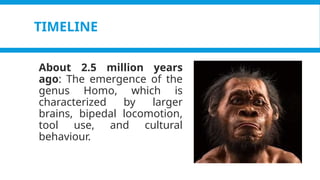
TIMELINE
About 2.5 million years
ago: The emergence of the
genus Homo, which is
characterized by larger
brains, bipedal locomotion,
tool use, and cultural
behaviour.
Pagel, M. (2017). Q&A: What is human language, when did it evolve and why should we care? BMC Biology, 15(1).
https://doi.org/10.1186/s12915-017-0405-3
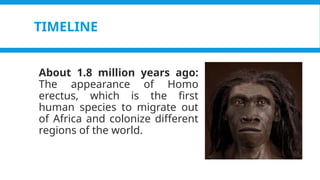
TIMELINE
About 1.8 million years ago:
The appearance of Homo
erectus, which is the first
human species to migrate out
of Africa and colonize different
regions of the world.
Pagel, M. (2017). Q&A: What is human language, when did it evolve and why should we care? BMC Biology, 15(1).
https://doi.org/10.1186/s12915-017-0405-3
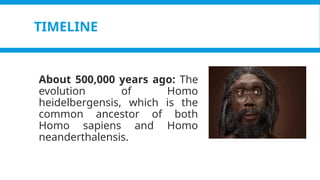
TIMELINE
About 500,000 years ago: The
evolution of Homo
heidelbergensis, which is the
common ancestor of both
Homo sapiens and Homo
neanderthalensis.
Pagel, M. (2017). Q&A: What is human language, when did it evolve and why should we care? BMC Biology, 15(1).
https://doi.org/10.1186/s12915-017-0405-3
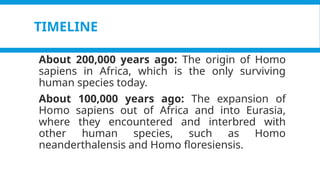
TIMELINE
About 200,000 years ago: The origin of Homo
sapiens in Africa, which is the only surviving
human species today.
About 100,000 years ago: The expansion of
Homo sapiens out of Africa and into Eurasia,
where they encountered and interbred with
other human species, such as Homo
neanderthalensis and Homo floresiensis.
Pagel, M. (2017). Q&A: What is human language, when did it evolve and why should we care? BMC Biology, 15(1).
https://doi.org/10.1186/s12915-017-0405-3
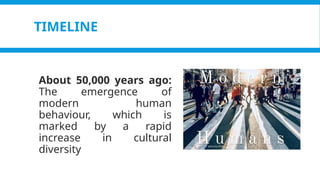
TIMELINE
About 50,000 years ago:
The emergence of
modern human
behaviour, which is
marked by a rapid
increase in cultural
diversity
Pagel, M. (2017). Q&A: What is human language, when did it evolve and why should we care? BMC Biology, 15(1).
https://doi.org/10.1186/s12915-017-0405-3
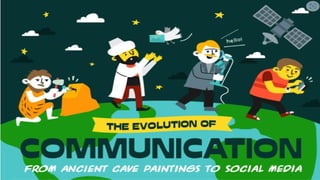
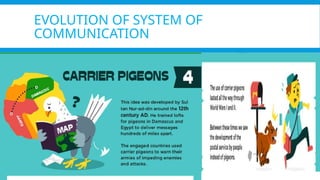
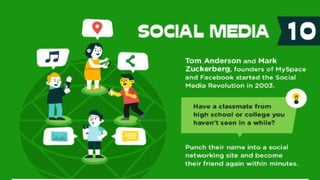
EVOLUTION OF SYSTEM OF
COMMUNICATION
Pagel, M. (2017). Q&A: What is human language, when did it evolve and why should we care? BMC Biology, 15(1).
https://doi.org/10.1186/s12915-017-0405-3
EVOLUTION OF SYSTEM OF
COMMUNICATION
Pagel, M. (2017). Q&A: What is human language, when did it evolve and why should we care? BMC Biology, 15(1).
https://doi.org/10.1186/s12915-017-0405-3
EVOLUTION OF SYSTEM OF
COMMUNICATION
Pagel, M. (2017). Q&A: What is human language, when did it evolve and why should we care? BMC Biology, 15(1).
https://doi.org/10.1186/s12915-017-0405-3
EVOLUTION OF SYSTEM OF
COMMUNICATION
Pagel, M. (2017). Q&A: What is human language, when did it evolve and why should we care? BMC Biology, 15(1).
https://doi.org/10.1186/s12915-017-0405-3
EVOLUTION OF SYSTEM OF
COMMUNICATION
Pagel, M. (2017). Q&A: What is human language, when did it evolve and why should we care? BMC Biology, 15(1).
https://doi.org/10.1186/s12915-017-0405-3
EVOLUTION OF SYSTEM OF
COMMUNICATION
Pagel, M. (2017). Q&A: What is human language, when did it evolve and why should we care? BMC Biology, 15(1).
https://doi.org/10.1186/s12915-017-0405-3
EVOLUTION OF SYSTEM OF
COMMUNICATION
Pagel, M. (2017). Q&A: What is human language, when did it evolve and why should we care? BMC Biology, 15(1).
https://doi.org/10.1186/s12915-017-0405-3
EVOLUTION OF SYSTEM OF
COMMUNICATION
Pagel, M. (2017). Q&A: What is human language, when did it evolve and why should we care? BMC Biology, 15(1).
https://doi.org/10.1186/s12915-017-0405-3
EVOLUTION OF SYSTEM OF
COMMUNICATION
Pagel, M. (2017). Q&A: What is human language, when did it evolve and why should we care? BMC Biology, 15(1).
https://doi.org/10.1186/s12915-017-0405-3
EVOLUTION OF SYSTEM OF
COMMUNICATION
Pagel, M. (2017). Q&A: What is human language, when did it evolve and why should we care? BMC Biology, 15(1).
https://doi.org/10.1186/s12915-017-0405-3
EVOLUTION OF SYSTEM OF
COMMUNICATION
Pagel, M. (2017). Q&A: What is human language, when did it evolve and why should we care? BMC Biology, 15(1).
https://doi.org/10.1186/s12915-017-0405-3
EVOLUTION OF SYSTEM OF
COMMUNICATION
Pagel, M. (2017). Q&A: What is human language, when did it evolve and why should we care? BMC Biology, 15(1).
https://doi.org/10.1186/s12915-017-0405-3
EVOLUTION OF SYSTEM OF
COMMUNICATION
MONOGENESIS VS. POLYGENESIS
1. Monogenesis:
Monogenesis, also known as the
single-origin or Out of Africa theory,
posits that all modern humans share
a common ancestry and originated
from a single population in Africa.
MONOGENESIS VS. POLYGENESIS
 Key points of the monogenesis theory include:
 Recent African Origin: It suggests that the most recent
common ancestor of all modern humans lived in Africa,
and all humans are descended from this population.
 Genetic Evidence: Genetic studies, particularly those
involving mitochondrial DNA and Y-chromosomes,
support the idea of a single African origin for modern
humans.
 Out-of-Africa Migration: Monogenesis suggests a series
of waves of human migration out of Africa, eventually
populating the rest of the world.
MONOGENESIS VS. POLYGENESIS
2. Polygenesis:
Polygenesis, also known as the
multiregional or regional continuity
theory, proposes that modern humans
did not originate from a single
population in Africa but instead evolved
independently from different hominid
populations in various regions of the
world
MONOGENESIS VS. POLYGENESIS
 Key points of the polygenesis theory include:
 Multiple Origins: It suggests that different human
populations evolved separately in various regions over a
long period of time.
 Regional Continuity: Polygenesis proposes that the
continuity of certain traits and characteristics within
regional populations indicates independent evolution.
 Hybridization: Some proponents of polygenesis also
acknowledge limited interbreeding between different
regional populations.
MONOGENESIS VS. POLYGENESIS
 Key points of the monogenesis theory include:
 Recent African Origin: It suggests that the most recent
common ancestor of all modern humans lived in Africa,
and all humans are descended from this population.
 Genetic Evidence: Genetic studies, particularly those
involving mitochondrial DNA and Y-chromosomes,
support the idea of a single African origin for modern
humans.
 Out-of-Africa Migration: Monogenesis suggests a series
of waves of human migration out of Africa, eventually
populating the rest of the world.

Lesson 4_The development and evolution of language.pptx

  • 2.
    Pagel, M. (2017).Q&A: What is human language, when did it evolve and why should we care? BMC Biology, 15(1). https://doi.org/10.1186/s12915-017-0405-3 Instructions: Encircle the letter of the correct answer. 1. What is the origin of the term "Kinesics"? A. Latin B. English C. Greek D. Spanish
  • 3.
    Pagel, M. (2017).Q&A: What is human language, when did it evolve and why should we care? BMC Biology, 15(1). https://doi.org/10.1186/s12915-017-0405-3 Instructions: Encircle the letter of the correct answer. 2. Who is credited with coining the term "Kinesics"? A. John Smith B. Ray Birdwhistell C. Jane Doe D. Mark Johnson
  • 4.
    Pagel, M. (2017).Q&A: What is human language, when did it evolve and why should we care? BMC Biology, 15(1). https://doi.org/10.1186/s12915-017-0405-3 Instructions: Encircle the letter of the correct answer. 3. How did Ray Birdwhistell describe a single body movement in the context of Kinesics? A. Kinetics B. Phonetics C. Kine D. Gesture
  • 5.
    Pagel, M. (2017).Q&A: What is human language, when did it evolve and why should we care? BMC Biology, 15(1). https://doi.org/10.1186/s12915-017-0405-3 Instructions: Encircle the letter of the correct answer. 4. What did Ray Birdwhistell develop to describe and analyze kinesics behavior? A. Alphabet B. System of Notation C. Vocabulary D. Dictionary
  • 6.
    Pagel, M. (2017).Q&A: What is human language, when did it evolve and why should we care? BMC Biology, 15(1). https://doi.org/10.1186/s12915-017-0405-3 Instructions: Encircle the letter of the correct answer. 5. Which of the following best defines Kinesics? A. The study of the Earth's motion B. The study of sound waves C. The study of body language and movement D. The study of written language
  • 7.
    Pagel, M. (2017).Q&A: What is human language, when did it evolve and why should we care? BMC Biology, 15(1). https://doi.org/10.1186/s12915-017-0405-3 Instructions: Encircle the letter of the correct answer. 6. Which of the following is NOT a part of Kinesics? A. Face B. Arms C. Voice D. Legs
  • 8.
    Pagel, M. (2017).Q&A: What is human language, when did it evolve and why should we care? BMC Biology, 15(1). https://doi.org/10.1186/s12915-017-0405-3 Instructions: Encircle the letter of the correct answer. 7. Which nonverbal behavior is commonly associated with conveying happiness or friendliness? A. Rolling your eyes B. Crossing your arms C. Smiling D. Raising your eyebrows
  • 9.
    Pagel, M. (2017).Q&A: What is human language, when did it evolve and why should we care? BMC Biology, 15(1). https://doi.org/10.1186/s12915-017-0405-3 Instructions: Encircle the letter of the correct answer. 8. What does nodding your head typically signify in nonverbal communication? A. Agreement or understanding B. Surprise or disbelief C. Defensiveness or resistance D. Uncertainty or indifference
  • 10.
    Pagel, M. (2017).Q&A: What is human language, when did it evolve and why should we care? BMC Biology, 15(1). https://doi.org/10.1186/s12915-017-0405-3 Instructions: Encircle the letter of the correct answer. 9. Which term refers to the study of human use of space and its impact on behavior and communication? A. Phonetics B. Kinesics C. Proxemics D. Whistle languages
  • 11.
    Pagel, M. (2017).Q&A: What is human language, when did it evolve and why should we care? BMC Biology, 15(1). https://doi.org/10.1186/s12915-017-0405-3 Instructions: Encircle the letter of the correct answer. 10. What is the primary method of communication in "Whistle languages"? A. Written language B. Verbal language C. Whistling D. Sign language
  • 12.
  • 13.
    Pagel, M. (2017).Q&A: What is human language, when did it evolve and why should we care? BMC Biology, 15(1). https://doi.org/10.1186/s12915-017-0405-3 Language likely emerged and evolved between 50,000 and 100,000 years ago, as a result of biological, social, and environmental factors that favored the survival and development of Homo Pagel, M. (2017). Q&A: What is human language, when did it evolve and why should we care? BMC Biology, 15(1). https://doi.org/10.1186/s12915-017-0405-3
  • 14.
    WHEN DOES ACOMMUNICATION SYSTEM BECOME LANGUAGE? No definitive answer!
  • 15.
    WHEN DOES ACOMMUNICATION SYSTEM BECOME LANGUAGE? Possible factors that distinguish a language from a communication system are: • Symbolism • Structure • Creativity • Function
  • 16.
    WHEN DOES ACOMMUNICATION SYSTEM BECOME LANGUAGE? 1.Symbolism: In the English language, the word "dog" symbolically represents a four-legged, domesticated animal of various breeds. The word itself has no inherent connection to the concept of a dog, but English speakers agree on its meaning.
  • 17.
  • 18.
    WHEN DOES ACOMMUNICATION SYSTEM BECOME LANGUAGE? 2. Structure: Spanish has a complex grammatical structure that dictates how words must be ordered in sentences. For example, in Spanish, the adjective typically comes after the noun, as in "casa grande" (big house), whereas in English, it comes before, as in "big
  • 19.
    WHEN DOES ACOMMUNICATION SYSTEM BECOME LANGUAGE? 2. Structure: Japanese employs a complex system of honorifics and verb conjugations that dictate the level of politeness and formality in communication. For instance, the verb "to eat" in Japanese can be expressed as "tabemasu" (casual), "tabemasu" (polite), or "meshiagaru" (very polite) depending on the social context and the level of respect or politeness required.
  • 20.
  • 21.
    WHEN DOES ACOMMUNICATION SYSTEM BECOME LANGUAGE? 3. Creativity: Shakespeare's plays are a testament to the creative potential of language. He coined and manipulated words and phrases to craft unique expressions and convey profound meanings, creating new words like "eyeball" and phrases like "break the ice."
  • 22.
  • 23.
    WHEN DOES ACOMMUNICATION SYSTEM BECOME LANGUAGE? 3. Function: Sign languages, such as American Sign Language (ASL), serve multiple functions beyond simple communication. They are used for emotional expression, storytelling, identity within the Deaf community, and even as a means of play among children who are deaf or hard of hearing.
  • 24.
  • 26.
    Pagel, M. (2017).Q&A: What is human language, when did it evolve and why should we care? BMC Biology, 15(1). https://doi.org/10.1186/s12915-017-0405-3 Language likely emerged and evolved between 50,000 and 100,000 years ago, as a result of biological, social, and environmental factors that favored the survival and development of Homo Pagel, M. (2017). Q&A: What is human language, when did it evolve and why should we care? BMC Biology, 15(1). https://doi.org/10.1186/s12915-017-0405-3
  • 27.
    MILESTONE OF HUMANEVOLUTION  Guide Questions: 1. 1. When did the story of human evolution start, and what significant event marked the beginning of this journey? 2. 2. What is the connection between Homo sapiens and chimpanzees, and when did their lineages separate? 3. 3. How many early human species are mentioned in the text, and what is their significance in our family tree? 4. 4. How does natural selection play a role in shaping the physical and behavioral traits of early humans?
  • 29.
    Pagel, M. (2017).Q&A: What is human language, when did it evolve and why should we care? BMC Biology, 15(1). https://doi.org/10.1186/s12915-017-0405-3 TIMELINE About 6 million years ago: The divergence of the human lineage from the chimpanzee lineage, which is the closest living relative of humans. This is estimated by comparing the DNA sequences of humans and chimpanzees and calculating the time of their most recent common ancestor.
  • 30.
    Pagel, M. (2017).Q&A: What is human language, when did it evolve and why should we care? BMC Biology, 15(1). https://doi.org/10.1186/s12915-017-0405-3 TIMELINE About 2.5 million years ago: The emergence of the genus Homo, which is characterized by larger brains, bipedal locomotion, tool use, and cultural behaviour.
  • 31.
    Pagel, M. (2017).Q&A: What is human language, when did it evolve and why should we care? BMC Biology, 15(1). https://doi.org/10.1186/s12915-017-0405-3 TIMELINE About 1.8 million years ago: The appearance of Homo erectus, which is the first human species to migrate out of Africa and colonize different regions of the world.
  • 32.
    Pagel, M. (2017).Q&A: What is human language, when did it evolve and why should we care? BMC Biology, 15(1). https://doi.org/10.1186/s12915-017-0405-3 TIMELINE About 500,000 years ago: The evolution of Homo heidelbergensis, which is the common ancestor of both Homo sapiens and Homo neanderthalensis.
  • 33.
    Pagel, M. (2017).Q&A: What is human language, when did it evolve and why should we care? BMC Biology, 15(1). https://doi.org/10.1186/s12915-017-0405-3 TIMELINE About 200,000 years ago: The origin of Homo sapiens in Africa, which is the only surviving human species today. About 100,000 years ago: The expansion of Homo sapiens out of Africa and into Eurasia, where they encountered and interbred with other human species, such as Homo neanderthalensis and Homo floresiensis.
  • 34.
    Pagel, M. (2017).Q&A: What is human language, when did it evolve and why should we care? BMC Biology, 15(1). https://doi.org/10.1186/s12915-017-0405-3 TIMELINE About 50,000 years ago: The emergence of modern human behaviour, which is marked by a rapid increase in cultural diversity
  • 35.
    Pagel, M. (2017).Q&A: What is human language, when did it evolve and why should we care? BMC Biology, 15(1). https://doi.org/10.1186/s12915-017-0405-3 EVOLUTION OF SYSTEM OF COMMUNICATION
  • 36.
    Pagel, M. (2017).Q&A: What is human language, when did it evolve and why should we care? BMC Biology, 15(1). https://doi.org/10.1186/s12915-017-0405-3 EVOLUTION OF SYSTEM OF COMMUNICATION
  • 37.
    Pagel, M. (2017).Q&A: What is human language, when did it evolve and why should we care? BMC Biology, 15(1). https://doi.org/10.1186/s12915-017-0405-3 EVOLUTION OF SYSTEM OF COMMUNICATION
  • 38.
    Pagel, M. (2017).Q&A: What is human language, when did it evolve and why should we care? BMC Biology, 15(1). https://doi.org/10.1186/s12915-017-0405-3 EVOLUTION OF SYSTEM OF COMMUNICATION
  • 39.
    Pagel, M. (2017).Q&A: What is human language, when did it evolve and why should we care? BMC Biology, 15(1). https://doi.org/10.1186/s12915-017-0405-3 EVOLUTION OF SYSTEM OF COMMUNICATION
  • 40.
    Pagel, M. (2017).Q&A: What is human language, when did it evolve and why should we care? BMC Biology, 15(1). https://doi.org/10.1186/s12915-017-0405-3 EVOLUTION OF SYSTEM OF COMMUNICATION
  • 41.
    Pagel, M. (2017).Q&A: What is human language, when did it evolve and why should we care? BMC Biology, 15(1). https://doi.org/10.1186/s12915-017-0405-3 EVOLUTION OF SYSTEM OF COMMUNICATION
  • 42.
    Pagel, M. (2017).Q&A: What is human language, when did it evolve and why should we care? BMC Biology, 15(1). https://doi.org/10.1186/s12915-017-0405-3 EVOLUTION OF SYSTEM OF COMMUNICATION
  • 43.
    Pagel, M. (2017).Q&A: What is human language, when did it evolve and why should we care? BMC Biology, 15(1). https://doi.org/10.1186/s12915-017-0405-3 EVOLUTION OF SYSTEM OF COMMUNICATION
  • 44.
    Pagel, M. (2017).Q&A: What is human language, when did it evolve and why should we care? BMC Biology, 15(1). https://doi.org/10.1186/s12915-017-0405-3 EVOLUTION OF SYSTEM OF COMMUNICATION
  • 45.
    Pagel, M. (2017).Q&A: What is human language, when did it evolve and why should we care? BMC Biology, 15(1). https://doi.org/10.1186/s12915-017-0405-3 EVOLUTION OF SYSTEM OF COMMUNICATION
  • 46.
    Pagel, M. (2017).Q&A: What is human language, when did it evolve and why should we care? BMC Biology, 15(1). https://doi.org/10.1186/s12915-017-0405-3 EVOLUTION OF SYSTEM OF COMMUNICATION
  • 47.
    Pagel, M. (2017).Q&A: What is human language, when did it evolve and why should we care? BMC Biology, 15(1). https://doi.org/10.1186/s12915-017-0405-3 EVOLUTION OF SYSTEM OF COMMUNICATION
  • 48.
    MONOGENESIS VS. POLYGENESIS 1.Monogenesis: Monogenesis, also known as the single-origin or Out of Africa theory, posits that all modern humans share a common ancestry and originated from a single population in Africa.
  • 49.
    MONOGENESIS VS. POLYGENESIS Key points of the monogenesis theory include:  Recent African Origin: It suggests that the most recent common ancestor of all modern humans lived in Africa, and all humans are descended from this population.  Genetic Evidence: Genetic studies, particularly those involving mitochondrial DNA and Y-chromosomes, support the idea of a single African origin for modern humans.  Out-of-Africa Migration: Monogenesis suggests a series of waves of human migration out of Africa, eventually populating the rest of the world.
  • 50.
    MONOGENESIS VS. POLYGENESIS 2.Polygenesis: Polygenesis, also known as the multiregional or regional continuity theory, proposes that modern humans did not originate from a single population in Africa but instead evolved independently from different hominid populations in various regions of the world
  • 51.
    MONOGENESIS VS. POLYGENESIS Key points of the polygenesis theory include:  Multiple Origins: It suggests that different human populations evolved separately in various regions over a long period of time.  Regional Continuity: Polygenesis proposes that the continuity of certain traits and characteristics within regional populations indicates independent evolution.  Hybridization: Some proponents of polygenesis also acknowledge limited interbreeding between different regional populations.
  • 52.
    MONOGENESIS VS. POLYGENESIS Key points of the monogenesis theory include:  Recent African Origin: It suggests that the most recent common ancestor of all modern humans lived in Africa, and all humans are descended from this population.  Genetic Evidence: Genetic studies, particularly those involving mitochondrial DNA and Y-chromosomes, support the idea of a single African origin for modern humans.  Out-of-Africa Migration: Monogenesis suggests a series of waves of human migration out of Africa, eventually populating the rest of the world.

Editor's Notes

  • #2 C. Greek B. Ray Birdwhistell C. Kine B. System of Notation C. The study of body language and movement C. Voice C. Smiling A. Agreement or understanding C. Proxemics C. Whistling Regenerate
  • #3 C. Greek B. Ray Birdwhistell C. Kine B. System of Notation C. The study of body language and movement C. Voice C. Smiling A. Agreement or understanding C. Proxemics C. Whistling Regenerate
  • #4 C. Greek B. Ray Birdwhistell C. Kine B. System of Notation C. The study of body language and movement C. Voice C. Smiling A. Agreement or understanding C. Proxemics C. Whistling Regenerate
  • #5 C. Greek B. Ray Birdwhistell C. Kine B. System of Notation C. The study of body language and movement C. Voice C. Smiling A. Agreement or understanding C. Proxemics C. Whistling Regenerate
  • #6 C. Greek B. Ray Birdwhistell C. Kine B. System of Notation C. The study of body language and movement C. Voice C. Smiling A. Agreement or understanding C. Proxemics C. Whistling Regenerate
  • #7 C. Greek B. Ray Birdwhistell C. Kine B. System of Notation C. The study of body language and movement C. Voice C. Smiling A. Agreement or understanding C. Proxemics C. Whistling Regenerate
  • #8 C. Greek B. Ray Birdwhistell C. Kine B. System of Notation C. The study of body language and movement C. Voice C. Smiling A. Agreement or understanding C. Proxemics C. Whistling Regenerate
  • #9 C. Greek B. Ray Birdwhistell C. Kine B. System of Notation C. The study of body language and movement C. Voice C. Smiling A. Agreement or understanding C. Proxemics C. Whistling Regenerate
  • #10 C. Greek B. Ray Birdwhistell C. Kine B. System of Notation C. The study of body language and movement C. Voice C. Smiling A. Agreement or understanding C. Proxemics C. Whistling Regenerate
  • #11 C. Greek B. Ray Birdwhistell C. Kine B. System of Notation C. The study of body language and movement C. Voice C. Smiling A. Agreement or understanding C. Proxemics C. Whistling Regenerate
  • #13 The development and evolution of language is a fascinating topic that explores how humans acquired and used language as a tool for communication, cognition, and culture. According to some sources, language likely emerged and evolved between 50,000 and 100,000 years ago, as a result of biological, social, and environmental factors that favored the survival and development of Homo sapiens1. Language evolution shares many features with biological evolution, such as variation, selection, inheritance, and adaptation2. Language also evolves over time through processes such as language birth, language growth, and language death, which are influenced by historical, cultural, and political factors34. Why are you interested in this topic?
  • #14 There is no definitive answer to this question, as different scholars may have different criteria for defining what constitutes a language. However, some possible factors that distinguish a language from a communication system are: Symbolism: A language uses arbitrary symbols, such as words or signs, that have no inherent meaning but are agreed upon by the speakers of the language1. Structure: A language has a complex and systematic structure, such as grammar, syntax, and morphology, that governs how the symbols can be combined and manipulated to convey meaning23. Creativity: A language allows for infinite creativity and variation, as the speakers can produce and understand novel and meaningful utterances that have never been said or heard before24. Function: A language serves multiple functions, such as communication, expression, identity, play, and emotional release, that go beyond the transmission of information536.
  • #15 There is no definitive answer to this question, as different scholars may have different criteria for defining what constitutes a language. However, some possible factors that distinguish a language from a communication system are: Symbolism: A language uses arbitrary symbols, such as words or signs, that have no inherent meaning but are agreed upon by the speakers of the language1. Structure: A language has a complex and systematic structure, such as grammar, syntax, and morphology, that governs how the symbols can be combined and manipulated to convey meaning23. Creativity: A language allows for infinite creativity and variation, as the speakers can produce and understand novel and meaningful utterances that have never been said or heard before24. Function: A language serves multiple functions, such as communication, expression, identity, play, and emotional release, that go beyond the transmission of information536.
  • #16 Symbolism: In the English language, the word "dog" symbolically represents a four-legged, domesticated animal of various breeds. The word itself has no inherent connection to the concept of a dog, but English speakers agree on its meaning. Structure: Spanish has a complex grammatical structure that dictates how words must be ordered in sentences. For example, in Spanish, the adjective typically comes after the noun, as in "casa grande" (big house), whereas in English, it comes before, as in "big house." Creativity: Shakespeare's plays are a testament to the creative potential of language. He coined and manipulated words and phrases to craft unique expressions and convey profound meanings, creating new words like "eyeball" and phrases like "break the ice." Function: Sign languages, such as American Sign Language (ASL), serve multiple functions beyond simple communication. They are used for emotional expression, storytelling, identity within the Deaf community, and even as a means of play among children who are deaf or hard of hearing. ASL poetry, for instance, combines creative expression with communication.
  • #18 Symbolism: In the English language, the word "dog" symbolically represents a four-legged, domesticated animal of various breeds. The word itself has no inherent connection to the concept of a dog, but English speakers agree on its meaning. Structure: Spanish has a complex grammatical structure that dictates how words must be ordered in sentences. For example, in Spanish, the adjective typically comes after the noun, as in "casa grande" (big house), whereas in English, it comes before, as in "big house." Creativity: Shakespeare's plays are a testament to the creative potential of language. He coined and manipulated words and phrases to craft unique expressions and convey profound meanings, creating new words like "eyeball" and phrases like "break the ice." Function: Sign languages, such as American Sign Language (ASL), serve multiple functions beyond simple communication. They are used for emotional expression, storytelling, identity within the Deaf community, and even as a means of play among children who are deaf or hard of hearing. ASL poetry, for instance, combines creative expression with communication.
  • #19 For instance, the verb "to eat" in Japanese can be expressed as "tabemasu" (casual), "tabemasu" (polite), or "meshiagaru" (very polite) depending on the social context and the level of respect or politeness required. This intricate grammatical structure is used to convey nuances of respect and hierarchy in Japanese communication, which is different from the grammatical structure found in English.This intricate grammatical structure is used to convey nuances of respect and hierarchy in Japanese communication, which is different from the grammatical structure found in English.
  • #21 Symbolism: In the English language, the word "dog" symbolically represents a four-legged, domesticated animal of various breeds. The word itself has no inherent connection to the concept of a dog, but English speakers agree on its meaning. Structure: Spanish has a complex grammatical structure that dictates how words must be ordered in sentences. For example, in Spanish, the adjective typically comes after the noun, as in "casa grande" (big house), whereas in English, it comes before, as in "big house." Creativity: Shakespeare's plays are a testament to the creative potential of language. He coined and manipulated words and phrases to craft unique expressions and convey profound meanings, creating new words like "eyeball" and phrases like "break the ice." Function: Sign languages, such as American Sign Language (ASL), serve multiple functions beyond simple communication. They are used for emotional expression, storytelling, identity within the Deaf community, and even as a means of play among children who are deaf or hard of hearing. ASL poetry, for instance, combines creative expression with communication.
  • #23 Symbolism: In the English language, the word "dog" symbolically represents a four-legged, domesticated animal of various breeds. The word itself has no inherent connection to the concept of a dog, but English speakers agree on its meaning. Structure: Spanish has a complex grammatical structure that dictates how words must be ordered in sentences. For example, in Spanish, the adjective typically comes after the noun, as in "casa grande" (big house), whereas in English, it comes before, as in "big house." Creativity: Shakespeare's plays are a testament to the creative potential of language. He coined and manipulated words and phrases to craft unique expressions and convey profound meanings, creating new words like "eyeball" and phrases like "break the ice." Function: Sign languages, such as American Sign Language (ASL), serve multiple functions beyond simple communication. They are used for emotional expression, storytelling, identity within the Deaf community, and even as a means of play among children who are deaf or hard of hearing. ASL poetry, for instance, combines creative expression with communication.
  • #26 The development and evolution of language is a fascinating topic that explores how humans acquired and used language as a tool for communication, cognition, and culture. According to some sources, language likely emerged and evolved between 50,000 and 100,000 years ago, as a result of biological, social, and environmental factors that favored the survival and development of Homo sapiens1. Language evolution shares many features with biological evolution, such as variation, selection, inheritance, and adaptation2. Language also evolves over time through processes such as language birth, language growth, and language death, which are influenced by historical, cultural, and political factors34. Why are you interested in this topic?
  • #30 These traits may have facilitated the development of more complex forms of communication among early humans.
  • #31 Homo erectus may have had some rudimentary form of language, as evidenced by their sophisticated stone tools, fire use, hunting strategies and social organization.
  • #32 Homo heidelbergensis had a larger brain than Homo erectus and may have had a more advanced language capacity, as suggested by their symbolic artefacts, such as ochre and bone tools.
  • #33 About 200,000 years ago: The origin of Homo sapiens in Africa, which is the only surviving human species today. Homo sapiens had a larger brain than Homo heidelbergensis and a more complex language system, as indicated by their abstract and symbolic behaviour, such as engravings on red-ochre. About 100,000 years ago: The expansion of Homo sapiens out of Africa and into Eurasia, where they encountered and interbred with other human species, such as Homo neanderthalensis and Homo floresiensis. Homo sapiens may have acquired some genetic adaptations for language from these interactions, such as variants of the FOXP2 gene, which is involved in speech and language development. About 50,000 years ago: The emergence of modern human behaviour, which is marked by a rapid increase in cultural diversity

  • #34 About 200,000 years ago: The origin of Homo sapiens in Africa, which is the only surviving human species today. Homo sapiens had a larger brain than Homo heidelbergensis and a more complex language system, as indicated by their abstract and symbolic behaviour, such as engravings on red-ochre. About 100,000 years ago: The expansion of Homo sapiens out of Africa and into Eurasia, where they encountered and interbred with other human species, such as Homo neanderthalensis and Homo floresiensis. Homo sapiens may have acquired some genetic adaptations for language from these interactions, such as variants of the FOXP2 gene, which is involved in speech and language development. About 50,000 years ago: The emergence of modern human behaviour, which is marked by a rapid increase in cultural diversity

  • #35 Prehistoric communication: The earliest forms of human communication were cave paintings, rock art, and gestures, which date back to about 30,000 BCE. These forms of communication used symbols and images to convey basic information, such as hunting scenes, calendars, and rituals12 Ancient communication: The invention of writing was a major breakthrough in human communication, as it allowed the recording and transmission of more complex and abstract information, such as laws, history, and literature. The first writing systems emerged in ancient civilizations, such as Sumer, Egypt, China, and Mesoamerica, around 3000 BCE. Writing was initially based on pictograms and ideograms, which later evolved into phonetic alphabets and syllabaries. Writing was mainly done on clay tablets, papyrus scrolls, bamboo strips, and animal skins23 Medieval communication: The development of paper and printing technology in China around the 2nd century CE and in Europe around the 15th century CE revolutionized the production and dissemination of written communication. Paper was cheaper and easier to produce than previous writing materials, and printing enabled the mass reproduction of texts. Printing also facilitated the spread of literacy, education, and culture among different regions and social groups. Some of the most influential printed works in history include the Diamond Sutra (the oldest dated printed book), the Gutenberg Bible (the first book printed with movable type in Europe), and the Encyclopédie (a landmark of the Enlightenment)23 Modern communication: The invention of telecommunication technologies in the 19th and 20th centuries transformed the speed and scope of human communication. Telegraphs, telephones, radios, televisions, computers, and the Internet enabled people to communicate across long distances and in real time. These technologies also created new forms of communication, such as Morse code, audio recordings, video recordings, digital media, and social media. Telecommunication technologies also influenced the development of other fields, such as science, engineering, business, politics, and entertainment23
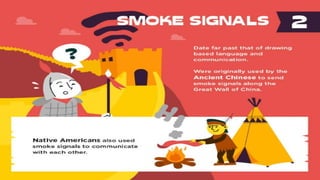
  • #36 Prehistoric communication: The earliest forms of human communication were cave paintings, rock art, and gestures, which date back to about 30,000 BCE. These forms of communication used symbols and images to convey basic information, such as hunting scenes, calendars, and rituals12 Ancient communication: The invention of writing was a major breakthrough in human communication, as it allowed the recording and transmission of more complex and abstract information, such as laws, history, and literature. The first writing systems emerged in ancient civilizations, such as Sumer, Egypt, China, and Mesoamerica, around 3000 BCE. Writing was initially based on pictograms and ideograms, which later evolved into phonetic alphabets and syllabaries. Writing was mainly done on clay tablets, papyrus scrolls, bamboo strips, and animal skins23 Medieval communication: The development of paper and printing technology in China around the 2nd century CE and in Europe around the 15th century CE revolutionized the production and dissemination of written communication. Paper was cheaper and easier to produce than previous writing materials, and printing enabled the mass reproduction of texts. Printing also facilitated the spread of literacy, education, and culture among different regions and social groups. Some of the most influential printed works in history include the Diamond Sutra (the oldest dated printed book), the Gutenberg Bible (the first book printed with movable type in Europe), and the Encyclopédie (a landmark of the Enlightenment)23 Modern communication: The invention of telecommunication technologies in the 19th and 20th centuries transformed the speed and scope of human communication. Telegraphs, telephones, radios, televisions, computers, and the Internet enabled people to communicate across long distances and in real time. These technologies also created new forms of communication, such as Morse code, audio recordings, video recordings, digital media, and social media. Telecommunication technologies also influenced the development of other fields, such as science, engineering, business, politics, and entertainment23
  • #37 Prehistoric communication: The earliest forms of human communication were cave paintings, rock art, and gestures, which date back to about 30,000 BCE. These forms of communication used symbols and images to convey basic information, such as hunting scenes, calendars, and rituals12 Ancient communication: The invention of writing was a major breakthrough in human communication, as it allowed the recording and transmission of more complex and abstract information, such as laws, history, and literature. The first writing systems emerged in ancient civilizations, such as Sumer, Egypt, China, and Mesoamerica, around 3000 BCE. Writing was initially based on pictograms and ideograms, which later evolved into phonetic alphabets and syllabaries. Writing was mainly done on clay tablets, papyrus scrolls, bamboo strips, and animal skins23 Medieval communication: The development of paper and printing technology in China around the 2nd century CE and in Europe around the 15th century CE revolutionized the production and dissemination of written communication. Paper was cheaper and easier to produce than previous writing materials, and printing enabled the mass reproduction of texts. Printing also facilitated the spread of literacy, education, and culture among different regions and social groups. Some of the most influential printed works in history include the Diamond Sutra (the oldest dated printed book), the Gutenberg Bible (the first book printed with movable type in Europe), and the Encyclopédie (a landmark of the Enlightenment)23 Modern communication: The invention of telecommunication technologies in the 19th and 20th centuries transformed the speed and scope of human communication. Telegraphs, telephones, radios, televisions, computers, and the Internet enabled people to communicate across long distances and in real time. These technologies also created new forms of communication, such as Morse code, audio recordings, video recordings, digital media, and social media. Telecommunication technologies also influenced the development of other fields, such as science, engineering, business, politics, and entertainment23
  • #38 Prehistoric communication: The earliest forms of human communication were cave paintings, rock art, and gestures, which date back to about 30,000 BCE. These forms of communication used symbols and images to convey basic information, such as hunting scenes, calendars, and rituals12 Ancient communication: The invention of writing was a major breakthrough in human communication, as it allowed the recording and transmission of more complex and abstract information, such as laws, history, and literature. The first writing systems emerged in ancient civilizations, such as Sumer, Egypt, China, and Mesoamerica, around 3000 BCE. Writing was initially based on pictograms and ideograms, which later evolved into phonetic alphabets and syllabaries. Writing was mainly done on clay tablets, papyrus scrolls, bamboo strips, and animal skins23 Medieval communication: The development of paper and printing technology in China around the 2nd century CE and in Europe around the 15th century CE revolutionized the production and dissemination of written communication. Paper was cheaper and easier to produce than previous writing materials, and printing enabled the mass reproduction of texts. Printing also facilitated the spread of literacy, education, and culture among different regions and social groups. Some of the most influential printed works in history include the Diamond Sutra (the oldest dated printed book), the Gutenberg Bible (the first book printed with movable type in Europe), and the Encyclopédie (a landmark of the Enlightenment)23 Modern communication: The invention of telecommunication technologies in the 19th and 20th centuries transformed the speed and scope of human communication. Telegraphs, telephones, radios, televisions, computers, and the Internet enabled people to communicate across long distances and in real time. These technologies also created new forms of communication, such as Morse code, audio recordings, video recordings, digital media, and social media. Telecommunication technologies also influenced the development of other fields, such as science, engineering, business, politics, and entertainment23
  • #39 Prehistoric communication: The earliest forms of human communication were cave paintings, rock art, and gestures, which date back to about 30,000 BCE. These forms of communication used symbols and images to convey basic information, such as hunting scenes, calendars, and rituals12 Ancient communication: The invention of writing was a major breakthrough in human communication, as it allowed the recording and transmission of more complex and abstract information, such as laws, history, and literature. The first writing systems emerged in ancient civilizations, such as Sumer, Egypt, China, and Mesoamerica, around 3000 BCE. Writing was initially based on pictograms and ideograms, which later evolved into phonetic alphabets and syllabaries. Writing was mainly done on clay tablets, papyrus scrolls, bamboo strips, and animal skins23 Medieval communication: The development of paper and printing technology in China around the 2nd century CE and in Europe around the 15th century CE revolutionized the production and dissemination of written communication. Paper was cheaper and easier to produce than previous writing materials, and printing enabled the mass reproduction of texts. Printing also facilitated the spread of literacy, education, and culture among different regions and social groups. Some of the most influential printed works in history include the Diamond Sutra (the oldest dated printed book), the Gutenberg Bible (the first book printed with movable type in Europe), and the Encyclopédie (a landmark of the Enlightenment)23 Modern communication: The invention of telecommunication technologies in the 19th and 20th centuries transformed the speed and scope of human communication. Telegraphs, telephones, radios, televisions, computers, and the Internet enabled people to communicate across long distances and in real time. These technologies also created new forms of communication, such as Morse code, audio recordings, video recordings, digital media, and social media. Telecommunication technologies also influenced the development of other fields, such as science, engineering, business, politics, and entertainment23
  • #40 Prehistoric communication: The earliest forms of human communication were cave paintings, rock art, and gestures, which date back to about 30,000 BCE. These forms of communication used symbols and images to convey basic information, such as hunting scenes, calendars, and rituals12 Ancient communication: The invention of writing was a major breakthrough in human communication, as it allowed the recording and transmission of more complex and abstract information, such as laws, history, and literature. The first writing systems emerged in ancient civilizations, such as Sumer, Egypt, China, and Mesoamerica, around 3000 BCE. Writing was initially based on pictograms and ideograms, which later evolved into phonetic alphabets and syllabaries. Writing was mainly done on clay tablets, papyrus scrolls, bamboo strips, and animal skins23 Medieval communication: The development of paper and printing technology in China around the 2nd century CE and in Europe around the 15th century CE revolutionized the production and dissemination of written communication. Paper was cheaper and easier to produce than previous writing materials, and printing enabled the mass reproduction of texts. Printing also facilitated the spread of literacy, education, and culture among different regions and social groups. Some of the most influential printed works in history include the Diamond Sutra (the oldest dated printed book), the Gutenberg Bible (the first book printed with movable type in Europe), and the Encyclopédie (a landmark of the Enlightenment)23 Modern communication: The invention of telecommunication technologies in the 19th and 20th centuries transformed the speed and scope of human communication. Telegraphs, telephones, radios, televisions, computers, and the Internet enabled people to communicate across long distances and in real time. These technologies also created new forms of communication, such as Morse code, audio recordings, video recordings, digital media, and social media. Telecommunication technologies also influenced the development of other fields, such as science, engineering, business, politics, and entertainment23
  • #41 Prehistoric communication: The earliest forms of human communication were cave paintings, rock art, and gestures, which date back to about 30,000 BCE. These forms of communication used symbols and images to convey basic information, such as hunting scenes, calendars, and rituals12 Ancient communication: The invention of writing was a major breakthrough in human communication, as it allowed the recording and transmission of more complex and abstract information, such as laws, history, and literature. The first writing systems emerged in ancient civilizations, such as Sumer, Egypt, China, and Mesoamerica, around 3000 BCE. Writing was initially based on pictograms and ideograms, which later evolved into phonetic alphabets and syllabaries. Writing was mainly done on clay tablets, papyrus scrolls, bamboo strips, and animal skins23 Medieval communication: The development of paper and printing technology in China around the 2nd century CE and in Europe around the 15th century CE revolutionized the production and dissemination of written communication. Paper was cheaper and easier to produce than previous writing materials, and printing enabled the mass reproduction of texts. Printing also facilitated the spread of literacy, education, and culture among different regions and social groups. Some of the most influential printed works in history include the Diamond Sutra (the oldest dated printed book), the Gutenberg Bible (the first book printed with movable type in Europe), and the Encyclopédie (a landmark of the Enlightenment)23 Modern communication: The invention of telecommunication technologies in the 19th and 20th centuries transformed the speed and scope of human communication. Telegraphs, telephones, radios, televisions, computers, and the Internet enabled people to communicate across long distances and in real time. These technologies also created new forms of communication, such as Morse code, audio recordings, video recordings, digital media, and social media. Telecommunication technologies also influenced the development of other fields, such as science, engineering, business, politics, and entertainment23
  • #42 Prehistoric communication: The earliest forms of human communication were cave paintings, rock art, and gestures, which date back to about 30,000 BCE. These forms of communication used symbols and images to convey basic information, such as hunting scenes, calendars, and rituals12 Ancient communication: The invention of writing was a major breakthrough in human communication, as it allowed the recording and transmission of more complex and abstract information, such as laws, history, and literature. The first writing systems emerged in ancient civilizations, such as Sumer, Egypt, China, and Mesoamerica, around 3000 BCE. Writing was initially based on pictograms and ideograms, which later evolved into phonetic alphabets and syllabaries. Writing was mainly done on clay tablets, papyrus scrolls, bamboo strips, and animal skins23 Medieval communication: The development of paper and printing technology in China around the 2nd century CE and in Europe around the 15th century CE revolutionized the production and dissemination of written communication. Paper was cheaper and easier to produce than previous writing materials, and printing enabled the mass reproduction of texts. Printing also facilitated the spread of literacy, education, and culture among different regions and social groups. Some of the most influential printed works in history include the Diamond Sutra (the oldest dated printed book), the Gutenberg Bible (the first book printed with movable type in Europe), and the Encyclopédie (a landmark of the Enlightenment)23 Modern communication: The invention of telecommunication technologies in the 19th and 20th centuries transformed the speed and scope of human communication. Telegraphs, telephones, radios, televisions, computers, and the Internet enabled people to communicate across long distances and in real time. These technologies also created new forms of communication, such as Morse code, audio recordings, video recordings, digital media, and social media. Telecommunication technologies also influenced the development of other fields, such as science, engineering, business, politics, and entertainment23
  • #43 Prehistoric communication: The earliest forms of human communication were cave paintings, rock art, and gestures, which date back to about 30,000 BCE. These forms of communication used symbols and images to convey basic information, such as hunting scenes, calendars, and rituals12 Ancient communication: The invention of writing was a major breakthrough in human communication, as it allowed the recording and transmission of more complex and abstract information, such as laws, history, and literature. The first writing systems emerged in ancient civilizations, such as Sumer, Egypt, China, and Mesoamerica, around 3000 BCE. Writing was initially based on pictograms and ideograms, which later evolved into phonetic alphabets and syllabaries. Writing was mainly done on clay tablets, papyrus scrolls, bamboo strips, and animal skins23 Medieval communication: The development of paper and printing technology in China around the 2nd century CE and in Europe around the 15th century CE revolutionized the production and dissemination of written communication. Paper was cheaper and easier to produce than previous writing materials, and printing enabled the mass reproduction of texts. Printing also facilitated the spread of literacy, education, and culture among different regions and social groups. Some of the most influential printed works in history include the Diamond Sutra (the oldest dated printed book), the Gutenberg Bible (the first book printed with movable type in Europe), and the Encyclopédie (a landmark of the Enlightenment)23 Modern communication: The invention of telecommunication technologies in the 19th and 20th centuries transformed the speed and scope of human communication. Telegraphs, telephones, radios, televisions, computers, and the Internet enabled people to communicate across long distances and in real time. These technologies also created new forms of communication, such as Morse code, audio recordings, video recordings, digital media, and social media. Telecommunication technologies also influenced the development of other fields, such as science, engineering, business, politics, and entertainment23
  • #44 Prehistoric communication: The earliest forms of human communication were cave paintings, rock art, and gestures, which date back to about 30,000 BCE. These forms of communication used symbols and images to convey basic information, such as hunting scenes, calendars, and rituals12 Ancient communication: The invention of writing was a major breakthrough in human communication, as it allowed the recording and transmission of more complex and abstract information, such as laws, history, and literature. The first writing systems emerged in ancient civilizations, such as Sumer, Egypt, China, and Mesoamerica, around 3000 BCE. Writing was initially based on pictograms and ideograms, which later evolved into phonetic alphabets and syllabaries. Writing was mainly done on clay tablets, papyrus scrolls, bamboo strips, and animal skins23 Medieval communication: The development of paper and printing technology in China around the 2nd century CE and in Europe around the 15th century CE revolutionized the production and dissemination of written communication. Paper was cheaper and easier to produce than previous writing materials, and printing enabled the mass reproduction of texts. Printing also facilitated the spread of literacy, education, and culture among different regions and social groups. Some of the most influential printed works in history include the Diamond Sutra (the oldest dated printed book), the Gutenberg Bible (the first book printed with movable type in Europe), and the Encyclopédie (a landmark of the Enlightenment)23 Modern communication: The invention of telecommunication technologies in the 19th and 20th centuries transformed the speed and scope of human communication. Telegraphs, telephones, radios, televisions, computers, and the Internet enabled people to communicate across long distances and in real time. These technologies also created new forms of communication, such as Morse code, audio recordings, video recordings, digital media, and social media. Telecommunication technologies also influenced the development of other fields, such as science, engineering, business, politics, and entertainment23
  • #45 Prehistoric communication: The earliest forms of human communication were cave paintings, rock art, and gestures, which date back to about 30,000 BCE. These forms of communication used symbols and images to convey basic information, such as hunting scenes, calendars, and rituals12 Ancient communication: The invention of writing was a major breakthrough in human communication, as it allowed the recording and transmission of more complex and abstract information, such as laws, history, and literature. The first writing systems emerged in ancient civilizations, such as Sumer, Egypt, China, and Mesoamerica, around 3000 BCE. Writing was initially based on pictograms and ideograms, which later evolved into phonetic alphabets and syllabaries. Writing was mainly done on clay tablets, papyrus scrolls, bamboo strips, and animal skins23 Medieval communication: The development of paper and printing technology in China around the 2nd century CE and in Europe around the 15th century CE revolutionized the production and dissemination of written communication. Paper was cheaper and easier to produce than previous writing materials, and printing enabled the mass reproduction of texts. Printing also facilitated the spread of literacy, education, and culture among different regions and social groups. Some of the most influential printed works in history include the Diamond Sutra (the oldest dated printed book), the Gutenberg Bible (the first book printed with movable type in Europe), and the Encyclopédie (a landmark of the Enlightenment)23 Modern communication: The invention of telecommunication technologies in the 19th and 20th centuries transformed the speed and scope of human communication. Telegraphs, telephones, radios, televisions, computers, and the Internet enabled people to communicate across long distances and in real time. These technologies also created new forms of communication, such as Morse code, audio recordings, video recordings, digital media, and social media. Telecommunication technologies also influenced the development of other fields, such as science, engineering, business, politics, and entertainment23
  • #46 Prehistoric communication: The earliest forms of human communication were cave paintings, rock art, and gestures, which date back to about 30,000 BCE. These forms of communication used symbols and images to convey basic information, such as hunting scenes, calendars, and rituals12 Ancient communication: The invention of writing was a major breakthrough in human communication, as it allowed the recording and transmission of more complex and abstract information, such as laws, history, and literature. The first writing systems emerged in ancient civilizations, such as Sumer, Egypt, China, and Mesoamerica, around 3000 BCE. Writing was initially based on pictograms and ideograms, which later evolved into phonetic alphabets and syllabaries. Writing was mainly done on clay tablets, papyrus scrolls, bamboo strips, and animal skins23 Medieval communication: The development of paper and printing technology in China around the 2nd century CE and in Europe around the 15th century CE revolutionized the production and dissemination of written communication. Paper was cheaper and easier to produce than previous writing materials, and printing enabled the mass reproduction of texts. Printing also facilitated the spread of literacy, education, and culture among different regions and social groups. Some of the most influential printed works in history include the Diamond Sutra (the oldest dated printed book), the Gutenberg Bible (the first book printed with movable type in Europe), and the Encyclopédie (a landmark of the Enlightenment)23 Modern communication: The invention of telecommunication technologies in the 19th and 20th centuries transformed the speed and scope of human communication. Telegraphs, telephones, radios, televisions, computers, and the Internet enabled people to communicate across long distances and in real time. These technologies also created new forms of communication, such as Morse code, audio recordings, video recordings, digital media, and social media. Telecommunication technologies also influenced the development of other fields, such as science, engineering, business, politics, and entertainment23
  • #47 Prehistoric communication: The earliest forms of human communication were cave paintings, rock art, and gestures, which date back to about 30,000 BCE. These forms of communication used symbols and images to convey basic information, such as hunting scenes, calendars, and rituals12 Ancient communication: The invention of writing was a major breakthrough in human communication, as it allowed the recording and transmission of more complex and abstract information, such as laws, history, and literature. The first writing systems emerged in ancient civilizations, such as Sumer, Egypt, China, and Mesoamerica, around 3000 BCE. Writing was initially based on pictograms and ideograms, which later evolved into phonetic alphabets and syllabaries. Writing was mainly done on clay tablets, papyrus scrolls, bamboo strips, and animal skins23 Medieval communication: The development of paper and printing technology in China around the 2nd century CE and in Europe around the 15th century CE revolutionized the production and dissemination of written communication. Paper was cheaper and easier to produce than previous writing materials, and printing enabled the mass reproduction of texts. Printing also facilitated the spread of literacy, education, and culture among different regions and social groups. Some of the most influential printed works in history include the Diamond Sutra (the oldest dated printed book), the Gutenberg Bible (the first book printed with movable type in Europe), and the Encyclopédie (a landmark of the Enlightenment)23 Modern communication: The invention of telecommunication technologies in the 19th and 20th centuries transformed the speed and scope of human communication. Telegraphs, telephones, radios, televisions, computers, and the Internet enabled people to communicate across long distances and in real time. These technologies also created new forms of communication, such as Morse code, audio recordings, video recordings, digital media, and social media. Telecommunication technologies also influenced the development of other fields, such as science, engineering, business, politics, and entertainment23
  • #48 Monogenesis, also known as the single-origin or Out of Africa theory, posits that all modern humans share a common ancestry and originated from a single population in Africa. According to this theory, anatomically modern humans first appeared in Africa and subsequently migrated to other parts of the world, replacing or assimilating with earlier hominid populations like Neanderthals and Denisovans. This migration occurred over tens of thousands of years, leading to the diverse human populations we see today
  • #49 Monogenesis, also known as the single-origin or Out of Africa theory, posits that all modern humans share a common ancestry and originated from a single population in Africa. According to this theory, anatomically modern humans first appeared in Africa and subsequently migrated to other parts of the world, replacing or assimilating with earlier hominid populations like Neanderthals and Denisovans. This migration occurred over tens of thousands of years, leading to the diverse human populations we see today
  • #50 2. Polygenesis: Polygenesis, also known as the multiregional or regional continuity theory, proposes that modern humans did not originate from a single population in Africa but instead evolved independently from different hominid populations in various regions of the world. According to this theory, regional populations of archaic humans like Neanderthals and Homo erectus gradually evolved into modern humans within their respective regions. This implies that there were multiple, parallel paths to the development of modern humans. Key points of the polygenesis theory include: Multiple Origins: It suggests that different human populations evolved separately in various regions over a long period of time. Regional Continuity: Polygenesis proposes that the continuity of certain traits and characteristics within regional populations indicates independent evolution. Hybridization: Some proponents of polygenesis also acknowledge limited interbreeding between different regional populations.
  • #51 Monogenesis, also known as the single-origin or Out of Africa theory, posits that all modern humans share a common ancestry and originated from a single population in Africa. According to this theory, anatomically modern humans first appeared in Africa and subsequently migrated to other parts of the world, replacing or assimilating with earlier hominid populations like Neanderthals and Denisovans. This migration occurred over tens of thousands of years, leading to the diverse human populations we see today
  • #52 Monogenesis, also known as the single-origin or Out of Africa theory, posits that all modern humans share a common ancestry and originated from a single population in Africa. According to this theory, anatomically modern humans first appeared in Africa and subsequently migrated to other parts of the world, replacing or assimilating with earlier hominid populations like Neanderthals and Denisovans. This migration occurred over tens of thousands of years, leading to the diverse human populations we see today