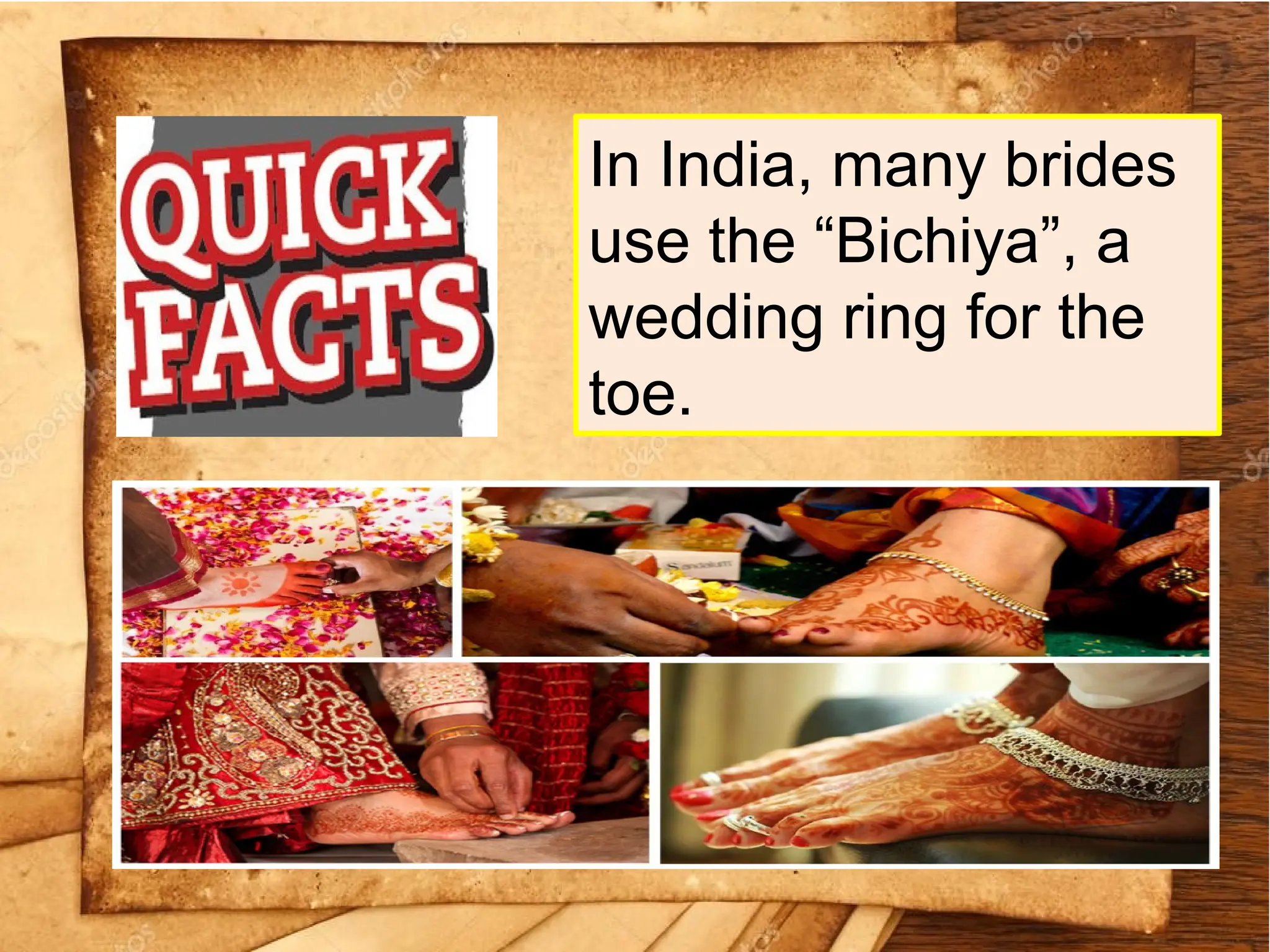
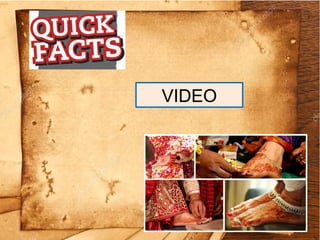
In India, many brides
use the “Bichiya”, a
wedding ring for the
toe.
VIDEO
Indian
Mythology
Hinduism
A diverse body of religion, philosophy,
and culture practice native to and
predominant in India, characterized by
a belief in reincarnation and a
supreme being of many forms and
natures, and by a desire for liberation
from earthly evils.
Vishnu
• one of the three main gods in Hindu
religion
• “the preserver” and has many
avatars:
• Krishna
• Rama
• Brahma
• Shiva
1. Indian Literature is based on piety
(virtue, goodness), a deeply religious
spirit.
2. Indian literary masterpieces were
written in a form of epic which
corresponds to the History of India.
Ramayana and Mahabharata
They also believe in Reincarnation
Introduction to Indian
Literature
Sanskrit –
Means “cultivated and perfected”
The common ancestral language in which the
Indian Literature was derived from.
 Vedas –
Serves as the Bible of the Indian
These contains hymns addressed to the Indian
gods.
 Sanskrit Literature –
This is the term for the literature of India.
Review: Introduction to Indian Literature
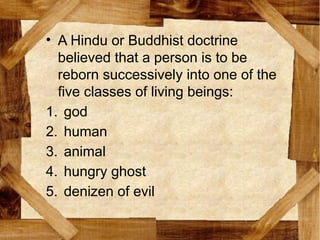
• A Hindu or Buddhist doctrine
believed that a person is to be
reborn successively into one of the
five classes of living beings:
1. god
2. human
3. animal
4. hungry ghost
5. denizen of evil
Video
RAMAYANA
Background
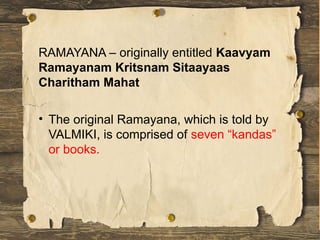
RAMAYANA – originally entitled Kaavyam
Ramayanam Kritsnam Sitaayaas
Charitham Mahat
• The original Ramayana, which is told by
VALMIKI, is comprised of seven “kandas”
or books.
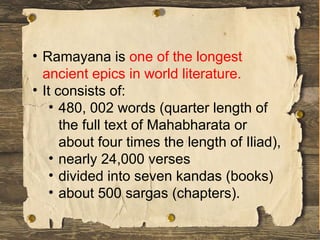
• Ramayana is one of the longest
ancient epics in world literature.
• It consists of:
• 480, 002 words (quarter length of
the full text of Mahabharata or
about four times the length of Iliad),
• nearly 24,000 verses
• divided into seven kandas (books)
• about 500 sargas (chapters).
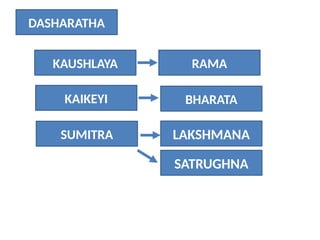
DASHARATHA
KAIKEYI
KAUSHLAYA
SUMITRA
RAMA
BHARATA
SATRUGHNA
LAKSHMANA
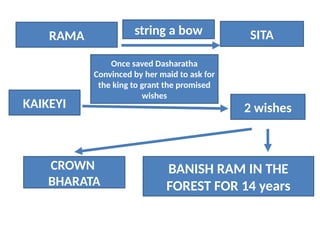
RAMA
KAIKEYI
string a bow
CROWN
BHARATA
SITA
2 wishes
BANISH RAM IN THE
FOREST FOR 14 years
Once saved Dasharatha
Convinced by her maid to ask for
the king to grant the promised
wishes
Major Characters
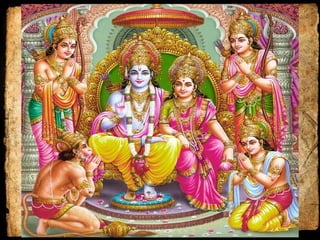
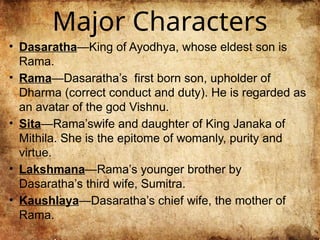
• Dasaratha—King of Ayodhya, whose eldest son is
Rama.
• Rama—Dasaratha’s first born son, upholder of
Dharma (correct conduct and duty). He is regarded as
an avatar of the god Vishnu.
• Sita—Rama’swife and daughter of King Janaka of
Mithila. She is the epitome of womanly, purity and
virtue.
• Lakshmana—Rama’s younger brother by
Dasaratha’s third wife, Sumitra.
• Kaushlaya—Dasaratha’s chief wife, the mother of
Rama.
Major Characters
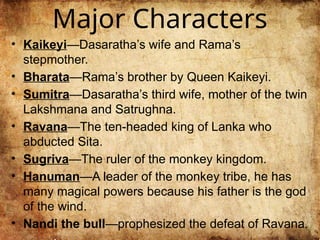
• Kaikeyi—Dasaratha’s wife and Rama’s
stepmother.
• Bharata—Rama’s brother by Queen Kaikeyi.
• Sumitra—Dasaratha’s third wife, mother of the twin
Lakshmana and Satrughna.
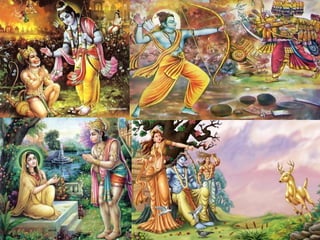
• Ravana—The ten-headed king of Lanka who
abducted Sita.
• Sugriva—The ruler of the monkey kingdom.
• Hanuman—A leader of the monkey tribe, he has
many magical powers because his father is the god
of the wind.
• Nandi the bull—prophesized the defeat of Ravana.
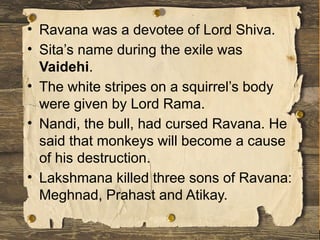
• Ravana was a devotee of Lord Shiva.
• Sita’s name during the exile was
Vaidehi.
• The white stripes on a squirrel’s body
were given by Lord Rama.
• Nandi, the bull, had cursed Ravana. He
said that monkeys will become a cause
of his destruction.
• Lakshmana killed three sons of Ravana:
Meghnad, Prahast and Atikay.
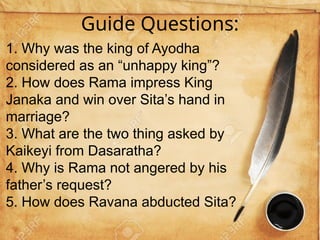
Guide Questions:
1. Why was the king of Ayodha
considered as an “unhappy king”?
2. How does Rama impress King
Janaka and win over Sita’s hand in
marriage?
3. What are the two thing asked by
Kaikeyi from Dasaratha?
4. Why is Rama not angered by his
father’s request?
5. How does Ravana abducted Sita?
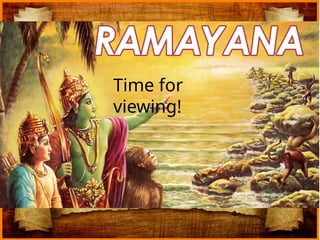
Time for
viewing!
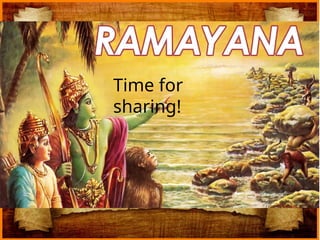
RAMAYANA
Major
Themes
• Rama and Sita come to embody the
ideals of matrimony through their
devotion and love for each other.
• Rama inspires loyalty among his people
for his nobility, while Sita’s self-sacrifice is
seen as the ultimate demonstration of
chastity.
• Lakshmana, who chose to be exiled with
Rama, embodies familial loyalty.
• Hanuman’s performance on the battlefield
exemplifies bravery and nobility.
• What are the other themes?
• What lesson(s) can you get
from the epic?
Guide Questions:
1. Why was the king of Ayodha
considered as an “unhappy king”?
2. How does Rama impress King
Janaka and win over Sita’s hand in
marriage?
3. What are the two thing asked by
Kaikeyi from Dasaratha?
4. Why is Rama not angered by his
father’s request?
5. How does Ravana abducted Sita?
Time for
sharing!
• (1/2 sheet of paper) Answer only.
1. If you are going to change or revise a part
of the story what would that be and why?
2. The Ramayana suggests that much of
Rama’s greatness is the result of his
choices to place dharma above his own
personal interests. Likewise, Ravana
possesses many noble characteristics but
has chosen to use them for a life of evil.
Do you think that being good or bad is a
matter of personal choice, or are people
simply born good or bad?
• Directions: Discuss the guide questions.
Copy and write your answer on a 1
whole sheet of paper.
• After answering, let’s have a sharing.
• You’ll share your answer based on your
group number (for example, group 1 will
share your answer on question 1)
including the last number.
Assignment
• On a one whole sheet of paper, copy
and answer the guide questions.
Indian Literature_Introduction_____.pptx

Indian Literature_Introduction_____.pptx

  • 1.
    In India, manybrides use the “Bichiya”, a wedding ring for the toe.
  • 2.
  • 4.
  • 5.
    Hinduism A diverse bodyof religion, philosophy, and culture practice native to and predominant in India, characterized by a belief in reincarnation and a supreme being of many forms and natures, and by a desire for liberation from earthly evils.
  • 6.
    Vishnu • one ofthe three main gods in Hindu religion • “the preserver” and has many avatars: • Krishna • Rama • Brahma • Shiva
  • 7.
    1. Indian Literatureis based on piety (virtue, goodness), a deeply religious spirit. 2. Indian literary masterpieces were written in a form of epic which corresponds to the History of India. Ramayana and Mahabharata They also believe in Reincarnation Introduction to Indian Literature
  • 8.
    Sanskrit – Means “cultivatedand perfected” The common ancestral language in which the Indian Literature was derived from.  Vedas – Serves as the Bible of the Indian These contains hymns addressed to the Indian gods.  Sanskrit Literature – This is the term for the literature of India. Review: Introduction to Indian Literature
  • 9.
    • A Hinduor Buddhist doctrine believed that a person is to be reborn successively into one of the five classes of living beings: 1. god 2. human 3. animal 4. hungry ghost 5. denizen of evil
  • 10.
  • 11.
  • 14.
    RAMAYANA – originallyentitled Kaavyam Ramayanam Kritsnam Sitaayaas Charitham Mahat • The original Ramayana, which is told by VALMIKI, is comprised of seven “kandas” or books.
  • 15.
    • Ramayana isone of the longest ancient epics in world literature. • It consists of: • 480, 002 words (quarter length of the full text of Mahabharata or about four times the length of Iliad), • nearly 24,000 verses • divided into seven kandas (books) • about 500 sargas (chapters).
  • 16.
  • 17.
    RAMA KAIKEYI string a bow CROWN BHARATA SITA 2wishes BANISH RAM IN THE FOREST FOR 14 years Once saved Dasharatha Convinced by her maid to ask for the king to grant the promised wishes
  • 18.
    Major Characters • Dasaratha—Kingof Ayodhya, whose eldest son is Rama. • Rama—Dasaratha’s first born son, upholder of Dharma (correct conduct and duty). He is regarded as an avatar of the god Vishnu. • Sita—Rama’swife and daughter of King Janaka of Mithila. She is the epitome of womanly, purity and virtue. • Lakshmana—Rama’s younger brother by Dasaratha’s third wife, Sumitra. • Kaushlaya—Dasaratha’s chief wife, the mother of Rama.
  • 19.
    Major Characters • Kaikeyi—Dasaratha’swife and Rama’s stepmother. • Bharata—Rama’s brother by Queen Kaikeyi. • Sumitra—Dasaratha’s third wife, mother of the twin Lakshmana and Satrughna. • Ravana—The ten-headed king of Lanka who abducted Sita. • Sugriva—The ruler of the monkey kingdom. • Hanuman—A leader of the monkey tribe, he has many magical powers because his father is the god of the wind. • Nandi the bull—prophesized the defeat of Ravana.
  • 20.
    • Ravana wasa devotee of Lord Shiva. • Sita’s name during the exile was Vaidehi. • The white stripes on a squirrel’s body were given by Lord Rama. • Nandi, the bull, had cursed Ravana. He said that monkeys will become a cause of his destruction. • Lakshmana killed three sons of Ravana: Meghnad, Prahast and Atikay.
  • 21.
    Guide Questions: 1. Whywas the king of Ayodha considered as an “unhappy king”? 2. How does Rama impress King Janaka and win over Sita’s hand in marriage? 3. What are the two thing asked by Kaikeyi from Dasaratha? 4. Why is Rama not angered by his father’s request? 5. How does Ravana abducted Sita?
  • 22.
  • 23.
  • 24.
    • Rama andSita come to embody the ideals of matrimony through their devotion and love for each other. • Rama inspires loyalty among his people for his nobility, while Sita’s self-sacrifice is seen as the ultimate demonstration of chastity. • Lakshmana, who chose to be exiled with Rama, embodies familial loyalty. • Hanuman’s performance on the battlefield exemplifies bravery and nobility.
  • 25.
    • What arethe other themes? • What lesson(s) can you get from the epic?
  • 26.
    Guide Questions: 1. Whywas the king of Ayodha considered as an “unhappy king”? 2. How does Rama impress King Janaka and win over Sita’s hand in marriage? 3. What are the two thing asked by Kaikeyi from Dasaratha? 4. Why is Rama not angered by his father’s request? 5. How does Ravana abducted Sita?
  • 27.
  • 28.
    • (1/2 sheetof paper) Answer only. 1. If you are going to change or revise a part of the story what would that be and why? 2. The Ramayana suggests that much of Rama’s greatness is the result of his choices to place dharma above his own personal interests. Likewise, Ravana possesses many noble characteristics but has chosen to use them for a life of evil. Do you think that being good or bad is a matter of personal choice, or are people simply born good or bad?
  • 29.
    • Directions: Discussthe guide questions. Copy and write your answer on a 1 whole sheet of paper. • After answering, let’s have a sharing. • You’ll share your answer based on your group number (for example, group 1 will share your answer on question 1) including the last number.
  • 30.
    Assignment • On aone whole sheet of paper, copy and answer the guide questions.

Editor's Notes

  • #5 1. a. B. b. H c. C d. I
  • #6 2. a. K b. R c. V d. S
  • #9 3. a. 3 b. 2 c. 4 d. 5
  • #11 4. a. Ramayana b. Mahabhrata c. Beauwulf d. Iliad
  • #14 is an ancient Indian epic poem which narrates the struggle of the divine prince Rama to rescue his wife Sita from the demon king Ravana. 5. a. Homer b. ann grifalconi c. Valmiki d. Jose Rizal
  • #15 6. 480002 7. 7 8 500
  • #18 9. a. 10. a 11. b
  • #19 12. B 13. a 14-18 19. Ramayana 20.
  • #20 To impress the god, he sacrificed his head. This happened ten times after which Lord Shiva gave him all those heads.