LESSON 2
SEWING MACHINE AND ITS TYPE
Introduction
A sewing machine is used to stitch the fabric and other pliable materials together with threads.
Sewing machines were invented during the first Industrial Revolution to decrease the quantum
of manual sewing done in garment industries. Since its invention, it has greatly improved the
efficiency and productivity of the fabric, garment and needle industries. The different parts of a
sewing machine and its functions help the Operator to know the functioning of a sewing
machine. There are different types of sewing machine used in the manufacturing of garments
and other articles, but here in this Unit, we will study only single needle lock stitch machine. A
sewing machine controls the fabric with feeding devices and forms a perfect stitch to join the
fabrics. It has various parts and attachments, each of which have their own importance and use.
There are mainly two categories of sewing machines that is, domestic sewing machine and
industrial sewing machine. A Sewing Machine Operator should have the knowledge and skills to
operate the different types of sewing machine. The Operator should know about the various
operations of the sewing machine, its parts, their functions, its attachments and the terms
related to stitching. Some of the common and important terms are explained in this Unit.
Learning Outcomes
At the end of this lesson, you are expected to:
Identify and list the different types sewing machine.
Perform different sewing machine stitching
Abstraction
Let us learn…
Sewing Machine and its Types
Before the invention of a useable machine for sewing, everything was sewn by hand. Many
early efforts tried to replicate this hand sewing method but were mostly a failure. It looked to
embroidery, where a needle was used to produce decorative stitches but not for joining the
fabrics. The final look of any garment or article depends on how the different components are
attached together by sewing. Any variation in sewing leads to a defective material. Thus, sewing
must be done with caution. Sewing can be broadly classified in two categories— hand sewing
and machine sewing. Hand sewing may be used for temporary purposes or sometimes, it may
be used for some special purposes like hemming, buttonhole making, blanket stitch, etc.
Here in this session, our main focus is on the sewing machine. The basic thought behind sewing
machines is to mechanically stitch two or more pieces of material—mainly fabric, together using
thread and a needle. Sewing machines reduce the amount of manual sewing in preparing a
garment or any other article. Sewing machines help the operator in getting the work done
quicker, with greater accuracy and much more consistently. Evolution of the sewing machine
The sewing machine device was invented in 1790 by English inventor, Thomas Saint, but he
could not advertise his invention. He designed a wooden awl to make holes in leather and
canvas, thus allowing a needle and single piece of thread through to hook underneath, and
forming locked chain stitches. Josef Madersperger began developing the sewing machine in
1807 and he presented the working machine in 1814. John Greenough patented the first sewing
machine in the United States in 1842. Elias Howe created a sewing machine in 1845. The
sewing machine’s recognition quickly spread like wildfire, initially selling to clothing
manufacturers so that they could construct standardised clothing sizes on a larger scale. In
1860s, there was a quick popularity of these machines in the middle class section. Later in
1889, the machines run by electricity were designed with motors fixed in them. At first, these
were standard machines with a motor strapped on the side. As with the expansion of the power
in houses, these became more popular and the motor was gradually introduced into the casing.
Later innovations include the ability to make more sophisticated stitching patterns. In the twenty-
first century, sewing machine companies have manufactured several type of machines used for
different sewing techniques and there are also computerised machines, embroidery machines
and special purpose machines manufactured. The latest machines have LCD screens,
microprocessors, and pre-programmed fonts. Categories of sewing machine The following are
the main categories of sewing machine. Domestic sewing machines These are designed mainly
for one person to sew individual dresses while using a single stitch type. Modern sewing
machines are designed in such a way that the fabric easily glides in and out of the sewing
machine, speeding the stitching process and saving time and energy. Some key points for
domestic sewing machines are as follows.
1. Domestic sewing machines are usually used in homes by people simply interested in sewing.
2. These are commonly used by people in a variety of projects for dressmaking, and for stitching
simple home furnishing items.
3. With little changes, these machines can perform a variety of stitch types. Domestic sewing
machines usually work on lightweight fabrics or work pieces.
5. These machines run on significantly smaller motors compared to that of the industrial sewing
machines.
Industrial sewing machines.
1. Industrial sewing machines are a heavy-duty version of a
standard basic sewing machine, and it is used in garment and
other related industries.
2. Industrial sewing machines are used for mass production.
3. These are heavy-duty machines that work thousands of
stitches per minute.
4. An industrial machine is well equipped with a clutch and
large servo motor.
5. Industrial machines are mainly designed to perform one
single specific function in assembly line based factories.
6. Some industrial machines are designed to operate heavier than normal material.
7. Mainly, mass production requires an industrial sewing machine, which is designed to sew
heavy material speedily, such as leather, canvas, and vinyl, at one time.
8. The industrial machines are named based on the function that they serve. Typical names for
industrial machine class include pocket setter, buttonhole, and programmable pattern sewers,
etc. For instance, a pocket industrial machine can sew 2,000 pockets in an eight-hour
production cycle.
9. Programmable machines can store 10–30 or more patterns in the memory.
10. Special purpose industrial machines can give better output in production, for example,
buttonhole machines, pocket setter, pattern sewer. Industrial sewing machines are larger,
faster, more complex, and more varied in their size, price and task.
The following are the comparison between domestic and industrial sewing machines:
1. The industrial machine is faster, stitching from 3000–6000 stitches per minute, while the
fastest domestic sewing machine stitches not more than 1500 stitches per minute.
2. The presser foot a power machine is raised and lowered with a knee lift to a special foot
pedal. On domestic machines, it is generally operated manually using a lever at the back of the
needle bar.
3. Lubrication is done automatically in industrial sewing machines whereas it is done manually
in domestic sewing machines.
Types of sewing machine
Though there are different types of sewing machine but mainly, three types are considered for
sewing, as given below.
1. Mechanical sewing machines
2. Electronic sewing machines
3. Computerised sewing machines
1. Mechanical sewing machines.
These machines are less expensive and are the simplest
type of sewing machines in terms of build. They
are the hand-operated sewing machine and
treadle sewing machine.
Hand-operated sewing machine
(i) This is the simplest form of domestic sewing
machine which is operated by hand.
(ii) A handle is attached to the flywheel is
detachable and is used to operate the machine.
(iii) A hand-operated sewing machine is
generally used for domestic purpose for simple
projects as it does not work very speedily.
(iv) This machine is suitable where there is no
electricity supply.
Treadle sewing machine
(i) This machine is the same as a hand-operated sewing machine but it is operated by
feet, with an additional stand attached to the machine.
(ii) A belt is attached to the lower stand passing through the balance wheel and driven
by feet.
(iii) These machines run faster than the hand-operated sewing machine.
(iv) This machine is also suitable for the places where there is no electric supply.
(v) When handling the treadle sewing machine, both the hands of the Operator are free
to handle the fabric. Hence, this speeds up the work of sewing.
2. Electronic sewing machine
These machines became popular during the 1970s. There are many more features in an
electronic sewing machine than in a mechanical sewing machine.
(i) These sewing machines run faster than manually operated machines.
(ii) In the electronic machines, balance wheel comes to motion by a belt, which is
attached to an electric motor.
(iii) A single motor is attached to the electronic sewing machines and this motor supplies
power to the needle.
(iv) It is essential to control the speed of this machine by putting pressure on an
electronic foot pedal.
(v) Practice is essential to handle an electric sewing machine.
3. Computerised sewing machines
(i) These sewing machines are very fast and specific to use.
(ii) These machines are similar to the electronic sewing machines. However, a
computerised sewing machine works with the help of various softwares.
(iii) Computerised sewing machines allow the Operator to tailor the functions according
to the sewing needs. A computerised sewing machine functions very appropriately in
designing and stitching various components of the garment like sleeves, yokes, pockets,
etc. These advanced computerised machines have an LED display or LCD display or
touch screen. They are multi-function machines and are expensive.
Parts of a Sewing Machine
1. Spool pin: It is fitted on top of the arm to
hold the reel.
2. Thread guide: It holds the thread in position
from the spool to the needle.
3. Tension disc: The two concave discs put
together with the convex sides
facing each other. The thread passes between
the two. The tension of the thread is
adjusted by a spring and nut which increases or
decreases pressure
4. Take up lever: It is a lever fitted to the body
of the arm. Its up and down
motion feeds the thread to the needle and
tightens the loop formed by the shuttle.
5. Needle bar: This is a steel rod to hold the
needle at one end with the help of
a clamp. Its main function is to give motion to
the needle.
6. Bobbin case: This moves into position to
catch the top thread and form the
stitch as the needle is lowered into the bobbin
chamber.
7. Presser foot: It is fixed to the presser bar to
hold the cloth firmly in position
when lowered.
8. Presser foot lifter: A lever attached to the
presser bar for raising and
lowering the presser foot.
9. Stitch regulator: This controls the length of
the stitch.
10. Bobbin winder: A simple mechanism used
for winding thread on the
bobbin.
11. Fly Wheel: When this is made to revolve, it
works the mechanism of the
motion
12. Clutch or Thumb Screw: This is in the
center of the fly wheel and it
engages and disengages the stitching
mechanism.
13. Slide Plate: A rectangular plate, which
facilitates the removal of the bobbin
case without lifting the machine.
14. Needle Plate or Throat Plate: A semi-
circular disc with a hole to
allow the needle to pass through it.
15. Feed dog: This consists of a set of teeth
fitted below the needle plate. It
helps to move the cloth forward while sewing.
16. Face plate: A cover which on removal gives
access to the oiling points on
the needle bar, presser bar and take-up lever.
17. Spool pin for bobbin winding: Spool of
thread is placed on this
at the time of bobbin winding
SEWING MACHINE ATTACHMENTS Some sewing machines may be supplied along with the machine
when you purchase it. Others may be available at additional cost. Attachments make sewing Easier and
provide opportunities for decorative sewing . In selecting attachments, make sure that they will fit the
model of machine you posses. Most of the attachments must be fixed to the presser bar in the place of
The presser foot. The attachments most commonly used on straight stitch machines are listed below.
(1)Hemmer foot (fig.5a): this is used for turning up
and stitching a narrow hem.
(2)Ruffler (fig.5b): This attachment is capable of
taking uniform gathered or pleated frills, and will
take and apply frills to another section at the same
time. It is useful in making Children’s clothes and
curtains.
(3)Cloth guide (fig.5c): This is a device which is
useful in guiding fabric for uniform stitching.
(4)Cording foot or zipper foot (fig.5d): This is
designed for stitching close to a raised edge. It is
used for applying cording into seams and for
application of zipper.
(5)Binder (fig.5e): This is for applying readymade or self-made bias binding to a straight or curved edge
and is a very useful attachment for trimming dresses etc.
(6)Tucker (fig.5f): This is used for making uniform tucks from 1/8 inch to 1 inch in width.
(7)Gathering foot (fig.5g): This attachment gathers fabric as it is stitched, with the fullness locked in
every stitch.
(8)Feed cover plate fig.5h): This is used to cover the feed dog while doing machine embroidery and
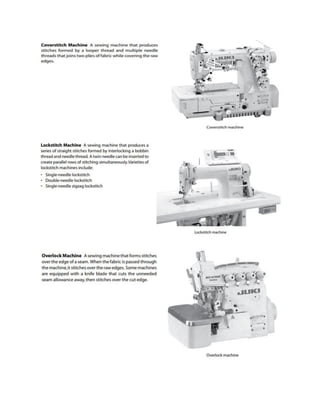
The following are some other types of sewing machines according to their specific applications.
(i) Lock stitch machine
(ii) Chain stitch machine
(iii) Double chain stitch machine
(iv) Buttonhole machine
(v) Button stitch machine
(vi) Bar-tack machine
(vii) Feed off arm machine
(viii) Over-lock machine
(ix) Blind stitch machine
(x) Over-edge machine
Application:
Task 1.
Draw or stick a picture of a sewing machine & label its parts. Stick pictures (5 or more) of
different sewing machines available in the market. [E.g. Basic or Domestic Sewing Machine,
Industrial Sewing machine, Over Locker Sewing Machine, Computerized Sewing Machine]
Use drawing template you used in your previous BTLE subject.
Task # 2
Search samples of sewing machine stitches.
Material Required
1. Cotton fabric to prepare samples (12" x 12")
2. Pen
3. A4-sized chart sheet
4. Glue
5. Markers/coloured pens
Procedure
1. Use zigzag, straight stitch, and blind hem stitch, stretch blind stitch to finish four sides of the
sample fabric.
2. Stitch atleast 10 types of machine stitches (search online) on the sample.
3. Label them (type of stitch, # of stitch per inch in light and heavy stiches.
4. Place it in your clearbook including your rubrics.
submit your work at the designated submission box DOSCST BEC GUARDHOUSE.
W.H.E.W. We Have Ended Well
Well done! Congratulate yourself. You have just finished Lesson 2 of this module. Now, if you
are ready, please proceed to Lesson 3,
Lesson 2-clothing-construction-file

Lesson 2-clothing-construction-file

  • 1.
    LESSON 2 SEWING MACHINEAND ITS TYPE Introduction A sewing machine is used to stitch the fabric and other pliable materials together with threads. Sewing machines were invented during the first Industrial Revolution to decrease the quantum of manual sewing done in garment industries. Since its invention, it has greatly improved the efficiency and productivity of the fabric, garment and needle industries. The different parts of a sewing machine and its functions help the Operator to know the functioning of a sewing machine. There are different types of sewing machine used in the manufacturing of garments and other articles, but here in this Unit, we will study only single needle lock stitch machine. A sewing machine controls the fabric with feeding devices and forms a perfect stitch to join the fabrics. It has various parts and attachments, each of which have their own importance and use. There are mainly two categories of sewing machines that is, domestic sewing machine and industrial sewing machine. A Sewing Machine Operator should have the knowledge and skills to operate the different types of sewing machine. The Operator should know about the various operations of the sewing machine, its parts, their functions, its attachments and the terms related to stitching. Some of the common and important terms are explained in this Unit. Learning Outcomes At the end of this lesson, you are expected to: Identify and list the different types sewing machine. Perform different sewing machine stitching Abstraction Let us learn… Sewing Machine and its Types Before the invention of a useable machine for sewing, everything was sewn by hand. Many early efforts tried to replicate this hand sewing method but were mostly a failure. It looked to embroidery, where a needle was used to produce decorative stitches but not for joining the fabrics. The final look of any garment or article depends on how the different components are attached together by sewing. Any variation in sewing leads to a defective material. Thus, sewing must be done with caution. Sewing can be broadly classified in two categories— hand sewing and machine sewing. Hand sewing may be used for temporary purposes or sometimes, it may be used for some special purposes like hemming, buttonhole making, blanket stitch, etc. Here in this session, our main focus is on the sewing machine. The basic thought behind sewing machines is to mechanically stitch two or more pieces of material—mainly fabric, together using thread and a needle. Sewing machines reduce the amount of manual sewing in preparing a garment or any other article. Sewing machines help the operator in getting the work done quicker, with greater accuracy and much more consistently. Evolution of the sewing machine The sewing machine device was invented in 1790 by English inventor, Thomas Saint, but he could not advertise his invention. He designed a wooden awl to make holes in leather and
  • 2.
    canvas, thus allowinga needle and single piece of thread through to hook underneath, and forming locked chain stitches. Josef Madersperger began developing the sewing machine in 1807 and he presented the working machine in 1814. John Greenough patented the first sewing machine in the United States in 1842. Elias Howe created a sewing machine in 1845. The sewing machine’s recognition quickly spread like wildfire, initially selling to clothing manufacturers so that they could construct standardised clothing sizes on a larger scale. In 1860s, there was a quick popularity of these machines in the middle class section. Later in 1889, the machines run by electricity were designed with motors fixed in them. At first, these were standard machines with a motor strapped on the side. As with the expansion of the power in houses, these became more popular and the motor was gradually introduced into the casing. Later innovations include the ability to make more sophisticated stitching patterns. In the twenty- first century, sewing machine companies have manufactured several type of machines used for different sewing techniques and there are also computerised machines, embroidery machines and special purpose machines manufactured. The latest machines have LCD screens, microprocessors, and pre-programmed fonts. Categories of sewing machine The following are the main categories of sewing machine. Domestic sewing machines These are designed mainly for one person to sew individual dresses while using a single stitch type. Modern sewing machines are designed in such a way that the fabric easily glides in and out of the sewing machine, speeding the stitching process and saving time and energy. Some key points for domestic sewing machines are as follows. 1. Domestic sewing machines are usually used in homes by people simply interested in sewing. 2. These are commonly used by people in a variety of projects for dressmaking, and for stitching simple home furnishing items. 3. With little changes, these machines can perform a variety of stitch types. Domestic sewing machines usually work on lightweight fabrics or work pieces. 5. These machines run on significantly smaller motors compared to that of the industrial sewing machines. Industrial sewing machines. 1. Industrial sewing machines are a heavy-duty version of a standard basic sewing machine, and it is used in garment and other related industries. 2. Industrial sewing machines are used for mass production. 3. These are heavy-duty machines that work thousands of stitches per minute. 4. An industrial machine is well equipped with a clutch and large servo motor. 5. Industrial machines are mainly designed to perform one single specific function in assembly line based factories. 6. Some industrial machines are designed to operate heavier than normal material.
  • 3.
    7. Mainly, massproduction requires an industrial sewing machine, which is designed to sew heavy material speedily, such as leather, canvas, and vinyl, at one time. 8. The industrial machines are named based on the function that they serve. Typical names for industrial machine class include pocket setter, buttonhole, and programmable pattern sewers, etc. For instance, a pocket industrial machine can sew 2,000 pockets in an eight-hour production cycle. 9. Programmable machines can store 10–30 or more patterns in the memory. 10. Special purpose industrial machines can give better output in production, for example, buttonhole machines, pocket setter, pattern sewer. Industrial sewing machines are larger, faster, more complex, and more varied in their size, price and task. The following are the comparison between domestic and industrial sewing machines: 1. The industrial machine is faster, stitching from 3000–6000 stitches per minute, while the fastest domestic sewing machine stitches not more than 1500 stitches per minute. 2. The presser foot a power machine is raised and lowered with a knee lift to a special foot pedal. On domestic machines, it is generally operated manually using a lever at the back of the needle bar. 3. Lubrication is done automatically in industrial sewing machines whereas it is done manually in domestic sewing machines. Types of sewing machine Though there are different types of sewing machine but mainly, three types are considered for sewing, as given below. 1. Mechanical sewing machines 2. Electronic sewing machines 3. Computerised sewing machines 1. Mechanical sewing machines.
  • 4.
    These machines areless expensive and are the simplest type of sewing machines in terms of build. They are the hand-operated sewing machine and treadle sewing machine. Hand-operated sewing machine (i) This is the simplest form of domestic sewing machine which is operated by hand. (ii) A handle is attached to the flywheel is detachable and is used to operate the machine. (iii) A hand-operated sewing machine is generally used for domestic purpose for simple projects as it does not work very speedily. (iv) This machine is suitable where there is no electricity supply. Treadle sewing machine (i) This machine is the same as a hand-operated sewing machine but it is operated by feet, with an additional stand attached to the machine. (ii) A belt is attached to the lower stand passing through the balance wheel and driven by feet. (iii) These machines run faster than the hand-operated sewing machine. (iv) This machine is also suitable for the places where there is no electric supply. (v) When handling the treadle sewing machine, both the hands of the Operator are free to handle the fabric. Hence, this speeds up the work of sewing. 2. Electronic sewing machine These machines became popular during the 1970s. There are many more features in an electronic sewing machine than in a mechanical sewing machine. (i) These sewing machines run faster than manually operated machines. (ii) In the electronic machines, balance wheel comes to motion by a belt, which is attached to an electric motor. (iii) A single motor is attached to the electronic sewing machines and this motor supplies power to the needle. (iv) It is essential to control the speed of this machine by putting pressure on an electronic foot pedal.
  • 5.
    (v) Practice isessential to handle an electric sewing machine. 3. Computerised sewing machines (i) These sewing machines are very fast and specific to use. (ii) These machines are similar to the electronic sewing machines. However, a computerised sewing machine works with the help of various softwares. (iii) Computerised sewing machines allow the Operator to tailor the functions according to the sewing needs. A computerised sewing machine functions very appropriately in designing and stitching various components of the garment like sleeves, yokes, pockets, etc. These advanced computerised machines have an LED display or LCD display or touch screen. They are multi-function machines and are expensive. Parts of a Sewing Machine 1. Spool pin: It is fitted on top of the arm to hold the reel. 2. Thread guide: It holds the thread in position from the spool to the needle. 3. Tension disc: The two concave discs put together with the convex sides facing each other. The thread passes between the two. The tension of the thread is adjusted by a spring and nut which increases or decreases pressure 4. Take up lever: It is a lever fitted to the body of the arm. Its up and down motion feeds the thread to the needle and tightens the loop formed by the shuttle. 5. Needle bar: This is a steel rod to hold the needle at one end with the help of a clamp. Its main function is to give motion to the needle. 6. Bobbin case: This moves into position to catch the top thread and form the stitch as the needle is lowered into the bobbin chamber. 7. Presser foot: It is fixed to the presser bar to hold the cloth firmly in position when lowered.
  • 6.
    8. Presser footlifter: A lever attached to the presser bar for raising and lowering the presser foot. 9. Stitch regulator: This controls the length of the stitch. 10. Bobbin winder: A simple mechanism used for winding thread on the bobbin. 11. Fly Wheel: When this is made to revolve, it works the mechanism of the motion 12. Clutch or Thumb Screw: This is in the center of the fly wheel and it engages and disengages the stitching mechanism. 13. Slide Plate: A rectangular plate, which facilitates the removal of the bobbin case without lifting the machine. 14. Needle Plate or Throat Plate: A semi- circular disc with a hole to allow the needle to pass through it. 15. Feed dog: This consists of a set of teeth fitted below the needle plate. It helps to move the cloth forward while sewing. 16. Face plate: A cover which on removal gives access to the oiling points on the needle bar, presser bar and take-up lever. 17. Spool pin for bobbin winding: Spool of thread is placed on this at the time of bobbin winding SEWING MACHINE ATTACHMENTS Some sewing machines may be supplied along with the machine when you purchase it. Others may be available at additional cost. Attachments make sewing Easier and provide opportunities for decorative sewing . In selecting attachments, make sure that they will fit the model of machine you posses. Most of the attachments must be fixed to the presser bar in the place of The presser foot. The attachments most commonly used on straight stitch machines are listed below. (1)Hemmer foot (fig.5a): this is used for turning up and stitching a narrow hem. (2)Ruffler (fig.5b): This attachment is capable of taking uniform gathered or pleated frills, and will take and apply frills to another section at the same time. It is useful in making Children’s clothes and curtains. (3)Cloth guide (fig.5c): This is a device which is useful in guiding fabric for uniform stitching. (4)Cording foot or zipper foot (fig.5d): This is designed for stitching close to a raised edge. It is used for applying cording into seams and for application of zipper.
  • 7.
    (5)Binder (fig.5e): Thisis for applying readymade or self-made bias binding to a straight or curved edge and is a very useful attachment for trimming dresses etc. (6)Tucker (fig.5f): This is used for making uniform tucks from 1/8 inch to 1 inch in width. (7)Gathering foot (fig.5g): This attachment gathers fabric as it is stitched, with the fullness locked in every stitch. (8)Feed cover plate fig.5h): This is used to cover the feed dog while doing machine embroidery and The following are some other types of sewing machines according to their specific applications. (i) Lock stitch machine (ii) Chain stitch machine (iii) Double chain stitch machine (iv) Buttonhole machine (v) Button stitch machine (vi) Bar-tack machine (vii) Feed off arm machine (viii) Over-lock machine (ix) Blind stitch machine (x) Over-edge machine
  • 11.
    Application: Task 1. Draw orstick a picture of a sewing machine & label its parts. Stick pictures (5 or more) of different sewing machines available in the market. [E.g. Basic or Domestic Sewing Machine, Industrial Sewing machine, Over Locker Sewing Machine, Computerized Sewing Machine] Use drawing template you used in your previous BTLE subject. Task # 2 Search samples of sewing machine stitches. Material Required 1. Cotton fabric to prepare samples (12" x 12") 2. Pen 3. A4-sized chart sheet 4. Glue 5. Markers/coloured pens Procedure 1. Use zigzag, straight stitch, and blind hem stitch, stretch blind stitch to finish four sides of the sample fabric. 2. Stitch atleast 10 types of machine stitches (search online) on the sample. 3. Label them (type of stitch, # of stitch per inch in light and heavy stiches. 4. Place it in your clearbook including your rubrics. submit your work at the designated submission box DOSCST BEC GUARDHOUSE. W.H.E.W. We Have Ended Well Well done! Congratulate yourself. You have just finished Lesson 2 of this module. Now, if you are ready, please proceed to Lesson 3,