Lesson 1: HowI view myself
At the end of the lesson, we much be able to:
Examine different views of the self;
Identify strengths and areas for improvement and
Enhance acceptance and appreciation of self
This journey will lead you towards self-discovery, understanding , acceptance and
fulfillment.
The best way to start
Is to know what you have,
Where are you now,
How far have you gone,
How far still would you want to go
And most importantly,
What you need to get there.
4.
“ An unexaminedlife is not worth living” –Socrates
You are about to start your journey and first stop is
taking a closer look at yourself. You will be making your
inventory of your strengths and limitations and since
becoming yourself is not a process that you do alone, so
you compare your self-assessment with a friend.
Acceptance and appreciation of your self-discoveries
will lead you and bring you closer to your goal.
5.
Questions to myself:
1.How do you see yourself as a person?
Your description of yourself tells you how you perceive yourself as a
person. The way you perceive yourself affects how you feel about yourself
and there are manifested in your behavior. If you attribute positive traits
to yourself, you feel good and will also behave in pleasant way.
In reality, we all perceive ourselves positively and negatively at one
time or another and sometimes there is a greater tendency for some of us
to have negative perceptions of self especially those who have self-
esteem issues.
What is important is that we don’t dwell on it, but we move forward,
maximize our potentials, grow as a person and also contribute to
enriching the lives of others.
6.
2. Who doyou want to be?
According to Leo Buscaglia, “We have right to be ourselves and all we can do
is claim that right”.
The challenge to you is to acknowledge your real self, the unique self that is not
identical to anyone in this world. The self whose characteristics are organized in
distinct way that marks you as different from all others around you.
According to Helen Keller, “ I learned that it is possible for us to create light
and sound and order within us no matter what calamity may befall us in the outer
world.”
“Know who you are, know your worth, never allow anyone to play with your
heart, disrespect you or take you for granted. Love yourself first”- unanimous
7.
There are fourtechniques
to correct out distorted
visions whether about our
selves or other things.
The Vision Therapy
of John Powell
8.
A. Countering
It isa statement of truth we tell ourselves to replace the
error in our false thinking and distorted attitudes.
Example:
Distorted statement about the self:
“ I have to be available to everybody who asks for my
help otherwise I am unfair.”
Countering statement:
“ I am very willing to help, but I just don’t have the
time.”
The Vision Therapy
of John Powell
9.
B. Modeling
It isimitation a person who acts the way we want to act.
We think, identify with, and act like that person.
Example:
My favorite teacher would usually say, “ I would
be very happy to do it. But my schedule has been filled
up since last week.”
Or: “ I hope it’s not urgent, but I can be available.”
The Vision Therapy
of John Powell
10.
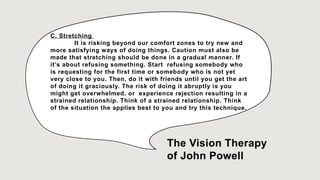
C. Stretching
It isrisking beyond our comfort zones to try new and
more satisfying ways of doing things. Caution must also be
made that stretching should be done in a gradual manner. If
it’s about refusing something. Start refusing somebody who
is requesting for the first time or somebody who is not yet
very close to you. Then, do it with friends until you get the art
of doing it graciously. The risk of doing it abruptly is you
might get overwhelmed, or experience rejection resulting in a
strained relationship. Think of a strained relationship. Think
of the situation the applies best to you and try this technique.
The Vision Therapy
of John Powell
11.
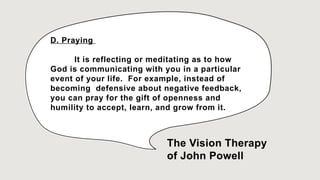
D. Praying
It isreflecting or meditating as to how
God is communicating with you in a particular
event of your life. For example, instead of
becoming defensive about negative feedback,
you can pray for the gift of openness and
humility to accept, learn, and grow from it.
The Vision Therapy
of John Powell
12.
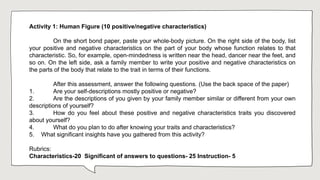
Activity 1: HumanFigure (10 positive/negative characteristics)
On the short bond paper, paste your whole-body picture. On the right side of the body, list
your positive and negative characteristics on the part of your body whose function relates to that
characteristic. So, for example, open-mindedness is written near the head, dancer near the feet, and
so on. On the left side, ask a family member to write your positive and negative characteristics on
the parts of the body that relate to the trait in terms of their functions.
After this assessment, answer the following questions. (Use the back space of the paper)
1. Are your self-descriptions mostly positive or negative?
2. Are the descriptions of you given by your family member similar or different from your own
descriptions of yourself?
3. How do you feel about these positive and negative characteristics traits you discovered
about yourself?
4. What do you plan to do after knowing your traits and characteristics?
5. What significant insights have you gathered from this activity?
Rubrics:
Characteristics-20 Significant of answers to questions- 25 Instruction- 5
13.
Manifestation is real.
Startspeaking positivity into
your life.
Change the way you think.
Change the way you speak.
-Unanimous