Scrum-damentals
© IBM Corporation 2
© IBM Corporation 3
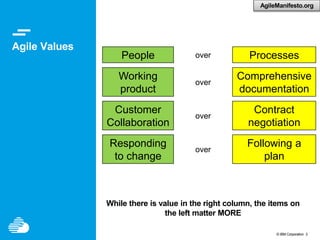
Agile Values
While there is value in the right column, the items on
the left matter MORE
People over Processes
Working
product
over
Comprehensive
documentation
Customer
Collaboration
over
Contract
negotiation
Responding
to change
over
Following a
plan
AgileManifesto.org
© IBM Corporation 4
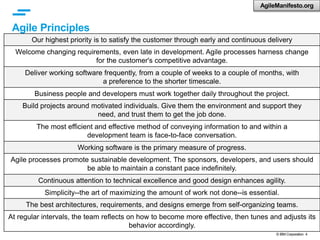
Agile Principles
Our highest priority is to satisfy the customer through early and continuous delivery
Welcome changing requirements, even late in development. Agile processes harness change
for the customer's competitive advantage.
Deliver working software frequently, from a couple of weeks to a couple of months, with
a preference to the shorter timescale.
Business people and developers must work together daily throughout the project.
Build projects around motivated individuals. Give them the environment and support they
need, and trust them to get the job done.
The most efficient and effective method of conveying information to and within a
development team is face-to-face conversation.
Working software is the primary measure of progress.
Agile processes promote sustainable development. The sponsors, developers, and users should
be able to maintain a constant pace indefinitely.
Continuous attention to technical excellence and good design enhances agility.
Simplicity--the art of maximizing the amount of work not done--is essential.
The best architectures, requirements, and designs emerge from self-organizing teams.
At regular intervals, the team reflects on how to become more effective, then tunes and adjusts its
behavior accordingly.
AgileManifesto.org
© IBM Corporation 5
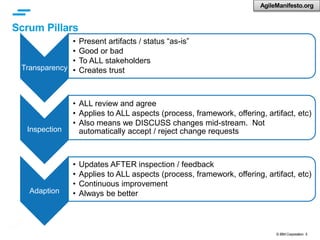
Scrum Pillars
AgileManifesto.org
Transparency
• Present artifacts / status “as-is”
• Good or bad
• To ALL stakeholders
• Creates trust
Inspection
• ALL review and agree
• Applies to ALL aspects (process, framework, offering, artifact, etc)
• Also means we DISCUSS changes mid-stream. Not
automatically accept / reject change requests
Adaption
• Updates AFTER inspection / feedback
• Applies to ALL aspects (process, framework, offering, artifact, etc)
• Continuous improvement
• Always be better
© IBM Corporation 6
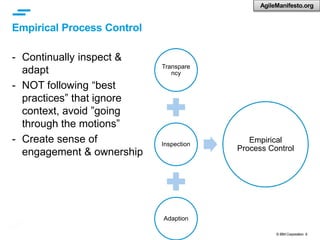
Empirical Process Control
Transpare
ncy
Inspection
Adaption
Empirical
Process Control
- Continually inspect &
adapt
- NOT following “best
practices” that ignore
context, avoid ”going
through the motions”
- Create sense of
engagement & ownership
AgileManifesto.org
© IBM Corporation 7
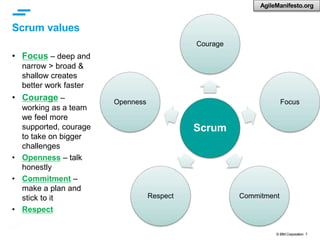
Scrum values
Scrum
Courage
Focus
CommitmentRespect
Openness
• Focus – deep and
narrow > broad &
shallow creates
better work faster
• Courage –
working as a team
we feel more
supported, courage
to take on bigger
challenges
• Openness – talk
honestly
• Commitment –
make a plan and
stick to it
• Respect
AgileManifesto.org
© IBM Corporation 8
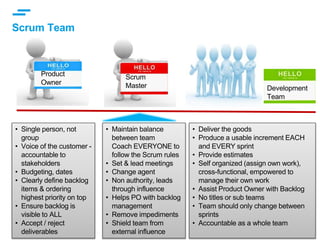
Scrum Team
Type equation here.
Product
Owner
Scrum
Master Development
Team
• Single person, not
group
• Voice of the customer -
accountable to
stakeholders
• Budgeting, dates
• Clearly define backlog
items & ordering
highest priority on top
• Ensure backlog is
visible to ALL
• Accept / reject
deliverables
• Deliver the goods
• Produce a usable increment EACH
and EVERY sprint
• Provide estimates
• Self organized (assign own work),
cross-functional, empowered to
manage their own work
• Assist Product Owner with Backlog
• No titles or sub teams
• Team should only change between
sprints
• Accountable as a whole team
• Maintain balance
between team
Coach EVERYONE to
follow the Scrum rules
• Set & lead meetings
• Change agent
• Non authority, leads
through influence
• Helps PO with backlog
management
• Remove impediments
• Shield team from
external influence
© IBM Corporation 9
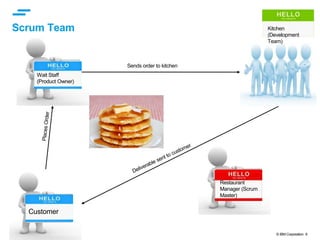
Scrum Team
Type equation here.
Wait Staff
(Product Owner)
Restaurant
Manager (Scrum
Master)
Kitchen
(Development
Team)
Customer
Sends order to kitchen
© IBM Corporation 10
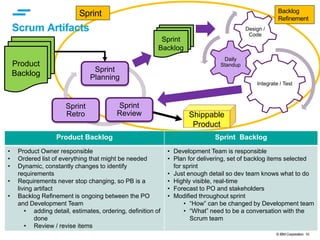
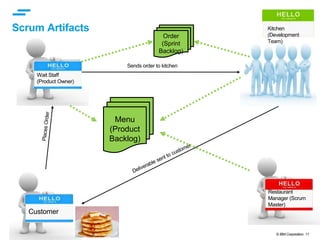
Scrum Artifacts
Sprint
Planning
Sprint
Review
Sprint
Retro
Integrate / Test
Daily
Standup
Design /
Code
Shippable
Product
Product
Backlog
Sprint
Backlog
Sprint Backlog
Refinement
Product Backlog Sprint Backlog
• Product Owner responsible
• Ordered list of everything that might be needed
• Dynamic, constantly changes to identify
requirements
• Requirements never stop changing, so PB is a
living artifact
• Backlog Refinement is ongoing between the PO
and Development Team
• adding detail, estimates, ordering, definition of
done
• Review / revise items
• Development Team is responsible
• Plan for delivering, set of backlog items selected
for sprint
• Just enough detail so dev team knows what to do
• Highly visible, real-time
• Forecast to PO and stakeholders
• Modified throughout sprint
• “How” can be changed by Development team
• “What” need to be a conversation with the
Scrum team
© IBM Corporation 11
Scrum Artifacts
Type equation here.
Wait Staff
(Product Owner)
Restaurant
Manager (Scrum
Master)
Kitchen
(Development
Team)
Customer
Sends order to kitchen
Menu
(Product
Backlog)
Order
(Sprint
Backlog)
© IBM Corporation 12
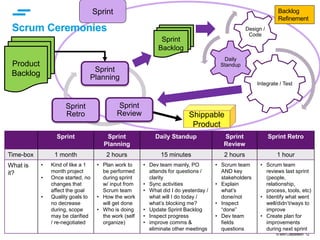
Scrum Ceremonies
Sprint
Planning
Sprint
Review
Sprint
Retro
Integrate / Test
Daily
Standup
Design /
Code
Sprint Sprint
Planning
Daily Standup Sprint
Review
Sprint Retro
Time-box 1 month 2 hours 15 minutes 2 hours 1 hour
What is
it?
• Kind of like a 1
month project
• Once started, no
changes that
affect the goal
• Quality goals to
no decrease
during, scope
may be clarified
/ re-negotiated
• Plan work to
be performed
during sprint
w/ input from
Scrum team
• How the work
will get done
• Who is doing
the work (self
organize)
• Dev team mainly, PO
attends for questions /
clarity
• Sync activities
• What did I do yesterday /
what will I do today /
what’s blocking me?
• Update Sprint Backlog
• Inspect progress
• improve comms &
eliminate other meetings
• Scrum team
AND key
stakeholders
• Explain
what’s
done/not
• Inspect
“done”
• Dev team
fields
questions
• Scrum team
reviews last sprint
(people,
relationship,
process, tools, etc)
• Identify what went
well/didn’t/ways to
improve
• Create plan for
improvements
during next sprint
Shippable
Product
Product
Backlog
Sprint
Backlog
Backlog
Refinement
Sprint
© IBM Corporation 13
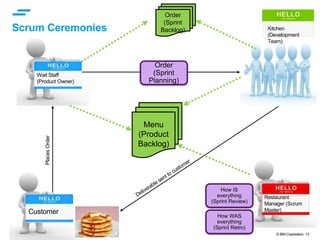
Scrum Ceremonies
Type equation here.
Wait Staff
(Product Owner)
Restaurant
Manager (Scrum
Master)
Kitchen
(Development
Team)
Customer
PlacesOrder
Menu
(Product
Backlog)
Order
(Sprint
Backlog)
Order
(Sprint
Planning)
How IS
everything
(Sprint Review)
How WAS
everything
(Sprint Retro)
© IBM Corporation 14
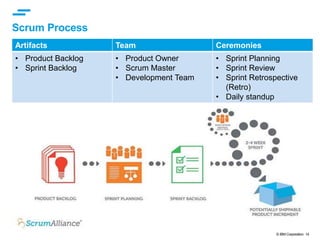
Scrum Process
Artifacts Team Ceremonies
• Product Backlog
• Sprint Backlog
• Product Owner
• Scrum Master
• Development Team
• Sprint Planning
• Sprint Review
• Sprint Retrospective
(Retro)
• Daily standup
LeSS is more
© IBM Corporation 16
LeSS?
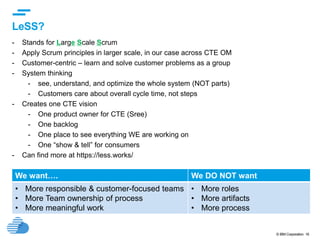
- Stands for Large Scale Scrum
- Apply Scrum principles in larger scale, in our case across CTE OM
- Customer-centric – learn and solve customer problems as a group
- System thinking
- see, understand, and optimize the whole system (NOT parts)
- Customers care about overall cycle time, not steps
- Creates one CTE vision
- One product owner for CTE (Sree)
- One backlog
- One place to see everything WE are working on
- One “show & tell” for consumers
- Can find more at https://less.works/
We want…. We DO NOT want
• More responsible & customer-focused teams
• More Team ownership of process
• More meaningful work
• More roles
• More artifacts
• More process
© IBM Corporation 17
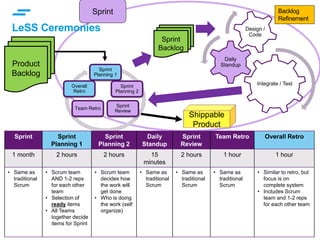
LeSS Ceremonies
Sprint
Planning 1
Sprint
Planning 2
Sprint
Review
Team Retro
Overall
Retro
Integrate / Test
Daily
Standup
Design /
Code
Sprint Sprint
Planning 1
Sprint
Planning 2
Daily
Standup
Sprint
Review
Team Retro Overall Retro
1 month 2 hours 2 hours 15
minutes
2 hours 1 hour 1 hour
• Same as
traditional
Scrum
• Scrum team
AND 1-2 reps
for each other
team
• Selection of
ready items
• All Teams
together decide
items for Sprint
• Scrum team
decides how
the work will
get done
• Who is doing
the work (self
organize)
• Same as
traditional
Scrum
• Same as
traditional
Scrum
• Same as
traditional
Scrum
• Similar to retro, but
focus is on
complete system
• Includes Scrum
team and 1-2 reps
for each other team
Shippable
Product
Product
Backlog
Sprint
Backlog
Backlog
Refinement
Sprint

LeSS & Scrum-damentals

  • 1.
  • 2.
  • 3.
    © IBM Corporation3 Agile Values While there is value in the right column, the items on the left matter MORE People over Processes Working product over Comprehensive documentation Customer Collaboration over Contract negotiation Responding to change over Following a plan AgileManifesto.org
  • 4.
    © IBM Corporation4 Agile Principles Our highest priority is to satisfy the customer through early and continuous delivery Welcome changing requirements, even late in development. Agile processes harness change for the customer's competitive advantage. Deliver working software frequently, from a couple of weeks to a couple of months, with a preference to the shorter timescale. Business people and developers must work together daily throughout the project. Build projects around motivated individuals. Give them the environment and support they need, and trust them to get the job done. The most efficient and effective method of conveying information to and within a development team is face-to-face conversation. Working software is the primary measure of progress. Agile processes promote sustainable development. The sponsors, developers, and users should be able to maintain a constant pace indefinitely. Continuous attention to technical excellence and good design enhances agility. Simplicity--the art of maximizing the amount of work not done--is essential. The best architectures, requirements, and designs emerge from self-organizing teams. At regular intervals, the team reflects on how to become more effective, then tunes and adjusts its behavior accordingly. AgileManifesto.org
  • 5.
    © IBM Corporation5 Scrum Pillars AgileManifesto.org Transparency • Present artifacts / status “as-is” • Good or bad • To ALL stakeholders • Creates trust Inspection • ALL review and agree • Applies to ALL aspects (process, framework, offering, artifact, etc) • Also means we DISCUSS changes mid-stream. Not automatically accept / reject change requests Adaption • Updates AFTER inspection / feedback • Applies to ALL aspects (process, framework, offering, artifact, etc) • Continuous improvement • Always be better
  • 6.
    © IBM Corporation6 Empirical Process Control Transpare ncy Inspection Adaption Empirical Process Control - Continually inspect & adapt - NOT following “best practices” that ignore context, avoid ”going through the motions” - Create sense of engagement & ownership AgileManifesto.org
  • 7.
    © IBM Corporation7 Scrum values Scrum Courage Focus CommitmentRespect Openness • Focus – deep and narrow > broad & shallow creates better work faster • Courage – working as a team we feel more supported, courage to take on bigger challenges • Openness – talk honestly • Commitment – make a plan and stick to it • Respect AgileManifesto.org
  • 8.
    © IBM Corporation8 Scrum Team Type equation here. Product Owner Scrum Master Development Team • Single person, not group • Voice of the customer - accountable to stakeholders • Budgeting, dates • Clearly define backlog items & ordering highest priority on top • Ensure backlog is visible to ALL • Accept / reject deliverables • Deliver the goods • Produce a usable increment EACH and EVERY sprint • Provide estimates • Self organized (assign own work), cross-functional, empowered to manage their own work • Assist Product Owner with Backlog • No titles or sub teams • Team should only change between sprints • Accountable as a whole team • Maintain balance between team Coach EVERYONE to follow the Scrum rules • Set & lead meetings • Change agent • Non authority, leads through influence • Helps PO with backlog management • Remove impediments • Shield team from external influence
  • 9.
    © IBM Corporation9 Scrum Team Type equation here. Wait Staff (Product Owner) Restaurant Manager (Scrum Master) Kitchen (Development Team) Customer Sends order to kitchen
  • 10.
    © IBM Corporation10 Scrum Artifacts Sprint Planning Sprint Review Sprint Retro Integrate / Test Daily Standup Design / Code Shippable Product Product Backlog Sprint Backlog Sprint Backlog Refinement Product Backlog Sprint Backlog • Product Owner responsible • Ordered list of everything that might be needed • Dynamic, constantly changes to identify requirements • Requirements never stop changing, so PB is a living artifact • Backlog Refinement is ongoing between the PO and Development Team • adding detail, estimates, ordering, definition of done • Review / revise items • Development Team is responsible • Plan for delivering, set of backlog items selected for sprint • Just enough detail so dev team knows what to do • Highly visible, real-time • Forecast to PO and stakeholders • Modified throughout sprint • “How” can be changed by Development team • “What” need to be a conversation with the Scrum team
  • 11.
    © IBM Corporation11 Scrum Artifacts Type equation here. Wait Staff (Product Owner) Restaurant Manager (Scrum Master) Kitchen (Development Team) Customer Sends order to kitchen Menu (Product Backlog) Order (Sprint Backlog)
  • 12.
    © IBM Corporation12 Scrum Ceremonies Sprint Planning Sprint Review Sprint Retro Integrate / Test Daily Standup Design / Code Sprint Sprint Planning Daily Standup Sprint Review Sprint Retro Time-box 1 month 2 hours 15 minutes 2 hours 1 hour What is it? • Kind of like a 1 month project • Once started, no changes that affect the goal • Quality goals to no decrease during, scope may be clarified / re-negotiated • Plan work to be performed during sprint w/ input from Scrum team • How the work will get done • Who is doing the work (self organize) • Dev team mainly, PO attends for questions / clarity • Sync activities • What did I do yesterday / what will I do today / what’s blocking me? • Update Sprint Backlog • Inspect progress • improve comms & eliminate other meetings • Scrum team AND key stakeholders • Explain what’s done/not • Inspect “done” • Dev team fields questions • Scrum team reviews last sprint (people, relationship, process, tools, etc) • Identify what went well/didn’t/ways to improve • Create plan for improvements during next sprint Shippable Product Product Backlog Sprint Backlog Backlog Refinement Sprint
  • 13.
    © IBM Corporation13 Scrum Ceremonies Type equation here. Wait Staff (Product Owner) Restaurant Manager (Scrum Master) Kitchen (Development Team) Customer PlacesOrder Menu (Product Backlog) Order (Sprint Backlog) Order (Sprint Planning) How IS everything (Sprint Review) How WAS everything (Sprint Retro)
  • 14.
    © IBM Corporation14 Scrum Process Artifacts Team Ceremonies • Product Backlog • Sprint Backlog • Product Owner • Scrum Master • Development Team • Sprint Planning • Sprint Review • Sprint Retrospective (Retro) • Daily standup
  • 15.
  • 16.
    © IBM Corporation16 LeSS? - Stands for Large Scale Scrum - Apply Scrum principles in larger scale, in our case across CTE OM - Customer-centric – learn and solve customer problems as a group - System thinking - see, understand, and optimize the whole system (NOT parts) - Customers care about overall cycle time, not steps - Creates one CTE vision - One product owner for CTE (Sree) - One backlog - One place to see everything WE are working on - One “show & tell” for consumers - Can find more at https://less.works/ We want…. We DO NOT want • More responsible & customer-focused teams • More Team ownership of process • More meaningful work • More roles • More artifacts • More process
  • 17.
    © IBM Corporation17 LeSS Ceremonies Sprint Planning 1 Sprint Planning 2 Sprint Review Team Retro Overall Retro Integrate / Test Daily Standup Design / Code Sprint Sprint Planning 1 Sprint Planning 2 Daily Standup Sprint Review Team Retro Overall Retro 1 month 2 hours 2 hours 15 minutes 2 hours 1 hour 1 hour • Same as traditional Scrum • Scrum team AND 1-2 reps for each other team • Selection of ready items • All Teams together decide items for Sprint • Scrum team decides how the work will get done • Who is doing the work (self organize) • Same as traditional Scrum • Same as traditional Scrum • Same as traditional Scrum • Similar to retro, but focus is on complete system • Includes Scrum team and 1-2 reps for each other team Shippable Product Product Backlog Sprint Backlog Backlog Refinement Sprint

Editor's Notes

  • #13 Time boxed focus on doing the things that matter motivation to start, prevent overruns Arrange ceremonies in advance, prepared for them
  • #15 Product Backlog – Complete todo list Sprint Backlog – what you’re committing to by a certain date Product Owner – manages stakeholders, gets clarity on need Scrum master – balances team & product owner, facilitates Team member – executer Sprint Planning – discussion on commitment during sprint Sprint review – show and tell Sprint retro - discuss how sprint went (good / bad / start doing / stop doing) Daily standup – daily conversation around what was done / doing and where stuck
  • #18 Time boxed focus on doing the things that matter motivation to start, prevent overruns Arrange ceremonies in advance, prepared for them