What’s in a crowd? Analysis of face-to-face
            behavioral networks

      Lorenzo Isella1 , Alain Barrat1,2 , Juliette Stehlé2 ,
    Jean-François Pinton3 , Wouter Van den Broeck1 and
                        Ciro Cattuto1
 1 Complex  Networks and Systems Group, Institute for Scientific Interchange (ISI)
                            Foundation, Turin, Italy.
      2 Centre de Physique Théorique, CNRS UMR 6207, Marseille, France.
   3 Laboratoire de Physique de l’ENS Lyon, CNRS UMR 5672, Lyon, France.


     Workshop on data driven dynamical networks, Les
                Houches, France, 2010
Outline

          Overview of the RFID infrastructure deployed to mine for
          face-to-face proximity ⇒ networks of human interactions.
          Network structural analysis.
          Network resilence.
          Information spreading: longitudinal network ⇐⇒ causality
              reachability and variability
              kinetics of information spreading
          Conclusions.
Goals and Case Studies

       Deployment of wearable RFID devices to collect data
       about human interaction in different social environments.
       Focus on two main case studies
           Science Gallery (SG) at the Trinity College, Dublin, Ireland
           (∼ 3 months, ∼ 10000 visitors).
           HT09 conference, Turin, Italy (3 days, ∼ 100 participants).
       Patented technology and data from Sociopatterns Project
       (http://www.sociopatterns.org/).
       Applications in computer science (ubiquitous computing,
       P2P) and computational epidemiology (causality,
       non-homogeneous mixing).
Goals and Case Studies

       Deployment of wearable RFID devices to collect data
       about human interaction in different social environments.
       Focus on two main case studies
           Science Gallery (SG) at the Trinity College, Dublin, Ireland
           (∼ 3 months, ∼ 10000 visitors).
           HT09 conference, Turin, Italy (3 days, ∼ 100 participants).
       Patented technology and data from Sociopatterns Project
       (http://www.sociopatterns.org/).
       Applications in computer science (ubiquitous computing,
       P2P) and computational epidemiology (causality,
       non-homogeneous mixing).
Goals and Case Studies

       Deployment of wearable RFID devices to collect data
       about human interaction in different social environments.
       Focus on two main case studies
           Science Gallery (SG) at the Trinity College, Dublin, Ireland
           (∼ 3 months, ∼ 10000 visitors).
           HT09 conference, Turin, Italy (3 days, ∼ 100 participants).
       Patented technology and data from Sociopatterns Project
       (http://www.sociopatterns.org/).
       Applications in computer science (ubiquitous computing,
       P2P) and computational epidemiology (causality,
       non-homogeneous mixing).
Goals and Case Studies

       Deployment of wearable RFID devices to collect data
       about human interaction in different social environments.
       Focus on two main case studies
           Science Gallery (SG) at the Trinity College, Dublin, Ireland
           (∼ 3 months, ∼ 10000 visitors).
           HT09 conference, Turin, Italy (3 days, ∼ 100 participants).
       Patented technology and data from Sociopatterns Project
       (http://www.sociopatterns.org/).
       Applications in computer science (ubiquitous computing,
       P2P) and computational epidemiology (causality,
       non-homogeneous mixing).
Goals and Case Studies

       Deployment of wearable RFID devices to collect data
       about human interaction in different social environments.
       Focus on two main case studies
           Science Gallery (SG) at the Trinity College, Dublin, Ireland
           (∼ 3 months, ∼ 10000 visitors).
           HT09 conference, Turin, Italy (3 days, ∼ 100 participants).
       Patented technology and data from Sociopatterns Project
       (http://www.sociopatterns.org/).
       Applications in computer science (ubiquitous computing,
       P2P) and computational epidemiology (causality,
       non-homogeneous mixing).
Goals and Case Studies

       Deployment of wearable RFID devices to collect data
       about human interaction in different social environments.
       Focus on two main case studies
           Science Gallery (SG) at the Trinity College, Dublin, Ireland
           (∼ 3 months, ∼ 10000 visitors).
           HT09 conference, Turin, Italy (3 days, ∼ 100 participants).
       Patented technology and data from Sociopatterns Project
       (http://www.sociopatterns.org/).
       Applications in computer science (ubiquitous computing,
       P2P) and computational epidemiology (causality,
       non-homogeneous mixing).
Goals and Case Studies

       Deployment of wearable RFID devices to collect data
       about human interaction in different social environments.
       Focus on two main case studies
           Science Gallery (SG) at the Trinity College, Dublin, Ireland
           (∼ 3 months, ∼ 10000 visitors).
           HT09 conference, Turin, Italy (3 days, ∼ 100 participants).
       Patented technology and data from Sociopatterns Project
       (http://www.sociopatterns.org/).
       Applications in computer science (ubiquitous computing,
       P2P) and computational epidemiology (causality,
       non-homogeneous mixing).
Overview of the Infrastructure
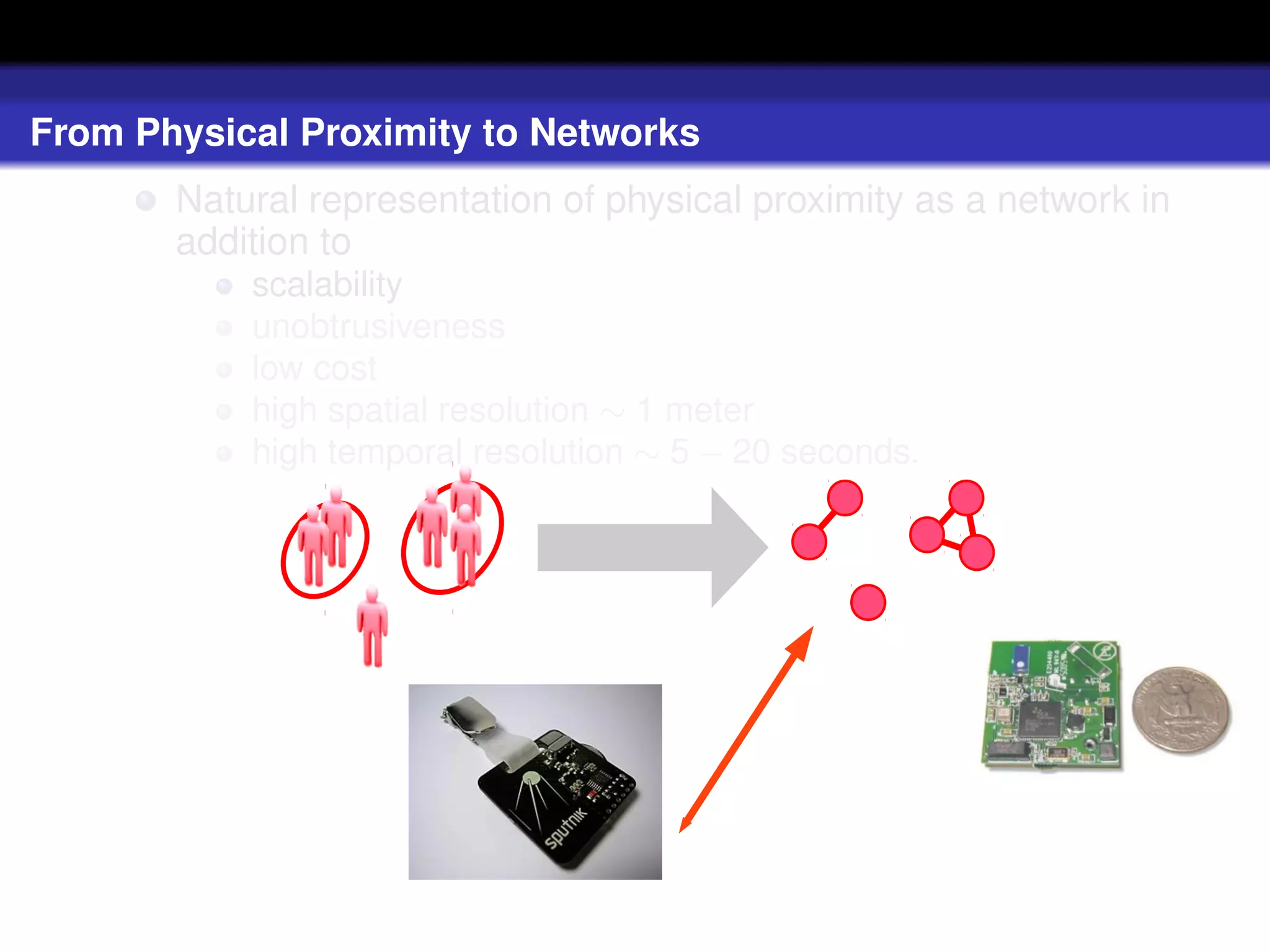
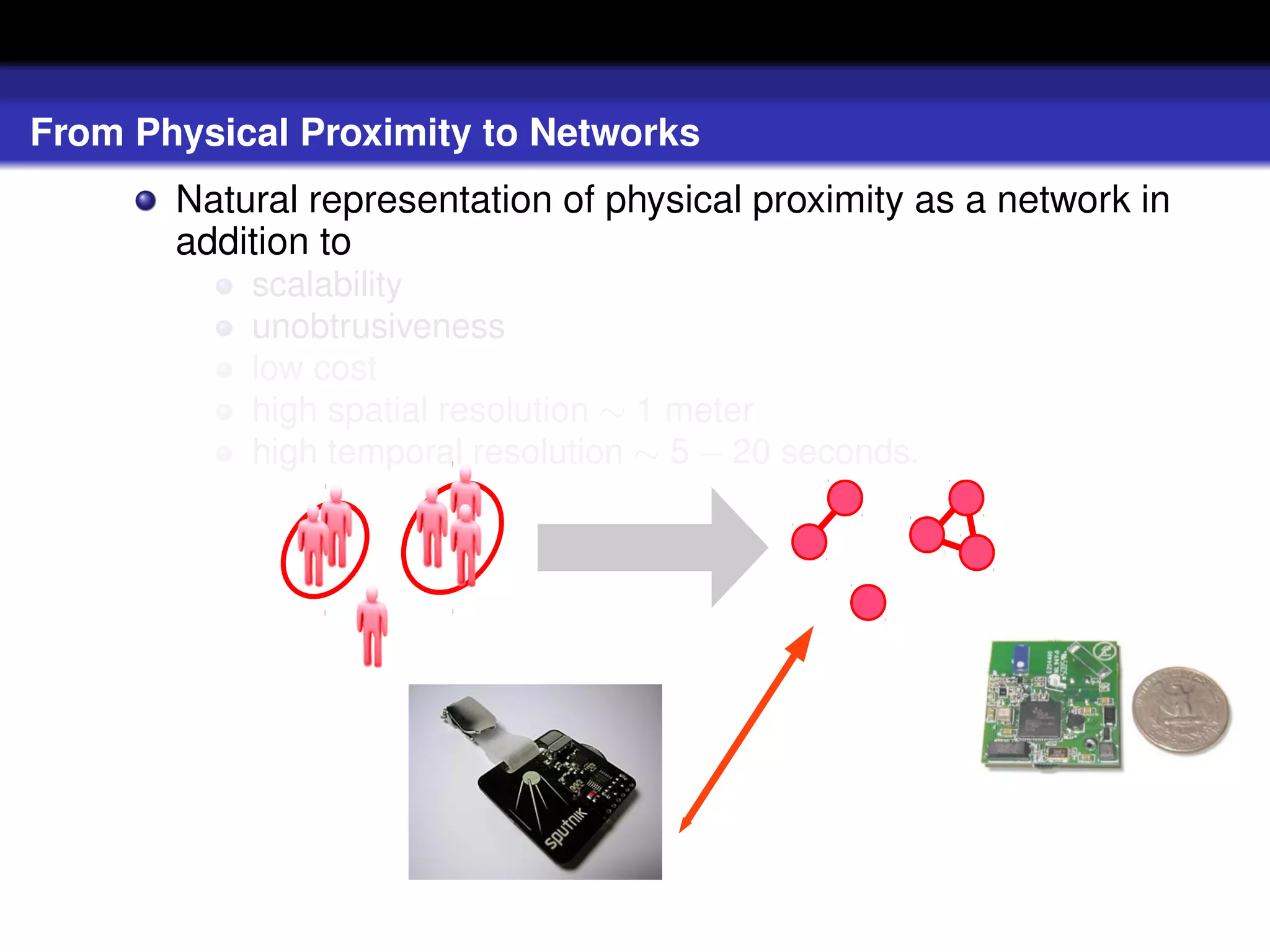
       Tags exchange packets at various powers and report their
       contacts to antennas broadcasting the data to a server.
       Low-power packets expose face-to-face interactions at
       small distances (∼ 1m).
From Physical Proximity to Networks
       Natural representation of physical proximity as a network in
       addition to
           scalability
           unobtrusiveness
           low cost
           high spatial resolution ∼ 1 meter
           high temporal resolution ∼ 5 − 20 seconds.
From Physical Proximity to Networks
       Natural representation of physical proximity as a network in
       addition to
           scalability
           unobtrusiveness
           low cost
           high spatial resolution ∼ 1 meter
           high temporal resolution ∼ 5 − 20 seconds.
From Physical Proximity to Networks
       Natural representation of physical proximity as a network in
       addition to
           scalability
           unobtrusiveness
           low cost
           high spatial resolution ∼ 1 meter
           high temporal resolution ∼ 5 − 20 seconds.
From Physical Proximity to Networks
       Natural representation of physical proximity as a network in
       addition to
           scalability
           unobtrusiveness
           low cost
           high spatial resolution ∼ 1 meter
           high temporal resolution ∼ 5 − 20 seconds.
From Physical Proximity to Networks
       Natural representation of physical proximity as a network in
       addition to
           scalability
           unobtrusiveness
           low cost
           high spatial resolution ∼ 1 meter
           high temporal resolution ∼ 5 − 20 seconds.
From Physical Proximity to Networks
       Natural representation of physical proximity as a network in
       addition to
           scalability
           unobtrusiveness
           low cost
           high spatial resolution ∼ 1 meter
           high temporal resolution ∼ 5 − 20 seconds.
From Physical Proximity to Networks
       Natural representation of physical proximity as a network in
       addition to
           scalability
           unobtrusiveness
           low cost
           high spatial resolution ∼ 1 meter
           high temporal resolution ∼ 5 − 20 seconds.
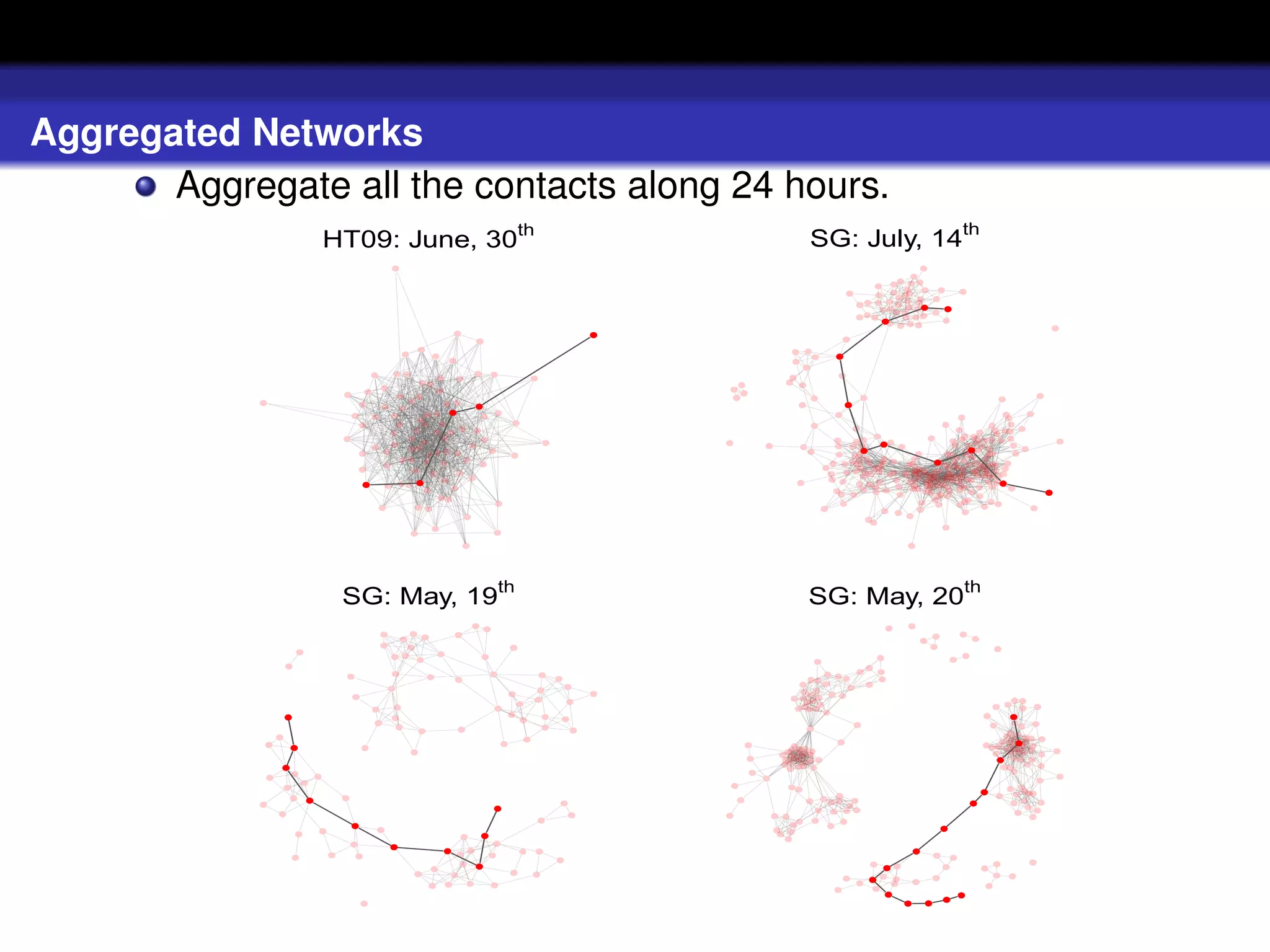
Aggregated Networks
       Aggregate all the contacts along 24 hours.
                          HT09: June, 30th                  SG: July, 14th

                                                                                          q       q
                                                                              q
                                                        q

                                                              q


                                                q                 q
                                            q


                                                                              q
                                                                      q                                   q
                                                                                              q

                                q       q                                                                         q
                                                                                                                          q


                           SG: May, 19th                    SG: May, 20th


              q                                                                                                       q


                                                                                                                      q
                  q
                                                                                                                  q
              q


                                                                                                              q
                      q                                                                                   q
                                                    q

                            q                                                                 q
                                                q
                                    q
                                            q                                         q
                                                q                             q
                                                                          q
                                                                              q                       q
                                                                                  q       q       q
Human Dynamics and Network Topology 1/2
       Entanglement of human behavior and network topology.
                                         0.008


                    P (visit duration)
                                         0.006


                                         0.004


                                         0.002


                                         0.000
                                                      101                102
                                                 Visit duration (min)


                                                        12:00 to 13:00
                                                        13:00 to 14:00
                                                        14:00 to 15:00
                                                        15:00 to 16:00
                                                        16:00 to 17:00
                                                        17:00 to 18:00
                                                        18:00 to 19:00
                                                        19:00 to 20:00
Human Dynamics and Network Topology 2/2
       Short-tailed P(k ) and broad P(wij ) and P(∆tij ).
                                          SG                                              HT09
                     10-1                                               10-1

                     10-2
                                                                        10-2
             P (k)


                                                                P (k)
                           -3
                     10
                                                                        10-3
                     10-4

                     10-5                                               10-4
                                 0 10 20 30 40 50 60 70                            0     20         40         60     80
                                              k                                                 k
                          100                                               100
                            -1
                          10                       SG
                                                                            10-1                          SG
                                                   HT09                                                   HT09
                          10-2                                                -2
                                                                            10
              P (∆tij )


                                                                 P (wij )


                          10-3
                                                                            10-3
                          10-4
                          10-5                                              10-4
                            -6
                          10                                                10-5
                                 101    102       103     104                      101    102            103        104
                                       ∆tij (sec)                                        wij (sec)
Random Networks and Smallworldness
      Network topology↔ information spreading.
                         HT09: June, 30th (rewired)                                     SG: July, 14th (rewired)
                         q
                                                                                                                  q


                                                                                                          q

                                              q
                                      q
                                                  q
                                                                                                  q


                                                                                                      q


                                                          q
                                                                                                              q
                                                                                                                      q


                             HT09: June, 30th                                                SG: July, 14th
                   1.0                                                        1.0

                                                                              0.8
                   0.8
       M(l)/M(∞)


                                                                  M(l)/M(∞)
                                                                              0.6
                   0.6
                                                                              0.4

                   0.4
                                  Aggregated network                          0.2                     Aggregated network
                                  Rewired networks                                                    Rewired networks

                   0.2                                                        0.0
                         1        2                   3       4                     1    2    3   4           5       6   7   8   9   10
                                          l                                                                   l
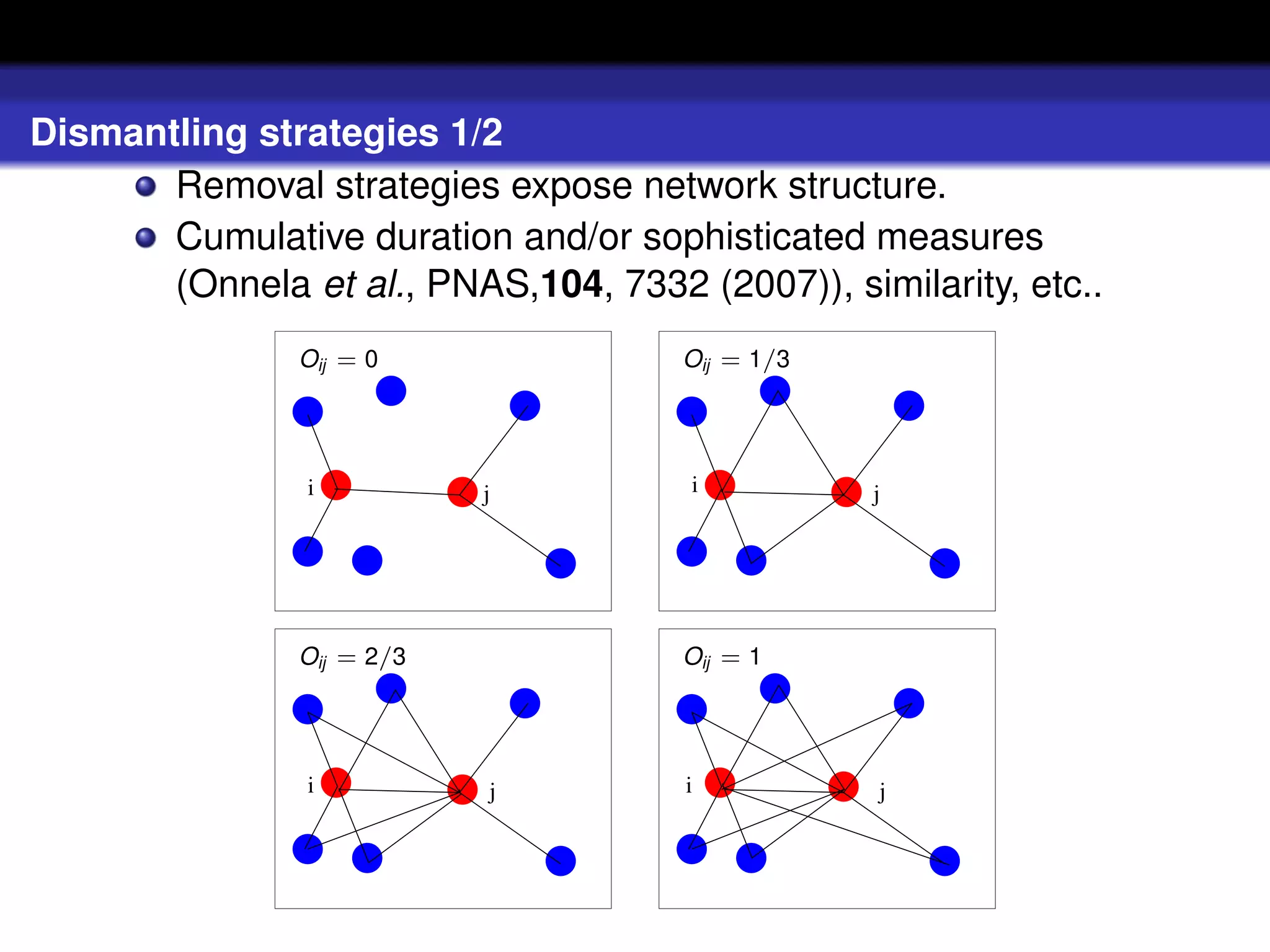
Dismantling strategies 1/2
       Removal strategies expose network structure.
       Cumulative duration and/or sophisticated measures
       (Onnela et al., PNAS,104, 7332 (2007)), similarity, etc..
                Oij = 0               Oij = 1/3


                i           j          i          j


                Oij = 2/3             Oij = 1


                i           j          i          j
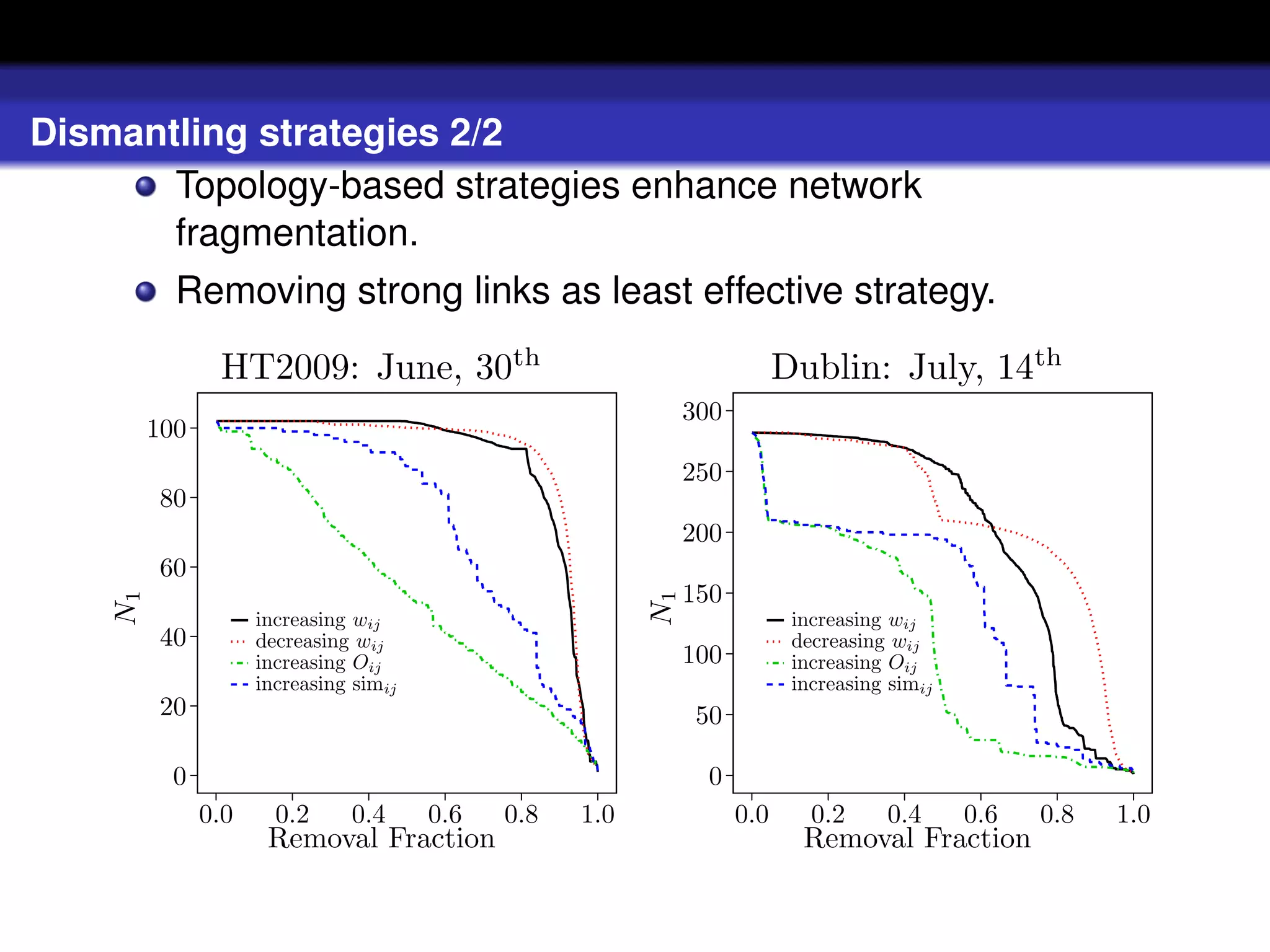
Dismantling strategies 2/2
       Topology-based strategies enhance network
       fragmentation.
           Removing strong links as least effective strategy.
                HT2009: June, 30th                                         Dublin: July, 14th
                                                               300
         100
                                                               250
         80
                                                               200
         60
                                                               150
    N1


                                                          N1
                     increasing wij                                         increasing wij
         40          decreasing wij                                         decreasing wij
                     increasing Oij                            100          increasing Oij
                     increasing simij                                       increasing simij
         20                                                    50

           0                                                     0
               0.0     0.2     0.4      0.6   0.8   1.0              0.0      0.2     0.4      0.6   0.8   1.0
                      Removal Fraction                                       Removal Fraction
Deterministic SI model 1/2

       SI model S + I → 2I, infection probability .
       Set = 1: snowball deterministic model (avoid
       stochasticity).
       Beyond epidemiology: paradigm for information diffusion
       and causality on the network.

                      I       S         I     I
                          +
Deterministic SI model 1/2

       SI model S + I → 2I, infection probability .
       Set = 1: snowball deterministic model (avoid
       stochasticity).
       Beyond epidemiology: paradigm for information diffusion
       and causality on the network.

                      I       S         I     I
                          +


       Collect distributions of infected visitors/conference
       participants at the end of each day by varying the seed
       (inter day variability).
Deterministic SI model 1/2

       SI model S + I → 2I, infection probability .
       Set = 1: snowball deterministic model (avoid
       stochasticity).
       Beyond epidemiology: paradigm for information diffusion
       and causality on the network.

                      I       S         I     I
                          +


       Collect distributions of infected visitors/conference
       participants at the end of each day by varying the seed
       (inter day variability).
       Dependence of the epidemic spreading during a single day
       on the choice of the seed (intra day variability).
Deterministic SI model 2/2
       Processes of and on the network
            partially aggregated network [human contacts]
            transmission network [information spreading].
            transmission network ⊆ partially aggregated network
            nodes outside seed’s CC cannot be reached by infection
       Fastest path = shortest path.
Deterministic SI model 2/2
       Processes of and on the network
            partially aggregated network [human contacts]
            transmission network [information spreading].
            transmission network ⊆ partially aggregated network
            nodes outside seed’s CC cannot be reached by infection
       Fastest path = shortest path.
Deterministic SI model 2/2
       Processes of and on the network
            partially aggregated network [human contacts]
            transmission network [information spreading].
            transmission network ⊆ partially aggregated network
            nodes outside seed’s CC cannot be reached by infection
       Fastest path = shortest path.
Inter day variability
        Nsus for a given seed ≡ number of individuals in the seed’s
        CC.
                                                           Ninf
        In a static network framework, P(Ninf /Nsus ) = δ( Nsus − 1).
        Information propagates differently at HT09 and SG.

                                               HT09                                                            SG
                            1.0                                                           1.0

                            0.8                                                           0.8
          P (Ninf /Nsus )


                                                                        P (Ninf /Nsus )
                            0.6                                                           0.6

                            0.4                                                           0.4

                            0.2                                                           0.2

                            0.0                                                           0.0
                                  0.0   0.2     0.4   0.6   0.8   1.0                           0.0   0.2     0.4   0.6   0.8   1.0
                                              Ninf /Nsus                                                    Ninf /Nsus
Intra day variability
        Impact of social events (e.g. coffee breaks).
        Highlight role played by each seed (hard to achieve in a
        static network framework).

                                   HT09: June, 30th                                                           SG: July, 14th
                                                                                            300
                       100       8:00 to 9:00                                                            12:00   to   13:00
                                 9:00 to 10:00                                                           13:00   to   14:00
                                 10:00 to 11:00                                             250          14:00   to   15:00
                            80   11:00 to 12:00                                                          15:00   to   16:00
          Incidence curve


                                                                               Incidence curve
                                 12:00 to 13:00                                                          16:00   to   17:00
                                 13:00 to 14:00                                             200          17:00   to   18:00
                                 14:00 to 15:00                                                          18:00   to   19:00
                            60   15:00 to 16:00                                                          19:00   to   20:00
                                 16:00 to 17:00                                             150
                            40
                                                                                            100

                            20                                                                   50

                             0                                                                    0
                                   08:00 10:00 12:00 14:00 16:00 18:00 20:00                          12:00       14:00       16:00   18:00   20:00
                                                  Time                                                                    Time
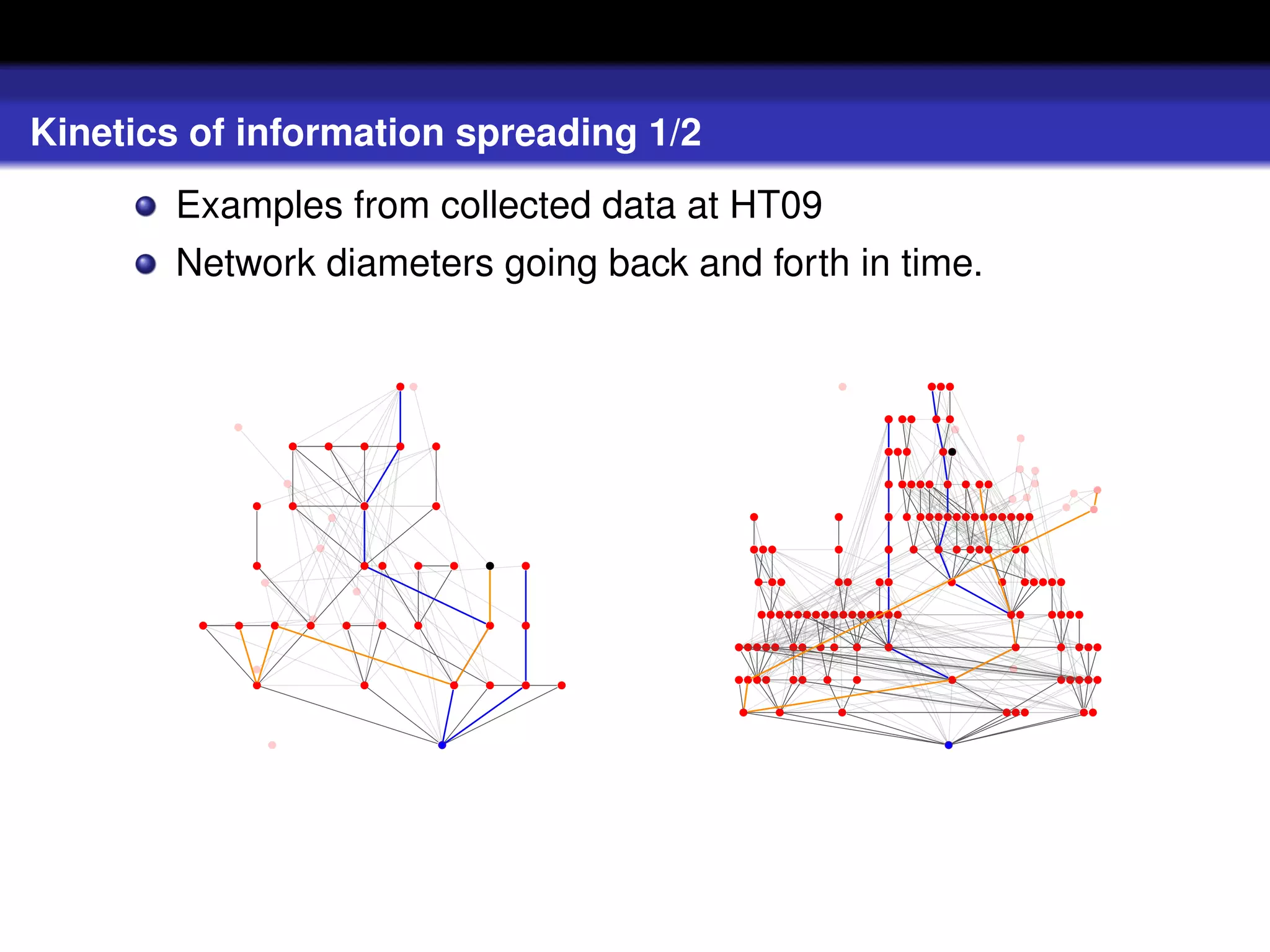
Kinetics of information spreading 1/2
        Examples from collected data at HT09
        Network diameters going back and forth in time.

                                                 q                                                                   qqq


                                                                                                             q qq    q q

                         q       q       q       q       q
                                                                                                             qqq      qq


                                                                                                             q qqqq       q    q qq

                 q       q               q               q
                                                                                 q                q          q   q qqqqqqqqqqqqq


                                                                                 qqq              q          q   q    q       q qqq       qq
                 q                       q   q       q       q   q   q
                                                                                 q qq             qq        qq            q           q       qqqqq


                                                                                 qqqqqqqqqqqqqqqq                                         qq     qqqq
         q   q       q       q       q       q       q           q   q

                                                                             qqqqq       qq   q q       q    q                            q       q   qqq


                                                                             qqqq        qq   q         q                 q                       qqqqq
                 q                       q                   q   q   q   q

                                                                             q       q              q                                 qqq             qq


                                                         q                                                                q
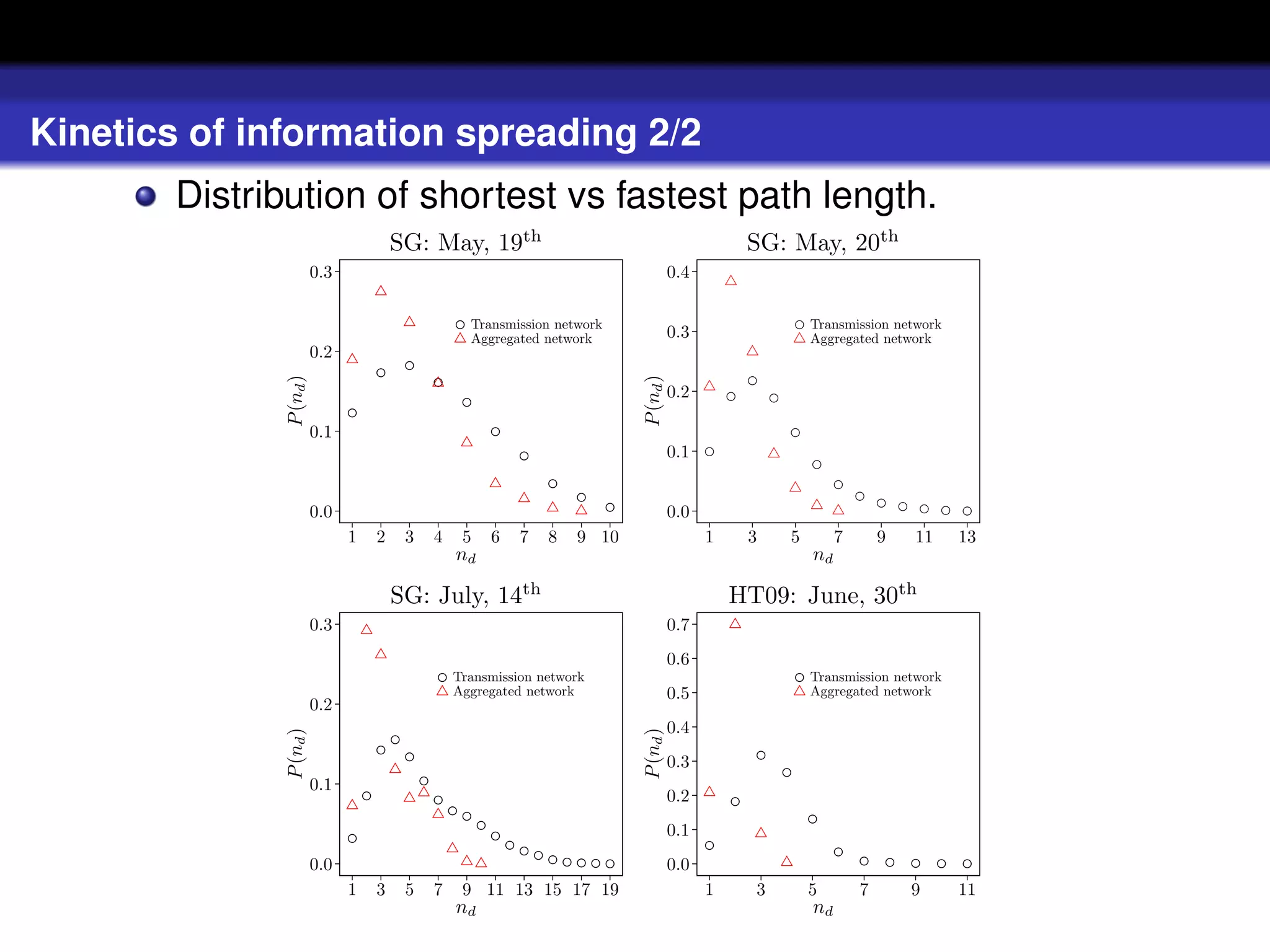
Kinetics of information spreading 2/2
        Distribution of shortest vs fastest path length.
                                       SG: May, 19th                                          SG: May, 20th
                         0.3                                                       0.4

                                                  Transmission network                                 Transmission network
                                                  Aggregated network               0.3                 Aggregated network
                         0.2
               P (nd )


                                                                         P (nd )
                                                                                   0.2

                         0.1
                                                                                   0.1


                         0.0                                                       0.0
                               1   2    3   4    5   6    7   8   9 10                   1    3    5        7       9   11    13
                                                nd                                                     nd

                                       SG: July, 14th                                        HT09: June, 30th
                         0.3                                                       0.7
                                                                                   0.6
                                                Transmission network                                   Transmission network
                                                Aggregated network                 0.5                 Aggregated network
                         0.2
                                                                                   0.4
               P (nd )


                                                                         P (nd )


                                                                                   0.3
                         0.1
                                                                                   0.2
                                                                                   0.1
                         0.0                                                       0.0
                               1   3    5   7    9 11 13 15 17 19                        1     3       5        7       9     11
                                                nd                                                     nd
Conclusions

       Network aggregation over different time periods
       (seasonality, trends, etc..).
       Network static properties (P(k ), diameter, assortativity,
       etc..).
       Network dynamic properties: spread of epidemics and
       diffusion processes on a longitudinal network hence
       dynamics of the network and dynamics on the network.
       What’s in a crowd? Analysis of face-to-face behavioral
       networks, L.Isella et al.
       http://arxiv.org/abs/1006.1260.
Conclusions

       Network aggregation over different time periods
       (seasonality, trends, etc..).
       Network static properties (P(k ), diameter, assortativity,
       etc..).
       Network dynamic properties: spread of epidemics and
       diffusion processes on a longitudinal network hence
       dynamics of the network and dynamics on the network.
       What’s in a crowd? Analysis of face-to-face behavioral
       networks, L.Isella et al.
       http://arxiv.org/abs/1006.1260.
Conclusions

       Network aggregation over different time periods
       (seasonality, trends, etc..).
       Network static properties (P(k ), diameter, assortativity,
       etc..).
       Network dynamic properties: spread of epidemics and
       diffusion processes on a longitudinal network hence
       dynamics of the network and dynamics on the network.
       What’s in a crowd? Analysis of face-to-face behavioral
       networks, L.Isella et al.
       http://arxiv.org/abs/1006.1260.
Conclusions

       Network aggregation over different time periods
       (seasonality, trends, etc..).
       Network static properties (P(k ), diameter, assortativity,
       etc..).
       Network dynamic properties: spread of epidemics and
       diffusion processes on a longitudinal network hence
       dynamics of the network and dynamics on the network.
       What’s in a crowd? Analysis of face-to-face behavioral
       networks, L.Isella et al.
       http://arxiv.org/abs/1006.1260.
Conclusions

       Network aggregation over different time periods
       (seasonality, trends, etc..).
       Network static properties (P(k ), diameter, assortativity,
       etc..).
       Network dynamic properties: spread of epidemics and
       diffusion processes on a longitudinal network hence
       dynamics of the network and dynamics on the network.
       What’s in a crowd? Analysis of face-to-face behavioral
       networks, L.Isella et al.
       http://arxiv.org/abs/1006.1260.
Conclusions

       Network aggregation over different time periods
       (seasonality, trends, etc..).
       Network static properties (P(k ), diameter, assortativity,
       etc..).
       Network dynamic properties: spread of epidemics and
       diffusion processes on a longitudinal network hence
       dynamics of the network and dynamics on the network.
       What’s in a crowd? Analysis of face-to-face behavioral
       networks, L.Isella et al.
       http://arxiv.org/abs/1006.1260.
Acknowlegements

      Michael John Gorman, director of the Science Gallery at
      Trinity College, Dublin
      http://sciencegallery.com/content/
      science-gallery-2009-infectious
      Organizers of Hypertext 2009 conference
      http://www.ht2009.org/
      SocioPatterns project and partners
      http://www.sociopatterns.org
      DynaNets project
      http://www.dynanets.org/

                  Thank you for your attention!
Acknowlegements

      Michael John Gorman, director of the Science Gallery at
      Trinity College, Dublin
      http://sciencegallery.com/content/
      science-gallery-2009-infectious
      Organizers of Hypertext 2009 conference
      http://www.ht2009.org/
      SocioPatterns project and partners
      http://www.sociopatterns.org
      DynaNets project
      http://www.dynanets.org/

                  Thank you for your attention!
Acknowlegements

      Michael John Gorman, director of the Science Gallery at
      Trinity College, Dublin
      http://sciencegallery.com/content/
      science-gallery-2009-infectious
      Organizers of Hypertext 2009 conference
      http://www.ht2009.org/
      SocioPatterns project and partners
      http://www.sociopatterns.org
      DynaNets project
      http://www.dynanets.org/

                  Thank you for your attention!
Acknowlegements

      Michael John Gorman, director of the Science Gallery at
      Trinity College, Dublin
      http://sciencegallery.com/content/
      science-gallery-2009-infectious
      Organizers of Hypertext 2009 conference
      http://www.ht2009.org/
      SocioPatterns project and partners
      http://www.sociopatterns.org
      DynaNets project
      http://www.dynanets.org/

                  Thank you for your attention!
Acknowlegements

      Michael John Gorman, director of the Science Gallery at
      Trinity College, Dublin
      http://sciencegallery.com/content/
      science-gallery-2009-infectious
      Organizers of Hypertext 2009 conference
      http://www.ht2009.org/
      SocioPatterns project and partners
      http://www.sociopatterns.org
      DynaNets project
      http://www.dynanets.org/

                  Thank you for your attention!
Acknowlegements

      Michael John Gorman, director of the Science Gallery at
      Trinity College, Dublin
      http://sciencegallery.com/content/
      science-gallery-2009-infectious
      Organizers of Hypertext 2009 conference
      http://www.ht2009.org/
      SocioPatterns project and partners
      http://www.sociopatterns.org
      DynaNets project
      http://www.dynanets.org/

                  Thank you for your attention!

Les Houches

  • 1.
    What’s in acrowd? Analysis of face-to-face behavioral networks Lorenzo Isella1 , Alain Barrat1,2 , Juliette Stehlé2 , Jean-François Pinton3 , Wouter Van den Broeck1 and Ciro Cattuto1 1 Complex Networks and Systems Group, Institute for Scientific Interchange (ISI) Foundation, Turin, Italy. 2 Centre de Physique Théorique, CNRS UMR 6207, Marseille, France. 3 Laboratoire de Physique de l’ENS Lyon, CNRS UMR 5672, Lyon, France. Workshop on data driven dynamical networks, Les Houches, France, 2010
  • 2.
    Outline Overview of the RFID infrastructure deployed to mine for face-to-face proximity ⇒ networks of human interactions. Network structural analysis. Network resilence. Information spreading: longitudinal network ⇐⇒ causality reachability and variability kinetics of information spreading Conclusions.
  • 3.
    Goals and CaseStudies Deployment of wearable RFID devices to collect data about human interaction in different social environments. Focus on two main case studies Science Gallery (SG) at the Trinity College, Dublin, Ireland (∼ 3 months, ∼ 10000 visitors). HT09 conference, Turin, Italy (3 days, ∼ 100 participants). Patented technology and data from Sociopatterns Project (http://www.sociopatterns.org/). Applications in computer science (ubiquitous computing, P2P) and computational epidemiology (causality, non-homogeneous mixing).
  • 4.
    Goals and CaseStudies Deployment of wearable RFID devices to collect data about human interaction in different social environments. Focus on two main case studies Science Gallery (SG) at the Trinity College, Dublin, Ireland (∼ 3 months, ∼ 10000 visitors). HT09 conference, Turin, Italy (3 days, ∼ 100 participants). Patented technology and data from Sociopatterns Project (http://www.sociopatterns.org/). Applications in computer science (ubiquitous computing, P2P) and computational epidemiology (causality, non-homogeneous mixing).
  • 5.
    Goals and CaseStudies Deployment of wearable RFID devices to collect data about human interaction in different social environments. Focus on two main case studies Science Gallery (SG) at the Trinity College, Dublin, Ireland (∼ 3 months, ∼ 10000 visitors). HT09 conference, Turin, Italy (3 days, ∼ 100 participants). Patented technology and data from Sociopatterns Project (http://www.sociopatterns.org/). Applications in computer science (ubiquitous computing, P2P) and computational epidemiology (causality, non-homogeneous mixing).
  • 6.
    Goals and CaseStudies Deployment of wearable RFID devices to collect data about human interaction in different social environments. Focus on two main case studies Science Gallery (SG) at the Trinity College, Dublin, Ireland (∼ 3 months, ∼ 10000 visitors). HT09 conference, Turin, Italy (3 days, ∼ 100 participants). Patented technology and data from Sociopatterns Project (http://www.sociopatterns.org/). Applications in computer science (ubiquitous computing, P2P) and computational epidemiology (causality, non-homogeneous mixing).
  • 7.
    Goals and CaseStudies Deployment of wearable RFID devices to collect data about human interaction in different social environments. Focus on two main case studies Science Gallery (SG) at the Trinity College, Dublin, Ireland (∼ 3 months, ∼ 10000 visitors). HT09 conference, Turin, Italy (3 days, ∼ 100 participants). Patented technology and data from Sociopatterns Project (http://www.sociopatterns.org/). Applications in computer science (ubiquitous computing, P2P) and computational epidemiology (causality, non-homogeneous mixing).
  • 8.
    Goals and CaseStudies Deployment of wearable RFID devices to collect data about human interaction in different social environments. Focus on two main case studies Science Gallery (SG) at the Trinity College, Dublin, Ireland (∼ 3 months, ∼ 10000 visitors). HT09 conference, Turin, Italy (3 days, ∼ 100 participants). Patented technology and data from Sociopatterns Project (http://www.sociopatterns.org/). Applications in computer science (ubiquitous computing, P2P) and computational epidemiology (causality, non-homogeneous mixing).
  • 9.
    Goals and CaseStudies Deployment of wearable RFID devices to collect data about human interaction in different social environments. Focus on two main case studies Science Gallery (SG) at the Trinity College, Dublin, Ireland (∼ 3 months, ∼ 10000 visitors). HT09 conference, Turin, Italy (3 days, ∼ 100 participants). Patented technology and data from Sociopatterns Project (http://www.sociopatterns.org/). Applications in computer science (ubiquitous computing, P2P) and computational epidemiology (causality, non-homogeneous mixing).
  • 10.
    Overview of theInfrastructure Tags exchange packets at various powers and report their contacts to antennas broadcasting the data to a server. Low-power packets expose face-to-face interactions at small distances (∼ 1m).
  • 11.
    From Physical Proximityto Networks Natural representation of physical proximity as a network in addition to scalability unobtrusiveness low cost high spatial resolution ∼ 1 meter high temporal resolution ∼ 5 − 20 seconds.
  • 12.
    From Physical Proximityto Networks Natural representation of physical proximity as a network in addition to scalability unobtrusiveness low cost high spatial resolution ∼ 1 meter high temporal resolution ∼ 5 − 20 seconds.
  • 13.
    From Physical Proximityto Networks Natural representation of physical proximity as a network in addition to scalability unobtrusiveness low cost high spatial resolution ∼ 1 meter high temporal resolution ∼ 5 − 20 seconds.
  • 14.
    From Physical Proximityto Networks Natural representation of physical proximity as a network in addition to scalability unobtrusiveness low cost high spatial resolution ∼ 1 meter high temporal resolution ∼ 5 − 20 seconds.
  • 15.
    From Physical Proximityto Networks Natural representation of physical proximity as a network in addition to scalability unobtrusiveness low cost high spatial resolution ∼ 1 meter high temporal resolution ∼ 5 − 20 seconds.
  • 16.
    From Physical Proximityto Networks Natural representation of physical proximity as a network in addition to scalability unobtrusiveness low cost high spatial resolution ∼ 1 meter high temporal resolution ∼ 5 − 20 seconds.
  • 17.
    From Physical Proximityto Networks Natural representation of physical proximity as a network in addition to scalability unobtrusiveness low cost high spatial resolution ∼ 1 meter high temporal resolution ∼ 5 − 20 seconds.
  • 18.
    Aggregated Networks Aggregate all the contacts along 24 hours. HT09: June, 30th SG: July, 14th q q q q q q q q q q q q q q q q SG: May, 19th SG: May, 20th q q q q q q q q q q q q q q q q q q q q q q q q
  • 19.
    Human Dynamics andNetwork Topology 1/2 Entanglement of human behavior and network topology. 0.008 P (visit duration) 0.006 0.004 0.002 0.000 101 102 Visit duration (min) 12:00 to 13:00 13:00 to 14:00 14:00 to 15:00 15:00 to 16:00 16:00 to 17:00 17:00 to 18:00 18:00 to 19:00 19:00 to 20:00
  • 20.
    Human Dynamics andNetwork Topology 2/2 Short-tailed P(k ) and broad P(wij ) and P(∆tij ). SG HT09 10-1 10-1 10-2 10-2 P (k) P (k) -3 10 10-3 10-4 10-5 10-4 0 10 20 30 40 50 60 70 0 20 40 60 80 k k 100 100 -1 10 SG 10-1 SG HT09 HT09 10-2 -2 10 P (∆tij ) P (wij ) 10-3 10-3 10-4 10-5 10-4 -6 10 10-5 101 102 103 104 101 102 103 104 ∆tij (sec) wij (sec)
  • 21.
    Random Networks andSmallworldness Network topology↔ information spreading. HT09: June, 30th (rewired) SG: July, 14th (rewired) q q q q q q q q q q q HT09: June, 30th SG: July, 14th 1.0 1.0 0.8 0.8 M(l)/M(∞) M(l)/M(∞) 0.6 0.6 0.4 0.4 Aggregated network 0.2 Aggregated network Rewired networks Rewired networks 0.2 0.0 1 2 3 4 1 2 3 4 5 6 7 8 9 10 l l
  • 22.
    Dismantling strategies 1/2 Removal strategies expose network structure. Cumulative duration and/or sophisticated measures (Onnela et al., PNAS,104, 7332 (2007)), similarity, etc.. Oij = 0 Oij = 1/3 i j i j Oij = 2/3 Oij = 1 i j i j
  • 23.
    Dismantling strategies 2/2 Topology-based strategies enhance network fragmentation. Removing strong links as least effective strategy. HT2009: June, 30th Dublin: July, 14th 300 100 250 80 200 60 150 N1 N1 increasing wij increasing wij 40 decreasing wij decreasing wij increasing Oij 100 increasing Oij increasing simij increasing simij 20 50 0 0 0.0 0.2 0.4 0.6 0.8 1.0 0.0 0.2 0.4 0.6 0.8 1.0 Removal Fraction Removal Fraction
  • 24.
    Deterministic SI model1/2 SI model S + I → 2I, infection probability . Set = 1: snowball deterministic model (avoid stochasticity). Beyond epidemiology: paradigm for information diffusion and causality on the network. I S I I +
  • 25.
    Deterministic SI model1/2 SI model S + I → 2I, infection probability . Set = 1: snowball deterministic model (avoid stochasticity). Beyond epidemiology: paradigm for information diffusion and causality on the network. I S I I + Collect distributions of infected visitors/conference participants at the end of each day by varying the seed (inter day variability).
  • 26.
    Deterministic SI model1/2 SI model S + I → 2I, infection probability . Set = 1: snowball deterministic model (avoid stochasticity). Beyond epidemiology: paradigm for information diffusion and causality on the network. I S I I + Collect distributions of infected visitors/conference participants at the end of each day by varying the seed (inter day variability). Dependence of the epidemic spreading during a single day on the choice of the seed (intra day variability).
  • 27.
    Deterministic SI model2/2 Processes of and on the network partially aggregated network [human contacts] transmission network [information spreading]. transmission network ⊆ partially aggregated network nodes outside seed’s CC cannot be reached by infection Fastest path = shortest path.
  • 28.
    Deterministic SI model2/2 Processes of and on the network partially aggregated network [human contacts] transmission network [information spreading]. transmission network ⊆ partially aggregated network nodes outside seed’s CC cannot be reached by infection Fastest path = shortest path.
  • 29.
    Deterministic SI model2/2 Processes of and on the network partially aggregated network [human contacts] transmission network [information spreading]. transmission network ⊆ partially aggregated network nodes outside seed’s CC cannot be reached by infection Fastest path = shortest path.
  • 30.
    Inter day variability Nsus for a given seed ≡ number of individuals in the seed’s CC. Ninf In a static network framework, P(Ninf /Nsus ) = δ( Nsus − 1). Information propagates differently at HT09 and SG. HT09 SG 1.0 1.0 0.8 0.8 P (Ninf /Nsus ) P (Ninf /Nsus ) 0.6 0.6 0.4 0.4 0.2 0.2 0.0 0.0 0.0 0.2 0.4 0.6 0.8 1.0 0.0 0.2 0.4 0.6 0.8 1.0 Ninf /Nsus Ninf /Nsus
  • 31.
    Intra day variability Impact of social events (e.g. coffee breaks). Highlight role played by each seed (hard to achieve in a static network framework). HT09: June, 30th SG: July, 14th 300 100 8:00 to 9:00 12:00 to 13:00 9:00 to 10:00 13:00 to 14:00 10:00 to 11:00 250 14:00 to 15:00 80 11:00 to 12:00 15:00 to 16:00 Incidence curve Incidence curve 12:00 to 13:00 16:00 to 17:00 13:00 to 14:00 200 17:00 to 18:00 14:00 to 15:00 18:00 to 19:00 60 15:00 to 16:00 19:00 to 20:00 16:00 to 17:00 150 40 100 20 50 0 0 08:00 10:00 12:00 14:00 16:00 18:00 20:00 12:00 14:00 16:00 18:00 20:00 Time Time
  • 32.
    Kinetics of informationspreading 1/2 Examples from collected data at HT09 Network diameters going back and forth in time. q qqq q qq q q q q q q q qqq qq q qqqq q q qq q q q q q q q q qqqqqqqqqqqqq qqq q q q q q qqq qq q q q q q q q q qq qq qq q q qqqqq qqqqqqqqqqqqqqqq qq qqqq q q q q q q q q q qqqqq qq q q q q q q qqq qqqq qq q q q qqqqq q q q q q q q q q qqq qq q q
  • 33.
    Kinetics of informationspreading 2/2 Distribution of shortest vs fastest path length. SG: May, 19th SG: May, 20th 0.3 0.4 Transmission network Transmission network Aggregated network 0.3 Aggregated network 0.2 P (nd ) P (nd ) 0.2 0.1 0.1 0.0 0.0 1 2 3 4 5 6 7 8 9 10 1 3 5 7 9 11 13 nd nd SG: July, 14th HT09: June, 30th 0.3 0.7 0.6 Transmission network Transmission network Aggregated network 0.5 Aggregated network 0.2 0.4 P (nd ) P (nd ) 0.3 0.1 0.2 0.1 0.0 0.0 1 3 5 7 9 11 13 15 17 19 1 3 5 7 9 11 nd nd
  • 34.
    Conclusions Network aggregation over different time periods (seasonality, trends, etc..). Network static properties (P(k ), diameter, assortativity, etc..). Network dynamic properties: spread of epidemics and diffusion processes on a longitudinal network hence dynamics of the network and dynamics on the network. What’s in a crowd? Analysis of face-to-face behavioral networks, L.Isella et al. http://arxiv.org/abs/1006.1260.
  • 35.
    Conclusions Network aggregation over different time periods (seasonality, trends, etc..). Network static properties (P(k ), diameter, assortativity, etc..). Network dynamic properties: spread of epidemics and diffusion processes on a longitudinal network hence dynamics of the network and dynamics on the network. What’s in a crowd? Analysis of face-to-face behavioral networks, L.Isella et al. http://arxiv.org/abs/1006.1260.
  • 36.
    Conclusions Network aggregation over different time periods (seasonality, trends, etc..). Network static properties (P(k ), diameter, assortativity, etc..). Network dynamic properties: spread of epidemics and diffusion processes on a longitudinal network hence dynamics of the network and dynamics on the network. What’s in a crowd? Analysis of face-to-face behavioral networks, L.Isella et al. http://arxiv.org/abs/1006.1260.
  • 37.
    Conclusions Network aggregation over different time periods (seasonality, trends, etc..). Network static properties (P(k ), diameter, assortativity, etc..). Network dynamic properties: spread of epidemics and diffusion processes on a longitudinal network hence dynamics of the network and dynamics on the network. What’s in a crowd? Analysis of face-to-face behavioral networks, L.Isella et al. http://arxiv.org/abs/1006.1260.
  • 38.
    Conclusions Network aggregation over different time periods (seasonality, trends, etc..). Network static properties (P(k ), diameter, assortativity, etc..). Network dynamic properties: spread of epidemics and diffusion processes on a longitudinal network hence dynamics of the network and dynamics on the network. What’s in a crowd? Analysis of face-to-face behavioral networks, L.Isella et al. http://arxiv.org/abs/1006.1260.
  • 39.
    Conclusions Network aggregation over different time periods (seasonality, trends, etc..). Network static properties (P(k ), diameter, assortativity, etc..). Network dynamic properties: spread of epidemics and diffusion processes on a longitudinal network hence dynamics of the network and dynamics on the network. What’s in a crowd? Analysis of face-to-face behavioral networks, L.Isella et al. http://arxiv.org/abs/1006.1260.
  • 40.
    Acknowlegements Michael John Gorman, director of the Science Gallery at Trinity College, Dublin http://sciencegallery.com/content/ science-gallery-2009-infectious Organizers of Hypertext 2009 conference http://www.ht2009.org/ SocioPatterns project and partners http://www.sociopatterns.org DynaNets project http://www.dynanets.org/ Thank you for your attention!
  • 41.
    Acknowlegements Michael John Gorman, director of the Science Gallery at Trinity College, Dublin http://sciencegallery.com/content/ science-gallery-2009-infectious Organizers of Hypertext 2009 conference http://www.ht2009.org/ SocioPatterns project and partners http://www.sociopatterns.org DynaNets project http://www.dynanets.org/ Thank you for your attention!
  • 42.
    Acknowlegements Michael John Gorman, director of the Science Gallery at Trinity College, Dublin http://sciencegallery.com/content/ science-gallery-2009-infectious Organizers of Hypertext 2009 conference http://www.ht2009.org/ SocioPatterns project and partners http://www.sociopatterns.org DynaNets project http://www.dynanets.org/ Thank you for your attention!
  • 43.
    Acknowlegements Michael John Gorman, director of the Science Gallery at Trinity College, Dublin http://sciencegallery.com/content/ science-gallery-2009-infectious Organizers of Hypertext 2009 conference http://www.ht2009.org/ SocioPatterns project and partners http://www.sociopatterns.org DynaNets project http://www.dynanets.org/ Thank you for your attention!
  • 44.
    Acknowlegements Michael John Gorman, director of the Science Gallery at Trinity College, Dublin http://sciencegallery.com/content/ science-gallery-2009-infectious Organizers of Hypertext 2009 conference http://www.ht2009.org/ SocioPatterns project and partners http://www.sociopatterns.org DynaNets project http://www.dynanets.org/ Thank you for your attention!
  • 45.
    Acknowlegements Michael John Gorman, director of the Science Gallery at Trinity College, Dublin http://sciencegallery.com/content/ science-gallery-2009-infectious Organizers of Hypertext 2009 conference http://www.ht2009.org/ SocioPatterns project and partners http://www.sociopatterns.org DynaNets project http://www.dynanets.org/ Thank you for your attention!