Motivation      Dynamics of linear chains          Langevin simulations Revisited   Conclusions


             Diffusion coefficient of linear chains
                   Is active surface a useful concept?


                      Lorenzo Isella            Yannis Drossinos

                                      European Commission
                                      Joint Research Centre
                                          Ispra (VA), Italy


              European Aerosol Conference 2009, Karlsruhe
Motivation           Dynamics of linear chains   Langevin simulations Revisited   Conclusions


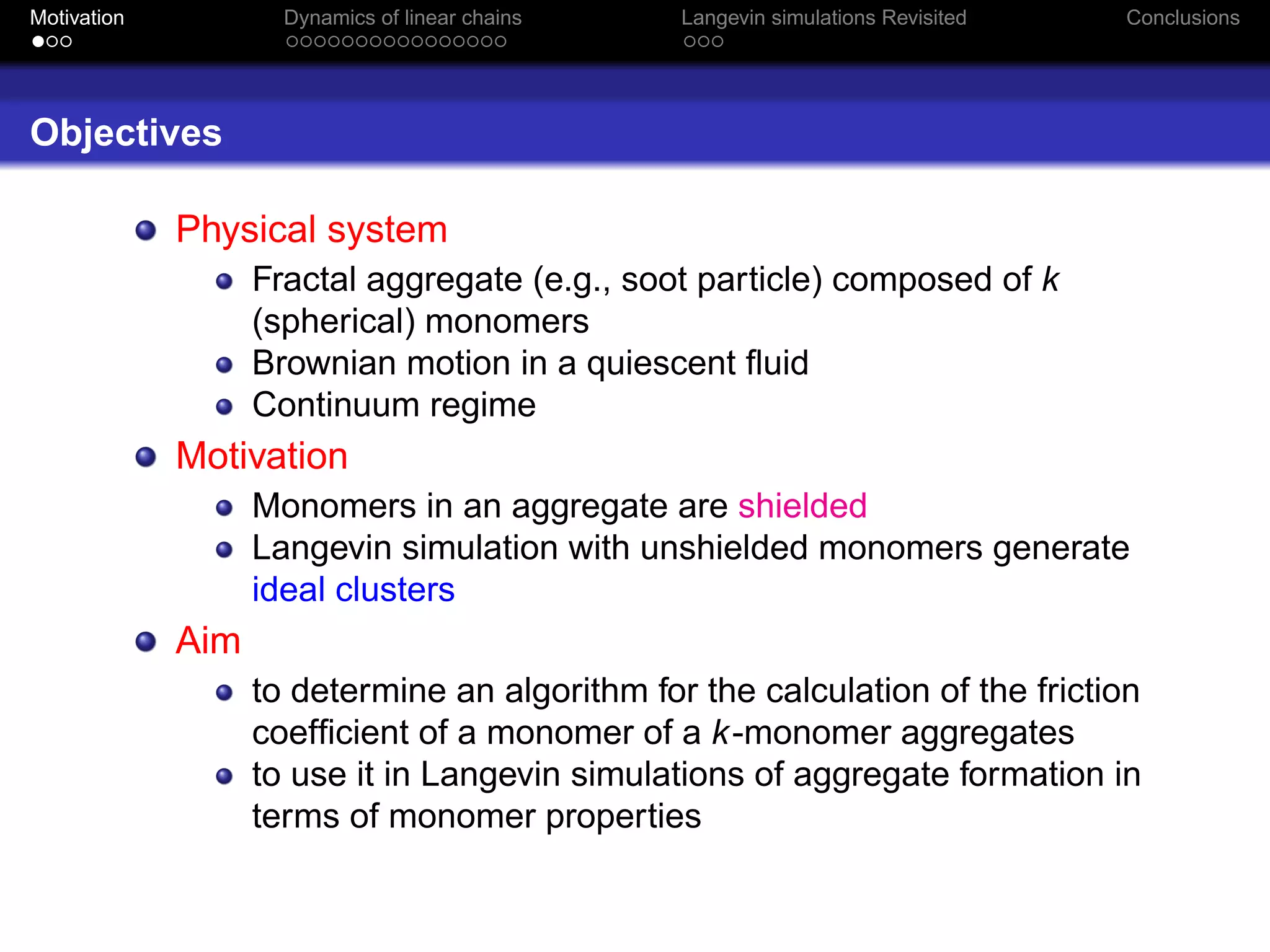
Objectives

             Physical system
                   Fractal aggregate (e.g., soot particle) composed of k
                   (spherical) monomers
                   Brownian motion in a quiescent fluid
                   Continuum regime
             Motivation
                   Monomers in an aggregate are shielded
                   Langevin simulation with unshielded monomers generate
                   ideal clusters
             Aim
                   to determine an algorithm for the calculation of the friction
                   coefficient of a monomer of a k -monomer aggregates
                   to use it in Langevin simulations of aggregate formation in
                   terms of monomer properties
Motivation         Dynamics of linear chains           Langevin simulations Revisited   Conclusions


Friction coefficient of a k -aggregate

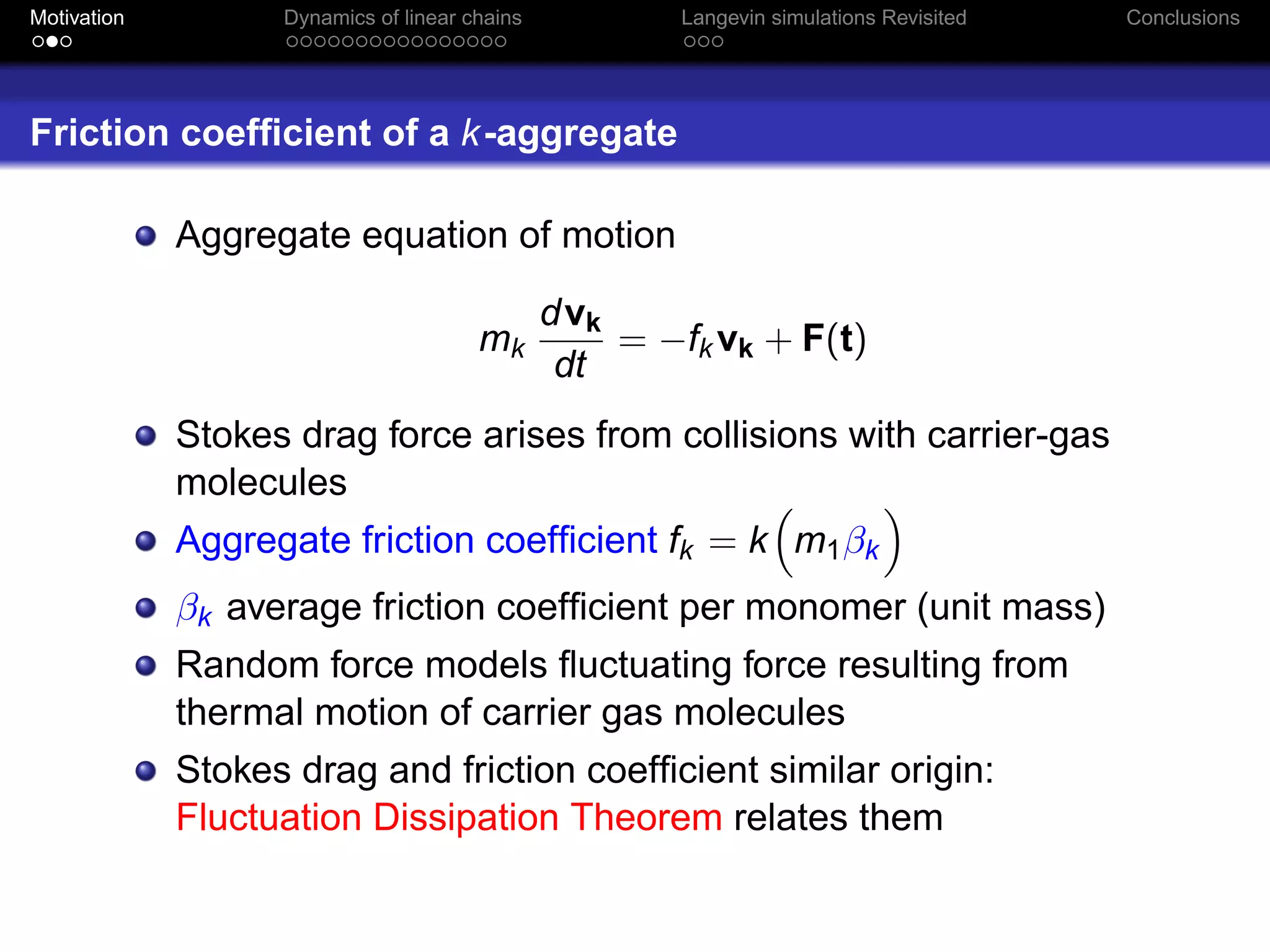
             Aggregate equation of motion

                                               dvk
                                       mk          = −fk vk + F(t)
                                                dt
             Stokes drag force arises from collisions with carrier-gas
             molecules
             Aggregate friction coefficient fk = k m1 βk
             βk average friction coefficient per monomer (unit mass)
             Random force models fluctuating force resulting from
             thermal motion of carrier gas molecules
             Stokes drag and friction coefficient similar origin:
             Fluctuation Dissipation Theorem relates them
Motivation         Dynamics of linear chains        Langevin simulations Revisited   Conclusions


Shielding factor

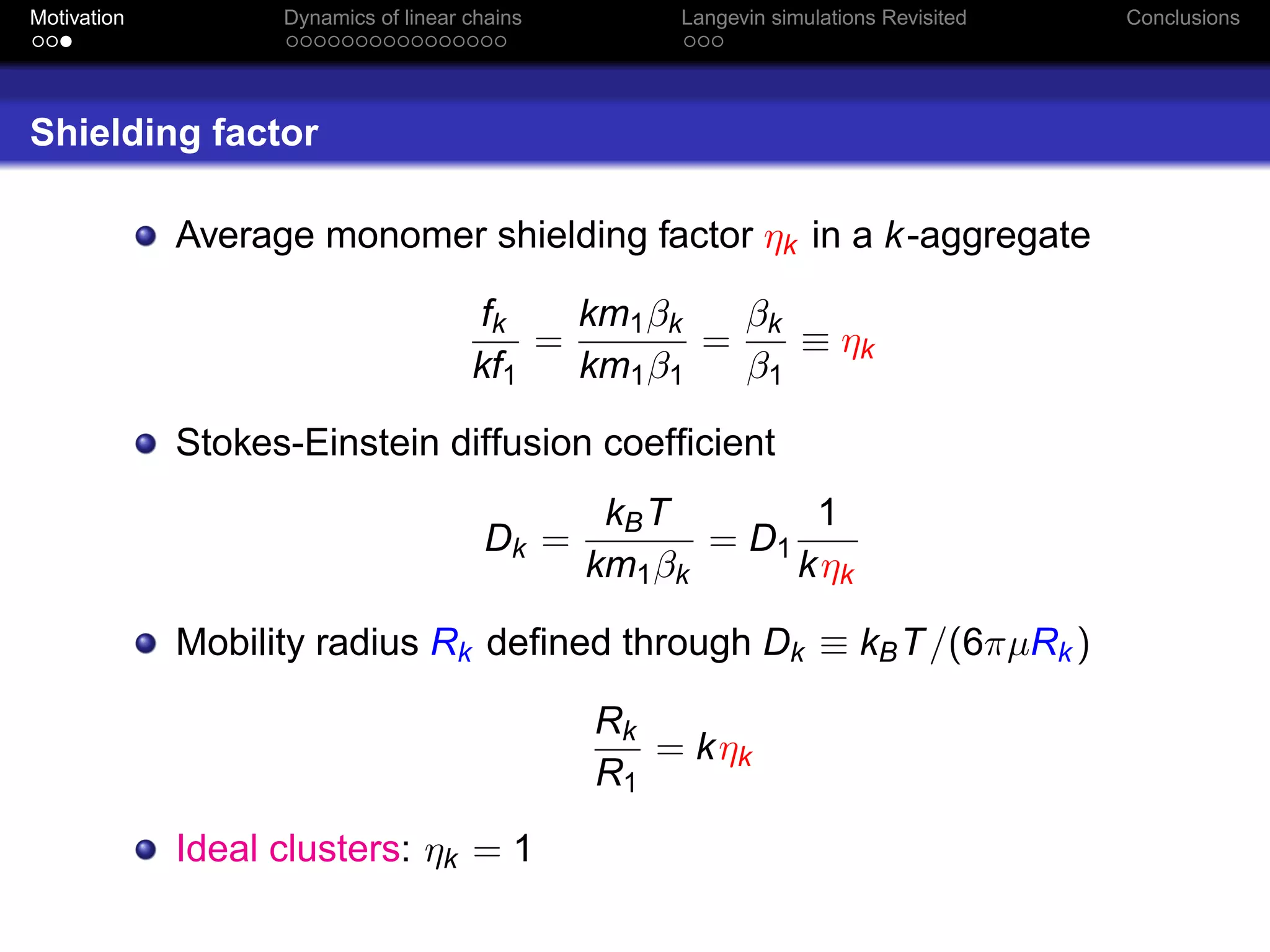
             Average monomer shielding factor ηk in a k -aggregate

                                      fk    km1 βk   βk
                                          =        =    ≡ ηk
                                      kf1   km1 β1   β1

             Stokes-Einstein diffusion coefficient
                                                kB T        1
                                        Dk =          = D1
                                               km1 βk      k ηk

             Mobility radius Rk defined through Dk ≡ kB T /(6πµRk )

                                               Rk
                                                  = k ηk
                                               R1
             Ideal clusters: ηk = 1
Motivation              Dynamics of linear chains   Langevin simulations Revisited   Conclusions


Gas molecule-monomer interactions

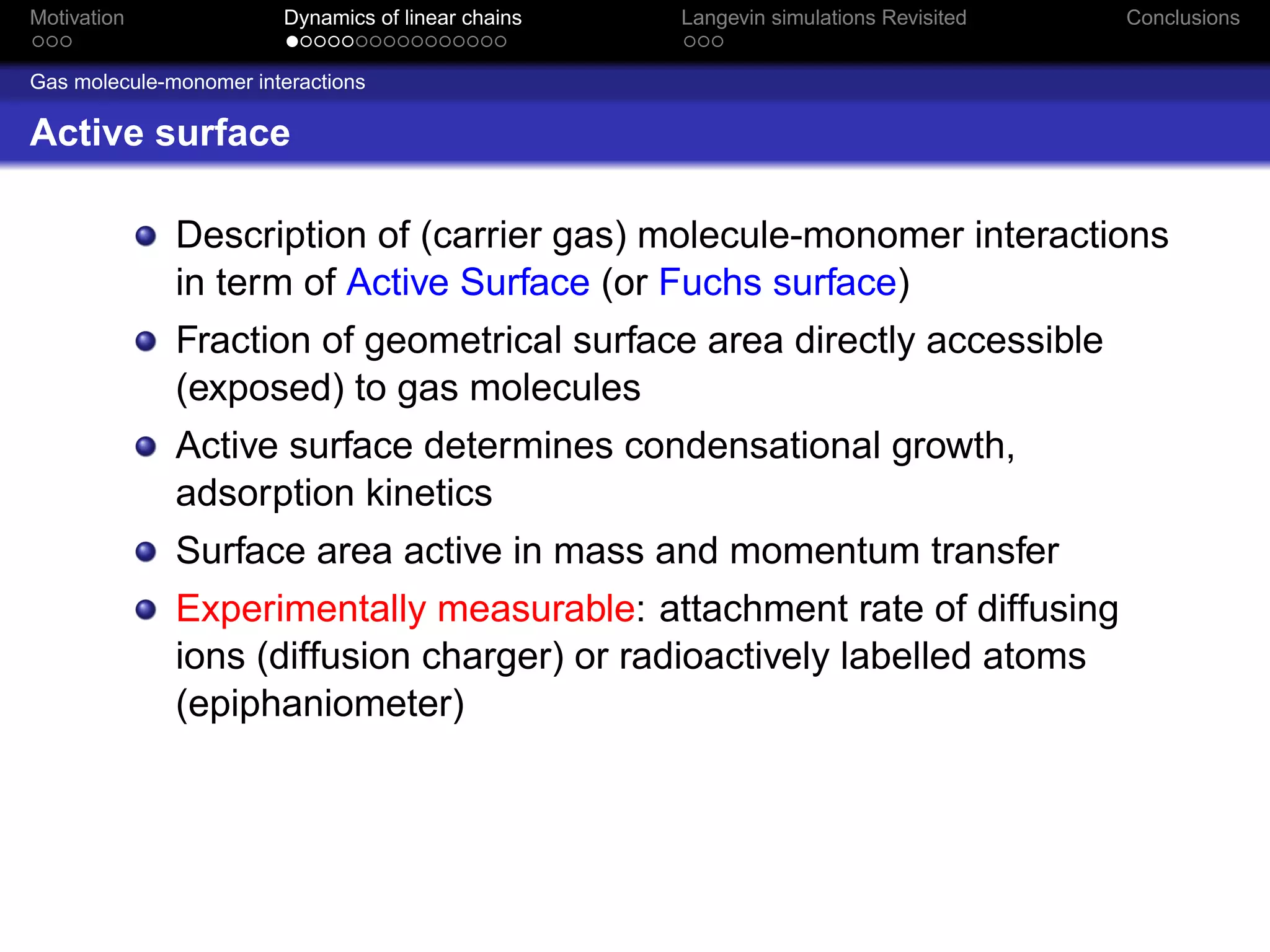
Active surface

              Description of (carrier gas) molecule-monomer interactions
              in term of Active Surface (or Fuchs surface)
              Fraction of geometrical surface area directly accessible
              (exposed) to gas molecules
              Active surface determines condensational growth,
              adsorption kinetics
              Surface area active in mass and momentum transfer
              Experimentally measurable: attachment rate of diffusing
              ions (diffusion charger) or radioactively labelled atoms
              (epiphaniometer)
Motivation              Dynamics of linear chains   Langevin simulations Revisited   Conclusions


Gas molecule-monomer interactions

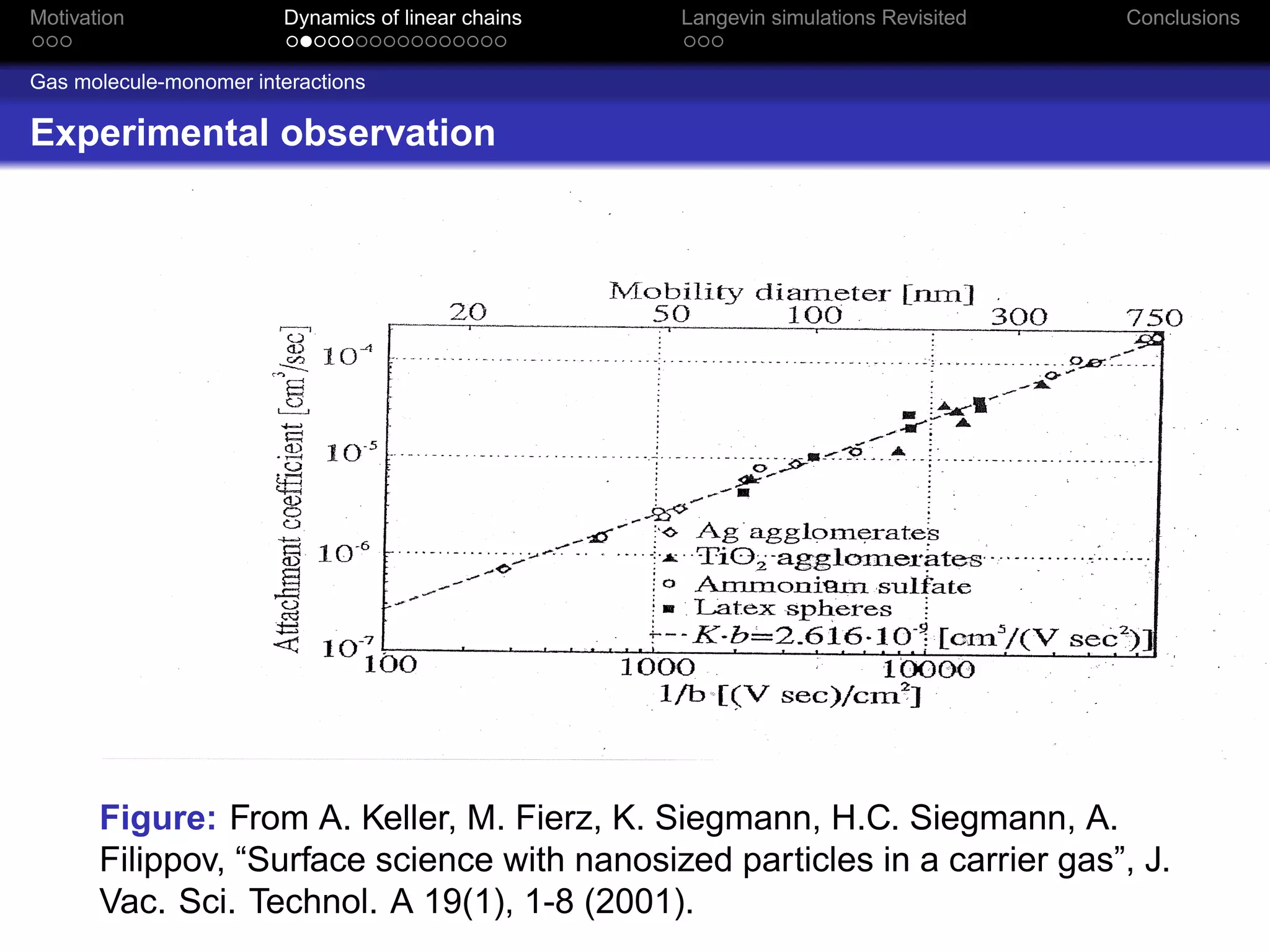
Experimental observation


       Figure: From A. Keller, M. Fierz, K. Siegmann, H.C. Siegmann, A.
       Filippov, “Surface science with nanosized particles in a carrier gas”, J.
       Vac. Sci. Technol. A 19(1), 1-8 (2001).
Motivation              Dynamics of linear chains     Langevin simulations Revisited   Conclusions


Gas molecule-monomer interactions

Scaling law (1)

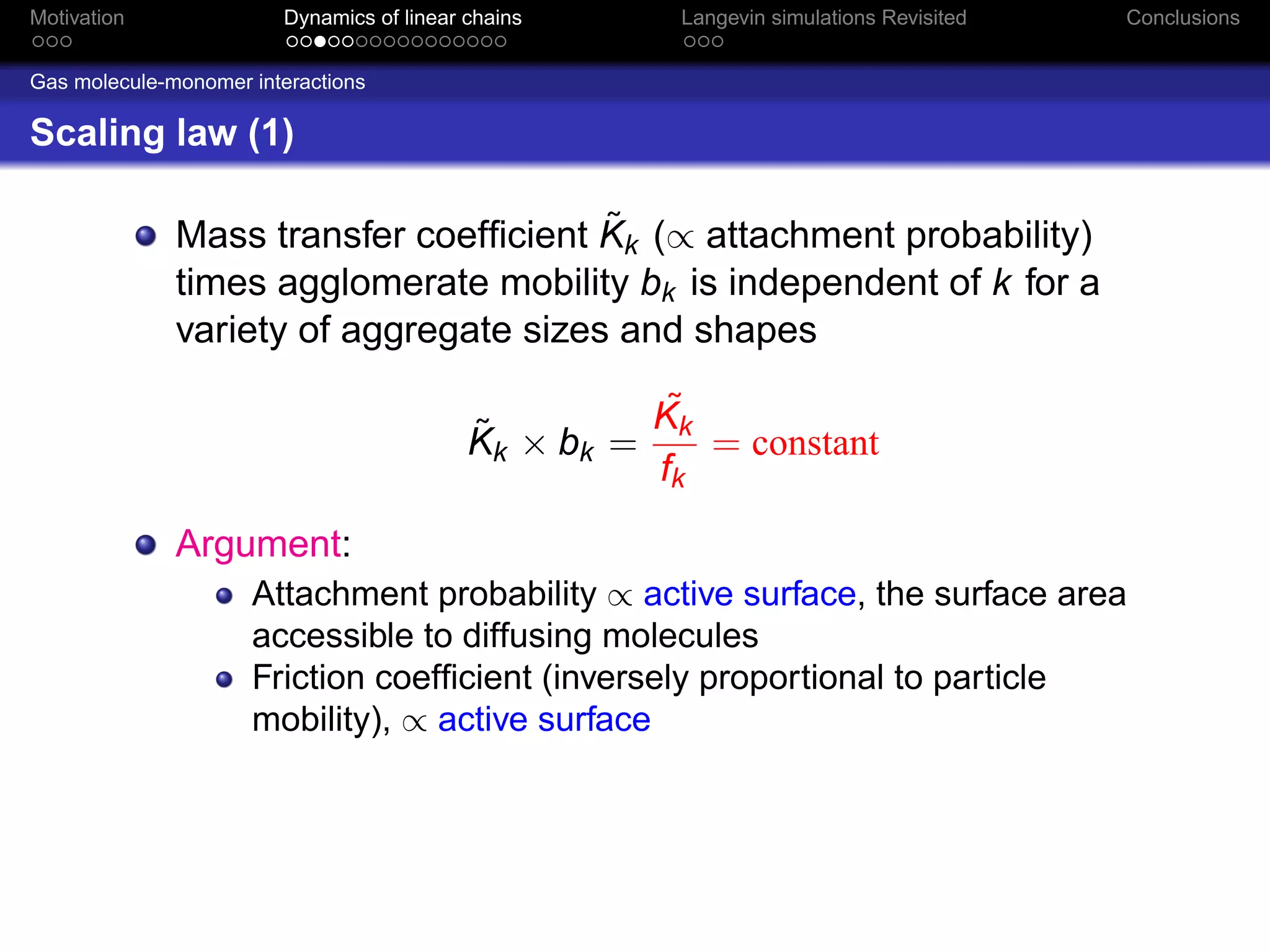
                                        ˜
              Mass transfer coefficient Kk (∝ attachment probability)
              times agglomerate mobility bk is independent of k for a
              variety of aggregate sizes and shapes
                                                     ˜
                                                     Kk
                                           ˜
                                           Kk × bk =    = constant
                                                     fk
              Argument:
                     Attachment probability ∝ active surface, the surface area
                     accessible to diffusing molecules
                     Friction coefficient (inversely proportional to particle
                     mobility), ∝ active surface
Motivation              Dynamics of linear chains         Langevin simulations Revisited   Conclusions


Gas molecule-monomer interactions

Scaling law (2)

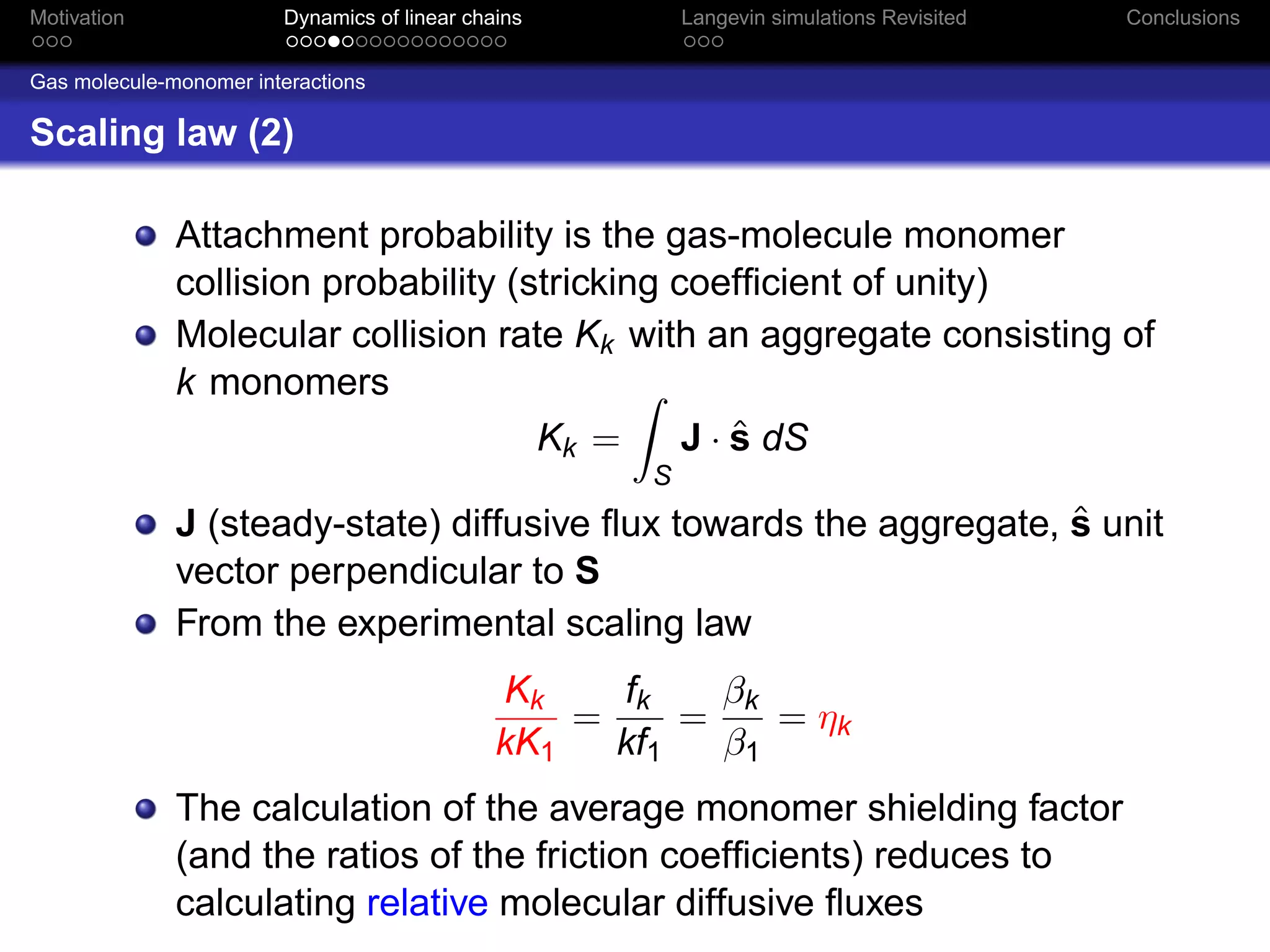
              Attachment probability is the gas-molecule monomer
              collision probability (stricking coefficient of unity)
              Molecular collision rate Kk with an aggregate consisting of
              k monomers
                                      Kk =          ˆ
                                                J · s dS
                                                      S
                                                                    ˆ
              J (steady-state) diffusive flux towards the aggregate, s unit
              vector perpendicular to S
              From the experimental scaling law
                                              Kk    fk    βk
                                                  =     =    = ηk
                                              kK1   kf1   β1
              The calculation of the average monomer shielding factor
              (and the ratios of the friction coefficients) reduces to
              calculating relative molecular diffusive fluxes
Motivation              Dynamics of linear chains             Langevin simulations Revisited         Conclusions


Gas molecule-monomer interactions

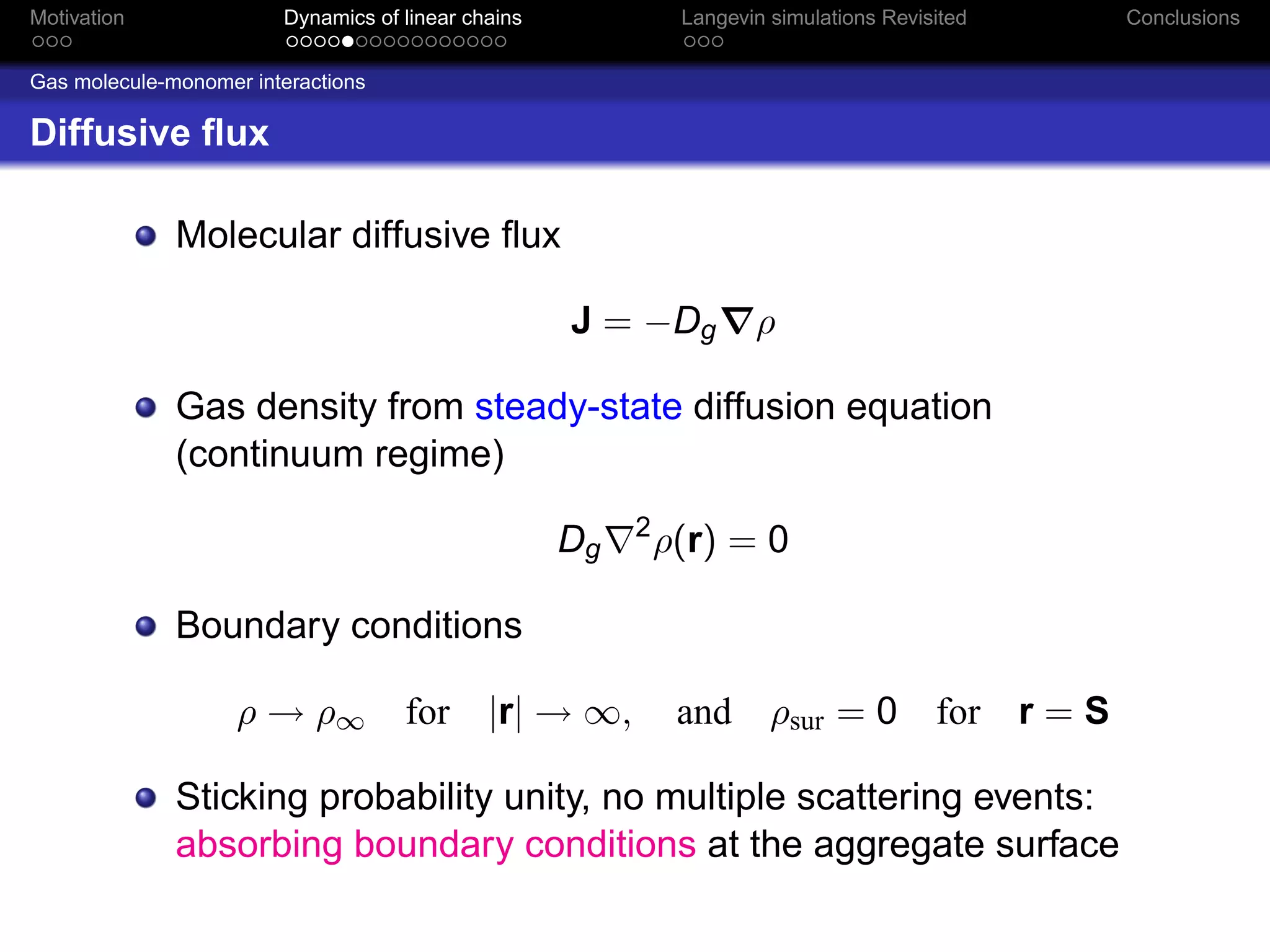
Diffusive flux

              Molecular diffusive flux

                                                    J = −Dg          ρ

              Gas density from steady-state diffusion equation
              (continuum regime)
                                                         2
                                                    Dg       ρ(r) = 0

              Boundary conditions

                    ρ → ρ∞          for      |r| → ∞,         and      ρsur = 0 for            r=S

              Sticking probability unity, no multiple scattering events:
              absorbing boundary conditions at the aggregate surface
Motivation                  Dynamics of linear chains   Langevin simulations Revisited   Conclusions


Linear chains: Effect of anisotropy

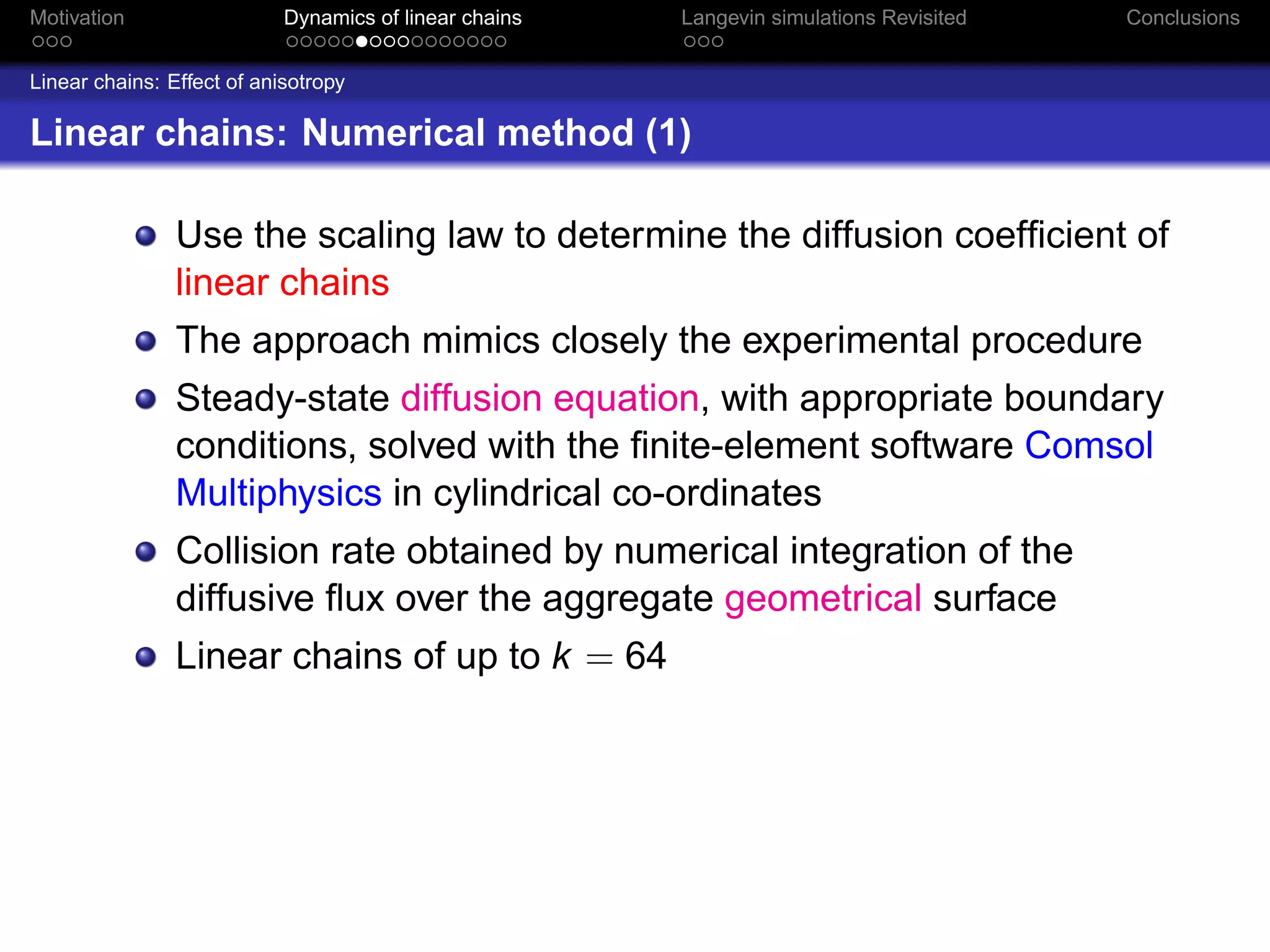
Linear chains: Numerical method (1)

                Use the scaling law to determine the diffusion coefficient of
                linear chains
                The approach mimics closely the experimental procedure
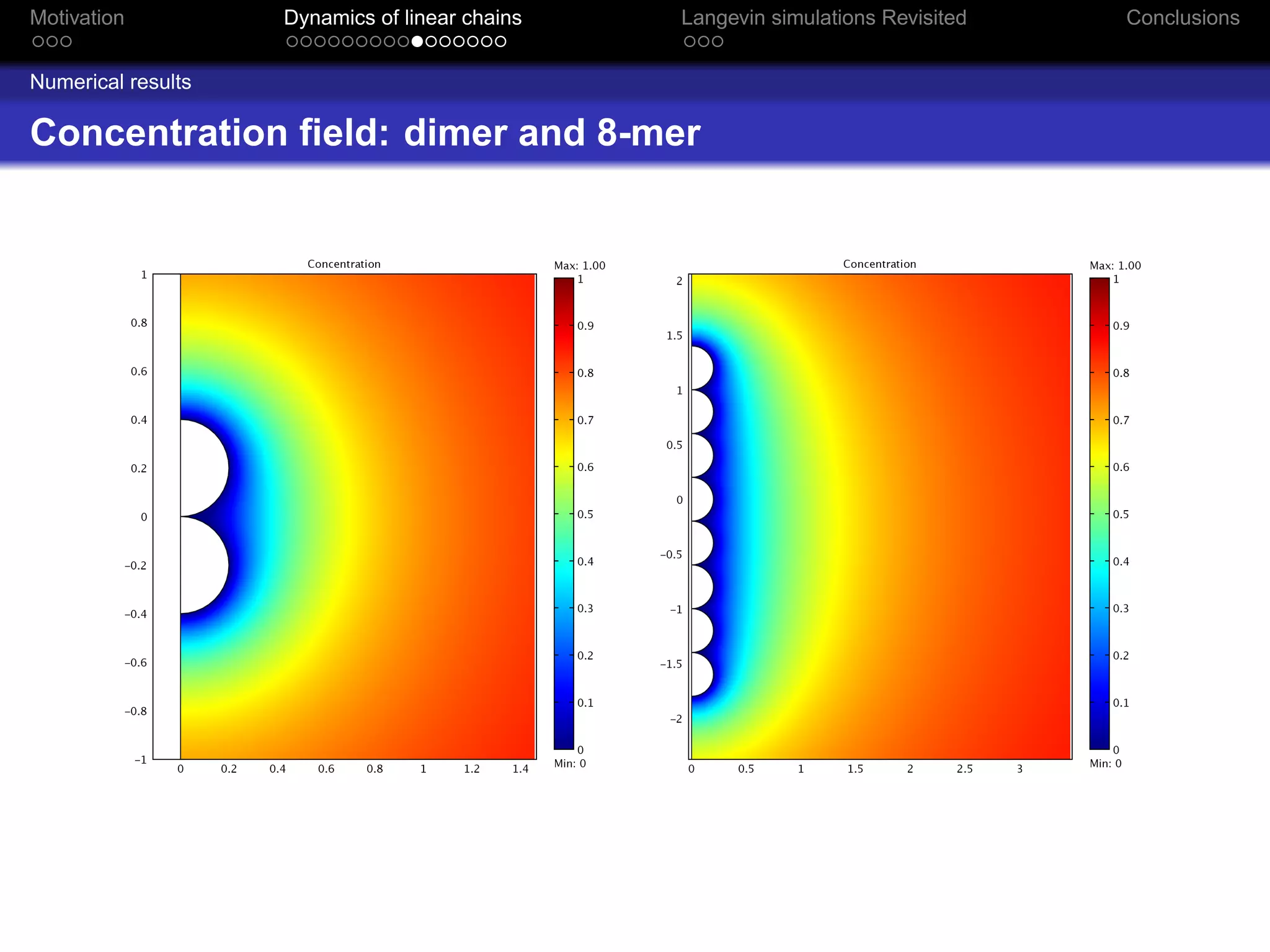
                Steady-state diffusion equation, with appropriate boundary
                conditions, solved with the finite-element software Comsol
                Multiphysics in cylindrical co-ordinates
                Collision rate obtained by numerical integration of the
                diffusive flux over the aggregate geometrical surface
                Linear chains of up to k = 64
Motivation                  Dynamics of linear chains            Langevin simulations Revisited   Conclusions


Linear chains: Effect of anisotropy

Linear chains: Anisotropic friction coefficients

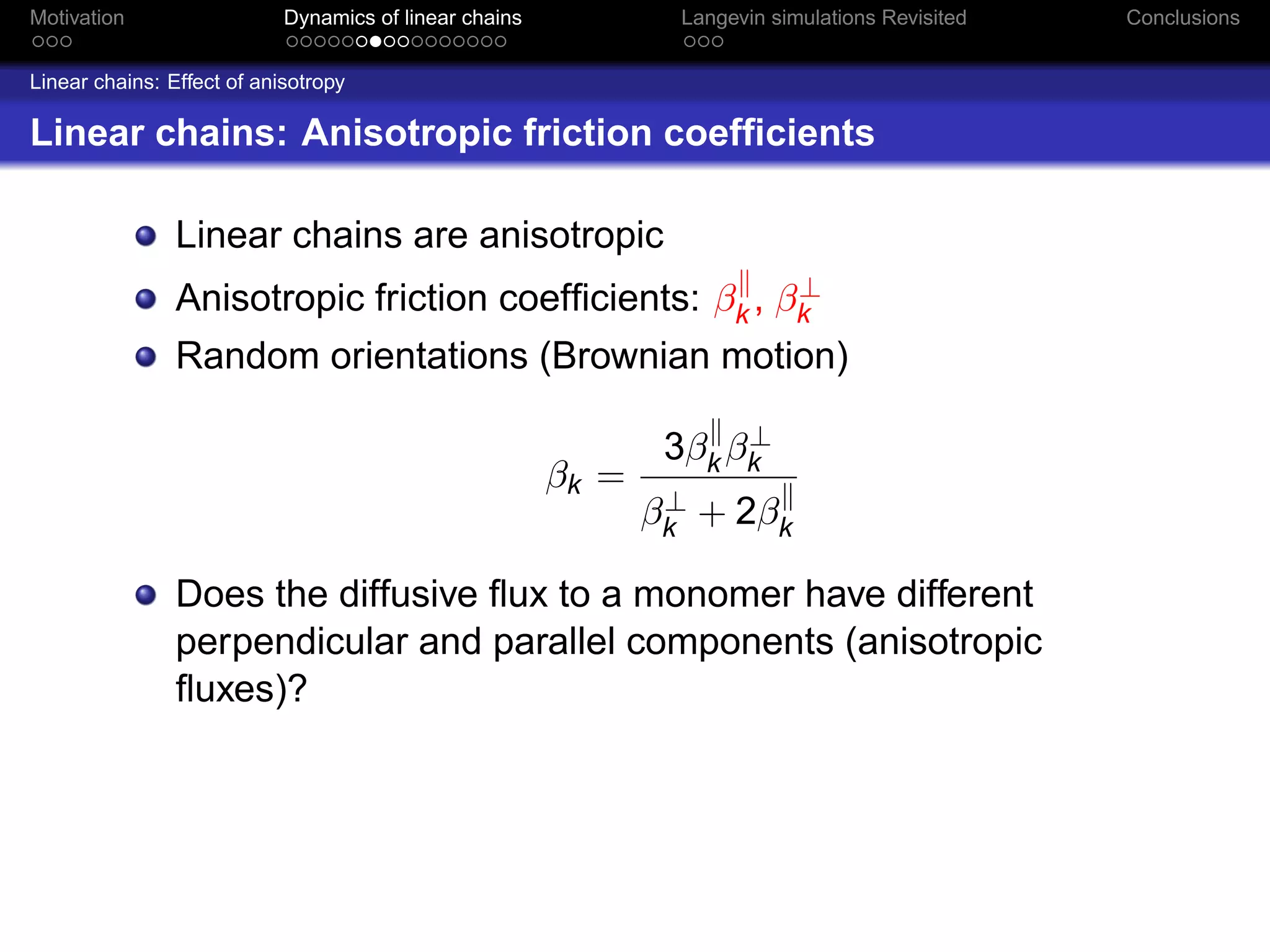
                Linear chains are anisotropic
                                                        ⊥
                Anisotropic friction coefficients: βk , βk
                Random orientations (Brownian motion)

                                                                     ⊥
                                                                3βk βk
                                                        βk =
                                                                ⊥
                                                               βk + 2βk

                Does the diffusive flux to a monomer have different
                perpendicular and parallel components (anisotropic
                fluxes)?
Motivation                  Dynamics of linear chains         Langevin simulations Revisited       Conclusions


Linear chains: Effect of anisotropy

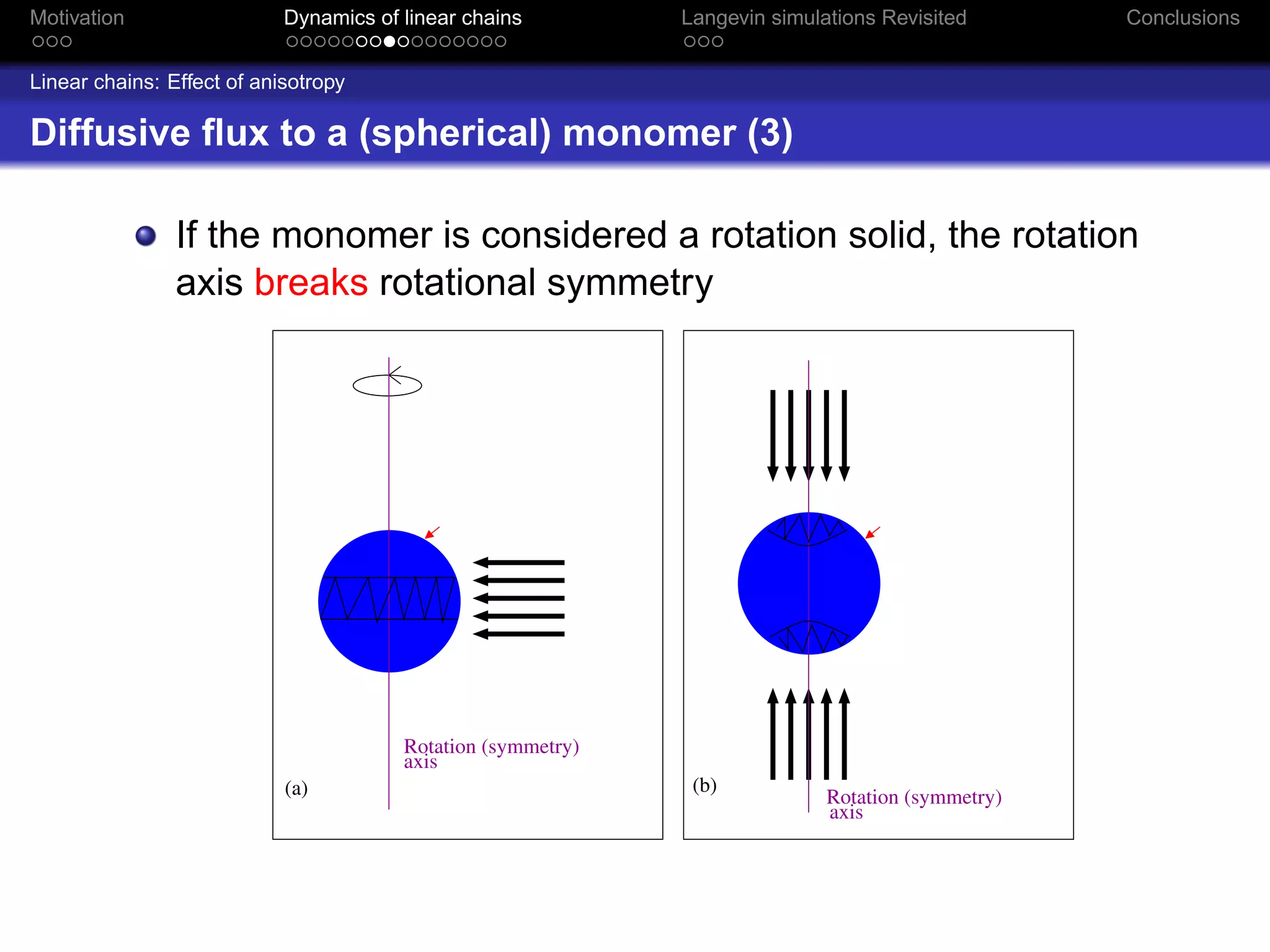
Diffusive flux to a (spherical) monomer (3)

                If the monomer is considered a rotation solid, the rotation
                axis breaks rotational symmetry


                                        Rotation (symmetry)
                                        axis
                            (a)                                (b)
                                                                             Rotation (symmetry)
                                                                             axis
Motivation                  Dynamics of linear chains          Langevin simulations Revisited   Conclusions


Linear chains: Effect of anisotropy

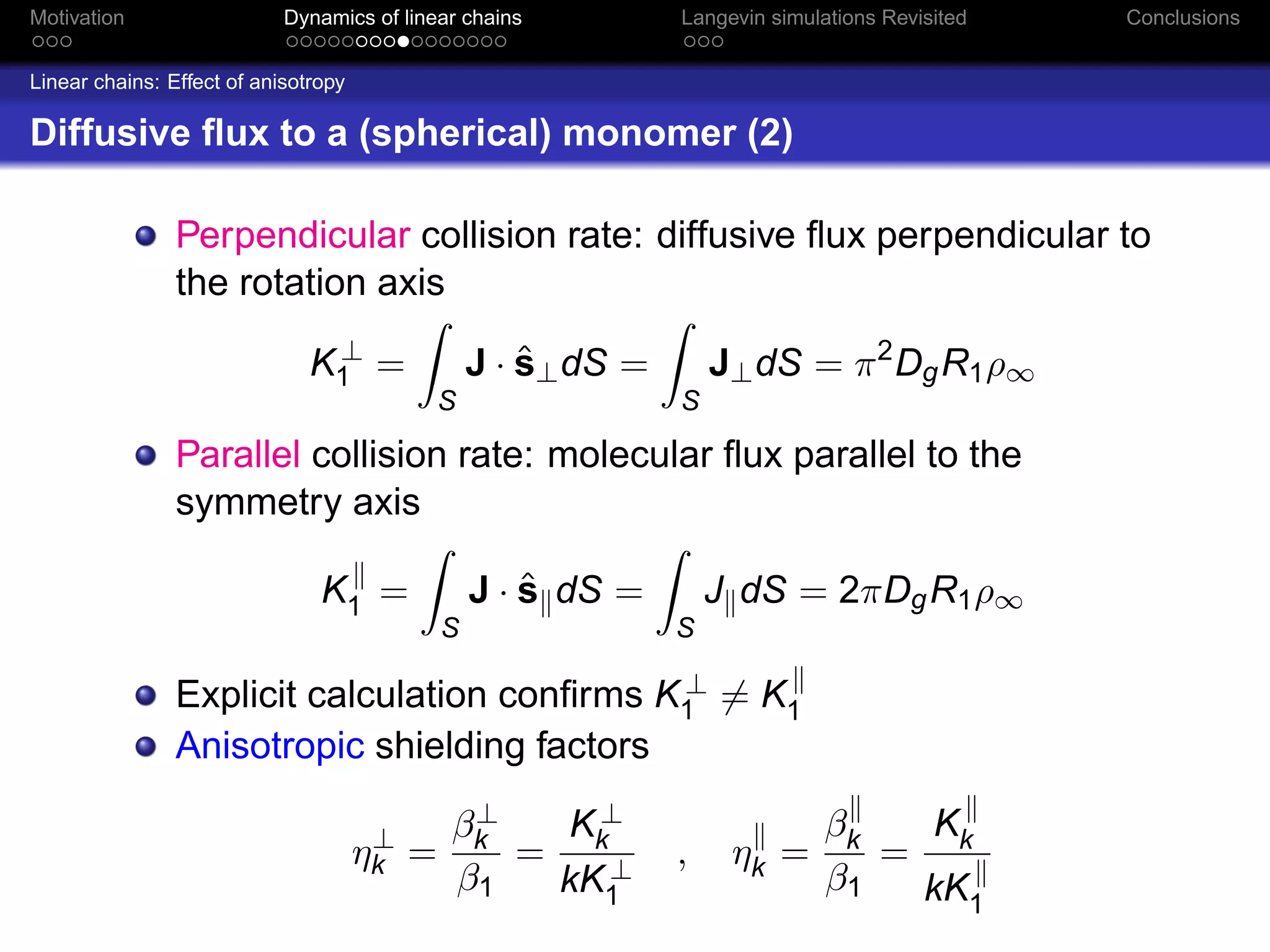
Diffusive flux to a (spherical) monomer (2)

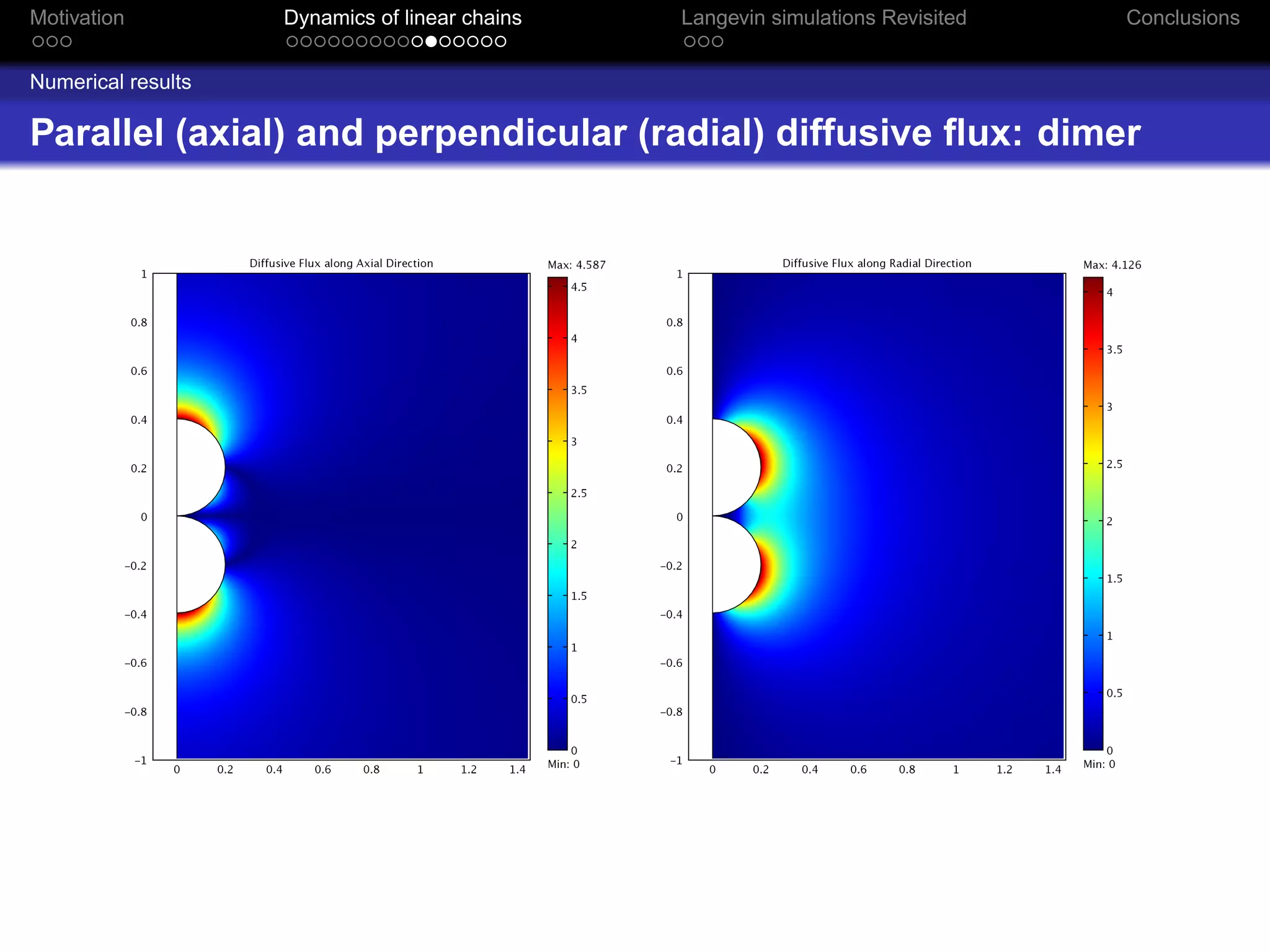
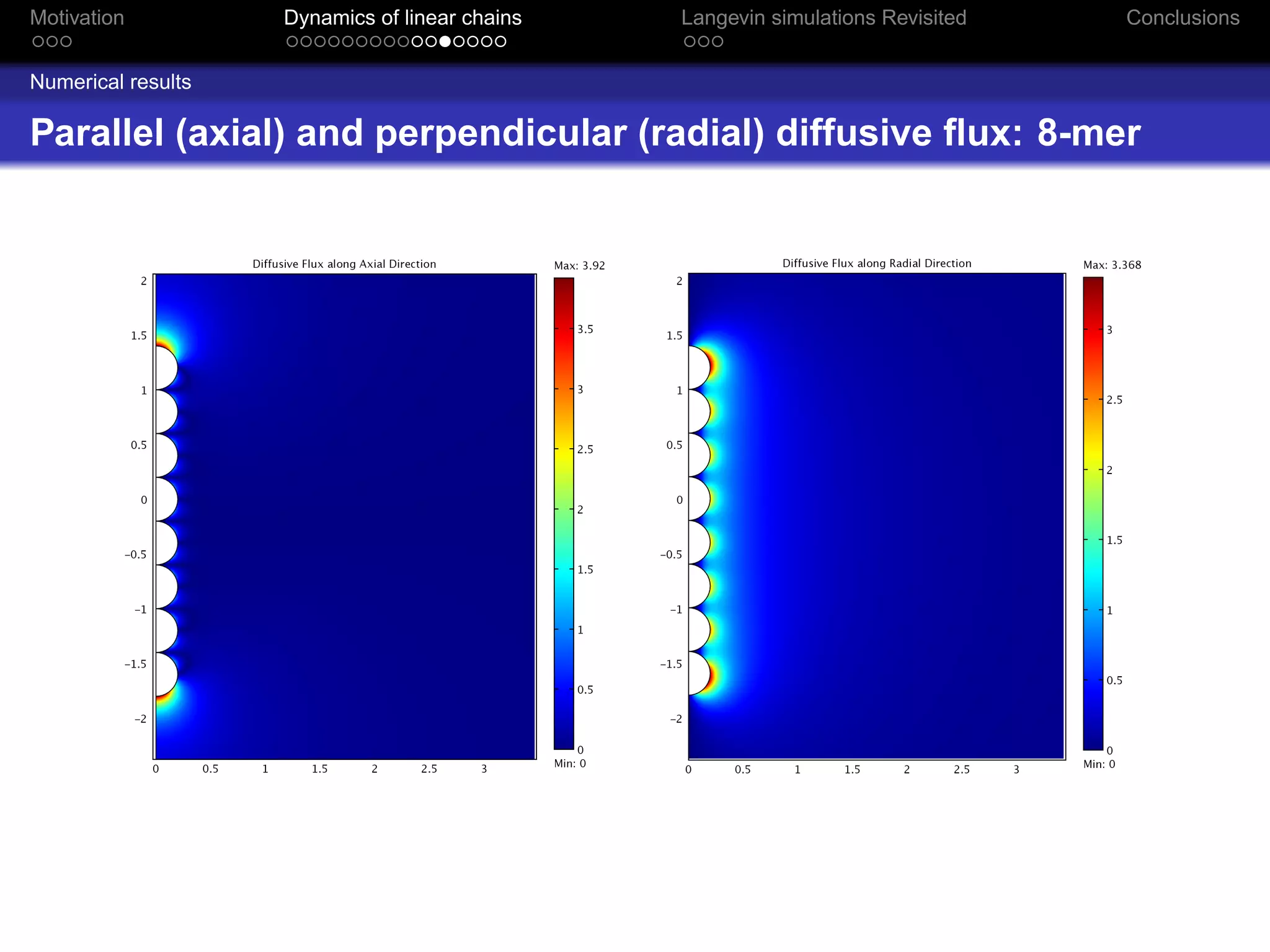
                Perpendicular collision rate: diffusive flux perpendicular to
                the rotation axis
                                ⊥
                               K1 =                  ˆ
                                                 J · s⊥ dS =       J⊥ dS = π 2 Dg R1 ρ∞
                                             S                 S

                Parallel collision rate: molecular flux parallel to the
                symmetry axis

                                K1 =                 ˆ
                                                 J · s dS =        J dS = 2πDg R1 ρ∞
                                             S                 S

                                              ⊥
                Explicit calculation confirms K1 = K1
                Anisotropic shielding factors
                                              ⊥
                                             βk   K⊥                          βk  K
                                       ⊥
                                      ηk =      = k⊥           ,    ηk =         = k
                                             β1  kK1                          β1  kK1
Motivation          Dynamics of linear chains   Langevin simulations Revisited   Conclusions


Numerical results

Concentration field: dimer and 8-mer
Motivation          Dynamics of linear chains   Langevin simulations Revisited   Conclusions


Numerical results

Parallel (axial) and perpendicular (radial) diffusive flux: dimer
Motivation          Dynamics of linear chains   Langevin simulations Revisited   Conclusions


Numerical results

Parallel (axial) and perpendicular (radial) diffusive flux: 8-mer
Motivation            Dynamics of linear chains    Langevin simulations Revisited   Conclusions


Numerical results

Monomer shielding factor in a linear chain (1)

               Comparison with previous calculations (linear chains,
               continuum regime)
                    Analytical solutions of the velocity field for steady-state
                    viscous flow (Stokes)
                          Happel and Brenner (1991): dimer
                          Filippov (2000): arbitrary aggregates of k spheres
                    Extrapolated experimental data: Dahneke (1982)
                    Creeping flow coupled to Darcy flow within the porous
                    aggregate
                          Vainshtein, Shapiro, and Gutfinger (2004)
                          Garcia-Ybarra, Castillo, and Rosner (2006)
                    and many others . . .
Motivation          Dynamics of linear chains           Langevin simulations Revisited       Conclusions


Numerical results

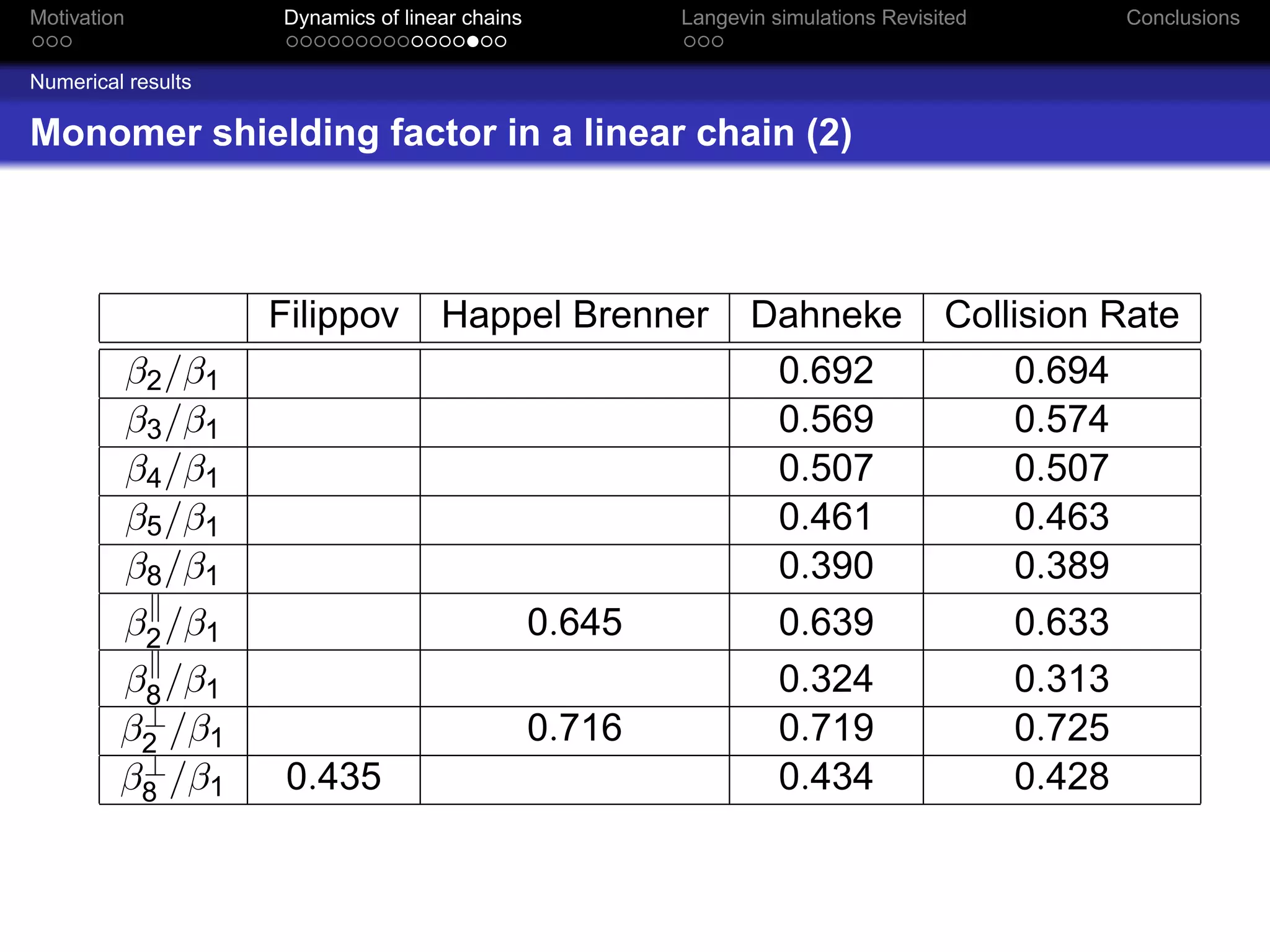
Monomer shielding factor in a linear chain (2)


                    Filippov        Happel Brenner             Dahneke             Collision Rate
         β2 /β1                                                 0.692                   0.694
         β3 /β1                                                 0.569                   0.574
         β4 /β1                                                 0.507                   0.507
         β5 /β1                                                 0.461                   0.463
         β8 /β1                                                 0.390                   0.389
         β2 /β1                                 0.645           0.639                   0.633
         β8 /β1                                                 0.324                   0.313
          ⊥
         β2 /β1                                 0.716           0.719                   0.725
          ⊥
         β8 /β1      0.435                                      0.434                   0.428
Motivation                     Dynamics of linear chains                             Langevin simulations Revisited                          Conclusions


Numerical results

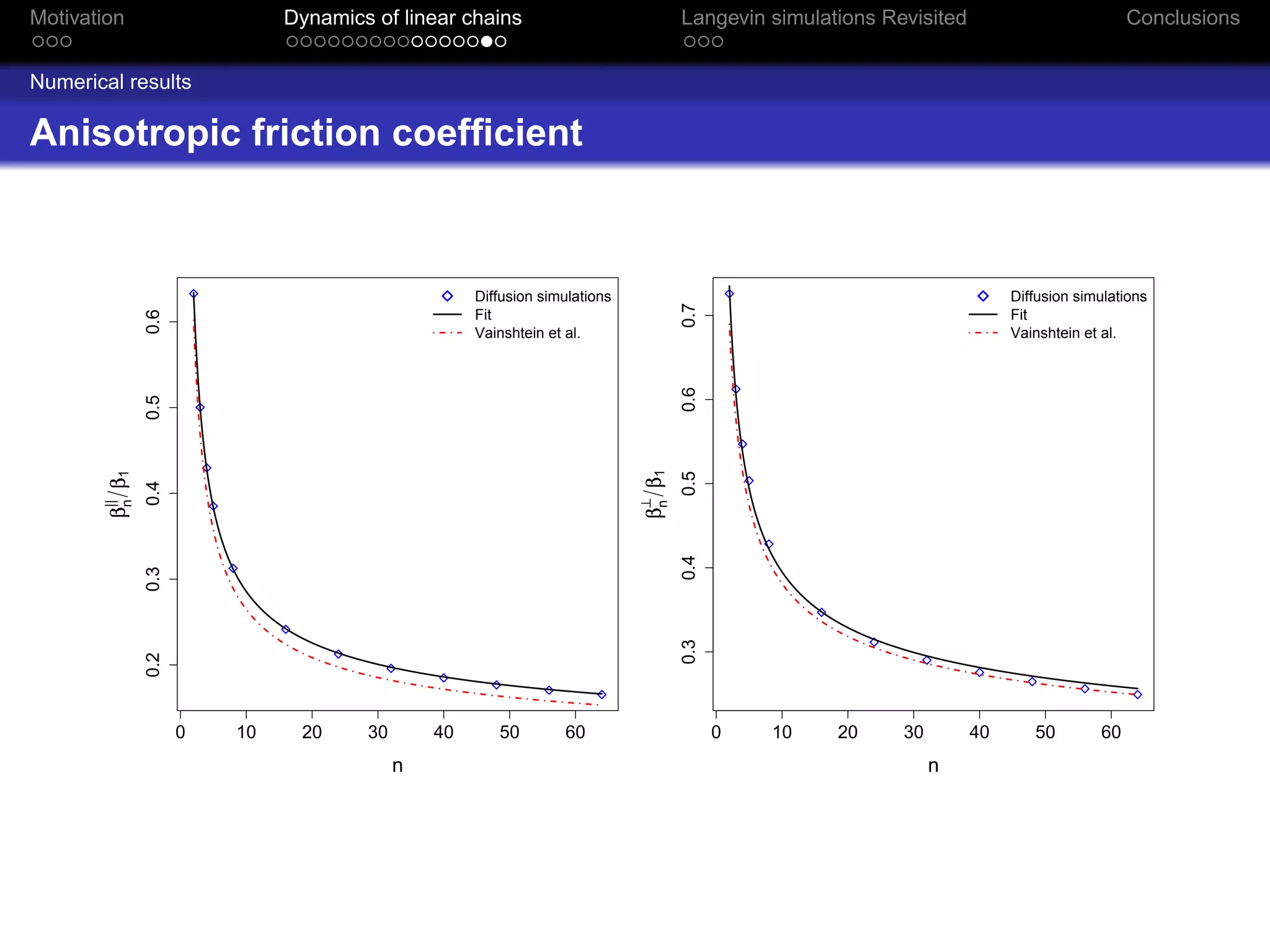
Anisotropic friction coefficient


                                                     Diffusion simulations                                                 Diffusion simulations


                                                                                     0.7
                                                     Fit                                                                   Fit
                0.6


                                                     Vainshtein et al.                                                     Vainshtein et al.


                                                                                     0.6
                0.5


                                                                             β⊥ β1
       β|| β1


                                                                                     0.5
                0.4
        n


                                                                              n
                                                                                     0.4
                0.3


                                                                                     0.3
                0.2


                      0   10    20     30       40      50        60                       0   10    20     30        40      50        60
                                            n                                                                    n
Motivation                     Dynamics of linear chains                             Langevin simulations Revisited                  Conclusions


Numerical results

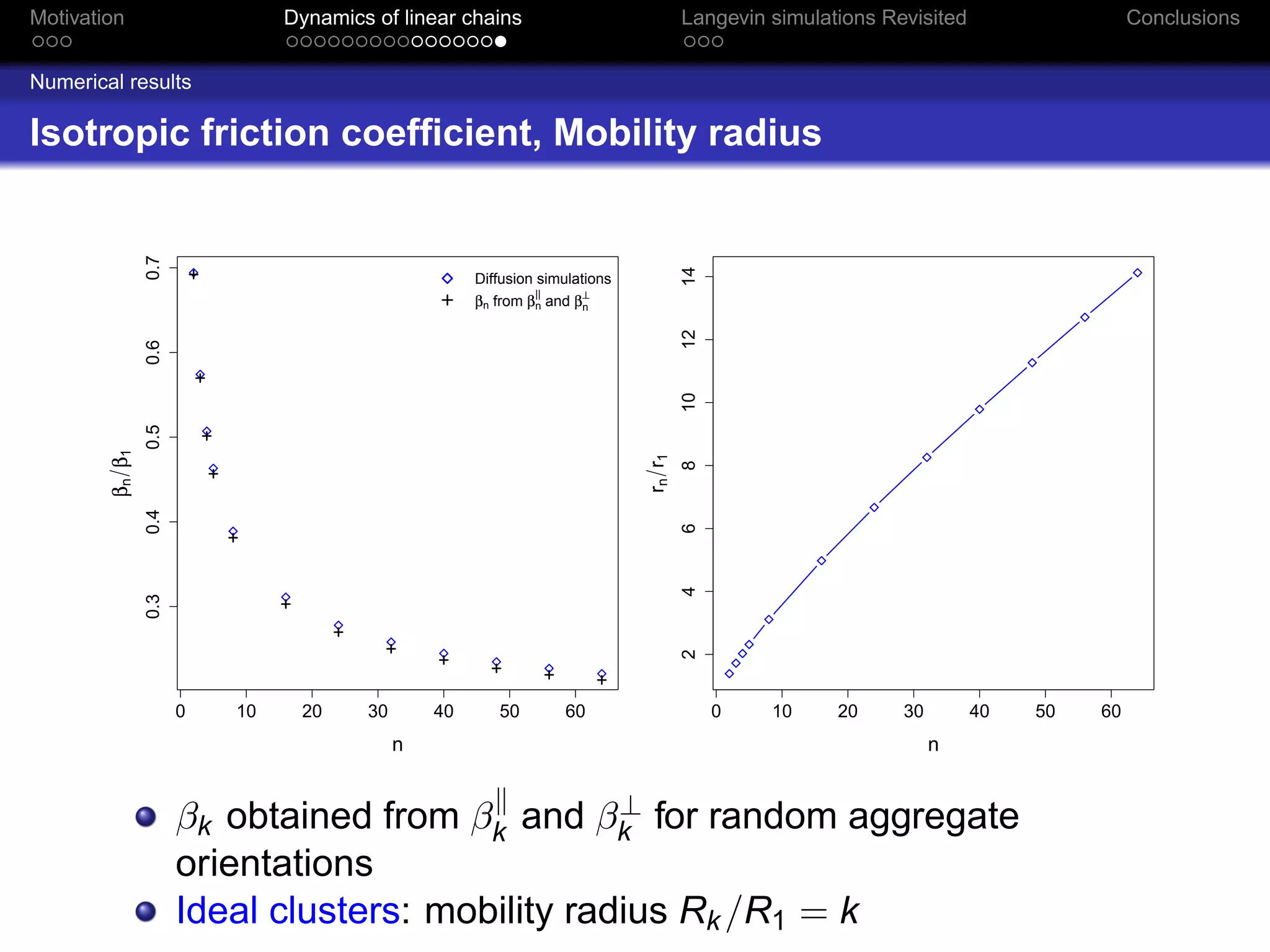
Isotropic friction coefficient, Mobility radius
                0.7


                                                                                     14
                                                     Diffusion simulations
                                                     βn from βn and β⊥
                                                              ||
                                                                     n


                                                                                     12
                0.6


                                                                                     10
                0.5
        βn β1


                                                                             rn r1
                                                                                     8
                0.4


                                                                                     6
                                                                                     4
                0.3


                                                                                     2
                      0   10    20     30       40      50         60                     0   10     20     30        40   50   60
                                            n                                                                    n


                                                  ⊥
                      βk obtained from βk and βk for random aggregate
                      orientations
                      Ideal clusters: mobility radius Rk /R1 = k
Motivation               Dynamics of linear chains        Langevin simulations Revisited   Conclusions


Shielded Langevin equations

Monomer Langevin equations of motion (1)

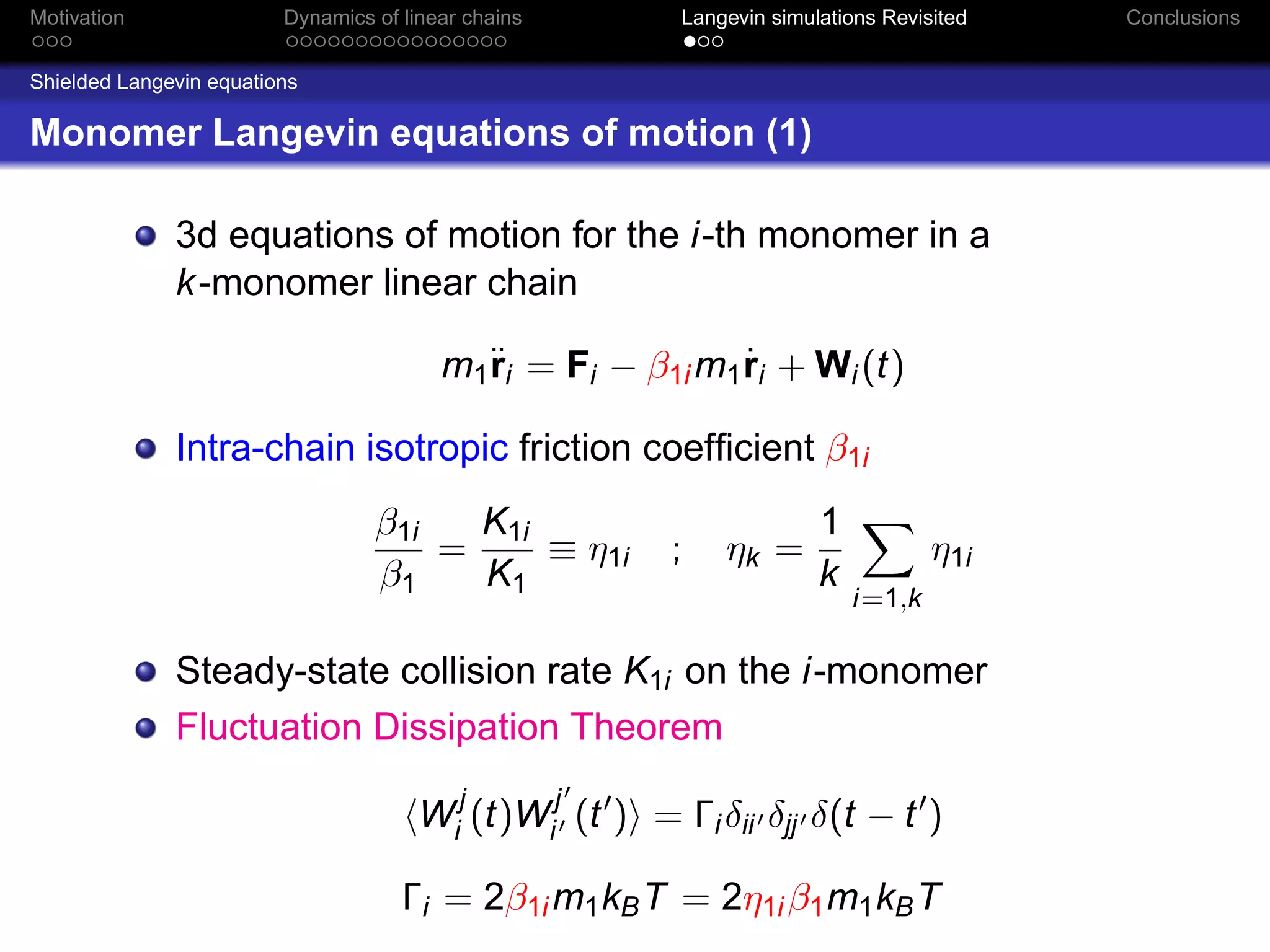
              3d equations of motion for the i-th monomer in a
              k -monomer linear chain

                                         m1¨i = Fi − β1i m1 ri + Wi (t)
                                           r                ˙

              Intra-chain isotropic friction coefficient β1i
                                  β1i   K1i                             1
                                      =     ≡ η1i        ;    ηk =                  η1i
                                  β1    K1                              k
                                                                            i=1,k

              Steady-state collision rate K1i on the i-monomer
              Fluctuation Dissipation Theorem

                                       Wij (t)Wij (t ) = Γi δii δjj δ(t − t )

                                     Γi = 2β1i m1 kB T = 2η1i β1 m1 kB T
Motivation               Dynamics of linear chains                                    Langevin simulations Revisited   Conclusions


Shielded Langevin equations

Langevin Dynamics: Diffusion coefficient of a linear chain (1)

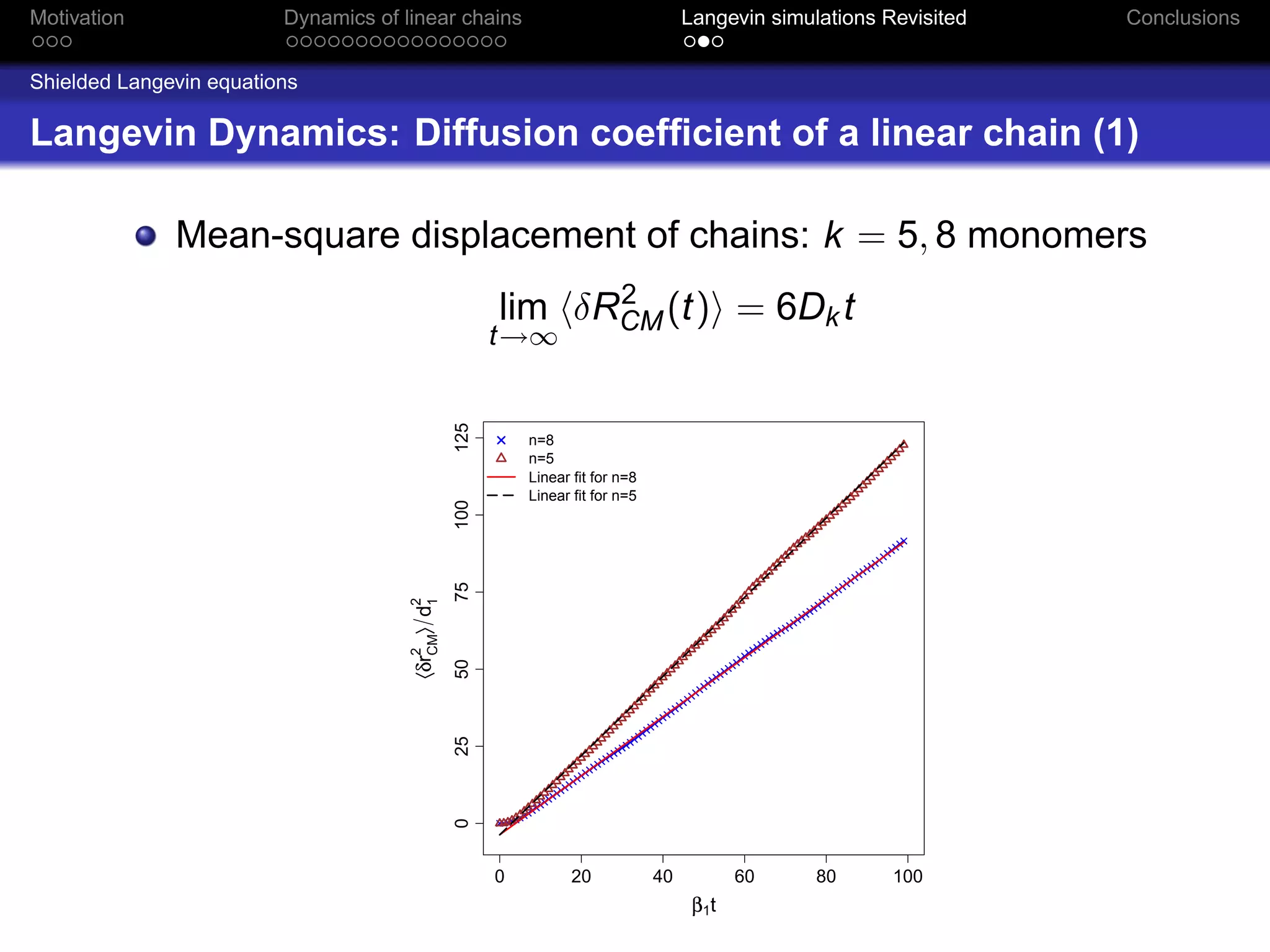
              Mean-square displacement of chains: k = 5, 8 monomers
                                                              2
                                                        lim δRCM (t) = 6Dk t
                                                        t→∞


                                                  125
                                                            n=8
                                                            n=5
                                                            Linear fit for n=8
                                                            Linear fit for n=5
                                                  100
                                                  75
                                      〈δr2 〉 d2
                                         CM   1

                                                  50
                                                  25
                                                  0


                                                        0          20            40          60     80      100
                                                                                       β1t
Motivation               Dynamics of linear chains       Langevin simulations Revisited   Conclusions


Shielded Langevin equations

Langevin simulations: Diffusion coefficient of a linear chain (2)

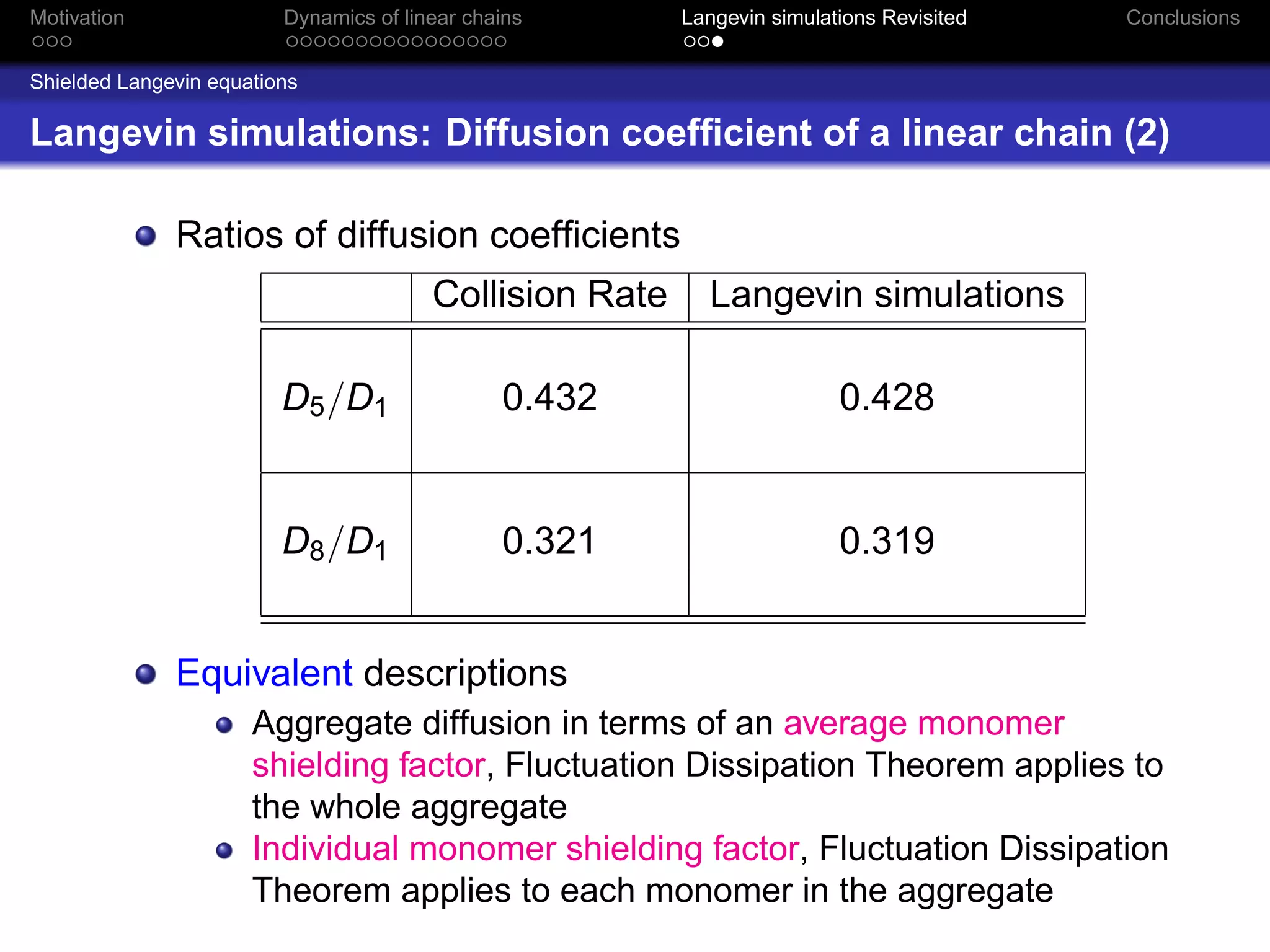
              Ratios of diffusion coefficients
                                        Collision Rate     Langevin simulations

                         D5 /D1                0.432                     0.428


                         D8 /D1                0.321                     0.319


              Equivalent descriptions
                      Aggregate diffusion in terms of an average monomer
                      shielding factor, Fluctuation Dissipation Theorem applies to
                      the whole aggregate
                      Individual monomer shielding factor, Fluctuation Dissipation
                      Theorem applies to each monomer in the aggregate
Motivation         Dynamics of linear chains   Langevin simulations Revisited   Conclusions


Conclusions

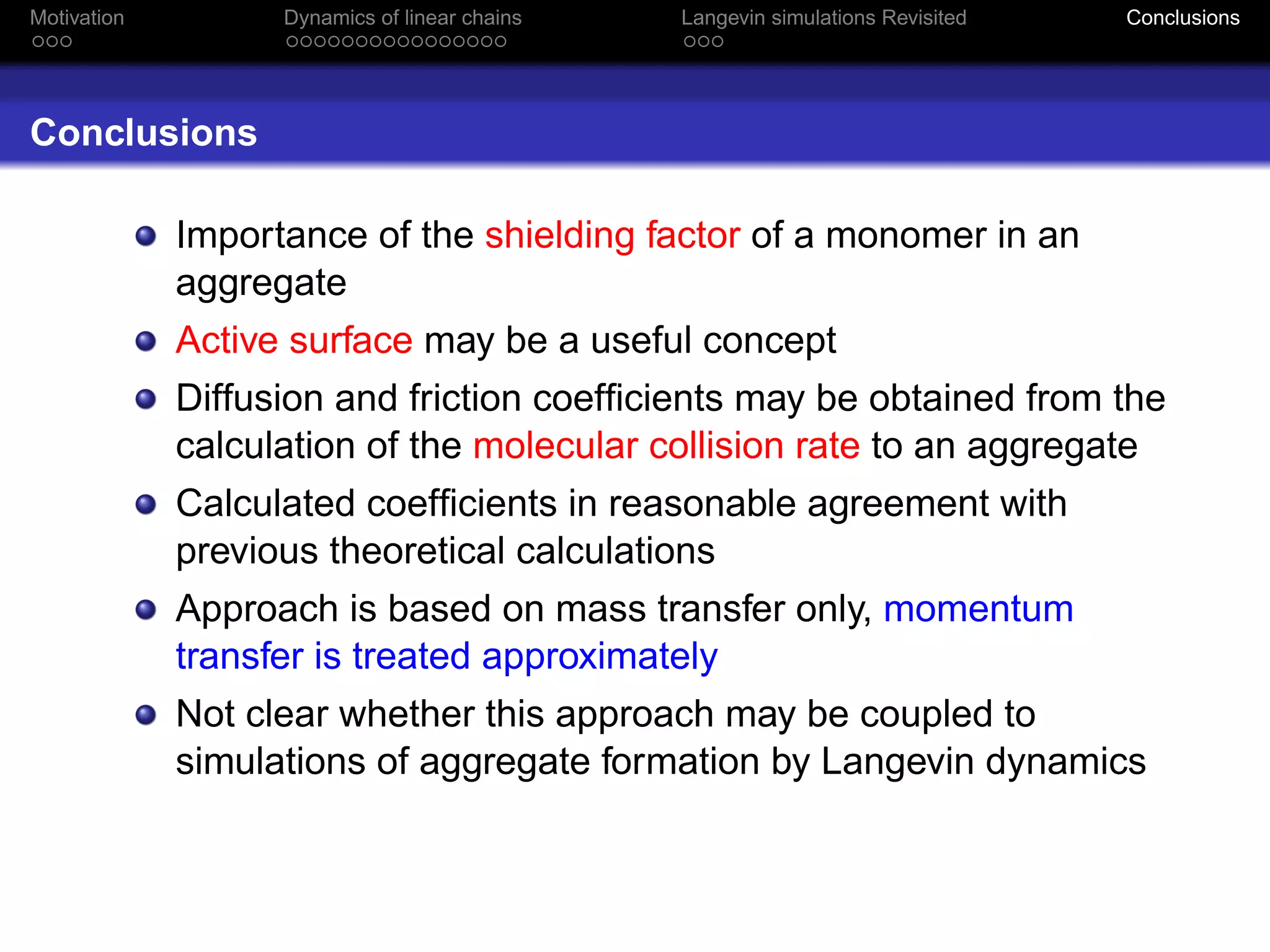
             Importance of the shielding factor of a monomer in an
             aggregate
             Active surface may be a useful concept
             Diffusion and friction coefficients may be obtained from the
             calculation of the molecular collision rate to an aggregate
             Calculated coefficients in reasonable agreement with
             previous theoretical calculations
             Approach is based on mass transfer only, momentum
             transfer is treated approximately
             Not clear whether this approach may be coupled to
             simulations of aggregate formation by Langevin dynamics

Diffusion Linear Chains V4

  • 1.
    Motivation Dynamics of linear chains Langevin simulations Revisited Conclusions Diffusion coefficient of linear chains Is active surface a useful concept? Lorenzo Isella Yannis Drossinos European Commission Joint Research Centre Ispra (VA), Italy European Aerosol Conference 2009, Karlsruhe
  • 2.
    Motivation Dynamics of linear chains Langevin simulations Revisited Conclusions Objectives Physical system Fractal aggregate (e.g., soot particle) composed of k (spherical) monomers Brownian motion in a quiescent fluid Continuum regime Motivation Monomers in an aggregate are shielded Langevin simulation with unshielded monomers generate ideal clusters Aim to determine an algorithm for the calculation of the friction coefficient of a monomer of a k -monomer aggregates to use it in Langevin simulations of aggregate formation in terms of monomer properties
  • 3.
    Motivation Dynamics of linear chains Langevin simulations Revisited Conclusions Friction coefficient of a k -aggregate Aggregate equation of motion dvk mk = −fk vk + F(t) dt Stokes drag force arises from collisions with carrier-gas molecules Aggregate friction coefficient fk = k m1 βk βk average friction coefficient per monomer (unit mass) Random force models fluctuating force resulting from thermal motion of carrier gas molecules Stokes drag and friction coefficient similar origin: Fluctuation Dissipation Theorem relates them
  • 4.
    Motivation Dynamics of linear chains Langevin simulations Revisited Conclusions Shielding factor Average monomer shielding factor ηk in a k -aggregate fk km1 βk βk = = ≡ ηk kf1 km1 β1 β1 Stokes-Einstein diffusion coefficient kB T 1 Dk = = D1 km1 βk k ηk Mobility radius Rk defined through Dk ≡ kB T /(6πµRk ) Rk = k ηk R1 Ideal clusters: ηk = 1
  • 5.
    Motivation Dynamics of linear chains Langevin simulations Revisited Conclusions Gas molecule-monomer interactions Active surface Description of (carrier gas) molecule-monomer interactions in term of Active Surface (or Fuchs surface) Fraction of geometrical surface area directly accessible (exposed) to gas molecules Active surface determines condensational growth, adsorption kinetics Surface area active in mass and momentum transfer Experimentally measurable: attachment rate of diffusing ions (diffusion charger) or radioactively labelled atoms (epiphaniometer)
  • 6.
    Motivation Dynamics of linear chains Langevin simulations Revisited Conclusions Gas molecule-monomer interactions Experimental observation Figure: From A. Keller, M. Fierz, K. Siegmann, H.C. Siegmann, A. Filippov, “Surface science with nanosized particles in a carrier gas”, J. Vac. Sci. Technol. A 19(1), 1-8 (2001).
  • 7.
    Motivation Dynamics of linear chains Langevin simulations Revisited Conclusions Gas molecule-monomer interactions Scaling law (1) ˜ Mass transfer coefficient Kk (∝ attachment probability) times agglomerate mobility bk is independent of k for a variety of aggregate sizes and shapes ˜ Kk ˜ Kk × bk = = constant fk Argument: Attachment probability ∝ active surface, the surface area accessible to diffusing molecules Friction coefficient (inversely proportional to particle mobility), ∝ active surface
  • 8.
    Motivation Dynamics of linear chains Langevin simulations Revisited Conclusions Gas molecule-monomer interactions Scaling law (2) Attachment probability is the gas-molecule monomer collision probability (stricking coefficient of unity) Molecular collision rate Kk with an aggregate consisting of k monomers Kk = ˆ J · s dS S ˆ J (steady-state) diffusive flux towards the aggregate, s unit vector perpendicular to S From the experimental scaling law Kk fk βk = = = ηk kK1 kf1 β1 The calculation of the average monomer shielding factor (and the ratios of the friction coefficients) reduces to calculating relative molecular diffusive fluxes
  • 9.
    Motivation Dynamics of linear chains Langevin simulations Revisited Conclusions Gas molecule-monomer interactions Diffusive flux Molecular diffusive flux J = −Dg ρ Gas density from steady-state diffusion equation (continuum regime) 2 Dg ρ(r) = 0 Boundary conditions ρ → ρ∞ for |r| → ∞, and ρsur = 0 for r=S Sticking probability unity, no multiple scattering events: absorbing boundary conditions at the aggregate surface
  • 10.
    Motivation Dynamics of linear chains Langevin simulations Revisited Conclusions Linear chains: Effect of anisotropy Linear chains: Numerical method (1) Use the scaling law to determine the diffusion coefficient of linear chains The approach mimics closely the experimental procedure Steady-state diffusion equation, with appropriate boundary conditions, solved with the finite-element software Comsol Multiphysics in cylindrical co-ordinates Collision rate obtained by numerical integration of the diffusive flux over the aggregate geometrical surface Linear chains of up to k = 64
  • 11.
    Motivation Dynamics of linear chains Langevin simulations Revisited Conclusions Linear chains: Effect of anisotropy Linear chains: Anisotropic friction coefficients Linear chains are anisotropic ⊥ Anisotropic friction coefficients: βk , βk Random orientations (Brownian motion) ⊥ 3βk βk βk = ⊥ βk + 2βk Does the diffusive flux to a monomer have different perpendicular and parallel components (anisotropic fluxes)?
  • 12.
    Motivation Dynamics of linear chains Langevin simulations Revisited Conclusions Linear chains: Effect of anisotropy Diffusive flux to a (spherical) monomer (3) If the monomer is considered a rotation solid, the rotation axis breaks rotational symmetry Rotation (symmetry) axis (a) (b) Rotation (symmetry) axis
  • 13.
    Motivation Dynamics of linear chains Langevin simulations Revisited Conclusions Linear chains: Effect of anisotropy Diffusive flux to a (spherical) monomer (2) Perpendicular collision rate: diffusive flux perpendicular to the rotation axis ⊥ K1 = ˆ J · s⊥ dS = J⊥ dS = π 2 Dg R1 ρ∞ S S Parallel collision rate: molecular flux parallel to the symmetry axis K1 = ˆ J · s dS = J dS = 2πDg R1 ρ∞ S S ⊥ Explicit calculation confirms K1 = K1 Anisotropic shielding factors ⊥ βk K⊥ βk K ⊥ ηk = = k⊥ , ηk = = k β1 kK1 β1 kK1
  • 14.
    Motivation Dynamics of linear chains Langevin simulations Revisited Conclusions Numerical results Concentration field: dimer and 8-mer
  • 15.
    Motivation Dynamics of linear chains Langevin simulations Revisited Conclusions Numerical results Parallel (axial) and perpendicular (radial) diffusive flux: dimer
  • 16.
    Motivation Dynamics of linear chains Langevin simulations Revisited Conclusions Numerical results Parallel (axial) and perpendicular (radial) diffusive flux: 8-mer
  • 17.
    Motivation Dynamics of linear chains Langevin simulations Revisited Conclusions Numerical results Monomer shielding factor in a linear chain (1) Comparison with previous calculations (linear chains, continuum regime) Analytical solutions of the velocity field for steady-state viscous flow (Stokes) Happel and Brenner (1991): dimer Filippov (2000): arbitrary aggregates of k spheres Extrapolated experimental data: Dahneke (1982) Creeping flow coupled to Darcy flow within the porous aggregate Vainshtein, Shapiro, and Gutfinger (2004) Garcia-Ybarra, Castillo, and Rosner (2006) and many others . . .
  • 18.
    Motivation Dynamics of linear chains Langevin simulations Revisited Conclusions Numerical results Monomer shielding factor in a linear chain (2) Filippov Happel Brenner Dahneke Collision Rate β2 /β1 0.692 0.694 β3 /β1 0.569 0.574 β4 /β1 0.507 0.507 β5 /β1 0.461 0.463 β8 /β1 0.390 0.389 β2 /β1 0.645 0.639 0.633 β8 /β1 0.324 0.313 ⊥ β2 /β1 0.716 0.719 0.725 ⊥ β8 /β1 0.435 0.434 0.428
  • 19.
    Motivation Dynamics of linear chains Langevin simulations Revisited Conclusions Numerical results Anisotropic friction coefficient Diffusion simulations Diffusion simulations 0.7 Fit Fit 0.6 Vainshtein et al. Vainshtein et al. 0.6 0.5 β⊥ β1 β|| β1 0.5 0.4 n n 0.4 0.3 0.3 0.2 0 10 20 30 40 50 60 0 10 20 30 40 50 60 n n
  • 20.
    Motivation Dynamics of linear chains Langevin simulations Revisited Conclusions Numerical results Isotropic friction coefficient, Mobility radius 0.7 14 Diffusion simulations βn from βn and β⊥ || n 12 0.6 10 0.5 βn β1 rn r1 8 0.4 6 4 0.3 2 0 10 20 30 40 50 60 0 10 20 30 40 50 60 n n ⊥ βk obtained from βk and βk for random aggregate orientations Ideal clusters: mobility radius Rk /R1 = k
  • 21.
    Motivation Dynamics of linear chains Langevin simulations Revisited Conclusions Shielded Langevin equations Monomer Langevin equations of motion (1) 3d equations of motion for the i-th monomer in a k -monomer linear chain m1¨i = Fi − β1i m1 ri + Wi (t) r ˙ Intra-chain isotropic friction coefficient β1i β1i K1i 1 = ≡ η1i ; ηk = η1i β1 K1 k i=1,k Steady-state collision rate K1i on the i-monomer Fluctuation Dissipation Theorem Wij (t)Wij (t ) = Γi δii δjj δ(t − t ) Γi = 2β1i m1 kB T = 2η1i β1 m1 kB T
  • 22.
    Motivation Dynamics of linear chains Langevin simulations Revisited Conclusions Shielded Langevin equations Langevin Dynamics: Diffusion coefficient of a linear chain (1) Mean-square displacement of chains: k = 5, 8 monomers 2 lim δRCM (t) = 6Dk t t→∞ 125 n=8 n=5 Linear fit for n=8 Linear fit for n=5 100 75 〈δr2 〉 d2 CM 1 50 25 0 0 20 40 60 80 100 β1t
  • 23.
    Motivation Dynamics of linear chains Langevin simulations Revisited Conclusions Shielded Langevin equations Langevin simulations: Diffusion coefficient of a linear chain (2) Ratios of diffusion coefficients Collision Rate Langevin simulations D5 /D1 0.432 0.428 D8 /D1 0.321 0.319 Equivalent descriptions Aggregate diffusion in terms of an average monomer shielding factor, Fluctuation Dissipation Theorem applies to the whole aggregate Individual monomer shielding factor, Fluctuation Dissipation Theorem applies to each monomer in the aggregate
  • 24.
    Motivation Dynamics of linear chains Langevin simulations Revisited Conclusions Conclusions Importance of the shielding factor of a monomer in an aggregate Active surface may be a useful concept Diffusion and friction coefficients may be obtained from the calculation of the molecular collision rate to an aggregate Calculated coefficients in reasonable agreement with previous theoretical calculations Approach is based on mass transfer only, momentum transfer is treated approximately Not clear whether this approach may be coupled to simulations of aggregate formation by Langevin dynamics