(Leçon 1)
Introduction to the french language.
(Introduction à la langue française)
The French Alphabet
(L’alphabet français )
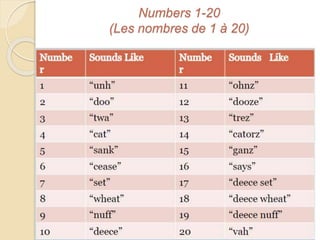
Numbers 1-20
(Les nombres de 1 à 20)
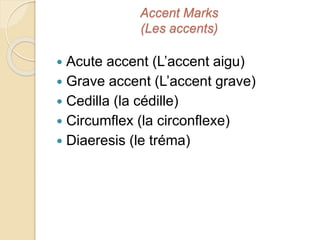
Accent Marks
(Les accents)
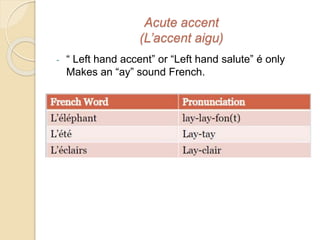
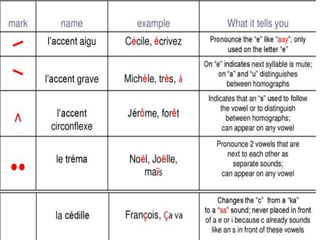
 Acute accent (L’accent aigu)
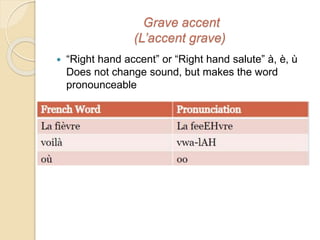
 Grave accent (L’accent grave)
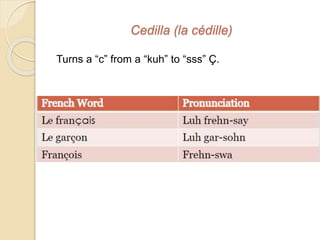
 Cedilla (la cédille)
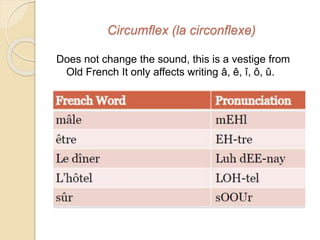
 Circumflex (la circonflexe)
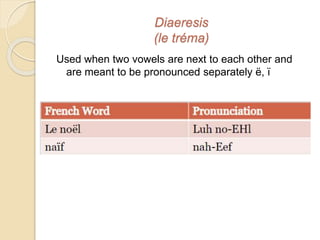
 Diaeresis (le tréma)
Acute accent
(L’accent aigu)
- “ Left hand accent” or “Left hand salute” é only
Makes an “ay” sound French.
Grave accent
(L’accent grave)
 “Right hand accent” or “Right hand salute” à, è, ù
Does not change sound, but makes the word
pronounceable
Cedilla (la cédille)
Turns a “c” from a “kuh” to “sss” Ç.
Circumflex (la circonflexe)
Does not change the sound, this is a vestige from
Old French It only affects writing â, ê, î, ô, û.
Diaeresis
(le tréma)
Used when two vowels are next to each other and
are meant to be pronounced separately ë, ï
Silent Letters
(Les lettres muettes)
 In French, some letters are not pronounced,
particularly at the end of words
 Final –e: The final –e is not usually pronounced
Madam e, Phillip e
 Final –s: The final –s is not usually pronounced Loui s,
Charle s, trè s
 Final consonants are not usually pronounced, the usual
exceptions are: -c, -r, -f, -l, -k *Remember to be
CaReFuL* which final consonants are pronounced
Rober t, Alber t, Eric, Marc, Raoul
 H is never pronounced* L’ h ôtel, L’ h ôpital, L’ h omme
* There is the h aspiré
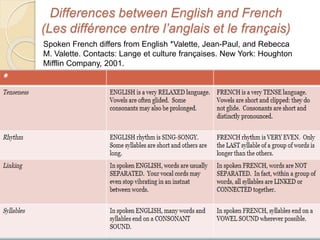
Differences between English and French
(Les différence entre l’anglais et le français)
Spoken French differs from English *Valette, Jean-Paul, and Rebecca
M. Valette. Contacts: Lange et culture françaises. New York: Houghton
Mifflin Company, 2001.
Merci

les accents et les alphabets.pptx

  • 1.
    (Leçon 1) Introduction tothe french language. (Introduction à la langue française)
  • 2.
  • 3.
  • 4.
    Accent Marks (Les accents) Acute accent (L’accent aigu)  Grave accent (L’accent grave)  Cedilla (la cédille)  Circumflex (la circonflexe)  Diaeresis (le tréma)
  • 5.
    Acute accent (L’accent aigu) -“ Left hand accent” or “Left hand salute” é only Makes an “ay” sound French.
  • 6.
    Grave accent (L’accent grave) “Right hand accent” or “Right hand salute” à, è, ù Does not change sound, but makes the word pronounceable
  • 7.
    Cedilla (la cédille) Turnsa “c” from a “kuh” to “sss” Ç.
  • 8.
    Circumflex (la circonflexe) Doesnot change the sound, this is a vestige from Old French It only affects writing â, ê, î, ô, û.
  • 9.
    Diaeresis (le tréma) Used whentwo vowels are next to each other and are meant to be pronounced separately ë, ï
  • 10.
    Silent Letters (Les lettresmuettes)  In French, some letters are not pronounced, particularly at the end of words  Final –e: The final –e is not usually pronounced Madam e, Phillip e  Final –s: The final –s is not usually pronounced Loui s, Charle s, trè s  Final consonants are not usually pronounced, the usual exceptions are: -c, -r, -f, -l, -k *Remember to be CaReFuL* which final consonants are pronounced Rober t, Alber t, Eric, Marc, Raoul  H is never pronounced* L’ h ôtel, L’ h ôpital, L’ h omme * There is the h aspiré
  • 12.
    Differences between Englishand French (Les différence entre l’anglais et le français) Spoken French differs from English *Valette, Jean-Paul, and Rebecca M. Valette. Contacts: Lange et culture françaises. New York: Houghton Mifflin Company, 2001.
  • 13.