French Alphabet and
Pronunciation
French Alphabet & Pronunciation
French Alphabet and
Pronunciation
French Alphabet
• a = ahh
• b = bay
• c = say
• d = day
• e = ur
• f = eff
• g = jay
• h = ash
• i = eeeee
• j = jee
• k = kar
• l = ell
• m = em
• n = en
• o = oh
• p = pay
• q = kuh
• r = air
• s = ess
• t = tay
• u = ew
• v = vay
• w = dooble vay
• x = eeks
• y = eeee grec
• Z = zed
French Alphabet and
Pronunciation
French Pronunciation
• French can be a challenge to pronounce but
not impossible! Persevere and keep coming
back to this practice. Also remember people
tend to like it when people have an accent so
don’t worry if you have one… it’s cute… unless
you’re being rude!! Following are a few
pointers but irritatingly there are a lot of
exceptions (as there are in the English
language) but most of the time the following
rules apply:
French Alphabet and
Pronunciation
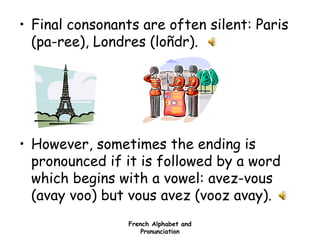
• Final consonants are often silent: Paris
(pa-ree), Londres (loñdr).
• However, sometimes the ending is
pronounced if it is followed by a word
which begins with a vowel: avez-vous
(avay voo) but vous avez (vooz avay).
French Alphabet and
Pronunciation
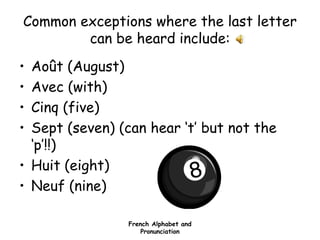
Common exceptions where the last letter
can be heard include:
• Août (August)
• Avec (with)
• Cinq (five)
• Sept (seven) (can hear ‘t’ but not the
‘p’!!)
• Huit (eight)
• Neuf (nine)
French Alphabet and
Pronunciation
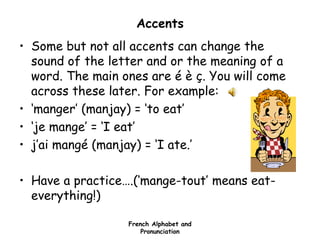
Accents
• Some but not all accents can change the
sound of the letter and or the meaning of a
word. The main ones are é è ç. You will come
across these later. For example:
• ‘manger’ (manjay) = ‘to eat’
• ‘je mange’ = ‘I eat’
• j’ai mangé (manjay) = ‘I ate.’
• Have a practice….(‘mange-tout’ means eat-
everything!)
French Alphabet and
Pronunciation
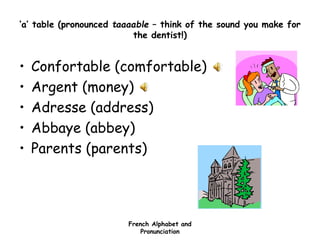
‘a’ table (pronounced taaaable – think of the sound you make for
the dentist!)
• Confortable (comfortable)
• Argent (money)
• Adresse (address)
• Abbaye (abbey)
• Parents (parents)
French Alphabet and
Pronunciation
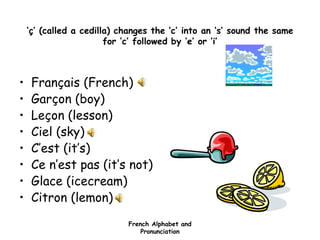
‘ç’ (called a cedilla) changes the ‘c’ into an ‘s’ sound the same
for ‘c’ followed by ‘e’ or ‘i’
• Français (French)
• Garçon (boy)
• Leçon (lesson)
• Ciel (sky)
• C’est (it’s)
• Ce n’est pas (it’s not)
• Glace (icecream)
• Citron (lemon)
French Alphabet and
Pronunciation
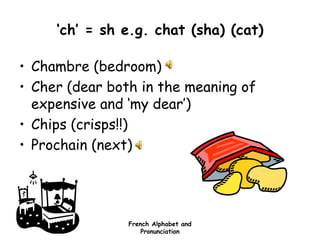
‘ch’ = sh e.g. chat (sha) (cat)
• Chambre (bedroom)
• Cher (dear both in the meaning of
expensive and ‘my dear’)
• Chips (crisps!!)
• Prochain (next)
French Alphabet and
Pronunciation
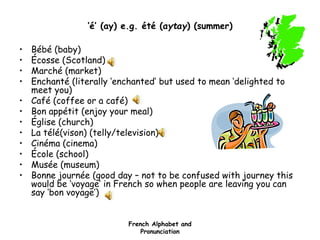
‘é’ (ay) e.g. été (aytay) (summer)
• Bébé (baby)
• Écosse (Scotland)
• Marché (market)
• Enchanté (literally ‘enchanted’ but used to mean ‘delighted to
meet you)
• Café (coffee or a café)
• Bon appétit (enjoy your meal)
• Église (church)
• La télé(vison) (telly/television)
• Cinéma (cinema)
• École (school)
• Musée (museum)
• Bonne journée (good day – not to be confused with journey this
would be ‘voyage’ in French so when people are leaving you can
say ‘bon voyage’)
French Alphabet and
Pronunciation
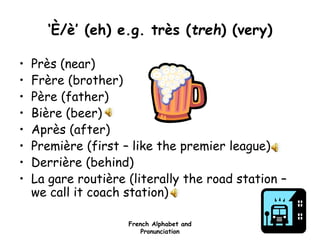
‘È/è’ (eh) e.g. très (treh) (very)
• Près (near)
• Frère (brother)
• Père (father)
• Bière (beer)
• Après (after)
• Première (first – like the premier league)
• Derrière (behind)
• La gare routière (literally the road station –
we call it coach station)
French Alphabet and
Pronunciation
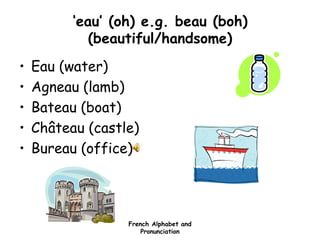
‘eau’ (oh) e.g. beau (boh)
(beautiful/handsome)
• Eau (water)
• Agneau (lamb)
• Bateau (boat)
• Château (castle)
• Bureau (office)
French Alphabet and
Pronunciation
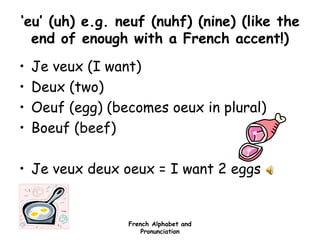
‘eu’ (uh) e.g. neuf (nuhf) (nine) (like the
end of enough with a French accent!)
• Je veux (I want)
• Deux (two)
• Oeuf (egg) (becomes oeux in plural)
• Boeuf (beef)
• Je veux deux oeux = I want 2 eggs
French Alphabet and
Pronunciation
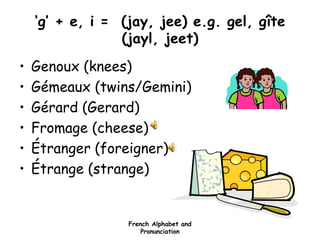
‘g’ + e, i = (jay, jee) e.g. gel, gîte
(jayl, jeet)
• Genoux (knees)
• Gémeaux (twins/Gemini)
• Gérard (Gerard)
• Fromage (cheese)
• Étranger (foreigner)
• Étrange (strange)
French Alphabet and
Pronunciation
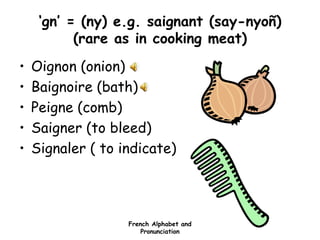
‘gn’ = (ny) e.g. saignant (say-nyoñ)
(rare as in cooking meat)
• Oignon (onion)
• Baignoire (bath)
• Peigne (comb)
• Saigner (to bleed)
• Signaler ( to indicate)
French Alphabet and
Pronunciation
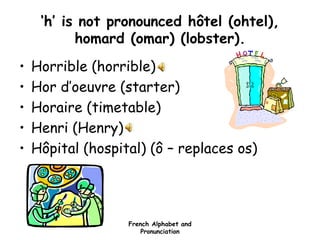
‘h’ is not pronounced hôtel (ohtel),
homard (omar) (lobster).
• Horrible (horrible)
• Hor d’oeuvre (starter)
• Horaire (timetable)
• Henri (Henry)
• Hôpital (hospital) (ô – replaces os)
French Alphabet and
Pronunciation
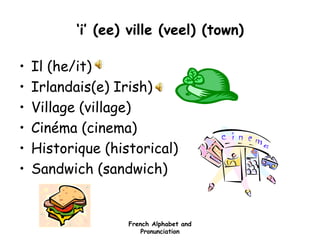
‘i’ (ee) ville (veel) (town)
• Il (he/it)
• Irlandais(e) Irish)
• Village (village)
• Cinéma (cinema)
• Historique (historical)
• Sandwich (sandwich)
French Alphabet and
Pronunciation
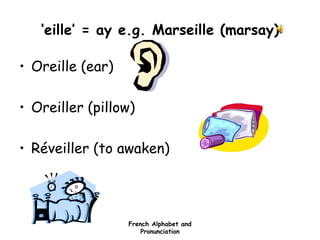
‘eille’ = ay e.g. Marseille (marsay)
• Oreille (ear)
• Oreiller (pillow)
• Réveiller (to awaken)
French Alphabet and
Pronunciation
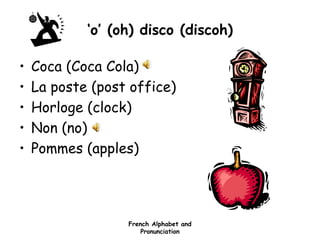
‘o’ (oh) disco (discoh)
• Coca (Coca Cola)
• La poste (post office)
• Horloge (clock)
• Non (no)
• Pommes (apples)
French Alphabet and
Pronunciation
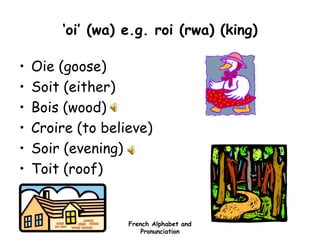
‘oi’ (wa) e.g. roi (rwa) (king)
• Oie (goose)
• Soit (either)
• Bois (wood)
• Croire (to believe)
• Soir (evening)
• Toit (roof)
French Alphabet and
Pronunciation
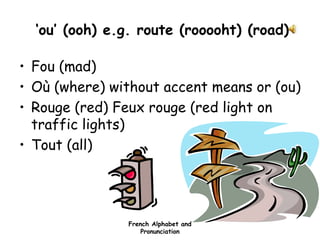
‘ou’ (ooh) e.g. route (rooooht) (road)
• Fou (mad)
• Où (where) without accent means or (ou)
• Rouge (red) Feux rouge (red light on
traffic lights)
• Tout (all)
French Alphabet and
Pronunciation
‘q’ or ‘qu’ has a hard ‘k’ sound e.g.
quinze (sounds like ‘cans’) (fifteen)
• Quatre (four)
• Quatorze (fourteen) ‘cat oars’
• Quatre – quatre (four wheel drive)
• Qui (who)
• Quitter (to leave – can also say ‘partir’)
• Cinq (five – one of the exceptions when
the last letter is pronounced)
French Alphabet and
Pronunciation
‘r’ is said at the back of the throat with the
tongue at the bottom of the mouth (in English
the ‘r’ makes the tongue go up). It sounds
like a softer version of a cat trying to get
rid of a furball.
• Travaille (work)
• Garage (garage)
• Carottes rapées (grated carrots)
• Tranche (slice)
• Hiver (winter)
• Printemps (spring)
• Réserver (to reserve)
French Alphabet and
Pronunciation
‘th’ is pronounced just ‘t’ which is why French native
speakers have a lot of problems with our th and you
may hear them say ‘zat was ze zeory on zursday ze
forz’ instead of ‘that was the theory on Thursday
the fourth’ although I haven’t heard this sentence
too often!
• Thé (tea)
• Thierry (Terry or Thierry as in the footballer
Thierry Henri)
• Cathédrale (cathedral)
• Théâtre (theatre)
• Thon (tuna)
French Alphabet and
Pronunciation
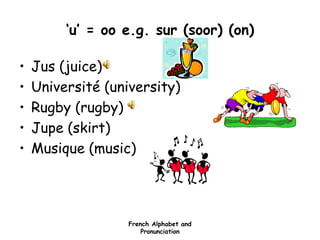
‘u’ = oo e.g. sur (soor) (on)
• Jus (juice)
• Université (university)
• Rugby (rugby)
• Jupe (skirt)
• Musique (music)
French Alphabet and
Pronunciation
‘ui’ (wee) e.g. huit (weet)
Huître (oyster)
• Huile (oil)
• Cuire (to cook)
• Suivre (to follow)
• Lui (him)
• Nuit (night)
• Puis-je? (may I?)
• Puis-je cuire les huîtres avec l’huile pour lui
cette nuit? = May I cook the oysters with oil
for him this night?!
French Alphabet and
Pronunciation
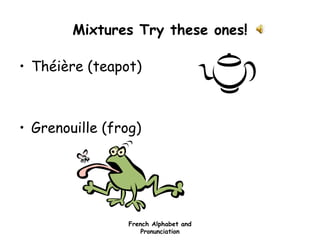
Mixtures Try these ones!
• Théière (teapot)
• Grenouille (frog)

Alphabet and pronunciation

  • 1.
  • 2.
    French Alphabet and Pronunciation FrenchAlphabet • a = ahh • b = bay • c = say • d = day • e = ur • f = eff • g = jay • h = ash • i = eeeee • j = jee • k = kar • l = ell • m = em • n = en • o = oh • p = pay • q = kuh • r = air • s = ess • t = tay • u = ew • v = vay • w = dooble vay • x = eeks • y = eeee grec • Z = zed
  • 3.
    French Alphabet and Pronunciation FrenchPronunciation • French can be a challenge to pronounce but not impossible! Persevere and keep coming back to this practice. Also remember people tend to like it when people have an accent so don’t worry if you have one… it’s cute… unless you’re being rude!! Following are a few pointers but irritatingly there are a lot of exceptions (as there are in the English language) but most of the time the following rules apply:
  • 4.
    French Alphabet and Pronunciation •Final consonants are often silent: Paris (pa-ree), Londres (loñdr). • However, sometimes the ending is pronounced if it is followed by a word which begins with a vowel: avez-vous (avay voo) but vous avez (vooz avay).
  • 5.
    French Alphabet and Pronunciation Commonexceptions where the last letter can be heard include: • Août (August) • Avec (with) • Cinq (five) • Sept (seven) (can hear ‘t’ but not the ‘p’!!) • Huit (eight) • Neuf (nine)
  • 6.
    French Alphabet and Pronunciation Accents •Some but not all accents can change the sound of the letter and or the meaning of a word. The main ones are é è ç. You will come across these later. For example: • ‘manger’ (manjay) = ‘to eat’ • ‘je mange’ = ‘I eat’ • j’ai mangé (manjay) = ‘I ate.’ • Have a practice….(‘mange-tout’ means eat- everything!)
  • 7.
    French Alphabet and Pronunciation ‘a’table (pronounced taaaable – think of the sound you make for the dentist!) • Confortable (comfortable) • Argent (money) • Adresse (address) • Abbaye (abbey) • Parents (parents)
  • 8.
    French Alphabet and Pronunciation ‘ç’(called a cedilla) changes the ‘c’ into an ‘s’ sound the same for ‘c’ followed by ‘e’ or ‘i’ • Français (French) • Garçon (boy) • Leçon (lesson) • Ciel (sky) • C’est (it’s) • Ce n’est pas (it’s not) • Glace (icecream) • Citron (lemon)
  • 9.
    French Alphabet and Pronunciation ‘ch’= sh e.g. chat (sha) (cat) • Chambre (bedroom) • Cher (dear both in the meaning of expensive and ‘my dear’) • Chips (crisps!!) • Prochain (next)
  • 10.
    French Alphabet and Pronunciation ‘é’(ay) e.g. été (aytay) (summer) • Bébé (baby) • Écosse (Scotland) • Marché (market) • Enchanté (literally ‘enchanted’ but used to mean ‘delighted to meet you) • Café (coffee or a café) • Bon appétit (enjoy your meal) • Église (church) • La télé(vison) (telly/television) • Cinéma (cinema) • École (school) • Musée (museum) • Bonne journée (good day – not to be confused with journey this would be ‘voyage’ in French so when people are leaving you can say ‘bon voyage’)
  • 11.
    French Alphabet and Pronunciation ‘È/è’(eh) e.g. très (treh) (very) • Près (near) • Frère (brother) • Père (father) • Bière (beer) • Après (after) • Première (first – like the premier league) • Derrière (behind) • La gare routière (literally the road station – we call it coach station)
  • 12.
    French Alphabet and Pronunciation ‘eau’(oh) e.g. beau (boh) (beautiful/handsome) • Eau (water) • Agneau (lamb) • Bateau (boat) • Château (castle) • Bureau (office)
  • 13.
    French Alphabet and Pronunciation ‘eu’(uh) e.g. neuf (nuhf) (nine) (like the end of enough with a French accent!) • Je veux (I want) • Deux (two) • Oeuf (egg) (becomes oeux in plural) • Boeuf (beef) • Je veux deux oeux = I want 2 eggs
  • 14.
    French Alphabet and Pronunciation ‘g’+ e, i = (jay, jee) e.g. gel, gîte (jayl, jeet) • Genoux (knees) • Gémeaux (twins/Gemini) • Gérard (Gerard) • Fromage (cheese) • Étranger (foreigner) • Étrange (strange)
  • 15.
    French Alphabet and Pronunciation ‘gn’= (ny) e.g. saignant (say-nyoñ) (rare as in cooking meat) • Oignon (onion) • Baignoire (bath) • Peigne (comb) • Saigner (to bleed) • Signaler ( to indicate)
  • 16.
    French Alphabet and Pronunciation ‘h’is not pronounced hôtel (ohtel), homard (omar) (lobster). • Horrible (horrible) • Hor d’oeuvre (starter) • Horaire (timetable) • Henri (Henry) • Hôpital (hospital) (ô – replaces os)
  • 17.
    French Alphabet and Pronunciation ‘i’(ee) ville (veel) (town) • Il (he/it) • Irlandais(e) Irish) • Village (village) • Cinéma (cinema) • Historique (historical) • Sandwich (sandwich)
  • 18.
    French Alphabet and Pronunciation ‘eille’= ay e.g. Marseille (marsay) • Oreille (ear) • Oreiller (pillow) • Réveiller (to awaken)
  • 19.
    French Alphabet and Pronunciation ‘o’(oh) disco (discoh) • Coca (Coca Cola) • La poste (post office) • Horloge (clock) • Non (no) • Pommes (apples)
  • 20.
    French Alphabet and Pronunciation ‘oi’(wa) e.g. roi (rwa) (king) • Oie (goose) • Soit (either) • Bois (wood) • Croire (to believe) • Soir (evening) • Toit (roof)
  • 21.
    French Alphabet and Pronunciation ‘ou’(ooh) e.g. route (rooooht) (road) • Fou (mad) • Où (where) without accent means or (ou) • Rouge (red) Feux rouge (red light on traffic lights) • Tout (all)
  • 22.
    French Alphabet and Pronunciation ‘q’or ‘qu’ has a hard ‘k’ sound e.g. quinze (sounds like ‘cans’) (fifteen) • Quatre (four) • Quatorze (fourteen) ‘cat oars’ • Quatre – quatre (four wheel drive) • Qui (who) • Quitter (to leave – can also say ‘partir’) • Cinq (five – one of the exceptions when the last letter is pronounced)
  • 23.
    French Alphabet and Pronunciation ‘r’is said at the back of the throat with the tongue at the bottom of the mouth (in English the ‘r’ makes the tongue go up). It sounds like a softer version of a cat trying to get rid of a furball. • Travaille (work) • Garage (garage) • Carottes rapées (grated carrots) • Tranche (slice) • Hiver (winter) • Printemps (spring) • Réserver (to reserve)
  • 24.
    French Alphabet and Pronunciation ‘th’is pronounced just ‘t’ which is why French native speakers have a lot of problems with our th and you may hear them say ‘zat was ze zeory on zursday ze forz’ instead of ‘that was the theory on Thursday the fourth’ although I haven’t heard this sentence too often! • Thé (tea) • Thierry (Terry or Thierry as in the footballer Thierry Henri) • Cathédrale (cathedral) • Théâtre (theatre) • Thon (tuna)
  • 25.
    French Alphabet and Pronunciation ‘u’= oo e.g. sur (soor) (on) • Jus (juice) • Université (university) • Rugby (rugby) • Jupe (skirt) • Musique (music)
  • 26.
    French Alphabet and Pronunciation ‘ui’(wee) e.g. huit (weet) Huître (oyster) • Huile (oil) • Cuire (to cook) • Suivre (to follow) • Lui (him) • Nuit (night) • Puis-je? (may I?) • Puis-je cuire les huîtres avec l’huile pour lui cette nuit? = May I cook the oysters with oil for him this night?!
  • 27.
    French Alphabet and Pronunciation MixturesTry these ones! • Théière (teapot) • Grenouille (frog)