The Legislative
Department of the
Republic of the Philippines
Basic Structures
There are two basic structures for legislative
branches of government:
1. Unicameral
 The legislative branch consists of
one chamber/house
2. Bicameral
 Legislative power is vested in two
chambers/houses
The Philippine Congress
The Philippine Congress is the country’s
legislative department (Art. VI, Sec. 1)
 Congress is bicameral
Upper House: Senate
Lower House: House of
Representatives
 N.B.: Senators are Congressmen
The Legislative Branch
From the Latin lex, legis meaning
law
The legislative branch broadly
deals with the making,
deliberation over, enactment,
amendment and repealing of laws
Senate
Composition
Qualifications
Term of Office
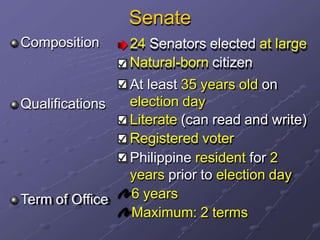
24 Senators elected at large
Natural-born citizen
At least 35 years old on
election day
Literate (can read and write)
Registered voter
Philippine resident for 2
years prior to election day
6 years
Maximum: 2 terms
House of Representatives
200 district reps, 50 party list
Natural-born citizen
At least 25 years old on
election day
Literate (can read and write)
Registered voter of the district
District resident for 1 year prior
to election day
3 years
Maximum: 3 terms
Composition
Qualifications
Term of Office
In Case of Vacancy…
Vacancy can be filled through
regular election
Special elections can be called for
the purpose of filling the vacancy
In either circumstance, the one
elected merely sits for the
unexpired term
Structure and Dynamics
Senate President and House Speaker elected
by majority vote
Other officers, procedures and the discipline of
its members is at the discretion of each house
Quorum: Majority
Each House maintains a journal and record of
proceedings
Neither House can adjourn without the other’s
consent while in session
Officers of the Senate
President
President Pro-tempore
Majority Floor Leader
Minority Floor Leader
Secretary
Sgt. –at-Arms
Senate Committees
Committee on Accountability of Public
Officers and Investigations
Committee on Accounts
Committee on Agrarian Reform
Committee on Agriculture and Food
Committee on Banks, Financial Institutions
and Currencies
Committee on Civil Service and
Government Reorganization
Committee on Constitutional
Amendments, Revision of Codes and
Laws
Committee on Cooperatives
Committee on Cultural Communities
Committee on Economic Affairs
Committee on Education, Arts and Culture
Committee on Energy
Committee on Environment and Natural
Resources
Committee on Ethics and Privileges
Committee on Finance
Committee on Foreign Relations
Committee on Games, Amusement and
Sports
Committee on Government Corporations
and Public Enterprises
Committee on Health and Demography
Committee on Justice and Human Rights
Committee on Labor, Employment and
Human Resources Development
Committee on Local Government
Committee on National Defense and
Security
Committee on Peace, Unification and
Reconciliation
Committee on Public Information and
Mass Media
Committee on Public Order and Illegal
Drugs
Committee on Public Services
Committee on Public Works
Committee on Rules
Committee on Science and Technology
Committee on Social Justice, Welfare and
Rural Development
Committee on Tourism
Committee on Trade and Commerce
Committee on Urban Planning, Housing
and Resettlement
Committee on Ways and Means
Committee on Youth, Women and Family
Relations
Officers of The House of
Representatives
Speaker
Deputy Speakers
Majority Floor Leader
Minority Floor Leader
House Committees
(58 House Committees)
Accounts
Cooperatives Development
Dangerous Drugs
Ecology
Economic Affairs
Foreign Affairs
Games and Amusements
Health
Human Rights
Justice
Labor and Employment
Local Government
Metro Manila Development
Mindanao Affairs
Muslim Affairs
Population and Family Relations
Social Services
Trade and Industry
Veterans Affairs and Welfare
Women and Gender Equality
PARLIAMENTARY IMMUNITIES
Parliamentary Privileges
Congressmen have two parliamentary
privileges while Congress is in session:
1. Privilege from arrest
 Immunity from offenses punishable by not
more than six years imprisonment
2. Privilege of speech and debate
 Immunity from libel and slander
Its Sessions
Regular Session
Special Session
Joint Session
Presidents of the Senate
Manuel L. Quezon
(1916-1935)
Manuel A. Roxas
(1945-1946)
Jose D. Avelino
(1946-1949)
Mariano Jesus
L. Cuenco
(1949-1951)
Quintin B. Paredes
(1952)
Camilo O. Osias
(1952 & 1953)
Eulogio A.
Rodriguez, Sr.
(1952-1963)
Jose C. Zulueta
(1953)
Ferdinand E. Marcos
(1963-1965)
Arturo M. Tolentino
(1966-1967)
Gil J. Puyat
(1967-1972)
Jovito R. Salonga
(1987-1991)
Neptali A. Gonzales
(1992-93, 95-96, 98)
Edgardo J. Angara
(1993-1995)
Ernesto M. Maceda
(1996-1998)
Marcelo B. Fernan
(1998-1999)
Blas F. Ople
(1999-2000)
Aquilino Q.
Pimentel, Jr.
(2000-2001)
Franklin M. Drilon
(2000, 2001-2006)
Manny Villar
(2006-Nov. 2008)
Juan Ponce Enrile
(Nov.17, 2008-June 2013)
Franklin M. Drilon
(July 2013-Present)
Speakers of the House of
Representatives
Sergio Osmeña
(1907-1922)
Manuel A. Roxas
(1922-1933)
Quintin Paredes
(1933-1935)
Gil Montilla
(1935-1938)
José Yulo
(1938-1941)
Benigno Aquino, Sr.
(1943-1944)
Jose Zulueta
(1945)
Eugenio Pérez
(1946-1953)
José Laurel, Jr.
(1953-1957)
Daniel Romualdez
(1957-1962)
Cornelio Villareal
(1962-1967)
Querube Makalintal
(1978-1984)
Nicanor Yñiguez
(1984-1986)
Ramon Mitra, Jr.
(1987-1992)
Jose de Venecia
(1992-1998)
Manny Villar
(1998-2000)
Arnulfo Fuentabella
(2000-2001)
Feliciano Belmonte
(2001)
Jose de Venecia,
(2001-2008)
Prospero Nograles
( 2008-2010)
Feliciano Belmonte.
(2010-Present)
Powers of Congress
1. Appointment of Public Officials
2. Legislative inquiry and investigation
3. Declare the existence of a state of
war
4. Ratify the country’s international
treaties (Senate)
5. Authorize limited emergency
powers for the President
Powers of Congress
6. Approve the government budget
7. Undertake projects under the CDF
8. Propose, review, and adopt bills for
enactment into law
9. Overturn a Presidential veto with respect to
proposed legislation
10. Allow for referenda
11. Propose amendments to the constitution and
call for a constitutional convention
Legislative Limitations
Congress may not:
1. Increase appropriations recommended by the
executive branch
2. Pass tax exemptions without the concurrence
of a majority of its members
3. Grant titles of nobility
4. Pass ex post facto bills
5. Pass bills of attainder
How a Bill Becomes
Law
~House of Representatives~
1stReading 2ndReading 3rd Reading
Debate
ReferraltoCommittee
Debate
Referralto
Committee
How a Bill Becomes Law
~House of Representatives~
1stReading 2ndReading 3rd Reading
~Senate~
1stReading 2ndReading 3rd Reading
How a Bill Becomes
Law
~House of Representatives~
1stReading 2ndReading 3rd Reading
~Senate~
1stReading 2ndReading 3rd Reading
BICAMERALCOMMITTEE
How a Bill Becomes Law
~House of Representatives~
1stReading 2ndReading 3rd Reading
~Senate~
1stReading 2ndReading 3rd Reading
President
How a Bill Becomes Law
~House of Representatives~
1stReading 2ndReading 3rd Reading
1st Reading 2nd Reading 3rdReading
President
APPROVE VETO
30DAY PERIOD
Sources:
http://www.senate.gov.ph/senators/compo
sition.asp#A._The_Officers_of_the_Senat
e_
http://www.congress.gov.ph/about/?about=
officials

Legislative-Department.pptx

  • 1.
    The Legislative Department ofthe Republic of the Philippines
  • 2.
    Basic Structures There aretwo basic structures for legislative branches of government: 1. Unicameral  The legislative branch consists of one chamber/house 2. Bicameral  Legislative power is vested in two chambers/houses
  • 3.
    The Philippine Congress ThePhilippine Congress is the country’s legislative department (Art. VI, Sec. 1)  Congress is bicameral Upper House: Senate Lower House: House of Representatives  N.B.: Senators are Congressmen
  • 4.
    The Legislative Branch Fromthe Latin lex, legis meaning law The legislative branch broadly deals with the making, deliberation over, enactment, amendment and repealing of laws
  • 5.
    Senate Composition Qualifications Term of Office 24Senators elected at large Natural-born citizen At least 35 years old on election day Literate (can read and write) Registered voter Philippine resident for 2 years prior to election day 6 years Maximum: 2 terms
  • 6.
    House of Representatives 200district reps, 50 party list Natural-born citizen At least 25 years old on election day Literate (can read and write) Registered voter of the district District resident for 1 year prior to election day 3 years Maximum: 3 terms Composition Qualifications Term of Office
  • 7.
    In Case ofVacancy… Vacancy can be filled through regular election Special elections can be called for the purpose of filling the vacancy In either circumstance, the one elected merely sits for the unexpired term
  • 8.
    Structure and Dynamics SenatePresident and House Speaker elected by majority vote Other officers, procedures and the discipline of its members is at the discretion of each house Quorum: Majority Each House maintains a journal and record of proceedings Neither House can adjourn without the other’s consent while in session
  • 9.
    Officers of theSenate President President Pro-tempore Majority Floor Leader Minority Floor Leader Secretary Sgt. –at-Arms
  • 10.
    Senate Committees Committee onAccountability of Public Officers and Investigations Committee on Accounts Committee on Agrarian Reform Committee on Agriculture and Food Committee on Banks, Financial Institutions and Currencies
  • 11.
    Committee on CivilService and Government Reorganization Committee on Constitutional Amendments, Revision of Codes and Laws Committee on Cooperatives Committee on Cultural Communities Committee on Economic Affairs Committee on Education, Arts and Culture Committee on Energy
  • 12.
    Committee on Environmentand Natural Resources Committee on Ethics and Privileges Committee on Finance Committee on Foreign Relations Committee on Games, Amusement and Sports Committee on Government Corporations and Public Enterprises
  • 13.
    Committee on Healthand Demography Committee on Justice and Human Rights Committee on Labor, Employment and Human Resources Development Committee on Local Government Committee on National Defense and Security Committee on Peace, Unification and Reconciliation
  • 14.
    Committee on PublicInformation and Mass Media Committee on Public Order and Illegal Drugs Committee on Public Services Committee on Public Works Committee on Rules Committee on Science and Technology Committee on Social Justice, Welfare and Rural Development
  • 15.
    Committee on Tourism Committeeon Trade and Commerce Committee on Urban Planning, Housing and Resettlement Committee on Ways and Means Committee on Youth, Women and Family Relations
  • 16.
    Officers of TheHouse of Representatives Speaker Deputy Speakers Majority Floor Leader Minority Floor Leader
  • 17.
    House Committees (58 HouseCommittees) Accounts Cooperatives Development Dangerous Drugs Ecology Economic Affairs Foreign Affairs Games and Amusements
  • 18.
    Health Human Rights Justice Labor andEmployment Local Government Metro Manila Development Mindanao Affairs Muslim Affairs Population and Family Relations
  • 19.
    Social Services Trade andIndustry Veterans Affairs and Welfare Women and Gender Equality
  • 20.
  • 21.
    Parliamentary Privileges Congressmen havetwo parliamentary privileges while Congress is in session: 1. Privilege from arrest  Immunity from offenses punishable by not more than six years imprisonment 2. Privilege of speech and debate  Immunity from libel and slander
  • 22.
  • 23.
  • 24.
    Manuel L. Quezon (1916-1935) ManuelA. Roxas (1945-1946) Jose D. Avelino (1946-1949) Mariano Jesus L. Cuenco (1949-1951) Quintin B. Paredes (1952) Camilo O. Osias (1952 & 1953) Eulogio A. Rodriguez, Sr. (1952-1963) Jose C. Zulueta (1953) Ferdinand E. Marcos (1963-1965) Arturo M. Tolentino (1966-1967) Gil J. Puyat (1967-1972) Jovito R. Salonga (1987-1991) Neptali A. Gonzales (1992-93, 95-96, 98) Edgardo J. Angara (1993-1995) Ernesto M. Maceda (1996-1998) Marcelo B. Fernan (1998-1999) Blas F. Ople (1999-2000) Aquilino Q. Pimentel, Jr. (2000-2001) Franklin M. Drilon (2000, 2001-2006) Manny Villar (2006-Nov. 2008) Juan Ponce Enrile (Nov.17, 2008-June 2013) Franklin M. Drilon (July 2013-Present)
  • 25.
    Speakers of theHouse of Representatives
  • 26.
    Sergio Osmeña (1907-1922) Manuel A.Roxas (1922-1933) Quintin Paredes (1933-1935) Gil Montilla (1935-1938) José Yulo (1938-1941) Benigno Aquino, Sr. (1943-1944) Jose Zulueta (1945) Eugenio Pérez (1946-1953) José Laurel, Jr. (1953-1957) Daniel Romualdez (1957-1962) Cornelio Villareal (1962-1967) Querube Makalintal (1978-1984) Nicanor Yñiguez (1984-1986) Ramon Mitra, Jr. (1987-1992) Jose de Venecia (1992-1998) Manny Villar (1998-2000) Arnulfo Fuentabella (2000-2001) Feliciano Belmonte (2001) Jose de Venecia, (2001-2008) Prospero Nograles ( 2008-2010) Feliciano Belmonte. (2010-Present)
  • 27.
    Powers of Congress 1.Appointment of Public Officials 2. Legislative inquiry and investigation 3. Declare the existence of a state of war 4. Ratify the country’s international treaties (Senate) 5. Authorize limited emergency powers for the President
  • 28.
    Powers of Congress 6.Approve the government budget 7. Undertake projects under the CDF 8. Propose, review, and adopt bills for enactment into law 9. Overturn a Presidential veto with respect to proposed legislation 10. Allow for referenda 11. Propose amendments to the constitution and call for a constitutional convention
  • 29.
    Legislative Limitations Congress maynot: 1. Increase appropriations recommended by the executive branch 2. Pass tax exemptions without the concurrence of a majority of its members 3. Grant titles of nobility 4. Pass ex post facto bills 5. Pass bills of attainder
  • 30.
    How a BillBecomes Law ~House of Representatives~ 1stReading 2ndReading 3rd Reading Debate ReferraltoCommittee
  • 31.
    Debate Referralto Committee How a BillBecomes Law ~House of Representatives~ 1stReading 2ndReading 3rd Reading ~Senate~ 1stReading 2ndReading 3rd Reading
  • 32.
    How a BillBecomes Law ~House of Representatives~ 1stReading 2ndReading 3rd Reading ~Senate~ 1stReading 2ndReading 3rd Reading BICAMERALCOMMITTEE
  • 33.
    How a BillBecomes Law ~House of Representatives~ 1stReading 2ndReading 3rd Reading ~Senate~ 1stReading 2ndReading 3rd Reading President
  • 34.
    How a BillBecomes Law ~House of Representatives~ 1stReading 2ndReading 3rd Reading 1st Reading 2nd Reading 3rdReading President APPROVE VETO 30DAY PERIOD
  • 35.