Philippine History and GovernmentAngeline G. HelleraBSIT – 41A
ArticleVI :The Legislative Department
The Philippine Congress is divided into two chambers :Senate  - The Upper HouseHouse of Representatives  - The Lower House
The Senate consists of 24 Senators elected at large.
 12 Senators are elected every three (3) years.
 Each has a term of six years. Qualifications :No person shall be a Senator unless he is a natural-born citizen of the Philippines, and on the day of the election, is at least 35 years of age, able to read and write, a registered voter, and a resident of the Philippines for not less than two years immediately preceding the day of the election.The age is fixed at 35 and must be possessed on the day of the elections, that is, when the polls are opened and the votes cast, and not on the day of the proclamation of the winners by the board of canvassers.
With regard to the residence requirements, it was ruled in the case of Lim v. Pelaez that it must be the place where one habitually resides and to which he, after absence, has the intention of returning.The enumeration laid down by the 1987 Philippine Constitution is exclusive under the Latin principle of expressiouniusestexclusioalterius. This means that Congress cannot anymore add additional qualifications other than those provided by the 1987 Philippine Constitution. Organizations :The Senate shall elect its President and      the House of Representatives its Speaker by a vote of all its respective members.
Each House shall choose such other officers as it may deem necessary.
Each House may determine the rules of its proceedingsThe 15th Congress Senators :
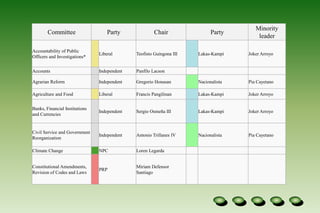
The list of standing committee chairmanships for the 15th Congress:
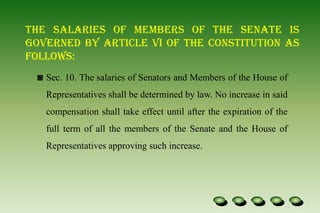
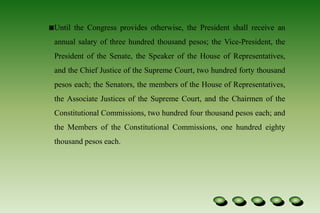
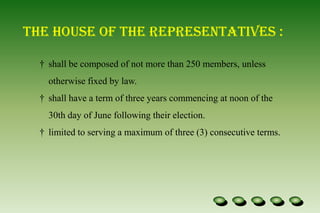
The salaries of members of the Senate is governed by Article VI of the Constitution as follows:Sec. 10. The salaries of Senators and Members of the House of Representatives shall be determined by law. No increase in said compensation shall take effect until after the expiration of the full term of all the members of the Senate and the House of Representatives approving such increase.Sec. 20. The records and books of accounts of Congress shall be preserved and be open to the public in accordance with law, and such books shall be audited by the Commission on Audit which shall publish annually an itemized list of amounts paid to and expenses incurred for each Member.Until the Congress provides otherwise, the President shall receive an annual salary of three hundred thousand pesos; the Vice-President, the President of the Senate, the Speaker of the House of Representatives, and the Chief Justice of the Supreme Court, two hundred forty thousand pesos each; the Senators, the members of the House of Representatives, the Associate Justices of the Supreme Court, and the Chairmen of the Constitutional Commissions, two hundred four thousand pesos each; and the Members of the Constitutional Commissions, one hundred eighty thousand pesos each.The house of the Representatives : shall be composed of not more than 250 members, unless otherwise fixed by law.
shall have a term of three years commencing at noon of the 30th day of June following their election.
limited to serving a maximum of three (3) consecutive terms.Legislative Powers and Functions Propose, review and adopt bills for enactment into law
Conduct studies and inquiries in aid of legislation and investigations necessary in the lawmaking process and in the oversight of the execution of laws by the executive
Propose appropriations, revenue or tariff bills; bills authorizing increase of the public sector debt; bills of local application and private billsConcur in all treaties and international agreements
Exercise the constitutional right and responsibility of advice and consent on certain presidential nominations through the Commission on Appointments
Judge the election, returns and qualifications of its members, determine the rules of its proceedings, and punish its members by suspension or expulsion for disorderly behavior
Authorize the President to exercise emergency power in times of war or national emergencyNon-legislative Functions: Non-legislative functions are powers and responsibilities not related to passing laws

Legislative department

  • 1.
    Philippine History andGovernmentAngeline G. HelleraBSIT – 41A
  • 2.
  • 3.
    The Philippine Congressis divided into two chambers :Senate  - The Upper HouseHouse of Representatives  - The Lower House
  • 4.
    The Senate consistsof 24 Senators elected at large.
  • 5.
    12 Senatorsare elected every three (3) years.
  • 6.
    Each hasa term of six years. Qualifications :No person shall be a Senator unless he is a natural-born citizen of the Philippines, and on the day of the election, is at least 35 years of age, able to read and write, a registered voter, and a resident of the Philippines for not less than two years immediately preceding the day of the election.The age is fixed at 35 and must be possessed on the day of the elections, that is, when the polls are opened and the votes cast, and not on the day of the proclamation of the winners by the board of canvassers.
  • 7.
    With regard tothe residence requirements, it was ruled in the case of Lim v. Pelaez that it must be the place where one habitually resides and to which he, after absence, has the intention of returning.The enumeration laid down by the 1987 Philippine Constitution is exclusive under the Latin principle of expressiouniusestexclusioalterius. This means that Congress cannot anymore add additional qualifications other than those provided by the 1987 Philippine Constitution. Organizations :The Senate shall elect its President and the House of Representatives its Speaker by a vote of all its respective members.
  • 8.
    Each House shallchoose such other officers as it may deem necessary.
  • 9.
    Each House maydetermine the rules of its proceedingsThe 15th Congress Senators :
  • 10.
    The list ofstanding committee chairmanships for the 15th Congress:
  • 13.
    The salaries ofmembers of the Senate is governed by Article VI of the Constitution as follows:Sec. 10. The salaries of Senators and Members of the House of Representatives shall be determined by law. No increase in said compensation shall take effect until after the expiration of the full term of all the members of the Senate and the House of Representatives approving such increase.Sec. 20. The records and books of accounts of Congress shall be preserved and be open to the public in accordance with law, and such books shall be audited by the Commission on Audit which shall publish annually an itemized list of amounts paid to and expenses incurred for each Member.Until the Congress provides otherwise, the President shall receive an annual salary of three hundred thousand pesos; the Vice-President, the President of the Senate, the Speaker of the House of Representatives, and the Chief Justice of the Supreme Court, two hundred forty thousand pesos each; the Senators, the members of the House of Representatives, the Associate Justices of the Supreme Court, and the Chairmen of the Constitutional Commissions, two hundred four thousand pesos each; and the Members of the Constitutional Commissions, one hundred eighty thousand pesos each.The house of the Representatives : shall be composed of not more than 250 members, unless otherwise fixed by law.
  • 14.
    shall have aterm of three years commencing at noon of the 30th day of June following their election.
  • 15.
    limited to servinga maximum of three (3) consecutive terms.Legislative Powers and Functions Propose, review and adopt bills for enactment into law
  • 16.
    Conduct studies andinquiries in aid of legislation and investigations necessary in the lawmaking process and in the oversight of the execution of laws by the executive
  • 17.
    Propose appropriations, revenueor tariff bills; bills authorizing increase of the public sector debt; bills of local application and private billsConcur in all treaties and international agreements
  • 18.
    Exercise the constitutionalright and responsibility of advice and consent on certain presidential nominations through the Commission on Appointments
  • 19.
    Judge the election,returns and qualifications of its members, determine the rules of its proceedings, and punish its members by suspension or expulsion for disorderly behavior
  • 20.
    Authorize the Presidentto exercise emergency power in times of war or national emergencyNon-legislative Functions: Non-legislative functions are powers and responsibilities not related to passing laws