Legal Tools for Worker Cooperatives and theLegal Tools for Worker Cooperatives and the
Sharing EconomySharing Economy
Wednesday, February 4, 2015
Take a piece of card stock, fold into a
tent shape, and write on front:
Name, Title/Affiliation
5-7 words describing
your interests
Joe Rinehart
Director of Cooperative Development
Democracy at Work Institute
Ted De Barbieri
Assistant Professor of Clinical Law
Brooklyn Law School
WelcomeWelcome
Legal Tools for Worker Cooperatives and the Sharing EconomyLegal Tools for Worker Cooperatives and the Sharing Economy
New York City’s New Economy
Center for Family Life in Sunset Park
Park Slope Food Co-op
New York City Worker Co-ops
Janelle Orsi
Executive Director
Sustainable Economies Law Center
Author, Practicing Law in the Sharing Economy
Legal Tools for Worker Cooperatives and the Sharing EconomyLegal Tools for Worker Cooperatives and the Sharing Economy
Workshop 1 — Big Picture Discussion: The NewWorkshop 1 — Big Picture Discussion: The New
Economy and the LawEconomy and the Law
Welcome to Day 1 of:
Legal Tools for Worker Cooperatives
and the Sharing Economy
Presented by:
Janelle Orsi, Executive Director of Sustainable Economies Law Center (SELC)
Ted De Barbieri, Assistant Professor of Clinical Law at Brooklyn Law School
Ricardo Nunez, Cooperatives Program Director at SELC
TheSELC.org
The New Economy and the Law
The economy has many pieces.
Let’s just start with bread:
small
bakery
Hostess
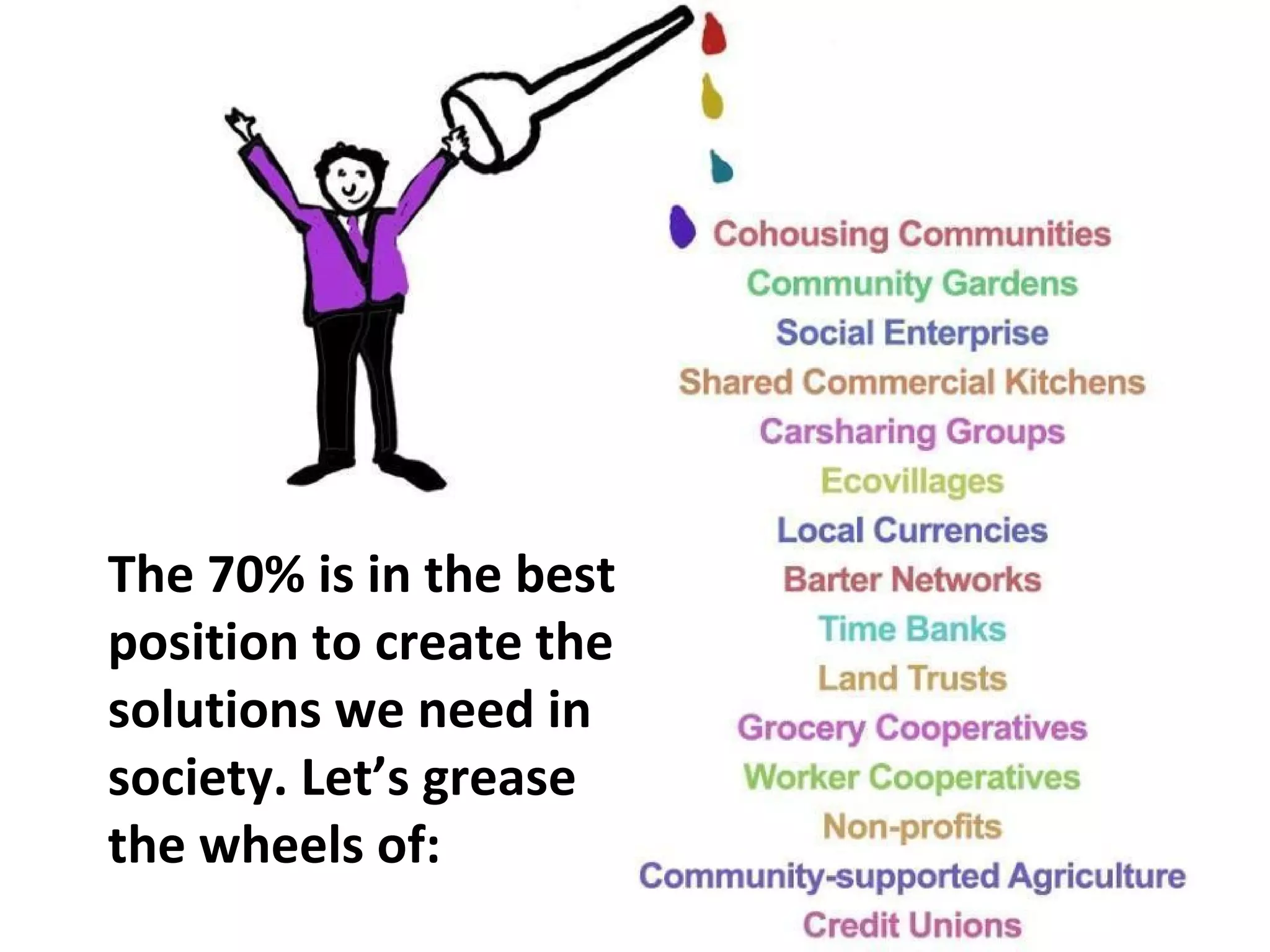
The 70% will create these things:
Worker Cooperatives
Cohousing Communities
Coworking Spaces
Maker Spaces
Community Gardens
Social Enterprise
Shared Commercial Kitchens
Carsharing Groups
Ridesharing
Tool Lending Libraries
Ecovillages
Local Currencies
Barter Networks
Time Banks
Land Trusts
Grocery Cooperatives
Community-Owned Solar Cooperatives
Community-Supported Agriculture
Lawyers
Creating the
Next Economy
Worker Cooperatives
Freelancer Cooperatives
Cohousing Communities
Community Gardens
Coworking and Maker Spaces
Shared Commercial Kitchens
Carsharing Groups
Tool Lending Libraries
Community-Owned Solar Cooperatives
Housing Cooperatives
Ecovillages
Local Currencies
Barter Networks
Time Banks
Land Trusts
Grocery Cooperatives
Community-Supported Agriculture
Community Credit Unions
Academics
Litigators
Policymakers
Transactional
Lawyers
Transactional lawyers will save the planet!
No, not these transactional lawyers:
Worker Cooperatives
Cohousing Communities
Coworking Spaces
Maker Spaces
Community Gardens
Social Enterprise
Shared Commercial Kitchens
Carsharing Groups
Ridesharing
Tool Lending Libraries
Ecovillages
Local Currencies
Barter Networks
Time Banks
Land Trusts
Grocery Cooperatives
Community-Owned Solar Cooperatives
Community-Supported Agriculture
Community Credit Unions
At least one million
lawyers need to start
greasing the wheels of
a new economy:
●
●
Anyone who enters the
field of sharing economy
law right now will,
inevitably, be a leader in
this emerging field.
The new economy has issues.
It all starts with “issue spotting.”
Where have you noticed the law
acting as a barrier to something
cool you or your clients wanted
to do?
REALMS OF
ECONOMIC
ACTIVITY
Employment Laws
And Are They Employees of Their Own
??
Volunteering
“Chores”
Volunteering
Employment
Volunteering
“Chores”
• Farm Internships
• CSA Volunteers
• Worker Cooperatives
• Consumer Cooperatives
• Mutual Aid
Minimum
Wage
Workers’
Comp
Overtime
Pay
Payroll
Taxes
OSHA
Compliance
Minimum
Wage
Workers’
Comp
Overtime
Pay
Payroll
Taxes
OSHA
Compliance
Minimum
Wage
Workers’
Comp
Overtime
Pay
Payroll
Taxes
OSHA
Compliance
We don’t have
any money yet!
New Worker Cooperatives:
We’ll never have
enough money
because we have
always made less
than minimum
wage.
Semi-Subsistence Farmers
We will never
have enough
money, because we
aren’t TRYING to
make money.
Food Cooperatives
And Housing Cooperatives, for example…
We can’t afford to
just teach people
about farming!
We can barely
afford farming!
Farm Internships and
CSA Volunteer Programs
Securities Laws
Zoning regulations
Steps to Approaching
Regulatory Grey Areas
STEP 1:
Determine what areas of regulation
might apply if this were a public or
commercial activity.
See the table in the handouts.
Page 37-38
STEP 2:
Determine whether that realm of regulation
designates explicit exemptions for small scale,
community-based, or cooperative activities.
Like cottage food laws or licensing exemptions for
parent-run childcare cooperatives.
STEP 3:
If there is no explicit exemption, determine
whether the activity legitimately falls outside of
the realm of regulation, or help clients move to
a safer end of the grey area.
This is part is infinitely interesting and tricky.
When Regulations Might Not Apply:
1.When there is no separation between
consumer and producer.
2. When an economic activity is private.
3. When an economic activity is non-
commercial.
1. When there is no separation between consumer and producer.
“No person shall buy, sell, deliver, or give milk that has not [been certified].”
SO, what does it mean to be in possession of ….
The issue at stake is not milk or cows or goats, per se…
It’s our right to collectively produce things that we consume.
When the developer is the
homebuyer and vice versa.
2. When an activity is private.
“Underground” Restaurants?
What is a Private Club?
FROM: Appendix B of 28 C.F.R Part 36, www.ada.gov/reg3a.html
Title II of the 1964 Act exempts any "private club or other establishment not in fact
open to the public […]” In determining whether a private entity qualifies as a private
club under Title II, courts have considered such factors as:
•the degree of member control of club operations
•the selectivity of the membership selection process
•whether substantial membership fees are charged
•whether the entity is operated on a nonprofit basis
•the extent to which the facilities are open to the public
•the degree of public funding, and
•whether the club was created specifically to avoid compliance
with the Civil Rights Act.
3. When the activity is not commercial.
Is it cost-sharing? Or commerce?
Givingafriendaride
Carpoolingwithfriendsandsharingcostofgas
CarpoolingwithstrangerstogetinHOVlane
Carpoolingwithstrangersandsplittingthecost
Givingstrangeraridefora“donation.”
Beingataxior
Uberdriver
Formal
Involves strangers
Inspired more by a desire to get
Casual
Relationship-based
Inspired more by desire to give
STEP 4:
If there’s no way for the client to avoid regulation,
search for ways to make compliance less
burdensome. That might mean finding a “sharing
solution,” like a shared commercial kitchen.
STEP 5:
If the law seems to unreasonably block people
from doing good things in the world,
change the law.
To do:
Set a goal to change at least one law!
Local ordinance?
State legislation?
Regulatory change?
Federal legislation?
Maybe one of each? :oD
It’s fun to change laws!
How we change laws will depend on the
purposes of regulation:
•Laws that Protect Consumers
•Laws that Protect a Marketplace
•Laws that Regulate a Profession
•Laws that Protect Communities and Ecosystems
•Laws that Protect a Resource or Necessity for the Public
•Laws that Protect Workers and Contractors in a Particular Industry
•Laws that Ensure Equitable Access to Public Accommodations
•Laws that Impose Additional Taxes on Certain Industries
•Laws that Require Consumers to Purchase a Particular Good or
Service
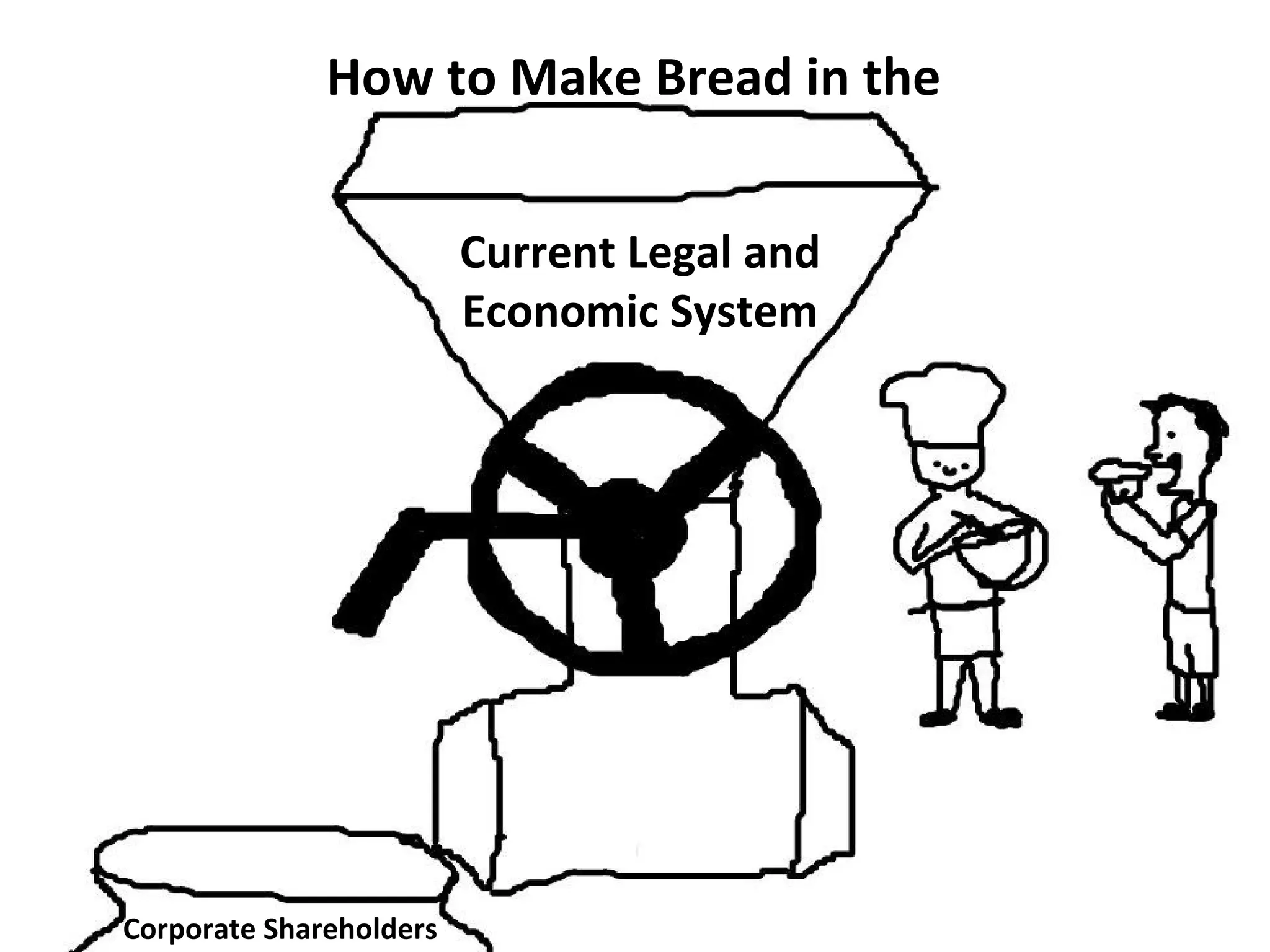
How to Make Bread in the
Current Legal and
Economic System
Corporate Shareholders
Land
Water
Seeds™
Current Legal and
Economic System
Corporate Shareholders
Work
Money
Current Legal and
Economic System
Corporate Shareholders
Work
Money
Current Legal and
Economic System
Corporate Shareholders
Work
Money
Current Legal and
Economic System
Corporate Shareholders
Shareholder-Elected Board
Work
Money
Current Legal and
Economic System
Corporate Shareholders
Shareholder-Elected Board
Work
Money
Current Legal and
Economic System
Corporate Shareholders
Shareholder-Elected Board
Money
Power
Jobs
FoodMoney
Power
Current Legal and
Economic System
Corporate Shareholders
Shareholder-Elected Board
Works long hours
Has average life
span of 50
Current Legal and
Economic System
Corporate Shareholders
Shareholder-Elected Board
The U.S. Congress and
the Supreme Court,
around 1937, decided
that the relationship
seemed a bit too
imbalanced.
Employment Laws
Corporate Shareholders
Shareholder-Elected Board
Employment Laws
Securities Laws
Corporate Shareholders
Shareholder-Elected Board
Employment Laws
Securities Laws
Corporate Shareholders
Shareholder-Elected Board
Consumer Protection Laws
Employment Laws
Securities Laws
Consumer Protection Laws Zoning Laws
Corporate Shareholders
Shareholder-Elected Board
Darden
Restaurants
One half billion in
profits per year
No paid sick time
$2.13/hour + tips
Corporate Shareholders
Shareholder-Elected Board
The laws
haven’t
really
protected us
very well….
Grocery Cooperatives
Worker Cooperatives
Urban Farms
Cohousing Communities
Community Gardens
Social Enterprise
Shared Commercial Kitchens
Carsharing Groups
Ecovillages
Local Currencies
Barter Networks
Time Banks
Land Trusts
Community-Supported Agriculture
Credit Unions
Etc. Etc. Etc….
Food Oasis Cooperative
400 residents of a food desert neighborhood form a cooperative to
purchase locally-grown and healthy food.
Employment Laws
Employment Laws
Securities Laws
Employment Laws
Securities Laws
Consumer Protection Laws
Employment Laws
Securities Laws
Zoning Laws
Shareholder-Elected Board
Consumer Protection Laws
Employment Laws
Securities Laws
Zoning Laws
Consumer Protection Laws
Regulations have limited how we use:
Our money
Our time
and labor
Our
relationships
Our homes and
neighborhoods
Employment Laws
Securities Laws
Zoning Laws
Consumer Protection Laws
At the same time, how can we loosen these bolts
without opening the floodgates to extraction?
But this is a flawed system and it’s
dangerous to loosen many of the laws.
Let’s try a new system.
X
Board elected by workers, consumers, or both.
Profits distributed to
workers on the basis of the
value or quantity of their
work.
Or to consumers based on
value or quantity of
purchases.
Or both.
Board elected by workers, consumers, or both.
Some people think
all cooperatives are this:
The 2 things to know about
cooperatives:
1.Board elected on a one-member, one-vote basis.
Capital ownership doesn’t determine voting power.
2. Profits distributed on the basis of patronage.
Capital ownership doesn’t determine profit share.
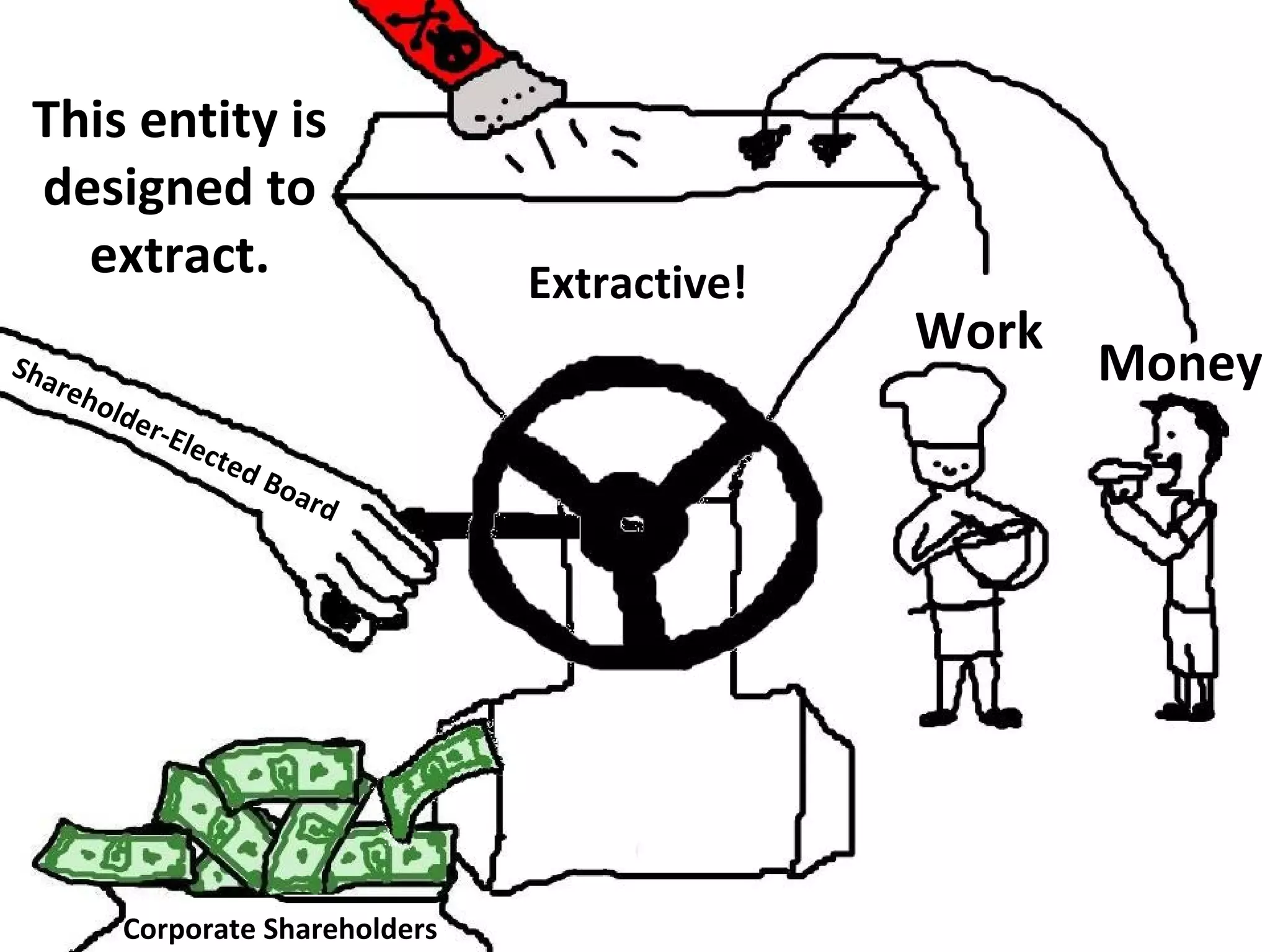
Work
Money
Corporate Shareholders
Shareholder-Elected Board
Extractive!
This entity is
designed to
extract.
JobsJobs
Generative!
This entity is
designed to
provide,
nourish, and
protect.
That’s our
legal wedge!!
We need ANOTHER
legal regime for
generative entities
We need one legal
regime for
extractive entities.
Market
Governance Structures
Commons
Governance Structures
Governance
COOOOOOOOOPERATIVES!
One moral to the story:
We can’t change
the economy
without them.
We can’t change
the legal system
without them.
What is opposite of
an apocalypse?
A co-opalypse!
Worker Coop
Housing Coop
Energy
Coop
Food Coop
Childcare
Coop
Freelancer-owned
and worker-owned
and consumer-owned
cooperatives will soon
rule the Earth!
We’re creating a new
commons
“A commons may arise whenever a group of
people decides that it wishes to manage a
resource in a collective manner, with a special
regard for equitable access, use and long-term
stewardship.” -- David Bollier
Read this book. It’s very quotable!
1. Share Control
2. Share
Responsibility
for the Common
Good
3. Share
Earnings
3. Share
Earnings
(on the basis of patronage)
small
bakery
Hostess
4. Share in
Capitalization
5. Share
Information
6. Share
Resources and
Efforts
Elinor Ostrom’s principles for the management of
common pool resources can even be applied to
worker cooperatives!
1. Clearly defined boundaries
2. Rules regarding use of common
resources
3. Participatory decision-making
4. Monitoring by people who are
accountable to group
5. Graduated sanctions for exploitation
of resources
6. Accessible conflict resolution methods
7. Recognition by the authorities of
group autonomy and self-governance
8. For larger groups: Multiple layers of
nested enterprises (to keep group
sizes small)
David Bollier:
“The important point, therefore, is to assure
that commons can have as much autonomy
and integrity of purpose as possible.
If commons are to interact with markets, they
must be able to resist enclosure, consumerism,
the lust for capital accumulation and other
familiar pathologies of capitalism.”
V. ?Small &
Groovy
New Agreements +
New Organizations
= New Economy!
“Hey! Making agreements and forming
organizations! I can do that!”
– said the transactional lawyer.
Community Supported Bread
Community Supported EVERYTHING!
•Share CAPITALIZATION
•Share PROFITS/BOUNTY
•Share RISK
•Share WORK/LABOR
•Share INFORMATION
•Share DECISION-MAKING
We should
support them!
We could get our
bread there
sometimes.
Make agreements!
It’s community-supported enterprise!
We all agree to
buy one loaf
per week.
And I agree to:
- Use healthy whole grains
- Buy from local farmer co-ops
- Deliver by bicycle, and
- Spend 10% of my earnings in
the neighborhood.
Our agreements and
organizational structures are like
roadmaps to our relationships….
And they become
our own private
laws.
Co-ownership agreements:
• Tenancy-in-common agreements for
co-ownership of a house or multiplex
• Car, truck, and van co-ownership
agreements
• Shared studio, workshop, and office
agreements
• Agreements for co-ownership of other
items, such as work or recreational
equipment and electronics
Leases:
• Leases for urban farm space
• Shared workspace agreements
• Leases for shared housing
Licenses:
• Licenses to share a yard for food-
growing or recreation
• Licenses for use of co-working spaces
• Licenses for short-term home stays
• Licenses for the use of intellectual
property
Borrow-lend agreements:
• Agreements to regularly borrow a car
or other equipment
Agreements Galore!
Agreements for cooperative activity or
mutual aid:
• Child care exchange agreements
• Rideshare agreements
Operating agreements and bylaws for
organizations:
• Operating agreements for cohousing
communities
• Bylaws for cooperatives
Membership and use agreements:
• Member agreements for cooperatives
• Agreements that describe rights and
responsibilities of members of
community-supported agriculture (CSA)
programs
Investment contracts / promissory notes:
• Promissory notes for peer-to-peer
loans to enterprises and homebuyers
• Shareholder agreements and term
sheets for local investing initiatives
Other:
• Liability waivers for shared spaces or
shared equipment
• Agreements for barter transactions
When the sharing hits the fan…
Giving
Sharing
Bartering
Swapping
Collaborating
Co-owing
Cooperating
Borrowing
Lending
Exchanging
Some ways to specialize in
the sharing economy:
Shared Housing Law
Cohousing Law
Small Social Enterprises Law
Large Social Enterprise Law
Community-Owned Enterprise Law
Cooperative Law
Fashion and Garment Enterprise Law
Nonprofit Law
Tax and Accounting for Currencies
Community Food Law
Community Education and Child Care Law
Community Health Care Law
Community Energy Law
Collaborative Consumption Law
Shared Intellectual Property Law
Mediation for all of the above!
The Sustainable Economies
Law Center’s living classroom:
Lawyers
advising
community
members
People discussing
the sharing economy
Law students
teaching
community
members
Community
members teaching
law students and
each other
Lawyers
advising
community
members
People discussing
the sharing economy
Law students
teaching
community
members
Community
members teaching
law students and
each other
How can we get to
this tipping point?
Published by ABA Books
www.theselc.org
Also see our resource libraries:
•UrbanAgLaw.org
•Co-opLaw.org
•CommunityEnterpriseLaw.org
•CommunityCurrenciesLaw.org
50% discount code: PAB12SHR
Royalties go to the Sustainable
Economies Law Center
Ideas?
Questions?
INTROS
The next slides are
ideas for intros
Say your name and fill in
the blank:
“I would love to have
______________________ as my client.”
Janelle Orsi
Sustainable Economies Law Center
Ricardo Nunez
Sustainable Economies Law Center
Ted De Barbieri
Brooklyn Law School
Legal Tools for Worker Cooperatives and the Sharing EconomyLegal Tools for Worker Cooperatives and the Sharing Economy
Workshop 2 — Entity Structures in the New EconomyWorkshop 2 — Entity Structures in the New Economy
OrganizationsORGANIZATIONS
Entity Choice and
Structure in the
Sharing Economy
Important: The architecture of
organizations will essentially be
the architecture of a new economy.
These clients
are coming for you!
They are weird.
They are wonderful.
They want you to
form their entity!!
How do we legally structure stuff like this?
Community food gardens
Car-sharing groups
Renewable energy co-ops
Local currencies
Time banks
Cottage foods markets
Childcare cooperatives
Lending Circles
Transition Initiatives
Farmers markets
Shared commercial kitchens
Ecovillages
Housing cooperatives
Elder care cooperatives
Grey water cooperatives
Mutual aid societies
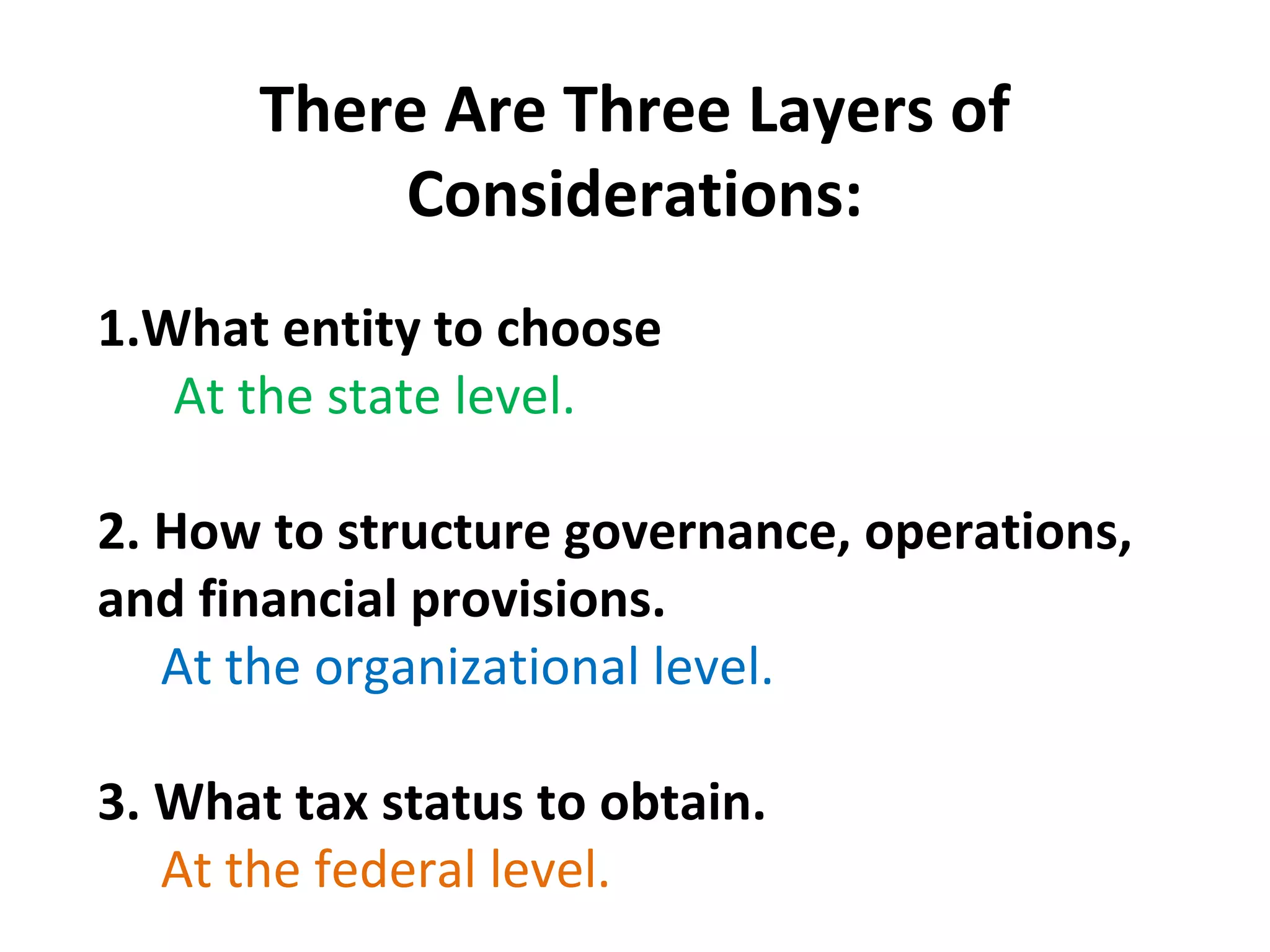
There Are Three Layers of
Considerations:
1.What entity to choose
At the state level.
2. How to structure governance, operations,
and financial provisions.
At the organizational level.
3. What tax status to obtain.
At the federal level.
Entity X Tax Status X Structural
Decisions = ∞ options
And yet...we still need to create more options for
sharing economy enterprises and orgs.
Common Entity Types (State Level)
•Sole Proprietorships
•Partnerships (General and Limited)
•Limited Liability Companies (LLCs)
•Low-Profit Limited Liability Companies (L3Cs)
•General Stock Corporations
• Plain Old Corporations
• Benefit Corporations (in NY, CA, and many
others)
• Flexible Purpose Corporations (in CA)
•Cooperative Corporations and Associations
•Nonprofit Public Benefit Corporations
•Nonprofit Mutual Benefit Corporations
What is your entity?
Common Tax Statuses
(Federal level. The state mostly follows suit.)
• Partnership taxation
• Subchapter S
• Subchapter C
• Subchapter T
• 501cEVERYTHING
• Other: 528, 501(d)
• Also consider rollovers: 1042
Rebranding alert!
Cooperatives have a special tax status under
Subchapter T of Internal Revenue Code…
That makes them “T Corporations!”
I sound important
when I say the phrase
“T Corps!”
We’re very excited about:
- Cooperative
- Nonprofits
We’re sorta excited about:
- Benefit Corporations
And also acknowledging:
Other entity types are flexible and can
sometimes accomplish similar purposes
The big question:
Who do you want to benefit?
Social Enterprise
Entities for
Social
Enterprise
B Corp is just a
kind of
certification.
Some consumers
think certifications
are sooooo cool!
Like!
• Living wage certification
•Green business certification
•Fair trade certification
•Organic certification
•Union certification
•Not animal tested certification
And those newfangled kinds of
entities?
Benefit Corporations
•MUST operate for public benefit
•Must report on general public purposes and
specific purposes, and measure them using 3rd
party standards.
Flexible Purpose Corporation
•ALLOWS directors to consider one or more
specific purposes beyond financial value, with
requirements to report on their accomplishment
of these specific purposes.
One reason CA created Benefit Corporations
and Flexible Purpose Corporations is that we
don’t have a constituency statute.
Example of Constituency Statute (30 states)
“A director of a corporation . . . shall consider, in determining what
he reasonably believes to be in the best interests of the
corporation, (1) the long-term as well as the short-term interests of
the corporation, (2) the interests of the shareholders, long-term as
well as short-term, including the possibility that those interests may
be best served by the continued independence of the corporation,
(3) the interests of the corporation’s employees, customers,
creditors and suppliers, and (4) community and societal
considerations including those of any community in which any office
or other facility of the corporation is located. A director may also in
his discretion consider any other factors he reasonably considers
appropriate in determining what he reasonably believes to be in the
best interests of the corporation.” Connecticut General Statutes 33-
756(d).
But we have the Business Judgment Rule!
The business judgment rule provides a
rebuttable presumption “that in making a
business decision the directors of a
corporation acted on an informed basis, in
good faith and in the honest belief that the
action taken was in the best interests of the
company.”
Except….
Sold! To the highest bidder!
Q: Which ice cream company is now owned by the same
corporation that makes this stuff? Isn’t that charming?
When the company is being sold….
When a board is considering selling a business (when it’s “in play”), it becomes the
obligation of the board to maximize shareholder profit. (The Revlon case)
Even Benefit Corporations aren’t
immune to the gravitation pull of
wealth accumulation.
What else can you do with a regular old
corporation?
• Create a nonprofit shareholder to act as a trustee of the
corporation’s integrity.
• Shareholder agreements.
• Limit the transferability of shares.
• Create different classes of shareholders for different stakeholder
groups (employees, customers, etc).
• Adopt a voting structure designed to give greater control to
employees and directors, and to reduce the authority of outside
investors, especially of those investors that acquire shares from
other shareholders as opposed to directly from the company.
• Require that certain decisions be made on a one-person/one vote
basis, rather than on the basis of share ownership.
• Require supermajority voting for certain decisions.
Summary of some provisions Upstream 21’s Articles of Incorporation:
Each director is required to sign an agreement stating that he/she shall discharge the
duties of a director in a manner the director reasonably believes to be in the best
interests of the Company, and the best interests of the Company is defined to include
the Company’s and its subsidiaries’ social, legal and economic effects on their
employees, customers, and suppliers and on the communities and geographic areas
in which the Company and its subsidiaries operate; the long-term as well as short-
term interests of the Company and its shareholders; and the Company’s and its
subsidiaries’ effects on the environment.
When evaluating any offer of another party to purchase the Company or merge, the
directors are required to consider the following: the social, legal and economic effects
on employees, customers and suppliers of the Company and its subsidiaries and on
the communities and geographic areas in which the Company and its subsidiaries
operate; the economy of the state and the nation; the environment; the long-term as
well as short-term interests of the Company and its shareholders, including the
possibility that these interests may be best served by the continued independence of
the Company; and other relevant factors.
There are four classes of voting stock, including a class for employees.
When shareholders vote on any matter such as the election of the board, each share is
entitled to one vote, but when the shareholders must vote on one of the following
actions (“Extraordinary Actions”), different voting rules apply (described below):
Amendments to the articles of incorporation
Amendments to the bylaws
Conversion
Merger
Share exchange
Dissolution
The sale, lease, exchange or other disposition of all or substantially all of the
Company’s property
Removal of a director
An Extraordinary Action may only be approved if (1) a majority of all shares entitled to
vote on the action, without regard to class or series, vote in favor of the action AND two-
thirds of all shares of any two series of Class A Common Stock entitled to vote on the
action, voting separately by series, shall not vote against the action; OR (2) two-thirds of
all shares of any two series of Class A Common Stock entitled to vote on the action,
voting separately by series, vote in favor of the action.
Another Newish Kind of Entity
Low-Profit Limited Liability Company (L3C)
Charitable: The Company significantly furthers the accomplishment of one
or more charitable or educational purposes and the Company would not
have been formed but for the company's relationship to the
accomplishment of charitable or educational purposes.
Not aimed at making a profit: No significant purpose of the company is the
production of income or the appreciation of property; provided, however,
that the fact that a person produces significant income or capital
appreciation shall not, in the absence of other factors, be conclusive
evidence of a significant purpose involving the production of income or the
appreciation of property.
No lobbying, etc: No purpose of the company is to accomplish one or more
political or legislative purposes
It’s all about the Program Related Investments
(PRIs) from foundations.
New York State
“Social Enterprise” Entity Options
• Business Corporation Law (BCL)
• Not-for-profit Corporation Law (NPCL)
– Charitable
– Non-charitable
• Cooperative Corporations Law (CCL)
• Limited Liability Company Law (LLC)
New York State Benefit
Corporation
• BCL – Article 17
– Certificate of Incorporation MUST have a purpose
of creating “general public benefit”
– “General public benefit” means “a material
positive impact on society and the environment,
taken as a whole, assessed against a third-party
standard, from the business and operations of a
benefit corporation.”
– Must present shareholders w/ annual benefit
report
Cooperatives!
A very short introduction
Question the First:
Who do we think of when we hear the
word “cooperatives?”
Beyond Mainstream
Conceptions
Question the Second:
What is a cooperative?
Question the Second:
What is a cooperative?
“A cooperative is an autonomous association of
persons united voluntarily to meet their common
economic, social, and cultural needs and aspirations
through a jointly-owned and democratically-
controlled enterprise.”
Third question:
What are the cooperative principles?
Fourth question:
Legally, what is a cooperative?
Cooperatives
as a set of practices and values
Cooperatives
as a tax category
Puget Sound Plywood, Inc. v. Commissioner
(44 T.C. 305, 308 (1965)
• Subordination
of capital
• Democratic
member control
• Surplus allocations based on patronage
Cooperatives
as a legal entity
What kind of co-op is it?
BREAD COOPERATIVE
•Worker coop: Members are worker-
owners of the bakery.
•Producer coop: Each member has an
independent bread baking business and the
co-op markets or sells their product.
•Consumer coop: Members are the people
who buy the bread.
•Multi-stakeholder coop: Two or more of
the above combined.
A plain old corporation…A plain old corporation…
But in a cooperative…But in a cooperative…
A Consumer CooperativeA Consumer Cooperative
A Producer CooperativeA Producer Cooperative
For example, worker cooperatives often divide
profits (“surplus”) on the basis of hours worked by
each member.
Patronage
BREAD COOPERATIVES AND
PATRONAGE
• Patronage in Worker Cooperatives: Determined based on the quantity
of services (measured by number of hour worked) or value of services
(often correlated with salary and/or education level, skills, etc.).
• Patronage in Producer Cooperatives: Determined based on the quantity
or value of bread sold to the cooperative.
• Patronage in Consumer Cooperatives: Determined based on the
quantity or value of bread purchased from the cooperative.
Cutting edge ways of measuring
patronage: By the number of jobs
created, in order to reward founders?
By the value of creative ideas and
intellectual property contributed?
Where should we get our English Muffins??
An entity that is formed for the purpose
of PROVIDING LIVELIHOODS in our
LOCAL COMMUNITY?
….Or an entity that is
designed to GROW
BIG, get a few
people RICH, then
SELL OUT to a GIANT
CORPORATION?
Stock Cooperative: A development in which a corporation is formed […] primarily
for the purpose of holding title to […] real property, and all or substantially all of
the shareholders of the corporation receive a right of exclusive occupancy in a
portion of the real property […]
CA Civil Code Section 1351(m)
Let’s encourage hundreds of
thousands of existing businesses to
sell to workers and convert to
cooperatives!
Because
For example, worker cooperatives often divide
profits (“surplus”) on the basis of hours worked by
each member.
Patronage
BREAD COOPERATIVES AND
PATRONAGE
• Patronage in Worker Cooperatives: Determined based on the quantity
of services (measured by number of hour worked) or value of services
(often correlated with salary and/or education level, skills, etc.).
• Patronage in Producer Cooperatives: Determined based on the quantity
or value of bread sold to the cooperative.
• Patronage in Consumer Cooperatives: Determined based on the
Cutting edge ways of measuring
patronage: By the number of jobs
created, in order to reward founders?
By the value of creative ideas and
intellectual property contributed?
Where should we get our English Muffins??
An entity that is formed for the purpose
of PROVIDING LIVELIHOODS in our
LOCAL COMMUNITY?
….Or an entity that is
designed to GROW
BIG, get a few
people RICH, then
SELL OUT to a GIANT
CORPORATION?
Stock Cooperative: A development in which a corporation is formed […] primarily
for the purpose of holding title to […] real property, and all or substantially all of
the shareholders of the corporation receive a right of exclusive occupancy in a
portion of the real property […]
CA Civil Code Section 1351(m)
Let’s encourage hundreds of
thousands of existing businesses to
sell to workers and convert to
cooperatives!
Because
OrganizationsNonprofits in the
New Economy
We’re nourishing communities
and creating livelihoods…
That must be a
501(c)(awesome)!
Nonprofits remove that drive to
generate wealth for individual
members/shareholders.
Nonprofit corporations are like cakes
Tax exemption (like 501c3) is like the
icing.
Is the focus of the benefit
inward or outward?
Public benefit nonprofits
(usually get 501c3 or c4 exemption)
V.
Mutual benefit nonprofits
(usually get c5, c6, c7, c8, c9……)
501(c)(3)
Purposes are limited to:
•Charitable (Includes relief of poor, distressed, and
underprivileged)
•Educational
•Scientific
•Religious
•And some other stuff…
Other stuff:
•It’s tax exempt AND donations are tax deductible.
•Cannot operate for the private gain or benefit of any
person.
•Cannot operate substantial unrelated business.
•You could operate a 501(c)(3) alongside your community,
but must be careful to ensure that they are separate and
independent.
Why 501(c)(3)s are an awkward
choice for practical projects that
help to sustain us?
Stuff like:
Community food gardens
Car-sharing groups
Renewable energy co-ops
Time banks
Shared commercial kitchens
Ecovillages
Housing cooperatives
The problem lies in the practical and the us.
501(c)(3)
Purposes are limited to:
•Charitable (Includes relief of poor, distressed, and
underprivileged)
•Educational
•Scientific
•Religious
Other stuff:
•It’s tax exempt AND donations are tax deductible.
•Cannot operate for the private gain or benefit of any
person.
•Cannot operate substantial unrelated business.
•You could operate a 501(c)(3) alongside your community,
but must be careful to ensure that they are separate and
independent.
Can community garden organizations be
501(c)(3) nonprofits?
A.Yes
B.No
C.Maybe
D.Sometimes
E.ALL OF THE ABOVE
(It’s complicated…)
501(c)(3) Tax Exempt Purposes:
• Charitable (donating food to low income families, preserving land
and ecosystems, relieving neighborhood tensions, creating a public
park, combating juvenile delinquency, growing food to feed school
children)
• Educational (teaching people about food growing, providing
vocational training)
• Scientific (testing organic agriculture methods)
• Religious (worshipping food! Umm, nice try. Growing food as
part of a religious practice/workshop…)
What about selling the food? Is that sufficiently…
• Charitable?
• Educational?
• Scientific?
• Religious?
Can changed ecological and economic
conditions give us a wedge to stretch
501(c)(3) purposes?
• Look for Revenue Rulings and Tax Cases where the IRS or
tax court took into account local or widespread economic or
ecological conditions when determining the need for or
benefit of an activity.
• What does neighborhood deterioration look like? Is it
everywhere now?
Tax-Exempt
Nonprofit
Corporation
Organized and operated exclusively for…. Charitable/
Educational
Purposes
Tax-Exempt
Nonprofit
Corporation
Organized and operated exclusively for…. Charitable/
Educational
Purposes
Related Business
Tax-Exempt
Nonprofit
Corporation
Organized and operated exclusively for….
Charitable/
Educational
Purposes
Related Business
•Must be substantially related to achieving…
•Must contribute importantly to and have a
substantial causal relationship to achieving…
•Not larger in scope than is necessary to achieve…
Tax-Exempt
Nonprofit
Corporation
Organized and operated exclusively for….
Charitable/
Educational
Purposes
Related Business
•Must be substantially related to achieving…
•Must contribute importantly to and have a
substantial causal relationship to achieving…
•Not larger in scope than is necessary to achieve…
Unrelated Business
$
• See various revenue rulings that say
what is or isn’t unrelated.
• Sometimes volunteer run projects
are presumed to note be unrelated.
IRC 513(a)(1). Hmm….
Tax-Exempt
Nonprofit
Corporation
Organized and operated exclusively for….
Charitable/
Educational
Purposes
Related Business
•Must be substantially related to achieving…
•Must contribute importantly to and have a
substantial causal relationship to achieving…
•Not larger in scope than is necessary to achieve…
Unrelated Business
Must be insubstantial (in its use of organization’s
time and resources). It’s not clear what
insubstantial is. 5% is safe. 15% might be ok.
$
Tax-Exempt
Nonprofit
Corporation
Charitable/
Educational
Purposes
Related Business
Unrelated Business
Pay Unrelated Business Income
Tax (UBIT) on this portion of the
income. File 990-T.
$
Tax-Exempt
Nonprofit
Corporation
Charitable/
Educational
Purposes
Related Business
Unrelated Business
$$
If unrelated business becomes
substantial, it may jeopardize
organization’s tax exempt
status.
Tax-Exempt
Nonprofit
Corporation
Charitable/
Educational
Purposes
Related Business
Unrelated Business
$$$
Form a subsidiary for-profit
corporation (or LLC)Owns/controls
Dividends Payments, Rent, etc. (Taxable to nonprofit)
Tax-Exempt
Nonprofit
Corporation
Charitable/
Educational
Purposes
Related Business
Unrelated Business
$$$
Subsidiary:
-Nonprofit capitalizes subsidiary and receives
shares
-Nonprofit elects Directors
-Maintains clear separation
-Dividends paid to nonprofit (*no charitable
donations)
-Parent and subsidiary may enter into contracts
with each other for goods or services (so long as
at market rate), etc.
Owns/controls
Profits and Payments
Lunch:
Teach school children and community members about
nutrition and cooking, then provide lunch for $3 per student.
Dinner: Have fabulous expensive dinners; provide
vocational training to people in re-entry.
b
Nonprofits without tax exemption
AND:
Fiscally sponsored nonprofits?
AND “nano-nonprofits?”
(page 25 or 26ish of IRS Publication 557)
Why do churches get to have all the fun?
• Exempt under 501c3
• Don’t need to file 1023
• Don’t need to file 990s
• Do need to persuade the
IRS that you are actually a
church.
• Those guys did it. 
501(c)(4)s – Social Welfare Organizations
Examples:
- Some farmers markets
- Political organizations
- Local currencies and time banks
Info:
- Need to benefit a broad sector of the community, not a
specific group
- Donations are not tax deductible
501(c)(5)s – Agricultural and Horticultural Orgs
The primary purpose of exempt agricultural and horticultural organizations under
Internal Revenue Code section 501(c)(5) must be to better the conditions of those
engaged in agriculture or horticulture, develop more efficiency in agriculture or
horticulture, or improve the products, for example:
•Promoting various cooperative agricultural, horticultural, and civic activities among
rural residents by a state and county farm and home bureau.
•Exhibiting livestock, farm products, and other aspects of agriculture and
horticulture.
•Testing soil for members and nonmembers of the farm bureau on a cost basis, the
results of the tests and other recommendations being furnished to the community
members to educate them in soil treatment.
•Encouraging improvements in the production of fish on privately-owned fish farms.
•Negotiating with processors for the price to be paid to members for, but not acting
as an agent to help members sell, their crops.
•Nonprofit association that operates an educational rodeo show promoting
agriculture.
501(c)(6)s – Business Leagues
Examples:
- Business Alliance for Local Living Economies chapters
- Green Chamber of Commerce
- Bar associations
- Professional leagues
- Orgs formed to support a category of businesses (certain type of food producers,
for example)
Info:
- The purpose of the organization must be to promote the common business
interest of a group of persons.
By the way…
About Form 1024…
When should you seek an exemption
letter?
501(c)(7)s – Social, recreational, and “other
nonprofitable purposes.”
Examples:
- Gardening clubs and gardens (but not farms?)
- Boat or RV-sharing club (but not a car sharing club?)
-Shared workshops (?)
- Tool lending libraries
Info:
- Fun is mandatory: IRS will generally deny exemption for activities that are not
sufficiently connected to or in furtherance of social, recreational, or other
pleasure activities
-Section 501(c)(7) is designed to provide tax exemption to organizations that
groups form for their own benefit, rather than for a public benefit.
- Rationale for tax exemption
- Income received from nonmember sources are taxed as unrelated business
income
501(c)(8)s – Fraternal Beneficiary Societies
501(c)(10)s – Fraternal Societies
Info:
- There are 100,000 of them!
-(c)(8): Provide members with the payment of life, sick, accident or other related
benefits
- Both types of societies must engage in “fraternal activities,” such as social
activities, ceremonies, rituals, and so on, and an organization found to be lacking
in such things will not be found tax exempt
- “The term “fraternal” can properly be applied to such an association for the
reason that the pursuit of a common object, calling, or profession usually has a
tendency to create a brotherly feeling among those who are thus engaged.”
- Annoying: must operate under a “lodge system”
Hmm: How can we use this for the sharing economy? Mutual aid societies?
Section 501(c)(12) - benevolent life insurance
associations, mutual ditch or irrigation companies,
mutual or cooperative telephone companies, and
“like organizations.”
Info:
-“Like organizations” is not a catch-all.
- No: A housing cooperative
- Yes: Funeral cooperatives,cable television cooperatives, and energy services - -
- Maybe? Other kinds of modern communication cooperatives (like internet
service providers), personal services, or renewable energy cooperatives?
Other:
-521 and 501(c)(16) Agricultural Cooperatives
(Marketing products or financing the crop growing
operations)
- 501(d) Apostolic Associations (Income-sharing
communities)
- 528 Homeowners Associations (to acquire,
construct, manage, and maintain property…what
else can we do with 528?)
FINAL THOUGHT:
Hooray for activities that don’t fit
into neat legal boxes!
BREAK!
11:00 – 11:15am11:00 – 11:15am
Legal Tools for Worker Cooperatives and the Sharing EconomyLegal Tools for Worker Cooperatives and the Sharing Economy
Janelle Orsi
Sustainable Economies Law Center
Ricardo NunezRicardo Nunez
Sustainable Economies Law Center
Legal Tools for Worker Cooperatives and the Sharing EconomyLegal Tools for Worker Cooperatives and the Sharing Economy
Workshop 3 — Governance and the SharingWorkshop 3 — Governance and the Sharing
Economy, Part 1Economy, Part 1
Whoa! Governance is LIFE!
The quotable David Bollier:
“We can begin to imagine ourselves as commoners.
We can begin to become protagonists in our lives,
applying our own considerable talents, aspirations and
responsibilities to real-life problems. We can begin to
act as if we have inalienable stakes in the world into
which we were born. We can assert the human right
and capacity to participate in managing resources
critical to our lives.”
GovernancePART 1: Three [or more] Things
I Realized About Governance
It’s all about governance!
Thing #1:
If you want an economy to
provide for a community, then the
community members need to participate
in the governance of all parts of that economy.
We’re about to
become
protagonists in
our own
economy!
How do you ENSURE
that your bakery will make
decisions that benefit workers?
How do you ENSURE
your bakery will make decisions
that benefit workers?
Put the workers in
charge!!
Cooperatives don’t have to be this:
Board Election
Ballot
 The person who never
listens to anyone.
 The person who has
creative ideas for the
business.
 The person who
prioritizes social
justice, above all else.
At the very least,
members elect the Board.
This means that co-ops
are ultimately
accountable to members.
Preferably we could harness the
wisdom from
here and here:
Big words: “subsidiarity” and “polycentricity.”
New communication tools and
governance models increasingly
enable governance to happen
here and here:
The quoteable David Bollier:
“Thanks to innovations in social networking, it
is now possible to imagine the state providing
a greater role to citizens through online
platforms.
They can do more than ‘participate’ in a
preordained (rigged?) government agenda;
they can initiate new ideas of their own
devising and assume real responsibilities that
matter.”
With resilient economies
I can make three times as
much money as the average
person!
Thing #2: In the new economy, profit
maximization is not the thing that personally
motivates people to be involved…
(Not.)
I want satisfying work, in a place where
my voice matters, I have control over my
work, I learn and grow, I can use my
creativity, build community, advance
equity, and have fun!
Thing #2:
Governance
structure
dramatically
shapes all this!
Everyone is
behind a wheel!
New communication tools and
governance models increasingly
enable governance to happen
here and here:
But what about B Corps and
Benefit Corps and [other pretty words]?
A word about profit maximization and how
that affects governance….
Insatiable drive to accumulate!
People behave differently in governance
roles when they have the opportunity to
advance their self-interest over and at the
expense of the interests of others.
The quotable David Bollier:
“The important point, therefore, is to assure
that commons can have as much autonomy
and integrity of purpose as possible.
If commons are to interact with markets, they
must be able to resist enclosure, consumerism,
the lust for capital accumulation and other
familiar pathologies of capitalism.”
Thing #3:
Without democratic and/or participatory governance,
much of what we do in the new economy is ILLEGAL!
Preview:
There are too
many legal
hoops designed
for the old
economy! Securities
Laws
Thing #3:
Without democratic and/or participatory governance,
much of what we do in the new economy is ILLEGAL!
Preview:
There are too
many legal
hoops designed
for the old
economy! Securities
Laws
Thing #3:
Without democratic and/or participatory governance,
much of what we do in the new economy is ILLEGAL!
Preview:
There are too
many legal
hoops designed
for the old
economy! Securities
Laws
Thing #3:
Without democratic and/or participatory governance,
much of what we do in the new economy is ILLEGAL!
Preview:
There are too
many legal
hoops designed
for the old
economy! Securities
Laws
That’s our
legal wedge!!
We need ANOTHER
legal regime for
generative entities
We need one legal
regime for
extractive entities.
Market
Governance Structures
Commons
Governance Structures
The quotable David Bollier:
“It is important that the State not become too
involved in overseeing the commons lest it
overwhelm the will of commoners to manage
things themselves, which is the very point.”
The somewhat less quotable Me:
But the State needs to identify basic elements
of commons governance, or there would be no
way to determine what should be given
autonomy versus what should be regulated.
The quotable David Bollier:
“Not all commons are necessarily equitable
and benign, so the state may have an
important role in setting minimal ground rules
and performance parameters for them – and
then letting the ‘distributed creativity’ of
commoners evolve the most appropriate local
solutions.”
PART 2: Designing your
governance structures….
Bylaws
Designing your
governance structures….
Bylaws
We are governed by
peace, love, and
friendship.
Beware of the
Tyranny of Structurelessness
This is
what we
should do!
Rex
New economy organizations often make the
mistake of not adopting clear governance
procedures.
Need to be quite specific about stuff like:
•Procedures for meetings
•Procedures for making, reviewing, and adopting proposals
•Process for giving notice and creating agendas
•Spheres of decision-making, management, and operations
•Committees, Circles, Spheres, Managers, etc.
•Composition and election of governing bodies/committees, etc.
•Voting rights
•Procedures for amending governance policies
•Conflict of interest policies
Elinor Ostrom’s principles for the management of
common pool resources can even be applied to
worker cooperatives and housing cooperatives!
1. Clearly defined boundaries
2. Rules regarding use of common
resources
3. Participatory decision-making
4. Monitoring by people who are
accountable to group
5. Graduated sanctions for exploitation
of resources
6. Accessible conflict resolution methods
7. Recognition by the authorities of
group autonomy and self-governance
8. For larger groups: Multiple layers of
nested enterprises (to keep group
sizes small)
Bylaws
The law currently dictates some
elements of governance….
• State Corporations Codes: Rules
about notice, quorum, voting,
elections, etc.
• Federal Tax Laws: Rules about
Board composition, conflicts of
interest, etc. Control of
cooperatives, etc.
• State Common Interest
Development Laws: Applies to
some intentional communities.
Davis Stirling Act in CA and
similar laws in other states.
Do those laws annoy us? Yes and no.
They are kinda good:
- Due process for the group, so that an individual doesn’t have too much power
- Due process for an individual, so that the group doesn’t have too much power
- Fallback rules in case the group didn’t adopt clear rules
They are kinda annoying:
- Requirement for secret ballots (Common Interest Development laws in CA)
- Rules that require certain decisions to be made by specific voting procedure
They are helpful to outsiders, who want to know:
- Who signs official papers? (The “President”)
- Who keeps records? (The “Secretary”)
- Who has the financial info? (The “Treasurer”)
- Was a legally enforceable decision made?
Partnerships, LLCs, and unincorporated associations have more flexibility.
Conclusion: We should design new entity structures for the Commons.
Some governance goals can conflict with each other…
…or do they?
High levels of engagement in decisions
v.
Efficiency of operations
Trust built upon a strong sense of community
v.
Highly formal rules and procedures
Transparency and broad access to information
v.
Protection of member privacy
Person who
evaluates things
Underappreciated
person who raises
money
Underappreciated
person who keeps
track of stuff
Person who
keeps track of
money
Important
person who
raises money
Person who also
raises money
Meeting
organizer
Paper
pusher
People who need more support to do things ?? ??
Person who
evaluates things
Underappreciated
person who raises
moneyUnderappreciated
person who keeps
track of stuff
Person whokeeps track of
money
Important
person who
raises money
Person who also
raises money
Meeting
organizer
Paper
pusher
People who
need more support to do things
?? ??
Person who
evaluates things
Underappreciated
person who raises
moneyUnderappreciated
person who keeps
track of stuff
Person whokeeps track of
money
Important
person who
raises money
Person who also
raises money
Meeting
organizer
Paper
pusher
People who
need more support to do things
?? ??
Remember
those old nonprofit
organizations….
and holacracy!(More info at www.holacracy.org)
Read some of SELC’s unique policies on our website!
Read Reinventing
Organizations,
By Frederic Laloux
You can download
the e-book and
pay what your
wish.
• Red (Wolf Packs): Competition for power,
magic, tribal, somewhat unstable (gangs, mafias)
• Amber (Armies): Rule-based, highly organized,
replicable processes, conformist, highly
hierarchical, stable, traditional (Catholic Church,
public schools).
• Orange (Machines): Thrive on constant
innovation, people given more autonomy in how
they achieve organizational goals, meritocracy,
people can rise in the ranks, organizations are
like machines, scientific, industrial (consulting
firms, law firms?)
Green (Families):
• Rejects the idea that people should just be cogs
in machines. Takes into account soft factors,
culture, emptions.
• “Culture eats strategy.” I.e., if you have a great
work culture, strategy will follow.
• Ideal of pushing decisions to lowest level, give
power to other stakeholders
• Leaders of these organizations view it as a family
Amber: absolute truth of right and wrong
Orange: what works and what doesn’t
Green: There is more to life than success or failure.
Pluralistic-Green is keenly aware of Orange’s shadow over
people and society: the materialistic obsession, the social
inequality, the loss of community.
Green breakthrough 1: Empowerment
Green breakthrough 2: Values-driven culture and
inspirational purpose
Green breakthrough 3: Multiple stakeholder perspective
• Self-management: Teal Organizations have found the key to
operate effectively, even at a large scale, with a system based on
peer relationships, without the need for either hierarchy or
consensus.
• Wholeness: Organizations have always been places that encourage
people to show up with a narrow “professional” self and to check
other parts of the self at the door. They often require us to show a
masculine resolve, to display determination and strength, and to
hide doubts and vulnerability. Rationality rules as king, while the
emotional, intuitive, and spiritual parts of ourselves often feel
unwelcome, out of place. Teal Organizations have developed a
consistent set of practices that invite us to reclaim our inner
wholeness and bring all of who we are to work.
• Evolutionary purpose: Teal Organizations are seen as having a life
and a sense of direction of their own. Instead of trying to predict
and control the future, members of the organization are invited to
listen in and understand what the organization wants to become,
what purpose it wants to serve.
Coops as they were.
A look at different approaches
to cooperative organization
Food for Thought Books
Amherst, MA
Olympia Plywood
Olympia, WA
Food for Thought Books Amherst, MA
• Founded in 1975 by Dick McLeester
• Years of sweat equity and organizing
eventually led to a store front opening.
• Clear Purpose: To educate the
community about the kinds of changes
we need to have.
• Store grew over a 10 year period with
substantial revenues with McLeester
acting as GM.
• Collective management structure
• After 10 years, they decided to begin a
bi-annual peer review process. A 4
page response was presented to
McLeester.
• McLeester was asked to leave his
cooperative, and he transitioned out.
Takeaways:
•Lack of structure created an informal
hierarchy
•There was a lack of role clarity, especially
around delegation of authority.
•No shared process for resolving issues.
•Members were not able to talk out the
problems they were having as they were
happening, i.e. unable to resolve tensions.
Olympia Plywood Olympia, WA
• Founded in 1921 by 125 workers who
each contributed $1000.00 each to
capitalize the business.
• First worker-owned cooperative
plywood factory. Led to 18 plywood
firms starting or converting to worker
ownership. By 1972, 1/8th
of US
Plywood production was generated by
these firms.
• Member elected Board of Directors
who hired managers.
• Initially pay rates were equal among
staff; the plant manager received the
same wages as those sweeping the
floors.
• Created extra safeguards for workers
regarding decisions that management
and the board would make.
• Olympia, and other plywood firms like
it, created a circular pattern of
authority within their coops.
Takeaways:
•Cooperatives need structured systems
of accountability and transparency.
•Cooperatives are able to be more
efficient and “profitable” than capitalist
firms with clear systems of self-
government, i.e. clear flows of
authority and communication.
Flows of Authority and Communication in Worker-Managed
Plywood Firms
Figure 2.1 from Paul Bernstein’s book, Workplace Democratization: Its Internal Dynamics
Governance in Cooperatives of Cooperatives
Arizmendi Association of Cooperatives
• Founded in 1995 as a CA Coop Corp
• Cheese Board Collective members
offered recipes, organizational
structure, startup funding, and use
of their name in marketing.
• Created two membership classes:
• Corporate members (the
businesses that make up the
Association). They elect two
members each to the board of
directors, aka the Policy
Council.
• Internal AAC staff, known as
the Development and Support
Cooperative, or DSC. This
group also sends delegates to
the Policy Council.
Governance in Cooperatives of Cooperatives
Arizmendi Association of Cooperatives
The relationship between the policy council and DSC
Starting a new bakery
Governance in Cooperatives of Cooperatives
Arizmendi Association of Cooperatives
New bakery joins the Association
To learn more, please visit
geo.coop/replication-of-arizmendi
1. What are the governing bodies and what
realms does each control?
Board of Directors?
Advisory Board?
Bicameral governance?
Empowered committees?
Circles?
Board

Board

Operations
Circle


Operations
Circle


Program
Circle

 
Program
Circle

 
Cooperatives Cooperatives 
Legal Cafe Legal Cafe 
Food Food 
Housing Housing 
Community Currencies

Community Currencies

City Policies City Policies 
Community Energy Community Energy 
Legal Profession Legal Profession 
Community Enterprise Community Enterprise 
Employment Law Employment Law 
Grants Grants 
Organizational Abundance

Organizational Abundance

Communications Communications 
Circle Members:
 Chris
 Christina
 Janelle
 Neil
 Ricardo
 Yassi
 VolunteersHousing Coop Bill Housing Coop Bill 
Coop Academy 
Coop Academy 
Neighborhood Food Act

Neighborhood Food Act

Currencies Bill Currencies Bill 
Worker Coop Bill
Worker Coop Bill

Apprenticeships

Apprenticeships

Credit unions are legally required to have
board-appointed supervisory committees.
2. How are governing bodies elected or
appointed?
Board-elected board?
Member-elected board?
Elected or appointed by an overlapping circle?
Specific appointments by outside organizations?
What is the candidate nomination process?
Loconomics Cooperative’s Seven Director Seats
5 Directors elected by members
(freelance workers)
“Local Economies Director”
appointed by the Sustainable
Economies Law Center
“Freelancers Empowerment Director”
appointed by the Freelancers Union
Community Land Trusts
and their three-part Boards
Residents of the land.
Non-resident
community members.
People with special
expertise and
experience.
David Bollier calls land trusts
“private property on the outside, commons on the inside.”
Let’s get creative…
Elected by residents
of the land
Elected by farm worker
members
Appointed by
nonprofits
Appointed by the Board
to bring skills/expertise
Elected by members
at large
Appointed by
government?
2 ½. How are new governing bodies created?
Self-organized and validated by existing governing
bodies?
3. Who are the members?
Criteria for becoming a member?
Qualifications to remain a member?
Are there different classes of members with
different powers?
1. Individual freelance service providers who have completed a
certain number of transactions on the platform
2. Worker-owned cooperative service providers
3. Nonprofit service providers filling unmet needs
4. Loconomics employees
5. Loconomics independent contractors
Board

Board

Operations
Circle


Operations
Circle


Program
Circle

 
Program
Circle

 
Cooperatives Cooperatives 
Legal Cafe Legal Cafe 
Food Food 
Housing Housing 
Community Currencies

Community Currencies

City Policies City Policies 
Community Energy Community Energy 
Legal Profession Legal Profession 
Community Enterprise Community Enterprise 
Employment Law Employment Law 
Grants Grants 
Organizational Abundance

Organizational Abundance

Communications Communications 
Circle Members:
 Chris
 Christina
 Janelle
 Neil
 Ricardo
 Yassi
 VolunteersHousing Coop Bill Housing Coop Bill 
Co-op Academy

Co-op Academy

Neighborhood Food Act

Neighborhood Food Act

Currencies Bill Currencies Bill 
Worker Coop Bill
Worker Coop Bill

Apprenticeships

Apprenticeships

LUNCH!
12:00 – 1:30pm12:00 – 1:30pm
Legal Tools for Worker Cooperatives and the Sharing EconomyLegal Tools for Worker Cooperatives and the Sharing Economy
Janelle Orsi
Sustainable Economies Law Center
Ricardo NunezRicardo Nunez
Sustainable Economies Law Center
Legal Tools for Worker Cooperatives and the Sharing EconomyLegal Tools for Worker Cooperatives and the Sharing Economy
Workshop 4 — Governance and the SharingWorkshop 4 — Governance and the Sharing
Economy, Part 2Economy, Part 2
4. What are avenues for member and
stakeholder participation and influence?
Meetings?
Participation in committees?
Petitions?
Feedback loops?
Or simply running for and electing a new board?
5. How are proposals brought, considered, and
adopted?
Who can bring a proposal, when, and about
what?
Is there a clear process for incorporating
feedback into the proposal?
Is it adopted by a majority? Supermajority?
Consensus? By holacratic procedures?
Delphi Method
Donnie McLauren, who is writing book about
governance, told me about Delphi process.
Groups vote from among, say, nine options in first
round. Each person stands up and advocates for their
proposal. The bottom three options drop off after the
vote, and people advocate again for the options that
remain. Again drop off bottom 3. Then people advocate
again for the three that are left, and then vote. Top
vote wins. The result is that everyone likely feels pretty
happy with the outcome, because they may have even
advocated for the result, even if it wasn't their original
first choice.
A Few Thoughts About Consensus Processes…
Consensus by unanimity?
Always factor in the potential for impaired reasoning….
REPTILIAN BRAIN
A Few Thoughts About Consensus Processes
I recommend:
• Allowing at least some decisions to be made by a percentage vote,
like issues that require quick decision and would not likely leave the
organization in turmoil (like purchasing insurance, etc.).
• Fallback mechanism if a decision is needed immediately
• Clear description of the basis for a block, like: The proposal will cause
irreparable harm to the organization and its mission/values (which are
clearly spelled out).
• Your unique personal preference is not a good basis for a block
• Procedure for handling a block, such as 1) scheduling separate
discussions to explore the issue, then 2) bringing a new proposal to the
group, then 3) using a fallback if there is still not consensus.
Note the amazing potential for vagueness in consensus policies.
Holacracy and Proposals
(Consent v. Consensus)
• Anyone can bring a proposal.
• The proposer may adapt the proposal through a highly
structured feedback process.
•Proposals are accepted if no one objects. An objection
must be based on a claim the proposal moves the
organization backward in its mission or harms the
organization.
• Accepted proposals can be revisited and adapted at any
time. This allows the organization to be nimble,
experiment, shift course quickly, and adjust to small
changes, all while moving forward.
6. How are meetings held?
Who can participate in meetings?
How often are meetings?
How to give notice?
In person or virtual?
How is the agenda set?
How is the meeting facilitated?
Is there a specific meeting procedure?
Holacracy has Highly Structured Meetings!
•Everyone Has a Voice: Most meetings are held by
going in a series of circles, which helps to ensure that
everyone has a voice.
• Keeps Personality Politics at Bay: The high level of
structure keeps personality politics from dominating
organizational culture, and keeps individuals from
taking up too much space with too much talking.
•Different Meeting Process for Different Types of
Meetings: Governance meetings, strategy meetings,
and tactical meetings.
7. Transparency?
How can the organization efficiently and clearly
communicate governance structure, rights,
responsibilities, and activities to members and
stakeholders?
8. Central organizations and outside
governance? What could be the role of a
centralized trust or federation of organizations
that dictates some activities and decisions of the
member organizations?
9. When to spin off a project and create separate
governance?
When should a project or enterprise have its
independent governance structures (as opposed
to coming under the governance umbrella of a
larger organization)?
10. When does it make sense to keep
organizational structures loose and governance
decentralized?
Such as an “adhocracy” or “do-ocracy?”
11. How does money interact with governance?
12. Is it actually possible to have automated
governance and truly distributed organizations?
See Project Douglas: https://eris.projectdouglas.org/
Add these to your to-do list:
 Become obsessed with governance!
 Rethink the governance of EVERYTHING!
 Participate in governance EVERYWHERE!
1.Participation in decision-making, whether direct or by elected representation.
• What degree of control do employees have over any single decision?
• Which issues do they exercise that control over?
• What is the organizational level at which it is exercised?
2. Frequent feedback of economic results to all employees (in the form of money, not just
information)
3. Full sharing with employees of management-level information and, to an increasing extent,
management-level expertise.
4. Guaranteed individual rights (corresponding to the basic political liberties)
5. An independent judiciary, aka independent board of appeals in case of disputes (composed of
peers as far as possible)
6. A particular set of values and attitudes, aka a participatory, democratic, or cooperative
consciousness
Workplace Democratization: Its Internal Dynamics
by Paul Bernstein
In small groups:
•How does this discussion about governance
relate to my world?
•Does it bring to mind past experiences with
organizations and businesses?
•Or does it prompt you to think about things
related to your current or future work?
Janelle Orsi
Sustainable Economies Law Center
Ricardo Nunez
Sustainable Economies Law Center
Ted De Barbieri
Brooklyn Law School
Legal Tools for Worker Cooperatives and the Sharing EconomyLegal Tools for Worker Cooperatives and the Sharing Economy
Workshop 5 — Community-Sourced Capital RaisingWorkshop 5 — Community-Sourced Capital Raising
Community-Sourced
Capital Raising
Do you know
where you dollar
sleeps at night?
Hey Dollar,
How do you feel
about sitting in a
Wells Fargo
savings account?
Um. Now what?
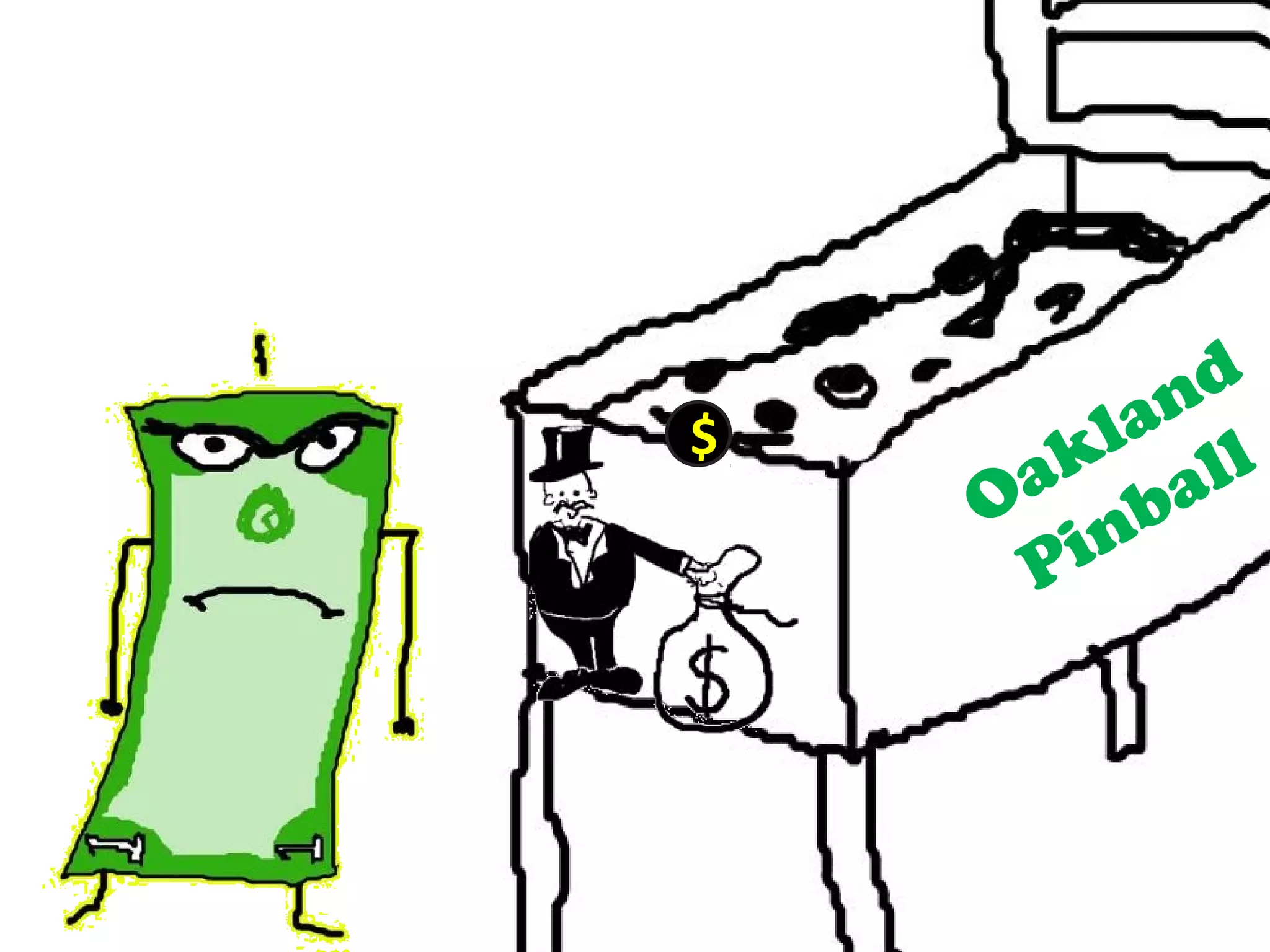
Oakland
Pinball
Oakland
Pinball
Let’s shift the culture and
get people to invest
local!
Let’s play!!
Impact
Hub
Laurel
Books
Issues
25th St.
Collective
New
Parkway
Rock
Paper
Scissors
Awaken
Red Bay
Coffee
Local wealth: $1
$
Impact
Hub
Laurel
Books
Issues
25th St.
Collective
New
Parkway
Rock
Paper
Scissors
Awaken
Red Bay
Coffee
Local wealth: $2
$
Impact
Hub
Laurel
Books
Issues
25th St.
Collective
New
Parkway
Rock
Paper
Scissors
Awaken
Red Bay
Coffee
Local wealth: $3
$
Impact
Hub
Laurel
Books
Issues
25th St.
Collective
New
Parkway
Rock
Paper
Scissors
Awaken
Red Bay
Coffee
Local wealth: $4
$
Impact
Hub
Laurel
Books
Issues
25th St.
Collective
New
Parkway
Rock
Paper
Scissors
Awaken
Red Bay
Coffee
Local wealth: $5
$
Impact
Hub
Laurel
Books
Issues
25th St.
Collective
New
Parkway
Rock
Paper
Scissors
Awaken
Red Bay
Coffee
Local wealth: $6
$
GovernanceI took all the money out my IRA
and put it in 500 local enterprises!
Which should we be
more worried about?
The 10% IRA withdrawal
penalty?
Or….
How do we
make this
sound
normal?
$
Oakland
Pinball
$
Oakland
Pinball
Divest from
EVERYTHING
that’s making the
rich richer!!
Impact Hub
Community supported
enterprise memberships
Loans to local
land trusts
Money in
credit unions
Cooperative
memberships
Shares of
local
businesses
Loans to
renewable
energy projects
Your Future Investment Portfolio
Food
What options exist for our
to fund the new economy?
Community Raised Capital
options, promises and pitfalls
Janelle’s going to talk about Direct Public
Offerings later, so we’ll move past that!
Thanks,
Janelle!
(Donation based) Crowdfunding
What is it? Is it useful?
Definition: the practice of funding a project or venture by
raising many small amounts of money from a large number
of people, typically via the Internet.
Equal Exchange’s Financing Model
Exit Does Not Exist
• Equal Exchange is a worker-owned
cooperative that pioneered the Fair Trade
coffee company with a radical financing
strategy: tell investors there was no exit
strategy for the company.
• Early on, they told investors to not expect
any returns on their investments!
• Created avenues for outside, passive capital
and built legally binding, internal controls.
• Latest edition: Equal Exchange Certificate of
Deposit with Eastern Bank (a mutual bank
owned by its depositors)
Securities Law is for
Everyone!
Securities Law:
Because people could take
your money and lose it!
U.S. Securities and Exchange
Commission mission is “to
protect investors, maintain fair,
orderly, and efficient markets,
and facilitate capital
formation.”
I just need to raise
$10,000 to start
my business.
1. What will money be raised for? To buy land? Start a business? Buy tangible
assets?
2. Form of investment: Loans? Equity investments? Cooperative memberships?
Pre-sold products? All of the above?
3. How much money and how many investors?
1. How much money can the project take? Per person, and aggregate?
2. Will it depend on the investor?
3. Must the project raise the full offering amount before it takes people’s
money?
4. Any cap on the number of investors?
5. Will your law create a tiered system of regulation, placing fewer constraints
on businesses raising small investments and tighter constraints for large
investments?
4. Investor qualifications?
1. Should the investors have any special qualifications? Minimum income
level? Minimum net worth? Geographic proximity to project? Relationship
with the project?
5. Project requirements: How should the project be structured and how should it
operate? Any requirements or limits on what it can do?
6. Advertising and info for investors and public: What info should the
project/enterprise provide to investors and the public (disclosures about the
business)? At the outset? On an ongoing basis?
7. Intermediary? May the project accept funds directly, or must it do so through
an intermediary? What is the role of the intermediary (advertising? collecting
investor info, providing disclosures, processing payments, holding funds in
escrow)?
8. Compliance steps: Should the project be required to register with the state? Or
simply provide notice and basic information to the state? What specific info should
the project provide? How much discretion should the regulators have? For
example should they be able to ask for audited financials if they want to or should
it be set in stone what they can and can't do? Can they reject a project on the basis
that it is overly risky? Should the state provide ongoing oversight?
Some Learning Goals:
1)Be able to spot a security.
2)To understand the interplay of federal and state laws.
3)Learn a few simple ways to comply with the law.
• You create a security when you ask people to
put money into your business or venture, and
you offer them a return.
• For example, a security could be:
–Selling stock or equity;
–Asking people to lend money to your
business;
–Offering a share of your business’s profits.
Basic Definition of Security
If you are offering a security, you need to:
1)Register with the federal government (with some
exceptions) and every state where you are offering
securities
• Intra state exemption
• Registration means filing an extensive document with
securities regulators. Usually requires audited financials.
1)Find an exemption from registration
Federal Definition:
The Securities Exchange Act of 1933
The 1933 Act:
“any note, stock, treasury stock, security future, bond,
debenture, evidence of indebtedness, certificate of interest
or participation in any profit-sharing agreement, collateral-
trust certificate, preorganization certificate or subscription,
transferable share, investment contract, voting-trust
certificate, certificate of deposit for a security, fractional
undivided interest in oil, gas, or other mineral rights, any
put, call, straddle, option, or privilege on any security,
certificate of deposit, or group or index of securities
(including any interest therein or based on the value
thereof), or any put, call, straddle, option, or privilege
entered into on a national securities exchange relating to
foreign currency, or, in general, any interest or instrument
commonly known as a ‘security’, or any certificate of
interest or participation in, temporary or interim certificate
for, receipt for, guarantee of, or warrant or right to
subscribe to or purchase, any of the foregoing.”
Federal Case Law:
What constitutes an “investment contract?”
• Howey Test: Court defined as “a contract, transaction, or
scheme whereby the person invests his money in a
common enterprise and is led to expect profits solely
from the efforts of a third party.” (SEC v. W.J. Howey Co.,
328 U.S. 293, 298).
• Investment of money: in manner as to subject investor to
financial loss—inquiry focuses on what purchasers were
offered or promised.
• Profits: Can include “capital appreciation…participation in
earnings.”
• Definition is flexible not static--capable of adapting.
• Often looks towards publication material but not
dispositive.
Federal continued …• Forman Case: Court said shares in a cooperative, were not
considered securities, holding that “when a purchaser is
motivated by a desire to use or consume the item
purchased . . . the securities laws do not apply.” (United
Housing Foundation v. Forman, 421 U.S. 837, 852-53 (1975)).
• Family Resemblance Test: Not all “notes” are securities
despite federal definition. Notes look more like securities
when:
– The seller's purpose is to raise money for the general use of a
business enterprise or to finance substantial investments and the
buyer is interested primarily in the profit the note is expected to
generate;
– There is a plan to distribute the notes for trading and investment;
– Investors reasonably expect that the notes will be treated as
securities;
– However, when some other regulatory scheme reduces the risk of
the note, the courts are likely to find the application of the
securities laws unnecessary.
The Risk Capital Test
Applied in 17 states and maaaybe NY:
• Sobieski: CA Supreme Court found the sale of charter memberships in a country
club as security even though the members would not share in the profits or
ownership of the club. (Silver Hills Country Club v. Sobieski, 361 P.2d 906 (Cal.
1961).
• California Court (and a minority of other states) found
the investor’s expectation of a return need not be a
material benefit. Now, the test considers whether:
– (1) The funds are being raised for a business venture;
– (2) The transaction is offered indiscriminately to the public
at large;
– (3) The investors are substantially powerless to affect the
success of the enterprise and;
– (4) The money is adequately secured.
The New York Court of Appeals held that the sale of
membership in recreational campgrounds is not a security
where members acquire no legal interests in the company, no
right to their business, any share of income, or any right to
participate in management. Rather than a financial interest, the
court found that members acquired membership solely for their
own personal enjoyment and not for resale or profit. The court
stated that the Howey test is the test of choice in New York;
however, it also acknowledged the use of the risk-capital test.
The court found application of the risk-capital test irrelevant
because the memberships were being sold for an established
business instead of to raise capital for a new enterprise. On this
basis, the court failed to consider whether or not the risk-
capital test would be a useful addition to the Howey test in New
York.
All Seasons Resorts, Inc. v. Abrams, 497 N.E.2d 33, 35 (N.Y.
1986).
What if every new business collects
500 Commitment contracts
before it starts raising capital?
Commitment:
1. Customer agrees to
purchase 40 loaves
of bread by
December 2015.
2. Baker agrees to …
You CAN raise money in a way that is
not considered a security.
What about pre-selling?
Looks less like a security when
there is less risk to the investor
of being unable to redeem the
certificate.
- Business is already in operation;
- Service oriented (landscaping,
child care);
- Not used to finance substantial
investment.
Federal Accredited v. Qualified Purchaser
Only 7.4% of U.S. households were accredited in 2010!
More Federal Exemptions
Private offerings Section 4(2): “transactions by an issuer not involving
any public offering.”
•Regulation D: Geared towards small business (all file Form D)
– Rule 504: $1M; No advertising (unless coordinated with state), generally
restricted resale (unless coordinated with state), comply with Blue Sky
laws.
– Rule 505: $5M; No advertising, 35 sophisticated non-accredited,
restricted resale, comply with Blue Sky laws
– Rule 506(b): No limit; No advertising, 35 non-accredited, restricted
resale, NSMIA “covered security” so no Blue Sky required
– New JOBS Act Rule 506(c): No limit, Advertising Allowed, only to
accredited, burden shifts to issuer for due diligence of investor income
verification (third party authorization allowed--attorney or CPA)
•New JOBS Act Draft Investment Crowdfunding Exemption
Federal Exemptions
• Intrastate offerings Section 3(a)(11): Rule 147 Safe Harbor--
presumption of federal exemption where:
– Issuer resides or principal place of business in state where offering made;
– 80% of assets and gross revenue of the business are located within the state
where the offering is made;
– 80% of net proceeds from sales used in that state;
– No part of offering made out-of-state within 9 months of last sale;
– Legend required on security.
• Charitable organizations Section 3(a)(4): Religious, educational,
fraternal, charitable or benevolent organizations. (Remember, not all
states may have similar exemption!)
• Farmers cooperatives Section 3(a)(5): Organized under I.R.S. Code
521 co-ops and I.R.S. 501(c)(16) nonprofits, Cooperative Organization
to Finance Crop Operations.
Crowdfunding!
In 2013:
JOBS Act / CROWDFUND Act!
• At least $2000 per person
• Or 5% of annual income
or net worth!
• At least $2000 per person
• Or 5% of annual income
or net worth!
•Or 10% if income or net
worth is over $100,000
• At least $2000 per person
• Or 5% of annual income
or net worth!
•Or 10% if income or net
worth is over $100,000
• Up to $1 Million Dollars
Crowdfunding
Intermediary
No advertising!
Ok, investors, here’s some
info about what you are
getting yourself into….
Investor
Education
Please fill out this form and
give info about your income
and other investments…
Investor
Info Form
JOBS Act Draft Investment Crowdfunding
Exemption
• Can raise up to $1M per year; can structure how you want (e.g. as
debt, equity, royalty).
• Issuer financial disclosure requirements:
– If you hope to raise over $500K, audited financials required;
– If you hope to raise over $100K, reviewed financials required;
– Annual reporting to SEC.
• Maximum aggregate investments per year:
– Investors with annual income or net worth under $100K can invest
greater of $2000 or 5% of annual income or net worth;
– Investors with annual income or net worth over $100K can invest 10%
of income or net worth, not to exceed maximum investment or $100K.
• Integration not triggered.
• Preempts state law.
• Must be done through an intermediary defined as broker-dealer
or "funding portal.”
Ready? Set? Write a law!
Every state should create special
securities exemptions for:
Micro-investments
Hyperlocal investments
Renewable energy projects
Farmland
Community supported agriculture
Worker cooperatives
Pre-sold products
Crowdfunding a house
Minority-owned businesses
Farm equipment
• Up to 35 unaccredited investors
• In California
• People you have a pre-existing relationship with
• No advertising
• File a simple form with Department of Business
Oversight
Some states have
“Friends and Family” exemptions
CeInvestment
secured by a Deed
of Trust
Governance
Perhaps we can find creative ways to
“hack” the existing laws:
“Reverse Private Offering!”
Disclaimer:
Reverse Private Offering
is not exactly a thing.
Hey Laurel Book Store,
Can you keep this $300 for
me and just pay it back with
2% interest over the next
five years? Thank you, dear!
Governance
Hack the existing laws:
Everyone get an investment advisor!
Also consider self-directed IRAs.
Equity Trust recently helped a community
finance land purchase with self-directed IRAs.
We did a direct
public offering!
Direct Public Offerings
Quimper Merc
Direct Public Offerings (DPOs)
• Find an exemption in federal securities law
• Business applies for a permit from the state(s)
where they will be soliciting investors
• Publicly advertise investment opportunity within
that state
• Not an “IPO”
Direct Public Offerings (DPOs)
• State must provide a permit approving
investment offering materials (“qualification
by permit”)
• Permitting process can take a few weeks to
a few months AFTER you submit the initial
application in good shape
• Permit valid for one year; renewable
Direct Public Offerings (DPO)
• Fee: $500 to $2,500 in California
• Many businesses choose to set a minimum
investment amount per person
• May want to avoid having more than 500
“unaccredited” (e.g. non-wealthy) investors
OR 2,000 total investors AND more than $10
million in assets
DPO Pros
• Business is free to advertise online, in public media, at
events, etc.
• No SEC registration!! (must file Form D only)
• No middleman or broker is required
• Marketing DPO forces enterprise to get exposure; get
people literally invested in its success
DPO Cons
Lots of work before and after you get permit from the
state(s)!
Legal paperwork and fee is an initial hurdle to
overcome
Legal paperwork usually requires the assistance of an
attorney; adds costs
What to submit to the state
• Financial statements (past, projected)
• Description of business
• What will you do with the money?
• Risk factors
• Samples of the security
• Subscription agreement or contract (if
applicable)
• Copies of all advertising materials
What to submit to the state, cont’d
• List of who will be selling the securities (and
compensation info)
• Lots of info about the directors, officers,
executives, managers of the business
• Articles, bylaws
• Lots more!
• See the regulations for full list of required
materials
Key thing to remember
•Make sure that any potential investor is
getting ALL the information they might
reasonably need to know to make an
informed decision.
A few more notes on DPOs
• There are special regulations for real estate
investment offerings that are more onerous
• There may be limits on how much
unaccredited investors can invest
• Only officers and directors of the issuer (the
business) can advertise generally
Investment Companies
• “I have a great idea! I’ll create one big entity
that will get a permit to raise money and it
will invest in other great, local businesses
that need to raise capital so they don’t need
to get permits!”
• Investment Company Act of 1940 would
impose lots of additional expensive
requirements on that entity….
New York State Martin Act
• Art. 23-A of New York General Business Law
• Requires registration of securities sold in
– Real estate offerings
– Theatrical syndications
– Intra-state offerings
• Issuer offering “securities to the public” need
to register as a broker/ dealer (inexpensive)
• Co-op membership shares not securities, in
general
Qualifications for Intrastate
Offering
• The issuer must be incorporated in New York
State.
• 80% of revenues, assets, and use of offering
proceeds must be in New York State.
• Solicitations and advertisements may be
directed to New York State residents only.
• Securities may only be sold to state residents,
by state residents, or by a corporation of that
state that also does business within that state.
Some Resources
• CommunityEnterpriseLaw.org
• CuttingEdgeCapital.com (check out blog and
resources links)
BREAK!
3:15 – 3:30pm3:15 – 3:30pm
Legal Tools for Worker Cooperatives and the Sharing EconomyLegal Tools for Worker Cooperatives and the Sharing Economy
Janelle Orsi
Executive Director
Sustainable Economies Law Center
Author, Practicing Law in the Sharing Economy
Legal Tools for Worker Cooperatives and the Sharing EconomyLegal Tools for Worker Cooperatives and the Sharing Economy
Workshop 6 — Community Land TrustsWorkshop 6 — Community Land Trusts
Organizations
Land Trusts
This assumption holds most of
society captive:
The goal of landownership and
homeownership is to accumulate
wealth when the market drives up
the value of the property!
Look, the Stick family
bought a house!
Then their house gained $100,000 in value
was because of the good school, nice city
park, and cute coffee shop.
All the owners had to do was sit
around and drink lattes!
I want to get paid $100,000
a year to drink lattes!
Look how respectable and
accomplished they are!
Oh….
What if new urban farms, parks,
healthy food stores, better
transit, and other public
infrastructure actually harm the
same people they were designed
to benefit?
It’s not that we need land trusts,
per se.
It’s that we need organizations that
can enforce restraints on the use of
land and that can work to ensure that
everyone has access.
An inherent tension in our work:
We’ll achieve many of our goals by putting
restraints on how land can be used and
transferred.
But those restraints can make it harder to
sell (alienate) the land.
Restraints on alienation?
Isn’t that un-American?
“The harmful effects that may flow from restraints on alienation
include impediments to the operation of a free market in land,
limiting the prospects for improvement, development, and
redevelopment of land, and limiting the mobility of landowners
and would-be purchasers.”
-Restatement Third of Property, § 3.4 Direct Restraints on Alienation,
Comment C at 442 (2000).
CA Civil Code 711:
Conditions restraining alienation, when repugnant to the interest created,
are void.
(Enacted 1872.)
Restraints on contract?
Isn’t that un-American?
Got ya!
Restraints are more enforceable
through contract (such as a lease).
“Determining reasonableness of a restraint on alienation
requires balancing the utility of the purpose served by the
restraint against the harm that is likely to flow from its
enforcement. […] Restraints on alienation of land are used to
accomplish a wide variety of purposes of differing utility:
[…] to retain land in families
[…] to preserve affordable housing
[…] to control entry into communities, like retirement
communities, developed for specialized purposes
[…] to further the conservation, preservation, and
charitable purposes to which land is devoted.”
- Restatement Third of Property, § 3.4 Direct Restraints on Alienation, Comment C at
442 (2000).
Tips:
1)Explicitly describe the purpose and
social/environmental/personal needs for such
a restraint.
2)Describe the way in which the owners will
benefit from or benefit “in consideration of”
the restraint.
3)Build in a sufficient number of exit options
for property owners and co-owners, along
with clear procedures and timelines for how to
exercise them.
Ways to put restraints on land:
Deed covenants and restrictions
Leases
Easements
Mortgages (hmm)
Not a good idea, in retrospect:
LEHC / HDFCs where the limited equity
provision was tied to a mortgage that
got paid off.
Who creates and enforces the restraint?
•Your own group?
•By giving limited return when people leave
•And by giving distributions to past members upon dissolution
•Is that a nightmare? Maybe not so much anymore.
• Or by making the distribution to a nonprofit.
•A city
•Sometimes cities will grant you a zoning permit, but only if you create affordable
housing. Then the city enforces a deed restriction that limits equity.
•A lender
•Sometimes lenders will give subsidized loans with good terms, and in exchange,
require that the community be limited equity. Like the HUD loans from 40 years ago
that are now expiring.
•By the way, expiring restraints make for a weird situation.
• A land trust
•The land trust could own the underlying land, and residents get long term ground
leases + ownership of the building. The land trust creates and enforces limits on how
the units are sold.
•A nonprofit
•Create some sort of affordability easement or deed restriction and grant in to a
nonprofit.
+
Documents
re-allocating
the bundle:
- TIC Agreements
- CC&Rs
- Leases
- Easements
Lease
with MORE
than the
usual bundle
of rights.
Deed
with LESS
than the
usual bundle
of rights.
= ?
Land as commons
We’re working on legal structures for land
trusts aimed at creating equitable access to
land, building ecological farms, and creating
sustainable livelihoods.
Words with no legal meaning, mostly….
Intentional Community (umbrella term)
Cohousing
Intentional Neighborhood
Commune
Ecovillage
Shared Housing
Housing Cooperative
Cohouseholding
Co-ownership without community
Land Trust*
Land Cooperative
Land Bank*
Some Variations on Land Trusts
Community Land Trust (housing/commercial)
Agricultural Land Trust
Conservation Land Trust
Three primary models:
1. Title held by the trust and leased to
occupant.
2. Title held by occupant and easement held by
the trust.
3. Right of reversion and other deed
restrictions.
Common Goals of Our Housing Clients:
To be more than just a renter
To avoid stressful financial burdens
To avoid inflexible, long-term debt
To live in housing that facilitates local economy, sharing, and
sustainability
To foster a non-speculative housing system
To foster a thriving ecosystem
Sharing Strategies:
Sharing Space
Intentional villages/neighborhoods
Cohousing
Shared housing
Sharing Management/Control
Sharing Financing
What’s Upwith All These Docs?
Formative Documents (File with the state)
Articles of Incorporation
Articles of Organization
Governing Documents
CC&Rs
Bylaws
Operating Agreements
Rules and Policy Documents
Pet Policies
Architectural Guidelines
Etc… Etc… Etc… Etc… Etc… Etc… Etc… Etc… Etc…
Transactional Documents
Purchase and Sale Agreements
Leases
Contracts for this and that
Reporting Documents
Register with Secretary of State
Tax returns
DBA forms
3 Common Arrangements
for Structuring Relationships
with Shared Land:
-Tenancy in Common
- Condos
- Ownership by an Entity
Tenancies in Common
(TICs)
Useful for:
Cohouseholding 1 Unit
“Casual Cohousing” (2 to 4 Units), and
Retrofit Cohousing
Small Intentional Communities
Condos:
Ownership by
An Entity:
Temporarily set aside everything we’ve said
about what a co-op is. In the context of housing,
the legal definition is kinda different.
Civil Code 1351(m) "Stock cooperative" means a development in
which a corporation is formed or availed of, primarily for the
purpose of holding title to, either in fee simple or for a term of
years, improved real property, and all or substantially all of the
shareholders of the corporation receive a right of exclusive
occupancy in a portion of the real property, title to which is held
by the corporation. The owners' interest in the corporation,
whether evidenced by a share of stock, a certificate of
membership, or otherwise, shall be deemed to be an interest in a
common interest development and a real estate development
for purposes of subdivision (f) of Section 25100 of the
Corporations Code.
Are housing cooperatives cooperative enough?
Key elements of cooperatives:
- Democratic
- Cooperative profit sharing
- Limited equity
CA’s definition of stock cooperative doesn’t
mandate any of these.
What is Common Area?
What is a Unit?
Promoting and Preserving Affordability
Step 1: Make it affordable to begin with
• Less expensive financing
• Less expensive buildings
Step 2: Keep it affordable
• Put a restriction on how the land or
shares of it are sold
• Make sure someone is enforcing that
restriction
Preserving Affordability
That means putting some restraints on how people
transfer (“alienate”) land. Stuff like:
•Limits on who you can sell your share to or lease to, such as:
• Only sell back to the community
• To a low-income person, elderly person, etc
• Only to people who already live in the neighborhood and
their families.
•Limits on how much you can get for it:
•Only what you paid for it?
•What you paid for it, plus interest?
•What you paid for it, plus a return correlated to the consumer
price index (CPI) or area median income (AMI)?
•With compensation for the improvements you made?
•Only what you paid, plus your share or profits or losses in the
entity?
•Etc.
22% of housing units in Zurich
are cooperative non-profits
https://placesjournal.org/article/housing-and-the-
cooperative-commonwealth/
Civil Code 817. "Limited-equity housing cooperative" or
a "workforce housing cooperative trust" means a corporation organized on a
cooperative basis that, in addition to complying with Section 817.1 as may be
applicable, meets all of the following requirements:
(a)The corporation is any of the following:
(1) Organized as a nonprofit public benefit corporation pursuant to Part 2
(commencing with Section 5110) of Division 2 of Title 1 of the Corporations
Code.
(2) Holds title to real property as the beneficiary of a trust providing for
distribution for public or charitable purposes upon termination of the trust.
(3) Holds title to real property subject to conditions that will result in reversion to
a public or charitable entity upon dissolution of the corporation.
(4) Holds a leasehold interest, of at least 20 years' duration, conditioned on the
corporation's continued qualification under this section, and provides for
reversion to a public entity or charitable corporation.
(b)
(1) The articles of incorporation or bylaws require the purchase and sale of the stock or
membership interest of resident owners who cease to be permanent residents, at no
more than a transfer value determined as provided in the articles or bylaws, and that
shall not exceed the aggregate of the following:
(A) The consideration paid for the membership or shares by the first occupant of the
unit involved, as shown on the books of the corporation.
(B) The value, as determined by the board of directors of the corporation, of any
improvements installed at the expense of the member or a prior member with the
prior approval of the board of directors.
(C) Accumulated simple interest, an inflation allowance at a rate that may be based
on a cost-of-living index, an income index, or market-interest index, or compound
interest if specified in the articles of incorporation or bylaws. For newly formed
corporations, accumulated simple interest shall apply. Any increment pursuant to
this paragraph shall not exceed a 10-percent annual increase on the consideration
paid for the membership or share by the first occupant of the unit involved.
(D) (2) (A) Except as provided in subparagraph (B), for purposes of a return of transfer
value, both of the following are prohibited: (i) A board of directors returning
transfer value, either full or partial, to a member while he or she still remains a
member. (ii) An existing member accepting the return of his or her transfer value,
either full or partial. (B) A board of directors may return to an existing member and
the existing member may accept return of his or her transfer value in the event
that the member moves within the cooperative from a category of unit initially
valued at a higher price to a different category of unit valued at a lower price.
(c) The articles of incorporation or bylaws require the board of directors to sell the
stock or membership interest purchased as provided in subdivision (b) to new
member-occupants or resident shareholders at a price that does not exceed the
"transfer value" paid for the unit.
(d) The "corporate equity," that is defined as the excess of the current fair market value of
the corporation's real property over the sum of the current transfer values of all shares
or membership interests, reduced by the principal balance of outstanding
encumbrances upon the corporate real property as a whole, shall be applied as follows:
(1) So long as any such encumbrance remains outstanding, the corporate equity shall
not be used for distribution to members, but only for the following purposes, and
only to the extent authorized by the board, subject to the provisions and limitations
of the articles of incorporation and bylaws:
(A) For the benefit of the corporation or the improvement of the real property.
(B) For expansion of the corporation by acquisition of additional real property.
(C) For public benefit or charitable purposes.
(2) Upon sale of the property, dissolution of the corporation, or occurrence of a
condition requiring termination of the trust or reversion of title to the real
property, the corporate equity is required by the articles, bylaws, or trust or title
conditions to be paid out, or title to the property transferred, subject to
outstanding encumbrances and liens, for the transfer value of membership
interests or shares, for use for a public or charitable purpose.
(e) Amendment of the bylaws and articles of incorporation requires the affirmative vote of
at least two-thirds of the resident-owner members or shareholders.
NY Private Housing Finance Law
• Article 11 Housing Development Fund
Companies
Financial Considerations Related to
How People Buy In and Sell Out
• Resale Restrictions
• Right to purchase (at appraised fair market value? At
predetermined price?)
•Right given to other members
•Right given to the association
• Right of first refusal refusal (at the price of a bona fide offer)
• Limiting equity / Preserving affordability
•Compensation for Improvements
•Appraisal before and after
•Depreciated re-imbursement
•Straight re-imbursement
•Distributing Proceeds on Sale of Entire Property
•On the basis of relative value of each unit?
•On the basis of number of years in community?
•On the basis of share of ownership in the entity?
PROTECTING PLACE WITH
CONSERVATION EASEMENTS
WHAT IS A CONSERVATION EASEMENT?
A conservation easement is a
legal limitation on the use of land in a
written document that is
executed by the property owner and
binding on successive owners for the purpose of
retaining the land in its natural, scenic, historic, agricultural,
forested, or open space condition.
PROTECTING PLACE WITH
CONSERVATION EASEMENTS
ISSUES RELATED TO CONSERVATION EASEMENTS
Conservation purposes
Conservation easement holders
Tax deductions for donation of conservation easements
Threats to perpetuity: Mortgage subordination
Mineral rights
Marketable record title acts
Recordation of the easement
Amendment of easements
Baseline documentation report
Co-owned property
SOURCE OF INFORMATION - www.landtrustalliance.org
Someone recently told me that U.S. farmers and
farm corporations own the majority of the
nation’s privately owned land….?
The average age of farm owners in the U.S. is 57.
400 million acres of land is about to change hands…
Let’s make some trusts!
Preservation of Agricultural Land
Food for thought:
Can we manage agricultural land as a commons if the
farm businesses are not managed as a commons for
the benefit of workers’ livelihoods?
I want satisfying work, where my voice
matters, I have control over my working
conditions, I learn and grow, use my
creativity, build community, advance equity,
nourish this ecosystem, and have fun!
Work as commons
Worker-Owned
Cooperative Farm
Brooklyn Alliance of Neighborhood
Gardens (BANG) Land Trust
Brooklyn Alliance of Neighborhood
Gardens (BANG) Land Trust
VALUES
•Access to Land
•Sustainable
Environments
•Community
•Governance
•Education
•Collaboration
GOALS
1. Conserve Land 
2. Create a Community
of Greenspaces 
3. Educate, Engage and
Inform 
4. Engage Government,
Institutions and
Individuals 
5. Build the
Organization 
6. Become a Facilitator
of Land Conservation
Janelle Orsi
Sustainable Economies Law Center
Ted De Barbieri
Brooklyn Law School
Legal Tools for Worker Cooperatives and the Sharing EconomyLegal Tools for Worker Cooperatives and the Sharing Economy
Workshop 7 — Ethics in Sharing Economy LawWorkshop 7 — Ethics in Sharing Economy Law
PracticePractice
Ethics in New Economy
Law Practice
Spoiler alert:
It gets awkward
Featuring:
The voice of Abraham Lincoln,
As played by Janelle Orsi
“[Make] your Skill in the Law a
Blessing to your Neighborhood.”
– Cotton Mather (1700ish)
Statistic cited by the Supreme Court in Bates v. State Bar of Arizona, 433 U.S. 350 (1977).
The 70% will change the world!
Let’s help them do that!
b
The 70% is in the best
position to create the
solutions we need in
society. Let’s grease
the wheels of:
create wealth for
these people:
These things:
Lawyers receive the privilege of
being the only people who can
practice law.
In exchange, lawyers adhere to
ethical rules to ensure the integrity
of their practice.
Ensure quality
and protect
society?
Protect the
interests of
lawyers?
What is the purpose
of enclosing the
legal profession?
What
happens
when law
becomes…Ensurequ
andprot
societ
Lincoln:
“I see in the near future a crisis approaching that
unnerves me and causes me to tremble for the safety of
my country. . . . corporations have been enthroned and
an era of corruption in high places will follow, and the
money power of the country will endeavor to prolong its
reign by working upon the prejudices of the people
until all wealth is aggregated in a few hands and the
Republic is destroyed.”
— Abraham Lincoln, Nov. 21, 1864 (letter to Col. William F. Elkins)
Be mindful of ways in which laws
have been corrupted:
From the Preamble ABA Model Rules of Professional Conduct:
“Lawyers play a vital role in the preservation of society.”
A lawyer is: “an officer of the legal system and a public citizen having
special responsibility for the quality of justice.”
“[a]s a public citizen, a lawyer should seek improvement of the law,
access to the legal system, the administration of justice and the
quality of service rendered by the legal profession.”
Purpose of Law and Legal Profession
So let’s go back in time to get into the
spirit of lawyers’ ethical rules….
This guy
George Sharswood
1854 “An Essay on
Professional Ethics”
David Hoffman’s 1836
“50 Resolutions in
Regard to Professional
Deportment”
Why the Legal Profession has Ethical Rules
“There is, perhaps, no profession, after that of the sacred
ministry, in which a high-toned morality is more
imperatively necessary than that of the law. There is
certainly, without any exception, no profession in which so
many temptations beset the path to swerve from the line
of strict integrity; in which so many delicate and difficult
questions of duty are continually arising. There are pitfalls
and man-traps at every step, and the mere youth, at the
very outset of his career, needs often the prudence and
self-denial, as well as the moral courage, which belong
commonly to riper years.”
-- Sharswood, p. 1
Here’s a man-trap:
Our clients do a lot of illegal things.
Not bad things. Just illegal things.
Should we help them ?
Our clients will be doing a lot of weird and
wonderful things…
A new economy means new legal territory
REALMS OF
ECONOMIC
ACTIVITY
Governance
YOU CAN’T DO THAT.
What many lawyers say:
Since the survival of our communities and planet depends
on people implementing innovative and creative
solutions, we should tell our clients:
LET’S TRY TO MAKE IT WORK!
“Legal propositions cannot be framed with the certainty
of mathematical theories. The most carefully studied
language still leaves room for interpretation and
construction. Time itself, which works such mighty
changes in all things, produces a state of circumstances
not in the mind of the lawgiver.” -- Sharswood, xxvi
Interpreting Laws With Reference to
Changed Times
A note about other sources:
•California Ethics Opinions: If you see a citation that looks like
this: CAL 2003-162, it means it’s the State Bar of California
Standing Committee on Professional Responsibility and Conduct
Formal Opinion No. 2003-162. You can also click the link and go
straight to the opinion.
•California Rules of Professional Conduct: Any rule in the format
#-### (example: 1-200) is a California Rules of Professional
Conduct.
•ABA Model Rules: Any rule in the format #.# (example: 2.1) is
from the ABA Model Rules of Professional Conduct.
Do lawyers have an affirmative obligation
to urge clients not to break the law?
Rule 3-210: A member shall not advise the violation of any law,
rule, or ruling of a tribunal unless the member believes in good
faith that such law, rule, or ruling is invalid. A member may take
appropriate steps in good faith to test the validity of any law,
rule, or ruling of a tribunal.
Ethics Opinion CAL 2003-162 seems to go a little further:
“Although a lawyer may advocate political and social change
through the violation of tax laws, she may not advise a client to
violate the law unless she believes reasonably and in good faith
that such law is invalid and there is a good-faith argument for
the modification or reversal of that law.”
Lawyers and Civil Disobedience
See: CAL 2003-162
Hmmm: “A state may not forbid or proscribe the advocacy of a
violation of law except where such advocacy is directed to inciting
or producing imminent lawless action and is likely to incite or
produce such action.” (Brandenburg v. Ohio (1969) 395 U.S. 444 [89 S. Ct.
1827].)
“Attorney’s status as a lawyer does not change the analysis. To
the extent speech is constitutionally protected, Attorney has the
First Amendment right to advocate political and social change
through the violation of law, even though the First Amendment
rights of lawyers are limited in certain respects.” (See Standing
Committee on Discipline v. Yagman (9th Cir. 1995) 55 F.3d 1430)
Read more here:
“Civil Disobedience and the Lawyer's Obligation to the Law,” Judith A. McMorrow,
Boston College - Law School, Washington and Lee Law Review, Vol. 48, pp. 139-163,
Hmm…
Representing undocumented immigrants in
forming cooperatives?
Can an attorney help a client form a business if
the activities of the business are illegal? Such as a
milk cooperative? Can the attorney limit the
scope of representation to the cooperative
entity, and disclaim any involvement in advising
on health/safety/food/ag regulations?
This is where limited-scope representation
agreements are helpful.
Form more info on limited scope representation,
see:
An Ethics Primer on Limited Scope Representation
By The State Bar of California Committee on
Professional Responsibility and Conduct
http://www.americanbar.org/content/dam/aba/migrated/legalservices/delivery/downlo
ads/ethics_primer_on_limited_scope_representation.authcheckdam.pdf
Limited Scope/ Unbundled
Legal Services in NYS
• Rule 1.2(c) - scope may be limited when
reasonable
• Rule 6.5 – can be limited as part of a pro bono
legal services program
“Legislation is indeed a nobler work than even
jurisprudence. It is the noblest work in which the
intellectual powers of man can be engaged, as it
resembles most nearly the work of the Deity.”
-- An Essay on Professional Ethics, by George Sharswood, 1854
Be like a Deity. Change laws.
Add to your to-do list:
Set a goal to change at least one law!
Local ordinance?
State legislation?
Regulatory change?
Federal legislation?
Maybe one of each? :oD
It’s fun to change laws!
Be an Angel. Help Other Lawyers.
To do:
Help Other Lawyers and Those Who
Want to Become Lawyers
From David Hoffman’s 50 Resolutions
#17 Should I attain that eminent standing at the bar which gives authority to my
opinions, I shall endeavor, in my intercourse with my junior brethren, to avoid the least
display of it to their prejudice. I will strive never to forget the days of my youth, when I
too was feeble in the law, and without standing. I will remember my then ambitious
aspirations (though timid and modest) nearly blighted by the inconsiderate or rude
and arrogant deportment of some of my seniors; and I will further remember that the
vital spark of my early ambition might have been wholly extinguished, and my hopes
forever ruined, had not my own resolutions, and a few generous acts of some others
of my seniors, raised me from my depression. To my juniors, therefore, I shall ever be
kind and encouraging; and never too proud to recognize distinctly that, on many
occasions, it is quite probable their knowledge may be more accurate than my own, and
that they, with their limited reading and experience, have seen the matter more
soundly than I, with my much reading and long experience.
Hmmm….Does this sentiment remain in any rules of
professional conduct?
By the way…
NY Bar Admission Rules § 520.4 Study of Law in Law Office
(a)General. An applicant may qualify to take the New York State bar examination by […]
(2) the applicant successfully completed the prescribed requirements of the first year of
full-time study in a first degree in law program at an approved law school […]
(5) the applicant thereafter studied law in a law office or offices located within New
York State, under the supervision of one or more attorneys admitted to practice law in
New York State, for such a period of time as, together with the credit permitted pursuant
to this section for attendance in an approved law school, shall aggregate four years.
(b) Employment and instruction requirements. An applicant studying law in a law office or
offices within New York State must be actually and continuously employed during the
required period as a regular law clerk and student in a law office, under the direction and
subject to the supervision of one or more attorneys admitted to practice law in New York
State, and must be actually engaged in the practical work of such law office during
normal business hours. In addition, the applicant must receive instruction from the
supervising attorney or attorneys in those subjects that are customarily taught in
approved law schools.
When seeking help from another attorney, can
you disclose confidential client information?
See the State Bar of California Standing Committee on Professional Responsibility and
Conduct Formal Opinion No. 2012-183
“In addition, Fox Searchlight recognized that the attorneys for the in-
house counsel were themselves bound by the rules of confidentiality
and attorney-client privilege and, thus, disclosure to them would not be
a public disclosure. Fox Searchlight Pictures, Inc. v. Paladino (2001) 89
Cal.App.4th 294 at p. 311.
Thus, Fox Searchlight makes clear that lawyers have the right to disclose
employer-client confidential information when seeking legal advice
from their own lawyers whether for their own protection or in aid of
the client’s cause. Fox Searchlight, supra, 89 Cal.App.4th at pp. 313-314.
What do you usually do?
Ethical Considerations in Working
With Interns and Apprentices?
Avoiding enabling interns and apprentices to
commit unauthorized practice of law.
Communicating ethical rules.
Will attorney/client privilege apply when non-
necessary people are in the room (in the case
of observers)?
Others?
“There will still be business enough."
-- The Collected Works of Abraham Lincoln edited by Roy P. Basler, Volume II, "Notes for
a Law Lecture" (July 1, 1850), p. 81.
Be like Lincoln.
Share information with the
public and clients
“Don’t share so much information that you put yourself
out of business."
-- My Mom
When Does Public Speaking Create Attorney-
Client Relationship?
CAL 2003-164: “The context of a radio call-in show or other
similar format is unlikely to support a reasonable belief by the
caller that the attorney fielding questions is agreeing
implicitly to act as the caller’s attorney or to assume any of
the duties that flow from an attorney-client relationship.”
But read the detailed analysis of the opinion for a more
nuanced understanding.
It never hurts to say:
“I’m not your attorney and this is not legal advice, but here’s
some information that could help you….”
Legal Structure of Law Practice, Part 1
• No: Partnerships with non lawyers (Rule 1-310)
• Sole Proprietorship
• Partnership
• Limited Liability Partnership (LLP)
• Professional Corporation
• “Professional corporation” means a corporation organized under the General
Corporation Law […] engaged in rendering professional services in a single profession,
[…]pursuant to a certificate of registration issued by the governmental agency
regulating the profession. (Corporations Code 13400)
•Shares of capital stock in a professional corporation may be issued only to a licensed
person or to a person who is licensed to render the same professional services
(Corporations Code 13406)
•A law corporation is a corporation which is registered with the State Bar of California and has
a currently effective certificate of registration from the State Bar pursuant to the Professional
Corporation Act (Business & Professions Code 6160)
•And if you think you’ll bring in a lot of money, choosing to be taxed as an S-Corp will
save you on taxes.
• Not: LLC, Cooperative Corporation
• Nonprofit: But can you charge regular lawyer fees if you are a
nonprofit?
Legal Structure of Law Practice, Part 2
What about nonprofit and for-profit practices
side by side?
What about Law Collectives?
How can a law firm be more like a cooperative?
CAL 1992-126
Rule 1-320 prohibits an attorney from dividing fees with a
non- attorney even with the consent of the client.
Consequently, an attorney who paid his secretary a
percentage of his legal fees was guilty of the illegal
division of fees. (See Gassman v. State Bar (1976) 18 Cal.3d 125 [132 Cal.Rptr.
675]
Fee-Splitting with Non-Attorneys
Hmm, part of the purpose of restrictions against
partnering with non-lawyers is to ensure that no one
has the right to direct or control the professional
judgment of a lawyer. (ABA Model Rule 5.4)
Rule 2-200
(A) A member shall not divide a fee for legal services with a
lawyer who is not a partner of, associate of, or shareholder with
the member unless:
(1) The client has consented in writing thereto after a full
disclosure has been made in writing that a division of fees
will be made and the terms of such division; and
(2) The total fee charged by all lawyers is not increased solely
by reason of the provision for division of fees and is not
unconscionable as that term is defined in rule 4-200.
Fee-Splitting with Attorneys Outside of
Firm
CAL 1997-150
What ethical issues arise when attorneys enter into arrangements to share
office space or services, such as reception and library facilities, maintenance
staff, secretarial staff, or paralegal staff, without forming a law firm?
DIGEST: Attorneys sharing space or staff must take reasonable steps under the
circumstances to ensure that their clients and potential clients are not
deceived, misled or confused regarding the nature of their relationship.
Attorneys who share office space or services also must take reasonable steps
under the circumstances to protect each client's confidence and secrets. If
attorneys do not address these issues sufficiently, they may violate their
obligation to maintain clients' confidential information.
Attorneys sharing facilities or staff must affirmatively disclose to the public
and to clients the nature of their shared arrangement when the arrangement
tends to confuse, deceive, or mislead the public. (Rule 1-400(D)(2).)
Lawyers Who Share Stuff
A major benefit is that it keeps overhead low.
CAL 2012-184
May an attorney maintain a virtual law office practice
(“VLO”) and still comply with her ethical obligations, if
the communications with the client, and storage of and
access to all information about the client’s matter, are
all conducted solely through the internet using the
secure computer servers of a third-party vendor (i.e.,
“cloud computing”)?
Virtual Law Office
CAL 2010-179
Whether an attorney violates his or her duties of confidentiality and
competence when using technology to transmit or store confidential
client information will depend on the particular technology being used
and the circumstances surrounding such use. Before using a particular
technology in the course of representing a client, an attorney must take
appropriate steps to evaluate: 1) the level of security attendant to the
use of that technology, including whether reasonable precautions may
be taken when using the technology to increase the level of security; 2)
the legal ramifications to a third party who intercepts, accesses or
exceeds authorized use of the electronic information; 3) the degree of
sensitivity of the information; 4) the possible impact on the client of an
inadvertent disclosure of privileged or confidential information or work
product; 5) the urgency of the situation; and 6) the client’s instructions
and circumstances, such as access by others to the client’s devices and
communications.
From SELC’s Legal Café Intake Form:
“No ongoing services: I will be taking part in a one-time legal advice clinic
organized by the Sustainable Economies Law Center (SELC). I understand
that neither SELC nor any volunteer attorneys are agreeing to provide
advice and legal services on an ongoing basis. Legal services will be limited
to the advice provided during today’s session. “
Limited Legal Services
From SELC’s Legal Café Intake Form:
This is not a thorough review of legal issues: I understand that attorneys
at the Legal Cafe are giving advice on the fly, and that the Legal Cafe is
designed in this way to ensure that many people can get basic legal
questions answered quickly. At the same time, this means that attorneys
cannot do a thorough review of all legal issues relevant to my matter. I
understand that the advising attorneys may even fail to spot important
legal issues related to my matter. I understand that if I want a thorough
review of legal issues, I should hire an attorney separately.
I understand that SELC cannot check for conflicts of interest: Due to the
short-term, walk-in, and limited nature of the legal services provided, it is
not possible for SELC to systematically screen for conflicts of interest. For
example, if I ask for advice about my dealings with a landlord or
contractor, it may turn out that SELC has advised, or will advise in the
future, the same landlord or contractor on the same matter. I am
informed of and understand this risk, and I waive all conflicts of interest
that may arise during the course of or subsequent to the legal services
Advice Clinics
Rule 1-650
(A) A member who, under the auspices of a program sponsored by a
court, government agency, bar association, law school, or nonprofit
organization, provides short-term limited legal services to a client
without expectation by either the member or the client that the
member will provide continuing representation in the matter:
(1) is subject to rule 3-310 only if the member knows that the
representation of the client involves a conflict of interest; and
(2) has an imputed conflict of interest only if the member knows that
another lawyer associated with the member in a law firm would have
a conflict of interest under rule 3-310 with respect to the matter.
(B) Except as provided in paragraph (A)(2), a conflict of interest that
arises from a member's participation in a program under paragraph (A)
will not be imputed to the member's law firm.
(C) The personal disqualification of a lawyer participating in the program
will not be imputed to other lawyers participating in the program.
Conflict Checks in Advice Clinics
From SELC’s Intake Form:
I understand that confidentiality and attorney-client privilege are
limited in this setting: Information shared during the advice session will
be kept confidential by attorneys, SELC staff, and volunteers present.
However, I understand that, due to the public nature of the space,
information I share may be overheard by others, and it may not be
possible to protect its confidentiality. Because of the presence of
students and observers, attorney-client privilege may not apply to the
information I share. This means that if I am ever a party to a lawsuit,
there is a chance that the volunteers or attorneys could be subpoenaed
and compelled to disclose information I share during the advice session.
Privilege and Confidentiality in Advice Clinics
Sharing economy law practice
involves working with groups…
Now it gets especially
awkward…
Confidentiality
Contact
Conflicts
Confidentiality
• Model Rule of Professional
Conduct 1.6
• U.S. v. Kovel, 296 F.2d 918 (2d
Cir. 1961)
Contact
• Model Rule of Professional
Conduct 4.2,
a.k.a. The “No Contact” Rule
Conflicts
Model Rule of Professional
Conduct 1.7:
Conflict of Interest Involving
Current Clients
Rule 2-100 Communication With a Represented Party
(A) While representing a client, a member shall not
communicate directly or indirectly about the subject of the
representation with a party the member knows to be
represented by another lawyer in the matter, unless the
member has the consent of the other lawyer.
This can be difficult in a transactional context. Example:
Lawyer advises entity, knowing that some members of the
entity periodically seek advice from independent counsel
regarding their transactions with the entity.
Communication with
Represented Parties
Read more about it in this opinion:
The State Bar of California Standing Committee on Professional
Responsibility and Conduct Formal Opinion No. 2011-181
Consent under the “no contact” rule of California Rule of
Professional Conduct 2-100 may be implied. Such consent may be
implied by the facts and circumstances surrounding the
communication with the represented party. Such facts and
circumstances may include the following: whether the
communication is within the presence of the other attorney; prior
course of conduct; the nature of the matter; how the
communication is initiated and by whom; the formality of the
communication; the extent to which the communication might
interfere with the attorney-client relationship; whether there exists
a common interest or joint defense privilege between the parties;
whether the other attorney will have a reasonable opportunity to
counsel the represented party with regard to the communication
contemporaneously or immediately following such communication;
Discussion (from Calbar): Rule 2-100 is not intended
to prevent the parties themselves from communicating
with respect to the subject matter of the representation,
and nothing in the rule prevents a member from advising
the client that such communication can be made.
But, grey area alert!
See this opinion - CAL 1993-131:
“When the content of such communication originates with
or is directed by the attorney, the communication is
prohibited as indirect communication under rule 2-100.
When the content of such communication originates with
and is directed by the client and not the attorney it is a
permitted communication under the rule.”
This comes up all the time!
From David Hoffman (1936)
43. I will never enter into any conversation with my opponent's client, relative to his
claim or defense, except with the consent and in the presence of his counsel.
44. Should the party just mentioned have no counsel, and my client's interest demand
that I should still commune with him, it shall be done in writing only, and no verbal
response will be received. And if such person be unable to commune in writing, I will
either delay the matter until he employs counsel, or take down in writing his reply in
the presence of others; so that if occasion should make it essential to avail myself of his
answer, it may be done through the testimony of others, and not by mine. Even such
cases should be regarded as the result of unavoidable necessity, and are to be resorted
to only to guard against great risk, the artifices of fraud, or with the hope of obviating
litigation.
Unrepresented Parties
Do you need to ask another party if they have a
lawyer?
More info in CAL 1996-145
“If an attorney has actual knowledge that an opposing party is represented by counsel, he
or she may not contact the party about the subject of the representation without the
consent of the attorney. Knowledge of such representation can be imputed from the
surrounding circumstances and is determined by an objective standard rather than the
subjective knowledge of the attorney. If the attorney does not have reason to know
whether a party is represented, the attorney is not required to inquire if a party is
represented. Nevertheless, it may be prudent to inquire when it is not clear whether the
party is represented. However, when the attorney has reason to know the party is
represented based on the circumstances, the party's statement to the contrary will not
relieve the attorney of the duty to obtain that lawyer's consent before communicating
with the party. The obligations of the attorney do not differ based solely on the means of
communication. The means of communication, however, can be one fact that may be
considered in determining whether the surrounding facts lead to the inference of
knowledge or require further inquiry.”
Market economy involves transactions where one
person stands to lose while the other gains.
Commons economy involves transactions where a
community of people create ongoing relationships to
serve mutual and aligned interests.
See the works of David Bollier for explanation of the
difference between Market and Commons.
Will we analyze conflicts of interest
differently in a different economy?
It’s a Small World After All
Hypo:
Organization A asks you to review a lease it is
entering into with Organization B.
Later Organization B asks for your help completing its
tax exemption application.
Can you help B? Do you need a waiver from A?
CAL 1984-84
May an attorney represent a client in a proceeding adverse to
one person who consulted the attorney in connection with
another matter?
DIGEST:
An attorney may represent a client adverse to one who consulted
the attorney in connection with another matter except where in
doing so he would be violating a legitimate expectation of
confidentiality with respect to information provided during the
consultation. The consulting person is a "client" for purposes of
analysis and the attorney is prohibited from disclosing his secrets
or undertaking another representation where he might be called
upon to use information obtained in confidence against the
consulting person.
CAL 1984-84
Indeed, it is our opinion that certain categories of
confidential information obtained in a prior matter or
relationship and not related in the usual sense to the matter
of the subsequent employment, are inherently likely to have
the potential for adverse use in any contested matter. Such
information includes, but is hardly limited to, the former
client's financial and emotional ability to withstand litigation,
past settlement patterns, and the priority of certain of his or
her needs over others (e.g., cash flow, emotional
satisfaction, tax deferral, etc.). (See e.g., Cal. Formal Op.
1980-52.)
Back to the hypo…
What if A later comes and asks for help renewing the
lease?
It’s awkward.
"It is the duty of an attorney: to maintain inviolate the
confidence and at every peril to himself to preserve the
secrets of his client."
(Bus. & Prof. Code, 6068, subd. (e).)
How to Explain that you Have a
Conflict
From SELC’s Intake Form:
□ Please check here if we may list your organization or
business on our website, grant applications, and other
materials, in order to showcase the range of interesting
clients that come to the Legal Cafe. Thank you!
Waiving Confidentiality About
Identity of Client
Blanket waivers may be enforceable, but are tricky…
CAL 1989-115
“Execution of an advance waiver of conflict of interest
and confidentiality protections is not per se improper;
that to the extent that the waiver of confidentiality is
‘informed,’ it is valid; that to the extent that a potential
conflict ripens into an actual conflict, the advance
waiver may or may not be sufficient depending upon the
degree of involvement and the nature of the subsequent
conflict.”
Waivers
What to put in the waivers
Organization as Client
See Rule 3-600
In representing an organization, a member shall conform his or
her representation to the concept that the client is the
organization itself, acting through its highest authorized officer,
employee, body, or constituent overseeing the particular
engagement. [….]
Under rule 3-600 of the California Rules of Professional Conduct
and case law, a lawyer represents the partnership itself acting
through its highest authorized partner or other constituent
overseeing the representation. A lawyer should follow the
direction of the partner or other person or entity who is
authorized to direct the actions of the partnership's lawyer.
Where there is a dispute among the partners about who may
oversee the lawyer's representation of the partnership and/or it
is unclear whose instruction the lawyer should follow, the
lawyer should work with the partners to resolve the dispute,
while explaining the likely consequences to the partnership if the
dispute is not resolved. If the dispute is not resolved, the lawyer
may, and in some cases will, be required to withdraw.
Representing Entities Where Members
Are in Conflict
Ugg:
Note the sticky situation that comes up with
entities that have consensus by unanimity.
CAL 1994-137
“the lawyer is in a position where he or she cannot follow
one partner's instruction without violating the other
partner's instruction. It is not a conflict of interest, because
the lawyer has only one client, the partnership. It is, instead,
a conflict of authority within the partnership over who
oversees and instructs the partnership's lawyer.”
“A lawyer in this situation is adrift in perilous waters.”
Working collaboratively with an attorney
on the other side of the transactions
Pitfalls of working with another attorney:
•How it can double or triple legal fees
•How malpractice by other attorney could result in
malpractice for you
Drawing from the field of Collaborative Law
Learn more: International Academy of Collaborative
Professionals (IACP)
Multiple Representation and Waivers
A conflict exists when there are “conflicting objectives of the
clients in which the lawyer cannot effectively advance one
client’s objective without detrimentally affecting another
client’s objective.”- -
CAL. 1999-153.
1. Can you competently and diligently represent the needs of
two or more people at once? Consider symmetry of interests.
2. Would your clients be willing to seek counsel of multiple
attorneys? If not, would it be a disservice to refuse multiple
representation?
3. How to waive the conflicts initially and on an ongoing basis.
See rule 3-310 Avoiding the Representation of Adverse
From Janelle’s Waiver, Part 1:
JOINT REPRESENTATION: Generally, professional ethics rules require that
attorneys represent only one party to a transaction, so that each party may have
her own advisor and advocate. However, exceptions can be made when the
interests of parties are closely aligned. For example, it is typical for an attorney
to jointly represent domestic partners and/or married couples when they
purchase a home together. In your case, I believe the three of you have a
similar vision and goals, which makes joint representation possible.
Nevertheless, I must advise you that having separate attorneys is traditionally
considered the most effective way to ensure that each party’s interests are
protected. At any time, if you feel that you would benefit from each having your
own attorney, you may end our attorney-client relationship and seek separate
representation. In the meantime, it is important for me to explain a couple
matters that come up when an attorney represents multiple parties:
From Janelle’s Waiver, Part 2:
CONFIDENTIALITY: In representing all three of you, matters that
one of you might discuss with me would not be protected from
disclosure to the others of you. While anything that any of you
discusses with me is confidential with respect to third parties, I
am prohibited from agreeing with any of you to withhold
information from the others.
From Janelle’s Waiver, Part 3:
CONFLICTS OF INTEREST: In addition, ethical rules require that I obtain a written
waiver of actual or potential conflicts that may arise out of my simultaneous
representation of two or more clients in the same matter. To work with potential
conflicts and for your co-ownership arrangement to be successful, it is important to
openly discuss any imbalances in your transaction, and to acknowledge how
decisions you make could affect each of you differently. For example, if applicable,
we should examine the implications of:
• Any situation where one party is contributing substantially more money
than the others, or receiving property of substantially different value;
• Any significant differences in your financial statuses or credit ratings;
• Any situation in which one of you has different financial goals than the other.
(An example would be a situation in which one of you is thinking of this
purchase as a short-term investment, while another is envisioning this as a
long term home);
• Any situation where joint ownership may subject one party to risk as a result
of the other party’s liabilities (such as a pending lawsuit against one party);
• Any other situation that demonstrates that your goals are significantly
divergent.
From Janelle’s Waiver, Part 4:
In your particular case, I have already noted at least two potential conflicts that are
important to be aware of. First of all, Irene has indicated that she plans to do a
significant amount of work on her portion of the property, much more so than the other
two of you.
Irene’s additional investment of time and resources in the property means that you have
important decisions to make about how to compensate co-owners for their
improvements, and the decision you make will likely have different impacts on each of
you.
Second, you have acknowledged that Mark has a poor credit rating, which could affect
your ability to get ideal loan terms. Thus, you will have some decisions to make regarding
your approach to obtaining a loan, and the decision you make could affect each of you
differently.
As potential conflicts such as these come to the surface, I can point out the pros and cons
of such differing opinions and help you determine how your course of action will affect
each of you. However, as the attorney for all of you, I cannot advocate one of your
positions over the others.
If significant conflicts arise between the three of you, and those conflicts are not
resolved through our discussion process, it would become necessary for me to withdraw
as your joint attorney, at which point I would advise each of you to obtain another
Lawyers as Mediators
Can you be both at the same time?
Can you be a lawyer for a group and then become
their mediator?
Can you be a mediator for a group and then
become their lawyer?
Mediator Turns Lawyer
ABA Model Rule 2.4(b):
(b) A lawyer serving as a third-party neutral shall inform unrepresented parties that the
lawyer is not representing them. When the lawyer knows or reasonably should know
that a party does not understand the lawyer's role in the matter, the lawyer shall
explain the difference between the lawyer's role as a third-party neutral and a lawyer's
role as one who represents a client
The ABA Section on Dispute Resolution has adopted the following principle in a 2002
Resolution:
“Mediation is a process in which an impartial individual assists the parties in reaching a
voluntary settlement. Such assistance does not constitute the practice of law. The
parties to the mediation are not represented by the mediator. […] In disputes where
the parties’ legal rights or obligations are at issue, the mediator’s discussions with
the parties may involve legal issues. Such discussions do not create an attorney-
client relationship, and do not constitute legal advice, whether or not the mediator is
an attorney.”
ABA Section on Dispute Resolution, “Resolution on Mediation and the Unauthorized
Practice of Law,” Adopted by the Section on February 2, 2002
ABA Section on Dispute Resolution has provided the following
guidance on drafting the mediation agreements:
“When an agreement is reached in a mediation, the parties often request
assistance from the mediator in memorializing their agreement. The
preparation of a memorandum of understanding or settlement
agreement by a mediator, incorporating the terms of settlement
specified by the parties, does not constitute the practice of law. If the
mediator drafts an agreement that goes beyond the terms specified by
the parties, he or she may be engaged in the practice of law. However, in
such a case, a mediator shall not be engaged in the practice of law if (a)
all parties are represented by counsel and (b) the mediator discloses that
any proposal that he or she makes with respect to the terms of
settlement is informational as opposed to the practice of law, and that
the parties should not view or rely upon such proposals as advice of
counsel, but merely consider them in consultation with their own
attorneys.”
ABA Section on Dispute Resolution, “Resolution on Mediation and the Unauthorized
Practice of Law,” Adopted by the Section on February 2, 2002
Lawyer Turns Mediator?
When does something officially become mediation? The
Uniform Mediation Act adopted by the National Conference of
Commissioners on Uniform State Laws, Section 3, recognizes that
something is a mediation if “the mediation parties use as a
mediator an individual who holds himself or herself out as a
mediator or the mediation is provided by a person that holds
itself out as providing mediation.” In essence, if I tell people that
I’m mediating, then it’s a mediation. My solution: Tell client it’s
not mediation.
"Discourage litigation. Persuade your neighbors to
compromise whenever you can. Point out to them how
the nominal winner is often a real loser---in fees,
expenses, and waste of time. As a peacemaker the
lawyer has a superior opportunity of being a good man.
There will still be business enough."
The Collected Works of Abraham Lincoln edited by Roy P. Basler, Volume II, "Notes for a
Law Lecture" (July 1, 1850), p. 81.
Discouraging Litigation?
See: CAL 1984-77
“On any matter which requires client understanding, the attorney must
take all reasonable steps to insure that the client comprehends the
legal concepts involved and the advice given, irrespective of the mode
of communication used, so that the client is in a position to make an
informed decision. Appreciation of the client's language may have a
substantial bearing on the capability of the attorney to communicate
with the client concerning such facts, legal concepts and advice. The
attorney may need to communicate in a particular language or dialect
and for this purpose may need to use an interpreter skilled in a
particular language or dialect. Other means reasonably available to
counsel, such as a person skilled in sign language or in translating a
written document, may need to be used in order for counsel to act
competently in a particular case.”
Representing Non-English Speakers
Men have a right not only to be well governed, but to be
cheaply governed—as cheaply as is consistent with the
due maintenance of that security, for which society was
formed and government instituted.
-- Sharswood p. xxii
Note that most lawyers oaths from the 12-14th
centuries
focused heavily on the fact that lawyers should charge
reasonable fees, and that they should serve the poor.
(“Standards of Conduct for Lawyers: An 800-Year Evolution” Carol Andrews, University
of Alabama - School of Law, Southern Methodist University Law Review, Vol. 57, p.
1385, 2005)
Accessibility of Lawyers
David Hoffman’s 50 Resolutions:
18. Those who can afford to compensate me, must do
so; but I shall never close my ear or heart because my
client's means are low. Those who have none, and who
have just causes are, of all others, the best entitled to
sue, or be defended; and they shall receive a due
portion of my services, cheerfully given.
27. I will charge for my services what my judgment and
conscience inform me is my due, and nothing more.
Excessive fees – not a new problem in the
world:
In 1605, Parliament acted to cure fee and
collection abuses in “An Act to Reform the
Multitudes & Misdemeanors of Attorneys &
Solicitors at Law, and to Avoid Unnecessary suits
and Charges at Law.” The 1605 Act complained of
“abuse” of clients through “excessive fees” and
“extraordinary delays” by lawyers to extract
those fees. The act therefore required lawyers to
submit “subscribed tickets” and “true bills” for all
charges.” – (“Standards of Conduct for Lawyers: An 800-Year Evolution” Carol
Andrews, University of Alabama - School of Law, Southern Methodist University Law
Review, Vol. 57, p. 1385, 2005)
Fee regulation relaxed considerably in the
early nineteenth century due to increasing
recognition of the independence of contract
between attorney and client
Hmmm…
But the concept of independence of contract
has been debunked in a lot of contexts, such
as employment law.
Rule 4-200
(B) Unconscionability of a fee shall be determined on the basis of all the facts and
circumstances existing at the time the agreement is entered into except where the parties
contemplate that the fee will be affected by later events. Among the factors to be
considered, where appropriate, in determining the conscionability of a fee are the
following:
(1) The amount of the fee in proportion to the value of the services performed.
(2) The relative sophistication of the member and the client.
(3) The novelty and difficulty of the questions involved and the skill requisite to perform
the legal service properly.
(4) The likelihood, if apparent to the client, that the acceptance of the particular
employment will preclude other employment by the member.
(5) The amount involved and the results obtained.
(6) The time limitations imposed by the client or by the circumstances.
(7) The nature and length of the professional relationship with the client.
(8) The experience, reputation, and ability of the member or members performing the
services.
(9) Whether the fee is fixed or contingent.
(10) The time and labor required.
(11) The informed consent of the client to the fee.
A lawyer’s time and
advice is [his/her]
stock in trade.
What to charge?
Hmmm…I was thinking…
If a lawyer’s primary role is to assist someone in
their effort to earn a lot of money, then it sorta
makes sense for the lawyer to earn a lot of
money also…
But in the new economy, many of our clients
aren’t trying to earn a lot of money; they are
trying to generate sustainable wealth for a
community. What should we charge for that?
Hoffman’s #49. Avarice gradually originates every species of indirection. Its
offspring is meanness; and it contaminates every pure and honorable principle.
It cannot consist with honesty scarce a moment without gaining the victory.
Should the young practitioner, therefore, on the receipt of the first fruits of
his exertions, perceive the slightest manifestations of this vice, let him view
it as his most insidious and deadly enemy. Unless he can then heartily and
thoroughly eradicate it, he will find himself, perhaps slowly, but surely, capable
of unprofessional, means, and, finally, dishonest acts which, as they cannot be
long concealed, will render him conscious of the loss of character; make him
callous to all the nicer feelings; and ultimately so degrade him, that he
consents to live upon arts, from which his talents, acquirements, and original
integrity would certainly have rescued him, had he, at the very
commencement, fortified himself with the resolution to reject all gains save
those acquired by the most strictly honorable and professional means. I am,
therefore, firmly resolved never to receive from any one a compensation not
justly and honorably my due, and if fairly received, to place on it no undue
value, to entertain no affection for money, further than as a means of
obtaining the goods of life; the art of using money being quite as important
for the avoidance of avarice, and the preservation of a pure character, as that
of acquiring it.
Let’s try being
average people!
What Form Should Fees Take?
• Flat fee versus hourly?
• Sliding scale
• Bartering
• Alternative currencies, barter networks, time banks
• Gifts? Rule 4-400 – Gifts from Clients: A member shall not induce a client
to make a substantial gift, including a testamentary gift, to the member or to
the member's parent, child, sibling, or spouse, except where the client is
related to the member.
• Collaborating with other attorneys
• See Rule 2-200: (A) A member shall not divide a fee for legal services
with a lawyer who is not a partner of, associate of, or shareholder with the
member unless: (1) The client has consented in writing thereto after a full
disclosure has been made in writing that a division of fees will be made
and the terms of such division; and (2) The total fee charged by all lawyers
is not increased solely by reason of the provision for division of fees and is
not unconscionable as that term is defined in rule 4-200.
Rule 4-400 – Gifts from Clients: A member shall not induce a
client to make a substantial gift, including a testamentary gift, to
the member or to the member's parent, child, sibling, or spouse,
except where the client is related to the member.
CAL 2011-180
[…] in deciding whether a gift is “insubstantial,” one must
consider the financial situation of both the client and the lawyer.
“To a poor client, a gift of $100 might be substantial, suggesting
that such an extraordinary act was the result of the lawyer’s
overreaching. To a wealthy client, a gift of $1,000 might seem
insubstantial in relation to the client’s assets, but if substantial in
relation to the lawyer’s assets, it suggests a motivation on the
part of the lawyer to overreach the client-donor. Under either set
of circumstances, the lawyer violates the client’s rights by
accepting
Gifts from Clients
Fee Agreements
• Legal requirements: See Business & Professions Code 6146-6148
• Business and Professions Code Section 6148: (a) In any case […] in
which it is reasonably foreseeable that total expense to a client,
including attorney fees, will exceed one thousand dollars ($1,000), the
contract for services in the case shall be in writing.
• Rule 3-410: A member who knows or should know that he or she does
not have professional liability insurance shall inform a client in writing,
at the time of the client's engagement of the member, that the member
does not have professional liability insurance whenever it is reasonably
foreseeable that the total amount of the member's legal representation
of the client in the matter will exceed four hours.
• The State Bar has samples, but they are LONG:
http://www.calbar.ca.gov/Portals/0/documents/mfa/Sample-Fee-Agreem
Hoffman’s #48. The ill success of many at the bar is
owing to the fact that their business is not their
pleasure. Nothing can be more unfortunate than this
state of mind. The world is too full of penetration not to
perceive it, and much of our discourteous manner to
clients, to courts, to juries, and counsel, has its source in
this defect. I am, therefore, resolved to cultivate a
passion for my profession, or, after a reasonable
exertion therein, without success, to abandon it.
It is Your Duty to Have Passion for
Your Work!
Hoffman’s # 50. Last resolution: I will read the
foregoing forty-nine resolutions twice every year during
my professional life.
Constantly Re-Examining Our Work
and Ourselves
“[Make] your Skill in the Law a
Blessing to your Neighborhood.”
– Cotton Mather (1700ish)
Extra slides I’ll use only if it
comes up in conversation
What about laws that are designed to
regulate the availability of essential
goods and services, or to regulate the
viability of a type of work/enterprise?
•Inclusionary zoning
•Taxi cab medallions
•Public utilities laws
Ways to calibrate the regulations:
•Limiting number of nights: To lower impact on neighborhood and
affordable housing supply
•Limiting amount of income: Set income cap at a level so that
people can’t earn more money than they could if they rent out a
room or unit to a regular tenant
•Require presence of host: So that neighbors aren’t stuck with
random strangers throwing a party next door
•Allow people to rent out whole unit for three weeks per year:
Assuming that everyone travels and it makes sense to be able to
share your unit for periods when you are away.
•Require safety measures: Exit signs, fire safety, local contact
number.
Ways to calibrate the regulations:
• Limit amount of income per mile: To allow people to carpool and
share costs, but not to operate a taxi.
• Require similar rules to taxis: If people are driving to make
money, then require that the licensing hurdles be similar to those
of taxi drivers, in order to prevent unfair competition
• Limit income to third parties: I.e. platforms like Lyft should not
be allowed to profit limitlessly, since the profit drive could lead
Lyft to manage the marketplace in ways that maximize its profits,
not that maximize earnings and good working conditions for
drivers.
• Require more insurance: To ensure that no one is left
uncompensated for an accident.
Tips for Consumer Cooperatives and Intentional Community
Member Work Contributions:
•Call it “chores” and “maintenance,” not “work” or “labor.” Perhaps
don’t call it “contribution.” Rather than “labor contribution,” call it
“shared chores program.” (Less like “work.”)
• Do not make work an obligatory part of the cooperative; make it
something that the group agrees on separately and collectively.
(More like a partnership.)
• Do not tie work hours to any discounts on member dues or to
other material benefits. (Less like “work.”)
• Allow people considerable latitude in when and how they do a
task. Don’t require a minimum # of hours. Assign tasks, not hours.
Don’t have a supervisor that dictates how things must be done.
(More like independent contractor.)

Legal Tools for Worker Cooperatives and the Sharing Economy

  • 1.
    Legal Tools forWorker Cooperatives and theLegal Tools for Worker Cooperatives and the Sharing EconomySharing Economy Wednesday, February 4, 2015
  • 2.
    Take a pieceof card stock, fold into a tent shape, and write on front: Name, Title/Affiliation 5-7 words describing your interests
  • 3.
    Joe Rinehart Director ofCooperative Development Democracy at Work Institute Ted De Barbieri Assistant Professor of Clinical Law Brooklyn Law School WelcomeWelcome Legal Tools for Worker Cooperatives and the Sharing EconomyLegal Tools for Worker Cooperatives and the Sharing Economy
  • 4.
    New York City’sNew Economy Center for Family Life in Sunset Park Park Slope Food Co-op
  • 5.
    New York CityWorker Co-ops
  • 6.
    Janelle Orsi Executive Director SustainableEconomies Law Center Author, Practicing Law in the Sharing Economy Legal Tools for Worker Cooperatives and the Sharing EconomyLegal Tools for Worker Cooperatives and the Sharing Economy Workshop 1 — Big Picture Discussion: The NewWorkshop 1 — Big Picture Discussion: The New Economy and the LawEconomy and the Law
  • 7.
    Welcome to Day1 of: Legal Tools for Worker Cooperatives and the Sharing Economy Presented by: Janelle Orsi, Executive Director of Sustainable Economies Law Center (SELC) Ted De Barbieri, Assistant Professor of Clinical Law at Brooklyn Law School Ricardo Nunez, Cooperatives Program Director at SELC
  • 8.
  • 9.
    The New Economyand the Law
  • 10.
    The economy hasmany pieces. Let’s just start with bread:
  • 13.
  • 17.
    The 70% willcreate these things: Worker Cooperatives Cohousing Communities Coworking Spaces Maker Spaces Community Gardens Social Enterprise Shared Commercial Kitchens Carsharing Groups Ridesharing Tool Lending Libraries Ecovillages Local Currencies Barter Networks Time Banks Land Trusts Grocery Cooperatives Community-Owned Solar Cooperatives Community-Supported Agriculture
  • 18.
    Lawyers Creating the Next Economy WorkerCooperatives Freelancer Cooperatives Cohousing Communities Community Gardens Coworking and Maker Spaces Shared Commercial Kitchens Carsharing Groups Tool Lending Libraries Community-Owned Solar Cooperatives Housing Cooperatives Ecovillages Local Currencies Barter Networks Time Banks Land Trusts Grocery Cooperatives Community-Supported Agriculture Community Credit Unions Academics Litigators Policymakers Transactional Lawyers
  • 20.
  • 21.
    No, not thesetransactional lawyers:
  • 24.
    Worker Cooperatives Cohousing Communities CoworkingSpaces Maker Spaces Community Gardens Social Enterprise Shared Commercial Kitchens Carsharing Groups Ridesharing Tool Lending Libraries Ecovillages Local Currencies Barter Networks Time Banks Land Trusts Grocery Cooperatives Community-Owned Solar Cooperatives Community-Supported Agriculture Community Credit Unions At least one million lawyers need to start greasing the wheels of a new economy:
  • 26.
  • 27.
    ● Anyone who entersthe field of sharing economy law right now will, inevitably, be a leader in this emerging field.
  • 28.
    The new economyhas issues.
  • 29.
    It all startswith “issue spotting.”
  • 31.
    Where have younoticed the law acting as a barrier to something cool you or your clients wanted to do?
  • 48.
  • 60.
  • 61.
    And Are TheyEmployees of Their Own ??
  • 62.
  • 63.
  • 64.
  • 65.
    • Farm Internships •CSA Volunteers • Worker Cooperatives • Consumer Cooperatives • Mutual Aid
  • 66.
  • 67.
  • 68.
  • 69.
    We don’t have anymoney yet! New Worker Cooperatives:
  • 70.
    We’ll never have enoughmoney because we have always made less than minimum wage. Semi-Subsistence Farmers
  • 71.
    We will never haveenough money, because we aren’t TRYING to make money. Food Cooperatives
  • 72.
  • 73.
    We can’t affordto just teach people about farming! We can barely afford farming! Farm Internships and CSA Volunteer Programs
  • 74.
  • 81.
  • 90.
    Steps to Approaching RegulatoryGrey Areas STEP 1: Determine what areas of regulation might apply if this were a public or commercial activity. See the table in the handouts. Page 37-38
  • 91.
    STEP 2: Determine whetherthat realm of regulation designates explicit exemptions for small scale, community-based, or cooperative activities. Like cottage food laws or licensing exemptions for parent-run childcare cooperatives.
  • 92.
    STEP 3: If thereis no explicit exemption, determine whether the activity legitimately falls outside of the realm of regulation, or help clients move to a safer end of the grey area. This is part is infinitely interesting and tricky.
  • 93.
    When Regulations MightNot Apply: 1.When there is no separation between consumer and producer. 2. When an economic activity is private. 3. When an economic activity is non- commercial.
  • 94.
    1. When thereis no separation between consumer and producer.
  • 96.
    “No person shallbuy, sell, deliver, or give milk that has not [been certified].” SO, what does it mean to be in possession of …. The issue at stake is not milk or cows or goats, per se… It’s our right to collectively produce things that we consume.
  • 97.
    When the developeris the homebuyer and vice versa.
  • 98.
    2. When anactivity is private.
  • 100.
  • 105.
    What is aPrivate Club? FROM: Appendix B of 28 C.F.R Part 36, www.ada.gov/reg3a.html Title II of the 1964 Act exempts any "private club or other establishment not in fact open to the public […]” In determining whether a private entity qualifies as a private club under Title II, courts have considered such factors as: •the degree of member control of club operations •the selectivity of the membership selection process •whether substantial membership fees are charged •whether the entity is operated on a nonprofit basis •the extent to which the facilities are open to the public •the degree of public funding, and •whether the club was created specifically to avoid compliance with the Civil Rights Act.
  • 106.
    3. When theactivity is not commercial. Is it cost-sharing? Or commerce?
  • 108.
  • 109.
    STEP 4: If there’sno way for the client to avoid regulation, search for ways to make compliance less burdensome. That might mean finding a “sharing solution,” like a shared commercial kitchen.
  • 110.
    STEP 5: If thelaw seems to unreasonably block people from doing good things in the world, change the law.
  • 111.
    To do: Set agoal to change at least one law! Local ordinance? State legislation? Regulatory change? Federal legislation? Maybe one of each? :oD
  • 112.
    It’s fun tochange laws!
  • 117.
    How we changelaws will depend on the purposes of regulation: •Laws that Protect Consumers •Laws that Protect a Marketplace •Laws that Regulate a Profession •Laws that Protect Communities and Ecosystems •Laws that Protect a Resource or Necessity for the Public •Laws that Protect Workers and Contractors in a Particular Industry •Laws that Ensure Equitable Access to Public Accommodations •Laws that Impose Additional Taxes on Certain Industries •Laws that Require Consumers to Purchase a Particular Good or Service
  • 118.
    How to MakeBread in the Current Legal and Economic System Corporate Shareholders
  • 119.
  • 120.
    Work Money Current Legal and EconomicSystem Corporate Shareholders
  • 121.
    Work Money Current Legal and EconomicSystem Corporate Shareholders
  • 122.
    Work Money Current Legal and EconomicSystem Corporate Shareholders Shareholder-Elected Board
  • 123.
    Work Money Current Legal and EconomicSystem Corporate Shareholders Shareholder-Elected Board
  • 124.
    Work Money Current Legal and EconomicSystem Corporate Shareholders Shareholder-Elected Board Money Power
  • 125.
    Jobs FoodMoney Power Current Legal and EconomicSystem Corporate Shareholders Shareholder-Elected Board
  • 127.
    Works long hours Hasaverage life span of 50 Current Legal and Economic System Corporate Shareholders Shareholder-Elected Board The U.S. Congress and the Supreme Court, around 1937, decided that the relationship seemed a bit too imbalanced.
  • 128.
  • 129.
    Employment Laws Securities Laws CorporateShareholders Shareholder-Elected Board
  • 130.
    Employment Laws Securities Laws CorporateShareholders Shareholder-Elected Board Consumer Protection Laws
  • 131.
    Employment Laws Securities Laws ConsumerProtection Laws Zoning Laws Corporate Shareholders Shareholder-Elected Board
  • 132.
    Darden Restaurants One half billionin profits per year No paid sick time $2.13/hour + tips Corporate Shareholders Shareholder-Elected Board The laws haven’t really protected us very well….
  • 133.
    Grocery Cooperatives Worker Cooperatives UrbanFarms Cohousing Communities Community Gardens Social Enterprise Shared Commercial Kitchens Carsharing Groups Ecovillages Local Currencies Barter Networks Time Banks Land Trusts Community-Supported Agriculture Credit Unions Etc. Etc. Etc….
  • 134.
    Food Oasis Cooperative 400residents of a food desert neighborhood form a cooperative to purchase locally-grown and healthy food.
  • 135.
  • 136.
  • 137.
  • 138.
    Employment Laws Securities Laws ZoningLaws Shareholder-Elected Board Consumer Protection Laws
  • 139.
    Employment Laws Securities Laws ZoningLaws Consumer Protection Laws Regulations have limited how we use: Our money Our time and labor Our relationships Our homes and neighborhoods
  • 140.
    Employment Laws Securities Laws ZoningLaws Consumer Protection Laws At the same time, how can we loosen these bolts without opening the floodgates to extraction?
  • 141.
    But this isa flawed system and it’s dangerous to loosen many of the laws. Let’s try a new system. X
  • 142.
    Board elected byworkers, consumers, or both.
  • 143.
    Profits distributed to workerson the basis of the value or quantity of their work. Or to consumers based on value or quantity of purchases. Or both. Board elected by workers, consumers, or both.
  • 144.
    Some people think allcooperatives are this:
  • 145.
    The 2 thingsto know about cooperatives: 1.Board elected on a one-member, one-vote basis. Capital ownership doesn’t determine voting power. 2. Profits distributed on the basis of patronage. Capital ownership doesn’t determine profit share.
  • 146.
  • 148.
    JobsJobs Generative! This entity is designedto provide, nourish, and protect.
  • 149.
    That’s our legal wedge!! Weneed ANOTHER legal regime for generative entities We need one legal regime for extractive entities. Market Governance Structures Commons Governance Structures
  • 150.
    Governance COOOOOOOOOPERATIVES! One moral tothe story: We can’t change the economy without them. We can’t change the legal system without them.
  • 151.
    What is oppositeof an apocalypse? A co-opalypse! Worker Coop Housing Coop Energy Coop Food Coop Childcare Coop
  • 152.
  • 153.
    We’re creating anew commons “A commons may arise whenever a group of people decides that it wishes to manage a resource in a collective manner, with a special regard for equitable access, use and long-term stewardship.” -- David Bollier
  • 154.
    Read this book.It’s very quotable!
  • 155.
  • 156.
  • 157.
  • 158.
    3. Share Earnings (on thebasis of patronage)
  • 159.
  • 160.
  • 161.
  • 162.
  • 163.
    Elinor Ostrom’s principlesfor the management of common pool resources can even be applied to worker cooperatives! 1. Clearly defined boundaries 2. Rules regarding use of common resources 3. Participatory decision-making 4. Monitoring by people who are accountable to group 5. Graduated sanctions for exploitation of resources 6. Accessible conflict resolution methods 7. Recognition by the authorities of group autonomy and self-governance 8. For larger groups: Multiple layers of nested enterprises (to keep group sizes small)
  • 164.
    David Bollier: “The importantpoint, therefore, is to assure that commons can have as much autonomy and integrity of purpose as possible. If commons are to interact with markets, they must be able to resist enclosure, consumerism, the lust for capital accumulation and other familiar pathologies of capitalism.”
  • 165.
  • 166.
    New Agreements + NewOrganizations = New Economy!
  • 167.
    “Hey! Making agreementsand forming organizations! I can do that!” – said the transactional lawyer.
  • 168.
    Community Supported Bread CommunitySupported EVERYTHING! •Share CAPITALIZATION •Share PROFITS/BOUNTY •Share RISK •Share WORK/LABOR •Share INFORMATION •Share DECISION-MAKING
  • 169.
    We should support them! Wecould get our bread there sometimes.
  • 170.
    Make agreements! It’s community-supportedenterprise! We all agree to buy one loaf per week. And I agree to: - Use healthy whole grains - Buy from local farmer co-ops - Deliver by bicycle, and - Spend 10% of my earnings in the neighborhood.
  • 171.
    Our agreements and organizationalstructures are like roadmaps to our relationships…. And they become our own private laws.
  • 172.
    Co-ownership agreements: • Tenancy-in-commonagreements for co-ownership of a house or multiplex • Car, truck, and van co-ownership agreements • Shared studio, workshop, and office agreements • Agreements for co-ownership of other items, such as work or recreational equipment and electronics Leases: • Leases for urban farm space • Shared workspace agreements • Leases for shared housing Licenses: • Licenses to share a yard for food- growing or recreation • Licenses for use of co-working spaces • Licenses for short-term home stays • Licenses for the use of intellectual property Borrow-lend agreements: • Agreements to regularly borrow a car or other equipment Agreements Galore! Agreements for cooperative activity or mutual aid: • Child care exchange agreements • Rideshare agreements Operating agreements and bylaws for organizations: • Operating agreements for cohousing communities • Bylaws for cooperatives Membership and use agreements: • Member agreements for cooperatives • Agreements that describe rights and responsibilities of members of community-supported agriculture (CSA) programs Investment contracts / promissory notes: • Promissory notes for peer-to-peer loans to enterprises and homebuyers • Shareholder agreements and term sheets for local investing initiatives Other: • Liability waivers for shared spaces or shared equipment • Agreements for barter transactions
  • 173.
    When the sharinghits the fan…
  • 175.
  • 179.
    Some ways tospecialize in the sharing economy: Shared Housing Law Cohousing Law Small Social Enterprises Law Large Social Enterprise Law Community-Owned Enterprise Law Cooperative Law Fashion and Garment Enterprise Law Nonprofit Law Tax and Accounting for Currencies Community Food Law Community Education and Child Care Law Community Health Care Law Community Energy Law Collaborative Consumption Law Shared Intellectual Property Law Mediation for all of the above!
  • 180.
    The Sustainable Economies LawCenter’s living classroom:
  • 182.
    Lawyers advising community members People discussing the sharingeconomy Law students teaching community members Community members teaching law students and each other
  • 183.
    Lawyers advising community members People discussing the sharingeconomy Law students teaching community members Community members teaching law students and each other
  • 184.
    How can weget to this tipping point?
  • 185.
    Published by ABABooks www.theselc.org Also see our resource libraries: •UrbanAgLaw.org •Co-opLaw.org •CommunityEnterpriseLaw.org •CommunityCurrenciesLaw.org 50% discount code: PAB12SHR Royalties go to the Sustainable Economies Law Center
  • 186.
  • 187.
    INTROS The next slidesare ideas for intros
  • 188.
    Say your nameand fill in the blank: “I would love to have ______________________ as my client.”
  • 189.
    Janelle Orsi Sustainable EconomiesLaw Center Ricardo Nunez Sustainable Economies Law Center Ted De Barbieri Brooklyn Law School Legal Tools for Worker Cooperatives and the Sharing EconomyLegal Tools for Worker Cooperatives and the Sharing Economy Workshop 2 — Entity Structures in the New EconomyWorkshop 2 — Entity Structures in the New Economy
  • 190.
    OrganizationsORGANIZATIONS Entity Choice and Structurein the Sharing Economy Important: The architecture of organizations will essentially be the architecture of a new economy.
  • 191.
    These clients are comingfor you! They are weird. They are wonderful. They want you to form their entity!!
  • 192.
    How do welegally structure stuff like this? Community food gardens Car-sharing groups Renewable energy co-ops Local currencies Time banks Cottage foods markets Childcare cooperatives Lending Circles Transition Initiatives Farmers markets Shared commercial kitchens Ecovillages Housing cooperatives Elder care cooperatives Grey water cooperatives Mutual aid societies
  • 193.
    There Are ThreeLayers of Considerations: 1.What entity to choose At the state level. 2. How to structure governance, operations, and financial provisions. At the organizational level. 3. What tax status to obtain. At the federal level.
  • 194.
    Entity X TaxStatus X Structural Decisions = ∞ options And yet...we still need to create more options for sharing economy enterprises and orgs.
  • 195.
    Common Entity Types(State Level) •Sole Proprietorships •Partnerships (General and Limited) •Limited Liability Companies (LLCs) •Low-Profit Limited Liability Companies (L3Cs) •General Stock Corporations • Plain Old Corporations • Benefit Corporations (in NY, CA, and many others) • Flexible Purpose Corporations (in CA) •Cooperative Corporations and Associations •Nonprofit Public Benefit Corporations •Nonprofit Mutual Benefit Corporations
  • 196.
    What is yourentity?
  • 197.
    Common Tax Statuses (Federallevel. The state mostly follows suit.) • Partnership taxation • Subchapter S • Subchapter C • Subchapter T • 501cEVERYTHING • Other: 528, 501(d) • Also consider rollovers: 1042
  • 198.
    Rebranding alert! Cooperatives havea special tax status under Subchapter T of Internal Revenue Code… That makes them “T Corporations!” I sound important when I say the phrase “T Corps!”
  • 199.
    We’re very excitedabout: - Cooperative - Nonprofits We’re sorta excited about: - Benefit Corporations And also acknowledging: Other entity types are flexible and can sometimes accomplish similar purposes The big question: Who do you want to benefit?
  • 200.
  • 205.
    B Corp isjust a kind of certification. Some consumers think certifications are sooooo cool! Like! • Living wage certification •Green business certification •Fair trade certification •Organic certification •Union certification •Not animal tested certification
  • 206.
    And those newfangledkinds of entities? Benefit Corporations •MUST operate for public benefit •Must report on general public purposes and specific purposes, and measure them using 3rd party standards. Flexible Purpose Corporation •ALLOWS directors to consider one or more specific purposes beyond financial value, with requirements to report on their accomplishment of these specific purposes.
  • 207.
    One reason CAcreated Benefit Corporations and Flexible Purpose Corporations is that we don’t have a constituency statute. Example of Constituency Statute (30 states) “A director of a corporation . . . shall consider, in determining what he reasonably believes to be in the best interests of the corporation, (1) the long-term as well as the short-term interests of the corporation, (2) the interests of the shareholders, long-term as well as short-term, including the possibility that those interests may be best served by the continued independence of the corporation, (3) the interests of the corporation’s employees, customers, creditors and suppliers, and (4) community and societal considerations including those of any community in which any office or other facility of the corporation is located. A director may also in his discretion consider any other factors he reasonably considers appropriate in determining what he reasonably believes to be in the best interests of the corporation.” Connecticut General Statutes 33- 756(d).
  • 208.
    But we havethe Business Judgment Rule! The business judgment rule provides a rebuttable presumption “that in making a business decision the directors of a corporation acted on an informed basis, in good faith and in the honest belief that the action taken was in the best interests of the company.” Except….
  • 209.
    Sold! To thehighest bidder! Q: Which ice cream company is now owned by the same corporation that makes this stuff? Isn’t that charming? When the company is being sold…. When a board is considering selling a business (when it’s “in play”), it becomes the obligation of the board to maximize shareholder profit. (The Revlon case)
  • 210.
    Even Benefit Corporationsaren’t immune to the gravitation pull of wealth accumulation.
  • 212.
    What else canyou do with a regular old corporation? • Create a nonprofit shareholder to act as a trustee of the corporation’s integrity. • Shareholder agreements. • Limit the transferability of shares. • Create different classes of shareholders for different stakeholder groups (employees, customers, etc). • Adopt a voting structure designed to give greater control to employees and directors, and to reduce the authority of outside investors, especially of those investors that acquire shares from other shareholders as opposed to directly from the company. • Require that certain decisions be made on a one-person/one vote basis, rather than on the basis of share ownership. • Require supermajority voting for certain decisions.
  • 213.
    Summary of someprovisions Upstream 21’s Articles of Incorporation: Each director is required to sign an agreement stating that he/she shall discharge the duties of a director in a manner the director reasonably believes to be in the best interests of the Company, and the best interests of the Company is defined to include the Company’s and its subsidiaries’ social, legal and economic effects on their employees, customers, and suppliers and on the communities and geographic areas in which the Company and its subsidiaries operate; the long-term as well as short- term interests of the Company and its shareholders; and the Company’s and its subsidiaries’ effects on the environment. When evaluating any offer of another party to purchase the Company or merge, the directors are required to consider the following: the social, legal and economic effects on employees, customers and suppliers of the Company and its subsidiaries and on the communities and geographic areas in which the Company and its subsidiaries operate; the economy of the state and the nation; the environment; the long-term as well as short-term interests of the Company and its shareholders, including the possibility that these interests may be best served by the continued independence of the Company; and other relevant factors.
  • 214.
    There are fourclasses of voting stock, including a class for employees. When shareholders vote on any matter such as the election of the board, each share is entitled to one vote, but when the shareholders must vote on one of the following actions (“Extraordinary Actions”), different voting rules apply (described below): Amendments to the articles of incorporation Amendments to the bylaws Conversion Merger Share exchange Dissolution The sale, lease, exchange or other disposition of all or substantially all of the Company’s property Removal of a director An Extraordinary Action may only be approved if (1) a majority of all shares entitled to vote on the action, without regard to class or series, vote in favor of the action AND two- thirds of all shares of any two series of Class A Common Stock entitled to vote on the action, voting separately by series, shall not vote against the action; OR (2) two-thirds of all shares of any two series of Class A Common Stock entitled to vote on the action, voting separately by series, vote in favor of the action.
  • 215.
    Another Newish Kindof Entity Low-Profit Limited Liability Company (L3C) Charitable: The Company significantly furthers the accomplishment of one or more charitable or educational purposes and the Company would not have been formed but for the company's relationship to the accomplishment of charitable or educational purposes. Not aimed at making a profit: No significant purpose of the company is the production of income or the appreciation of property; provided, however, that the fact that a person produces significant income or capital appreciation shall not, in the absence of other factors, be conclusive evidence of a significant purpose involving the production of income or the appreciation of property. No lobbying, etc: No purpose of the company is to accomplish one or more political or legislative purposes It’s all about the Program Related Investments (PRIs) from foundations.
  • 216.
    New York State “SocialEnterprise” Entity Options • Business Corporation Law (BCL) • Not-for-profit Corporation Law (NPCL) – Charitable – Non-charitable • Cooperative Corporations Law (CCL) • Limited Liability Company Law (LLC)
  • 217.
    New York StateBenefit Corporation • BCL – Article 17 – Certificate of Incorporation MUST have a purpose of creating “general public benefit” – “General public benefit” means “a material positive impact on society and the environment, taken as a whole, assessed against a third-party standard, from the business and operations of a benefit corporation.” – Must present shareholders w/ annual benefit report
  • 218.
  • 219.
    Question the First: Whodo we think of when we hear the word “cooperatives?”
  • 220.
  • 221.
    Question the Second: Whatis a cooperative?
  • 222.
    Question the Second: Whatis a cooperative? “A cooperative is an autonomous association of persons united voluntarily to meet their common economic, social, and cultural needs and aspirations through a jointly-owned and democratically- controlled enterprise.”
  • 223.
    Third question: What arethe cooperative principles?
  • 224.
  • 225.
    Cooperatives as a setof practices and values
  • 226.
    Cooperatives as a taxcategory Puget Sound Plywood, Inc. v. Commissioner (44 T.C. 305, 308 (1965) • Subordination of capital • Democratic member control • Surplus allocations based on patronage
  • 227.
  • 228.
    What kind ofco-op is it? BREAD COOPERATIVE •Worker coop: Members are worker- owners of the bakery. •Producer coop: Each member has an independent bread baking business and the co-op markets or sells their product. •Consumer coop: Members are the people who buy the bread. •Multi-stakeholder coop: Two or more of the above combined.
  • 229.
    A plain oldcorporation…A plain old corporation…
  • 230.
    But in acooperative…But in a cooperative…
  • 233.
    A Consumer CooperativeAConsumer Cooperative
  • 234.
    A Producer CooperativeAProducer Cooperative
  • 235.
    For example, workercooperatives often divide profits (“surplus”) on the basis of hours worked by each member. Patronage
  • 236.
    BREAD COOPERATIVES AND PATRONAGE •Patronage in Worker Cooperatives: Determined based on the quantity of services (measured by number of hour worked) or value of services (often correlated with salary and/or education level, skills, etc.). • Patronage in Producer Cooperatives: Determined based on the quantity or value of bread sold to the cooperative. • Patronage in Consumer Cooperatives: Determined based on the quantity or value of bread purchased from the cooperative. Cutting edge ways of measuring patronage: By the number of jobs created, in order to reward founders? By the value of creative ideas and intellectual property contributed?
  • 237.
    Where should weget our English Muffins?? An entity that is formed for the purpose of PROVIDING LIVELIHOODS in our LOCAL COMMUNITY? ….Or an entity that is designed to GROW BIG, get a few people RICH, then SELL OUT to a GIANT CORPORATION?
  • 238.
    Stock Cooperative: Adevelopment in which a corporation is formed […] primarily for the purpose of holding title to […] real property, and all or substantially all of the shareholders of the corporation receive a right of exclusive occupancy in a portion of the real property […] CA Civil Code Section 1351(m)
  • 240.
    Let’s encourage hundredsof thousands of existing businesses to sell to workers and convert to cooperatives! Because
  • 241.
    For example, workercooperatives often divide profits (“surplus”) on the basis of hours worked by each member. Patronage
  • 242.
    BREAD COOPERATIVES AND PATRONAGE •Patronage in Worker Cooperatives: Determined based on the quantity of services (measured by number of hour worked) or value of services (often correlated with salary and/or education level, skills, etc.). • Patronage in Producer Cooperatives: Determined based on the quantity or value of bread sold to the cooperative. • Patronage in Consumer Cooperatives: Determined based on the Cutting edge ways of measuring patronage: By the number of jobs created, in order to reward founders? By the value of creative ideas and intellectual property contributed?
  • 243.
    Where should weget our English Muffins?? An entity that is formed for the purpose of PROVIDING LIVELIHOODS in our LOCAL COMMUNITY? ….Or an entity that is designed to GROW BIG, get a few people RICH, then SELL OUT to a GIANT CORPORATION?
  • 244.
    Stock Cooperative: Adevelopment in which a corporation is formed […] primarily for the purpose of holding title to […] real property, and all or substantially all of the shareholders of the corporation receive a right of exclusive occupancy in a portion of the real property […] CA Civil Code Section 1351(m)
  • 246.
    Let’s encourage hundredsof thousands of existing businesses to sell to workers and convert to cooperatives! Because
  • 247.
    OrganizationsNonprofits in the NewEconomy We’re nourishing communities and creating livelihoods… That must be a 501(c)(awesome)!
  • 248.
    Nonprofits remove thatdrive to generate wealth for individual members/shareholders.
  • 249.
    Nonprofit corporations arelike cakes Tax exemption (like 501c3) is like the icing.
  • 250.
    Is the focusof the benefit inward or outward? Public benefit nonprofits (usually get 501c3 or c4 exemption) V. Mutual benefit nonprofits (usually get c5, c6, c7, c8, c9……)
  • 251.
    501(c)(3) Purposes are limitedto: •Charitable (Includes relief of poor, distressed, and underprivileged) •Educational •Scientific •Religious •And some other stuff… Other stuff: •It’s tax exempt AND donations are tax deductible. •Cannot operate for the private gain or benefit of any person. •Cannot operate substantial unrelated business. •You could operate a 501(c)(3) alongside your community, but must be careful to ensure that they are separate and independent.
  • 252.
    Why 501(c)(3)s arean awkward choice for practical projects that help to sustain us? Stuff like: Community food gardens Car-sharing groups Renewable energy co-ops Time banks Shared commercial kitchens Ecovillages Housing cooperatives The problem lies in the practical and the us.
  • 253.
    501(c)(3) Purposes are limitedto: •Charitable (Includes relief of poor, distressed, and underprivileged) •Educational •Scientific •Religious Other stuff: •It’s tax exempt AND donations are tax deductible. •Cannot operate for the private gain or benefit of any person. •Cannot operate substantial unrelated business. •You could operate a 501(c)(3) alongside your community, but must be careful to ensure that they are separate and independent.
  • 254.
    Can community gardenorganizations be 501(c)(3) nonprofits? A.Yes B.No C.Maybe D.Sometimes E.ALL OF THE ABOVE (It’s complicated…)
  • 258.
    501(c)(3) Tax ExemptPurposes: • Charitable (donating food to low income families, preserving land and ecosystems, relieving neighborhood tensions, creating a public park, combating juvenile delinquency, growing food to feed school children) • Educational (teaching people about food growing, providing vocational training) • Scientific (testing organic agriculture methods) • Religious (worshipping food! Umm, nice try. Growing food as part of a religious practice/workshop…)
  • 259.
    What about sellingthe food? Is that sufficiently… • Charitable? • Educational? • Scientific? • Religious?
  • 260.
    Can changed ecologicaland economic conditions give us a wedge to stretch 501(c)(3) purposes? • Look for Revenue Rulings and Tax Cases where the IRS or tax court took into account local or widespread economic or ecological conditions when determining the need for or benefit of an activity. • What does neighborhood deterioration look like? Is it everywhere now?
  • 261.
    Tax-Exempt Nonprofit Corporation Organized and operatedexclusively for…. Charitable/ Educational Purposes
  • 262.
    Tax-Exempt Nonprofit Corporation Organized and operatedexclusively for…. Charitable/ Educational Purposes Related Business
  • 263.
    Tax-Exempt Nonprofit Corporation Organized and operatedexclusively for…. Charitable/ Educational Purposes Related Business •Must be substantially related to achieving… •Must contribute importantly to and have a substantial causal relationship to achieving… •Not larger in scope than is necessary to achieve…
  • 264.
    Tax-Exempt Nonprofit Corporation Organized and operatedexclusively for…. Charitable/ Educational Purposes Related Business •Must be substantially related to achieving… •Must contribute importantly to and have a substantial causal relationship to achieving… •Not larger in scope than is necessary to achieve… Unrelated Business $ • See various revenue rulings that say what is or isn’t unrelated. • Sometimes volunteer run projects are presumed to note be unrelated. IRC 513(a)(1). Hmm….
  • 265.
    Tax-Exempt Nonprofit Corporation Organized and operatedexclusively for…. Charitable/ Educational Purposes Related Business •Must be substantially related to achieving… •Must contribute importantly to and have a substantial causal relationship to achieving… •Not larger in scope than is necessary to achieve… Unrelated Business Must be insubstantial (in its use of organization’s time and resources). It’s not clear what insubstantial is. 5% is safe. 15% might be ok. $
  • 266.
    Tax-Exempt Nonprofit Corporation Charitable/ Educational Purposes Related Business Unrelated Business PayUnrelated Business Income Tax (UBIT) on this portion of the income. File 990-T. $
  • 267.
    Tax-Exempt Nonprofit Corporation Charitable/ Educational Purposes Related Business Unrelated Business $$ Ifunrelated business becomes substantial, it may jeopardize organization’s tax exempt status.
  • 268.
    Tax-Exempt Nonprofit Corporation Charitable/ Educational Purposes Related Business Unrelated Business $$$ Forma subsidiary for-profit corporation (or LLC)Owns/controls Dividends Payments, Rent, etc. (Taxable to nonprofit)
  • 269.
    Tax-Exempt Nonprofit Corporation Charitable/ Educational Purposes Related Business Unrelated Business $$$ Subsidiary: -Nonprofitcapitalizes subsidiary and receives shares -Nonprofit elects Directors -Maintains clear separation -Dividends paid to nonprofit (*no charitable donations) -Parent and subsidiary may enter into contracts with each other for goods or services (so long as at market rate), etc. Owns/controls Profits and Payments
  • 273.
    Lunch: Teach school childrenand community members about nutrition and cooking, then provide lunch for $3 per student.
  • 274.
    Dinner: Have fabulousexpensive dinners; provide vocational training to people in re-entry. b
  • 275.
  • 276.
    AND: Fiscally sponsored nonprofits? AND“nano-nonprofits?” (page 25 or 26ish of IRS Publication 557)
  • 277.
    Why do churchesget to have all the fun? • Exempt under 501c3 • Don’t need to file 1023 • Don’t need to file 990s • Do need to persuade the IRS that you are actually a church. • Those guys did it. 
  • 278.
    501(c)(4)s – SocialWelfare Organizations Examples: - Some farmers markets - Political organizations - Local currencies and time banks Info: - Need to benefit a broad sector of the community, not a specific group - Donations are not tax deductible
  • 279.
    501(c)(5)s – Agriculturaland Horticultural Orgs The primary purpose of exempt agricultural and horticultural organizations under Internal Revenue Code section 501(c)(5) must be to better the conditions of those engaged in agriculture or horticulture, develop more efficiency in agriculture or horticulture, or improve the products, for example: •Promoting various cooperative agricultural, horticultural, and civic activities among rural residents by a state and county farm and home bureau. •Exhibiting livestock, farm products, and other aspects of agriculture and horticulture. •Testing soil for members and nonmembers of the farm bureau on a cost basis, the results of the tests and other recommendations being furnished to the community members to educate them in soil treatment. •Encouraging improvements in the production of fish on privately-owned fish farms. •Negotiating with processors for the price to be paid to members for, but not acting as an agent to help members sell, their crops. •Nonprofit association that operates an educational rodeo show promoting agriculture.
  • 280.
    501(c)(6)s – BusinessLeagues Examples: - Business Alliance for Local Living Economies chapters - Green Chamber of Commerce - Bar associations - Professional leagues - Orgs formed to support a category of businesses (certain type of food producers, for example) Info: - The purpose of the organization must be to promote the common business interest of a group of persons.
  • 281.
    By the way… AboutForm 1024… When should you seek an exemption letter?
  • 282.
    501(c)(7)s – Social,recreational, and “other nonprofitable purposes.” Examples: - Gardening clubs and gardens (but not farms?) - Boat or RV-sharing club (but not a car sharing club?) -Shared workshops (?) - Tool lending libraries Info: - Fun is mandatory: IRS will generally deny exemption for activities that are not sufficiently connected to or in furtherance of social, recreational, or other pleasure activities -Section 501(c)(7) is designed to provide tax exemption to organizations that groups form for their own benefit, rather than for a public benefit. - Rationale for tax exemption - Income received from nonmember sources are taxed as unrelated business income
  • 283.
    501(c)(8)s – FraternalBeneficiary Societies 501(c)(10)s – Fraternal Societies Info: - There are 100,000 of them! -(c)(8): Provide members with the payment of life, sick, accident or other related benefits - Both types of societies must engage in “fraternal activities,” such as social activities, ceremonies, rituals, and so on, and an organization found to be lacking in such things will not be found tax exempt - “The term “fraternal” can properly be applied to such an association for the reason that the pursuit of a common object, calling, or profession usually has a tendency to create a brotherly feeling among those who are thus engaged.” - Annoying: must operate under a “lodge system” Hmm: How can we use this for the sharing economy? Mutual aid societies?
  • 284.
    Section 501(c)(12) -benevolent life insurance associations, mutual ditch or irrigation companies, mutual or cooperative telephone companies, and “like organizations.” Info: -“Like organizations” is not a catch-all. - No: A housing cooperative - Yes: Funeral cooperatives,cable television cooperatives, and energy services - - - Maybe? Other kinds of modern communication cooperatives (like internet service providers), personal services, or renewable energy cooperatives?
  • 285.
    Other: -521 and 501(c)(16)Agricultural Cooperatives (Marketing products or financing the crop growing operations) - 501(d) Apostolic Associations (Income-sharing communities) - 528 Homeowners Associations (to acquire, construct, manage, and maintain property…what else can we do with 528?)
  • 286.
    FINAL THOUGHT: Hooray foractivities that don’t fit into neat legal boxes!
  • 287.
    BREAK! 11:00 – 11:15am11:00– 11:15am Legal Tools for Worker Cooperatives and the Sharing EconomyLegal Tools for Worker Cooperatives and the Sharing Economy
  • 288.
    Janelle Orsi Sustainable EconomiesLaw Center Ricardo NunezRicardo Nunez Sustainable Economies Law Center Legal Tools for Worker Cooperatives and the Sharing EconomyLegal Tools for Worker Cooperatives and the Sharing Economy Workshop 3 — Governance and the SharingWorkshop 3 — Governance and the Sharing Economy, Part 1Economy, Part 1
  • 289.
  • 290.
    The quotable DavidBollier: “We can begin to imagine ourselves as commoners. We can begin to become protagonists in our lives, applying our own considerable talents, aspirations and responsibilities to real-life problems. We can begin to act as if we have inalienable stakes in the world into which we were born. We can assert the human right and capacity to participate in managing resources critical to our lives.”
  • 291.
    GovernancePART 1: Three[or more] Things I Realized About Governance It’s all about governance!
  • 292.
    Thing #1: If youwant an economy to provide for a community, then the community members need to participate in the governance of all parts of that economy. We’re about to become protagonists in our own economy!
  • 293.
    How do youENSURE that your bakery will make decisions that benefit workers?
  • 294.
    How do youENSURE your bakery will make decisions that benefit workers?
  • 295.
    Put the workersin charge!!
  • 296.
  • 297.
    Board Election Ballot  Theperson who never listens to anyone.  The person who has creative ideas for the business.  The person who prioritizes social justice, above all else. At the very least, members elect the Board. This means that co-ops are ultimately accountable to members.
  • 298.
    Preferably we couldharness the wisdom from here and here: Big words: “subsidiarity” and “polycentricity.”
  • 299.
    New communication toolsand governance models increasingly enable governance to happen here and here:
  • 300.
    The quoteable DavidBollier: “Thanks to innovations in social networking, it is now possible to imagine the state providing a greater role to citizens through online platforms. They can do more than ‘participate’ in a preordained (rigged?) government agenda; they can initiate new ideas of their own devising and assume real responsibilities that matter.”
  • 301.
    With resilient economies Ican make three times as much money as the average person! Thing #2: In the new economy, profit maximization is not the thing that personally motivates people to be involved… (Not.)
  • 302.
    I want satisfyingwork, in a place where my voice matters, I have control over my work, I learn and grow, I can use my creativity, build community, advance equity, and have fun! Thing #2: Governance structure dramatically shapes all this!
  • 303.
  • 304.
    New communication toolsand governance models increasingly enable governance to happen here and here:
  • 305.
    But what aboutB Corps and Benefit Corps and [other pretty words]? A word about profit maximization and how that affects governance….
  • 306.
  • 307.
    People behave differentlyin governance roles when they have the opportunity to advance their self-interest over and at the expense of the interests of others.
  • 309.
    The quotable DavidBollier: “The important point, therefore, is to assure that commons can have as much autonomy and integrity of purpose as possible. If commons are to interact with markets, they must be able to resist enclosure, consumerism, the lust for capital accumulation and other familiar pathologies of capitalism.”
  • 310.
    Thing #3: Without democraticand/or participatory governance, much of what we do in the new economy is ILLEGAL! Preview: There are too many legal hoops designed for the old economy! Securities Laws
  • 311.
    Thing #3: Without democraticand/or participatory governance, much of what we do in the new economy is ILLEGAL! Preview: There are too many legal hoops designed for the old economy! Securities Laws
  • 312.
    Thing #3: Without democraticand/or participatory governance, much of what we do in the new economy is ILLEGAL! Preview: There are too many legal hoops designed for the old economy! Securities Laws
  • 313.
    Thing #3: Without democraticand/or participatory governance, much of what we do in the new economy is ILLEGAL! Preview: There are too many legal hoops designed for the old economy! Securities Laws
  • 314.
    That’s our legal wedge!! Weneed ANOTHER legal regime for generative entities We need one legal regime for extractive entities. Market Governance Structures Commons Governance Structures
  • 315.
    The quotable DavidBollier: “It is important that the State not become too involved in overseeing the commons lest it overwhelm the will of commoners to manage things themselves, which is the very point.” The somewhat less quotable Me: But the State needs to identify basic elements of commons governance, or there would be no way to determine what should be given autonomy versus what should be regulated.
  • 316.
    The quotable DavidBollier: “Not all commons are necessarily equitable and benign, so the state may have an important role in setting minimal ground rules and performance parameters for them – and then letting the ‘distributed creativity’ of commoners evolve the most appropriate local solutions.”
  • 317.
    PART 2: Designingyour governance structures…. Bylaws
  • 318.
    Designing your governance structures…. Bylaws Weare governed by peace, love, and friendship.
  • 319.
    Beware of the Tyrannyof Structurelessness This is what we should do! Rex
  • 321.
    New economy organizationsoften make the mistake of not adopting clear governance procedures. Need to be quite specific about stuff like: •Procedures for meetings •Procedures for making, reviewing, and adopting proposals •Process for giving notice and creating agendas •Spheres of decision-making, management, and operations •Committees, Circles, Spheres, Managers, etc. •Composition and election of governing bodies/committees, etc. •Voting rights •Procedures for amending governance policies •Conflict of interest policies
  • 322.
    Elinor Ostrom’s principlesfor the management of common pool resources can even be applied to worker cooperatives and housing cooperatives! 1. Clearly defined boundaries 2. Rules regarding use of common resources 3. Participatory decision-making 4. Monitoring by people who are accountable to group 5. Graduated sanctions for exploitation of resources 6. Accessible conflict resolution methods 7. Recognition by the authorities of group autonomy and self-governance 8. For larger groups: Multiple layers of nested enterprises (to keep group sizes small)
  • 323.
    Bylaws The law currentlydictates some elements of governance…. • State Corporations Codes: Rules about notice, quorum, voting, elections, etc. • Federal Tax Laws: Rules about Board composition, conflicts of interest, etc. Control of cooperatives, etc. • State Common Interest Development Laws: Applies to some intentional communities. Davis Stirling Act in CA and similar laws in other states.
  • 324.
    Do those lawsannoy us? Yes and no. They are kinda good: - Due process for the group, so that an individual doesn’t have too much power - Due process for an individual, so that the group doesn’t have too much power - Fallback rules in case the group didn’t adopt clear rules They are kinda annoying: - Requirement for secret ballots (Common Interest Development laws in CA) - Rules that require certain decisions to be made by specific voting procedure They are helpful to outsiders, who want to know: - Who signs official papers? (The “President”) - Who keeps records? (The “Secretary”) - Who has the financial info? (The “Treasurer”) - Was a legally enforceable decision made? Partnerships, LLCs, and unincorporated associations have more flexibility. Conclusion: We should design new entity structures for the Commons.
  • 325.
    Some governance goalscan conflict with each other… …or do they? High levels of engagement in decisions v. Efficiency of operations Trust built upon a strong sense of community v. Highly formal rules and procedures Transparency and broad access to information v. Protection of member privacy
  • 326.
    Person who evaluates things Underappreciated personwho raises money Underappreciated person who keeps track of stuff Person who keeps track of money Important person who raises money Person who also raises money Meeting organizer Paper pusher People who need more support to do things ?? ??
  • 327.
    Person who evaluates things Underappreciated personwho raises moneyUnderappreciated person who keeps track of stuff Person whokeeps track of money Important person who raises money Person who also raises money Meeting organizer Paper pusher People who need more support to do things ?? ??
  • 328.
    Person who evaluates things Underappreciated personwho raises moneyUnderappreciated person who keeps track of stuff Person whokeeps track of money Important person who raises money Person who also raises money Meeting organizer Paper pusher People who need more support to do things ?? ??
  • 329.
  • 330.
    and holacracy!(More infoat www.holacracy.org)
  • 331.
    Read some ofSELC’s unique policies on our website!
  • 333.
    Read Reinventing Organizations, By FredericLaloux You can download the e-book and pay what your wish.
  • 334.
    • Red (WolfPacks): Competition for power, magic, tribal, somewhat unstable (gangs, mafias) • Amber (Armies): Rule-based, highly organized, replicable processes, conformist, highly hierarchical, stable, traditional (Catholic Church, public schools). • Orange (Machines): Thrive on constant innovation, people given more autonomy in how they achieve organizational goals, meritocracy, people can rise in the ranks, organizations are like machines, scientific, industrial (consulting firms, law firms?) Green (Families): • Rejects the idea that people should just be cogs in machines. Takes into account soft factors, culture, emptions. • “Culture eats strategy.” I.e., if you have a great work culture, strategy will follow. • Ideal of pushing decisions to lowest level, give power to other stakeholders • Leaders of these organizations view it as a family
  • 335.
    Amber: absolute truthof right and wrong Orange: what works and what doesn’t Green: There is more to life than success or failure. Pluralistic-Green is keenly aware of Orange’s shadow over people and society: the materialistic obsession, the social inequality, the loss of community. Green breakthrough 1: Empowerment Green breakthrough 2: Values-driven culture and inspirational purpose Green breakthrough 3: Multiple stakeholder perspective
  • 336.
    • Self-management: TealOrganizations have found the key to operate effectively, even at a large scale, with a system based on peer relationships, without the need for either hierarchy or consensus. • Wholeness: Organizations have always been places that encourage people to show up with a narrow “professional” self and to check other parts of the self at the door. They often require us to show a masculine resolve, to display determination and strength, and to hide doubts and vulnerability. Rationality rules as king, while the emotional, intuitive, and spiritual parts of ourselves often feel unwelcome, out of place. Teal Organizations have developed a consistent set of practices that invite us to reclaim our inner wholeness and bring all of who we are to work. • Evolutionary purpose: Teal Organizations are seen as having a life and a sense of direction of their own. Instead of trying to predict and control the future, members of the organization are invited to listen in and understand what the organization wants to become, what purpose it wants to serve.
  • 337.
    Coops as theywere. A look at different approaches to cooperative organization Food for Thought Books Amherst, MA Olympia Plywood Olympia, WA
  • 338.
    Food for ThoughtBooks Amherst, MA • Founded in 1975 by Dick McLeester • Years of sweat equity and organizing eventually led to a store front opening. • Clear Purpose: To educate the community about the kinds of changes we need to have. • Store grew over a 10 year period with substantial revenues with McLeester acting as GM. • Collective management structure • After 10 years, they decided to begin a bi-annual peer review process. A 4 page response was presented to McLeester. • McLeester was asked to leave his cooperative, and he transitioned out. Takeaways: •Lack of structure created an informal hierarchy •There was a lack of role clarity, especially around delegation of authority. •No shared process for resolving issues. •Members were not able to talk out the problems they were having as they were happening, i.e. unable to resolve tensions.
  • 339.
    Olympia Plywood Olympia,WA • Founded in 1921 by 125 workers who each contributed $1000.00 each to capitalize the business. • First worker-owned cooperative plywood factory. Led to 18 plywood firms starting or converting to worker ownership. By 1972, 1/8th of US Plywood production was generated by these firms. • Member elected Board of Directors who hired managers. • Initially pay rates were equal among staff; the plant manager received the same wages as those sweeping the floors. • Created extra safeguards for workers regarding decisions that management and the board would make. • Olympia, and other plywood firms like it, created a circular pattern of authority within their coops. Takeaways: •Cooperatives need structured systems of accountability and transparency. •Cooperatives are able to be more efficient and “profitable” than capitalist firms with clear systems of self- government, i.e. clear flows of authority and communication.
  • 340.
    Flows of Authorityand Communication in Worker-Managed Plywood Firms Figure 2.1 from Paul Bernstein’s book, Workplace Democratization: Its Internal Dynamics
  • 341.
    Governance in Cooperativesof Cooperatives Arizmendi Association of Cooperatives • Founded in 1995 as a CA Coop Corp • Cheese Board Collective members offered recipes, organizational structure, startup funding, and use of their name in marketing. • Created two membership classes: • Corporate members (the businesses that make up the Association). They elect two members each to the board of directors, aka the Policy Council. • Internal AAC staff, known as the Development and Support Cooperative, or DSC. This group also sends delegates to the Policy Council.
  • 342.
    Governance in Cooperativesof Cooperatives Arizmendi Association of Cooperatives The relationship between the policy council and DSC Starting a new bakery
  • 343.
    Governance in Cooperativesof Cooperatives Arizmendi Association of Cooperatives New bakery joins the Association To learn more, please visit geo.coop/replication-of-arizmendi
  • 344.
    1. What arethe governing bodies and what realms does each control? Board of Directors? Advisory Board? Bicameral governance? Empowered committees? Circles?
  • 346.
    Board  Board  Operations Circle   Operations Circle   Program Circle    Program Circle    CooperativesCooperatives  Legal Cafe Legal Cafe  Food Food  Housing Housing  Community Currencies  Community Currencies  City Policies City Policies  Community Energy Community Energy  Legal Profession Legal Profession  Community Enterprise Community Enterprise  Employment Law Employment Law  Grants Grants  Organizational Abundance  Organizational Abundance  Communications Communications  Circle Members:  Chris  Christina  Janelle  Neil  Ricardo  Yassi  VolunteersHousing Coop Bill Housing Coop Bill  Coop Academy  Coop Academy  Neighborhood Food Act  Neighborhood Food Act  Currencies Bill Currencies Bill  Worker Coop Bill Worker Coop Bill  Apprenticeships  Apprenticeships 
  • 347.
    Credit unions arelegally required to have board-appointed supervisory committees.
  • 348.
    2. How aregoverning bodies elected or appointed? Board-elected board? Member-elected board? Elected or appointed by an overlapping circle? Specific appointments by outside organizations? What is the candidate nomination process?
  • 351.
    Loconomics Cooperative’s SevenDirector Seats 5 Directors elected by members (freelance workers) “Local Economies Director” appointed by the Sustainable Economies Law Center “Freelancers Empowerment Director” appointed by the Freelancers Union
  • 352.
    Community Land Trusts andtheir three-part Boards Residents of the land. Non-resident community members. People with special expertise and experience. David Bollier calls land trusts “private property on the outside, commons on the inside.”
  • 353.
    Let’s get creative… Electedby residents of the land Elected by farm worker members Appointed by nonprofits Appointed by the Board to bring skills/expertise Elected by members at large Appointed by government?
  • 354.
    2 ½. Howare new governing bodies created? Self-organized and validated by existing governing bodies?
  • 355.
    3. Who arethe members? Criteria for becoming a member? Qualifications to remain a member? Are there different classes of members with different powers?
  • 356.
    1. Individual freelanceservice providers who have completed a certain number of transactions on the platform 2. Worker-owned cooperative service providers 3. Nonprofit service providers filling unmet needs 4. Loconomics employees 5. Loconomics independent contractors
  • 357.
    Board  Board  Operations Circle   Operations Circle   Program Circle    Program Circle    CooperativesCooperatives  Legal Cafe Legal Cafe  Food Food  Housing Housing  Community Currencies  Community Currencies  City Policies City Policies  Community Energy Community Energy  Legal Profession Legal Profession  Community Enterprise Community Enterprise  Employment Law Employment Law  Grants Grants  Organizational Abundance  Organizational Abundance  Communications Communications  Circle Members:  Chris  Christina  Janelle  Neil  Ricardo  Yassi  VolunteersHousing Coop Bill Housing Coop Bill  Co-op Academy  Co-op Academy  Neighborhood Food Act  Neighborhood Food Act  Currencies Bill Currencies Bill  Worker Coop Bill Worker Coop Bill  Apprenticeships  Apprenticeships 
  • 358.
    LUNCH! 12:00 – 1:30pm12:00– 1:30pm Legal Tools for Worker Cooperatives and the Sharing EconomyLegal Tools for Worker Cooperatives and the Sharing Economy
  • 359.
    Janelle Orsi Sustainable EconomiesLaw Center Ricardo NunezRicardo Nunez Sustainable Economies Law Center Legal Tools for Worker Cooperatives and the Sharing EconomyLegal Tools for Worker Cooperatives and the Sharing Economy Workshop 4 — Governance and the SharingWorkshop 4 — Governance and the Sharing Economy, Part 2Economy, Part 2
  • 360.
    4. What areavenues for member and stakeholder participation and influence? Meetings? Participation in committees? Petitions? Feedback loops? Or simply running for and electing a new board?
  • 361.
    5. How areproposals brought, considered, and adopted? Who can bring a proposal, when, and about what? Is there a clear process for incorporating feedback into the proposal? Is it adopted by a majority? Supermajority? Consensus? By holacratic procedures?
  • 362.
    Delphi Method Donnie McLauren,who is writing book about governance, told me about Delphi process. Groups vote from among, say, nine options in first round. Each person stands up and advocates for their proposal. The bottom three options drop off after the vote, and people advocate again for the options that remain. Again drop off bottom 3. Then people advocate again for the three that are left, and then vote. Top vote wins. The result is that everyone likely feels pretty happy with the outcome, because they may have even advocated for the result, even if it wasn't their original first choice.
  • 365.
    A Few ThoughtsAbout Consensus Processes… Consensus by unanimity? Always factor in the potential for impaired reasoning…. REPTILIAN BRAIN
  • 366.
    A Few ThoughtsAbout Consensus Processes I recommend: • Allowing at least some decisions to be made by a percentage vote, like issues that require quick decision and would not likely leave the organization in turmoil (like purchasing insurance, etc.). • Fallback mechanism if a decision is needed immediately • Clear description of the basis for a block, like: The proposal will cause irreparable harm to the organization and its mission/values (which are clearly spelled out). • Your unique personal preference is not a good basis for a block • Procedure for handling a block, such as 1) scheduling separate discussions to explore the issue, then 2) bringing a new proposal to the group, then 3) using a fallback if there is still not consensus. Note the amazing potential for vagueness in consensus policies.
  • 367.
    Holacracy and Proposals (Consentv. Consensus) • Anyone can bring a proposal. • The proposer may adapt the proposal through a highly structured feedback process. •Proposals are accepted if no one objects. An objection must be based on a claim the proposal moves the organization backward in its mission or harms the organization. • Accepted proposals can be revisited and adapted at any time. This allows the organization to be nimble, experiment, shift course quickly, and adjust to small changes, all while moving forward.
  • 368.
    6. How aremeetings held? Who can participate in meetings? How often are meetings? How to give notice? In person or virtual? How is the agenda set? How is the meeting facilitated? Is there a specific meeting procedure?
  • 369.
    Holacracy has HighlyStructured Meetings! •Everyone Has a Voice: Most meetings are held by going in a series of circles, which helps to ensure that everyone has a voice. • Keeps Personality Politics at Bay: The high level of structure keeps personality politics from dominating organizational culture, and keeps individuals from taking up too much space with too much talking. •Different Meeting Process for Different Types of Meetings: Governance meetings, strategy meetings, and tactical meetings.
  • 370.
    7. Transparency? How canthe organization efficiently and clearly communicate governance structure, rights, responsibilities, and activities to members and stakeholders?
  • 371.
    8. Central organizationsand outside governance? What could be the role of a centralized trust or federation of organizations that dictates some activities and decisions of the member organizations?
  • 372.
    9. When tospin off a project and create separate governance? When should a project or enterprise have its independent governance structures (as opposed to coming under the governance umbrella of a larger organization)?
  • 373.
    10. When doesit make sense to keep organizational structures loose and governance decentralized? Such as an “adhocracy” or “do-ocracy?”
  • 374.
    11. How doesmoney interact with governance?
  • 375.
    12. Is itactually possible to have automated governance and truly distributed organizations? See Project Douglas: https://eris.projectdouglas.org/
  • 376.
    Add these toyour to-do list:  Become obsessed with governance!  Rethink the governance of EVERYTHING!  Participate in governance EVERYWHERE!
  • 378.
    1.Participation in decision-making,whether direct or by elected representation. • What degree of control do employees have over any single decision? • Which issues do they exercise that control over? • What is the organizational level at which it is exercised? 2. Frequent feedback of economic results to all employees (in the form of money, not just information) 3. Full sharing with employees of management-level information and, to an increasing extent, management-level expertise. 4. Guaranteed individual rights (corresponding to the basic political liberties) 5. An independent judiciary, aka independent board of appeals in case of disputes (composed of peers as far as possible) 6. A particular set of values and attitudes, aka a participatory, democratic, or cooperative consciousness Workplace Democratization: Its Internal Dynamics by Paul Bernstein
  • 379.
    In small groups: •Howdoes this discussion about governance relate to my world? •Does it bring to mind past experiences with organizations and businesses? •Or does it prompt you to think about things related to your current or future work?
  • 380.
    Janelle Orsi Sustainable EconomiesLaw Center Ricardo Nunez Sustainable Economies Law Center Ted De Barbieri Brooklyn Law School Legal Tools for Worker Cooperatives and the Sharing EconomyLegal Tools for Worker Cooperatives and the Sharing Economy Workshop 5 — Community-Sourced Capital RaisingWorkshop 5 — Community-Sourced Capital Raising
  • 381.
  • 382.
    Do you know whereyou dollar sleeps at night?
  • 383.
    Hey Dollar, How doyou feel about sitting in a Wells Fargo savings account?
  • 392.
  • 393.
    Oakland Pinball Oakland Pinball Let’s shift theculture and get people to invest local! Let’s play!!
  • 394.
  • 395.
  • 396.
  • 397.
  • 398.
  • 399.
  • 400.
    GovernanceI took allthe money out my IRA and put it in 500 local enterprises! Which should we be more worried about? The 10% IRA withdrawal penalty? Or…. How do we make this sound normal?
  • 401.
  • 402.
  • 403.
  • 404.
    Impact Hub Community supported enterprisememberships Loans to local land trusts Money in credit unions Cooperative memberships Shares of local businesses Loans to renewable energy projects Your Future Investment Portfolio Food
  • 405.
    What options existfor our to fund the new economy? Community Raised Capital options, promises and pitfalls
  • 406.
    Janelle’s going totalk about Direct Public Offerings later, so we’ll move past that! Thanks, Janelle!
  • 407.
    (Donation based) Crowdfunding Whatis it? Is it useful? Definition: the practice of funding a project or venture by raising many small amounts of money from a large number of people, typically via the Internet.
  • 416.
    Equal Exchange’s FinancingModel Exit Does Not Exist • Equal Exchange is a worker-owned cooperative that pioneered the Fair Trade coffee company with a radical financing strategy: tell investors there was no exit strategy for the company. • Early on, they told investors to not expect any returns on their investments! • Created avenues for outside, passive capital and built legally binding, internal controls. • Latest edition: Equal Exchange Certificate of Deposit with Eastern Bank (a mutual bank owned by its depositors)
  • 417.
    Securities Law isfor Everyone!
  • 418.
    Securities Law: Because peoplecould take your money and lose it! U.S. Securities and Exchange Commission mission is “to protect investors, maintain fair, orderly, and efficient markets, and facilitate capital formation.”
  • 419.
    I just needto raise $10,000 to start my business.
  • 420.
    1. What willmoney be raised for? To buy land? Start a business? Buy tangible assets? 2. Form of investment: Loans? Equity investments? Cooperative memberships? Pre-sold products? All of the above? 3. How much money and how many investors? 1. How much money can the project take? Per person, and aggregate? 2. Will it depend on the investor? 3. Must the project raise the full offering amount before it takes people’s money? 4. Any cap on the number of investors? 5. Will your law create a tiered system of regulation, placing fewer constraints on businesses raising small investments and tighter constraints for large investments? 4. Investor qualifications? 1. Should the investors have any special qualifications? Minimum income level? Minimum net worth? Geographic proximity to project? Relationship with the project?
  • 421.
    5. Project requirements:How should the project be structured and how should it operate? Any requirements or limits on what it can do? 6. Advertising and info for investors and public: What info should the project/enterprise provide to investors and the public (disclosures about the business)? At the outset? On an ongoing basis? 7. Intermediary? May the project accept funds directly, or must it do so through an intermediary? What is the role of the intermediary (advertising? collecting investor info, providing disclosures, processing payments, holding funds in escrow)? 8. Compliance steps: Should the project be required to register with the state? Or simply provide notice and basic information to the state? What specific info should the project provide? How much discretion should the regulators have? For example should they be able to ask for audited financials if they want to or should it be set in stone what they can and can't do? Can they reject a project on the basis that it is overly risky? Should the state provide ongoing oversight?
  • 422.
    Some Learning Goals: 1)Beable to spot a security. 2)To understand the interplay of federal and state laws. 3)Learn a few simple ways to comply with the law.
  • 423.
    • You createa security when you ask people to put money into your business or venture, and you offer them a return. • For example, a security could be: –Selling stock or equity; –Asking people to lend money to your business; –Offering a share of your business’s profits. Basic Definition of Security
  • 426.
    If you areoffering a security, you need to: 1)Register with the federal government (with some exceptions) and every state where you are offering securities • Intra state exemption • Registration means filing an extensive document with securities regulators. Usually requires audited financials. 1)Find an exemption from registration
  • 427.
    Federal Definition: The SecuritiesExchange Act of 1933 The 1933 Act: “any note, stock, treasury stock, security future, bond, debenture, evidence of indebtedness, certificate of interest or participation in any profit-sharing agreement, collateral- trust certificate, preorganization certificate or subscription, transferable share, investment contract, voting-trust certificate, certificate of deposit for a security, fractional undivided interest in oil, gas, or other mineral rights, any put, call, straddle, option, or privilege on any security, certificate of deposit, or group or index of securities (including any interest therein or based on the value thereof), or any put, call, straddle, option, or privilege entered into on a national securities exchange relating to foreign currency, or, in general, any interest or instrument commonly known as a ‘security’, or any certificate of interest or participation in, temporary or interim certificate for, receipt for, guarantee of, or warrant or right to subscribe to or purchase, any of the foregoing.”
  • 428.
    Federal Case Law: Whatconstitutes an “investment contract?” • Howey Test: Court defined as “a contract, transaction, or scheme whereby the person invests his money in a common enterprise and is led to expect profits solely from the efforts of a third party.” (SEC v. W.J. Howey Co., 328 U.S. 293, 298). • Investment of money: in manner as to subject investor to financial loss—inquiry focuses on what purchasers were offered or promised. • Profits: Can include “capital appreciation…participation in earnings.” • Definition is flexible not static--capable of adapting. • Often looks towards publication material but not dispositive.
  • 429.
    Federal continued …•Forman Case: Court said shares in a cooperative, were not considered securities, holding that “when a purchaser is motivated by a desire to use or consume the item purchased . . . the securities laws do not apply.” (United Housing Foundation v. Forman, 421 U.S. 837, 852-53 (1975)). • Family Resemblance Test: Not all “notes” are securities despite federal definition. Notes look more like securities when: – The seller's purpose is to raise money for the general use of a business enterprise or to finance substantial investments and the buyer is interested primarily in the profit the note is expected to generate; – There is a plan to distribute the notes for trading and investment; – Investors reasonably expect that the notes will be treated as securities; – However, when some other regulatory scheme reduces the risk of the note, the courts are likely to find the application of the securities laws unnecessary.
  • 430.
    The Risk CapitalTest Applied in 17 states and maaaybe NY: • Sobieski: CA Supreme Court found the sale of charter memberships in a country club as security even though the members would not share in the profits or ownership of the club. (Silver Hills Country Club v. Sobieski, 361 P.2d 906 (Cal. 1961). • California Court (and a minority of other states) found the investor’s expectation of a return need not be a material benefit. Now, the test considers whether: – (1) The funds are being raised for a business venture; – (2) The transaction is offered indiscriminately to the public at large; – (3) The investors are substantially powerless to affect the success of the enterprise and; – (4) The money is adequately secured.
  • 431.
    The New YorkCourt of Appeals held that the sale of membership in recreational campgrounds is not a security where members acquire no legal interests in the company, no right to their business, any share of income, or any right to participate in management. Rather than a financial interest, the court found that members acquired membership solely for their own personal enjoyment and not for resale or profit. The court stated that the Howey test is the test of choice in New York; however, it also acknowledged the use of the risk-capital test. The court found application of the risk-capital test irrelevant because the memberships were being sold for an established business instead of to raise capital for a new enterprise. On this basis, the court failed to consider whether or not the risk- capital test would be a useful addition to the Howey test in New York. All Seasons Resorts, Inc. v. Abrams, 497 N.E.2d 33, 35 (N.Y. 1986).
  • 432.
    What if everynew business collects 500 Commitment contracts before it starts raising capital? Commitment: 1. Customer agrees to purchase 40 loaves of bread by December 2015. 2. Baker agrees to …
  • 433.
    You CAN raisemoney in a way that is not considered a security.
  • 434.
    What about pre-selling? Looksless like a security when there is less risk to the investor of being unable to redeem the certificate. - Business is already in operation; - Service oriented (landscaping, child care); - Not used to finance substantial investment.
  • 438.
    Federal Accredited v.Qualified Purchaser Only 7.4% of U.S. households were accredited in 2010!
  • 439.
    More Federal Exemptions Privateofferings Section 4(2): “transactions by an issuer not involving any public offering.” •Regulation D: Geared towards small business (all file Form D) – Rule 504: $1M; No advertising (unless coordinated with state), generally restricted resale (unless coordinated with state), comply with Blue Sky laws. – Rule 505: $5M; No advertising, 35 sophisticated non-accredited, restricted resale, comply with Blue Sky laws – Rule 506(b): No limit; No advertising, 35 non-accredited, restricted resale, NSMIA “covered security” so no Blue Sky required – New JOBS Act Rule 506(c): No limit, Advertising Allowed, only to accredited, burden shifts to issuer for due diligence of investor income verification (third party authorization allowed--attorney or CPA) •New JOBS Act Draft Investment Crowdfunding Exemption
  • 440.
    Federal Exemptions • Intrastateofferings Section 3(a)(11): Rule 147 Safe Harbor-- presumption of federal exemption where: – Issuer resides or principal place of business in state where offering made; – 80% of assets and gross revenue of the business are located within the state where the offering is made; – 80% of net proceeds from sales used in that state; – No part of offering made out-of-state within 9 months of last sale; – Legend required on security. • Charitable organizations Section 3(a)(4): Religious, educational, fraternal, charitable or benevolent organizations. (Remember, not all states may have similar exemption!) • Farmers cooperatives Section 3(a)(5): Organized under I.R.S. Code 521 co-ops and I.R.S. 501(c)(16) nonprofits, Cooperative Organization to Finance Crop Operations.
  • 441.
  • 442.
    In 2013: JOBS Act/ CROWDFUND Act!
  • 443.
    • At least$2000 per person
  • 444.
    • At least$2000 per person • Or 5% of annual income or net worth!
  • 445.
    • At least$2000 per person • Or 5% of annual income or net worth! •Or 10% if income or net worth is over $100,000
  • 446.
    • At least$2000 per person • Or 5% of annual income or net worth! •Or 10% if income or net worth is over $100,000 • Up to $1 Million Dollars
  • 447.
  • 448.
    Ok, investors, here’ssome info about what you are getting yourself into…. Investor Education
  • 449.
    Please fill outthis form and give info about your income and other investments… Investor Info Form
  • 450.
    JOBS Act DraftInvestment Crowdfunding Exemption • Can raise up to $1M per year; can structure how you want (e.g. as debt, equity, royalty). • Issuer financial disclosure requirements: – If you hope to raise over $500K, audited financials required; – If you hope to raise over $100K, reviewed financials required; – Annual reporting to SEC. • Maximum aggregate investments per year: – Investors with annual income or net worth under $100K can invest greater of $2000 or 5% of annual income or net worth; – Investors with annual income or net worth over $100K can invest 10% of income or net worth, not to exceed maximum investment or $100K. • Integration not triggered. • Preempts state law. • Must be done through an intermediary defined as broker-dealer or "funding portal.”
  • 455.
    Ready? Set? Writea law! Every state should create special securities exemptions for: Micro-investments Hyperlocal investments Renewable energy projects Farmland Community supported agriculture Worker cooperatives Pre-sold products Crowdfunding a house Minority-owned businesses Farm equipment
  • 456.
    • Up to35 unaccredited investors • In California • People you have a pre-existing relationship with • No advertising • File a simple form with Department of Business Oversight Some states have “Friends and Family” exemptions
  • 457.
  • 458.
    Governance Perhaps we canfind creative ways to “hack” the existing laws: “Reverse Private Offering!” Disclaimer: Reverse Private Offering is not exactly a thing.
  • 459.
    Hey Laurel BookStore, Can you keep this $300 for me and just pay it back with 2% interest over the next five years? Thank you, dear!
  • 460.
    Governance Hack the existinglaws: Everyone get an investment advisor!
  • 461.
    Also consider self-directedIRAs. Equity Trust recently helped a community finance land purchase with self-directed IRAs.
  • 462.
    We did adirect public offering!
  • 463.
  • 464.
    Direct Public Offerings(DPOs) • Find an exemption in federal securities law • Business applies for a permit from the state(s) where they will be soliciting investors • Publicly advertise investment opportunity within that state • Not an “IPO”
  • 465.
    Direct Public Offerings(DPOs) • State must provide a permit approving investment offering materials (“qualification by permit”) • Permitting process can take a few weeks to a few months AFTER you submit the initial application in good shape • Permit valid for one year; renewable
  • 466.
    Direct Public Offerings(DPO) • Fee: $500 to $2,500 in California • Many businesses choose to set a minimum investment amount per person • May want to avoid having more than 500 “unaccredited” (e.g. non-wealthy) investors OR 2,000 total investors AND more than $10 million in assets
  • 467.
    DPO Pros • Businessis free to advertise online, in public media, at events, etc. • No SEC registration!! (must file Form D only) • No middleman or broker is required • Marketing DPO forces enterprise to get exposure; get people literally invested in its success
  • 468.
    DPO Cons Lots ofwork before and after you get permit from the state(s)! Legal paperwork and fee is an initial hurdle to overcome Legal paperwork usually requires the assistance of an attorney; adds costs
  • 469.
    What to submitto the state • Financial statements (past, projected) • Description of business • What will you do with the money? • Risk factors • Samples of the security • Subscription agreement or contract (if applicable) • Copies of all advertising materials
  • 470.
    What to submitto the state, cont’d • List of who will be selling the securities (and compensation info) • Lots of info about the directors, officers, executives, managers of the business • Articles, bylaws • Lots more! • See the regulations for full list of required materials
  • 471.
    Key thing toremember •Make sure that any potential investor is getting ALL the information they might reasonably need to know to make an informed decision.
  • 472.
    A few morenotes on DPOs • There are special regulations for real estate investment offerings that are more onerous • There may be limits on how much unaccredited investors can invest • Only officers and directors of the issuer (the business) can advertise generally
  • 473.
    Investment Companies • “Ihave a great idea! I’ll create one big entity that will get a permit to raise money and it will invest in other great, local businesses that need to raise capital so they don’t need to get permits!” • Investment Company Act of 1940 would impose lots of additional expensive requirements on that entity….
  • 474.
    New York StateMartin Act • Art. 23-A of New York General Business Law • Requires registration of securities sold in – Real estate offerings – Theatrical syndications – Intra-state offerings • Issuer offering “securities to the public” need to register as a broker/ dealer (inexpensive) • Co-op membership shares not securities, in general
  • 475.
    Qualifications for Intrastate Offering •The issuer must be incorporated in New York State. • 80% of revenues, assets, and use of offering proceeds must be in New York State. • Solicitations and advertisements may be directed to New York State residents only. • Securities may only be sold to state residents, by state residents, or by a corporation of that state that also does business within that state.
  • 476.
    Some Resources • CommunityEnterpriseLaw.org •CuttingEdgeCapital.com (check out blog and resources links)
  • 478.
    BREAK! 3:15 – 3:30pm3:15– 3:30pm Legal Tools for Worker Cooperatives and the Sharing EconomyLegal Tools for Worker Cooperatives and the Sharing Economy
  • 479.
    Janelle Orsi Executive Director SustainableEconomies Law Center Author, Practicing Law in the Sharing Economy Legal Tools for Worker Cooperatives and the Sharing EconomyLegal Tools for Worker Cooperatives and the Sharing Economy Workshop 6 — Community Land TrustsWorkshop 6 — Community Land Trusts
  • 480.
  • 481.
    This assumption holdsmost of society captive: The goal of landownership and homeownership is to accumulate wealth when the market drives up the value of the property!
  • 482.
    Look, the Stickfamily bought a house!
  • 483.
    Then their housegained $100,000 in value was because of the good school, nice city park, and cute coffee shop.
  • 484.
    All the ownershad to do was sit around and drink lattes! I want to get paid $100,000 a year to drink lattes!
  • 485.
    Look how respectableand accomplished they are!
  • 486.
    Oh…. What if newurban farms, parks, healthy food stores, better transit, and other public infrastructure actually harm the same people they were designed to benefit?
  • 487.
    It’s not thatwe need land trusts, per se. It’s that we need organizations that can enforce restraints on the use of land and that can work to ensure that everyone has access.
  • 488.
    An inherent tensionin our work: We’ll achieve many of our goals by putting restraints on how land can be used and transferred. But those restraints can make it harder to sell (alienate) the land.
  • 489.
    Restraints on alienation? Isn’tthat un-American? “The harmful effects that may flow from restraints on alienation include impediments to the operation of a free market in land, limiting the prospects for improvement, development, and redevelopment of land, and limiting the mobility of landowners and would-be purchasers.” -Restatement Third of Property, § 3.4 Direct Restraints on Alienation, Comment C at 442 (2000). CA Civil Code 711: Conditions restraining alienation, when repugnant to the interest created, are void. (Enacted 1872.)
  • 490.
    Restraints on contract? Isn’tthat un-American? Got ya! Restraints are more enforceable through contract (such as a lease).
  • 491.
    “Determining reasonableness ofa restraint on alienation requires balancing the utility of the purpose served by the restraint against the harm that is likely to flow from its enforcement. […] Restraints on alienation of land are used to accomplish a wide variety of purposes of differing utility: […] to retain land in families […] to preserve affordable housing […] to control entry into communities, like retirement communities, developed for specialized purposes […] to further the conservation, preservation, and charitable purposes to which land is devoted.” - Restatement Third of Property, § 3.4 Direct Restraints on Alienation, Comment C at 442 (2000).
  • 492.
    Tips: 1)Explicitly describe thepurpose and social/environmental/personal needs for such a restraint. 2)Describe the way in which the owners will benefit from or benefit “in consideration of” the restraint. 3)Build in a sufficient number of exit options for property owners and co-owners, along with clear procedures and timelines for how to exercise them.
  • 493.
    Ways to putrestraints on land: Deed covenants and restrictions Leases Easements Mortgages (hmm) Not a good idea, in retrospect: LEHC / HDFCs where the limited equity provision was tied to a mortgage that got paid off.
  • 494.
    Who creates andenforces the restraint? •Your own group? •By giving limited return when people leave •And by giving distributions to past members upon dissolution •Is that a nightmare? Maybe not so much anymore. • Or by making the distribution to a nonprofit. •A city •Sometimes cities will grant you a zoning permit, but only if you create affordable housing. Then the city enforces a deed restriction that limits equity. •A lender •Sometimes lenders will give subsidized loans with good terms, and in exchange, require that the community be limited equity. Like the HUD loans from 40 years ago that are now expiring. •By the way, expiring restraints make for a weird situation. • A land trust •The land trust could own the underlying land, and residents get long term ground leases + ownership of the building. The land trust creates and enforces limits on how the units are sold. •A nonprofit •Create some sort of affordability easement or deed restriction and grant in to a nonprofit.
  • 497.
    + Documents re-allocating the bundle: - TICAgreements - CC&Rs - Leases - Easements
  • 498.
    Lease with MORE than the usualbundle of rights. Deed with LESS than the usual bundle of rights. = ?
  • 499.
    Land as commons We’reworking on legal structures for land trusts aimed at creating equitable access to land, building ecological farms, and creating sustainable livelihoods.
  • 500.
    Words with nolegal meaning, mostly…. Intentional Community (umbrella term) Cohousing Intentional Neighborhood Commune Ecovillage Shared Housing Housing Cooperative Cohouseholding Co-ownership without community Land Trust* Land Cooperative Land Bank*
  • 501.
    Some Variations onLand Trusts Community Land Trust (housing/commercial) Agricultural Land Trust Conservation Land Trust Three primary models: 1. Title held by the trust and leased to occupant. 2. Title held by occupant and easement held by the trust. 3. Right of reversion and other deed restrictions.
  • 502.
    Common Goals ofOur Housing Clients: To be more than just a renter To avoid stressful financial burdens To avoid inflexible, long-term debt To live in housing that facilitates local economy, sharing, and sustainability To foster a non-speculative housing system To foster a thriving ecosystem Sharing Strategies: Sharing Space Intentional villages/neighborhoods Cohousing Shared housing Sharing Management/Control Sharing Financing
  • 503.
    What’s Upwith AllThese Docs? Formative Documents (File with the state) Articles of Incorporation Articles of Organization Governing Documents CC&Rs Bylaws Operating Agreements Rules and Policy Documents Pet Policies Architectural Guidelines Etc… Etc… Etc… Etc… Etc… Etc… Etc… Etc… Etc… Transactional Documents Purchase and Sale Agreements Leases Contracts for this and that Reporting Documents Register with Secretary of State Tax returns DBA forms
  • 504.
    3 Common Arrangements forStructuring Relationships with Shared Land: -Tenancy in Common - Condos - Ownership by an Entity
  • 506.
    Tenancies in Common (TICs) Usefulfor: Cohouseholding 1 Unit “Casual Cohousing” (2 to 4 Units), and Retrofit Cohousing Small Intentional Communities
  • 507.
  • 511.
  • 516.
    Temporarily set asideeverything we’ve said about what a co-op is. In the context of housing, the legal definition is kinda different. Civil Code 1351(m) "Stock cooperative" means a development in which a corporation is formed or availed of, primarily for the purpose of holding title to, either in fee simple or for a term of years, improved real property, and all or substantially all of the shareholders of the corporation receive a right of exclusive occupancy in a portion of the real property, title to which is held by the corporation. The owners' interest in the corporation, whether evidenced by a share of stock, a certificate of membership, or otherwise, shall be deemed to be an interest in a common interest development and a real estate development for purposes of subdivision (f) of Section 25100 of the Corporations Code.
  • 518.
    Are housing cooperativescooperative enough? Key elements of cooperatives: - Democratic - Cooperative profit sharing - Limited equity CA’s definition of stock cooperative doesn’t mandate any of these.
  • 519.
    What is CommonArea? What is a Unit?
  • 522.
    Promoting and PreservingAffordability Step 1: Make it affordable to begin with • Less expensive financing • Less expensive buildings Step 2: Keep it affordable • Put a restriction on how the land or shares of it are sold • Make sure someone is enforcing that restriction
  • 523.
    Preserving Affordability That meansputting some restraints on how people transfer (“alienate”) land. Stuff like: •Limits on who you can sell your share to or lease to, such as: • Only sell back to the community • To a low-income person, elderly person, etc • Only to people who already live in the neighborhood and their families. •Limits on how much you can get for it: •Only what you paid for it? •What you paid for it, plus interest? •What you paid for it, plus a return correlated to the consumer price index (CPI) or area median income (AMI)? •With compensation for the improvements you made? •Only what you paid, plus your share or profits or losses in the entity? •Etc.
  • 525.
    22% of housingunits in Zurich are cooperative non-profits https://placesjournal.org/article/housing-and-the- cooperative-commonwealth/
  • 526.
    Civil Code 817."Limited-equity housing cooperative" or a "workforce housing cooperative trust" means a corporation organized on a cooperative basis that, in addition to complying with Section 817.1 as may be applicable, meets all of the following requirements: (a)The corporation is any of the following: (1) Organized as a nonprofit public benefit corporation pursuant to Part 2 (commencing with Section 5110) of Division 2 of Title 1 of the Corporations Code. (2) Holds title to real property as the beneficiary of a trust providing for distribution for public or charitable purposes upon termination of the trust. (3) Holds title to real property subject to conditions that will result in reversion to a public or charitable entity upon dissolution of the corporation. (4) Holds a leasehold interest, of at least 20 years' duration, conditioned on the corporation's continued qualification under this section, and provides for reversion to a public entity or charitable corporation.
  • 527.
    (b) (1) The articlesof incorporation or bylaws require the purchase and sale of the stock or membership interest of resident owners who cease to be permanent residents, at no more than a transfer value determined as provided in the articles or bylaws, and that shall not exceed the aggregate of the following: (A) The consideration paid for the membership or shares by the first occupant of the unit involved, as shown on the books of the corporation. (B) The value, as determined by the board of directors of the corporation, of any improvements installed at the expense of the member or a prior member with the prior approval of the board of directors. (C) Accumulated simple interest, an inflation allowance at a rate that may be based on a cost-of-living index, an income index, or market-interest index, or compound interest if specified in the articles of incorporation or bylaws. For newly formed corporations, accumulated simple interest shall apply. Any increment pursuant to this paragraph shall not exceed a 10-percent annual increase on the consideration paid for the membership or share by the first occupant of the unit involved. (D) (2) (A) Except as provided in subparagraph (B), for purposes of a return of transfer value, both of the following are prohibited: (i) A board of directors returning transfer value, either full or partial, to a member while he or she still remains a member. (ii) An existing member accepting the return of his or her transfer value, either full or partial. (B) A board of directors may return to an existing member and the existing member may accept return of his or her transfer value in the event that the member moves within the cooperative from a category of unit initially valued at a higher price to a different category of unit valued at a lower price.
  • 528.
    (c) The articlesof incorporation or bylaws require the board of directors to sell the stock or membership interest purchased as provided in subdivision (b) to new member-occupants or resident shareholders at a price that does not exceed the "transfer value" paid for the unit.
  • 529.
    (d) The "corporateequity," that is defined as the excess of the current fair market value of the corporation's real property over the sum of the current transfer values of all shares or membership interests, reduced by the principal balance of outstanding encumbrances upon the corporate real property as a whole, shall be applied as follows: (1) So long as any such encumbrance remains outstanding, the corporate equity shall not be used for distribution to members, but only for the following purposes, and only to the extent authorized by the board, subject to the provisions and limitations of the articles of incorporation and bylaws: (A) For the benefit of the corporation or the improvement of the real property. (B) For expansion of the corporation by acquisition of additional real property. (C) For public benefit or charitable purposes. (2) Upon sale of the property, dissolution of the corporation, or occurrence of a condition requiring termination of the trust or reversion of title to the real property, the corporate equity is required by the articles, bylaws, or trust or title conditions to be paid out, or title to the property transferred, subject to outstanding encumbrances and liens, for the transfer value of membership interests or shares, for use for a public or charitable purpose. (e) Amendment of the bylaws and articles of incorporation requires the affirmative vote of at least two-thirds of the resident-owner members or shareholders.
  • 530.
    NY Private HousingFinance Law • Article 11 Housing Development Fund Companies
  • 531.
    Financial Considerations Relatedto How People Buy In and Sell Out • Resale Restrictions • Right to purchase (at appraised fair market value? At predetermined price?) •Right given to other members •Right given to the association • Right of first refusal refusal (at the price of a bona fide offer) • Limiting equity / Preserving affordability •Compensation for Improvements •Appraisal before and after •Depreciated re-imbursement •Straight re-imbursement •Distributing Proceeds on Sale of Entire Property •On the basis of relative value of each unit? •On the basis of number of years in community? •On the basis of share of ownership in the entity?
  • 532.
    PROTECTING PLACE WITH CONSERVATIONEASEMENTS WHAT IS A CONSERVATION EASEMENT? A conservation easement is a legal limitation on the use of land in a written document that is executed by the property owner and binding on successive owners for the purpose of retaining the land in its natural, scenic, historic, agricultural, forested, or open space condition.
  • 533.
    PROTECTING PLACE WITH CONSERVATIONEASEMENTS ISSUES RELATED TO CONSERVATION EASEMENTS Conservation purposes Conservation easement holders Tax deductions for donation of conservation easements Threats to perpetuity: Mortgage subordination Mineral rights Marketable record title acts Recordation of the easement Amendment of easements Baseline documentation report Co-owned property SOURCE OF INFORMATION - www.landtrustalliance.org
  • 534.
    Someone recently toldme that U.S. farmers and farm corporations own the majority of the nation’s privately owned land….? The average age of farm owners in the U.S. is 57. 400 million acres of land is about to change hands… Let’s make some trusts! Preservation of Agricultural Land
  • 535.
    Food for thought: Canwe manage agricultural land as a commons if the farm businesses are not managed as a commons for the benefit of workers’ livelihoods?
  • 537.
    I want satisfyingwork, where my voice matters, I have control over my working conditions, I learn and grow, use my creativity, build community, advance equity, nourish this ecosystem, and have fun!
  • 539.
  • 540.
    Brooklyn Alliance ofNeighborhood Gardens (BANG) Land Trust
  • 541.
    Brooklyn Alliance ofNeighborhood Gardens (BANG) Land Trust VALUES •Access to Land •Sustainable Environments •Community •Governance •Education •Collaboration GOALS 1. Conserve Land  2. Create a Community of Greenspaces  3. Educate, Engage and Inform  4. Engage Government, Institutions and Individuals  5. Build the Organization  6. Become a Facilitator of Land Conservation
  • 542.
    Janelle Orsi Sustainable EconomiesLaw Center Ted De Barbieri Brooklyn Law School Legal Tools for Worker Cooperatives and the Sharing EconomyLegal Tools for Worker Cooperatives and the Sharing Economy Workshop 7 — Ethics in Sharing Economy LawWorkshop 7 — Ethics in Sharing Economy Law PracticePractice
  • 543.
    Ethics in NewEconomy Law Practice Spoiler alert: It gets awkward Featuring: The voice of Abraham Lincoln, As played by Janelle Orsi
  • 545.
    “[Make] your Skillin the Law a Blessing to your Neighborhood.” – Cotton Mather (1700ish)
  • 546.
    Statistic cited bythe Supreme Court in Bates v. State Bar of Arizona, 433 U.S. 350 (1977).
  • 548.
    The 70% willchange the world! Let’s help them do that!
  • 549.
    b The 70% isin the best position to create the solutions we need in society. Let’s grease the wheels of:
  • 550.
    create wealth for thesepeople: These things:
  • 551.
    Lawyers receive theprivilege of being the only people who can practice law. In exchange, lawyers adhere to ethical rules to ensure the integrity of their practice.
  • 552.
    Ensure quality and protect society? Protectthe interests of lawyers? What is the purpose of enclosing the legal profession?
  • 553.
  • 554.
    Lincoln: “I see inthe near future a crisis approaching that unnerves me and causes me to tremble for the safety of my country. . . . corporations have been enthroned and an era of corruption in high places will follow, and the money power of the country will endeavor to prolong its reign by working upon the prejudices of the people until all wealth is aggregated in a few hands and the Republic is destroyed.” — Abraham Lincoln, Nov. 21, 1864 (letter to Col. William F. Elkins) Be mindful of ways in which laws have been corrupted:
  • 555.
    From the PreambleABA Model Rules of Professional Conduct: “Lawyers play a vital role in the preservation of society.” A lawyer is: “an officer of the legal system and a public citizen having special responsibility for the quality of justice.” “[a]s a public citizen, a lawyer should seek improvement of the law, access to the legal system, the administration of justice and the quality of service rendered by the legal profession.” Purpose of Law and Legal Profession
  • 556.
    So let’s goback in time to get into the spirit of lawyers’ ethical rules…. This guy George Sharswood 1854 “An Essay on Professional Ethics” David Hoffman’s 1836 “50 Resolutions in Regard to Professional Deportment”
  • 557.
    Why the LegalProfession has Ethical Rules “There is, perhaps, no profession, after that of the sacred ministry, in which a high-toned morality is more imperatively necessary than that of the law. There is certainly, without any exception, no profession in which so many temptations beset the path to swerve from the line of strict integrity; in which so many delicate and difficult questions of duty are continually arising. There are pitfalls and man-traps at every step, and the mere youth, at the very outset of his career, needs often the prudence and self-denial, as well as the moral courage, which belong commonly to riper years.” -- Sharswood, p. 1
  • 558.
    Here’s a man-trap: Ourclients do a lot of illegal things. Not bad things. Just illegal things. Should we help them ?
  • 559.
    Our clients willbe doing a lot of weird and wonderful things… A new economy means new legal territory
  • 562.
  • 563.
    Governance YOU CAN’T DOTHAT. What many lawyers say:
  • 564.
    Since the survivalof our communities and planet depends on people implementing innovative and creative solutions, we should tell our clients: LET’S TRY TO MAKE IT WORK!
  • 565.
    “Legal propositions cannotbe framed with the certainty of mathematical theories. The most carefully studied language still leaves room for interpretation and construction. Time itself, which works such mighty changes in all things, produces a state of circumstances not in the mind of the lawgiver.” -- Sharswood, xxvi Interpreting Laws With Reference to Changed Times
  • 566.
    A note aboutother sources: •California Ethics Opinions: If you see a citation that looks like this: CAL 2003-162, it means it’s the State Bar of California Standing Committee on Professional Responsibility and Conduct Formal Opinion No. 2003-162. You can also click the link and go straight to the opinion. •California Rules of Professional Conduct: Any rule in the format #-### (example: 1-200) is a California Rules of Professional Conduct. •ABA Model Rules: Any rule in the format #.# (example: 2.1) is from the ABA Model Rules of Professional Conduct.
  • 567.
    Do lawyers havean affirmative obligation to urge clients not to break the law? Rule 3-210: A member shall not advise the violation of any law, rule, or ruling of a tribunal unless the member believes in good faith that such law, rule, or ruling is invalid. A member may take appropriate steps in good faith to test the validity of any law, rule, or ruling of a tribunal. Ethics Opinion CAL 2003-162 seems to go a little further: “Although a lawyer may advocate political and social change through the violation of tax laws, she may not advise a client to violate the law unless she believes reasonably and in good faith that such law is invalid and there is a good-faith argument for the modification or reversal of that law.”
  • 568.
    Lawyers and CivilDisobedience See: CAL 2003-162 Hmmm: “A state may not forbid or proscribe the advocacy of a violation of law except where such advocacy is directed to inciting or producing imminent lawless action and is likely to incite or produce such action.” (Brandenburg v. Ohio (1969) 395 U.S. 444 [89 S. Ct. 1827].) “Attorney’s status as a lawyer does not change the analysis. To the extent speech is constitutionally protected, Attorney has the First Amendment right to advocate political and social change through the violation of law, even though the First Amendment rights of lawyers are limited in certain respects.” (See Standing Committee on Discipline v. Yagman (9th Cir. 1995) 55 F.3d 1430) Read more here: “Civil Disobedience and the Lawyer's Obligation to the Law,” Judith A. McMorrow, Boston College - Law School, Washington and Lee Law Review, Vol. 48, pp. 139-163,
  • 569.
    Hmm… Representing undocumented immigrantsin forming cooperatives? Can an attorney help a client form a business if the activities of the business are illegal? Such as a milk cooperative? Can the attorney limit the scope of representation to the cooperative entity, and disclaim any involvement in advising on health/safety/food/ag regulations? This is where limited-scope representation agreements are helpful.
  • 570.
    Form more infoon limited scope representation, see: An Ethics Primer on Limited Scope Representation By The State Bar of California Committee on Professional Responsibility and Conduct http://www.americanbar.org/content/dam/aba/migrated/legalservices/delivery/downlo ads/ethics_primer_on_limited_scope_representation.authcheckdam.pdf
  • 571.
    Limited Scope/ Unbundled LegalServices in NYS • Rule 1.2(c) - scope may be limited when reasonable • Rule 6.5 – can be limited as part of a pro bono legal services program
  • 572.
    “Legislation is indeeda nobler work than even jurisprudence. It is the noblest work in which the intellectual powers of man can be engaged, as it resembles most nearly the work of the Deity.” -- An Essay on Professional Ethics, by George Sharswood, 1854 Be like a Deity. Change laws.
  • 573.
    Add to yourto-do list: Set a goal to change at least one law! Local ordinance? State legislation? Regulatory change? Federal legislation? Maybe one of each? :oD
  • 574.
    It’s fun tochange laws!
  • 579.
    Be an Angel.Help Other Lawyers.
  • 580.
    To do: Help OtherLawyers and Those Who Want to Become Lawyers From David Hoffman’s 50 Resolutions #17 Should I attain that eminent standing at the bar which gives authority to my opinions, I shall endeavor, in my intercourse with my junior brethren, to avoid the least display of it to their prejudice. I will strive never to forget the days of my youth, when I too was feeble in the law, and without standing. I will remember my then ambitious aspirations (though timid and modest) nearly blighted by the inconsiderate or rude and arrogant deportment of some of my seniors; and I will further remember that the vital spark of my early ambition might have been wholly extinguished, and my hopes forever ruined, had not my own resolutions, and a few generous acts of some others of my seniors, raised me from my depression. To my juniors, therefore, I shall ever be kind and encouraging; and never too proud to recognize distinctly that, on many occasions, it is quite probable their knowledge may be more accurate than my own, and that they, with their limited reading and experience, have seen the matter more soundly than I, with my much reading and long experience. Hmmm….Does this sentiment remain in any rules of professional conduct?
  • 586.
    By the way… NYBar Admission Rules § 520.4 Study of Law in Law Office (a)General. An applicant may qualify to take the New York State bar examination by […] (2) the applicant successfully completed the prescribed requirements of the first year of full-time study in a first degree in law program at an approved law school […] (5) the applicant thereafter studied law in a law office or offices located within New York State, under the supervision of one or more attorneys admitted to practice law in New York State, for such a period of time as, together with the credit permitted pursuant to this section for attendance in an approved law school, shall aggregate four years. (b) Employment and instruction requirements. An applicant studying law in a law office or offices within New York State must be actually and continuously employed during the required period as a regular law clerk and student in a law office, under the direction and subject to the supervision of one or more attorneys admitted to practice law in New York State, and must be actually engaged in the practical work of such law office during normal business hours. In addition, the applicant must receive instruction from the supervising attorney or attorneys in those subjects that are customarily taught in approved law schools.
  • 587.
    When seeking helpfrom another attorney, can you disclose confidential client information? See the State Bar of California Standing Committee on Professional Responsibility and Conduct Formal Opinion No. 2012-183 “In addition, Fox Searchlight recognized that the attorneys for the in- house counsel were themselves bound by the rules of confidentiality and attorney-client privilege and, thus, disclosure to them would not be a public disclosure. Fox Searchlight Pictures, Inc. v. Paladino (2001) 89 Cal.App.4th 294 at p. 311. Thus, Fox Searchlight makes clear that lawyers have the right to disclose employer-client confidential information when seeking legal advice from their own lawyers whether for their own protection or in aid of the client’s cause. Fox Searchlight, supra, 89 Cal.App.4th at pp. 313-314. What do you usually do?
  • 588.
    Ethical Considerations inWorking With Interns and Apprentices? Avoiding enabling interns and apprentices to commit unauthorized practice of law. Communicating ethical rules. Will attorney/client privilege apply when non- necessary people are in the room (in the case of observers)? Others?
  • 589.
    “There will stillbe business enough." -- The Collected Works of Abraham Lincoln edited by Roy P. Basler, Volume II, "Notes for a Law Lecture" (July 1, 1850), p. 81. Be like Lincoln. Share information with the public and clients “Don’t share so much information that you put yourself out of business." -- My Mom
  • 590.
    When Does PublicSpeaking Create Attorney- Client Relationship? CAL 2003-164: “The context of a radio call-in show or other similar format is unlikely to support a reasonable belief by the caller that the attorney fielding questions is agreeing implicitly to act as the caller’s attorney or to assume any of the duties that flow from an attorney-client relationship.” But read the detailed analysis of the opinion for a more nuanced understanding. It never hurts to say: “I’m not your attorney and this is not legal advice, but here’s some information that could help you….”
  • 591.
    Legal Structure ofLaw Practice, Part 1 • No: Partnerships with non lawyers (Rule 1-310) • Sole Proprietorship • Partnership • Limited Liability Partnership (LLP) • Professional Corporation • “Professional corporation” means a corporation organized under the General Corporation Law […] engaged in rendering professional services in a single profession, […]pursuant to a certificate of registration issued by the governmental agency regulating the profession. (Corporations Code 13400) •Shares of capital stock in a professional corporation may be issued only to a licensed person or to a person who is licensed to render the same professional services (Corporations Code 13406) •A law corporation is a corporation which is registered with the State Bar of California and has a currently effective certificate of registration from the State Bar pursuant to the Professional Corporation Act (Business & Professions Code 6160) •And if you think you’ll bring in a lot of money, choosing to be taxed as an S-Corp will save you on taxes. • Not: LLC, Cooperative Corporation • Nonprofit: But can you charge regular lawyer fees if you are a nonprofit?
  • 592.
    Legal Structure ofLaw Practice, Part 2 What about nonprofit and for-profit practices side by side? What about Law Collectives? How can a law firm be more like a cooperative?
  • 593.
    CAL 1992-126 Rule 1-320prohibits an attorney from dividing fees with a non- attorney even with the consent of the client. Consequently, an attorney who paid his secretary a percentage of his legal fees was guilty of the illegal division of fees. (See Gassman v. State Bar (1976) 18 Cal.3d 125 [132 Cal.Rptr. 675] Fee-Splitting with Non-Attorneys
  • 594.
    Hmm, part ofthe purpose of restrictions against partnering with non-lawyers is to ensure that no one has the right to direct or control the professional judgment of a lawyer. (ABA Model Rule 5.4)
  • 595.
    Rule 2-200 (A) Amember shall not divide a fee for legal services with a lawyer who is not a partner of, associate of, or shareholder with the member unless: (1) The client has consented in writing thereto after a full disclosure has been made in writing that a division of fees will be made and the terms of such division; and (2) The total fee charged by all lawyers is not increased solely by reason of the provision for division of fees and is not unconscionable as that term is defined in rule 4-200. Fee-Splitting with Attorneys Outside of Firm
  • 596.
    CAL 1997-150 What ethicalissues arise when attorneys enter into arrangements to share office space or services, such as reception and library facilities, maintenance staff, secretarial staff, or paralegal staff, without forming a law firm? DIGEST: Attorneys sharing space or staff must take reasonable steps under the circumstances to ensure that their clients and potential clients are not deceived, misled or confused regarding the nature of their relationship. Attorneys who share office space or services also must take reasonable steps under the circumstances to protect each client's confidence and secrets. If attorneys do not address these issues sufficiently, they may violate their obligation to maintain clients' confidential information. Attorneys sharing facilities or staff must affirmatively disclose to the public and to clients the nature of their shared arrangement when the arrangement tends to confuse, deceive, or mislead the public. (Rule 1-400(D)(2).) Lawyers Who Share Stuff
  • 597.
    A major benefitis that it keeps overhead low. CAL 2012-184 May an attorney maintain a virtual law office practice (“VLO”) and still comply with her ethical obligations, if the communications with the client, and storage of and access to all information about the client’s matter, are all conducted solely through the internet using the secure computer servers of a third-party vendor (i.e., “cloud computing”)? Virtual Law Office
  • 598.
    CAL 2010-179 Whether anattorney violates his or her duties of confidentiality and competence when using technology to transmit or store confidential client information will depend on the particular technology being used and the circumstances surrounding such use. Before using a particular technology in the course of representing a client, an attorney must take appropriate steps to evaluate: 1) the level of security attendant to the use of that technology, including whether reasonable precautions may be taken when using the technology to increase the level of security; 2) the legal ramifications to a third party who intercepts, accesses or exceeds authorized use of the electronic information; 3) the degree of sensitivity of the information; 4) the possible impact on the client of an inadvertent disclosure of privileged or confidential information or work product; 5) the urgency of the situation; and 6) the client’s instructions and circumstances, such as access by others to the client’s devices and communications.
  • 599.
    From SELC’s LegalCafé Intake Form: “No ongoing services: I will be taking part in a one-time legal advice clinic organized by the Sustainable Economies Law Center (SELC). I understand that neither SELC nor any volunteer attorneys are agreeing to provide advice and legal services on an ongoing basis. Legal services will be limited to the advice provided during today’s session. “ Limited Legal Services
  • 601.
    From SELC’s LegalCafé Intake Form: This is not a thorough review of legal issues: I understand that attorneys at the Legal Cafe are giving advice on the fly, and that the Legal Cafe is designed in this way to ensure that many people can get basic legal questions answered quickly. At the same time, this means that attorneys cannot do a thorough review of all legal issues relevant to my matter. I understand that the advising attorneys may even fail to spot important legal issues related to my matter. I understand that if I want a thorough review of legal issues, I should hire an attorney separately. I understand that SELC cannot check for conflicts of interest: Due to the short-term, walk-in, and limited nature of the legal services provided, it is not possible for SELC to systematically screen for conflicts of interest. For example, if I ask for advice about my dealings with a landlord or contractor, it may turn out that SELC has advised, or will advise in the future, the same landlord or contractor on the same matter. I am informed of and understand this risk, and I waive all conflicts of interest that may arise during the course of or subsequent to the legal services Advice Clinics
  • 602.
    Rule 1-650 (A) Amember who, under the auspices of a program sponsored by a court, government agency, bar association, law school, or nonprofit organization, provides short-term limited legal services to a client without expectation by either the member or the client that the member will provide continuing representation in the matter: (1) is subject to rule 3-310 only if the member knows that the representation of the client involves a conflict of interest; and (2) has an imputed conflict of interest only if the member knows that another lawyer associated with the member in a law firm would have a conflict of interest under rule 3-310 with respect to the matter. (B) Except as provided in paragraph (A)(2), a conflict of interest that arises from a member's participation in a program under paragraph (A) will not be imputed to the member's law firm. (C) The personal disqualification of a lawyer participating in the program will not be imputed to other lawyers participating in the program. Conflict Checks in Advice Clinics
  • 603.
    From SELC’s IntakeForm: I understand that confidentiality and attorney-client privilege are limited in this setting: Information shared during the advice session will be kept confidential by attorneys, SELC staff, and volunteers present. However, I understand that, due to the public nature of the space, information I share may be overheard by others, and it may not be possible to protect its confidentiality. Because of the presence of students and observers, attorney-client privilege may not apply to the information I share. This means that if I am ever a party to a lawsuit, there is a chance that the volunteers or attorneys could be subpoenaed and compelled to disclose information I share during the advice session. Privilege and Confidentiality in Advice Clinics
  • 604.
    Sharing economy lawpractice involves working with groups… Now it gets especially awkward…
  • 605.
  • 606.
    Confidentiality • Model Ruleof Professional Conduct 1.6 • U.S. v. Kovel, 296 F.2d 918 (2d Cir. 1961)
  • 607.
    Contact • Model Ruleof Professional Conduct 4.2, a.k.a. The “No Contact” Rule
  • 608.
    Conflicts Model Rule ofProfessional Conduct 1.7: Conflict of Interest Involving Current Clients
  • 609.
    Rule 2-100 CommunicationWith a Represented Party (A) While representing a client, a member shall not communicate directly or indirectly about the subject of the representation with a party the member knows to be represented by another lawyer in the matter, unless the member has the consent of the other lawyer. This can be difficult in a transactional context. Example: Lawyer advises entity, knowing that some members of the entity periodically seek advice from independent counsel regarding their transactions with the entity. Communication with Represented Parties
  • 610.
    Read more aboutit in this opinion: The State Bar of California Standing Committee on Professional Responsibility and Conduct Formal Opinion No. 2011-181 Consent under the “no contact” rule of California Rule of Professional Conduct 2-100 may be implied. Such consent may be implied by the facts and circumstances surrounding the communication with the represented party. Such facts and circumstances may include the following: whether the communication is within the presence of the other attorney; prior course of conduct; the nature of the matter; how the communication is initiated and by whom; the formality of the communication; the extent to which the communication might interfere with the attorney-client relationship; whether there exists a common interest or joint defense privilege between the parties; whether the other attorney will have a reasonable opportunity to counsel the represented party with regard to the communication contemporaneously or immediately following such communication;
  • 611.
    Discussion (from Calbar):Rule 2-100 is not intended to prevent the parties themselves from communicating with respect to the subject matter of the representation, and nothing in the rule prevents a member from advising the client that such communication can be made. But, grey area alert! See this opinion - CAL 1993-131: “When the content of such communication originates with or is directed by the attorney, the communication is prohibited as indirect communication under rule 2-100. When the content of such communication originates with and is directed by the client and not the attorney it is a permitted communication under the rule.”
  • 612.
    This comes upall the time! From David Hoffman (1936) 43. I will never enter into any conversation with my opponent's client, relative to his claim or defense, except with the consent and in the presence of his counsel. 44. Should the party just mentioned have no counsel, and my client's interest demand that I should still commune with him, it shall be done in writing only, and no verbal response will be received. And if such person be unable to commune in writing, I will either delay the matter until he employs counsel, or take down in writing his reply in the presence of others; so that if occasion should make it essential to avail myself of his answer, it may be done through the testimony of others, and not by mine. Even such cases should be regarded as the result of unavoidable necessity, and are to be resorted to only to guard against great risk, the artifices of fraud, or with the hope of obviating litigation. Unrepresented Parties
  • 613.
    Do you needto ask another party if they have a lawyer? More info in CAL 1996-145 “If an attorney has actual knowledge that an opposing party is represented by counsel, he or she may not contact the party about the subject of the representation without the consent of the attorney. Knowledge of such representation can be imputed from the surrounding circumstances and is determined by an objective standard rather than the subjective knowledge of the attorney. If the attorney does not have reason to know whether a party is represented, the attorney is not required to inquire if a party is represented. Nevertheless, it may be prudent to inquire when it is not clear whether the party is represented. However, when the attorney has reason to know the party is represented based on the circumstances, the party's statement to the contrary will not relieve the attorney of the duty to obtain that lawyer's consent before communicating with the party. The obligations of the attorney do not differ based solely on the means of communication. The means of communication, however, can be one fact that may be considered in determining whether the surrounding facts lead to the inference of knowledge or require further inquiry.”
  • 614.
    Market economy involvestransactions where one person stands to lose while the other gains. Commons economy involves transactions where a community of people create ongoing relationships to serve mutual and aligned interests. See the works of David Bollier for explanation of the difference between Market and Commons. Will we analyze conflicts of interest differently in a different economy?
  • 615.
    It’s a SmallWorld After All Hypo: Organization A asks you to review a lease it is entering into with Organization B. Later Organization B asks for your help completing its tax exemption application. Can you help B? Do you need a waiver from A?
  • 616.
    CAL 1984-84 May anattorney represent a client in a proceeding adverse to one person who consulted the attorney in connection with another matter? DIGEST: An attorney may represent a client adverse to one who consulted the attorney in connection with another matter except where in doing so he would be violating a legitimate expectation of confidentiality with respect to information provided during the consultation. The consulting person is a "client" for purposes of analysis and the attorney is prohibited from disclosing his secrets or undertaking another representation where he might be called upon to use information obtained in confidence against the consulting person.
  • 617.
    CAL 1984-84 Indeed, itis our opinion that certain categories of confidential information obtained in a prior matter or relationship and not related in the usual sense to the matter of the subsequent employment, are inherently likely to have the potential for adverse use in any contested matter. Such information includes, but is hardly limited to, the former client's financial and emotional ability to withstand litigation, past settlement patterns, and the priority of certain of his or her needs over others (e.g., cash flow, emotional satisfaction, tax deferral, etc.). (See e.g., Cal. Formal Op. 1980-52.)
  • 618.
    Back to thehypo… What if A later comes and asks for help renewing the lease?
  • 619.
    It’s awkward. "It isthe duty of an attorney: to maintain inviolate the confidence and at every peril to himself to preserve the secrets of his client." (Bus. & Prof. Code, 6068, subd. (e).) How to Explain that you Have a Conflict
  • 620.
    From SELC’s IntakeForm: □ Please check here if we may list your organization or business on our website, grant applications, and other materials, in order to showcase the range of interesting clients that come to the Legal Cafe. Thank you! Waiving Confidentiality About Identity of Client
  • 621.
    Blanket waivers maybe enforceable, but are tricky… CAL 1989-115 “Execution of an advance waiver of conflict of interest and confidentiality protections is not per se improper; that to the extent that the waiver of confidentiality is ‘informed,’ it is valid; that to the extent that a potential conflict ripens into an actual conflict, the advance waiver may or may not be sufficient depending upon the degree of involvement and the nature of the subsequent conflict.” Waivers
  • 622.
    What to putin the waivers
  • 623.
    Organization as Client SeeRule 3-600 In representing an organization, a member shall conform his or her representation to the concept that the client is the organization itself, acting through its highest authorized officer, employee, body, or constituent overseeing the particular engagement. [….]
  • 624.
    Under rule 3-600of the California Rules of Professional Conduct and case law, a lawyer represents the partnership itself acting through its highest authorized partner or other constituent overseeing the representation. A lawyer should follow the direction of the partner or other person or entity who is authorized to direct the actions of the partnership's lawyer. Where there is a dispute among the partners about who may oversee the lawyer's representation of the partnership and/or it is unclear whose instruction the lawyer should follow, the lawyer should work with the partners to resolve the dispute, while explaining the likely consequences to the partnership if the dispute is not resolved. If the dispute is not resolved, the lawyer may, and in some cases will, be required to withdraw. Representing Entities Where Members Are in Conflict
  • 625.
    Ugg: Note the stickysituation that comes up with entities that have consensus by unanimity. CAL 1994-137 “the lawyer is in a position where he or she cannot follow one partner's instruction without violating the other partner's instruction. It is not a conflict of interest, because the lawyer has only one client, the partnership. It is, instead, a conflict of authority within the partnership over who oversees and instructs the partnership's lawyer.” “A lawyer in this situation is adrift in perilous waters.”
  • 626.
    Working collaboratively withan attorney on the other side of the transactions Pitfalls of working with another attorney: •How it can double or triple legal fees •How malpractice by other attorney could result in malpractice for you Drawing from the field of Collaborative Law Learn more: International Academy of Collaborative Professionals (IACP)
  • 627.
    Multiple Representation andWaivers A conflict exists when there are “conflicting objectives of the clients in which the lawyer cannot effectively advance one client’s objective without detrimentally affecting another client’s objective.”- - CAL. 1999-153. 1. Can you competently and diligently represent the needs of two or more people at once? Consider symmetry of interests. 2. Would your clients be willing to seek counsel of multiple attorneys? If not, would it be a disservice to refuse multiple representation? 3. How to waive the conflicts initially and on an ongoing basis. See rule 3-310 Avoiding the Representation of Adverse
  • 628.
    From Janelle’s Waiver,Part 1: JOINT REPRESENTATION: Generally, professional ethics rules require that attorneys represent only one party to a transaction, so that each party may have her own advisor and advocate. However, exceptions can be made when the interests of parties are closely aligned. For example, it is typical for an attorney to jointly represent domestic partners and/or married couples when they purchase a home together. In your case, I believe the three of you have a similar vision and goals, which makes joint representation possible. Nevertheless, I must advise you that having separate attorneys is traditionally considered the most effective way to ensure that each party’s interests are protected. At any time, if you feel that you would benefit from each having your own attorney, you may end our attorney-client relationship and seek separate representation. In the meantime, it is important for me to explain a couple matters that come up when an attorney represents multiple parties:
  • 629.
    From Janelle’s Waiver,Part 2: CONFIDENTIALITY: In representing all three of you, matters that one of you might discuss with me would not be protected from disclosure to the others of you. While anything that any of you discusses with me is confidential with respect to third parties, I am prohibited from agreeing with any of you to withhold information from the others.
  • 630.
    From Janelle’s Waiver,Part 3: CONFLICTS OF INTEREST: In addition, ethical rules require that I obtain a written waiver of actual or potential conflicts that may arise out of my simultaneous representation of two or more clients in the same matter. To work with potential conflicts and for your co-ownership arrangement to be successful, it is important to openly discuss any imbalances in your transaction, and to acknowledge how decisions you make could affect each of you differently. For example, if applicable, we should examine the implications of: • Any situation where one party is contributing substantially more money than the others, or receiving property of substantially different value; • Any significant differences in your financial statuses or credit ratings; • Any situation in which one of you has different financial goals than the other. (An example would be a situation in which one of you is thinking of this purchase as a short-term investment, while another is envisioning this as a long term home); • Any situation where joint ownership may subject one party to risk as a result of the other party’s liabilities (such as a pending lawsuit against one party); • Any other situation that demonstrates that your goals are significantly divergent.
  • 631.
    From Janelle’s Waiver,Part 4: In your particular case, I have already noted at least two potential conflicts that are important to be aware of. First of all, Irene has indicated that she plans to do a significant amount of work on her portion of the property, much more so than the other two of you. Irene’s additional investment of time and resources in the property means that you have important decisions to make about how to compensate co-owners for their improvements, and the decision you make will likely have different impacts on each of you. Second, you have acknowledged that Mark has a poor credit rating, which could affect your ability to get ideal loan terms. Thus, you will have some decisions to make regarding your approach to obtaining a loan, and the decision you make could affect each of you differently. As potential conflicts such as these come to the surface, I can point out the pros and cons of such differing opinions and help you determine how your course of action will affect each of you. However, as the attorney for all of you, I cannot advocate one of your positions over the others. If significant conflicts arise between the three of you, and those conflicts are not resolved through our discussion process, it would become necessary for me to withdraw as your joint attorney, at which point I would advise each of you to obtain another
  • 632.
    Lawyers as Mediators Canyou be both at the same time? Can you be a lawyer for a group and then become their mediator? Can you be a mediator for a group and then become their lawyer?
  • 633.
    Mediator Turns Lawyer ABAModel Rule 2.4(b): (b) A lawyer serving as a third-party neutral shall inform unrepresented parties that the lawyer is not representing them. When the lawyer knows or reasonably should know that a party does not understand the lawyer's role in the matter, the lawyer shall explain the difference between the lawyer's role as a third-party neutral and a lawyer's role as one who represents a client
  • 634.
    The ABA Sectionon Dispute Resolution has adopted the following principle in a 2002 Resolution: “Mediation is a process in which an impartial individual assists the parties in reaching a voluntary settlement. Such assistance does not constitute the practice of law. The parties to the mediation are not represented by the mediator. […] In disputes where the parties’ legal rights or obligations are at issue, the mediator’s discussions with the parties may involve legal issues. Such discussions do not create an attorney- client relationship, and do not constitute legal advice, whether or not the mediator is an attorney.” ABA Section on Dispute Resolution, “Resolution on Mediation and the Unauthorized Practice of Law,” Adopted by the Section on February 2, 2002
  • 635.
    ABA Section onDispute Resolution has provided the following guidance on drafting the mediation agreements: “When an agreement is reached in a mediation, the parties often request assistance from the mediator in memorializing their agreement. The preparation of a memorandum of understanding or settlement agreement by a mediator, incorporating the terms of settlement specified by the parties, does not constitute the practice of law. If the mediator drafts an agreement that goes beyond the terms specified by the parties, he or she may be engaged in the practice of law. However, in such a case, a mediator shall not be engaged in the practice of law if (a) all parties are represented by counsel and (b) the mediator discloses that any proposal that he or she makes with respect to the terms of settlement is informational as opposed to the practice of law, and that the parties should not view or rely upon such proposals as advice of counsel, but merely consider them in consultation with their own attorneys.” ABA Section on Dispute Resolution, “Resolution on Mediation and the Unauthorized Practice of Law,” Adopted by the Section on February 2, 2002
  • 636.
    Lawyer Turns Mediator? Whendoes something officially become mediation? The Uniform Mediation Act adopted by the National Conference of Commissioners on Uniform State Laws, Section 3, recognizes that something is a mediation if “the mediation parties use as a mediator an individual who holds himself or herself out as a mediator or the mediation is provided by a person that holds itself out as providing mediation.” In essence, if I tell people that I’m mediating, then it’s a mediation. My solution: Tell client it’s not mediation.
  • 637.
    "Discourage litigation. Persuadeyour neighbors to compromise whenever you can. Point out to them how the nominal winner is often a real loser---in fees, expenses, and waste of time. As a peacemaker the lawyer has a superior opportunity of being a good man. There will still be business enough." The Collected Works of Abraham Lincoln edited by Roy P. Basler, Volume II, "Notes for a Law Lecture" (July 1, 1850), p. 81. Discouraging Litigation?
  • 638.
    See: CAL 1984-77 “Onany matter which requires client understanding, the attorney must take all reasonable steps to insure that the client comprehends the legal concepts involved and the advice given, irrespective of the mode of communication used, so that the client is in a position to make an informed decision. Appreciation of the client's language may have a substantial bearing on the capability of the attorney to communicate with the client concerning such facts, legal concepts and advice. The attorney may need to communicate in a particular language or dialect and for this purpose may need to use an interpreter skilled in a particular language or dialect. Other means reasonably available to counsel, such as a person skilled in sign language or in translating a written document, may need to be used in order for counsel to act competently in a particular case.” Representing Non-English Speakers
  • 639.
    Men have aright not only to be well governed, but to be cheaply governed—as cheaply as is consistent with the due maintenance of that security, for which society was formed and government instituted. -- Sharswood p. xxii Note that most lawyers oaths from the 12-14th centuries focused heavily on the fact that lawyers should charge reasonable fees, and that they should serve the poor. (“Standards of Conduct for Lawyers: An 800-Year Evolution” Carol Andrews, University of Alabama - School of Law, Southern Methodist University Law Review, Vol. 57, p. 1385, 2005) Accessibility of Lawyers
  • 640.
    David Hoffman’s 50Resolutions: 18. Those who can afford to compensate me, must do so; but I shall never close my ear or heart because my client's means are low. Those who have none, and who have just causes are, of all others, the best entitled to sue, or be defended; and they shall receive a due portion of my services, cheerfully given. 27. I will charge for my services what my judgment and conscience inform me is my due, and nothing more.
  • 641.
    Excessive fees –not a new problem in the world: In 1605, Parliament acted to cure fee and collection abuses in “An Act to Reform the Multitudes & Misdemeanors of Attorneys & Solicitors at Law, and to Avoid Unnecessary suits and Charges at Law.” The 1605 Act complained of “abuse” of clients through “excessive fees” and “extraordinary delays” by lawyers to extract those fees. The act therefore required lawyers to submit “subscribed tickets” and “true bills” for all charges.” – (“Standards of Conduct for Lawyers: An 800-Year Evolution” Carol Andrews, University of Alabama - School of Law, Southern Methodist University Law Review, Vol. 57, p. 1385, 2005)
  • 642.
    Fee regulation relaxedconsiderably in the early nineteenth century due to increasing recognition of the independence of contract between attorney and client Hmmm… But the concept of independence of contract has been debunked in a lot of contexts, such as employment law.
  • 643.
    Rule 4-200 (B) Unconscionabilityof a fee shall be determined on the basis of all the facts and circumstances existing at the time the agreement is entered into except where the parties contemplate that the fee will be affected by later events. Among the factors to be considered, where appropriate, in determining the conscionability of a fee are the following: (1) The amount of the fee in proportion to the value of the services performed. (2) The relative sophistication of the member and the client. (3) The novelty and difficulty of the questions involved and the skill requisite to perform the legal service properly. (4) The likelihood, if apparent to the client, that the acceptance of the particular employment will preclude other employment by the member. (5) The amount involved and the results obtained. (6) The time limitations imposed by the client or by the circumstances. (7) The nature and length of the professional relationship with the client. (8) The experience, reputation, and ability of the member or members performing the services. (9) Whether the fee is fixed or contingent. (10) The time and labor required. (11) The informed consent of the client to the fee.
  • 644.
    A lawyer’s timeand advice is [his/her] stock in trade. What to charge?
  • 645.
    Hmmm…I was thinking… Ifa lawyer’s primary role is to assist someone in their effort to earn a lot of money, then it sorta makes sense for the lawyer to earn a lot of money also… But in the new economy, many of our clients aren’t trying to earn a lot of money; they are trying to generate sustainable wealth for a community. What should we charge for that?
  • 646.
    Hoffman’s #49. Avaricegradually originates every species of indirection. Its offspring is meanness; and it contaminates every pure and honorable principle. It cannot consist with honesty scarce a moment without gaining the victory. Should the young practitioner, therefore, on the receipt of the first fruits of his exertions, perceive the slightest manifestations of this vice, let him view it as his most insidious and deadly enemy. Unless he can then heartily and thoroughly eradicate it, he will find himself, perhaps slowly, but surely, capable of unprofessional, means, and, finally, dishonest acts which, as they cannot be long concealed, will render him conscious of the loss of character; make him callous to all the nicer feelings; and ultimately so degrade him, that he consents to live upon arts, from which his talents, acquirements, and original integrity would certainly have rescued him, had he, at the very commencement, fortified himself with the resolution to reject all gains save those acquired by the most strictly honorable and professional means. I am, therefore, firmly resolved never to receive from any one a compensation not justly and honorably my due, and if fairly received, to place on it no undue value, to entertain no affection for money, further than as a means of obtaining the goods of life; the art of using money being quite as important for the avoidance of avarice, and the preservation of a pure character, as that of acquiring it.
  • 648.
  • 649.
    What Form ShouldFees Take? • Flat fee versus hourly? • Sliding scale • Bartering • Alternative currencies, barter networks, time banks • Gifts? Rule 4-400 – Gifts from Clients: A member shall not induce a client to make a substantial gift, including a testamentary gift, to the member or to the member's parent, child, sibling, or spouse, except where the client is related to the member. • Collaborating with other attorneys • See Rule 2-200: (A) A member shall not divide a fee for legal services with a lawyer who is not a partner of, associate of, or shareholder with the member unless: (1) The client has consented in writing thereto after a full disclosure has been made in writing that a division of fees will be made and the terms of such division; and (2) The total fee charged by all lawyers is not increased solely by reason of the provision for division of fees and is not unconscionable as that term is defined in rule 4-200.
  • 650.
    Rule 4-400 –Gifts from Clients: A member shall not induce a client to make a substantial gift, including a testamentary gift, to the member or to the member's parent, child, sibling, or spouse, except where the client is related to the member. CAL 2011-180 […] in deciding whether a gift is “insubstantial,” one must consider the financial situation of both the client and the lawyer. “To a poor client, a gift of $100 might be substantial, suggesting that such an extraordinary act was the result of the lawyer’s overreaching. To a wealthy client, a gift of $1,000 might seem insubstantial in relation to the client’s assets, but if substantial in relation to the lawyer’s assets, it suggests a motivation on the part of the lawyer to overreach the client-donor. Under either set of circumstances, the lawyer violates the client’s rights by accepting Gifts from Clients
  • 651.
    Fee Agreements • Legalrequirements: See Business & Professions Code 6146-6148 • Business and Professions Code Section 6148: (a) In any case […] in which it is reasonably foreseeable that total expense to a client, including attorney fees, will exceed one thousand dollars ($1,000), the contract for services in the case shall be in writing. • Rule 3-410: A member who knows or should know that he or she does not have professional liability insurance shall inform a client in writing, at the time of the client's engagement of the member, that the member does not have professional liability insurance whenever it is reasonably foreseeable that the total amount of the member's legal representation of the client in the matter will exceed four hours. • The State Bar has samples, but they are LONG: http://www.calbar.ca.gov/Portals/0/documents/mfa/Sample-Fee-Agreem
  • 652.
    Hoffman’s #48. Theill success of many at the bar is owing to the fact that their business is not their pleasure. Nothing can be more unfortunate than this state of mind. The world is too full of penetration not to perceive it, and much of our discourteous manner to clients, to courts, to juries, and counsel, has its source in this defect. I am, therefore, resolved to cultivate a passion for my profession, or, after a reasonable exertion therein, without success, to abandon it. It is Your Duty to Have Passion for Your Work!
  • 653.
    Hoffman’s # 50.Last resolution: I will read the foregoing forty-nine resolutions twice every year during my professional life. Constantly Re-Examining Our Work and Ourselves
  • 654.
    “[Make] your Skillin the Law a Blessing to your Neighborhood.” – Cotton Mather (1700ish)
  • 656.
    Extra slides I’lluse only if it comes up in conversation
  • 657.
    What about lawsthat are designed to regulate the availability of essential goods and services, or to regulate the viability of a type of work/enterprise? •Inclusionary zoning •Taxi cab medallions •Public utilities laws
  • 661.
    Ways to calibratethe regulations: •Limiting number of nights: To lower impact on neighborhood and affordable housing supply •Limiting amount of income: Set income cap at a level so that people can’t earn more money than they could if they rent out a room or unit to a regular tenant •Require presence of host: So that neighbors aren’t stuck with random strangers throwing a party next door •Allow people to rent out whole unit for three weeks per year: Assuming that everyone travels and it makes sense to be able to share your unit for periods when you are away. •Require safety measures: Exit signs, fire safety, local contact number.
  • 665.
    Ways to calibratethe regulations: • Limit amount of income per mile: To allow people to carpool and share costs, but not to operate a taxi. • Require similar rules to taxis: If people are driving to make money, then require that the licensing hurdles be similar to those of taxi drivers, in order to prevent unfair competition • Limit income to third parties: I.e. platforms like Lyft should not be allowed to profit limitlessly, since the profit drive could lead Lyft to manage the marketplace in ways that maximize its profits, not that maximize earnings and good working conditions for drivers. • Require more insurance: To ensure that no one is left uncompensated for an accident.
  • 666.
    Tips for ConsumerCooperatives and Intentional Community Member Work Contributions: •Call it “chores” and “maintenance,” not “work” or “labor.” Perhaps don’t call it “contribution.” Rather than “labor contribution,” call it “shared chores program.” (Less like “work.”) • Do not make work an obligatory part of the cooperative; make it something that the group agrees on separately and collectively. (More like a partnership.) • Do not tie work hours to any discounts on member dues or to other material benefits. (Less like “work.”) • Allow people considerable latitude in when and how they do a task. Don’t require a minimum # of hours. Assign tasks, not hours. Don’t have a supervisor that dictates how things must be done. (More like independent contractor.)