Platform as a Mirror
Understanding Regulatory Cultures
Through their interaction with
Megaplatforms
Dr. Prodromos Tsiavos
Theodoros Karounos
Dr. Petros Stefaneas
p.tsiavos@sgt.gr
karounos@netmode.ntua.gr
petros@math.ntua.gr
IPP2016
23.09.16
Impetus
Hypothesis
Key Issues
Regulatory Approaches
On Method
Cases
Conclusions
1
Impetus
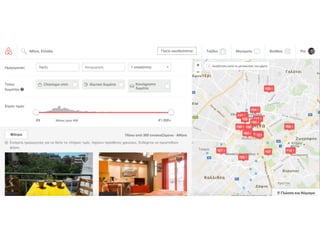
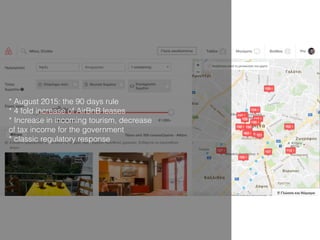
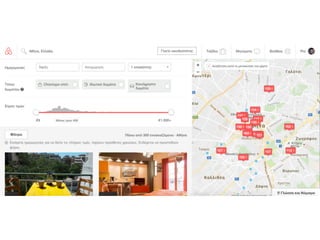
* August 2015: the 90 days rule
* 4 fold increase of AirBnB leases
* Increase in incoming tourism, decrease
of tax income for the government
* classic regulatory response
* initiated in 2012
·Citizens save 12 billion won annually
·The city saved 1.18 trillion won
·1,280 new jobs
·A 29,800 ton reduction of Co2 emissions.
* 57 Sharing organisations
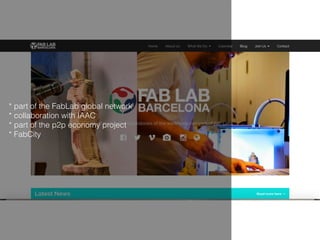
* part of the FabLab global network
* collaboration with IAAC
* part of the p2p economy project
* FabCity
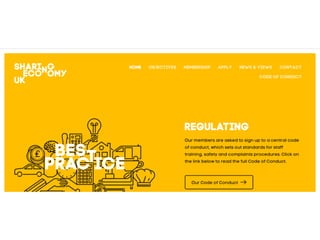
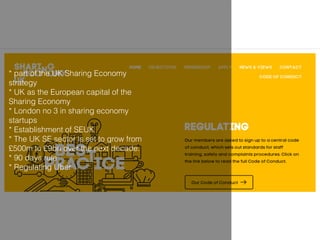
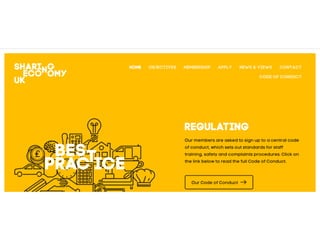
* part of the UK Sharing Economy
strategy
* UK as the European capital of the
Sharing Economy
* London no 3 in sharing economy
startups
* Establishment of SEUK
* The UK SE sector is set to grow from
£500m to £9bn over the next decade.
* 90 days rule
* Regulating Uber
2
Hypothesis
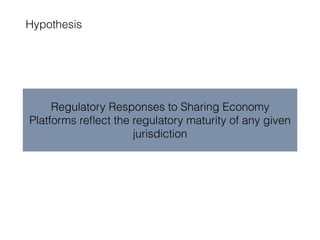
Regulatory Responses to Sharing Economy
Platforms reflect the regulatory maturity of any given
jurisdiction
Hypothesis
3
Key issues
Platforms
+ Sharing Economy
+ Collaborative Economy
“Platforms are generally known as "two-sided" or "multi-
sided" markets where users are brought together by a
platform operator in order to facilitate an interaction
(exchange of information, a commercial transaction,
etc.). In the context of digital markets, depending on a
platform's business model, users can be buyers of
products or services, sellers, advertisers, software
developers, etc.” [1]
I
[1] Commission Staff Working Document on Online Platforms, accompanying the document
"Communication on Online Platforms and the Digital Single Market" (COM(2016) 288)
II
Platforms
+ Sharing Economy
+ Collaborative Economy
For the purposes of this Communication, the term "collaborative economy” refers to
business models where activities are facilitated by collaborative platforms that create
an open marketplace for the temporary usage of goods or services often provided by
private individuals. The collaborative economy involves three categories of actors: (i)
service providers who share assets, resources, time and/or skills — these can be private
individuals offering services on an occasional basis (‘peers’) or service providers
acting in their professional capacity ("professional services providers"); (ii) users of
these; and (iii) intermediaries that connect — via an online platform — providers with
users and that facilitate transactions between them (‘collaborative platforms’).
Collaborative economy transactions generally do not involve a change of ownership
and can be carried out for profit or not-for-profit.
[1] COM(2016) 356 - A European agenda for the collaborative economy
Platforms
+ Sharing Economy
+ Collaborative Economy
“ [CoR] notes that the European Commission uses the
term "collaborative economy" rather than "sharing
economy" and has made a first effort in its recent
Communication on "Upgrading the Single Market" to
define the concept. In the view of the CoR however, the
proposed definition focuses on the commercial and
consumer aspects of the sharing (or collaborative)
economy while leaving aside the non-commercial and
commons-based approaches. Calls therefore on the
European Commission to further analyse and later
define the different forms of the sharing economy;” [1]
[1] BRIGHENTI, Benedetta, 2015 Local and regional dimension of the Sharing Economy
CDR 2698/2015
III
Platforms
+ Sharing Economy
+ Collaborative Economy
“The use of digital platforms or portals to reduce the
scale for viable hiring transactions or viable participation
in consumer hiring markets (i.e. 'sharing' in the sense of
hiring an asset) and thereby reduce the extent to which
assets are under-utilised.” [1]
[1] Pierre Goudin (2016) The Cost of NonEurope in the Sharing Economy European
Parliamentary Research Service PE 558.777
IV
Platforms
+ Sharing Economy
+ Collaborative Economy
Several aspects of the sharing economy can be distinguished:
• 'access economy', where goods and services are traded on the basis of
access rather than ownership. This form refers to renting things temporarily
rather than selling them permanently(e.g. Rent The Runway; ShareDesk;
Airbnb);
• 'gig economy', based on 'contingent work' that is transacted on a digital
marketplace (e.g. Uber;BlaBlaCar; Elance; TaskRabbit);
• 'collaborative economy' based on a peer-to-peer approach, involving users
in the design of theproductive process, transforming consumers into
'prosumers' (i.e. simultaneously producers and consumers) and clients into
community (e.g. Etsy, Kiva);
• the 'commoning economy' for initiatives that are collectively owned and
managed (e.g. Wikipedia, Kickstarter).
[1] : Jana Valant (2016) Sharing economy: They come in like a
wrecking ball EPRS PE 581.956
V
4
Regulatory approaches
Law
Social Norms
Markets
Norms
}
Modalities
of
Regulation
[1], [2],[3], [4]
[1] Lessig, Lawrence. “The New Chicago School.” Journal of Legal Studies 27, no. June (1998): 661–91.
[2] Brownsword, Roger. “Code, Control, and Choice: Why East Is East and West Is West.” Legal Studies 25 (2005): 1–21.
[3] Brownsword, Roger. “Neither East Nor West, Is Mid-West Best?” Script-Ed 3, no. 1 (2006): 15–33.
[4] Murray, Andrew. The Regulation of Cyberspace: Control in the Online Environment. New York, Abingdon: Routledge-
Cavendish, 2007.
Law
Social Norms
Markets
Norms
* Indirection [1]
* Plasticity [1]
* Polycentric Regulation [2]
* Functional Simplification [3]
* Closure [3]
* CBPP vs. Extractive Techs [4], [5]
[1] Lessig, Lawrence. Code : Version 2.0 ; Lawrence Lessig. New York: BasicBooks ; [London : Perseus Running,
distributor], 2006.
[2] Black, Julia. “Proceduralising Regulation: Part I.” Oxford Journal of Legal Studies 20, no. 4 (2000): 597–614.
Black, Julia. “Proceduralising Regulation: Part II.” Oxford Journal of Legal Studies 21, no. 1 (2001): 33–58.
[3] Kallinikos, Jannis. The Consequences of Information : Institutional Implications of Technological Change.
Cheltenham: Edward Elgar, 2006. Table of contents only http://www.loc.gov/catdir/toc/ecip0613/2006014313.html.
[4] Benkler, Yochai. The Wealth of Networks: How Social Production Transforms Markets and Freedom. New Haven
and London: Yale University Press, 2006.
[5] Kallinikos, Jannis. (2011). Governing through technology: Information artefacts and social practice. Palgrave
Macmillan.
5
On Method
(a) the issue of the unit of analysis [1]
(b) journeys of norms [2]
(c) disassembling regulatory artefacts [3]
(d) a two stages analysis
methodological concerns
[1] Latour, Bruno. Reassembling the Social : An Introduction to Actor-Network-Theory.
Oxford: Oxford University Press, 2005.
[2] Bruno Latour, and Christophe Leclercq, eds. Reset Modernity! MIT Press, 2016.
[3] Aaltonen, Aleksi, and Giovan Francesco Lanzara. "Building governance capability in
online social production: insights from Wikipedia." Organization Studies 36.12 (2015):
1649-1673.
6
Cases
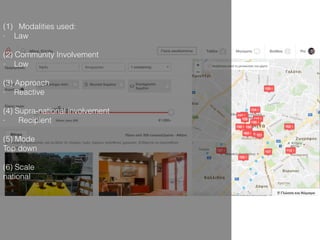
(1) Modalities used:
- Law
(2) Community Involvement
- Low
(3) Approach
- Reactive
(4) Supra-national involvement
- Recipient
(5) Mode
Top down
(6) Scale
national
(1) Modalities used:
- Law
- Community
- Market
- Social Norms
(2) Community Involvement
- High
(3) Approach
- Proactive
- Incremental
(4) Supra-national involvement
- Interactive
(5) Mode
Top down
(6) Scale
local-national-global
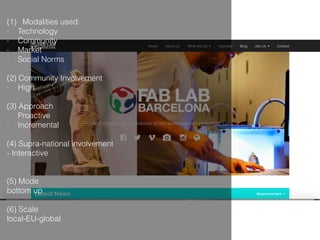
(1) Modalities used:
- Technology
- Community
- Market
- Social Norms
(2) Community Involvement
- High
(3) Approach
- Proactive
- Incremental
(4) Supra-national involvement
- Interactive
(5) Mode
bottom up
(6) Scale
local-EU-global
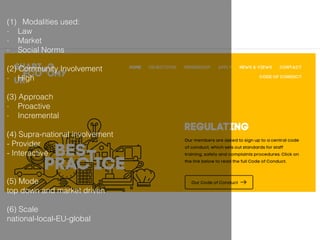
(1) Modalities used:
- Law
- Market
- Social Norms
(2) Community Involvement
- High
(3) Approach
- Proactive
- Incremental
(4) Supra-national involvement
- Provider
- Interactive
(5) Mode
top down and market driven
(6) Scale
national-local-EU-global
7
Conclusions
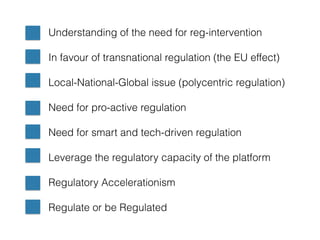
Understanding of the need for reg-intervention
In favour of transnational regulation (the EU effect)
Local-National-Global issue (polycentric regulation)
Need for pro-active regulation
Need for smart and tech-driven regulation
Leverage the regulatory capacity of the platform
Regulatory Accelerationism
Regulate or be Regulated
q a&
p.tsiavos@sgt.gr
karounos@netmode.ntua.gr
petros@math.ntua.gr
@prodromos
@karounosIPP2016 23.09.16

Platform as a mirror 23 09_16_pdf

  • 1.
    Platform as aMirror Understanding Regulatory Cultures Through their interaction with Megaplatforms Dr. Prodromos Tsiavos Theodoros Karounos Dr. Petros Stefaneas p.tsiavos@sgt.gr karounos@netmode.ntua.gr petros@math.ntua.gr IPP2016 23.09.16
  • 2.
  • 3.
  • 5.
    * August 2015:the 90 days rule * 4 fold increase of AirBnB leases * Increase in incoming tourism, decrease of tax income for the government * classic regulatory response
  • 7.
    * initiated in2012 ·Citizens save 12 billion won annually ·The city saved 1.18 trillion won ·1,280 new jobs ·A 29,800 ton reduction of Co2 emissions. * 57 Sharing organisations
  • 9.
    * part ofthe FabLab global network * collaboration with IAAC * part of the p2p economy project * FabCity
  • 11.
    * part ofthe UK Sharing Economy strategy * UK as the European capital of the Sharing Economy * London no 3 in sharing economy startups * Establishment of SEUK * The UK SE sector is set to grow from £500m to £9bn over the next decade. * 90 days rule * Regulating Uber
  • 12.
  • 13.
    Regulatory Responses toSharing Economy Platforms reflect the regulatory maturity of any given jurisdiction Hypothesis
  • 14.
  • 15.
    Platforms + Sharing Economy +Collaborative Economy “Platforms are generally known as "two-sided" or "multi- sided" markets where users are brought together by a platform operator in order to facilitate an interaction (exchange of information, a commercial transaction, etc.). In the context of digital markets, depending on a platform's business model, users can be buyers of products or services, sellers, advertisers, software developers, etc.” [1] I [1] Commission Staff Working Document on Online Platforms, accompanying the document "Communication on Online Platforms and the Digital Single Market" (COM(2016) 288)
  • 16.
    II Platforms + Sharing Economy +Collaborative Economy For the purposes of this Communication, the term "collaborative economy” refers to business models where activities are facilitated by collaborative platforms that create an open marketplace for the temporary usage of goods or services often provided by private individuals. The collaborative economy involves three categories of actors: (i) service providers who share assets, resources, time and/or skills — these can be private individuals offering services on an occasional basis (‘peers’) or service providers acting in their professional capacity ("professional services providers"); (ii) users of these; and (iii) intermediaries that connect — via an online platform — providers with users and that facilitate transactions between them (‘collaborative platforms’). Collaborative economy transactions generally do not involve a change of ownership and can be carried out for profit or not-for-profit. [1] COM(2016) 356 - A European agenda for the collaborative economy
  • 17.
    Platforms + Sharing Economy +Collaborative Economy “ [CoR] notes that the European Commission uses the term "collaborative economy" rather than "sharing economy" and has made a first effort in its recent Communication on "Upgrading the Single Market" to define the concept. In the view of the CoR however, the proposed definition focuses on the commercial and consumer aspects of the sharing (or collaborative) economy while leaving aside the non-commercial and commons-based approaches. Calls therefore on the European Commission to further analyse and later define the different forms of the sharing economy;” [1] [1] BRIGHENTI, Benedetta, 2015 Local and regional dimension of the Sharing Economy CDR 2698/2015 III
  • 18.
    Platforms + Sharing Economy +Collaborative Economy “The use of digital platforms or portals to reduce the scale for viable hiring transactions or viable participation in consumer hiring markets (i.e. 'sharing' in the sense of hiring an asset) and thereby reduce the extent to which assets are under-utilised.” [1] [1] Pierre Goudin (2016) The Cost of NonEurope in the Sharing Economy European Parliamentary Research Service PE 558.777 IV
  • 19.
    Platforms + Sharing Economy +Collaborative Economy Several aspects of the sharing economy can be distinguished: • 'access economy', where goods and services are traded on the basis of access rather than ownership. This form refers to renting things temporarily rather than selling them permanently(e.g. Rent The Runway; ShareDesk; Airbnb); • 'gig economy', based on 'contingent work' that is transacted on a digital marketplace (e.g. Uber;BlaBlaCar; Elance; TaskRabbit); • 'collaborative economy' based on a peer-to-peer approach, involving users in the design of theproductive process, transforming consumers into 'prosumers' (i.e. simultaneously producers and consumers) and clients into community (e.g. Etsy, Kiva); • the 'commoning economy' for initiatives that are collectively owned and managed (e.g. Wikipedia, Kickstarter). [1] : Jana Valant (2016) Sharing economy: They come in like a wrecking ball EPRS PE 581.956 V
  • 20.
  • 21.
    Law Social Norms Markets Norms } Modalities of Regulation [1], [2],[3],[4] [1] Lessig, Lawrence. “The New Chicago School.” Journal of Legal Studies 27, no. June (1998): 661–91. [2] Brownsword, Roger. “Code, Control, and Choice: Why East Is East and West Is West.” Legal Studies 25 (2005): 1–21. [3] Brownsword, Roger. “Neither East Nor West, Is Mid-West Best?” Script-Ed 3, no. 1 (2006): 15–33. [4] Murray, Andrew. The Regulation of Cyberspace: Control in the Online Environment. New York, Abingdon: Routledge- Cavendish, 2007.
  • 22.
    Law Social Norms Markets Norms * Indirection[1] * Plasticity [1] * Polycentric Regulation [2] * Functional Simplification [3] * Closure [3] * CBPP vs. Extractive Techs [4], [5] [1] Lessig, Lawrence. Code : Version 2.0 ; Lawrence Lessig. New York: BasicBooks ; [London : Perseus Running, distributor], 2006. [2] Black, Julia. “Proceduralising Regulation: Part I.” Oxford Journal of Legal Studies 20, no. 4 (2000): 597–614. Black, Julia. “Proceduralising Regulation: Part II.” Oxford Journal of Legal Studies 21, no. 1 (2001): 33–58. [3] Kallinikos, Jannis. The Consequences of Information : Institutional Implications of Technological Change. Cheltenham: Edward Elgar, 2006. Table of contents only http://www.loc.gov/catdir/toc/ecip0613/2006014313.html. [4] Benkler, Yochai. The Wealth of Networks: How Social Production Transforms Markets and Freedom. New Haven and London: Yale University Press, 2006. [5] Kallinikos, Jannis. (2011). Governing through technology: Information artefacts and social practice. Palgrave Macmillan.
  • 23.
  • 24.
    (a) the issueof the unit of analysis [1] (b) journeys of norms [2] (c) disassembling regulatory artefacts [3] (d) a two stages analysis methodological concerns [1] Latour, Bruno. Reassembling the Social : An Introduction to Actor-Network-Theory. Oxford: Oxford University Press, 2005. [2] Bruno Latour, and Christophe Leclercq, eds. Reset Modernity! MIT Press, 2016. [3] Aaltonen, Aleksi, and Giovan Francesco Lanzara. "Building governance capability in online social production: insights from Wikipedia." Organization Studies 36.12 (2015): 1649-1673.
  • 25.
  • 27.
    (1) Modalities used: -Law (2) Community Involvement - Low (3) Approach - Reactive (4) Supra-national involvement - Recipient (5) Mode Top down (6) Scale national
  • 29.
    (1) Modalities used: -Law - Community - Market - Social Norms (2) Community Involvement - High (3) Approach - Proactive - Incremental (4) Supra-national involvement - Interactive (5) Mode Top down (6) Scale local-national-global
  • 31.
    (1) Modalities used: -Technology - Community - Market - Social Norms (2) Community Involvement - High (3) Approach - Proactive - Incremental (4) Supra-national involvement - Interactive (5) Mode bottom up (6) Scale local-EU-global
  • 33.
    (1) Modalities used: -Law - Market - Social Norms (2) Community Involvement - High (3) Approach - Proactive - Incremental (4) Supra-national involvement - Provider - Interactive (5) Mode top down and market driven (6) Scale national-local-EU-global
  • 34.
  • 35.
    Understanding of theneed for reg-intervention In favour of transnational regulation (the EU effect) Local-National-Global issue (polycentric regulation) Need for pro-active regulation Need for smart and tech-driven regulation Leverage the regulatory capacity of the platform Regulatory Accelerationism Regulate or be Regulated
  • 36.