1 800-916-7680
LED Grow Lights:
Power, Spectral Output,
and your ROI Explained.
By Jef Schaefer
Chicago/USA
Montreal/Canada
Horticulture lighting lighting has advanced tremendously in a relatively short period. Research and development in
plant growth science have experienced a dynamic increase in funding, fueled by the evolving medical and recreational
cannabis industries. Across the globe, wherever production of this high-value plant is legal; entrepreneurs are building
their future around the business of cannabis. The fledgling industry continues to evolve and change, and as it matures,
there is at least one trait it shares with all industries that want to survive; Create the best product the most efficiently at
the lowest cost.
This paper aims to isolate and explain two key factors
to consider when investing in horticulture lighting. It
details the effect they can have on a business’s ROI
and explain why smart procurement decisions keep
the complete plant growth environment in mind.
LED GROW LIGHTS: POWER, SPECTRAL OUTPUT, AND YOUR ROI EXPLAINED.
$0
Growth of the U.S. Legal Canabis Industry
2019-2025 est. ($USD billions)
$50
$13.2
$7.4
$11.6
$14.9
$11.0
$18.4
$12.8
$21.3
$23.5 $25.1
$20.1
$25.9
$31.3
$35.6
$39.0
$41.5
2025e
2024e
2023e
2022e
2021e
2020e
2019
$40
$30
$20
$10
$USD
BILLIONS
Growth projections from New Frontier Data; Cannabis in America for 2021 & Beyond: A New Normal in Consumption and Demand.
When LED-equipped grow lights were first introduced to the
commercial horticulture industry, there was incredible interest in
the low-power consumption, decreased heat output, safety, and
other benefits. However, the cutting-edge technology was too
expensive, and the investment required eliminated any chance of
turning a profit in a large-scale commercial setting.
A decade later, mass production of LEDs for residential use along
with improved manufacturing processes have greatly reduced the
cost of LED chip technology. Todays LED light is significantly more
efficient and as much as 94% less expensive (1).
The introduction of phosphors onto Blue LEDs to create various
widebandspectrumshasimprovedPARperformance(2).Research
into the light spectrum effects on plant growth has improved our
understanding of photosynthesis and light absorption, improving
grow light efficiency and efficacy. It is now feasible to equip a
commercial grow op with LED lighting and have an ROI within
months, not years.
!!


Relative Cost for LED 800 Im A19 Lamp
1.00
0.80
0.60
0.40
0.20
0.00
2013 2014 2015 2016 2017 2018 2019 2020
LED GROW LIGHTS: POWER, SPECTRAL OUTPUT, AND YOUR ROI EXPLAINED.
Articles and publications comparing HID grow lights
to LED grow lights are easily found on the internet (3)
(4) and will not be repeated here. Any well-managed
comparison will conclude the only advantage to
using HID is the initial start-up investment. That
advantage is quickly eroding as LED technology
matures and manufacturing costs decrease.
Comparing LED grow lights to each other is more
complicated than HID fixtures. There is a lot more
to consider than the reflector shape and the bulb’s
maximum output. For the purpose of selecting
the best suited LED grow lights for medical and
commercial cannabis production we will isolate and
focus on two key features: Power and Spectrum.
Here, the term “Power” is used to represent
both what the light fixture is giving and what it
is taking. The design or upgrade of a cultivation
center’s plant grow lighting must consider how
much light is required for a successful harvest
and what the electrical productions costs will be.
For a clear decision and to truly take advantage
of LED lighting benefits, the complete grow
environment must be included.
How much light is needed?
A business cannot waste its’ resources if it expects to turn a profit. For cannabis growers, light is a resource. The light
that does not land on a plant is a waste of resources because it will not be used for photosynthesis. Often overlooked
is that light touching the plants but beyond what they can efficiently use for photosynthesis is also wasted. The amount
of spectral radiation a plant can process into photosynthesis over 24hrs is measured as the Daily Light Integral (DLI)
(5). Cannabis is a PAR thirsty and high DLI plant, but to truly take advantage of that thirst requires a tightly controlled
environment.
Power
LED GROW LIGHTS: POWER, SPECTRAL OUTPUT, AND YOUR ROI EXPLAINED.
Power
Knowing the PPF a crop requires establishes the POWER
the grow light must give. It is a first step towards choosing
the grow light fixture that maximizes the return on
investment. The next step is understanding the POWER
the fixture is taking.
Though fixtures up to 2000W and more can be found, the
market-leading high-output LED grow light fixtures used
for commercial cannabis production vary on average
from 580W to 670W. The rated watts output directly
affects the PPFD produced and the energy consumption
of the fixture. In North America, Samsung and Osram
built chips dominate the horticulture lighting market.
In most instances, compared fixtures will share the
same LED chips and 120-degree optics. The difference
comes from the chosen array (creating the plant growth
spectrum discussed later), the fixture’s physical design,
and the power consumption.
LED GROW LIGHTS: POWER, SPECTRAL OUTPUT, AND YOUR ROI EXPLAINED.
5
0
10
15
20
25
30
35
40
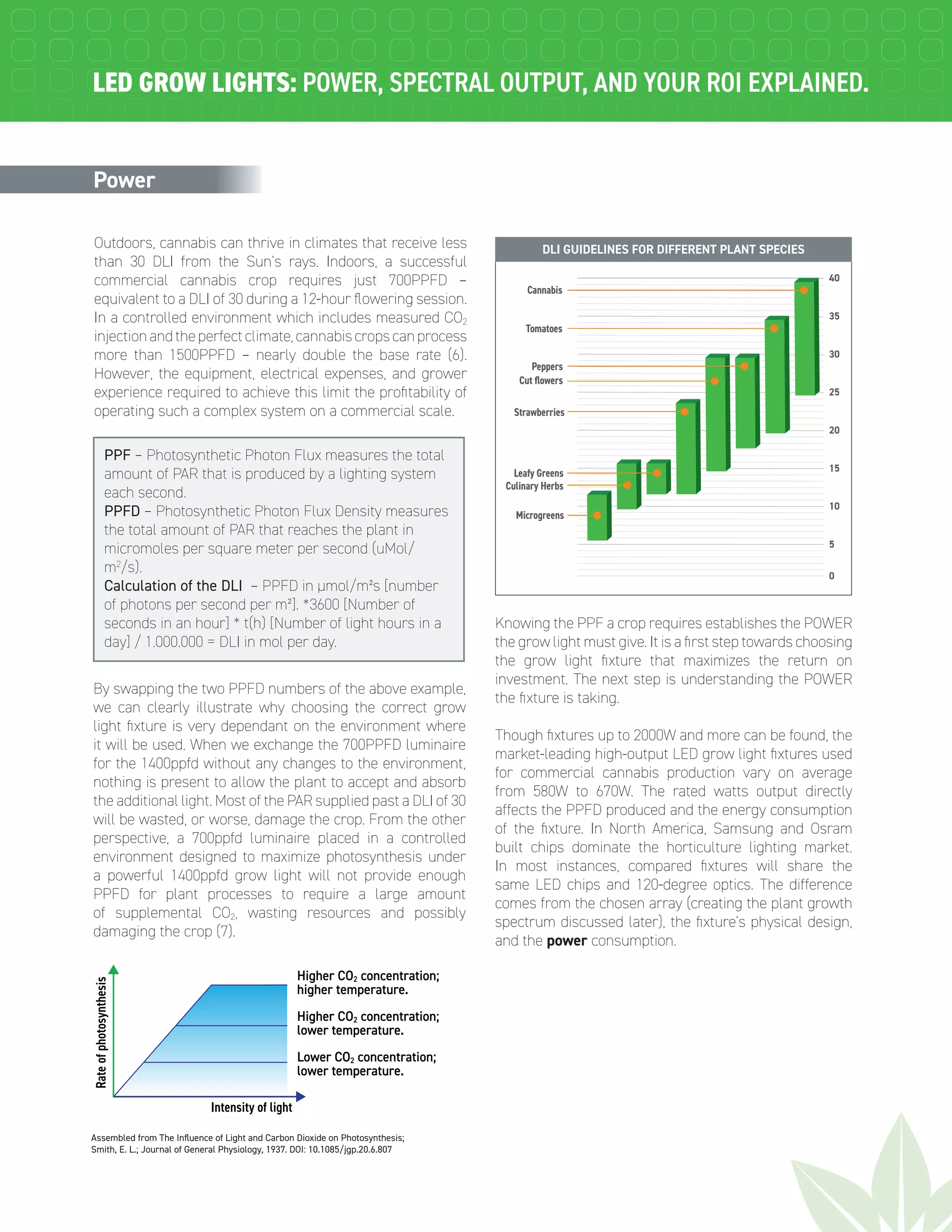
Microgreens
Culinary Herbs
Leafy Greens
Strawberries
Cut flowers
Peppers
Tomatoes
Cannabis
DLI GUIDELINES FOR DIFFERENT PLANT SPECIES
Outdoors, cannabis can thrive in climates that receive less
than 30 DLI from the Sun’s rays. Indoors, a successful
commercial cannabis crop requires just 700PPFD –
equivalent to a DLI of 30 during a 12-hour flowering session.
In a controlled environment which includes measured CO2
injectionandtheperfectclimate,cannabiscropscanprocess
more than 1500PPFD – nearly double the base rate (6).
However, the equipment, electrical expenses, and grower
experience required to achieve this limit the profitability of
operating such a complex system on a commercial scale.
PPF – Photosynthetic Photon Flux measures the total
amount of PAR that is produced by a lighting system
each second.
PPFD – Photosynthetic Photon Flux Density measures
the total amount of PAR that reaches the plant in
micromoles per square meter per second (uMol/
m2
/s).
Calculation of the DLI – PPFD in μmol/m²s [number
of photons per second per m²]. *3600 [Number of
seconds in an hour] * t(h) [Number of light hours in a
day] / 1.000.000 = DLI in mol per day.
By swapping the two PPFD numbers of the above example,
we can clearly illustrate why choosing the correct grow
light fixture is very dependant on the environment where
it will be used. When we exchange the 700PPFD luminaire
for the 1400ppfd without any changes to the environment,
nothing is present to allow the plant to accept and absorb
the additional light. Most of the PAR supplied past a DLI of 30
will be wasted, or worse, damage the crop. From the other
perspective, a 700ppfd luminaire placed in a controlled
environment designed to maximize photosynthesis under
a powerful 1400ppfd grow light will not provide enough
PPFD for plant processes to require a large amount
of supplemental CO2, wasting resources and possibly
damaging the crop (7).
Higher CO2 concentration;
higher temperature.
Higher CO2 concentration;
lower temperature.
Lower CO2 concentration;
lower temperature.
Rate
of
photosynthesis
Intensity of light
Assembled from The Influence of Light and Carbon Dioxide on Photosynthesis;
Smith, E. L.; Journal of General Physiology, 1937. DOI: 10.1085/jgp.20.6.807
Watts do not matter, at least not in the traditional terms used by
medical growers. Driver and chip watts state the electrical input
and do not represent the light output. Additionally, the volume
of LED chips and the current used to run them varies with each
fixture. The old standard of “Watts per gram” cannot be applied.
PPFD measures the amount of PAR that reaches the plant and
is used instead as a more accurate measure of useable light
output. A well-designed LED grow light will balance electrical
consumption with PPFD and spectral efficacy.
The rated PPF output listed by manufacturers represents the maximum output under ideal operating temperatures.
The manufacturer provides the PPF, and fixture testing height will range from six to twelve inches. This measurement is
irrelevant in practice. The radiant heat produced by the high-intensity grow lights will stress, if not cook, the plant canopy
at six inches distance. Also, the vast majority of horticulture grow lights use a chip with 120 degrees light distribution. The
grow light fixture’s square-foot coverage is severely reduced and the PAR spectrum recipe compromised at such a close
distance.
The rated input in watts comes into play when considering the grow room environment and the PPF required for maximum
plant growth. By suspending other vital factors considered when investing in LED grow lighting, such as PAR spectrum,
warranty, and build quality, the selection dramatically decreases. Selecting a fixture that can meet the required PPF is the
first step. Next is knowing where the grow lights mount in the cultivation area.
Why Watts matter.
Daily PPFD Reference Table
Forward voltage (@ 1050 mA, 85 °C)
Forward voltage (@ 1500 mA, 85 °C)
Forward voltage (@ 2000 mA, 85 °C)
Forward voltage (@ 3000 mA, 85 °C)
2.95V
3.05V
3.15V
3.35V
24-Hour Photoperiod
PPFD DLI
100 9
200 17
300 26
600 52
1000 86
2000 173
16-Hour Photoperiod 12-Hour Photoperiod
PPFD DLI PPFD DLI
100 6
200 11.5
300 17
600 34.5
1000 57.5
2000 115
100 4
200 9
300 13
600 26
1000 43
2000 86
LED GROW LIGHTS: POWER, SPECTRAL OUTPUT, AND YOUR ROI EXPLAINED.
Less Power Required
The closer the lights can be mounted to a crop’s canopy, the less power will be required to drive the nourishing PAR
photons to the plants. The further away the lights must be installed, the more power will be required to accomplish the
same goal. Whether the considered grow light has an output of 1200ppfd or 2100ppfd, the amount required for the crop
is likely between 700 – 900uMol/s. The logical choice is which grow light can deliver the PPFD required by the crop at the
crop’s installed distance, with the least amount of power (Watts)?
Achieving a balance between the production needs and the
production equipment is an essential step to profitability
and a quick return on investment.
®
®
LED GROW LIGHTS: POWER, SPECTRAL OUTPUT, AND YOUR ROI EXPLAINED.
California Michigan
Electrical Costs 12hrs/day over 5 years
$4,300
$3,800
$3,300
$2,800
$2,300
$1,800
$1,300
$800
$300
Mass
600W 650W 700W 800W
LED GROW LIGHTS: POWER, SPECTRAL OUTPUT, AND YOUR ROI EXPLAINED.
Spectrum
Early research in artificial lighting and photosynthesis
led to a popular misunderstanding; the 400-500nm
(Blue) and the 600-700nm (Red) wavelengths were
solely responsible for photosynthesis in plants (8).
By ignoring the details and popularizing an easy-to-
comprehend but inaccurate summary, unscrupulous
lighting manufacturers created a secondary market
for themselves. Meanwhile, horticulturists and indoor
gardeners spent the next few decades using primarily
Blue and Red spectrum lighting on their crops.
Cannabis cultivators adapted this research and
developed a successful strategy. The Blue end of the
spectrum would be emphasized to increase leaf growth
during a plant’s vegetative phase, most commonly with
high-intensity discharge (HID) metal-halide lamps. The
flowering phase would be reversed, receiving more light
from primarily Red light sources like HID high-pressure
sodium lamps, which helped increase height and flower
development. This strategy involved an elaborate room
and lamp swapping system to compensate for the plant’s
growth stage and photoperiod. Production costs were
high; The high-powered HID systems were electrically
inefficient and costly to operate; The excessive amounts
of heat they generate would create climate issues within
the crop; Heating, ventilation, and air cooling costs were
high. However, the effective LED grow lights of this time
remained too expensive for use on large-scale crops. The
underpowered but affordable red/blue fixtures sold to
the public were as effective as the proverbial Snake Oil.
It would be accurate to state that everything has changed
in the last decade. Advances in horticulture research and
knowledge sharing have returned the focus to what had
been confirmed decades ago; that higher plants can
process a wide range of wavelengths into photosynthesis
(9). More recent studies have demonstrated the physical
effects of emphasizing the ratio of specific wavelengths
over others, with positive and negative results (10).
Reconfirming and popularizing the role the 500-600nm
(Green) wavelength plays in photosynthesis (11) has
led to significant improvements in the science and
affordability of horticulture lighting. It has also created
some chaos within the industry.
On the one hand, Blue chips with phosphors added to
create lighting for humans were mass-produced, and
these chips cover a broad spectrum from 400-700nM.
With some modifications to the chip layout and selection,
they can create an optimal plant growth spectrum recipe.
On the other hand, opportunistic lighting manufacturers
created chaos by flooding the market with high lumen
warehouse lighting not designed for horticulture. Though
warehouse lighting delivers a strong PPF reading, the
skewed B:G:R ratio of the PAR spectrum produces slow-
growing plants with poor development. These products’
flaws are less noticeable for hobbyist growers but are
devastating for a commercial cultivator’s investment.
The PPFD and watts used are not the only LED grow light features that vary significantly across commercial grow lights
used for cannabis production. Even more confusing is the number of different spectral outputs promoted as the ideal PAR
spectrum for indoor growing and cannabis specifically.
PAR spectrums for horticulture growth vary among manufacturers. Information gathered from designlights.org.
380 480 580 680 780
0.0
0. 2
0. 4
0. 6
0. 8
1. 0
1. 2
LED GROW LIGHTS: POWER, SPECTRAL OUTPUT, AND YOUR ROI EXPLAINED.
How do you choose?
Research on indoor plant growth through artificial
lighting increasingly demonstrates there is no perfect
PAR spectrum recipe.
The optimal light recipe varies between
species, sub-species, and cultivars. The
plant’s ability to absorb and process
different spectral wavelengths is strongly
influenced by the cultivation environment,
the chosen production method, the nutrient
schedule, and a plethora of other factors (12).
Optimizing LED lighting for the horticulture industry is still
in its infancy. An optimal strategy for using high-quality
LED lighting in horticulture is to select the best spectra
for a specific crop or cultivar, offering improved quality
in the most energy-efficient way. While photosynthetic
responses are similar among the various plant types, a
morphological response is more species- and cultivar-
specific.
For the cannabis plant, the optimal spectral recipe varies
like any other plant species. Achieving that perfect plant
growth spectrum for a specific strain requires multiple
trials under repeatable conditions. Maximizing production
output while reducing costs should be on the list of every
successful business. However, testing and evaluating
luminaires can take months, if not years, and is not
always economically feasible for a commercial cultivator.
Fortunately, optimal is not necessary to be profitable. A
sealed growth chamber with high-power LED grow lights
fine-tuned to the cultivar’s genetic DNA is not required.
By including quality grow lighting specifically built for
horticulture and a reliable spectral recipe that benefits
cannabis, a successful harvest is achieved.
LED GROW LIGHTS: POWER, SPECTRAL OUTPUT, AND YOUR ROI EXPLAINED.
Spectral range in nanometers
Average
plant
response
Chlorophyil a
Chlorophyil b
300 350 400 450 500 550 600 650 700 750 800
Selecting a growth spectrum
The addition of UV, Violet, Far Red, and other wavelengths outside of the 400-700nM can have beneficial or disastrous
effects on a crop. Results are dependant on the species and grow environment. Stunted growth or excessive elongation
for some, improved dry weight, or increased plant oils for others. A consensus for optimizing plant growth through
spectral manipulation is to use these wavelengths at specific growth phases as the plants mature, but the results are not
uniform or conclusive.
Until more research is complete and trials run in the field, the risks outweigh the benefits for a cultivator to include
significant amounts of these wavelengths in the fixed light recipe. For best results, a grow light should include a PAR
spectrum with a balanced B:G:R ratio designed for high DLI plants.
Blue and Red light are the driving force behind chlorophyll absorption and photosynthesis (8). Under monochromatic
light, either Blue or Red, natural plant growth suffers. Research suggests that a minimum of 7% Blue light is required to
produce near-natural growth (13). In practice, a 25-35% Blue to Red light balance will grow a healthy plant. In tandem,
they cover Chlorophyll A and Chlorophyll B’s absorption peaks and are the base to creating a successful PAR recipe.
As previously stated, the importance of the 500-600nM (Green) spectrum for photosynthesis and plant growth is confirmed.
However, problems with excessive Green in the spectral ratio can stunt growth and plant morphology. At 24% or less of
the spectrum, Green enhances plant growth. When Green is dominant at greater than 50% of the PAR spectrum, research
shows that growth is slowed and stunted (14). More pertinent to the cannabis industry, experiments (15) where the
G:R ratio was higher than 50% showed decreases in THC levels (10) (16). Natural plant growth and a healthy crop are
achievable by balancing the B:G:R and the G:R spectral wavelength ratios.
The image below demonstrates the average plant response to different wavelengths based on McCree’s studies (8). It is
clear that plants respond to wavelengths outside of the 400-700nM (B:G:R) range. Horticulture scientists and ambitious
growers are experimenting with these wavelengths, pushing the boundaries of plant lighting in search of the optimum
growth spectrum to produce super plants. The cannabis industry remains at the forefront of these experiments, with
incredible anecdotal results presented daily via social media.
LED GROW LIGHTS: POWER, SPECTRAL OUTPUT, AND YOUR ROI EXPLAINED.
Summary: The ROI.
The purpose of this paper is to simplify and explain two key factors to consider when investing in horticulture lighting and
how they affect a business’s return on investment. The additional positive factors affecting an ROI, such as fixture lifespan
and maintenance costs, are not considered here.
First, determining Power and establishing the crop’s true lighting requirements provides a base for selecting a suitable
grow light.
• Lowering fixture height reduces PPF output required.
• Essential instead of excessive PPF lowers specification requirements and the initial cost of lighting equipment.
• Lower power draw reduces energy costs. chart
Second, observing Spectrum ratios will help ensure natural crop development and a dependable, repeatable harvest.
Product consistency and quality lead to repeat sales and increased market share.
• A horticulture-specific balanced spectrum ensures natural plant growth and health.
• Awareness of the B:G:R and the G:R ratios in any grow light under consideration will protect the growth and
medical value of a cannabis crop.
• Fixtures with enhanced wavelengths outside of the 400-700nM range, such as UV-A, UV-B, Far Red, are more
costly to manufacture. Hence, a more significant investment.
• The benefits of grow lighting, including excessive amounts of wavelengths outside the 400-700nM PAR zone,
remain unproven and risky for commercial growers.
• Commercial cultivators should invest in trusted technology with a solid ROI until they can run their research and
develop optimum lighting in-house.
Segregating the grow light system helps to determine the exact specification requirements for production. This method
should apply to all cultivation equipment involved in the planning. Accurate production requirements established for all
grow room parameters simplify selection and procurement, reduces layout and design changes, and lowers marketing
and peer influence.
There are numerous factors involved in the layout and design of a legal cannabis cultivation facility. On the subject of
horticulture lighting, the information contained here should be considered along with, and not in place of, those factors.
Selecting horticulture lighting with the complete plant growth environment in mind ensures cost savings, improved
production, and a quick return-on-investment.
LED GROW LIGHTS: POWER, SPECTRAL OUTPUT, AND YOUR ROI EXPLAINED.

LED Grow Lights: Power, Spectral Output, & ROI Explained

  • 1.
    1 800-916-7680 LED GrowLights: Power, Spectral Output, and your ROI Explained. By Jef Schaefer Chicago/USA Montreal/Canada
  • 2.
    Horticulture lighting lightinghas advanced tremendously in a relatively short period. Research and development in plant growth science have experienced a dynamic increase in funding, fueled by the evolving medical and recreational cannabis industries. Across the globe, wherever production of this high-value plant is legal; entrepreneurs are building their future around the business of cannabis. The fledgling industry continues to evolve and change, and as it matures, there is at least one trait it shares with all industries that want to survive; Create the best product the most efficiently at the lowest cost. This paper aims to isolate and explain two key factors to consider when investing in horticulture lighting. It details the effect they can have on a business’s ROI and explain why smart procurement decisions keep the complete plant growth environment in mind. LED GROW LIGHTS: POWER, SPECTRAL OUTPUT, AND YOUR ROI EXPLAINED. $0 Growth of the U.S. Legal Canabis Industry 2019-2025 est. ($USD billions) $50 $13.2 $7.4 $11.6 $14.9 $11.0 $18.4 $12.8 $21.3 $23.5 $25.1 $20.1 $25.9 $31.3 $35.6 $39.0 $41.5 2025e 2024e 2023e 2022e 2021e 2020e 2019 $40 $30 $20 $10 $USD BILLIONS Growth projections from New Frontier Data; Cannabis in America for 2021 & Beyond: A New Normal in Consumption and Demand.
  • 3.
    When LED-equipped growlights were first introduced to the commercial horticulture industry, there was incredible interest in the low-power consumption, decreased heat output, safety, and other benefits. However, the cutting-edge technology was too expensive, and the investment required eliminated any chance of turning a profit in a large-scale commercial setting. A decade later, mass production of LEDs for residential use along with improved manufacturing processes have greatly reduced the cost of LED chip technology. Todays LED light is significantly more efficient and as much as 94% less expensive (1). The introduction of phosphors onto Blue LEDs to create various widebandspectrumshasimprovedPARperformance(2).Research into the light spectrum effects on plant growth has improved our understanding of photosynthesis and light absorption, improving grow light efficiency and efficacy. It is now feasible to equip a commercial grow op with LED lighting and have an ROI within months, not years.
  • 4.
    !! Relative Cost forLED 800 Im A19 Lamp 1.00 0.80 0.60 0.40 0.20 0.00 2013 2014 2015 2016 2017 2018 2019 2020 LED GROW LIGHTS: POWER, SPECTRAL OUTPUT, AND YOUR ROI EXPLAINED. Articles and publications comparing HID grow lights to LED grow lights are easily found on the internet (3) (4) and will not be repeated here. Any well-managed comparison will conclude the only advantage to using HID is the initial start-up investment. That advantage is quickly eroding as LED technology matures and manufacturing costs decrease. Comparing LED grow lights to each other is more complicated than HID fixtures. There is a lot more to consider than the reflector shape and the bulb’s maximum output. For the purpose of selecting the best suited LED grow lights for medical and commercial cannabis production we will isolate and focus on two key features: Power and Spectrum.
  • 5.
    Here, the term“Power” is used to represent both what the light fixture is giving and what it is taking. The design or upgrade of a cultivation center’s plant grow lighting must consider how much light is required for a successful harvest and what the electrical productions costs will be. For a clear decision and to truly take advantage of LED lighting benefits, the complete grow environment must be included. How much light is needed? A business cannot waste its’ resources if it expects to turn a profit. For cannabis growers, light is a resource. The light that does not land on a plant is a waste of resources because it will not be used for photosynthesis. Often overlooked is that light touching the plants but beyond what they can efficiently use for photosynthesis is also wasted. The amount of spectral radiation a plant can process into photosynthesis over 24hrs is measured as the Daily Light Integral (DLI) (5). Cannabis is a PAR thirsty and high DLI plant, but to truly take advantage of that thirst requires a tightly controlled environment. Power LED GROW LIGHTS: POWER, SPECTRAL OUTPUT, AND YOUR ROI EXPLAINED.
  • 6.
    LED GROW LIGHTS:POWER, SPECTRAL OUTPUT, AND YOUR ROI EXPLAINED. Power Knowing the PPF a crop requires establishes the POWER the grow light must give. It is a first step towards choosing the grow light fixture that maximizes the return on investment. The next step is understanding the POWER the fixture is taking. Though fixtures up to 2000W and more can be found, the market-leading high-output LED grow light fixtures used for commercial cannabis production vary on average from 580W to 670W. The rated watts output directly affects the PPFD produced and the energy consumption of the fixture. In North America, Samsung and Osram built chips dominate the horticulture lighting market. In most instances, compared fixtures will share the same LED chips and 120-degree optics. The difference comes from the chosen array (creating the plant growth spectrum discussed later), the fixture’s physical design, and the power consumption. LED GROW LIGHTS: POWER, SPECTRAL OUTPUT, AND YOUR ROI EXPLAINED. 5 0 10 15 20 25 30 35 40 Microgreens Culinary Herbs Leafy Greens Strawberries Cut flowers Peppers Tomatoes Cannabis DLI GUIDELINES FOR DIFFERENT PLANT SPECIES Outdoors, cannabis can thrive in climates that receive less than 30 DLI from the Sun’s rays. Indoors, a successful commercial cannabis crop requires just 700PPFD – equivalent to a DLI of 30 during a 12-hour flowering session. In a controlled environment which includes measured CO2 injectionandtheperfectclimate,cannabiscropscanprocess more than 1500PPFD – nearly double the base rate (6). However, the equipment, electrical expenses, and grower experience required to achieve this limit the profitability of operating such a complex system on a commercial scale. PPF – Photosynthetic Photon Flux measures the total amount of PAR that is produced by a lighting system each second. PPFD – Photosynthetic Photon Flux Density measures the total amount of PAR that reaches the plant in micromoles per square meter per second (uMol/ m2 /s). Calculation of the DLI – PPFD in μmol/m²s [number of photons per second per m²]. *3600 [Number of seconds in an hour] * t(h) [Number of light hours in a day] / 1.000.000 = DLI in mol per day. By swapping the two PPFD numbers of the above example, we can clearly illustrate why choosing the correct grow light fixture is very dependant on the environment where it will be used. When we exchange the 700PPFD luminaire for the 1400ppfd without any changes to the environment, nothing is present to allow the plant to accept and absorb the additional light. Most of the PAR supplied past a DLI of 30 will be wasted, or worse, damage the crop. From the other perspective, a 700ppfd luminaire placed in a controlled environment designed to maximize photosynthesis under a powerful 1400ppfd grow light will not provide enough PPFD for plant processes to require a large amount of supplemental CO2, wasting resources and possibly damaging the crop (7). Higher CO2 concentration; higher temperature. Higher CO2 concentration; lower temperature. Lower CO2 concentration; lower temperature. Rate of photosynthesis Intensity of light Assembled from The Influence of Light and Carbon Dioxide on Photosynthesis; Smith, E. L.; Journal of General Physiology, 1937. DOI: 10.1085/jgp.20.6.807
  • 7.
    Watts do notmatter, at least not in the traditional terms used by medical growers. Driver and chip watts state the electrical input and do not represent the light output. Additionally, the volume of LED chips and the current used to run them varies with each fixture. The old standard of “Watts per gram” cannot be applied. PPFD measures the amount of PAR that reaches the plant and is used instead as a more accurate measure of useable light output. A well-designed LED grow light will balance electrical consumption with PPFD and spectral efficacy. The rated PPF output listed by manufacturers represents the maximum output under ideal operating temperatures. The manufacturer provides the PPF, and fixture testing height will range from six to twelve inches. This measurement is irrelevant in practice. The radiant heat produced by the high-intensity grow lights will stress, if not cook, the plant canopy at six inches distance. Also, the vast majority of horticulture grow lights use a chip with 120 degrees light distribution. The grow light fixture’s square-foot coverage is severely reduced and the PAR spectrum recipe compromised at such a close distance. The rated input in watts comes into play when considering the grow room environment and the PPF required for maximum plant growth. By suspending other vital factors considered when investing in LED grow lighting, such as PAR spectrum, warranty, and build quality, the selection dramatically decreases. Selecting a fixture that can meet the required PPF is the first step. Next is knowing where the grow lights mount in the cultivation area. Why Watts matter. Daily PPFD Reference Table Forward voltage (@ 1050 mA, 85 °C) Forward voltage (@ 1500 mA, 85 °C) Forward voltage (@ 2000 mA, 85 °C) Forward voltage (@ 3000 mA, 85 °C) 2.95V 3.05V 3.15V 3.35V 24-Hour Photoperiod PPFD DLI 100 9 200 17 300 26 600 52 1000 86 2000 173 16-Hour Photoperiod 12-Hour Photoperiod PPFD DLI PPFD DLI 100 6 200 11.5 300 17 600 34.5 1000 57.5 2000 115 100 4 200 9 300 13 600 26 1000 43 2000 86 LED GROW LIGHTS: POWER, SPECTRAL OUTPUT, AND YOUR ROI EXPLAINED.
  • 8.
    Less Power Required Thecloser the lights can be mounted to a crop’s canopy, the less power will be required to drive the nourishing PAR photons to the plants. The further away the lights must be installed, the more power will be required to accomplish the same goal. Whether the considered grow light has an output of 1200ppfd or 2100ppfd, the amount required for the crop is likely between 700 – 900uMol/s. The logical choice is which grow light can deliver the PPFD required by the crop at the crop’s installed distance, with the least amount of power (Watts)? Achieving a balance between the production needs and the production equipment is an essential step to profitability and a quick return on investment. ® ® LED GROW LIGHTS: POWER, SPECTRAL OUTPUT, AND YOUR ROI EXPLAINED. California Michigan Electrical Costs 12hrs/day over 5 years $4,300 $3,800 $3,300 $2,800 $2,300 $1,800 $1,300 $800 $300 Mass 600W 650W 700W 800W
  • 9.
    LED GROW LIGHTS:POWER, SPECTRAL OUTPUT, AND YOUR ROI EXPLAINED. Spectrum Early research in artificial lighting and photosynthesis led to a popular misunderstanding; the 400-500nm (Blue) and the 600-700nm (Red) wavelengths were solely responsible for photosynthesis in plants (8). By ignoring the details and popularizing an easy-to- comprehend but inaccurate summary, unscrupulous lighting manufacturers created a secondary market for themselves. Meanwhile, horticulturists and indoor gardeners spent the next few decades using primarily Blue and Red spectrum lighting on their crops. Cannabis cultivators adapted this research and developed a successful strategy. The Blue end of the spectrum would be emphasized to increase leaf growth during a plant’s vegetative phase, most commonly with high-intensity discharge (HID) metal-halide lamps. The flowering phase would be reversed, receiving more light from primarily Red light sources like HID high-pressure sodium lamps, which helped increase height and flower development. This strategy involved an elaborate room and lamp swapping system to compensate for the plant’s growth stage and photoperiod. Production costs were high; The high-powered HID systems were electrically inefficient and costly to operate; The excessive amounts of heat they generate would create climate issues within the crop; Heating, ventilation, and air cooling costs were high. However, the effective LED grow lights of this time remained too expensive for use on large-scale crops. The underpowered but affordable red/blue fixtures sold to the public were as effective as the proverbial Snake Oil. It would be accurate to state that everything has changed in the last decade. Advances in horticulture research and knowledge sharing have returned the focus to what had been confirmed decades ago; that higher plants can process a wide range of wavelengths into photosynthesis (9). More recent studies have demonstrated the physical effects of emphasizing the ratio of specific wavelengths over others, with positive and negative results (10). Reconfirming and popularizing the role the 500-600nm (Green) wavelength plays in photosynthesis (11) has led to significant improvements in the science and affordability of horticulture lighting. It has also created some chaos within the industry. On the one hand, Blue chips with phosphors added to create lighting for humans were mass-produced, and these chips cover a broad spectrum from 400-700nM. With some modifications to the chip layout and selection, they can create an optimal plant growth spectrum recipe. On the other hand, opportunistic lighting manufacturers created chaos by flooding the market with high lumen warehouse lighting not designed for horticulture. Though warehouse lighting delivers a strong PPF reading, the skewed B:G:R ratio of the PAR spectrum produces slow- growing plants with poor development. These products’ flaws are less noticeable for hobbyist growers but are devastating for a commercial cultivator’s investment. The PPFD and watts used are not the only LED grow light features that vary significantly across commercial grow lights used for cannabis production. Even more confusing is the number of different spectral outputs promoted as the ideal PAR spectrum for indoor growing and cannabis specifically. PAR spectrums for horticulture growth vary among manufacturers. Information gathered from designlights.org. 380 480 580 680 780 0.0 0. 2 0. 4 0. 6 0. 8 1. 0 1. 2 LED GROW LIGHTS: POWER, SPECTRAL OUTPUT, AND YOUR ROI EXPLAINED.
  • 10.
    LED GROW LIGHTS:POWER, SPECTRAL OUTPUT, AND YOUR ROI EXPLAINED. How do you choose? Research on indoor plant growth through artificial lighting increasingly demonstrates there is no perfect PAR spectrum recipe. The optimal light recipe varies between species, sub-species, and cultivars. The plant’s ability to absorb and process different spectral wavelengths is strongly influenced by the cultivation environment, the chosen production method, the nutrient schedule, and a plethora of other factors (12). Optimizing LED lighting for the horticulture industry is still in its infancy. An optimal strategy for using high-quality LED lighting in horticulture is to select the best spectra for a specific crop or cultivar, offering improved quality in the most energy-efficient way. While photosynthetic responses are similar among the various plant types, a morphological response is more species- and cultivar- specific. For the cannabis plant, the optimal spectral recipe varies like any other plant species. Achieving that perfect plant growth spectrum for a specific strain requires multiple trials under repeatable conditions. Maximizing production output while reducing costs should be on the list of every successful business. However, testing and evaluating luminaires can take months, if not years, and is not always economically feasible for a commercial cultivator. Fortunately, optimal is not necessary to be profitable. A sealed growth chamber with high-power LED grow lights fine-tuned to the cultivar’s genetic DNA is not required. By including quality grow lighting specifically built for horticulture and a reliable spectral recipe that benefits cannabis, a successful harvest is achieved. LED GROW LIGHTS: POWER, SPECTRAL OUTPUT, AND YOUR ROI EXPLAINED.
  • 11.
    Spectral range innanometers Average plant response Chlorophyil a Chlorophyil b 300 350 400 450 500 550 600 650 700 750 800 Selecting a growth spectrum The addition of UV, Violet, Far Red, and other wavelengths outside of the 400-700nM can have beneficial or disastrous effects on a crop. Results are dependant on the species and grow environment. Stunted growth or excessive elongation for some, improved dry weight, or increased plant oils for others. A consensus for optimizing plant growth through spectral manipulation is to use these wavelengths at specific growth phases as the plants mature, but the results are not uniform or conclusive. Until more research is complete and trials run in the field, the risks outweigh the benefits for a cultivator to include significant amounts of these wavelengths in the fixed light recipe. For best results, a grow light should include a PAR spectrum with a balanced B:G:R ratio designed for high DLI plants. Blue and Red light are the driving force behind chlorophyll absorption and photosynthesis (8). Under monochromatic light, either Blue or Red, natural plant growth suffers. Research suggests that a minimum of 7% Blue light is required to produce near-natural growth (13). In practice, a 25-35% Blue to Red light balance will grow a healthy plant. In tandem, they cover Chlorophyll A and Chlorophyll B’s absorption peaks and are the base to creating a successful PAR recipe. As previously stated, the importance of the 500-600nM (Green) spectrum for photosynthesis and plant growth is confirmed. However, problems with excessive Green in the spectral ratio can stunt growth and plant morphology. At 24% or less of the spectrum, Green enhances plant growth. When Green is dominant at greater than 50% of the PAR spectrum, research shows that growth is slowed and stunted (14). More pertinent to the cannabis industry, experiments (15) where the G:R ratio was higher than 50% showed decreases in THC levels (10) (16). Natural plant growth and a healthy crop are achievable by balancing the B:G:R and the G:R spectral wavelength ratios. The image below demonstrates the average plant response to different wavelengths based on McCree’s studies (8). It is clear that plants respond to wavelengths outside of the 400-700nM (B:G:R) range. Horticulture scientists and ambitious growers are experimenting with these wavelengths, pushing the boundaries of plant lighting in search of the optimum growth spectrum to produce super plants. The cannabis industry remains at the forefront of these experiments, with incredible anecdotal results presented daily via social media. LED GROW LIGHTS: POWER, SPECTRAL OUTPUT, AND YOUR ROI EXPLAINED.
  • 12.
    Summary: The ROI. Thepurpose of this paper is to simplify and explain two key factors to consider when investing in horticulture lighting and how they affect a business’s return on investment. The additional positive factors affecting an ROI, such as fixture lifespan and maintenance costs, are not considered here. First, determining Power and establishing the crop’s true lighting requirements provides a base for selecting a suitable grow light. • Lowering fixture height reduces PPF output required. • Essential instead of excessive PPF lowers specification requirements and the initial cost of lighting equipment. • Lower power draw reduces energy costs. chart Second, observing Spectrum ratios will help ensure natural crop development and a dependable, repeatable harvest. Product consistency and quality lead to repeat sales and increased market share. • A horticulture-specific balanced spectrum ensures natural plant growth and health. • Awareness of the B:G:R and the G:R ratios in any grow light under consideration will protect the growth and medical value of a cannabis crop. • Fixtures with enhanced wavelengths outside of the 400-700nM range, such as UV-A, UV-B, Far Red, are more costly to manufacture. Hence, a more significant investment. • The benefits of grow lighting, including excessive amounts of wavelengths outside the 400-700nM PAR zone, remain unproven and risky for commercial growers. • Commercial cultivators should invest in trusted technology with a solid ROI until they can run their research and develop optimum lighting in-house. Segregating the grow light system helps to determine the exact specification requirements for production. This method should apply to all cultivation equipment involved in the planning. Accurate production requirements established for all grow room parameters simplify selection and procurement, reduces layout and design changes, and lowers marketing and peer influence. There are numerous factors involved in the layout and design of a legal cannabis cultivation facility. On the subject of horticulture lighting, the information contained here should be considered along with, and not in place of, those factors. Selecting horticulture lighting with the complete plant growth environment in mind ensures cost savings, improved production, and a quick return-on-investment. LED GROW LIGHTS: POWER, SPECTRAL OUTPUT, AND YOUR ROI EXPLAINED.
  • 13.
    References 1. Brodrick, Ph.D,James. RD Plan. USA DOE SSL Program. Washington : USA DOE, 2016. 2. Park, Yujin and Runkle, Eric S. Spectral effects of light-emitting diodes on plant growth, visual color quality, and photosynthetic photon efficacy: White versus blue plus red radiation. 2018. 3. Radetsky, Leora C. LED and HID Horticultural. Lighting Research Center, Rensselaer Polytechnic Institute. Troy : s.n., 2018. 4. Paucek I, Appolloni E, Pennisi G, Quaini S, Gianquinto G, Orsini F. LED Lighting Systems for Horticulture: Business Growth and Global Distribution. s.l. : Sustainability, 2020. 5. The Effect of Daily Light Integral on Bedding Plant Growth and Flowering. James E. Faust, Veronda Holcombe, Nihal C. Rajapakse , and Desmond R. Layne. 3, s.l. : HortScience, Vol. 40. 6. Photosynthetic response of Cannabis sativa L. to variations in photosynthetic photon flux densities, temperature and CO2 conditions. Suman Chandra, corresponding author Hemant Lata, Ikhlas A. Khan, and Mahmoud A. Elsohly. s.l. : Prof. H.S. Srivastava Foundation for Science and Society, 2008, Physiol Mol Biol Plants. 7. Photosynthesis under artificial light: the shift in primary and secondary metabolism. Eva Darko, Parisa Heydarizadeh, Benoît Schoefs and Mohammad R. Sabzalian. s.l. : The Royal Society, April 19, 2014. 8. McCree, K. J. The action spectrum, absorptance and quantum yield of photosynthesis in crop plants. Institute of Life Science and Biology Department, Texas A and M University. 1970. 9. Action spectra for photosynthesis in higher plants. Inada, Katsumi. 2, April 1976, Plant and Cell Physiology, Vol. 17, pp. Pages 355–365. 10. The Effect of Light Spectrum on the Morphology and Cannabinoid Content of Cannabis sativa L. Gianmaria Magagninia, Gianpaolo Grassia, Stiina Kotiranta. s.l. : S. Karger AG, 2018, Med Cannabis Cannabinoids. 11. Green Light Drives CO2 Fixation Deep within Leaves. Jindong Sun, John N. Nishio, Thomas C. Vogelmann. 10, October 1998, Plant and Cell Physiology, Vol. 39. 12. An Update on Plant Photobiology and Implications for Cannabis Production. Samuel Eichhorn Bilodeau, Bo-Sen Wu, Anne-Sophie Rufyikiri, Sarah MacPherson, and Mark Lefsrud. 296, March 29, 2019, Frontiers in Plant Science, Vol. 10. 13. Blue light dose–responses of leaf photosynthesis, morphology, and chemical composition of Cucumis sativus grown under different combinations of red and blue light. Sander W. Hogewoning, Govert Trouwborst, Hans Maljaars, Hendrik Poorter, Wim van Ieperen, Jeremy Harbinson. 11, June 2010, Journal of Experimental Botany, Vol. 61. 14. EVALUATION OF LETTUCE GROWTH USING SUPPLEMENTAL GREEN LIGHT WITH RED AND BLUE LIGHT- EMITTING DIODES IN A CONTROLLED ENVIRONMENT - A REVIEW OF RESEARCH AT KENNEDY SPACE CENTER. H.H. Kim, R.M. Wheeler, J.C. Sager, G.D. Gains, J.H. Naikane. 2006, Acta Hortic. 15. Green light enhances growth, photosynthetic pigments and CO2 assimilation efficiency of lettuce as revealed by ‘knock out’ of the 480–560 nm spectral waveband. Liu, H., Fu, Y., Wang, M. et al. 2017, Photosynthetica , Vol. 55. 16. HEMPHILL, PAUL G. MAHLBERG AND JOHN K. EFFECT OF LIGHT QUALITY ON CANNABINOID CONTENT OF CANNABIS SATIVA L. (CANNABACEAE). Department of Biology, Indiana University. Indiana : Botanical Gazette, 1983. “Jeffrey is an experienced medical plant grower and controlled agriculture consultant. His background in the greenhouse and legal cannabis industries includes sales, procurement, marketing, and product development. Jef specialises in indoor cultivation troubleshooting and optimizing plant grow lighting. Currently, he is the Sales Technical Manager for Grow Elite LED.” Email: jefs@etissl.com LED GROW LIGHTS: POWER, SPECTRAL OUTPUT, AND YOUR ROI EXPLAINED.