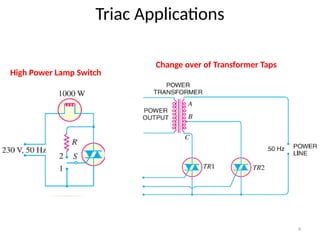
2
TRIAC (Triode forAlternating Current)
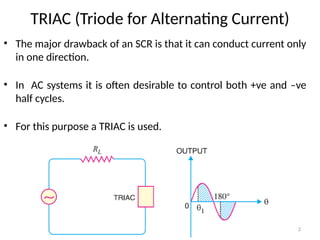
• The major drawback of an SCR is that it can conduct current only
in one direction.
• In AC systems it is often desirable to control both +ve and –ve
half cycles.
• For this purpose a TRIAC is used.
3.
3
TRIAC (Triode forAlternating Current)
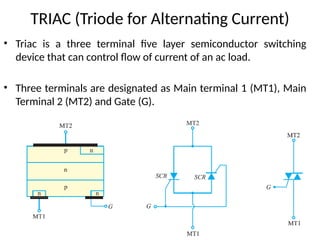
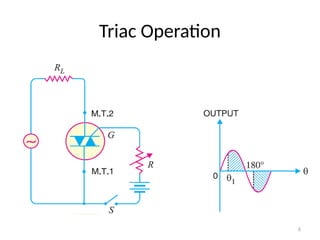
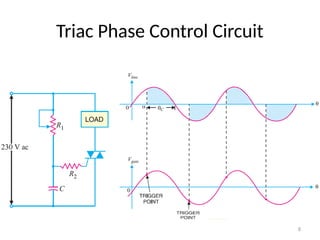
• Triac is a three terminal five layer semiconductor switching
device that can control flow of current of an ac load.
• Three terminals are designated as Main terminal 1 (MT1), Main
Terminal 2 (MT2) and Gate (G).
5
TRIAC (Triode forAlternating Current)
• Following point may be noted about the triac.
1. The triac can conduct current (with proper gate current) regardless of
the polarity of the main terminals.
2. A triac can be turned on either with a positive or negative voltage at
the gate terminal.
3. Like the SCR once the triac is fired into conduction, the gate lose all
control. The triac can be turned off by reducing the circuit current to
the value of holding current.
4. The main disadvantage of triacs of SCRs is that triacs have considerably
lower current handling capabilities. Most triac are available in ratings of
less than 40A at voltages up to 600V.
7
Triac Characteristics
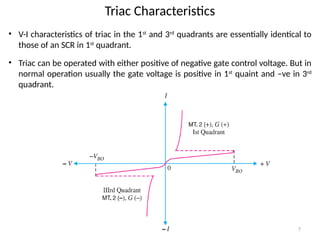
• V-Icharacteristics of triac in the 1st
and 3rd
quadrants are essentially identical to
those of an SCR in 1st
quadrant.
• Triac can be operated with either positive of negative gate control voltage. But in
normal operation usually the gate voltage is positive in 1st
quaint and –ve in 3rd
quadrant.
10
Example-1
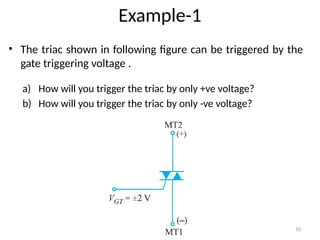
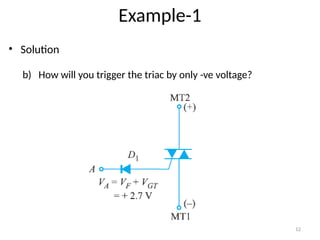
• The triacshown in following figure can be triggered by the
gate triggering voltage .
a) How will you trigger the triac by only +ve voltage?
b) How will you trigger the triac by only -ve voltage?
16
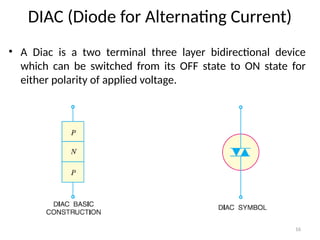
DIAC (Diode forAlternating Current)
• A Diac is a two terminal three layer bidirectional device
which can be switched from its OFF state to ON state for
either polarity of applied voltage.
24
Solid State Relay
•A solid state relay (SSR) is an electronic switching device
that switches on or off when an external voltage (AC or
DC) is applied across its control terminals.
• They serve the same function as an electromechanical
relay, but solid-state electronics contain no moving parts.
• SSR is an opto-isolator (optocoupler) which contains one
(or more) infra-red LED light source, and a photo
sensitive device within a single case.
25.
25
Solid State Relay
•The opto-isolator isolates the input from
the output.
• LED light source is connected to the SSR’s
input drive section and provides optical
coupling through a gap to an adjacent
photo sensitive transistor.
• When a current passes through the LED, it
illuminates and its light is focused across
the gap to a photo-transistor