Electronic Commerce and Digital
Marketing
LECTURE 6: E-Commerce Infrastructure
Faculty of Computing and Informatics-MUST
Wilson Tumuhimbise, PhD
based on Prof. Insup Lee’s Lecture on Electronic Commerce
Systems
7/12/2023 "The Just shall live by faith" Hab 2:4 1
LECTURE 6
By the end of this lecture, students should be
able to
• Describe the e-commerce infrastructure
• Discuss the main elements of e-commerce
7/12/2023 "The Just shall live by faith" Hab 2:4 2
3/9/01 EMTM 553 3
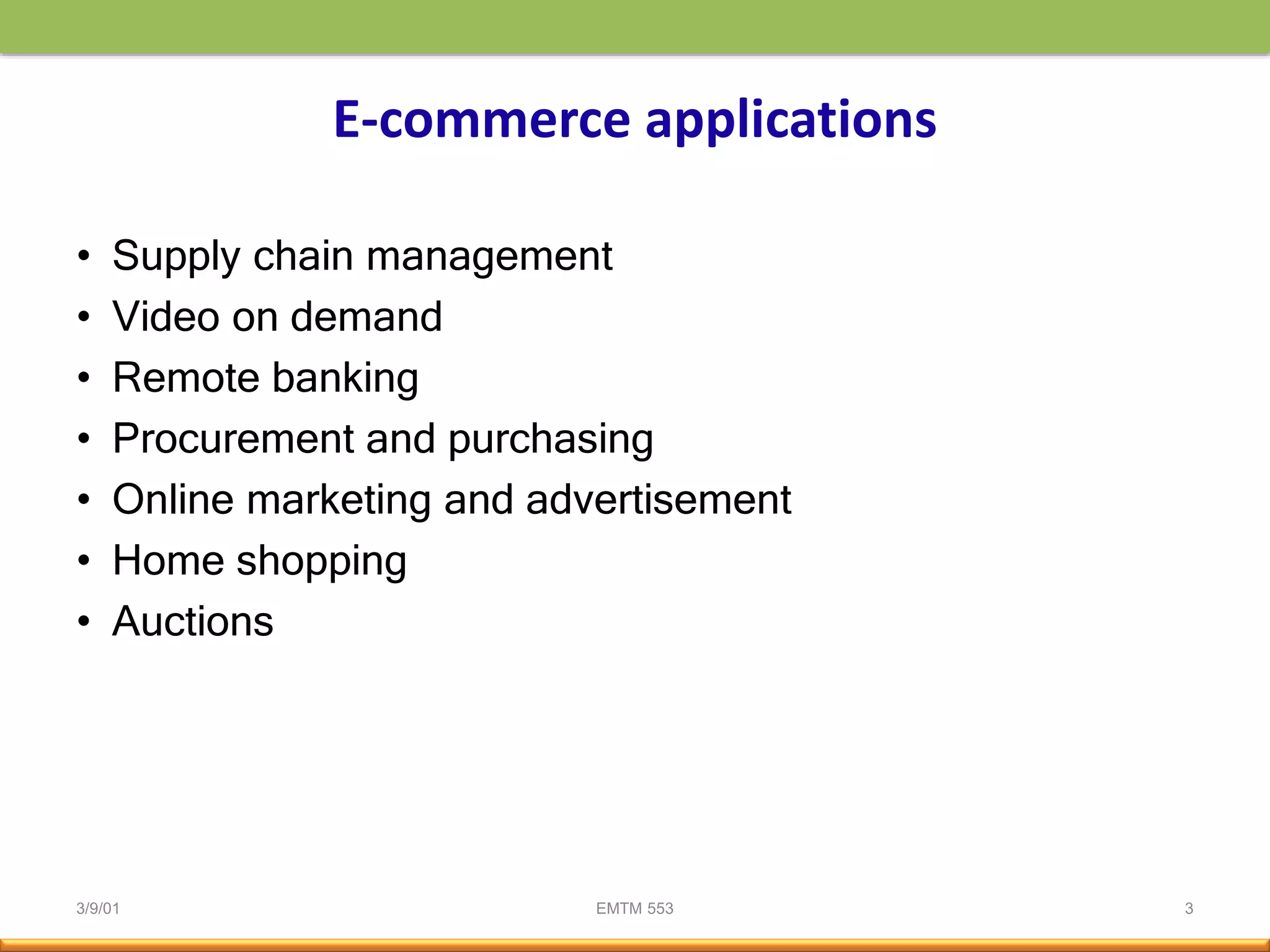
E-commerce applications
• Supply chain management
• Video on demand
• Remote banking
• Procurement and purchasing
• Online marketing and advertisement
• Home shopping
• Auctions
3/9/01 EMTM 553 4
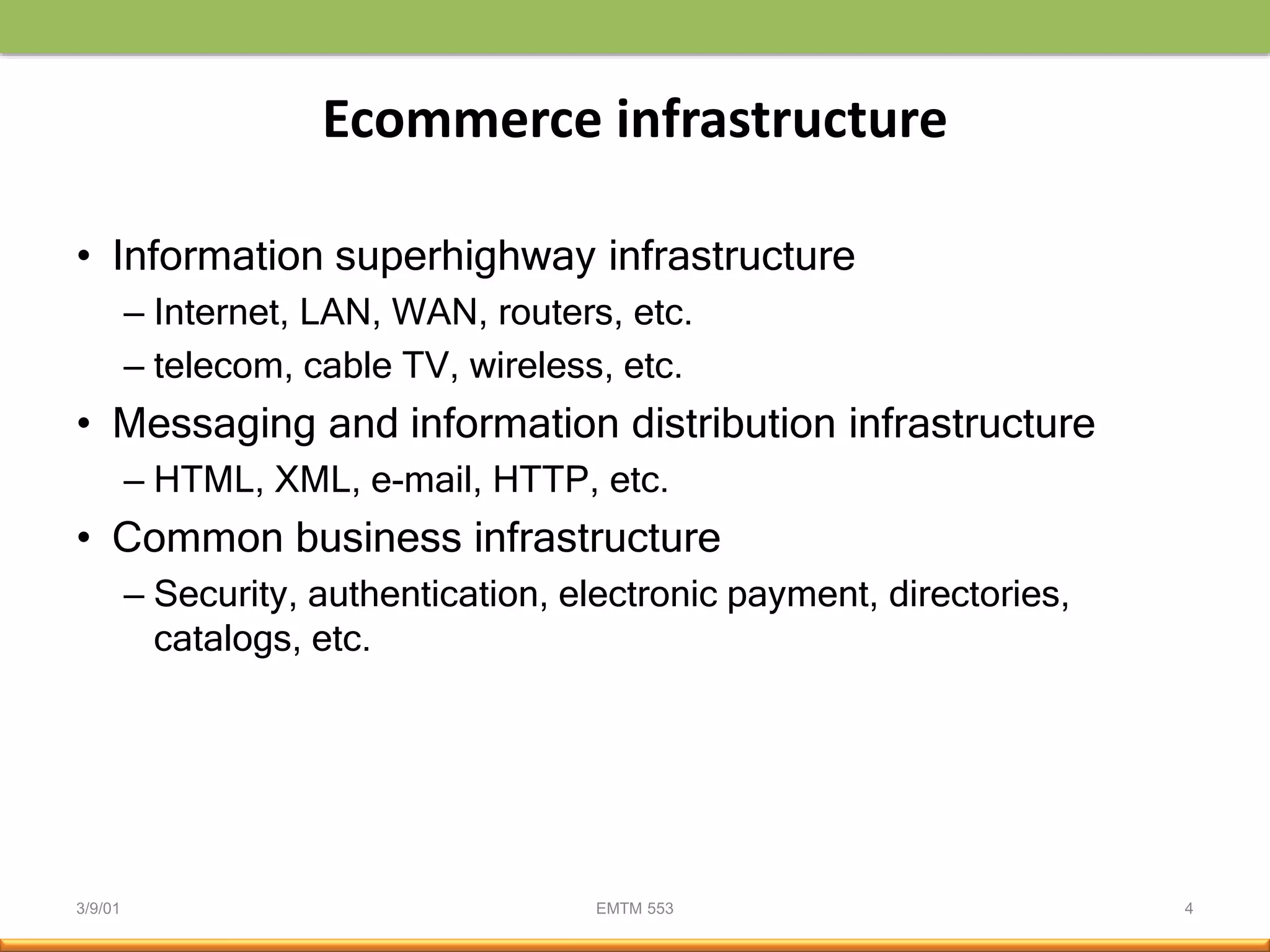
Ecommerce infrastructure
• Information superhighway infrastructure
– Internet, LAN, WAN, routers, etc.
– telecom, cable TV, wireless, etc.
• Messaging and information distribution infrastructure
– HTML, XML, e-mail, HTTP, etc.
• Common business infrastructure
– Security, authentication, electronic payment, directories,
catalogs, etc.
3/9/01 EMTM 553 5
The Main Elements of E-commerce
• Consumer shopping on the Web, called B2C (business to
consumer)
• Transactions conducted between businesses on the
Web, call B2B (business to business)
• Transactions and business processes that support selling
and purchasing activities on the Web
– Supplier, inventory, distribution, payment management
– Financial management, purchasing products and information
3/9/01 EMTM 553 6
Advantages of Electronic Commerce
• Increased sales
– Reach narrow market segments in geographically dispersed
locations
– Create virtual communities
• Decreased costs
– Handling of sales inquiries
– Providing price quotes
– Determining product availability
• Being in the space
3/9/01 EMTM 553 7
Disadvantages of Electronic Commerce
• Loss of ability to inspect products from remote
locations
• Rapid developing pace of underlying technologies
• Difficult to calculate return on investment
• Cultural and legal impediments
3/9/01 EMTM 553 8
The process of e-commerce
1. Attract customers
– Advertising, marketing
2. Interact with customers
– Catalog, negotiation
3. Handle and manage orders
– Order capture
– Payment
– Transaction
– Fulfillment (physical good, service good, digital good)
4. React to customer inquiries
– Customer service
– Order tracking
3/9/01 EMTM 553 9
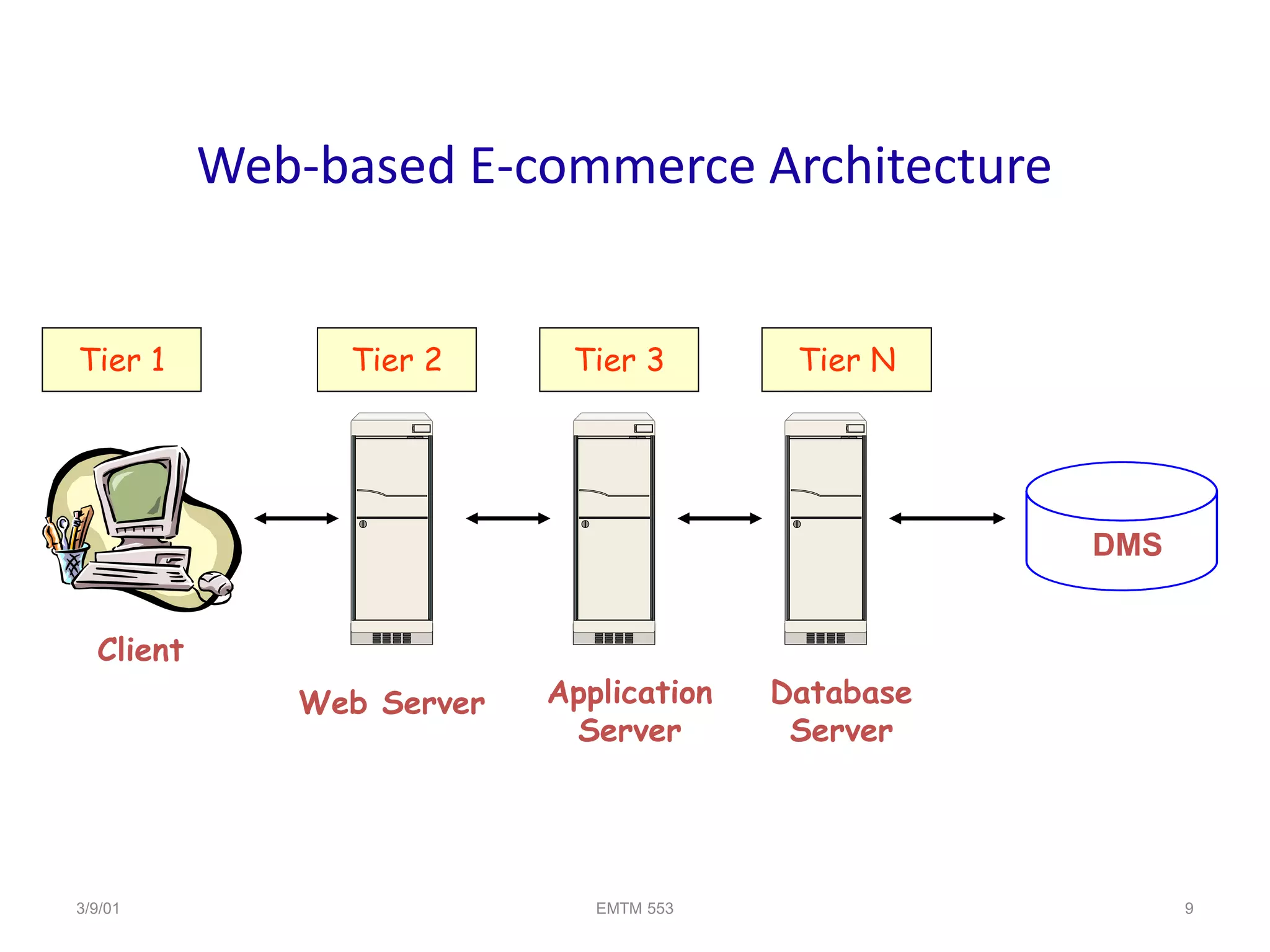
Web-based E-commerce Architecture
Client
Tier 1
Web Server
Tier 3
Tier 2 Tier N
Application
Server
Database
Server
DMS
3/9/01 EMTM 553 10
Web-based E-commerce Architecture
Web server: a software and hardware that uses HTTP (Hypertext
Transfer Protocol) and other protocols to respond to client requests
made over the World Wide Web.
Its role is to display website content through storing, processing and
delivering webpages to users
Application server: It is system software that resides between the
operating system (OS) on one side, the external resources (such as a
database management system [DBMS], communications and Internet
services) on another side and the users’ applications on the third side
Database server: is a server which uses a database application that
provides database services to other computer programs or to
computers, as defined by the client–server model.
3/9/01 EMTM 553 11
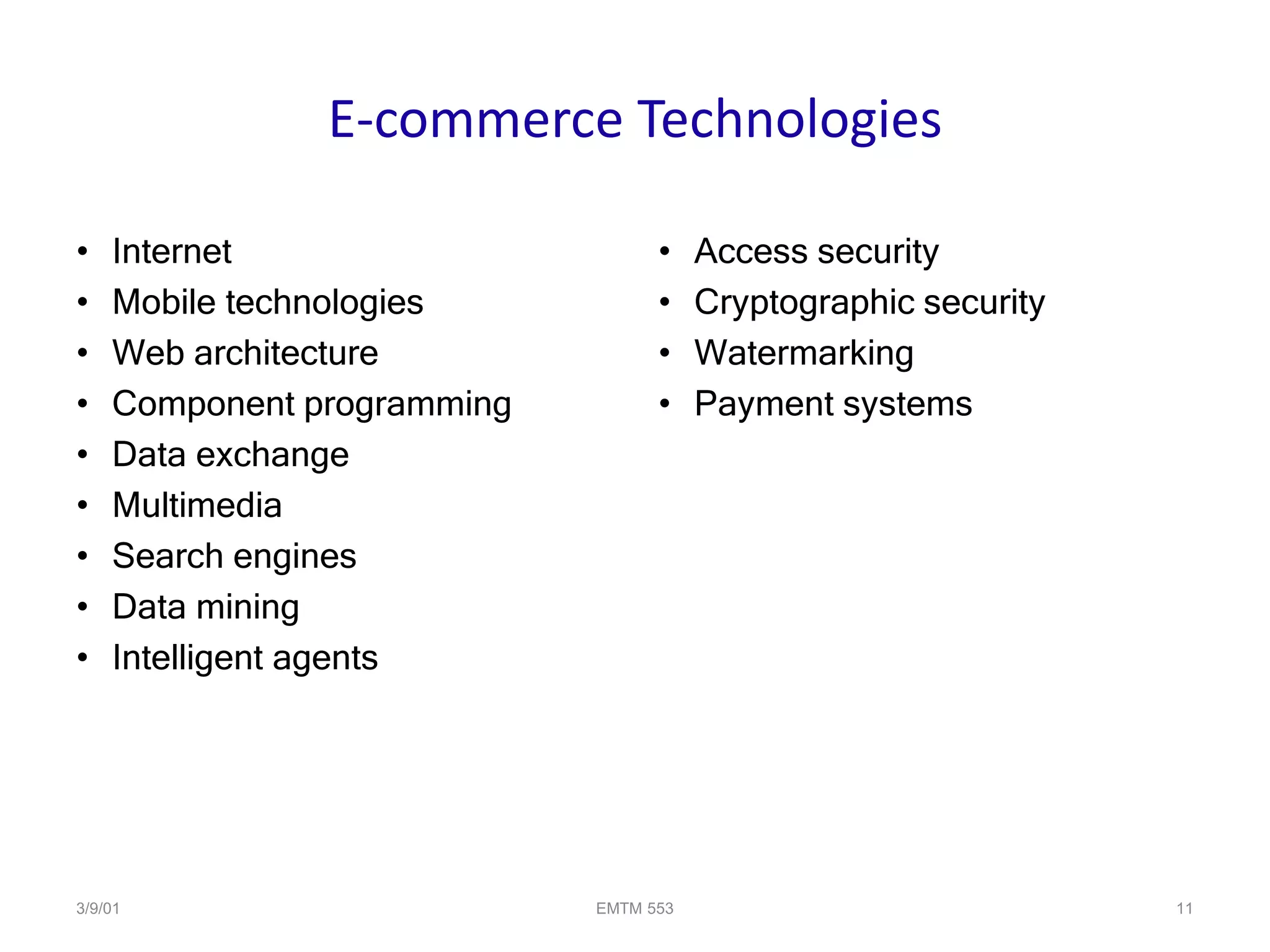
E-commerce Technologies
• Internet
• Mobile technologies
• Web architecture
• Component programming
• Data exchange
• Multimedia
• Search engines
• Data mining
• Intelligent agents
• Access security
• Cryptographic security
• Watermarking
• Payment systems
3/9/01 EMTM 553 12
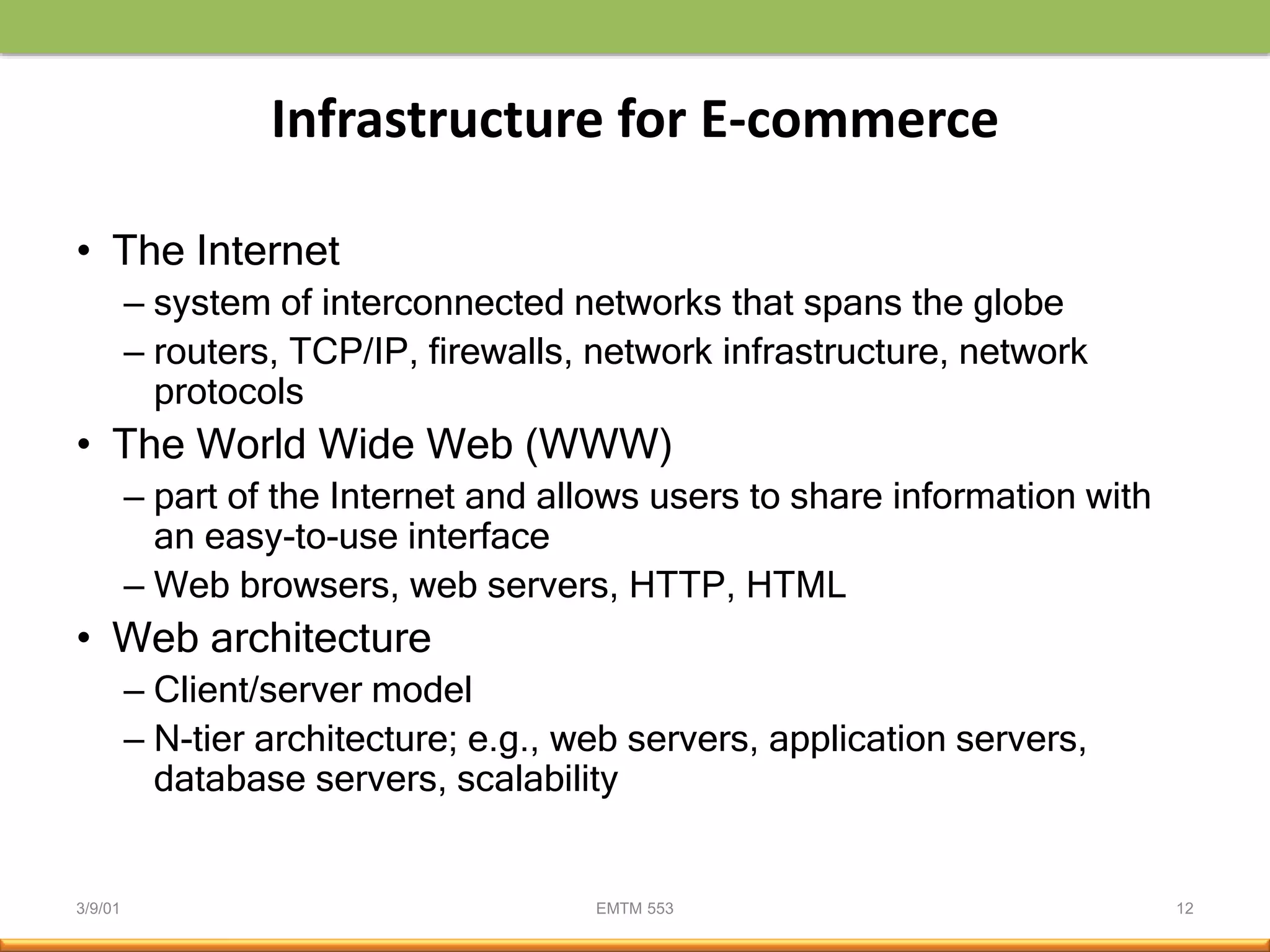
Infrastructure for E-commerce
• The Internet
– system of interconnected networks that spans the globe
– routers, TCP/IP, firewalls, network infrastructure, network
protocols
• The World Wide Web (WWW)
– part of the Internet and allows users to share information with
an easy-to-use interface
– Web browsers, web servers, HTTP, HTML
• Web architecture
– Client/server model
– N-tier architecture; e.g., web servers, application servers,
database servers, scalability
3/9/01 EMTM 553 13
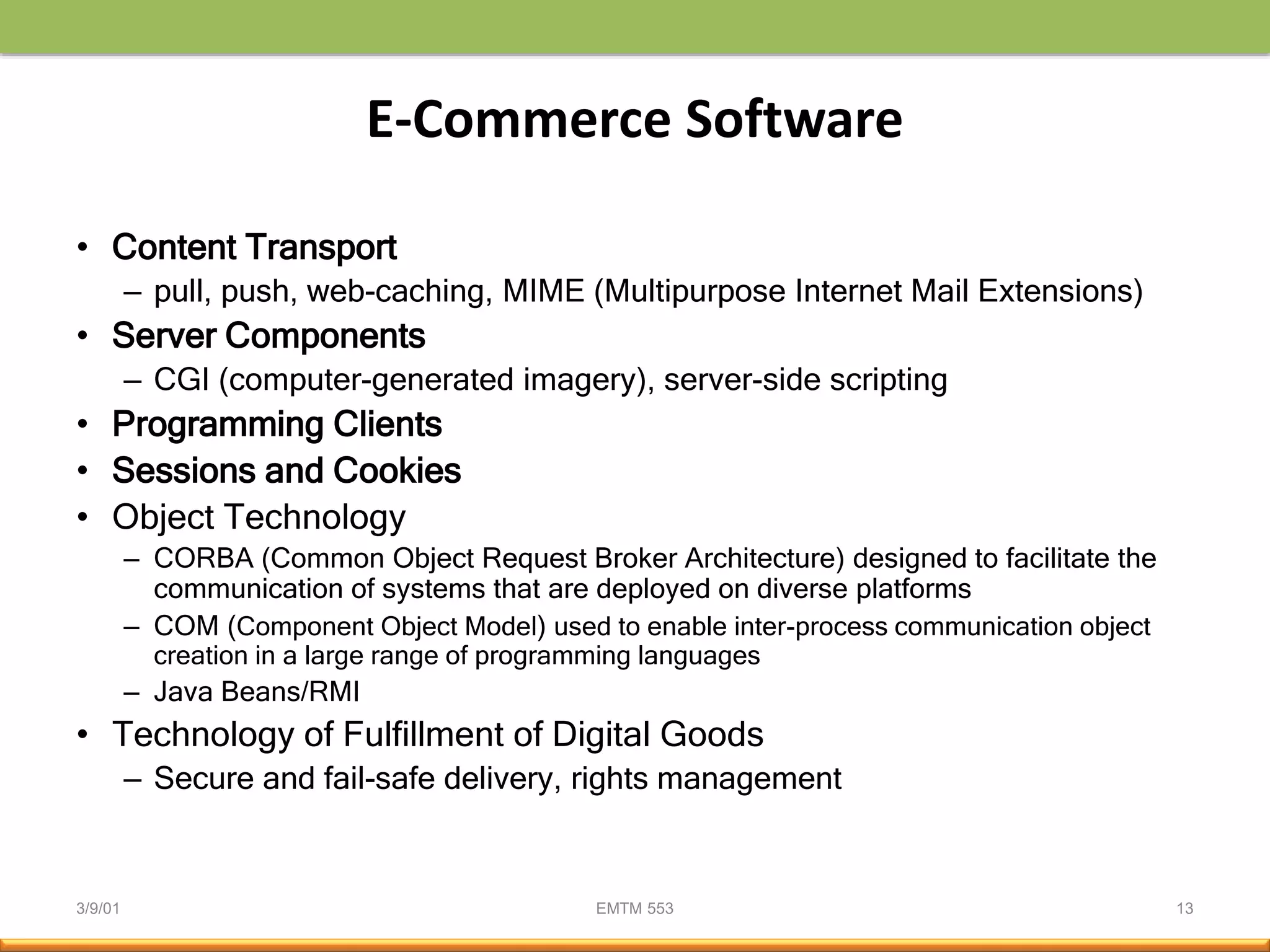
E-Commerce Software
• Content Transport
– pull, push, web-caching, MIME (Multipurpose Internet Mail Extensions)
• Server Components
– CGI (computer-generated imagery), server-side scripting
• Programming Clients
• Sessions and Cookies
• Object Technology
– CORBA (Common Object Request Broker Architecture) designed to facilitate the
communication of systems that are deployed on diverse platforms
– COM (Component Object Model) used to enable inter-process communication object
creation in a large range of programming languages
– Java Beans/RMI
• Technology of Fulfillment of Digital Goods
– Secure and fail-safe delivery, rights management
3/9/01 EMTM 553 14
System Design Issues
• Good architectural properties
– Functional separation
– Performance (load balancing, web caching)
– Secure
– Reliable
– Available
– Scalable
3/9/01 EMTM 553 15
Creating and Managing Content
• What the customer see
• Static vs. dynamic content
• Different faces for different users
• Tools for creating content
• Multimedia presentation
• Integration with other media
• Data interchange
• HTML, XML (Extensible Markup Language)
3/9/01 EMTM 553 16
Cryptography
• Keeping secrets
– Privacy: interceptor cannot use information
– Authentication: sender’s identity cannot be forged
– Integrity: data cannot be altered
– Non-repudiation: sender cannot deny sending
• How to evaluate cryptography
• Secret key (symmetric) cryptography; e.g., DES
• Public key (asymmetric) cryptosystems; e.g, RSA
• Digital signatures, digital certificates
• Key management; e.g., PKI
3/9/01 EMTM 553 17
Security
• Concerns about security
• Client security issues
• Server security issues
• Security policy, risk assessment
• Authentication methods
– Something you know: passwords
– Something you have: smart card
– Something you are: biometrics
• Firewalls, proxy servers, intrusion detection
• Denial of service (DOS) attacks, viruses, worms
3/9/01 EMTM 553 18
Payment Systems
• Role of payment
• Cash
– properties: wide accept, convenient, anonymity, untraceability, no buyer transaction
cost
• Online credit card payment, Smart Cards
– Secure protocols: SSL (Secure Sockets Layer— standard technology for securing
an internet connection by encrypting data sent between a website and a browser
(or between two servers). prevents hackers from seeing or stealing any information
transferred, including personal or financial data.
– SET (Secure Electronic Transaction) is a system and electronic protocol to ensure
the integrity and security of transactions conducted over the internet
• Internet payment systems
– Electronic cash, digital wallets
• Micro-payments: are small transactions or payments usually of less than
a dollar
• Wireless devices
3/9/01 EMTM 553 19
Transactions Processing
• Transactions and e-commerce
• Overview of transaction processing
– The process of completing a task and/or user/program request either
instantly or at runtime
• Transaction processing in e-commerce:
– An online transaction processing system (OTPS) is an equivalent
system that online merchants use for e-commerce.
– Ensures that each transaction is successful by storing, sending and
receiving information via a database.
• Keeping business records, audit, backup
• High-availability systems
• Replication and scaling
• Implementation
3/9/01 EMTM 553 20
Other System Components
• Taxes
• Shipping and handling
• Search engines
• Data mining
• Intelligent agents
• Inventory management, enterprise resource planning
(ERP)
• Customer relation management (CRM)
Question
•Is there any question?
7/12/2023 "The Just shall live by faith" Hab 2:4 21

Lecture_6_E-commerce_Infrastructure.pptx

  • 1.
    Electronic Commerce andDigital Marketing LECTURE 6: E-Commerce Infrastructure Faculty of Computing and Informatics-MUST Wilson Tumuhimbise, PhD based on Prof. Insup Lee’s Lecture on Electronic Commerce Systems 7/12/2023 "The Just shall live by faith" Hab 2:4 1
  • 2.
    LECTURE 6 By theend of this lecture, students should be able to • Describe the e-commerce infrastructure • Discuss the main elements of e-commerce 7/12/2023 "The Just shall live by faith" Hab 2:4 2
  • 3.
    3/9/01 EMTM 5533 E-commerce applications • Supply chain management • Video on demand • Remote banking • Procurement and purchasing • Online marketing and advertisement • Home shopping • Auctions
  • 4.
    3/9/01 EMTM 5534 Ecommerce infrastructure • Information superhighway infrastructure – Internet, LAN, WAN, routers, etc. – telecom, cable TV, wireless, etc. • Messaging and information distribution infrastructure – HTML, XML, e-mail, HTTP, etc. • Common business infrastructure – Security, authentication, electronic payment, directories, catalogs, etc.
  • 5.
    3/9/01 EMTM 5535 The Main Elements of E-commerce • Consumer shopping on the Web, called B2C (business to consumer) • Transactions conducted between businesses on the Web, call B2B (business to business) • Transactions and business processes that support selling and purchasing activities on the Web – Supplier, inventory, distribution, payment management – Financial management, purchasing products and information
  • 6.
    3/9/01 EMTM 5536 Advantages of Electronic Commerce • Increased sales – Reach narrow market segments in geographically dispersed locations – Create virtual communities • Decreased costs – Handling of sales inquiries – Providing price quotes – Determining product availability • Being in the space
  • 7.
    3/9/01 EMTM 5537 Disadvantages of Electronic Commerce • Loss of ability to inspect products from remote locations • Rapid developing pace of underlying technologies • Difficult to calculate return on investment • Cultural and legal impediments
  • 8.
    3/9/01 EMTM 5538 The process of e-commerce 1. Attract customers – Advertising, marketing 2. Interact with customers – Catalog, negotiation 3. Handle and manage orders – Order capture – Payment – Transaction – Fulfillment (physical good, service good, digital good) 4. React to customer inquiries – Customer service – Order tracking
  • 9.
    3/9/01 EMTM 5539 Web-based E-commerce Architecture Client Tier 1 Web Server Tier 3 Tier 2 Tier N Application Server Database Server DMS
  • 10.
    3/9/01 EMTM 55310 Web-based E-commerce Architecture Web server: a software and hardware that uses HTTP (Hypertext Transfer Protocol) and other protocols to respond to client requests made over the World Wide Web. Its role is to display website content through storing, processing and delivering webpages to users Application server: It is system software that resides between the operating system (OS) on one side, the external resources (such as a database management system [DBMS], communications and Internet services) on another side and the users’ applications on the third side Database server: is a server which uses a database application that provides database services to other computer programs or to computers, as defined by the client–server model.
  • 11.
    3/9/01 EMTM 55311 E-commerce Technologies • Internet • Mobile technologies • Web architecture • Component programming • Data exchange • Multimedia • Search engines • Data mining • Intelligent agents • Access security • Cryptographic security • Watermarking • Payment systems
  • 12.
    3/9/01 EMTM 55312 Infrastructure for E-commerce • The Internet – system of interconnected networks that spans the globe – routers, TCP/IP, firewalls, network infrastructure, network protocols • The World Wide Web (WWW) – part of the Internet and allows users to share information with an easy-to-use interface – Web browsers, web servers, HTTP, HTML • Web architecture – Client/server model – N-tier architecture; e.g., web servers, application servers, database servers, scalability
  • 13.
    3/9/01 EMTM 55313 E-Commerce Software • Content Transport – pull, push, web-caching, MIME (Multipurpose Internet Mail Extensions) • Server Components – CGI (computer-generated imagery), server-side scripting • Programming Clients • Sessions and Cookies • Object Technology – CORBA (Common Object Request Broker Architecture) designed to facilitate the communication of systems that are deployed on diverse platforms – COM (Component Object Model) used to enable inter-process communication object creation in a large range of programming languages – Java Beans/RMI • Technology of Fulfillment of Digital Goods – Secure and fail-safe delivery, rights management
  • 14.
    3/9/01 EMTM 55314 System Design Issues • Good architectural properties – Functional separation – Performance (load balancing, web caching) – Secure – Reliable – Available – Scalable
  • 15.
    3/9/01 EMTM 55315 Creating and Managing Content • What the customer see • Static vs. dynamic content • Different faces for different users • Tools for creating content • Multimedia presentation • Integration with other media • Data interchange • HTML, XML (Extensible Markup Language)
  • 16.
    3/9/01 EMTM 55316 Cryptography • Keeping secrets – Privacy: interceptor cannot use information – Authentication: sender’s identity cannot be forged – Integrity: data cannot be altered – Non-repudiation: sender cannot deny sending • How to evaluate cryptography • Secret key (symmetric) cryptography; e.g., DES • Public key (asymmetric) cryptosystems; e.g, RSA • Digital signatures, digital certificates • Key management; e.g., PKI
  • 17.
    3/9/01 EMTM 55317 Security • Concerns about security • Client security issues • Server security issues • Security policy, risk assessment • Authentication methods – Something you know: passwords – Something you have: smart card – Something you are: biometrics • Firewalls, proxy servers, intrusion detection • Denial of service (DOS) attacks, viruses, worms
  • 18.
    3/9/01 EMTM 55318 Payment Systems • Role of payment • Cash – properties: wide accept, convenient, anonymity, untraceability, no buyer transaction cost • Online credit card payment, Smart Cards – Secure protocols: SSL (Secure Sockets Layer— standard technology for securing an internet connection by encrypting data sent between a website and a browser (or between two servers). prevents hackers from seeing or stealing any information transferred, including personal or financial data. – SET (Secure Electronic Transaction) is a system and electronic protocol to ensure the integrity and security of transactions conducted over the internet • Internet payment systems – Electronic cash, digital wallets • Micro-payments: are small transactions or payments usually of less than a dollar • Wireless devices
  • 19.
    3/9/01 EMTM 55319 Transactions Processing • Transactions and e-commerce • Overview of transaction processing – The process of completing a task and/or user/program request either instantly or at runtime • Transaction processing in e-commerce: – An online transaction processing system (OTPS) is an equivalent system that online merchants use for e-commerce. – Ensures that each transaction is successful by storing, sending and receiving information via a database. • Keeping business records, audit, backup • High-availability systems • Replication and scaling • Implementation
  • 20.
    3/9/01 EMTM 55320 Other System Components • Taxes • Shipping and handling • Search engines • Data mining • Intelligent agents • Inventory management, enterprise resource planning (ERP) • Customer relation management (CRM)
  • 21.
    Question •Is there anyquestion? 7/12/2023 "The Just shall live by faith" Hab 2:4 21