Introduction to
E-Commerce
UNIT 1
Commerce
• Commerce is a division of trade or production
which deals with the exchange of goods and
services from producer to final consumer
E-COMMERCE
• It is commonly known as electronic marketing.
• It consist of buying and selling goods and
services over an electronic system such as the
internet.
• E-commerce is the purchasing , selling &
exchanging goods and services over computer
network or internet through which transactions or
terms of sale are performed electronically.
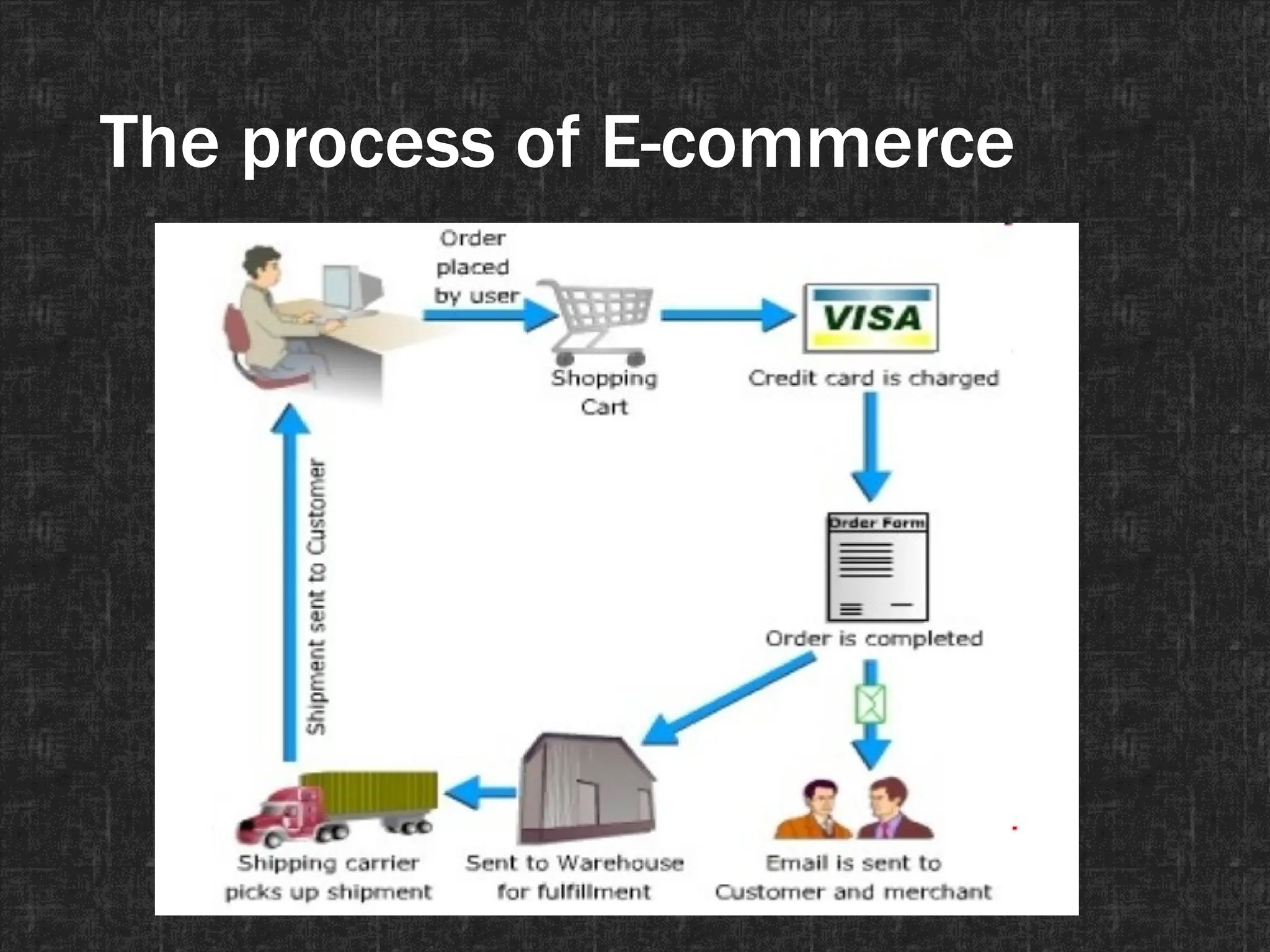
The process of E-commerce
Traditional Commerce
vs. E-Commerce
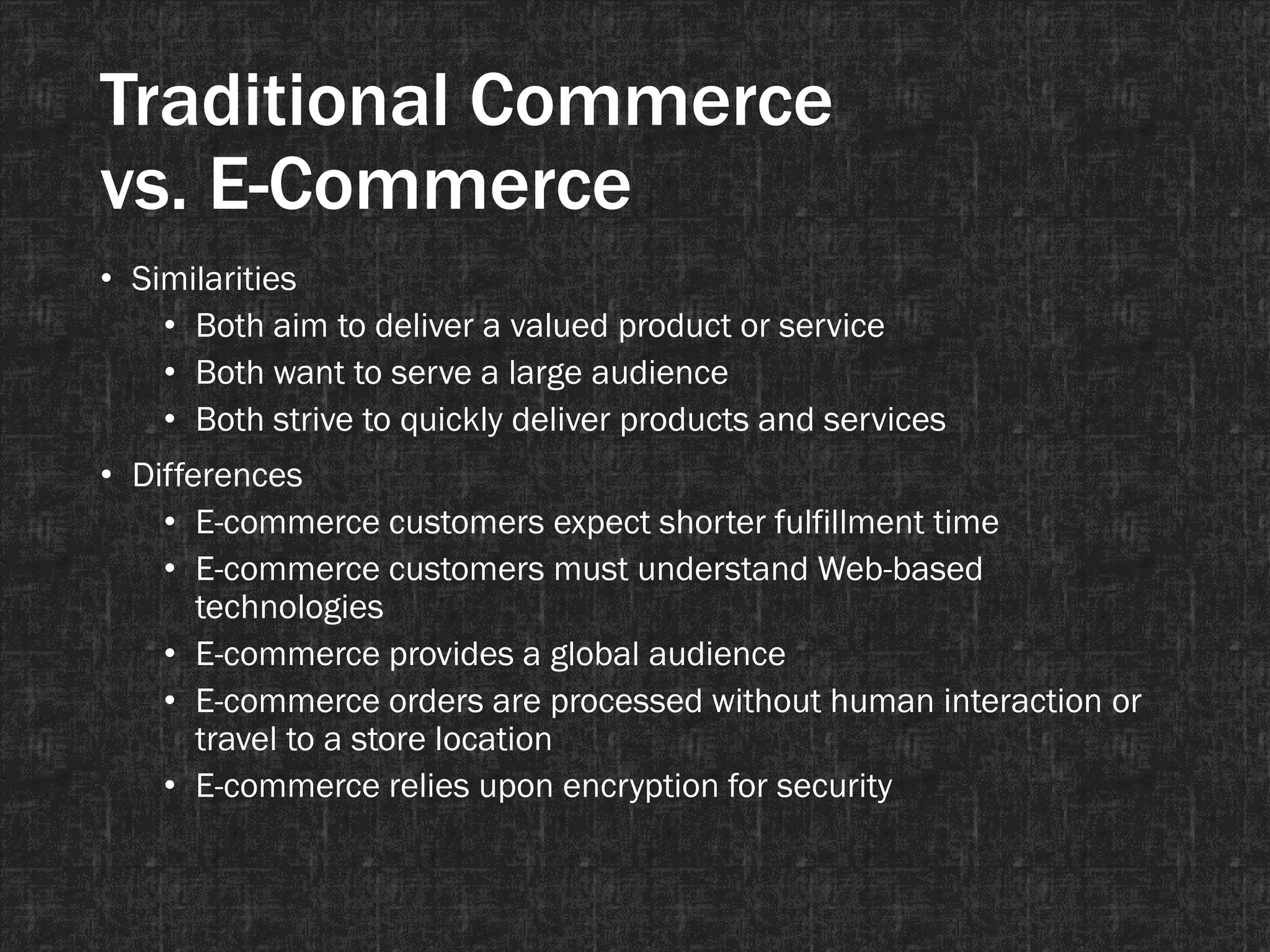
• Similarities
• Both aim to deliver a valued product or service
• Both want to serve a large audience
• Both strive to quickly deliver products and services
• Differences
• E-commerce customers expect shorter fulfillment time
• E-commerce customers must understand Web-based
technologies
• E-commerce provides a global audience
• E-commerce orders are processed without human interaction or
travel to a store location
• E-commerce relies upon encryption for security
Traditional Commerce
vs. E-Commerce
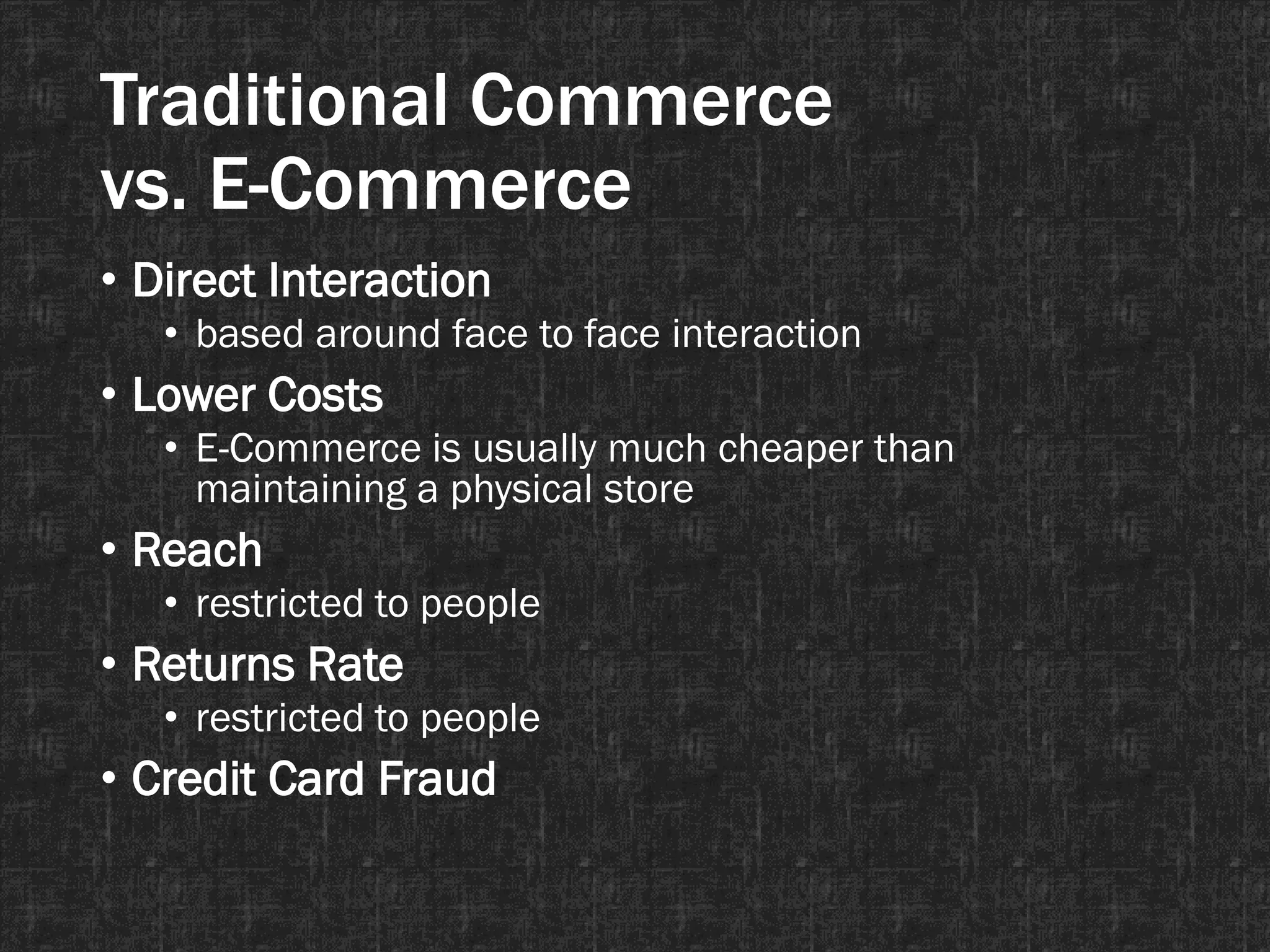
• Direct Interaction
• based around face to face interaction
• Lower Costs
• E-Commerce is usually much cheaper than
maintaining a physical store
• Reach
• restricted to people
• Returns Rate
• restricted to people
• Credit Card Fraud
In E-commerce
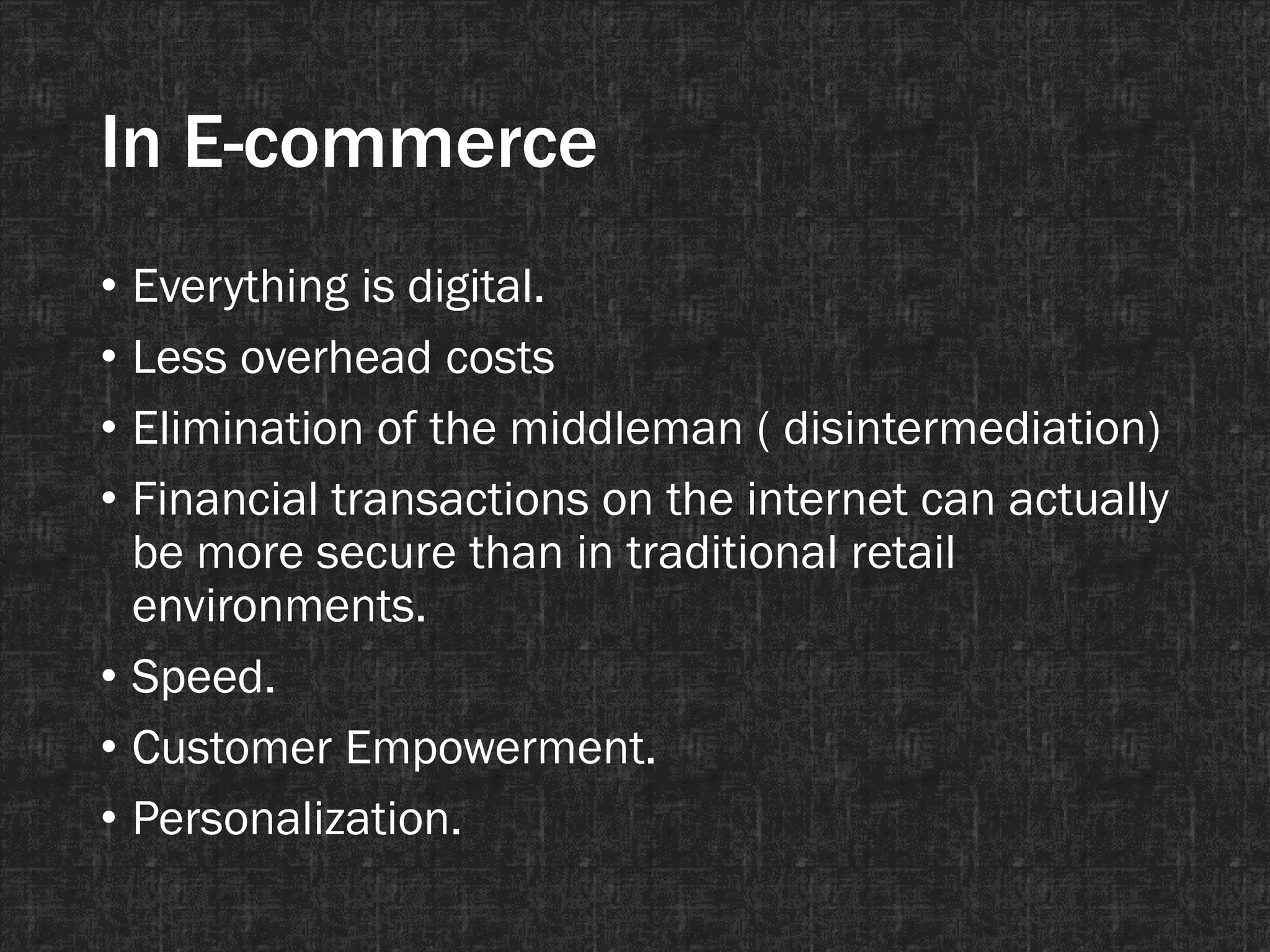
• Everything is digital.
• Less overhead costs
• Elimination of the middleman ( disintermediation)
• Financial transactions on the internet can actually
be more secure than in traditional retail
environments.
• Speed.
• Customer Empowerment.
• Personalization.
ADVANTAGES OF E-COMMERCE
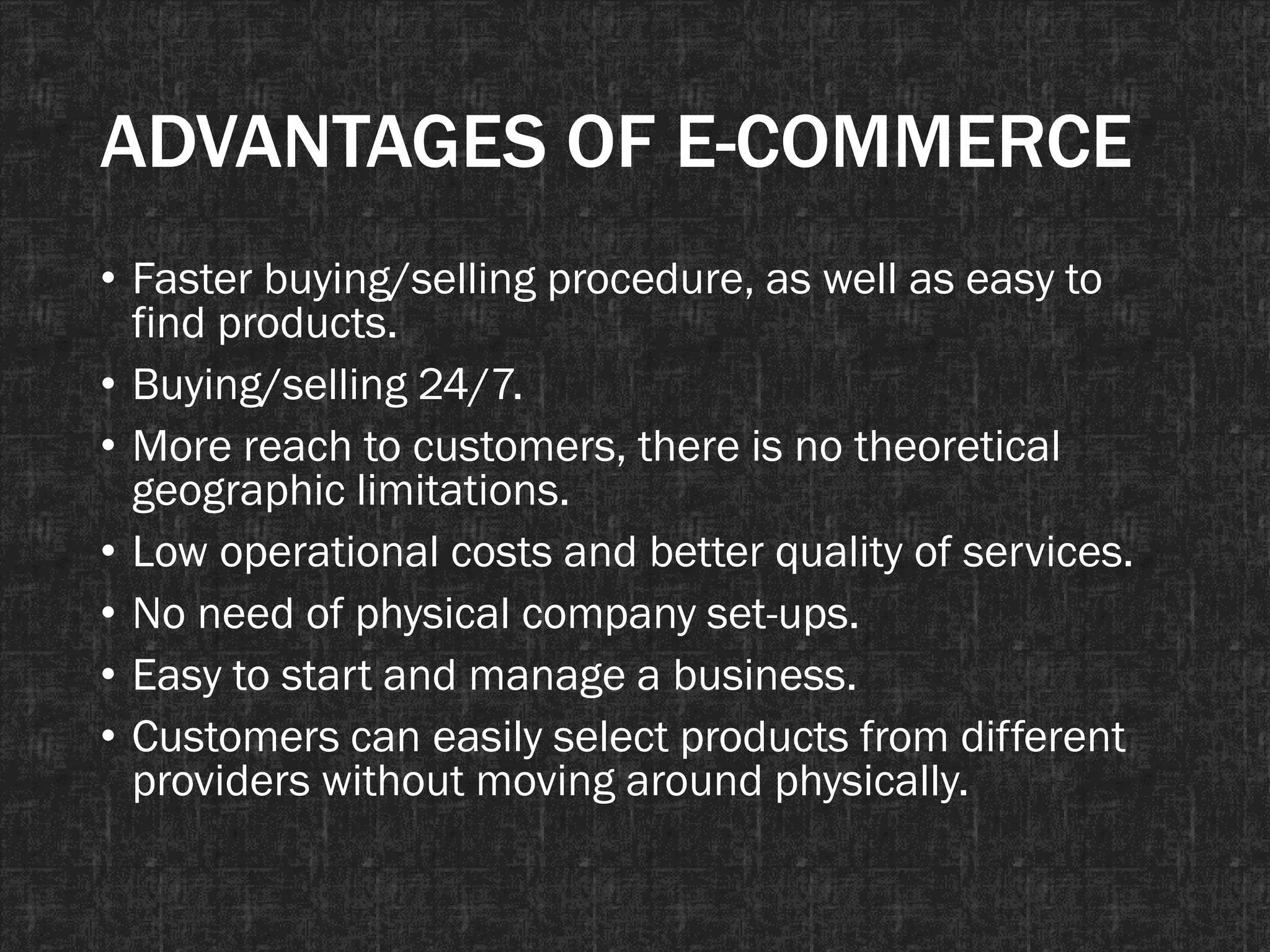
• Faster buying/selling procedure, as well as easy to
find products.
• Buying/selling 24/7.
• More reach to customers, there is no theoretical
geographic limitations.
• Low operational costs and better quality of services.
• No need of physical company set-ups.
• Easy to start and manage a business.
• Customers can easily select products from different
providers without moving around physically.
Advantages of E-Commerce
• Being able to conduct business
24 x 7
• Reduce cost to buyers
• Reduced cost to the suppliers
• Create New markets-
• Easy market entry
• Increase in variety of goods
• Reduce inventories
• No Middlemen
• E-Payment system
• Ensure secrecy
• Computer platform
• Improved and better customer
service
• Teamwork
• Information sharing with the
customers
• Customized products
• Swapping of goods and services
• Information sharing
• Global reach
• Advertising of goods and
services
• Higher profits-
DISADVANTAGES OF E-
COMMERCE
• Unable to examine products personally
• Not everyone is connected to the Internet
• There is the possibility of credit card number theft
• Mechanical failures can cause unpredictable
effects on the total processes.
e-Commerce Applications
• Supply Chain Management
• Video on demand
• Remote banking
• Online Marketing and Advertising
• Home shopping
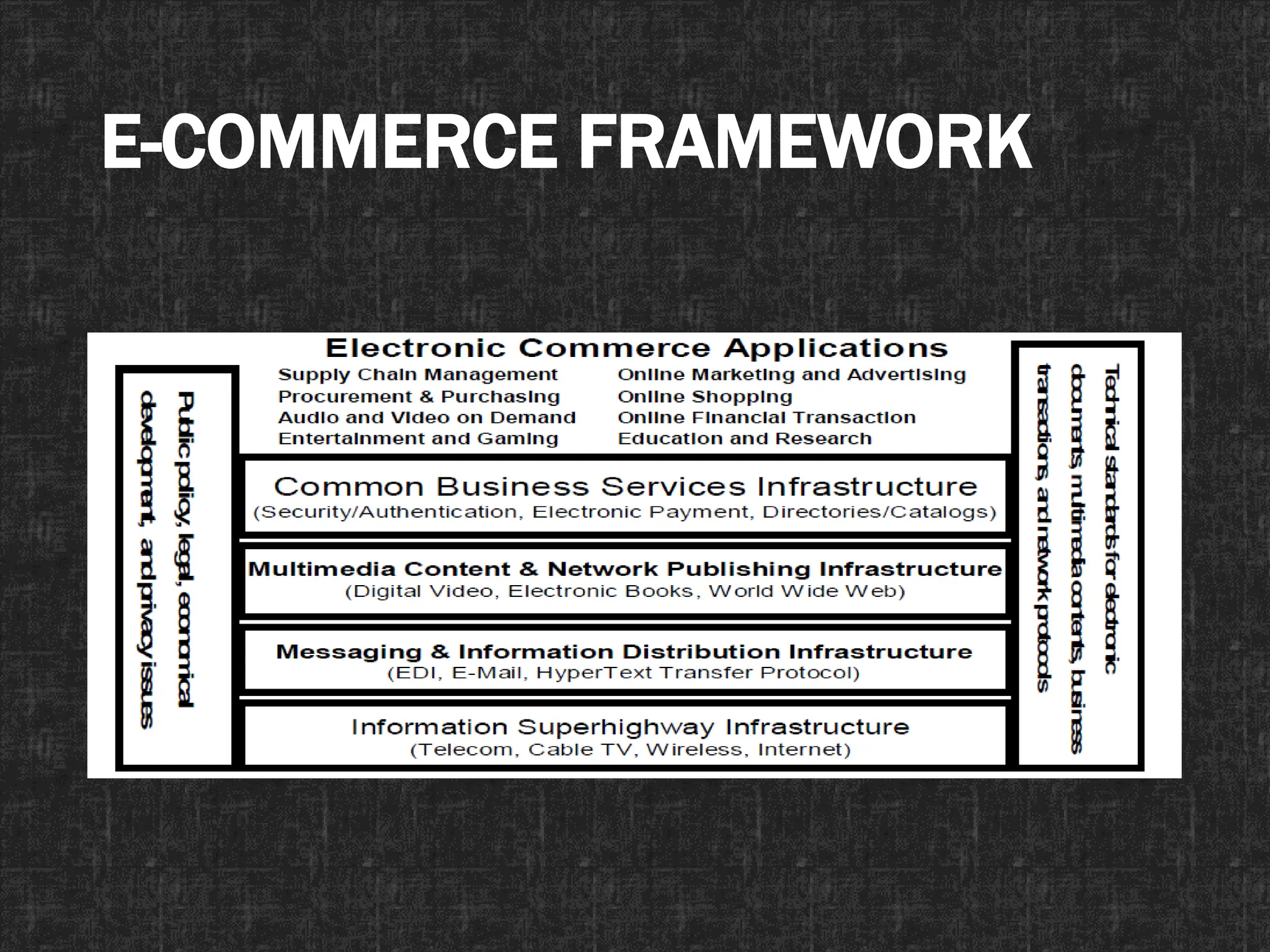
E-COMMERCE FRAMEWORK
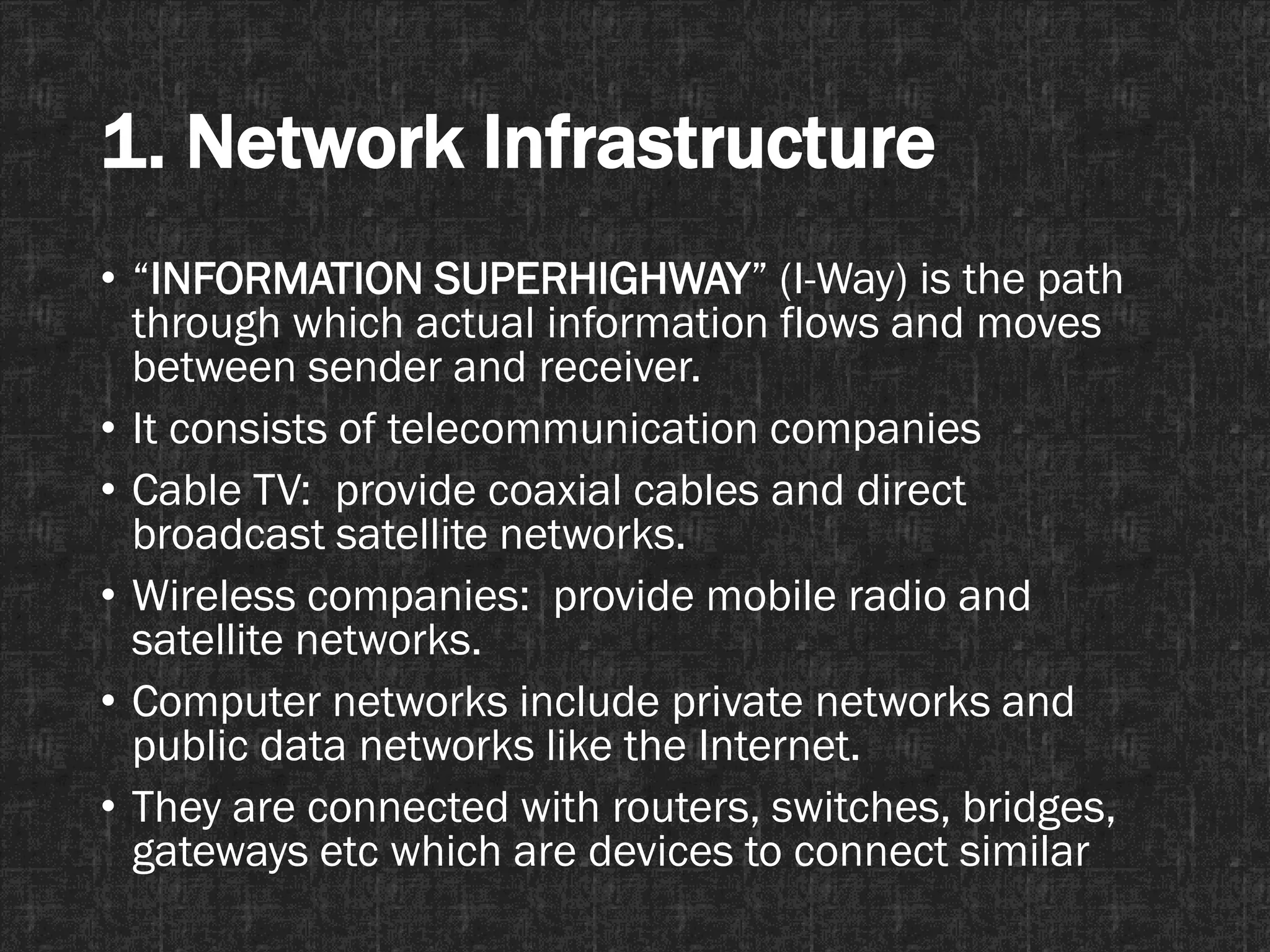
1. Network Infrastructure
• “INFORMATION SUPERHIGHWAY” (I-Way) is the path
through which actual information flows and moves
between sender and receiver.
• It consists of telecommunication companies
• Cable TV: provide coaxial cables and direct
broadcast satellite networks.
• Wireless companies: provide mobile radio and
satellite networks.
• Computer networks include private networks and
public data networks like the Internet.
• They are connected with routers, switches, bridges,
gateways etc which are devices to connect similar
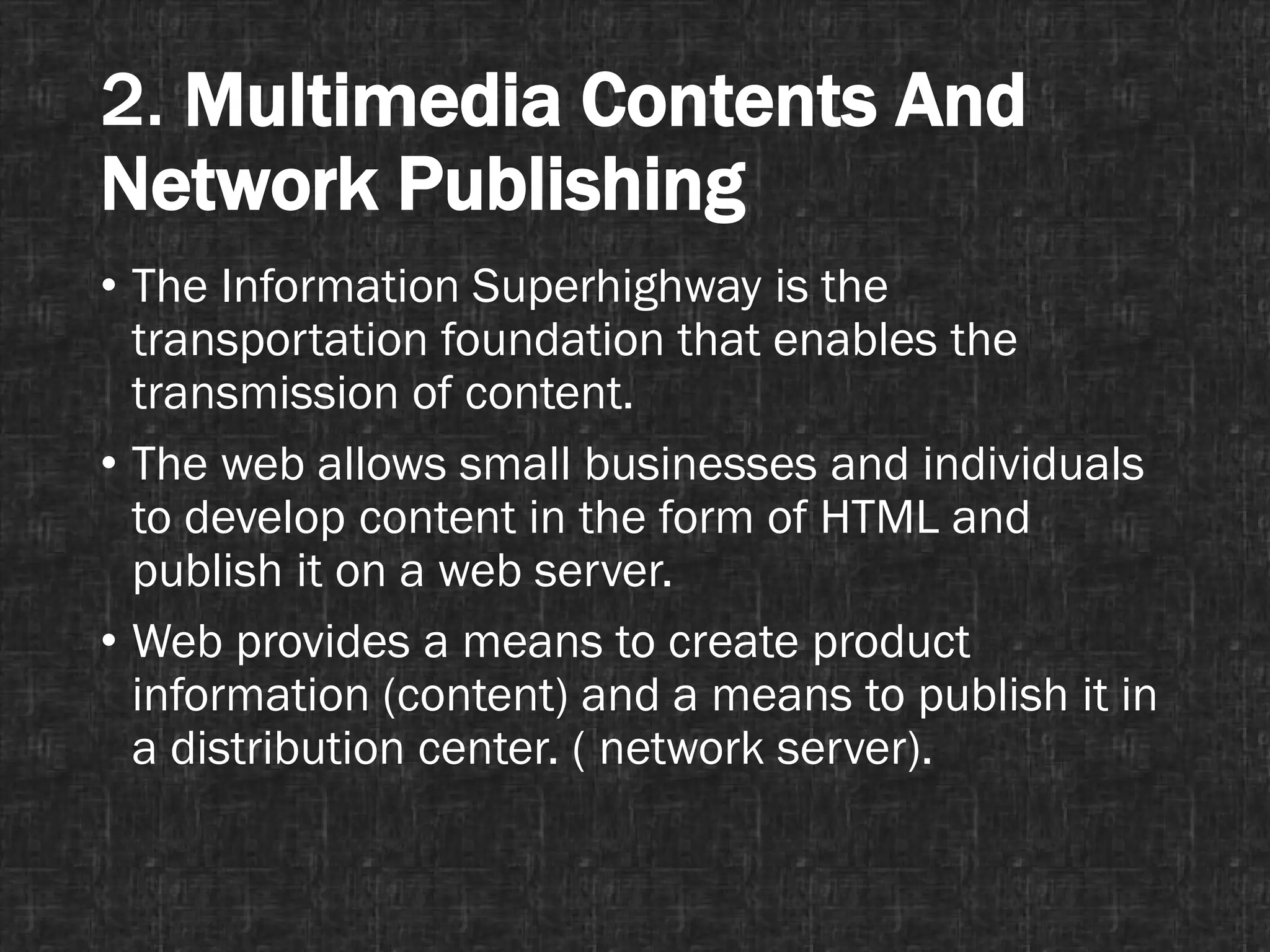
2. Multimedia Contents And
Network Publishing
• The Information Superhighway is the
transportation foundation that enables the
transmission of content.
• The web allows small businesses and individuals
to develop content in the form of HTML and
publish it on a web server.
• Web provides a means to create product
information (content) and a means to publish it in
a distribution center. ( network server).
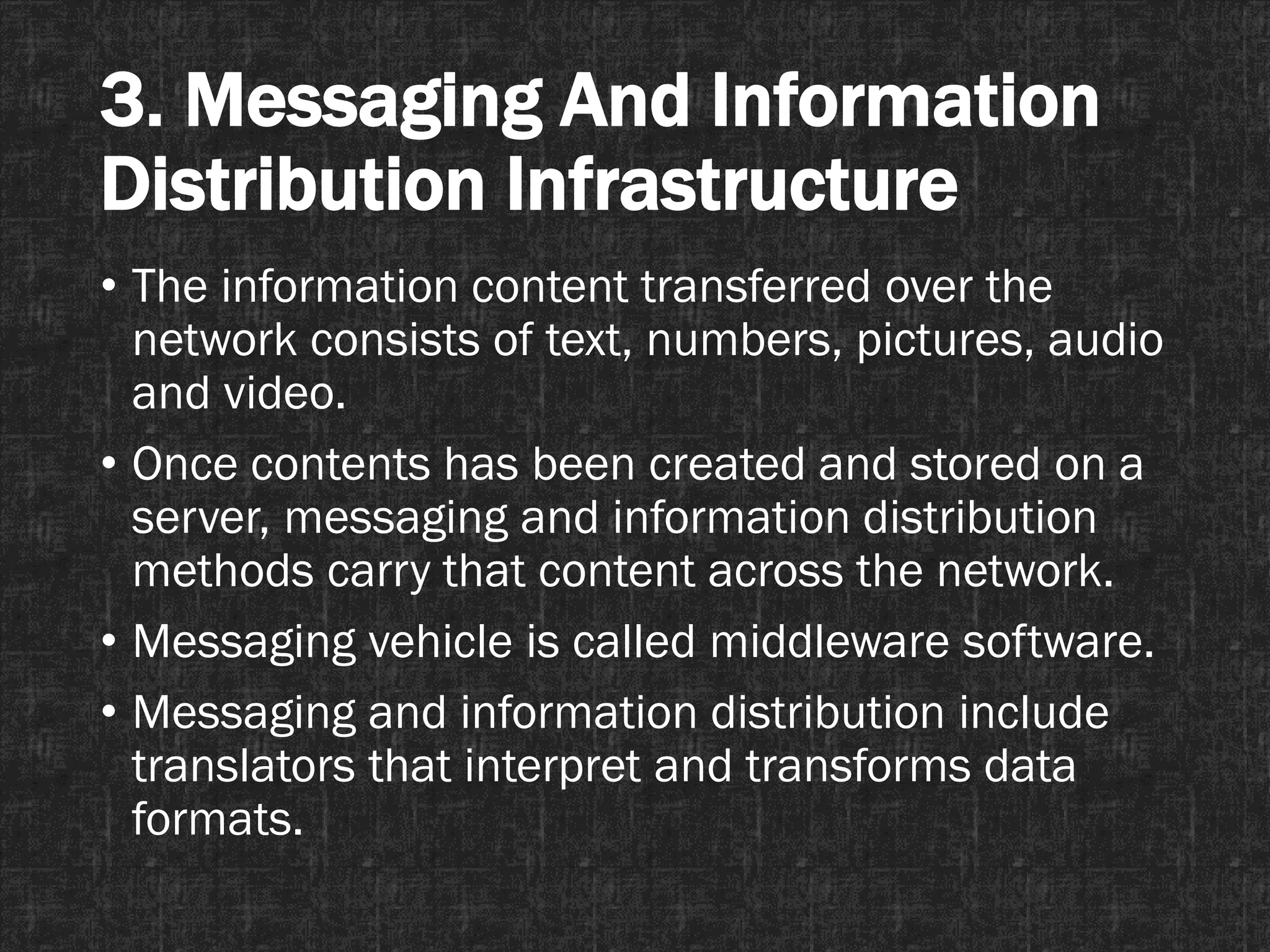
3. Messaging And Information
Distribution Infrastructure
• The information content transferred over the
network consists of text, numbers, pictures, audio
and video.
• Once contents has been created and stored on a
server, messaging and information distribution
methods carry that content across the network.
• Messaging vehicle is called middleware software.
• Messaging and information distribution include
translators that interpret and transforms data
formats.
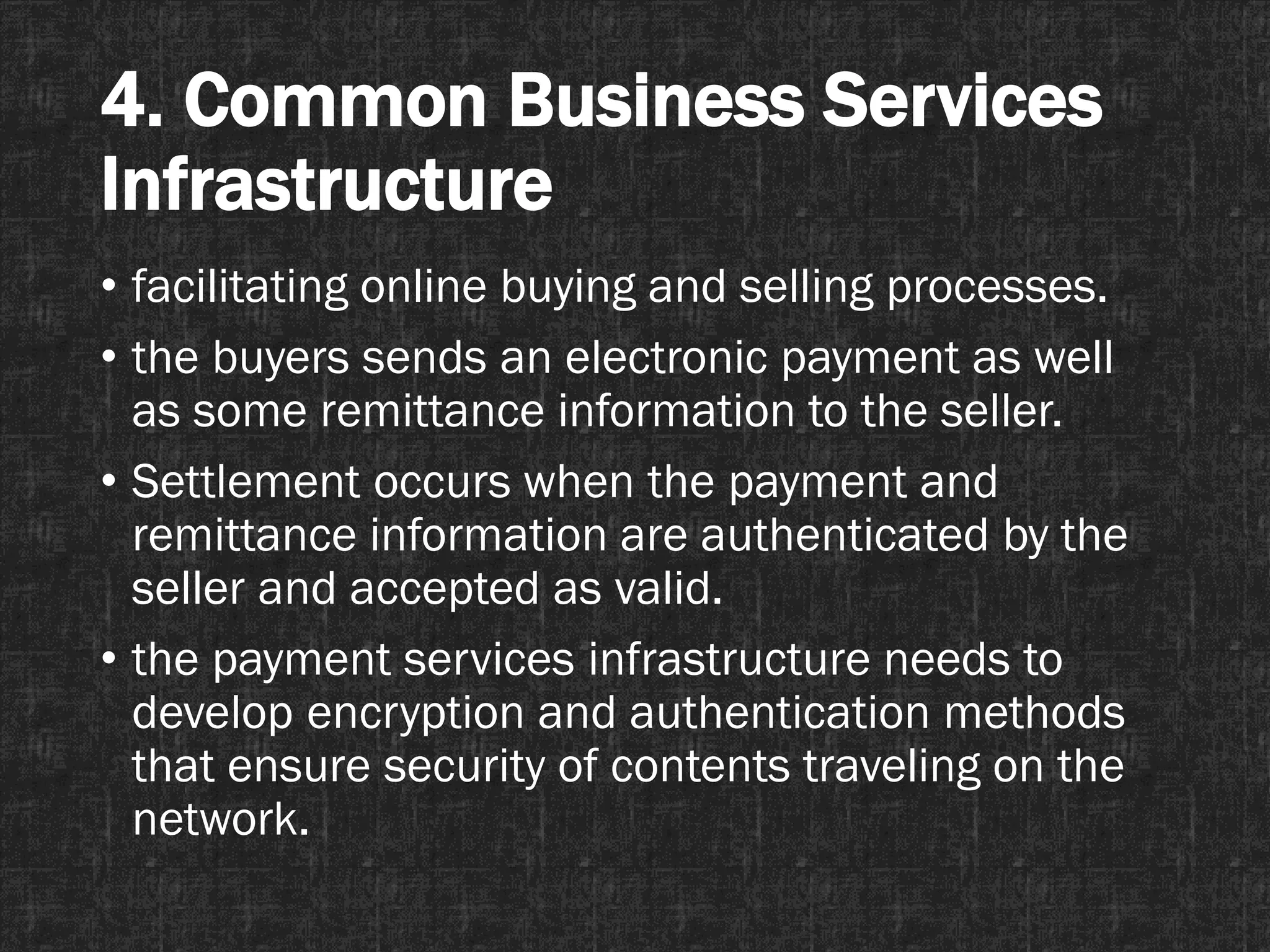
4. Common Business Services
Infrastructure
• facilitating online buying and selling processes.
• the buyers sends an electronic payment as well
as some remittance information to the seller.
• Settlement occurs when the payment and
remittance information are authenticated by the
seller and accepted as valid.
• the payment services infrastructure needs to
develop encryption and authentication methods
that ensure security of contents traveling on the
network.
5. Public Policy And Technical
Standards
• Public Policy And Technical Standards are two
support pillars for all e-commerce applications and
infrastructure.
• Public policy related to e-commerce encompasses
such issues as universal access, privacy and
information pricing.
• Technical Standards dictate the specifics of
information publishing tools, user interfaces and
transport.
• Standards are essential to ensure compatibility
across the entire network of world.

Unit 1 Introduction to E-Commerce -Basic Concepts

  • 1.
  • 2.
    Commerce • Commerce isa division of trade or production which deals with the exchange of goods and services from producer to final consumer
  • 3.
    E-COMMERCE • It iscommonly known as electronic marketing. • It consist of buying and selling goods and services over an electronic system such as the internet. • E-commerce is the purchasing , selling & exchanging goods and services over computer network or internet through which transactions or terms of sale are performed electronically.
  • 4.
    The process ofE-commerce
  • 5.
    Traditional Commerce vs. E-Commerce •Similarities • Both aim to deliver a valued product or service • Both want to serve a large audience • Both strive to quickly deliver products and services • Differences • E-commerce customers expect shorter fulfillment time • E-commerce customers must understand Web-based technologies • E-commerce provides a global audience • E-commerce orders are processed without human interaction or travel to a store location • E-commerce relies upon encryption for security
  • 6.
    Traditional Commerce vs. E-Commerce •Direct Interaction • based around face to face interaction • Lower Costs • E-Commerce is usually much cheaper than maintaining a physical store • Reach • restricted to people • Returns Rate • restricted to people • Credit Card Fraud
  • 7.
    In E-commerce • Everythingis digital. • Less overhead costs • Elimination of the middleman ( disintermediation) • Financial transactions on the internet can actually be more secure than in traditional retail environments. • Speed. • Customer Empowerment. • Personalization.
  • 8.
    ADVANTAGES OF E-COMMERCE •Faster buying/selling procedure, as well as easy to find products. • Buying/selling 24/7. • More reach to customers, there is no theoretical geographic limitations. • Low operational costs and better quality of services. • No need of physical company set-ups. • Easy to start and manage a business. • Customers can easily select products from different providers without moving around physically.
  • 9.
    Advantages of E-Commerce •Being able to conduct business 24 x 7 • Reduce cost to buyers • Reduced cost to the suppliers • Create New markets- • Easy market entry • Increase in variety of goods • Reduce inventories • No Middlemen • E-Payment system • Ensure secrecy • Computer platform • Improved and better customer service • Teamwork • Information sharing with the customers • Customized products • Swapping of goods and services • Information sharing • Global reach • Advertising of goods and services • Higher profits-
  • 10.
    DISADVANTAGES OF E- COMMERCE •Unable to examine products personally • Not everyone is connected to the Internet • There is the possibility of credit card number theft • Mechanical failures can cause unpredictable effects on the total processes.
  • 12.
    e-Commerce Applications • SupplyChain Management • Video on demand • Remote banking • Online Marketing and Advertising • Home shopping
  • 13.
  • 14.
    1. Network Infrastructure •“INFORMATION SUPERHIGHWAY” (I-Way) is the path through which actual information flows and moves between sender and receiver. • It consists of telecommunication companies • Cable TV: provide coaxial cables and direct broadcast satellite networks. • Wireless companies: provide mobile radio and satellite networks. • Computer networks include private networks and public data networks like the Internet. • They are connected with routers, switches, bridges, gateways etc which are devices to connect similar
  • 15.
    2. Multimedia ContentsAnd Network Publishing • The Information Superhighway is the transportation foundation that enables the transmission of content. • The web allows small businesses and individuals to develop content in the form of HTML and publish it on a web server. • Web provides a means to create product information (content) and a means to publish it in a distribution center. ( network server).
  • 16.
    3. Messaging AndInformation Distribution Infrastructure • The information content transferred over the network consists of text, numbers, pictures, audio and video. • Once contents has been created and stored on a server, messaging and information distribution methods carry that content across the network. • Messaging vehicle is called middleware software. • Messaging and information distribution include translators that interpret and transforms data formats.
  • 17.
    4. Common BusinessServices Infrastructure • facilitating online buying and selling processes. • the buyers sends an electronic payment as well as some remittance information to the seller. • Settlement occurs when the payment and remittance information are authenticated by the seller and accepted as valid. • the payment services infrastructure needs to develop encryption and authentication methods that ensure security of contents traveling on the network.
  • 18.
    5. Public PolicyAnd Technical Standards • Public Policy And Technical Standards are two support pillars for all e-commerce applications and infrastructure. • Public policy related to e-commerce encompasses such issues as universal access, privacy and information pricing. • Technical Standards dictate the specifics of information publishing tools, user interfaces and transport. • Standards are essential to ensure compatibility across the entire network of world.