
E-Commerce
Dr. Kamal Gulati
Objectives
• Define e-commerce and understand its role as
a transaction processing system
• List the three types of e-commerce, and
explain how e-commerce supports the stages
of the buying process and methods of
marketing and selling
• Discuss several examples of e-commerce
applications and services
2
Objectives
• Define m-commerce, and describe several m-
commerce services
• List the components of an e-commerce
system, and explain how they function
together to provide e-commerce services
3
Chapter Content
• The Roots of E-Commerce
• Overview of Electronic Commerce
• E-Commerce Applications
• Mobile Commerce
• E-Commerce Implementation
4
Electronic Commerce
• Electronic commerce (e-commerce)
– Systems that support electronically executed
business transactions
– The fundamental purpose of e-commerce is to
execute transactions
5
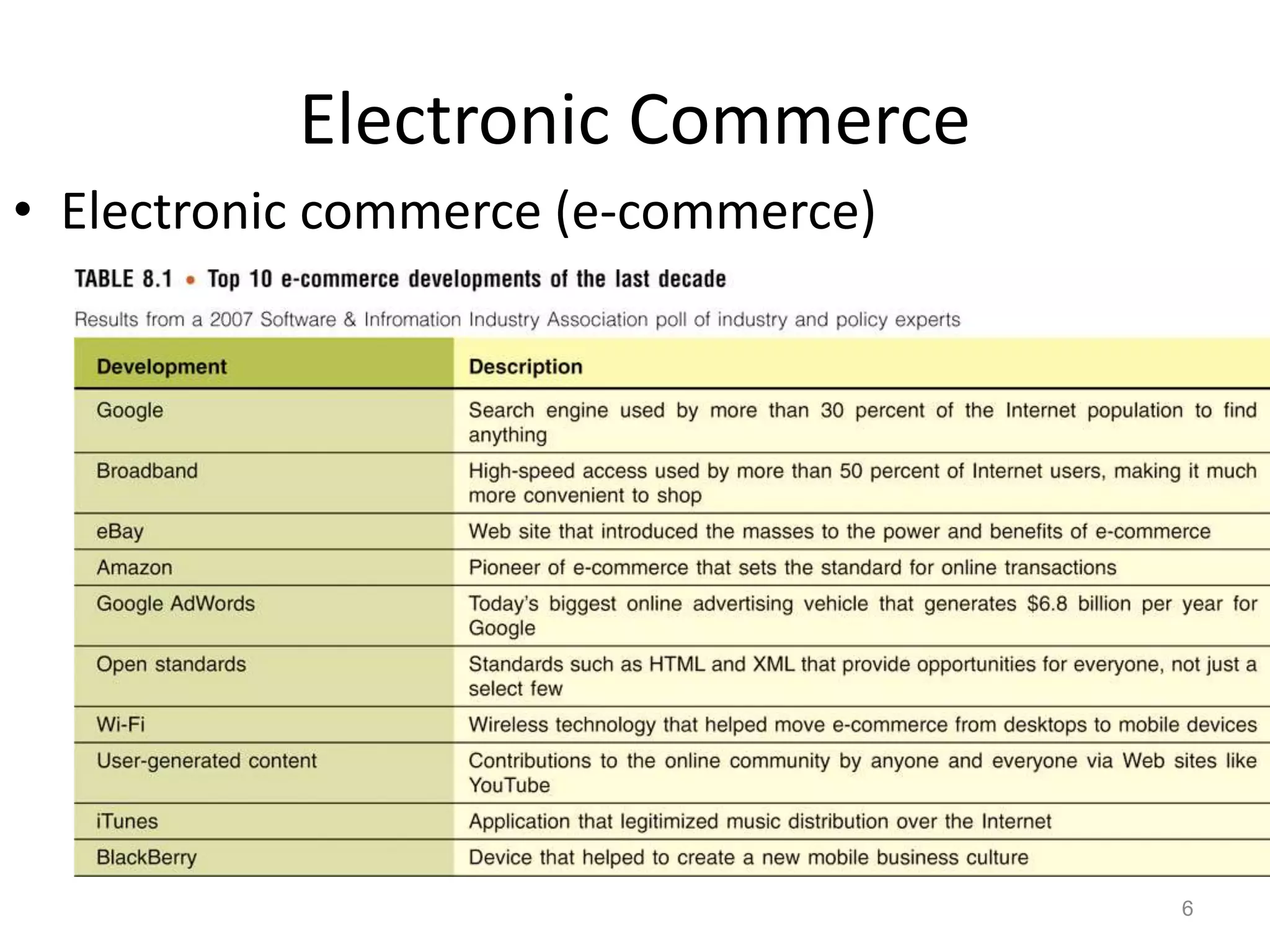
Electronic Commerce
• Electronic commerce (e-commerce)
6
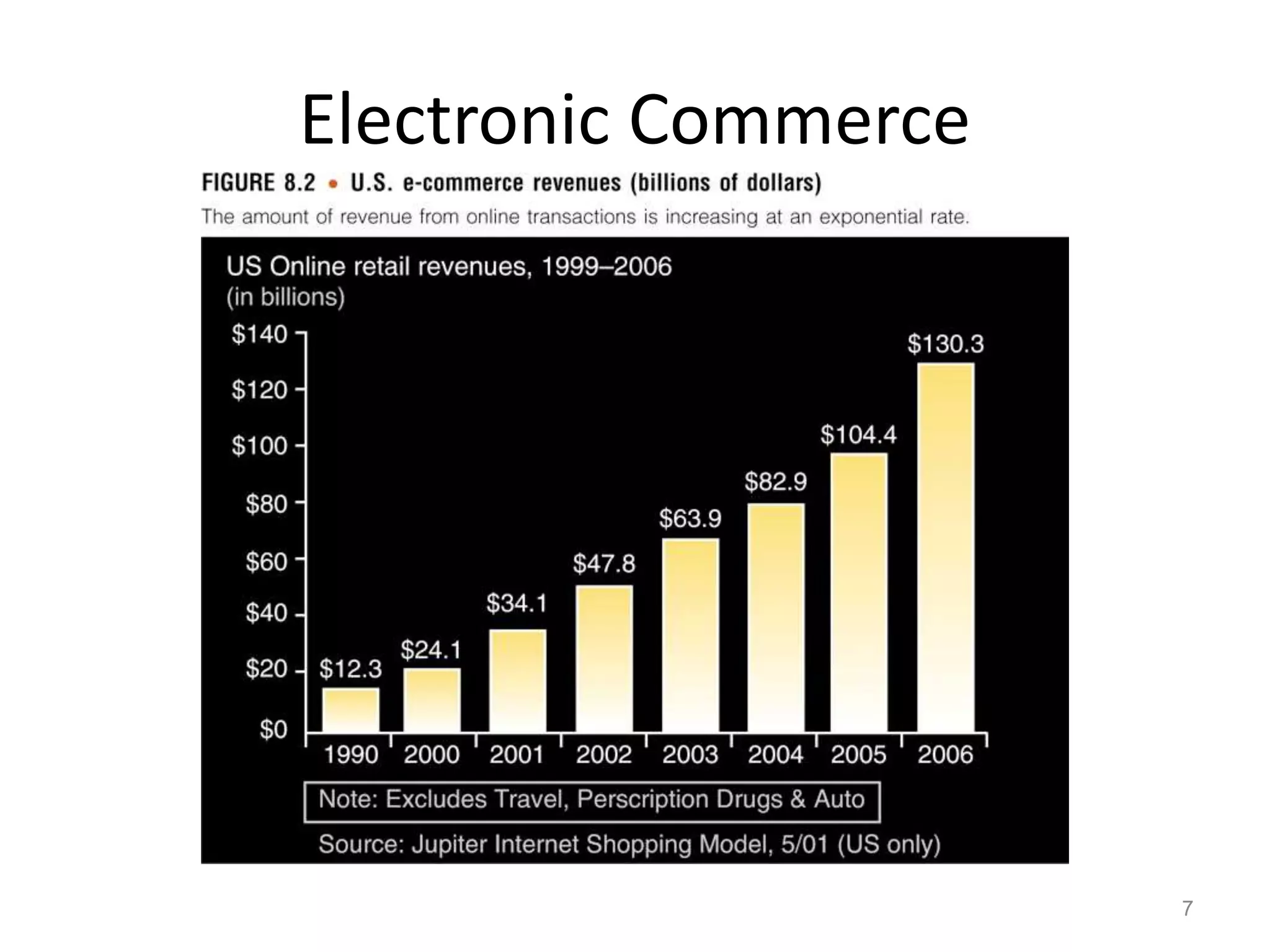
Electronic Commerce
7
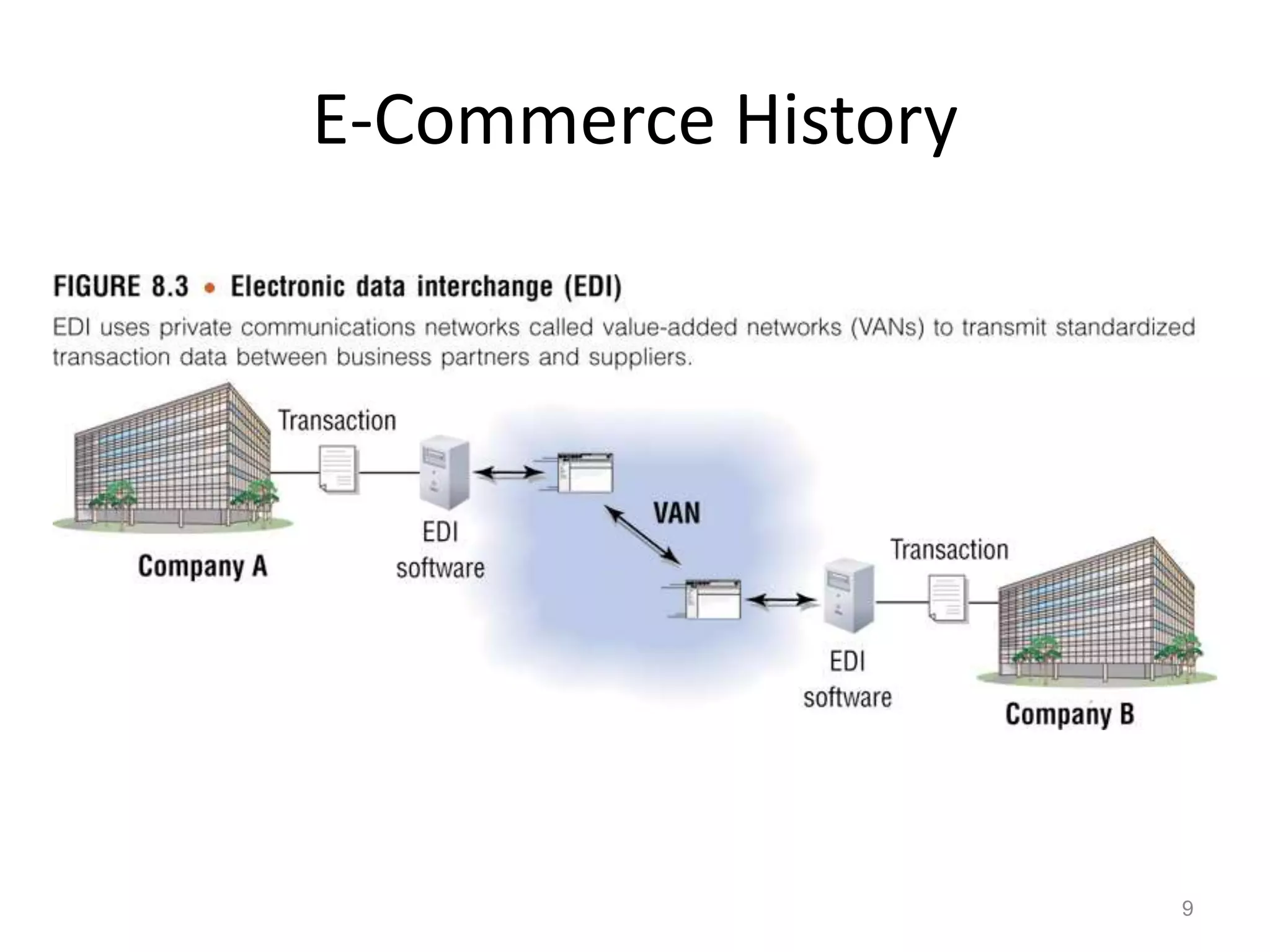
E-Commerce History
• EDI
– Uses private communications networks (VANs) to
transmit standardized transaction data between
business partners and suppliers
• Automating transactions using EDI
– Drastically reduced the amount of paperwork and the
need for human intervention
• Internet
– Provided the ideal platform for conducting EDI
transactions
8
E-Commerce History
9
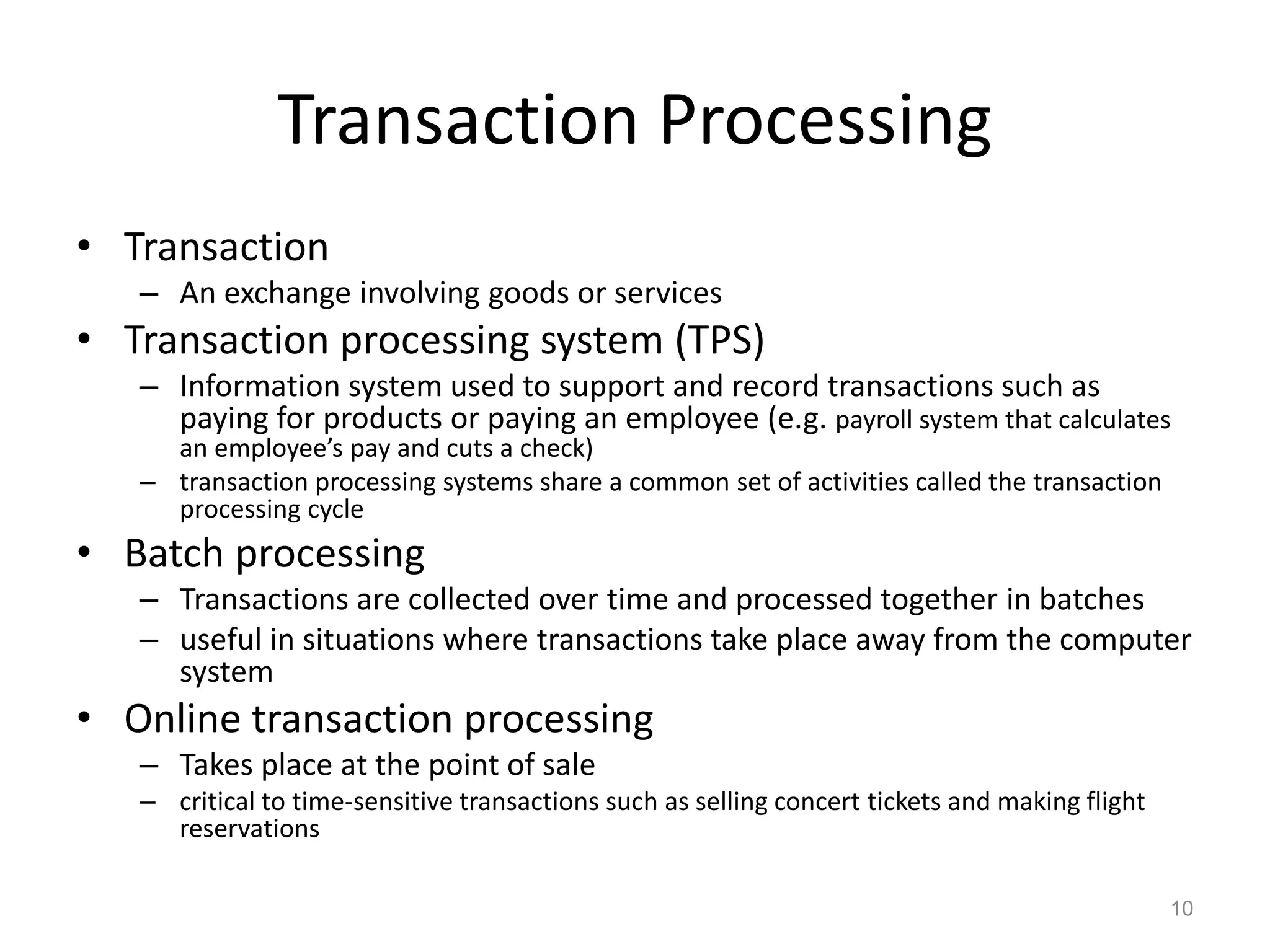
Transaction Processing
• Transaction
– An exchange involving goods or services
• Transaction processing system (TPS)
– Information system used to support and record transactions such as
paying for products or paying an employee (e.g. payroll system that calculates
an employee’s pay and cuts a check)
– transaction processing systems share a common set of activities called the transaction
processing cycle
• Batch processing
– Transactions are collected over time and processed together in batches
– useful in situations where transactions take place away from the computer
system
• Online transaction processing
– Takes place at the point of sale
– critical to time-sensitive transactions such as selling concert tickets and making flight
reservations
10
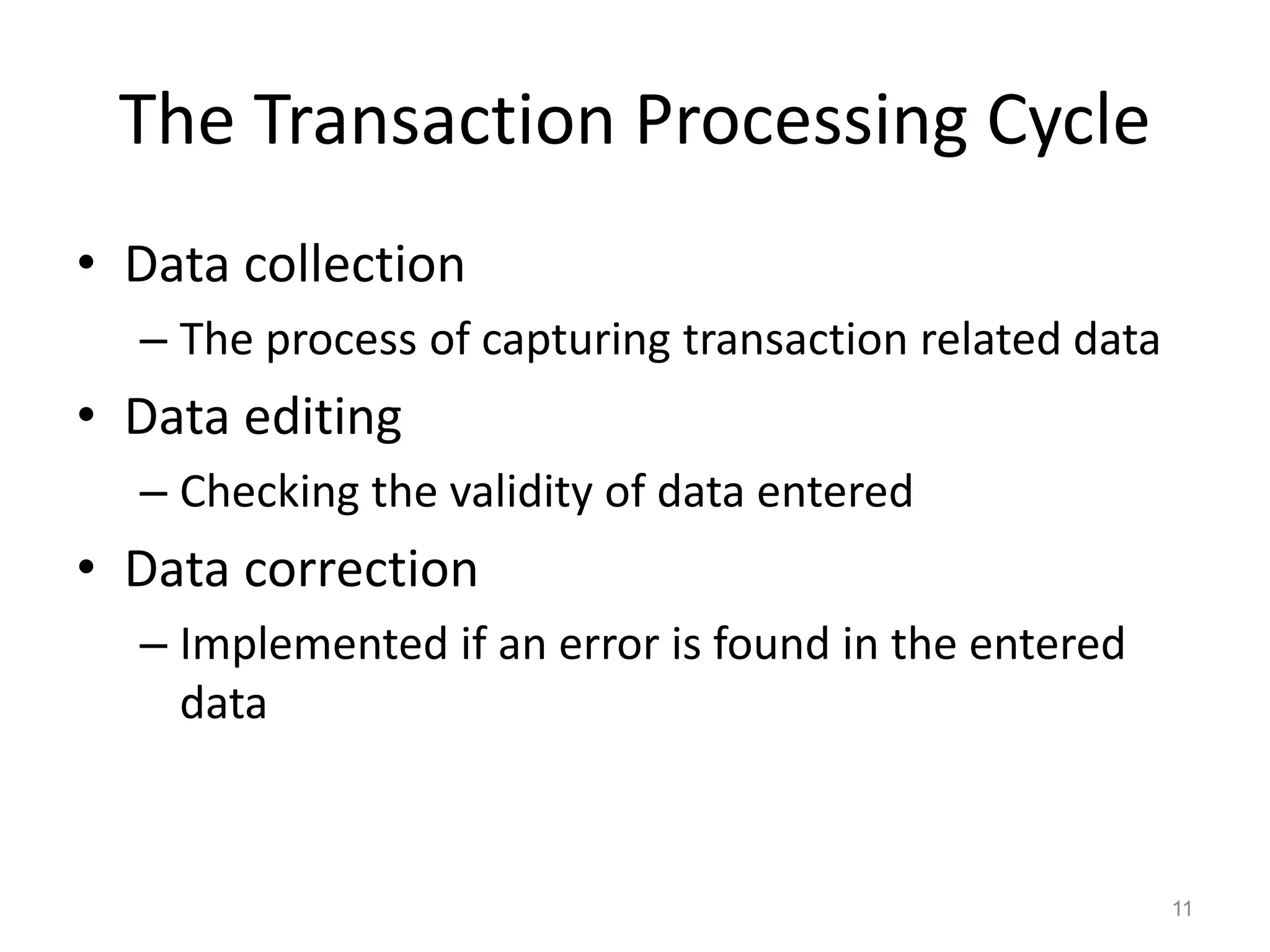
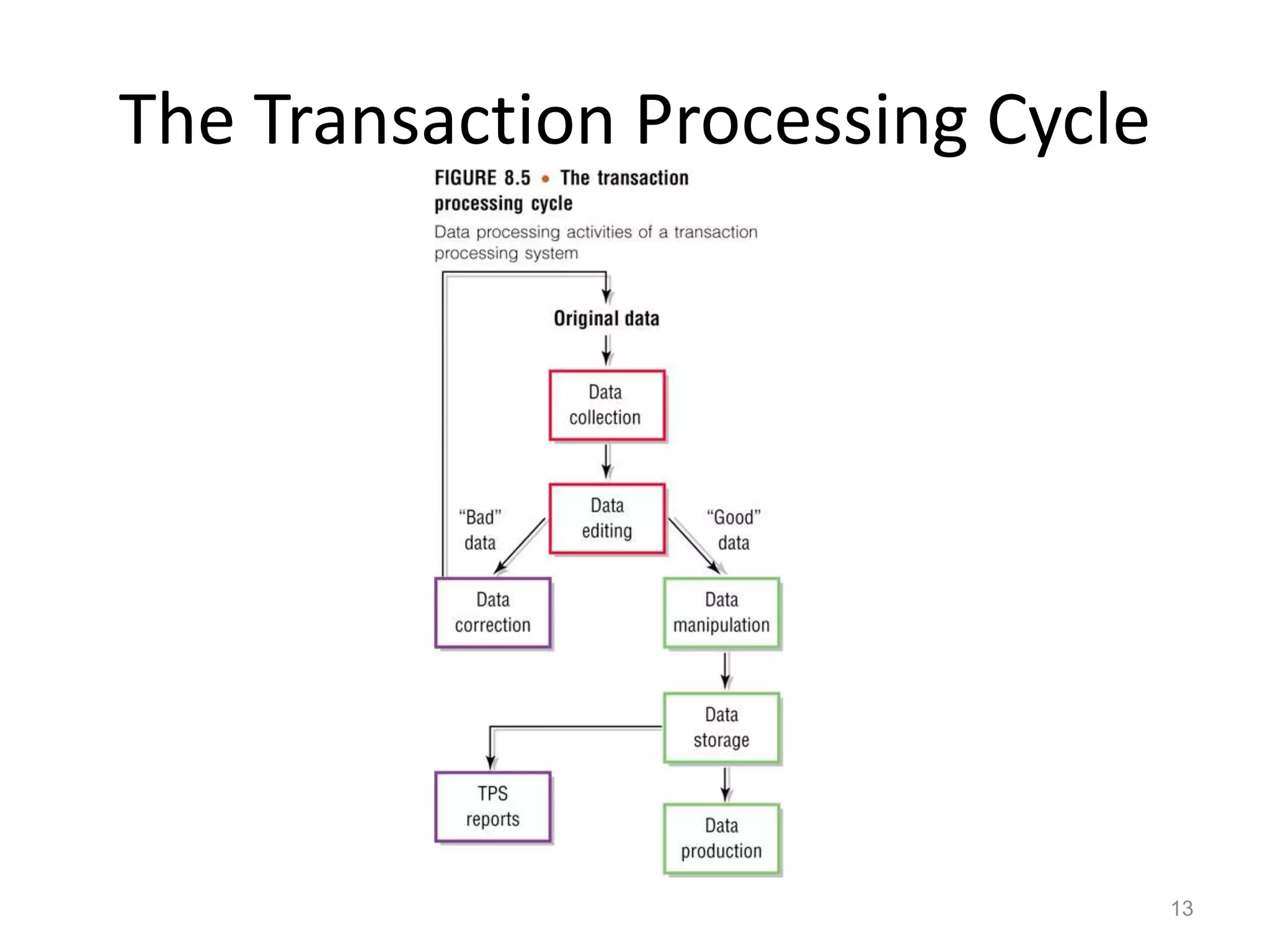
The Transaction Processing Cycle
• Data collection
– The process of capturing transaction related data
• Data editing
– Checking the validity of data entered
• Data correction
– Implemented if an error is found in the entered
data
11
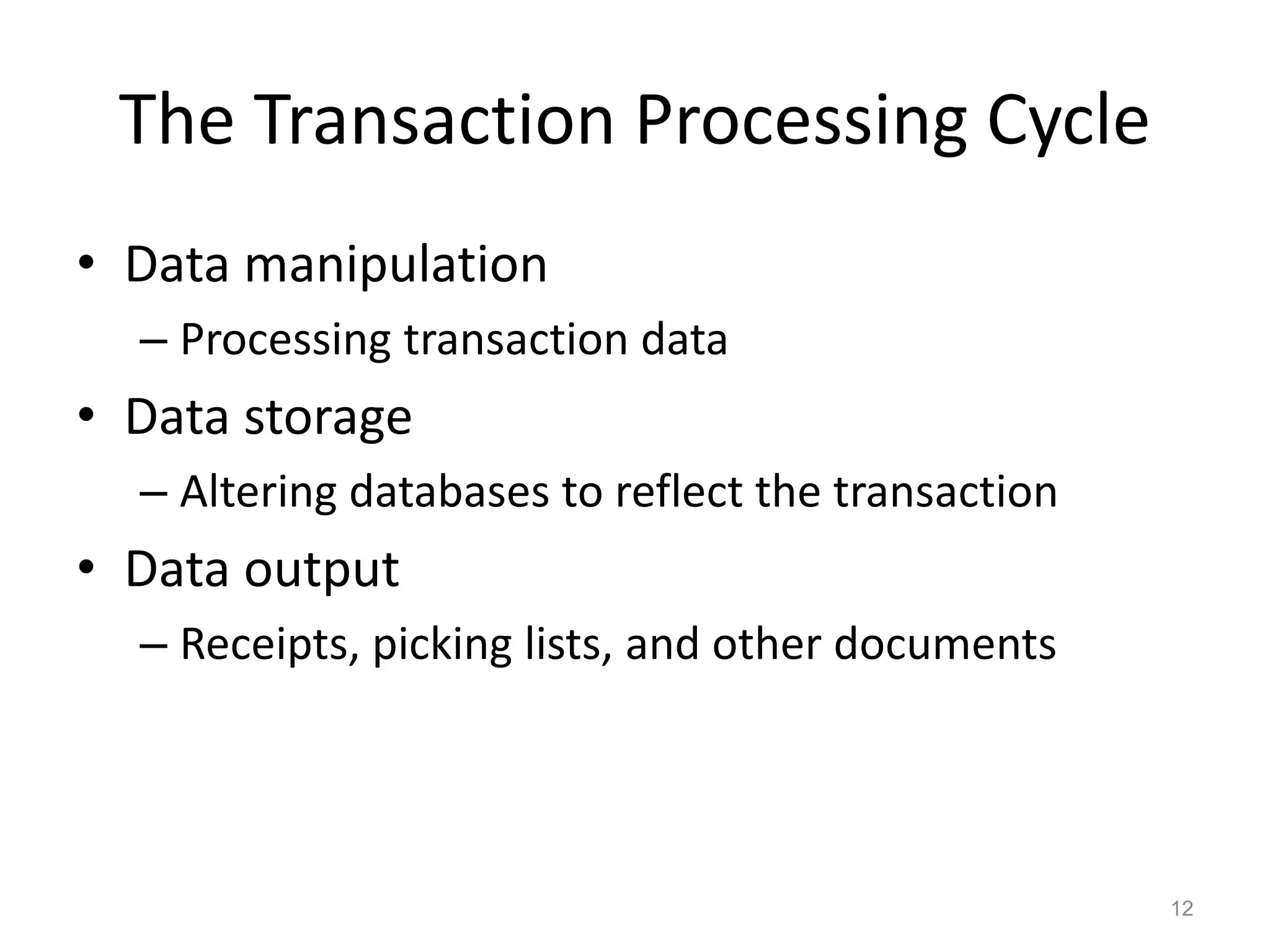
The Transaction Processing Cycle
• Data manipulation
– Processing transaction data
• Data storage
– Altering databases to reflect the transaction
• Data output
– Receipts, picking lists, and other documents
12
The Transaction Processing Cycle
13
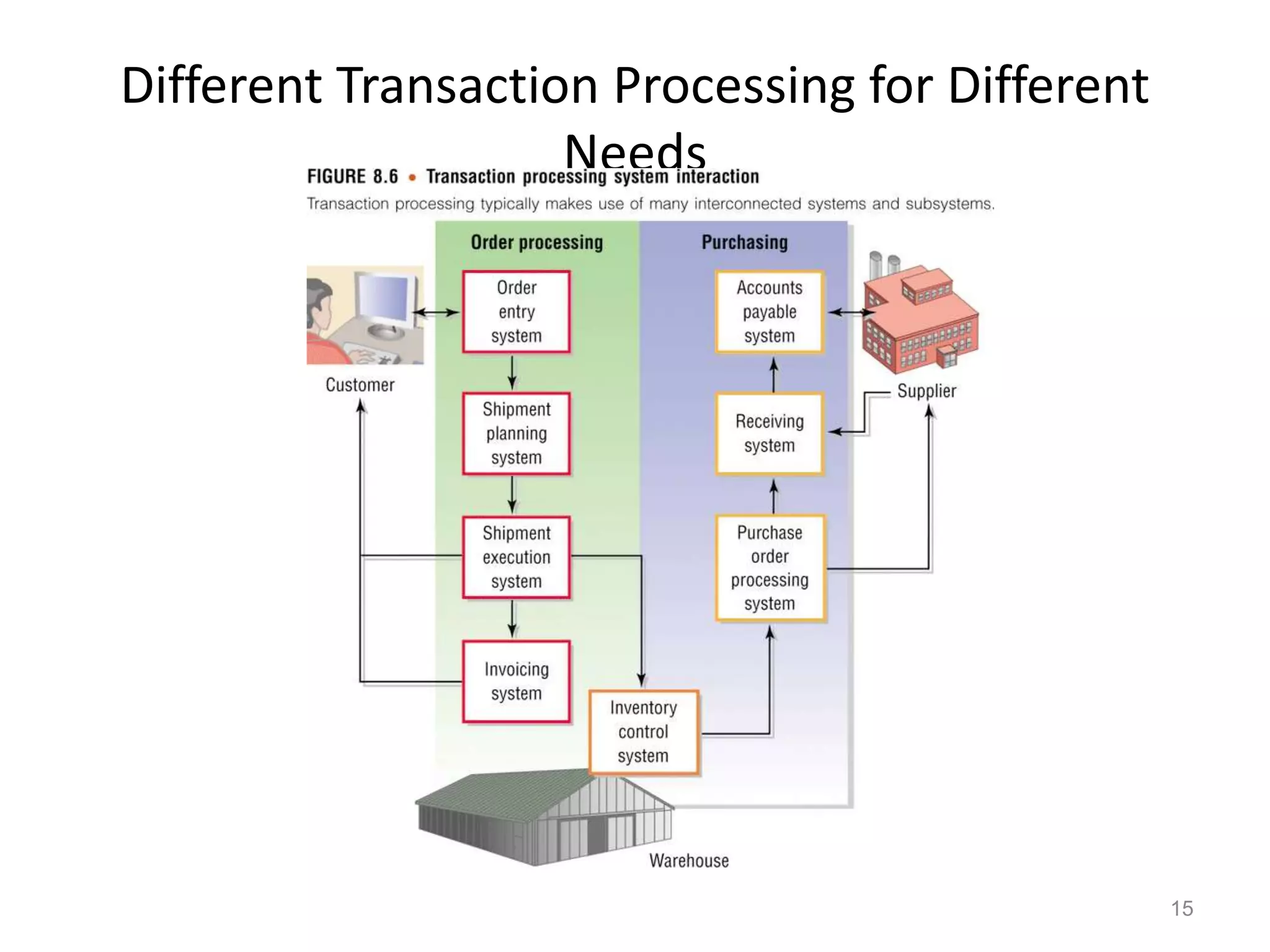
Different Transaction Processing for Different
Needs
• Order processing system
– Supports the sales of goods or services to
customers
– Arranges for shipment of products
• Purchasing system
– Supports the purchase of goods and raw materials
from suppliers
14
Different Transaction Processing for Different
Needs
15
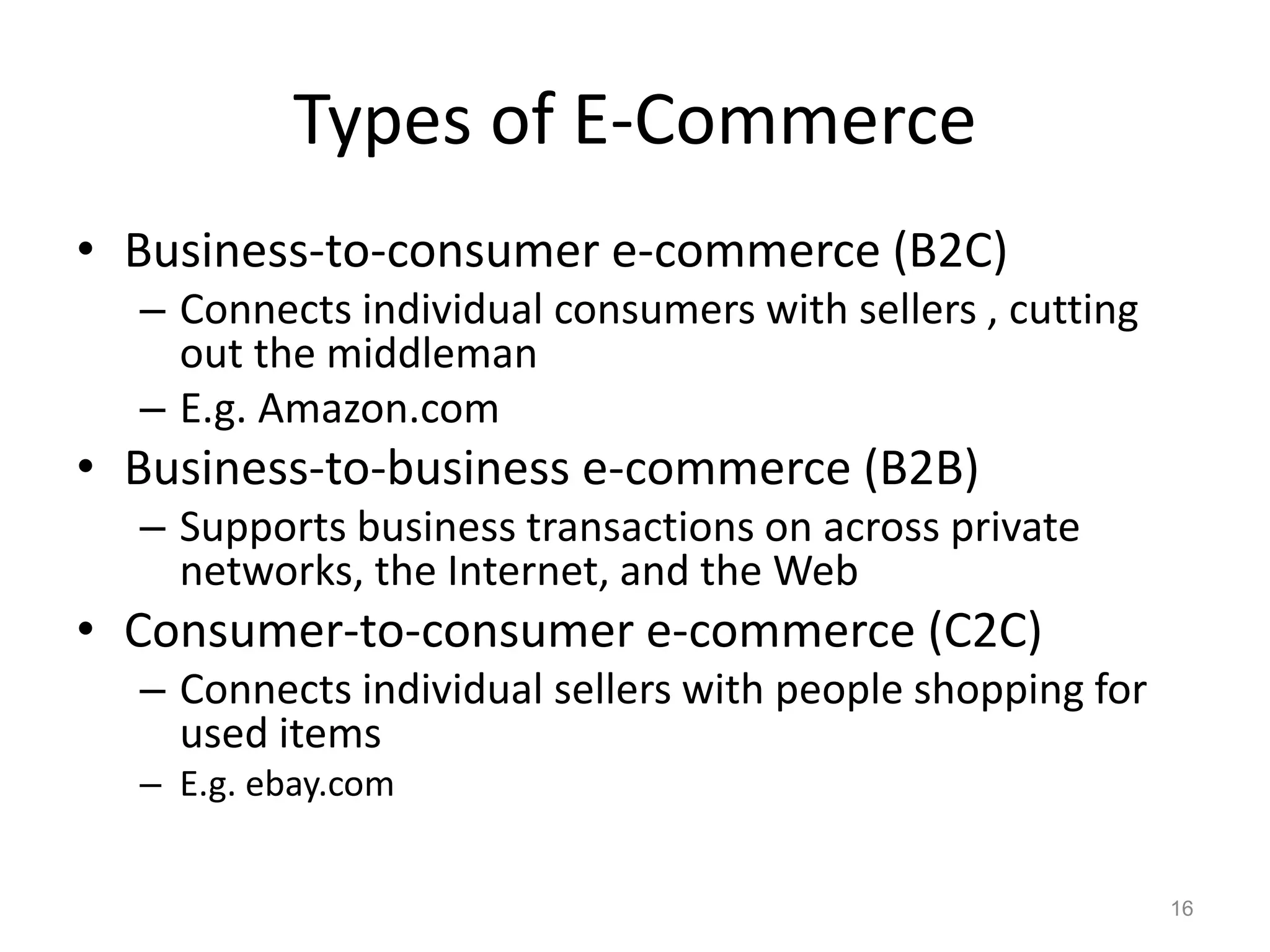
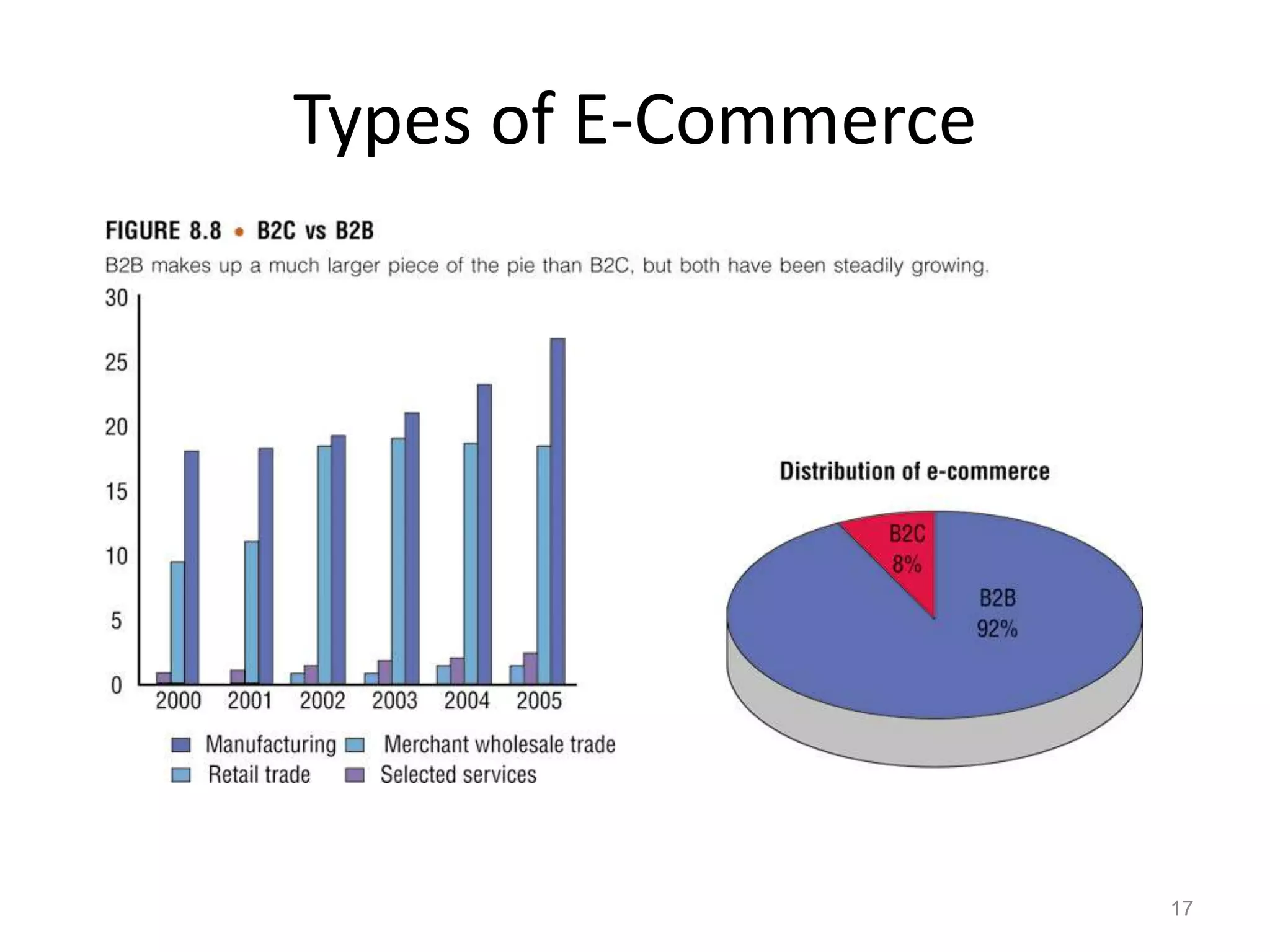
Types of E-Commerce
• Business-to-consumer e-commerce (B2C)
– Connects individual consumers with sellers , cutting
out the middleman
– E.g. Amazon.com
• Business-to-business e-commerce (B2B)
– Supports business transactions on across private
networks, the Internet, and the Web
• Consumer-to-consumer e-commerce (C2C)
– Connects individual sellers with people shopping for
used items
– E.g. ebay.com
16
Types of E-Commerce
17
E-Commerce from the Buyer’s Perspective
• Process of buying or acquiring goods or
services
– Realizing a need
– Researching a product
– Selecting a vendor
– Providing payment
– Accepting delivery
– Using product support
18
E-Commerce from the Buyer’s Perspective
19
E-Commerce from the Seller’s Perspective
• Sellers business practices
– Market research to identify customer needs
– Manufacturing products or supplying services that
meet customer needs
– Marketing and advertising to make customers
aware of available products and services
20
E-Commerce from the Seller’s Perspective
• Sellers business practices
– Providing a method for acquiring payments
– Making arrangements for delivery of the product
– Providing after-sales support
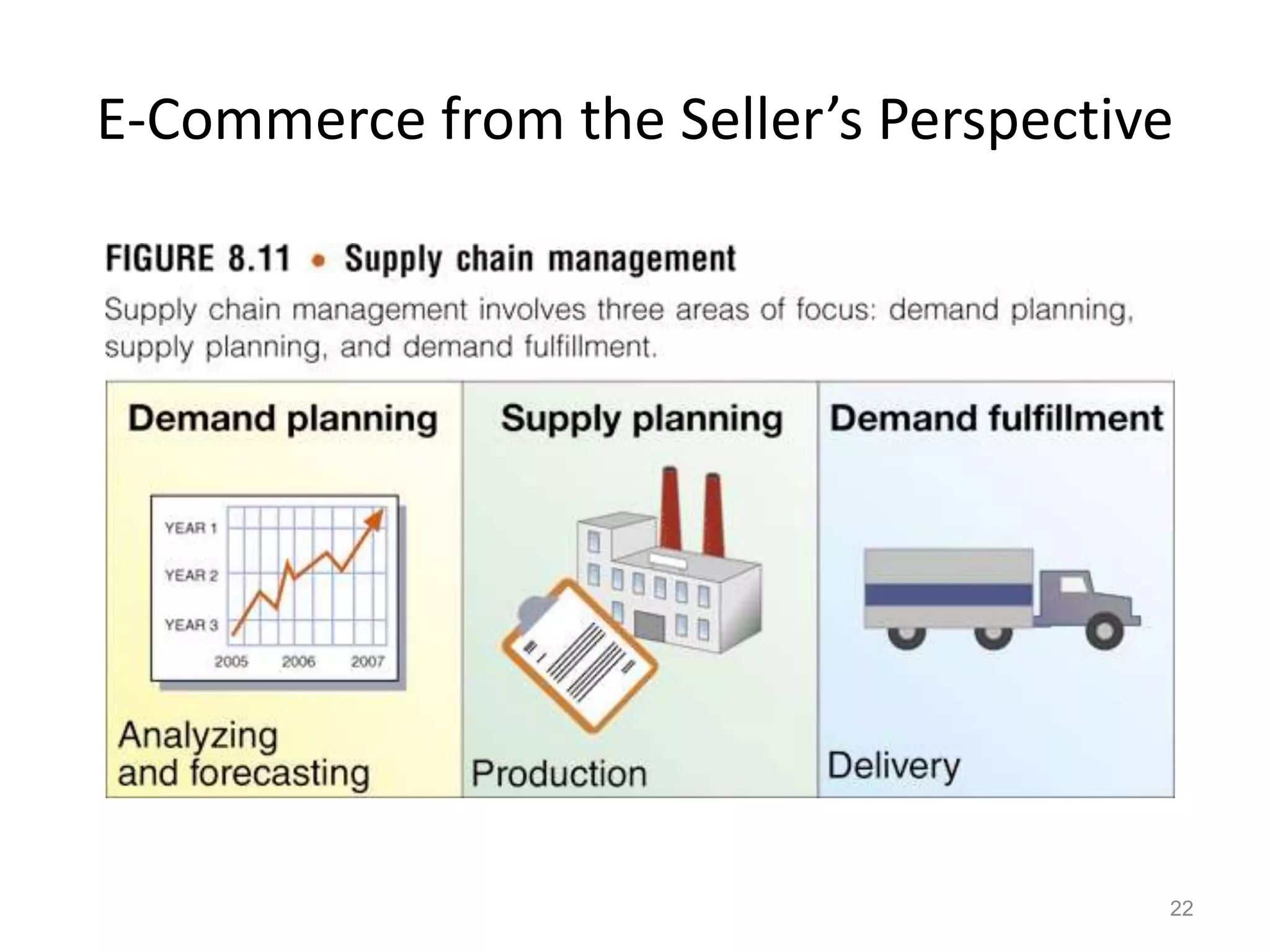
• Supply chain management
– From the seller’s perspective, the process of
producing and selling goods
– Involves three areas of focus: demand planning,
supply planning, and demand fulfillment
• Demand fulfillment: process of getting the product or service to the
customer
21
E-Commerce from the Seller’s Perspective
22
Benefits and Challenges of E-Commerce
• Buyers enjoy the convenience of shopping from
their desktop
• B2C e-commerce
– Levels the playing field between large and small
businesses
• Challenges
– Established businesses must alter systems and
business practices
– Security, privacy, reliability: E-commerce can survive
only if all involved can trust the system
– Social concerns
23
Benefits and Challenges of E-Commerce
24
E-Commerce Applications
• E-Commerce
– Playing an increasingly important role in our
personal and professional lives
– Allows us to discover new and interesting
products
– Allows us to find better deals
– Used to monitor bank accounts and transfer
electronic funds
25
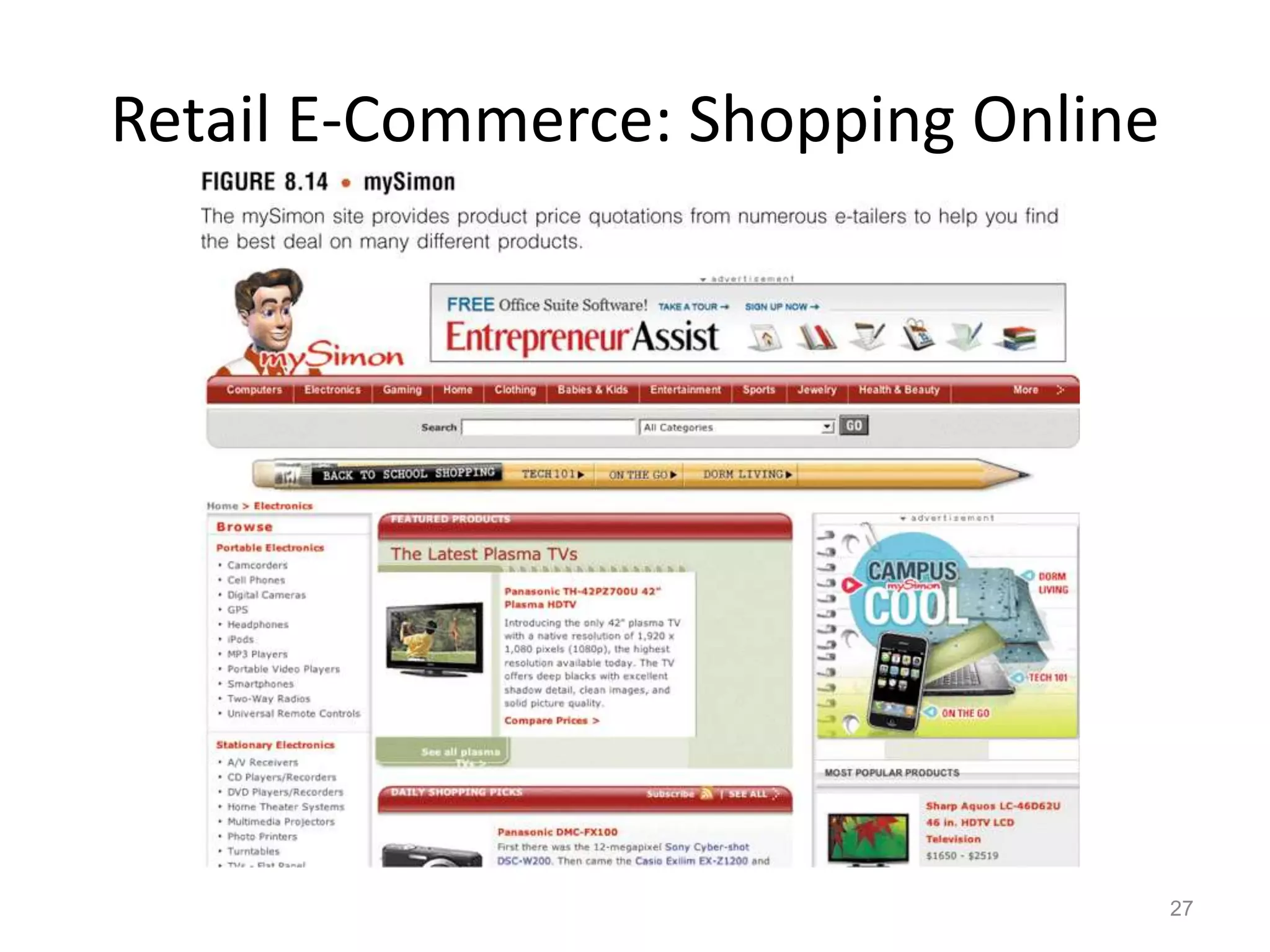
Retail E-Commerce: Shopping Online
• E-tailing provides customers with
– Product information
– The ability to comparison shop
• E-tailing options
– Set up an electronic storefront
– Lease space in a cybermall
• Web site that allows users to browse through a wide
variety of products offered by several different retailers
26
Retail E-Commerce: Shopping Online
27
Online Clearing Houses, Web Auctions,
and Marketplaces
• Provide a platform for businesses and
individuals to sell their products and
belongings
– www.ubid.com
• Provides a method for manufacturers to liquidate stock
and consumers to find a good deal
– eBay.com
• Most popular auction/marketplace
28
B2B Global Supply Management
and Electronic Exchanges
• Global supply management (GSM)
– Businesses can find the best deals for raw materials
and supplies needed to manufacture their products on
the global market
• Electronic exchange
– an industry-specific Web resource created to provide
a convenient centralized platform for B2B e-
commerce among manufacturers, suppliers, and
customers
– Promotes cooperation between competing companies
29
Marketing
• Web is used for
– Unsolicited advertising
• Banner: A rectangular area embedded in the Web page
content for advertising, often across the top of the page
– Access to product information through business Web
sites
• Get better deals and make informed decisions
– Market research
• Traditionally done by interviewing customers
• Market segmentation divides customer opinions based on
various criteria
• E-commerce allows market segmentation to take place on an
individual level
30
Marketing
31
Banking, Finance, and Investment
• Online banking provides
– Convenient access to bank balance information
– Ability to transfer funds, pay bills, and obtain
account histories
• Electronic funds transfer
– Popular for paying bills and receiving paychecks
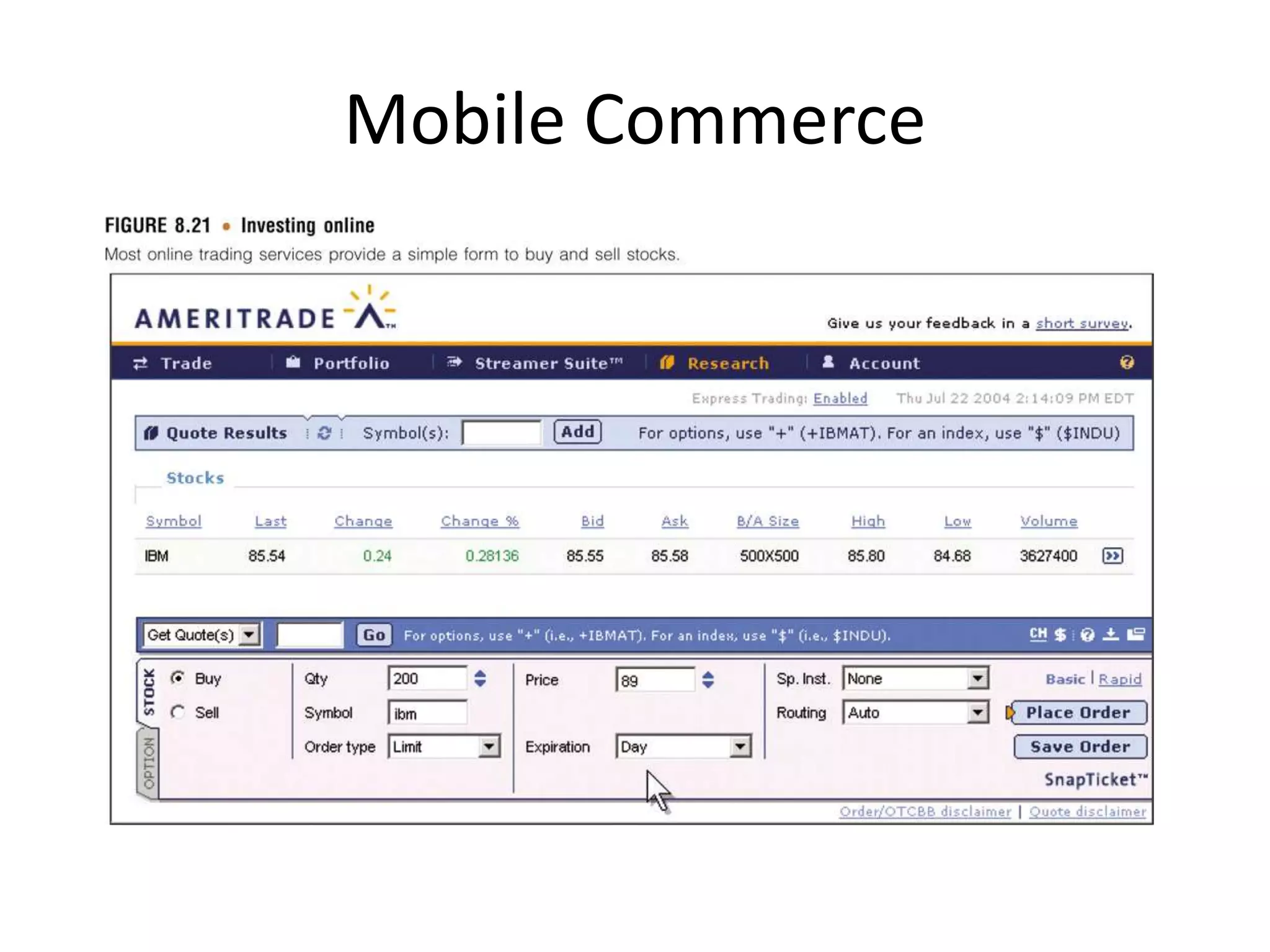
• Online brokerages
– Able to execute trades fast, within seconds
32
Mobile Commerce (M- Commerce)
• A form of e-commerce
• Takes place over wireless mobile devices such
as
– Handheld computers and cell phones
– takes place in emerging technologies such as
dashtop computers embedded in automobile
dashboards
• Presents unique opportunities and challenges
33
Mobile Commerce
M-Commerce Technology
• Technologies and standards
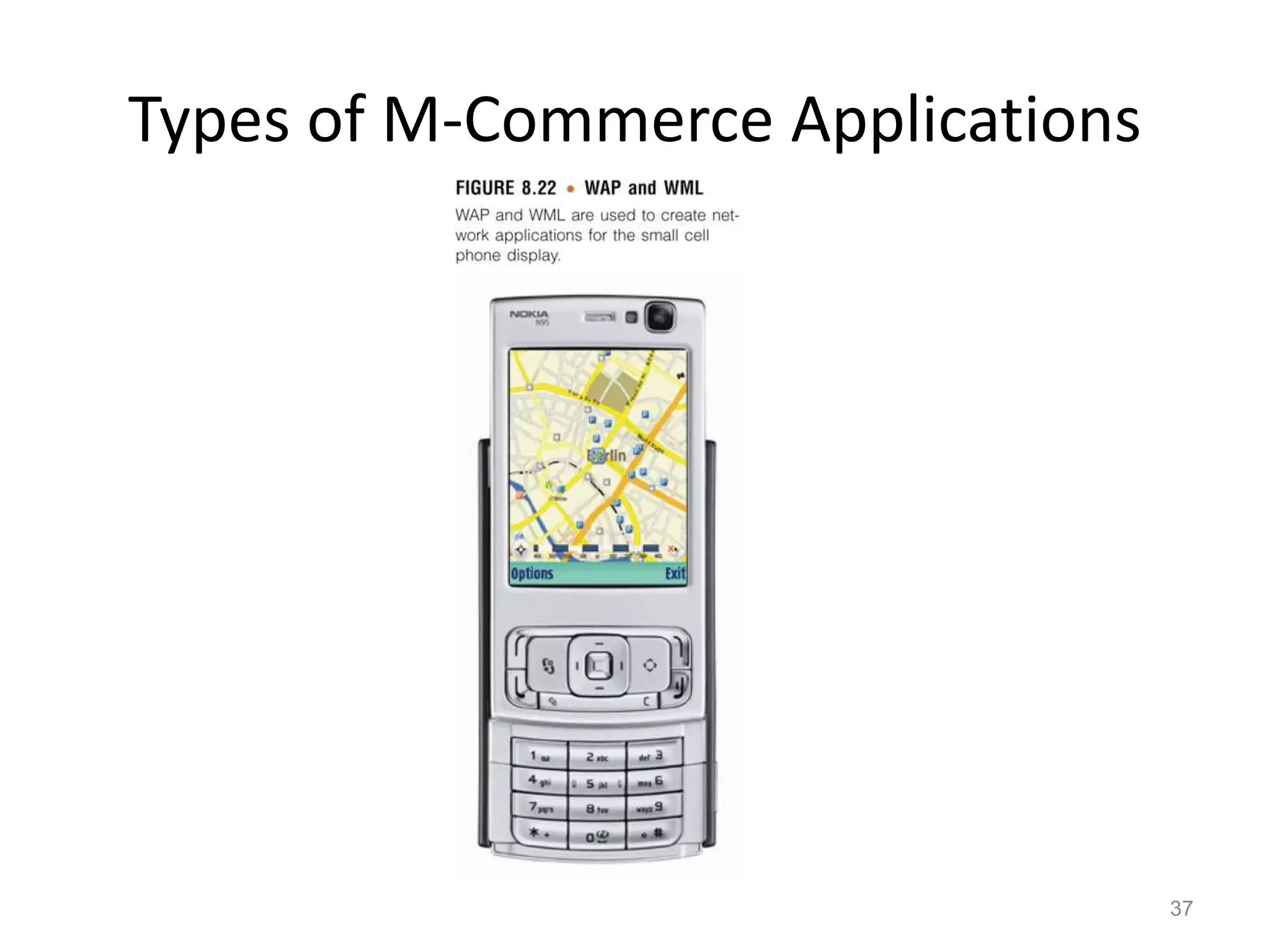
– Wireless Application Protocol (WAP)
• a communication standard used by developers to create m-
commerce applications
– Wireless Markup Language (WML)
– Infrared or Bluetooth wireless networking technology
• Near Field Communications (NFC)
• Open Mobile Alliance (OMA)
– Hundreds of mobile operators, device and network
suppliers and companies have joined together to create
standards and interoperability between mobile devices
35
Types of M-Commerce Applications
• Methods for delivering m-commerce services
– Directly from cell phone service providers
– Via mobile Internet or Web applications
• Location-based m-commerce applications
– Using Short Message Service (SMS) text messaging
or Multimedia Messaging Service (MMS)
– Using short-range wireless technology, such as
infrared
• Proximity payment system
36
Types of M-Commerce Applications
37
E-Commerce Implementation
• Implementing e-commerce
– Requires large investment and expertise
• E-Commerce host
– A company that takes on some or all of the
responsibility of setting up and maintaining an e-
commerce system for a business or organization
38
Infrastructure
• E-Commerce requires significant infrastructure
changes
• Businesses must have employees who are
technically savvy
• B2C e-commerce
– Often connects manufacturers directly with
consumers, cutting out the middleman
– Requires shipping individual products directly to
consumers
39
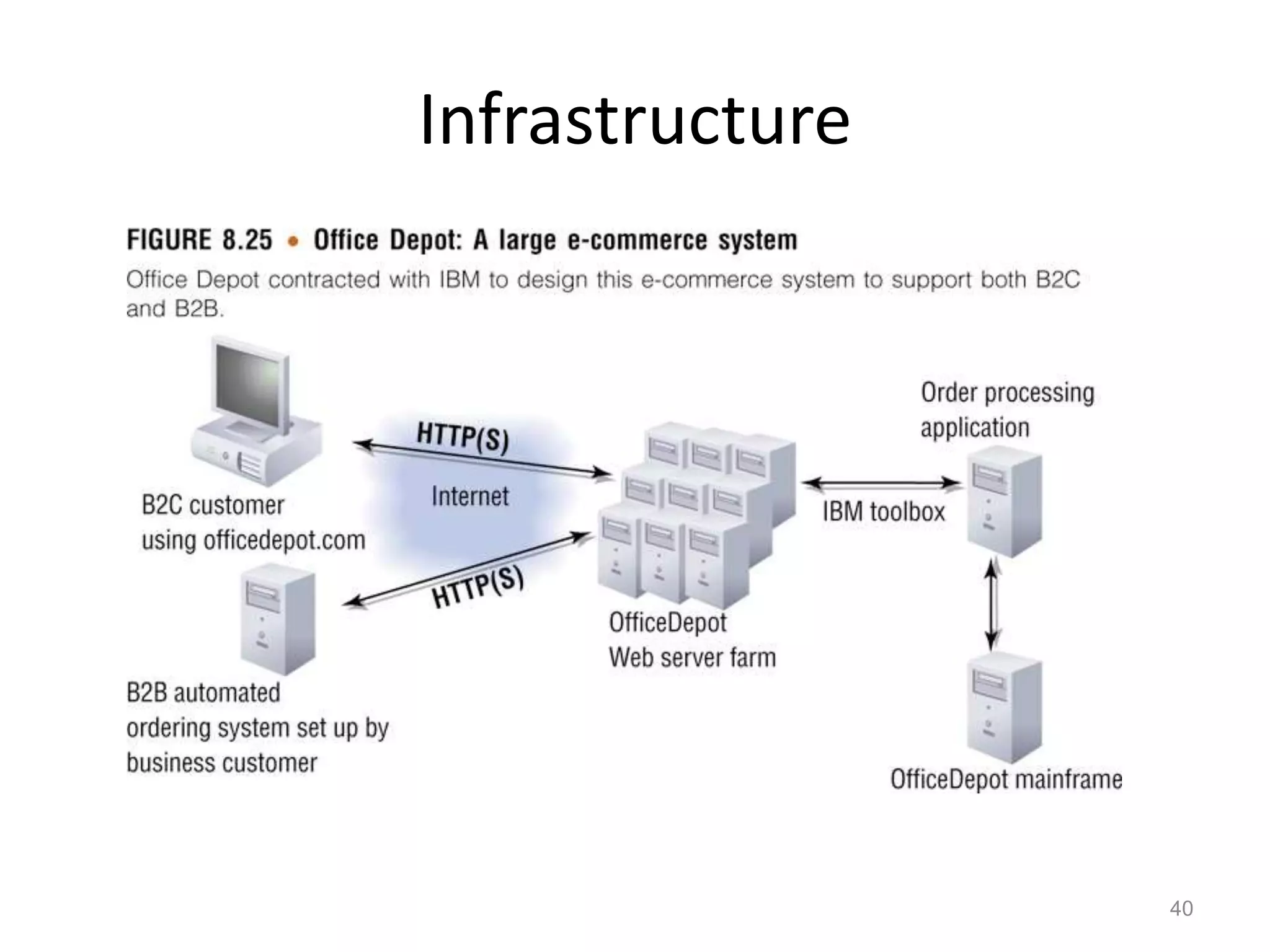
Infrastructure
40
Hardware and Networking
• Underestimating the amount of Web traffic
– Leads to network stalls and long wait times
• Typical e-commerce Web site
– Employs one or more server computers and a
high-speed Internet connection
• Outsourcing to a Web hosting company
– Can operate 24 hours a day, 7 days a week
– Load-balancing
41
Software
• Web Server Software
– Responds to requests for Web pages
• Web Server Utility Programs
– Provide statistical information about server usage
and Web site traffic patterns
• E-Commerce Software
– Supports e-commerce activities
– Includes catalog management, electronic
shopping cart, and payment software
42
Software
• Web Site Design Tools
– What-you-see-is-what-you-get (WYSIWYG)
applications or wizards
• Graphics Applications
– Design and create graphic elements of Web sites
• Web Site Development Tools
– Application programming interfaces (API’s)
• Allow software engineers to develop Web-driven
programs
43
Software
• Web services
– Programs that automate tasks by communicating
with each other over the Web
– Systems developers can provide tools for
automating trivial or repetitive tasks
– Important in transaction processing
44
Building Traffic
• The 3Cs Approach
– Content, community, and commerce
• Keywords and Search Engines
– Choose name and product names that best
describe business purpose and features
– Select descriptive domain names
– Business-related keywords can be listed in the
HTML meta tag
• Read by search engines and servers, but not displayed
on the page
45
Building Traffic
• Marketing
– Online advertising methods include banner ads,
pop-up ads, and e-mail
– market segmentation: customer opinions are
divided into demographic variables such as race,
gender, income, education, and age to determine
which segment a product appeals to most
– Offline advertising methods include magazines,
newspapers, radio, and television
46
Building Traffic
47
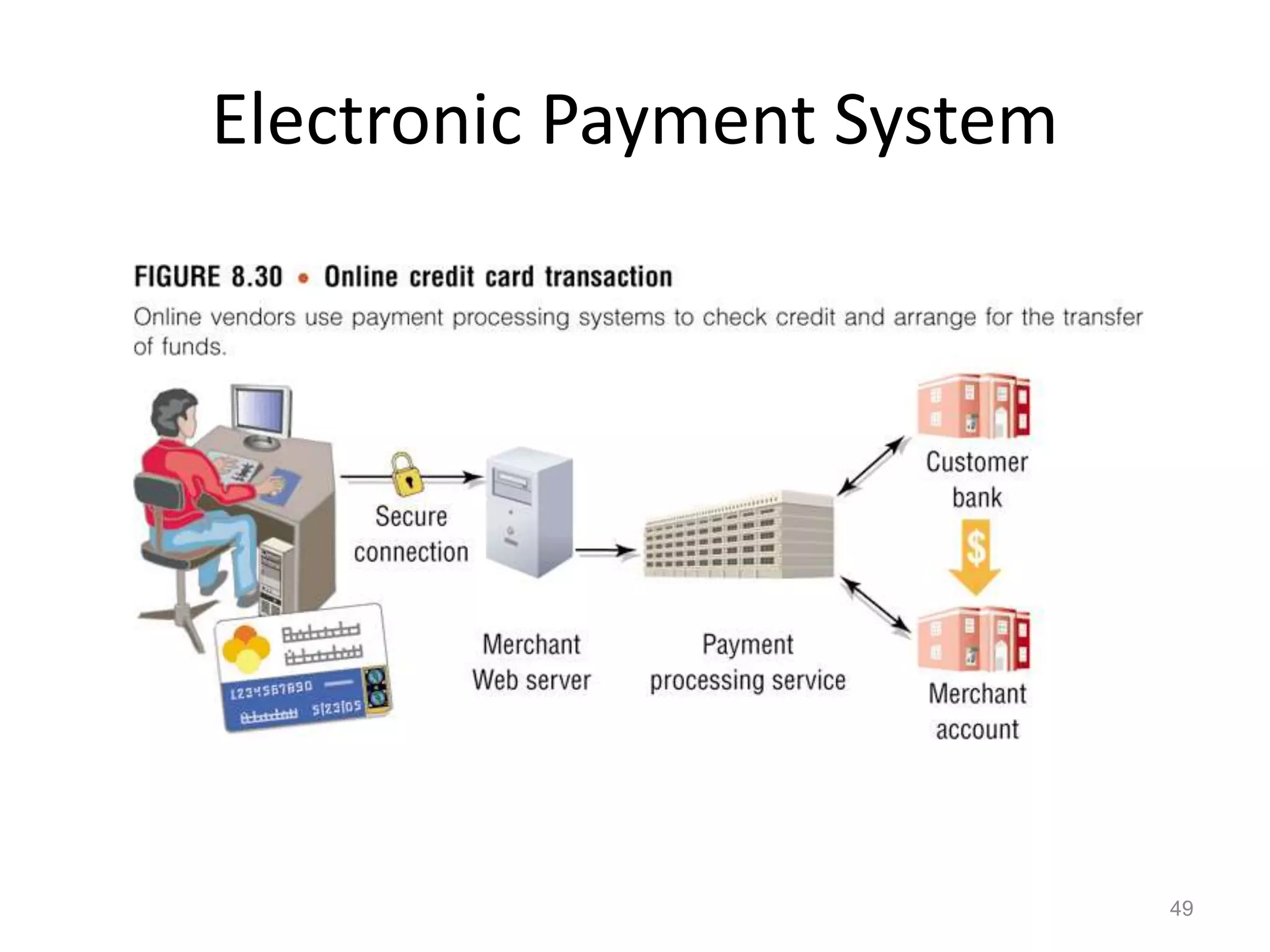
Electronic Payment System
• proximity payment system
– allows customers to transfer funds wirelessly between their mobile
device and a point-of-sale terminal
• Electronic cash (e-cash or digital cash)
– Provides a private and secure method of transferring funds from a
bank account or credit card to online vendors or individuals
– PayPal
• Best-known e-cash provider
• E-cash benefits
– Privacy - hides account information from vendors
– Convenient if seller cannot process a credit card
• Smartcards
– Credit cards with embedded microchips that can store and process data
and can be used as electronic wallets
48
Electronic Payment System
49
Electronic Payment System
50
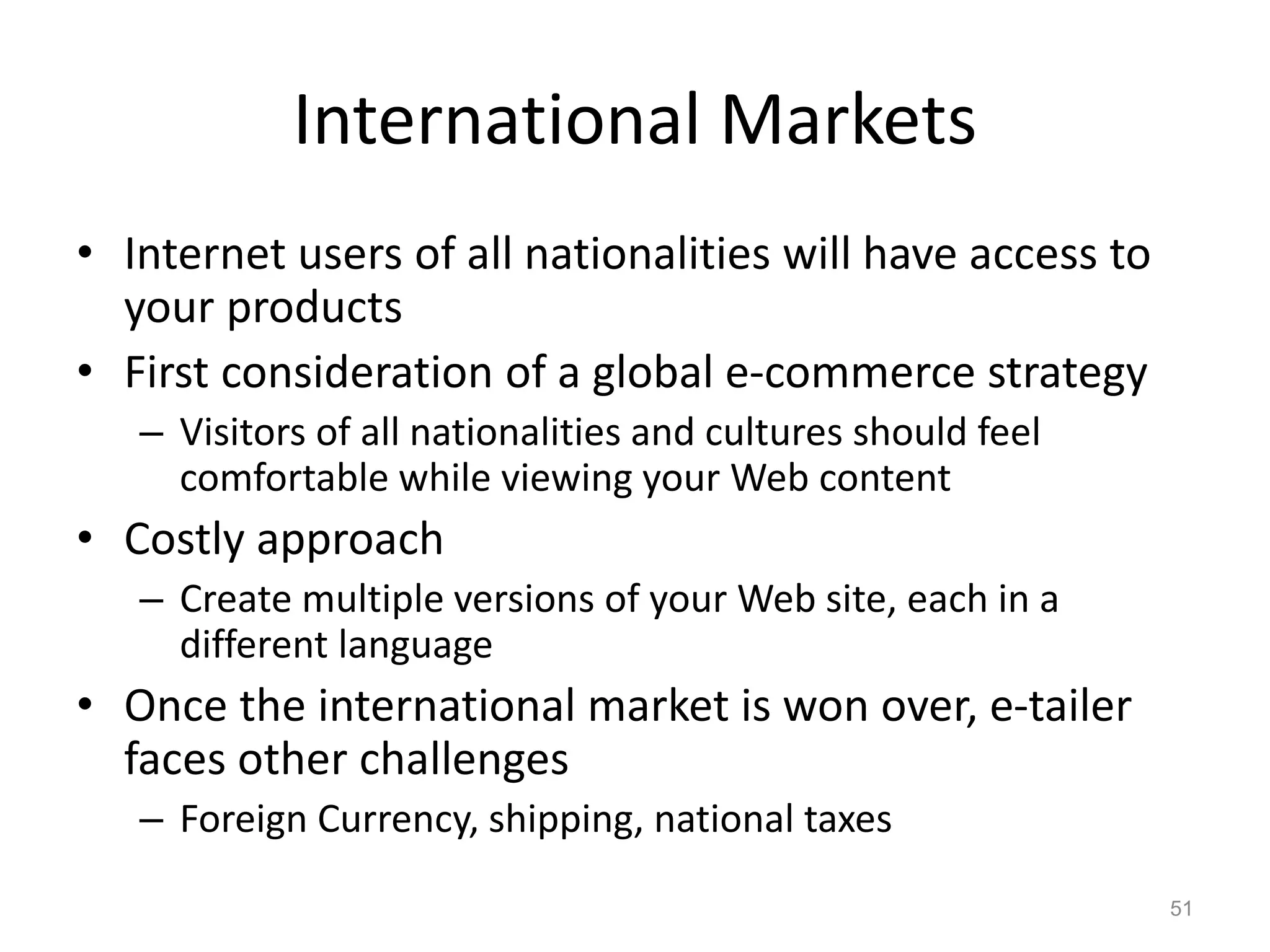
International Markets
• Internet users of all nationalities will have access to
your products
• First consideration of a global e-commerce strategy
– Visitors of all nationalities and cultures should feel
comfortable while viewing your Web content
• Costly approach
– Create multiple versions of your Web site, each in a
different language
• Once the international market is won over, e-tailer
faces other challenges
– Foreign Currency, shipping, national taxes
51
E-Commerce Security Issues
• There are significant privacy and security
concerns
– Public network
– No buyer or seller identity verification
– Hacker attacks
52
E-Commerce Security Issues
• Digital certificate
– A type of electronic business card
– Attached to Internet transaction data
– Verifies the sender of the data
– Provided by certification authorities
– Encryption
• Uses high-level mathematical functions and computer
algorithms to transform data so that it is unintelligible
to all but the intended recipient
53
E-Commerce Security Issues
• Securing data in transit
– Secure Sockets Layer (SSL)
• Digital certificates combined allows for encrypted
communications to occur between Web browser and
Web server
– Transport Layer Security (TLS)
• A URL associated with this begins with https
• Allow for encrypted communication to occur between
browsers and servers
• Secures usernames, passwords, credit card information
54
E-Commerce Security Issues
55
Business Resumption Planning
• Great pains are taken to ensure that
transaction processing systems remain in
working order
• Business resumption planning (BRP)
– Takes into account every possible disaster and
provides courses of action to minimize negative
effects
– The goal is to protect data and keep key systems
operating until order is resumed
56
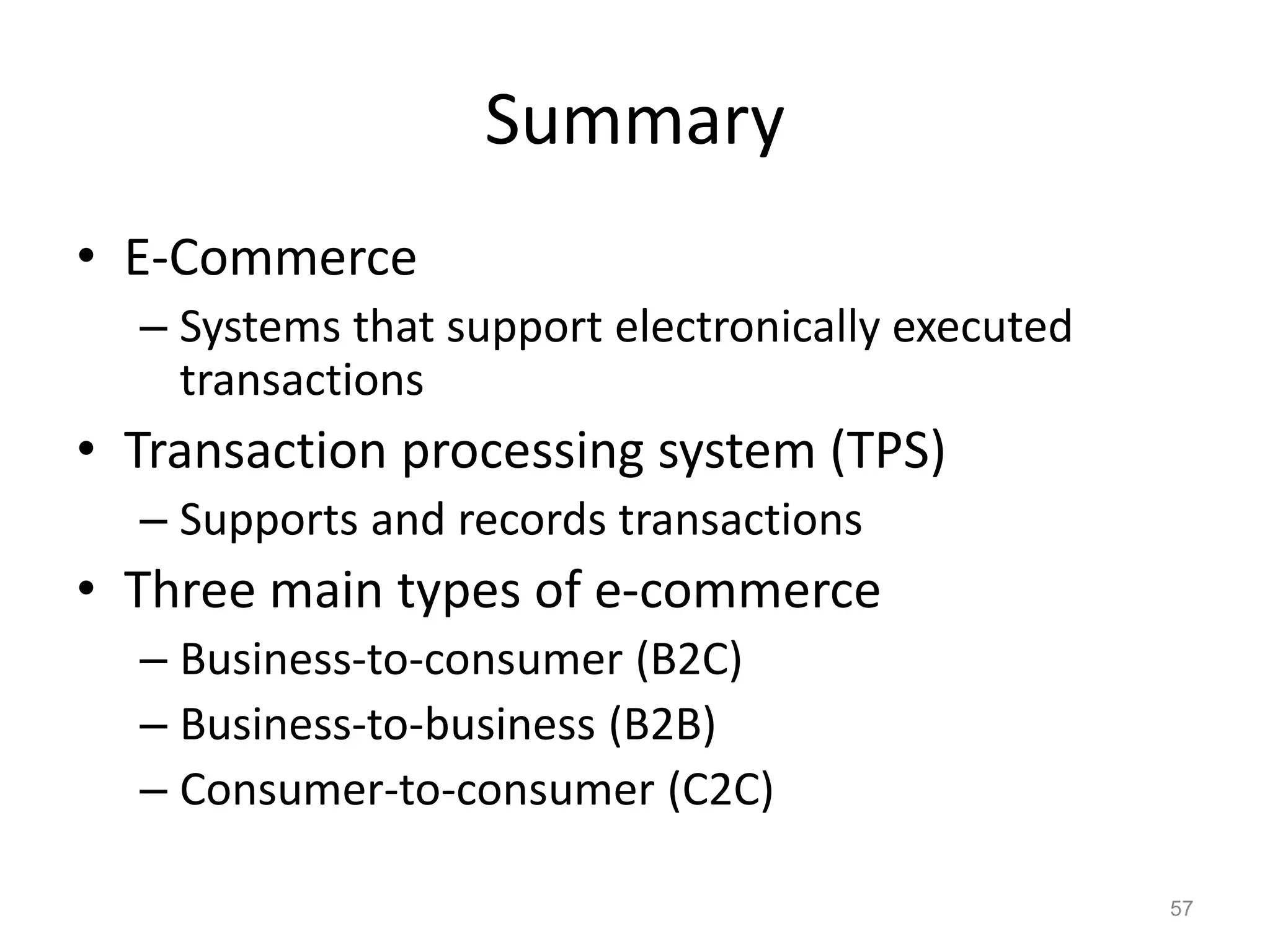
Summary
• E-Commerce
– Systems that support electronically executed
transactions
• Transaction processing system (TPS)
– Supports and records transactions
• Three main types of e-commerce
– Business-to-consumer (B2C)
– Business-to-business (B2B)
– Consumer-to-consumer (C2C)
57
Summary
• Retail Web sites
– Allow consumers to comparison shop
• Mobile commerce
– A form of e-commerce that takes place over wireless
mobile devices
• E-Commerce
– Requires investment in networking, hardware, and a
wide variety of software
– Requires changes in infrastructure
58
59
For more updates on Data Science, Big
Data, Cloud Computing, Data Analytics,
Artificial Intelligence, IoT subscribe to
http://www.mybigdataanalytics.in

ECommerce in one Presentation...

  • 1.
  • 2.
    Objectives • Define e-commerceand understand its role as a transaction processing system • List the three types of e-commerce, and explain how e-commerce supports the stages of the buying process and methods of marketing and selling • Discuss several examples of e-commerce applications and services 2
  • 3.
    Objectives • Define m-commerce,and describe several m- commerce services • List the components of an e-commerce system, and explain how they function together to provide e-commerce services 3
  • 4.
    Chapter Content • TheRoots of E-Commerce • Overview of Electronic Commerce • E-Commerce Applications • Mobile Commerce • E-Commerce Implementation 4
  • 5.
    Electronic Commerce • Electroniccommerce (e-commerce) – Systems that support electronically executed business transactions – The fundamental purpose of e-commerce is to execute transactions 5
  • 6.
    Electronic Commerce • Electroniccommerce (e-commerce) 6
  • 7.
  • 8.
    E-Commerce History • EDI –Uses private communications networks (VANs) to transmit standardized transaction data between business partners and suppliers • Automating transactions using EDI – Drastically reduced the amount of paperwork and the need for human intervention • Internet – Provided the ideal platform for conducting EDI transactions 8
  • 9.
  • 10.
    Transaction Processing • Transaction –An exchange involving goods or services • Transaction processing system (TPS) – Information system used to support and record transactions such as paying for products or paying an employee (e.g. payroll system that calculates an employee’s pay and cuts a check) – transaction processing systems share a common set of activities called the transaction processing cycle • Batch processing – Transactions are collected over time and processed together in batches – useful in situations where transactions take place away from the computer system • Online transaction processing – Takes place at the point of sale – critical to time-sensitive transactions such as selling concert tickets and making flight reservations 10
  • 11.
    The Transaction ProcessingCycle • Data collection – The process of capturing transaction related data • Data editing – Checking the validity of data entered • Data correction – Implemented if an error is found in the entered data 11
  • 12.
    The Transaction ProcessingCycle • Data manipulation – Processing transaction data • Data storage – Altering databases to reflect the transaction • Data output – Receipts, picking lists, and other documents 12
  • 13.
  • 14.
    Different Transaction Processingfor Different Needs • Order processing system – Supports the sales of goods or services to customers – Arranges for shipment of products • Purchasing system – Supports the purchase of goods and raw materials from suppliers 14
  • 15.
    Different Transaction Processingfor Different Needs 15
  • 16.
    Types of E-Commerce •Business-to-consumer e-commerce (B2C) – Connects individual consumers with sellers , cutting out the middleman – E.g. Amazon.com • Business-to-business e-commerce (B2B) – Supports business transactions on across private networks, the Internet, and the Web • Consumer-to-consumer e-commerce (C2C) – Connects individual sellers with people shopping for used items – E.g. ebay.com 16
  • 17.
  • 18.
    E-Commerce from theBuyer’s Perspective • Process of buying or acquiring goods or services – Realizing a need – Researching a product – Selecting a vendor – Providing payment – Accepting delivery – Using product support 18
  • 19.
    E-Commerce from theBuyer’s Perspective 19
  • 20.
    E-Commerce from theSeller’s Perspective • Sellers business practices – Market research to identify customer needs – Manufacturing products or supplying services that meet customer needs – Marketing and advertising to make customers aware of available products and services 20
  • 21.
    E-Commerce from theSeller’s Perspective • Sellers business practices – Providing a method for acquiring payments – Making arrangements for delivery of the product – Providing after-sales support • Supply chain management – From the seller’s perspective, the process of producing and selling goods – Involves three areas of focus: demand planning, supply planning, and demand fulfillment • Demand fulfillment: process of getting the product or service to the customer 21
  • 22.
    E-Commerce from theSeller’s Perspective 22
  • 23.
    Benefits and Challengesof E-Commerce • Buyers enjoy the convenience of shopping from their desktop • B2C e-commerce – Levels the playing field between large and small businesses • Challenges – Established businesses must alter systems and business practices – Security, privacy, reliability: E-commerce can survive only if all involved can trust the system – Social concerns 23
  • 24.
    Benefits and Challengesof E-Commerce 24
  • 25.
    E-Commerce Applications • E-Commerce –Playing an increasingly important role in our personal and professional lives – Allows us to discover new and interesting products – Allows us to find better deals – Used to monitor bank accounts and transfer electronic funds 25
  • 26.
    Retail E-Commerce: ShoppingOnline • E-tailing provides customers with – Product information – The ability to comparison shop • E-tailing options – Set up an electronic storefront – Lease space in a cybermall • Web site that allows users to browse through a wide variety of products offered by several different retailers 26
  • 27.
  • 28.
    Online Clearing Houses,Web Auctions, and Marketplaces • Provide a platform for businesses and individuals to sell their products and belongings – www.ubid.com • Provides a method for manufacturers to liquidate stock and consumers to find a good deal – eBay.com • Most popular auction/marketplace 28
  • 29.
    B2B Global SupplyManagement and Electronic Exchanges • Global supply management (GSM) – Businesses can find the best deals for raw materials and supplies needed to manufacture their products on the global market • Electronic exchange – an industry-specific Web resource created to provide a convenient centralized platform for B2B e- commerce among manufacturers, suppliers, and customers – Promotes cooperation between competing companies 29
  • 30.
    Marketing • Web isused for – Unsolicited advertising • Banner: A rectangular area embedded in the Web page content for advertising, often across the top of the page – Access to product information through business Web sites • Get better deals and make informed decisions – Market research • Traditionally done by interviewing customers • Market segmentation divides customer opinions based on various criteria • E-commerce allows market segmentation to take place on an individual level 30
  • 31.
  • 32.
    Banking, Finance, andInvestment • Online banking provides – Convenient access to bank balance information – Ability to transfer funds, pay bills, and obtain account histories • Electronic funds transfer – Popular for paying bills and receiving paychecks • Online brokerages – Able to execute trades fast, within seconds 32
  • 33.
    Mobile Commerce (M-Commerce) • A form of e-commerce • Takes place over wireless mobile devices such as – Handheld computers and cell phones – takes place in emerging technologies such as dashtop computers embedded in automobile dashboards • Presents unique opportunities and challenges 33
  • 34.
  • 35.
    M-Commerce Technology • Technologiesand standards – Wireless Application Protocol (WAP) • a communication standard used by developers to create m- commerce applications – Wireless Markup Language (WML) – Infrared or Bluetooth wireless networking technology • Near Field Communications (NFC) • Open Mobile Alliance (OMA) – Hundreds of mobile operators, device and network suppliers and companies have joined together to create standards and interoperability between mobile devices 35
  • 36.
    Types of M-CommerceApplications • Methods for delivering m-commerce services – Directly from cell phone service providers – Via mobile Internet or Web applications • Location-based m-commerce applications – Using Short Message Service (SMS) text messaging or Multimedia Messaging Service (MMS) – Using short-range wireless technology, such as infrared • Proximity payment system 36
  • 37.
    Types of M-CommerceApplications 37
  • 38.
    E-Commerce Implementation • Implementinge-commerce – Requires large investment and expertise • E-Commerce host – A company that takes on some or all of the responsibility of setting up and maintaining an e- commerce system for a business or organization 38
  • 39.
    Infrastructure • E-Commerce requiressignificant infrastructure changes • Businesses must have employees who are technically savvy • B2C e-commerce – Often connects manufacturers directly with consumers, cutting out the middleman – Requires shipping individual products directly to consumers 39
  • 40.
  • 41.
    Hardware and Networking •Underestimating the amount of Web traffic – Leads to network stalls and long wait times • Typical e-commerce Web site – Employs one or more server computers and a high-speed Internet connection • Outsourcing to a Web hosting company – Can operate 24 hours a day, 7 days a week – Load-balancing 41
  • 42.
    Software • Web ServerSoftware – Responds to requests for Web pages • Web Server Utility Programs – Provide statistical information about server usage and Web site traffic patterns • E-Commerce Software – Supports e-commerce activities – Includes catalog management, electronic shopping cart, and payment software 42
  • 43.
    Software • Web SiteDesign Tools – What-you-see-is-what-you-get (WYSIWYG) applications or wizards • Graphics Applications – Design and create graphic elements of Web sites • Web Site Development Tools – Application programming interfaces (API’s) • Allow software engineers to develop Web-driven programs 43
  • 44.
    Software • Web services –Programs that automate tasks by communicating with each other over the Web – Systems developers can provide tools for automating trivial or repetitive tasks – Important in transaction processing 44
  • 45.
    Building Traffic • The3Cs Approach – Content, community, and commerce • Keywords and Search Engines – Choose name and product names that best describe business purpose and features – Select descriptive domain names – Business-related keywords can be listed in the HTML meta tag • Read by search engines and servers, but not displayed on the page 45
  • 46.
    Building Traffic • Marketing –Online advertising methods include banner ads, pop-up ads, and e-mail – market segmentation: customer opinions are divided into demographic variables such as race, gender, income, education, and age to determine which segment a product appeals to most – Offline advertising methods include magazines, newspapers, radio, and television 46
  • 47.
  • 48.
    Electronic Payment System •proximity payment system – allows customers to transfer funds wirelessly between their mobile device and a point-of-sale terminal • Electronic cash (e-cash or digital cash) – Provides a private and secure method of transferring funds from a bank account or credit card to online vendors or individuals – PayPal • Best-known e-cash provider • E-cash benefits – Privacy - hides account information from vendors – Convenient if seller cannot process a credit card • Smartcards – Credit cards with embedded microchips that can store and process data and can be used as electronic wallets 48
  • 49.
  • 50.
  • 51.
    International Markets • Internetusers of all nationalities will have access to your products • First consideration of a global e-commerce strategy – Visitors of all nationalities and cultures should feel comfortable while viewing your Web content • Costly approach – Create multiple versions of your Web site, each in a different language • Once the international market is won over, e-tailer faces other challenges – Foreign Currency, shipping, national taxes 51
  • 52.
    E-Commerce Security Issues •There are significant privacy and security concerns – Public network – No buyer or seller identity verification – Hacker attacks 52
  • 53.
    E-Commerce Security Issues •Digital certificate – A type of electronic business card – Attached to Internet transaction data – Verifies the sender of the data – Provided by certification authorities – Encryption • Uses high-level mathematical functions and computer algorithms to transform data so that it is unintelligible to all but the intended recipient 53
  • 54.
    E-Commerce Security Issues •Securing data in transit – Secure Sockets Layer (SSL) • Digital certificates combined allows for encrypted communications to occur between Web browser and Web server – Transport Layer Security (TLS) • A URL associated with this begins with https • Allow for encrypted communication to occur between browsers and servers • Secures usernames, passwords, credit card information 54
  • 55.
  • 56.
    Business Resumption Planning •Great pains are taken to ensure that transaction processing systems remain in working order • Business resumption planning (BRP) – Takes into account every possible disaster and provides courses of action to minimize negative effects – The goal is to protect data and keep key systems operating until order is resumed 56
  • 57.
    Summary • E-Commerce – Systemsthat support electronically executed transactions • Transaction processing system (TPS) – Supports and records transactions • Three main types of e-commerce – Business-to-consumer (B2C) – Business-to-business (B2B) – Consumer-to-consumer (C2C) 57
  • 58.
    Summary • Retail Websites – Allow consumers to comparison shop • Mobile commerce – A form of e-commerce that takes place over wireless mobile devices • E-Commerce – Requires investment in networking, hardware, and a wide variety of software – Requires changes in infrastructure 58
  • 59.
  • 60.
    For more updateson Data Science, Big Data, Cloud Computing, Data Analytics, Artificial Intelligence, IoT subscribe to http://www.mybigdataanalytics.in