Lecture 38: The Internet


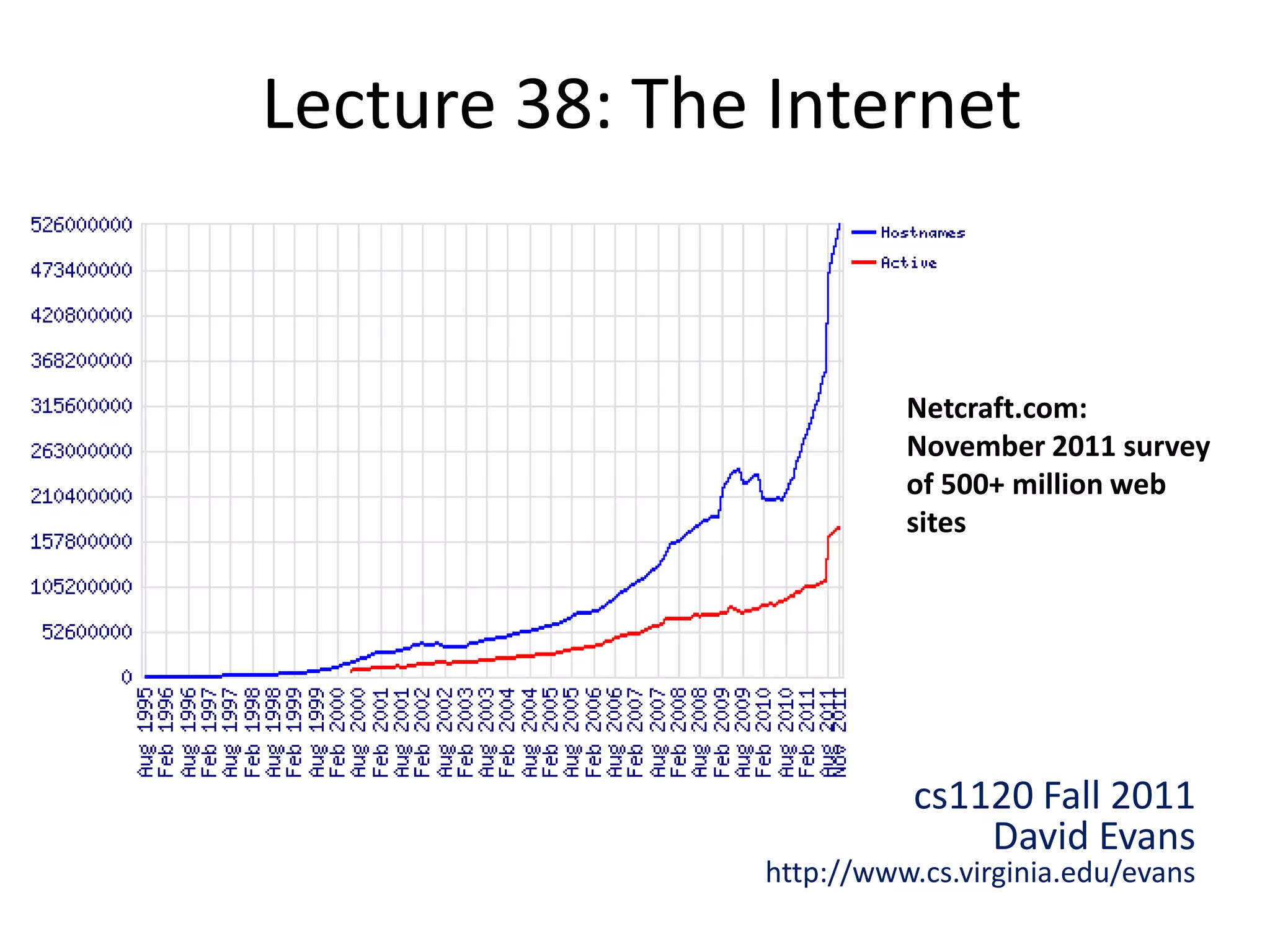
                         Netcraft.com:
                         November 2011 survey
                         of 500+ million web
                         sites


                          cs1120 Fall 2011
                              David Evans
               http://www.cs.virginia.edu/evans
Reminders
          My office hours today are cancelled. I will have office
          hours tomorrow or email for appointment.

Exam 2: Due Wednesday, beginning of class
Problem Set 8:
  J Option: due next Monday (7:59pm)
  C/W Option:
     In-class presentation option (next Monday)
     Submission by posting
If you want to present in class, send me an email by 5pm Friday.
Request how much time you want/need and what you want to do.
Plan
Type Checking
  Most important difference between
  Python/Scheme and Java

The Internet
  Latency/Bandwidth
  Packet switching
  Web applications

                                      3
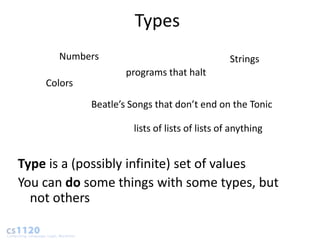
Types
      Numbers                                   Strings
                     programs that halt
    Colors
             Beatle’s Songs that don’t end on the Tonic

                      lists of lists of lists of anything


Type is a (possibly infinite) set of values
You can do some things with some types, but
  not others
Why have types?
Detecting programming errors: (usually) better
  to notice error than report incorrect result
Make programs easier to read, understand and
  maintain: thinking about types can help
  understand code
Verification: types make it easier to prove
  properties about programs
Security: can use types to constrain the behavior
  of programs
Types of Types
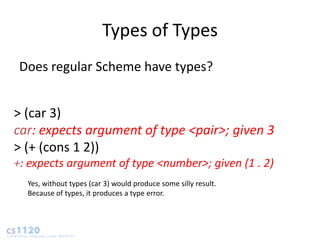
 Does regular Scheme have types?


> (car 3)
car: expects argument of type <pair>; given 3
> (+ (cons 1 2))
+: expects argument of type <number>; given (1 . 2)
  Yes, without types (car 3) would produce some silly result.
  Because of types, it produces a type error.
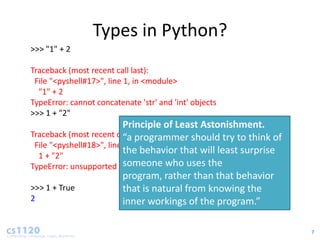
Types in Python?
>>> "1" + 2

Traceback (most recent call last):
 File "<pyshell#17>", line 1, in <module>
  "1" + 2
TypeError: cannot concatenate 'str' and 'int' objects
>>> 1 + "2"
                           Principle of Least Astonishment.
Traceback (most recent call last):
                           “a programmer should try to think of
 File "<pyshell#18>", line 1, in <module>
  1 + "2"
                           the behavior that will least surprise
                           someone who uses the
TypeError: unsupported operand type(s) for +: 'int' and 'str‘
                           program, rather than that behavior
>>> 1 + True               that is natural from knowing the
2                          inner workings of the program.”

                                                                   7
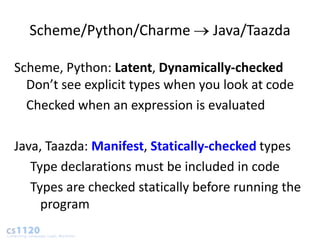
Scheme/Python/Charme            Java/Taazda

Scheme, Python: Latent, Dynamically-checked
  Don’t see explicit types when you look at code
  Checked when an expression is evaluated

Java, Taazda: Manifest, Statically-checked types
   Type declarations must be included in code
   Types are checked statically before running the
     program
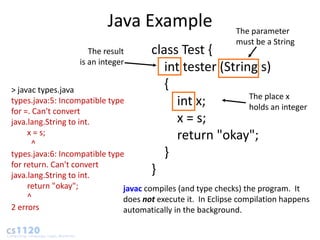
Java Example                       The parameter
                                                             must be a String
                     The result       class Test {
                  is an integer
                                         int tester (String s)
> javac types.java
                                         {
                                                          The place x
types.java:5: Incompatible type            int x;         holds an integer
for =. Can't convert
java.lang.String to int.                   x = s;
     x = s;                                return "okay";
       ^
types.java:6: Incompatible type          }
for return. Can't convert
java.lang.String to int.
                                      }
     return "okay";            javac compiles (and type checks) the program. It
     ^                         does not execute it. In Eclipse compilation happens
2 errors                       automatically in the background.
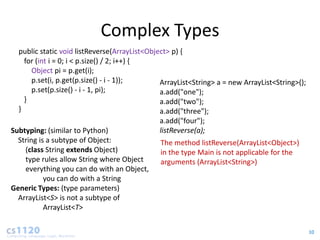
Complex Types
  public static void listReverse(ArrayList<Object> p) {
    for (int i = 0; i < p.size() / 2; i++) {
       Object pi = p.get(i);
       p.set(i, p.get(p.size() - i - 1));      ArrayList<String> a = new ArrayList<String>();
       p.set(p.size() - i - 1, pi);            a.add("one");
    }                                          a.add("two");
  }                                            a.add("three");
                                               a.add("four");
Subtyping: (similar to Python)                 listReverse(a);
  String is a subtype of Object:               The method listReverse(ArrayList<Object>)
     (class String extends Object)             in the type Main is not applicable for the
     type rules allow String where Object      arguments (ArrayList<String>)
     everything you can do with an Object,
           you can do with a String
Generic Types: (type parameters)
  ArrayList<S> is not a subtype of
           ArrayList<T>

                                                                                                10
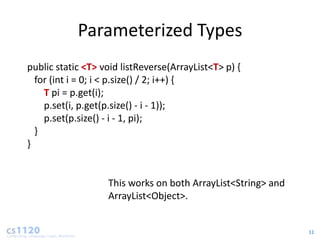
Parameterized Types
public static <T> void listReverse(ArrayList<T> p) {
  for (int i = 0; i < p.size() / 2; i++) {
    T pi = p.get(i);
    p.set(i, p.get(p.size() - i - 1));
    p.set(p.size() - i - 1, pi);
  }
}


                   This works on both ArrayList<String> and
                   ArrayList<Object>.


                                                              11
The Internet
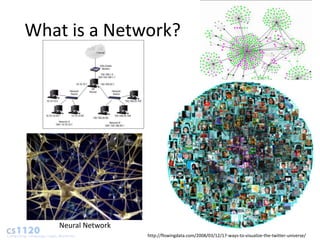
What is a Network?


   Neural Network
                    http://flowingdata.com/2008/03/12/17-ways-to-visualize-the-twitter-universe/
What is a Network?
A group of three or more connected
communicating entities.
Beacon Chain Networking
Thus, from some far-away beleaguered
island, where all day long the men have fought a
desperate battle from their city walls, the smoke
goes up to heaven; but no sooner has the sun
gone down than the light from the line of
beacons blazes up and shoots into the sky to
warn the neighboring islanders and bring them
to the rescue in their ships.
                            Iliad, Homer, 700 BC
  Chain of beacon’s signaled Agammemnon’s return
  (~1200BC), spread on Greek peaks over 600km.
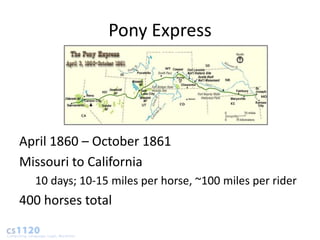
Pony Express


April 1860 – October 1861
Missouri to California
  10 days; 10-15 miles per horse, ~100 miles per rider
400 horses total
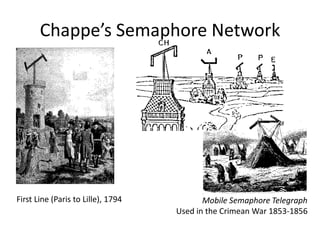
Chappe’s Semaphore Network


First Line (Paris to Lille), 1794          Mobile Semaphore Telegraph
                                    Used in the Crimean War 1853-1856
Measuring Networks
Latency
  Time from sending a bit until it arrives
  seconds (or seconds per geographic distance)

Bandwidth
  Rate at which can you transmit
  bits per second
Latency and Bandwidth
Napoleon’s Network: Paris to Toulon, 475 miles
Latency: 13 minutes (1.6s per mile)
  What is the delay at each signaling station, how
    many stations to reach destination
  At this rate, it would take ~1 hour to get a bit from
    California
Bandwidth: 2 symbols per minute (98 possible
  symbols, so that is ~13 bits per minute
  How fast can signalers make symbols
  At this rate, it would take about 9 days to get ps7.zip
Improving Latency
Less transfer points
   Longer distances between transfer points
   Semaphores: how far can you see clearly
      Curvature of Earth is hard to overcome
   Use wires (electrical telegraphs, 1837)
Faster transfers
   Replace humans with machines
Faster travel between transfers
   Hard to beat speed of light (semaphore network)
   Electrons in copper: about 1/3rd speed of light
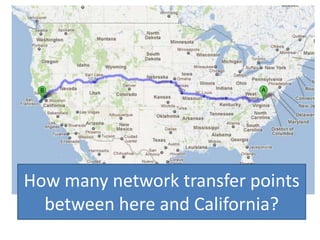
How many network transfer points
  between here and California?
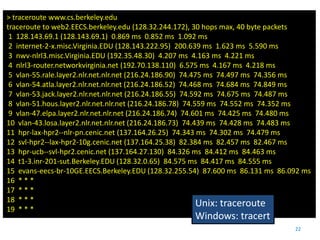
> traceroute www.cs.berkeley.edu
traceroute to web2.EECS.berkeley.edu (128.32.244.172), 30 hops max, 40 byte packets
 1 128.143.69.1 (128.143.69.1) 0.869 ms 0.852 ms 1.092 ms
 2 internet-2-x.misc.Virginia.EDU (128.143.222.95) 200.639 ms 1.623 ms 5.590 ms
 3 nwv-nlrl3.misc.Virginia.EDU (192.35.48.30) 4.207 ms 4.163 ms 4.221 ms
 4 nlrl3-router.networkvirginia.net (192.70.138.110) 6.575 ms 4.167 ms 4.218 ms
 5 vlan-55.rale.layer2.nlr.net.nlr.net (216.24.186.90) 74.475 ms 74.497 ms 74.356 ms
 6 vlan-54.atla.layer2.nlr.net.nlr.net (216.24.186.52) 74.468 ms 74.684 ms 74.849 ms
 7 vlan-53.jack.layer2.nlr.net.nlr.net (216.24.186.55) 74.592 ms 74.675 ms 74.487 ms
 8 vlan-51.hous.layer2.nlr.net.nlr.net (216.24.186.78) 74.559 ms 74.552 ms 74.352 ms
 9 vlan-47.elpa.layer2.nlr.net.nlr.net (216.24.186.74) 74.601 ms 74.425 ms 74.480 ms
10 vlan-43.losa.layer2.nlr.net.nlr.net (216.24.186.73) 74.439 ms 74.428 ms 74.483 ms
11 hpr-lax-hpr2--nlr-pn.cenic.net (137.164.26.25) 74.343 ms 74.302 ms 74.479 ms
12 svl-hpr2--lax-hpr2-10g.cenic.net (137.164.25.38) 82.384 ms 82.457 ms 82.467 ms
13 hpr-ucb--svl-hpr2.cenic.net (137.164.27.130) 84.326 ms 84.412 ms 84.463 ms
14 t1-3.inr-201-sut.Berkeley.EDU (128.32.0.65) 84.575 ms 84.417 ms 84.555 ms
15 evans-eecs-br-10GE.EECS.Berkeley.EDU (128.32.255.54) 87.600 ms 86.131 ms 86.092 ms
16 * * *
17 * * *
18 * * *
                                                            Unix: traceroute
19 * * *
                                                    Windows: tracert
                                                                                22
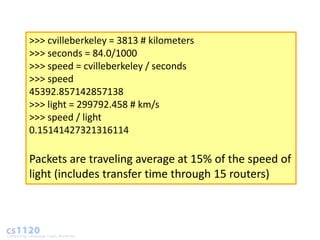
>>> cvilleberkeley = 3813 # kilometers
>>> seconds = 84.0/1000
>>> speed = cvilleberkeley / seconds
>>> speed
45392.857142857138
>>> light = 299792.458 # km/s
>>> speed / light
0.15141427321316114

Packets are traveling average at 15% of the speed of
light (includes transfer time through 15 routers)
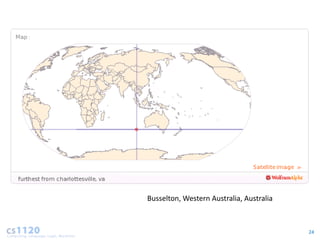
Busselton, Western Australia, Australia


                                          24
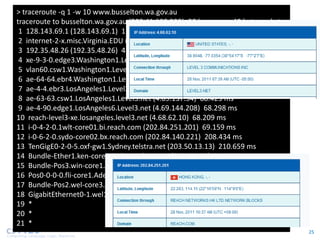
> traceroute -q 1 -w 10 www.busselton.wa.gov.au
traceroute to busselton.wa.gov.au (203.41.180.233), 30 hops max, 40 byte packets
 1 128.143.69.1 (128.143.69.1) 1.196 ms
 2 internet-2-x.misc.Virginia.EDU (128.143.222.95) 0.822 ms
 3 192.35.48.26 (192.35.48.26) 4.243 ms
 4 xe-9-3-0.edge3.Washington1.Level3.net (4.59.144.65) 4.151 ms
 5 vlan60.csw1.Washington1.Level3.net (4.69.149.62) 4.149 ms
 6 ae-64-64.ebr4.Washington1.Level3.net (4.69.134.177) 16.255 ms
 7 ae-4-4.ebr3.LosAngeles1.Level3.net (4.69.132.81) 69.054 ms
 8 ae-63-63.csw1.LosAngeles1.Level3.net (4.69.137.34) 68.423 ms
 9 ae-4-90.edge1.LosAngeles6.Level3.net (4.69.144.208) 68.298 ms
10 reach-level3-xe.losangeles.level3.net (4.68.62.10) 68.209 ms
11 i-0-4-2-0.1wlt-core01.bi.reach.com (202.84.251.201) 69.159 ms
12 i-0-6-2-0.sydo-core02.bx.reach.com (202.84.140.221) 208.434 ms
13 TenGigE0-2-0-5.oxf-gw1.Sydney.telstra.net (203.50.13.13) 210.659 ms
14 Bundle-Ether1.ken-core4.Sydney.telstra.net (203.50.6.5) 218.852 ms
15 Bundle-Pos3.win-core1.Melbourne.telstra.net (203.50.11.13) 225.130 ms
16 Pos0-0-0-0.fli-core1.Adelaide.telstra.net (203.50.6.186) 234.263 ms
17 Bundle-Pos2.wel-core3.Perth.telstra.net (203.50.11.19) 269.102 ms
18 GigabitEthernet0-1.wel13.Perth.telstra.net (203.50.115.151) 267.374 ms
19 *
20 *
21 *
                                                                                   25
26
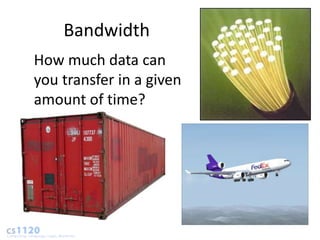
Bandwidth
How much data can
you transfer in a given
amount of time?
Improving Bandwidth
Faster transmission
   Train signalers to move semaphore flags faster
   Use something less physically demanding to transmit
Bigger pipes
   Have multiple signalers transmit every other letter at the
     same time
Better encoding
   Figure out how to code more than 98 symbols with
      semaphore signal
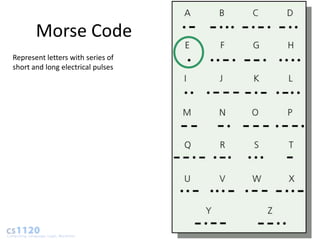
   Morse code (1840s)
Morse Code
Represent letters with series of
short and long electrical pulses
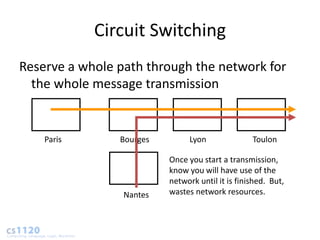
Circuit Switching
Reserve a whole path through the network for
  the whole message transmission


    Paris       Bourges         Lyon              Toulon

                          Once you start a transmission,
                          know you will have use of the
                          network until it is finished. But,
                 Nantes   wastes network resources.
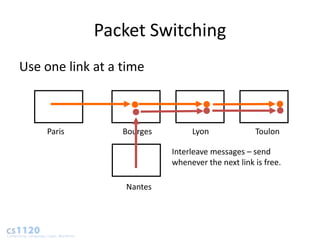
Packet Switching
Use one link at a time


    Paris         Bourges        Lyon              Toulon

                            Interleave messages – send
                            whenever the next link is free.

                  Nantes
Circuit and Packet Switching
(Land) Telephone Network (back in the old days)
  Circuit: when you dial a number, you have a
    reservation on a path through the network until
    you hang up
The Internet
  Packet: messages are broken into small
    packets, that find their way through the network
    link by link; software reassembles packets as
    received
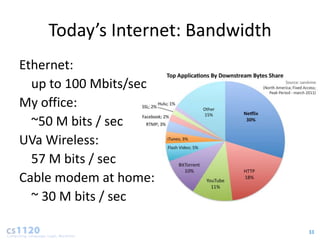
Today’s Internet: Bandwidth
Ethernet:
  up to 100 Mbits/sec
My office:
  ~50 M bits / sec
UVa Wireless:
  57 M bits / sec
Cable modem at home:
  ~ 30 M bits / sec

                                  33
internetwork
A collection of multiple networks connected
together, so messages can be transmitted
between nodes on different networks.
The First (international) internet
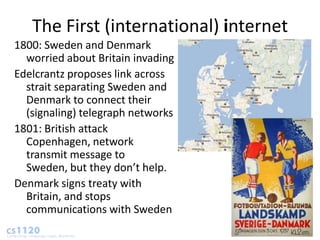
1800: Sweden and Denmark
  worried about Britain invading
Edelcrantz proposes link across
  strait separating Sweden and
  Denmark to connect their
  (signaling) telegraph networks
1801: British attack
  Copenhagen, network
  transmit message to
  Sweden, but they don’t help.
Denmark signs treaty with
  Britain, and stops
  communications with Sweden
The (capital-I) Internet
Packet Switching:
   Leonard Kleinrock (UCLA) thinks
   he did, Donald Davies and Paul
   Baran, Edelcrantz’s signalling
   network (1809)
Internet Protocol:
   Vint Cerf, Bob Kahn
Vision, Funding (DARPA):
   J.C.R. Licklider, Bob Taylor
Government: Al Gore
  First politician to promote
  Internet, 1986; act to connect
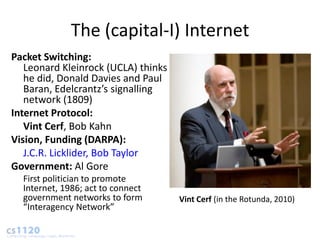
  government networks to form        Vint Cerf (in the Rotunda, 2010)
  “Interagency Network”
First Use of the Internet
October 1969: First packets on the ARPANet
 from UCLA to Stanford. Starts to send
 "LOGIN", but it crashes on the G.


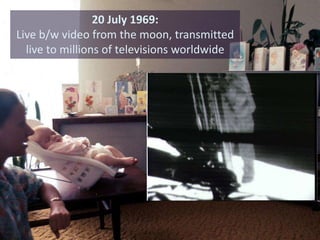
                 How impressive is this compared to
             communications event 3 months earlier?
20 July 1969:
Live b/w video from the moon, transmitted
  live to millions of televisions worldwide


                                              38
Exam 2 due
                                     Charge                       Wednesday, beginning of
                                                                  class
From Tim Berners-Lee’s “Answers for Young People” http://www.w3.org/People/Berners-Lee/Kids.html
I think the main thing to remember is that any really powerful thing can be
used for good or evil. Dynamite can be used to build tunnels or to make
missiles. Engines can be put in ambulances or tanks. Nuclear power can be
used for bombs or for electrical power. So the what is made of the Web is up
to us. You, me, and everyone else.

Here is my hope: The Web is a tool for communicating. With the Web, you
can find out what other people mean. You can find out where they are
coming from. The Web can help people understand each other.
Think about most of the bad things that have happened between people in
your life. Maybe most of them come down to one person not understanding
another. Even wars.

Let’s use the web to create neat new exciting things.
Let’s use the Web to help people understand each other.

Lecture38

  • 1.
    Lecture 38: TheInternet Netcraft.com: November 2011 survey of 500+ million web sites cs1120 Fall 2011 David Evans http://www.cs.virginia.edu/evans
  • 2.
    Reminders My office hours today are cancelled. I will have office hours tomorrow or email for appointment. Exam 2: Due Wednesday, beginning of class Problem Set 8: J Option: due next Monday (7:59pm) C/W Option: In-class presentation option (next Monday) Submission by posting If you want to present in class, send me an email by 5pm Friday. Request how much time you want/need and what you want to do.
  • 3.
    Plan Type Checking Most important difference between Python/Scheme and Java The Internet Latency/Bandwidth Packet switching Web applications 3
  • 4.
    Types Numbers Strings programs that halt Colors Beatle’s Songs that don’t end on the Tonic lists of lists of lists of anything Type is a (possibly infinite) set of values You can do some things with some types, but not others
  • 5.
    Why have types? Detectingprogramming errors: (usually) better to notice error than report incorrect result Make programs easier to read, understand and maintain: thinking about types can help understand code Verification: types make it easier to prove properties about programs Security: can use types to constrain the behavior of programs
  • 6.
    Types of Types Does regular Scheme have types? > (car 3) car: expects argument of type <pair>; given 3 > (+ (cons 1 2)) +: expects argument of type <number>; given (1 . 2) Yes, without types (car 3) would produce some silly result. Because of types, it produces a type error.
  • 7.
    Types in Python? >>>"1" + 2 Traceback (most recent call last): File "<pyshell#17>", line 1, in <module> "1" + 2 TypeError: cannot concatenate 'str' and 'int' objects >>> 1 + "2" Principle of Least Astonishment. Traceback (most recent call last): “a programmer should try to think of File "<pyshell#18>", line 1, in <module> 1 + "2" the behavior that will least surprise someone who uses the TypeError: unsupported operand type(s) for +: 'int' and 'str‘ program, rather than that behavior >>> 1 + True that is natural from knowing the 2 inner workings of the program.” 7
  • 8.
    Scheme/Python/Charme Java/Taazda Scheme, Python: Latent, Dynamically-checked Don’t see explicit types when you look at code Checked when an expression is evaluated Java, Taazda: Manifest, Statically-checked types Type declarations must be included in code Types are checked statically before running the program
  • 9.
    Java Example The parameter must be a String The result class Test { is an integer int tester (String s) > javac types.java { The place x types.java:5: Incompatible type int x; holds an integer for =. Can't convert java.lang.String to int. x = s; x = s; return "okay"; ^ types.java:6: Incompatible type } for return. Can't convert java.lang.String to int. } return "okay"; javac compiles (and type checks) the program. It ^ does not execute it. In Eclipse compilation happens 2 errors automatically in the background.
  • 10.
    Complex Types public static void listReverse(ArrayList<Object> p) { for (int i = 0; i < p.size() / 2; i++) { Object pi = p.get(i); p.set(i, p.get(p.size() - i - 1)); ArrayList<String> a = new ArrayList<String>(); p.set(p.size() - i - 1, pi); a.add("one"); } a.add("two"); } a.add("three"); a.add("four"); Subtyping: (similar to Python) listReverse(a); String is a subtype of Object: The method listReverse(ArrayList<Object>) (class String extends Object) in the type Main is not applicable for the type rules allow String where Object arguments (ArrayList<String>) everything you can do with an Object, you can do with a String Generic Types: (type parameters) ArrayList<S> is not a subtype of ArrayList<T> 10
  • 11.
    Parameterized Types public static<T> void listReverse(ArrayList<T> p) { for (int i = 0; i < p.size() / 2; i++) { T pi = p.get(i); p.set(i, p.get(p.size() - i - 1)); p.set(p.size() - i - 1, pi); } } This works on both ArrayList<String> and ArrayList<Object>. 11
  • 12.
  • 13.
    What is aNetwork? Neural Network http://flowingdata.com/2008/03/12/17-ways-to-visualize-the-twitter-universe/
  • 14.
    What is aNetwork? A group of three or more connected communicating entities.
  • 15.
    Beacon Chain Networking Thus,from some far-away beleaguered island, where all day long the men have fought a desperate battle from their city walls, the smoke goes up to heaven; but no sooner has the sun gone down than the light from the line of beacons blazes up and shoots into the sky to warn the neighboring islanders and bring them to the rescue in their ships. Iliad, Homer, 700 BC Chain of beacon’s signaled Agammemnon’s return (~1200BC), spread on Greek peaks over 600km.
  • 16.
    Pony Express April 1860– October 1861 Missouri to California 10 days; 10-15 miles per horse, ~100 miles per rider 400 horses total
  • 17.
    Chappe’s Semaphore Network FirstLine (Paris to Lille), 1794 Mobile Semaphore Telegraph Used in the Crimean War 1853-1856
  • 18.
    Measuring Networks Latency Time from sending a bit until it arrives seconds (or seconds per geographic distance) Bandwidth Rate at which can you transmit bits per second
  • 19.
    Latency and Bandwidth Napoleon’sNetwork: Paris to Toulon, 475 miles Latency: 13 minutes (1.6s per mile) What is the delay at each signaling station, how many stations to reach destination At this rate, it would take ~1 hour to get a bit from California Bandwidth: 2 symbols per minute (98 possible symbols, so that is ~13 bits per minute How fast can signalers make symbols At this rate, it would take about 9 days to get ps7.zip
  • 20.
    Improving Latency Less transferpoints Longer distances between transfer points Semaphores: how far can you see clearly Curvature of Earth is hard to overcome Use wires (electrical telegraphs, 1837) Faster transfers Replace humans with machines Faster travel between transfers Hard to beat speed of light (semaphore network) Electrons in copper: about 1/3rd speed of light
  • 21.
    How many networktransfer points between here and California?
  • 22.
    > traceroute www.cs.berkeley.edu tracerouteto web2.EECS.berkeley.edu (128.32.244.172), 30 hops max, 40 byte packets 1 128.143.69.1 (128.143.69.1) 0.869 ms 0.852 ms 1.092 ms 2 internet-2-x.misc.Virginia.EDU (128.143.222.95) 200.639 ms 1.623 ms 5.590 ms 3 nwv-nlrl3.misc.Virginia.EDU (192.35.48.30) 4.207 ms 4.163 ms 4.221 ms 4 nlrl3-router.networkvirginia.net (192.70.138.110) 6.575 ms 4.167 ms 4.218 ms 5 vlan-55.rale.layer2.nlr.net.nlr.net (216.24.186.90) 74.475 ms 74.497 ms 74.356 ms 6 vlan-54.atla.layer2.nlr.net.nlr.net (216.24.186.52) 74.468 ms 74.684 ms 74.849 ms 7 vlan-53.jack.layer2.nlr.net.nlr.net (216.24.186.55) 74.592 ms 74.675 ms 74.487 ms 8 vlan-51.hous.layer2.nlr.net.nlr.net (216.24.186.78) 74.559 ms 74.552 ms 74.352 ms 9 vlan-47.elpa.layer2.nlr.net.nlr.net (216.24.186.74) 74.601 ms 74.425 ms 74.480 ms 10 vlan-43.losa.layer2.nlr.net.nlr.net (216.24.186.73) 74.439 ms 74.428 ms 74.483 ms 11 hpr-lax-hpr2--nlr-pn.cenic.net (137.164.26.25) 74.343 ms 74.302 ms 74.479 ms 12 svl-hpr2--lax-hpr2-10g.cenic.net (137.164.25.38) 82.384 ms 82.457 ms 82.467 ms 13 hpr-ucb--svl-hpr2.cenic.net (137.164.27.130) 84.326 ms 84.412 ms 84.463 ms 14 t1-3.inr-201-sut.Berkeley.EDU (128.32.0.65) 84.575 ms 84.417 ms 84.555 ms 15 evans-eecs-br-10GE.EECS.Berkeley.EDU (128.32.255.54) 87.600 ms 86.131 ms 86.092 ms 16 * * * 17 * * * 18 * * * Unix: traceroute 19 * * * Windows: tracert 22
  • 23.
    >>> cvilleberkeley =3813 # kilometers >>> seconds = 84.0/1000 >>> speed = cvilleberkeley / seconds >>> speed 45392.857142857138 >>> light = 299792.458 # km/s >>> speed / light 0.15141427321316114 Packets are traveling average at 15% of the speed of light (includes transfer time through 15 routers)
  • 24.
  • 25.
    > traceroute -q1 -w 10 www.busselton.wa.gov.au traceroute to busselton.wa.gov.au (203.41.180.233), 30 hops max, 40 byte packets 1 128.143.69.1 (128.143.69.1) 1.196 ms 2 internet-2-x.misc.Virginia.EDU (128.143.222.95) 0.822 ms 3 192.35.48.26 (192.35.48.26) 4.243 ms 4 xe-9-3-0.edge3.Washington1.Level3.net (4.59.144.65) 4.151 ms 5 vlan60.csw1.Washington1.Level3.net (4.69.149.62) 4.149 ms 6 ae-64-64.ebr4.Washington1.Level3.net (4.69.134.177) 16.255 ms 7 ae-4-4.ebr3.LosAngeles1.Level3.net (4.69.132.81) 69.054 ms 8 ae-63-63.csw1.LosAngeles1.Level3.net (4.69.137.34) 68.423 ms 9 ae-4-90.edge1.LosAngeles6.Level3.net (4.69.144.208) 68.298 ms 10 reach-level3-xe.losangeles.level3.net (4.68.62.10) 68.209 ms 11 i-0-4-2-0.1wlt-core01.bi.reach.com (202.84.251.201) 69.159 ms 12 i-0-6-2-0.sydo-core02.bx.reach.com (202.84.140.221) 208.434 ms 13 TenGigE0-2-0-5.oxf-gw1.Sydney.telstra.net (203.50.13.13) 210.659 ms 14 Bundle-Ether1.ken-core4.Sydney.telstra.net (203.50.6.5) 218.852 ms 15 Bundle-Pos3.win-core1.Melbourne.telstra.net (203.50.11.13) 225.130 ms 16 Pos0-0-0-0.fli-core1.Adelaide.telstra.net (203.50.6.186) 234.263 ms 17 Bundle-Pos2.wel-core3.Perth.telstra.net (203.50.11.19) 269.102 ms 18 GigabitEthernet0-1.wel13.Perth.telstra.net (203.50.115.151) 267.374 ms 19 * 20 * 21 * 25
  • 26.
  • 27.
    Bandwidth How much datacan you transfer in a given amount of time?
  • 28.
    Improving Bandwidth Faster transmission Train signalers to move semaphore flags faster Use something less physically demanding to transmit Bigger pipes Have multiple signalers transmit every other letter at the same time Better encoding Figure out how to code more than 98 symbols with semaphore signal Morse code (1840s)
  • 29.
    Morse Code Represent letterswith series of short and long electrical pulses
  • 30.
    Circuit Switching Reserve awhole path through the network for the whole message transmission Paris Bourges Lyon Toulon Once you start a transmission, know you will have use of the network until it is finished. But, Nantes wastes network resources.
  • 31.
    Packet Switching Use onelink at a time Paris Bourges Lyon Toulon Interleave messages – send whenever the next link is free. Nantes
  • 32.
    Circuit and PacketSwitching (Land) Telephone Network (back in the old days) Circuit: when you dial a number, you have a reservation on a path through the network until you hang up The Internet Packet: messages are broken into small packets, that find their way through the network link by link; software reassembles packets as received
  • 33.
    Today’s Internet: Bandwidth Ethernet: up to 100 Mbits/sec My office: ~50 M bits / sec UVa Wireless: 57 M bits / sec Cable modem at home: ~ 30 M bits / sec 33
  • 34.
    internetwork A collection ofmultiple networks connected together, so messages can be transmitted between nodes on different networks.
  • 35.
    The First (international)internet 1800: Sweden and Denmark worried about Britain invading Edelcrantz proposes link across strait separating Sweden and Denmark to connect their (signaling) telegraph networks 1801: British attack Copenhagen, network transmit message to Sweden, but they don’t help. Denmark signs treaty with Britain, and stops communications with Sweden
  • 36.
    The (capital-I) Internet PacketSwitching: Leonard Kleinrock (UCLA) thinks he did, Donald Davies and Paul Baran, Edelcrantz’s signalling network (1809) Internet Protocol: Vint Cerf, Bob Kahn Vision, Funding (DARPA): J.C.R. Licklider, Bob Taylor Government: Al Gore First politician to promote Internet, 1986; act to connect government networks to form Vint Cerf (in the Rotunda, 2010) “Interagency Network”
  • 37.
    First Use ofthe Internet October 1969: First packets on the ARPANet from UCLA to Stanford. Starts to send "LOGIN", but it crashes on the G. How impressive is this compared to communications event 3 months earlier?
  • 38.
    20 July 1969: Liveb/w video from the moon, transmitted live to millions of televisions worldwide 38
  • 39.
    Exam 2 due Charge Wednesday, beginning of class From Tim Berners-Lee’s “Answers for Young People” http://www.w3.org/People/Berners-Lee/Kids.html I think the main thing to remember is that any really powerful thing can be used for good or evil. Dynamite can be used to build tunnels or to make missiles. Engines can be put in ambulances or tanks. Nuclear power can be used for bombs or for electrical power. So the what is made of the Web is up to us. You, me, and everyone else. Here is my hope: The Web is a tool for communicating. With the Web, you can find out what other people mean. You can find out where they are coming from. The Web can help people understand each other. Think about most of the bad things that have happened between people in your life. Maybe most of them come down to one person not understanding another. Even wars. Let’s use the web to create neat new exciting things. Let’s use the Web to help people understand each other.