Class 27:
Pythonic Objects

cs1120 Fall 2011
David Evans
26 October 2011
John McCarthy
  1927-2011


                2
McCarthy
                                                    created the name
                                                    “Artificial
                                                    Intelligence” (but
                                                    6 years after Alan
                                                    Turing really
                                                    started things
                                                    with “Computing
                                                    Machinery and
                                                    Intelligence”)


Organized First Conference on “Artificial Intelligence” (1956)
            (Dartmouth Mathematics Professor)
        (Claude Shannon also helped organize this)

                                                                     3
Scheme is LISP with
a few minor
modifications
                      4
Magentic Core Memory
                                              32,000 36-bit words
                                              40,000 instructions/second

1955-1960: First “mass-produced” computer (sold 123 of them)
1 accumulator register (38 bits), 3 decrement registers (15 bit)
Instructions had 3 bit opcode, 15 bit decrement, 15 bit address
                                                                           5
John McCarthy
playing chess
with IBM 7090


                6
7
(define (ff x)
  (if (not (pair? x))
      x
      (ff (car x))))


                        8
Why learn
Python?
Reason 1: Vocational Skill
Job listings at monster.com (20 October 2009)
 Keyword     All US      Virginia    Typical
                         Only        Salary
 Python      527         38          $60-180K

 Java        5000+       535         $70-140K

 Scheme      83          0           $100-999K
“Scheme” Jobs
Reason 1: Vocational Skill
Job listings at monster.com (20 October 2009)
 Keyword     All US      Virginia    Typical
                         Only        Salary
 Python      527         38          $60-180K

 Java        5000+       535         $70-140K

 Scheme      83          0           $100-999K
Reason 2: Expanding Minds


The more languages you know, the more
different ways you have of expressing ideas and
for thinking about (and solving) problems.
“Jamais Jamais Jamais” from Harmonice Musices Odhecaton A.
   Printed by Ottaviano Dei Petrucci in 1501 (first music with
                        movable type)
“Jamais Jamais Jamais” from   J S Bach, “Coffee
Harmonice Musices Odhecaton   Cantata”, BWV 211 (1732)
                              www.npj.com/homepage/teritowe/jsbhand.
A. (1501)                     html
Reason 3: Deepening Understanding


By seeing how the same concepts we
encountered in Scheme are implemented by
a different language, you will understand
those concepts better (especially
procedures, assignment, data abstraction).
Reason 4: Building Confidence
  By learning Python (mostly) on your
  own, the next time you encounter a
  problem that is best solved using a
  language you don’t know, you will be
  confident you can learn it (rather than
  trying to use the wrong tool to solve the
  problem).
Those who do the Plan J option will also be learning Java soon.
  Once you know Scheme, Python, and Java you should be
      extremely confident you can learn any language!
Reason 5: Fun
Programming in Python is fun (possibly even more fun
than programming in Scheme!)

     Especially because:
     • It is an elegant and simple language
     • Most programs mean what you think they mean
     • It is dynamic and interactive
     • It can be used to easily build web applications
     • It is named after Monty Python’s Flying Circus
     • It was designed by someone named Guido.
Python
A universal programming language
  Everything you can compute in Scheme you can compute in
    Python, and vice versa
  Chapter 11/PS7: implement a Scheme interpreter in Python
  Chapter 12: more formal definition of a universal PL
Imperative Language
  Designed to support a programming where most of the work
    is done using assignment statements: x = e
Object-Oriented Language
  All data are objects
  Built in support for classes, methods, inheritance
Learning New Languages
Syntax: Where the {,%;!,$, etc. all go
   If you can understand a BNF grammar, this is easy
        (Okay, it still takes some getting used to a new syntax…)
Semantics: What does it mean
   Learning the evaluation rules
   Harder, but most programming languages have very similar
     evaluation rules (but the subtle differences can cause lots of
     problems)
Style: What are the idioms and customs of experienced
  programmers in that language?
       Takes many years to learn - need it to be a “professional” Python
         programmer, but not to make a useful program
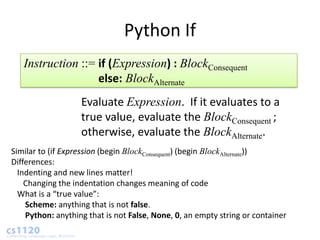
Python If
   Instruction ::= if (Expression) : BlockConsequent
                   else: BlockAlternate
                   Evaluate Expression. If it evaluates to a
                   true value, evaluate the BlockConsequent ;
                   otherwise, evaluate the BlockAlternate.
Similar to (if Expression (begin BlockConsequent) (begin BlockAlternate))
Differences:
  Indenting and new lines matter!
    Changing the indentation changes meaning of code
  What is a “true value”:
    Scheme: anything that is not false.
    Python: anything that is not False, None, 0, an empty string or container
If Example

if []:
   print "Empty is true!"
else:
   print "Empty is false!"

Empty is false!
Learning Python
We will introduce (usually informally) Python
  constructs in class as we use them, example
  code in PS6
The “Schemer’s Guide to Python” is an
  introduction to Python: covers the most
  important constructs you need for PS6, etc.
Course book: Chapter 11 introduces Python
  Read ahead Section 11.1
On-line Python documentation
Making Objects

           ClassDefinition ::= class Name:
                                     FunctionDefinitions

class Dog:
  def bark(self):
     print “wuff wuff wuff wuff”

                   In Washington, it’s dog eat dog. In
                  academia, it's exactly the opposite.
                                         Robert Reich
Making a Dog
      class Dog:
        def bark(self):
           print "wuff wuff wuff wuff"

spot = Dog()                AssignmentStatement ::= Variable = Expression

    Python assignments are like both define and set!.
    If the Variable name is not yet defined, it creates a new place.
    The value in the named place is initialized to the value of the Expression.
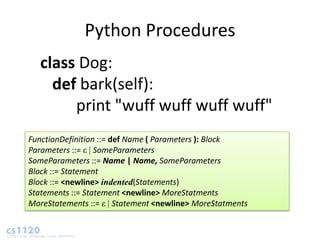
Python Procedures
   class Dog:
     def bark(self):
        print "wuff wuff wuff wuff"
FunctionDefinition ::= def Name ( Parameters ): Block
Parameters ::= ε | SomeParameters
SomeParameters ::= Name | Name, SomeParameters
Block ::= Statement
Block ::= <newline> indented(Statements)
Statements ::= Statement <newline> MoreStatments
MoreStatements ::= ε | Statement <newline> MoreStatments
Some Python Procedures
FunctionDefinition ::= def Name ( Parameters ): Block
Parameters ::= ε | SomeParameters
SomeParameters ::= Name | Name, SomeParameters
Block ::= Statement
Block ::= <newline> indented(Statements)
Statements ::= Statement <newline> MoreStatments
MoreStatements ::= ε | Statement <newline> MoreStatments


def square(x):                def bigger(a,b):
  return x * x                  if a > b:
                                    return a
                                else:
                                    return b
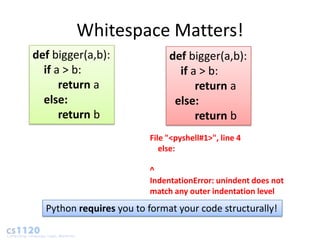
Whitespace Matters!
def bigger(a,b):              def bigger(a,b):
  if a > b:                     if a > b:
      return a                      return a
  else:                        else:
      return b                      return b
                         File "<pyshell#1>", line 4
                            else:

                         ^
                         IndentationError: unindent does not
                         match any outer indentation level
  Python requires you to format your code structurally!
Charge
Learning new languages
  Formal grammar / intuition from examples
  Evaluation rules / guessing what things mean
     Either approach can work…but a mix of both
     formal and intuition/guessing is usually best.


Friday: Inheritance

Class 27: Pythonic Objects

  • 1.
    Class 27: Pythonic Objects cs1120Fall 2011 David Evans 26 October 2011
  • 2.
    John McCarthy 1927-2011 2
  • 3.
    McCarthy created the name “Artificial Intelligence” (but 6 years after Alan Turing really started things with “Computing Machinery and Intelligence”) Organized First Conference on “Artificial Intelligence” (1956) (Dartmouth Mathematics Professor) (Claude Shannon also helped organize this) 3
  • 4.
    Scheme is LISPwith a few minor modifications 4
  • 5.
    Magentic Core Memory 32,000 36-bit words 40,000 instructions/second 1955-1960: First “mass-produced” computer (sold 123 of them) 1 accumulator register (38 bits), 3 decrement registers (15 bit) Instructions had 3 bit opcode, 15 bit decrement, 15 bit address 5
  • 6.
  • 7.
  • 8.
    (define (ff x) (if (not (pair? x)) x (ff (car x)))) 8
  • 9.
  • 10.
    Reason 1: VocationalSkill Job listings at monster.com (20 October 2009) Keyword All US Virginia Typical Only Salary Python 527 38 $60-180K Java 5000+ 535 $70-140K Scheme 83 0 $100-999K
  • 11.
  • 12.
    Reason 1: VocationalSkill Job listings at monster.com (20 October 2009) Keyword All US Virginia Typical Only Salary Python 527 38 $60-180K Java 5000+ 535 $70-140K Scheme 83 0 $100-999K
  • 13.
    Reason 2: ExpandingMinds The more languages you know, the more different ways you have of expressing ideas and for thinking about (and solving) problems.
  • 14.
    “Jamais Jamais Jamais”from Harmonice Musices Odhecaton A. Printed by Ottaviano Dei Petrucci in 1501 (first music with movable type)
  • 15.
    “Jamais Jamais Jamais”from J S Bach, “Coffee Harmonice Musices Odhecaton Cantata”, BWV 211 (1732) www.npj.com/homepage/teritowe/jsbhand. A. (1501) html
  • 16.
    Reason 3: DeepeningUnderstanding By seeing how the same concepts we encountered in Scheme are implemented by a different language, you will understand those concepts better (especially procedures, assignment, data abstraction).
  • 17.
    Reason 4: BuildingConfidence By learning Python (mostly) on your own, the next time you encounter a problem that is best solved using a language you don’t know, you will be confident you can learn it (rather than trying to use the wrong tool to solve the problem). Those who do the Plan J option will also be learning Java soon. Once you know Scheme, Python, and Java you should be extremely confident you can learn any language!
  • 18.
    Reason 5: Fun Programmingin Python is fun (possibly even more fun than programming in Scheme!) Especially because: • It is an elegant and simple language • Most programs mean what you think they mean • It is dynamic and interactive • It can be used to easily build web applications • It is named after Monty Python’s Flying Circus • It was designed by someone named Guido.
  • 19.
    Python A universal programminglanguage Everything you can compute in Scheme you can compute in Python, and vice versa Chapter 11/PS7: implement a Scheme interpreter in Python Chapter 12: more formal definition of a universal PL Imperative Language Designed to support a programming where most of the work is done using assignment statements: x = e Object-Oriented Language All data are objects Built in support for classes, methods, inheritance
  • 20.
    Learning New Languages Syntax:Where the {,%;!,$, etc. all go If you can understand a BNF grammar, this is easy (Okay, it still takes some getting used to a new syntax…) Semantics: What does it mean Learning the evaluation rules Harder, but most programming languages have very similar evaluation rules (but the subtle differences can cause lots of problems) Style: What are the idioms and customs of experienced programmers in that language? Takes many years to learn - need it to be a “professional” Python programmer, but not to make a useful program
  • 21.
    Python If Instruction ::= if (Expression) : BlockConsequent else: BlockAlternate Evaluate Expression. If it evaluates to a true value, evaluate the BlockConsequent ; otherwise, evaluate the BlockAlternate. Similar to (if Expression (begin BlockConsequent) (begin BlockAlternate)) Differences: Indenting and new lines matter! Changing the indentation changes meaning of code What is a “true value”: Scheme: anything that is not false. Python: anything that is not False, None, 0, an empty string or container
  • 22.
    If Example if []: print "Empty is true!" else: print "Empty is false!" Empty is false!
  • 23.
    Learning Python We willintroduce (usually informally) Python constructs in class as we use them, example code in PS6 The “Schemer’s Guide to Python” is an introduction to Python: covers the most important constructs you need for PS6, etc. Course book: Chapter 11 introduces Python Read ahead Section 11.1 On-line Python documentation
  • 24.
    Making Objects ClassDefinition ::= class Name: FunctionDefinitions class Dog: def bark(self): print “wuff wuff wuff wuff” In Washington, it’s dog eat dog. In academia, it's exactly the opposite. Robert Reich
  • 25.
    Making a Dog class Dog: def bark(self): print "wuff wuff wuff wuff" spot = Dog() AssignmentStatement ::= Variable = Expression Python assignments are like both define and set!. If the Variable name is not yet defined, it creates a new place. The value in the named place is initialized to the value of the Expression.
  • 26.
    Python Procedures class Dog: def bark(self): print "wuff wuff wuff wuff" FunctionDefinition ::= def Name ( Parameters ): Block Parameters ::= ε | SomeParameters SomeParameters ::= Name | Name, SomeParameters Block ::= Statement Block ::= <newline> indented(Statements) Statements ::= Statement <newline> MoreStatments MoreStatements ::= ε | Statement <newline> MoreStatments
  • 27.
    Some Python Procedures FunctionDefinition::= def Name ( Parameters ): Block Parameters ::= ε | SomeParameters SomeParameters ::= Name | Name, SomeParameters Block ::= Statement Block ::= <newline> indented(Statements) Statements ::= Statement <newline> MoreStatments MoreStatements ::= ε | Statement <newline> MoreStatments def square(x): def bigger(a,b): return x * x if a > b: return a else: return b
  • 28.
    Whitespace Matters! def bigger(a,b): def bigger(a,b): if a > b: if a > b: return a return a else: else: return b return b File "<pyshell#1>", line 4 else: ^ IndentationError: unindent does not match any outer indentation level Python requires you to format your code structurally!
  • 29.
    Charge Learning new languages Formal grammar / intuition from examples Evaluation rules / guessing what things mean Either approach can work…but a mix of both formal and intuition/guessing is usually best. Friday: Inheritance