2
WHAT WE GIVEYOU?
•What is Python…?
•Differences between program and scripting language
•History of Python
•Scope of Python
•What can I do with python
•Who uses python today
•Why do people use Python?
•Installing Python IDE
•A Sample Code
•Python code execution
•Running Python
•Python Basic(Variable, Strings, Data types etc.)
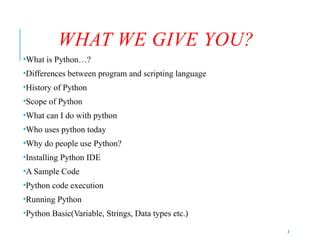
3.
3
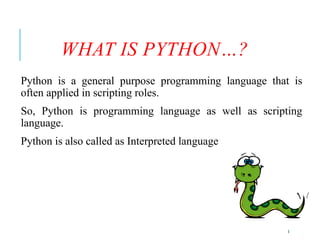
WHAT IS PYTHON…?
Pythonis a general purpose programming language that is
often applied in scripting roles.
So, Python is programming language as well as scripting
language.
Python is also called as Interpreted language
4.
4
DIFFERENCES BETWEEN
PROGRAM ANDSCRIPTING
LANGUAGE
Program
a program is executed (i.e.
the source is first compiled,
and the result of that
compilation is expected)
A "program" in general, is a
sequence of instructions
written so that a computer
can perform certain task.
Scripting
a script is interpreted
A "script" is code written in
a scripting language. A scripting
language is nothing but a type of
programming language in
which we can write code to
control another software
application.
5.
5
HISTORY
Invented in theNetherlands, early 90s by Guido van
Rossum
Python was conceived in the late 1980s and its
implementation was started in December 1989
Guido Van Rossum is fan of ‘Monty Python’s Flying
Circus’, this is a famous TV show in Netherlands
Named after Monty Python
Open sourced from the beginning
6.
6
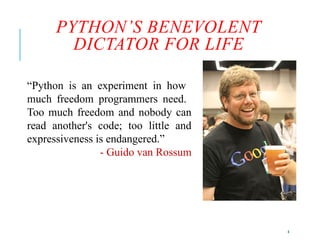
PYTHON’S BENEVOLENT
DICTATOR FORLIFE
“Python is an experiment in how
much freedom programmers need.
Too much freedom and nobody can
read another's code; too little and
expressiveness is endangered.”
- Guido van Rossum
7.
7
WHY WAS PYTHONCREATED?
"My original motivation for creating Python was the
perceived need for a higher level language in the Amoeba
[Operating Systems] project.
I realized that the development of system administration
utilities in C was taking too long. Moreover, doing these things
in the Bourne shell wouldn't work for a variety of reasons. ...
So, there was a need for a language that would bridge the
gap between C and the shell”
- Guido Van Rossum
8.
8
SCOPE OF PYTHON
Science
-Bioinformatics
System Administration
-Unix
-Web logic
-Web sphere
Web Application Development
-CGI
-Jython – Servlets
Testing scripts
9.
9
WHAT CAN IDO WITH PYTHON…?
System programming
Graphical User Interface Programming
Internet Scripting
Component Integration
Database Programming
Gaming, Images, XML , Robot and more
10.
10
WHO USES PYTHONTODAY…
Python is being applied in real revenue-generating products by
real companies. For instance:
Google makes extensive use of Python in its web search system,
and employs Python’s creator.
Intel, Cisco, Hewlett-Packard, Seagate, Qualcomm, and IBM
use Python for hardware testing.
ESRI uses Python as an end-user customization tool for its
popular GIS mapping products.
The YouTube video sharing service is largely written in Python
11.
11
WHY DO PEOPLEUSE PYTHON…?
The following primary factors cited by Python users
seem to be these:
Python is object-oriented
Structure supports such concepts as polymorphism, operation
overloading, and multiple inheritance.
.
It's free (open source)
Downloading and installing Python is free and easy
Source code is easily accessible
12.
12
It's powerful
- Dynamictyping
- Built-in types and tools
- Library utilities
- Third party utilities (e.g. Numeric, NumPy, SciPy)
- Automatic memory management
It's portable
- Python runs virtually every major platform used today
- As long as you have a compatible Python interpreter
installed, Python programs will run in exactly the same
manner, irrespective of platform.
13.
13
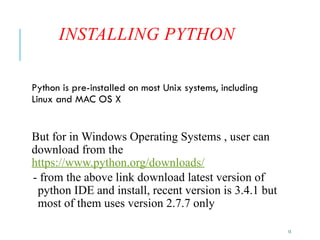
INSTALLING PYTHON
Python ispre-installed on most Unix systems, including
Linux and MAC OS X
But for in Windows Operating Systems , user can
download from the
https://www.python.org/downloads/
- from the above link download latest version of
python IDE and install, recent version is 3.4.1 but
most of them uses version 2.7.7 only
14.
14
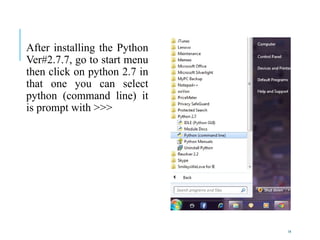
After installing thePython
Ver#2.7.7, go to start menu
then click on python 2.7 in
that one you can select
python (command line) it
is prompt with >>>
16
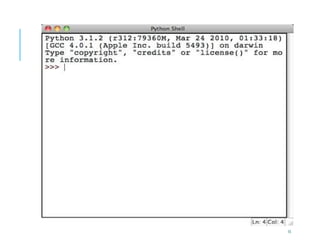
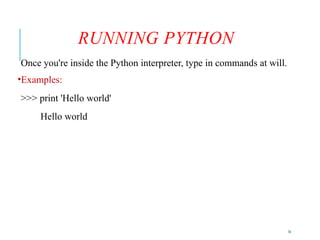
RUNNING PYTHON
Once you'reinside the Python interpreter, type in commands at will.
•Examples:
>>> print 'Hello world'
Hello world
17.
17
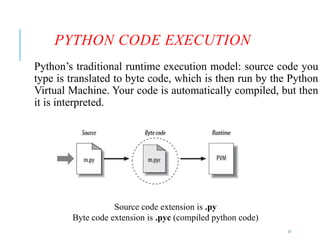
PYTHON CODE EXECUTION
Python’straditional runtime execution model: source code you
type is translated to byte code, which is then run by the Python
Virtual Machine. Your code is automatically compiled, but then
it is interpreted.
Source code extension is .py
Byte code extension is .pyc (compiled python code)
20
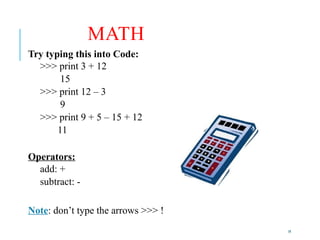
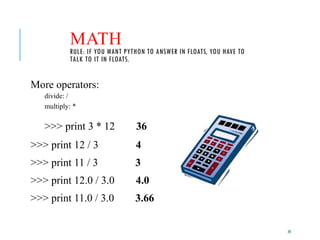
MATH
RULE: IF YOUWANT PYTHON TO ANSWER IN FLOATS, YOU HAVE TO
TALK TO IT IN FLOATS.
More operators:
divide: /
multiply: *
>>> print 3 * 12 36
>>> print 12 / 3 4
>>> print 11 / 3 3
>>> print 12.0 / 3.0 4.0
>>> print 11.0 / 3.0 3.66
28
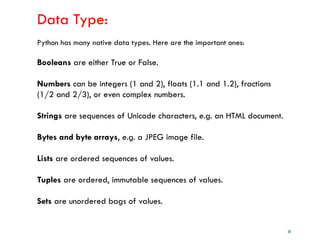
Data Type:
Python hasmany native data types. Here are the important ones:
Booleans are either True or False.
Numbers can be integers (1 and 2), floats (1.1 and 1.2), fractions
(1/2 and 2/3), or even complex numbers.
Strings are sequences of Unicode characters, e.g. an HTML document.
Bytes and byte arrays, e.g. a JPEG image file.
Lists are ordered sequences of values.
Tuples are ordered, immutable sequences of values.
Sets are unordered bags of values.
29.
29
EXAMPLE:
String “Whoop!”
Integer 42
Float3.14159
List [“John”, “Paul”, “George”, “Ringo”]
Python can tell us about types using the type() function:
>>> print type(“Whoop!”)
<type ‘str’>
31
List:
The list isa most versatile Data type available in Python
which can be written as a list of comma-separated values
(items) between square brackets. Important thing about a list
is that items in a list need not be of the same type.
Example:
list1 = ['physics', 'chemistry', 1997, 2000];
list2 = [1, 2, 3, 4, 5 ];
32.
32
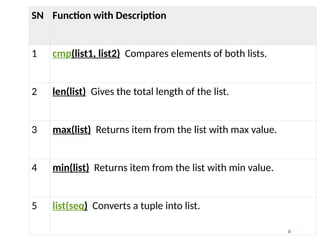
SN Function withDescription
1 cmp(list1, list2) Compares elements of both lists.
2 len(list) Gives the total length of the list.
3 max(list) Returns item from the list with max value.
4 min(list) Returns item from the list with min value.
5 list(seq) Converts a tuple into list.
33.
33
List: a sequenceof objects
>>> Beatles = [“John”, “Paul”, “George”,
“Ringo”]
>>> grades = [82, 93, 67, 99, 100]
Guess what this will output:
>>> type(Beatles)
>>> type(grades)
34.
34
LISTS
Index: Where anitem is in the list
>>> Beatles = [“John”, “Paul”, “George”,
“Ringo”]
>>> Beatles[0]
‘John‘
[“John”, “Paul”, “George”, “Ringo”]
0 1 2 3
Python always starts at zero!
36
Tuples:
A tuple isa sequence of immutable Python objects. Tuples are
sequences, just like lists. The differences between tuples and lists
are, the tuples cannot be changed unlike lists and tuples use
parentheses, whereas lists use square brackets.
Example:
tup2 = (1, 2, 3, 4, 5 );
tup3 = ("a", "b", "c", "d“);
Accessing Values:
print "tup2[1:5]: “
Output:
tup2[1:5]: [2, 3, 4, 5]
37.
37
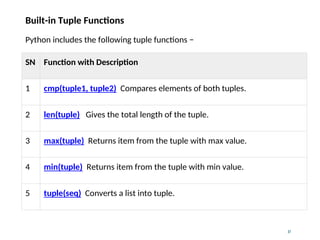
Built-in Tuple Functions
Pythonincludes the following tuple functions −
SN Function with Description
1 cmp(tuple1, tuple2) Compares elements of both tuples.
2 len(tuple) Gives the total length of the tuple.
3 max(tuple) Returns item from the tuple with max value.
4 min(tuple) Returns item from the tuple with min value.
5 tuple(seq) Converts a list into tuple.
39
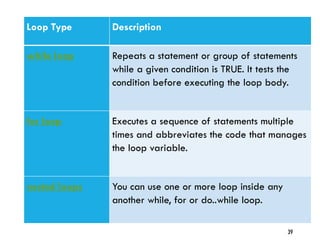
Loop Type Description
whileloop Repeats a statement or group of statements
while a given condition is TRUE. It tests the
condition before executing the loop body.
for loop Executes a sequence of statements multiple
times and abbreviates the code that manages
the loop variable.
nested loops You can use one or more loop inside any
another while, for or do..while loop.
40.
40
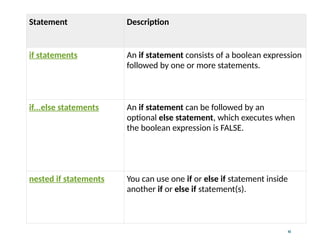
Statement Description
if statementsAn if statement consists of a boolean expression
followed by one or more statements.
if...else statements An if statement can be followed by an
optional else statement, which executes when
the boolean expression is FALSE.
nested if statements You can use one if or else if statement inside
another if or else if statement(s).
41.
41
I believe thetrial has shown conclusively that it is both possible and
desirable to use Python as the principal teaching language:
o It is Free (as in both cost and source code).
o It is trivial to install on a Windows PC allowing students to take
their interest further. For many the hurdle of installing a Pascal or
C compiler on a Windows machine is either too expensive or too
complicated;
o It is a flexible tool that allows both the teaching of traditional
procedural programming and modern OOP; It can be used to
teach a large number of transferable skills;
o It is a real-world programming language that can be and is used in
academia and the commercial world;
o It appears to be quicker to learn and, in combination with its many
libraries, this offers the possibility of more rapid student
development allowing the course to be made more challenging
and varied;
o and most importantly, its clean syntax offers increased
understanding and enjoyment for students;
![7
WHY WAS PYTHON CREATED?
"My original motivation for creating Python was the
perceived need for a higher level language in the Amoeba
[Operating Systems] project.
I realized that the development of system administration
utilities in C was taking too long. Moreover, doing these things
in the Bourne shell wouldn't work for a variety of reasons. ...
So, there was a need for a language that would bridge the
gap between C and the shell”
- Guido Van Rossum](https://image.slidesharecdn.com/cupdf-250613090053-ed2ce8f0/85/cupdf-com_python-seminar-ppt-pptx-7-320.jpg)
![29
EXAMPLE:
String “Whoop!”
Integer 42
Float 3.14159
List [“John”, “Paul”, “George”, “Ringo”]
Python can tell us about types using the type() function:
>>> print type(“Whoop!”)
<type ‘str’>](https://image.slidesharecdn.com/cupdf-250613090053-ed2ce8f0/85/cupdf-com_python-seminar-ppt-pptx-29-320.jpg)
![31
List:
The list is a most versatile Data type available in Python
which can be written as a list of comma-separated values
(items) between square brackets. Important thing about a list
is that items in a list need not be of the same type.
Example:
list1 = ['physics', 'chemistry', 1997, 2000];
list2 = [1, 2, 3, 4, 5 ];](https://image.slidesharecdn.com/cupdf-250613090053-ed2ce8f0/85/cupdf-com_python-seminar-ppt-pptx-31-320.jpg)
![33
List: a sequence of objects
>>> Beatles = [“John”, “Paul”, “George”,
“Ringo”]
>>> grades = [82, 93, 67, 99, 100]
Guess what this will output:
>>> type(Beatles)
>>> type(grades)](https://image.slidesharecdn.com/cupdf-250613090053-ed2ce8f0/85/cupdf-com_python-seminar-ppt-pptx-33-320.jpg)
![34
LISTS
Index: Where an item is in the list
>>> Beatles = [“John”, “Paul”, “George”,
“Ringo”]
>>> Beatles[0]
‘John‘
[“John”, “Paul”, “George”, “Ringo”]
0 1 2 3
Python always starts at zero!](https://image.slidesharecdn.com/cupdf-250613090053-ed2ce8f0/85/cupdf-com_python-seminar-ppt-pptx-34-320.jpg)
![36
Tuples:
A tuple is a sequence of immutable Python objects. Tuples are
sequences, just like lists. The differences between tuples and lists
are, the tuples cannot be changed unlike lists and tuples use
parentheses, whereas lists use square brackets.
Example:
tup2 = (1, 2, 3, 4, 5 );
tup3 = ("a", "b", "c", "d“);
Accessing Values:
print "tup2[1:5]: “
Output:
tup2[1:5]: [2, 3, 4, 5]](https://image.slidesharecdn.com/cupdf-250613090053-ed2ce8f0/85/cupdf-com_python-seminar-ppt-pptx-36-320.jpg)