Introduction and
Operating Systems
Structures
• Definition of Operating System
• Operating System Role
• Operating systems operations
• Function of Operating System
• Computing Environments
What is an
Operating System?
• A program that acts as an intermediary
between a user of a computer and the
computer hardware
• Operating system goals:
• Execute user programs and make
solving user problems easier
• Make the computer system
convenient to use
• Use the computer hardware in an
efficient manner
Operating System
Definition
•OS is a resource allocator
•Manages all resources
•Decides between conflicting
requests for efficient and fair
resource use
•OS is a control program
•Controls execution of programs to
prevent errors and improper use
of the computer
Operating System
Definition (Cont.)
• No universally accepted definition
• “Everything a vendor ships when you
order an operating system” is a good
approximation
• But varies wildly
• “The one program running at all times
on the computer” is the kernel.
• Everything else is either
• a system program (ships with the
operating system) , or
• an application program.
Computer System Organization
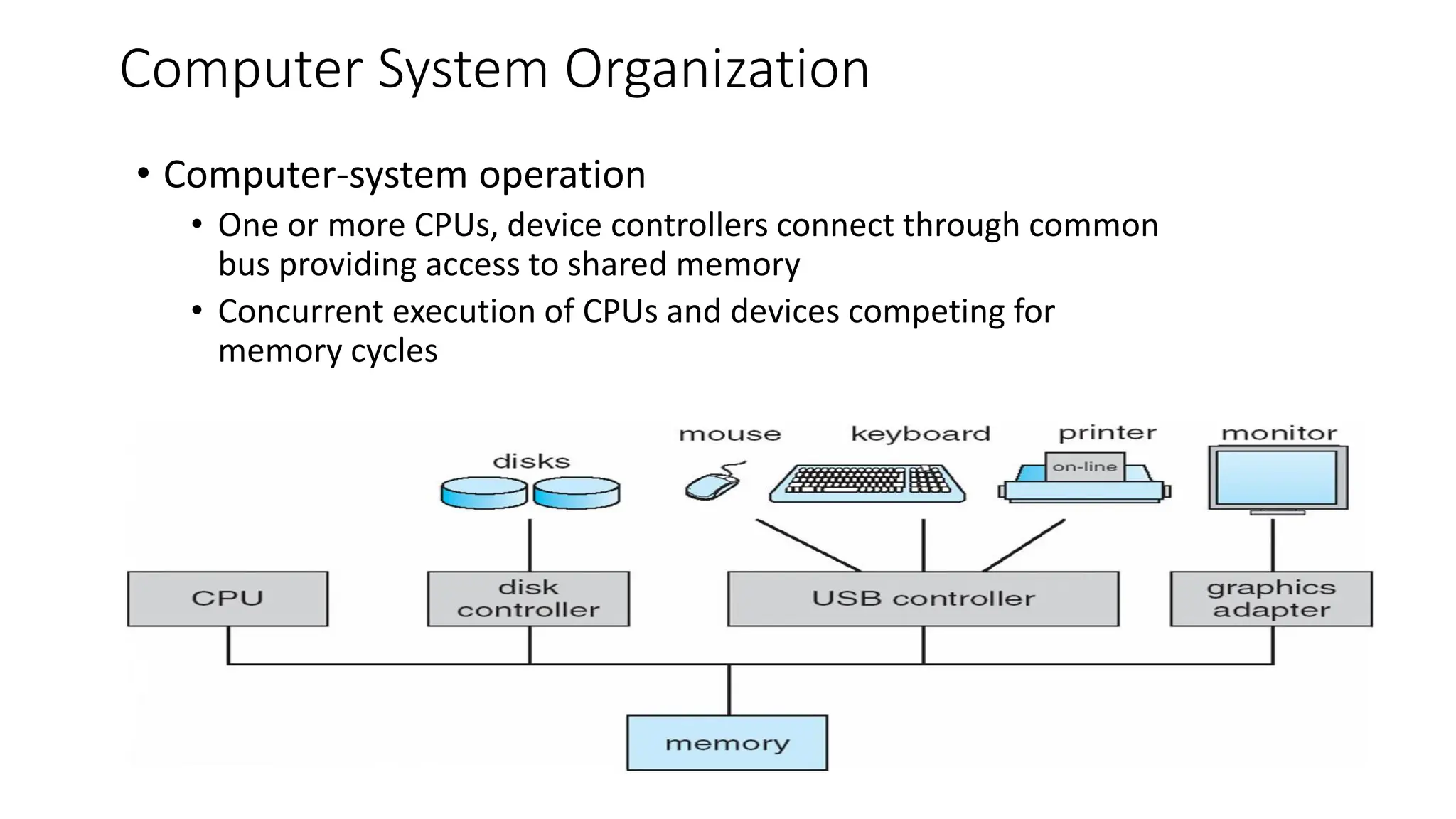
• Computer-system operation
• One or more CPUs, device controllers connect through common
bus providing access to shared memory
• Concurrent execution of CPUs and devices competing for
memory cycles
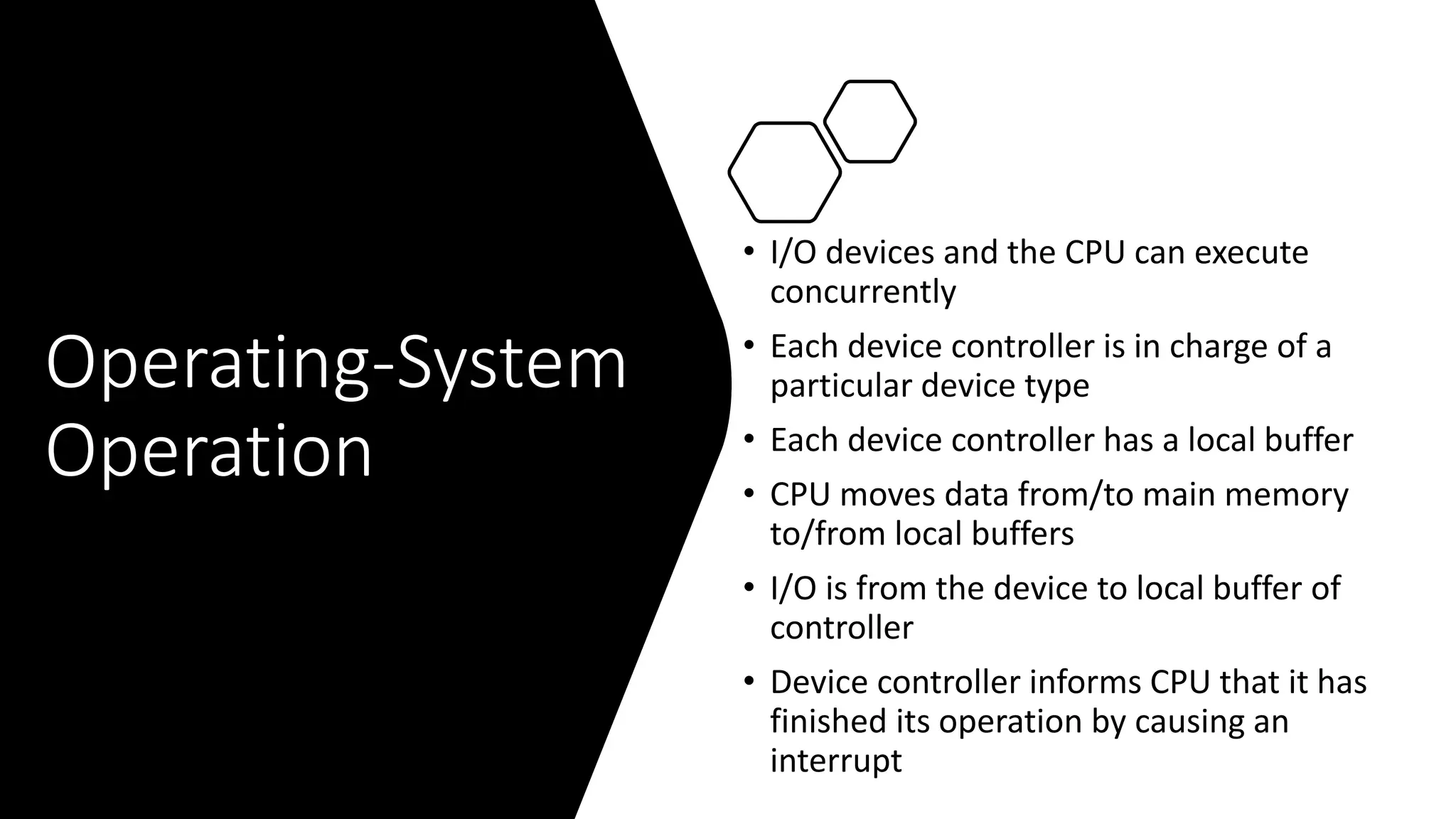
Operating-System
Operation
• I/O devices and the CPU can execute
concurrently
• Each device controller is in charge of a
particular device type
• Each device controller has a local buffer
• CPU moves data from/to main memory
to/from local buffers
• I/O is from the device to local buffer of
controller
• Device controller informs CPU that it has
finished its operation by causing an
interrupt
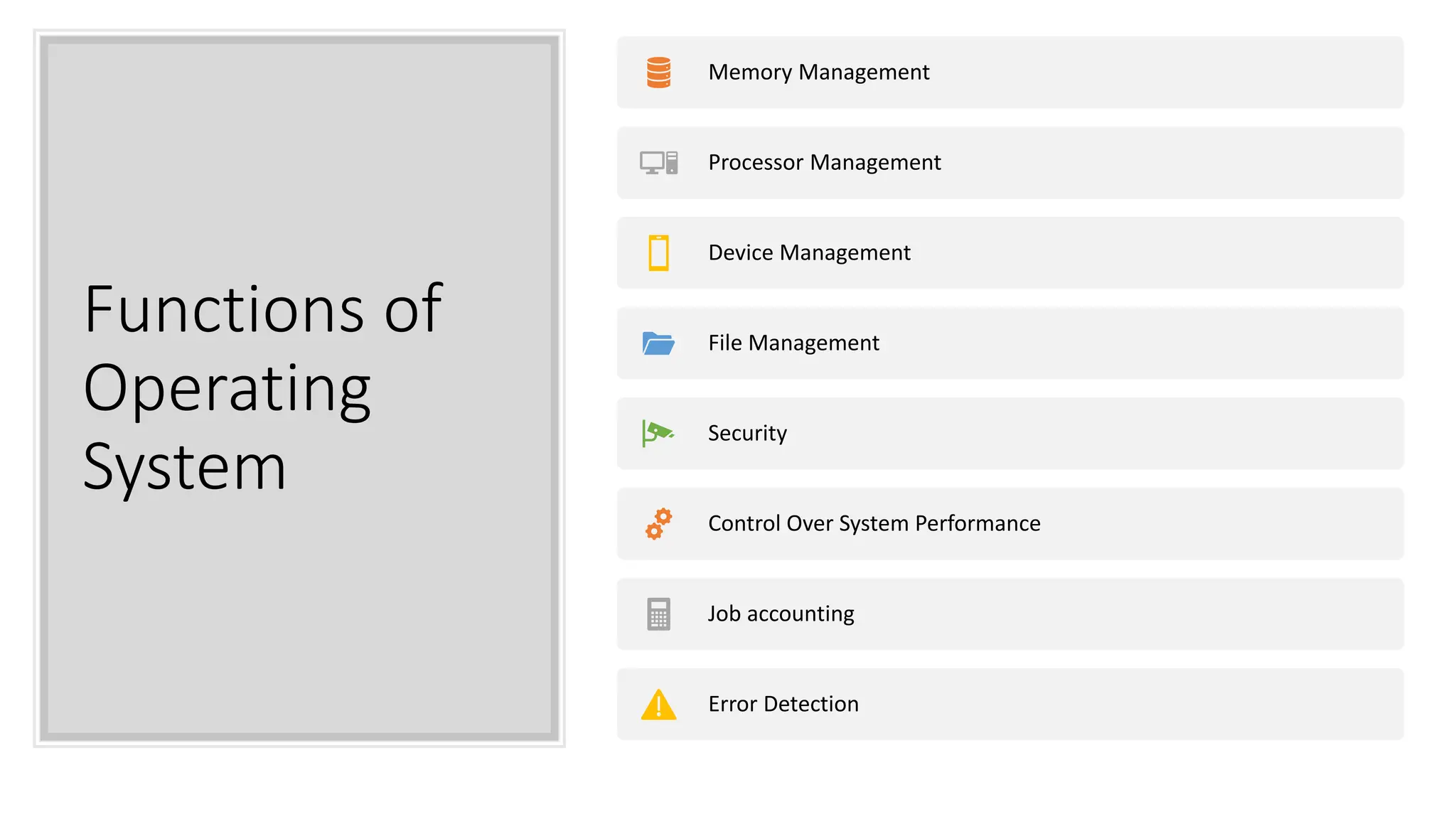
Functions of
Operating
System
Memory Management
Processor Management
Device Management
File Management
Security
Control Over System Performance
Job accounting
Error Detection
Computing
Environments
• Batch Operating System
• Multiprogramming Computing
Environment
• Time Sharing Computing Environment
• Client-Server Computing Environment
• Peer to Peer Computing Environment
• Real Time Operating System
• Distributed Computing Environment
• Cluster Computing Environment
• Web-based Computing Environment
THANKS

Lecture_01_OS_INTRODUCTION[1].pdf operating sys

  • 1.
    Introduction and Operating Systems Structures •Definition of Operating System • Operating System Role • Operating systems operations • Function of Operating System • Computing Environments
  • 2.
    What is an OperatingSystem? • A program that acts as an intermediary between a user of a computer and the computer hardware • Operating system goals: • Execute user programs and make solving user problems easier • Make the computer system convenient to use • Use the computer hardware in an efficient manner
  • 3.
    Operating System Definition •OS isa resource allocator •Manages all resources •Decides between conflicting requests for efficient and fair resource use •OS is a control program •Controls execution of programs to prevent errors and improper use of the computer
  • 4.
    Operating System Definition (Cont.) •No universally accepted definition • “Everything a vendor ships when you order an operating system” is a good approximation • But varies wildly • “The one program running at all times on the computer” is the kernel. • Everything else is either • a system program (ships with the operating system) , or • an application program.
  • 5.
    Computer System Organization •Computer-system operation • One or more CPUs, device controllers connect through common bus providing access to shared memory • Concurrent execution of CPUs and devices competing for memory cycles
  • 6.
    Operating-System Operation • I/O devicesand the CPU can execute concurrently • Each device controller is in charge of a particular device type • Each device controller has a local buffer • CPU moves data from/to main memory to/from local buffers • I/O is from the device to local buffer of controller • Device controller informs CPU that it has finished its operation by causing an interrupt
  • 7.
    Functions of Operating System Memory Management ProcessorManagement Device Management File Management Security Control Over System Performance Job accounting Error Detection
  • 8.
    Computing Environments • Batch OperatingSystem • Multiprogramming Computing Environment • Time Sharing Computing Environment • Client-Server Computing Environment • Peer to Peer Computing Environment • Real Time Operating System • Distributed Computing Environment • Cluster Computing Environment • Web-based Computing Environment
  • 9.