Lecture 1: Oracle Database Architecture
1
Agenda
2
□ definition
□ What is oracle database server?
□ Oracle database server Architecture
□ Background process
Defination
3
General defination.
 Collection of organized data is called
database
 oracle definition:
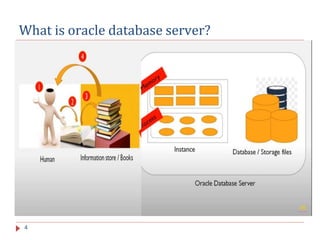
 Instance+storage files is called oracle
database
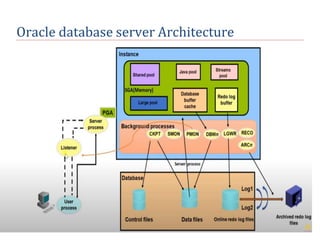
What is oracle database server?
4
□
Oracle database server Architecture
5 Enayatullah Naeemi java programming
Checkpoint process
6
 Role: The Checkpoint process signals the DBWn
(Database Writer) to write all dirty buffers to disk and
update the datafile and control file headers with the
checkpoint information.
 Purpose: Helps in reducing the time required for
instance recovery by ensuring that all changes to data
blocks are regularly written to disk.
SMON (system Monitor(
7
 Role: The System Monitor process performs
instance recovery at startup if necessary. It also
cleans up temporary segments that are no
longer in use.
• Purpose: Ensures that the database is
consistent and operational by recovering
transactions that were active before a crash and
by cleaning up temporary space
PMON (Process Monitor(
8
 Role: The Process Monitor process performs
process recovery when a user process fails. It
cleans up the cache and frees resources that the
process was using.
 Purpose: Ensures that the database resources
are properly released and made available for
other processes after a failure.
DBWR (Database Writer)
9
 Role: The Database Writer process writes
modified (dirty) buffers in the database buffer
cache to the data files. There can be multiple
DBWR processes
 Purpose: Ensures that changes made to data
blocks in memory are eventually written to
disk, thus making them permanent.
LGWR (Log Writer)
1
0
 Role: The Log Writer process writes redo log
entries from the redo log buffer to the online
redo log files on disk. This is crucial for the
recovery of transactions in case of a failure.
 Purpose: Ensures that all changes made to the
database are recorded in the redo logs, which
are essential for data recovery.
RECO (Recoverer)
1
1
 Role: The Recoverer process resolves
distributed transactions that are pending due to
a network or system failure in a distributed
database configuration.
 Purpose: Ensures that distributed transactions
are either committed or rolled back,
maintaining data consistency across multiple
databases.
ARCR (Archiver)
1
2
 Role: The Archiver process copies online redo
log files to an archive location when they are
full or when a log switch occurs.
 Purpose: Ensures that redo logs are archived
for backup and recovery purposes, allowing
for point-in-time recovery and the ability to
recover from media failures.
lecture about oracle   and defination.pptx

lecture about oracle and defination.pptx

  • 1.
    Lecture 1: OracleDatabase Architecture 1
  • 2.
    Agenda 2 □ definition □ Whatis oracle database server? □ Oracle database server Architecture □ Background process
  • 3.
    Defination 3 General defination.  Collectionof organized data is called database  oracle definition:  Instance+storage files is called oracle database
  • 4.
    What is oracledatabase server? 4 □
  • 5.
    Oracle database serverArchitecture 5 Enayatullah Naeemi java programming
  • 6.
    Checkpoint process 6  Role:The Checkpoint process signals the DBWn (Database Writer) to write all dirty buffers to disk and update the datafile and control file headers with the checkpoint information.  Purpose: Helps in reducing the time required for instance recovery by ensuring that all changes to data blocks are regularly written to disk.
  • 7.
    SMON (system Monitor( 7 Role: The System Monitor process performs instance recovery at startup if necessary. It also cleans up temporary segments that are no longer in use. • Purpose: Ensures that the database is consistent and operational by recovering transactions that were active before a crash and by cleaning up temporary space
  • 8.
    PMON (Process Monitor( 8 Role: The Process Monitor process performs process recovery when a user process fails. It cleans up the cache and frees resources that the process was using.  Purpose: Ensures that the database resources are properly released and made available for other processes after a failure.
  • 9.
    DBWR (Database Writer) 9 Role: The Database Writer process writes modified (dirty) buffers in the database buffer cache to the data files. There can be multiple DBWR processes  Purpose: Ensures that changes made to data blocks in memory are eventually written to disk, thus making them permanent.
  • 10.
    LGWR (Log Writer) 1 0 Role: The Log Writer process writes redo log entries from the redo log buffer to the online redo log files on disk. This is crucial for the recovery of transactions in case of a failure.  Purpose: Ensures that all changes made to the database are recorded in the redo logs, which are essential for data recovery.
  • 11.
    RECO (Recoverer) 1 1  Role:The Recoverer process resolves distributed transactions that are pending due to a network or system failure in a distributed database configuration.  Purpose: Ensures that distributed transactions are either committed or rolled back, maintaining data consistency across multiple databases.
  • 12.
    ARCR (Archiver) 1 2  Role:The Archiver process copies online redo log files to an archive location when they are full or when a log switch occurs.  Purpose: Ensures that redo logs are archived for backup and recovery purposes, allowing for point-in-time recovery and the ability to recover from media failures.