Demography &
Family Planning
Professor Dr Salwa Sh Abdul-wahid
Lecture - 16
Learning Objectives
• By the end of this lecture the students will be
able to :
• 1- Define Demography and to display its
relationship with Community medicine
• 2- to have opinion about population pyramid
• 3- to discus dependency Ratio
• 4- to mention an important term related to
demography
• 5-to explain infertility & list its related factors
6- to highlight the Family planning
Demography
• Demography, as understood today, is the scientific
study of human population. It focuses on three
observable human phenomena :
• (a) changes in population size (growth or decline)
(b) the composition of the population and
• (c) the distribution of population in space.
It deals with five "demographic processes“ : Fertility,
Mortality, Marriage, Migration & Social mobility.
These five processes are continuously at work within a
population determining size, composition &
distribution.
• Community Medicine branch, is vitally
concerned with population, because health in
the group depends upon the dynamic
relationship between the numbers of people,
the space which they occupy &the skill that
they have acquired in providing their needs.
• The main sources of demographic statistics are
population censuses, National Sample Surveys,
registration of vital events, and other
demographic studies.
Population Pyramid
• The age pyramid of India is typical of developing
countries, with a broad base and a tapering top. In
the developed countries, as in Switzerland,· the
pyramid generally shows a bulge in the middle,
and has a narrower base. Sex ratio Sex ratio is
defined as "the number of females per 1000
males". One of the basic demographic
characteristics of the . population is the sex
composition. In any study of population, analysis
of the sex composition plays a vital role. The sex
composition of the population is affected by the
differentials in mortality conditions of males and
females, sex selective migration and sex ratio at
birth.
Dependency ratio
• The proportion of persons above 65 years of age &
children below 15 years of age are considered to be
dependant on the economically productive age group
(15-64 years).
• The ratio of the combined age groups 0-14 years plus
65 years and above to the 15-65 years age group is
referred to as the total dependency ratio.
• Total dependency ratio =Children 0-14 years age + Population
more than 65 years of age x lOO / Population of 15 to 64 years
• It reflects the need for a society to provide for their
younger and older population groups. The dependency
ratio can be subdivided into :
• young age dependency ratio (0-14 years);
• & old age dependency ratio (65 years and more).
• The term "demographic burden" is increase in
the total dependency ratio during any period of
time, mostly caused by increased old age
dependency ratio.
• Density of population It is the ratio between
(total) population and surface (land) area.
• Urbanization , urban population is the number of
persons residing in urban localities.
• Fertility , is meant the actual bearing of children.
Some demographers prefer to use the word natality
in place of fertility. A woman's reproductive period
is roughly from 15 to 45 years
Fertility
• Is meant the actual bearing of children. Some
demographers prefer to use the word natality in
place of fertility. A woman's reproductive period is
roughly from 15 to 45 years . A woman married at
15 and living till 45 with her husband is exposed
to the risk of pregnancy for 30 years, and may
give birth to 15 children, but this maximum is
rarely achieved. Fertility depends upon several
factors.
• Fertility depends upon several factors:
• 1. Age at marriage The age at which a female
marries and enters the reproductive period of
life has a great impact on her fertility.
• 2. Duration of married life Studies indicate
that 10-25 per cent of all births occur within 1-
5 years of married life
• 3. Spacing of children Studies have shown
that when all births are postponed by one year,
in each age group, there was a decline in total
fertility.
• 4. Education There is an inverse association
between fertility and educational status.
Education provides knowledge; increased
exposure to information and media; builds skill
for gainful employment; increases female
participation in family decision making.
• 5-Economic status Operational Research
studies support the hypothesis that economic
status bears an inverse relationship with
fertility.
• 6-Nutrition There some relationship between
nutritional status and fertility levels.
Family size
• Family size refers to the total number of
persons in a family. The family size depends
upon numerous factors,
• -Duration of marriage,
• -Education of the couple,
• -The number of live births and living children,
-Preference of male children,
• -Desired family size, etc.
• The question of family size is undoubtedly
important from the demographic point of view.
• Family planning involves both decision
regarding the "desired family size" and the
effective limitation of fertility once that size has
been reached. The decrease in family size does
not appear to be due to any reduction in fertility;
rather it appears to be due to the result of
deliberate family planning.
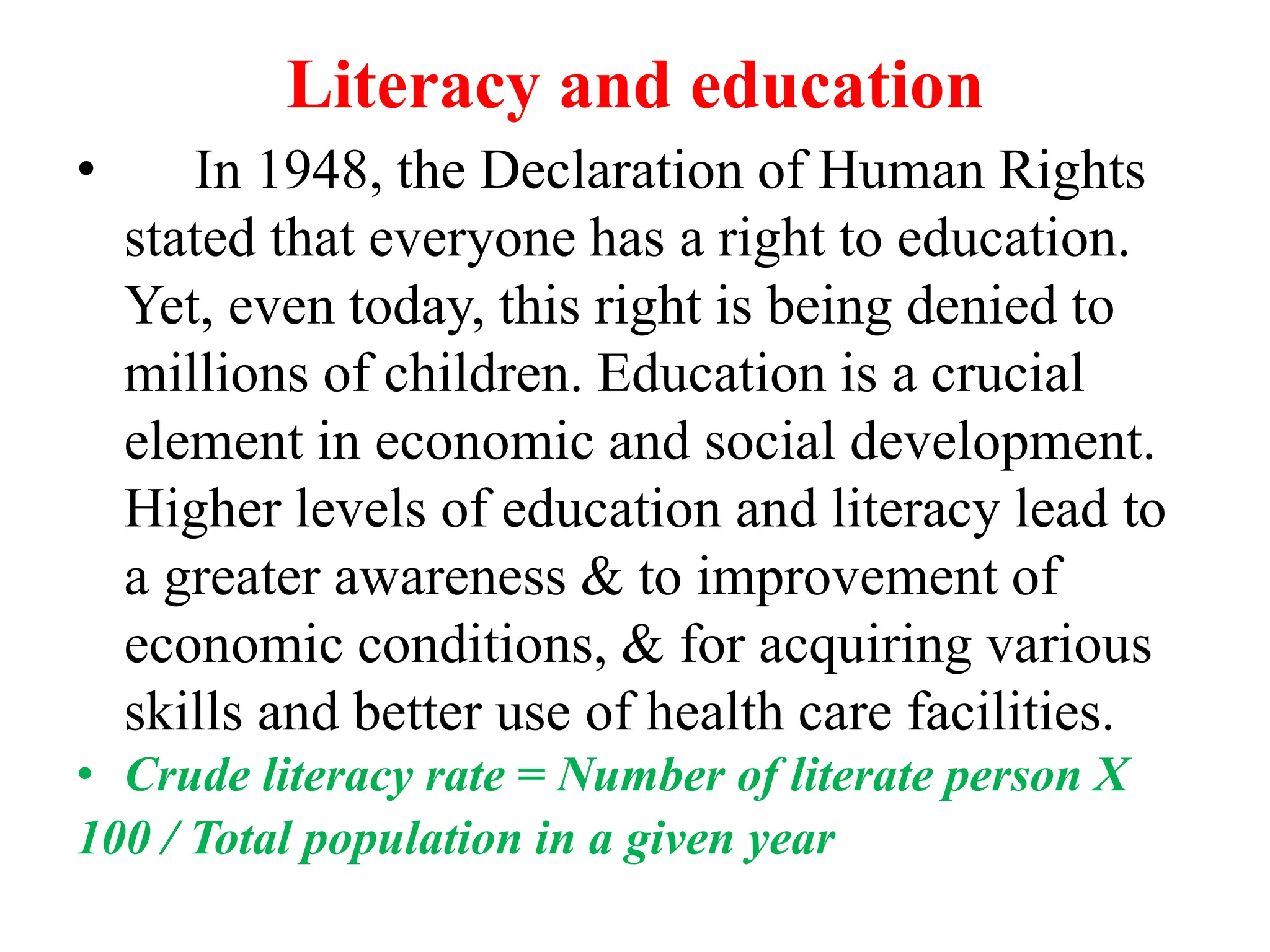
Literacy and education
• In 1948, the Declaration of Human Rights
stated that everyone has a right to education.
Yet, even today, this right is being denied to
millions of children. Education is a crucial
element in economic and social development.
Higher levels of education and literacy lead to
a greater awareness & to improvement of
economic conditions, & for acquiring various
skills and better use of health care facilities.
• Crude literacy rate = Number of literate person X
100 / Total population in a given year
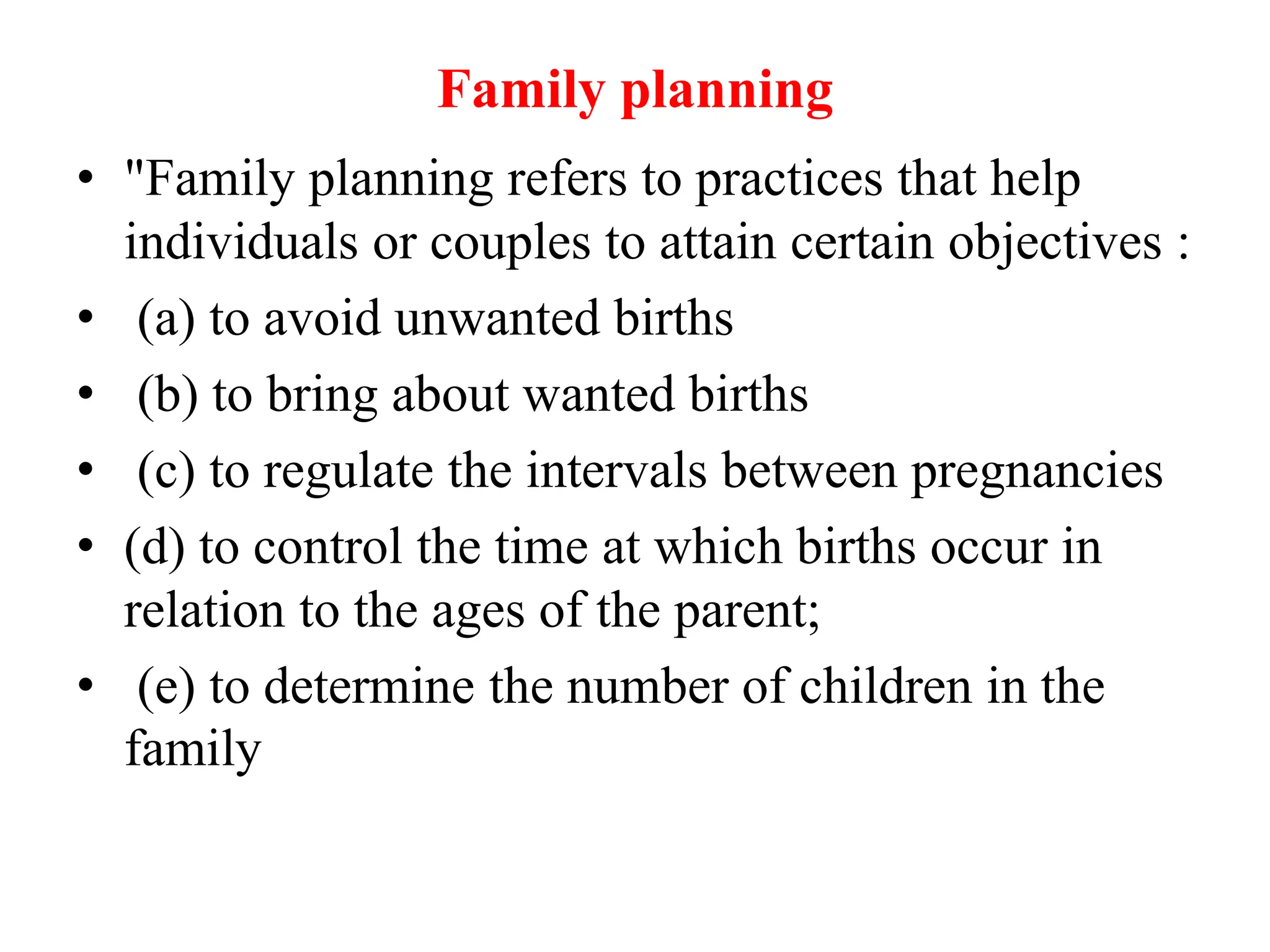
Family planning
• "Family planning refers to practices that help
individuals or couples to attain certain objectives :
• (a) to avoid unwanted births
• (b) to bring about wanted births
• (c) to regulate the intervals between pregnancies
• (d) to control the time at which births occur in
relation to the ages of the parent;
• (e) to determine the number of children in the
family
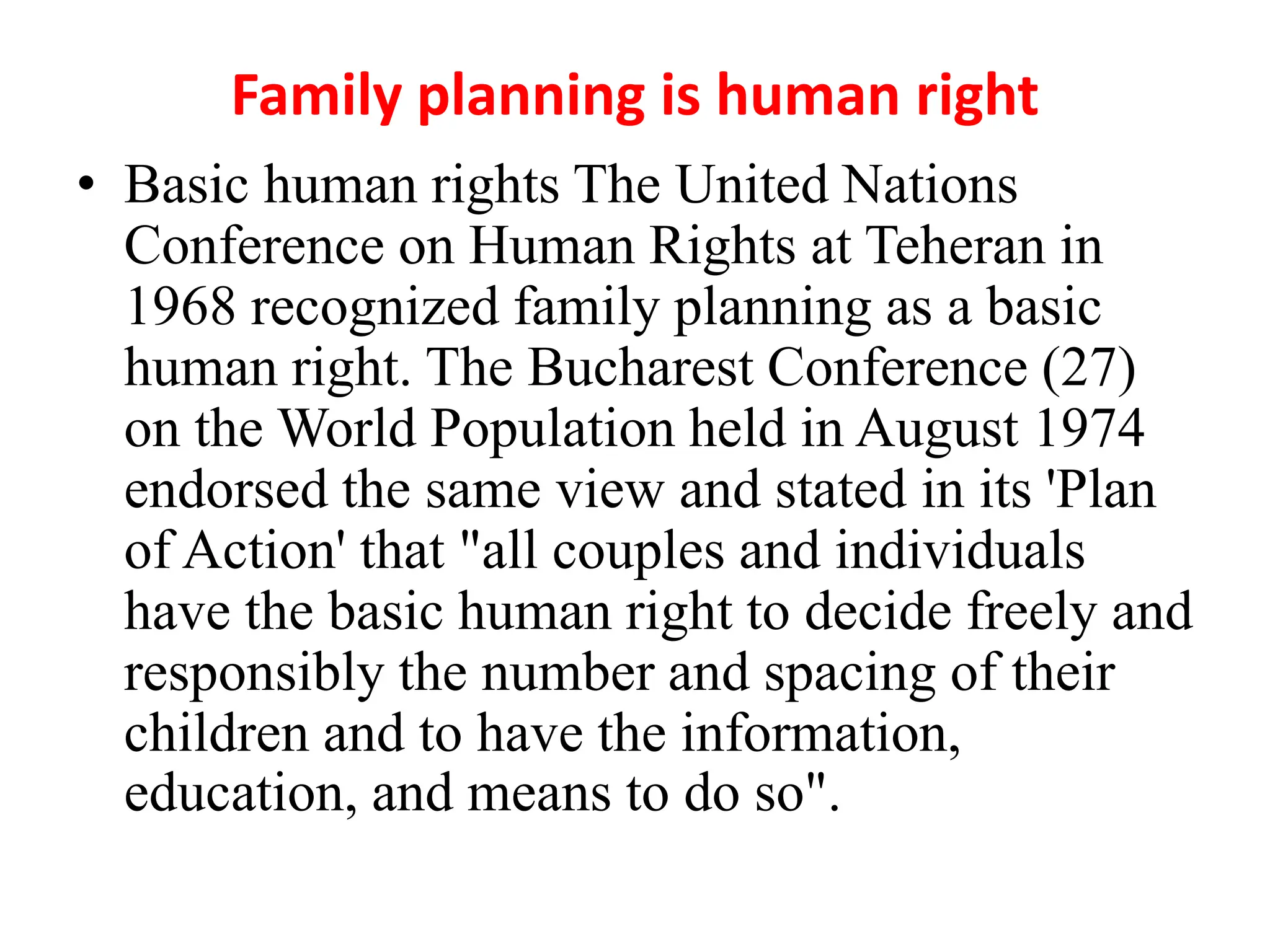
Family planning is human right
• Basic human rights The United Nations
Conference on Human Rights at Teheran in
1968 recognized family planning as a basic
human right. The Bucharest Conference (27)
on the World Population held in August 1974
endorsed the same view and stated in its 'Plan
of Action' that "all couples and individuals
have the basic human right to decide freely and
responsibly the number and spacing of their
children and to have the information,
education, and means to do so".
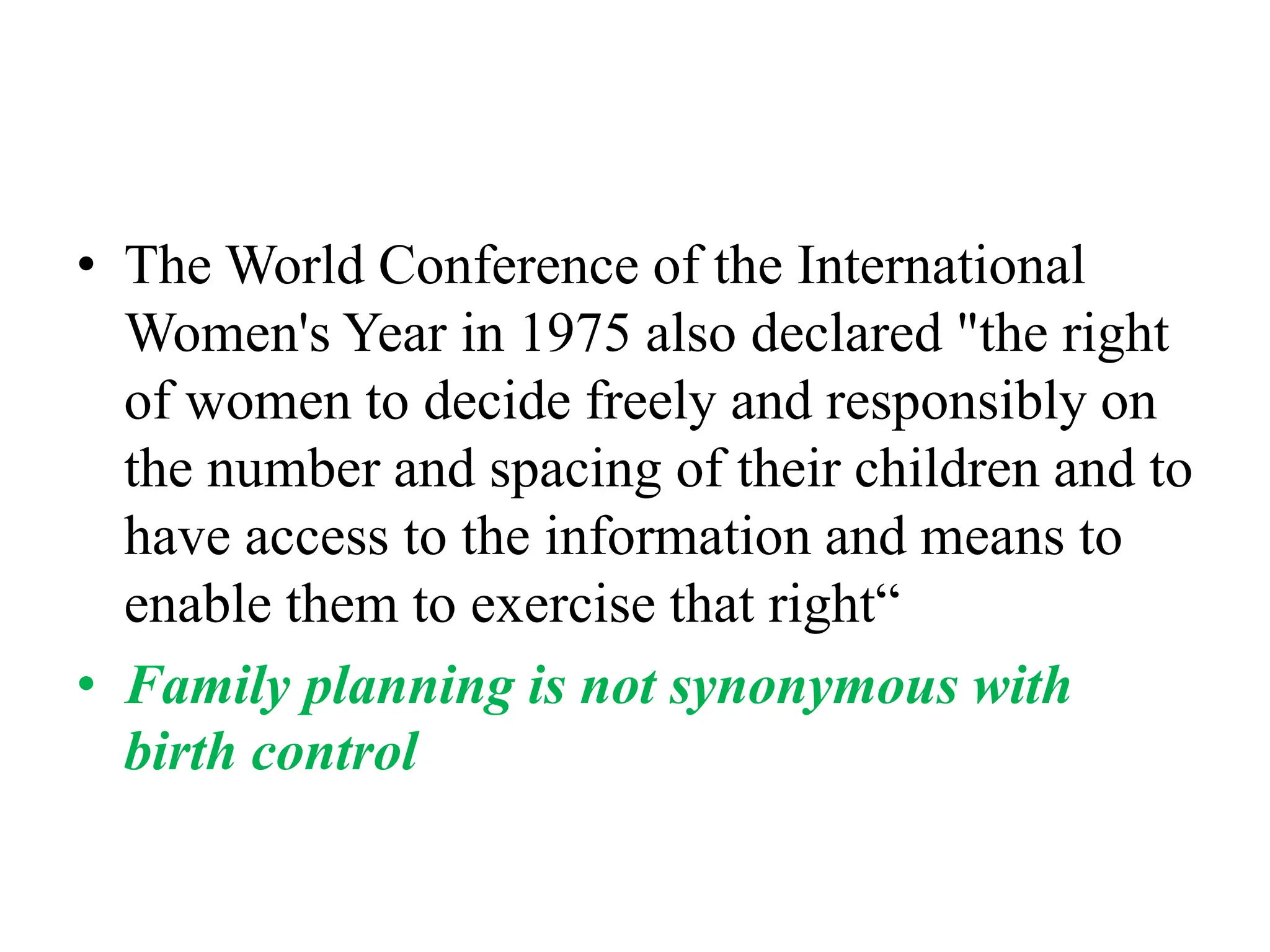
• The World Conference of the International
Women's Year in 1975 also declared "the right
of women to decide freely and responsibly on
the number and spacing of their children and to
have access to the information and means to
enable them to exercise that right“
• Family planning is not synonymous with
birth control
• family planning includes :- (1) the proper spacing
and limitation of births, {2) advice on sterility,
• {3) education for parenthood, (4) sex education,
(5) screening for pathological conditions related
to the reproductive system (e.g., cervical cancer),
(6) genetic counselling, (7) premarital
consultation and examination, {8) carrying out
pregnancy tests, (9) marriage counselling, (10) the
preparation of couples for the arrival of their first
child, (11) providing services for unmarried
mothers, (12) teaching home economics and
nutrition, and (13) providing adoption services
The health impact of family planning
• (i) the avoidance of unwanted pregnancies;
• {ii) limiting the number of births and proper
spacing, and
• (iii) timing the births, particularly the first and
last, in relation to the age of the mother.
CONTRACEPTIVE METHODS
(Fertility Regulating Methods)
• Contraceptive methods are, by definition,
preventive methods to help women avoid
unwanted pregnancies. They include all
temporary and permanent measures to prevent
pregnancy. It is now generally recognized that
there can never be an ideal contraceptive - that is,
contraceptive that is safe, effective, acceptable,
inexpensive, reversible, simple to administer,
independent of coitus, long-lasting enough to
obviate frequent administration and requiring
little or no medical supervision.
The contraceptive methods
• The contraceptive methods may be broadly
grouped into two classes as shown below :
• I. Spacing methods
• 1. Barrier methods (a) Physical methods (b)
Chemical methods (c) Combined methods
• 2. Intra-uterine devices
• 3. Hormonal methods
• 4. Post-conceptional methods 5. Miscellaneous.
II. Terminal methods :
• 1 Male sterilization (used mainly in India)
• 2 Female sterilization.
Thank You

Lecture 6 - Demography and Family Planning.pdf

  • 1.
    Demography & Family Planning ProfessorDr Salwa Sh Abdul-wahid Lecture - 16
  • 2.
    Learning Objectives • Bythe end of this lecture the students will be able to : • 1- Define Demography and to display its relationship with Community medicine • 2- to have opinion about population pyramid • 3- to discus dependency Ratio • 4- to mention an important term related to demography • 5-to explain infertility & list its related factors 6- to highlight the Family planning
  • 3.
    Demography • Demography, asunderstood today, is the scientific study of human population. It focuses on three observable human phenomena : • (a) changes in population size (growth or decline) (b) the composition of the population and • (c) the distribution of population in space. It deals with five "demographic processes“ : Fertility, Mortality, Marriage, Migration & Social mobility. These five processes are continuously at work within a population determining size, composition & distribution.
  • 4.
    • Community Medicinebranch, is vitally concerned with population, because health in the group depends upon the dynamic relationship between the numbers of people, the space which they occupy &the skill that they have acquired in providing their needs. • The main sources of demographic statistics are population censuses, National Sample Surveys, registration of vital events, and other demographic studies.
  • 5.
    Population Pyramid • Theage pyramid of India is typical of developing countries, with a broad base and a tapering top. In the developed countries, as in Switzerland,· the pyramid generally shows a bulge in the middle, and has a narrower base. Sex ratio Sex ratio is defined as "the number of females per 1000 males". One of the basic demographic characteristics of the . population is the sex composition. In any study of population, analysis of the sex composition plays a vital role. The sex composition of the population is affected by the differentials in mortality conditions of males and females, sex selective migration and sex ratio at birth.
  • 6.
    Dependency ratio • Theproportion of persons above 65 years of age & children below 15 years of age are considered to be dependant on the economically productive age group (15-64 years). • The ratio of the combined age groups 0-14 years plus 65 years and above to the 15-65 years age group is referred to as the total dependency ratio. • Total dependency ratio =Children 0-14 years age + Population more than 65 years of age x lOO / Population of 15 to 64 years • It reflects the need for a society to provide for their younger and older population groups. The dependency ratio can be subdivided into : • young age dependency ratio (0-14 years); • & old age dependency ratio (65 years and more).
  • 7.
    • The term"demographic burden" is increase in the total dependency ratio during any period of time, mostly caused by increased old age dependency ratio. • Density of population It is the ratio between (total) population and surface (land) area. • Urbanization , urban population is the number of persons residing in urban localities. • Fertility , is meant the actual bearing of children. Some demographers prefer to use the word natality in place of fertility. A woman's reproductive period is roughly from 15 to 45 years
  • 8.
    Fertility • Is meantthe actual bearing of children. Some demographers prefer to use the word natality in place of fertility. A woman's reproductive period is roughly from 15 to 45 years . A woman married at 15 and living till 45 with her husband is exposed to the risk of pregnancy for 30 years, and may give birth to 15 children, but this maximum is rarely achieved. Fertility depends upon several factors.
  • 9.
    • Fertility dependsupon several factors: • 1. Age at marriage The age at which a female marries and enters the reproductive period of life has a great impact on her fertility. • 2. Duration of married life Studies indicate that 10-25 per cent of all births occur within 1- 5 years of married life • 3. Spacing of children Studies have shown that when all births are postponed by one year, in each age group, there was a decline in total fertility.
  • 10.
    • 4. EducationThere is an inverse association between fertility and educational status. Education provides knowledge; increased exposure to information and media; builds skill for gainful employment; increases female participation in family decision making. • 5-Economic status Operational Research studies support the hypothesis that economic status bears an inverse relationship with fertility. • 6-Nutrition There some relationship between nutritional status and fertility levels.
  • 11.
    Family size • Familysize refers to the total number of persons in a family. The family size depends upon numerous factors, • -Duration of marriage, • -Education of the couple, • -The number of live births and living children, -Preference of male children, • -Desired family size, etc. • The question of family size is undoubtedly important from the demographic point of view.
  • 12.
    • Family planninginvolves both decision regarding the "desired family size" and the effective limitation of fertility once that size has been reached. The decrease in family size does not appear to be due to any reduction in fertility; rather it appears to be due to the result of deliberate family planning.
  • 13.
    Literacy and education •In 1948, the Declaration of Human Rights stated that everyone has a right to education. Yet, even today, this right is being denied to millions of children. Education is a crucial element in economic and social development. Higher levels of education and literacy lead to a greater awareness & to improvement of economic conditions, & for acquiring various skills and better use of health care facilities. • Crude literacy rate = Number of literate person X 100 / Total population in a given year
  • 14.
    Family planning • "Familyplanning refers to practices that help individuals or couples to attain certain objectives : • (a) to avoid unwanted births • (b) to bring about wanted births • (c) to regulate the intervals between pregnancies • (d) to control the time at which births occur in relation to the ages of the parent; • (e) to determine the number of children in the family
  • 15.
    Family planning ishuman right • Basic human rights The United Nations Conference on Human Rights at Teheran in 1968 recognized family planning as a basic human right. The Bucharest Conference (27) on the World Population held in August 1974 endorsed the same view and stated in its 'Plan of Action' that "all couples and individuals have the basic human right to decide freely and responsibly the number and spacing of their children and to have the information, education, and means to do so".
  • 16.
    • The WorldConference of the International Women's Year in 1975 also declared "the right of women to decide freely and responsibly on the number and spacing of their children and to have access to the information and means to enable them to exercise that right“ • Family planning is not synonymous with birth control
  • 17.
    • family planningincludes :- (1) the proper spacing and limitation of births, {2) advice on sterility, • {3) education for parenthood, (4) sex education, (5) screening for pathological conditions related to the reproductive system (e.g., cervical cancer), (6) genetic counselling, (7) premarital consultation and examination, {8) carrying out pregnancy tests, (9) marriage counselling, (10) the preparation of couples for the arrival of their first child, (11) providing services for unmarried mothers, (12) teaching home economics and nutrition, and (13) providing adoption services
  • 18.
    The health impactof family planning • (i) the avoidance of unwanted pregnancies; • {ii) limiting the number of births and proper spacing, and • (iii) timing the births, particularly the first and last, in relation to the age of the mother.
  • 19.
    CONTRACEPTIVE METHODS (Fertility RegulatingMethods) • Contraceptive methods are, by definition, preventive methods to help women avoid unwanted pregnancies. They include all temporary and permanent measures to prevent pregnancy. It is now generally recognized that there can never be an ideal contraceptive - that is, contraceptive that is safe, effective, acceptable, inexpensive, reversible, simple to administer, independent of coitus, long-lasting enough to obviate frequent administration and requiring little or no medical supervision.
  • 20.
    The contraceptive methods •The contraceptive methods may be broadly grouped into two classes as shown below : • I. Spacing methods • 1. Barrier methods (a) Physical methods (b) Chemical methods (c) Combined methods • 2. Intra-uterine devices • 3. Hormonal methods • 4. Post-conceptional methods 5. Miscellaneous. II. Terminal methods : • 1 Male sterilization (used mainly in India) • 2 Female sterilization.
  • 21.