1
Adrenal Gland Disorders
HYPERALDOSTERONISM
ADRENAL INSUFFECIENCY
Professor Mohammed AL-Rekabi
Lecture 1
Part 2
Email :info@alkafeel.edu.iq Website :http://Alkafeel.edu.iq 2
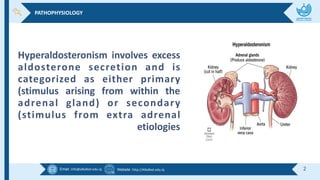
Hyperaldosteronism involves excess
aldosterone secretion and is
categorized as either primary
(stimulus arising from within the
adrenal gland) or secondary
(stimulus from extra adrenal
etiologies
PATHOPHYSIOLOGY
Email :info@alkafeel.edu.iq Website :http://Alkafeel.edu.iq 3
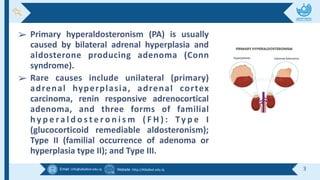
➢ Primary hyperaldosteronism (PA) is usually
caused by bilateral adrenal hyperplasia and
aldosterone producing adenoma (Conn
syndrome).
➢ Rare causes include unilateral (primary)
adrenal hyperplasia, adrenal cortex
carcinoma, renin responsive adrenocortical
adenoma, and three forms of familial
h y p e r a l d o s t e r o n i s m ( F H ) : Ty p e I
(glucocorticoid remediable aldosteronism);
Type II (familial occurrence of adenoma or
hyperplasia type II); and Type III.
Email :info@alkafeel.edu.iq Website :http://Alkafeel.edu.iq 4
➢
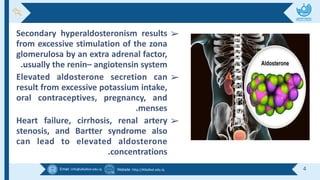
Secondary hyperaldosteronism results
from excessive stimulation of the zona
glomerulosa by an extra adrenal factor,
.usually the renin– angiotensin system
➢
Elevated aldosterone secretion can
result from excessive potassium intake,
oral contraceptives, pregnancy, and
.menses
➢
Heart failure, cirrhosis, renal artery
stenosis, and Bartter syndrome also
can lead to elevated aldosterone
.concentrations
Email :info@alkafeel.edu.iq Website :http://Alkafeel.edu.iq 5
➢Patients may complain of muscle weakness, fatigue,
paresthesias, headache, polydipsia, and nocturnal
polyuria.
➢Signs may include hypertension, tetany/paralysis, and
polydipsia/nocturnal polyuria.
CLINICAL PRESENTATION
Email :info@alkafeel.edu.iq Website :http://Alkafeel.edu.iq 6
2020-2021
➢ A plasma aldosterone concentration to plasma renin activity
(PAC to PRA) ratio or aldosterone to renin ratio (ARR) >30 ng/dL
per ng/(mL·h) (830 pmol/L per mcg/(L·h) and a PAC >15 ng/dL
(420 pmol/L) is suggestive of PA.
➢ Other laboratory findings include suppressed renin activity,
elevated plasma aldosterone, hypernatremia (>142 mEq/L),
hypokalemia, hypomagnesemia, elevated serum bicarbonate
(>31 mEq/L), and glucose intolerance.
CLINICAL PRESENTATION
Email :info@alkafeel.edu.iq Website :http://Alkafeel.edu.iq 7
➢ Initial diagnosis is made by screening patients with suspected PA.
➢ Any patient with a blood pressure >150/100 mm Hg measured on three
separate days, and those meeting the criteria for treatment resistant
hypertension should be screened.
DIAGNOSIS
Email :info@alkafeel.edu.iq Website :http://Alkafeel.edu.iq 8
2020-2021
➢ Additional patients at risk for PA include those with
diuretic induced hypokalemia, hypertension and adrenal
incidentaloma, hypertension and sleep apnea,
hypertension and a family history of early onset
hypertension or cerebrovascular accident at an age less
than 40 years, and all patients with hypertension and a
first degree relatives diagnosed with PA
Email :info@alkafeel.edu.iq Website :http://Alkafeel.edu.iq 9
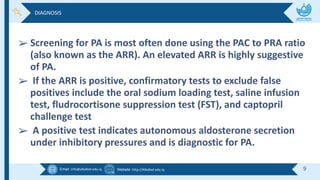
➢ Screening for PA is most often done using the PAC to PRA ratio
(also known as the ARR). An elevated ARR is highly suggestive
of PA.
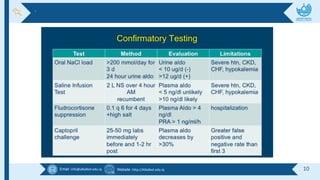
➢ If the ARR is positive, confirmatory tests to exclude false
positives include the oral sodium loading test, saline infusion
test, fludrocortisone suppression test (FST), and captopril
challenge test
➢ A positive test indicates autonomous aldosterone secretion
under inhibitory pressures and is diagnostic for PA.
DIAGNOSIS
Email :info@alkafeel.edu.iq Website :http://Alkafeel.edu.iq 10
`
Email :info@alkafeel.edu.iq Website :http://Alkafeel.edu.iq 11
Nonpharmacologic Therapy
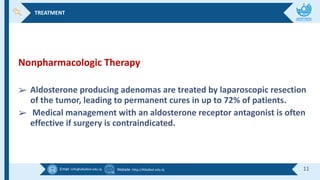
➢ Aldosterone producing adenomas are treated by laparoscopic resection
of the tumor, leading to permanent cures in up to 72% of patients.
➢ Medical management with an aldosterone receptor antagonist is often
effective if surgery is contraindicated.
TREATMENT
Email :info@alkafeel.edu.iq Website :http://Alkafeel.edu.iq 12
Aldosterone receptor antagonists are the treatment of choice for bilateral adrenal
hyperplasia.
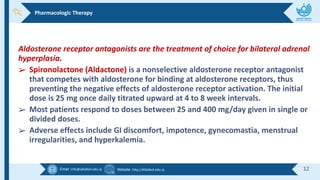
➢ Spironolactone (Aldactone) is a nonselective aldosterone receptor antagonist
that competes with aldosterone for binding at aldosterone receptors, thus
preventing the negative effects of aldosterone receptor activation. The initial
dose is 25 mg once daily titrated upward at 4 to 8 week intervals.
➢ Most patients respond to doses between 25 and 400 mg/day given in single or
divided doses.
➢ Adverse effects include GI discomfort, impotence, gynecomastia, menstrual
irregularities, and hyperkalemia.
Pharmacologic Therapy
Email :info@alkafeel.edu.iq Website :http://Alkafeel.edu.iq 13
❑ Eplerenone (Inspra) is a selective aldosterone receptor antagonist with
high affinity for aldosterone receptors and low affinity for androgen and
progesterone receptors.
❑ Consequently, it elicits fewer sex steroid–dependent effects than
spironolactone.
❑ Dosing starts at 50 mg daily, with titration at 4 to 8 week intervals to 50
mg twice a day; some patients may require total daily doses as high as
200–300 mg.
Email :info@alkafeel.edu.iq Website :http://Alkafeel.edu.iq 14
❑ Amiloride (Amiloride), a potassium sparing diuretic, is less effective than
spironolactone, and patients often require additional therapy to
adequately control blood pressure.
❑ The initial dose is 5 mg twice daily, with a usual range of 20 mg/day given
in two divided doses; doses up to 30 mg/day may be necessary.
Email :info@alkafeel.edu.iq Website :http://Alkafeel.edu.iq 15
❑ Additional second line options include calcium channel blockers, ACE
inhibitors, and diuretics such as chlorthalidone, although all of these lack
outcome data in PA.
❑ Treatment of secondary aldosteronism is dictated by etiology. Control or
correction of the extra adrenal stimulation of aldosterone secretion
should resolve the disorder.
❑ Medical therapy with spironolactone is undertaken until the etiology is
identified.
Email :info@alkafeel.edu.iq Website :http://Alkafeel.edu.iq 16
❑ Primary adrenal insufficiency (Addison disease) usually involves
destruction of all regions of the adrenal cortex. There are deficiencies of
cortisol, aldosterone, and the various androgens, and levels of CRH and
ACTH increase in a compensatory manner.
❑ Autoimmune dysfunction is responsible for 80%–90% of cases in
developed countries, whereas tuberculosis is the predominant cause in
developing countries.
ADRENAL INSUFFICIENCY: PATHOPHYSIOLOGY
Email :info@alkafeel.edu.iq Website :http://Alkafeel.edu.iq 17
Medications that inhibit cortisol synthesis (eg,
ketoconazole) or accelerate cortisol metabolism (eg,
phenytoin, rifampin, phenobarbital) can also cause
primary adrenal insufficiency.
Email :info@alkafeel.edu.iq Website :http://Alkafeel.edu.iq 18
➢ Secondary adrenal insufficiency most commonly results from exogenous
corticosteroid use, leading to suppression of the hypothalamic–
pituitary–adrenal axis and decreased ACTH release as well as impaired
androgen and cortisol production.
➢ Mirtazapine and progestins (eg, medroxyprogesterone acetate,
megestrol acetate) have also been reported to induce secondary adrenal
insufficiency. Secondary disease typically presents with normal
mineralocorticoid concentrations.
Email :info@alkafeel.edu.iq Website :http://Alkafeel.edu.iq 19
➢ Patients with adrenal insufficiency commonly complain of weakness,
weight loss, GI symptoms, salt craving, headaches, memory impairment,
depression, and postural dizziness.
➢ Early symptoms of acute adrenal insufficiency also include myalgia,
malaise, and anorexia.
➢ As the situation progresses, vomiting, fever, hypotension, and shock
develop.
➢ Signs of adrenal insufficiency include increased skin pigmentation,
postural hypotension, fever, decreased body hair, vitiligo, amenorrhea,
and cold intolerance.
CLINICAL PRESENTATION
Email :info@alkafeel.edu.iq Website :http://Alkafeel.edu.iq 20
➢ The short cosyntropin stimulation test can be used to assess patients
with suspected hypercortisolism.
➢ An increase to a cortisol level of ≥18 mcg/dL (500 nmol/L) rules out
adrenal insufficiency.
➢ Patients with Addison disease have an abnormal response to the short
cosyntropin stimulation test.
DIAGNOSIS
Email :info@alkafeel.edu.iq Website :http://Alkafeel.edu.iq 21
➢ Plasma ACTH levels are usually elevated (400– 2000 pg/mL or 88–440
pmol/L) in primary insufficiency versus normal to low (5–50 pg/mL or
1.1–11 pmol/L]) in secondary insufficiency.
➢ A normal cosyntropin stimulation test does not rule out secondary
adrenal insufficiency. Other tests include the insulin hypoglycemia test,
the metyrapone test, and the CRH stimulation test.
Email :info@alkafeel.edu.iq Website :http://Alkafeel.edu.iq 22
TREATMENT
Goals of Treatment: Limit morbidity and mortality,
return the patient to a normal functional state, and
prevent episodes of acute adrenal insufficiency.
Email :info@alkafeel.edu.iq Website :http://Alkafeel.edu.iq 23
Nonpharmacologic Therapy
Inform patients of treatment complications, expected outcomes,
proper medication administration and adherence, and possible
side effects.
Email :info@alkafeel.edu.iq Website :http://Alkafeel.edu.iq 24
➢ The agents of choice are hydrocortisone and cortisone
acetate, usually administered two times daily, with the
goal of establishing the lowest effective dose while
mimicking the normal diurnal adrenal rhythm.
➢ Once daily prednisolone is an alternative when
adherence to a multidose regimen is a concern.
Pharmacologic Therapy : Corticosteroids
Email :info@alkafeel.edu.iq Website :http://Alkafeel.edu.iq 25
➢ Recommended starting total daily doses are hydrocortisone 15–
25 mg daily, which is approximately equivalent to cortisone
acetate 20–35 mg daily, or prednisolone 3–5 mg daily.
➢ For hydrocortisone or cortisone, two thirds of the dose is given
in the morning and one third is given 6–8 hours later.
Email :info@alkafeel.edu.iq Website :http://Alkafeel.edu.iq 26
➢ Monitor the patient’s symptoms every 6–8 weeks to assess proper
glucocorticoid replacement.
➢ Measure body weight, postural blood pressures, subjective energy levels,
and signs of glucocorticoid excess.
Email :info@alkafeel.edu.iq Website :http://Alkafeel.edu.iq 27
➢ In primary adrenal insufficiency, fludrocortisone acetate 0.05–0.2 mg orally
once daily can be used to replace mineralocorticoid loss and maintain
volume status.
➢ If parenteral therapy is needed, 2–5 mg of deoxycorticosterone
trimethylacetate in oil can be administered intramuscularly every 3–4
weeks.
➢ Mineralocorticoid replacement attenuates development of hyperkalemia,
and patients on fludrocortisone therapy do not need to restrict salt intake.
➢ Mineralocorticoid therapy may be unnecessary in some cases because
glucocorticoids (especially in large doses) also bind to mineralocorticoid
receptors.
Email :info@alkafeel.edu.iq Website :http://Alkafeel.edu.iq 28
➢ Because most adrenal crises occur because of glucocorticoid dose
reductions or lack of stress related dose adjustments, patients receiving
corticosteroid replacement therapy should add 5–10 mg hydrocortisone
(or equivalent) to their normal daily regimen shortly before strenuous
activities, such as exercise.
➢ During times of severe physical stress (e.g, febrile illness, injury), patients
should be instructed to double their daily dose until recovery.
Email :info@alkafeel.edu.iq Website :http://Alkafeel.edu.iq 29
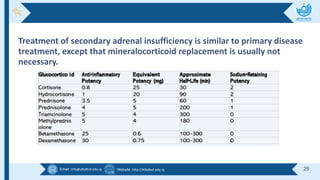
Treatment of secondary adrenal insufficiency is similar to primary disease
treatment, except that mineralocorticoid replacement is usually not
necessary.
Email :info@alkafeel.edu.iq Website :http://Alkafeel.edu.iq 30
2020-2021
• Acute adrenal insufficiency (adrenal crisis or Addisonian crisis) represents
a true endocrine emergency. Major clinical features include volume
depletion and hypotension that resolve within 1–2 hours after parenteral
glucocorticoid administration.
• Stressful situations, surgery, infection, and trauma are potential events
that increase adrenal requirements, especially in patients with some
underlying adrenal or pituitary insufficiency.
• The most common cause of adrenal crisis is HPA axis suppression brought
on by abrupt withdrawal of chronic glucocorticoid use.
Pharmacologic Therapy of Acute Adrenal Insufficiency
Email :info@alkafeel.edu.iq Website :http://Alkafeel.edu.iq 31
2020-2021
➢ Hydrocortisone given parenterally is the corticosteroid of choice
because of its combined glucocorticoid and mineralocorticoid activity.
➢ The starting dose is 100 mg IV by rapid infusion, followed by 200 mg over
24 hours as a continuous infusion.
➢ IV administration is continued for an additional day at a reduced dose of
100 mg over 24 hours.
➢ If the patient is stable at that time, oral hydrocortisone can be started at
a dose of 50 mg every 6–8 hours, followed by tapering to the individual’s
chronic replacement needs.
Email :info@alkafeel.edu.iq Website :http://Alkafeel.edu.iq 32
2020-2021
➢ Fluid replacement often is required and can be accomplished
with IV dextrose 5% in normal saline solution at a rate to
support blood pressure. If therapy is needed for hypoglycemia,
dextrose 25% in water can be infused at a dose of 2–4 mL/kg.
➢ If hyperkalemia is present after the hydrocortisone
maintenance phase, additional mineralocorticoid
supplementation can be achieved with fludrocortisone acetate
0.1 mg daily.
Email :info@alkafeel.edu.iq Website :http://Alkafeel.edu.iq 33
2020-2021
➢ Patients with adrenal insufficiency should carry a card or wear a bracelet
or necklace that contains information about their condition.
➢ They should also have easy access to injectable hydrocortisone or
glucocorticoid suppositories in case of an emergency or during times of
physical stress.
Email :info@alkafeel.edu.iq Website :http://Alkafeel.edu.iq 34
2020-2021
➢ The endpoint of therapy for adrenal insufficiency is difficult to assess in
most patients, but a reduction in excess pigmentation is a good clinical
marker.
➢ Development of features of Cushing syndrome indicates excessive
replacement.
EVALUATION OF THERAPEUTIC OUTCOMES
lecture 2 therapeutics II كاملة من دون نقص-1.pdf

lecture 2 therapeutics II كاملة من دون نقص-1.pdf

  • 1.
    1 Adrenal Gland Disorders HYPERALDOSTERONISM ADRENALINSUFFECIENCY Professor Mohammed AL-Rekabi Lecture 1 Part 2
  • 2.
    Email :info@alkafeel.edu.iq Website:http://Alkafeel.edu.iq 2 Hyperaldosteronism involves excess aldosterone secretion and is categorized as either primary (stimulus arising from within the adrenal gland) or secondary (stimulus from extra adrenal etiologies PATHOPHYSIOLOGY
  • 3.
    Email :info@alkafeel.edu.iq Website:http://Alkafeel.edu.iq 3 ➢ Primary hyperaldosteronism (PA) is usually caused by bilateral adrenal hyperplasia and aldosterone producing adenoma (Conn syndrome). ➢ Rare causes include unilateral (primary) adrenal hyperplasia, adrenal cortex carcinoma, renin responsive adrenocortical adenoma, and three forms of familial h y p e r a l d o s t e r o n i s m ( F H ) : Ty p e I (glucocorticoid remediable aldosteronism); Type II (familial occurrence of adenoma or hyperplasia type II); and Type III.
  • 4.
    Email :info@alkafeel.edu.iq Website:http://Alkafeel.edu.iq 4 ➢ Secondary hyperaldosteronism results from excessive stimulation of the zona glomerulosa by an extra adrenal factor, .usually the renin– angiotensin system ➢ Elevated aldosterone secretion can result from excessive potassium intake, oral contraceptives, pregnancy, and .menses ➢ Heart failure, cirrhosis, renal artery stenosis, and Bartter syndrome also can lead to elevated aldosterone .concentrations
  • 5.
    Email :info@alkafeel.edu.iq Website:http://Alkafeel.edu.iq 5 ➢Patients may complain of muscle weakness, fatigue, paresthesias, headache, polydipsia, and nocturnal polyuria. ➢Signs may include hypertension, tetany/paralysis, and polydipsia/nocturnal polyuria. CLINICAL PRESENTATION
  • 6.
    Email :info@alkafeel.edu.iq Website:http://Alkafeel.edu.iq 6 2020-2021 ➢ A plasma aldosterone concentration to plasma renin activity (PAC to PRA) ratio or aldosterone to renin ratio (ARR) >30 ng/dL per ng/(mL·h) (830 pmol/L per mcg/(L·h) and a PAC >15 ng/dL (420 pmol/L) is suggestive of PA. ➢ Other laboratory findings include suppressed renin activity, elevated plasma aldosterone, hypernatremia (>142 mEq/L), hypokalemia, hypomagnesemia, elevated serum bicarbonate (>31 mEq/L), and glucose intolerance. CLINICAL PRESENTATION
  • 7.
    Email :info@alkafeel.edu.iq Website:http://Alkafeel.edu.iq 7 ➢ Initial diagnosis is made by screening patients with suspected PA. ➢ Any patient with a blood pressure >150/100 mm Hg measured on three separate days, and those meeting the criteria for treatment resistant hypertension should be screened. DIAGNOSIS
  • 8.
    Email :info@alkafeel.edu.iq Website:http://Alkafeel.edu.iq 8 2020-2021 ➢ Additional patients at risk for PA include those with diuretic induced hypokalemia, hypertension and adrenal incidentaloma, hypertension and sleep apnea, hypertension and a family history of early onset hypertension or cerebrovascular accident at an age less than 40 years, and all patients with hypertension and a first degree relatives diagnosed with PA
  • 9.
    Email :info@alkafeel.edu.iq Website:http://Alkafeel.edu.iq 9 ➢ Screening for PA is most often done using the PAC to PRA ratio (also known as the ARR). An elevated ARR is highly suggestive of PA. ➢ If the ARR is positive, confirmatory tests to exclude false positives include the oral sodium loading test, saline infusion test, fludrocortisone suppression test (FST), and captopril challenge test ➢ A positive test indicates autonomous aldosterone secretion under inhibitory pressures and is diagnostic for PA. DIAGNOSIS
  • 10.
    Email :info@alkafeel.edu.iq Website:http://Alkafeel.edu.iq 10 `
  • 11.
    Email :info@alkafeel.edu.iq Website:http://Alkafeel.edu.iq 11 Nonpharmacologic Therapy ➢ Aldosterone producing adenomas are treated by laparoscopic resection of the tumor, leading to permanent cures in up to 72% of patients. ➢ Medical management with an aldosterone receptor antagonist is often effective if surgery is contraindicated. TREATMENT
  • 12.
    Email :info@alkafeel.edu.iq Website:http://Alkafeel.edu.iq 12 Aldosterone receptor antagonists are the treatment of choice for bilateral adrenal hyperplasia. ➢ Spironolactone (Aldactone) is a nonselective aldosterone receptor antagonist that competes with aldosterone for binding at aldosterone receptors, thus preventing the negative effects of aldosterone receptor activation. The initial dose is 25 mg once daily titrated upward at 4 to 8 week intervals. ➢ Most patients respond to doses between 25 and 400 mg/day given in single or divided doses. ➢ Adverse effects include GI discomfort, impotence, gynecomastia, menstrual irregularities, and hyperkalemia. Pharmacologic Therapy
  • 13.
    Email :info@alkafeel.edu.iq Website:http://Alkafeel.edu.iq 13 ❑ Eplerenone (Inspra) is a selective aldosterone receptor antagonist with high affinity for aldosterone receptors and low affinity for androgen and progesterone receptors. ❑ Consequently, it elicits fewer sex steroid–dependent effects than spironolactone. ❑ Dosing starts at 50 mg daily, with titration at 4 to 8 week intervals to 50 mg twice a day; some patients may require total daily doses as high as 200–300 mg.
  • 14.
    Email :info@alkafeel.edu.iq Website:http://Alkafeel.edu.iq 14 ❑ Amiloride (Amiloride), a potassium sparing diuretic, is less effective than spironolactone, and patients often require additional therapy to adequately control blood pressure. ❑ The initial dose is 5 mg twice daily, with a usual range of 20 mg/day given in two divided doses; doses up to 30 mg/day may be necessary.
  • 15.
    Email :info@alkafeel.edu.iq Website:http://Alkafeel.edu.iq 15 ❑ Additional second line options include calcium channel blockers, ACE inhibitors, and diuretics such as chlorthalidone, although all of these lack outcome data in PA. ❑ Treatment of secondary aldosteronism is dictated by etiology. Control or correction of the extra adrenal stimulation of aldosterone secretion should resolve the disorder. ❑ Medical therapy with spironolactone is undertaken until the etiology is identified.
  • 16.
    Email :info@alkafeel.edu.iq Website:http://Alkafeel.edu.iq 16 ❑ Primary adrenal insufficiency (Addison disease) usually involves destruction of all regions of the adrenal cortex. There are deficiencies of cortisol, aldosterone, and the various androgens, and levels of CRH and ACTH increase in a compensatory manner. ❑ Autoimmune dysfunction is responsible for 80%–90% of cases in developed countries, whereas tuberculosis is the predominant cause in developing countries. ADRENAL INSUFFICIENCY: PATHOPHYSIOLOGY
  • 17.
    Email :info@alkafeel.edu.iq Website:http://Alkafeel.edu.iq 17 Medications that inhibit cortisol synthesis (eg, ketoconazole) or accelerate cortisol metabolism (eg, phenytoin, rifampin, phenobarbital) can also cause primary adrenal insufficiency.
  • 18.
    Email :info@alkafeel.edu.iq Website:http://Alkafeel.edu.iq 18 ➢ Secondary adrenal insufficiency most commonly results from exogenous corticosteroid use, leading to suppression of the hypothalamic– pituitary–adrenal axis and decreased ACTH release as well as impaired androgen and cortisol production. ➢ Mirtazapine and progestins (eg, medroxyprogesterone acetate, megestrol acetate) have also been reported to induce secondary adrenal insufficiency. Secondary disease typically presents with normal mineralocorticoid concentrations.
  • 19.
    Email :info@alkafeel.edu.iq Website:http://Alkafeel.edu.iq 19 ➢ Patients with adrenal insufficiency commonly complain of weakness, weight loss, GI symptoms, salt craving, headaches, memory impairment, depression, and postural dizziness. ➢ Early symptoms of acute adrenal insufficiency also include myalgia, malaise, and anorexia. ➢ As the situation progresses, vomiting, fever, hypotension, and shock develop. ➢ Signs of adrenal insufficiency include increased skin pigmentation, postural hypotension, fever, decreased body hair, vitiligo, amenorrhea, and cold intolerance. CLINICAL PRESENTATION
  • 20.
    Email :info@alkafeel.edu.iq Website:http://Alkafeel.edu.iq 20 ➢ The short cosyntropin stimulation test can be used to assess patients with suspected hypercortisolism. ➢ An increase to a cortisol level of ≥18 mcg/dL (500 nmol/L) rules out adrenal insufficiency. ➢ Patients with Addison disease have an abnormal response to the short cosyntropin stimulation test. DIAGNOSIS
  • 21.
    Email :info@alkafeel.edu.iq Website:http://Alkafeel.edu.iq 21 ➢ Plasma ACTH levels are usually elevated (400– 2000 pg/mL or 88–440 pmol/L) in primary insufficiency versus normal to low (5–50 pg/mL or 1.1–11 pmol/L]) in secondary insufficiency. ➢ A normal cosyntropin stimulation test does not rule out secondary adrenal insufficiency. Other tests include the insulin hypoglycemia test, the metyrapone test, and the CRH stimulation test.
  • 22.
    Email :info@alkafeel.edu.iq Website:http://Alkafeel.edu.iq 22 TREATMENT Goals of Treatment: Limit morbidity and mortality, return the patient to a normal functional state, and prevent episodes of acute adrenal insufficiency.
  • 23.
    Email :info@alkafeel.edu.iq Website:http://Alkafeel.edu.iq 23 Nonpharmacologic Therapy Inform patients of treatment complications, expected outcomes, proper medication administration and adherence, and possible side effects.
  • 24.
    Email :info@alkafeel.edu.iq Website:http://Alkafeel.edu.iq 24 ➢ The agents of choice are hydrocortisone and cortisone acetate, usually administered two times daily, with the goal of establishing the lowest effective dose while mimicking the normal diurnal adrenal rhythm. ➢ Once daily prednisolone is an alternative when adherence to a multidose regimen is a concern. Pharmacologic Therapy : Corticosteroids
  • 25.
    Email :info@alkafeel.edu.iq Website:http://Alkafeel.edu.iq 25 ➢ Recommended starting total daily doses are hydrocortisone 15– 25 mg daily, which is approximately equivalent to cortisone acetate 20–35 mg daily, or prednisolone 3–5 mg daily. ➢ For hydrocortisone or cortisone, two thirds of the dose is given in the morning and one third is given 6–8 hours later.
  • 26.
    Email :info@alkafeel.edu.iq Website:http://Alkafeel.edu.iq 26 ➢ Monitor the patient’s symptoms every 6–8 weeks to assess proper glucocorticoid replacement. ➢ Measure body weight, postural blood pressures, subjective energy levels, and signs of glucocorticoid excess.
  • 27.
    Email :info@alkafeel.edu.iq Website:http://Alkafeel.edu.iq 27 ➢ In primary adrenal insufficiency, fludrocortisone acetate 0.05–0.2 mg orally once daily can be used to replace mineralocorticoid loss and maintain volume status. ➢ If parenteral therapy is needed, 2–5 mg of deoxycorticosterone trimethylacetate in oil can be administered intramuscularly every 3–4 weeks. ➢ Mineralocorticoid replacement attenuates development of hyperkalemia, and patients on fludrocortisone therapy do not need to restrict salt intake. ➢ Mineralocorticoid therapy may be unnecessary in some cases because glucocorticoids (especially in large doses) also bind to mineralocorticoid receptors.
  • 28.
    Email :info@alkafeel.edu.iq Website:http://Alkafeel.edu.iq 28 ➢ Because most adrenal crises occur because of glucocorticoid dose reductions or lack of stress related dose adjustments, patients receiving corticosteroid replacement therapy should add 5–10 mg hydrocortisone (or equivalent) to their normal daily regimen shortly before strenuous activities, such as exercise. ➢ During times of severe physical stress (e.g, febrile illness, injury), patients should be instructed to double their daily dose until recovery.
  • 29.
    Email :info@alkafeel.edu.iq Website:http://Alkafeel.edu.iq 29 Treatment of secondary adrenal insufficiency is similar to primary disease treatment, except that mineralocorticoid replacement is usually not necessary.
  • 30.
    Email :info@alkafeel.edu.iq Website:http://Alkafeel.edu.iq 30 2020-2021 • Acute adrenal insufficiency (adrenal crisis or Addisonian crisis) represents a true endocrine emergency. Major clinical features include volume depletion and hypotension that resolve within 1–2 hours after parenteral glucocorticoid administration. • Stressful situations, surgery, infection, and trauma are potential events that increase adrenal requirements, especially in patients with some underlying adrenal or pituitary insufficiency. • The most common cause of adrenal crisis is HPA axis suppression brought on by abrupt withdrawal of chronic glucocorticoid use. Pharmacologic Therapy of Acute Adrenal Insufficiency
  • 31.
    Email :info@alkafeel.edu.iq Website:http://Alkafeel.edu.iq 31 2020-2021 ➢ Hydrocortisone given parenterally is the corticosteroid of choice because of its combined glucocorticoid and mineralocorticoid activity. ➢ The starting dose is 100 mg IV by rapid infusion, followed by 200 mg over 24 hours as a continuous infusion. ➢ IV administration is continued for an additional day at a reduced dose of 100 mg over 24 hours. ➢ If the patient is stable at that time, oral hydrocortisone can be started at a dose of 50 mg every 6–8 hours, followed by tapering to the individual’s chronic replacement needs.
  • 32.
    Email :info@alkafeel.edu.iq Website:http://Alkafeel.edu.iq 32 2020-2021 ➢ Fluid replacement often is required and can be accomplished with IV dextrose 5% in normal saline solution at a rate to support blood pressure. If therapy is needed for hypoglycemia, dextrose 25% in water can be infused at a dose of 2–4 mL/kg. ➢ If hyperkalemia is present after the hydrocortisone maintenance phase, additional mineralocorticoid supplementation can be achieved with fludrocortisone acetate 0.1 mg daily.
  • 33.
    Email :info@alkafeel.edu.iq Website:http://Alkafeel.edu.iq 33 2020-2021 ➢ Patients with adrenal insufficiency should carry a card or wear a bracelet or necklace that contains information about their condition. ➢ They should also have easy access to injectable hydrocortisone or glucocorticoid suppositories in case of an emergency or during times of physical stress.
  • 34.
    Email :info@alkafeel.edu.iq Website:http://Alkafeel.edu.iq 34 2020-2021 ➢ The endpoint of therapy for adrenal insufficiency is difficult to assess in most patients, but a reduction in excess pigmentation is a good clinical marker. ➢ Development of features of Cushing syndrome indicates excessive replacement. EVALUATION OF THERAPEUTIC OUTCOMES