NumericalMethods
Lecture 2
Errors
Overview
– Significant Digits
– Types of Errors
– Absolute and Relative Errors
– Conditioning and Stability
Tashreef Muhammad 2
SignificantDigits
What are Significant Digits
Tashreef Muhammad 3
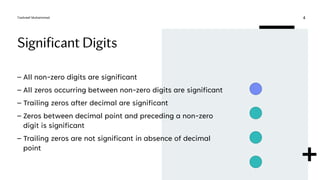
Significant Digits
– All non-zero digits are significant
– All zeros occurring between non-zero digits are significant
– Trailing zeros after decimal are significant
– Zeros between decimal point and preceding a non-zero
digit is significant
– Trailing zeros are not significant in absence of decimal
point
Tashreef Muhammad 4
TypesofErrors
Different types of erros
Tashreef Muhammad 5
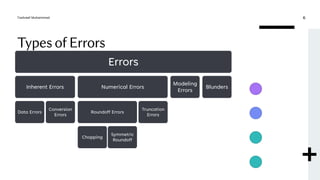
Types of Errors
Tashreef Muhammad 6
Errors
Inherent Errors
Data Errors
Conversion
Errors
Numerical Errors
Roundoff Errors
Chopping
Symmetric
Roundoff
Truncation
Errors
Modeling
Errors
Blunders
AbsoluteandRelative
Errors
Understanding some common error calculation
schemes
Tashreef Muhammad 7
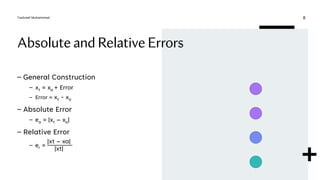
Absolute and Relative Errors
– General Construction
– xt = xa + Error
– Error = xt - xa
– Absolute Error
– ea = |xt – xa|
– Relative Error
– er =
|xt – xa|
|xt|
Tashreef Muhammad 8
Conditioningand
Stability
Understand the concept of conditioning and stability
Tashreef Muhammad 9
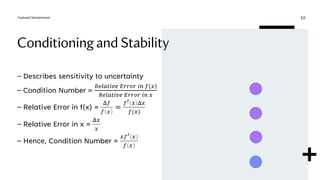
Conditioning and Stability
– Describes sensitivity to uncertainty
– Condition Number =
𝑅𝑅𝑅𝑅𝑅𝑅𝑅𝑅𝑅𝑅𝑅𝑅𝑅𝑅𝑅𝑅 𝐸𝐸𝐸𝐸𝐸𝐸𝐸𝐸𝐸𝐸 𝑖𝑖𝑖𝑖 𝑓𝑓(𝑥𝑥)
𝑅𝑅𝑅𝑅𝑅𝑅𝑅𝑅𝑅𝑅𝑅𝑅𝑅𝑅𝑅𝑅 𝐸𝐸𝐸𝐸𝐸𝐸𝐸𝐸𝐸𝐸 𝑖𝑖𝑖𝑖 𝑥𝑥
– Relative Error in f(x) =
Δ𝑓𝑓
𝑓𝑓 𝑥𝑥
=
𝑓𝑓′ 𝑥𝑥 Δ𝑥𝑥
𝑓𝑓(𝑥𝑥)
– Relative Error in x =
Δ𝑥𝑥
𝑥𝑥
– Hence, Condition Number =
𝑥𝑥𝑓𝑓′ 𝑥𝑥
𝑓𝑓 𝑥𝑥
Tashreef Muhammad 10
Conditioning and Stability
– Significance of condition number
– Large condition number means “ill-conditioned”
– It dictates that for small change x, large change in f(x)
– In other words, “very much sensitive”
– “ill-conditioned” is “ill-defined”, no fixed values
Tashreef Muhammad 11
Thank You
Tashreef Muhammad 12

Lecture 2 - Numerical Methods

  • 1.
  • 2.
    Overview – Significant Digits –Types of Errors – Absolute and Relative Errors – Conditioning and Stability Tashreef Muhammad 2
  • 3.
    SignificantDigits What are SignificantDigits Tashreef Muhammad 3
  • 4.
    Significant Digits – Allnon-zero digits are significant – All zeros occurring between non-zero digits are significant – Trailing zeros after decimal are significant – Zeros between decimal point and preceding a non-zero digit is significant – Trailing zeros are not significant in absence of decimal point Tashreef Muhammad 4
  • 5.
    TypesofErrors Different types oferros Tashreef Muhammad 5
  • 6.
    Types of Errors TashreefMuhammad 6 Errors Inherent Errors Data Errors Conversion Errors Numerical Errors Roundoff Errors Chopping Symmetric Roundoff Truncation Errors Modeling Errors Blunders
  • 7.
    AbsoluteandRelative Errors Understanding some commonerror calculation schemes Tashreef Muhammad 7
  • 8.
    Absolute and RelativeErrors – General Construction – xt = xa + Error – Error = xt - xa – Absolute Error – ea = |xt – xa| – Relative Error – er = |xt – xa| |xt| Tashreef Muhammad 8
  • 9.
    Conditioningand Stability Understand the conceptof conditioning and stability Tashreef Muhammad 9
  • 10.
    Conditioning and Stability –Describes sensitivity to uncertainty – Condition Number = 𝑅𝑅𝑅𝑅𝑅𝑅𝑅𝑅𝑅𝑅𝑅𝑅𝑅𝑅𝑅𝑅 𝐸𝐸𝐸𝐸𝐸𝐸𝐸𝐸𝐸𝐸 𝑖𝑖𝑖𝑖 𝑓𝑓(𝑥𝑥) 𝑅𝑅𝑅𝑅𝑅𝑅𝑅𝑅𝑅𝑅𝑅𝑅𝑅𝑅𝑅𝑅 𝐸𝐸𝐸𝐸𝐸𝐸𝐸𝐸𝐸𝐸 𝑖𝑖𝑖𝑖 𝑥𝑥 – Relative Error in f(x) = Δ𝑓𝑓 𝑓𝑓 𝑥𝑥 = 𝑓𝑓′ 𝑥𝑥 Δ𝑥𝑥 𝑓𝑓(𝑥𝑥) – Relative Error in x = Δ𝑥𝑥 𝑥𝑥 – Hence, Condition Number = 𝑥𝑥𝑓𝑓′ 𝑥𝑥 𝑓𝑓 𝑥𝑥 Tashreef Muhammad 10
  • 11.
    Conditioning and Stability –Significance of condition number – Large condition number means “ill-conditioned” – It dictates that for small change x, large change in f(x) – In other words, “very much sensitive” – “ill-conditioned” is “ill-defined”, no fixed values Tashreef Muhammad 11
  • 12.