Introduction- Energy sources,
classification, advantages and
disadvantages
Introduction
• With the increase in world population and the rise of
living standards, the demand for energy in the world is
steadily increasing. Global environmental issues and
exhaustion of fossil resources also pose serious
problems for energy consumption.
• Environment friendly energy technology and a shift to
non-fossil energy resources such as natural energy and
biomass are the need of the day.
• Energy has been defined as the capacity to do work or
capability to produce an effort. It is expressed in N-m
or Joules. The energy density is expressed as Jkg.
• R = EN
R :total yearly energy requirement for a population of N people.
E :per capita energy-use averaged over one year, related closely to
provision of food and manufactured goods. The unit of E is energy
per unit time, i.e. power.
• On a world scale, the dominant supply of energy is from
commercial sources, especially fossil fuels; however, significant use
of non-commercial energy may occur (e.g. fuel wood, passive solar
heating), which is often absent from most official and company
statistics.
• In terms of total commercial energy use, the average per capita
value of E worldwide is about 2 kW; however, regional average
values range widely, with North America 9 kW, Europe as a whole 4
kW, and several regions of Central Africa as small as 0.1 kW.
• Standard of living relates in a complex and an ill-defined
way to E. Thus per capita gross national product S (a crude
measure of standard of living) may be related to E by:
S = f E
• Here f is a complex and non-linear coefficient that is itself a
function of many factors. It may be considered efficiency
for transforming energy into wealth and, by traditional
economics, is expected to be as large as possible. However,
S does not increase uniformly as E increases. Indeed S may
even decrease for large E (e.g. because of pollution or
technical inefficiency). Obviously unnecessary waste of
energy leads to a lower value of f than would otherwise be
possible.
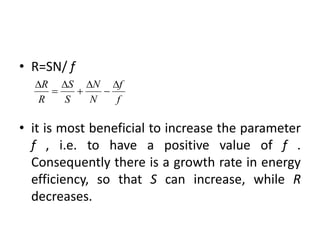
• R=SN/ f
• it is most beneficial to increase the parameter
f , i.e. to have a positive value of f .
Consequently there is a growth rate in energy
efficiency, so that S can increase, while R
decreases.
f
f
N
N
S
S
R
R 






• Broadly speaking two main types of energy are heat and
work. However, other forms of energy are 1) electrical
energy, 2) mechanical energy, 3) chemical energy, 4) heat
energy and 5) nuclear energy.
• Electrical energy is the most convenient form of energy
because it can be easily transported, easily controlled and
easily converted into other forms of energy at about 100%
efficiency. The only short coming of electrical energy is that
it can’t be stored in large quantities.
• Out of all the energy resources, fossil fuels have been used
the most because of their extremely high energy densities
and simplicity of conversion and use. Recent concerns
about the environment are expected to increase the use of
natural gas for power production.
Classification of energy resources
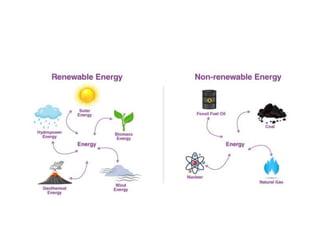
• Commercial primary energy resources: Energy obtained from static
stores of energy that remain underground unless released by
human interaction’. Examples are nuclear fuels and fossil fuels of
coal, oil and natural gas. Note that the energy is initially an isolated
energy potential, and external action is required to initiate the
supply of energy for practical purposes. To avoid using the ungainly
word ‘non-renewable’, such energy supplies are called finite
supplies or Brown Energy.
• Renewable sources of energy: Energy obtained from natural and
persistent flows of energy occurring in the immediate environment’.
An obvious example is solar (sunshine) energy, where ‘repetitive’
refers to the 24-hour major period. Note that the energy is already
passing through the environment as a current or flow, irrespective
of there being a device to intercept and harness this power. Such
energy may also be called Green Energy or Sustainable Energy.
• Energy sources which comes from natural resources such
as sunlight, wind, rain, tides, and geothermal heat, which
are renewable (naturally replenished) are known as the
renewable sources of energy.
• About 16% of global final energy consumption comes from
renewables, with 10% coming from traditional biomass,
which is mainly used for heating, and 3.4%
from hydroelectricity. New renewables (small hydro,
modern biomass, wind, solar, geothermal, and biofuels)
accounted for another 3% and are growing very rapidly.
• The share of renewables in electricity generation is around
19%, with 16% of global electricity coming from
hydroelectricity and 3% from new renewable.
Solar Energy Input to the Surface of
the Earth
• Solar constant : radiation power density at the top of the
earth’s atmosphere which faces the sun directly. Its value is
about 2 cal/min-cm2; it is about 3% greater than the
average value during the summer in the northern
hemisphere and about 3% smaller during the winter in the
northern hemisphere because the earth’s orbit around the
sun is not exactly circular.
• Using 2 cal/min-cm2, we may estimate a reasonable
average radiant power density for the earth as a whole by
proceeding as follows. We first multiply the approximate
value 2 cal/min-cm2 by factors of unity in order to convert
the solar constant to the power density in watts per square
meter (W/m2), viz., =2.0 (cal/min-cm2)×(104 cm2/m2)×(1
J/0.24 cal)×(1 min/60 sec)×(1 W-sec/J) or = 1389 W/m2.
• The approximate average solar radiation power density
at the top of the earth’s atmosphere is obtained from
the solar constant by dividing by 4 to allow for
variations of seasons and times of day around the
globe.
• The resulting global average radiant solar power
density is then about 345 W/m2. Since the mean radius
of the earth is re =6.371×10⁶ m and its surface area is
approximately 4πre
2 =5.10×10¹⁴ m2, the radiant power
incident on the entire surface of the earth becomes
(345 W/m2)×5.10×1014 m2 =1.77×1017 W×(107 erg/1W-
sec)× (3.154×10⁷ sec/year) ≈ 5×1031 erg/year.
Wind, Geothermal, Hydroelectric, and
Tidal Energy
• The numerical value listed for the worldwide wind
energy potential results from the estimate that 2×(10×
1010 MW) are available if the average winds are the
same in the northern and southern hemispheres,
which corresponds to 2×10× 1010 MW ×(106
W/MW)×(107 erg/2.78×10−4 W-hr) ×(8.76×10³
hr/year)=6×1031 W/yr.
• The listed value for the outward flow of heat from the
core of the earth equals 8×10¹⁷ Btu/yr=8×1027 erg/year
and includes heat flow to the large areas covered by
the earth’s oceans; at locations where this geothermal
heat flow is usable, the conversion efficiency to
electricity is not likely to exceed about 25%.
• The limiting worldwide potential for hydroelectric
energy is 2.86×106 MW ×[106 W/MW]×(107
erg/2.78×10−4 W-hr)×(8.76× 10³ hr/yr)=9×1026
erg/year; the fossil-fuel equivalent for this resource
base as a source of electric energy is about three times
larger or about 3×1027 erg/year.
• Based on the increase in the length of the day during
the last 100 years, the total tidal energy has been
estimated to be about 3×10⁶ MW =3×1012 W×(107
erg/2.78× 10−4 W-hr)×(8.76×10³ hr/year)=1×1027
erg/year. The achieved conversion efficiencies for tidal
to electrical energy are in the range of 10–20%.
Ocean Thermal Energy Conversion
[OTEC]
• OTEC is a technology that converts solar heat stored in the upper
layers of the oceans into mechanical and electrical energy. OTEC is
an important energy option because it offers a practical way to
provide clean, renewable fuels and electricity in quantities large
enough to replace all fossil fuel and nuclear energy sources.
• A total assessment of the worldwide potential for energy recovery
using OTEC is around 1.82×10¹⁴ kWeh/yr. Assuming 33% conversion
efficiency to electricity, the thermal fossil-energy equivalent
becomes (1.82 × 10¹⁴ kWeh/yr) × (3 kW/kWe) × (107 erg/2.78 ×10−7
kWh) = 1.96 × 1028 erg/yr. The worldwide potential is probably at
least 20 times greater, i.e.>4×1029 erg/year, and hence may
represent a complete, sustainable solution to the world’s energy
needs at the estimated steady-state requirement beyond 2050 for
5% recovery of the worldwide ocean thermal energy conversion
potential.
Advantages of renewable energy
• a) Renewable energies are renewable, or almost infinite sources of
energy from nature that are not perishable
• b) The power plants based on renewable sources of energy don’t
have any fuel cost and hence negligible running and
maintenance costs, which makes renewable energy affordable for the
individual.
• c) Renewable is more sites specific and is used for local processing
and application. There is no need for transmission and distribution of
power.
• d) Renewable have low energy density and more or less there is no
pollution or ecological balance problem.
• e) Most of the devices and plants used with the renewable are simple
in design and construction which are made from local materials, local
skills and by local people. The use of renewable energy can help to
save foreign exchange and generate local employment.
• f) The rural areas and remote villages can be better
served with locally available renewable sources of
energy. There will be huge savings from transporting
fuels or transmitting electricity from long distances.
• g) The more technology grows, the easier these
energies will be able to be harnessed by the individual,
perhaps saving lots of money on electric bills.
• h) It is clean energy, most renewable energies do not
negatively affect the environment. (Nuclear energy
perhaps being one major exception)
• i) At any geographic location all or most of
these renewable energy sources can be found.
Disadvantages of renewable energy
• a) Low energy density of renewable sources of energy need large
sizes of plant resulting in increased cost of delivered energy.
• b) Intermittency and lack of dependability are the main
disadvantages of renewable energy sources.
• c) Low energy density also results in lower operating temperatures
and hence low efficiencies.
• d) Although renewables are essentially free, there is definite cost
effectiveness associated with its conversion and utilization.
• e) Much of the construction materials used for renewable energy
devices are themselves very energy intensive.
• f) The low efficiency of these plants can result in large heat rejections
and hence thermal pollution.
• g) The renewable energy plants use larger land masses.
New sources of energy
• These are available for local exploitation. In many cases,
autonomous and small power plants can be built to avoid
transmission losses.
• Most prominent new sources of energy are tidal energy,
ocean waves, OTEC, peat, tar sand, oil shales, coal tar, geo
thermal energy, draught animals, agricultural residues etc.,
The total energy production in India is 14559×1015 joules.
• 93% of India’s requirement of commercial energy is being
met by fossil fuels, with coal contributing 56%, and oil and
natural gas contributing 37%. Water power and nuclear
power contributing only 7% of total energy production.
Comparing the total energy production in India from
commercial sources with that of world, it is only 3.5% of
total world production.
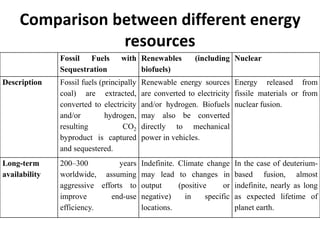
Comparison between different energy
resources
Fossil Fuels with
Sequestration
Renewables (including
biofuels)
Nuclear
Description Fossil fuels (principally
coal) are extracted,
converted to electricity
and/or hydrogen,
resulting CO2
byproduct is captured
and sequestered.
Renewable energy sources
are converted to electricity
and/or hydrogen. Biofuels
may also be converted
directly to mechanical
power in vehicles.
Energy released from
fissile materials or from
nuclear fusion.
Long-term
availability
200–300 years
worldwide, assuming
aggressive efforts to
improve end-use
efficiency.
Indefinite. Climate change
may lead to changes in
output (positive or
negative) in specific
locations.
In the case of deuterium-
based fusion, almost
indefinite, nearly as long
as expected lifetime of
planet earth.
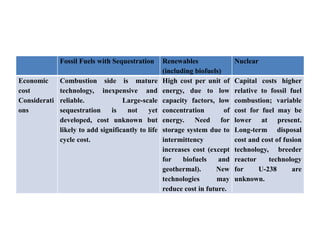
Fossil Fuels with Sequestration Renewables
(including biofuels)
Nuclear
Economic
cost
Considerati
ons
Combustion side is mature
technology, inexpensive and
reliable. Large-scale
sequestration is not yet
developed, cost unknown but
likely to add significantly to life
cycle cost.
High cost per unit of
energy, due to low
capacity factors, low
concentration of
energy. Need for
storage system due to
intermittency
increases cost (except
for biofuels and
geothermal). New
technologies may
reduce cost in future.
Capital costs higher
relative to fossil fuel
combustion; variable
cost for fuel may be
lower at present.
Long-term disposal
cost and cost of fusion
technology, breeder
reactor technology
for U-238 are
unknown.
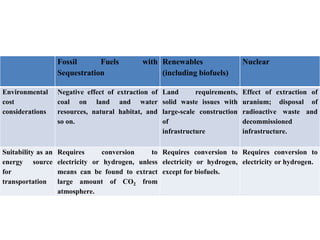
Fossil Fuels with
Sequestration
Renewables
(including biofuels)
Nuclear
Environmental
cost
considerations
Negative effect of extraction of
coal on land and water
resources, natural habitat, and
so on.
Land requirements,
solid waste issues with
large-scale construction
of
infrastructure
Effect of extraction of
uranium; disposal of
radioactive waste and
decommissioned
infrastructure.
Suitability as an
energy source
for
transportation
Requires conversion to
electricity or hydrogen, unless
means can be found to extract
large amount of CO2 from
atmosphere.
Requires conversion to
electricity or hydrogen,
except for biofuels.
Requires conversion to
electricity or hydrogen.
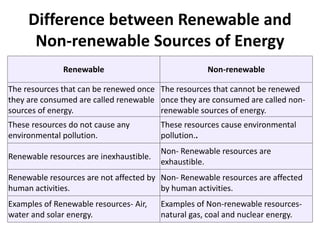
Difference between Renewable and
Non-renewable Sources of Energy
Renewable Non-renewable
The resources that can be renewed once
they are consumed are called renewable
sources of energy.
The resources that cannot be renewed
once they are consumed are called non-
renewable sources of energy.
These resources do not cause any
environmental pollution.
These resources cause environmental
pollution..
Renewable resources are inexhaustible.
Non- Renewable resources are
exhaustible.
Renewable resources are not affected by
human activities.
Non- Renewable resources are affected
by human activities.
Examples of Renewable resources- Air,
water and solar energy.
Examples of Non-renewable resources-
natural gas, coal and nuclear energy.
Definitions
• Fossil fuels: Coals, petroleums, natural gases, oils from shales
and tar sands, methane hydrates, and any other supplies from
which hydrocarbons for energy applications may be extracted.
• Fuels for nuclear breeder reactors: These include U-238 and
Th-232, which may be converted to fissile isotopes (e.g., U-
233, U-235, Pu-239, and Pu-241) as the result of neutron
capture.
• Fuels for (nuclear) fission reactors: The naturally occurring
fissile isotope U-235, as well as Pu-239 and Pu-241 produced
by neutron capture in U-238 and U-233 from Th-232.
• Nonrenewable resources (nonrenewables): Resources
located on the planet with estimable times for exhaustion at
allowable costs and use rates.
• Renewable resources (renewables) Usually defined as
extraterrestrial energy supplies such as solar resources,
but some authors include energy supplies of such types
and magnitudes that they will be available for the
estimated duration of human habitation on the planet.
• Reserves Energy supplies which are immediately
usable at or very close to current prices.
• Resources The totality of energy supplies of specified
types that include reserves and may become usable in
time at competitive prices with improved technologies

Lecture 1.pptx

  • 1.
  • 2.
    Introduction • With theincrease in world population and the rise of living standards, the demand for energy in the world is steadily increasing. Global environmental issues and exhaustion of fossil resources also pose serious problems for energy consumption. • Environment friendly energy technology and a shift to non-fossil energy resources such as natural energy and biomass are the need of the day. • Energy has been defined as the capacity to do work or capability to produce an effort. It is expressed in N-m or Joules. The energy density is expressed as Jkg.
  • 3.
    • R =EN R :total yearly energy requirement for a population of N people. E :per capita energy-use averaged over one year, related closely to provision of food and manufactured goods. The unit of E is energy per unit time, i.e. power. • On a world scale, the dominant supply of energy is from commercial sources, especially fossil fuels; however, significant use of non-commercial energy may occur (e.g. fuel wood, passive solar heating), which is often absent from most official and company statistics. • In terms of total commercial energy use, the average per capita value of E worldwide is about 2 kW; however, regional average values range widely, with North America 9 kW, Europe as a whole 4 kW, and several regions of Central Africa as small as 0.1 kW.
  • 4.
    • Standard ofliving relates in a complex and an ill-defined way to E. Thus per capita gross national product S (a crude measure of standard of living) may be related to E by: S = f E • Here f is a complex and non-linear coefficient that is itself a function of many factors. It may be considered efficiency for transforming energy into wealth and, by traditional economics, is expected to be as large as possible. However, S does not increase uniformly as E increases. Indeed S may even decrease for large E (e.g. because of pollution or technical inefficiency). Obviously unnecessary waste of energy leads to a lower value of f than would otherwise be possible.
  • 5.
    • R=SN/ f •it is most beneficial to increase the parameter f , i.e. to have a positive value of f . Consequently there is a growth rate in energy efficiency, so that S can increase, while R decreases. f f N N S S R R       
  • 6.
    • Broadly speakingtwo main types of energy are heat and work. However, other forms of energy are 1) electrical energy, 2) mechanical energy, 3) chemical energy, 4) heat energy and 5) nuclear energy. • Electrical energy is the most convenient form of energy because it can be easily transported, easily controlled and easily converted into other forms of energy at about 100% efficiency. The only short coming of electrical energy is that it can’t be stored in large quantities. • Out of all the energy resources, fossil fuels have been used the most because of their extremely high energy densities and simplicity of conversion and use. Recent concerns about the environment are expected to increase the use of natural gas for power production.
  • 7.
    Classification of energyresources • Commercial primary energy resources: Energy obtained from static stores of energy that remain underground unless released by human interaction’. Examples are nuclear fuels and fossil fuels of coal, oil and natural gas. Note that the energy is initially an isolated energy potential, and external action is required to initiate the supply of energy for practical purposes. To avoid using the ungainly word ‘non-renewable’, such energy supplies are called finite supplies or Brown Energy. • Renewable sources of energy: Energy obtained from natural and persistent flows of energy occurring in the immediate environment’. An obvious example is solar (sunshine) energy, where ‘repetitive’ refers to the 24-hour major period. Note that the energy is already passing through the environment as a current or flow, irrespective of there being a device to intercept and harness this power. Such energy may also be called Green Energy or Sustainable Energy.
  • 9.
    • Energy sourceswhich comes from natural resources such as sunlight, wind, rain, tides, and geothermal heat, which are renewable (naturally replenished) are known as the renewable sources of energy. • About 16% of global final energy consumption comes from renewables, with 10% coming from traditional biomass, which is mainly used for heating, and 3.4% from hydroelectricity. New renewables (small hydro, modern biomass, wind, solar, geothermal, and biofuels) accounted for another 3% and are growing very rapidly. • The share of renewables in electricity generation is around 19%, with 16% of global electricity coming from hydroelectricity and 3% from new renewable.
  • 10.
    Solar Energy Inputto the Surface of the Earth • Solar constant : radiation power density at the top of the earth’s atmosphere which faces the sun directly. Its value is about 2 cal/min-cm2; it is about 3% greater than the average value during the summer in the northern hemisphere and about 3% smaller during the winter in the northern hemisphere because the earth’s orbit around the sun is not exactly circular. • Using 2 cal/min-cm2, we may estimate a reasonable average radiant power density for the earth as a whole by proceeding as follows. We first multiply the approximate value 2 cal/min-cm2 by factors of unity in order to convert the solar constant to the power density in watts per square meter (W/m2), viz., =2.0 (cal/min-cm2)×(104 cm2/m2)×(1 J/0.24 cal)×(1 min/60 sec)×(1 W-sec/J) or = 1389 W/m2.
  • 11.
    • The approximateaverage solar radiation power density at the top of the earth’s atmosphere is obtained from the solar constant by dividing by 4 to allow for variations of seasons and times of day around the globe. • The resulting global average radiant solar power density is then about 345 W/m2. Since the mean radius of the earth is re =6.371×10⁶ m and its surface area is approximately 4πre 2 =5.10×10¹⁴ m2, the radiant power incident on the entire surface of the earth becomes (345 W/m2)×5.10×1014 m2 =1.77×1017 W×(107 erg/1W- sec)× (3.154×10⁷ sec/year) ≈ 5×1031 erg/year.
  • 12.
    Wind, Geothermal, Hydroelectric,and Tidal Energy • The numerical value listed for the worldwide wind energy potential results from the estimate that 2×(10× 1010 MW) are available if the average winds are the same in the northern and southern hemispheres, which corresponds to 2×10× 1010 MW ×(106 W/MW)×(107 erg/2.78×10−4 W-hr) ×(8.76×10³ hr/year)=6×1031 W/yr. • The listed value for the outward flow of heat from the core of the earth equals 8×10¹⁷ Btu/yr=8×1027 erg/year and includes heat flow to the large areas covered by the earth’s oceans; at locations where this geothermal heat flow is usable, the conversion efficiency to electricity is not likely to exceed about 25%.
  • 13.
    • The limitingworldwide potential for hydroelectric energy is 2.86×106 MW ×[106 W/MW]×(107 erg/2.78×10−4 W-hr)×(8.76× 10³ hr/yr)=9×1026 erg/year; the fossil-fuel equivalent for this resource base as a source of electric energy is about three times larger or about 3×1027 erg/year. • Based on the increase in the length of the day during the last 100 years, the total tidal energy has been estimated to be about 3×10⁶ MW =3×1012 W×(107 erg/2.78× 10−4 W-hr)×(8.76×10³ hr/year)=1×1027 erg/year. The achieved conversion efficiencies for tidal to electrical energy are in the range of 10–20%.
  • 14.
    Ocean Thermal EnergyConversion [OTEC] • OTEC is a technology that converts solar heat stored in the upper layers of the oceans into mechanical and electrical energy. OTEC is an important energy option because it offers a practical way to provide clean, renewable fuels and electricity in quantities large enough to replace all fossil fuel and nuclear energy sources. • A total assessment of the worldwide potential for energy recovery using OTEC is around 1.82×10¹⁴ kWeh/yr. Assuming 33% conversion efficiency to electricity, the thermal fossil-energy equivalent becomes (1.82 × 10¹⁴ kWeh/yr) × (3 kW/kWe) × (107 erg/2.78 ×10−7 kWh) = 1.96 × 1028 erg/yr. The worldwide potential is probably at least 20 times greater, i.e.>4×1029 erg/year, and hence may represent a complete, sustainable solution to the world’s energy needs at the estimated steady-state requirement beyond 2050 for 5% recovery of the worldwide ocean thermal energy conversion potential.
  • 15.
    Advantages of renewableenergy • a) Renewable energies are renewable, or almost infinite sources of energy from nature that are not perishable • b) The power plants based on renewable sources of energy don’t have any fuel cost and hence negligible running and maintenance costs, which makes renewable energy affordable for the individual. • c) Renewable is more sites specific and is used for local processing and application. There is no need for transmission and distribution of power. • d) Renewable have low energy density and more or less there is no pollution or ecological balance problem. • e) Most of the devices and plants used with the renewable are simple in design and construction which are made from local materials, local skills and by local people. The use of renewable energy can help to save foreign exchange and generate local employment.
  • 16.
    • f) Therural areas and remote villages can be better served with locally available renewable sources of energy. There will be huge savings from transporting fuels or transmitting electricity from long distances. • g) The more technology grows, the easier these energies will be able to be harnessed by the individual, perhaps saving lots of money on electric bills. • h) It is clean energy, most renewable energies do not negatively affect the environment. (Nuclear energy perhaps being one major exception) • i) At any geographic location all or most of these renewable energy sources can be found.
  • 17.
    Disadvantages of renewableenergy • a) Low energy density of renewable sources of energy need large sizes of plant resulting in increased cost of delivered energy. • b) Intermittency and lack of dependability are the main disadvantages of renewable energy sources. • c) Low energy density also results in lower operating temperatures and hence low efficiencies. • d) Although renewables are essentially free, there is definite cost effectiveness associated with its conversion and utilization. • e) Much of the construction materials used for renewable energy devices are themselves very energy intensive. • f) The low efficiency of these plants can result in large heat rejections and hence thermal pollution. • g) The renewable energy plants use larger land masses.
  • 18.
    New sources ofenergy • These are available for local exploitation. In many cases, autonomous and small power plants can be built to avoid transmission losses. • Most prominent new sources of energy are tidal energy, ocean waves, OTEC, peat, tar sand, oil shales, coal tar, geo thermal energy, draught animals, agricultural residues etc., The total energy production in India is 14559×1015 joules. • 93% of India’s requirement of commercial energy is being met by fossil fuels, with coal contributing 56%, and oil and natural gas contributing 37%. Water power and nuclear power contributing only 7% of total energy production. Comparing the total energy production in India from commercial sources with that of world, it is only 3.5% of total world production.
  • 19.
    Comparison between differentenergy resources Fossil Fuels with Sequestration Renewables (including biofuels) Nuclear Description Fossil fuels (principally coal) are extracted, converted to electricity and/or hydrogen, resulting CO2 byproduct is captured and sequestered. Renewable energy sources are converted to electricity and/or hydrogen. Biofuels may also be converted directly to mechanical power in vehicles. Energy released from fissile materials or from nuclear fusion. Long-term availability 200–300 years worldwide, assuming aggressive efforts to improve end-use efficiency. Indefinite. Climate change may lead to changes in output (positive or negative) in specific locations. In the case of deuterium- based fusion, almost indefinite, nearly as long as expected lifetime of planet earth.
  • 20.
    Fossil Fuels withSequestration Renewables (including biofuels) Nuclear Economic cost Considerati ons Combustion side is mature technology, inexpensive and reliable. Large-scale sequestration is not yet developed, cost unknown but likely to add significantly to life cycle cost. High cost per unit of energy, due to low capacity factors, low concentration of energy. Need for storage system due to intermittency increases cost (except for biofuels and geothermal). New technologies may reduce cost in future. Capital costs higher relative to fossil fuel combustion; variable cost for fuel may be lower at present. Long-term disposal cost and cost of fusion technology, breeder reactor technology for U-238 are unknown.
  • 21.
    Fossil Fuels with Sequestration Renewables (includingbiofuels) Nuclear Environmental cost considerations Negative effect of extraction of coal on land and water resources, natural habitat, and so on. Land requirements, solid waste issues with large-scale construction of infrastructure Effect of extraction of uranium; disposal of radioactive waste and decommissioned infrastructure. Suitability as an energy source for transportation Requires conversion to electricity or hydrogen, unless means can be found to extract large amount of CO2 from atmosphere. Requires conversion to electricity or hydrogen, except for biofuels. Requires conversion to electricity or hydrogen.
  • 22.
    Difference between Renewableand Non-renewable Sources of Energy Renewable Non-renewable The resources that can be renewed once they are consumed are called renewable sources of energy. The resources that cannot be renewed once they are consumed are called non- renewable sources of energy. These resources do not cause any environmental pollution. These resources cause environmental pollution.. Renewable resources are inexhaustible. Non- Renewable resources are exhaustible. Renewable resources are not affected by human activities. Non- Renewable resources are affected by human activities. Examples of Renewable resources- Air, water and solar energy. Examples of Non-renewable resources- natural gas, coal and nuclear energy.
  • 23.
    Definitions • Fossil fuels:Coals, petroleums, natural gases, oils from shales and tar sands, methane hydrates, and any other supplies from which hydrocarbons for energy applications may be extracted. • Fuels for nuclear breeder reactors: These include U-238 and Th-232, which may be converted to fissile isotopes (e.g., U- 233, U-235, Pu-239, and Pu-241) as the result of neutron capture. • Fuels for (nuclear) fission reactors: The naturally occurring fissile isotope U-235, as well as Pu-239 and Pu-241 produced by neutron capture in U-238 and U-233 from Th-232. • Nonrenewable resources (nonrenewables): Resources located on the planet with estimable times for exhaustion at allowable costs and use rates.
  • 24.
    • Renewable resources(renewables) Usually defined as extraterrestrial energy supplies such as solar resources, but some authors include energy supplies of such types and magnitudes that they will be available for the estimated duration of human habitation on the planet. • Reserves Energy supplies which are immediately usable at or very close to current prices. • Resources The totality of energy supplies of specified types that include reserves and may become usable in time at competitive prices with improved technologies